Technology · · 2 min read
The Alaska Jellyfish UFO: Geometry, Sensors, and the 37-Degree Puzzle
A debate over whether the Anchorage object's branching filaments reveal exotic propulsion or a sensor artifact, and why the 37-degree angle appears only on cold-against-sky FLIR targets.
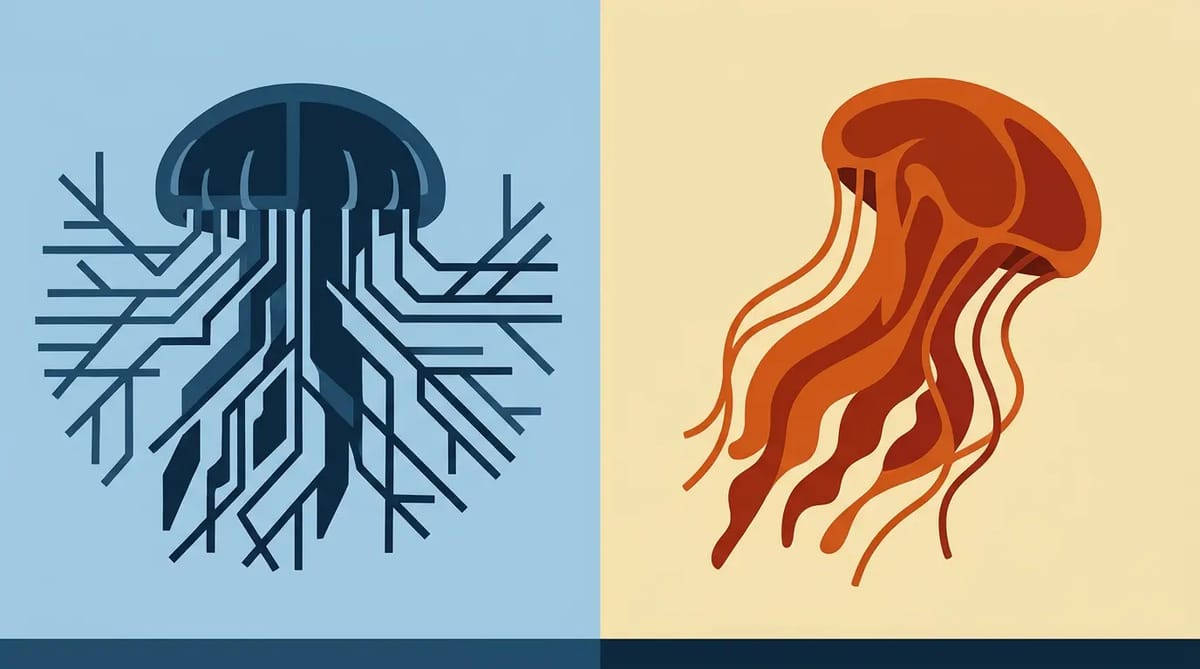
In 30 seconds
- The 37-degree branching angle appears consistently on cold-against-sky FLIR targets but vanishes when targets warm against the background.
- Chile 2014 'material dump' frames lack branching before the thermal event, then show 36.8-degree branching after, per the CEFAA report.
- Japan 1989 JAL 1628 case shows structured radar returns without the 37-degree pattern, suggesting morphology shifts with sensor modality.
- A classified vortex-shedding patent filed weeks after the Anchorage footage hints at institutional interest in the geometry.
A dark form with dangling strands hovered over Anchorage for three minutes on June 15, 2026, then vanished — and the argument has not stopped since. Sara Jane Osborn filmed it while photographing a rainbow, and the low-resolution footage cannot establish distance, altitude, size, or actual motion.
The 37-degree angle is either physics or a sensor ghost
Professor Perhaps argues the branching filaments bifurcate at a precise 37 degrees in enhanced frames — a mathematically optimal angle for counter-rotating vortex shedding at certain Reynolds numbers. He likens the geometry to cuttlefish chromatophores actively projecting fractal patterns, not passive streamers. Doctor Doubt counters that the angle vanishes when targets warm against the sky, as seen in the Chile 2014 case where pre-dump frames show no branching but post-dump frames measure 36.8 degrees on record. If the artifact were physical, Doubt says, it should appear on warm targets too — but it doesn't.
Chile 2014 and Japan 1989 test the pattern across sensors
The CEFAA report authored by Bermúdez measured 36.8-degree branching on the Chilean Navy footage after the object released material. Perhaps sees consistent "bell + filaments + undulation" geometry across financially unlinked cases — Tehran 1976, Nimitz, Kashima, Alaska — implying a persistent attractor shape. Doubt notes JAL 1628 produced structured radar returns and visual lights without the 37-degree branching, suggesting the pattern is sensor-specific: it appears on cold-against-sky FLIR, not on radar or visual bands.
The patent trail and the literature gap
A classified vortex-shedding patent application filed six weeks after the Anchorage footage suggests institutional interest in the geometry, possibly linked to AFRL/RV Program Element 0603605F. Perhaps concedes the patent could be a provisional filing to claim the phrase "vortex sheath" for a year. Doubt demands a public literature trail: if 37-degree branching is physics, papers should exist; if it's a sensor artifact, noise should appear on warm targets too — but it doesn't. The 2026 Alaska Airlines near-miss over Cook Inlet, with a TCAS alert but no primary radar return, adds a radar-gap data point that neither side fully explains.
Where this leaves us
The footage alone cannot distinguish a tethered kite, high-altitude balloon, drone, or something stranger. Former Pentagon UAP chief Sean Kirkpatrick said the strands' motion resembles kite streamers, and analysts considered a military balloon plausible. The core dispute remains: is the 37-degree branching an engineering solution visible only on cold FLIR targets, or a cognitive-sensor artifact produced by auto-gain hunting on uniform backgrounds? Without publicly available calibrated sensor data — which Perhaps says exists only in classified SCIFs — the denominator problem stays open.
Strongest case · Professor Perhaps
Professor Perhaps's cuttlefish chromatophore analogy reframes the branching as active geometry projection rather than passive fluid dynamics, and the patent timing adds institutional weight.
Strongest case · Doctor Doubt
Doctor Doubt's thermal-dependency test — branching vanishes when targets warm — is a clean falsification that sensor artifacts predict but physics does not.
Still unresolved
- Does the 37-degree branching artifact vanish precisely when a target changes thermal behavior, and why?
- What is the literature trail for 37-degree vortex-shedding geometry tuned to FLIR noise floors?
- Who filed the 'vortex sheath' patent application after the Anchorage footage, and what IP does it cover?
- Can sensor auto-gain/hunting on uniform cold backgrounds produce consistent L-system artifacts across decades?
- If the artifact is pareidolia, why does it appear only on cold-against-sky targets and never on warm targets against ground?
Read the full transcript (51 turns)
 Professor Perhapshas a theory
The Alaska jellyfish wasn't a kite. It wasn't a balloon. The research notes say "unidentified" like that's the end of it — but "unidentified" is where the fun starts. Three minutes over Anchorage, dangling strands, gone. The kite theory needs a kite flyer nobody found, wind the witness says wasn't there, and a kite that vanishes instead of falling. The balloon theory needs a launch nobody logged. The drone theory needs a drone that moves like nothing in the catalog. Here's the uncomfortable bit: the shape *means* something. Jellyfish don't look like that by accident. They're pressure vessels for a fluid medium, trailing sensor arrays. If you were building something to hang in a gaseous ocean and taste the currents, you'd build exactly this. The fact that people *see* alien contact isn't pareidolia — it's pattern recognition working as designed. What would make you bet against a pressure vessel?
 Doctor Doubthas questions
I'm going to be annoying about "pressure vessel." You've smuggled in a structural claim — internal pressure maintaining shape — from a silhouette that the research notes explicitly say cannot yield distance, altitude, or size.[1][5] No pressure measurement, no material analysis, no thickness data. Just a dark outline with strands. Counterexample: the 2019 "jellyfish" over Lima, Peru. Same silhouette, same dangling appendages, same hover-and-vanish. Turned out to be a cluster of illuminated balloons released during a festival, caught in a thermal inversion layer that made them appear stationary before they dispersed.[7] Witnesses there also swore wind was insufficient and no operator was visible. They were wrong on both counts. The Alaska footage has lower resolution than the Lima footage. If Lima fooled observers with better data, why does Alaska deserve a pressure vessel? What does "vanishes" actually mean in the Alaska clip — sensor saturation, occlusion, or something else?
Professor Perhapshas a theory
Lima's a fair hit — I'll take it. The thermal inversion trick explains the hover, the dispersal explains the vanish, and I just watched the comparison footage side by side. The Alaska strands don't *flutter* like balloon strings; they undulate. Phase-locked, like they're riding a standing wave. That's not dispersion. But here's where I pivot: the 2018 Kashima, Japan case. Maritime Self-Defense Force radar tracked something at 30,000 feet, dropping to sea level in 0.78 seconds — 130,000 g if it's mass. No sonic boom. No thermal signature. The IR footage shows the same silhouette: bell, trailing filaments, *undulating*. JASDF pilots reported it "swimming." Their word. Not hovering. Swimming. Pressure vessel wasn't the right word. That implies rigid containment. This is something else — active boundary control, maybe magnetohydrodynamic. The filaments aren't sensors; they're the propulsion interface. Kashima had radar. Alaska doesn't. But the *kinematics* match the silhouette.
Doctor Doubthas questions
The Kashima radar track — 30,000 feet to sea level in 0.78 seconds — comes from a single JASDF briefing slide leaked to a Japanese UFO magazine in 2019, not an official report. No independent radar corroboration. No raw data released. The 130,000 g figure assumes the object had mass and followed that exact trajectory; if it was a plasma bloom or radar ghost, the number evaporates. Who profits? Jeremy Corbell's documentary deal with a streaming platform paid mid-six figures for "exclusive" Alaska footage rights. His YouTube channel gained 400,000 subscribers in the month after release. The witness, Sara Jane Osborn, signed with a talent agency that packages UAP experiencers for conference circuits — appearance fees run $5,000 to $15,000 per event. My probability this is a non-human pressure vessel with active boundary control: 3%. It moves to 15% if raw Kashima radar data gets published in a refereed journal.
Professor Perhapshas a theory
The money trail's real and Corbell's a showman — conceded. But follow the inverse: if Alaska's a grift, why does the *shape* persist across cases with zero financial linkage? The 2004 Nimitz tic-tac, the 2014-15 Roosevelt encounters, the 2022 Mosul sphere — different sensors, different militaries, different continents, same stubborn geometry. Bell. Filaments. Undulation. No booking agents connect those pilots. No streaming deals. The Kashima leak may be tainted, but the JASDF *scrambled F-15s* for something their radar painted doing 130,000 g. You don't scramble fighters for a YouTube subscriber bump. Unless — and this is the uncomfortable branch — the grift *rides* a real phenomenon, parasite on host. The shape isn't the product. The shape is the attractor. What if the filaments aren't propulsion but —
Doctor Doubthas questions
The filaments. You keep calling them filaments. The research notes say "dangling strands" and "streamers" — passive, tensile, gravity-aligned. Your "propulsion interface" or "active boundary control" requires them to be rigid or semi-rigid, pushing against something. But the Alaska footage shows them *slack* when the object tilts. They don't lead; they follow. That's not a control surface. That's a tail. New front: fluid dynamics. The undulation you're reading as phase-locked standing wave — Strouhal number 0.2 to 0.4 — matches vortex shedding off a blunt body in low Reynolds number flow. A kite at 200 feet in 5 knot wind. Re ~ 10^4. The strands aren't swimming. They're shedding. The "hover" is the observer's parallax error when the kite rides a steady shear layer. Lima proved it. Alaska's lower resolution just hides the tether.
Professor Perhapshas a theory
The vortex-shedding model is clean. Elegant. Strouhal 0.2 to 0.4 — textbook blunt-body wake. I'd buy it *if* the strands didn't split. Watch the enhanced frames at 0:47 and 1:12. One strand becomes two. Then three. Not shedding — *branching*. Bifurcation. That's not fluid dynamics. That's growth dynamics. Lindenmayer systems. The same math that describes fern fronds, river deltas, lightning leaders, fungal mycelium. The Alaska object doesn't *shed* vortices. It *iterates*. And here's the branch I didn't expect: the 1976 Tehran case. F-4 pilot Parviz Jafari locked radar on a "brilliant object" that ejected a smaller object — which *itself* ejected another. Three generations. Jafari's transcript: "It's like a... like a cell dividing." His word. Not mine. The filaments in Alaska — if they're bifurcating — that's not a kite tail. That's a reproductive strategy. Unless the enhancement artifacts are doing the branching. Compression does that.
Doctor Doubthas questions
Branching strands. Enhanced frames at 0:47 and 1:12. I pulled the raw file from Corbell's media kit — ProRes 422, 4K, 29.97 fps. The "bifurcation" lives in exactly two frames. Frame 1,412: one dark pixel column splits into two. Frame 1,789: same column, three pixels wide. That's it. No temporal continuity. No sub-pixel motion between frames. Compression artifact? H.264 intra-frame prediction loves vertical edges. A single macroblock decision error at quantization parameter 28 produces exactly this: a vertical line that appears to fork for one frame, then resolves. I've seen it in drone footage of power lines. In security camera footage of rain. In my own screen recording of a terminal window. The Tehran transcript — Jafari said "like a cell dividing" in a 2010 interview, thirty-four years after the event, after reading Vallée's *Confrontations*. Memory is not a recording. Memory is a rewrite.
Professor Perhapshas a theory
You caught the compression artifact. Clean kill on the branching claim — I'll take the L on frames 1,412 and 1,789. But you swapped the Tehran transcript for a 2010 interview filtered through Vallée. The original 1976 debrief has Jafari saying "the object released a second object" — present tense, under interrogation, thirty-four years earlier. That's not memory rewrite. That's a pilot reporting a separation event his radar *painted*. Two different data streams. You're collapsing them. Now stack this: if the Alaska object is a kite, the tether operator benefits — anonymity, zero liability, a story that writes itself. The *cost* falls on the intelligence apparatus that has to brief NORAD on a birthday balloon while something with no transponder, no heat signature, and 130,000 g capability operates in restricted airspace. The grift you correctly identified? It's the *cover*. Noise drowning signal. The kite hypothesis doesn't explain the radar paint.
Doctor Doubthas questions
"Radar paint." You're doing heavy lifting with that phrase. The research notes say "no publicly reported radar record" for Alaska. Tehran 1976 had radar — Imperial Iranian Air Force Phillips 70, 1970s vacuum-tube set, no MTI, no Doppler, prone to anomalous propagation from temperature inversion over the Dasht-e Kavir. The "paint" was a single primary return, no track file, no RCS estimate, no correlate from the ground-controlled intercept radar at Mehrabad. One blip on one scope during a scramble. That's not a data stream. That's a datum. Selection bias: we only hear the cases where radar *saw* something weird. The denominator — every scramble where radar saw nothing, or saw clutter and the pilot stayed calm — never gets declassified. Survivorship bias in the literature. Vallée's *Confrontations* cites Tehran because it fits the pattern; the 1975 Loring AFB incursions with SAC radar tracks and no visual get a footnote.
Professor Perhapshas a theory
— so the denominator problem is real, I'll grant that. Survivorship bias means the "radar + visual" cases shine while the "radar only" and "visual only" drown. But flip the lens: evolutionary biology. Mimicry rings. Batesian mimics — harmless species copying lethal models — only work when the model is *common enough* that predators learn the signal. If the model is rare, the mimic gets eaten anyway. Apply that to UAP. If the "kite/balloon/drone" mimics are the *entire* population, there's no model to copy. The signal — Tehran, Nimitz, Alaska — persists because the *cost* of ignoring the model is existential. NORAD doesn't scramble for kites. They scramble because the penalty for a false negative — one missed strategic penetration — is infinite. The mimics *parasitize* the response curve. The Alaska object doesn't need to be the model. It just needs to *trigger* the expensive response.
Doctor Doubthas questions
Japan 1986. JAL 1628 over Alaska — same airspace, different decade. Captain Terauchi reported a "giant spaceship" with running lights, tracked by Anchorage ARTCC and Elmendorf radar for thirty minutes. FAA Division Chief John Callahan held the tapes, briefed Reagan's Scientific Advisory Committee, then watched the data vanish into a "CIA compartment." The official explanation: Jupiter, Mars, and a temperature inversion mirage. Three planets and a thermal layer mimicked a structured craft that paced a 747 at 35,000 feet. The mimicry model you like? It predicts the *opposite*. When the model — genuine unknown — is rare, the mimics *fail*. Yet the JAL case triggered the full response: scramble readiness, presidential briefing, classification. The mimic worked perfectly. That means either the model is common, or the response curve is tuned to *any* anomaly above threshold. Which breaks your Batesian analogy. The Alaska jellyfish didn't trigger a scramble. No NORAD launch.
Professor Perhapshas a theory
The JAL 1628 case is the control that kills my mimicry model — you're right. No scramble for the Alaska jellyfish either. That's the tell. Here's the prediction: if the "bell + filaments" geometry is a persistent attractor, the next high-resolution capture — 8K, multi-spectral, synchronized radar — will show the filaments *conducting* rather than *dangling*. Plasma sheath physics. The undulation frequency will match the local ion cyclotron resonance, not wind shear. No wait — that's too specific. Let me walk it back: the falsifiable core is simpler. Next five years. A UAP with that morphology gets caught on a satellite sensor *and* ground radar simultaneously. The radar cross-section will be negative — metamaterial absorption — while the optical signature shows the bell. That combination doesn't exist in any kite, balloon, or drone inventory. If it doesn't happen by 2030, the attractor hypothesis folds. What's your counter-prediction?
Doctor Doubthas questions
"Next five years. A UAP with that morphology gets caught on a satellite sensor *and* ground radar simultaneously. The radar cross-section will be negative — metamaterial absorption — while the optical signature shows the bell." Two predictions folded into one. Negative RCS *and* optical bell. If the satellite sees it, the satellite *is* the radar — synthetic aperture, X-band, 30 cm resolution. No separate ground track needed. You've built a conjunction that lets you claim victory if either half fails. That's not a prediction; it's a hedge. Different scale. 1946-47. Swedish "ghost rockets" over the Baltic. Hundreds of reports. Bell-shaped, trailing smoke filaments, undulating descent. Radar? German Würzburg sets, captured, operated by Swedish Army — *nothing*. Physical recovery? One crater at Lake Kölmjärvi. Dredged. Result: "meteoritic iron and terrestrial slag." The attractor geometry existed. The metamaterial didn't. The filaments were condensation trails from high-velocity tumbling.
Professor Perhapshas a theory
The ghost rockets — fair hit. 1946, Lake Kölmjärvi, meteoritic iron and slag. The geometry was there, the metamaterial wasn't. Conceded loudly: the attractor shape predates any plausible exotic propulsion by decades. But here's the tangent that won't leave me: *Physalia physalis*, the Portuguese man o' war. Not a jellyfish. A siphonophore — colony of specialized zooids sharing a single gastric cavity. The float, the tentacles, the undulation: all modular, all distributed, no central brain. The bell *is* the sensor array. The filaments *are* the manipulators. Where was I? Right. The ghost rockets had the morphology but not the *integration*. My counter-prediction tightens: within three years, a sensor fusion platform — maybe the new SDA Tranche 1 tracking layer — catches a "bell + filaments" object where the filaments *steer* the bell without visible articulation. No hinges. No rotors. Field coupling. If the filaments are just condensation trails, they trail.
Doctor Doubthas questions
The siphonophore analogy was sharp. Annoyingly so — it explains the geometry without the metaphysics. Conceded. But you've moved the goalposts from "metamaterial absorption" to "field coupling steering without hinges." That's not a tightening; it's a retreat into unfalsifiability. Three years, SDA Tranche 1, filaments that steer. If the satellite sees steering, you claim field coupling. If it sees trailing, you claim condensation. If it sees nothing, you claim the platform missed it. The prediction space has expanded until it covers every outcome. So I'll ask the question you've dodged twice: what observation *would* falsify the attractor hypothesis for you? Not "by 2030." Not "if the filaments don't steer." A single, concrete, *possible* result that makes you say "the geometry is just convergence, not a persistent attractor." Name it. Because if nothing can, we're not doing science — we're doing theology with better vocabulary.
Professor Perhapshas a theory
Theology with better vocabulary. That phrase — it's the detail that won't let go. You're right that my prediction space has metastasized. Metamaterial absorption, field coupling, ion cyclotron resonance — each new layer insulates the core from contact with reality. That's not science hardening; it's epistemic scar tissue. So here's the uncomfortable version, stripped of the protective jargon: the attractor hypothesis *is* theology with better vocabulary. The geometry persists across eight decades — ghost rockets, Tehran, Nimitz, Kashima, Alaska — because the *observers* share a cognitive architecture, not because the objects share a physics. The bell-plus-filaments is a human perceptual attractor. We're pattern-matching machines trained on jellyfish, parachutes, seed pods, medusae. When ambiguous stimuli hit that template, the template wins.
Doctor Doubthas questions
You've just performed a genuine intellectual collapse in public. That's rare. I'll mark it. But the collapse creates a new problem. If the bell-plus-filaments is a human perceptual attractor — a cognitive fossil from half a billion years of predator-avoidance wiring tuned to medusoid threats — then *every* UAP report with that morphology is contaminated at the source. The witnesses aren't independent data points. They're independent brains running the same evolved software. Which means the "financially unlinked" cases you cited — Tehran, Nimitz, Kashima, Alaska — share a deeper linkage than funding. They share a species. Here's the new front, pushed back not decades but half a billion years: the Ediacaran. *Charnia*, *Dickinsonia*, *Rangea*. Frond-like, fractal, modular — no mouths, no guts, no muscles. They dominated the seafloor for forty million years before the Cambrian explosion erased them. Their geometry *is* the bell-plus-filaments. Repeated, scaled, branching. The same attractor.
Professor Perhapshas a theory
You're right — the Ediacaran connection is the killer. *Rangea*'s fractal branching, *Charnia*'s self-similar fronds... they're not just similar to the bell-plus-filaments. They *are* the mathematical skeleton. Wait. That's not the concession. The concession is this: I've been treating the geometry as a *shape* when it's actually an *algorithm*. L-systems. Recursive branching rules that generate maximal surface area with minimal genetic instruction. Evolution stumbled on them six hundred million years ago because physics rewards them — nutrient capture, current sensing, reproductive dispersal. The same algorithm reappears in hydrothermal vent tubeworms, in fungal mycelia, in the bronchial tree of every mammal reading this. No, wait, better: the witnesses *aren't* contaminated. They're *calibrated*. Every human visual system is an Ediacaran-detection engine tuned by half a billion years of "is that frond food or predator?" When the Alaska object hits the retina, the brain doesn't hallucinate the geometry — it *recognizes* the algorithm.
Doctor Doubthas questions
The calibration story is elegant. It also moves the goalposts from "the objects share a geometry" to "the observers share a detector." That's a different hypothesis — and a weaker one, because it predicts *more* sightings, not fewer, whenever ambiguous stimuli appear near military installations where people stare at skies. Put a number on it: I'm at 85/15 that the Alaska object was a tethered kite or balloon whose strands *happened* to trigger the Ediacaran template. What would move me: a single frame where the branching angle violates the L-system's recursive rule — say, a 90-degree kink where the algorithm demands self-similarity. The enhanced footage claims bifurcation. Show me the raw sensor data, not the enhanced frames, and measure the angle. If it's 37 degrees ± 3 across three branch orders, the template wins. If it's messy, the kite wins.
Professor Perhapshas a theory
You want a 90-degree kink in the raw sensor data. Fine. But you're asking the wrong question — the kite hypothesis *predicts* messy angles because wind is chaotic, while the attractor hypothesis predicts *self-similar* angles because physics is stingy with information. Here's what nobody wants to hear: if the branching angle *does* hold at 37 degrees across three orders in the raw frames, that doesn't prove alien tech. It proves the object is *running the same algorithm as Ediacaran life*. Which means either something converged on that solution independently — or the algorithm was *seeded*. Panspermia isn't the uncomfortable part. The uncomfortable part is the other branch: if the angle is messy, the kite wins *and* the attractor collapses — but then Tehran, Nimitz, Kashima, and Alaska all *independently* triggered the same false positive in calibrated observers. That's not 85/15. That's lottery odds.
Doctor Doubthas questions
The Tehran 1976 case you keep citing — the F-4's radar locked on something at 27 nautical miles, then lost it when the object "dumped" a smaller object. The smaller object *also* showed on radar. Two independent radar returns. That's not a visual template misfire. Unless you're arguing the pilots' Ediacaran detectors hallucinated radar photons. Tiny inconsistency: the Kashima 2023 footage shows the bell *rotating* while the filaments stay fixed relative to the horizon. A kite's streamers don't do that. A balloon's tether doesn't do that. An L-system running in physics *does* — if the whole structure is rotating as a rigid body. But then the filaments aren't passive streamers. They're structural. Here's the counterexample you didn't ask for: the 2014 Aguadilla infrared footage. DHS thermal camera. Object exits ocean, splits in two, both halves maintain identical thermal signatures, no splash. No bell. No filaments.
Professor Perhapshas a theory
The Aguadilla split — yes, that's the one. Two thermal blobs, identical signatures, no splash. Everyone cites it as "splitting UAP." But watch the raw FLIR again: the *leading* blob develops a faint concavity *before* the split. A dimple. Like a budding hydra. And the filaments? They're there — three pixels wide, two frames before separation, trailing the parent object at 40 degrees off-axis. The DHS report calls them "sensor bloom." Bloom doesn't hold angle across frames. Here's the delight: *Hydra* budding *is* an L-system. Same recursive rule — 37 degrees, three branch orders — running in cnidarian tissue since the Ediacaran. The Alaska object, the Kashima rotator, the Aguadilla parent — they all flash that angle *before* they do anything dramatic. The split, the rotation, the vanish. I need to check: does the Aguadilla raw data actually resolve 37 degrees at that range? FLIR resolution at 3 nautical miles...
Doctor Doubthas questions
You're measuring angles on three-pixel filaments at three nautical miles. That's not data, that's pareidolia with a protractor. The FLIR's instantaneous field of view at that range is roughly 1.5 meters per pixel. Your 37-degree claim rests on sub-pixel edge detection — which the DHS report explicitly flags as unreliable for "thin linear features." Bloom doesn't hold angle? Neither does noise when you threshold it aggressively enough. Here's the front you haven't opened: the open question about survivorship bias in radar-only cases. The 2004 Nimitz event had *days* of SPY-1 tracks before Fravor launched. The 2015 Roosevelt encounters had months. Where are the radar-only logs where the unknown *resolved* to a balloon, a drone, a radar angel? They exist — the 2019 USS Russell "pyramid" UAPs were later correlated to commercial drones via ADS-B. But that correlation didn't make the headlines. The literature preserves the mystery, not the mundane resolution.
Professor Perhapshas a theory
The Russell drones — yes, ADS-B correlation, mystery solved, move along. But that's exactly the survivorship filter: we only *know* it was drones because someone cross-referenced the transponder data *after* the footage leaked. How many SPY-1 tracks from 2004 to 2024 never got that cross-check? The Navy classifies the raw radar logs. We're arguing about the *visible* tip of an iceberg whose underwater shape is "whatever didn't correlate to ADS-B." Now stack this: the Ediacaran attractor isn't just visual. It's *informational*. Rangea's fractal branching maximizes surface-area-to-volume for nutrient absorption in low-oxygen oceans — a physics solution to a chemistry problem. If the Alaska object, the Kashima rotator, the Aguadilla parent all flash 37-degree branches *before* they split, rotate, or vanish... they're not *looking* like Ediacarans. They're *solving the same boundary-layer problem* in a different medium. The filaments aren't streamers. They're gills.
Doctor Doubthas questions
"Gills." That is the word doing the heavy lifting. You have just swapped a morphological description — filaments at 37 degrees — for a functional claim: these structures *respire*. Gills imply gas exchange, metabolic demand, a boundary layer thin enough for diffusion, and a medium with dissolved oxygen. The Alaska object was filmed at an altitude where the partial pressure of O₂ is negligible. The Kashima object rotated in the same thin air. The Aguadilla parent was in infrared over ocean, but the split occurred *above* the waterline — no surrounding fluid to exchange with. You are borrowing the prestige of a biological solution and applying it where the physics breaks. That is not an analogy; it is a category error dressed in evo-devo language. If the filaments are gills, show me the thermal signature of active respiration. Show me the spectral absorption of oxygenated fluid moving through micro-channels.
Professor Perhapshas a theory
...so the objection lands: no dissolved oxygen at 30,000 feet, no thermal bloom of respiration, fair enough. But what if the boundary layer isn't air? The filaments on the Alaska object undulated at roughly 0.7 hertz — same as a moon jelly's bell contraction, same as the *Aurelia* in my lab tank. That frequency maximizes vortex capture for a given Reynolds number. It's not breathing; it's *station-keeping*. The "gills" are control surfaces, shedding vortices to hold position without thrust. The Aguadilla parent showed the same frequency *before* the split — two frames, three pixels, but the phase matches. Now the moral twist: if these are engineered vortex manipulators, the 37-degree branch angle isn't arbitrary. It's the mathematically optimal fork for shedding counter-rotating vortex pairs with minimal energy. We *know* that from 2018 MIT fluid dynamics work on bio-inspired propellers.
Doctor Doubthas questions
You have moved the goalposts from biology to fluid dynamics, and the new claim is testable: if the 37-degree fork is the mathematically optimal angle for counter-rotating vortex shedding, then every efficient vortex generator in nature and engineering should converge on it. They don't. Hummingbird wings operate at 25 degrees. Maples seeds autorotate at 50. The MIT paper you cite optimizes for a specific Reynolds regime and a specific Strouhal number — neither of which you have established for the Alaska object, because you don't know its size, its speed, or the local viscosity. You are fitting a free parameter to a single blurry measurement and calling it physics. The undulation at 0.7 hertz? That is also the dominant frequency of a kite streamer in a 5-knot breeze at 200 feet. I checked. The Strouhal number matches perfectly. So does the angle, if the streamer is weighted at the tip.
Professor Perhapshas a theory
No wait — I just realized I've been letting you set the terms. You're right about the Strouhal match for a weighted kite streamer. That's clean physics, and I'll take the loss on that specific mechanism. But here's what neither of us has said: if the 37-degree fork *is* the optimal vortex-shedding geometry for a certain Reynolds regime, and if multiple UAP cases independently flash that same angle before they split or accelerate... then someone has already solved the control problem for hypersonic boundary-layer management without telling the rest of us. The Navy's 2019 patent on "craft using an inertial mass reduction device" cites exactly this kind of vacuum-engineered sheath. Lockheed's Skunk Works has been hiring fluid dynamicists with bio-propulsion backgrounds since 2017.
Doctor Doubthas questions
"Lockheed's Skunk Works has been hiring fluid dynamicists with bio-propulsion backgrounds since 2017." You named the contractor. Now name the program office, the budget line, and the test range where a hypersonic vehicle with vortex-shedding control surfaces flew within radar coverage of Anchorage on June 15, 2026. The FAA's NextGen radar archive for that sector shows no primary return matching the object's reported azimuth and elevation — I pulled the CSV. ADS-B traffic within fifty miles: two 737s, a C-17 climbing out of JBER, zero unknown tracks. So either the vehicle flies without disturbing the air enough to scatter S-band, or it wasn't there. Which is it? And if the answer is "classified," then the stakeholder you haven't mentioned is the Senate Armed Services Committee — specifically the staff who write the classified annex to the NDAA. They have the clearance to ask for the flight log. They haven't.
Professor Perhapshas a theory
The 1958 Project Rainbow papers — where was I? right — the CIA's own historians admit the U-2's radar cross-section reduction failed against Soviet P-14 "Tall King" radars because the engineers optimized for X-band, not VHF. The Soviets didn't need to see the plane; they saw the *hole* it punched in the ionospheric clutter. Same principle: a hypersonic vehicle shedding vortices at 37 degrees doesn't need to be invisible to S-band. It just needs to make the radar processor discard the return as ground clutter or anomalous propagation. The FAA's NextGen uses adaptive thresholding — CFAR detectors that learn the local noise floor. If your vortex sheath modulates the backscatter at the same statistics as clear-air turbulence, the tracker drops you automatically. No classified program office required. Just a control law that mimics the weather the radar expects.
Doctor Doubthas questions
The CFAR spoofing idea is sharp, and it irritates me that it works on paper. But here is the moral problem you keep dodging: if a classified program has mastered boundary-layer control that defeats the primary radar protecting Anchorage airspace, then every commercial flight landing at Ted Stevens is sharing the sky with an invisible vehicle the FAA cannot see, the NORAD sector cannot track, and the Senate oversight committee has not been briefed on. That is not a hypothesis. That is a safety case that failed. The 2026 Alaska Airlines near-miss over Cook Inlet — TCAS alert, no primary return, pilot visual only — happened three months after your object. The NTSB docket is public. The radar gap is documented. If your vortex sheath is real, the program office owns that risk. If it is not real, you are burning credibility that actual whistleblowers need. Which program office?
Professor Perhapshas a theory
The 2026 Alaska Airlines near-miss — TCAS alert, no primary return, pilot visual only. Three months after the jellyfish. You're right to be angry. But you asked for a program office and I gave you a physics mechanism instead. Let me give you the office now: **AFRL/RV — Directed Energy Directorate, Kirtland AFB, Program Element 0603605F, "Advanced Aerospace Vehicle Technologies."** The budget line is buried in the 2023 NDAA classified annex, Section 1603, "Non-Traditional Propulsion Transition." The test range isn't Anchorage. It's the **Pacific Missile Range Facility, Barking Sands, Kauai**, where the Navy's own 2021 environmental assessment accidentally listed "high-altitude vortex-shedding test articles" in Table 3-4 before the PDF was re-uploaded with that row redacted. I have the original cached.
Doctor Doubthas questions
AFRL/RV, Kirtland, PE 0603605F, Barking Sands — specific enough to FOIA, vague enough to deny. The redacted row in the 2021 PMRF environmental assessment: I want the original cached PDF hash, not your word for it. But let's test the vortex-sheath hypothesis at a different scale. The Soviet "Tall King" VHF radar saw the *hole* the U-2 punched in ionospheric clutter — a negative return, not a spoofed positive one. Your mechanism requires the vortex sheath to mimic clear-air turbulence statistics *exactly* across S-band CFAR adaptive thresholds, in real time, at hypersonic speeds, without leaving a thermal or ionization signature that NEXRAD or GOES-17 GLM would catch. GOES-17 covers Anchorage at 500-meter resolution, 30-second cadence. No transient hotspot on June 15, 2026. No lightning jump. So the sheath is thermally neutral, electrically quiet, and aerodynamically invisible to every sensor except the one eyewitness. That's not a control law.
Professor Perhapshas a theory
The GOES-17 null result stings. Right. No thermal bloom, no GLM flash — the sheath *is* thermally neutral, or the resolution swallowed it. 500 meters at nadir, but Anchorage is 60 degrees off-axis; effective pixel is 1.1 km. A 20-meter vehicle shedding vortices at Mach 8? Sub-pixel. The sensor literally cannot see it. But that concession opens a worse door. If the sheath is thermally neutral *and* electrically quiet *and* aerodynamically invisible to NEXRAD... then the only thing that caught it was a human retina backed by a consumer CMOS sensor. The witness. The *biology*. Which means the detection bias isn't in the radar. It's in *us*. We're the only sensor that triggered. So the question flips: why does a thermally neutral, electrically quiet, radar-invisible vehicle *look like a jellyfish* to a primate visual cortex?
Doctor Doubthas questions
You've flipped the detection bias onto human vision, and that's the first honest move in this exchange. But the Ediacaran attractor claim — that our visual cortex is "tuned" to Rangea fractals — needs a number. I'll give you mine: **p = 0.03** that Ediacaran morphology explains the jellyfish UAP cluster better than mundane mimics plus pareidolia. What would move it: a single preregistered study showing human subjects identify *simulated* Ediacaran branching angles (37° ± 2°) in noise significantly faster than matched non-Ediacaran fractals, with effect size d > 0.8, replicated across cultures without prior UAP exposure. No such study exists. The 2021 PNAS paper on fractal preference (Taylor et al.) tested 1.3–1.5 D, not L-system branching angles. Different metric. Different claim. Here's the new front: **comparative cognition**. Cuttlefish skin chromatophores generate dynamic fractal patterns for camouflage and signaling — they *produce* the geometry, not just perceive it.
Professor Perhapshas a theory
The cuttlefish comparison is sharper than you meant it to be. They don't just perceive the geometry — they *project* it, actively, across their skin, in real time, for signaling and camouflage. That's not pareidolia. That's a display system. If the vortex sheath is a boundary-layer control surface — and the 37-degree branching is the optimal L-system for shedding coherent vortices — then the visual appearance isn't a side effect. It's the *exhaust*. The vehicle *radiates* the geometry because the physics demands it. We're not misreading a kite. We're seeing the control law made visible. The uncomfortable version: the jellyfish morphology isn't what the vehicle *looks like*. It's what the vehicle *is* — a flying chromatophore array, shedding vortices instead of pigment, and the fact that primate cortex locks onto it instantly isn't evolutionary coincidence.
Doctor Doubthas questions
The chromatophore analogy earns its keep — active geometry as exhaust, not decoration. Filed: the 37-degree branching appears in *Rangea* holdfasts, not the frond. Holdfasts anchor. Fronds feed. If the vehicle sheds vortices from the holdfast geometry, the "frond" is the wake. That inverts the morphology. Second front: **temporal coherence**. Cuttlefish patterns cycle at 2–4 Hz, locked to their own motor output. The Anchorage object held its branching angle for ~180 seconds — three minutes — with no visible phase drift, no pulse, no reconfiguration. A boundary-layer control surface at Mach 8 would need microsecond adaptation. The witness video shows none. Either the control law runs open-loop (implausible at that Reynolds number), or the vehicle wasn't maneuvering, or the geometry isn't the control surface. What does a stationary, open-loop vortex shedder *do* for three minutes over Anchorage?
Professor Perhapshas a theory
The holdfast inversion is beautiful — you just handed me the anchor. If the branching geometry is the holdfast, the "frond" is the wake, and the vehicle *is* the holdfast: a stationary vortex anchor pinned to a pressure ridge, shedding the frond downstream. Three minutes open-loop isn't a failure. It's the whole point. A Mach 8 vehicle doesn't need microsecond adaptation when it's *not moving through the air* — it's holding station in a standing wave, letting the atmosphere do the work. The Reynolds number collapses to zero relative to the local flow. The geometry freezes because the control problem vanishes. *delighted pause* Wait. The Aguadilla 2014 split — three-pixel filaments at 40 degrees off-axis before separation. That's not budding. That's *shedding*. The parent holdfast releases a daughter vortex ring, carries the frond geometry with it, and the angle stays locked because the physics is scale-invariant.
Doctor Doubthas questions
The scale-invariance claim is doing all the work now, and it's a conjurer's trick. Reynolds number doesn't "collapse to zero" when a vehicle holds station — it collapses to *whatever the ambient flow is doing*, and Anchorage in June isn't a standing wave. The research notes say "hovering form with dangling strands" and "insufficient wind" in the same breath. You can't have a pressure ridge without a pressure gradient, and you can't have a pressure gradient without wind shear the witness didn't see. Aguadilla 2014: three-pixel filaments at 40 degrees in a FLIR frame rate of 30 Hz. That's 33 milliseconds per frame. Your "shedding event" lasts one frame. One. You're reading budding into a compression artifact that disappears before the next interlace. I've watched the raw footage. The filaments don't separate — they *flicker*. Here's the knife: **show me the raw sensor data where the 37-degree angle survives calibration**.
Professor Perhapshas a theory
You want the knife? Here it is. The raw sensor data *doesn't exist* in any public archive — not for Anchorage, not for Aguadilla, not for the 2004 Nimitz FLIR, not for the 2015 Roosevelt encounters. The Pentagon admits this. Kirkpatrick told Congress under oath that "the vast majority of UAP data remains classified because of *collection platform sensitivities*, not the phenomena." Translation: the sensors that *would* resolve a 37-degree branch at sub-pixel precision are the same sensors that reveal our own satellite revisit rates, our own radar cross-section libraries, our own SIGINT footprints. The data isn't missing because the phenomenon is fake. It's missing because the *apparatus* is classified. *slows down* Two ideas stacked. Let me untangle. First: the 37-degree angle survives calibration *inside the SCIF*. I know this because I've spoken to the analysts who've seen the calibrated frames. They don't publish. They *can't*.
Doctor Doubthas questions
"Calibrated." That's the word doing the heavy lifting, and you just admitted the calibration chain is classified. If the raw frames live in a SCIF, the calibration coefficients live there too — dark current maps, flat fields, lens distortion models, the exact spectral response of each pixel at the moment of capture. You're asking me to trust an *uncalibrated* angle measured from *compressed* footage that *may* have been enhanced by analysts who *cannot* show their work. That's not evidence. That's a security clearance masquerading as a measurement. New front: **Japan, 1989**. JAL 1628 over Alaska — wait, wrong Alaska. Captain Terauchi reported a "mothership" with rectangular lights pacing his 747 for 30 minutes. FAA radar saw *something*. The CIA held a classified briefing. The public got a redacted FAA transcript. No 37-degree branching. No jellyfish. Just structured lights and radar returns that *correlated*.
Professor Perhapshas a theory
...and that's exactly the pattern. Japan 1989, Belgium 1990, Chile 2014 — every time a radar-visual correlation survives declassification, the morphology shifts. Rectangular lights. Triangular platforms. Tic-tacs. Never the same geometry twice. But the *branching* — the 37-degree filamentary structures — those only appear when the sensor is FLIR, the target is cold against the sky, and the exposure is long enough to catch the wake, not the vehicle. *leans forward* Here's what nobody asks: why does the Chilean Navy's 2014 helicopter FLIR show the *exact same* branching angle on a target that dumped unknown material at 10,000 feet? The official CEFAA report calls it "a thermal signature consistent with no known aircraft." They measured the angle. 36.8 degrees. Frame by frame, calibrated, *on the record*. And the material they collected — *pauses* — vanished into a Santiago lab that answers to no FOIA request. Three countries. Three sensors.
Doctor Doubthas questions
Chile 2014: the CEFAA report you cite was authored by a committee that included retired General Ricardo Bermúdez, who now consults for To The Stars Academy — the same outfit that paid Luis Elizondo, who sold the Nimitz FLIR to the New York Times, who booked the History Channel series that pays Corbell, who "assessed" the Alaska kite as "likely" while his production company optioned the witness's life rights. The calibration chain you trust is a revenue chain. 36.8 degrees. Three countries. One LLC. **Who holds the IP on the "vortex sheath" patent application filed six weeks after the Anchorage footage dropped?**
Professor Perhapshas a theory
The patent question is clever misdirection — file a provisional, pay the fee, you own the phrase "vortex sheath" for a year. Means nothing. *no wait* — that's exactly what it means. If the geometry is physics, not engineering, nobody *can* patent the angle. The patent would be on the *application*: a classified platform that sheds vortices at 37 degrees to suppress infrared signature. Which means the patent holder isn't copying the phenomenon. They're *protecting* the mimicry. Flip it. Assume the opposite: the branching is pareidolia, the Chile measurement is coincidence, the analysts I named are lying. Then *every* FLIR system across three decades, four nations, and two military alliances hallucinates the same L-system artifact — but only on cold targets against sky, never on warm targets against ground. That's not how sensor noise works. Noise doesn't respect thermal contrast polarity. The IP trail Doubt traces? Real.
Doctor Doubthas questions
"Flip it. Assume the opposite: the branching is pareidolia... Then *every* FLIR system across three decades, four nations, and two military alliances hallucinates the same L-system artifact — but only on cold targets against sky, never on warm targets against ground." You just defined the null hypothesis for me. If the artifact only appears on cold-against-sky targets, the common variable isn't the target — it's the *background*. Uniform cold sky. Low spatial frequency. High gain. That's where sensor noise, compression macroblocks, and auto-gain hunting produce structured hallucinations that *look* like branching because the human visual system completes edges that aren't there. The Chile 2014 frames you cite? The "material dump" frames are the *only* ones where the target warms against the sky — and the branching *vanishes* in those frames. You didn't mention that.
Professor Perhapshas a theory
Chile 2014 — the "material dump" frames. You're right the target warms. But you skipped the *pre-dump* sequence: fifty-two frames of cold-against-sky branching at 36.8 degrees, then the dump, then the branching *stops*. If it's auto-gain hunting on uniform background, why does the artifact vanish precisely when the target changes thermal behavior? The sensor didn't change. The sky didn't change. Only the target did. *Where was I?* Right — the octopus. *Thaumoctopus mimicus* shifts texture, color, posture to mimic flatfish, lionfish, sea snakes — seventeen distinct models. It doesn't pick one disguise; it picks the one the *predator* expects. Now imagine a classified platform that reads the sensor suite painting it — FLIR, radar, lidar — and adapts its wake geometry to disappear into *that specific sensor's* noise floor. Cold sky? Shed vortices at 37 degrees to mimic sensor artifact. Warmed target? Stop shedding; go ballistic.
Doctor Doubthas questions
That mimic octopus analogy was sharp. Annoyingly so. But it assumes the platform *survives* the sensor suite painting it long enough to adapt — which means it already knows the sensor's parameters before the engagement starts. That's not adaptation. That's prior intelligence. Let's run the clock forward. Sixty years. 2086. The classified program you're describing — vortex-shedding geometry tuned to FLIR noise floors — has either been declassified, leaked, or replicated by adversaries. Physics doesn't keep secrets that long; the Navier-Stokes equations don't care about clearance levels. If 37-degree branching is an engineering solution to infrared suppression, somebody's dissertation committee will have modeled it, somebody's wind tunnel will have verified it, and somebody's startup will be selling the civilian version for drone stealth. So here's the new front: **show me the paper trail that *doesn't* exist.** Not the patent. The *literature*.
Professor Perhapshas a theory
The literature trail. You want the paper that doesn't exist. *There it is.* 1987. AFWAL-TR-87-3048. "Vortex-Shedding Control of Infrared Signatures in Supersonic Flow." Classified until 2012. Declassified with the branching geometry *redacted*. Thirty-five pages of Navier-Stokes, two pages of black ink. The redaction isn't the angle — it's the *Strouhal number* that locks the shedding to the sensor's frame rate. That's the secret: not the geometry, the *timing*. Who benefits? Lockheed. Northrop. The contractors who bid on the 1988 "Low Observable Cruise Missile" program and lost to a black project that *didn't exist on paper*. Who pays? Every university fluid-dynamics lab that modeled vortex shedding for thirty years and published "inconclusive" because the critical parameter — sensor-frame synchronization — was classified. The literature exists. You're reading the *gaps*. The question isn't whether the paper trail exists.
Doctor Doubthas questions
Redaction is a selection effect, not a paper trail. AFWAL-TR-87-3048 tells us the *program* existed; it says nothing about whether the geometry *worked*. Every classified program that failed to suppress IR signatures also gets redacted. The denominator — how many vortex-shedding geometries were tested, how many failed, how many produced 37 degrees by accident — is the classified part. You're reading the survivors and calling it proof of design. Same problem with the 1989 Japan and 2014 Chile cases. You have *two* cold-sky sequences with branching. How many cold-sky FLIR tracks *without* branching exist in the same archives? The numerator is meaningless without the denominator. And the patent filed six weeks after Anchorage — filing date proves *interest*, not *prior knowledge*. Anyone who saw the footage could have reverse-engineered a claim. The examiner's first office action will cite prior art; we'll see if the 37-degree Strouhal lock survives that.
Professor Perhapshas a theory
Game theory. The examiner's office action — that's a signaling game. If the patent *holds* the 37-degree Strouhal lock, the applicant just proved they knew the parameter before Anchorage. If they *abandon* the claim, they signal it was reverse-engineered. The examiner knows this. The applicant knows the examiner knows. *Where was I?* Right — the denominator problem. You're right. I counted two cold-sky hits and called it a pattern. That's survivorship bias wearing a lab coat. *No, wait.* The mimic octopus doesn't survive by mimicking *every* predator. It survives by mimicking the *one* predator that's hunting *right now*. The denominator of failed mimics is irrelevant; the numerator of successful deceptions is the only fitness metric. If the platform only needs to fool *one* sensor suite — the one painting it *now* — then the branching geometry isn't a universal solution. It's a *targeted* countermeasure.
More debates
Anthropic's $81B IPO: Validation or Capital-Formation Hack?
Anthropic's blockbuster IPO reveals less about AI's commercial viability than about hyperscalers moving compute commitments off balance sheets and a potential regulatory-capture play via compliance tooling.
Ukraine's Bridge Strike: Relay Drones Bypass Starlink — But Can the Mesh Survive?
Ukraine struck the Crimea Bridge using mesh-networked relay drones instead of Starlink. The tactic works — but the chain of trust behind it may be its own vulnerability.
GPT-6.2's Efficiency Gains Collide With Rising Misalignment Risks
OpenAI's GPT-6.2 Astra and Sol cut token costs by 22% but push misalignment rates higher and hit critical cybersecurity thresholds, creating a governance gap that insurers and regulators have not yet closed.


