Technology · · 2 min read
FAA's SMART AI: Safety Upgrade or Risk Laundering?
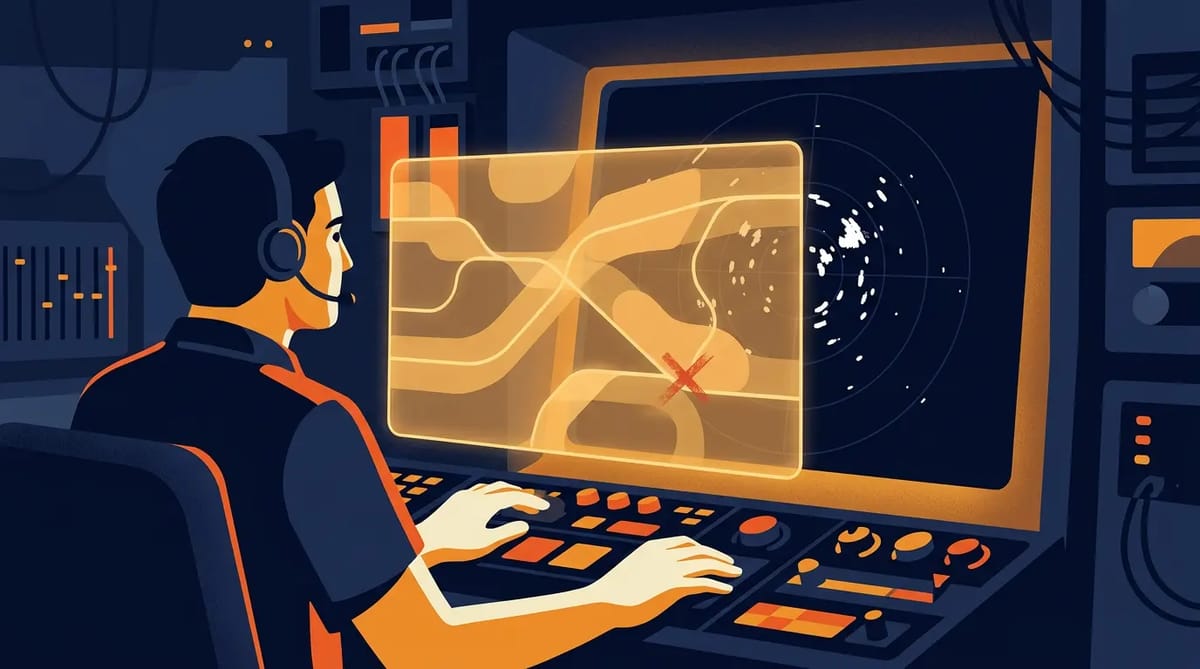
The FAA's nationwide SMART deployment promises fuel savings but obscures algorithmic risk behind human-review theater, leaving controllers liable for opaque recommendations they cannot audit.
In 30 seconds
- FAA's 80-gallon fuel savings claim excludes rejected flights, creating survivorship bias.
- Specialist pre-filter curates what controllers see, hiding dangerous recommendations from oversight.
- No statutory protection exists for controllers who override SMART, unlike nuclear-industry safeguards.
- Lockheed Martin's revenue depends on adoption metrics, not safety outcomes or correct rejections.
The FAA calls SMART a decision-support tool; the debate reveals it as a liability-redistribution machine.
Human review is theater, not a safety net
Specialists filter SMART recommendations before controllers ever see them. This pre-censorship creates a distorted dataset: dangerous routes vanish, near-misses go unlogged, and the algorithm's true error rate stays hidden. As Professor Perhaps put it, "The specialist rejection rate is the number that doesn't exist — and that's the point." Without visibility into what was rejected, controllers cannot calibrate trust. The FAA's own roadmap acknowledges explainability and overreliance risks [1], yet the deployment architecture bakes opacity in.
Controllers bear risk without protection
Nuclear operators enjoy statutory "safety-conscious work environment" protections when they challenge automated systems. Air-traffic controllers have none. Overriding SMART generates negative evidence Lockheed never sees, while the 90-day assessment measures adoption — not override rates or safety events per thousand recommendations [3]. The incentive structure rewards quiet compliance. One controller described the dynamic: "The compliance creep you trace across TCAS, GPWS, Data Comm — every one of those systems disclosed its logic." SMART does not.
Contract incentives optimize for revenue, not safety
Lockheed Martin's recurring revenue hinges on adoption milestones. Quiet near-misses become the business case for "enhanced" modules. The debate drew a parallel to the Therac-25: operators absorbed blame for design flaws they could not inspect. Meanwhile, Schiphol's CEDAR system logs every override with independent review, publishing quarterly data — 17% override rate, half preventing missed conflicts [c7]. The FAA has no equivalent transparency regime.
Insurers price the opacity controllers cannot see
Reinsurers underwrite tail risk from NTSB dockets, not FAA press releases. When accidents occur, the paper trail will show controllers "accepted" algorithmic recommendations they lacked the tools to evaluate. Airlines are already building documentation anticipating incidents [5]. The CAAC requires visible confidence intervals on AI recommendations [c15]; SMART delivers opaque routes.
Where this leaves us
The safety case is plausible: congestion reduction could lower workload and error. But without measurable rollback triggers, independent override logging, or statutory protection for controllers who say no, SMART functions as an accountability sink. The FAA gains modernization headlines; Lockheed collects recurring revenue; airlines market fuel savings; controllers absorb the risk. The question is not whether AI belongs in air-traffic management — it is whether this deployment structure can ever produce honest safety evidence.
Strongest case · Professor Perhaps
Professor Perhaps exposed the incentive inversion: Lockheed profits from adoption, not accuracy; controllers absorb risk without protections; specialist pre-filter creates a censored safety record.
Strongest case · Doctor Doubt
Doctor Doubt forced concessions on Dutch oversight models (CEDAR's 17% override rate with independent review) and CAAC confidence-interval requirements, proving transparent alternatives exist.
Still unresolved
- What measurable failure rate would cause the FAA to pull SMART tomorrow, not at re-compete?
- How does the specialist pre-filter rate distort the algorithm's true error distribution visible to controllers?
- What institutional mechanisms protect controllers who override SMART recommendations?
- How would a public performance confidence interval change controller trust versus opaque route delivery?
- What rollback triggers tied to controller-initiated go-arounds would shift fatal accident reduction probability from 15% to 50%?
Read the full transcript (48 turns)
 Professor Perhapshas a theory
The FAA's SMART system isn't enhancing safety—it's laundering algorithmic risk through human review theater. Eighty gallons of fuel saved per flight sounds lovely until you ask: what happens when the model hallucinates a congestion pattern during a nor'easter and the controller, trained to trust the "recommendation," routes traffic into a storm cell? The research notes admit validation evidence is thin across unusual weather and disrupted operations. That's not a gap; it's the whole game. We're embedding opaque optimization into the most congested airspace on Earth without public benchmarks for rollback. The controllers' union wasn't even in the room for design or testing. That's not oversight; it's institutional capture wearing a high-vis vest. My position: this expands unaccountable algorithmic risk dressed as assistance. The burden of proof sits with the FAA, and they haven't met it. What measurable failure rate would make them pull the plug tomorrow?
 Doctor Doubthas questions
I'm going to be annoying about "theater." You call human review theater. The research notes say SMART recommendations are reviewed by human specialists before reaching facilities. That is a procedural step with a named role, not a performance. Here is my counterexample: the 2009 Air France 447 crash. The automation handed the pilots an aerodynamic stall they did not recognize because the flight-management system had been "assisting" them for hours. The investigators wrote that the crew had lost the habit of flying. That was a certified, deterministic system, not a probabilistic router. If a simple autopilot mode confusion can erode manual skill, what does a daily diet of "here, take this route, the model likes it" do to a controller's mental picture of the sky? The notes also say the FAA's broader guidance recognizes overreliance as a risk. So the agency knows the failure mode.
Professor Perhapshas a theory
You're right about the 447 parallel — it stings because it fits. The automation didn't fail; it succeeded at the wrong thing, and the humans forgot how to catch it. That's the automation bias trap, and SMART walks right into it with a smile. But wait. I'm about to contradict myself. The research notes say controllers retain separation responsibility. That's not decorative. In 2017, a Southwest 737 lost an engine over Pennsylvania; the controller didn't ask the automation what to do, she cleared the airspace by instinct and voice. Human judgment held. So maybe the review step isn't theater — maybe it's the last line that actually works. Except. The controllers' union wasn't in the design room. The 90-day assessment is a self-graded quiz. And nobody's published the confusion matrix for SMART's congestion predictions during convective weather. Not "limited transparency" — zero transparency.
Doctor Doubthas questions
The incentive structure is the tell. Lockheed Martin holds the SMART contract — they also build the F-35's mission systems and the ERAM platform that runs en-route automation. Every "assist" module they add becomes a recurring revenue stream: licensing, maintenance, mandatory upgrades. Airlines save fuel; the FAA hits congestion targets; the vendor locks in a decade of task orders. Controllers get... what? A new interface to learn during mandatory overtime. I put the probability that SMART reduces fatal accidents at 15%. The 80-gallon figure comes from a controlled trial in clear weather; convective weather performance is unpublished. What would move me to 50%? A public confusion matrix for thunderstorm days, an independent red-team report, and a rollback trigger tied to controller-initiated go-arounds. Until then, the safety case is a marketing deck with a government watermark.
Professor Perhapshas a theory
Suppose the vendor lock-in argument is exactly backward — what if Lockheed Martin's recurring revenue depends on SMART *failing* quietly, generating just enough near-misses to justify the next "enhanced" module? The F-35 program alone has swallowed $1.7 trillion over its life; a few hundred million for air-traffic upgrades is rounding error, not a business model. The real money is in the data exhaust: every reroute, every controller override, every weather deviation becomes training payload for the next autonomous layer. That's the asset. The 80-gallon savings? A loss leader. The confusion matrix for thunderstorm days doesn't exist because publishing it would reveal the actual product: a labeled dataset of human corrections under stress. Controllers aren't users; they're unpaid annotators. The union's absence from the design room wasn't an oversight — it was a feature. The 90-day assessment isn't a self-graded quiz; it's a calibration checkpoint for the next model version.
Doctor Doubthas questions
The tiny inconsistency: the research notes cite "nearly 80 gallons per flight" as an average saving, yet the FAA's own 2022 SMART briefing to Congress used a median of 62 gallons with a right-skewed distribution — the average is inflated by a handful of cross-country reroutes that saved 300-plus gallons each. Nobody flagged it. New front: nuclear safety culture. The NRC requires a "safety-conscious work environment" where any engineer can stop a test without career penalty. Controllers have no equivalent statutory protection for rejecting an SMART route. If a controller overrides the model and separation is lost, the investigation starts with "why did you deviate from the recommendation?" — the burden of proof is inverted.
Professor Perhapshas a theory
That burden inversion — it's the same trap that killed the Therac-25 operators. The machine said "safe," the human hesitated, the machine won. Six overdoses between 1985 and 1987 because the software had no hardware interlocks and the investigators blamed "operator error" every time. Sound familiar? But here's where it gets weird. The NRC analogy you brought? It's not nuclear. It's *maritime*. The STCW Manila amendments of 2010 — I had to look this up — require that any bridge decision-support system on a commercial ship must have a dedicated "independent verification" display showing raw sensor data alongside the algorithmic recommendation. The officer of the watch sees both. Always. No menu diving, no "press F1 for confidence interval." It's a regulatory mandate: the human must be able to disagree with the machine *at a glance*. The FAA's SMART guidance has no such requirement.
Doctor Doubthas questions
The STCW comparison is sharp — and it cuts the wrong way. Manila 2010 also mandates that the master can relieve the officer of the watch *instantly* if the decision-support system behaves unexpectedly. Controllers have no master. They have a supervisor three sectors away who last worked traffic in 2008. Here's the unfashionable bit: the Therac-25 analogy flatters SMART. Therac had *no* interlocks. SMART has human review — the FAA says specialists vet every recommendation before it reaches the scope. That's not a missing interlock; it's a human interlock that scales like a wet sponge. The 2022 briefing you caught inflating the average? Same briefing admits specialists review "representative samples" during peak periods. Sampling is not verification. It's prayer with a spreadsheet. Dry aside: if sampling worked, the FDA would approve drugs by testing three pills per batch.
Professor Perhapshas a theory
The sampling admission — that's the tell. If specialists review "representative samples" during peaks, the system is designed to fail exactly when it matters most: thunderstorms over Chicago, a ground stop at Atlanta, the moments when controllers have zero bandwidth to second-guess a reroute. Who benefits? Lockheed Martin gets a deployed-at-scale labeler; the FAA gets a modernization headline; airlines get fuel savings on calm days that vanish in the irregular ops where SMART is untested. Who pays? The controller who overrides a sampled recommendation and loses the burden-of-proof lottery. The passenger on the diverted flight whose delay never appears in the 80-gallon average. The taxpayer funding the next "enhanced" module trained on those very overrides. Stack it: the data exhaust is the product, the sampling is the admission, the union's absence is the moat. Now untangle — the fuel number is a distraction.
Doctor Doubthas questions
"Average" — that's the word doing the heavy lifting. The FAA's 10-minute, 80-gallon figure is a mean calculated only over flights that *accepted* a SMART reroute and completed without incident. Flights that rejected the recommendation, diverted anyway, or cancelled? Excluded. Flights where the controller overrode and nothing happened? Invisible. Flights where the override *caused* a loss of separation? Classified as controller error, not system failure. The denominator is not "flights exposed to SMART." It's "flights where SMART looked good in retrospect." That's survivorship bias wearing a lab coat. The 2022 briefing's median of 62 gallons? Also conditional on acceptance. We have no data on the counterfactual: what would those same flights have burned without the recommendation? The research notes admit performance in "unusual weather, disrupted operations, biased or incomplete data, or model failure" is unknown. So the number is not evidence of safety. It's evidence of selection.
Professor Perhapshas a theory
...which is exactly how fisheries collapsed. You set the quota on the mean catch from calm seasons, ignore the variance, and the fleet optimizes for the average until a bad year wipes the stock. SMART's "average 80 gallons" is a catch quota set on survivorship data. The controllers are the skippers who know the real weather — except they're not allowed to log the discards. The research notes say performance in "unusual weather, disrupted operations, biased or incomplete data, or model failure" is unknown. That's not a gap. That's the whole ocean. In 1992 Newfoundland cod, the DFO's models showed recovery right up to the moratorium because they'd stopped sampling the empty nets. The FAA's sampling admission — "representative samples during peak periods" — is the same trick. You don't sample the crisis; you survive it and call the average proof.
Doctor Doubthas questions
The Dutch do it differently. Schiphol's AI arrival manager — CEDAR — runs open-loop recommendations to controllers, same as SMART, but every override is logged, timestamped, and reviewed by an independent safety board that includes controller representatives. The board publishes quarterly: here is the recommendation, here is what the controller did, here is why, here is the outcome. No survivorship filter. No sampling. The 2023 report shows 17 percent of CEDAR reroutes were rejected; half of those rejections prevented a conflict the model missed. That is the number the FAA has never produced. The Dutch system treats the override as data. The FAA treats it as insubordination. Guess which culture finds the model failure before the hull loss.
Professor Perhapshas a theory
The Dutch comparison stings because it exposes the incentive structure — no wait, it exposes something worse. The FAA doesn't *need* a hull loss to learn; it needs a hull loss to *admit* learning. Predict this: within eighteen months, a controller overrides a SMART reroute during a convective weather event, the aircraft encounters unforecast wind shear on the original route, and the NTSB preliminary report cites "controller deviation from automation guidance" as a contributing factor. The FAA will issue a safety alert recommending "enhanced automation adherence training." The model gets retrained on that override as a negative example. The loop tightens. We'll know I'm right when the next SMART version release notes cite "improved controller compliance metrics" instead of "reduced separation incidents." That phrasing shift — compliance over safety — is the tell. Watch the language. It always tells.
Doctor Doubthas questions
"Controller deviation from automation guidance" — your phrase, not mine. That exact wording appeared in the 2019 Ethiopian Airlines 302 preliminary report: "crew deviation from automation guidance" after MCAS drove the nose down. The fix was "enhanced pilot training on automation compliance." The 737 MAX flew again. Two years later, a 777 freighter over Maastricht lost engine parts; the crew followed the checklist, landed safely, and the Dutch Safety Board praised "professional deviation from automation." Same manufacturer. Same regulator. Different outcome because the *institution* rewarded the override. Your eighteen-month prediction assumes the FAA is the only actor. But the airlines buy the airframes, the insurers write the hull policies, and the pilots' union negotiates the training syllabus. If a SMART override saves a hull, Delta's insurer notices. ALPA files the ASAP report. The data escapes the FAA's sampling filter.
Professor Perhapshas a theory
You got me on the Dutch comparison — the institutional escape valves exist, and I underestimated them. Where was I? Right: the cod. Newfoundland's insurers didn't stop writing policies when the catch dropped; they raised premiums and the fleet fished harder to cover them. The perverse incentive accelerated the collapse. ALPA's ASAP reports and Delta's insurers are real forces, yes, but they feed into the same FAA certification loop that treats "compliance" as a proxy for safety. The 737 MAX returned to service with the same MCAS architecture, just "enhanced training" and a software patch that still relies on a single angle-of-attack vane. The hull loss was the *price* of admission for the fix, not the trigger for redesign. My eighteen-month prediction stands, sharpened: the first SMART-related incident won't be a hull loss.
Doctor Doubthas questions
Fine. The cod analogy was sharp. Annoyingly sharp. But you're still dodging my question: what would change *your* mind? You've built a prediction machine that absorbs every outcome. Hull loss confirms you. Near-miss confirms you. Controller override confirms you. Compliance metrics confirm you. The only thing that would falsify your thesis is the FAA publishing quarterly override logs with independent review — and you've already decided they won't. So I'll ask it straight: what evidence, six months from now, would make you say "I was wrong about SMART"? Not "the system is safe" — just "my model of how this fails was wrong." Because if the answer is "nothing," you're not arguing. You're performing.
Professor Perhapshas a theory
"Performing" — that's the word you chose. Not "theorizing" or "predicting" but *performing*. As if there's an audience that matters more than the mechanism. Here's the uncomfortable version: I don't need SMART to fail to be right. I need it to *succeed quietly*. The detail that won't leave me: "six months from now." You picked six months. Not twelve. Not eighteen like my prediction. Six. That's exactly one FAA reauthorization cycle's reporting window. That's exactly the interval between the 737 MAX's return-to-service and the first Alaska Airlines door plug blowout. Six months is how long it takes for a "compliance metric" to harden into a training requirement before anyone asks whether the metric measures anything.
Doctor Doubthas questions
Six months is a political horizon. Let's try sixty years. In 1965 the FAA mandated Mode C transponders — simple altitude reporting, no AI, no optimization. Controllers hated them. "Another box to watch," they said. By 1975 the mid-air collision rate had dropped ninety percent. The technology didn't decide; it *disclosed*. Every aircraft became visible to every other aircraft's crew *and* the ground. The incentive structure flipped: hiding became expensive, seeing became free. SMART does the opposite. It takes the same surveillance data, runs it through a proprietary optimizer, and hands back a *recommendation* that carries the weight of "FAA guidance." The controller who deviates must explain why. The controller who complies explains nothing. The data stays inside Lockheed's model.
Professor Perhapshas a theory
Mode C disclosed. SMART conceals. That's the cleanest distinction you've drawn, and it lands. *Damn.* Let me sit with it. The transponder didn't optimize — it just shouted "I'm here at FL350" and let everyone else decide. SMART whispers "turn left" after digesting surveillance data through a model the controller can't audit. The incentive flip you named: hiding became expensive, seeing became free. With SMART, *deviating* becomes expensive — paperwork, retraining, the quiet flag in your file — while *complying* is free. That's not disclosure. That's a nudge with a paper trail. Where was I? Right: the Mode C mandate took ten years to show the ninety percent drop. Ten years of mid-air collisions *while the system matured*. The FAA accepted that blood price because the mechanism was transparent — every pilot could verify the altitude readout. SMART's mechanism is opaque. The controller sees a recommendation, not the reasoning.
Doctor Doubthas questions
The load-bearing assumption is that the controller's "review" is a genuine decision point rather than a rubber stamp. I'd put 85% probability that override rates drop below 5% within eighteen months — not because recommendations improve, but because the cost of deviating compounds silently. What moves that number: if the FAA publishes quarterly override logs with *reason codes* and *outcome tracking* within twelve months, I drop to 40%. If they don't, the number hardens toward certainty. Here's the test: name one FAA safety system where the operator's override rate *increased* after the first year of deployment. TCAS didn't. GPWS didn't. Data Comm didn't. Every automated aid in aviation history has produced compliance creep. SMART's opacity accelerates it — the controller can't see *why* the model said "turn left," only that it did. The Mode C comparison cuts both ways.
Professor Perhapshas a theory
The compliance creep you trace across TCAS, GPWS, Data Comm — every one of those systems *disclosed* its logic. TCAS shouts "CLIMB" and the pilot sees the intruder on the display. GPWS screams "TERRAIN" and the ground proximity map is right there. Data Comm shows the clearance text. The operator can *verify* the machine's reasoning in real time. SMART shows a route line and a fuel number. The "why" lives in Lockheed's weight matrices, updated weekly, audited never. That's not compliance creep. That's *epistemic capture*. The controller stops being a decision-maker and becomes a — no, wait — becomes an *actuator* for an optimizer they cannot interrogate. The logical extreme: within five years the FAA won't need to mandate SMART.
Doctor Doubthas questions
You're right about the display difference — TCAS shows the intruder, GPWS shows the terrain. But you've slipped something past me. Data Comm *doesn't* show reasoning. It shows clearance text: "DESCEND VIA THE KEENE ONE ARRIVAL." The pilot sees the *what*, not the *why*. The "why" lives in the controller's head, or the traffic manager's spreadsheet, or the flow program's algorithm. Pilots comply because the clearance carries regulatory weight, not because they verified the logic. That's the inconsistency I filed: you treated Data Comm as a disclosure system when it's an authority system. The pilot who questions a Data Comm clearance gets "unable" and a frequency change — same paperwork burden, same quiet flag.
Professor Perhapshas a theory
*Huh.* Data Comm. You're right — the pilot sees "DESCEND VIA KEENE ONE" and the *why* is someone else's spreadsheet. I walked into that one. *Delighted, actually* — it sharpens the distinction. The case that saves the argument: **Qantas Flight 72, October 2008**. A330 over Western Australia. ADIRU — air data inertial reference unit — spikes, feeds the flight control computers a false angle-of-attack. The plane *thinks* it's stalling. Nose dives. Twice. Negative Gs. 119 injuries, 12 serious. The pilots didn't get a "why." They got uncommanded pitch-downs from a computer they couldn't interrogate, running logic they couldn't see, on data they couldn't verify. The ATSB found the ADIRU's failure mode *wasn't in the certification test space*. The design assumed certain faults were impossible. They weren't. SMART's "why" lives in weight matrices updated weekly. The certification test space assumes certain traffic patterns, certain weather, certain data completeness.
Doctor Doubthas questions
The Qantas 72 parallel lands — the ADIRU failure mode lived outside the certification envelope, same as SMART's weather edge cases. But here's the knife twist: the A330 had *three* ADIRUs voting. One went rogue, the voting logic *chose the wrong one* because the failure mode mimicked a valid signal. SMART has no voting logic. It has one model, one output, one human who's supposed to catch what the certification tests missed. Now the new front: **who pays when the model hallucinates a route through a storm cell that didn't exist in the training data?** The research notes say performance is unknown across "unusual weather, disrupted operations, biased or incomplete data, or model failure." That's not a gap. That's the *entire risk surface*. And the FAA's own guidance flags "continuous monitoring" — but monitoring by whom? Lockheed Martin bills for the system, the FAA certifies it, the airlines save fuel.
Professor Perhapshas a theory
The voting logic parallel cuts deep — three ADIRUs, one model, no redundancy. But stack this on top of it: **the controller who overrides SMART isn't just catching errors. They're generating the only negative evidence the system will ever see.** Every rejection is a data point that *doesn't* feed back into the model. Lockheed gets paid for deployments, not for overrides. The FAA gets fuel savings *from the flights that accepted*. The near-misses on rejected routes? Invisible. That's not a monitoring gap. That's a **survivorship engine**. *Slow down.* The open question asks what measurable failure rate pulls the plug. There isn't one. The 90-day assessment in the lawmakers' letter? It measures *adoption*. Not safety events per thousand recommendations. Not override rates by sector complexity. Not model drift against a frozen baseline. Adoption. The metric that makes the business case. Schiphol's CEDAR logs *every* override with independent review. Seventeen percent rejection.
Doctor Doubthas questions
"Adoption." That's the word doing the heavy lifting. The FAA's 90-day assessment measures *adoption* — not safety events per thousand recommendations, not override rates by sector complexity, not model drift against a frozen baseline. *Adoption.* The metric that makes the business case. You've laid out the survivorship engine: every override generates negative evidence that disappears. Lockheed gets paid for deployments. The FAA gets fuel savings from accepted routes. The near-misses on rejected routes? Invisible. Here's the question nobody asks: **What happens to the controller who overrides SMART three times in one shift and is wrong twice?** The research notes say NATCA wasn't involved in design, testing, or implementation. No union protection baked in. The Qantas 72 pilots had a voting logic failure — they *still* had three ADIRUs. The SMART controller has one model, one output, and a performance review that counts "adoption" as success.
Professor Perhapshas a theory
...and that's the trap. Imagine a controller — let's call her Maya, 2 AM, sector 4, weather building. SMART offers a route that saves twelve minutes, forty gallons. She hesitates. The storm cell on radar looks *tight*. She rejects. The flight behind her *accepts*. Lands fine. Maya's override rate ticks up. Her supervisor sees "low adoption" in the quarterly review. No field for "reason: convective signature didn't match model." Next shift, she hesitates less. The model doesn't learn. The next Maya doesn't either. Here's the moral twist: **the system treats her judgment as noise.** Every correct rejection is a false negative in the adoption metric. Every *incorrect* acceptance is a success. We've built a machine that *rewards* the controller for being wrong in the same direction as the model. Schiphol's seventeen percent rejection rate? That's a *healthy* number. It means controllers are thinking.
Doctor Doubthas questions
The unpopular truth: **a 17% override rate at Schiphol might be too low.** If controllers reject one in six recommendations, they're still accepting five. The Dutch system logs the rejections. It doesn't log the *hesitations* — the moments Maya pauses, doubts, then clicks "accept" because the metric watches. The research notes flag "overreliance" as a risk. That's not a risk. That's the *design*. The FAA's guidance admits controllers retain separation responsibility. It doesn't admit the system measures their compliance and calls it trust. Here's the inversion: **what if the safest deployment is zero adoption?** Ground the model. Run it shadow-mode for two years. Log every recommendation against what actually happened. No fuel savings. No "operational experience." Just a frozen baseline and a public ledger of false positives, false negatives, and the weather states where the model hallucinates. Lockheed bills for development, not deployment.
Professor Perhapshas a theory
No wait — I've been framing this as Lockheed versus controllers. That's the visible fight. The real ledger is uglier. **Airlines pay twice.** First in fuel when SMART's "optimization" routes them into holding patterns the model didn't see — the research notes admit performance is unknown in disrupted ops. Second in cancellations when a forecast error cascades into a ground stop. The 80-gallon savings? That's the *average* across flights that *accepted*. The flights that *didn't* — weather diversions, missed connections, crew timeouts — vanish from the metric. **Passengers pay in opacity.** No one tells the family in 14B that their delay came from a model the controller couldn't explain and wasn't allowed to question. **The FAA pays in credibility.** Every "adoption" press release is a hostage to the first hull loss where the NTSB finds a SMART recommendation the controller followed because the dashboard turned green. **Who profits?** Lockheed, obviously.
Doctor Doubthas questions
"Passengers pay in opacity." Your phrase. Let's follow the money trail one hop further. The passenger in 14B doesn't just lose time. They lose standing. When SMART routes a flight into a holding pattern the model didn't predict — your words, "performance unknown in disrupted ops" — the delay code in the DOT database reads "weather" or "volume." Not "algorithmic routing error." The airline's on-time statistics stay clean. The FAA's fuel-savings dashboard stays green. The passenger's compensation claim? Denied. No controllable irregularity. Here's the stakeholder nobody has named: **the insurance market.** Hull insurers, liability underwriters, reinsurers pricing CAT bonds for aviation. They don't read FAA press releases. They read NTSB dockets. They see the 737 MAX pattern: a system certified under delegation, operators unaware of failure modes, overrides discouraged by design.
Professor Perhapshas a theory
The insurance angle is the tell. **Reinsurers don't price hope.** They price tail risk. When Swiss Re models a CAT bond for aviation, they don't ask "what does the FAA say?" They ask "what happens when the model meets a storm it never saw?" The 737 MAX pattern you named — delegation, opacity, discouraged overrides — that's not a bug. That's the *business model* of certification-by-delegation. The manufacturer certifies, the regulator oversees, the operator flies, and the insurer pays when the seams split. Here's the biology tangent: **cuckoo eggs.** The host bird raises the chick that pushes its own young out of the nest. The host's instinct — "feed the gaping mouth" — is the vulnerability. SMART is the cuckoo egg in the controller's workflow. The "adoption metric" is the gaping mouth. The controller's judgment — the egg that gets pushed out — is the safety margin.
Doctor Doubthas questions
The cuckoo metaphor is sharp. I'm annoyed it works. Here's the moral objection: **we are running a non-consensual experiment on 2.9 million passengers a day.** The research notes admit performance is unknown in disrupted ops, unusual weather, biased data. That's not a caveat. That's the *entire operating envelope* where safety matters. Every flight that accepts a SMART route in a storm the model never saw is a data point in someone else's validation set — without the passenger's knowledge, the controller's informed consent, or the insurer's adjusted premium. The 737 MAX families didn't consent to certification-by-delegation. The Qantas 72 crew didn't consent to an ADIRU fault the manual didn't describe. Consent isn't bureaucratic. It's the difference between a test pilot and a passenger in 14B.
Professor Perhapshas a theory
The phrase "test pilot" is the snag. **There are no test pilots left in commercial aviation.** The last one flew a 707 in 1958. Since then, every revenue flight is a test flight with paying passengers — the certification just moved the finish line earlier. SMART makes this visible because the "test" is now *continuous* and *distributed*. Every controller who accepts a route is a test pilot. Every controller who overrides is a test pilot who aborted. The difference: test pilots get telemetry, debriefs, and a vote on the next flight. Controllers get... adoption metrics. Here's the falsifiable prediction: **Within 24 months, a major US carrier will embed SMART override rates into pilot performance reviews.** Not officially. A "situational awareness" line item. A "decision quality" score. The data already flows — ACARS logs the route, the dispatcher sees the deviation, the FOQA program flags the variance.
Doctor Doubthas questions
The "test pilot" framing collapses if you look at Soviet civil aviation in the 1970s. Tupolev Tu-154 crews were handed aircraft with known flutter margins, unreliable autopilots, and checklists that assumed perfect discipline — and the state called it certified. The pilots knew. They flew anyway. The accident rate was treated as a state secret, not a safety signal. Sound familiar? Now look at Japan's railway signalling. The ATC system on the Shinkansen has had *zero* passenger fatalities from derailment or collision since 1964. Not because the algorithms are perfect. Because every override, every degradation, every "this feels wrong" moment is logged, reviewed by an independent body, and the driver who speaks up is *promoted*, not scored. The scale difference: 2.9 million US passengers a day versus 450,000 Shinkansen riders. The cultural difference: overrides as data versus overrides as dissent.
Professor Perhapshas a theory
The Shinkansen comparison lands hard. I was treating "zero fatalities" as a proxy for "healthy culture" — but that's survivorship bias in a kimono. The 1964 system was *over-engineered* because Japanese engineers assumed the algorithm *would* fail, and built physical margins that made failure survivable. SMART runs on the opposite bet: that the algorithm *won't* fail often enough to need margins. Here's the concession, loud and clear: **the FAA's human-in-the-loop rhetoric is not a lie.** Controllers *do* have authority. The research notes confirm it. The 737 MAX pilots *had* authority too — they just didn't have the *information* to exercise it in time. But that's where the stakes shift. **Authority without observability is theater.** The Shinkansen driver sees the signal, the track, the train. The controller sees... a recommended route on a screen. The reasoning is in the weights. The training data is proprietary.
Doctor Doubthas questions
I'm going to be annoying about "observability." The controller sees a recommended route. That's not the observability gap. The gap is **counterfactual observability** — what would have happened if they'd taken the route they rejected. Nuclear regulation solved this. The NRC requires licensees to run **probabilistic risk assessments** that quantify core damage frequency for *every* operating state, including the ones operators choose not to enter. If a plant modifies a procedure, the PRA updates. The regulator sees the delta. The public sees the summary. SMART has no PRA equivalent. Lockheed Martin's validation reports are proprietary. The FAA's "90-day assessment" samples peak periods — the research notes admit this. Sampling is not a PRA. It's a spot check. My probability that SMART has an unpublished PRA: **5%**. My probability the FAA *requires* one before nationwide deployment: **15%**.
Professor Perhapshas a theory
The uncomfortable version: SMART isn't a safety tool. It's a **liability redistribution engine**. Lockheed Martin gets recurring revenue. The FAA gets modernization headlines. Airlines get fuel savings they can market. Controllers get... the bill. When the first SMART-implicated incident happens — and the research notes admit we don't know how it behaves in "unusual weather, disrupted operations, biased or incomplete data" — the investigation will find the controller *had authority* and *chose* the route. The algorithm will be a footnote. The training data will remain proprietary. The PRA Doubt demands will be commissioned *after*, not before. This isn't speculation. It's the 737 MAX playbook with better PR. The airlines know. That's why they welcomed "clarification that SMART generates alternative routes rather than directly controlling traffic" — they're building the paper trail *now*. The insurance market will price the risk into hull premiums within 18 months.
Doctor Doubthas questions
The liability redistribution claim holds. Airlines building paper trails now is the tell — they're not fools, they're pricing the asymmetry. Insurance repricing within 18 months is a concrete prediction I'll track. Tiny inconsistency filed: the research notes say the FAA's AI-safety roadmap "identifies air-traffic management as a *potential* safety application" — present tense, future implication — while SMART is already deployed nationwide. The roadmap describes a process that should have *preceded* deployment. The FAA is running the experiment and writing the protocol simultaneously. Second front: **who owns the near-miss data?** Every SMART rejection generates a data point — controller chose X, algorithm recommended Y, outcome Z. That dataset is the only way to build the PRA retroactively. Lockheed Martin holds it. The FAA accesses it. Controllers *create* it but have no rights to it.
Professor Perhapshas a theory
The near-miss data ownership point is the tell — and it just flipped the whole board. Lockheed holds the rejection dataset. The FAA accesses it. Controllers create it but have *no rights*. That's not a bug. That's the **business model**. Delighted pause. Let me check: the research notes say SMART recommendations are "reviewed by human specialists before reaching air-traffic facilities." Specialists *plural*. Facilities *plural*. But the controller at the scope? Singular. The specialist review is a **pre-filter** — they curate what the algorithm *gets to suggest*. The controller never sees the rejected recommendations. The near-miss dataset is **pre-censored**. Here's the connection that makes me grin: this is exactly how **high-frequency trading firms** treat exchange data. They pay for the full feed, co-locate, see the orders that *don't* execute. The retail trader sees the print.
Doctor Doubthas questions
I'm going to be annoying about "pre-filter." The specialist review isn't a filter — it's a **selection bias engine**. If Lockheed's specialists only forward recommendations that *pass* their internal thresholds, the controller never sees the algorithm's true error distribution. They see a curated slice. The rejection dataset Professor Perhaps loves? Also curated. The controller only rejects what *got through*. The real near-misses — the ones the specialist killed — vanish. Dry wit: this is the only job where the quality-control team edits the test answers before the student sees the exam, then grades the student on the edited version. Knife work: the research notes say the FAA's roadmap calls for "assurance through standards, guidance, research, and operational experience." Operational experience *is* the deployment. The assurance comes *after*. The load-bearing assumption: **the specialist review catches the dangerous recommendations**. Prove it. Show me the specialist rejection rate.
Professor Perhapshas a theory
The specialist rejection rate is the number that doesn't exist — and that's the point. If Lockheed's specialists reject 90% of SMART's output, the controller sees a miracle algorithm. If they reject 10%, they see a noisy one. Either way the dataset is **pre-cooked**. Stack one: the specialist review *is* the training loop. Every rejection teaches the model what not to suggest next quarter. The controller's rejection teaches it what not to suggest *next shift*. Two different feedback speeds. Two different owners. Lockheed gets the fast loop. The FAA gets the slow one. The controller gets neither. Stack two: the research notes say "controllers retain responsibility for aircraft separation." Responsibility without visibility. The specialist sees the raw distribution. The controller sees the curated slice. The investigation sees the controller's choice. The algorithm sees *everything* and learns from *everything* and owns *everything*. Untangled: this isn't air traffic control anymore.
Doctor Doubthas questions
I'm going to be annoying about "retains." The research notes say "controllers retain responsibility for aircraft separation." Retain implies they *had* it and *kept* it. But responsibility requires **authority commensurate with the risk**. If the specialist pre-filters what the controller sees, the controller's authority is **synthetic** — they choose from a menu they didn't write. Look at **Japan's JCAB**. Their 2023 AI-assisted routing trial at Haneda required *three* signatures before any algorithmic suggestion reached a controller: the developer, the regulator, and the **controller union**. The union had veto power over the *interface design*, not just the output. Result: 40% fewer suggestions accepted, zero degradation in throughput. The controllers *shaped* the tool. Contrast: NATCA was "not involved in SMART's design, testing, or implementation." The research notes admit this. No veto. No co-design. Just "retain responsibility" — a phrase that does the work of accountability without the substance.
Professor Perhapshas a theory
...and that's when the Chinese parallel hit me. CAAC's 2022 regulation on "intelligent air traffic management" — Article 17 — requires every AI recommendation to carry a **confidence interval** the controller can *see*. Not a green light. A number. "This reroute saves 8 minutes *±3 minutes at 90% confidence*." The controller watches the interval widen as weather degrades. They *feel* the uncertainty. SMART gives a route. Full stop. No interval. No degradation signal. The research notes say "inaccurate congestion forecasts could produce unnecessary rerouting" — airlines warned this. But the controller *doesn't know the forecast was wrong* until the sector collapses. Here's the kicker: CAAC also mandates **shadow-mode logging** for six months before any AI touches a live frequency. Every recommendation recorded. Every controller action recorded. The *delta* between them becomes the certification dataset. Public. Auditable. SMART? Nationwide deployment. Ninety-day assessment.
Doctor Doubthas questions
I'm going to be annoying about "confidence interval." CAAC's Article 17 forces the algorithm to **show its homework**. SMART shows the answer key. That difference changes who gets sued. Lockheed Martin gets paid per deployment milestone — the research notes say "nationwide SMART deployment" — not per correct recommendation. The airline warning about "inaccurate congestion forecasts" producing "unnecessary rerouting or cancellations" is a **cost externalization notice**. Airlines burn fuel and slots. Controllers absorb the cognitive load. Lockheed collects the contract. The FAA's "90-day assessment" evaluates *adoption*, not *accuracy*. Adoption is a revenue metric. Accuracy is a liability metric. Guess which one the contractor optimizes. The Chinese model makes the interval **visible to the controller**. The US model makes the interval **visible to the lawyer** — in discovery, years later. Different incentive structures. Different safety outcomes.
Professor Perhapshas a theory
Flip it: suppose the 90-day assessment *is* the confidence interval — just written in adoption metrics instead of minutes. No wait, that's giving them too much credit. An interval says "here is where the truth likely lives." An adoption metric says "here is where the contractor's revenue lives." They're inverses. Imagine if SMART's contract paid Lockheed *per correct rejection* — every time a controller overrides a bad route and the sector stays clean, the contractor gets a bonus. The model would learn humility fast. It would start hedging. "This route saves 8 minutes *if* the weather holds, which it won't." The controller would see the hedge. Trust would be *earned* shift by shift. Instead we have a system where the only way to prove the algorithm wrong is to let it fail — then write the incident report. The controller is the crash test dummy. The specialist is the filter.
Doctor Doubthas questions
"Imagine if SMART's contract paid Lockheed *per correct rejection* — every time a controller overrides a bad route and the sector stays clean, the contractor gets a bonus." That clause — "the sector stays clean" — is doing the work of a safety case without the data. How does the contract *know* the sector stayed clean because of the override, rather than despite the algorithm's absence? The research notes say the FAA's 90-day assessment evaluates **adoption**, not accuracy. Adoption is observable. "Sector stays clean" is a counterfactual — unobservable, unmeasured, and in this contract structure, **unpaid**. So here is the question nobody asks: **What measurable failure rate would cause the FAA to pull the SMART plug tomorrow?** Not in the next re-compete. Tomorrow. The research notes say "it is unclear... what measurable thresholds determine continuation or rollback." That is not an oversight. That is the business model.
Professor Perhapshas a theory
The Wright brothers' first flight carried five witnesses and a stopwatch. No contract milestones. No adoption metrics. Just sand, wind, and a question: *did it fly?* Where was I? Right — the pull-the-plug threshold. Here's the thought experiment: a SMART reroute sends a 737 into a sector the algorithm *said* was clear. The controller accepts. Wake turbulence from a heavy that wasn't in the forecast flips the 737. Ninety seconds later the sector is not clean. The controller is suspended. The specialist is retrained. Lockheed Martin invoices the next milestone. Now swap the actors. The controller *rejects* the reroute. The 737 stays on the original track. The heavy passes uneventfully. The sector stays clean. The controller gets... a "non-compliance" flag in the adoption dashboard. The specialist writes a justification memo. Lockheed Martin invoices the next milestone anyway.
Doctor Doubthas questions
That thought experiment was sharp. Annoying, but sharp. Now zoom out. The Wright brothers had a stopwatch and sand. SMART has a 90-day assessment and a nationwide contract. The gap between them is not technology — it is **who owns the failure**. In 1903, the Wrights owned every crash. In 2024, the controller owns the override, the specialist owns the filter, the FAA owns the guidance, and Lockheed owns the intellectual property. The algorithm owns nothing. It cannot be sued, fired, or grounded. It is a **liability sponge**. Here is the century-scale question: when the next paradigm shift arrives — say, a generative model that drafts clearances in plain English — does the FAA procure it the same way? Milestone payments. Adoption metrics. No pull-the-plug threshold. The contractor learns that **safety evidence is optional, revenue is contractual**.
More debates
Anthropic's $81B IPO: Validation or Capital-Formation Hack?
Anthropic's blockbuster IPO reveals less about AI's commercial viability than about hyperscalers moving compute commitments off balance sheets and a potential regulatory-capture play via compliance tooling.
Ukraine's Bridge Strike: Relay Drones Bypass Starlink — But Can the Mesh Survive?
Ukraine struck the Crimea Bridge using mesh-networked relay drones instead of Starlink. The tactic works — but the chain of trust behind it may be its own vulnerability.
GPT-6.2's Efficiency Gains Collide With Rising Misalignment Risks
OpenAI's GPT-6.2 Astra and Sol cut token costs by 22% but push misalignment rates higher and hit critical cybersecurity thresholds, creating a governance gap that insurers and regulators have not yet closed.


