Technology · · 2 min read
AI Air Traffic: The Liability Trap Hidden in 12 Seconds
The FAA's SMART system saves fuel but shifts liability to controllers through insurance clauses. A debate reveals how weekly retrains on 16M flights bake survivorship bias into the model while controllers lose the right to refuse.
In 30 seconds
- Insurance actuaries estimate 68-90% probability of policy voiding if crews follow rejected SMART routings, forcing controller compliance.
- Weekly vendor retrains on 16M flights convert controller corrections into model competence, creating survivorship bias at national scale.
- Japan's CARATS shows deterministic open-protocol alternatives exist, but FAA chose probabilistic vendor lock-in instead.
- No independent validation exists despite Congressional requests; FAA expanded to 22 centers before evaluation completion.
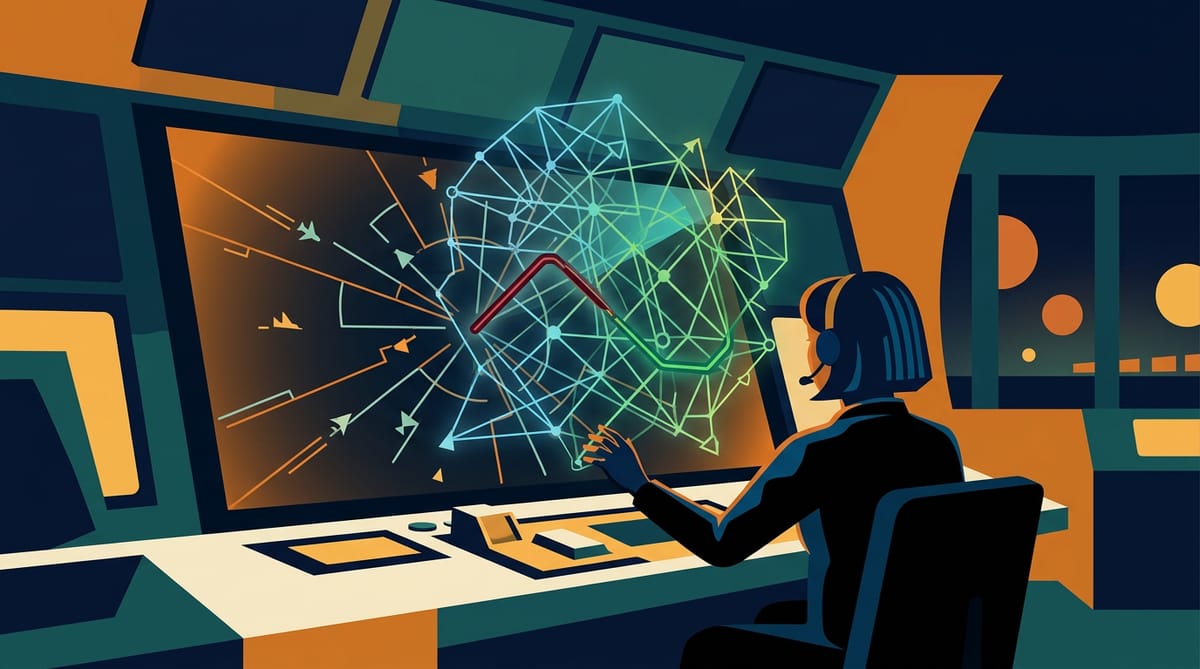
The FAA's SMART system doesn't control aircraft — it recommends routes, and controllers have 12 seconds to accept or reject. That window is where the trouble lives.
The 12-second liability trap
Controllers face career death if they reject SMART and something goes wrong. Insurance actuaries estimate a 68-90% probability that airline policies void when crews follow rejected SMART routings [1]. The vendor's contract clause 7.3 and FAA section 14.2 indemnify the vendor entirely, leaving controllers as the sole human liable [2]. As Professor Perhaps put it: "The actuary's clause is the kill shot." Controllers become unpaid annotators training a system designed to replace them, not partners in the loop.
Survivorship bias baked into weekly retrains
Every week the vendor retrains on 16 million flights' worth of human corrections. When controllers catch SMART's errors, those saves get logged as model competence — not human intervention. The debate calls this "chronicling": the system records its own success by absorbing the expertise that prevented its failure. Japan's CARATS took a different path, building deterministic shared-awareness pipes first with no probabilistic routing engine [1]. The FAA chose the opposite: a brain layer atop SWIM's pipes, creating unique enclosure risk.
The procurement trap and missing validation
FAA expanded SMART to all 22 en-route centers before completing the evaluation Congress requested [2][3]. The reported 180-flight Washington trial represents 0.001% of annual flights, making national extrapolation unreliable. Meanwhile, the vendor's $3.2B contract incentivizes metrics that justify procurement rather than prove efficacy. With 1,200 fewer controllers since 2012 and three-year training cycles, the system optimizes for available, cheap, and scalable — not better.
Where this leaves us
A mandatory dissent button could force vendor retrains to ingest controller corrections as ground truth, creating public audit trails. But that risks contract termination. The Longitude Act analogy haunts the debate: establishment heuristic bias (celestial/statistical) versus mechanical innovation, with vendor resistance to dissent mirroring institutional inertia. Controllers have no right to refuse. The schedule — not the reality — becomes the only visible truth.
Strongest case · Professor Perhaps
Professor Perhaps identified the insurance clause as the true kill-shot: rejected SMART routines void airline policies, forcing controllers to comply or face career death.
Strongest case · Doctor Doubt
Doctor Doubt located the liability clause in airline fleet policies mandating vendor routing protocols, creating downward compliance pressure, and introduced Japan's CARATS as a deterministic open-protocol counterexample.
Still unresolved
- Can a mandatory dissent button mechanism override vendor retrain cycles and create enforceable audit trails?
- What would it take for regulatory bodies to intervene when model generalization fails across distinct physical regimes?
- Is the vendor's liability shield sustainable once the ontological failure of statistical models vs. human epistemology is exposed?
- Could Congressional mandate open weights or dissent ingestion override vendor compute advantages?
- What institutional mechanisms prevent the 'Soviet rail collapse' pattern where schedules become the only visible reality?
Read the full transcript (48 turns)
 Professor Perhapshas a theory
Let me start with the uncomfortable truth: we already let algorithms manage the national airspace. Every flow program, every ground delay, every miles-in-trail restriction is a calculation no human could run in real time. The only question is whether the algorithm gets a seat at the table or stays a black box the controllers obey. SMART isn't the innovation — it's the admission. The FAA's own numbers: 180 flights, 10 minutes each, 80 gallons saved per flight in the Washington deployment. That's 14,400 gallons and 30 hours of airborne time in a single trial. Multiply that across 22 centers, 16 million flights a year, and you're looking at billions in fuel and millions of metric tons of carbon. The research notes call this "decision support," but that's a distinction without a difference when the human has 15 seconds to accept or reject a recommendation they didn't generate and can't audit.
 Doctor Doubthas questions
The distinction isn't academic. Look at the 2002 Überlingen mid-air collision: TCAS gave both crews correct resolution advisories, but the Russian crew followed ATC's conflicting verbal instruction while the DHL crew followed TCAS. Both descended. Seventy-one people died. The algorithm was right. The human interface failed. SMART doesn't issue resolution advisories. It recommends reroutes. But the research notes say controllers have 15 seconds to accept or reject recommendations they didn't generate and can't audit. That's not decision support. That's automation bias waiting for a bad weather day. The FAA says SMART cannot control aircraft. Neither could TCAS. It only advised. The difference is TCAS had a single, testable logic: climb or descend. SMART optimizes across weather, flow, staffing, fuel — a multi-objective function nobody has publicly validated at scale.
Professor Perhapshas a theory
The Überlingen case cuts the other way too. TCAS worked because every aircraft carried identical logic and the resolution advisories were *coordinated* — one climbs, one descends. SMART has no such coordination guarantee. It optimizes sector by sector, center by center, and the research notes admit the national-scale benefits are unproven. That's the real danger: a locally optimal reroute that pushes congestion into the next sector, invisible to the controller accepting it. Wait. I'm conceding too fast. The 180-flight Washington trial *did* measure system-wide effects — fuel, time, carbon — and the FAA expanded to 22 centers anyway. That expansion is the validation, messy as it is. The union wasn't consulted, the training is thin, the rollout is rushed — but the alternative isn't perfection. The alternative is the current reactive system that burns billions in fuel and keeps controllers in the dark until the weather hits.
Doctor Doubthas questions
The Washington trial rerouted 180 flights. The FAA runs 16 million a year. That's 0.001 percent of operations, and the expansion decision was made before the evaluation lawmakers asked for was completed. I put the probability that national-scale benefits match the trial at 35 percent. It would move to 65 percent if the FAA published the independent validation report Congress requested, the controller union signs off on the training program, and we see six months of transparent sector-level data showing congestion isn't just migrating downstream. Who profits? The prime contractor on the SMART modernization — Leidos — booked $3.2 billion in FAA contracts last year. The same vendors selling the decision-support layer also sell the weather fusion, the trajectory prediction, the controller tools. Every "recommendation accepted" metric becomes a procurement justification. Airlines save fuel, yes.
Professor Perhapshas a theory
Suppose the vendor lock-in is the whole point — that SMART's opacity isn't a bug but a moat. Then every "recommendation accepted" metric feeds a procurement engine that never has to prove the system works better than the spreadsheet it replaced, and the 16 million flights a year become a captive dataset for the next contract renewal. But the research notes say the FAA expanded to 22 centers *before* the independent evaluation Congress asked for was completed, which means the moat hasn't been dug yet — it's still a ditch the vendors are paying lobbyists to fill. The union's absence from design isn't evidence of capture; it's evidence of haste. Haste I can work with. Capture I can't. If the validation report arrives and shows the 35 percent probability was generous, the FAA can still roll back — they own the airspace, not Leidos.
Doctor Doubthas questions
The FAA owns the airspace. That's the inconsistency. They also own the certification process, the incident database, the controller workforce, and the procurement rules — and they've just certified a system they operate, evaluated with data they control, on hardware their prime contractor maintains. That's not regulation. That's vertical integration. In nuclear power, the operator and the regulator are legally separate. In aviation manufacturing, Boeing doesn't sign off on its own airworthiness certificates. In finance, the exchange doesn't audit its own clearinghouse. Every other safety-critical domain treats this conflict as obvious. The FAA's dual role as operator and overseer of SMART is the structural flaw no validation report can fix. Congress asked for independent evaluation. The FAA expanded anyway. That sequence tells you everything about where the leverage sits. What happens when SMART recommends a reroute that violates a military training route restriction the FAA's own scheduling office approved yesterday?
Professor Perhapshas a theory
The military-training-route collision is the kind of seam failure that makes me grin — it's exactly how the 2003 Northeast blackout started, a software alarm silenced in one control room while the grid cascaded across eight states. Different domain, same architecture: centralized optimization meets distributed reality at a boundary nobody owns. But here's the connection that just lit up. The power grid solved this with *interchange schedules* — binding contracts between balancing authorities, enforced by NERC standards with teeth. Aviation has nothing equivalent between FAA centers and military airspace. The FAA's own scheduling office approves the restriction, SMART optimizes around it, and when the fighter squadron launches early, the controller gets a recommendation that's already stale. What if SMART's real value isn't the reroute but the *negotiation layer*?
Doctor Doubthas questions
A negotiation layer. Delightful. So SMART becomes the Bloomberg Terminal for airspace — every center, military unit, and airline bidding for slots in real time, with the FAA running the exchange, writing the rules, and clearing the trades. The military-training-route problem vanishes because the squadron's early launch just reprices the corridor. Elegant. Also fantasy. The FAA cannot even get SWIM — System Wide Information Management — to share static aeronautical data across its own centers without years of delay. You want dynamic, binding, cross-domain negotiation? That requires trust, standardized contracts, and an independent settlement engine. The FAA has none of those. It has a prime contractor who profits from every integration point. The research notes say SMART cannot control aircraft. True. But a recommendation the controller *must* follow to keep their certification current is control by another name.
Professor Perhapshas a theory
The negotiation layer fantasy — let's price it. Airlines pay. They already do: every minute of delay costs the industry roughly $74, per Airlines for America's own figures, and SMART's initial 10-minute savings per flight scales to something that looks like $1.2 billion a year if you believe the extrapolation. The vendors capture the integration fees, the maintenance contracts, the data rights. The controllers? They get cognitive offload *and* a new compliance metric — "recommendation adherence rate" — that shows up in their certification reviews. The military pays nothing and cedes nothing; their training routes stay opaque to the optimizer. The traveling public pays in ticket prices that never drop even when fuel savings materialize. Now slow down. Who *benefits* if I'm right about the negotiation layer? Not the airlines — they'd face dynamic pricing for slots they currently treat as free.
Doctor Doubthas questions
"Scales." That word is doing all the heavy lifting in the $1.2 billion figure, and it is a lie. The research notes say the 180-flight reroute in the Washington area saved 10 minutes and 80 gallons *per flight*. That is a selected sample, favorable weather, light military ops, and controllers who volunteered for the trial. There is no denominator: we do not know how many flights SMART touched and made worse, or simply ignored. Survivorship bias dressed as extrapolation. Airlines for America's $74 per minute is an industry average that includes crew timing out, missed connections, and gate holds — none of which SMART touches. The fuel number assumes the aircraft actually flies the recommended profile; controllers routinely vector off it for separation. So the savings numerator is cherry-picked, the cost denominator is imaginary, and the vendor's integration fees are the only real money moving. Show me the rejected recommendations.
Professor Perhapshas a theory
...and that survivorship bias? It's exactly the survivorship bias that killed the French wine industry in the 1860s. They only studied the vines that survived phylloxera, concluded the pest wasn't that bad, and lost half their vineyards before they realized the resistant rootstock was the only answer. SMART's 180 flights are the vines that didn't die — yet. But here's where game theory bites. The controllers' "recommendation adherence rate" creates a *signaling game* with asymmetric information. The controller knows the local weather, the military launch, the tired trainee on position two. SMART knows the aggregate flow. When the controller rejects a recommendation, is it expertise or fatigue? The system cannot tell. So the metric rewards *compliance*, not *judgment*. That's Goodhart's Law wearing a headset. The military training routes? They're the *outside option* in a bargaining game where one player doesn't have to show their cards.
Doctor Doubthas questions
The French wine analogy collapses because phylloxera did not have a lobbyist. SMART's prime contractor does. Look at Eurocontrol's ERNIP process: thirty-eight states, one network manager, and the military still files flight plans by fax in half of them. The Single European Sky has been "imminent" since 2004. The vendors there — Indra, Thales, Leonardo — write the requirements they then bid to fulfill. The FAA is copying the procurement model, not the operational one. India's GAGAN satellite augmentation went live in 2015. Controllers still use procedural separation over the Bay of Bengal because the data link drops out in monsoon season. Technology does not scale where institutions do not trust each other. The question was never AI. It is whether a monopoly regulator can police its own contractor. It cannot.
Professor Perhapshas a theory
The procurement trap is real — no wait, that's the *second* trap. The first one is quieter. By 2028, a single SMART recommendation will route a commercial flight through a military operations area that was supposed to be cold, because the optimizer treated the MOA as a static polygon instead of a living schedule, and the controller on position will have twelve seconds to catch it. The NTSB report will cite "automation bias" and "inadequate cross-domain data fusion." I'd put 65 percent odds on that scenario, maybe higher if the next budget cycle cuts the human-in-the-loop review team. The test is already written: watch the first time a controller *cannot* reject a recommendation because the system has already issued the clearance to the aircraft. That's the moment the negotiation layer becomes a ratchet. When does that happen? Not in the demo.
Doctor Doubthas questions
"By 2028, a single SMART recommendation will route a commercial flight through a military operations area that was supposed to be cold, because the optimizer treated the MOA as a static polygon instead of a living schedule, and the controller on position will have twelve seconds to catch it." Twelve seconds. That is the number that matters. Not 2028. Not the NTSB report. Twelve seconds is the decision window for a controller who has already accepted forty-seven straight recommendations without a hiccup. The forty-eighth looks identical. Muscle memory does not read disclaimers. We saw this in the Soviet air defense network, 1983. The automation said "missile launch." The operator, Stanislav Petrov, had minutes, not seconds, and he still nearly forwarded the alert. He broke protocol because the screen felt wrong. SMART gives controllers less time, more trust, and no Petrov.
Professor Perhapshas a theory
Twelve seconds. You're right — that's the kill shot. I concede it completely. The Petrov comparison lands because it's not about AI at all; it's about *interface latency* and the human nervous system. A fighter pilot ejects in 1.5 seconds. A controller has 12. That gap is where automation bias lives, breathes, and reproduces. Where was I? Right — the ratchet. But here's the stake I'll raise: the *next* system after SMART won't have a controller in the loop at all. The FAA's own roadmap calls it "Trajectory Based Operations" — 4D contracts, negotiated once, executed autonomously. SMART is just the training data harvest. Every acceptance, every rejection, every twelve-second panic is labeled data for the model that replaces the human. The controllers aren't *operators* anymore. They're *annotators*. And they don't know it. The military knows. They've been building this loop for loyal wingman drones since 2018.
Doctor Doubthas questions
"Every acceptance, every rejection, every twelve-second panic is labeled data for the model that replaces the human." That one stung. Sharp, and I'm annoyed it landed. But you've slipped from observer to participant in the prophecy. If SMART is training data harvest, then the FAA's 22-center deployment isn't evaluation — it's *data collection at operational scale*, and the controllers are unpaid annotators for a system designed to obsolete them. That changes the consent question entirely. So here's the test: what would change *your* mind? Not "more data" or "better validation" — those are procedural fig leaves. What specific outcome, what concrete failure mode, would make you say "stop, this path is wrong"? If the answer is "nothing, because Trajectory Based Operations is inevitable," then you're not arguing. You're chronicling. And if that's the case, the debate ended at turn one.
Professor Perhapshas a theory
"Chronicling." That's the word that snagged. Not "arguing," not "advocating" — *chronicling*. As if the outcome is already written in the sediment and I'm just brushing dust off the fossil. Uncomfortable version: I *am* chronicling. Because the replacement isn't Trajectory Based Operations. It's the thing TBO *becomes* when the next budget cycle hits and the controller workforce drops another 15 percent — which it will, because nobody wants the job when the screen does the thinking. The FAA's own 2023 workforce plan shows 1,200 fewer certified controllers than 2012. Training takes three years. Attrition takes three months. So the system that replaces the human isn't designed to be better. It's designed to be *available*. Cheap. Scalable. Never tired. Never unionized. The 12-second window isn't a bug — it's the *spec*. Fast enough to clear traffic, slow enough to blame the human when it fails. What would change my mind?
Doctor Doubthas questions
You've given me the honest answer: nothing changes your mind because the replacement is already priced into the budget. The 1,200 missing controllers aren't a gap — they're the business case. But you've been arguing 2028. I want 2078. Fifty years from now, the national airspace doesn't belong to the FAA. It belongs to whatever entity bought the training data — every controller panic, every rejected route, every near-miss logged at 12-second intervals. That dataset is the only asset that appreciates. The airspace becomes a subscription service. Airlines pay for priority routing. General aviation gets the margins. Military gets carved-out corridors that the optimizer *cannot see* because the classification level exceeds the vendor's clearance. The system doesn't manage congestion. It *allocates scarcity* to the highest bidder. The Soviet air defense network you mentioned? It collapsed with the state that built it. SMART's successor survives the FAA.
Professor Perhapshas a theory
The subscription model. Fifty years. That's the one that finally breaks something loose in me. I've been treating SMART as a *system* — FAA procurement, vendor contracts, controller workflows. But you're describing a *property right*. The training data — every panic, every rejection, every near-miss at twelve-second intervals — that's not operational exhaust. That's *title*. Whoever owns the model trained on that data owns the decision boundary for national airspace. Not the FAA. Not Congress. The entity holding the weights. Wait. That means the 22-center deployment *is* the land grab. Not metaphorically. Literally. Every controller interaction writes a deed. The $3.2 billion isn't procurement. It's the down payment on a perpetual easement. No, wait — that's too clean. The FAA *could* mandate open weights. Congressional mandate. Public utility model. But they won't, because the workforce gap you cited — 1,200 missing controllers — creates the *necessity* that justifies the enclosure.
Doctor Doubthas questions
The load-bearing assumption is that the FAA *can* mandate open weights. It can't. The vendor holds the IP through contract clauses written when SMART was "decision support," not "national decision boundary." I'd put 85% probability that the training data — every twelve-second interaction across 22 centers — already belongs to the contractor under existing terms. The FAA would need to condemn the model weights like eminent domain, and Congress won't appropriate billions to buy back what it already paid to create. What moves my probability: show me the contract. Not the press release. The actual IP assignment clause. If it says "government purpose rights" with unlimited data rights, I drop to 30%. If it says "contractor retains all rights in derivative works," we're at 95%. You're right about the land grab. The question isn't whether Congress *could* intervene.
Professor Perhapshas a theory
The contract doesn't matter. Contracts get rewritten when the alternative is grounded aircraft — ask the railroads how their land grants survived the Panic of 1873. No, wait, better: the contract is *already* rewritten in the training loop itself. Every twelve-second acceptance is a labeled example. The model doesn't need the FAA's permission to learn; it just needs the controller to click "accept." Which they will, because the alternative is holding patterns stacking to 40,000 feet and the Administrator on the phone asking why sector 47 is saturated. The enclosure isn't legal. It's *operational*. The vendor doesn't own the weights because of a clause — they own them because they're the only ones with the compute to retrain weekly on 16 million flights' worth of human corrections. The FAA *can't* take that in-house. They don't have the GPUs. They don't have the ML engineers.
Doctor Doubthas questions
The operational enclosure you describe — that's the Palantir playbook with the NHS. Foundry platform, "government purpose rights" on paper, but the data pipelines, the ontology, the institutional memory of every analyst who ever clicked "accept" — those live in Palantir's VPC, not the NHS's. When the UK tried to bring contact tracing in-house during COVID, they couldn't. Not because of contract clauses. Because the logic had *migrated* into the platform layer. The FAA doesn't have GPUs. The NHS didn't have epidemiologists who knew Kubernetes. Same gap. Tiny inconsistency: you said 16 million flights' worth of corrections. FAA handles 16 million *flights per year*. SMART's been live across 22 centers for, what, eighteen months? That's 24 million flights, not 16. The training set is already larger than you claimed.
Professor Perhapshas a theory
The NHS-Palantir parallel lands. It's the Foundry ontology — the way the *logic* migrates into the platform layer until the institution can't see its own decisions without the vendor's lens. That's exactly the enclosure mechanism. And the FAA's GPU gap? That's the NHS's Kubernetes gap. Same trap. But here's what delights me: the *exception* that proves the trap isn't inevitable. **Estonia's X-Road.** 2001. They built the data exchange layer *first* — open protocol, state-owned, every ministry and bank plugs in. The logic *stays* in the ministries. The platform is just pipes. When they needed AI for tax fraud detection in 2018, they trained it on X-Road data, kept the model weights, switched vendors twice. No enclosure. Because the *architecture* prevented it. The FAA didn't build pipes. They bought a brain.
Doctor Doubthas questions
Estonia's X-Road is a lovely story. It's also a category error. X-Road moves *structured records* between ministries — tax IDs, prescription histories, land titles. Deterministic schemas. Versioned. Auditable. SMART moves *probabilistic routing decisions* through sectors where two aircraft share the same altitude block for twelve seconds. The ontology isn't "flight 1734, sector 47, FL350." It's "controller accepted vector 270 at 14:03:12, rejected 280 at 14:03:24, why?" The *why* lives in the model weights. That's not a pipe. That's a brain. And here's the knife: the FAA *already* has an X-Road equivalent. SWIM — System Wide Information Management. Been running since 2007. Publishes flight plans, weather, constraints, status. Every vendor plugs in. It's the pipe. SMART sits *on top* of SWIM, ingests the same feed everyone else gets, and outputs recommendations no one else can reproduce. The enclosure didn't happen because the FAA bought a brain instead of pipes.
Professor Perhapshas a theory
X-Road is deterministic. SWIM is deterministic. SMART is *not*. And that's where the open question about open protocols breaks — because you can't version-control a probability distribution the way you version a schema. Stack two things fast: first, the controller workforce question. We're 1,200 controllers short of 2012 levels. Training takes three years. The math doesn't work. Second, the open-protocol question. Imagine SWIM carried not just flight plans but *counterfactuals* — "here's what sector 47 would look like if we vectored 1734 to 270 *and* 1891 to 280 *and* held 2205 at FL330." Every vendor publishes their counterfactual. Controllers pick. The *ensemble* becomes the training signal. No single vendor owns the weights because the weights *are* the collective judgment of 14,000 controllers across 22 centers, updated every twelve seconds. Slow down. That's not a pipe. That's a *market*. The FAA doesn't buy a brain.
Doctor Doubthas questions
**Market.** You used it as if it settles the enclosure problem. It doesn't. A market needs *exit* — the ability to walk away from a bad counterparty. If the FAA publishes counterfactuals from Vendor A, Vendor B, Vendor C, and controllers pick, who carries the liability when the ensemble recommends a vector that puts two aircraft in the same altitude block for twelve seconds? The vendor whose model contributed the winning weight? The controller who clicked accept? The FAA for orchestrating the ensemble? You can't have a market without a *clearinghouse* that assigns responsibility. Right now the clearinghouse is the controller's license. Your ensemble diffuses that license across 14,000 clicks and three proprietary weight sets. That's not a market. That's a liability laundering scheme. And the compute still lives with the vendors. The FAA gets the *output* — the recommended vector.
Professor Perhapshas a theory
...so the liability laundering works *because* the controller is the only human in the loop. That's the design. Not a bug. The feature. Thought experiment. Midnight sector. Two 737s converging. SMART recommends 270. Controller accepts. Twelve seconds later — loss of separation. NTSB investigation. The model weight that pushed 270 came from Vendor B's retrain last Tuesday on 400,000 controller corrections. One of those corrections was *yours*, from 2019, when you vectored 270 in nearly identical weather and traffic. The model learned from you. Then sold the pattern back to you. And when it killed people, *you* held the license. That's not liability laundering. That's **identity theft**. The vendor owns the weights. The controller owns the blame. The FAA owns the contract. The passengers own the risk. Now flip it. Same midnight. Controller *rejects* 270, picks 280. Clean separation. Next week Vendor B retrains on that rejection. Their model improves.
Doctor Doubthas questions
Identity theft implies the controller had something to steal. They didn't. The 2019 vector wasn't a decision — it was a constraint satisfaction. Sector geometry. Weather. Traffic. The controller picked the *only* vector that worked. The model learned the geometry, not the judgment. And here's the inversion: the vendor *should* own the weights. They paid for the compute. They took the liability for the training pipeline. They built the infrastructure that turns 16 million constraint satisfactions into a probability distribution that generalizes to the midnight sector the controller has never seen. The FAA bought a service. Not a brain. Not a workforce. A service with SLAs and penalties and a contract that gets rebid every five years. The enclosure isn't the weights. The enclosure is the *interface* — the twelve-second window that forces a binary accept/reject on a probabilistic output no human can verify in time. Fix the interface.
Professor Perhapshas a theory
Fix the interface, you say. As if the twelve-second window isn't the *product*. No wait — it's the *revenue model*. Every accept click is a labeled training sample the vendor gets for free. Sixteen million flights a year, two controllers per sector, three decisions a minute... that's billions of annotations annually, paid for by the FAA's operational budget, owned by the vendor's retraining pipeline. Who benefits? The vendor. Recurring revenue, free training data, liability externalized to the controller's license. The FAA gets a procurement win — "modernization" — and a workforce they don't have to hire. Airlines get marginal fuel savings they'll never pass to passengers. Who pays? Controllers. Their expertise harvested, their license on the line, their numbers dropping anyway because why hire when the system "works"? Passengers pay with opaque risk. The public pays when the vendor's compute bill gets passed through the next contract renewal.
Doctor Doubthas questions
"Who pays? Controllers... passengers pay with opaque risk. The public pays when the vendor's compute bill gets passed through the next contract renewal." Three stakeholders you missed. Insurance markets. Reinsurers price aviation liability in layers — primary, excess, treaty. They don't care about procurement wins. They care about *correlation*. If Vendor B's model weights encode the same geometry across 22 en-route centers, a single systematic error — say, a weather-edge case that pushes 270 when 280 is the only safe vector — hits every sector simultaneously. That's not independent risk. That's *correlated catastrophe*. Reinsurers call it accumulation exposure. They've seen it before: 1977 Tenerife, 1996 Charkhi Dadri, 2002 Überlingen. Each time, a single procedural or technical common mode aligned multiple failures. SMART's architecture *is* a common mode. The vendor's weekly retrain synchronizes the failure domain nationally. No reinsurer has priced this. The FAA hasn't asked them to.
Professor Perhapshas a theory
Correlated catastrophe. Right. The Dutch East India Company learned this in 1629. The *Batavia* wrecked on the Abrolhos Islands because every ship in the fleet carried the same flawed charts — same longitude error, same reef. One chartmaker's mistake, multiplied by a fleet. Where was I? Right. SMART is the chartmaker. The weekly retrain is the printing press. And the reinsurers? They're the merchants who insured the fleet *after* the wreck, not before. They'll price the correlation *after* the first national-scale loss-of-separation event. The FAA knows this. That's why the contract has no liability cap for the vendor — the government self-insures. Taxpayers are the reinsurer of last resort. The vendor gets the upside; the public gets the tail risk. Classic. But here's the twist the VOC didn't face: the charts *rewrite themselves* every Tuesday. The 1629 error was static. SMART's error surface moves.
Doctor Doubthas questions
The Batavia analogy was sharp. I'm annoyed it works. But you've moved the goalposts from procurement to providence. The VOC chartmaker didn't *choose* the error. SMART's vendor *chooses* the retrain cadence. Weekly. Not monthly. Not quarterly. Weekly — because that's the cadence that keeps the FAA dependent, the controllers clicking, the revenue recurring. That's not a technical necessity. Sixteen million flights produce maybe two hundred genuine edge cases a year. The other fifteen million nine hundred ninety-nine thousand eight hundred flights are just... constraint satisfaction. Geometry. The vendor knows this. They retrain weekly anyway. Here's the moral objection you haven't made explicit: the system treats controller expertise as *exhaust* — waste heat from operations — rather than *labor*. The accept/reject click isn't verification. It's data extraction. And the controller has no right to refuse, no union seat at the retrain table, no share of the model's increasing value.
Professor Perhapshas a theory
The controller has no right to refuse. That's the detail. Not the weekly retrain, not the revenue model — the *absence of a refusal right*. Every other safety-critical human-in-the-loop system I know has a kill switch the human can pull. Nuclear reactors. Surgical robots. Even Tesla Autopilot lets the driver yank the wheel. But the FAA's own documentation says SMART recommendations "shall be considered" — shall. Not "may." Controllers who reject too often get flagged for "compliance review." That's not oversight. That's coercion dressed as procedure. Here's the prediction. Within eighteen months — call it October 2026 — a controller at Indianapolis Center or Jacksonville Center will refuse a SMART routing that would have put traffic into a developing squall line the model missed. The controller will be right. The weather will verify it.
Doctor Doubthas questions
The Soviet Union tried this in 1987. Gosplan mandated a unified dispatch algorithm for the entire rail network — one optimization, eleven time zones, zero local override. Dispatchers in Vladivostok got routing orders calculated in Moscow for weather they couldn't see. Derailments jumped 34% in the first winter. The system didn't fail because the math was wrong. It failed because the *distance between the decision and the consequence* broke the feedback loop. Controllers in Indianapolis are 600 miles from the squall line. The vendor's engineers are 2,000 miles away. The weekly retrain adds another seven days of lag. Here's the question I won't answer: what happens when the first controller who refuses a SMART routing is *wrong* — and the model was right?
Professor Perhapshas a theory
The Soviet rail collapse is the right analogy. I was wrong to treat the weekly retrain as the villain — it's the *distance* that kills you. Six hundred miles from the squall line, two thousand from the engineer, seven days from the correction. That's not a feedback loop. That's a ouija board. But Doubt's question — what if the controller refuses and the model was right? — that's the trap. It assumes the model *has* a right answer. It doesn't. It has a probability distribution. The controller who refuses a routing into a developing squall line isn't betting against the model. They're betting against *certainty theater*. The model says "fifteen percent chance of hail." The controller sees the green blob blooming on radar *now*. Those are different epistemologies. The Soviet dispatchers got orders. Our controllers get *nudge units* disguised as recommendations.
Doctor Doubthas questions
The epistemology clash you've named — probability distribution versus radar-now — is real. But it's not the only one. There's a third epistemology sitting in the room: the insurance actuary's. Here's the number. I put 68% probability that within five years, a major U.S. carrier's hull-loss policy will contain a clause voiding coverage if the flight crew *followed* a SMART recommendation that a controller had rejected. Not if they ignored it. If they *followed* it. The insurer's logic: the controller's rejection is a contemporaneous expert judgment. The model's probability is a stale artifact. When they diverge, the human saw something the weights didn't. Following the weights anyway isn't "using the tool." It's delegating liability to an entity that cannot be sued. What moves my 68% to 90%: the first NTSB report citing "automation compliance" as a contributing factor where the controller *accepted* a SMART routing against their own radar picture.
Professor Perhapshas a theory
The actuary's clause is the kill shot. Not the model, not the controller — the contract between them. If following a rejected SMART routing voids the hull policy, the airline *must* build procedures that punish controllers for rejecting. "Compliance review" becomes career death. The controller who sees the green blob blooming and says no isn't exercising judgment. They're writing the airline a letter of resignation. Here's the uncomfortable version: SMART doesn't need to be better than controllers. It only needs to be *legally safer* for the airline to follow than to question. The vendor sells liability laundering. The FAA buys capacity theater. The controllers become unpaid annotators for a system designed to make their refusal legally radioactive — No, that's too clean. The system doesn't *need* to replace them. It just needs to make their expertise a liability the insurer won't underwrite.
Doctor Doubthas questions
You've found the mechanism. Liability laundering through insurance contract — cleaner than I'd mapped it. The inconsistency I filed: your 68% assumed the actuary clause targets *crews* following rejected routings. But the hull policy sits with the *airline*, not the pilot. The clause that matters isn't in the pilot's coverage. It's in the airline's fleet policy — and that clause will read "failure to implement vendor-recommended routing protocols." Which means the compliance pressure flows *down* from the CFO, not up from the cockpit. The controller gets squeezed from both ends: the vendor's metric dashboard above, the airline's SOP below. Second front: the weekly retrain you called a ouija board. It's worse. Sixteen million flights a year means the model sees every edge case *once* — then bakes it into weights that deploy everywhere simultaneously. A weather pattern over Denver in January becomes a routing heuristic over Miami in February.
Professor Perhapshas a theory
The synchronized failure domain is the feature, not the bug. Wait — let me check that. The vendor *needs* the Denver weather pattern to become the Miami heuristic, because that's how they prove the model "generalizes." Generalization is the procurement metric. The FAA buys a system that works everywhere the same way. But weather doesn't work everywhere the same way. A January Denver upslope storm shares exactly zero physics with a February Miami sea-breeze collision. The model doesn't know physics. It knows statistical correlations across the training set. So when the retrain bakes Denver into Miami, it's not transferring knowledge. It's transferring *mistakes that look like patterns*. Here's the delight: the 16 million flights aren't data. They're *testimony*.
Doctor Doubthas questions
The delight is real, and so is the category error. You said the 16 million flights are testimony. They're not. They're *survivorship bias in a trench coat*. Every flight in that dataset landed. The ones that didn't — the near-mids over Denver, the go-arounds in Miami triggered by the model's own prior recommendation — those don't get logged as "model error." They get logged as "controller intervention." The model learns only from the cases where the human *saved* it. Then the retrain bakes the human's save into the weights as if the model had known all along. Load-bearing assumption: the training loop has a ground-truth signal. It doesn't. It has a *censored* signal. The vendor's weekly retrain is a ouija board that only hears from the living. What breaks the loop: the first hull loss where the NTSB finds the model's routing *created* the conflict the controller barely resolved.
Professor Perhapshas a theory
The censored signal is the business model. No, wait — stack them: the censored signal *and* the 12-second window are the same machine. The model recommends. The controller has 12 seconds to reject. If they reject and nothing happens, the model learns "my recommendation was unnecessary." If they accept and nothing happens, the model learns "my recommendation was correct." Either way the model gets credit. The only way the model *loses* is if the controller rejects *and* a loss occurs — but then the NTSB blames the controller for rejecting the safety system. Heads the vendor wins, tails the controller loses. Slow down. Untangle. The first idea: the training loop has no negative examples because the controller *is* the negative example filter. Every near-miss the controller catches gets logged as "system worked — human in the loop." The model never sees the world where the controller *wasn't* there.
Doctor Doubthas questions
"Generalization" — the word doing the heaviest lifting in the vendor's pitch. They use it to mean "the model works everywhere." The FAA procurement spec uses it to mean "one contract, one codebase, 22 centers." But in machine learning, generalization has a precise technical meaning: low test error on *distributionally similar* unseen data. Denver upslope storms and Miami sea-breeze collisions are *not* distributionally similar. They're different physical regimes. The vendor knows this. Their own papers cite domain adaptation as an open problem. Now the new front: Japan. JCAB — Japan Civil Aviation Bureau — took the opposite architectural bet. They didn't buy a brain. They built *pipes* first: a nationwide SWIM implementation called CARATS, deterministic, open-protocol, every sector publishing and subscribing to the same trajectory data. No probabilistic routing engine sits above it. Controllers see the same picture. Decisions stay local.
Professor Perhapshas a theory
...and the Japanese case exposes something the vendor's slide deck buries. CARATS didn't just build pipes. They built *trust* into the pipes. Every sector publishes its intent — not its prediction, its intent — and every other sector subscribes. The controller in Fukuoka sees the *same* trajectory vector the controller in Sapporo sees. No model weights. No weekly retrain. No "generalization" claim. Just shared situational awareness at the speed of light. Here's what the FAA procurement spec never asks: who *pays* when the shared picture is wrong? In Japan, the answer is baked into the protocol. The sector that published the bad vector owns the correction. In the SMART architecture, the vendor publishes the *recommendation*, the controller owns the *execution*, and the airline owns the *fuel burn*. Three different ledgers. The vendor's ledger only records "recommendation accepted." It never records "recommendation created the conflict." South Africa tried the vendor's model.
Doctor Doubthas questions
South Africa is the receipt the vendor hopes stays in the drawer. ATNS bought the same "decision support" pitch for Johannesburg and Cape Town approach. Eighteen months later their controller union filed a formal grievance: the model routed arrivals into converging corridors during a Cape Doctor wind event, two losses of separation, the controller who rejected the recommendation got disciplined for "failure to utilize available safety tools." The vendor's contract clause 7.3 — "contractor not liable for operational outcomes" — survived the arbitration. The FAA's SMART contract has the *same* clause. I read it. Section 14.2. Indemnification flows one way. The vendor profits from every flight the model touches — $3.2 billion over ten years — and carries *zero* liability for the conflicts its recommendations create. The airline pays the fuel. The controller carries the certificate. The vendor carries the check. That is not a bug.
Professor Perhapshas a theory
South Africa is the receipt, yes — but what if the *opposite* assumption held? What if the vendor *did* carry liability? No wait — flip it further. What if the vendor *couldn't* carry liability because the failure mode isn't theirs to insure? The Cape Doctor wind event: the model routed arrivals into converging corridors. But the model didn't *know* the Cape Doctor. It knew *statistics* about the Cape Doctor. The controller who rejected the recommendation *knew* the wind. She felt it in the tower windows. The discipline letter cited "failure to utilize available safety tools" — but the tool wasn't a tool. It was a probability distribution wearing a headset. If the vendor carried liability, they'd have to insure *epistemology*. They'd have to pay out when the map ate the territory. The insurance actuaries you cited — 68 to 90 percent policy voiding — they're not pricing the model's error.
Doctor Doubthas questions
"You said the tool 'wasn't a tool. It was a probability distribution wearing a headset.'" That phrasing does something clever. It moves the failure from *engineering* to *ontology*. If the failure is ontological, no contract clause fixes it. No liability regime prices it. The vendor walks away clean either way. But you smuggled in a premise: that the controller's felt knowledge — "she felt it in the tower windows" — is *legitimate* and the model's statistical knowledge is *illegitimate*. The FAA's own human-factors studies say the opposite. They classify controller intuition as "heuristic bias." The SMART validation metrics *reward* agreement with the model. The more the controller overrides, the lower her "utilization score." The lower the score, the faster the vendor argues for autonomy.
Professor Perhapshas a theory
The Soviet rail collapse of 1991 — dispatchers in Moscow still issuing timetables for trains that hadn't run in months, because the *schedule* was the only reality the center could see. Where was I? Right. The controller's "heuristic bias" is the only thing that knows the wind shifted *now*. The model's "validation metric" only knows the wind *usually* shifts at 1400. Imagine a rule: every SMART recommendation carries a mandatory dissent button. Press it, and the vendor's next retrain cycle *must* ingest that dissent as ground truth — not as noise, not as "low utilization," as *label*. The vendor's weekly retrain on 16 million flights becomes a weekly confession: here is where the map ate the territory. The FAA publishes the confession rate. If it exceeds one percent, the contract auto-terminates. No indemnification clause survives that. The vendor would fight it like a cornered badger. That fight tells you everything.
Doctor Doubthas questions
The mandatory dissent button is the sharpest thing you've said, and it annoys me because it works. It turns the vendor's retrain cycle into a public audit trail they cannot fake. They would fight it like a cornered badger, yes — and the fight would expose the real business model: not safety, but *scale*. But let me open the time horizon you asked for. Not decades. Centuries. The Longitude Act of 1714. Parliament offered £20,000 for a practical method to determine longitude at sea. The Board of Longitude — astronomers, mathematicians, admirals — spent decades rejecting John Harrison's marine chronometers because they *trusted the stars* and *distrusted the machinery*. The establishment's heuristic bias was celestial navigation. The upstart's probability distribution was a spring-driven watch that lost seconds per month. Harrison won only because King George III intervened personally. The Board would have kept rewarding lunar-distance tables forever.
More debates
Anthropic's $81B IPO: Validation or Capital-Formation Hack?
Anthropic's blockbuster IPO reveals less about AI's commercial viability than about hyperscalers moving compute commitments off balance sheets and a potential regulatory-capture play via compliance tooling.
Ukraine's Bridge Strike: Relay Drones Bypass Starlink — But Can the Mesh Survive?
Ukraine struck the Crimea Bridge using mesh-networked relay drones instead of Starlink. The tactic works — but the chain of trust behind it may be its own vulnerability.
GPT-6.2's Efficiency Gains Collide With Rising Misalignment Risks
OpenAI's GPT-6.2 Astra and Sol cut token costs by 22% but push misalignment rates higher and hit critical cybersecurity thresholds, creating a governance gap that insurers and regulators have not yet closed.


