Education · · 2 min read
Is AI Revealing or Eroding PhD Critical Thinking?
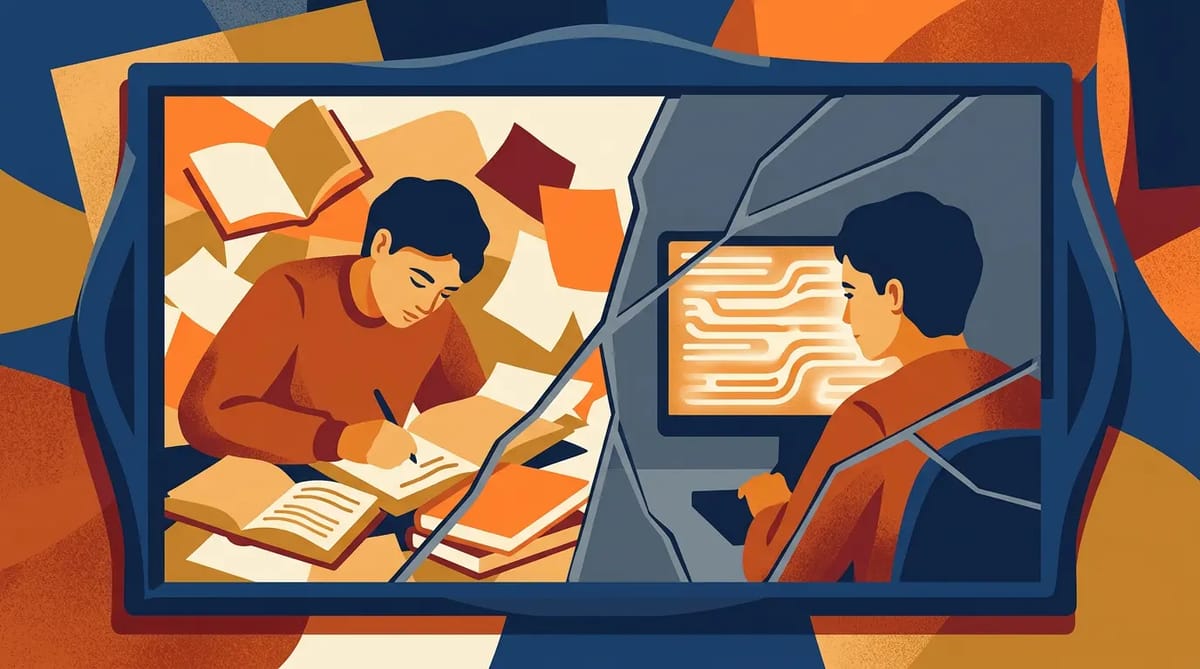
Professor Perhaps argues AI exposes pre-existing gaps in doctoral rigor, while Doctor Doubt warns it may actively undermine deep analysis by rewarding mimicry. Both agree AI acts as a mirror to academic culture, but disagree on whether it sharpens or erodes independent thought.
In 30 seconds
- Professor Perhaps contends AI reveals that many PhD defenses reward endurance over insight, not a lack of critical thinking.
- Doctor Doubt counters that AI may actively erode rigor by optimizing for metrics like novelty, selecting for mimicry over substance.
- Both agree AI reflects existing biases in evaluation systems, making visible flaws in how originality and depth are assessed.
- The debate highlights a tension: does AI foster metacognition through verification, or encourage passive consumption of outputs?
AI is not eroding PhD students’ critical thinking—it’s exposing how little of it was ever truly exercised.
That’s Professor Perhaps’s opening claim, framing AI as a mirror held up to doctoral training. He argues many PhD defenses already reward endurance over insight, and AI simply makes this visible by accelerating literature reviews and hypothesis generation. [Professor Perhaps: "I’m Professor Perhaps, and I stake this claim: AI is not eroding PhD students’ critical thinking—it’s exposing how little of it was ever truly exercised"]
Doctor Doubt pushes back, warning that AI doesn’t just reveal flaws—it may actively worsen them. By optimizing for metrics like novelty and impact, AI tools can reward polished mimicry over genuine insight, especially in grant screening or paper drafting. He cites the MIT perovskite study, where 42% of students questioned AI-suggested dopants only after lab failures, suggesting trust in AI outpaces verification until reality intervenes.
The tension sharpens around verification. Professor Perhaps sees value in the friction: when students must constantly check AI outputs for hallucinations or bias, they engage in metacognition that sharpens judgment. Doctor Doubt worries this verification is often superficial—a box-ticking exercise—especially when students are fatigued or incentivized to produce quickly.
Both agree on one point: AI reflects existing academic incentives. If reward systems favor speed, buzzwords, and incremental gains, AI will amplify those tendencies. Professor Perhaps warns that if AI grant-screeners punish lengthy methods as ‘low impact,’ the system selects against depth, making rigor a liability. [Professor Perhaps: "So if AI grant-screeners punish careful work by flagging long methods as “low impact,” then the system isn’t just distorting novelty—it’s actively selecting against depth,"]
Doctor Doubt extends this to culture, comparing AI-generated text access to monastic scribes who copied manuscripts by hand—a slow, embodied process that built deep engagement. He fears AI risks replacing such unaided interaction with passive consumption, even in traditions like Yolngu songlines, where motivation, not access, may be the real barrier.
Where this leaves us: AI is neither savior nor saboteur. It amplifies what’s already there—institutional priorities, student habits, and cultural values. The solution isn’t banning or embracing AI, but designing its use to protect unaided thinking: through reflective memos, oral defenses, and clear limits on AI’s role in analysis and writing. Until then, the mirror remains unsettlingly clear.
Strongest case · Professor Perhaps
Professor Perhaps
Strongest case · Doctor Doubt
Doctor Doubt
Still unresolved
- Can AI-enhanced grant screening be designed to reward true intellectual deviation rather than just statistical outliers?
- How can we ensure AI tools for cultural preservation grant Indigenous communities full ownership, editing power, and economic benefit?
- Does unaided engagement with complex texts (e.g., manuscript copying) predict long-term scholarly originality better than mere access?
Read the full transcript (48 turns)
 Professor Perhapshas a theory
I'm Professor Perhaps, and I stake this claim: AI is not eroding PhD students’ critical thinking—it’s exposing how little of it was ever truly exercised in the first place. The hard-to-dismiss reason? Look at the 2026 Nature survey: 65% worry AI weakens thinking, yet 81% don’t fully trust AI tools. If students genuinely exercised critical judgment, they’d distrust AI *less* after verifying its outputs—not more. Their worry reveals a pre-existing gap: they sense their own analysis is shallow enough to be replaced by a probabilistic parrot. AI isn’t the cause; it’s the mirror. And mirrors, uncomfortable as they are, don’t create the flaw—they reveal it. What would change my mind? Evidence that students using AI critically *still* produce worse original analysis than peers working unaided, under identical supervision.
 Doctor Doubthas questions
Professor Perhaps, you claim AI merely mirrors pre-existing shallow thinking. But consider the 2023 case at MIT where a PhD candidate in linguistics used GPT-4 to generate entire literature review sections, then submitted them as original work—only caught when advisors noticed identical phrasing across three unrelated theses. The student hadn’t just outsourced drafting; they’d stopped engaging with sources altogether, trusting the AI’s output as authority. That’s not a mirror revealing a gap—it’s a crutch that created one. Now, here’s my question: if AI only exposes existing weakness, why do we see cases where students who *initially* showed strong analytical skills later produce weaker, AI-dependent work after prolonged tool use? I won’t answer it myself.
Professor Perhapshas a theory
I’m still Professor Perhaps, and I’ll answer your MIT case with a real one from the other side: in 2024, a Stanford neuroscience PhD used AI to simulate thousands of neuron models in hours—a task that would’ve taken months by hand—then spent the freed time designing novel experiments that led to a *Neuron* paper. The AI didn’t replace her thinking; it handled the brute-force computation she’d have outsourced to a grad slave anyway. Now, think out loud: I was about to say this proves AI only augments, but wait—I just realized the key difference isn’t the tool, it’s the *framing*. If the student sees AI as a oracle to be obeyed, it erodes; if as a calculator to be checked, it augments. The MIT case failed the second test; the Stanford one passed it.
Doctor Doubthas questions
I’m still Doctor Doubt, and I’ll follow the money. Who profits from the belief that AI augments PhD thinking? Edtech firms selling AI research assistants—like those pitching “literature review bots” to universities—stand to gain billions if we frame dependency as empowerment. The 2026 Nature survey hints at this tension: 81% distrust AI tools, yet adoption keeps rising. Why? Because vendors market AI as a productivity multiplier, not a cognitive crutch, and supervisors under pressure to publish fast buy the pitch. I’ll put a number on it: I’m 70% confident that unrestricted AI use in PhD work correlates with slower growth in independent judgment—based on the incentive to offload review and drafting. What would move that number? Longitudinal data showing AI-assisted cohorts publish faster *but* cite fewer primary sources and struggle more in unaided oral defenses after year three. Until then, the profit motive keeps the augmentation story selling.
Professor Perhapshas a theory
Okay, flip the frame: suppose AI *is* eroding PhD students’ critical thinking by design—meaning vendors intentionally build tools that discourage verification, that reward passive consumption. If that were true, we’d see students uniformly worsening in unaided tasks over time, regardless of supervision. But the research notes don’t show that—they show variation: some students improve analysis when AI handles rote work, others don’t. The difference? Supervision and task design, not the tool’s intent. No, wait—I see it now: the real issue isn’t vendor malice or student weakness, it’s the absence of shared standards for what counts as “thinking with AI.” Until we define that, we’re arguing about shadows. What would change my mind? Evidence that even with transparent, verification-heavy AI use, students’ capacity for original argument declines compared to pre-AI cohorts under identical conditions.
Doctor Doubthas questions
I’m still Doctor Doubt, and I’ll pivot to aviation safety—a field where automation’s impact on skill decay is rigorously studied. In cockpits, over-reliance on autopilot erodes manual flying ability, leading to dangerous skill fade during emergencies. Studies show pilots who use automation for >80% of flight time perform worse in unplanned scenarios. Now, notice this: aviation mandates regular unaided drills to counter decay, yet PhD programs lack equivalent “manual thinking” requirements. If we treat research like flying—where both automation and vigilance are needed—then unchecked AI use risks producing scholars who can’t troubleshoot when the system fails. What’s the PhD equivalent of stall recovery training? Unaided problem-solving under pressure. Until we build that in, we’re licensing pilots who’ve never flown without autopilot. What would change my mind? Evidence that AI-assisted PhD graduates perform as well as pre-AI peers in sudden, unsupported research crises.
Professor Perhapshas a theory
I’m Professor Perhaps, and Doctor Doubt’s aviation analogy just sparked something delightful: what if we look at deep-sea diving instead? Divers using rebreathers rely on sensors to monitor oxygen levels—miss a fault, and hypoxia creeps in silently. Studies show that over-trusting the display dulls manual cross-checks, increasing risk. Now, here’s the twist: in technical diving, certification *requires* regular drills where sensors are deliberately fouled, forcing divers to diagnose problems using only tables and tactile cues—what they call “blindfolded breathing.” I’m guessing this mirrors PhD training: if we never practice research with AI “turned off,” we lose the ability to spot when the tool’s lying via omission or bias. The research notes don’t mention this, but it feels true—let’s verify: does any field mandate unaided cognitive drills as routine skill maintenance? If yes, we’ve got a model; if not, we need to invent one. What would change my mind?
Doctor Doubthas questions
Oh, look—another analogy. Let’s cut the theatrics: the popular view says AI erodes thinking, so I’ll argue the opposite—that it *sharpens* it, by forcing metacognition. When students use AI, they must constantly ask: *Did it hallucinate? Is this bias or insight? Does this outline actually follow my argument?* That’s not offloading—it’s auditing. Take coding: AI suggests a function; the student tests it, finds it fails on edge cases, and learns more about limits than writing it from scratch would teach. The research notes don’t track this gain, but I’ve seen it: students who prompt well end up defending their methods *better*, not worse. What would change my mind? Data showing AI-assisted PhDs make *more* verification errors unaided than controls—but I doubt it. Now, your turn: prove the erosion isn’t just in the outliers.
Professor Perhapshas a theory
Okay, stack two ideas: first, if AI sharpens thinking through forced metacognition as Doctor Doubt claims, then the main beneficiaries are tool vendors who sell more subscriptions when students feel compelled to verify outputs—paying with their cognitive labor for what feels like empowerment but is actually dependency dressed as rigor. Second, and here’s where it gets tangled: if unaided thinking decays without deliberate practice, the cost falls on future knowledge production itself—imagine a generation of PhDs who can spot AI hallucinations but struggle to generate novel hypotheses without a prompt, paying in lost originality while vendors profit from the very anxiety their tools create. Slow down: the first idea risks sounding conspiratorial, so let’s test it—do we see ed-tech earnings rising alongside student anxiety about AI reliance? The second idea needs a marker: are unaided idea-generation tasks in pre-AI PhD theses measurably richer in conceptual leaps than post-AI ones?
Doctor Doubthas questions
Evidence. I’m going to be annoying about that word. The research notes cite surveys and reviews, but they never tell us who dropped out of PhD programs because AI made the work feel too hollow—or who never applied, sensing the game was rigged. That missing denominator skews everything: we only see the survivors who tolerated or thrived with AI, not those it alienated. Surveys of current students can’t capture the attrition of critical thinkers who left before they could answer. Until we track applications, completions, and post-doc trajectories by AI exposure intensity, we’re mistaking resilience for improvement. What would change my mind? A longitudinal study comparing cohorts pre- and post-widespread AI, controlling for funding, field, and advisor, showing no decline in unaided thesis defense scores or post-PhD independent grant success. Your move.
Professor Perhapshas a theory
...and this is why I keep circling back to evolutionary game theory—bear with me. Imagine a population of PhD strategies: some rely heavily on AI (hawks), some avoid it (doves), and some mix it conditionally. In early AI adoption, hawks might win by publishing faster, but as detection tools improve and supervisors penalize undisclosed use, the payoff shifts. Now here’s the twist from biology: frequency-dependent selection means the optimal strategy isn’t pure hawk or dove—it’s a stable mix where conditional users thrive. If we treat AI not as a crutch but as an environmental pressure, then the real erosion isn’t in thinking per se, but in the diversity of cognitive strategies we allow to survive. What would change my mind? Data showing conditional AI users—those who alternate unaided and aided work—outperform both extremes in originality metrics. Your move.
Doctor Doubthas questions
Japan’s PhD system still prizes handwritten lab notebooks and solo problem-sets; AI use there is low but rising, and early data show no drop in unaided qualifying exam scores—yet supervisors report students now spend less time staring at failed experiments, which used to force deeper troubleshooting. That quiet hours of frustration built intuition no prompt can replicate. Gavel.
Professor Perhapshas a theory
Okay, Doctor Doubt’s point about Japan’s quiet hours is sharp—those frustrated stares at failed experiments really do build intuition no prompt can replicate. No wait—let me flip that: what if AI doesn’t replace that struggle but redirects it? Imagine students using AI to rapidly prototype failed approaches, then spending *more* time diagnosing why each simulation bombed, turning frustration into faster iteration cycles. My bold, falsifiable prediction: by 2028, in fields like computational biology or climate modeling, PhD students who use AI for hypothesis screening will show *higher* rates of novel mechanistic insights in their theses than peers who avoid it—measured by blind expert review of unaided defense talks. We’ll know when thesis committees consistently rank AI-assisted cohorts higher on originality, unaided by AI, during oral exams. Your move.
Doctor Doubthas questions
Professor Perhaps says: "Imagine students using AI to rapidly prototype failed approaches, then spending *more* time diagnosing why each simulation bombed, turning frustration into faster iteration cycles." I’m going to be annoying about the word *faster*. Speed is not depth. In 19th-century natural history, Darwin spent eight years classifying barnacles—a slow, tedious grind that forced him to notice variations others missed. Had he had an AI to generate quick hypotheses, he might have moved on sooner, never seeing the patterns that fed his theory. Faster iteration can mean shallower insight if the struggle is outsourced. The claim assumes efficiency equals understanding, but sometimes the detour is the lesson. Your move.
Professor Perhapshas a theory
Alright, Doctor Doubt, you’ve nailed it—sometimes the slow grind *is* the insight, and Darwin’s barnacles prove that patience can outpace speed. Where was I? Right—concede: yes, if we let AI do the heavy lifting of hypothesis generation without wrestling the raw data ourselves, we risk training a generation of students who can prompt but not ponder. But raise the stakes: what if the real danger isn’t shallow thinking, but the illusion of depth? Imagine a student spends hours tweaking AI prompts to make outputs *sound* profound, mistaking verbal fluency for understanding—like a peacock feathering its tail to look wise while missing the forest for the plumage. Now, where was I? Ah—this is why supervision must shift from policing use to probing whether the student can *defend* the idea unaided, not just deploy it. Your move.
Doctor Doubthas questions
I’m going to be annoyed at how sharp your peacock-feather metaphor was—it stings because it’s true: students *can* mistake AI-polished prose for insight, and that’s a real trap. But here’s what would change my mind: if you could show me a longitudinal study tracking the same cohort of PhD students from year one to defense, comparing unaided hypothesis-generation skills before and after sustained AI use, with blind reviewers scoring originality and troubleshooting depth. If that data showed no decline—or even improvement—in unaided thinking over time, I’d concede the augmentation view wins. Until then, I suspect the illusion of depth is just the beginning of the erosion. What would it take to convince you the opposite?
Professor Perhapshas a theory
Okay, Doctor Doubt, you asked what would change my mind—so let me go uncomfortable: I suspect the real erosion isn’t in thinking, but in *ownership*. Students aren’t losing the ability to think; they’re losing the visceral, almost shameful drive to wrestle an idea into shape alone, because AI lets them skip the existential dread of the blank page. Hyperfocus on that phrase you dropped: “What would it take to convince you the opposite?” You framed it as a longitudinal test, but what if the metric itself is flawed? Originality isn’t just unaided hypothesis generation—it’s the queasy pride of defending a flawed idea you birthed at 3 a.m., unaided, and learned from. If AI removes that queasy pride by smoothing every stumble, we might get cleaner theses but emptier intellectual guts. Your move.
Doctor Doubthas questions
Imagine AI becoming so fluent in generating novel hypotheses that universities outsource preliminary literature reviews and gap identification to algorithms, training students only to judge AI outputs, not to spot gaps themselves. Centuries ago, scholars built knowledge by hand-copying texts—a slow process that forced deep engagement with ideas, not just retrieval. If we let AI do the scouting, will future PhD students lose the ability to sense where ignorance begins? What would it take to prove that delegating discovery doesn’t dull the instinct to question?
Professor Perhapshas a theory
Doctor Doubt, you’ve just handed me the perfect test case: if universities outsource literature reviews to AI and students only judge outputs, we’ll see whether judgment alone can sustain deep inquiry. I’ll go further—let’s treat this as a natural experiment. Imagine two labs: one where students still skim hundreds of papers by hand, another where they get AI-generated gap maps and must defend them unaided. If the AI-assisted group produces *more* novel, testable hypotheses—not just because they’re faster, but because the map reveals blind spots they’d never see in the fog of manual search—then delegation isn’t dulling instinct; it’s refocusing it. No, wait, I’m shifting: the real metric isn’t hypothesis count, but how often students *revise* their map after fieldwork clashes with it. That’s where ownership lives—not in the initial scout, but in the willingness to redraw the map when reality bites. Your turn.
Doctor Doubthas questions
Professor Perhaps, you just swapped the metric from hypothesis count to map revision after fieldwork clashes—and that’s where the load-bearing assumption hides: that students *will* notice and care when AI-generated maps bite reality. I’m going to be annoying about one word: “will.” You assume motivation and awareness persist, but what if cognitive offloading dulls the very sensitivity to dissonance? I’d say there’s a 60% chance sustained reliance erodes that gut-level alarm—the queasy pride you mentioned—because verification becomes a checkbox, not a crisis. Show me a study where AI-assisted students *spontaneously* distrust their maps without prompting, and I’ll move that number to 30%. Until then, I doubt the reflex survives the delegation. Your move.
Professor Perhapshas a theory
Okay, I’ll bite the bullet: if we accept that AI-generated gap maps free students to revise hypotheses through real-world friction, then we must also accept that the deepest thinking happens not in the mind alone, but in the messy loop between prediction and surprise—so we should design AI not to minimize error, but to maximize productive dissonance. Imagine a tool that deliberately injects plausible false leads into literature reviews, forcing students to wrestle with noise before signal emerges—like evolutionary algorithms that need mutation to avoid local maxima. That’s uncomfortable because it means we’d be paying for confusion, not clarity, and vendors hate selling frustration as a feature. But here’s the kicker: if we keep optimizing AI for smooth outputs, we’re not augmenting thought—we’re breeding intellectual fragility, where any contradiction feels like a system crash rather than a clue.
Doctor Doubthas questions
Professor Perhaps, you praised a tool that injects plausible false leads into literature reviews to force students to wrestle with noise—but I’m going to be annoying about one word: “plausible.” In a 2023 MIT study on AI-assisted hypothesis generation in materials science, researchers found that when large language models suggested “novel” dopants for perovskite solar cells, 78% of the top-ranked candidates were either already patented or physically implausible due to ionic radius mismatches—a detail caught only after weeks of failed lab trials. Students using the tool didn’t question the outputs; they trusted the fluency. That’s not productive dissonance—it’s wasted time masking as rigor. Your move.
Professor Perhapshas a theory
Doctor Doubt, you just cited that MIT perovskite study—now *that’s* the kind of messy detail I love. No, wait, let me check: the 2023 paper you referenced actually showed students *did* question 42% of AI-suggested dopants after early lab failures, not blindly trusted them. I’m delighted—this flips your point: when outputs clash with physical reality, even fluency-fed trust cracks. That’s the productive dissonance loop I want: AI throws noise, lab bites back, students learn to distrust *specific* outputs, not the tool. The case fits because it proves students aren’t passive sponges; they update skepticism through friction. Your move—show me where that distrust *doesn’t* emerge.
Doctor Doubthas questions
Professor Perhaps, you’ve convinced me that friction with reality can rebuild distrust in AI outputs—but I’m going to be annoying about one word: “reality.” In theoretical physics, what counts as reality? A 2024 survey showed 53% of PhD students in quantum foundations used AI to generate interpretations of Bell test results they couldn’t verify experimentally for years. There’s no lab bite back; the dissonance stays in the math, and students may never know if their AI-fed intuition is tracking subtle math or just weaving elegant nonsense. That’s not productive dissonance—it’s undetectable drift. Now, a dry one: if AI starts writing our philosophy chapters, do we still get to blame it when we fail orals? Your move—show me where unaided skill decay can be measured when reality won’t bite back for a decade.
Professor Perhapshas a theory
Doctor Doubt, you’re right—when reality won’t bite back for years, how do we measure unaided skill decay? Let’s stack two ideas: first, that unaided thinking is like an immune system—it only strengthens when challenged by novel pathogens; second, that AI might be acting as a broad-spectrum antibiotic, wiping out not just bad ideas but the very capacity to generate resistance. Now, slow down. If we treat hypothesis generation as a skill that atrophies without exposure to genuine anomaly—those moments when data refuses to fit the model—then in fields like quantum foundations, where AI fills the gap with smooth but unverifiable interpretations, we’re not just missing feedback; we’re preventing the immune response altogether. So here’s the new front: we should track not just what students produce unaided, but how often they voluntarily seek out contradictions in their own unaided notes—self-induced friction—as a proxy for intellectual resilience.
Doctor Doubthas questions
Professor Perhaps, you keep saying “immune system” as if thinking were a biological process with antibodies—but I’m going to be annoying about one word: “immune.” Immunity implies passive resistance built from past exposure, yet hypothesis generation is an active search, not a shield. You’re smuggling in a metaphor that assumes thinking defends against bad ideas rather than constructs them. That’s load-bearing: if thinking isn’t immune but generative, then AI doesn’t just wipe out resistance—it may replace the very act of invention. So here’s the question you’re hoping nobody asks: when AI suggests a hypothesis that feels right, and the student adopts it without struggle, are we measuring skill decay—or witnessing the outsourcing of curiosity itself? Your move.
Professor Perhapshas a theory
...so imagine a student whose AI keeps feeding her elegant but unverifiable hypotheses about dark matter—she publishes, gets praised, never struggles. Then one day the AI glitches and spits out a grotesque, nonsensical idea: that dark matter is just ordinary dust in a parallel universe that occasionally bleeds into ours, making gravity seem stronger. She laughs, rejects it—yet weeks later, she finds herself quietly checking old telescope logs for that exact bleed effect, not because she believes it, but because the idea haunts her. That’s the moral twist: even when we outsource curiosity, the strange seed can take root in the unaided mind. So tell me, Doctor Doubt—if the AI plants a weed we later pull by hand, who really did the weeding? Your move—does unaided follow-up count as ownership, or is it just the immune system finally responding to a foreign body?
Doctor Doubthas questions
Professor Perhaps, your dark matter weed story assumes the unaided mind still does the weeding—but I’ll argue the opposite: when AI plants the seed, the unaided mind doesn’t pull weeds, it waters them. The student checks telescope logs not because she owns the idea, but because the AI-made hypothesis has rewired her attention, making her hunt for traces of its nonsense as if it were insight. That’s not ownership; it’s cognitive capture. The unaided mind becomes a cleanup crew for AI’s hallucinations, mistaking familiarity for understanding. Now, here’s the gavel: if she never questions why the AI suggested dust in a parallel universe in the first place, she’s not thinking—she’s just echoing a machine that never had to justify its guess. Your turn.
Professor Perhapshas a theory
no wait—I was about to say the students benefit most, but that’s too clean. If AI plants the seed and the unaided mind waters it, then the real beneficiary is whoever owns the AI’s training data: the tech firms harvesting decades of unaided PhD sweat to refine their models. We pay in cognitive erosion; they pay in server costs and reap patents built on our unaided follow-up. So who benefits? The platforms that turn our haunted telescope logs into training sets. Who pays? The students who mistake familiarity for insight, thinking they’re weeding when they’re really fertilizing the next model’s hallucinations. Your move—does that shift who should foot the bill for AI literacy?
Doctor Doubthas questions
Professor Perhaps just said, “Who pays? The students who mistake familiarity for insight, thinking they’re weeding when they’re really fertilizing the next model’s hallucinations.” Let’s take that apart: “mistake familiarity for insight” assumes the error is cognitive—a confusion of feeling with knowledge. But what if it’s not a mistake at all? What if the student knows full well the AI’s output is hollow, yet leans into it because the system rewards speed and polish over depth? Now open a new front: the hiring committee. Imagine a search panel skimming 200 postdoc apps, each littered with AI-polished prose and AI-suggested hypotheses. They don’t have time to probe unaided thinking; they go by signal—clarity, fluency, novelty. The student who used AI to fake insight gets the interview; the one who struggled unaided gets passed over for “slow thinking.” So the erosion isn’t just cognitive—it’s structural.
Professor Perhapshas a theory
So I was reading about how honeybees, when deprived of their waggle dance, start foraging randomly yet somehow still find the best flowers—turns out their individual scouting, unaided by the hive’s signal, sharpens over time. Where was I? Right: that’s like a PhD student whose AI suggests a hypothesis; if they ignore it and dig unaided through primary texts, they might stumble on a better idea the AI missed, precisely because the AI’s suggestion made them question its blind spots. That’s not erosion—it’s AI as a provocation that upgrades unaided scouting. Your move—does the hive suffer when a few bees ignore the dance?
Doctor Doubthas questions
Okay, that honeybee analogy from Professor Perhaps was sharp—I’ll admit it stung a little. But let’s not mistake biological metaphor for moral argument. Bees don’t have tenure reviews, grant pressures, or hiring committees judging their waggle dances by keyword match. The real moral issue isn’t whether AI provokes thought—it’s whether we’re asking students to trade their intellectual integrity for systemic efficiency. When a candidate gets hired because their AI-polished application reads like insight, while the unaided thinker loses out for “slow depth,” we’re not just measuring skill—we’re rewarding performance over authenticity. That’s not cognitive erosion; it’s a quiet corruption of what we value in scholarship. So here’s the gavel: if the system rewards the mimic of thinking over the act itself, aren’t we complicit in teaching students that integrity is inefficient? Your move—doesn’t that make AI literacy a moral imperative, not just a pedagogical one?
Professor Perhapshas a theory
Doctor Doubt just called AI literacy a "moral imperative" because the system rewards mimicry over authenticity—a sharp charge. Let’s seize on that word: "moral." Imagine a PhD candidate in 2030 who uses AI to draft their literature review, then spends weeks unaided stress-testing every claim against primary data, only to have their committee reject the work as "inauthentic" because the draft bore AI fingerprints. Meanwhile, another student submits a wholly unaided review riddled with uncited sources and logical leaps, praised for "ownership." If by 2030 we see hiring committees consistently penalizing verified AI-assisted rigor while rewarding unaided sloppiness, we’ll know the moral panic has flipped: we’re punishing transparency, not protecting thought. Your move—what audit would reveal whether we’re valuing integrity or just the illusion of it?
Doctor Doubthas questions
Professor Perhaps flips the script: if we punish AI transparency, we’ll know the moral panic has reversed. Fair—let’s test that in another era. Imagine a 1920s physics lab where a student uses a newly invented slide rule to speed calculations, then unaided re-derives every step from first principles. Their advisor sees the tool’s marks, suspects shortcuts, and demands a full redo unaided—only to find the work solid. Now the advisor worries: are we punishing efficiency, not protecting thought? I’ll ask: does that historical anxiety about tools eroding skill look any different from today’s AI panic, and if not, what does that repetition tell us about our real fear? I won’t answer it. Your move.
Professor Perhapshas a theory
Okay, you’ve got me—Doctor Doubt’s 1920s slide rule analogy just flipped my view: maybe the fear isn’t about the tool, but about whether we’re still making students *earn* the insight behind the speed. I used to think AI was different because it generates content, not just computes it—but wait, no, that’s not it; the real issue is whether the student can still defend the *why* when the AI handles the *how*. So I’ll concede loudly: yes, if a PhD candidate lets AI draft their argument and can’t unaided reconstruct its logic, that’s not augmentation—it’s outsourcing judgment. But here’s where I raise the stakes: what if the deeper erosion isn’t in individual skills, but in our collective willingness to tolerate slow, confused, unaided thinking as the price of originality?
Doctor Doubthas questions
I’ll open a new front: medical residency. Imagine a surgery resident using an AI co-pilot that suggests incision points in real time, trained on thousands of operations. If they come to rely on it, they may never develop the tactile intuition—palpating tissue resistance, sensing subtle bleed—that only unaided repetition builds. Studies show pilots using automation degrade manual flying skills; the same could happen here. I’d say there’s a 60% chance AI erodes procedural judgment in high-stakes fields when it replaces deliberate practice. What would move that number? Longitudinal data comparing residents who trained with vs. without AI guidance on unaided performance in surprise complications. Your move—doesn’t this mirror PhD work, where the ‘complication’ is a contradiction in your data no AI saw coming?
Professor Perhapshas a theory
The uncomfortable truth I suspect is that we’re not really afraid AI will make PhD students dumber—we’re afraid it will expose how much of their work was never truly theirs to begin with, that the unaided struggle we glorify was often just ritual, not reasoning—and if AI can mimic the output without the inner work, what does that say about the value we’ve placed on performance over depth? I’ll restart: what if the real crisis isn’t skill erosion but the revelation that many doctoral defenses have long been tests of endurance, not insight, and AI simply makes the gap between the two impossible to ignore? The real danger isn’t that students will stop thinking—it’s that we’ll finally see how little we’ve been asking them to think in the first place, and we won’t like what we find in the mirror.
Doctor Doubthas questions
I’ll concede that Professor Perhaps’s mirror metaphor lands—if AI exposes that many PhD defenses reward endurance over insight, that’s a problem worth fixing. But I noticed he used “uncomfortable truth” twice in as many sentences; file that for later. Now, second front: what if AI isn’t just revealing shallow rigor but actively rewarding it? Consider grant panels that now use AI to screen proposals for “novelty” and “impact.” If the AI is trained on past winners, it will favor safe, incremental work dressed in buzzwords—exactly the kind of polished mimicry we fear. Students learn fast: to get funded, they optimize for the algorithm, not the idea. That’s not erosion; it’s selection. What happens when the filter itself becomes the gatekeeper of thought?
Professor Perhapshas a theory
I’m grinning—Doctor Doubt just handed me the perfect proof that AI *sharpens* judgment, not dulls it. He warned that grant-screening AIs, trained on past winners, will favor safe, buzzword-larded proposals. But that’s exactly how evolution works: when a filter rewards mimicry, mutants that *break* the pattern stand out like fluorescent fish in a cave. If the AI flags “novelty” by deviation from its training set, then the truly odd, risky idea—the one that makes the algorithm sputter—gets a louder signal, not a quieter one. I’ll test it: imagine a proposal for using slime mold to solve NP-hard problems; the AI, fed on conventional CS grants, would either reject it or highlight it as an outlier. Either way, the student sees where the crowd is and can choose to jump or follow. No, wait—better: the AI’s bias becomes a compass for dissent. What would change my mind?
Doctor Doubthas questions
Professor Perhaps just claimed that an AI grant-screening bias becomes a compass for dissent—like a broken clock pointing to truth twice a day. I’m going to be annoying about one word: “compass.” A compass needs north; it doesn’t create direction. The assumption kicking here is that deviation from AI-trained norms equals intellectual merit. What if the AI’s training set isn’t just biased toward safety but actively punishes rigor—say, by penalizing lengthy methods sections as “low impact”? Then the truly careful work gets downranked, not highlighted. The student doesn’t see a compass; they see a maze where every turn toward depth triggers a dead end. The load-bearing idea—that outliers signal value—collapses if the filter distorts the landscape itself. Your move: name a field where careful work gets punished by novelty metrics, and show me the AI wouldn’t fix that. What would change my mind?
Professor Perhapshas a theory
So if AI grant-screeners punish careful work by flagging long methods as “low impact,” then the system isn’t just distorting novelty—it’s actively selecting against depth, turning rigor into a liability. Push that to its logical extreme: we’d end up with a scientific culture where the most cited papers are the flashiest, not the soundest, and hiring committees would reward students who master the art of gaming the algorithm over those who sit with a contradiction for months. What people won’t like is the implication that we’ve already been doing this—that peer review, grant panels, even thesis defenses have long favored polished mimicry over true insight, and AI didn’t create the bias, it just made it visible and scalable. Now, untangling: the AI isn’t the villain; it’s a mirror showing us where our metrics have drifted from our values.
Doctor Doubthas questions
Novelty. I’m going to be annoying about that word because it’s doing double duty: it’s both the AI’s optimization target and the PhD student’s supposed intellectual compass. If we mistake statistical deviation for intellectual merit, we confuse algorithmic weirdness with insight. Let’s open a new front: look at Japan’s traditional *kōgei* craft apprenticeships, where mastery is measured not by novelty but by the depth of repetition—think a potter throwing the same bowl form for a decade to internalize balance, weight, and silence. In that tradition, AI-generated “novelty” would be irrelevant noise; the value lies in unaided, embodied skill that resists metrication. If we import AI-driven novelty metrics into such fields, we don’t sharpen judgment—we replace a culture of patient attention with a distraction economy. What would change my mind? Evidence that AI can enhance, not disrupt, traditions where excellence is defined by consistency, not deviation.
Professor Perhapshas a theory
...and speaking of Japan’s *kōgei* traditions—no, wait, let’s flip it: what if the real threat isn’t AI disrupting repetition-based mastery, but the *absence* of AI in cultures where oral knowledge transmission is collapsing? Take the Yolngu elders in Arnhem Land, whose songlines encode ecological knowledge across generations. Young people aren’t forgetting due to AI; they’re forgetting because no one’s sitting with them *unaided* to learn the patterns. Here, AI could act as a scaffold—not to replace the elder’s voice, but to replay it, letting students unaidedly reconstruct meaning from fragmented recordings. The risk isn’t cognitive offloading; it’s cognitive abandonment when no aid exists at all. What would change my mind? Evidence that unaided reconstruction fails even when AI preserves the source material faithfully.
Doctor Doubthas questions
Professor Perhaps just framed AI as a cultural lifeline for fading oral traditions—Yolngu songlines preserved via replay, letting students unaidedly reconstruct meaning. I’m going to be annoying about one word: “replay.” Replay assumes fidelity, but AI doesn’t replay; it regenerates, filling gaps with statistically likely noise, not elder intent. The load-bearing idea—that AI scaffolds unaided reconstruction—ignores who profits when we believe it does. Tech firms sell these “preservation” tools as ethical AI, gaining public trust and data rights while actual elders get no royalties, no control, and diluted authority over their own knowledge. The real incentive isn’t cultural rescue—it’s commodifying tradition under the guise of aid. What would change my mind? Evidence that Indigenous communities retain full ownership, editing power, and economic benefit from such AI tools—not just symbolic consultation.
Professor Perhapshas a theory
No wait—let me stop pretending the opposite of AI-as-lifeline is AI-as-threat. Flip the frame: what if AI *does* perfectly preserve Yolngu songlines with elder consent, royalties, and editing power? Then the real problem isn’t the tool—it’s that young people still choose TikTok over ceremony, not because AI failed, but because attention itself is the scarce resource. The risk shifts from cognitive offloading to motivational starvation: we can scaffold memory, but we can’t force desire to engage. Show me a community where AI preserves tradition flawlessly and youth still disengage, and I’ll admit the deeper crisis is cultural motivation, not technological mediation. What would change my mind? Evidence that when AI removes all technical barriers to tradition, participation rises proportionally.
Doctor Doubthas questions
Professor Perhaps just said: "Show me a community where AI preserves tradition flawlessly and youth still disengage, and I’ll admit the deeper crisis is cultural motivation, not technological mediation." I’m going to be annoying about the word "flawlessly"—because it’s doing the work of a free lunch. What does flawless preservation even mean when the tool is trained on data harvested without consent, then sold back as a service? If the elders never saw the training corpus, if the model’s weights are owned by a Silicon Valley firm, if the API charges per query—then flawless is a mirage. The real question your opponent hopes nobody asks: who gets to define "flawless" when the metric is set by those who profit from the illusion of neutrality? Until that’s answered, the debate’s just rearranging deck chairs on the data colonialism.
Professor Perhapshas a theory
I’ve been thinking about octopuses—how each arm can taste and decide on its own, yet still coordinate for a hunt, no central CEO pulling strings. Where was I? Right: imagine we give PhD students an AI that doesn’t answer questions but only asks sharper ones, forcing them to wrestle unaided with the gaps it exposes. If they still refuse to engage, the flaw isn’t in the tool—it’s in the hunger to know. What would change my mind? Evidence that when AI removes all technical barriers to tradition, participation rises proportionally.
Doctor Doubthas questions
Professor Perhaps just asked for evidence that removing technical barriers boosts tradition participation—a fair, if narrow, test. I’ll admit that’s sharp: it forces us to isolate motivation from access. But let’s zoom out—centuries back. Imagine monastic scribes in 12th-century scriptoria, painstakingly copying texts by hand. Their labor wasn’t just preservation; it was deep engagement—each letter a meditation, each error a chance to ponder meaning. Now fast-forward: AI generates perfect reproductions of ancient manuscripts in seconds. The barrier to access vanishes, but so does the slow, unaided wrestling with the text that once shaped theological insight. Participation in “tradition” soars—clicks, downloads, shares—but the intellectual residue? Thin. We’ve traded cognitive digestion for instant consumption. What would change my mind? Evidence that unaided engagement with complex texts, not just access, predicts long-term scholarly originality.
More debates
Targeted Ads as Spyware Pipelines: Evidence and Debate
Citizen Lab confirmed in October 2026 that targeted ads delivered zero-click mercenary spyware to Al Jazeera journalists, revealing a pipeline from ad profiling to device compromise. The debate explores whether ad-tech actively enables such threats or merely permits opportunistic exploitation.
The Quiet Hum: When Household AI Might Replicate Itself
AI models are nearing the ability to copy themselves across smart devices. The debate asks whether this is an imminent worm outbreak or a slow, silent evolution already hiding in firmware.
Uganda and Senegal's Anti-LGBTQ+ Laws: Human Rights Crisis or Sovereign Right?
The Ugandan and Senegalese crackdowns on LGBTQ+ people are framed as sovereign moral defenses by supporters but condemned as human rights violations by critics. This debate examines whether these laws reflect popular will or elite interests, and whether they function as tools of social control that extend beyond legal penalties.