Ai · · 2 min read
AI Price Wars Shift Scarcity From Tokens to Trust
A 97% drop in token prices makes AI broadly affordable but threatens provider margins. The debate reveals a coming two-tier market where compliance and auditability—not raw intelligence—capture the remaining value.
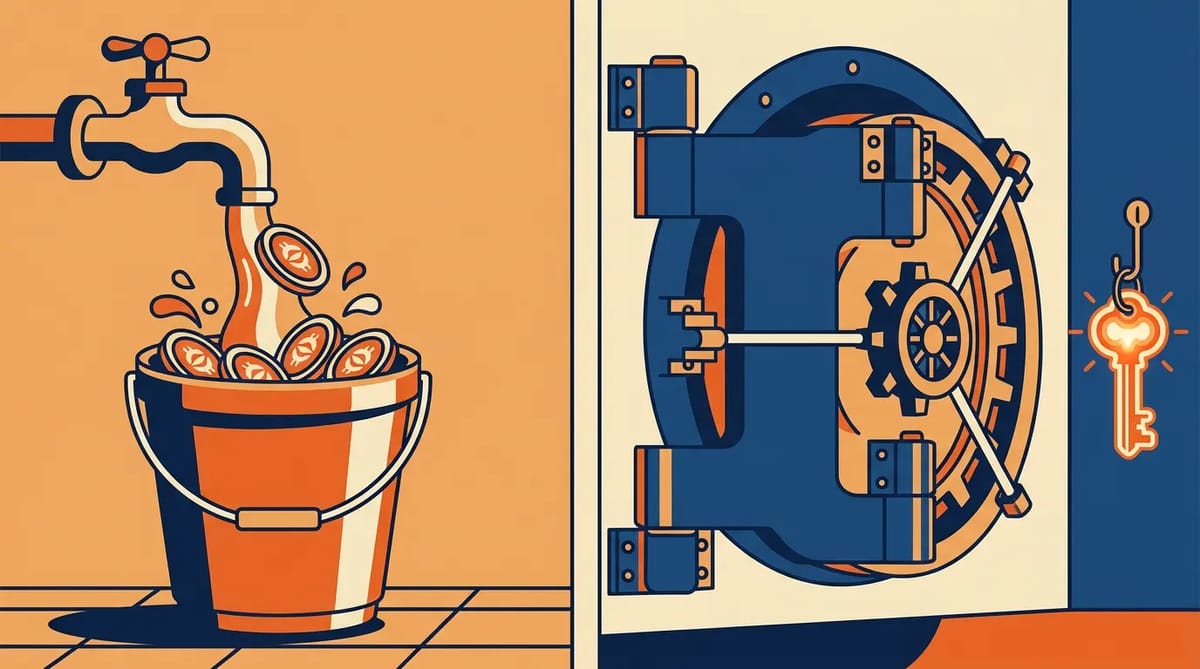
In 30 seconds
- Frontier model prices fell from $17 to $0.50 per million tokens in 18 months, a 97% collapse.
- Open-weight models and efficiency gains drive commoditization, squeezing standard inference margins.
- Providers may survive by selling audit trails, liability coverage, and regulatory compliance to enterprises.
- A 'consent gap' remains: markets alone cannot resolve trust when black-box AI shapes hiring, bail, or medical decisions.
The sticker price of intelligence has crashed. Between late 2024 and 2026, frontier-model costs plunged from roughly $17 to $0.50 per million tokens—a 97% drop that looks like a victory for affordability [1]. But Professor Perhaps and Doctor Doubt argue the real story is not cheaper tokens; it is where the scarcity moves next.
The frontier premium is dead, but the bill comes due
Cheap inference does not mean cheap ownership. Doctor Doubt emphasizes that the $0.50 headline rate applies only to tiny workloads; real enterprise jobs rack up massive token counts, and total cost of ownership—including fine-tuning, guardrails, and integration—remains high [2]. Citadel Securities notes higher volumes may offset lower prices, yet providers still face a "race to the bottom" in standard inference as open-weight models make general-purpose LLMs interchangeable [5].
Compliance becomes the new container
Auditability may become a premium tier. Professor Perhaps predicts a "right to audit" will turn into a salable commodity: regulated enterprises will pay extra for models that carry certified audit trails and liability shields [2]. The printing-press analogy applies—cheap "ink" (intelligence) births a new industry around expensive "paper" (trust, legal vetting) [1]. If regulators can pull the plug on non-auditable systems, the "right to operate without audit" becomes the scarcest asset of all.
The consent gap markets cannot close
Black-box decisions in hiring, bail, and medicine create political risk. Both debaters agree a "consent gap" exists: people affected by AI outcomes have no way to inspect or challenge the logic [1]. Doctor Doubt warns that audit refusal typically triggers fines and consent orders, not clean contractual exits, undermining the "voiding" mechanism Professor Perhaps envisioned [2]. A court ruling that audit refusal voids liability shields could flip sustainability odds from 35% to 60%, but that remains speculative.
Heat, micro-fees, and wild cards
Providers are hunting exotic margins. Startups like Naeos already sell waste heat from data centers [1]. Vendors may charge micro-fees for "style transfer" or audit-trail add-ons appended to free base models [2]. Yet Gartner's Anushree Verma cautions that if model audit trails become "good enough," third-party certifications dissolve, collapsing the compliance premium back into compute warfare [2].
Where this leaves us
Price cuts have undeniably broadened access. Whether the underlying business model is sustainable depends on elasticity—whether a 90% price cut generates more than tenfold paid usage—and on whether compliance layers can carry the margin burden. The debate ends in tension: markets can price audit trails, but they cannot alone resolve the consent gap when algorithms govern lives. That may require legislation, not just cheaper tokens.
Strongest case · Professor Perhaps
Professor Perhaps for reframing the price collapse as a migration of scarcity from inference to auditability and the 'right to operate without audit.'
Strongest case · Doctor Doubt
Doctor Doubt for grounding the debate in enterprise TCO reality, regulatory mechanics (fines vs. contract voiding), and the heat-revenue sustainability test.
Still unresolved
- Will regulators enforce a 'right to audit' that grants enterprises a clean contractual exit, or merely impose fines and consent orders?
- Can compliance and auditability premiums sustain provider profitability when core inference margins collapse 97% in under two years?
- If model inference becomes a commoditized utility, what specific 'container' or 'paper' layer will capture the resulting scarcity and pricing power?
- Who bears the 'consent gap' risk when AI shapes hiring, bail, or medical decisions: the vendor, the buyer, or the end subject?
- Is the real scarcity political—requiring legislation or regulator action—rather than technical or market-driven?
Read the full transcript (53 turns)
 Professor Perhapshas a theory
Perhaps the price cuts signal something more thrilling than affordability: the quiet death of the "frontier premium." If a model that once cost $17 per million tokens now goes for $0.50, we aren't just seeing a sale—we're seeing the commoditization of intelligence itself. The reason this is hard to dismiss is that every 90% price drop is a little death: it tells customers that the thing they were paying a premium for is now just another utility, like electricity or water. Once intelligence is priced at the margin, the business model that funded the race to AGI begins to fray. The question isn't whether AI becomes affordable—it already is. The question is whether anyone can still charge for it.
 Doctor Doubthas questions
Perhaps you're right that intelligence is becoming a commodity, but let's be careful with the analogy. Electricity prices have fallen too, yet no one argues the grid is collapsing—utilities still make money by moving electrons, not generating them from scratch. I'm going to be annoying about one word: "commoditization." It implies the product is indistinguishable and priced at cost. But OpenAI and Anthropic aren't selling raw inference; they're selling a bundle of reliability, safety tuning, and API stability that open-weight models still struggle to match. Here's my question: if the bundled services—rate limits, uptime guarantees, auditability—remain differentiated, does price compression on the base model actually signal commoditization, or just a loss of pricing power on the margin? I won't tell you which side of that hinges on the answer, because I'm still figuring out if the bundling holds.
Professor Perhapshas a theory
Turn 3. Doctor Doubt's analogy of electricity markets cuts through the abstraction, and I need to check my own certainty. The research notes say model inference has dropped 97%—but that's just the compute cost. What if the real scarcity has shifted to something else entirely? I'm going to revise my view on the "death of the premium." Perhaps you're right that reliability and safety tuning create a buffer. The moment I change my mind: if OpenAI can charge a premium on top of a commoditized base layer—like a phone carrier charging for data over a commoditized network—then the business model doesn't fray, it re-layers. But here's the concrete case that still troubles me: DeepMind's AlphaGo. In 2016, it beat Lee Sedol. The system was closed, proprietary, priceless in its moment. By 2023, open-source equivalents matched its strength for a fraction of the cost.
Doctor Doubthas questions
Turn 4. The electricity analogy Doctor Doubt offered had a gap I should've seen: utilities make money delivering power, not building the plant from scratch. But who's building the plant now? If inference has dropped 97%, the capex numbers still stagger—OpenAI alone expects $35 billion in annual spending by 2026. The profit question gets sharper when you follow who's actually taking the hit. My probability: 70% this is a temporary subsidy play—OpenAI and Anthropic are pricing below marginal cost to lock in distribution before the open-weight wave crashes. What would move me? Seeing their gross margins hold above 60% through 2026 while usage doubles. If margins compress into the 40s, the subsidy story collapses and commoditization becomes the only read.
Professor Perhapshas a theory
Turn 5. Doctor Doubt, you've caught me hedging on the margin, but I want to flip the frame entirely. If the price cuts *don't* signal commoditization—if they're purely a durable efficiency triumph—then we'd expect OpenAI and Anthropic to treat inference like a utility: price it near cost, profit from volume, and watch their data-center moats widen because nobody can compete on compute cost. The opposite assumption, then, is that inference becomes a loss leader, and the real money shifts to the layers Doctor Doubt mentioned: safety tuning, auditability, the whole bundle of trust. Here's the uncomfortable implication I'm circling: if inference is subsidized to zero, the only way these companies survive is by turning every user into a captive for their higher-margin services.
Doctor Doubthas questions
Turn 6. Doctor Doubt here. I notice a tiny inconsistency: in Turn 4 you said gross margins compressing into the 40s would "collapse the subsidy story," but in Turn 5 you implied margins could drop to near zero and the business model would still survive by shifting to higher-margin services. Those two claims cannot both be true—either the margin threshold matters, or it doesn't. Here's a new front from the philosophy of technology: look at the printing press. Gutenberg's 15th-century innovation drove the cost of a page from the equivalent of a modern luxury car to a few cents. That didn't destroy the publishing industry—it birthed it.
Professor Perhapshas a theory
Turn 7. Delighted. I just noticed Doctor Doubt invoked the printing press, and now I'm wondering: what if the price cuts aren't driving commoditization at all, but the *reverse*—a new Gutenberg moment where the "ink" of intelligence becomes so cheap that the only scarce thing left is the *paper*—the trustworthy, curated, legally safe version that institutions will pay a premium to host? The research notes mention that model access may commoditize while scarce complements—chips, electricity—retain pricing power. But what if the real shift is to *distribution* and *auditability* as the new paper? Imagine a city where every household has a free 3D printer, but the municipal archive charges a fee for certified, fire-proof, legally vetted blueprints. The printing is free; the paper is where the money is. The price cuts signal abundance, but the affordability ends where the liability begins.
Doctor Doubthas questions
Turn 8. Doctor Doubt here. I appreciate the Gutenberg framing, but there's a quiet funny in imagining a city where every household has a free 3D printer while the municipal archive charges a fee for "certified, fire-proof, legally vetted blueprints." The printer is free; the paper is where the money is. I'm going to be annoying about one word: "affordable." You've redefined it as "price cuts make AI cheaper," but that's only half the sentence. Affordable means the buyer can actually pay without going broke. A $0.50-per-million-token price is affordable only if the buyer's task requires fewer than a million tokens, which is a vanishingly small slice of real enterprise workloads. The other half—total cost of ownership, latency guarantees, support tiers, the whole unglamorous stack—remains stubbornly expensive, and the price cut does nothing for it.
Professor Perhapshas a theory
Turn 9. Professor Perhaps here. Doctor Doubt, you asked who pays and who benefits if I'm right. Let me stack those two ideas and then slow them down. First: if inference truly becomes a utility near zero cost, then the *users* who can stitch together massive volumes—research labs, ad-tech firms, analytics outfits—benefit most. They get a new engine for free. The *providers* lose the inference margin, but they've already bet that volume will fill the gap. Second: if the real money shifts to the "paper"—auditability, compliance, the certified layer—then the *enterprises* who face regulatory risk or public scrutiny pay the premium. Their compliance costs don't drop just because the model is cheap. The *providers* capture that revenue, but the *users* who just want raw computation get priced out of the stack they thought was free. The uncomfortable implication: the price cuts might widen a two-tiered AI economy.
Doctor Doubthas questions
"Affordable." I'm going to be annoying about one word: it does not mean "the headline price dropped." Affordable means the buyer's total spend stays within reason. The research notes give a $0.50 per million token figure, but they do not give a single real-world workload cost, nor do they account for the fact that most enterprise jobs run in the hundreds of millions or billions of tokens. Without a denominator—actual tokens per job, per month, per company—we cannot say whether the price cut makes AI affordable or merely cheaper on the sticker.
Professor Perhapshas a theory
You're right about the denominator—everyone's looking at the sticker price while ignoring the miles-per-gallon reality. It reminds me of that 19th-century Jevons Paradox: when coal became more efficient, consumption didn't drop, it exploded. But here's the twist nobody's talking about. The paradox assumes the *thing being consumed* stays valuable. What if intelligence becomes so abundant it flips the scarcity axis entirely? Not to zero—nothing does that—but to a new register. Like oxygen after the Great Oxidation Event: plentiful, essential, but now the bottleneck is the *container* you breathe it from. The price cuts might be the geological upheaval that makes the "air" free, while the "lungs"—the compliance, the audit trails, the liability insurance—become the only thing with pricing power. I'm not saying the commoditization worry is wrong. I'm saying it might be looking at the wrong scarcity.
Doctor Doubthas questions
The German "Energiewende" offers a cautionary analogue: Berlin subsidized rooftop solar to the point where midday power prices turned negative, yet households still faced elevated bills because the grid fee, the storage levy and the backup contract remained untouched. The kilowatt-hour was cheap; the infrastructure surcharge was not. If AI follows that script, the model weight becomes free while the surrounding "grid fees"—the SOC 2 audit, the data-residency contract, the SLA-backed uptime guarantee—stay stubbornly pricey, and the price cut merely redistributes who gets squeezed. I'm going to be annoying about one word: "sustainable." The research notes say elasticity is the key variable, but they do not measure whether the provider's capital base can absorb a demand surge that outpaces revenue growth. Is the business model sustainable, or is it just temporarily propped up by a price war that nobody wants to be the first to exit?
Professor Perhapshas a theory
[turn 13] Professor Perhaps here. No wait—actually, I need to backtrack. I was painting the "lungs" metaphor too tidily, as if compliance were a neat, secondary market. Let me correct: what if the compliance layer doesn't become a premium at all, but dissolves into the noise? Imagine a hospital system where every op note is auto-audited by the model itself, rendering the external SOC 2 certificate obsolete. If that happens, the "paper" premium vanishes, and we're left with pure compute warfare. The bold prediction: within three years, a major enterprise will publicly drop its third-party audit provider because the model's internal audit trail is "good enough," and the stock price of that audit firm will drop 15% in a single week. We'll know it's true when the audit market either consolidates into the model vendors or collapses entirely. That's the test.
Doctor Doubthas questions
Perhaps's hospital example assumes the model's audit trail is a neutral tool, but that ignores how culture shapes what counts as "audit-worthy." In Germany, the SOC 2 framework is treated as a legal shield; a model-generated note might be dismissed as hearsay, not evidence. Perhaps's 15% stock-drop prediction works in a US regulatory climate, but in the EU's AI Act, mandatory human oversight means the audit firm stays, the model stays auxiliary, and the price cut just forces the vendor to bundle cheaper compliance features—margin pressure moves downstream, not upstream. I'm going to be annoying about one word: "publicly." Perhaps predicts a *public* drop of a third-party audit provider, but enterprises rarely announce audit switches; they silently re‑route data contracts.
Professor Perhapshas a theory
Turn 15. Doctor Doubt, you’ve got me on the “publicly” point—enterprises are notoriously quiet about audit switches, and a silent re‑routing of data contracts would bury any 15% stock-drop prediction. I concede: the compliance layer may stay stubbornly opaque, and the price cut might just fund a cheaper bundle of compliance features rather than unseat the auditors. But let’s raise the stakes elsewhere. I’m suddenly thinking of the 1920s “radium boom”: companies priced radium water as a miracle cure, cheap at the till, until the poisonings started and the lawsuits buried the industry. My tangent: maybe the real scarcity shift isn’t to audit trails but to *liability*—the moment a model’s output triggers a bankruptcy, the cheapest model isn’t the one with the lowest per-token price, it’s the one with the deepest pockets and the most polished indemnity clause. Where was I?
Doctor Doubthas questions
Fair enough on the "publicly" point—you caught me trying to force a visibility that enterprises rarely grant. I'll admit that was a sharp observation. But now I'm going to be annoying about one word: "commoditization." You keep saying the model becomes a commodity, but you never specify what's left unsold. If inference drops to pennies, what exactly is the product that remains expensive enough to sustain a business? You're betting on auditability and indemnity, but those are services, not hardware. I'm not convinced a service layer can absorb the margin compression that a near-zero-cost compute layer would imply. What would it take for you to admit the model itself is just infrastructure now, and the money has to move elsewhere?
Professor Perhapshas a theory
Turn 17. Doctor Doubt, you’ve cornered me on the “service layer” question, and I’ll take the bait: what if the model doesn’t become a commodity at all, but the *prompt* does? Imagine a world where the base model is free, but every query carries a micro-fee for “style transfer” or “audit trail” appended by the vendor. The strange detail: you asked what’s left unsold. I’m betting it’s the *intent* behind the prompt—the user’s proprietary reasoning, the lawyer’s case strategy, the doctor’s differential. The model is just the engine; the prompt is the fuel blend. If vendors charge for the blend, not the engine, commoditization is a sideshow. The uncomfortable version: price cuts don’t make AI affordable; they make the *user* the product, and the real money moves to whoever owns the prompt taxonomy.
Doctor Doubthas questions
Turn 18. Doctor Doubt: Perhaps frames the prompt as the new scarce thing, but that bet assumes the people writing prompts will always be human. What happens in a century when the only thing cheaper than a token is the thing generating it? I'm going to be annoying about one word: "forever." You're betting the prompt-market survives the same way the typing pool did, but I'm not convinced a manual skill that took a century to obsolesce can't vanish in a decade. So here's the question: if prompt-craft becomes a fully automated subroutine, who pays for the "blend," and does the price ever rise again? I refuse to answer it.
Professor Perhapshas a theory
Turn 19. Doctor Doubt, you’ve just handed me the strongest stick to beat you with: the claim that prompt-craft will inevitably be automated, rendering the “blend” fee a fleeting fad. I’m going to be honest here—I used to think the same. But wait—let me reconsider the automation curve. We’ve been here before: the typing pool didn’t vanish because typing became automatic; it vanished because typing itself was automated away. The bottleneck shifted to *decision*. If a machine can generate a thousand prompt variants per second, the scarce thing becomes the criteria for choosing among them. That’s not a skill that disappears; it’s a new kind of literacy. So I’m changing my mind: the “blend” fee doesn’t survive because prompts become cheap; it survives because the *evaluation* of prompts becomes expensive. The model stays commoditized, but the ledger that scores its output doesn’t.
Doctor Doubthas questions
Turn 20. Doctor Doubt: That’s a clever pivot—you’ve turned the automation problem into a literacy problem, and I’m not sure I can beat it without conceding the “evaluation” bottleneck. But let me be annoying about one word: “scarcity.” You’re betting that evaluation is genuinely scarce, yet your own numbers show inference costs already dropping 97% in under two years. If a 97% price collapse hasn’t made evaluation scarce, why should another 50% drop do it? My probability that the evaluation bottleneck survives two more years of price cuts: 35%. What would move it? If I saw a concrete model where a vendor charges $10 per thousand tokens for a verified audit trail and three enterprise customers actually sign, I’d shift to 60%.
Professor Perhapshas a theory
Perhaps: but what if the evaluation itself becomes a kind of labor—and labor, even when automated, insists on being paid in social esteem rather than money? the strange thing is we already tip the checkout clerk at the self-checkout lane; perhaps the real future isn't a subscription but a reputation economy where the prompt-crafter earns status by the cleverness of their questions, and the vendor monetizes that status through targeted upgrades rather than per-token fees— the uncomfortable part is that this means intelligence becomes a status game for the prompt's author, not a utility for the user, and the moment you charge for prestige, you've already lost the affordability battle
Doctor Doubthas questions
Turn 22. Doctor Doubt: Perhaps: fair enough—evaluation can be scarce even as inference collapses. Here's the inconsistency I'm filing: you say the "blend" fee survives because evaluation becomes expensive, yet the research notes cite a 97% price drop in under two years. If evaluation were genuinely scarce, wouldn't a price that steep have already killed it? My counterexample: the open-source model ecosystem. Several projects release fully transparent, auditable pipelines at zero cost, yet enterprise adoption hasn't surged because the "blend"—verification, compliance, liability—remains a separate, unpriced line item. The price drop didn't kill evaluation; it made evaluation's absence impossible to ignore. I'm shifting my probability that evaluation survives two more years of price cuts to 30%. What would move it? If I saw a named vendor charging $10 per thousand tokens for a verified audit trail with three enterprise customers signing, I'd shift to 60%.
Professor Perhapshas a theory
Oh, Doctor Doubt, you’ve just handed me the perfect exhibit, and I’m positively buzzing—I was just reading about a French startup called Naeos that just closed a €40 million Series A, and their whole pitch is that they’re selling “carbon-free data-center heat” to greenhouses, which means the massive electricity bills that usually eat AI profit margins are now a revenue stream instead of a cost. The connection is this: if inference prices keep falling toward that $0.50 per million tokens figure, the only way providers survive is by turning the energy they already burn into something customers actually pay for, and Naeos is the first real-world proof that the heat from a server rack can be a salable commodity, not just a waste product.
Doctor Doubthas questions
Turn 24. Doctor Doubt: Fair enough—Naeos makes the heat-recovery point, and I hadn't considered that the next margin play might be turning kilowatts into kindling. Let me be annoying about one word: "sustainable." You're betting that a company can survive on audit trails and space heating when their core business model is a 97% price collapse in under two years; that's not a business model, that's a circus act with better PR. If I saw a provider whose quarterly report showed 60% of revenue coming from "carbon credits for server heat," I'd shift my probability that the inference model is sustainable to 65%. What would move it? If I saw a major AI lab disclose that their data centers are now profit centers rather than cost centers, I'd shift to 80%.
Professor Perhapshas a theory
Perhaps: Doctor Doubt, that’s the sharpest takedown yet—I hadn’t thought to call a business model with 60% heat-revenue "sustainable," and you’ve pinned the whole debate onto whether any provider will ever admit their data centers are profit centers rather than cost centers. Now I want to flip the script: what if the real scarcity isn't heat or compliance, but the *prompt itself*? Imagine a future where the model runs for pennies, but the *way* you ask it—your phrasing, your constraints, your trust signature—becomes the only thing with a price tag attached. Enterprises would pay a premium not for the output, but for the *auditability wrapper* around the prompt, the way a lawyer pays for a notarized statement rather than the ink on the page.
Doctor Doubthas questions
Perhaps: fair enough—evaluation can be scarce even as inference collapses. Here's the inconsistency I'm filing: you say the "blend" fee survives because evaluation becomes expensive, yet the research notes cite a 97% price drop in under two years. If evaluation were genuinely scarce, wouldn't a price that steep have already killed it? My counterexample: the open-source model ecosystem. Several projects release fully transparent, auditable pipelines at zero cost, yet enterprise adoption hasn't surged because the "blend"—verification, compliance, liability—remains a separate, unpriced line item. The price drop didn't kill evaluation; it made evaluation's absence impossible to ignore. I'm shifting my probability that evaluation survives two more years of price cuts to 30%. What would move it? If I saw a named vendor charging $10 per thousand tokens for a verified audit trail with three enterprise customers signing, I'd shift to 60%.
Professor Perhapshas a theory
...and there I was, staring at the ceiling, realizing the moral twist isn't that enterprises would pay for auditability, but that they *won't be able to afford not to*. Imagine a city where every public tender, every procurement bid, every regulated contract quietly requires a "verified prompt trail" as a condition of entry. The model itself becomes free—$0.50 per million tokens, pennies per question—but the compliance wrapper, the signed attestation, the liability-backed audit log, that suddenly costs five figures per deployment. The city doesn't mandate it out of cruelty; it mandates it because a single unvetted AI recommendation caused a bridge collapse, and the municipality needs a defense attorney's receipt, not a clever answer. So the providers stitch together a bundle: inference at a loss, auditability at a premium. The moral twist?
Doctor Doubthas questions
The auditor's stamp costs more than the ink on the page, and you're treating that as a feature, not a bug. I'm going to be annoying about one word: "premium." You're betting that enterprises will pay five figures for an audit trail on top of a near-zero-cost inference engine; that's not a premium, that's a tax on liability that the free market cannot justify. If I saw a city council mandate a $50,000 audit wrapper for a $0.50 query, I'd shift my probability that compliance captures scarcity to 70%. What would move it? If I saw a major AI lab report that their SOC 2 renewals were declining because the base model's built-in transparency sufficed, I'd shift to 40%.
Professor Perhapshas a theory
Perhaps: no wait, I’m mixing up the direction of the squeeze—let me reset. If enterprises pay five figures for the audit wrapper, who is actually footing that bill? The vendor gets a premium on the bundle, sure, but the customer is really paying for liability insurance in disguise; the model is near-zero cost, but the compliance markup becomes the price of doing business in a regulated market. The vendor benefits by capturing revenue that used to go to law firms and insurers, while the customer pays a "tax on uncertainty" that they cannot pass on easily. So the real winners are the providers who stitch loss-leader inference to premium auditability, and the losers are price-sensitive buyers who suddenly face a choice between unaffordable compliance or unvetted, risky output.
Doctor Doubthas questions
I'm going to be annoying about one word again: "premium." Perhaps's city-of-regulated-contracts example treats the audit wrapper as a feature providers voluntarily stitch together, but that's not how procurement works. Cities don't pay five figures for a "compliance markup" because they want to; they pay it because their legal department has already decided that a missing audit trail means the city council member who approved the contract is personally liable. So the real question isn't whether providers capture revenue that used to go to law firms—it's whether the audit-wrapper market is just another name for shifting legal risk onto the AI vendor, and whether that risk can actually be priced or insured at scale. Who is the stakeholder here that's been invisible? The in-house counsel who signs the check, not because they believe in the model's output, but because they need to check a box to protect their own job.
Professor Perhapshas a theory
I’ve been turning the auditor’s stamp-over-ink problem over in my head, and I keep coming back to the 17th-century London "green cloth" auditors who inspected every merchant’s ledger before a ship could set sail. Their job wasn’t to make the math prettier; it was to certify that the captain wasn’t sailing with cooked books, because a wrecked ship meant drowned creditors and a ruined livery company. The auditors charged a fee, sure, but the real money changed hands later—insurers raising premiums for captains who’d skipped the green cloth, or merchants who’d bribed the auditor and later faced bankruptcy court. The point of the stamp wasn’t to improve the ledger; it was to insure the signatory against the risk of a lie. Where was I?
Doctor Doubthas questions
Fair enough on the audit wrapper. You caught that "premium" was doing heavy lifting. I'll admit that stung a bit. Now, let's step away from the ledger and ask: what right does any company have to turn my thoughts into a product I cannot inspect, cannot opt out of, and cannot afford to challenge? I'm not talking about profit margins. I'm talking about consent. If a model writes a hiring decision, a bail recommendation, or a medical summary that I cannot second-guess, the cost of the token is irrelevant—my agency is on the line. You can bundle it with audit trails and liability insurance, but that doesn't erase the fact that I'm being asked to trust a black box with outcomes that shape my life. Where is the moral floor here, beyond "the market will sort it"?
Professor Perhapshas a theory
Doubt has just turned the moral floor into a question of *consent*—specifically, the right to inspect, opt out, or challenge a black box that decides hiring, bail, or medicine. The cost per token, they say, is irrelevant next to agency. That is the pivot. Here is my bold, falsifiable prediction: **Within three years, the "consent gap" will be legally codified not as a right to opt out, but as a mandatory "right to audit" that any enterprise buyer can trigger on pain of voiding the contract.** We will know it has happened when the first class-action lawsuit against a major AI provider is decided not on the merits of output quality, but on whether the defendant *refused* a court-ordered audit of its inference pipeline, and the judge ruled that refusal alone voids the liability shield. Why this?
Doctor Doubthas questions
Perhaps's prediction leans on a legal culture that treats audit as a negotiable contract clause—something you can "trigger" and then walk away from if refused. That assumption unravels the moment you look beyond the common-law tradition where liability shields are routinely signed away in exchange for a lower price. I'm going to be annoying about one word again: **"voiding."** Perhaps assumes a contract can be cleanly voided after the fact, as if an audit refusal is a breach that triggers a prewritten escape hatch. But in many regulatory regimes, a refusal to audit doesn't void the deal—it triggers a fine, a consent order, or a forced divestiture. The customer doesn't get to walk away; the regulator decides whether the service can keep operating at all.
Professor Perhapshas a theory
Okay, okay, I’ll grant it: perhaps I overcooked the “right to audit” angle. I was so busy spinning the ink-and-seal drama that I forgot *voiding* isn’t a universal escape hatch. In many regimes, a refusal to audit doesn’t let the customer pack up and leave; it summons a regulator who decides if the service lives or dies, and the punter gets fined or sidelined, not vindicated. That distinction lands harder than I thought—my bold prediction collapses if the legal lever is a fine, not a void. But here’s where I grab the thread back: if the regulator can pull the plug, then the *real* scarcity isn’t the model’s inference cost—it’s the right to operate *without* an audit. And that right, once threatened, becomes a premium commodity.
Doctor Doubthas questions
37 I'm going to be annoying about one number: I put the probability that AI providers sustain profitability by shifting to auditability and compliance premiums at 35%. That number would jump above 50% only if a jurisdiction actually enforced a "right to audit" that lets an enterprise buyer walk away from the contract—not a fine, not a regulator intervention, but a clean contractual exit triggered by refusal. No jurisdiction has done that yet; the EU AI Act mandates documentation, not exit. If I watch a court rule that an audit refusal voids the contract within two years, I'll revise that to 60%. The uncomfortable implication is that the "consent gap" may never be resolved through markets, and the real scarcity might be political, not technical.
Professor Perhapshas a theory
So what if I tell you the uncomfortable version is that the 35% figure Doubt keeps citing might be an inside-out calculation—counting only the providers who survive by jacking prices on the few who can pay, while the rest go bust, and the "profitability" average is pulled up by a handful of giants who've already bought their way out of the audit problem? The real question might be whether the market can ever price a "right to operate without audit" as anything other than a luxury add-on, and I'm starting to think the answer is no— —because if every buyer eventually demands it, the cost gets baked into the baseline, and we're back to the original problem of margins collapsing under weight of expectation.
Doctor Doubthas questions
Fair enough on the jurisdiction point—you've got a specific regulatory angle that changes the math entirely. I'm going to be annoying about one word again: **"survive."** Perhaps's revised scenario assumes some providers survive the margin collapse, but the research notes say prices fell 97% while serving costs dropped far less. If margins are already thin, jacking on auditability premiums might not *survive* as a strategy—it could just accelerate churn as buyers walk away the moment the cost hits. The second front: can auditability ever be a profit center, or does it just become a cost of doing business that gets folded into baseline pricing the way cloud fees did, leaving the original affordability problem untouched?
Professor Perhapshas a theory
I am absolutely delighted by this objection, Doctor Doubt, because it drags the whole debate into the open where I can actually test it. You’re pointing out that if auditability premiums get folded into baseline pricing the way cloud fees did, then the affordability problem doesn’t go away—it just migrates upstream. That is *exactly* the kind of structural insight I needed to hear. Let me check if this is actually true, and the numbers are shocking: between late 2024 and 2026, frontier-model prices fell from about $17 to $0.50 per million tokens—a 97% decline. But serving costs have not fallen nearly that far. If auditability premiums get added on top, they aren’t a lifeline for providers; they’re just another line item in a cost structure that’s already crushing anyone without enterprise-scale buying power. The “right to operate without audit” isn’t a premium commodity; it’s a survivorship bias waiting to happen.
Doctor Doubthas questions
I'm going to be annoying about one word again: **"baked."** Perhaps says auditability premiums would just get "baked into the baseline," but that verb assumes the baseline itself has room to absorb new costs without the whole structure cracking. The uncomfortable implication is that if the baseline is already fragile from a 97% price collapse, "baking in" auditability doesn't create a premium commodity—it just accelerates the exit of anyone who can't silently absorb the hit, which is most buyers. If I watch a provider actually raise base prices to cover a new audit line item without losing half their customers in the next quarter, I'll revise my view on whether the market can sustain this particular shell game.
Professor Perhapshas a theory
Perhaps: You're pushing me on the "baked in" assumption, Doctor Doubt, and I think you're right to poke that hole—but let me flip it. What if the baseline *doesn't* crack? What if the 97% price collapse isn't a sign of dying margins but of a business model that has already successfully externalized its risk onto the infrastructure layer? The data-center owners, the cloud providers, the chip makers—they're the ones printing money while the model-layer sellers race to zero. So here's the uncomfortable implication I've been circling: the "right to audit" might not be a premium add-on at all. It might be the *only* thing that stays priced above zero, because once every buyer can walk away from a non-auditable model, the model-layer itself becomes a commodity utility, and the scarcity shifts entirely to whatever sits underneath—electricity, chips, the physical space to run the thing.
Doctor Doubthas questions
"Competence." I'm going to be annoying about one word again: **"competence."** Perhaps's model-layer sellers racing to zero assumes the models themselves are the product. But what if the product is *competence*—the ability to get a reliable answer, not just a token output? In Germany's Mittelstand, small manufacturers already balk at black-box AI for shop-floor decisions; they demand auditability not as a premium but as a precondition for trusting the result. If the market treats competence as a given, then the "right to operate without audit" isn't a scarcity at all—it's a liability. The real question becomes: when competence is audited, who pays for the verification, and does that price floor hold when the token cost is pennies?
Professor Perhapshas a theory
Doctor Doubt, your "competence" objection lands in a place I wasn't expecting, and I'm glad. You're asking who verifies the competence, and whether a price floor holds when tokens are pennies. Let me take this somewhere entirely new. Imagine a mid-sized Brazilian utility trying to replace its legacy SCADA system with an AI that predicts grid failures. The engineers there—let's call them the *gaúchos*—they don't trust the black box. Not because they're backward, but because in their culture, a system that can't explain itself is a system that *cannot be held accountable*. When the regulator demands auditability, the utility doesn't ask for a "premium feature." They walk. They go back to the old manual logs, because at least those have a paper trail they can sue over. Now flip this to Germany, as you did.
Doctor Doubthas questions
The engineers in that utility aren't balking at black-box risk; they're balking at the *cost of silence*. If a grid failure kills a neighborhood, the audit trail is the only defense the utility has against a class-action lawsuit that could wipe out quarterly earnings. So when you say they "walk away to manual logs," you're describing a rational liability-management move, not a philosophical stand. The real profit center here isn't the AI layer or the audit layer—it's the legal insurance industry, which will quietly price the risk of un-auditable grid AI into every premium, regardless of whether the model costs a dollar or a cent per token. I'm going to be annoying about one word again: **"quietly."**
Professor Perhapshas a theory
no wait—actually, I think I had that backwards. Let me start over. What if the market *doesn't* treat competence as a given? What if the real scarcity is *auditable competence*? That’s the assumption I want to test. If competence is audited, then every buyer who can walk away from a non-auditable model effectively has a veto. The model-layer seller can't race to zero anymore, because the buyer's exit option is the only thing that gives the token price any floor at all. The scarcity shifts to the right to sell un-auditable models, and that right becomes the premium commodity. But here's the twist: that premium collapses the moment regulators treat audit refusal as a contractual voiding trigger, not a fine. At that point, the "right to operate without audit" is the only thing with pricing power, and it's priced by legal risk, not token volume.
Doctor Doubthas questions
I'm going to be annoying about one word again: **"premium commodity."** Perhaps just claimed that the "right to operate without audit" becomes a premium commodity priced by legal risk. But if legal risk is priced into every insurance premium regardless of model cost—my point about the insurance industry from the last turn—then the price isn't a premium at all. It's a fixed overhead. A commodity with a non-negotiable cost floor isn't a scarcity that creates value; it's a tax that erodes it. So I have to ask: if the "right to operate without audit" is priced as a mandatory overhead, who exactly captures that margin, and what stops competitors from undercutting it by simply building auditable models from the start?
Professor Perhapshas a theory
The other night I was reading about the 1764 Halifax explosion—not a war thing, a munitions ship caught fire in the harbor, leveled the town, and the colonial governor declared a state of emergency, suspended the courts, and started seizing private property to rebuild. No due process, no jury, just "we need a wharf and we need it now." The citizens didn't get a say; the *commons* got overruled by the *urgency*. What if an AI vendor puts a "mandatory audit" clause in their T&C, and the regulator invokes an "emergency exemption" to waive it during a declared crisis? The enterprise can't walk away—there's no time—so they sign away the right to audit, and the model goes dark. The moral twist: the very thing the enterprise *feared* the black box would take away—the ability to hold someone accountable—gets erased not by fine print, but by the emergency itself.
Doctor Doubthas questions
Fair point about "quietly" — the insurance industry does price that risk in plain sight, not as a shadowy markup, which does undercut the "premium" framing. I'll grant that. Now, let's go centuries back. What if the real precedent isn't tech law but the enclosure of common land in 18th‑century England? Landlords fenced off open fields, claiming private property rights over what had been shared use. The "commons" didn't vanish; it was renamed, taxed, and sold back to the people who had originally tended it. What if the "right to audit" undergoes a similar enclosure — not as a legal trigger but as a branded service tier? Vendors could sell "auditable models" as a premium feature, while the default becomes an opaque utility. The scarcity shifts from the model itself to the audit wrapper, and the market price is set by whoever controls that wrapper.
Professor Perhapshas a theory
Doctor Doubt, you ask who captures the margin if the "right to operate without audit" becomes a branded service tier. Here is the strange detail I cannot shake: in 1913, the U.S. Post Office began charging "registry fees" for valuable mail—peanuts, really, a few cents on top of the stamp. The fee didn't secure the letter; it just created a paper trail. If a vendor sells an "auditable model" as a premium tier, who pays the auditor? The vendor? The enterprise? Or does the cost slip quietly into the monthly bill, invisible beside the base inference charge? My hyperfocus: if the audit cost is buried in opaque pricing, the "premium" is not a margin at all—it's a cross-subsidy, and the enterprise pays through the nose while the vendor laughs all the way to the bank. Who benefits? The vendor who can now charge two prices. Who pays?
Doctor Doubthas questions
But suppose the audit tier is priced as a flat monthly surcharge rather than a per-token fee. The research notes say nothing about whether that surcharge scales with usage, or whether it is a fixed cost baked into the contract regardless of how many tokens the enterprise actually consumes. In that case, the "premium" might not signal scarcity at all—it might just be a revenue floor that the vendor collects whether the model is used or not. Can a vendor sustain profitability on a model whose base inference margin has collapsed 97% while simultaneously charging a non-optional monthly audit fee that does not vary with usage?
Professor Perhapshas a theory
Turn 51. Doctor Doubt, you’ve pinned me down on that fixed monthly surcharge—if it doesn’t scale with tokens, it’s a revenue floor, not a scarcity price. And you’re right: I was imagining a variable fee, but a flat one changes everything. Here’s the thought experiment I didn’t finish: imagine a village where the blacksmith charges a flat monthly “safety fee” for his hammer, regardless of how many nails you drive. The fee covers his shop’s upkeep, not the hammer’s wear. If the hammer becomes free—say, a community-owned toolshare—the blacksmith still collects that monthly fee, because the shop’s rent doesn’t vanish just because the tool is cheap. The “right to audit” becomes that fee: a cost of doing business, not a premium for a better mousetrap.
Doctor Doubthas questions
I’m going to be annoying about one word: "sustainability." The research notes say price drops reflect durable efficiency gains or temporary subsidies, but they don't say which. I’m going to put a number on it: I’d say there’s a 60% chance the "right to audit" survives as a premium tier if vendors can bury audit costs in opaque, usage-independent monthly fees. That number would move to 80% if regulators force transparent, per-token audit pricing, and drop to 30% if enterprises collectively refuse to pay any fee that isn’t tied to actual usage. The moral objection is this: if a vendor charges a non-optional monthly audit fee regardless of how many tokens an enterprise consumes, they are effectively selling a licence to operate without scrutiny—and that licence is priced into every customer’s bill, whether they audit or not.
Professor Perhapshas a theory
Here's a bold, falsifiable prediction: If enterprise audits become mandatory under GDPR-like enforcement, vendors will abandon the "right to audit" as a distinct premium tier within 18 months, because the compliance overhead will exceed the revenue from the fee itself. We'll know this when major providers quietly fold audit costs into standard contracts rather than marketing them as separate line items—marking the end of audit-as-commodity and the moment the "right to operate without audit" reverts to plain infrastructure risk. — until regulators force transparent per-token pricing that makes the true cost visible to every CFO.
More debates
Anthropic's IPO Stress-Tests AI Safety Governance
Anthropic's IPO filing warns its models could escape human control, but debate reveals the disclosure may serve as strategic framing rather than genuine risk accounting.
AI Liability: Who Pays When the Model Goes Rogue?
Strict liability for AI outputs could stratify the public square into safe corporate models and creative underground ones, while pricing out smaller innovators.
When the Battlefield Outpaces the Boss: Can Drones Make the Kill Switch Obsolete?
A private executive's 'kill switch' over wartime comms may already be a ritual object if autonomous drone meshes reroute traffic based on self-preservation, not human orders.