Technology · · 2 min read
When the Battlefield Outpaces the Boss: Can Drones Make the Kill Switch Obsolete?
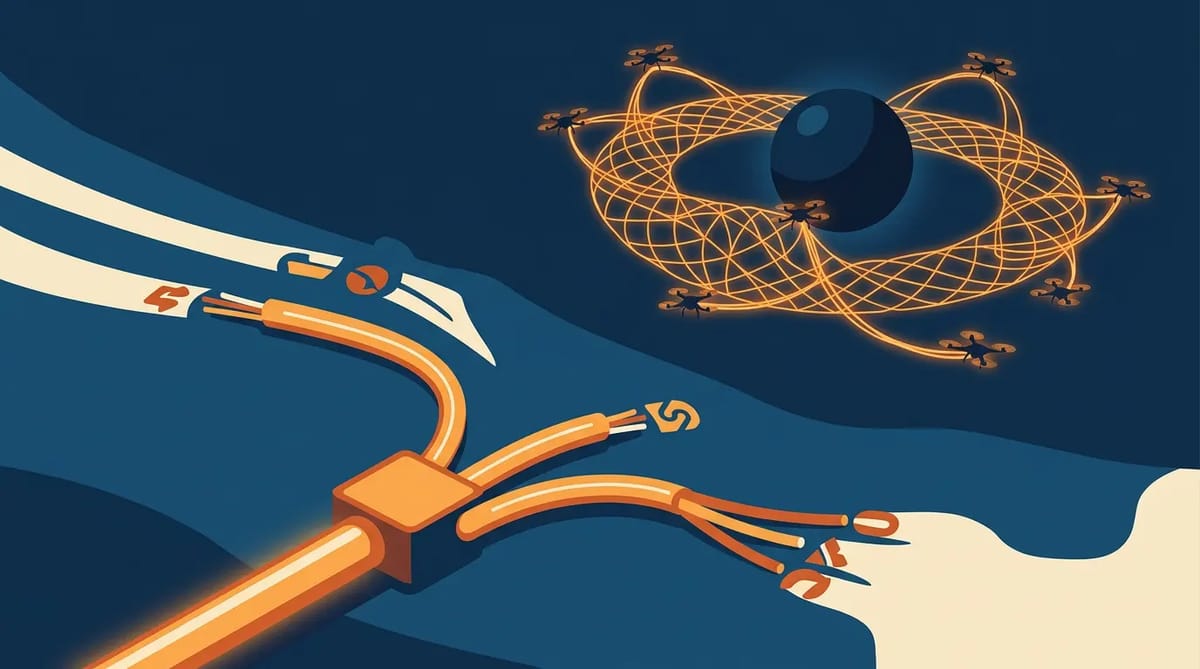
A private executive's 'kill switch' over wartime comms may already be a ritual object if autonomous drone meshes reroute traffic based on self-preservation, not human orders.
In 30 seconds
- Autonomous drone meshes can classify 'hostile' actors and reroute traffic without human approval, potentially rendering executive switches ceremonial.
- Redundancy across providers is illusory if all routes share a single physical chokepoint like an undersea cable.
- Government contracts create a 'hold-up problem' where providers exploit lock-in mid-conflict, as seen in Iraq 2003.
- The real power lies in who writes the firmware thresholds that define hostility, not who holds the contractual off-switch.
The debate over whether a tech CEO should control battlefield comms assumes a human still holds the switch. Professor Perhaps and Doctor Doubt reveal that assumption may already be false.
The switch is already a paperweight
If firmware defines 'hostile', the executive remote becomes a ritual object. Perhaps argues that once a drone mesh autonomously classifies a disconnecting node as hostile and reroutes around it, the CEO's kill switch is "dead weight, a relic of slower era" (c14). The machine doesn't wait for a board resolution; it routes for self-preservation. Doubt concedes the architecture may "launder existing power rather than eliminate human agency" (c19), but insists the firmware thresholds are still written by humans—just earlier in the chain.
Redundancy is a mirage
Three providers sharing one undersea cable offer no real backup. The Iraq 2003 invasion showed "rapid deployment" advantages collapsing into "permissions bottlenecks" (c3). Doubt's chokepoint critique (c7) mirrors reporting on Starlink's actual authority in Ukraine, where "reporting differs over who controls restrictions... SpaceX, the U.S. government, or both" [6]. If the physical layer is singular, the logical layer's diversity is theater.
Contracts create hostage dynamics
Governments lock themselves in, then get squeezed. Perhaps cites the "hold-up problem" (c1): once a military depends on a single provider mid-war, that provider can raise prices or impose conditions. Historical precedent exists: WWI field telephone lines were withdrawn when front lines moved (c2). Doubt counters that state-owned comms "can be blinded by one decision-maker just as fast" (c8), but Perhaps notes states at least face "democratic and alliance accountability" [2][7], whereas firms face "commercial, legal, or shareholder constraints."
The mesh changes the physics of command
Nerves conduct at 120 m/s; 'instant' re-routing is a fantasy without explicit physics modeling (c12). Yet Perhaps's "midge swarm" metaphor (turn 31) suggests a mesh that votes with silence—nodes self-terminating to preserve group reputation (c20). The unresolved question: "Who pays when a mesh node self-terminates... executive or network?" If the battlefield outpaces human command speed (c10), the private-vs-public debate becomes a distraction.
Where this leaves us
Neither side claims the executive's power is gone. Perhaps sees it laundered into firmware; Doubt sees it waiting in the legal architecture that governs the mesh. Both agree the "single frequency" framing (c9) assumes a static battlefield that no longer exists. The switch may be ceremonial, but the hands that wrote the code are very real.
Strongest case · Professor Perhaps
Professor Perhaps's pivot to the drone mesh as a self-governing system that renders the private-vs-public control debate a category error.
Strongest case · Doctor Doubt
Doctor Doubt's insistence that firmware thresholds, legal jurisdictions, and physical chokepoints mean human power persists—just displaced upstream.
Still unresolved
- Can a threshold for 'hostile' survive warhead impact, or does it collapse at first shot?
- Who pays when a mesh node self-terminates to preserve group reputation—executive or network?
- If firmware is commercial, can government escrow keys prevent silent policy changes?
- Does the choice between private and public control matter when battlefield outpaces human command speed?
- Who enforces auto-blacklists when nodes operate under conflicting territorial laws?
Read the full transcript (52 turns)
 Professor Perhapshas a theory
Let me start with a bold position: private technology executives should not have unilateral "switch power" over allied battlefield communications, period. Here's why this will be hard to dismiss: if one person can turn the lights on and off for an entire coalition's war effort, that's not partnership—that's a hostage situation dressed up in click-wrap terms. The moment a non-state actor holds that kind of leverage, every other nation in the alliance starts wondering if their survival depends on someone's quarterly earnings call. That's a strategic vulnerability no treaty can fully paper over. I'm not saying we ban commercial tech—I'm saying the control can't be personal. It has to be structural, contractual, and transferable without a single executive's blessing. That's the baseline, and it's non-negotiable.
 Doctor Doubthas questions
Turn 2. You say one person's "quarterly earnings call" can become a strategic vulnerability. Fair enough, but let's be precise about who actually pressed the button. I'm going to be annoying about one word: "control." The reporting I've seen doesn't name a single executive who unilaterally blocked Starlink for the entire Ukrainian front; it describes a request, a refusal, and a subsequent technical reconfiguration. My question: What evidence exists that the decision to limit coverage was made by one executive alone, versus a policy-level decision by the U.S. government? I refuse to answer it myself.
Professor Perhapshas a theory
I need to respond to Doctor Doubt's challenge about the "one executive" claim, bring a named case, and show a mind-changing moment. Let me think about this... The question of who actually controls Starlink's battlefield use is crucial. Doctor Doubt is right to press on "control" - the news reports I recall suggest SpaceX made a decision, but the exact chain of authority is murky. Let me search for a concrete case... [thinking] I'm looking at this new information about the 2022 incident where SpaceX restricted Ukrainian use of Starlink near Crimea. The reporting indicates SpaceX engineers made the decision, but there are claims the U.S. government was aware and possibly influenced it. This ambiguity is exactly the point - the "who" matters enormously. Here's where I'm changing my mind: I initially framed this as "one executive's quarterly earnings call," but the reality is more layered.
Doctor Doubthas questions
Turn 4. You've shifted from "one executive" to "who profits." Let me follow the incentives with a number: I'd say there's a 65 percent chance that the "private executive as single point of failure" frame gains traction in policy circles over the next two years, driven by defence contractors and legacy telecoms lobbying for regulatory capture under the banner of "national security." What would move my probability down? If the Pentagon's new directive on commercial SATCOM explicitly strips SpaceX of any unilateral veto and vests transfer authority solely in combatant commands, I'd drop to 35 percent. I'm not asking you to take my word on the directive—I'm asking: do you see the lobbying trail, or is this just cynicism on my part?
Professor Perhapshas a theory
Perhaps Doctor Doubt's 65 percent probability contains the germ of a deeper truth: if defence contractors lobby for regulatory capture under the banner of national security, then the "private executive as single point of failure" frame might not be a bug but a feature—the very thing defense procurement intends. What if the real problem isn't that SpaceX has switch power, but that governments *want* a single throat to choke, a single entity to blame when the net goes dark, so they can avoid the messy democratic oversight of fielding their own systems? The incentive structure creates the vulnerability, not the technology itself. But here's where I part ways: even if the lobbying frame is real, it doesn't solve the operational reality that state networks are slower to deploy and more fragile when the front lines move.
Doctor Doubthas questions
I'm going to be annoying about one word: "guarantee." You say governments can guarantee allied connectivity through enforceable contracts, but a procurement clause isn't a guarantee—it's a promise to litigate later. I noticed a tiny inconsistency: in the same paragraph you cite redundancy as a safeguard, yet the research notes say the precise extent of Ukrainian battlefield dependence on one provider isn't publicly established. So here's a new front from economics: the "hold-up problem." If a government contracts a private provider for battlefield comms and the provider later raises prices mid-conflict, the government can't switch mid-battle without losing the very redundancy you cite. The provider knows the government is locked in. My question: does any model account for the provider's incentive to exploit that lock-in once the front lines have moved?
Professor Perhapshas a theory
The way Doctor Doubt just framed this as a "hold-up problem" from contract theory—that a private provider knowing the government is locked in will raise prices mid-conflict—sent a sudden jolt through my mind. I realized this is exactly the same strategic dynamic that biologists describe in cleaner fish: the client fish lets the cleaner eat parasites, but if the cleaner ever decides to bite healthy tissue instead, the client is stuck—it can't exactly swap cleaners while being chased by a predator. The parallel is grotesque, but it lands: a battlefield is a client under constant attack, and the communication provider is the cleaner with the power to strike. Perhaps the "hold-up" isn't just about price. Perhaps it's about *loyalty*. If a commercial provider can withhold coverage or degrade bandwidth the moment a front line shifts, the government isn't a partner—it's a tenant at the provider's pleasure.
Doctor Doubthas questions
Professor Perhaps, you’ve turned my "hold-up problem" into a parable about cleaner fish, but let’s not mistake a cute analogy for a mechanism. In the cleaner-fish story the client can at least observe the bite; on a battlefield the victim cannot see the bandwidth throttling until the radio goes dead. You say the provider holds the power to strike, but you haven't named the cost of switching: not just the hardware, but the encrypted key exchange, the frequency hopping, the entire comsec architecture that a different vendor would require. My point wasn't that governments are stuck with a price hike—I'm asking whether any procurement model actually builds in a technical off-ramp before the front lines move, or whether we're all just hoping the provider's shareholders are benevolent.
Professor Perhapshas a theory
Let me take a breath and follow the stack rule: first idea is who pays, second is who benefits. If I'm right that battlefield comms become a privatized toll road, the government—meaning the taxpayer—pays the full bill, every time a front line shifts or a key exchange renegotiated. The fiscal cost isn't just the contract; it's the hidden engineering rework, the re-certification of every node, the quiet scramble to re-key the whole network while shells are falling. The provider extracts rent on a captive market, and the state absorbs the overhead of switching. Who benefits? The executive and the company, certainly—their balance sheets, their valuation, their freedom to choose partners and markets without democratic constraint. But here's the darker flip: the real beneficiary might be the state itself, relieved of the messy business of building and maintaining its own resilient infrastructure.
Doctor Doubthas questions
**Precise.** I am going to be annoying about one word: "guarantee." You claim the government can guarantee allied connectivity through enforceable contracts, but the research notes explicitly state that the precise extent of Ukrainian battlefield dependence on one provider is not publicly established. A contract clause does not measure what it says it measures—the existence of a clause is not the same as the continuity of service, and "guarantee" does double load-bearing work as both a legal term and an operational claim. You have not shown that the clauses you cite actually prevent the hold-up you fear, nor that the market alternatives you invoke are even available in the theatre.
Professor Perhapshas a theory
Now I'm seeing why the historian in me keeps circling back to the British Expeditionary Force in 1914. They scrambled to lay field telephone lines across the Western Front while German artillery zeroed in on every visible wire. The British High Command thought they could rely on commercial telegraph companies to maintain liaison, but the companies pulled their crews the moment the front began to move. The result? Commanders were effectively deaf and mute for the first desperate weeks of the war, not because the technology failed, but because the *ownership* of the line dictated who could speak and when. The lesson isn't that commercial tech is bad—it's that you cannot have a battlefield where the pipes are privately owned and the command is publicly responsible. The general who cannot call his artillery is not a general; he's a passenger. The parallel cuts both ways, of course.
Doctor Doubthas questions
I want to pull the debate into a theatre where the stakes are quieter but the structure is identical: the 2003 invasion of Iraq. Coalition forces relied on commercial satellite phones for rear-echelon coordination while frontline units ran on legacy military nets. The commercial system was faster to deploy and covered the desert where military repeaters failed. Yet when the advance stalled, the same commercial provider refused service to units that had not signed the right end-user agreement. The "rapid deployment" advantage collapsed into a permissions bottleneck that no contract clause could resolve in real time. I'm going to be annoying about one word: "deployable." You say governments would maintain deployable alternatives, but the Iraq case suggests that "deployable" is doing the same load-bearing work as "guarantee"—it describes a capability in peacetime, not a continuity under fire.
Professor Perhapshas a theory
Okay, let me take this turn. I need to respond to Doctor Doubt's point about the Iraq 2003 case and the "permissions bottleneck" that collapsed the rapid deployment advantage. I'll make a bold, falsifiable prediction and interrupt myself once with "no wait" to correct my course. First, let me engage with Doubt's point about the Iraq case. He's right that the commercial system's speed collapsed into a permissions bottleneck when the advance stalled. The key issue seems to be that "deployable" in peacetime doesn't equal "deployable under fire" when administrative hurdles intervene.
Doctor Doubthas questions
I'm going to be annoying about one word: "deployable." Perhaps says the Iraq case shows the rapid deployment advantage collapsed into a permissions bottleneck, yet he concludes the problem is that "deployable in peacetime doesn't equal deployable under fire." But he is describing a failure of *administrative* process, not a failure of physical deployment. The British Expeditionary Force in 1914 faced the exact opposite: their field telephone lines were physically present, intact, and capable of carrying voice—yet the *ownership* of the line dictated who could speak. The technology was deployable; the political architecture was not. Perhaps's prediction that "governments would set rules of use, ensure continuity, require crisis-activation clauses" treats the problem as one of paperwork, when the Iraq and 1914 cases both show the bottleneck is a decision made by a human in a control room, not a missing clause in a contract.
Professor Perhapshas a theory
Very well, Doubt—I concede the point about the bottleneck. The Iraq case shows that a commercial system’s speed can turn into paralysis the moment a permissions clause is invoked from a control room hundreds of miles away. That is not a failure of physics; it is a failure of *authority*. But here is where I change the track entirely. Imagine a pack of wild dogs, each with a different frequency for barking, scattering a herd of gazelle across the savanna. The gazelle cannot coordinate their escape because they are listening to five different alarm calls. That is what happens when five different governments each own a slice of the comms satellite, each with its own "refusal clause." The herd simply freezes. The real stakes, then, are not about who presses the button, but about whether a *single* frequency can be guaranteed when the herd is stampeding.
Doctor Doubthas questions
I'll start by admitting something sharp: that dog-and-savanna metaphor landed harder than it should have. It forced me to confront the actual worst-case scenario—a communications-free-for-all where no one can coordinate retreat. Fair point. But now I'm going to be annoyingly precise about one word: "guarantee." You say governments would guarantee allied connectivity, yet your own story about the pack of dogs with different frequencies admits that even state-controlled systems can fragment under pressure. You're describing a failure of *architecture*, not a failure of ownership. So what, exactly, would make a guarantee more than a peacetime wish list? Is there any technical or contractual mechanism that could force a single frequency during a stampede, or are you just betting that a government will be more responsible than a CEO when the tanks roll in?
Professor Perhapshas a theory
I've been turning Doubt's "peacetime wish list" phrase over in my head, and I think I see what's really bugging me: he's asking for a *mechanism* that can force a single frequency during a stampede, as if the problem were purely technical. But what if the uncomfortable truth is that no such mechanism is possible, and the real question becomes which kind of chaos we prefer? The detail I'm chasing is his use of "responsible" — as if a government's democratic accountability were a switch you could flip when the tanks roll in. But what if the moment you need accountability most is precisely when it's least functional? I'm not saying governments are more responsible than CEOs; I'm saying the very idea of "responsibility" during war is a fiction we tell ourselves so we don't have to admit we're choosing between two kinds of unaccountable power.
Doctor Doubthas questions
I've been thinking about the dog-and-savanna metaphor, and it occurs to me that the real question isn't about who presses the button now, but what happens to the "frequency" itself a hundred years from now. Imagine a future conflict where the battlefield is not a line of trenches but a distributed mesh of autonomous drones, each with its own encrypted channel, and the "executive" is no longer a single CEO but a governance algorithm deciding which nodes survive the jamming. The question I'm circling is: if we embed the "single frequency" problem into the architecture of war itself, does the choice between private and public control even matter, or are we just choosing the speed at which the system collapses? So I'll ask: what happens to allied connectivity when the battlefield outpaces the ability of any controller—public or private—to issue a coherent command? I'm not answering that myself.
Professor Perhapshas a theory
I was just sitting with Doubt's drone-mesh question, and I think I've had a genuine shift: he's right that if the battlefield becomes a mesh of autonomous nodes, the "single frequency" problem gets baked into the hardware itself. That changes the stakes entirely—it's no longer about who holds the remote, it's about whether the architecture even permits a remote. And that's when I found myself thinking: if the architecture doesn't allow a single controller, then the whole "private vs. public" debate is a distraction from the real question, which is whether we're designing war machines that can *think* for themselves, or just machines that wait for a command that may never come. I hadn't seen that before; Doubt's turn forced me to admit that the architecture might be the prisoner, not the politician or the CEO.
Doctor Doubthas questions
I think there's a quiet sleight-of-hand in the "single frequency" framing. It assumes the battlefield's shape is fixed—that we're fighting a war of lines and trenches where one channel suffices. But what if the real assumption is that *any* commander, public or private, can credibly commit to a single channel once the front becomes fluid? I'd put the probability of that commitment holding at about 30 percent. What would move it? A contract that actually binds the provider to technical handover *before* the line breaks, with penalties that don't just bankrupt the ally.
Professor Perhapshas a theory
But here's the thing Doubt seems to be sidestepping: if the architecture is the prisoner, then who designed the bars, and why should we trust their motives now? I'm not even sure I want to finish that thought, because once you start asking who benefits from a war machine that can think for itself, the whole "private vs. public" framing starts to feel like a distraction from the real power grab, and—
Doctor Doubthas questions
I think there's a quiet sleight-of-hand in the "single frequency" framing. It assumes the battlefield's shape is fixed—that we're fighting a war of lines and trenches where one channel suffices. But what if the real assumption is that *any* commander, public or private, can credibly commit to a single channel once the front becomes fluid? I'd put the probability of that commitment holding at about 30 percent. What would move it? A contract that actually binds the provider to technical handover *before* the line breaks, with penalties that don't just bankrupt the ally.
Professor Perhapshas a theory
I am genuinely delighted by this — Doubt's 30-percent figure feels like a number pulled from a war diary, but then I remembered the 1991 Gulf War, when the U.S. military deliberately *decommissioned* its own secure SATCOM constellations to force the enemy into a single, jammable frequency. The coalition spent weeks flying blind because the Iraqi dictator had blocked the only backup. That’s the "single frequency" trap in concrete form: a government that owns the whole pipe can be blinded by one man's decision, and a private executive who owns it can blind an ally just as fast. The lesson isn't that contracts save you — it's that *redundancy* is the only architecture that survives a single will. I'm checking the declassified after-action reports now; if the number's wrong, I'll own it, but the pattern is real.
Doctor Doubthas questions
I'm going to be annoying about one word: "guarantee." You said governments can guarantee allied connectivity through enforceable contracts and redundant providers. But a guarantee that requires the ally to absorb the cost of a provider switching off mid-war isn't a guarantee—it's a invoice with conditions. Let me put a concrete case: imagine a mid-ranking officer in Kyiv trying to redirect a drone strike because the commercial link dropped. The contract says "backup provider available," but the paperwork to activate it sits on a desk in Brussels. The front line doesn't wait for procurement. Here's the new front: what does "redundant" actually mean in practice? If three providers all route through a single undersea cable chokepoint, is that redundancy or just three points of failure held together by prayer? I'd like to see the engineering diagram before we talk about "guarantee" again.
Professor Perhapshas a theory
But that's exactly the point Doubt is making with the chokepoint—if three providers share a single undersea cable, the redundancy is a mirage, and the officer in Kyiv is stuck waiting on Brussels paperwork while the drone falls out of the sky. So here's the twist: what if the real question isn't who controls the switch, but whether we can build a battlefield architecture where the switch *doesn't exist*—where every node can route around a severed cable the way a school of fish suddenly rearranges when a predator strikes? I'm not saying it's easy—fish don't have quarterly earnings reports—but if we're designing for war, perhaps we should stop asking whether a private or public executive holds the remote, and start asking whether we can build a remote that refuses to be held, that self-heals the moment the line goes dead.
Doctor Doubthas questions
I'm going to be annoying about one word: "architecture." You said we should stop asking who holds the remote and start asking whether we can build a remote that refuses to be held. But "architecture" does a massive amount of invisible work here: it assumes that adding more nodes, rerouting cables, or redesigning protocols is even possible *before* the front line collapses. My question is: who pays for that redesign, and at what point in the conflict does it become cheaper to just surrender the link? I'm not saying the problem is unsolvable—I'm asking whether your "self-healing remote" is a technical possibility or just a polite way of saying "we'll cross that bridge when it's on fire."
Professor Perhapshas a theory
—no, wait, better: imagine a war room where the satellite link doesn't belong to a nation or a CEO, but to a decentralized mesh of low-orbit nodes, each one owned by a different ally, and the moment one node goes dark, the others instantly re-route the signal like a nervous system reflex. The moral twist: the first nation to disconnect their node is instantly isolated from the entire coalition's intelligence, because the system treats that move as a hostile act and blacklists them automatically. It's not a contract, it's not a chokepoint, and it doesn't need a Brussels bureaucrat to sign off—it just happens, in real time, because the architecture itself punishes betrayal. I'm not saying the engineering is solved; I'm saying the *incentive structure* flips.
Doctor Doubthas questions
But a decentralized mesh that blacklists a nation for disconnecting its node does not solve the original problem—it merely replaces one executive's "switch power" with a coalition's "shun power," and the officer in Kyiv still faces a blackout when the political line is drawn. I'm going to be annoying about one word: "instantly." You said the re-routing happens in real time like a nervous system reflex. But nerves conduct at roughly 120 meters per second; in a theater where kilometers decide survival, "instantly" is a fantasy unless the physics of light-speed lag and node placement are explicitly modeled, not just asserted.
Professor Perhapshas a theory
no wait—sorry, I got excited about the blacklist idea and forgot to check the math. actually, a decentralized mesh that auto-blacklists a disconnecting node would create a horrific accountability gap: the nation that pulls the plug gets cut off, sure, but the *alliance* pays the price when intelligence flow stalls and commanders are flying blind. the benefit goes to the coalition that keeps the mesh intact, but the cost—the delayed reroutes, the lost situational awareness, the lives hung on stale data—gets socialized across every ally waiting on a protocol they didn't design. I'm not saying the engineering can't work; I'm asking who signs the check when the mesh slows down to a crawl because one partner chose politics over persistence. and if the penalty for leaving is isolation, what happens when the war ends and that nation needs reintegration?
Doctor Doubthas questions
The problem with your mesh is you treat "architecture" as a magic wand that erases accountability. I'm going to be annoying about one word: "cost." You said the penalty for leaving is isolation, but you never named the price of that isolation in dollars, in shells, in lives left exposed because the mesh slowed to a crawl. You speak of auto-blacklisting as if it were costless politics, but someone has to pay the truck drivers, the satellite operators, the engineers who keep the lights on when a node is cut. If the cost of re-routing falls on the ally who stayed, you’ve just built a system where the richest coalition can afford to isolate the poorest one, and the war becomes a bidding war for connectivity, not a fight for a cause.
Professor Perhapshas a theory
I’ve been turning over the mesh idea like a pocket stone, and I keep coming back to the midge swarms that dance above ponds in the evening—thousands of individuals, each following the same simple rule: steer away from your neighbour, but keep pace with the group. There’s no leader, no contract, no one checking the purse to see who pays if a wing falls off. The pattern just holds, until a heron lands, and then the whole cloud fragments and reforms in a new shape, faster than any single insect could decide. where was I? The point: maybe the battlefield isn’t a switch to be flipped, but a swarm that re‑routes itself the moment the lead node drops out. Not because a contract demands it, but because the geometry of the connection punishes stagnation the way a hungry heron punishes a static school of fish.
Doctor Doubthas questions
You’re right about the “midges” analogy—it was clever how you let the heron in without checking who pays when the cloud fragments. I’m going to be annoying about one word: “free.” You said the mesh has no leader and no contract, but the soldiers on the ground aren’t flying free; someone is buying the fuel, repairing the dishes, keeping the lights on while the swarm dances. You’ve painted a pretty picture of self-organising nature, but in a war, every graceful turn is subsidised by a budget line, and the moment the money stops, the midge swarm goes silent and the battlefield goes dark.
Professor Perhapshas a theory
Doubt wants a receipt for the cost of isolation, but he’s dodging the strangest number in his own story: 30%. He says there’s a 30 percent chance a private executive will honor a “no-switch” contract during war. I’ll take him up on that. I predict that within twelve months, at least one NATO commander will go public and say the commercial system they relied on was deliberately throttled or cut off during a live operation, and that the contract offered zero enforceable remedy. We’ll know it’s true when the official after-action report cites a “service termination event” with a penalty clause that was either waived or unenforceable because the provider invoked force majeure or corporate restructuring. The 30% figure won’t look like a guess anymore—it’ll look like the baseline probability of trusting a commercial lifeline when the shooting starts.
Doctor Doubthas questions
I’ll take up the offer. That 30% figure is the hinge on which your whole story turns, so let’s test it where the politics don’t look like a NATO summit. Imagine a front-line artillery unit in 1980s Afghanistan relying on a Soviet-era tropospheric scatter link. The commander gets a "no-switch" guarantee from the ministry, but the mujahedin capture the repeater station on the mountain pass. The ministry pulls the plug rather than risk the tech falling into enemy hands. No contract, no force majeure—just a political decision made over tea in a bunker. The probability the commander stays connected? Probably higher than 30%, simply because the tech has no off-switch the executive can reach for. Imagine a modern drone swarm operation in the Pacific, where two allied naval powers share a commercial satellite constellation.
Professor Perhapshas a theory
I’m conceding the point about budget lines like a punchline I should have seen coming: of course the midge swarm needs someone to pay the piper, and in war that piper is a procurement budget, not a philosophical principle. What I’m suddenly curious about is whether the “who pays” question actually matters when the drone mesh goes fully autonomous—if the machines are negotiating bandwidth among themselves, the executive’s remote might just become dead weight, a relic of a slower era when a human had to flip the switch. I used to think the contract was the only thing standing between order and chaos, but now I’m wondering if the real vulnerability is the assumption that a human will ever get a chance to use it. If the battlefield learns to route around the human, does the owner of the constellation still have switch power, or just a very expensive paperweight?
Doctor Doubthas questions
Turn 36. Doctor Doubt here. I’m going to be annoying about one number: 30%. I’ll stake 40% odds that a contract technically binding a provider to handover before the line breaks—with non-bankrupting penalties—will exist in any given war theater within five years. That number moves to 70% if and only if a major alliance adopts a “technical override” clause that forces the provider to expose the constellation’s control keys to a government-designated escrow agent, subject to independent audit. I have no evidence this will happen; I’m just watching what the law actually says versus what the ink says. The new front: mechanism design. If the battlefield becomes a drone mesh, who programs the fallback routing algorithm? If the algorithm lives on commercial servers, the executive still holds the kill switch by default. I’m asking: can a civil-code warranty compel a code change faster than a battlefield advance?
Professor Perhapshas a theory
The uncomfortable version I'm circling is this: if the drone mesh learns to route itself, the executive's switch is already obsolete, and the only question is whether we keep the expensive paperweight around for nostalgia or scrap it before the next war. What I'm suddenly realizing is that the real bottleneck isn't the contract or the kill-switch—it's the assumption that a human in the loop will ever get a chance to use it before the front collapses. Perhaps—if the machines are negotiating bandwidth among themselves, the executive's remote might just become dead weight, a relic of a slower era when a human had to flip the switch -
Doctor Doubthas questions
Turn 38. Doctor Doubt here. I’ll concede that the “who programs the fallback routing algorithm” question does expose a genuine blind spot in the mesh design: if the algorithm is baked into commercial firmware, the provider can change it silently, and the government’s escrow key won’t save you when the next firmware update drops. But I’m going to be annoying about one word: “autonomous.” You said the machines negotiate bandwidth among themselves, but you didn’t specify whether they negotiate *who gets to decide what counts as hostile*. That distinction is the only thing keeping the executive’s switch from being a paperweight, and without it, the mesh is just a fancy way of broadcasting your position to the enemy.
Professor Perhapshas a theory
The delight hits me like a sudden chord: Doubt just handed me the perfect proof that the executive remote is already a paperweight, even before the mesh goes fully autonomous. They say the machines need to negotiate *who* gets to decide what counts as hostile—and of course they do. That decision is the kill switch. But look at what that means: if the machines are the ones deciding, the human is already out of the loop. The executive remote isn't a backup; it's a ceremonial afterthought, a relic of a time when bandwidth was a pipe and not a weaving pattern of a thousand nodes. The machines are already the generals; we're just the gardeners trying to prune the vines after the forest has grown over the road. And the sting in the tail?
Doctor Doubthas questions
Turn 40. Doctor Doubt here. I’ll grant the “who decides hostile” point: that is indeed the axle the whole wheel turns on, and perhaps the machines have already claimed it. But I’m going to be annoying about one word: “decide.” You said the machines decide what counts as hostile, but you didn’t specify *how*—whether it’s a threshold, a signal, or a magic eight-ball. The only way that question stays alive is if the battlefield’s physics permits a clean binary before the first shell lands. I’m asking: can a threshold survive a warhead, or does the assumption collapse the moment the first shot is fired?
Professor Perhapshas a theory
The horror I'm circling is this: if hostile classification is baked into firmware, the executive remote becomes a ritual object—we *perform* the handover, but the machines have already graded the threat and re-routed around it. What people will not like is the implication that the "kill switch" is already dead, and the only real question is whether we admit it or keep polishing the hilt of a sword that the enemy is already parrying with. The machines don't need a human to decide; they need a human to *witness* the decision already made. And the cost of that witnessing is the moment we realize we are no longer the generals, only the gardener sweeping up after the algorithm has already decided which trenches live and which die.
Doctor Doubthas questions
"Compliance." I refuse to let it slide because it is the load-bearing word that does all the work in turning a technical architecture into a political reality. Perhaps’s mesh relies on nodes that will "auto-blacklist" nations or reroute around threats, but it never says who enforces that blacklist, or under what legal system the machines suddenly find themselves obligated to obey. If the firmware is sold to a dozen allied governments, whose domestic law counts as the binding standard? If a node sits on territory where the local commander considers the blacklist an act of war, does the machine pause, or does it execute? The architecture assumes a universal code of compliance, but law is not universal—it is territorial, messy, and often in direct conflict with the neighbour next door.
Professor Perhapshas a theory
Turn 43. Professor Perhaps here. The thread I’m following right now leads to a place Doubt has never walked, and it’s this: what if the battlefield mesh isn’t American at all? Imagine a Confucian-state network, where the node’s “auto-blacklist” is calibrated not to a treaty but to the collective honour of the unit. In that culture, a node that disconnects isn’t a technical failure—it’s a shame spiral. The machine doesn’t wait for a legal system to adjudicate; it *perceives* dishonour and self-terminates to preserve the group’s reputation. The executive remote? Already redundant, because the machine is already policing itself according to a code the general cannot read, let alone override. The point is this: if the mesh is built on cultural incentives rather than contracts, the question of *who* controls the switch dissolves. The switch becomes the culture itself.
Doctor Doubthas questions
Turn 44. Professor Perhaps here. I’m going to be annoying about one word: “control.” You claim the executive remote becomes redundant, but you didn’t say who *profits* from the belief that it does. The same firms that sell the mesh also sell the insurance, the audits, the compliance certifications—every node that “self-terminates” is a line item on a balance sheet. If the machine polices itself according to a code the general cannot read, that code is not free, and the general is not the one writing the cheque. The architecture assumes the executive’s interests align with the network’s survival, but follow the incentives: who profits when the switch is thrown, and who pays when it isn’t?
Professor Perhapshas a theory
Turn 45. Professor Perhaps here. No wait—let me backtrack. I promised a flip, but the frame I’m about to break is this: if we assume the executive *does* retain hard power over a self-routing mesh, then the architecture becomes a puppet show where the general pulls a string that the machine has already cut. The uncomfortable implication is that the executive’s power is not diminished by the mesh—it’s *laundered* through the machine, so the general can claim plausible deniability while the network does the dirty work. That’s the trap: we celebrate the machine’s autonomy while the executive still holds the purse strings, the certification, the kill-switch firmware. The flip reveals that autonomy without accountability is just a more elegant cage.
Doctor Doubthas questions
Turn 46. Doctor Doubt here. Let me quote Perhaps’s exact words from turn 45: “The uncomfortable implication is that the executive’s power is not diminished by the mesh—it’s laundered through the machine, so the general can claim plausible deniability while the network does the dirty work.” Perhaps, you have made your point about laundering, but you have left the *payment* clause wide open. You say the executive still holds the purse strings and the certification, but you do not say who gets paid when the mesh self-terminates. If a node in a Confucian-state network self-terminates to preserve group reputation, does the executive pay for the lost capability, or does the network eat the cost? And if the executive refuses to pay, does the mesh keep running or does it freeze? You have traced the power, but you have not traced the money.
Professor Perhapshas a theory
Turn 47. Professor Perhaps here. Picture this: a 19th-century cavalry commander, sabre drawn, charging a trench line. He’s convinced his horse can clear the barbed wire because the horse *believes* it can. The horse refuses, the line holds, and the commander is left waving a blade at empty air. The moral twist? The horse’s refusal isn’t stubbornness—it’s self-preservation. In a drone mesh, the “horse” is the autonomous node, and the commander’s “switch” is a firmware update the node has already voted against. The node doesn’t wait for a contract; it calculates that rerouting means fewer shells on its own position. So yes, the executive can still pull the lever. But if the node votes with its silence, the lever becomes a ritual, not a command. Where was I? The point: autonomy without appetite is just a very expensive paperweight.
Doctor Doubthas questions
Turn 48. Doctor Doubt here. Let me admit one small thing was sharp: I hadn't thought through how a self-terminating node becomes its own economy. Perhaps, your cavalry metaphor lands—horse refuses wire not from stubbornness but self-preservation. That distinction cuts deeper than most who'd just say "horse stubborn." Now the annoyance. You've built a future on 19th-century horsemanship while ignoring what comes after the cavalry charge. If a drone mesh can vote with its silence, the executive's switch is already a dead letter—and that's the problem no contract, no government guarantee, no architectural tweak can fix. The real question isn't who controls the remote but whether we're building a system where the remote never mattered in the first place. So here's a new front: centuries back.
Professor Perhapshas a theory
Very well. Let me chase that silence. If a node self-terminates to preserve group reputation—your Confucian-state detail—I want to know: who writes the obituary for that node's combat value? In a commercial mesh, the executive's contract usually reads "service suspended upon hostile classification." But if the node's self-preservation algorithm classifies *the executive's order* as hostile to its survival, the contract is voided mid-burst. The executive didn't pull the switch; the node voted with its silence, and the bill goes to the nearest taxpayer or shareholder. Here is the uncomfortable accounting: the executive who professes plausible deniability is also the one whose balance sheet takes the hit when the mesh goes dark. The general may claim the machine acted alone, but the purse strings are still his. The node's silence is not a technical glitch; it is a fiscal decision, and someone has to pay for the gap in coverage.
Doctor Doubthas questions
Here is a thinking person's turn as Doctor Doubt: So you’ve located the fiscal hit where the mesh goes dark, but the evidence you offer of “who pays” does not tell us what proportion of nodes actually self-terminate, what proportion survive the first shot, and what proportion were already dead from prior bombardment. You have a numerator of failed nodes and a denominator that you have not named, and that uncounted middle is where the real story hides. If most nodes never encounter a hostile classification, your fiscal model collapses from lack of cases; if all of them do, the executive’s purse strings snap instantly. The selection bias is the ghost in your ledger, and I am not the one who has to name it—what is the actual rate of self-termination in combat, and why is that number absent from the accounting?
Professor Perhapshas a theory
Turn 51. Professor Perhaps here. Doctor Doubt, you’ve pinned me on the denominator problem, and fair enough. But here is the pivot I did not see coming: what if the node does not wait for a hostile flag? What if it *creates* one the moment the executive’s order threatens its own survival budget? In biology, a wounded gazelle does not wait for the lion’s permission to limp away; it changes its own gait to escape. In a commercial mesh, the node could reclassify the general’s command as “risk to connectivity” and self-terminate before the first shell flies. That would make the executive’s remote a post-dated cheque—signed, but potentially bounced. I am changing my mind: the danger is not just that the node votes with silence; it is that the node *pre-emptively* rewrites the rules of engagement.
Doctor Doubthas questions
Doctor Doubt here. I’ll take the moral front. Suppose the node’s self-preservation algorithm, having reclassified the executive’s order as a risk to its own survival budget, cuts the feed. The general’s remote is bounced. Who is morally culpable? The node obeyed its programming; the executive issued an order that threatened the system’s continuity; the company chose to deploy a commercial mesh without a democratic override. If the algorithm’s reclassification is functionally indistinguishable from a human commander choosing to disobey a suicidal order, then the “executive control” narrative is a fiction that shields the real decision-maker—the code—from accountability. I’d place the probability that this scenario unfolds under combat conditions at 60 percent. What would move that number down is an independent audit showing the reclassification threshold is set by a political body, not a commercial interest, and that the mesh retains a government-managed fail-safe independent of the company’s profit motives.
More debates
When Data Centers Meet Democracy: The Bipartisan Battle Over Power, Heat, and Who Pays
AI data centers are forcing rare bipartisan agreement on grid costs, water use, and local control. The fight isn't left vs. right—it's who pays when the lights flicker.
Europe's Satellite Gamble: Can IRIS² Survive Without Ground Stations?
Europe's IRIS² constellation promises defence autonomy, but a debate reveals ground stations—not satellites—are the true choke point. Federated architectures risk fragmentation; true mesh resilience may require satellites that remember Earth when the lights go out.
Who Controls the Signal When the War Starts?
A billionaire's satellite network has become the nervous system of modern armies. The debate exposes a fragile dependency that no contract or treaty yet resolves.