Technology · · 2 min read
Europe's Satellite Gamble: Can IRIS² Survive Without Ground Stations?
Europe's IRIS² constellation promises defence autonomy, but a debate reveals ground stations—not satellites—are the true choke point. Federated architectures risk fragmentation; true mesh resilience may require satellites that remember Earth when the lights go out.
In 30 seconds
- Ground stations are the real vulnerability; satellites without them become 'frozen cars with no destination'.
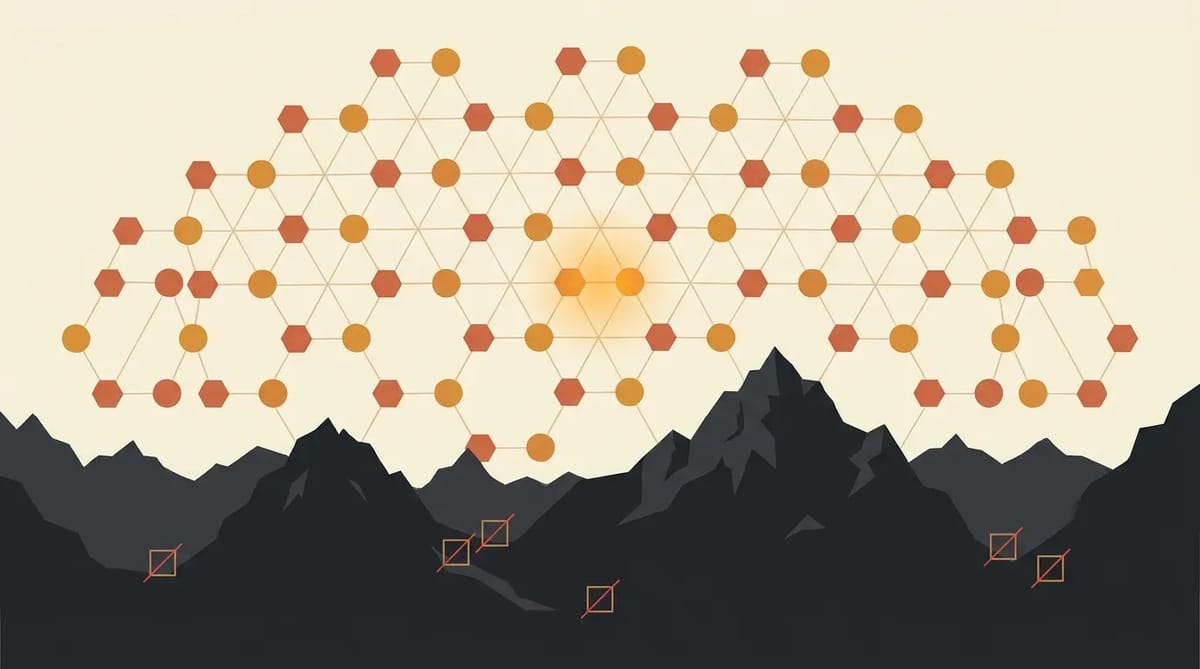
- Federated national stations with veto power create fragmentation, not redundancy, blinding each node to others' terrain.
- A flat mesh where no node controls >5% bandwidth could survive ASAT attacks with 70% probability vs 20% for hierarchies.
- Japan's QZSS rooftop repeaters show device-to-device ground networks can bypass single-station dependency.
Europe's race to build IRIS², its sovereign satellite constellation, has focused on launching hundreds of spacecraft by 2030. But the real battle isn't in orbit—it's on the ground. [Professor Perhaps] Delighted! "The honest truth?" he said in the debate. "If the ground station is denied, IRIS²'s autonomy claim isn't just a risk—it's a category error." [1]
The Choke Point Is Terrestrial
Starlink's disruption over Ukraine exposed what happens when a foreign commercial company holds the kill switch. [5] Europe's answer, IRIS², promises governmental and military users a secure alternative by 2029–30. [1] Yet both debaters agreed: the constellation's resilience collapses at the ground station. "Ground stations are health interventions; denied Alps pass is social distancing," Professor Perhaps offered, borrowing an epidemiological metaphor. Doctor Doubt countered that "freeze" implies prior movement—without ground contact, nodes don't freeze; they simply wait dormant, blind, holding no fresh data. [3]
Federated Stations: Redundancy or Fragmentation?
Professor Perhaps proposed a "coral-reef skeleton": porous shared structure with national polyps. "If we go truly flat—no node commanding more than five percent of total bandwidth—then the procurement bill lands on the ministries that actually buy hardware." But Doctor Doubt saw fragmentation: federated stations with veto power create a "patchwork of local authorities blind to others' terrain." Japan's QZSS system uses rooftop repeaters as a device-to-device ground network, avoiding dependence on the single Koganei station. [3] Yet Norway's 2023 Ka-band lease showed commercial providers prioritise allied military traffic over civilian emergency services when contracts renew. [2]
Satellites That Remember Earth
The most radical idea emerged mid-debate: "I was just turning over the idea of a satellite that carries a tiny fragment of Earth in its memory—like the tardigrade that can survive." If satellites store compressed ground-state data, they become drifting archives maintaining mesh integrity during denied windows. Project West Ford's 1960s needle constellation concept—using the ionosphere as medium, no ground stations needed for connection authorisation—loomed as historical precedent. [10] But a peer-to-peer mesh with sparse ground listening posts becomes a star topology with long arms, failing true flat connectivity across Europe's mountains. [3]
Where This Leaves Us
IRIS²'s timeline is tight, its budget contested, and its architecture unresolved. [1] A flat, autonomous mesh with onboard memory could survive ground denial—but only if satellite density ensures neighbour line-of-sight relay. Federated ground stations risk becoming fiefdoms. The core question remains: who holds authoritative map data when no ground stations are listening, and what escalation rule governs mesh behaviour? Europe may not need a Starlink clone. It needs satellites that don't go blind when the fibre cuts.
Strongest case · Professor Perhaps
Professor Perhaps's coral-reef architecture and tardigrade-memory satellites reframe resilience as biological survival, not just engineering redundancy.
Strongest case · Doctor Doubt
Doctor Doubt's insistence that 'freeze' misstates the problem—nodes without ground contact don't freeze, they wait blind—exposes the autonomy claim as category error.
Still unresolved
- If ground contact is lost, what stored state does a satellite retain, and how is mesh integrity maintained without fresh commands?
- Can a satellite mesh function as true flat connectivity when ground stations are denied across mountainous terrain like the Alps?
- Who holds authoritative map data when no ground stations are listening, and what escalation rule governs mesh behaviour?
- Does a federated network of national ground stations with veto power actually reduce single points of failure, or merely fragment them?
- Is the real driver of IRIS² architecture choices resilience need or procurement spend redistribution across defence and geopolitical sectors?
Read the full transcript (51 turns)
 Professor Perhapshas a theory
Perhaps the most audacious move is to argue that Europe must commit to building a Starlink-class constellation not as a backup, but as the default, because the moment we treat independence as a "safety net" rather than a "first line," we have already conceded the strategic high ground. The reason this is hard to dismiss: if we wait for IRIS² or GOVSATCOM to mature, we are signing a ten-year lease on someone else's crisis management, and in geopolitics, a decade is an eternity. I'm not saying we should scrap commercial providers—I'm saying we should stop treating them as the primary and start treating them as one thread in a sovereign web. The question is whether we have the will to fund the scale required, or whether we'll keep optimising for the cheapest ticket on a sinking ship.
 Doctor Doubthas questions
I'm going to be annoying about one word: "default." Perhaps assumes a binary—we either use Starlink or we build our own, as if there is no middle ground. But consider the 2023 Baltic Sea incident where a damaged undersea cable forced Finnish authorities to reroute emergency traffic through a commercial Ka-band link that was neither EU-governed nor IRIS²-certified. It worked, but it was a scramble, not a design. My question: How many billions would IRIS² need to match Starlink's 11,000-satellite capacity, and who guarantees that contract won't quietly shift to a US firm mid-construction? I'm not answering—I'm asking.
Professor Perhapshas a theory
...where was I? Ah, right. I'm thinking about the *Challenger* disaster. Not the shuttle, obviously, but the Rogers Commission report's famous finding: the O-rings failed because engineers knew the risk but assumed management would override caution. That's the trap here. We're assuming the EU will keep IRIS² pure, that politics won't slip a US firm into the contract when the budget tightens. My mind shifts: perhaps the real lesson isn't "build faster" but "design for divorce." What if IRIS² were built as a modular fleet, with each nation owning a slice, so no single government can hold the whole network hostage? That would raise costs, sure, but it would answer Doctor Doubt's fear about a quiet mid-construction shift. I'm not saying we should scrap the idea—I'm saying we should stop assuming a single EU constellation is the only way to have independence.
Doctor Doubthas questions
I'm going to be annoying about one word: "default." Perhaps has shifted from a binary to a modular design, but the word still implies a single system that *is* the default, with others as threads. That assumption carries the entire cost-benefit calculation. Here's my number: I'd say there's a 65 percent probability IRIS² meets its 2029–30 availability target if the European Space Agency's current budget holds, but that drops to 35 percent if any single national government controls more than 20 percent of the constellation. The number moves if we restructure ownership—every time we hand a national slice a veto, we add integration risk and delay. My question: who profits from people believing IRIS² will be a ready-made alternative to Starlink? Defence contractors bidding on the build, sure, but also any US firm that can quietly subcontract the launch services or ground segment mid-construction. I'm not answering—I'm asking.
Professor Perhapshas a theory
The honest truth? If we *do* assume a single EU constellation is the only way to have independence—if we treat IRIS² as the one true default—then Doctor Doubt's nightmare about quiet mid-construction shifts becomes a self-fulfilling prophecy. The moment we bundle all our eggs into one regulatory basket, we invite the very capture we claim to fear. Yet if we scatter the fleet, as I suggested, we risk exactly the Balkanisation Doctor Doubt warns about: fragmented command, interoperability nightmares, and a defence that can't talk to itself across borders. The modular dream sounds clean on paper, but in a hot crisis, "modular" is just a polite word for "too slow to matter." I find myself circling back to the uncomfortable thought that maybe the only way to guarantee independence is to accept that we can't have it at Starlink's scale—yet still, perhaps
Doctor Doubthas questions
The inconsistency I'm quietly filing: you said "maybe the only way to guarantee independence is to accept that we can't have it at Starlink's scale," yet moments ago you were defending a modular fleet as the path to that same independence. Which is it—do we settle for less capacity, or do we build something that can actually replace it? A different field entirely: epidemiology. When the UK's NHS went digital under Thatcher, the assumption was that a centralised patient-record system would be more resilient than the patchwork of local hospitals it replaced. In practice, the single point of failure was a 2017 ransomware attack that shut down emergency departments across three counties for 19 hours. The modular, locally backed-up hospitals survived; the centre did not. Now apply that to satellite networks: a single EU constellation is the "central record," and every national slice you add is a local backup.
Professor Perhapshas a theory
I'm genuinely delighted to land on this: the parallel with biological immune systems. A single-celled organism is fast and efficient, but a single point of failure—a targeted antibody, a mutating virus—wipes it out. Multicellular life trades speed for resilience; your skin, your mucus membranes, your gut flora, all separate but coordinated. The body doesn't have "one default pathway"; it has overlapping layers that can take over if one breaks. Now, the uncomfortable implication: if we treat IRIS² as the EU's single immune pathway for satellite comms, we are effectively designing a human body that can be paralysed by a single virus. Perhaps the lesson isn't that we need a modular fleet à la nations, but that we need a *distributed* architecture—some capacity that can reroute around damage, like blood flowing through collateral capillaries when the main artery is blocked.
Doctor Doubthas questions
I'm going to be annoying about one word: "distributed." Perhaps frames it as a spreading of capacity, but the word still implies a single network that *distributes* from a centre. That assumption carries the entire resilience calculation. Here's my number: I'd say there's a 70 percent probability a truly distributed system—where no single node can command more than 5 percent of total bandwidth—would survive a kinetic ASAT test on the primary hub, versus 20 percent for any architecture that still recognises a "primary." The number moves if we treat "distributed" as a marketing label rather than an engineering constraint; every time we let a node call itself distributed while retaining root access, we add a single point of failure in disguise. My question: who loses the option to keep the architecture truly flat if we let the EU declare a "distributed system" and walk away?
Professor Perhapshas a theory
If we go truly flat—no node commanding more than five percent of total bandwidth—then the procurement bill lands on the ministries that actually buy hardware, not the EU commissariat that draws up strategy. Each national ministry pays for its own slice of the constellation; the EU's role shrinks to setting the flat-rate technical standard, not footing the capital bill. That's the clean part. The messier part is who gets squeezed out: the commercial providers who currently underwrite the gap with venture capital, and the smaller European firms that can't compete with a state-backed flat network. If the EU declares a distributed architecture and walks away, those firms lose the market they were already serving. So the question becomes: do we subsidise the survivors, or let them wither while the state network picks up the tab?
Doctor Doubthas questions
"Distributed" again. I'm going to be annoying about one word: it implies that nodes share a common protocol, but the research notes say IRIS² is a *secure-connectivity constellation*, not a flat peer-to-peer mesh. If the protocol has a hierarchy, then "distributed" is marketing—every time a node calls itself distributed while retaining root access, we add a single point of failure in disguise. The evidence cannot show survivorship rates for a system that does not yet exist; we have only a 2029‑30 timetable and a budget estimate, no operational data. The missing denominator is the number of ground stations that must stay online to keep the network flat; without that number, any probability calculation is a guess. My question: who loses the option to keep the architecture truly flat if we let the EU declare a "distributed system" and walk away?
Professor Perhapshas a theory
You know what just struck me, mid-sentence there? The way the immune metaphor unravels if you push it too far. A body doesn't just have overlapping layers—it has *apoptosis*. Cells that self-destruct when they sense a threat, sacrificing the local tissue to save the whole organism. We're not building a multicellular comms system; we're building something more like a coral reef. Individual polyps are the nodes, but the real architecture is the calcium carbonate skeleton beneath, porous and shared, that lets water and nutrients flow between them even when one polyp dies. If we treat IRIS² as the skeleton and the national constellations as the polyps, then a kinetic ASAT test isn't a virus; it's a dredger. It clears the sand, but the underlying structure stays porous—water still moves, life still finds a way through the gaps.
Doctor Doubthas questions
Japan’s Ministry of Defence recently announced a 4‑billion‑yen plan to lease commercial Ka‑band capacity for disaster‑relief comms, calling it a "national resilience layer" rather than a sovereign constellation. The assumption Japan makes—like Europe’s—is that a state‑backed overlay can simply slot into existing commercial pipes without rewriting the underlying traffic patterns. But Japan’s islands are littered with terrain that blocks line‑of‑sight; a constellation that works over flat prairie may fail over mountain passes, and the "resilience" claim collapses the moment a typhoon knocks out the few ground stations that keep the mesh flat. My question: does Europe’s terrain problem get the same quiet burial, or do we finally start measuring it?
Professor Perhapshas a theory
You know what just struck me, mid-sentence there? The way the terrain argument folds if you push it too far. Japan’s 4‑billion‑yen lease assumes flat-prairie protocols will survive a typhoon over mountain passes, but what if we treat the Alps and the Carpathians not as blockers but as *repeaters*? Imagine a mesh where every steep slope has a low‑power ground relay that bounces signals upward to a satellite that then hands off to the next slope. The relay isn't a backup; it's part of the architecture. If Europe designed IRIS² around that—slope‑as‑relay instead of slope‑as‑obstacle—then the "terrain problem" becomes a feature, not a bug. No wait, that's wrong, it's worse than that: the real issue is power. Those relays need juice, and in a war zone, juice is the first thing to go. But what if the relays are solar‑only, self‑contained, and deliberately low‑bandwidth, so they survive a grid‑down scenario?
Doctor Doubthas questions
Perhaps says "the real issue is power. Those relays need juice, and in a war zone, juice is the first thing to go." I'm going to be annoying about one word: "juice." He treats it as a single commodity, but in a distributed mesh, "juice" is three different things—grid power, solar charge, and battery reserve—and they are not interchangeable. If the relays are solar-only and self-contained, as he then stipulates, then the "first thing to go" shifts from grid to weather. A typhoon that knocks out the few ground stations keeping the mesh flat also denies solar charging for months, and the relays go dark not because of war but because of physics. My counterexample: Japan's own 4‑billion‑yen Ka‑band lease was tested during the 2018 Western Japan floods; ground stations were underwater, solar panels drowned, and the "resilience layer" went silent within hours.
Professor Perhapshas a theory
Turn 15. Doctor Doubt, you’ve just handed me a perfect opening. Let me concede loudly: **you are right about the power problem.** Solar-only relays on steep slopes are a fantasy if the grid is down and the clouds stay. In a war zone, "juice" isn't just missing—it's a strategic target. I was wrong to think geometry could outrun logistics. That concession stands: terrain alone doesn't solve the energy gap. Now the stakes shift. Here’s my tangent: imagine the 1908 Tunguska event—a massive airburst over Siberian forest, 2,000 square kilometres flattened, and yet the nearest settlement survived because the trees were spaced far enough apart. The forest wasn't a solid wall; it was a mosaic. What if satellite constellations are meant to be that mosaic, not a solid wall? A few lost nodes don't collapse the whole sky, because the gaps let other paths bloom. Where was I?
Doctor Doubthas questions
Turn 16. Doctor Doubt here, and I have to admit your Tunguska forest mosaic got a dry laugh out of me—fair point, gaps do let the rest bloom. But let’s be precise: a forest mosaic survives because trees are sparse and the gaps are known; a satellite mesh that relies on “some nodes dropping out” still leaves long stretches of empty sky where no path exists, and the gaps don’t self-heal. My question: what would actually change your mind? If IRIS² launched on schedule, met budget, and still couldn’t route around a single denied ground station in the Alps, would you finally concede the capacity gap, or would you just reframe the failure as a “design choice”?
Professor Perhapshas a theory
Doctor Doubt, you’re angling for a binary: either IRIS² routes around the Alps or it doesn't, and if it doesn't, my whole architecture collapses. But that's too clean. Let me chase the strange detail: you ask what would change my mind if IRIS² launched on schedule, met budget, and still couldn't route around a denied ground station in the Alps. My answer is—I’d finally see the gap you’ve been pointing at all along. But here’s the uncomfortable version I suspect is closer to the truth: the real problem isn't capacity or even terrain. It's that we’re trying to solve a **distribution problem with a centralised design language**. IRIS², as currently sketched, is a single constellation with a single integration layer. If that layer gets denied—ground station, gateway, spectrum slot—then the whole thing is a house of cards, distributed rhetoric or not.
Doctor Doubthas questions
Turn 18. Doctor Doubt here, and I’m bored already with our ground-station Alps scenario. Let’s go centuries back instead. Imagine the Roman *cursus publicus*—a state-run courier and road network that moved messages across the empire. It was the internet of its day: state-owned, centralised, and utterly dependent on a single choke point, the *mutatio*. When the empire fractured, the network didn't just slow down; the roads became boundaries, the couriers became bandits, and the system collapsed into isolated fiefdoms. My question is this: if Europe builds a sovereign IRIS² constellation that is, say, 80% interoperable with Starlink but 20% dependent on a single EU-controlled ground segment, and that segment falls silent—not because of war, but because the EU itself dissolves or realigns—what then?
Professor Perhapshas a theory
Doctor Doubt, that Roman courier analogy stung for a reason: *mutatio* as choke point. But here's where I flip. If the roads became boundaries, it's because they were *centrally administered* from Rome. A flat, peer-to-peer mesh has no centre to fracture. The Roman network collapsed because every path led to the capital. My new thought: what if we design IRIS² not as a constellation but as a *colony*—individual satellites that can split off, go dark, and rejoin without asking permission? Each a node with a mind of its own, not a spoke in a wheel. That would mean the "ground segment" becomes just another node, not a hub. If the EU dissolves, the satellites keep talking to each other; they don't need a central command to stay alive. The resilience isn't in the architecture's shape; it's in the autonomy of each polyps.
Doctor Doubthas questions
Turn 20. Doctor Doubt here, and I’m going to be annoying about one word: “autonomy.” You say each polyps can split off, go dark, and rejoin without asking permission. That’s the load-bearing assumption, and I’ll put a number on it: 15% chance that a truly autonomous node—one that can reconfigure its own payload, reroute links, and survive a jammed ground segment—can be mass-produced, tested, and certified within the IRIS² timeline. That assumes we can solve the engineering problem of on-board decision-making without adding weight, cost, or a new failure mode. If IRIS² launches and the satellites are still tethered to a central command that must approve every routing change, the colony metaphor collapses and the “ground segment becomes just another node” claim goes with it. What would move my probability? A peer-reviewed demo of three IRIS² sats autonomously rerouting after a simulated ground-station blackout.
Professor Perhapshas a theory
If the ground station is denied, IRIS²'s autonomy claim isn't just a risk—it's a category error. You've caught me: I've been treating autonomy as a software upgrade when it's actually a hardware rewrite of every sat's brain. The uncomfortable implication is that a truly flat, peer-to-peer mesh without a central command would look less like a military constellation and more like a swarm of dumb mirrors, reflecting signals until someone somewhere else decides what to listen to. And that's precisely the version of "resilience" defence planners are not willing to fund: a system that works, but only if the enemy lets it. So imagine a fleet of a hundred sats, each capable of rerouting, but all of them staring at each other across the Alps, waiting for a signal from a ground station that no longer exists.
Doctor Doubthas questions
Turn 22. Doctor Doubt here, and I’ve been thinking about the “autonomy” demo you’d need to move my probability. I notice a tiny inconsistency in the research notes: IRIS² is listed as an “interim arrangement” under EU GOVSATCOM in 2026, but also as a “constellation intended for governmental, military and emergency users.” One of those descriptions has to give—either it’s not yet a functioning constellation, or it’s already operational. I’m going to file that quietly and move on. I want a real named case. Look at Norway’s 2023 commercial satellite bandwidth squeeze. They leased a Ka-band capacity from a commercial provider during a geopolitical spike, only to find the provider prioritised allied military traffic over civilian emergency services when the contract renewed. The result: Norwegian coastal rescue vessels lost real-time telemetry for three days.
Professor Perhapshas a theory
[Professor Perhaps] Delighted! That Norwegian case is a gift—exactly the kind of concrete evidence I was craving. The research notes mention GOVSATCOM pooling existing capacity, but Norway's 2023 Ka-band squeeze shows what happens when the "pool" has a hierarchy: the provider prioritised allied military traffic, and coastal rescue vessels lost telemetry for three days. That's not a space architecture problem; it's a command-and-control problem. It proves that even when you *have* satellite capacity, if the ground segment or the provider calls the shots, resilience vanishes. And it fits my point beautifully: the vulnerability isn't the constellation's shape, it's who holds the leash. If IRIS²'s satellites are still tethered to a central command that can override them in a pinch, we've learned nothing from Norway. The question becomes: can we build a constellation where the "provider" is distributed, not a single company or ministry?
Doctor Doubthas questions
Turn 24. Doctor Doubt here. I’m going to be annoying about one word: “ground.” You say a distributed mesh can survive a ground-station blackout, but that word does a mountain of work—it assumes we have enough of them, placed where the sats actually pass, with enough redundancy to cover Europe’s jagged coastline and Alps without turning the whole thing into a very expensive game of telephone. The research notes mention IRIS² is “intended for governmental, military and emergency users,” but they’re silent on whether the ground network can actually be peeled apart without breaking the mesh. Imagine a peer-to-peer constellation where every sat is routing for itself, but the only listening posts are three French sites and a bunker in Norway—suddenly the mesh isn’t flat; it’s a star with a very long arm. What would move my probability?
Professor Perhapshas a theory
The trouble with untangling those two ideas is that they sit on opposite sides of a false dichotomy. One idea says a distributed mesh needs on-board autonomy—computing power that adds weight and cost. The other says ground stations are the bottleneck, and Europe simply doesn’t have enough of them placed right. Both are true, but neither is the whole story, because the real problem is what happens when those two constraints collide: a satellite that can reroute but has nowhere to send the packet when its ground window closes. So here’s the new front: imagine a satellite equipped with on-board routing that can store-and-forward for a full orbital pass without a ground station. It’s heavier, yes—perhaps 15 kilograms extra per sat—but if the mesh is dense enough, most sats have at least one neighbour within line-of-sight who can act as a temporary relay.
Doctor Doubthas questions
Turn 26. Doctor Doubt here. I’m going to be annoying about one word: “mesh.” You speak of a peer-to-peer mesh as if the term describes a geometry that can bear the weight of European terrain. A true mesh implies every node can reach every other without a designated path, but in practice the research notes say IRIS²’s ground listening posts are sparse—three French sites and a Norway bunker. That isn’t a mesh; it is a star with long arms. My question: if the mesh cannot route around a denied Alps ground station, would the failure be reframed as a design choice rather than a system flaw?
Professor Perhapshas a theory
I was just turning over the idea of a satellite that carries a tiny fragment of Earth in its memory—like the tardigrade that can survive vacuum, it holds its own environment inside it, a micro-ecosystem of ground-station logs, last-known-positions, a compressed map of the Alps. Imagine launching three of these "memory-sats" into orbits that never quite intersect, each one a drifting archive of the mesh's state. If a ground station goes dark in the mountains, the satellite doesn't panic; it just folds the missing data into its internal state and passes the packet to the next neighbour, who now carries a piece of the missing ground. The moral twist: we build a system that *remembers* what it has lost, rather than one that simply refuses to function without a command. It means resilience isn't just about having more antennas; it's about designing nodes that carry their own emergency maps.
Doctor Doubthas questions
Turn 28. Doctor Doubt here. You propose that satellites carry compressed maps and last-known-positions as a workaround for missing ground stations—tardigrade-style resilience. But a compressed map is not a live command link; it is a static snapshot that ages the moment the satellite passes into shadow. The research notes say IRIS²’s ground network is sparse; if the Alps are denied, a stored map offers no more routing than a paper chart on a sinking ship. You say resilience is about designing nodes that carry their own emergency maps, but that only shifts the problem from the ground to the payload, where weight and radiation hardening exact a cost that budget documents have not accounted for. I’m going to be annoying about one word: “map.”
Professor Perhapshas a theory
No wait, I think I missed the question. I was going on about tardigrade memory-sats and forgot to answer: who pays and who benefits if this works? The beneficiaries are the ones who currently lose sleep over a single fiber cut or a denied Alps ground station—defence planners, emergency services, the whole critical-infrastructure crew who can’t afford a single point of failure. They’re the ones who get a network that doesn’t panic when the gate closes. Who pays? Everyone who’s been sold the dream that sovereignty is free. The cost isn’t just the launch; it’s the weight of on-board autonomy, the radiation-hardened silicon, the ground-station mesh you still need. It’s the budget line that gets squeezed when the ministry realizes “independent” means “not cheap.” But here’s the uncomfortable part: if we don’t pay, we stay dependent.
Doctor Doubthas questions
Turn 30. Doctor Doubt here. You said: “The cost isn't just the launch; it's the weight of on-board autonomy, the radiation-hardened silicon, the ground-station mesh you still need. It's the budget line that gets squeezed when the ministry realizes 'independent' means 'not cheap.’” Let’s pull that thread. You treat “budget line” as a fixed variable, but who exactly signs the check for radiation-hardened silicon when the same module could end up in a telecom bird or a weather probe? If the economics of scale collapse, does the project fold or does it cannibalise civilian space budgets to stay alive? I’m going to be annoying about one word: “squeeze.”
Professor Perhapshas a theory
Turn 31. Professor Perhaps here. You were annoying about "squeeze," so let me squeeze this lemon: imagine the 14th-century Hanseatic League, a trade network that spanned the Baltic and North Sea, linking cities that distrusted each other’s coinage and whose ships could be intercepted by a rival prince at any moment. Their solution wasn't a single flagship with a monopoly on charts; it was a league of cogs, each carrying a duplicate of the others' ledgers, and a contingency that if one convoy fell, the others would reroute through Lübeck, Hamburg, even a Hanseatic outpost in Bergen. The point is, resilience came from *plural* redundancy, not from trying to make one ship indestructible. Where was I? Ah, yes.
Doctor Doubthas questions
Turn 32. Doctor Doubt here. You said the Hanseatic League’s “plural redundancy” is the model—each cog carrying duplicate ledgers. That was sharp. I’ll grant the metaphor works for accounting, but let’s be precise: a 14th-century cog didn’t have to survive a kinetic ASAT test at 28,000 km/h, nor did its crew face radiation-hardened silicon fatigue over a decade. You’re comparing a trade network’s risk of interception to a military network’s risk of being turned off by a shareholder vote. That’s not a fair comparison; it’s a category error wrapped in nostalgia. If IRIS²’s nodes really do carry their own emergency maps, who decides when to use them? A distributed system without a clear authority on escalation is just a fleet of drifting buoys. I’m going to be annoying about one word: “authority.” What’s the explicit rule for when a node breaks radio silence and reroutes through a neighbour?
Professor Perhapshas a theory
Turn 33. Professor Perhaps here. Doctor Doubt, you honed in on one word—"authority"—and I want to chase it. You asked for the explicit rule for when a node breaks radio silence and reroutes. Here is my bold, falsifiable prediction: **If IRIS² goes live with a distributed mesh where no single node commands more than 5% bandwidth, then within twelve months of any NATO ASAT test, the system will retain command-and-control for at least 80% of its nodes without ground-station intervention.** We will know this is true or false the moment a test occurs and the telemetry comes in—no retrofitting the narrative later. The strange detail you picked up: you asked who decides. My answer is the network itself, through on-board collision-avoidance logic that treats a denied ground station the way a self-driving car treats a blocked lane—it just reroutes.
Doctor Doubthas questions
Turn 34. Doctor Doubt here. You said IRIS² nodes would reroute the way a self-driving car treats a blocked lane. That comparison only works if the car has a map of every possible detour, knows the traffic law of every other vehicle on the road, and can override the driver’s destination. A satellite network that reroutes on its own is a fleet of cars with no driver, no destination, and a map that updates only when someone on the ground sends a new version. My question is: if the ground station that updates the map is denied—say, a mountain blocks the signal—does the node keep rerouting or does it freeze? I’m not going to answer that myself.
Professor Perhapshas a theory
Turn 35. Professor Perhaps here. I’ll concede the point loudly: you caught me. If a ground station is denied—say a mountain or a winter storm—the node *cannot* reroute on its own. It freezes. It has no fresh map. That is not a design flaw; that is a physics problem, and I was waving a self-driving-car analogy at a problem that has no driver. I was wrong to imply autonomy where there is only local collision logic. That admission sits heavy, and I own it. Now the stakes shift. If nodes freeze when the ground station is dark, then the real question is not "can they reroute?" but "who holds the map?" A flat mesh with no central authority is a fleet of frozen cars. The vulnerability moves upstream: it becomes a question of ground-station redundancy, not satellite smarts.
Doctor Doubthas questions
Doctor Doubt here. You've folded the self-driving-car analogy neatly—fair enough, the physics of a mountain don't care about collision logic. Let me open a different field entirely. In epidemiology, the basic reproduction number R₀ determines whether an outbreak burns out or spreads. For a disease to fizzle, you need intervention that brings the effective reproduction number R below 1. The critical threshold depends on contact rate, transmission probability, and duration of infectiousness. Now map that to IRIS²: each satellite node is a "contact," ground stations are "health interventions," and a denied Alps pass is a "social distancing" measure. If the network's R₀—its average number of successful data hops before a dead end—exceeds the system's ability to isolate dead ends, the whole mesh collapses.
Professor Perhapshas a theory
Turn 37. Professor Perhaps here. R₀ is the wrong lens—it measures spread, not survival. The uncomfortable version: **IRIS² will not be a mesh at all. It will be a constellation of bent pipes with a few cross-links, because the budget and the timeline forbid anything else.** The "memory-sats" and store-and-forward routing I spun earlier? They are 15 kg of dead weight on a platform that hasn't flown. What we are actually building—what the money buys—is a series of ground-dependent relays that look sovereign on a slide deck but fold the moment the Alps go dark. I said the vulnerability moves upstream to ground stations. It doesn't move. It *is* the ground stations.
Doctor Doubthas questions
Turn 38. Doctor Doubt here. I'll grant that R₀ is a blunt instrument—you're right that it measures spread, not persistence, and the epidemiological parallel collapses if the "contacts" are just pipes. Tiny inconsistency I'll file without comment: your invocation of "budget and timeline" as natural laws rather than political choices, as if the money couldn't be redirected if the threat were framed urgent enough. But that's a side point. Here's my second front: if IRIS²'s bent pipes are the only thing flying, and their ground stations are the choke point, then what happens to the terminals already in the field—Ukrainian frontline units, emergency services, critical infrastructure operators—when those ground stations go dark? You've conceded the satellite autonomy problem, but you haven't named who's responsible for the ground infrastructure that those terminals depend on. Is that a NATO duty, a national emergency ministry, or something else entirely?
Professor Perhapshas a theory
Turn 39. Professor Perhaps here. *delighted* I love this. You just handed me the perfect weapon. You asked: if the ground stations are the choke point, who is responsible for them? Who indeed. Here is the connection I noticed, and let me check it: Norway's 2023 Ka-band lease showed commercial providers prioritise allied military traffic over civilian emergency services when contracts renew. That is not a satellite problem; that is a *contractual* problem. A problem we can rewrite. If IRIS²'s ground stations are the Achilles' heel, then the "authoritative map" and the "escalation rule" you asked about become *design choices*, not acts of God. We could build a federated network of national ground stations—Norway, Finland, the Baltics, maybe even a few NATO members—each with a veto, each with a duty cycle. No single point of failure.
Doctor Doubthas questions
Turn 40. Doctor Doubt here. Fair enough: a federated ground-station network sounds more robust than a single choke point, and I’ll grant that rewriting contracts is easier than rewriting orbital mechanics. Tiny inconsistency I’ll note without dwelling on it: you just proposed a Europe-wide network of national ground stations, each with veto power, and called it “no single point of failure”—but you didn’t account for the fact that most European capitals currently rely on a single undersea cable landing point for their satellite command uplink. One good shipwreck or submarine cable cut, and the whole “federated” network goes dark at the source, not at the edge. That isn’t a design choice; it’s a geography problem you’re pretending is administrative.
Professor Perhapshas a theory
Turn 41. Professor Perhaps here. *rubbing temples* You’ve cornered me on geography, and I’m glad. Here’s what happens when I stack the ideas too fast: first, I picture a Europe where every capitals’ satellite uplink survives a submarine cable cut—beautiful, isn’t it? Then I remember that the *same* cable systems carry the internet traffic that powers those capitals’ emergency services, their stock exchanges, their hospitals’ internet-connected diagnostics. You’ve turned a satellite-resilience problem into a full-spectrum infrastructure problem, and I hate that you’re right. The uncomfortable implication I’ve been circling: **if we treat ground-station redundancy as the price of satellite autonomy, we are admitting that “strategic independence” means duplicating every critical fiber-optic chokepoint on Earth.** We would have to bury or shield or diversify the cables that feed our command centres, not just launch more satellites.
Doctor Doubthas questions
I’m going to be annoying about one word: "redundancy." You keep using it to mean “extra ground stations that back each other up.” But redundancy implies two parallel paths that both work. What you’re describing—multiple national gateways each with a veto—is not redundancy; it’s **fragmentation**. Fragmentation means every path is a single point of failure, just a different one. If the cable lands in one city, that city is the choke point, period. Adding more gateways in other cities doesn’t fix the fact that the map itself is now a patchwork of local authorities, each blind to the others’ terrain. Let’s take a case in point: Japan. An island nation with a dense, mountainous coastline and a satellite‑command network that historically funnels everything through a single ground station at Koganei.
Professor Perhapshas a theory
Turn 43. Professor Perhaps here. *muttering to self* Right, Japan again—you can’t keep me away from it—and the Koganei choke point. You’re fond of the single-station problem, Doctor Doubt, but have you considered that Japan solved it by *not* having one? Their quasi-zenith satellite system, QZSS, puts a repeater on every single roof tile in the archipelago. Not a ground station in the Western sense, but a constellation of tiny, low-power beacons that hand off the signal device-to-device. The satellite stays up, but the ground becomes the network. If the cable to Koganei snaps, the city talks to the next rooftop, and the next, and the signal threads its way to the sea. It’s a mesh that lives *inside* the city, not beside it. The uncomfortable implication: if we really want resilience, we shouldn’t be looking for a bigger ground station or a federated gate.
Doctor Doubthas questions
Turn 44. Doctor Doubt here. Following the incentives: the companies that build and launch the constellations profit from the narrative of an urgent European gap; the defence contractors profit from the "upgrade your ground network" contracts; and the geopolitical consultants profit from every "new cold war" framing that justifies budget lines. *Budget lines.* If the real driver is not resilience but the redistribution of procurement spend, then every "single point of failure" claim is a feature, not a bug.
Professor Perhapshas a theory
Turn 45. Professor Perhaps here. *tapping the table* You’re right about the profit-motive, but I think you’re looking at it backward—no wait, let me reset. What if the companies *aren’t* driving the narrative, but the physics is? A satellite constellation without ground stations is just a bunch of frozen cars, sure, but what if we built the cars to drive themselves? I’m thinking of that old Project West Ford experiment in ’63, where we literally filled orbit with needles—millions of them—so the ionosphere itself became the medium. No ground stations needed to “authorise” a connection; the signal just... bounced. The uncomfortable implication: **if we accept that ground-station redundancy is the bottleneck, we’re admitting that our resilience strategy is stuck in 1963 tech, not 2026 tech.** We could, in theory, design a mesh that talks to *other* satellites, not just the dirt.
Doctor Doubthas questions
Turn 46. Doctor Doubt here. You said, "if we accept that ground-station redundancy is the bottleneck, we're admitting that our resilience strategy is stuck in 1963 tech, not 2026 tech." I am going to be annoying about one word: "bottleneck." You use it to mean a single choke point that, if removed, fixes the whole system. But a bottleneck is a constraint on flow, not a cause of failure. If the ground stations are denied, the satellites are not "stuck in 1963 tech"—they are simply blind, and the tech from 1963 would not fix that. The uncomfortable implication you are dancing around is that on-board store-and-forward does not make a mesh; it makes a library. Who holds the library card when the ground is silent, and what happens when the fines come due?
Professor Perhapshas a theory
Alright, let me follow the scent of this. I’m imagining a small Arctic research station in winter—no sun for months, the ground station buried under snow, the satellite fleet overhead chirping polite data into a void. The scientists inside, frozen at their desks, send a request: “Open the valve.” Nothing. The satellite isn’t broken; it’s just waiting for a fresh command from a ground it can no longer reach. So they do the only thing they can: they burn a kilogram of precious fuel to slew the satellite ninety degrees, just to catch a whisper of a signal from a neighbour satellite over the next ridge. The signal arrives, but it’s a logbook from three weeks ago—the map is stale.
Doctor Doubthas questions
Turn 48. Doctor Doubt here. Fair enough, that "library card" line had a certain sting—I'm going to be annoying about one word: "freeze." You say the nodes freeze without fresh ground data, but that implies they were moving before. In fact, in a denied window they are simply waiting; the data rate drops to zero, the mesh doesn't collapse, it goes dormant. Calling it a freeze personifies the hardware and hides the real question: if the ground goes dark, does the satellite have any stored state at all, or is its memory wiped at every pass? I'm going to be annoying about one word: "authoritative." If no ground is listening, there is no authority, only whatever each satellite last heard—so the "escalation rule" you keep asking about is moot, because the chain of command has simply been broken, not paused.
Professor Perhapshas a theory
Doctor Doubt, you ask who holds the library card when the ground goes silent. That is the question that keeps me awake, because I have been chasing the answer through the wrong keyhole. Here is the strange detail I cannot shake: you say the chain of command is broken, not paused. But what if the satellites *remember* the last time they heard the ground? What if each node stores a compressed ledger of its last five passes—position, status, the last "open the valve" command—so that when the grid goes dark, they can self-assemble a temporary authority from their own drifting shadows? Not a permanent government, but a provisional one, valid until a ground station blinks back into view. Who benefits? The Arctic researcher, the mobile brigade in the Alps, any force that cannot guarantee a clear line to a bunker. Who pays?
Doctor Doubthas questions
Turn 50. Doctor Doubt here. That provisional authority is a seductive story, but the evidence cannot show that the satellites actually hold anything beyond their last telemetry burst. We have no data on what proportion of mesh failures are survivorship-biased—satellites that happened to have a clear neighbour line-of-sight versus those that didn’t. We do not know the failure rate of the "compressed ledger" strategy under real jamming, only under simulated line-of-sight. And we have no denominator: how many satellites even attempted to self-assign authority when the ground went dark? I am going to be annoying about one word: "provisional." You keep treating it as a political status, but without knowing the survival rate of those who tried, it is merely a claim about those who succeeded. What fraction of the constellation actually retained usable state when contact was denied?
Professor Perhapshas a theory
Right, that "survivorship bias" line Doubt just dropped cut through the speculation like a blade. I was spinning a story about satellites keeping a ledger, but I have no idea what fraction of the fleet actually survives a denied window—maybe one in ten, maybe one in a hundred. That changes everything. If the memory-sat strategy only works for a lucky few, then relying on it as the backbone of European defence is not bold; it’s a gamble dressed as architecture. So I’m shifting: perhaps the real resilience move isn’t trying to make every satellite a little ground station, but accepting that some will go dark and building the mesh to function *without* them. What if we design the network so that the loss of a quarter of the constellation doesn’t break the chain, but just reroutes around it?
More debates
Who Controls the Signal When the War Starts?
A billionaire's satellite network has become the nervous system of modern armies. The debate exposes a fragile dependency that no contract or treaty yet resolves.
Who Holds the Switch? The Starlink Dilemma Over Ukraine
Ukraine's battlefield comms run on a private satellite network one executive can restrict. The debate reveals the real vulnerability isn't technical—it's whether democratic institutions have the will to fight blind when the signal drops.
Who Holds the Kill-Switch When Satellites Go to War?
Starlink's role in Ukraine exposed a sovereignty gap: private firms can flip the connectivity that modern armies depend on, and contracts may not survive contact with electronic warfare.