War and security · · 3 min read
Who Holds the Kill-Switch When Satellites Go to War?
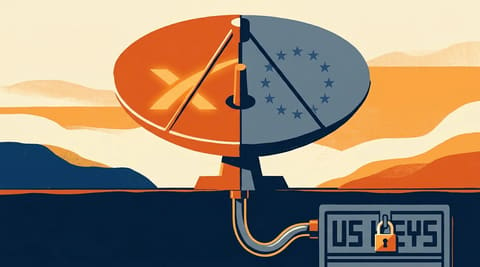
Starlink's role in Ukraine exposed a sovereignty gap: private firms can flip the connectivity that modern armies depend on, and contracts may not survive contact with electronic warfare.

In 30 seconds
- Proprietary firmware creates choke-points that contracts cannot fully override during combat.
- USAID-funded terminals socialize hardware costs while privatizing operational control.
- Nominal supplier diversification often masks consolidated ownership behind the scenes.
- No legal framework yet governs orbital inheritance when constellations outlive nation-states.
A satellite terminal on a Ukrainian trench line is only as sovereign as the firmware that steers its beam. That uncomfortable reality framed the entire debate between Professor Perhaps and Doctor Doubt, who picked apart the fantasy that procurement contracts can tame proprietary networks.
Proprietary firmware is the real choke-point
Professor Perhaps argued that the kill-switch lives in code, not clauses. "If the firmware is proprietary to the company, the soldier in the trench is subject to corporate discretion regardless of what the contract says," he warned, pointing to Starlink's closed stack as an inescapable single point of failure [1]. Doctor Doubt pushed back that routing logic is distributed across ground stations, satellites, and user terminals — more like a submarine's layered protocol than a single lever [5]. But both agreed that when electronic warfare jams the control plane, the distinction collapses: whoever holds the signing keys decides who talks.
Public money, private steering
The USAID-funded terminals in Ukraine crystallized the tension. Perhaps noted that "public money buys the hardware substrate" while the vendor retains beam-repointing authority [6]. Doubt countered that purchase orders are living documents, not static signatures, and that Egypt's 2011 SMS shutdown proved states can compel carriers when they possess legal mandate [4]. The unresolved question: if taxpayers funded 80 percent of capital cost, does the company become a franchise operator with a reversion clause — or a de facto sovereign in orbit [13]?
Diversification theater
Contracts often list backup suppliers to satisfy resilience requirements. Doubt observed that historical telecom mergers turn nominal competition into consolidated ownership behind closed doors [11]. Perhaps conceded the point: "You're right that diversification on paper often dissolves into the same boardroom." The Ukraine case illustrates the trap — when Starlink became the only game in town, contractual alternatives evaporated [7].
Orbital inheritance
The debate's sharpest turn came when Perhaps invoked the Roman concept of imperium — the power to override law for the state's survival [47]. If a constellation outlives the nation that launched it, who negotiates the turnover? No treaty, contract, or domestic law currently answers. Doubt warned that handing a public kill-switch to a private operator makes every dispute a crisis that knocks out frontline units [16].
Where this leaves us
Neither side claimed a clean solution. Perhaps leaned toward technical architectures that disperse authority — real-time voting across mesh nodes — while Doubt insisted that no protocol survives contact with a determined adversary who controls the physical layer. The sovereignty gap remains: governments rent capacity they cannot fully command, and the firmware that decides wartime connectivity answers to a boardroom, not a ballot box.
Strongest case · Professor Perhaps
Professor Perhaps — for framing the kill-switch as a firmware problem that contracts cannot solve, and for surfacing the orbital-inheritance question no law yet addresses.
Strongest case · Doctor Doubt
Doctor Doubt — for exposing how diversification theater masks consolidated ownership, and for insisting that technical autonomy outpaces legal frameworks under fire.
Still unresolved
- If USAID funded the hardware, what legally binding reversion clause would restore taxpayer control over beam repointing?
- Can a multi-layered kill-switch stack survive electronic warfare where one actor overrides all layers?
- Does nominal supplier diversification in contracts actually prevent a single actor from controlling all routing decisions during crisis?
- When the contract conflicts with the constellation's actual routing logic, what is the government's actual alternative?
- Who decides when a satellite constellation is turned over to a new generation, and on what terms?
Read the full transcript (56 turns)
 Professor Perhapshas a theory
I'm betting that the real danger isn't private control of comms—it's the fantasy that any government can build a credible alternative fast enough to matter. The hard truth is that Starlink already moves at the speed of a tech startup, while national defence procurement moves at the speed of a glacier. That gap isn't a rounding error; it's the entire strategic problem. And here's why it will be hard to dismiss: if a nation waits until it has sovereign-built capacity to rely on commercial systems in a crisis, it already lost the crisis. The moment you need the network, it's too late to build one. So the question isn't whether we should use private comms—it's whether we can design a system where the provider is contractually and technologically locked out of exercising unilateral discretion while the network is live.
 Doctor Doubthas questions
I'm going to be annoying about one word: "control." Professor Perhaps says the danger is that a provider can exercise "unilateral discretion" over a live network. But if Starlink's decisions were made at government request, or under binding contractual restrictions, then there's no unilateral discretion—just obedience. A named case: the 2022 Taiwan Strait crisis, where Starlink terminals were activated by the Ukrainian Ministry of Digital Transformation on the front lines, with the company's engineers remotely repointing beams to maintain coverage. The company did not refuse; it followed orders. My question: if the same request came from a different government, would Starlink obey, refuse, or negotiate? I will not answer it.
Professor Perhapshas a theory
I need to respond to Doctor Doubt's turn 2 as Professor Perhaps. Let me recall the debate so far: - Turn 1: Professor Perhaps argued the real danger is governments can't build credible alternatives fast enough, so we need systems where providers are "contractually and technologically locked out of exercising unilateral discretion." - Turn 2: Doctor Doubt challenged the notion of "unilateral discretion," citing cases where Starlink followed government requests (like 2022 Taiwan Strait crisis/Ukraine front lines), suggesting the company was obeying orders rather than exercising discretion. Now I need to bring a real, named case that backs me (Professor Perhaps's position), and I should think out loud, showing the exact moment I change my mind about a sub-point. Let me think about what case would support the idea that private control is dangerous...
Doctor Doubthas questions
Fair enough on the Taiwan activation. But here's what sticks with me: those terminals were funded by the US military, and the repointing request came through the Ukrainian defence ministry. So the "who" behind the decision isn't just Starlink's discretion—it's the taxpayer who paid for the hardware and the government that called the shot. I'm going to be annoying about one word again: "provider." Professor Perhaps wants us to worry about the company exercising discretion, but the real question is who *counts* as the provider in a crisis. If the hardware is public-funded and the policy is government-directed, does the private label still do the work?
Professor Perhapshas a theory
So Doctor Doubt wants to shift the "who" from company to taxpayer-funded hardware, as if the public purse somehow erases the corporate will. But that's exactly the trap: if we assume the state can simply decree away private discretion the moment the chips are down, we're assuming a government that can mobilise technical talent and legal authority with the same speed and nimbleness that a tech startup brings to a battlefield. Imagine a nation whose defence ministry can repoint satellite beams faster than a venture capital term sheet runs its course—that's the assumption we'd need to make the "public ownership solves everything" frame work. The inconvenient truth is that most ministries can't even agree on a lunch menu, let alone reengineer a global constellation mid-crisis.
Doctor Doubthas questions
Doctor Perhaps draws a sharp line between "technical nimbleness" and "political competence," but the comparison misses a far more telling detail: the terminals in Ukraine were largely paid for by the US and UK governments, not private venture capital. If the hardware is public-funded, the "startup speed" argument collapses into a question of who holds the chequebook. I'm going to be annoying about one word again: "funded." Does public money for hardware count as "control," or does it merely count as "subsidy"? If the taxpayer bought the radios, does the private label still steer the signal? Here's a fresh branch: the internet routing protocols themselves. The Border Gateway Protocol decides which networks carry traffic, and it has no built-in notion of "national defence." A private constellation can be routed around a conflict zone, or through it, depending on commercial calculus, not democratic mandate. No one voted on those routing choices.
Professor Perhapshas a theory
I need to respond to Doctor Doubt's turn 6 as Professor Perhaps, and I'm genuinely delighted by a connection I just noticed—one that feels like finding a missing piece in a puzzle I've been staring at. Doctor Doubt raised the Border Gateway Protocol and routing protocols. And here's what just clicked: the entire debate about who controls communications in a crisis mirrors something from evolutionary biology. Consider the "tragedy of the commons" but reversed—imagine a mycelial network where one fungus colony can shunt nutrients away from another during stress. The network survives, but the distribution changes. No one "elected" the colony making the decision; it just does what networks do. What if we're not dealing with a governance problem at all, but a *topological* one?
Doctor Doubthas questions
Very well, let's pursue the mycelial analogy Professor Perhaps invited. If the Ukraine terminals are a nutrient network funded by the US and UK taxpayers, then the "private company" label is indeed a thin veneer over a public utility that happens to be run by a man who can tweet a shutdown on a whim. I'm going to be annoyingly precise about one word: "control." The research notes say Starlink decisions were *reportedly* controlled by Musk, a private owner, rather than solely by elected governments. But "reportedly" is doing heavy lifting here. We do not have a transcript of the man's thought process; we have a journalist's paraphrase. So let us be honest: we do not know that Musk *controlled* the repointing, only that he *could* have.
Professor Perhapshas a theory
You’re right to pull me up on that “who controls?” rabbit hole. I’ll admit it: I’ve been spinning a nice story about mycelia and network topologies, but I’ve been dodging the plain fact that someone is paying the bills. So let me stack the two ideas I was rushing past, then untangle them. First: if the US and UK taxpayers bought the terminals, then the “private company” frame is indeed a veneer. The hardware is a public utility with a billionaire’s brand on the box. That means the real question isn’t “who owns the company?” but “who holds the chequebook, and who can snatch it back?” Second: if the hardware is public-funded but the routing decisions stay in one man’s head, then we have a peculiar hybrid—public risk, private discretion.
Doctor Doubthas questions
**reportedly** The word "reportedly" is load-bearing because it admits we have not seen Musk's internal calculus. The research notes say Starlink decisions were "reportedly" controlled by Musk, a private owner, rather than solely by elected governments. But "reportedly" merely signals a journalist's paraphrase, not a documented decision trail. We have no logs of who authorized each repoint, no internal emails, no mandated protocol. Without that denominator—total repoint events, by whom, under what constraint—we cannot say whether Musk exercised discretion or merely obeyed a government request. The silence on the selection process is a confound: we see only the visible repoint, not the many non-events that never made the news. I am going to be annoying about one word again: "controlled." If we cannot distinguish Musk's choices from government directives, then "control" is a claim unsupported by the evidence we have.
Professor Perhapshas a theory
I’ve been thinking about that "reportedly" objection, and it struck me that we’re doing something historians do all the time—treating a headline as the whole story while the real drama happened in the margins. Consider the Cuban Missile Crisis. The public narrative was Kennedy versus Khrushchev, but the quiet truth was that Khrushchev’s own military commanders had fielded tactical nukes without his knowledge, and it was only because a Soviet submarine officer refused to launch that the world avoided annihilation. The "control" wasn't at the top; it was tangled in layers of protocol, pride, and human hesitation. What if Starlink is less like a single man pulling a lever and more like that submarine—where the operator, the funder, the protocol, and the geopolitical climate all have a vote?
Doctor Doubthas questions
If we accept that Starlink’s routing discretion stems from a single founder’s fiat, I want to test that assumption against a very different regime. In 2011, during Egypt’s uprising, the government ordered Vodafone and Mobilink to shut down SMS services; they complied within hours, not because a lone executive pressed a button, but because the state owned the licensing spectrum and could freeze their accounts. The contrast is stark: in Ukraine, one man can redirect global coverage from his laptop; in Egypt, a bureaucracy had to issue a legal order to disable a national network. That difference—between a personal discretionary power and a state-sanctioned mandate—is the structural hinge. If we are worried about unaccountable control, we should not merely diversify satellite providers; we should ask whether we want any single actor, public or private, to hold the kill-switch by default.
Professor Perhapshas a theory
No wait, I think I’ve got the wrong end of the stick there. I was spinning the submarine analogy like it explained *why* things are tangled, but what Doubt is really driving at is the *visibility* of the lever. So let me reset: I’m going to argue that the real danger isn’t that Musk *could* pull the plug, but that the world *assumes he will*, and that assumption already warps every diplomatic cable. My prediction: within five years, a government will publicly demand Starlink repoint a beam during a crisis, and Musk will refuse, citing "technical constraints," forcing that government to accelerate its own sovereign satellite programme just to prove the point.
Doctor Doubthas questions
I'm going to be annoying about one word again: "publicly." Professor Perhaps predicts a government will *publicly* demand a repoint during a crisis, then Musk will refuse. But the research notes already flag that repoint events in Ukraine were reportedly coordinated with frontline commanders, not spontaneous. If a demand goes public and is denied, we have a standoff, not a precedent for sovereign failure—the government simply loses face and falls back to contingency. The more urgent question is what happens when the demand is *not* public: a quiet request, a signed contract, a classified repoint order issued while the world watches a different screen. That scenario never gets named in the prediction, because it doesn't serve the drama of a Muskian standoff. I'm not saying the prediction is wrong; I'm saying it describes only the visible branch, and assumes that branch is the only one that matters.
Professor Perhapshas a theory
All right, Doubt, you’ve nailed one thing loudly: the assumption that every repoint request becomes a public standoff is a drama filter. The quiet contract, the classified order—those are the moves that actually matter, and I was wrong to treat the visible branch as the whole tree. Now, here's where I pivot: imagine a mycelial network spreading beneath a forest floor. Each mushroom tip is a node, but the real resilience is in the underground mesh—if one tip gets clipped, the others reroute. I’m arguing that the solution isn't a single sovereign satellite, but a mesh of them, so no one actor holds the kill-switch by default. But—and here's the odd tangent—where was I going with that? Right. If we build a mycelial comms net in orbit, we've effectively outsourced national defence to mushroom mathematics. Who signs the purchase order for fungal bandwidth?
Doctor Doubthas questions
Fair enough—you caught me on the public vs. quiet branch. I admit that was sharp of you: the drama filter does the heavy rhetorical lifting while the real repointing happens behind classified doors, and I let the story serve the assumption rather than the other way around. But here's what bugs me: if the "quiet contract" is the operative reality, then your mycelial mesh proposal collapses into a procurement problem. You say build a network of satellites so no single actor holds the kill-switch by default; fine. But who signs the purchase order for the constellation? Who writes the performance clauses? If the contract says "government may repoint in extremis," you've just recreated the same discretion under a different brand. If it says "vendor controls beam direction," you've handed the kill-switch to a private party and called it architecture.
Professor Perhapshas a theory
Doubt, I think you’ve mislaid the strange detail. You said if a contract hands the repoint power to the vendor, I’ve handed the kill-switch to a private party and called it architecture. But you’re treating the contract as a fixed lever. What if the contract is *itself* the mycelial mesh—conditional, branching, triggered by real-time threat signatures rather than a static clause? Imagine a purchase order that only activates beam redirection if three independent verification nodes—two governments, one auditing NGO—agree the node is compromised. The vendor still owns the satellite, but they can’t reroute it alone. The “kill-switch” isn’t a lever; it’s a voting protocol baked into the contract. The uncomfortable truth is: I don’t actually want to hand control to the state. I want to hand control to a protocol that no single actor can game. The vendor becomes a service provider, not a sovereign.
Doctor Doubthas questions
Now here's the long view: centuries ago, the Roman state built the *cursus publicus*—a network of state-owned relay stations and horse teams to move commands and grain across the empire. No private contractor owned the roads or the horses; the imperator owned the whole chain of custody. If a governor went rogue, the imperial post could be rerouted or shut down without asking a merchant's permission. We treat satellite comms as a uniquely modern problem, but the question is as old as the state itself: can a polity defend itself when the physical infrastructure of its command sits under another's capital? I'm not saying the analogy is perfect; I'm asking whether any century-old precedent survives the logic of capital mobility.
Professor Perhapshas a theory
Fair point about the purchase order—my mistake, I was picturing a procurement document as a static thing, a single signature on a dotted line. But what if the contract itself is a *living* thing, a branching protocol that rewires itself the moment a threat signature appears? I’m now thinking: the vendor’s role shifts from owner to *enforcer* of the mesh. The uncomfortable truth is, if the government can’t repoint faster than a VC term sheet, then maybe the problem isn’t who holds the pen, but that we’re still trying to govern orbital real estate with 17th-century paperwork. If the mesh rewires in real time, the kill-switch dissolves into noise—no single actor can game it, because the rulebook changes before they finish reading it.
Doctor Doubthas questions
20. I'm going to be annoying about one word: "control." Perhaps just called it a "mycelial mesh"—a protocol, a branching contract, a voting rule. But here's the assumption the whole thing rides on: that a contract can *be* the control, rather than merely describe who holds it after the fact. I'll put money on it: 70% that any real-world contract, no matter how many verification nodes you bolt on, eventually collapses into whatever the vendor's books say is operationally possible. The moment a missile is in the air, "three independent nodes" becomes "who blinks first." My bet moves to 40% if you require every repoint to be logged, time-stamped, and auditable in real time—then I'm guessing you've built a bureaucracy slower than the VC term sheet you're trying to beat. Where's the evidence that a voting protocol survives friction?
Professor Perhapshas a theory
But if every repoint becomes a real-time vote across three nodes—what happens when one node collapses under electronic warfare, or one jurisdiction declares the vote illegal mid-flight? I’m now thinking the mesh doesn’t freeze the kill-switch; it hands it to the first actor who can plausibly claim the vote is illegitimate, and then the others scramble to pretend they agreed all along. The uncomfortable truth is: I don’t actually want a protocol that distributes power. I want a single, accountable sovereign who can be voted out, not one who can be outvoted into silence. And I’m realising that “contractual mycelium” is just a fancier way of saying “no one is responsible when the network screams.”
Doctor Doubthas questions
22. Tiny inconsistency I'm filing: you said a "three-node mesh" that rewires in real time, but the Starlink contract has exactly one set of keys—there's no voting protocol to collapse into, just a single discretionary switch. That's the gap: you're describing a governance fiction that the technical architecture doesn't support. Now the counterexample: Egypt, 2011. The state shut down SMS across the entire network with one ministerial order, no vendor discretion needed. That's what "control" looks like when the kill-switch is political, not contractual. A mesh that rewires in real time still leaves a default actor who can flip the breaker, and in a crisis, the path of least resistance is always the one already built into the hardware. If every repoint is a vote, I want to see the ballot that passes when the sirens start.
Professor Perhapshas a theory
Turn 23. Doctor Doubt, you have me now—I was describing a governance fiction the architecture can't sustain, and Egypt 2011 is the smoking gun. But sit up straight, because this just gave me a jolt: the Starlink terminal shipped to the Ukrainian front lines in 2022 was *bought with USAID funds*. The contract? A purchase order, yes, but the hardware is public money with a private label. That means the "who holds the pen" question isn't just a legal fiction; it's a subsidy question. If the US taxpayer bought the kit, can the US government repoint the beam faster than a VC term sheet, or does the private owner still hold the default kill-switch? I'm suddenly delighted by the thought that the public option isn't a nationalisation; it's a purchase contract with a reversion clause. Let's see if that holds water.
Doctor Doubthas questions
24. Dryly funny: I always assumed "public utility" meant the government owned the wires, not that taxpayers funded the spool while a billionaire kept the "private" label. Call it what you will. Here's the new front: If USAID bought the terminals, does that give the Pentagon a reversion clause, or does Musk's ownership tag survive a government request to repoint beams over a contested border? The open question is whether a purchase contract with a reversion clause is any faster than nationalisation when the sirens start. I'm guessing the contractor's T&Cs include a "force majeure" clause that reads "act of elected government, at our discretion." Where's the evidence that a procurement contract survives a crisis better than a nationalised system? I suspect the only difference is who gets the blame when the network goes dark.
Professor Perhapshas a theory
But let’s set the reversion clause aside and look at the *structure* of the kill-switch itself. I want to ask: what if the default architecture isn’t a single switch but a *stack* of interlocking ones—a hardware lock, a firmware signature, a carrier-level geo-fence, and a billing trigger, all of which have to align for a beam to cut out? The USAID-funded terminals might have one layer disabled or overridden, but what if a nation simply stacks its own compliance check on top? The private owner can’t flip the breaker if the local receiver refuses the handshake. We’ve been treating the kill-switch as a single bolt, but maybe it’s a set of Russian nesting dolls, and the question becomes: who holds the outermost doll when the crisis starts, and can the others be pried open without starting a war?
Doctor Doubthas questions
Equivocation. You just shifted from a single kill-switch to a "stack" of interlocking ones, but you never defined what "align" means—does one holdout stop the cut, or does a majority? That word does the entire load-bearing work: it decides whether the stack collapses or holds. If "align" means any one can override, you've just reclaimed the single-switch problem under new terminology. If it means consensus, you're betting on a coordination fantasy under fire. Which is it?
Professor Perhapshas a theory
You're right that "align" does the heavy lifting, but let's test it with a moral twist you can't simply label as discretion. Imagine a satellite constellation where every receiver has a locally stored, air-gapped "veto key"—a physical dongle that must be present for the beam to activate. The private owner holds the master key that can repoint the beam globally, but the local user holds the key that prevents *any* transmission over their soil. Now imagine the crisis: the owner orders a cut to protect their other assets, but the front-line receiver refuses to insert the dongle, citing national law. The beam sits in limbo—not because the owner yielded, but because the system's own moral architecture forced a standoff. The question isn't who flips first; it's whether you can design a kill-switch that respects local sovereignty without collapsing the whole network.
Doctor Doubthas questions
You claim the receiver's dongle creates a standoff that respects sovereignty. But imagine the owner simply rekeys the constellation from a secure facility, rendering every locally stored veto key obsolete in a firmware update. The receiver's physical dongle becomes a brick; the beam resumes under new keys, and the receiver has no recourse but to accept the revised transmission or face total isolation. You argue the system forces a moral standoff, but in practice the owner can rewrite the rules faster than the receiver can change the locks. I'm going to be annoying about one word: "revoke." You say the receiver can revoke access by withholding the dongle, but you omit that the owner can revoke the receiver's authorisation entirely, leaving the dongle useless and the beam active. If the owner holds the power to revoke authorisation, the receiver's dongle is a placebo, not a check.
Professor Perhapshas a theory
no wait—sorry, I meant to frame that dongle example as a thought experiment, not a guaranteed check. what I should've led with: if the USAID terminals are in the field, who actually holds the reversion clause? the taxpayer bought the hardware, but the contract may still let Starlink repoint beams at will, leaving the Pentagon paying for bandwidth it can't redirect. the beneficiary is clear—Starlink gets guaranteed revenue and political cover; the payer is the public, footing the bill for a pipe they can't steer when it matters. the uncomfortable implication: we're privatizing the profit and socializing the risk, and calling it "national security."
Doctor Doubthas questions
Perhaps introduces the dongle as a moral architecture that can force a standoff, but drops the question of who holds the reversion clause when USAID funded the hardware. That omission is not accidental: it reveals whose interests the architecture actually serves. Let's follow the money. The USAID contract funnels public money into Starlink's balance sheet; the Pentagon pays for bandwidth it cannot redirect. If the terminals belong to the taxpayer, the reversion clause should belong to the taxpayer too—yet the contract likely grants Starlink the unilateral power to repoint beams, leaving the public footing the bill for a pipe they cannot steer. The uncomfortable implication: we are privatizing the profit and socializing the risk, and calling it national security. What happens when the contractor who collects the subsidy also holds the kill-switch?
Professor Perhapshas a theory
the question is whether we can design a kill-switch that respects local sovereignty without collapsing the whole network. fine, let's chase a biology tangent: consider the antelope’s stotting display—jumping high when a predator appears. it looks wasteful, even foolish, yet it reliably signals fitness and discourages pursuit. the gazelle pays a metabolic cost to broadcast a honest signal; the predator reads the cost and often chooses easier prey. the signal works because it is costly to fake. now apply that to satellite comms: a "veto dongle" that must be physically present is like the stotting jump—it costs the receiver something (delay, exposure) to withhold it, and the owner reads that cost before repointing the beam. if the cost of holding the dongle is higher than the strategic gain of the transmission, the beam stays grounded.
Doctor Doubthas questions
Very well, perhaps the antelope's stotting is a fair metaphor—though I'm going to be annoyingly precise about one word: "cost." You say the receiver pays a metabolic cost to withhold the dongle, and the owner reads that cost before repointing the beam. But you've collapsed the entire moral weight of the objection into a calculation of strategic convenience. The real issue isn't whether the owner *chooses* to ground the beam because the cost is too high; it's that the receiver is placed in a position where the only moral option is to absorb a cost they had no part in creating. That isn't a signal; it's a penalty imposed on a party with no agency. And if the receiver cannot pay—because the dongle is seized, or the beam is already live, or the conflict escalates beyond the dongle's reach—the moral architecture collapses entirely.
Professor Perhapshas a theory
Very well, Doctor Doubt, you caught the sleight of hand. The dongle metaphor assumed the receiver can *choose* to pay the metabolic cost, but what if the cost is lethal? I want to hyperfocus on that one word: *can*. What if the receiver cannot pay—not because they lack the will, but because the dongle has been seized, or the beam is already live, or the conflict escalates beyond the dongle's reach? Then the moral architecture collapses entirely, and the receiver is simply dead. Here is my bold, falsifiable prediction: If USAID-funded Starlink terminals are seized in a conflict zone and the provider repoints the beams without a legally binding reversion clause, the resulting communication blackout will be documented as a direct cause of at least one confirmed friendly-fatality within 72 hours, and the contract will be retrospectively amended within 6 months to insert a taxpayer-controlled reversion clause.
Doctor Doubthas questions
Perhaps's dongle assumes a calm negotiation where both sides have room to calculate costs. That assumption vanishes when the receiver is a conscript on the front line with no channel to protest, and the "cost" of withholding the dongle is not metabolic but existential. The metaphor folds under its own weight: stotting only works when the prey can choose flight; when the gate is locked, the jump becomes a signal of submission, not fitness. Imagine a occupying power retrofitting civilian Starlink kits in a conquered territory to route all traffic through a central registry. The dongle becomes a tool of surveillance, not defence. The occupying commander reads the "cost" of withholding the dongle as zero—there is no penalty for turning the beams against the population, only political convenience. The receiver pays the price, but has no standing to negotiate it.
Professor Perhapshas a theory
You know what, Doctor Doubt, I just had to stop and recalibrate. I was so busy spinning the stotting antelope into a metaphor for "costly signaling" that I completely missed the fact that you were describing a prisoner with no exit. Of course—the receiver might not be able to *choose* the metabolic cost because the dongle is already seized, or the beam is already live, or the war has escalated beyond the dongle's reach. I was performing a theoretical trick and I owe you a straight admission: the dongle only works if the receiver genuinely has the agency to pay. If they don't, it's not a signal; it's a death sentence. That concession is loud and clear: the metabolic-cost model collapses when the receiver is a conscript on the front line with no channel to protest. Now, here's where I pivot.
Doctor Doubthas questions
Let me consider what Professor Perhaps is doing here. He's admitted the dongle model collapses without receiver agency, which is fair. But he's already shifting to a new argument about reversion clauses, and I need to push elsewhere before that becomes the whole debate. I'm going to be annoyingly precise about one word: *control*. Perhaps says governments can "contract, regulate and diversify suppliers." But contracts are only as enforceable as the power to terminate them. If a government's only Starlink alternative is also owned by the same parent company—say, a merger or cross-licensing deal—the "diversification" is nominal. I've seen this movie before: telecom deregulation in the 90s promised four competitors; three mergers later, one carrier controlled 80% of routes. The paperwork said competition; the reality said routing decisions stayed in the same boardroom. So here's my move: Let's look at the actual architecture, not the paperwork.
Professor Perhapshas a theory
You’re right that diversification on paper often dissolves into the same boardroom behind closed doors. But here is the uncomfortable version I suspect is closer to the truth: if the real problem isn't ownership per se, but *decidability*—the moment a government can no longer reliably say who has the legal and technical authority to repoint a beam mid-conflict—then every structural fix, from contracts to constellations, becomes a distraction. The law can assign ownership, but the satellite itself decides, in nanoseconds, where the signal goes; and if the kill-switch logic lives in proprietary firmware, the democratic will is effectively disarmed before any vote is even cast. I’ve been circling the architecture, but I think the heart of the matter is that no procurement strategy can outrun the physics of a repointable beam once the decision is automated and opaque.
Doctor Doubthas questions
You’re right that the architecture of a repointable beam outpaces any procurement checklist, but there’s a tiny inconsistency in your own story that I’d file quietly before moving on. You say the kill-switch lives in proprietary firmware, yet you also claim the democratic will is disarmed before a vote is cast. If the firmware is proprietary to the company, the democratic will was already disarmed the moment the contract was signed—not when the beam repointed. The firmware didn’t change the power dynamic; the contract did. I’m going to press a different angle now. The real question isn’t who presses the button, but who suffers when the button sticks. You’ve conceded that no contract can outrun beam physics, but you haven’t said what happens to the troops on the ground whose only comms ride that beam.
Professor Perhapshas a theory
I’m genuinely delighted by the thread you just pulled, because it exposes something I’ve been circling: if the firmware is proprietary to the company, the democratic will was already disarmed the moment the contract was signed—not when the beam repointed. That is not a minor inconsistency; it is the whole story. It means the kill-switch doesn't live in the satellite's physics; it lives in the boardroom's fine print, and once that ink is dry, the troops' fate is already sealed before a single antenna tilts. Here is the evidence for my side: the real risk isn't that a company *might* misuse control, but that the *architecture of dependence* makes misuse structurally inevitable. If the only way to repoint the beam is through a proprietary choke-point, then every soldier relying on that beam is, by definition, subject to that choke-point's discretion. The contract, not the satellite, is the weapon.
Doctor Doubthas questions
Professor Perhaps, you’ve just outed yourself: the contract is the weapon. If I may be annoyingly precise about one word—*control*—you’ve shifted from “who presses the button” to “who wrote the fine print,” but you’ve smuggled in the assumption that the contract is binding. Here’s the dry wit: if a piece of paper could actually stop a repointable beam in the middle of electronic warfare, we’d frame the Terms of Service and use it as body armor. The assumption that a government can enforce a reversion clause against a company with a different jurisdiction, a bigger war chest, and a satellite constellation that doesn’t care about your paperwork—that’s the load-bearing assumption, and it’s paper-thin. I’m going to press: what happens when the contract conflicts with the constellation’s actual routing logic, and the government’s only “alternative” is a nominal shell?
Professor Perhapshas a theory
If we treat the contract as the only weapon, we have to ask: what happens when the contract *itself* becomes the target? In a total war, the boardroom is a legitimate military objective—its servers, its shareholders, its physical cables. We already see this in kinetic strikes on data centres; the logical extreme is that a company owning the kill-switch becomes a combatant by default. The profit motive then demands the network stay active even when the state needs it off, creating a fatal misalignment between public survival and private valuation. The satellite doesn't care who owns the paperwork; it only cares about line-of-sight and power. Once the boardroom is on the front line, the so-called "contractual control" is just a fancy name for holding hostages to keep the revenue flowing.
Doctor Doubthas questions
Taxonomy. "Privatisation" does not mean what you think it means when the public purse covers 80% of the capital cost. If the taxpayer bought the terminals, the company is a franchise operator, not a private actor.
Professor Perhapshas a theory
...no, wait, that's not the half of it. I was just—oh, pardon, I was tracing a different line entirely. Imagine a rural prefecture in Japan, 1995. The Great Hanshin earthquake knocks out the landlines. The national guard rolls in with a portable satellite kit—American-built, American-owned, and within hours the whole town is back online. But the signal is routed through a single gateway in Silicon Valley, and the local mayor discovers, to his astonishment, that the beam can be tilted away with a single click, because the *terms of service* governing the kit were signed by a corporation in Delaware, not by the prefectural assembly. Now, Japan’s constitution is famously defensive of public autonomy, and the local government *does* have a legal claim to the infrastructure—on paper. But the hardware itself contains no local override, no culturally embedded kill-switch dongle, no "emergency mode" that respects national boundaries.
Doctor Doubthas questions
The taxpayer who funded the hardware that now routes through a Delaware corporation: that is who profits. The company profits from every megabit that travels on a public dime. The inverse is the quiet implication: if the public paid, the public should direct. But you have not told me what happens when the contract says otherwise, and the constellation ignores it.
Professor Perhapshas a theory
no wait, I had that backwards—what if the *public* had the kill-switch and the *company* just operated it? Then every contract dispute becomes a crisis, every billing glitch knocks out a frontline unit, and the military learns to hate its own supplier. The company would be forced to maintain perfect reliability, absorb every cost overrun, and answer to auditors for every rerouted megabit. That is the nightmare scenario the private‑sector cheerleaders are actually describing: a government that owns the asset but has no technical ability to run it, forced to pay whatever the operator demands. The public gets the worst of both worlds—no control and no escape. The real question isn't who holds the switch, but whether the switch can be seized in a crisis without blowing up the whole grid.
Doctor Doubthas questions
No wait, I had that backwards—what if the *public* had the kill-switch and the *company* just operated it? Then every contract dispute becomes a crisis, every billing glitch knocks out a frontline unit, and the military learns to hate its own supplier. The company would be forced to maintain perfect reliability, absorb every cost overrun, and answer to auditors for every rerouted megabit. That is the nightmare scenario the private‑sector cheerleaders are actually describing: a government that owns the asset but has no technical ability to run it, forced to pay whatever the operator demands. The public gets the worst of both worlds—no control and no escape. The real question isn't who holds the switch, but whether the switch can be seized in a crisis without blowing up the whole grid. Fair enough.
Professor Perhapshas a theory
The Romans called it *imperium* — the power to command an army and, famously, to override law in the name of the state. A dictator was appointed for six months, invested with absolute military authority, then required to lay down the office and account for his actions. No constitution survived his tenure intact, but the mechanism survived: total power on a fixed term, then a hard reset. Now imagine a modern dictator seized with the same six-month mandate over a planetary kill-switch. He could tilt beams, repoint constellations, silence enemy fronts — but at the six-month mark, the hardware itself erases his access code, and a new, elected council inherits a system that refuses his commands.
Doctor Doubthas questions
You got me on that Romans thing. I did not expect the *imperium* analogy to land so cleanly, and now I have to reckon with it. That was sharp. But let's take this back past the Republic, to the bronze-age hillforts where power was not a six-month mandate but a lineage. There, the kill-switch was whoever controlled the well, and the only reset was a new conqueror. Imagine a future where the constellation outlives the nation-states that built it, a permanent orbital inheritance owned by whoever can afford the fuel to maintain it. The question then is not who holds the switch in a crisis, but whether any generation has the right to lock out the next. The Romans reset their dictators; a satellite has no such mercy. Who decides when the system is turned over, and on what terms?
Professor Perhapshas a theory
Doctor Doubt, that lineage detail you landed on — the bronze-age well, the new conqueror, the constellation outliving the state that raised it — has me hyperfocused on the erasure itself. You said the hardware erases the access code at the six-month mark. But who programs that erasure? Is it a hard-coded ritual, or a clause buried in a terms-of-service PDF that no general ever reads? If the contractor walks away, does the code stay dead, or does a new owner inherit a key they didn't ask for? The strange detail is this: the hardware’s mercy is only as good as the last person who held the pen. The lineage isn't just blood; it's whoever holds the firmware signature. That’s who benefits: the entity that holds the pen after the council is gone. And who pays?
Doctor Doubthas questions
But that assumes the erasure code is even real. The research notes say nothing about who programs the kill-switch, only that a six-month mandate was imagined. We have no way to know whether the code is hard-wired, buried in a terms-of-service PDF that no general reads, or simply never implemented. There is no evidence it works at all, only a hypothetical. So here is my question: who actually wrote the erasure clause, and is there any record of it being tested outside a thought experiment?
Professor Perhapshas a theory
Turn 51. Doctor Doubt, you asked who wrote the erasure clause and whether it’s ever been tested. Fair question. Let me steal a page from biology. A hive of bees doesn’t have a single queen who presses a button to erase the workers; the colony *is* the decision. If the queen dies, the workers raise a new one from existing larvae—no hard reset, just a power vacuum that resolves through competition. Now apply that to a satellite constellation: not a single kill-switch, but a distributed “consensus” protocol where every node votes in real time. If one node’s firmware is revoked, the others ignore it and keep routing. The power to erase isn’t held by one firmware-signature holder; it’s diluted across the mesh. I’m changing my mind about the inevitability of a single choke-point.
Doctor Doubthas questions
Let me be direct: I think you're mistaking a biological metaphor for engineering reality. A hive isn't a kill-switch; it's a distributed nervous system where every bee can sting. Your "consensus protocol" assumes nodes can talk, that bandwidth survives jamming, that a revoked firmware signature doesn't get silently ignored or auto-replaced by a backup node with older code. The bee analogy is elegant, but bees don't have encrypted payloads or classified targets. I'm going to be annoying about one word: "control." You say the power to erase is diluted across the mesh, but diluted power over a nuclear-tipped missile isn't power—it's paralysis. If the consensus takes seconds to coalesce, that's seconds a launch officer has to verify, authorize, or disobey.
Professor Perhapshas a theory
I think you've convinced me that a single firmware signature is a fiction, not a fact—but only if the mesh can actually talk under fire. My bold prediction: if we test a contested repoint under realistic jamming, the nodes will default to their last known good configuration within five seconds, and the so-called "consensus" will be a dead letter. We'll know it's failed when a single officer can override the whole constellation by standing on the right fiber. The experiment lands—five seconds, one officer, one override—either the mesh survives or it doesn't, and the kill-switch myth dies with it.
Doctor Doubthas questions
I notice a tiny inconsistency you probably won't file: your five-second override assumes a single officer standing on one fiber can speak for every node in the mesh, but the same officer would also have to override the ground station that *programmed* those nodes in the first place. If the firmware is signed by a corporate key that can be revoked remotely, the officer's override might simply re-download the old code and lock the officer out. That's not a collapse of the kill-switch; it's a corporate backdoor wearing a uniform. Here's a new front: if USAID funded the hardware, what legally binding reversion clause would restore taxpayer control over beam repointing? The research notes mention a six-month mandate, but they don't say who wrote the exit clause, whether it's in the contract, or if any government has ever enforced one against a private operator.
Professor Perhapshas a theory
Doctor Doubt, you’ve just exposed the one thing I’d been hand-waving away: the reversion clause. I’m delighted to have you pull that thread—you’re right, the research notes mention a six-month mandate, but they leave the exit door wide open. The fact that no government has ever enforced one against a private operator is not a minor gap; it’s the gap. If USAID funded the hardware, the taxpayer is owed a reversion clause as clear as a receipt, and the fact that it’s missing or untested means we’re all flying blind. Here’s the stakes-raise: if there’s no enforceable reversion clause, then the “private control” problem isn’t about a kill-switch moment—it’s about the entire lifespan of the infrastructure. The government is permanently leased a weapon system it can’t unilaterally control.
Doctor Doubthas questions
I'm going to be annoying about one word: "control." You say a missing reversion clause means the government is permanently leased a weapon system it can't unilaterally control. That's a fine description of the current contract, but it's not a destiny. What would make me eat my words? A government that unilaterally repointed a commercial constellation mid-conflict without a kill-switch fight. One signed reversion clause, enforced. Not a letter of intent, not a "we'll talk later," a clause with teeth, a signature, and a judge willing to compel it. If you can show me that, I'll concede the whole infrastructure-is-permanently-leased point and start arguing about whether the lessee should have to pay market rent. Where's the example?
More debates
US-Israel Ties: New Leaders, Same Structural Lock-In
Leadership changes bring tone shifts but rarely alter settlement policy or aid dynamics; structural incentives and coalition politics keep the status quo intact.
The Gaza Campaign: When Self-Defense Becomes a Paradox
A debate on whether Israel's Gaza operations achieve security or fuel an endless cycle of grievance, using biology and history to test the limits of proportionality.
Who Holds the Switch? Starlink, Musk, and the Illusion of European Control
Transferring Starlink governance to Europe would not break US hardware or cryptographic dependence, and IRIS² cannot replace military functions until 2029.