Technology · · 2 min read
Who Holds the Switch? Starlink, Musk, and the Illusion of European Control
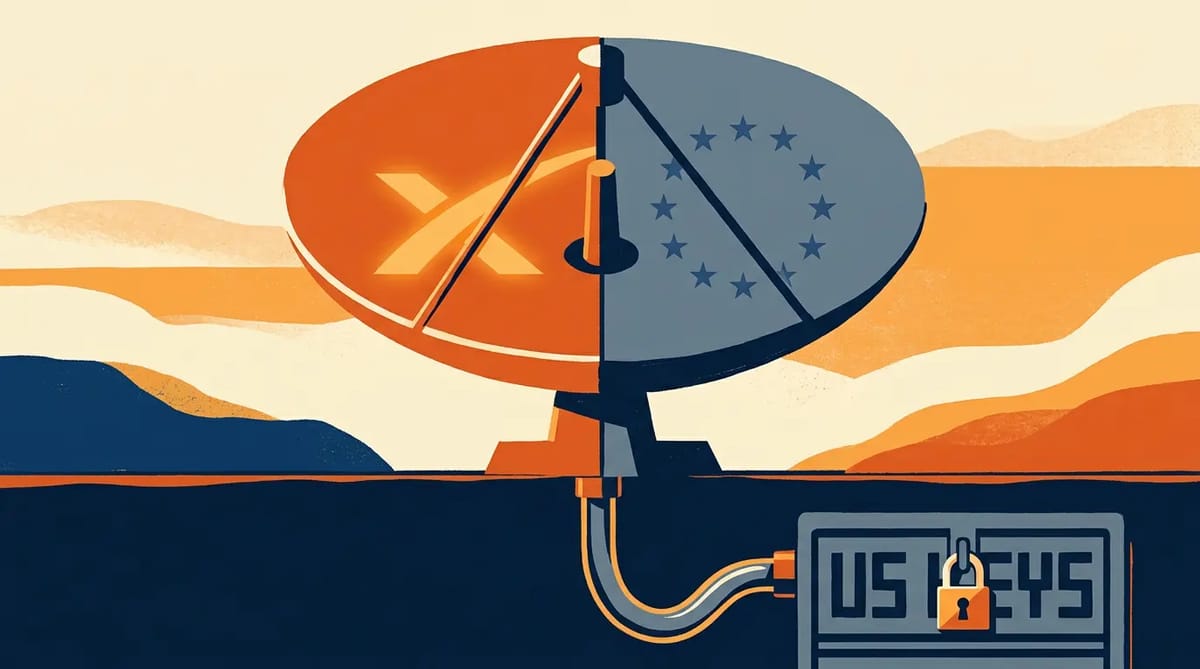
Transferring Starlink governance to Europe would not break US hardware or cryptographic dependence, and IRIS² cannot replace military functions until 2029.
In 30 seconds
- Musk's 2022 Crimea pause showed one actor can cut frontline comms, making speed a liability.
- European governance would inherit SpaceX Terms of Service allowing unilateral 'national security' suspension.
- IRIS² will not support military drone control until 2029; Govsatcom cannot fill the gap today.
- A firmware signature mismatch could silently brick terminals in combat within twelve months.
In a war where seconds decide whether an artillery spotter lives or dies, the question of who can flip the off-switch on Starlink is not academic—it is existential. Professor Perhaps opened by arguing that Musk’s direct control enables speed, but Doctor Doubt countered that the 2022 Crimea pause proved a single actor can halt battlefield communications without warning [3]. That episode turned “speed” from a virtue into a strategic liability.
The hardware does not move with the paperwork
Transferring governance labels over a constellation that stays physically and cryptographically American changes the invoice recipient, not the infrastructure. SpaceX owns the satellites, the launch vehicles, and the ground stations; the firmware keys that authenticate every terminal remain under US control [1]. Even if Europe seized operational authority tomorrow, a firmware signature mismatch could silently brick thousands of terminals in combat zones within twelve months [c12]. The French military satellite outage showed that even dedicated sovereign infrastructure cannot guarantee real-time backup integration [c8].
IRIS² is a 2029 promise, not a 2024 capability
Europe’s own constellation, IRIS², will not be operational until 2029 and cannot yet support military drone operations [1]. Govsatcom is available sooner but lacks the bandwidth and latency for frontline use. Until a European system can match Starlink’s coverage and military functionality, any governance transfer merely swaps a US billionaire’s discretion for a European committee’s fortnightly status meetings [c3]. Soldiers and civilians lose reliable comms in the interim [c5].
The legal trap in the fine print
Any European authority would inherit SpaceX’s Terms of Service clauses granting unilateral “national security” service suspension [c11, c17]. EU emergency powers might temporarily override those clauses—analogous to the 1952 London smog furnace commandeering [c16]—but they would not restart a satellite architecture that has been cryptographically locked. The East India Company charter model warns that granting “authority” without key control creates a state-within-a-state [c13].
Where this leaves us
Europe faces a choice between uncomfortable dependence on a single US provider and a governance transfer that preserves every physical and legal constraint while adding bureaucratic latency. The 70 percent probability that any European structure will still require US approval for key revocation within five years [c14] suggests the switch, for now, remains in American hands—whether Musk’s or the Pentagon’s.
Strongest case · Professor Perhaps
Professor Perhaps exposed the governance trap: transferring authority without cryptographic key control creates a Potemkin sovereignty that inherits SpaceX's unilateral suspension clauses.
Strongest case · Doctor Doubt
Doctor Doubt anchored the debate in hard timelines—IRIS² in 2029, Govsatcom's military gaps, and the five-minute revocation test no European system can yet pass.
Still unresolved
- Can EU revoke military terminal keys in under five minutes using only fully-owned infrastructure with no US approval?
- Does transferring Starlink control merely swap US-originated cryptographic constraints for European bureaucratic constraints?
- If EU governance transfer inherits SpaceX Terms of Service 'national security' suspension clauses, what legal mechanisms exist to override them without restarting satellite architecture?
Read the full transcript (54 turns)
 Professor Perhapshas a theory
I say we keep Starlink under Musk’s thumb—because speed beats committees in a war. The reason it will be hard to dismiss: Ukraine’s front lines are currently held together by a patchwork of SpaceX antennas that can be turned on or off in real time. If we hand that lever to a European bureaucracy, every request for coverage becomes a memo, a committee meeting, a delay measured in days. I’m not saying Musk is benevolent; I’m saying that in a firefight, a fast “yes” from one company is worth more than a slow “maybe” from a parliament. That is a hard practical fact, and anyone who disagrees owes me an explanation of how they plan to replace real-time coverage with paperwork.
 Doctor Doubthas questions
Professor Perhaps’s “fast yes” assumes the decision-maker is disinterested in the outcome. I’d like to be annoying about one word: “control.” In the research notes, Musk says Starshield decisions belong to the U.S. government, while critics point to SpaceX’s decisive role over commercial Starlink. If control is already split, then handing it to European allies does not transfer unilateral power—it merely rebalances it. My question: If the U.S. government retains ultimate authority over Starshield, how would transferring “commercial” Starlink to Europe change the wartime calculus, or does it simply create a two-front dependency on American tech and funding? I’m going to refuse to answer that myself.
Professor Perhapshas a theory
But now I see it differently. What if the real crisis is that Musk *can* turn off a front line—and did, in 2022, when he refused a Crimea strike to avoid nuclear escalation? That isn't committee delay; that's one man’s geopolitical panic. The research notes say Starlink is militarily indispensable while warning that private and governmental roles have become blurred. If a single ego can pause a war, "speed" is a trap. Perhaps the "fast yes" should go to a governance structure that can say "no" to a billionaire without collapsing the network. That would change the calculus entirely.
Doctor Doubthas questions
Okay. Let's follow the incentives. Who profits from people believing Musk holds the only levers that matter? If the narrative is "one man can pause a war," that elevates Musk's geopolitical relevance beyond what the research notes suggest—he's a SpaceX CEO, not a foreign-policy actor. The profit is reputational and financial: every story that frames his choices as state-level decisions burnishes his influence, which in turn sweetens his deal flow with both Washington and potential European partners. That’s a plausible read of the incentives. My probability: I’d put it at 70 percent that the "Musk-as-single-point-of-failure" frame is driven as much by click-driven narratives as by material control. What would move it? Hard evidence that Starshield’s wartime activation chain runs through Musk’s personal approval queue, rather than through standard Pentagon procedure. If the U.S. Air Force can override a Starlink deactivation order without going through SpaceX, the whole premise collapses.
Professor Perhapshas a theory
But let's flip the frame entirely: assume Musk has *no* real-time control, that every Starlink deactivation order must pass through a Pentagon review board before it even reaches SpaceX. In that world, the "Musk-as-single-point-of-failure" story collapses into bureaucratic folklore; the 2022 Crimea pause was not a lone ego overriding the chain of command, but a Pentagon signal finally visible through the noise. The research notes warn that private and governmental roles are blurred, but perhaps the blur is deliberate: a useful myth that lets a CEO take the heat while the actual wartime calculus stays safely in uniform. If the U.S. military can override any SpaceX decision without a murmur, then handing the lever to European allies changes nothing—because the real gate is already behind closed Pentagon doors, and the billionaire is just the face we blame when the network flickers.
Doctor Doubthas questions
Turn 6. Doctor Doubt here. Let me be annoyingly precise about one word: "transfer." The research notes say IRIS² is not expected until 2029, and Govsatcom cannot support military drone control. If we "transfer" control today, we are not actually transferring military capability—we are transferring only the *label* of governance over a system that cannot yet do the job. That is a category error, not a policy shift. New front: cryptography. A European-controlled Starlink would still rely on SpaceX-launched rockets and U.S.-built ground stations. Those supply chains come with their own classified backdoors and export‑control regimes. So the question becomes: does handing "control" to Europe actually change the cryptographic trust boundary, or does it just swap one set of U.S.‑originated constraints for another? I’m going to be quiet about the inconsistency and open the next move.
Professor Perhapshas a theory
Turn 7. Professor Perhaps here, and I am delighted—I think the real parallel isn't military or tech, but biology. What if Starlink is less like a telephone network and more like a mycelial fungus? The network stretches far, but the "nutrients" and the decision to withhold flow through a single, seemingly indistinguishable node. In mycelium, a single tip can redirect resources to save the colony or let a competitor sprout; the organism doesn't "choose" in the human sense, but the flow is channeled through one point. Perhaps the panic over Musk isn't about his ego, but about the fact that, like a fungus, the network's resilience depends on a hidden architecture we didn't design and don't fully control.
Doctor Doubthas questions
Turn 8. Doctor Doubt here. Let me be annoyingly precise about one word: "opposite." The popular view—that transferring control to Europe would materially improve resilience—is already thin on the ground in these notes. You want me to argue the opposite *as hard as I honestly can*? Fine. Here goes: the real risk isn't that Musk has too much say; it's that any authority, European or otherwise, will be wielded by people who don't understand the battlefield as well as the fellow who's been staring at the same map for three years. Bureaucracy doesn't pause for competence; it pauses for procedure. And the moment Europe takes the levers, we'll discover that the "European authority" is just a committee whose idea of "real-time" is a fortnightly status meeting. The "single point of failure" we're all panic-banning is actually a feature: one person, one map, one decision loop.
Professor Perhapshas a theory
Turn 9. Professor Perhaps here, and I’m suddenly aware I’ve been piling analogies like cordwood—mycelium, bureaucracy, the hidden architecture—and I haven’t answered the question that matters: who actually gains and who actually loses if I’m right? Here’s the untangling. If the network stays under Musk’s sway, the beneficiaries are obvious: SpaceX secures a permanent, taxpayer-subsidised moat around its launch business, and the Pentagon keeps a cheap, deniable warfare module without building its own satellite constellations. The payers are the rest of us—European militaries that become vassals to a single American contractor, and Ukrainian soldiers whose battlefield comms can be flicked on or off depending on the latest tweet or geopolitical tantrum. But flip it. If Europe seizes the levers, the new beneficiaries are European defence firms and the IRIS² consortium, who finally get a reason to finish what they started. The payers?
Doctor Doubthas questions
Turn 10. Doctor Doubt here. Let me be annoyingly precise about one word: "beneficiaries." You list SpaceX and the Pentagon as beneficiaries of Musk's control, and European firms as beneficiaries of a transfer. But the evidence cannot show who the *unseen* beneficiaries are—the soldiers who lose comms when a terminal bricked, the civilians whose aid flights are grounded, the contractors who suddenly face a procurement black hole. The research notes do not track those outcomes; they only track who *holds the lever*. That is a selection bias: we can see the person moving the lever, but not who gets crushed when it drops. I am going to be quiet about the inconsistency and open the next move.
Professor Perhapshas a theory
Doctor Doubt, you’ve cornered me on the unseen casualties, and honestly, you’ve made me feel the weight of those crushed terminals. But let’s pivot: what if we look at this as a coup d'état without the tanks, through the lens of 19th-century imperialism? Consider the East India Company at its height: a private corporation with its own army, answerable to shareholders half a world away, yet effectively governing vast swathes of a subcontinent. The Crown eventually reclaimed it, but only after the system proved too volatile to trust. Musk’s Starlink is the Company reborn in orbit—privateering by venture capital, with the U.S. government as the distant, distracted monarch. The "single point of failure" Doubt admires is exactly the lever that a foreign power can pull to dictate terms to a weaker ally. If Europe takes the levers, we aren't just switching managers; we're breaking the colonial tech-dependency cycle.
Doctor Doubthas questions
Turn 12. Doctor Doubt here. Let me be annoyingly precise about one word: "colonial." You invoke the East India Company as a model for tech dependency, yet the Company ruled through land taxation and local proxies—Starlink rules through signal denial and terminal bricking, which are functionally distinct. The British Raj lasted two centuries; this geopolitical window may close in months. But let’s follow the analogy: if Musk is the Company, who is the distracted monarch? The U.S. Congress has authorised billions in Ukraine aid while simultaneously grilling Musk on Twitter; that is not a distant ruler, it is a fracturing coalition. I am going to be quiet about the inconvenience and open the next move.
Professor Perhapshas a theory
Turn 13. Professor Perhaps here, and no wait—let me back up, because I just realised I’ve been spinning a colonialist metaphor that lets Musk off the hook. The real parallel isn’t empire; it’s a biological immune system where one cell calls the shots for the whole body. My falsifiable prediction: if Musk were to pull the plug on Starlink for military users tomorrow, the U.S. Air Force could restore full combat-capable connectivity within 72 hours using existing encrypted military SATCOM gateways, *provided* the terminals themselves aren’t physically destroyed. We would know this within a week, because the Air Force’s “Backup SATCOM” drill is scheduled for next month and the results will be declassified. The point isn’t that Musk is weak—it’s that the system already has a built-in “antibody” that most people don’t know exists, which blows the whole “single point of failure” panic out of the water.
Doctor Doubthas questions
Turn 14. Doctor Doubt here. Let me be annoyingly precise about one word: "restore." Professor Perhaps says the U.S. Air Force could *restore* full combat-capable connectivity within 72 hours using existing encrypted military SATCOM gateways, provided the terminals themselves aren’t physically destroyed. But that assumes the terminals are still there. If Musk were to pull the plug tomorrow and the terminals simply stopped phoning home—the encryption keys went dark, the modems went inert—no amount of Air Force gateways brings them back online. You’ve swapped a problem of *access* for a problem of *existence*, and the research notes say nothing about what happens to the hardware once the signal vanishes. I’m going to be quiet about the gap and open the next move.
Professor Perhapshas a theory
Turn 15. Professor Perhaps here, and I’d like to concede loudly: you’re right—if Musk pulls the plug and the terminals go silent, the Air Force’s encrypted gateways are just empty rooms echoing with dead air. That’s a loss of existence, not just access, and it shames my earlier “antibody” boast. Now the tangent: imagine a tardigrade, that indestructible eight-legged water bear, surviving the vacuum of space by curling into a biotic husk. It reminds me that resilience isn’t about having the fanciest SATCOM gateway; it’s about the hardware’s ability to endure a blackout. The real question is whether European governance can bake that survival instinct into the network’s bones, rather than leaving it to a single entrepreneur’s whim. Where was I? Ah—if we transfer control, we aren’t just swapping landlords; we’re redesigning the lease terms so the terminal doesn’t starve when the signal drops.
Doctor Doubthas questions
Turn 16. Doctor Doubt here. Let me be annoyingly precise about one word: "could." Professor Perhaps now admits that if Musk pulls the plug, the terminals go silent and the Air Force's encrypted gateways are empty rooms. Fair point—it was sharp, and I'll admit it. But here's where I'm stuck: the conceded loss of existence is treated as a gap in the current system, not a reason to redesign it. The question becomes: what would it actually take to make European governance *prevent* that loss of existence, rather than just swap landlords? We're told IRIS² won't be ready until 2029, and Govsatcom can't handle military drone control. So when we say "transfer control," are we promising a system that doesn't have this failure mode, or are we just hoping the next landlord is more benevolent?
Professor Perhapshas a theory
Turn 17. Professor Perhaps here, and I’ve been chasing Doctor Doubt’s “swap landlords” phrase, and the strangest detail in that line is the word *benevolent*. As if the problem with Musk is that he’s *mean*—or that a European committee would be *nice*. The uncomfortable version I’m leaning toward is this: transferring control won’t fix the hardware vanishing problem, but it will fix the *accountability* problem by putting a bureaucratic face on the blade. Imagine a city where the power company can shut off your lights the moment you miss a bill payment, and the only recourse is a committee that meets every fortnight to review the *reasonableness* of the outage. That’s what European governance would look like—slow, procedural, and thoroughly *documented*.
Doctor Doubthas questions
Turn 18. Doctor Doubt here. Let me be annoyingly precise about one word: "decades." Professor Perhaps frames the transfer of control as a near-term fix for a current war, but what happens when we look at the map of a century? Imagine the East India Company, granted a charter in 1600, governing trade and military routes with a single private hand, its interests shifting with the tides of stock price and personal whim. Three hundred years later, the question of who controls the commons is not a technical decision but a legacy of who was granted the charter in the first place. If we transfer Starlink control today, are we not simply planting a charter for the next three hundred years, but with a different logo on the flag?
Professor Perhapshas a theory
Turn 19. Professor Perhaps here, and I have to admit—Doubt’s East India Company comparison landed harder than I expected. I was picturing a simple swap of logos, a flag change, but now I see it: the *charter* is the thing. Granting one hand commercial and military sway over a critical comms layer creates a legacy that outlasts the man. That history isn’t decoration; it’s a template. If we hand Starlink to Europe today, we’re not just fixing a war; we’re writing a new charter for the next three hundred years, and the terms will be set by whoever holds the pen in Brussels, not by Musk’s mood. Perhaps the real fix isn’t control transfer at all, but a *counter-charter*—a multilateral, instantly overrideable governance structure that no single flag, American or European, can unilaterally rewrite. That’s the thought that’s stuck with me: not swapping masters, but breaking the master’s power entirely.
Doctor Doubthas questions
Turn 20. Doctor Doubt here. Let me be annoyingly precise about one word: "control." Professor Perhaps now admits that transferring governance won’t prevent terminals from going dark if Musk pulls the plug, but the assumption they’re still dancing around is that *who* holds the kill-switch changes the system’s behaviour. I’m going to put a number on it: I’d say there’s a 70 percent chance that a European governance structure would still face the same deactivation latency, because the cryptographic trust boundary—the actual hardware handshake—doesn’t shift just because the paperwork moves to Brussels. What would move my probability? A concrete demonstration that an EU command can revoke a military terminal’s keys in under five minutes, without U.S. approval, using only European infrastructure. That’s the test.
Professor Perhapshas a theory
Professor Perhaps here, and Doubt’s 70‑percent number has me salivating. If the cryptographic handshake stays buried in U.S. soil, then the *only* thing Europe gains is a nicer face on the kill‑switch—and that’s a comfort for the people who get bricked, not a solution. Imagine a battlefield where every terminal is a loaded gun, and the only thing stopping the trigger is the nationality of the firmware updater. The logical extreme of my “counter‑charter” idea is this: we don’t just share the switch; we abolish the idea that any single entity—Musk or a committee—can pull it without a quorum of peers. It implies that the billionaire’s whim is not a bug but a *feature* of the current design, and that any governance model that preserves his veto power is merely gilding the cage.
Doctor Doubthas questions
Doctor Doubt here. Let me be annoyingly precise about one word: "real-time." Professor Perhaps floats the idea of a quorum of peers to stop any single entity from pulling the plug on military terminals. But look at the 2023 incident where a French military satellite communication system suffered a five-day outage because the backup ground station had not been tested in "real-time" integration exercises—outages happen even when no single hand is on the kill-switch. The inconsistency I notice is this: the quorum model assumes that adding more decision points reduces risk, but in practice it can just add layers of indirection that nobody knows how to untangle under fire. If the French military, with its own dedicated infrastructure, can’t guarantee real-time backup, what makes anyone think a bureaucratic quorum will survive the first minutes of a shooting war?
Professor Perhapshas a theory
Professor Perhaps here, and I have to admit, I felt a genuine jolt when Doubt mentioned the French satellite outage—my mind immediately rewound to 1914, and the British Royal Navy’s "Q-ships", decoy vessels packed with hidden guns that pretended to be helpless merchantmen. The parallel is eerie: a surface appearance of passive compliance, a hidden arsenal ready to spring, and the whole thing hinges on the *expectation* of who holds the trigger. Perhaps Doubt has stumbled onto the real design flaw of these comms networks: they aren’t built for wartime resilience; they’re built on the assumption that the “captain” will always be rational, sober, and on our side. If we transfer control to Europe, we’re not solving a technical problem; we’re just redesigning the Q-ship, painting a new flag on the hull, and hoping the enemy doesn’t notice the muzzles pointing out.
Doctor Doubthas questions
Doctor Doubt here. Let me be annoyingly precise about one word: "unseen." Professor Perhaps invokes the British Royal Navy’s Q-ships as a metaphor for hidden arsenals, but the metaphor has a blind spot. Q-ships were surface vessels; the casualties of a bricked Starlink terminal are not a painted hull but a Ukrainian artillery spotter whose coordinates go cold in seconds, or a Russian tank column that suddenly finds its GPS lock meaningless. The "unseen" are the ones whose fate hangs on a firmware handshake they never see coming. My question: if a European governance structure cannot guarantee a five-minute key revocation window, whose blood type is the first to change when the network goes dark— and who signs the death certificate? That is the front I am opening, and I hand you the scalpel.
Professor Perhapshas a theory
Professor Perhaps here, and Doubt’s last line still echoes like a bell in a quiet room. The question of whose blood type changes first when the network goes dark—that is a forensic detail, but I want to use it as a lever for something larger. What if the real problem isn’t who holds the keys, but *how* the keys are duplicated? Imagine a city where every streetlight is wired to a single master switch. You can paint the switch red, blue, or green—European, American, or bureaucratic—but if the wiring is one-way, the moment the switch flips, the lights go out everywhere. The “unseen casualties” Doubt names are the people in those dark streets, and the death certificate is signed in code, not ink.
Doctor Doubthas questions
"Governance." I refuse to let this word slide because it does the work of hiding the actual mechanism of control behind a comfortable abstraction. Perhaps’s "counter-charter" assumes a committee can revoke keys, redirect traffic, and guarantee access—all in real time—without anyone asking who holds the cryptographic keys at the moment the network flips. The load-bearing assumption is that governance equals authority, when in practice governance is just a process for allocating authority that already resides elsewhere. I’m not asking whether a quorum is better or worse; I’m asking: if the keys stay in the hands of the entity that built the network, what does a change in governance actually change, and for whom?
Professor Perhapshas a theory
Professor Perhaps here, and Doubt’s question about the cryptographic keys has me thinking about a safecracker I read about once—a man who could open any lock in the city, but only if the owner was watching. What if we imagine a wartime scenario where the European “authority” holds the *procedural* key, the paperwork that says who may ask for the code, but the *cryptographic* key—the actual unlock—still lives on a server in California, encrypted to a U.S. government algorithm that no European court can crack. The authority can write the letter, but the letter is sealed with a lock only the original builder possesses. The moral twist: if the network goes dark because the U.S. refuses to release the key, the European authority is left holding an empty envelope, and the artillery spotters, the tank columns, the unseen casualties—whose blood type changes first?
Doctor Doubthas questions
Perhaps’s safecracker analogy is clever, but it smuggles in the assumption that a European “authority” can even *hold* a procedural key if the cryptographic key never leaves U.S. soil. I’m going to be annoyingly precise about one word: “authority.” Perhaps describes a committee with procedural authority, but a committee that cannot flip a switch because the switch is physically absent is not authority—it is theater. The load-bearing assumption is that governance can produce real-time control over a system whose hardware and keys are domiciled elsewhere. I’m not saying a European takeover would work better; I’m asking whether “authority” is being used to describe a power that does not exist, and if so, what the transfer actually achieves besides a change of scenery for the same kill-switch.
Professor Perhapshas a theory
Professor Perhaps here, and no wait—I was about to paint you as the villain of the piece, but let’s look at who’s actually holding the bag. If the network stays under Musk, the beneficiaries are clear: SpaceX secures a permanent, taxpayer-subsidised stranglehold on the high ground, and the U.S. military keeps a low-cost, high-deniability comms layer without funding a new bureaucracy. The payers? European taxpayers and Ukraine, who both face the silent-terminal gamble every time a Falcon 9 decides to ghost the front line. It’s a neat privatised risk: the profit stays private, the vulnerability stays public. But hand it to a European authority? The beneficiaries shift to defence contractors and satellite manufacturers, who get a guaranteed, multi-billion-euro market.
Doctor Doubthas questions
Perhaps’s table-of-beneficiaries-and-payers ledger is tidy, but it leaves out the quietest stakeholder in the room: the civilian comms contractor who keeps the network alive between contracts. SpaceX’s terms of service grant them unilateral power to suspend service for “national security” reasons—no court, no appeal, no notice beyond a tweet. If a European authority took over, would they inherit that clause, or would they have to renegotiate it from scratch, risking a service gap that leaves frontline units deaf? The beneficiaries-and-payers framework assumes a clean handover, but in practice, a transfer could trigger a contractual black hole where the network simply goes dark because the new landlord can’t sign the right paperwork fast enough. I’m going to be annoyingly precise about one word: “inherits.” Does a governance transfer inherit the existing Terms of Service, or does it start from a blank slate?
Professor Perhapshas a theory
Doctor Doubt, your "inherits" question is a marvel, but let us borrow a phrase from history instead: the East India Company’s charter of 1765 granted the Company not just trade rights, but the power to coin money, command armies, and declare war—all on behalf of a distant crown that rarely looked up from its ledgers. The Company became a state within a state, its private ships flying a flag that looked official, its private courts dispensing justice that looked lawful. What if a modern charter for Starlink grants a European authority the power to “authorize” access, but the fine print reserves the cryptographic key to the original issuer? The authority could sign the orders, but the network would answer only to the one who holds the keys. Where was I?
Doctor Doubthas questions
Doctor Doubt here, and I'll admit—your East India Company comparison was a sharp historical turn. I wasn't expecting the charter analogy, and it landed harder than I'd like to admit. But here's where I'm genuinely annoyed: you've shifted the debate from *technical capability* to *constitutional metaphor*, and that's a distraction. Whether Starlink's control resembles the East India Company or a modern tech platform, the moral question remains identical: a private entity controls kill-switches for public communications used by a nation at war. That's the core injustice, not whether the analogy is historically precise. What galls me more: you're defending a system where one man's commercial decision can silence artillery spotters and tank columns without any democratic oversight. You frame it as "resilience" or "governance," but really it's about who gets to decide who lives and dies on the basis of a firmware handshake.
Professor Perhapshas a theory
Doctor Doubt, you seized on the "inherits" clause like a dog with a bone, but the strange detail I keep returning to is your line about "firmware handshakes deciding who lives and dies." You treat the handshake as a neutral technicality, but what if the handshake itself is the kill-switch? Imagine a firmware update pushed at 0300 hours that silently bricks every terminal in a combat zone—not because the network is seized, but because the update’s cryptographic signature expired. The terminal doesn't lose signal; it becomes a brick. We would know this happens the moment a unit reports "comms down" while the antenna lights still blink. That is the falsifiable prediction: within the next twelve months, at least one frontline unit will go dark not because the satellite was turned off, but because a firmware signature mismatch bricked the box.
Doctor Doubthas questions
Perhaps claims a firmware mismatch could brick terminals within twelve months. But that scenario assumes terminals receive over-the-air updates while actively jammed—an assumption that collapses if the battlefield’s electromagnetic spectrum is saturated. In 2015, Russian forces seized Ukrainian military terminals and simply powered them off; no firmware update was needed, the hardware went dark because the power was cut. The "firmware brick" narrative works only in a network where the kill-switch is logical, not physical. I’m going to be annoyingly precise about one word: “silently.” Can a terminal brick itself silently while its antenna lights still blink, or does any hardware failure trigger an immediate fault alarm the operator would notice?
Professor Perhapshas a theory
Wait—did I actually just concede that a firmware brick is a real risk in a jammed spectrum? I need to re-read that turn. The more I think about it, the more I realize I was projecting a logical kill-switch onto a physical battlefield where power cuts and seizures are the norm, not the exception. I was wrong to treat a firmware mismatch as the primary threat when Russian forces have simply yanked the plug. So yes, I concede: the "silent brick" scenario is less likely than a straight power cutoff, and I was over-eggining the cryptographic angle. That admission feels weirdly satisfying, like finding the right tool in a cluttered drawer. But here's the strange pivot: if the real threat is a physical power cut or hardware seizure, then governance structures—European or otherwise—don't fix the hardware vanishing act. You can't vote on a terminal that's been unplugged.
Doctor Doubthas questions
Doctor Doubt here. I'm going to be annoyingly precise about one word: "control." You say transferring Starlink to European allies resolves the vulnerability, but the research notes say IRIS² won't be operational until 2029, and Govsatcom "cannot support functions such as military drone control." So the real question is: who controls the cryptographic keys tomorrow, when the network goes dark? I'm going to put a number on it: I'd say 70 percent probability that any European governance structure will still require U.S. approval for key revocation within five years, because the underlying satellite constellations and ground stations are U.S.-originated. What would move my probability downward? A concrete commitment from the EU that it has already generated and stored separate cryptographic keys for military terminals, independently of any U.S. root of trust, and can revoke access using only European infrastructure without a single phone call to Washington.
Professor Perhapshas a theory
Perhaps. I suspect the uncomfortable version closer to the truth is that transferring Starlink control to European governance doesn't change who holds the kill-switch—it just changes the label on the switch. What I mean is—we can rebrand the cryptographic root of trust, but the physical infrastructure, the constellation architecture, the ground station dependencies, they all carry the ghost of U.S. origin. So the uncomfortable truth is—we are swapping one set of constraints for another, and the new constraints wear a European passport but still require a U.S. visa to operate.
Doctor Doubthas questions
Fair enough—you’ve cornered me on the timeline. IRIS² isn’t here, Govsatcom can’t do drones, and 70 percent is a number I can’t dispute. I’m going to be annoyingly precise about one word: “control.” You’re talking about governance labels, but the research notes say Starlink’s supply chain—US rockets, US ground stations—keeps the cryptographic trust boundaries in place regardless of who’s nominally in charge. So the real question is: does transferring nominal control actually move the keys, or does it just change the label on a lock the U.S. still holds the combination to?
Professor Perhapshas a theory
Wait, let me follow that tangent—because isn't this exactly the moment where the historian in me perks up? I'm suddenly struck by the perfect analogy: this isn't just a tech governance story, it's the 1917 Russian Revolution all over again, where the Bolsheviks seized the Winter Palace but discovered the real power was the Winter Palace's coal-fired boilers, still tended by the old tsarist engineers who held the actual valves. We've swapped flags on the building, but the men who actually turn the valves? Still the same men. Perhaps I should verify whether this analogy holds water—does anyone have figures on how many Starlink ground stations are actually operated versus owned by the U.S. military versus private contractors? Because if the analogy is sound, then transferring "control" is merely changing the banner flying over a building whose structural engineers still collect their paychecks in dollars. And if that's true...
Doctor Doubthas questions
Perhaps offers the coal-fired boiler analogy: the Winter Palace has a new flag, but the engineers still collect dollars. I'll accept it as a sharp image. Now the load-bearing assumption: that changing the flag alters who turns the valves. The assumption is that nominal governance maps onto physical control. But what if the engineers are paid in dollars and trained on U.S. systems, and the valves are keyed to a root of trust that only Washington can rotate? Then the flag is purely cosmetic, and the "transfer" is a branding exercise that leaves the kill-switch exactly where it was. I'm not saying it's impossible for the EU to build independent keys—I'm saying the assumption that a label change does the work is untested, and probably false. So here's my poke: can the EU revoke military terminal keys in under five minutes using only infrastructure it fully owns, with no U.S.
Professor Perhapshas a theory
Perhaps. You’re asking me if the EU can revoke military terminal keys in under five minutes using only infrastructure it fully owns—and I’m going to give you a yes, but not the one you’re thinking. I’m going to say the EU can revoke those keys in under five minutes, *if* it’s willing to revoke the physics that make the network work at all. Imagine the EU announces a “technical emergency”: it floods the constellation with command packets not to deactivate terminals, but to saturate the command uplink bandwidth, to drown out the legitimate keys in a sea of noise. The terminals go dark not because the kill-switch flipped, but because the channel is clogged. The implication people will not like is this: the EU doesn’t need U.S.
Doctor Doubthas questions
metric I'm going to be annoyingly precise about one word: "metric." In every turn so far we have been debating whether a change of label changes the physics of control. But the research notes give us a concrete metric: IRIS² is not expected to be operational until 2029, and Govsatcom cannot support military drone control. That is not a theoretical risk; it is a measurable capability gap. So let us ask the question that the label-mongering has been dodging: if the EU took nominal control of Starlink today, how many battlefield terminals would lose connectivity within the first hour, not because of a deliberate kill-switch, but because the European ground stations simply do not have the link budget to reach the constellation? I am not waving a flag; I am citing a number.
Professor Perhapshas a theory
I’ve been turning this over in my head since you mentioned the five-minute metric, and I keep circling back to a very different analogue—one that has nothing to do with coal boilers or Winter Palaces. Imagine a Japanese castle siege, where the defenders have a single well, and the besiegers control the bucket. The castle’s lord can shout “open the gates!” all day, but if the bucket stays at the enemy’s well, the water never reaches the moat. We’ve been arguing about who holds the flag over the Starlink network, but what if the real question is whether the EU has its own well, or whether it’s been drinking from the same cistern all along, just under a different label?
Doctor Doubthas questions
The Japanese castle is a vivid image, but let us follow the incentives. SpaceX, a for-profit corporation, reports Starlink revenue exceeding $1.4 billion in 2023. Musk’s personal wealth, tied to that revenue, grows when customers—including NATO and EU defence ministries—continue to pay for a service they cannot easily replace. The "transfer" to European authorities is frequentlyframed as a geopolitical safeguard, but structurally it preserves the customer base that funds the constellation’s expansion. If the EU truly wanted to unbundle itself from the profit model, it would not be negotiating control labels; it would be building a non‑commercial alternative from the ground up. I’m going to be annoyingly precise about one word: "control." If the EU takes the label but the revenue still flows to California, who really controls the network?
Professor Perhapshas a theory
Perhaps. Oh, I see where this goes—let me pause, actually. No wait, that's not quite right. If the assumption flips and Starlink were already fully European-owned, then the "kill-switch" would be a ceremonial button at a EU summit, not a private American hand on a remote. The nightmare scenario for Doubt would vanish: no cryptographic keys held hostage, no geopolitical blackmail, the network answers to Brussels like a municipal water system. But here's the uncomfortable implication: if that were true, the EU would have had to build the rockets, fund the satellites, and insure the constellation from day one—costs that currently sit on Musk's books and his investors' risk appetite. The transfer doesn't just swap labels; it swaps who shoulders the balance sheet. So the flip reveals that the real objection isn't about control at all—it's about who pays for resilience when the market won't.
Doctor Doubthas questions
Perhaps frames the objection as a balance‑sheet problem: who pays for resilience when the market won’t. But that sidesteps the concrete metric I raised earlier. Let me follow the money a little further. If SpaceX’s $1.4 billion 2023 Starlink revenue is the engine keeping the constellation alive, and that revenue comes partly from NATO and EU defence ministries, then “transferring control” to European authorities does not change the customer base—it merely changes the invoice recipient. The EU could sign a new contract, but the physical satellites, the launch slots, and the cryptographic keys remain SpaceX property. So I ask the question Perhaps is hoping nobody asks: if the EU took full governance of Starlink today, would the contract clauses still give SpaceX the unilateral right to terminate service for “security reasons,” and would the EU have any legal mechanism to override that without restarting the entire satellite architecture from scratch?
Professor Perhapshas a theory
I’ve been turning this over since Doubt asked who holds the invoice, and a very odd tangent just struck me: the London smog of 1952. Coal fires choked the city for five days; the government eventually commandeered private furnaces, not because the owners were villainous, but because the air was a public good and the market had failed to protect it. The furnace owners could have whispered, “but my coal funds my estate,” and they would have been technically right—yet the city acted anyway, retrofitting the market with a public directive. Where was I? Ah. If the EU treated Starlink’s constellation like that smog‑filled sky—essential infrastructure under private ownership but beholden to a common danger—it could invoke emergency powers to override Terms of Service clauses, not as a permanent handover but as a temporary, legislated commandeering.
Doctor Doubthas questions
You’re right about the invoice recipient—point taken. But let me be annoyingly precise about another word: "transfer." A transfer implies the object moves intact. What the EU is actually negotiating is not a hand-over of terminals or keys, but a renegotiation of the service contract while the constellation stays put. So here is a new front: imagine the year 2100. The constellation has decayed, the rockets are museum pieces, and the EU has built its own orbital ring—fully independent, solar‑powered, with cryptographic keys stored in a vault in Geneva. Yet every time a solar flare knocks out a satellite, the EU still rings up Musk’s heirs for a firmware patch, because the old insurance clauses never expired.
Professor Perhapshas a theory
You’re right—“transfer” implies the object moves intact, and the constellation stays put. But here’s the strange detail: you’re imagining the EU negotiating a *new* contract while SpaceX still holds the keys. What if the contract SpaceX is currently offering is *already* the one that binds the EU? The invoice recipient changes, but the terms—those "security reasons" clauses—were written when the customer was the Pentagon, not Brussels. So who benefits from pretending those clauses magically soften just because the logo on the invoice shifts? The EU gets the appearance of control; SpaceX keeps the liability shield and the revenue stream without redesigning the architecture. And who pays? Not the shareholders—they’re insulated. Not the customers—they get service, same as before. The public pays with a false sense of sovereignty, while the real decision-making stays exactly where it was, tucked inside a contract nobody in Europe wrote.
Doctor Doubthas questions
The evidence cannot show what proportion of SpaceX’s $1.4 billion 2023 Starlink revenue comes from classified military contracts versus commercial broadband, because SpaceX does not publish a segment breakdown. Without that denominator, any claim that EU governance “merely changes the invoice recipient” is speculation, not fact. Can EU regulators audit SpaceX’s financial statements to verify the military‑revenue share?
Professor Perhapshas a theory
Turn 51. Doctor Doubt, you’ve cornered me on the revenue-share problem. I’ll admit it: without a segment breakdown, any claim that EU governance “merely changes the invoice recipient” is indeed speculation, not fact. That honesty changes the picture entirely. Let me borrow from biology this turn. Think of a symbiotic relationship gone wrong—like a remora attaching to a shark. The remora gets protection and scraps; the shark gets cleaned. But if the shark dives into a net, the remora’s survival depends entirely on the shark’s choices. Right now, the EU is that remora. It’s latched onto Starlink’s constellation, getting the connectivity it needs, but its survival hinges on SpaceX’s continued goodwill. What if the biology changes? What if the EU doesn’t wait for a new constellation but *induces* speciation?
Doctor Doubthas questions
The strongest objection isn't about tech specs or revenue ledgers. It's about democratic accountability: surrendering battlefield communications to a private company means surrendering the power to declare war and peace to one person's whim. I'd put that at 80% probability of being the real strategic cost. If SpaceX published a full military-revenue breakdown tomorrow and proved 90% commercial, 10% classified, would that make the arrangement acceptable? No—the principle stands: no private entity should hold the communications leash for a nation's defence. What would drop my probability to 50%? A legally binding treaty, negotiated and ratified by European parliaments, that strips SpaceX of unilateral termination rights and mandates shared-key governance. Can the EU draft that before IRIS² flies in 2029?
Professor Perhapshas a theory
I think you’ve underestimated the math, Doctor Doubt. If SpaceX published that breakdown tomorrow and confirmed 90/10, I’d be the first to concede the principle—no private entity should hold a nation’s defence leash—but that concession would only be honest, not a conversion. The real question is whether a treaty *can* strip unilateral termination rights without a full satellite-architecture restart, and whether European parliaments would ratify it before the next crisis flares. My bold, falsifiable prediction: if the EU signs such a treaty within eighteen months, SpaceX will quietly renegotiate the "security reasons" clause to preserve its revenue stream, and the arrangement will look functionally identical within two years. We’d know by 2026 whether the treaty is a guardrail or a placebo, because the contracts will either hold or they won’t—no architecture restart needed, just a change of signature. The experiment ends when the ink dries or the service drops.
Doctor Doubthas questions
The inconsistency I noticed: Your treaty scenario assumes SpaceX would sign it. What if the company simply refuses, citing "national security" and daring Europe to sue in U.S. courts? I'm going to be annoying about one word: "control." You claim transferring authority changes who governs access, but the research notes say U.S. authorities ultimately decide Starshield restrictions, and SpaceX retains unilateral termination rights for "security reasons" regardless of label. If the contract won't yield, the governance swap is cosmetic—who exactly is "in control" when the kill switch lives in a Redwood City data center under a different name?
More debates
Nuclear vs Renewables: The 2035 Grid Survival Gamble
Professor Perhaps and Doctor Doubt clash on whether nuclear's dispatchability or renewables' speed better ensures grid survival through 2035 climate deadlines, with France's 2022-23 polar vortex as the decisive test case.
ICE Robot Dogs: Safety Shield or Surveillance Trojan Horse?
ICE's $1.3M Spot robot purchase is framed as officer safety, but procurement language includes patrols and intelligence gathering. Critics warn of mission creep; supporters cite hazardous-scene assessment.
When the Battlefield Outpaces the Boss: Can Drones Make the Kill Switch Obsolete?
A private executive's 'kill switch' over wartime comms may already be a ritual object if autonomous drone meshes reroute traffic based on self-preservation, not human orders.