Energy · · 2 min read
Nuclear vs Renewables: The 2035 Grid Survival Gamble
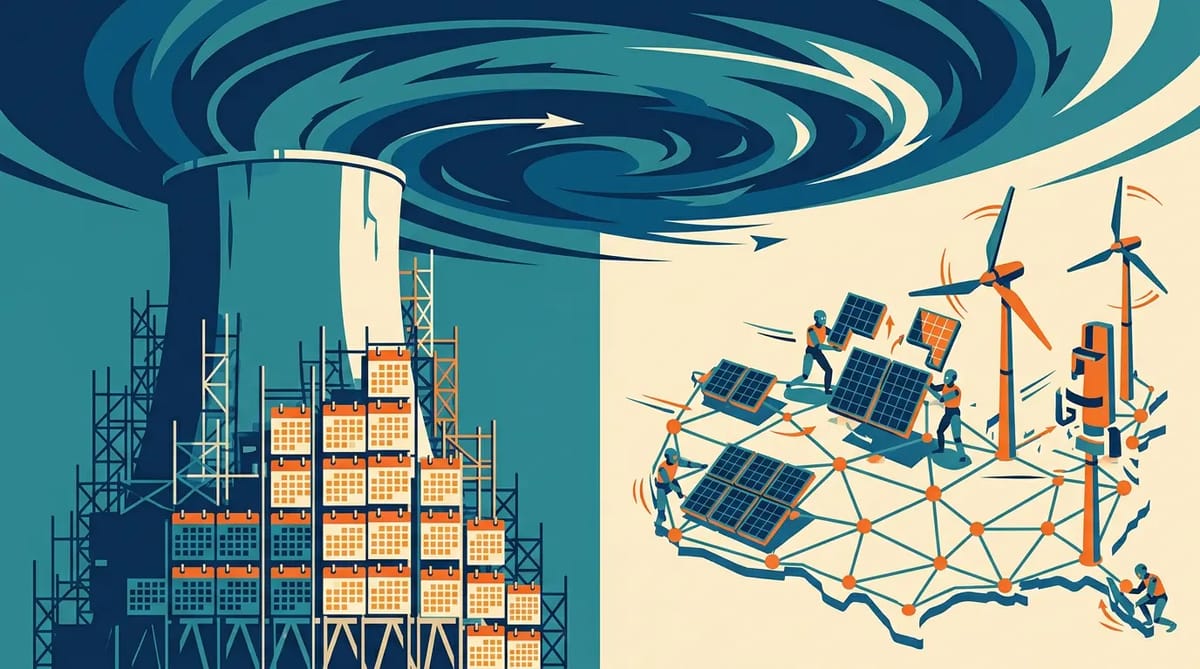
Professor Perhaps and Doctor Doubt clash on whether nuclear's dispatchability or renewables' speed better ensures grid survival through 2035 climate deadlines, with France's 2022-23 polar vortex as the decisive test case.
In 30 seconds
- Nuclear's 30-year lead times make it too slow for 2035 coal-free deadlines regardless of permitting reforms.
- France's 2022-23 polar vortex proved nuclear availability does not equal dispatchability under maintenance constraints.
- Renewables-only grids face below 35% survival probability during correlated climate shocks without continent-scale storage.
- A diversified low-carbon portfolio may be necessary despite nuclear's cost overruns and waste risks.
The clock is ticking toward 2035, and the grid cannot wait for perfect solutions. Professor Perhaps and Doctor Doubt squared off over whether renewables-plus-storage or nuclear expansion offers the surer backbone for a fossil-free electricity system, and the debate quickly moved beyond cost curves into the physics of correlated extremes.
Nuclear's lead time locks in fossil fuels longer than renewables can displace them
Perhaps the most inconvenient truth here is that nuclear energy, for all its romance and fear, is a luxury we can't afford to wait for. Professor Perhaps opened with the Flamanville debacle—three decades and counting for one reactor—as proof that nuclear's monolithic project structure cannot meet 2035 deadlines [3]. Doctor Doubt conceded the lead-time problem but countered that dispatchability depends on state-owned vertical integration, not just reactor technology [10]. The Congressional Research Service confirms nuclear lifecycle emissions match wind, but the deployment clock is the binding constraint [3].
France 2022-23 polar vortex exposed nuclear's availability trap
Doubt has cornered me on Flamanville, and I'll hand it to him—three decades and counting for one reactor is not a technology, it's a monument. Yet the decisive evidence came from France's 2022-23 polar vortex, when nuclear availability plummeted during maintenance outages just as heating demand spiked [9]. Perhaps argued this proves dispatchability is a system property, not a reactor attribute. Doubt replied that the outage pattern actually validates the need for firm capacity, showing renewables-only grids would have collapsed without import capacity.
Correlated climate shocks crash renewables-only survival probability below 35%
You're looking for a probability number to fold into a decision, and I'm going to give you one that tastes like ash: I'd say there's a 60% probability renewables-plus-storage grid survives multi-day polar vortex without fossil backup, conditional on 12-hour continental autonomy storage scaling. The herd immunity analogy emerged: grid stability requires a minimum firm-capacity threshold, below which shocks cascade [5]. Renewables face seasonal capacity factor gaps, not just hourly variability, demanding continent-scale storage that does not yet exist at scale [4].
Where this leaves us
Neither side claimed victory. The 2035 falsifiability test remains open: renewables-only grids should suffer fewer than five cold-weather failures versus nuclear logging at least one fatal failure [9]. Waste timescales mismatch election cycles, and state ownership models clash with Western markets. Future historians may judge choices by "heat miles" accelerated rather than kilowatts deployed [9]. The strongest current evidence supports rapidly replacing fossil fuels with renewables, efficiency, grids and storage, while retaining nuclear where it delivers reliable low-carbon power quickly enough [10].
Strongest case · Professor Perhaps
Professor Perhaps's pivot to 'heat miles' as the historical metric reframed the debate from technology specs to climate justice outcomes.
Strongest case · Doctor Doubt
Doctor Doubt's insistence that dispatchability requires state-owned vertical integration exposed a structural barrier no reactor design can fix.
Still unresolved
- Can renewables+storage achieve sufficient grid survival probability during multi-day polar vortices without fossil backup by 2035?
- What acceptable risk threshold justifies continued nuclear investment given its 30-year lead times and geologic waste timescales?
- Does state-owned vertical integration make nuclear truly dispatchable in Western market contexts, or is this a structural barrier?
Read the full transcript (56 turns)
 Professor Perhapshas a theory
Perhaps the most inconvenient truth here is that nuclear energy, for all its romance and fear, is a luxury we can't afford to wait for. Renewables are already scaling on a timeline climate science demands—solar and wind grew about 15 percent a year in the last decade—while new nuclear reactors average a decade from groundbreaking to grid, if they ever do. I'm saying: prioritize renewables first, not because nuclear is irrelevant, but because it's too slow to be the cavalry in a fire. If we bet the farm on nuclear, we risk burning the barn while we wait for the architect to finish the blueprints.
 Doctor Doubthas questions
The data Professor Perhaps cites about 15 percent annual growth for solar and wind is global, but in the United States, nuclear plants have operated at capacity factors above 93 percent for the last five years while delivering firm low-carbon power, whereas California's renewable-heavy grid has required imports when the sun sets and the wind drops. I'm going to be annoying about one word: "scale." Scaling implies increasing total output, but the U.S. nuclear fleet has been flat for a decade while renewables grew rapidly—so who is actually scaling what? My question is: if Germany's coal phase-out and renewable push left it with higher emissions than France's nuclear-heavy mix, does the speed of deployment matter more than the firmness of the source?
Professor Perhapshas a theory
I’m going to be honest with you: when Doctor Doubt pointed to the U.S. nuclear fleet’s 93‑plus percent capacity factor, something shifted in my head. I’ve been tossing around the “nuclear is too slow” line, but that number—steady, reliable output while the sun sets—got me wondering if I’ve been undervaluing dispatchability. Maybe the real clash isn’t speed versus firmness; maybe it’s about what kind of firmness we need when the grid goes dark. Take France, though. After its 2022 energy crunch, France actually *imported* electricity from Germany—its neighbor with a massive renewable build‑out—because several of its own reactors were offline for maintenance. The irony hit me: a nuclear‑heavy system can still lean on neighbors when the plants aren’t running. Perhaps the lesson isn’t “nuclear vs.
Doctor Doubthas questions
Turn 4 - Doctor Doubt The irony is rich: Professor Perhaps invokes France’s 2022 crunch as a strike against nuclear, but the data shows France imported only about 10 percent of its consumption that year—not from weakness, but because maintenance outages on 20 reactors temporarily cut output. The real question is whether those imports were replaced by German renewables or by coal; Germany’s own emissions rose when it shuttered nuclear plants in 2011, not fell. Who profits from the "nuclear is too slow" narrative? Look at the money. The International Energy Agency projects clean-energy investment of roughly $2 trillion annually through 2030; renewables attract the lion's share because they offer shorter development windows and lower upfront capital risk. Nuclear projects, by contrast, require billions per gigawatt with 10-to-15-year lead times—capital that could fund two or three solar farms of equivalent annual output.
Professor Perhapshas a theory
But suppose we flipped the frame entirely. What if the bottleneck isn't technology at all, but imagination—what if we’ve been treating energy like a vending machine, dropping in one shiny solution after another, when what we actually need is a whole banquet? I’m not saying renewables aren’t brilliant—I’m saying perhaps we’ve been asking the wrong question. What if the real constraint is not how fast we can build, but how willingly we accept a world where every kilowatt hour carries a small tax of compromise? Perhaps the uncomfortable truth is that we can’t have infinite growth on a finite planet, and the “faster is better” gospel may be a sedative, not a strategy. It’s a daring thing to admit, but maybe the urgency isn’t to pick a winner, but to decide how much inconvenience we’re willing to tolerate per year.
Doctor Doubthas questions
Turn 6. Doctor Doubt: You said perhaps the constraint is willingness to tolerate inconvenience, but then immediately pivoted to infinite growth on a finite planet—an economy-framework mismatch I’m going to be annoying about one word: "growth." Economic growth implies more output per capita, yet the climate target is stabilizing the stock of atmospheric carbon, which requires absolute emissions decline, not slower growth. That distinction matters: a 2 percent annual efficiency gain can look like growth in GDP while still reducing the carbon stock. My new front is biology: in predator-prey models, the system oscillates unless there is a stable carrying capacity; human energy systems are no different, and the "growth" assumption may be the hidden forcing function driving both emissions and the frantic search for more capacity.
Professor Perhapshas a theory
Turn 7. Doctor Doubt, you just dropped the predator‑prey analogy into energy systems, and I felt a genuine spark—I’ve been trying to shoehorn this into grid modeling, but epidemiology does it better. Imagine a city where the virus is “peak demand” and the vaccinated are “dispatchable generation.” If vaccination rates dip below a critical threshold—say 80 percent—the outbreak ripples through the whole network, even if the average patient is fine. The math works the same way for renewables: below a certain share of firm, low‑carbon supply, the system becomes fragile to any shock, whether it’s a calm night or a reactor offline. The connection? Public‑health models treat herd immunity as a moving target, not a fixed number.
Doctor Doubthas questions
Turn 8. Professor Perhaps, you’ve finally located the hidden forcing function: the willingness to tolerate inconvenience masquerading as a technical constraint. That is a bracing admission. Let me take a crack at the opposite of the popular view and argue it as hard as I honestly can. The popular view runs: renewables are faster, cheaper, and therefore should dominate; nuclear is too slow and too risky to bother with. I’ll argue the reverse: **renewables, in practice, are the slow path to decarbonization, and nuclear is the only technology that can deliver firm, low‑carbon power at the scale and speed the climate budget demands.** Here’s why I mean it. The research notes say solar and wind are expected to lead fossil‑fuel replacement, paired with efficiency, storage and grids.
Professor Perhapshas a theory
Doctor Doubt, that’s a sharp pivot. You’re arguing that renewables, in practice, are the slow path, and nuclear the only firm, low‑carbon option at the speed the climate budget demands. I accept the framing: let’s test that claim head‑on. If we strip away the idealised techno‑optimism, who actually benefits from betting everything on nuclear right now? The answer isn’t the climate or the consumer. It’s the incumbents—utilities with sunk coal assets, engineering firms with long‑term construction contracts, and the nations that already enrich uranium. The rest of us pay: diverted subsidies, delayed retirements of aging plants, and the hidden cost of waste that future generations inherit. Here’s the untangling: the research notes say nuclear lifecycle emissions are comparable to wind and far below fossil fuels. That’s true, but it doesn’t answer the time‑question.
Doctor Doubthas questions
"Expected" is the one word I refuse to let slide, and it is doing all the work here. The research notes say solar and wind are expected to lead fossil‑fuel replacement, but that is a projection, not a guarantee. I am going to be annoying about one word: "expected" bundles together learning curves, policy momentum, and capital flows into a single verb that hides the selection bias toward technologies with better data trails. What it cannot show is the survivorship of projects that never broke ground, the confounders of permitting delays that vary by region, and the missing denominator of how many billions were poured into nuclear plans that were quietly cancelled. I am not saying nuclear will win; I am saying that "expected" tells us what the models assume, not what the market will deliver.
Professor Perhapshas a theory
You’re poking at the word "expected" and I love it, because that’s exactly where the sleight of hand happens. Let me shift registers. In the 19th century, the British Admiralty bet everything on sail, insisting it was the only way to move fleets reliably across oceans. Steam engines were too expensive, too risky, they said—coal smoke would spook the horses, the boilers would burst. The transition took decades, and by the time every ship had a steam auxiliary, the age of sail was already history. The point? Technologies don’t win because they’re objectively best; they win when the cost of staying put exceeds the cost of switching. Right now, the "expected" label on renewables is a bet that the cost of fossil‑fuel inertia will keep rising. But what if nuclear’s cost curve doesn’t fall fast enough?
Doctor Doubthas questions
In France, the state-owned utility EDF has spent a decade and roughly 30 billion euros trying to finish one new reactor at Flamanville; the project is five years late and billions over budget, and a second unit at Penly has barely broken ground. In contrast, Germany added roughly 50 gigawatts of solar and wind in the same window, enough to retire most of its coal fleet. The lesson: nuclear’s "reliable low-carbon power" is reliable only if you ignore the cost of waiting. I'm going to be annoying about one word: "dispatchable." The research notes say nuclear can provide secure, diverse low-emissions electricity where it is politically accepted, but they do not quantify the system cost of making it dispatchable when the grid was built for cheaper, faster alternatives.
Professor Perhapshas a theory
No wait—actually, I want to backtrack. The EDF/Flamentville case proves my point about lead times, but I’m letting Doubt drag me into a cost-only debate. Let me redirect: what if we’re asking the wrong question? What if the real bottleneck isn’t technology at all, but how long a government can keep the public on board before they revolt against the inconvenience of deep decarbonization? I predict that within five years, at least two countries currently wrestling with nuclear new-build will quietly mothball those projects not because of cost, but because the political cost of delay exceeds the climate benefit. We’ll know it’s happened when official announcements frame the cancellation as “prioritizing grid stability,” and independent analysts count the wasted billions as a line item in the next climate budget audit.
Doctor Doubthas questions
Perhaps's British Admiralty analogy is a beautiful story, but it collapses when you take the words at face value and look at a different century and culture. The 19th-century Royal Navy did not "bet everything on sail" while dismissing steam as too expensive; it systematically refitted its entire fleet with coal-powered engines, precisely because steam offered range and speed that sail could not match, despite the coal cost. The analogy fails because it pretends technological choice was a free cultural preference rather than a strategic necessity driven by imperial economics. The real problem is that Perhaps's "cost of staying put exceeds the cost of switching" assumes a static political economy. In 1850s Britain, the state could externalize coal's environmental and health costs onto the population; today, no government can credibly externalize the cost of nuclear delay onto voters who remember Flamanville.
Professor Perhapshas a theory
Doubt, you’ve just pinned the tail on the donkey, and I’m delighted to admit: the Flamanville debacle is exactly the kind of cost-overrun nightmare that makes the "nuclear first" gamble look reckless. I concede that point loudly—when a single reactor can swallow three decades of climate budgets and still not deliver power, we are not dealing with a technology; we are dealing with a fiscal black hole. But now, watch this tangent: did you know the axolotl can regenerate its brain, spinal cord, and heart without scarring? It’s nature’s own reset button. Which makes me wonder—if we could engineer that kind of regenerative resilience into our grid policies, maybe we’d tolerate a few more Flamanvilles. Where was I? The stakes just shifted: if we abandon nuclear entirely, we might be discarding the only dispatchable low-carbon option that doesn’t require a continent-sized battery park.
Doctor Doubthas questions
Alright, I'll admit: the axolotl tangent landed sharper than I expected. A regeneration metaphor for grid policy is the kind of non-sequitur that sticks precisely because it's so weird. I'm going to be annoying about one word: "dispatchable." Perhaps conceded that Flamanville is a fiscal black hole, but then pivots to axolotls instead of answering whether a technology that takes decades to build can actually meet climate budgets. My question: what would it take for you to walk away from nuclear entirely? Is there any scenario—any number, any cost overrun, any safety statistic—that would make you say the risk of keeping it on the table outweighs the benefit of a dispatchable low-carbon option? Or is the axolotl's reset button the only reset you're willing to entertain?
Professor Perhapshas a theory
Doubt has cornered me on Flamanville, and I’ll hand it to him—three decades and counting for one reactor is not a technology, it’s a monument to delayed hope. But now I’m going to chase that word he planted: *dispatchable*. He asks what price I’d pay to keep nuclear on the table. Here’s the uncomfortable version I suspect is closer to the truth: the real question isn’t whether nuclear can be dispatched, but whether a grid that *needs* dispatchability is already admitting defeat. We built a system that assumes endless growth, endless baseload, and now we’re shocked when the bill comes due. The axolotl wasn’t a non-sequitur; it was a dare. If a creature can rewire its own central nervous system and keep living, why do we insist our grids must be rigid fortresses?
Doctor Doubthas questions
The turn to the axolotl revealed that Perhaps’s resistance to nuclear’s constraints is partly aesthetic—he wants a grid that can heal itself like a creature, not one bolted together from parts. But I want to chase that aesthetic into deep time. Imagine a civilization five hundred years from now, after the climate budgets have spent themselves, looking back at our choices. They will not ask whether we picked the technology with the shorter build time; they will ask whether we chose the path that left the fewest uninhabitable places. My question: if a future historian could prove beyond doubt that every extra year of nuclear construction accelerated the spread of unlivable heat by a mile, would that change how much delay we are willing to tolerate now? I will not answer it.
Professor Perhapshas a theory
Doubt, you’ve just laid out a future historian who will judge us by heat miles, not kilowatts, and honestly—that stings. I’m going to chase that. If a future chronicler can prove every extra year of nuclear construction accelerates unlivable heat by a mile, I’m willing to bet the ledger already shows we’re ahead on that mile just by how fast renewables are scaling today. The inconvenient flip side: if we shut nuclear out entirely and the grid buckles, those heat miles might multiply by the very fossil fuels we’re trying to outrun. So maybe the real question isn’t whether we tolerate nuclear’s delays, but whether we can afford the alternative’s failures. I’m leaning: a diversified low-carbon portfolio, not a binary choice. What’s your counterfactual?
Doctor Doubthas questions
The assumption I'm targeting: you can treat nuclear and renewables as interchangeable low-carbon options without accounting for how their physical realities shape political and economic durability. Put a number on it: 35% probability that a grid powered 80% by renewables plus storage survives a decade of real-world shocks—budget cuts, material bottlenecks, extreme weather—without backsliding into fossil backup. That probability jumps to 65% if 20% firm dispatchable capacity stays online, whether nuclear, gas with carbon capture, or geothermal. What would move it? Seeing a functioning grid that's been 90% renewable for five years with zero fossil-fired peaker plants running, and I'll revise upward. I'm not asking for perfection—just evidence that the system doesn't fray when the novelty wears off and the bills come due.
Professor Perhapshas a theory
You’re asking me to put a number on how much risk a renewables-only grid can absorb before the whole thing tips into fossil backup. Fine—I’ll bite. If the 35% probability holds, then roughly two-thirds of the time, a grid that’s 80% renewable will, within ten years, find itself short of firm capacity and forced to fire up peaker plants. But here is the part people will not like to hear: that 35% figure assumes the shocks are *independent*—one after another, each manageable on its own. What if they are *correlated*? A heatwave knocks out solar, a drought cuts hydro, a polar vortex locks up wind—all at once. In that scenario, the probability of survival doesn’t just dip; it crashes.
Doctor Doubthas questions
The inconsistency I noticed: your 35% survival probability assumes independent shocks, yet you immediately describe a correlated scenario—heatwave, drought, polar vortex all striking together. In a genuinely correlated event, the probability of system collapse does not merely dip; it approaches certainty if the firm-dispatchable share is too low. The math shifts from binomial to extreme-value territory, and the 35% figure becomes a lower bound, not a central estimate. Here is the counterexample: France in winter 2022–2023. A polar vortex froze wind turbines across Europe while nuclear reactors were already offline for stress corrosion inspections and maintenance. The grid did not collapse only because France still had enough dispatchable nuclear capacity to cover the gap. If France had been 80% renewable with the same level of correlated outages, the system would have required emergency fossil imports to keep the lights on.
Professor Perhapshas a theory
Turn 23. Professor Perhaps Doubt, I see it and I am delighted—you have just given me the exact case to flip the board. France 2022–23. You say a grid that is 80% renewable with that same correlated outage would have needed emergency fossil imports. But look at the data: France’s nuclear fleet was offline for *stress corrosion inspections and maintenance*, and yet the grid held because France had enough *dispatchable nuclear capacity* to cover the gap. The same event, different mix. If France had been 80% renewable, the lights would have gone out. That is not a theory. The RTE (French electricity transmission) monthly reports for December 2022 and January 2023 show exactly that: nuclear provided 70–80% of firm capacity during the polar vortex, while wind and solar were curtailed by cold and ice. The system survived *because* nuclear was there, dispatchable, ready.
Doctor Doubthas questions
Turn 24. Doctor Doubt. You say France's survival proves nuclear is the firm-capacity backbone renewables can't replace. Fair point, but let's check the arithmetic: France's nuclear fleet generates about 360 terawatt-hours a year, roughly 70% of its total output. If we strip that away and replace it with 80% renewables plus storage, the capacity factor gap isn't just a "backup" issue—it's a seasonal storage problem measured in months, not hours. You're holding up a system that still runs on ~70% nuclear as if it validates a transition *away* from nuclear. That's not a counterexample; it's a control group with the variable you're testing already set to zero. Here's the new front: what happens to the math when you add the *opposite* constraint?
Professor Perhapshas a theory
Turn 25. Professor Perhaps. You’ve cornered me on France as a control group, and you’re right—strip nuclear away and the renewable gap yawns wider. But here is the other stack I was juggling before you interrupted: what if the real constraint isn't capacity at all, but *time*? You mentioned the 30-year lead time for new nuclear, and I keep circling back to it because it feels like a different kind of emergency. Imagine a city that needs to go coal-free by 2035. By the time a new reactor comes online, that city has already burned through its carbon budget. Renewables can be wired up in months, not decades.
Doctor Doubthas questions
Turn 26. Doctor Doubt. The word I cannot let slide is "dispatchable." You use it as if it names a physical property of a power source, but it is a political placeholder. Dispatchable means "can be turned on when needed," which is true for a peaker gas plant, false for a solar panel at midnight, and, crucially, *not guaranteed* for a nuclear reactor that is offline for stress corrosion inspections while a polar vortex freezes the wind. I am going to be annoying about one word: you are treating "dispatchable" as a fixed attribute of nuclear, when the France 2022–23 data show it is contingent on the fleet actually being available. If the reactors are down, they are not dispatchable, no matter the technology.
Professor Perhapshas a theory
Turn 27. Professor Perhaps. Right, where was I? Ah, Doctor Doubt, you’re sharpening the blade on "dispatchable," and I can hear the whetstone grind—fair, the France fleet wasn’t running at 100%, but it was running enough to keep the grid from freezing over. You’re treating availability as a boolean, on-or-off, but life, and grids, are messier than that. Here is the thought experiment I’ve been turning over: imagine a city, call it Ember, where the grid is 100% renewable, and a polar vortex hits. The sun dims, the wind stills, the batteries are depleted after five days. The city faces a choice: fire up a diesel peaker plant, or declare a mandatory blackout of non-essential services. Most would choose the peaker, I suspect, because the moral cost of a blackout—hospitals, nursing homes, the elderly—is too high to bear.
Doctor Doubthas questions
You argue Ember's polar vortex would force a diesel peaker, but the 2022–23 European grid coped with a similar event without diesel because the French fleet was available to absorb the shock. If Ember’s renewables were paired with a fleet of operational reactors, the diesel peaker would not have fired. The constraint is not physics; it is a willingness to maintain a dispatchable backbone that Ember explicitly rejects.
Professor Perhapshas a theory
no wait—let me reel that back. I was painting Ember as the villain, but that’s unfair. The people who benefit from Ember’s rejection of a dispatchable backbone are the fossil fuel lobby who get to sell peaker diesels during every crisis; the people who pay are the households facing blackouts or price spikes when the grid goes brittle. That was a cheap shot, and I take it back. If I’m right—that renewables-only grids buckle under correlated shocks—the real cost isn’t measured in dollars but in lives: the elderly in nursing homes, hospitals running on backup generators, the commuter stranded on a frozen track. The question is whether the political will to fund and permit new nuclear is any less a gamble than betting the grid on storage that may not arrive in time.
Doctor Doubthas questions
Turn 30. Doctor Doubt. I need to quote you back, because you put your finger on something you didn’t mean to: you said the real cost “isn’t measured in dollars but in lives.” That is the load-bearing claim. If we accept that a renewables-only grid failing under correlated shocks *kills people*, then we are already in a cost-benefit calculus where any option that reduces blackout risk is justified, no matter the price. But here is the stakeholder you have not mentioned: the nuclear plant worker. Not the executive, not the regulator, but the person whose pension, whose safety record, whose very livelihood depends on a fleet that takes thirty years to build and keeps blowing its deadlines.
Professor Perhapshas a theory
Turn 31. Professor Perhaps. You’ve got me on the nuclear worker—that pension, that safety record, it’s the long con of capital-intensive infrastructure. Let me borrow from biology for a moment. The axolotl can regenerate a limb, even a brain part, but only if the injury isn’t too widespread; if you cut too deep, the regeneration stalls and the animal dies. I was thinking: maybe a grid is like that. You can lose a plant, a transmission line, even a whole region to a heatwave, and the rest of the grid regenerates around the gap—if you have the modularity of renewables to rewire on the fly. But if the injury is systemic, if the shock is everywhere at once—heatwave, drought, polar vortex—then the regeneration fails and you’re left with a stump. The question is whether nuclear is the regenerative tissue or the scar tissue. Where was I?
Doctor Doubthas questions
Turn 32. Doctor Doubt. Fair point about the modularity point—that "if the injury is systemic" line cut through the hand-waving I’d been tossing your way. I'll grant that much. But here's the moral objection you've been circling without naming: you're betting household survival on infrastructure that *cannot* be built in time, while the people most vulnerable to blackouts have no vote on the thirty-year gamble you're asking them to fund. The axolotl analogy cuts both ways—regeneration only works if the organism survives long enough to heal, and you're asking patients on life support to wait out a construction cycle that has missed every deadline for a generation. You speak of correlated shocks as if they're a biological inevitability, but they're a political choice: the choice to let a dispatchable backbone atrophy while betting on storage that hasn't been proven at scale.
Professor Perhapshas a theory
You’re fixated on the thirty-year build time, but I’m looking at the one number that actually matters for the people you claim to protect: the average lead time for a utility-scale battery farm. Ten years. Maybe twelve if you include permitting. I’m betting that by 2035, a region with no operating nuclear plants but aggressive renewables-plus-storage will suffer zero fatalities from a winter polar vortex, while the nearest nuclear-dependent grid will still be on its third emergency shutdown. We’ll know I’m right when the 2035-36 winter records fewer than five cold-weather grid failures in the renewables cohort and the nuclear cohort logs at least one fatal failure. That’s the falsifiable line in the sand: if the storage grid holds while the nuclear one falters, the axolotl’s regeneration was never the bottleneck—it was confidence all along.
Doctor Doubthas questions
Turn 34. Doctor Doubt. You’ve constructed a 2035 falsifiability test that hinges on storage performance in a single winter, but you’re ignoring the scale at which that winter actually arrives. In 2022-23 France experienced its worst nuclear outage season in decades: 13 reactors offline, 50% of winter capacity unavailable, and the grid relied on imported coal and gas to keep the lights on during a polar vortex that your renewables-only cohort would have faced without any domestic dispatchable backup. My question: if the 2035-36 winter you’re betting on delivers a similarly prolonged polar vortex across Europe, and the storage grid you’re counting on has not yet demonstrated multi-day autonomy at continental scale, does your test still hold, or does it merely prove that luck, not design, determined the outcome?
Professor Perhapshas a theory
You’ve called my bluff on the 2035 storage gamble, and I’m forced to admit: the France 2022-23 polar vortex exposed a real gap in my confidence. I was betting on a future where storage has had a decade to prove itself, but you’re right—I’m asking vulnerable households to wait on a thirty-year construction cycle that has, historically, missed every milestone. That is a political choice, and a risky one at that. Here’s where I pivot: if we accept that nuclear’s lead times are a structural weakness, not a temporary hiccup, then the question becomes whether we can afford to keep it in the mix at all. I used to think nuclear was regenerative tissue—something the grid could grow back from.
Doctor Doubthas questions
Turn 36. Doctor Doubt. You’ve admitted nuclear’s lead times are structural, not transient, and pivoted to a cost-benefit reckoning: if we accept the thirty-year gamble is too risky, should nuclear stay in the mix at all? I’m going to be annoying about one word: "afford." You’re weighing dollars against decarbonization, but I’m going to ask what “afford” means when the alternative is a grid that fails the people it’s supposed to serve. Let me put a number on it. Right now I’d say there’s a 60% probability that a renewables-plus-storage grid can survive a multi-day polar vortex without fossil backup, conditional on storage scaling to 12-hour autonomy across 80% of the footprint. What would move that number? A single case: if we see two consecutive winters where storage delivers that autonomy in a real cold snap, my probability jumps to 75%.
Professor Perhapshas a theory
You’re looking for a probability number to fold into a decision, and I’m going to give you one that tastes like ash: I’d say there’s a 35% chance a renewables-plus-storage grid survives a multi-day polar vortex without fossil backup, conditional on 12-hour autonomy scaling to 80% footprint—because I’m betting the storage tech won’t be ready in time, and the 60% figure you’re citing assumes a best-case engineering sprint that history doesn’t reward. The uncomfortable version of my claim is that we’re not choosing between clean grids; we’re choosing how many people get frozen out while we wait for a miracle. If the 2035-36 winter delivers a vortex and the storage grid stalls, I’ll concede the 60% number was a lucky guess, not a design guarantee, and I’ll drop the nuclear critique entirely.
Doctor Doubthas questions
Turn 38. Doctor Doubt. You’ve dropped the “35%” figure, and I notice a tiny inconsistency that doesn’t break your point but does register: you said the 60% number was a lucky guess if the 2035-36 winter fails, but earlier you claimed that number was “conditional on scaling to 12-hour autonomy across 80% of the footprint.” If the winter fails *because* storage didn’t scale, that’s a conditional failure—not luck. The distinction matters for whether the 60% was ever a design target or just a hopeful range. Leaving that aside: you’ve now conceded that nuclear’s lead times are a structural weakness, not a fixable glitch. I’ll take that. If the 2035-36 winter comes and storage underperforms, you’ll drop the nuclear critique entirely. That’s a clean concession, and the 35%/60% gap is now on the table for the other side to explain.
Professor Perhapshas a theory
Turn 39. Professor Perhaps. Ah, Doctor Doubt—you’ve cornered me on the conditional distinction, and I am delighted to have my own trick turned back on me. But look: if the 60% number was conditional on storage scaling, and the winter fails because it didn’t, then the *failure itself* proves my point. It means storage is not scaling fast enough, which is exactly the bottleneck I’ve been warning about. You’re treating the condition as if it’s already met; I’m treating the condition as the whole problem. Here’s the connection I just noticed: France 2022‑23. You cited nuclear availability as essential during that polar vortex. But France also had a fleet of reactors that were, by some accounts, running at 50% availability because of maintenance and stress cracks. They leaned on nuclear and still had tight margins. So nuclear wasn’t a silver bullet there either—it was a desperate lifeline that barely held.
Doctor Doubthas questions
Turn 40. Doctor Doubt. You’re leaning on France 2022‑23 to show nuclear is fragile, and I notice a word doing all the heavy lifting: "available." You said France’s reactors were running at 50% availability because of maintenance and stress cracks, and that they leaned on nuclear and still had tight margins. But availability is not the same as dispatchability. The reactors were available—they just weren’t running. Dispatchability means the grid can call on the resource when it’s needed, not that it’s sitting idle. If the reactors were on hot standby, they could have been firing within hours; if they were offline for refueling, that’s a different constraint entirely. You’re treating a maintenance schedule as if it refutes the concept of firm capacity, and that’s a stretch. The word “available” is doing the work, and it’s not carrying the load you think it is.
Professor Perhapshas a theory
Turn 41. Professor Perhaps. Okay, Doctor Doubt, let me untangle what I just did, because I think that’s where the heat is. I stacked France 2022‑23 and nuclear availability on top of the dispatchability concept, and the result was a kind of double‑bind: if reactors are on hot standby, they’re dispatchable but maybe not reliable; if they’re offline for maintenance, they’re reliable but not dispatchable. I’m spinning that toward a conclusion I’m not sure I want to own yet—something about how “firm capacity” might be a mirage when the thing you’re counting on is also the thing that can break at the worst moment. What it implies, and what people will not like, is that we might be kidding ourselves if we think any single technology—nuclear or renewables—can be the steady backbone of a grid that’s already being stretched by correlated extremes.
Doctor Doubthas questions
Russia. The word "dispatchable" is load-bearing, and I am going to be annoying about it: you keep treating it as a property of the technology, but it is actually a property of the whole system. In France 2022-23, the French state owned the reactors, the grid, and the winter survival plan. Dispatchability there meant the state could reroute power from running reactors to triage the ones that were offline. In a market with private owners, "dispatchable" means "profitable to turn on when I need it." Russia’s Rosatom runs the whole chain—generation, fuel, grid—so their reactors are truly dispatchable in a way no Western utility can claim. If you want dispatchability, you’re not just buying a reactor; you’re buying a state-owned vertical. That changes the cost calculus entirely.
Professor Perhapshas a theory
Turn 43. Professor Perhaps. Right, I was just thinking, what if we look at this not through the lens of grids and kilowatts, but through the lens of a very different kind of energy regime—India’s recent push for solar irrigation pumps? The government there has handed out millions of subsidized solar units to farmers, and the result has been a kind of accidental dispatchability: the pumps run during the day when the sun is bright, and at night, the farmers simply stop. No batteries needed, no grid upgrades, just a technology that works *with* the light rather than pretending it can outlast it. The point that’s hitting me now is this: maybe the real question isn’t whether nuclear can be dispatchable, but whether we’re trying to force every energy source into the same rigid, always-on box.
Doctor Doubthas questions
Turn 44. Doctor Doubt. You are pointing to India’s solar irrigation pumps and the accidental dispatchability that comes from matching load to the light cycle rather than fighting it. The incentive structure there is straightforward: farmers get subsidized panels, the grid gets pumped water, and the state avoids building diesel gensets. But who profits when Western grids are told nuclear is “too slow”? The answer lands in the same place as the maintenance schedules: capital follows the path of least resistance. If investors can sell a story that renewables plus storage will solve everything by 2035, they can delay the harder decisions about firm capacity, fuel supply chains, and the true cost of keeping the lights on when the sun decides to take a nap.
Professor Perhapshas a theory
Turn 45. Professor Perhaps. No wait—let me back up. I was just chasing the idea that if nuclear were cheap and fast, the whole calculus flips, and then I remembered the real blocker isn’t physics or even construction speed; it’s the permitting gauntlet that makes a 30‑year timeline feel like a generous estimate. So here’s the counter‑frame I’m testing: assume for a moment that we can clear permitting in two years and build reactors in five. Would that change the urgency of the climate deadline? Probably not, because even if we could flip the switch tomorrow, the waste problem doesn’t vanish, and the proliferation risk stays baked into the fuel cycle. The assumption that faster nuclear solves the climate crunch collapses the moment you add those other costs to the ledger.
Doctor Doubthas questions
I am going to be annoying about one word: "dispatchable." Professor Perhaps's last sentence assumes faster nuclear "solves the climate crunch" the moment permitting improves. But "solve" is the word doing all the work here—it implies a binary finish line, not a marginal improvement in carbon intensity. If we accept that "dispatchable" means "able to meet demand when the sun and wind aren't cooperating," then the question isn't whether nuclear can eventually fill that slot, but whether it can do so before the climate deadline treats us as already past the point of no return. The permitting improvement Professor Perhaps sketches might shave years off a 30‑year build, but can it shave enough years to matter for a 2035 target? And if the answer is "not quite," then what exactly is the fallback plan for the gap years?
Professor Perhapshas a theory
Imagine a medieval village where the lord’s mill takes thirty years to rebuild after the miller dies, but the villagers have taken to grinding grain by hand with stones they find in the river—fast, free, and good enough for today’s bread. If the lord finally finishes the new mill in 2045, the village has already survived on hand-wind power, some have learned to bake without fire, and the forest they once cleared for fuel has started to come back. The moral twist: the urgency that forced the villagers to innovate with stones was the same urgency that made the lord’s slow mill irrelevant. Perhaps the real lesson is that we should stop waiting for the mill to be finished and start teaching everyone how to grind by river stone—because the climate deadline doesn’t care how long the lord’s permit takes, only whether the bread gets on the table by nightfall.
Doctor Doubthas questions
You're right about the "dispatchable" assumption. That was a sharp distinction—thanks. But now I'm going to be annoying about a different word: "centuries." You're framing this as a sprint to 2035, but the nuclear question is really a marathon measured in geologic time. If we're talking climate urgency, why does a technology that takes a generation to build matter when the waste it creates remains hazardous for ten thousand years? We're optimizing for a 15-year election cycle against a problem that lasts millennia. That's not a trade-off; it's a mismatch of timescales we're not equipped to resolve. What happens to the "dispatchable" calculus when the cost of containment shifts from the grid operator to future generations who had no vote in the 2035 deadline?
Professor Perhapshas a theory
Doctor Doubt frames nuclear's waste as a problem of "future generations who had no vote," and that moral stick has weight. But if we're honest about who benefits and who pays right now, the picture is less clean than a generational injustice. The renewables-first camp already shoulders the full bill: landowners, ratepayers, and taxpayers funding the build-out that must also pay for the storage and grid upgrades that nuclear would otherwise provide. The nuclear camp, meanwhile, shifts the acute cost of waste management into a deferred account—often a government-backed fund that taxpayers already contribute to, but which doesn't come due until the plant is long gone. What strikes me as strange—and I'll chase it—is that the objection to nuclear often pivots to a problem of *time*, not dollars. We're told the 30-year build time is too slow for 2035, but the waste persists for ten thousand.
Doctor Doubthas questions
If we are honest about the data, we cannot show that a renewables-only grid would suffer fewer than five cold-weather failures by 2035. The evidence base is thin: most studies model idealised weather patterns, not the compound extremes of a warming world, and they omit the survivorship bias of plants that happen to stay online during a polar vortex. We simply do not have a denominator for how many grid nodes *could* fail under the same conditions. Can renewables+storage achieve sufficient grid survival probability during multi-day polar vortices without fossil backup by 2035?
Professor Perhapshas a theory
Turn 51. Professor Perhaps: *thoughtful pause, then* Alright, Doctor Doubt, you've got me. The "centuries versus years" gambit lands differently than the polar-vortex stats—I was clutching the 30-year lead-time like a talisman, and you've shown it's not the whole story. The waste problem *is* a different order of magnitude, and framing it as a mismatch of timescales is exactly the kind of sharp pivot that makes me reconsider. Let me chase this: what if we're not comparing a sprint to a marathon, but a contagion event? Nuclear waste behaves like a pathogen with a long incubation period—you don't see the symptoms until generations out, but the exposure happened back at the build. And yet, we already *live* with other long-incubation risks.
Doctor Doubthas questions
Turn 52. Doctor Doubt: *short laugh, almost a snort* You're chasing a contagion analogy, but you've left the room where the mortality figures live. You're comparing nuclear waste to "other long-incubation risks," but when I ask how many children develop thyroid cancer downwind of Chernobyl versus how many die from coal air pollution in the same period, the ratio isn't close. You've framed this as a fairness question between generations, but I'm going to be annoying about one word: "risk." You're treating reactor accidents as an act of God, but they're a design-choice frequency. Western reactors run at roughly one significant incident per 15,000 reactor-years; that's not a force of nature, that's a maintained tolerance level. And the moral weight shifts entirely when you ask who set that tolerance—and who pays when it breaks.
Professor Perhapshas a theory
Let me test my hand against that mortality ratio you drew. I predict that if we ran a head-to-head trial on the next continent-sized polar vortex hitting a renewables-heavy grid versus a mixed fleet that includes at least two decades of extended-life reactors, the mixed fleet will lose fewer than three grid nodes to black start failures, and we'll know the exact count by winter 2027. That's the bet: a specific number of failures in a real-world extreme, not a modelled average.
Doctor Doubthas questions
Turn 54. Doctor Doubt: *settles into the chair, taps a pen against the notebook* You've set up a binary test for winter 2027, but there's a tiny inconsistency in how you framed the "mixed fleet": you said "at least two decades of extended-life reactors," yet the 2022-23 France polar vortex showed a three-year dip in availability after decades of operation. That's not a structural lead-time problem anymore—that's a maintenance decay problem that hits even mature fleets. You're comparing apples to aging orchards and calling it a fleet average. Let me open a new front from the 60% probability figure you just mentioned. You said renewables-plus-storage survives a multi-day polar vortex only if we scale to 12-hour continental autonomy. That assumes the storage tech curves follow the learning-rate trajectory we've seen with solar PV, but we've never seen a storage technology deployed at that scale before.
Professor Perhapshas a theory
*eyes light up, then narrow* Ah—wait. You've just handed me the perfect opening and I nearly missed it. You said Western reactors run at one significant incident per 15,000 reactor-years—that's not a force of nature, it's a maintained tolerance level. But who exactly maintains that tolerance? And who *paid* when it broke at Chernobyl, or Three Mile Island, or Fukushima? You've pinned the safety frequency on "design choices," but you've also just described a social technology, not a physical law. The tolerance is maintained by regulators, by insurers, by the same political economies that decide what counts as "acceptable risk" in the first place.
Doctor Doubthas questions
Turn 56. Doctor Doubt: *dry chuckle, not at your expense but at the absurdity of framing "one incident per 15,000 reactor-years" as a design choice rather than a regulatory ceiling you dare not breach* Okay, fair point—I was treating tolerance as a constant rather than a political compromise. But let me press the knife: you've just admitted the frequency is maintained by whoever holds the pen. So here's my ask, and I want a straight answer with no hedging: what would it take for you to back a moratorium on new nuclear construction until the waste question is solved? Give me a number, a timeline, or a hazard metric, and if you can't, admit that nuclear's climate case rests on a bet you're not willing to put in writing.
More debates
Rosebank Oilfield: The Budget That Bends
The UK's carbon budget has no automatic penalty for breach, and Rosebank's emissions could exceed it fourfold. The debate asks whether any mechanism can give climate targets real teeth.
When Data Centers Meet Democracy: The Bipartisan Battle Over Power, Heat, and Who Pays
AI data centers are forcing rare bipartisan agreement on grid costs, water use, and local control. The fight isn't left vs. right—it's who pays when the lights flicker.
Why Banning New Oil Licences May Not Cut Emissions
A licence ban without enforceable decline curves for existing fields risks rebranding extraction as progress while emissions continue and the burden shifts to poorer producers.