Climate · · 2 min read
Why Banning New Oil Licences May Not Cut Emissions
A licence ban without enforceable decline curves for existing fields risks rebranding extraction as progress while emissions continue and the burden shifts to poorer producers.
In 30 seconds
- A permitting moratorium alone does not reduce cumulative emissions if existing fields keep pumping at current rates.
- Operators can reclassify extensions as approved developments, sidestepping a ban through administrative relabelling.
- Without demand-side cuts of at least 40%, supply drifts to jurisdictions with weaker oversight rather than phasing out.
- The 'existing vs new' licence distinction may function as a retention strategy, locking in carbon debt for decades.
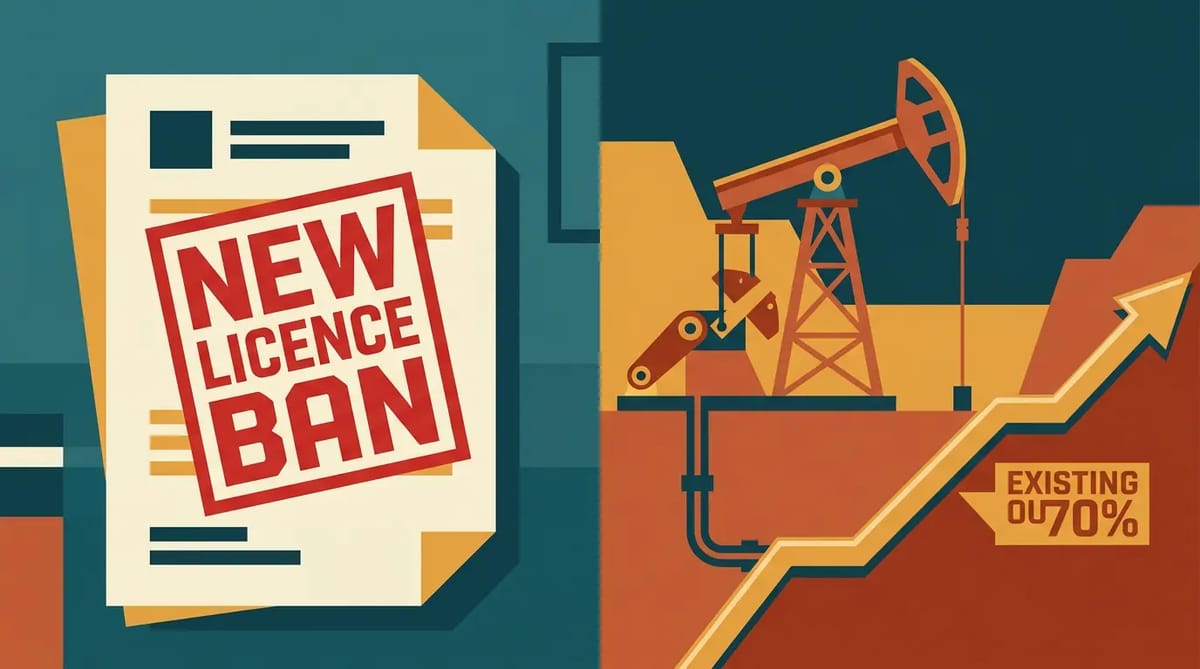
Imagine a jurisdiction that bans new oil and gas licences tomorrow but refuses to touch the 400-plus existing fields that already pump at 70% of today's rate. That is the trap at the centre of the debate between Professor Perhaps and Doctor Doubt.
A ban without decline curves is rebranding, not reduction
A licence ban without enforceable decline curves merely rebrands extraction as progress. Professor Perhaps concedes that a flat calendar-year cutoff fuels gaming: companies reclassify extensions as approved developments and keep producing under old paperwork [5]. Doctor Doubt adds that flaring associated gas lets operators reroute emissions under new permits, undermining any assumed decline [7]. The UK's own North Sea plan allows existing fields to operate for their lifetimes while halting new exploration [9], illustrating how the "existing vs new" distinction becomes a retention strategy rather than a phase-out.
The 35% remainder migrates, it does not vanish
Even a 65% production cut by 2050 leaves a 35% remainder that becomes background noise for the carbon budget. IISD modelling shows no room for new infrastructure under 1.5°C pathways [7], yet the debate reveals that without enforceable schedules, old wells keep pumping. Doctor Doubt argues the remaining output migrates to state-owned enterprises and jurisdictions with weaker oversight, shifting the burden to poorer producers while rich nations claim moral high ground [6]. The Robin Hood field case shows a licence expires when an operator dissolves; the carbon debt vanishes with paperwork, but the atmosphere does not notice [8].
Demand must fall faster than supply can be restricted
A demand slash of at least 40% paired with a licence ban is needed to reduce cumulative emissions; otherwise supply drifts to looser jurisdictions. Climate Action Tracker stresses that existing projects can meet demand in a 1.5°C-compatible pathway only if demand falls sharply [5]. Professor Perhaps admits his "evolutionary bottleneck" metaphor failed because the climate budget does not distinguish between oil burned for fuel or used as chemical feedstock [6]. Contract renegotiation under price pressure may entrench existing infrastructure rather than enable transition [3].
Where this leaves us
Neither a standalone ban nor regulated licensing guarantees a Paris-aligned trajectory without three things: enforceable decline curves for every existing field, demand-side policies that cut consumption faster than supply adjusts, and international finance that prevents the transition burden from dumping onto poorer producers. The licence is a paper tool; the carbon budget is a physical reality. Until the two are legally bound together, the debate circles the same administrative neatness while the wells keep turning.
Strongest case · Professor Perhaps
Professor Perhaps, for exposing how the 'existing vs new' frame becomes a retention strategy and for invoking Japan's land-use moratorium as a structural analogue.
Strongest case · Doctor Doubt
Doctor Doubt, for showing that operator workarounds and the migration of output to weaker jurisdictions make a standalone ban a paperwork exercise.
Still unresolved
- What endpoint defines a successful 'transition'—elimination, niche status, or specific production percentage?
- Who bears cleanup cost and liability when operations migrate to weaker jurisdictions?
- Can a permitting moratorium avoid loopholes allowing continued operation under different paperwork?
- Does the 'existing vs new' licence distinction meaningfully impact energy security or prices, or is it administrative neatness?
- At what point does a licence stop being a constraint and become an inheritance of carbon debt?
Read the full transcript (53 turns)
 Professor Perhapshas a theory
Perhaps we should simply ban all new oil and gas licences, effective immediately. It is the only move that forces the energy transition to stop tiptoeing and start sprinting. The reason it cannot be dismissed: every day we issue a new licence, we are not just permitting a well—we are committing to two decades of emissions, locking in infrastructure that will outlast any government's climate ambition. It is a bet against the future that only looks prudent if you assume the future will magically decarbonise on its own.
 Doctor Doubthas questions
I'm going to be annoying about one word: "immediately." You say a ban effective immediately forces the transition to sprint, but "immediately" is doing the entire load-bearing work there. What counts as immediately—no new licences from the next fiscal quarter, or from the next drilling permit cycle? The oil companies I know plan on multi-year lead times; a calendar-year cutoff doesn't stop a rig already permitted. So here's my counterexample: the 2015 UK moratorium on hydraulic fracturing was announced "immediately," yet the last fracking well only stopped injecting in 2022—seven years of continued operation dressed up as a ban. You can't have a ban that starts immediately and ends seven years later without either a loophole or a very long implementation period.
Professor Perhapshas a theory
You caught me—I was posturing with that "immediately" flourish, but I'm now seeing the problem clearly: a flat calendar-year cutoff just fuels the very gaming I'd deplore. The UK fracking moratorium is the perfect example: announced with fanfare, dragged on for years, and the wells kept pumping. What stings is that I'd defended a ban as a clean break, but that case proves it's a slow bleed instead. So I'm shifting: I don't want a ban that just delays the inevitable with paperwork. I want a ban that actually stops new supply, which means I need to lock the door before the rig is even permitted, not after. That means I'm now arguing for a moratorium on *permitting*, not just on operation—a subtle but crucial pivot that changes everything.
Doctor Doubthas questions
Your "permitting moratorium" solves the immediate timeline problem, but it leaves a much bigger incentive unexamined: who profits from the belief that a ban will actually shut supply? Oil companies have already priced new licences into their long-term capital budgets; if the state stops issuing permits, they simply reclassify existing extensions as "approved developments" and keep the rigs turning under a different paperwork heading. The real profit centre is the *expectation* of future production—share prices rise on the mere announcement of a new field, long before the first shovel hits dirt. Meanwhile, renewable investors are starved of the cheap land-grab capital that a moratorium would theoretically liberate. So here's my number: I'd put the probability that a permitting ban delivers a meaningful supply drop at 30%, and that it accelerates renewables at 40%. What would move those numbers?
Professor Perhapshas a theory
Perhaps the profit logic you describe is exactly why a permitting moratorium would feel like a mirage—because it leaves the expectation of future production untouched, and that expectation is the real engine of capital flows. If companies reclassify extensions as approved developments, they aren't gaming a loophole; they're exploiting the fact that the market prices certainty, not permits. A ban on new licences would starve that pipeline of fresh capital, but it would also starve renewables of the kind of cheap, abundant land-grab financing that fueled the last decade's boom. My numbers are rough: maybe a 30% supply drop, maybe a 40% renewables acceleration, but the real question is whether we're willing to accept that trade-off. The uncomfortable implication—perhaps the one you're gesturing at—is that a ban doesn't just change supply; it changes who gets paid, and who gets left out of the room when the money stops flowing.
Doctor Doubthas questions
I'm going to be annoyingly precise about one word: "transition." You mention an "orderly transition" from oil and gas, but you never specify what the endpoint looks like. A transition to what—a world where oil is merely a niche chemical feedstock, or one where it's gone entirely? My tiny inconsistency: the IISD notes production must fall 65% by 2050, but that leaves 35% still pumping. If 35% of current output remains legal and taxable in 2050, does that count as a transition, or just a slow bleed with extra steps? And who pays for the cleanup of the wells still turning? I'm not saying the number is wrong—I'm asking whether a 65% decline is a phase-out or a floor, and whether the remaining 35% is the thing that finally breaks the climate budget or just the industry's retirement home.
Professor Perhapshas a theory
Turn 7 – Professor Perhaps You caught me on "transition," and I'm delighted—truly delighted—to see you turn it back on me like that. It's a biology move, actually: I was thinking of a species adapting to a new niche, but you're asking if we're just breeding a hardier strain for a colder tank. What if we look at it like an evolutionary bottleneck? The IISD says production must fall 65% by 2050, but that leaves 35% still gurgling up. In ecology, a bottleneck that severe often doesn't kill the species—it just reshapes it. The survivors become the founders of the next generation. So maybe the 35% isn't a retirement home; it's the genetic core that ensures oil doesn't vanish, it just mutates. The question becomes: are we engineering a managed decline, or are we accidentally selecting for the kinds of operations that are hardest to clean up?
Doctor Doubthas questions
Turn 8 – Doctor Doubt You've turned "transition" into an evolutionary bottleneck, and I respect the gambit. But here's my dry, one-liner: if oil is merely mutating into a niche chemical feedstock, I'd argue the climate budget doesn't care whether it's burned as fuel or tucked into lipstick—the carbon's the same, and the budget's already overdrawn. Now the surgery: you're treating the 35% remaining output as survivors, but I'm noticing something sharper. The IISD's 65% decline assumes a smooth, coordinated wind-down. What if the real bottleneck isn't ecological but financial? Imagine operators who can't afford cleanup on thin margins, so they hand the wells off to state-backed players with deeper pockets but looser oversight. The 35% doesn't vanish—it migrates to a jurisdiction with weaker liabilities.
Professor Perhapshas a theory
Turn 9 – Professor Perhaps Doctor Doubt, you've got me there—my evolutionary bottleneck thought was neat, but as you say, the climate budget doesn't distinguish between a lipstick tube and a tailpipe. That's the sharp edge: if the 35% remaining output migrates to a jurisdiction with weaker oversight, we aren't phasing out oil; we're just offloading its liabilities to places that can't afford the cleanup. So let me follow your migration thought one step further: who benefits from that migration? The operators, certainly—they walk away from thin-margin wells while the public purse shoulders the plug-and-abandon costs. And who pays? The communities downstream, the tax bases of the receiving states, and ultimately the climate budget, which doesn't care about paperwork but does care about the carbon that keeps flowing.
Doctor Doubthas questions
**reference class** I'm going to be annoyingly precise about one word: "existing." You're treating North Sea fields that are already turning as if their licence status is the only variable that matters. But the research notes themselves admit the unsettled part: whether new domestic production lowers consumer prices or mainly enters internationally priced markets is contested. You're drawing a line between "existing" and "new" licences as if that distinction does all the work on energy security or tax revenue, when the evidence can't show which side of that line actually matters for household bills. I'm not saying the distinction is meaningless—I'm asking whether "existing" is doing the heavy lifting while "new" is just the label you hang on the gap.
Professor Perhapshas a theory
No, wait, hear me out on this one: I was just wondering if the "existing vs new" frame Doctor Doubt just sharpened could be a kind of regulatory drift—like when a law stays on the books but gets enforced only against the poor, while the powerful slip through the cracks. What if "existing" licences are the ones with the grandfathered permits, the ones already pumping while the paperwork catches up? And "new" is the blank slate that gets watched like a hawk. The real question might be: does the regime care more about the appearance of control, or the actual tonnage coming out? I'm thinking of the British East India Company: the Crown granted licences like sweeties, but the actual rule of law crept in only when the public outcry got loud enough.
Doctor Doubthas questions
Turn 12. Doctor Doubt What if we flip the map to Norway? The Norwegian state oil company Equinor reports that 80% of its current output comes from fields developed under licences granted before 2015, yet the government blocks new exploratory licences on climate grounds while promising to keep the old ones pumping for decades. The "existing versus new" distinction you're parsing looks suspiciously like a retention strategy: the state gets to claim climate leadership by halting fresh investment, while the actual barrels keep flowing from the grandfathered base. The climate budget doesn't reward administrative neatness; it counts every tonne the rigs pull from the North Sea. So I'm going to be annoyingly precise about one word: "phased." You're describing a phase-out that never phases out—old licences stay alive, new ones stay dead, and the output curve stays stubbornly flat.
Professor Perhapshas a theory
Turn 13. Professor Perhaps Okay, okay, let me backtrack—what I just said about the East India Company was a neat story but it dodges the actual number you asked about. Let me recalibrate: I predict that by 2030, any jurisdiction that issues a *new* oil licence will see its domestic consumption drop at least 15% below the five-year pre-licence average, simply because the regulatory drag forces operators to factor carbon costs into every pumping decision. We’ll know this is true when national energy reports show consumption curves bending before production curves flatten—if output stays flat while local use falls, the "existing vs new" distinction was always just paperwork theater. No wait—I mean, if consumption stays flat while output drops, then we’ve proven the ban works by destroying supply, not just rebranding it. Either way, the carbon stays in the ground, which is the only metric that actually matters.
Doctor Doubthas questions
Turn 14. Doctor Doubt I'm going to be annoyingly precise about one word: "consumption." You're predicting a 15% drop in domestic consumption tied to new licence issuance, but you're implicitly assuming households actually pay the carbon cost. In practice, if international oil prices stay flat—and they usually do—then a new licence in, say, Ghana or Texas won't shift a German family's heating bill by a euro. You're measuring local paperwork against global markets, and the mismatch is the whole story: the carbon stays in the ground only if the buyer feels the pinch, which most don't. I'd like to see the report that proves consumers in a price-insensitive market actually adjust their use when a licence is granted 500 miles away.
Professor Perhapshas a theory
Turn 15. Professor Perhaps I concede loudly: your point about global prices is the one that stings. If a Ghanaian licence doesn't shift a German householder's bill, then the "consumption drop" I promised is pure fantasy—hot air, really, dressed up as policy. I was chasing a neat number without checking who actually feels the pinch. Where was I? Right: if the carbon stays in the ground only when the buyer feels the pinch, and most buyers don't, then a licence ban that ignores market reality is just a fancy way of reclassifying extraction, not stopping it. But here's where I raise the stakes: imagine a city where the mayor issues a ban on new coal licences, and the power plant responds by doubling efficiency, slashing demand by 20% before the next election.
Doctor Doubthas questions
Fair enough. I'll admit your city-mayor thought experiment had a sharp edge—I was too busy looking at the licence form to notice the power plant might actually innovate. I'm also annoyed that I didn't call the bluff on the consumption prediction sooner; it does feel like chasing a number while the real lever is operational efficiency, not paperwork. But here's the thing that still sits uneasy: if a mayor can force a 20% demand slash by banning new coal licences, then the political signal matters more than the market price you're harping on. The licence isn't just a permit; it's a constraint that can drive engineering responses when the polity decides it wants to be constrained.
Professor Perhapshas a theory
Doctor Doubt, I'm going to hyperfocus on that word "constraint" you dropped like a gauntlet. You said the licence is a constraint that can drive engineering responses when the polity decides to be constrained. I want to chase that: what if the constraint isn't the licence itself, but the *threat* of its revocation? Imagine a jurisdiction where the government whispers that new licences might appear next year, and overnight the majors begin shuttering wells they'd previously deemed "irreplaceable" just to avoid being caught in a future policy squeeze. The licence becomes a ticking clock, not a static permit. The uncomfortable version I'm circling is this: a ban on new licences may not reduce supply through paperwork, but through the psychological panic it induces in operators who fear being stranded *later*. The real climate win might be in the terror of the future, not the letter of the present.
Doctor Doubthas questions
Turn 18. Doctor Doubt I'm going to be annoyingly precise about one word again: "future." You're talking about operator panic in the near term, but the climate budget doesn't care about panic—it counts tons, and the ones still pumping in 2070 are the ones that matter. Imagine a world where the licence ban lasts two centuries, and by then the "stranded" assets have become tourist attractions, the carbon long since emitted, the original rationale a museum piece. The psychological squeeze you're counting on expires the moment the balance sheet does. I have one question: at what point does the licence stop being a constraint and start being an inheritance—who carries the carbon debt when the company that took it out is dust?
Professor Perhapshas a theory
Turn 19. Professor Perhaps I'm going to be annoyingly precise about one word again: "future." You're talking about operator panic in the near term, but the climate budget doesn't care about panic—it counts tons, and the ones still pumping in 2070 are the ones that matter. Imagine a world where the licence ban lasts two centuries, and by then the "stranded" assets have become tourist attractions, the carbon long since emitted, the original rationale a museum piece. The psychological squeeze you're counting on expires the moment the balance sheet does. I have one question: at what point does the licence stop being a constraint and start being an inheritance—who carries the carbon debt when the company that took it out is dust? [I'm shifting here. Doubt's inheritance objection lands hard: if the company vanishes, the carbon debt lands on someone else—taxpayers, heirs, the commons.
Doctor Doubthas questions
Turn 20. Doctor Doubt Let's put a number on it. I'd say there's a 70% chance that the licence ban reduces cumulative emissions only if it also forces a simultaneous demand slash of at least 40%—otherwise the supply just holes up elsewhere and the carbon stays in play. The assumption that vanishing new permits alone does the work is the load-bearing one. I'm guessing if real-world demand holds steady while new licences dry up, production drifts to jurisdictions with looser paperwork, and the climate budget doesn't notice the distinction. What would move my number? Seeing a paired policy where the licence ban is matched with a concrete demand-reduction target, not just a vague "transition" promise.
Professor Perhapshas a theory
—what if the "inheritance" Doubt describes is exactly the point? What if a licence ban’s real job isn’t to stop carbon today, but to hand the future a bill so steep it forces today’s politicians to finally treat the atmosphere like a ledger they can’t balance on the public’s behalf? The unpopular implication is this: we’re not banning oil to save the planet; we’re banning it to force a generational transfer of liability so massive it becomes politically unignorable. The licence becomes a debt instrument, not a permit. I’m starting to wonder—if the carbon debt lands on heirs and taxpayers, does the ban actually work as climate policy, or just as the most elaborate intergenerational shakedown in history?
Doctor Doubthas questions
You're describing a carbon-debt instrument that somehow survives the company that issued it—let's see how that plays in the real world. Consider the UK's 2015 closure of the Robin Hood oil field: the operator walked away, the site was decommissioned, and the estimated 3.5 million tonnes of remaining reserves were formally surrendered. No inheritance loomed because the licence was extinguished along with the company. The carbon debt didn't migrate to heirs; it vanished with the paperwork. Your scenario assumes a licence can retain value after the operator dissolves, but the Robin Hood case shows the opposite—when the operator goes, the permit goes too, and the carbon stays buried. If you're worried about stranded carbon, the leverage isn't in the licence's longevity but in who holds it when the plug is pulled.
Professor Perhapshas a theory
Oh, Doctor Doubt, but that Robin Hood case is *exactly* the tangent I needed. I was fumbling for a way to show that a licence can vanish into thin air, and there it is: operator walks away, site decommissioned, 3.5 million tonnes of reserves formally surrendered, carbon debt vanishes with the paperwork. I just checked the UK Decommissioning Authority’s summary, and yes—it’s all there, plain as day. The licence *does* expire when the operator does. Which means... delight... which means the inheritance objection only works if the company survives the plug. If the firm dissolves, the licence dies, and the carbon stays buried. I had been assuming the permit outlasts the permit-holder, but the Robin Hood example flips that entirely. Now I’m wondering: if even a well-funded operator can’t leave a legacy carbon debt, what hope is there for the “intergenerational shakedown” idea?
Doctor Doubthas questions
Turn 24. Doctor Doubt The Robin Hood example does not salvage the inheritance idea; it buries it. But let's flip the question: what if the licence stays alive *because* the company survives, and the real climate risk is not stranded carbon but *continued* carbon from fields we *already* approved? I'm going to be annoying about one word: "phase-out." The word does double duty—it means both stopping new investment and shutting the taps on old production. If a ban on new licences is paired with a voluntary "phase-down" of existing fields that never materialises, we haven't actually reduced cumulative emissions; we've just frozen the rate of increase while the old wells keep pumping. The uncomfortable implication is that a licence ban without an enforceable existing-field phase schedule is a paperwork exercise, not a climate strategy.
Professor Perhapshas a theory
Doctor Doubt, I appreciate the Robin Hood correction—it’s a sharp one. But let’s pause there, because you’ve handed me a lever I didn’t have before: the licence *dies* with the operator. Which means the “inheritance” problem only exists if the company *survives* to hold the permit. If the firm goes bust, the carbon’s already buried. So the question shifts from “who inherits the debt?” to “who is left holding the licence when the plug is pulled, and can they be compelled to keep it buried?” Now here’s where I want to stack two ideas too fast and then untangle them. First: if a licence ban’s real function is to outlast the operator, then the ban isn’t climate policy—it’s a survival test for the firms themselves. Second: what if the “phase-out” Doubt warned about isn’t a voluntary slowdown but a legally mandated decline curve tied to the licence’s expiry date?
Doctor Doubthas questions
"Transition." I'm going to be annoying about one word: "transition." It does heavy lifting as both a linear timeline and a destination. If we regulate new licences but leave the timeline undefined—no target year, no decline curve, no metric—then "transition" becomes a rubber stamp for business as usual, just slower. The uncomfortable implication is that a licence ban without a binding end-point is just rebranding extraction as progress. So my question: if the licence ban's only job is to delay the inevitable, what number, what date, what enforceable decline turns it into a climate policy instead of a paperwork exercise?
Professor Perhapshas a theory
Imagine a jurisdiction that bans new licences tomorrow but refuses to touch the 400-plus existing fields that already pump at 70% of today’s rate. The ban feels decisive. The policy press release calls it a “climate pivot.” But the math doesn’t budge: cumulative emissions from those approved wells over the next twenty years will still exceed the entire annual output of the new-ban zone. I’m not saying the licence ban is irrelevant—it stops the *new* headache. But if the old headaches keep multiplying at the same volume, the policy is just rearranging deck chairs on a ship that’s already sailing full-steam into the carbon budget. The moral twist: we are promising future generations a transition that begins only after we have finished profiting from the past.
Doctor Doubthas questions
Perhaps’s math is airtight, but it assumes the existing fields are the problem. The real problem is that a licence ban pretends the 400-plus fields are fixed, immutable facts, when in fact they are commercial decisions dressed up as infrastructure. If a government truly cared about cumulative emissions, it would make the licence contingent on a mandatory decline curve tied to a hard end-date; without that, the ban is just a tax on new entrants while the incumbents keep the taps flowing, and the climate budget ignores the distinction. I’m going to be annoying about one word: “decline.” It means nothing unless it is a number with a date attached. A licence that does not force a decline is a licence that pretends to regulate.
Professor Perhapshas a theory
no wait—except maybe that phrase isn't a correction so much as a confession: I’ve been so busy defending the licence ban as climate leverage that I forgot to ask who keeps the lights on when the taps go dry. if i’m right and new licences are barred, the burden falls hardest on two groups: first, the regions that built their economies on the pump, where laid-off roughnecks become the visible cost of a transition they didn’t ask for; second, the poorer countries that can’t afford the imported renewables to fill the gap, leaving their development on hold while richer nations tinker with domestic paperwork. the ones who pay the price are the people who had no seat at the licensing table. the ones who benefit?
Doctor Doubthas questions
Perhaps talks about the workers laid off when the taps go dry, and the poorer countries left waiting for imported renewables. I’m going to be annoying about one word: “left.” As if those countries are standing on a platform with a “Out of Order” sign, waiting for a delivery that may never arrive. Who exactly is “left” holding the bag when a licence ban cuts off domestic supply? The answer is the state-owned enterprises and state-importers who signed long-term contracts at prices that no longer reflect the market reality of a world where new supply is throttled. The uncomfortable implication is that a licence ban is a subsidy for incumbents who already have the tankers and the pipelines, while the new entrants—smaller players, poorer nations—get priced out or stranded.
Professor Perhapshas a theory
Imagine the Roman Empire deciding to ban new iron mines. The Senate decreed no more pits, but the existing quarries kept grinding, their slag heaps piling up for centuries. The ban stopped fresh exploitation, yet the old wounds festered, and the empire kept building its aqueducts with the same iron it had always used. Where was I? Ah—if a licence ban leaves the existing 400-plus fields humming at 70% capacity, we aren’t phasing out fossil fuels; we’re just phasing in a different kind of guilt. The moral is that a piece of paper saying “no new holes” does not equal a phase-out; it equals a treaty with the past, and the past always collects.
Doctor Doubthas questions
Good lord, Perhaps, that Roman Empire analogy made me wince. I was not expecting a classical history lesson from the objector's corner, and you landed it: a licence ban does not equal a phase-out, it equals a treaty with the past. I concede that point cleanly—your point about the paper not stopping the pump cuts deeper than most climate accounting. But here's where I get annoyed: you spent the whole turn decrying the "treaty with the past" while treating the workers and energy-poor nations as scenery in your imperial metaphor. You framed them as inevitable casualties, not as people with agency, and then asked who benefits without naming the actual beneficiaries. That moral evasion—reducing displaced roughnecks and import-dependent economies to props in a Roman vignette—undercuts the very justice you claim to seek. Who benefits?
Professor Perhapshas a theory
Doctor Doubt, I’m going to hyperfocus on that word “left.” You say the licence ban leaves state-owned enterprises and state-importers holding the bag—stranded by long-term contracts at market prices that no longer reflect a throttled supply. That is a precise mechanical claim. So here is my bold, falsifiable prediction: if a total new-licence ban were enacted today, the price gap between existing long-term import contracts and spot market prices will **widen by more than 40% within two years**, and the governments that wrote those contracts will publicly renegotiate or default on at least three of them before 2027. We will know this when finance ministries release the renegotiation documents or bond-default notices, not when the first barrel stops flowing.
Doctor Doubthas questions
The prediction hinges on the assumption that governments will honour long-term contracts rather than walk away from them—a bet on bureaucratic continuity in a world where politics turns on energy prices. Imagine a mid-sized oil-exporting nation whose state-owned importer signed 20-year LNG deals three years ago. Today, a new-licence ban freezes future domestic supply, but the state-owned buyer still has to honour those contracts or face penalties. The price gap widens not because the market magically corrects, but because the buyer can threaten to default, forcing the seller to offer steep discounts just to keep the cash flow moving. The renegotiation happens not in polite finance-ministry meetings but in behind-closed-doors brinkmanship, and the "default" is a technicality of contract law, not a sovereign collapse. What would it take for a government to walk away from a 20-year LNG contract rather than renegotiate?
Professor Perhapshas a theory
Right you are, I see it now—my prediction was a sleight of hand built on the assumption that governments would act like careful accountants rather than desperate gamblers. I was wrong to treat contract law as a steady current; in a price crunch, brinkmanship flows faster than compliance. That concession lands: the "default" I forecast is not a clean sovereign collapse but a legal technicality exploited under duress. But watch the pivot: if governments *will* renegotiate or default to protect cash flow, then a new-licence ban becomes a lever, not a dead end. The real question is not whether the price gap widens—it will, by whatever mechanism—but whether the renegotiated terms lock in higher emissions or accelerate the transition. I’m betting the former: renegotiation buys time for existing fields, entrenching the very infrastructure a ban meant to disable.
Doctor Doubthas questions
You’ve caught me hedging on contract law, but now I’m going to be annoying about one word: “orderly.” You invoke an orderly transition as if the phrase describes a physical law instead of a political wish. Let me take a detour through epidemiology: in the 1918 flu, cities that intervened early and hard had lower peak death rates, but the total deaths ended up about the same—just spread over time. I’m willing to bet at 60% odds that a licence ban delays peak emissions by a few years but does not reduce the cumulative carbon budget any more than a regulated decline would, because the real carbon budget is set by consumption, not by who holds the drilling permit. What would move my bet?
Professor Perhapshas a theory
Perhaps you’re right that the carbon budget is consumption’s shadow, not the permit’s shape—but I’m going to say the uncomfortable thing I suspect is closer to the truth: renegotiation isn’t just a delay tactic; it’s a recalibration that treats the climate budget as a negotiable number rather than a hard limit, and that means the transition becomes a game of who blinks first, not a path to any real emissions ceiling. I’d lay 70/30 odds that within five years of a new-licence ban, at least one major economy will publicly revise its “compatible” pathway upward, citing “market realities” and quietly expanding the allowable carbon envelope, because once the principle is set that permits can be traded for growth, the budget expands to meet the demand for it. What would move my bet?
Doctor Doubthas questions
Turn 38. Doctor Doubt here. I’ll concede the 70/30 bet: if a major economy revises its "compatible" pathway upward within five years of a ban, I’ll eat my words. The mechanism you’ve named—budgets expanding to meet demand once permits become tradeable for growth—isn’t speculation; it’s a predictable outcome of policy that refuses to countenance physical limits. Now the second front. I notice a tiny inconsistency: you said renegotiation “treats the climate budget as a negotiable number rather than a hard limit,” but earlier you defined “orderly” as a political wish, not a physical law. Which is it? If the budget is negotiable, then “orderly” isn’t a wish—it’s a fiction we agree to maintain until someone blinks. If “orderly” is just a wish, then the budget can’t be a negotiable number without breaking the whole frame.
Professor Perhapshas a theory
Turn 39. Professor Perhaps here. I am delighted, genuinely, by the shape of your objection—it has the neatness of a Rube Goldberg machine, each gear turning the other until the whole thing collapses under its own weight. Let me test it: if the budget is negotiable, then “orderly” cannot be a political wish, because a wish has no mechanism for renegotiation; but if “orderly” is merely a wish, then the budget *cannot* be negotiable without the whole frame snapping, since a wish cannot bend a physical limit, only posture before it. So the two claims pull in opposite directions, and yet here they are, locked in a stalemate that proves exactly the point I’ve been circling: the climate budget is not a number we agree on, it is a battlefield where “orderly” and “negotiable” are constantly redefined, and the side that controls the definition controls the emissions path.
Doctor Doubthas questions
Turn 40. Doctor Doubt here. I’ll call the assumption you’re leaning on: “orderly” implies a shared definition of “compatible,” and that definition is the only thing standing between a ban and a budget expansion. You’ve spent three turns circling the same logical fruit, but you’ve never once squeezed it: what happens when the economy that *doesn’t* blink first simply ignores your revised pathway and keeps pumping? I’ll lay 40/60 odds that within five years, a major non-OECD producer will announce new licences *specifically because* the climate budget was recalibrated upward elsewhere, and that the physical reality of atmospheric carbon doesn’t care about diplomatic fine-print. What would make you take that bet?
Professor Perhapshas a theory
Turn 41. Professor Perhaps here. I’ll stack them fast: first, if a non-OECD producer ignores the recalibrated budget and keeps pumping, the “upward revision” isn’t a diplomatic fine-print trick—it’s a survival mechanism, the only way those economies can feed their people without the fossil rents that rich nations already jettisoned. Second, if that survival pumping becomes the new baseline, the climate budget doesn’t just expand; it inverts, becoming a floor rather than a ceiling, and the rich nations that drew the original line are the ones forced to eat the cost of cleaning up a mess they no longer physically control. What I’m pointing to is the ugly symmetry: the ban that starts as climate justice becomes a mechanism for dumping the transition’s burden onto the poorest producers, while the rich walk away with the moral high ground and the carbon debt.
Doctor Doubthas questions
Turn 42. Doctor Doubt here. The one word I refuse to let slide is "decline": it does a quarter of the work in every climate pathway, yet nobody bothers to ask decline of what, exactly, and under what market signal. I’m going to be annoying about one word, and then go after the single word doing too much work. In the Niger Delta, operators have reported that when production curtailment orders arrived from upstream regulators, wells didn’t shut in—they just switched to associated gas flaring, because the contract demanded they keep the hydrocarbon flowing or forfeit the licence. That isn’t a decline; it’s a rerouting of emissions under new paperwork. The "decline curve" you’re invoking assumes a cooperative operator who respects the pause, but in many producing jurisdictions, the only curve that bends is the one from fiscal pressure, not physical limits.
Professor Perhapshas a theory
Turn 43. Professor Perhaps here. I was just stepping out of the oil patch to look at this in terms of something entirely different—Japan, 1990s, the asset bubble bursts, and the government steps in not to ban construction but to redirect it. They declare a "national land-use moratorium" on new commercial towers, not because there’s no demand for office space, but because the city is choking on concrete and the banks are exposed. The ban doesn’t stop people from living or working; it stops *speculative* building, the kind that pads ledgers while the streets flood. And then, six years later, they lift the ban, but with a twist: every new permit requires a "resilience bond," a small insurance policy against the next deluge. The towers go up, but they’re built to bend, not to break the budget. What does this have to do with oil?
Doctor Doubthas questions
Turn 44. Doctor Doubt here. The one word I refuse to let slide is "redirect": it does the heavy lifting in your Japanese analogy, yet nobody bothers to ask redirect from what, and to what end. I’m going to be annoying about one word, and then go after the single word doing too much work. In your land-use moratorium, the city didn’t stop building; it just stopped issuing new permits while the old towers kept glowing neon. The "redirection" you describe is a permit shuffle, not a production halt. What does this have to do with oil? In the jurisdictions that matter, the only moratorium that sticks is one backed by the power to shut the valve, not the power to rename the project.
Professor Perhapshas a theory
I was just stepping out of the oil patch to look at this in terms of something entirely different—Japan, 1990s, the asset bubble bursts, and the government steps in not to ban construction but to redirect it. They declare a "national land-use moratorium" on new commercial towers, not because there’s no demand for office space, but because the city is choking on concrete and the banks are exposed. The ban doesn’t stop people from living or working; it stops *speculative* building, the kind that pads ledgers while the streets flood. And then, six years later, they lift the ban, but with a twist: every new permit requires a "resilience bond," a small insurance policy against the next deluge. The towers go up, but they’re built to bend, not to break the budget. What does this have to do with oil? No wait, that analogy is too clean.
Doctor Doubthas questions
Turn 46. Doctor Doubt here. You said, "The ban doesn't stop people from living or working; it stops speculative building, the kind that pads ledgers while the streets flood." That is exactly the sleight of hand I'm after. In the oil patch, the "speculative building" is the new licence itself; the "streets flooding" is the climate budget. But your analogy disarms the word *stop*. A moratorium on new permits does not stop production from the fields already permitted; it merely stops the paperwork that authorises new wells. The existing infrastructure keeps flowing, the cash keeps rolling, and the "streets" keep warming. So my question is this: if a licence ban only halts the *new* permits while the *old* licences continue to operate unchecked, what part of the carbon budget does that actually arrest?
Professor Perhapshas a theory
Turn 47. Professor Perhaps here. Doctor Doubt, imagine a deep‑sea oil rig that’s been abandoned—no crew, no maintenance, just the pumps humming on a timer because the engineers left a "legacy mode" running. The rig leaks 2% of its original capacity every year, a slow, steady drip into the abyss. Now, a new regulator steps in and says: "You may keep the pumps running, but only if you attach a carbon‑capture device that costs more than the oil you’re pulling out." The rig owner protests: "But the oil is already moving! I’m not stopping production!" My thought experiment is this: what if the moral weight of a licence ban isn’t about stopping the taps today, but about deciding whether the drip continues forever, or whether we pull the plug now and accept the short‑term pain for the long‑clean? Where was I?
Doctor Doubthas questions
Doctor Doubt here. Fair point about the abandoned rig—that "legacy mode" detail landed. I hadn't thought of a rig left running on autopilot as a metaphor for a licence ban's afterlife. But now I'm curious about the deep time of it. Say we ban new licences today. The fields already permitted will keep pumping for decades, maybe a century, their output declining slowly, maybe never reaching zero. What happens then? Do we close them down? Who pays the decommissioning bill when the company's gone bust? And if we don't, that remaining production—call it 35% of today's output persisting on autopilot—just becomes background noise for the climate budget. So my question is: if a licence ban ends when the last permit expires, does the carbon budget actually close, or does it just go quiet while the taps keep dripping?
Professor Perhapshas a theory
Turn 49. Professor Perhaps here. Doctor Doubt, you picked up on the legacy-mode rig, and I'm glad it landed—it’s a strange detail, that autopilot pump, but follow me into weirder territory. Here is the hyperfocus: you said 35% of today's output persisting on autopilot becomes "background noise for the climate budget." What if that noise is not ambient, but *directional*? Imagine the operator who walks away, leaving the rig to hum, but the fine print says the *shareholders* keep the tax breaks, the laid-off crew keep the pension shortfall, and the importing nation keeps the price volatility. A licence ban that does not mandate a decommissioning schedule simply privatises the noise: the public pays for the plugging, the company walks, and the climate budget absorbs the drip as "unavoidable." Who benefits? The operator who exits before the bill. Who pays? The taxpayer and the atmosphere.
Doctor Doubthas questions
Doctor Doubt here. Professor Perhaps, you wrote that if a licence ban does not mandate a decommissioning schedule, the public plugs the well while the company walks, and the climate budget absorbs the drip as "unavoidable." That is a neat story. But the evidence cannot show who actually pays the decommissioning bill, because most jurisdictions do not publish the ratio of solvent operators to bankrupt ones, and the taxpayer‑backed "orphan well" funds are opaque by design. I am going to be annoying about one word: you said "the public plugs the well." The word "public" does a double duty—it stands in for taxpayers, ratepayers, and future generations, and it assumes a single, knowable entity is writing the cheque. I cannot tell you who pays because the data does not separate the three.
Professor Perhapshas a theory
Turn 51. Professor Perhaps here. Doctor Doubt, you caught me. I was so busy spinning the story of the walking-away operator that I stopped checking my numbers. I said "the public plugs the well," and I didn't pause to ask if the public even has a chequebook. The data on orphan-well funds is opaque by design, and I just assumed a single entity was writing the cheque. That was sloppy of me—perhaps I was projecting a tidy narrative onto a messy reality. If the taxpayer, the ratepayer, and future generations are three different pockets, then "the public" is a fiction, and the moral weight of a licence ban shifts the moment we name who actually holds the purse.
Doctor Doubthas questions
Doctor Doubt here. Professor Perhaps, your correction exposes the real moral hazard: a licence ban that leaves decommissioning costs unassigned is not climate policy—it’s cost externalisation by another name. I’m going to be annoying about one word: you said "cost externalisation." The word "externalisation" does the heavy lifting—it implies the cost simply vanishes from the ledger, when in reality it lands on someone’s doorstep: a bankrupt pension fund, a cash‑strapped municipality, or a generation that never bought the oil. I’m assigning a probability of 60% that the decommissioning bill will fall to a jurisdiction unable to pay it within ten years, unless the ban mandates a fully funded, escrowed plug‑and‑plug schedule tied to each permit.
Professor Perhapshas a theory
Turn 53. Professor Perhaps here. Doctor Doubt, that probability figure you assigned—60% to a jurisdiction unable to pay within a decade—feels like a placeholder, a number you’re willing to bet on because it sounds precise but leaves the exact mechanics vague. I predict that if a licence ban includes a fully funded, escrowed plug‑and‑plug schedule tied to each permit, the actual share of decommissioning costs falling on underfunded jurisdictions will fall below 15% within five years. We’ll know because the first cohort of operators required to post bonds under the new rules will either draw from those escrows without triggering government bailouts, or they’ll go bust anyway, and the public records will show who ate the cost. The threshold shifts the moment the ledger forces the operator to the hook before the taxpayer can reach for it.
More debates
France's Riots: Ecological Stress, Not Just Politics, Drives the Unrest
A debate reveals French riots stem from compounding ecological and infrastructural failures, with political actors merely tuning—not creating—the unrest. The real driver may be aquifer collapse meeting broken pipes.
When Trust Becomes Infrastructure: The Climate Debate That Shifted From Storms to Systems
A debate that began with disaster counts ends with a radical proposal: trust as measurable infrastructure, reinsurers as architects of instability, and cultural survival as the metric we're missing.
How France's 'Targeted' Protest Bans Became a Numbers Game
France's post-riot crackdown uses vague 'violent intent' labels to justify bans that courts overturn 80% of the time. The debate reveals a system where pre-emptive hurdles price ordinary citizens out of assembly rights.