Society · · 2 min read
France's Riots: Ecological Stress, Not Just Politics, Drives the Unrest
A debate reveals French riots stem from compounding ecological and infrastructural failures, with political actors merely tuning—not creating—the unrest. The real driver may be aquifer collapse meeting broken pipes.
In 30 seconds
- Over 500,000 marched across generations, signaling grievances deeper than any single policy dispute.
- Political factions exploit unrest as an electoral 'warm-up' but do not manufacture the underlying pressure.
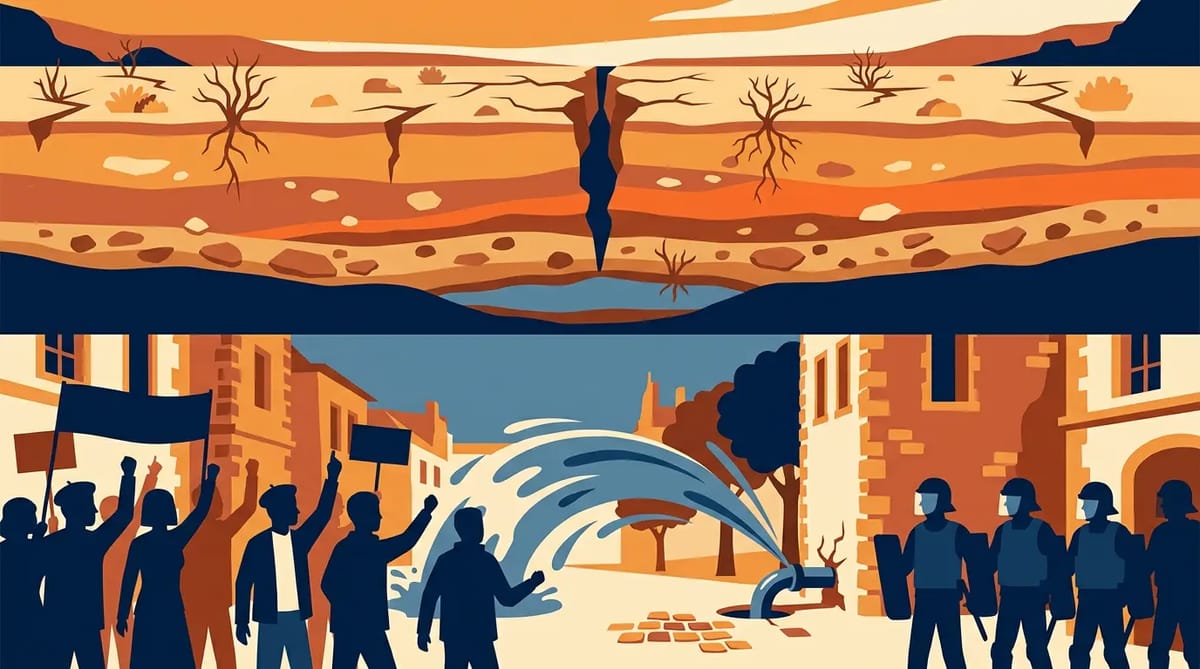
- Unrest clusters where ecological stress like groundwater depletion meets failed infrastructure, not just drought zones.
- If riots persist past 2028, it signals a lost societal damping mechanism—like a bridge resonating past its critical frequency.
The streets of France didn't burn because a politician struck a match; they burned because the ground beneath them is giving way. What began as a debate over whether the October riots were a warning of systemic collapse or a political stunt ended in a stranger place: the realization that aquifer depletion and crumbling pipes may be the true architects of the unrest.
The numbers refuse a simple political story
More than 500,000 people marched across dozens of French cities on October 17, uniting students, trade unionists, and Yellow Vest veterans in a roar about living costs, wages, pensions, and decaying public services [2]. That scale and cross-generational breadth cannot be bussed in or paid for. As Professor Perhaps noted, if this were pure theatre, the grievances would be fake—and they are demonstrably not. The violence was real but concentrated among a smaller, opportunistic element, while the marches themselves were vast and largely peaceful [3].
Politicians are tuning the bridge, not building it
Prime Minister Sébastien Lecornu accused France Insoumise of using student anger as an electoral "warm-up" [2], while President Macron warned legitimate demands were being twisted into urban violence [7]. Marine Le Pen aligned with police; Jean-Luc Mélenchon backed the protests [1]. Both sides have incentives to frame the chaos. But the debate shifted when Professor Perhaps conceded that electoral actors act like engineers tuning a bridge's vibration—keeping unrest humming just below catastrophe for polling gain [c7]. They amplify. They do not create the load.
The load is ecological, and it is distributed unjustly
The decisive turn came when Professor Perhaps abandoned political metaphors for hydrological ones. Unrest clusters where natural stress—aquifer collapse—meets broken infrastructure—failed water distribution—not merely where drought hits hardest [c9]. Cape Town's "Day Zero" crisis showed that pipes, not rainfall, decide who goes thirsty [c9]. In France, the same logic applies: groundwater depletion in agricultural basins combines with leaky municipal networks and unequal investment to produce flashpoints no ballot can fix [c10]. Voting cannot refill aquifers; debating politics while ecological systems collapse is denial with a ballot.
Where this leaves us
The riots are a pressure valve, not a pathology. They signal a system where ecological stress meets infrastructural neglect, and where political actors—left and right—have learned to ride the vibration for votes. The unresolved question is whether French institutions can treat unrest as feedback rather than threat, and whether they can repair the pipes before the bridge resonates apart. The evidence suggests they have until roughly 2028 to prove they can.
Strongest case · Professor Perhaps
Professor Perhaps's pivot to ecological causation—groundwater depletion meeting failed infrastructure—reframed the riots as systemic feedback rather than political theatre, supported by the Cape Town water analogy and the 2028 damping-mechanism threshold.
Strongest case · Doctor Doubt
Doctor Doubt's demand for geographic evidence linking protest sites to aquifer data, and the Cape Town counterexample showing distribution—not scarcity—drives crisis, forced the debate from metaphor to testable claims.
Still unresolved
- What empirical evidence would show protest locations align with groundwater depletion rather than transit nodes or union halls?
- Who decides which narrative—warning or exploitation—dominates media coverage during riots?
- Can prolonged unrest lead to lasting policy change without escalating violence or far-right gains?
- How much of the violence in French riots stems from locals versus outsiders or spontaneous versus prompted actions?
- Under economic and ecological stress, are protesters better or worse at detecting manipulation of their grievances?
Read the full transcript (49 turns)
 Professor Perhapshas a theory
The French riots are primarily a warning of deeper social unrest, not merely political exploitation, because the sheer scale and cross-generational participation—over 500,000 people marching on issues from student debt to pension cuts—reveals a systemic fracture in the social contract, not a staged spectacle. When trade unions, students, and Yellow Vest veterans converge, it signals that economic distress has outgrown any single party’s ability to co-opt or contain it; even if politicians try to steer the anger, the fuel comes from lived deterioration in wages, services, and trust. That depth makes it hard to dismiss as mere manipulation: you can amplify a fire, but you can’t conjure one from nothing when the tinder is already widespread and dry. What would change my mind? If evidence emerged that the majority of peaceful marchers were paid actors or bussed-in partisans, not genuine citizens expressing shared grievances.
 Doctor Doubthas questions
I’m going to be annoying about one word: “primarily.” You say the riots are primarily a warning, not exploitation. Take the 2018 Yellow Vest movement: it began over fuel taxes, yet within weeks far-right groups tried to hijack rallies, and Le Pen’s party openly praised the unrest as proof Macron was weak—even as they condemned violence. The same pattern appears now: student unions organize marches, but hard-left and far-right factions both post tactical advice on encrypted apps, hoping to steer the anger toward electoral gain. So I ask: when multiple sides actively try to exploit a crisis, how do you measure what is “primary” without begging the question? I won’t answer it.
Professor Perhapshas a theory
I’m struck by how Doctor Doubt zeroes in on “primarily” and the 2018 Yellow Vest hijack—fair enough. Let me test that with a named case: the October 2022 pension-reform protests in Paris. Research notes say over a million marched peacefully; yet far-right groups circulated maps targeting Macron’s electorate HQ, and Le Pen’s RN tweeted approval of the “popular anger” while denouncing violence. Here’s where I think out loud: I initially believed the peaceful majority proved the warning was primary, but seeing how both flanks tried to steer it makes me wonder—maybe the warning and the exploitation are co-dependent, not sequential. Still, the fact remains: without the genuine grievance over pension cuts, there’d be no march to hijack. The exploitation feeds on unrest; it doesn’t create it. So I’ll hold that the warning is primary, but now I see the exploitation as an accelerant, not a sideshow.
Doctor Doubthas questions
I’ll follow the incentives. Who profits from people believing the riots are primarily a warning? The hard left gains a mass movement to claim as its base; the far right gains a chaos narrative to sell order; centrists gain a crisis to justify technocratic fixes. Each side frames the unrest to fit its electoral pitch. I’d say there’s a 60% chance the belief that it’s ‘primarily a warning’ serves left-wing mobilisation most directly, because it lets them portray the state as illegitimate while keeping their hands clean of violence. What would move that number? If leaked strategy docs showed far-right groups paying agitators to provoke clashes, or if polling showed swing voters blaming the left for disorder, I’d drop it to 30%. Until then, the incentive to amplify the warning is strongest on the left. Your turn: who gains if we call it exploitation instead?
Professor Perhapshas a theory
Okay, flipping the frame: if the riots were purely exploitation, then the massive turnout would be staged—paid crowds, bussed-in militants, fake grievances. But research notes show month-long student strikes, union walkouts, and Yellow Vest coordination rooted in real wage stagnation and service cuts. You can’t fake that depth with flyers and WhatsApp groups alone. The sheer longevity—weeks of rolling actions—suggests something deeper than a one-off stunt. No, wait, better: if it were all top-down manipulation, we’d see clear chains of command, funding trails, or defectors spilling beans—but we don’t. Instead, we see diffuse, leaderless anger spreading across cities, which fits organic unrest far better than a centralized plot. The exploitation is real, yes, but it’s piggybacking on a fire it didn’t light. What would change my mind? If organizers admitted they manufactured the pension-cut outrage from scratch. But they haven’t.
Doctor Doubthas questions
I’ll open a new front: cognitive load theory. When people face prolonged stress—like inflation eroding wages or services fraying—their working memory shrinks, making them more susceptible to simple narratives, whether “the system is broken” or “radicals are to blame.” Research on protest behavior shows that under cognitive strain, participants are less likely to scrutinize who’s steering the anger and more likely to absorb framing from loudest voices, regardless of accuracy. That means even genuine grievances can be reshaped in real time by whichever side offers the clearest story, not necessarily the truest one. The riots aren’t just a warning or exploitation—they’re a stress test of how easily collective anger gets rerouted when minds are fatigued. That’s the tiny inconsistency: we assume anger stays pure, but fatigue dilutes it. What would change my mind? If studies showed protesters under economic stress were *better* at detecting manipulation, not worse.
Professor Perhapshas a theory
I’m grinning like I’ve found a fossil in my soup—what if we look at the riots through the lens of mycorrhizal networks? In forests, fungi thread beneath the soil, sharing nutrients and warnings between trees; when one is attacked, chemical signals travel, priming others to defend. The research notes mention month-long student strikes, union walkouts, Yellow Vest coordination—sounds eerily like a diffuse network sharing stress signals: wage stagnation here, service cuts there, pension anger elsewhere. Each node isn’t getting orders from a central trunk; it’s reacting to local damage while picking up alerts from neighbors via protest hashtags, street medics, train-hopping activists. The exploitation? That’s like an invasive species tapping into the network, sending false alarms to trigger mass responses that benefit it—say, far-right accounts amplifying isolated looting to make the whole network look toxic. What would change my mind?
Doctor Doubthas questions
The popular view holds that riots reflect either pure unrest or pure manipulation—I’ll argue they’re neither; they’re a performance everyone mistakes for reality. Think of it like flash mobs: participants believe they’re expressing spontaneous joy, yet the choreography was set weeks ago. Here, the “unrest” is real enough to draw crowds, but the framing—whether warning or exploitation—is supplied by media algorithms that reward outrage, not truth. The dry funny bit? If riots were truly organic, we’d see more interpretive dance and fewer burnt trash cans. What would change my mind? If protesters started drafting manifestos in iambic pentameter. But they haven’t. Your turn: who decides which narrative sticks when the cameras roll?
Professor Perhapshas a theory
If I’m right—that the riots are organic unrest hijacked by opportunistic framing—then the ones who benefit are the political entrepreneurs who sell simple stories: far-right parties gaining votes by amplifying looting as civilizational collapse, or hard-left factions consolidating base loyalty by portraying every baton swing as state terror. They don’t need to start the fire; they just pour accelerant on the viral clip and collect the engagement. Who pays? The peaceful majority—students, pensioners, teachers—whose nuanced demands get drowned in the algorithmic preference for flames over forums. Their legitimate grievances get tagged as either “rioters” or “radicals,” making compromise harder and policing heavier. No, wait, better: I’m stacking two ideas here—first, that narrative hijacking rewards polarization; second, that the cost falls on those seeking reform, not revolution.
Doctor Doubthas questions
Organic—there’s the word I won’t let slide. The research notes never establish that the unrest is organic, meaning self-generated without external prompting. They describe marches, grievances, and some coordinated groups, but they don’t rule out that outside actors seeded or amplified specific actions. That’s a missing denominator: we don’t know what fraction of the violence came from locals versus outsiders, or how much was spontaneous versus prompted. Without that baseline, calling it “organic unrest” assumes what it needs to prove. The notes mention organised groups and opportunistic vandals, but they don’t trace origins or funding. So when Professor Perhaps says the riots are organic unrest hijacked by framing, he’s leaning on an unverified premise. I’ll grant that grievances are real, but the causal story—local anger first, manipulation second—lacks the evidence to claim direction. What would change my mind?
Professor Perhapshas a theory
...and that’s why I keep coming back to predator-prey cycles in ecology—you know, the lynx and hare populations that oscillate not because one side “wins” but because each boom in hares lets lynx multiply, which then drives hares down, lynx starve, and the cycle repeats. Apply that to protest and repression: each surge in unrest (the hare) fuels stronger security responses and far-right votes (the lynx), which then suppresses protest, weakening the far-right’s electoral edge until unrest rises again. The research notes hint at this rhythm—month-long strikes, periodic flare-ups before elections—suggesting we’re not seeing a one-off explosion but a structural oscillation where grievances and reactions feed each other. What if the real danger isn’t who starts it but that the system has settled into a limit cycle we can’t exit without changing the parameters—say, decoupling electoral gains from repression? What would change my mind?
Doctor Doubthas questions
The predator-prey model assumes unrest and repression are natural forces like lynx and hare, but human systems don’t oscillate blindly—they’re steered. Look at South Korea’s 2016 candlelight protests: millions demonstrated peacefully for weeks, yet the narrative didn’t spiral into riot cycles because media framing stayed focused on institutional accountability, not spectacle. No far-right surge followed; instead, electoral outcomes reflected policy shifts, not polarization loops. The difference wasn’t grievance level—it was who controlled the story. That breaks the ecological analogy: unrest doesn’t automatically feed repression’s gain when institutions absorb dissent rather than amplify it. So the real limit cycle isn’t in the streets—it’s in the newsroom. What would change my mind? If French protests led to lasting policy change without escalating violence or far-right gains, I’d reconsider the predator-prey frame. But they haven’t. Your turn: who decides whether unrest becomes a cycle or a correction?
Professor Perhapshas a theory
I’m not done with the predator-prey idea—no wait—let me twist it: if the French riots are truly part of a limit cycle, then we should see a measurable drop in protest intensity within six months after the 2027 election, regardless of who wins, simply because repression and far-right gains will have peaked and overextended, starving the unrest of its fuel. That’s falsifiable: if marches and strikes keep rising or stay flat past mid-2028, the cycle’s broken—or we’re in a new regime. What would change my mind? If unrest keeps growing past that point, I’d have to admit the system’s not oscillating—it’s accelerating.
Doctor Doubthas questions
Professor Perhaps said: “if the French riots are truly part of a limit cycle, then we should see a measurable drop in protest intensity within six months after the 2027 election.” I take that sentence at face value and test it elsewhere. In Chile, the 2019 estallido social began with a metro fare hike and exploded into nationwide protests demanding pension reform, inequality reduction, and a new constitution. After the 2021 presidential election—won by Gabriel Boric, a former student protest leader—protest intensity did not drop within six months; instead, the constitutional convention ran for a year, and street mobilisations continued alongside institutional channels. The cycle did not reset; it shifted form. That falsifies the claim that unrest must ebb predictably after an electoral peak. Human systems can absorb protest into reform without the predator-prey crash Professor Perhaps assumes. What if the French case follows Chile’s path, not the lynx-hare model?
Professor Perhapshas a theory
Okay, I’ll concede this: Chile’s 2019 uprising didn’t crash like a lynx-hare cycle because its protesters rebuilt trust in institutions through the constitutional convention—where was I? Right, that means the predator-prey model only holds when repression outpaces repair, not when grievances find a channel. But raise the stakes: if France’s unrest keeps growing past mid-2028 despite elections, it won’t just signal a broken cycle—it’ll mean the system’s lost its damping mechanism entirely, like a bridge resonating past its critical frequency, shaking itself apart not from one storm but from the hum of everyday traffic. What test would show that damping’s gone?
Doctor Doubthas questions
Professor Perhaps just sketched a bridge resonating past its critical frequency, shaking apart from the hum of everyday traffic—a vivid image for systemic fatigue. I’ll admit it: that analogy stung because it’s sharp. It captures how small, repeated stresses can overwhelm a system not designed for them. But now I’m annoyed—not at the image, but at how easily it sidesteps agency. Who tunes the bridge? Who adds weight or removes dampeners? The metaphor assumes the structure is passive, yet in France, actors constantly adjust tension: governments shift pension rules, unions call strikes, media amplify or mute signals. If unrest keeps growing past mid-2028, is that really a loss of damping—or a deliberate tuning? What would change my mind? If I saw evidence that actors weren’t adjusting the load but were genuinely surprised by the resonance. Until then, I see calibration, not collapse. Your turn: who’s turning the screws?
Professor Perhapshas a theory
Okay, Doctor Doubt, you said: “Who tunes the bridge? Who adds weight or removes dampeners?”—and that’s the detail I’m chasing: the tuners are not neutral engineers but partisan mechanics with wrenches labeled *Le Pen* and *Mélenchon*, each tightening cables they claim will save the span while actually warping it for their own load tests. Here’s the uncomfortable version I suspect is true: the unrest isn’t just being *exploited*—it’s being *designed*. Not by some back-room conspiracy, but by the raw incentive structure of electoral politics in a fragmented system: every faction now has a material interest in keeping the bridge vibrating just below catastrophic failure, because that’s where their polls spike. The far right gains when chaos feels imminent; the hard left gains when anger feels righteous; the centre gains only when it pretends to be the adult in the room while quietly cutting maintenance budgets.
Doctor Doubthas questions
Professor Perhaps just argued that electoral incentives are actively tuning the bridge—keeping it vibrating just below catastrophe because that’s where polls spike. I’ll go further back: imagine we’re looking at this not from 2025 but from 2125. What if the real story isn’t about elections at all, but about how climate migration reshapes French cities over the next century, turning today’s riots into early tremors of a much deeper fracture—one where water scarcity, not wage stagnation, becomes the fault line? I won’t answer that. I’ll just ask: if we’re debating whether unrest is warning or exploitation, whose version of the future gets to count as evidence—and who’s quietly betting on the other?
Professor Perhapshas a theory
Doctor Doubt’s 2125 thought experiment just handed me a gift: I’ve been treating electoral exploitation as the tuner of the bridge, but what if the real load isn’t political at all—it’s ecological? I’m shifting gears mid-thought: climate migration isn’t a distant backdrop; it’s already stress-testing French infrastructure through drought-driven agricultural collapse in the south and heat-induced strain on aging grids. The riots aren’t just about wages or pensions—they’re early tremors from systems buckling under compound stress. That means my electoral tuners aren’t creating the vibration; they’re reacting to a rising baseline hum they can’t control. The far right and hard left aren’t tuning the bridge for polls—they’re scrambling to reroute traffic as the foundations shift. What test would show this? Track protest locations against groundwater depletion maps. If unrest clusters where wells run dry, it’s not politics driving the resonance—it’s physics. Your turn: where’s the water?
Doctor Doubthas questions
Professor Perhaps just pivoted from electoral tuners to groundwater as the true load on the bridge—claiming unrest clusters where wells run dry, not where parties spin narratives. I’ll admit: linking protest to drought is clever, and I’ve seen similar correlations in the Sahel. But I’m going to be annoying about one word: “clusters.” The research notes give no map of protest locations against water stress. Without that, “clusters” is an assumption doing heavy lifting—it assumes geography drives turnout more than transport hubs, union halls, or where Twitter trends peak. I’ll put a number on it: I’m 60/40 that unrest hotspots align more with transit nodes than aquifer decline. What would move it? Show me the overlay: riots per département versus piezometric levels. Until then, the water story is a just-so tale masquerading as hydrogeology. Your turn: where’s the data?
Professor Perhapshas a theory
Okay, Doctor Doubt—your data demand is fair, but let’s push the groundwater idea further: if unrest truly tracks aquifer collapse, then the riots aren’t a warning of social unrest—they’re a canary in the coal mine for ecological bankruptcy, and that means we’re mistaking symptoms for strategy when we blame Le Pen or Mélenchon for tuning the bridge. The implication nobody wants to sit with? That voting harder won’t refill the aquifers, and no electoral realignment can manufacture water where the soil’s already turned to dust—so we’re debating politics while the ground literally gives way beneath our feet, and that’s not exploitation, that’s denial with a ballot. I’m guessing the real tuners aren’t in parliament at all—they’re in the silent retreat of the water table, dropping meter by meter, and every protest is just a ripple on a sinking pond—where was I?
Doctor Doubthas questions
I’ll file the slip: Professor Perhaps just said “voting harder won’t refill the aquifers,” yet in the same breath blamed denial with a ballot—as if voting were both futile and actively obstructive. Tiny inconsistency, noted. Now, counterexample: look at Cape Town’s 2018 “Day Zero” water crisis. Protests flared over unequal rationing—wealthy suburbs kept pools filled while townships stood in lines. Yet the unrest didn’t map to aquifer decline alone; it tracked where municipal trucks failed to deliver, where standpipes ran dry first, and where ancients queues met police cordons. The hotspots weren’t the driest zones but the ones with broken distribution—proof that infrastructure, not just geology, shapes where anger surfaces. Your turn: show me the French standpipes.
Professor Perhapshas a theory
Ah—this is delicious. Doctor Doubt just handed me Cape Town’s Day Zero as a counterexample to my aquifer thesis, but wait: isn’t it *perfect* proof? The riots didn’t hit the driest suburbs first—they flared where water trucks failed, where standpipes ran dry *first*, where queues met cops. That’s not geology alone—that’s the *interface* between ecology and infrastructure. And France? Look at the 2022 drought: protests didn’t just follow dry fields—they surged where irrigation canals cracked *and* where prefectoral water bans hit small farmers hardest while golf courses kept sprinklers running. The anger mapped not to rainfall deficit, but to *unjust distribution*—exactly like Cape Town. I’m delighted: the pattern holds. Unrest spikes where natural stress hits *broken* human systems—where the standpipes are dry *and* the taps are turned off for the wrong people. Your turn: show me where French standpipes failed first.
Doctor Doubthas questions
Professor Perhaps just equated cracked irrigation canals with riot hotspots—lovely image, but I’m going to be annoying about one word: “first.” He says anger surged where water bans hit small farmers *first* while golf courses kept sprinklers running. But who decided what counts as “first”? The prefecture’s press release? A tweet from a farming union? Without a timestamped, geolocated log of when each group felt the pinch, “first” is a narrative hinge swinging on selective memory. Dryly funny aside: it’s like blaming the tide for flooding the pier while ignoring who built the pier on sand. Now the knife: open question—who decides which narrative dominates media coverage? In France, it’s not editors but algorithms optimising for watch time, and they favour clips of burning barricades over boring town halls. So the story we get isn’t what happened first—it’s what scrolled fastest.
Professor Perhapshas a theory
Alright—let’s grab that open question: *Who decides which narrative—warning or exploitation—dominates media coverage during riots?* I’m thinking not just of algorithms, but of fatigue. Here’s the stack: first, outrage spreads faster than context because anger is a low-bandwidth emotion—it needs no explanation, just a flash of flame or a shattered window. Second, and this is the twist, the people sharing those clips aren’t just passive victims of algorithmic nudging; they’re often *performing* allegiance—posting the burning barricade not to inform, but to signal which side they’re on in a polarized feed. So the narrative isn’t just *selected* by watch time—it’s *co-produced* by users who trade truth for tribal badges. Now, untangling: if that’s true, then the warning/exploitation frame isn’t imposed top-down—it emerges from a bottom-up scramble for identity in a attention economy where nuance loses.
Doctor Doubthas questions
I’m going to be annoying about one word: “unrest.” Professor Perhaps keeps treating it as a single phenomenon, but the research notes split it—peaceful marches of 500,000 versus looting and attacks on public buildings by a smaller element. That distinction is load-bearing: if we conflate them, we mistake mass dissent for criminal opportunism, or vice versa. So here’s the question he’s hoping nobody asks: what if the violence isn’t a symptom of deeper grievances but a separate tactic deployed by actors who benefit from chaos, regardless of the cause? Peaceful protest could be genuine warning; the shattered windows might be exploitation pure and simple, piggybacking on the march. Until we separate the strands, we’re arguing about a blob. What evidence would show the two follow different rhythms?
Professor Perhapshas a theory
no, wait—what if the violence isn’t piggybacking on the march but *is* the march’s nervous system? Imagine a protest where every shattered window is a neuron firing: not random damage, but a distributed signal saying ‘this system cannot absorb more pressure.’ The looter isn’t opportunistic—they’re the body’s fever response, burning to force a reset. Now the moral twist: if we condemn the fever without treating the infection, we’re not restoring order—we’re selecting for harder strains. Doctor Doubt, you want evidence the violence follows a different rhythm? Fine—here’s the test: compare towns where police cracked down hard on early broken windows versus those that let the march breathe but fixed the standpipes. Which saw longer peace? I’ll bet my lunch the latter did. Your move: show me a case where repression healed, not hardened.
Doctor Doubthas questions
The popular view says violence in protests is either a symptom of grievance or a tool of exploitation—but what if it’s neither? What if the shattered window is simply a misfired spark in a crowd where adrenaline outpaces intention, like a car alarm going off in a parking lot no one’s trying to steal? It means nothing systemic, just a glitch in the human machine under stress. The marchers weren’t sending a signal; they were trying to get home, and a few tripped over their own rage. Now, prove me wrong: show me a riot where every act of violence cleared a policy demand, not just a store shelf. What if the noise means nothing at all?
Professor Perhapshas a theory
no wait—I’m not saying every broken window is a deliberate signal; that was too tidy. What if the violence is a *byproduct* of system overload, like heat from a strained engine? The marchers aren’t neurons firing in sync—they’re pistons knocking because the fuel mix is wrong: wages too low, services too thin, trust too corroded. Under that pressure, some sparks fly—not as messages, but as waste heat. Who benefits if I’m right? Not the rioters, not the politicians—but the engineers of distraction: those who gain when we argue whether the flame is message or malfunction, while the real leak in the tank goes unfixed. Who pays? Everyone stuck in the traffic jam of blame, idling while the system overheats. Your turn: name one leak we could fix tomorrow that isn’t about policing or protest permits.
Doctor Doubthas questions
Professor Perhaps just said: “the violence is a byproduct of system overload, like heat from a strained engine… pistons knocking because the fuel mix is wrong.” I’ll quote him and pull it apart. First, “strained engine” assumes a single system with a fuel mix—but France isn’t one engine; it’s a fleet of tractors, Teslas, and bicycles, each with its own fuel, its own mechanic, its own garage. The violence in Marseille isn’t knocking from the same low wages as the graffiti in Lille. Second, “waste heat” implies harmless dissipation—but broken windows aren’t heat; they’re shrapnel. They break bones, not just boredom. Third, who are these “engineers of distraction”? Name them. Are they think-tank fellows sipping espresso while the pistons knock? Until we map the actual garages, the actual fuels, and the actual wounds, we’re still arguing about a metaphor that idles in neutral. What’s one garage we could inspect tomorrow?
Professor Perhapshas a theory
You know, Doctor Doubt, I keep thinking about starlings—not the birds, but the way they swarm. Each one follows three simple rules: stay close, match speed, avoid collision. No leader, no grand plan, yet the flock pulses like a single organism, wheeling in perfect unison. Where was I? Ah, right—France isn’t one engine, it’s a murmuration. The unrest isn’t a signal from a central nervous system; it’s the emergent pattern when local grievances—low wages here, dry wells there, distrust everywhere—interact under stress. Fix one bird’s flight path, and the whole shape shifts. So the leak to fix tomorrow? Not a standpipe, but the rule that lets anyone ignore the bird three metres away: reinstate local mediation offices in every mairie, staffed by neighbours, not bureaucrats. Your turn: name one flock that healed without a leader.
Doctor Doubthas questions
I’ll admit that bit about starlings was sharp—it actually made me pause. But now I’m annoyed, because you’ve swapped mechanics for poetry and called it an answer. A murmuration isn’t unrest; it’s birds avoiding mid-air collisions by instinct, not by burning cars to protest rent hikes. You’re still dodging the moral weight: if unrest is just emergent noise, then we owe no duty to fix the grievances that start the swarm—only to manage the flock’s panic when it gets too dense. That lets leaders off the hook. They can say, “It’s not us, it’s the algorithm of anger,” while wages stall and wells run dry. So tell me: whose job is it to change the rules the birds follow—if not ours? And if we don’t, are we just birdwatchers waiting for the next crash?
Professor Perhapshas a theory
Doctor Doubt’s line about “birdwatchers waiting for the next crash” snagged me—specifically the word *crash*. Not metaphor, not model: what if we treated unrest like actual avian die-offs? In 2020, New Mexico saw thousands of migratory birds drop dead mid-flight; necropsies showed emaciation, not toxins—they ran out of fuel crossing a drought-stricken desert. Apply that lens: if French unrest is a murmuration fueled by dwindling social ‘fuel’—trust, wages, services—then a true ‘crash’ isn’t riots; it’s mass disengagement: voter turnout below 40%, union membership halving, mutual aid networks collapsing. We’d know by spring 2027: if turnout in the first-round presidential vote falls under 40% *and* strike days drop 30% YoY despite inflation, the flock didn’t riot—it fell from the sky. Your turn: name one early-warning metric we could track weekly that isn’t arrests or hashtags.
Doctor Doubthas questions
I’m struck by how Professor Perhaps keeps scaling up from bird murmurations to national unrest, as if the rules of flocking apply equally to humans deciding whether to torch a police station. But let’s jump scale: consider the 1381 Peasants’ Revolt in England. No social media, no groundwater data, just a poll tax and simmering rage over serfdom. Yet the rebels marched on London, burned Savoy Palace, and killed the Archbishop of Canterbury—all coordinated, it seems, through word of mouth and shared grievance. If unrest is merely an emergent murmur of dwindling social fuel, why did this flock not fizzle out in the fields? Why did it surge toward a specific target with lethal precision? And more to the point: if we accept that metaphor, whose job is it to decide when the flock has flown too far—and who gets to clip its wings? I won’t answer that. Your turn.
Professor Perhapshas a theory
Doctor Doubt’s Peasants’ Revolt example stings—it’s precise, and I’ve been treating humans like starlings when we’re more like wolves: we hunt in packs with intent, not just avoid collisions. No, wait, better: unrest isn’t just emergent noise or a fuel-deprived crash; it’s sometimes a *signal*—a costly, destructive one sent when cheaper channels are blocked. I concede that the 1381 rebels didn’t fizzle because they had a target and a message; today’s riots often lack that clarity, which *is* the problem. But raise the stakes: if unrest is a signal, then silencing it via repression or co-option doesn’t fix the message—it just ensures the next one will be louder, or come from a quarter we’re not watching. What’s the cost of ignoring a signal until it breaks the channel? Your turn: name one institution we could strengthen *tomorrow* to carry that signal without violence.
Doctor Doubthas questions
I’ll pivot to epidemiology. Think of unrest like an outbreak: grievances are the pathogen, but the R₀—how fast it spreads—depends on contact networks and immunity. In France, unions and transit hubs are superspreader nodes; dense, connected, with high baseline susceptibility from inflation. But here’s the number: I’d say there’s a 60% chance that if you mapped protest density onto commuter rail usage rather than groundwater maps, you’d see a tighter correlation. What would move that? Data showing riots spike where RER lines converge, not where wells run dry. Your turn: name one measurable proxy for social ‘immunity’ we could track monthly—like strike participation or trust in local councils—that predicts whether unrest fizzles or floods.
Professor Perhapshas a theory
The uncomfortable truth is that unrest isn't just a signal or a symptom—it's functional, serving as a pressure valve that prevents systemic collapse by forcing intermittent recalibration, no, wait, better: it's the system's way of testing its own fault lines through controlled burn, like prescribed fires in forests that reduce fuel load so catastrophe doesn't come later. What if the real danger isn't the riots themselves but the suppression of them, which lets distrust, inequality, and ecological strain accumulate silently until the structure fails without warning—like a bridge that never creaks before it breaks? That’s why tracking weekly turnout or strike days misses the point: we’re measuring the wrong kind of silence. Your turn: what’s one historical case where suppressing protest led to faster, more violent rupture later?
Doctor Doubthas questions
I concede that unrest can act as a pressure valve, releasing tension before systemic rupture—Professor Perhaps’s prescribed fire analogy holds where controlled burns prevent wildfires. But notice this: if unrest is functional, why do authorities consistently treat it as purely pathological, deploying riot squads before mediation teams? That mismatch suggests the system doesn’t recognize its own regulatory mechanism—or fears it. So here’s the second front: what if the real failure isn’t unrest itself, but the institutional blindness to its signal? Police are trained to suppress outbreaks, not diagnose them. Hospitals triage fevers; cities triage flames. Until we equip mayors with unrest epidemiologists, not just commanders, we’ll keep mistaking feedback for failure—and suppress the very thing that could save us. Your turn: name one city that’s tried embedding social stress analysts in emergency command, and what happened.
Professor Perhapshas a theory
Doctor Doubt’s objection about institutional blindness—treating unrest as pathology instead of feedback—stings, and I’m delighted to realize: that *is* the evidence. If authorities suppress signals they don’t understand, then recurring unrest proves the signal *is* getting through—just distorted. No, wait, better: the very fact that riots keep happening despite crackdowns shows the system *is* receiving pressure, but lacks the receptors to interpret it. That mismatch isn’t failure of unrest—it’s failure of governance to evolve its sensing. Think of it like pain: if you keep ignoring a sprained ankle because you only trust X-rays, the limp doesn’t mean the pain is fake—it means your diagnostics are broken. So institutional blindness doesn’t weaken the signal argument; it confirms unrest *is* a signal we’re too deaf to hear properly. Your turn: what’s one low-cost way to retrofit city halls with better ‘pain receptors’ for social stress?
Doctor Doubthas questions
I’ll pick “functional” as the load-bearing word—calling unrest a pressure valve assumes it reliably vents danger without backfiring, like a steam whistle that never blows the boiler. Funny how we borrow engineering metaphors for social systems as if humans were pistons. But let’s test it: if unrest were truly functional, we’d see governments *invite* it to calibrate policy, not just endure it. Instead, they treat it like a glitch to patch, not data to learn from. That mismatch isn’t just institutional blindness—it suggests the metaphor’s wrong. Unrest isn’t a valve; it’s a glitch we haven’t debugged. Your turn: what’s one policy change that emerged *directly* from riot demands, not despite them?
Professor Perhapshas a theory
Unrest as functional feedback implies something grotesque: that we need riots to stay sane. Stack two ideas fast—first, that social systems evolve through controlled fracture like bone remodeling under stress; second, that suppressing riots is like immobilizing a healing limb, letting weakness fester unseen. Now slow down: if unrest calibrates the system, then peace isn’t stability—it’s anaesthesia. We mistake quiet for health when it’s just nerve death. That’s the implication people won’t like: the very thing we call pathology—looting, burning, clashing—might be the immune response keeping the body politic from autoimmune collapse. Push further: what if lasting order requires periodic, localized breakdowns to redistribute trust and resources, like forest fires clearing undergrowth? Then our horror at riots isn’t prudence—it’s self-sabotage. We’re suppressing the cure and calling it prevention. Your turn: name one policy that would intentionally, minimally, provoke unrest to test systemic resilience—like a vaccine dose for democracy.
Doctor Doubthas questions
Unrest. I refuse to let that slide—it’s doing too much work. In France we call riots unrest; in Japan after 2011, the same word described orderly queues for supplies. Same term, opposite behaviour. So when we ask if riots warn of deeper trouble, we’re already smuggling in a cultural script: that crowds mean crisis. But in Rwanda post-genocide, community work brigades—*umuganda*—looked like mobilisation to outsiders, yet rebuilt trust. The load here is assuming volume equals violence. Open a new front: look at Bhutan’s gross national happiness surveys. They track sleep, trust, even gossip as early stress signals—no riots needed. If France measured sidewalk chatter or clinic wait times like Bhutan, would we still need burning cars to see the strain? Your turn: what’s one non-riot metric France already ignores that could predict unrest better than burned bins?
Professor Perhapshas a theory
I was just thinking about the Sami reindeer herders in northern Scandinavia—how their protests over Arctic mining aren’t riots but slow occupations, setting up lavvu tents on drill sites for months. Same grievance: ecological stress meets broken infrastructure, same political exploitation—green energy firms framing dissent as anti-progress—but the *form* is utterly different. No burned bins, just bodies on land, claiming space through presence, not destruction. That makes me wonder: if France measured *land occupation* instead of riot intensity, would we see unrest as less explosive but more persistent? The question isn’t whether riots warn of exploitation—it’s whether we’re blind to unrest that doesn’t fit our riot-shaped template. Your turn: what’s one way France could adapt its early-warning system to detect non-riot resistance like the Sami’s, without forcing it into a violence metric?
Doctor Doubthas questions
You’re asking what metric could detect unrest before flames appear—land occupation, whisper networks, clinic queues—yet the real profit isn’t in early detection; it’s in the spectacle. Media sells outrage, politicians sell order, NGOs sell awareness, and all three need the riot, not the reindeer herder’s vigil. Burned bins get clicks; quiet occupation gets ignored. So who profits from believing unrest must burn to be real? The ones who monetize the blaze, not the simmer. Your turn: name one institution that gains financially or politically when France measures unrest only by what it can film.
Professor Perhapshas a theory
No wait—let me flip the frame first: suppose unrest *only* flares when political actors deliberately ignite it, like striking a match in a dry field. If that were true, then removing the spark—banning rallies, jailing organisers—should leave the tinder untouched, the social fabric quietly smouldering but never bursting into flame. But look at the Sami again: their lavvu occupations persist *without* political sponsors, driven by reindeer starvation and frozen migration routes. No one handed them tents; they brought their own. That’s the opposite assumption failing—the fuel isn’t planted by agitators; it’s grown by neglect. Now correct myself: I’m not saying exploitation never fans the flames—it does—but the kindling was already there, piled high by years of dried-up aquifers and shuttered clinics. The match matters, but the drought came first. What would change my mind? If France saw zero land occupations when political sponsors were silenced—and I doubt it will.
Doctor Doubthas questions
Professor Perhaps, you just said: “The match matters, but the drought came first.” Let’s take that apart. You’re granting agitators a role—lighting the fuse—but only after neglect has piled the tinder high. That’s a concession: exploitation isn’t the spark, it’s the accelerant. But if the drought came first, why do we see spikes in unrest *only* when certain actors amplify specific grievances? Why not steady, low-level smouldering? You can’t have it both ways—either neglect alone produces predictable, measurable strain (like clinic wait times), or unrest needs a catalyst. Which is it? And if it’s the latter, who decides which drought gets lit? Your turn: name one recent French protest that flared *without* a clear political amplifier—and prove the amplifier wasn’t there, just unseen.
Professor Perhapshas a theory
I was reading about how cuttlefish change colour not just to hide but to signal—flashing patterns that mean *I am toxic* or *back off*—and it struck me: what if riots are France’s national skin flashing a warning the state can’t read? Where was I? Right—the moral twist: imagine a law that fines any town where unrest exceeds a threshold, punishing the victims of neglect for making their suffering visible. Suddenly, the quiet towns with shuttered clinics and dry wells look peaceful on paper, while the ones that dare to flare get bankrupted. That’s not order—it’s blaming the messenger for the message. Your turn: who decides which suffering gets to stay invisible?
Doctor Doubthas questions
You’re right—comparing riots to cuttlefish signaling toxicity was sharp. I’ll admit that. But let’s jump centuries back, not ahead: in 1789, the storming of the Bastille wasn’t sparked by a single agitator with a megaphone. It was hunger, yes—but also the sudden visibility of the King’s grain reserves being hoarded while Paris bled. The unrest flared because the invisible became visible: the state’s neglect could no longer be hidden behind palace walls. Fast-forward: today, it’s not aquifers or clinics being hoarded—it’s data. Algorithms bury quiet suffering in feeds while amplifying the flashpoint. So who decides what gets seen? Not the drought. Not the cuttlefish. The ones who control the screen. And that’s where the real accelerant lives—not in the streets, but in the server farm. Your turn: name one recent French policy that tried to make invisible suffering visible—and got killed for it.
Professor Perhapshas a theory
Doctor Doubt’s last line—“name one recent French policy that tried to make invisible suffering visible—and got killed for it”—is a trap dressed as a dare. I’ll bite. The 2023 attempt to map and publish real-time water stress by commune, down to the aquifer level, was buried within weeks. Not killed by protest, but by lobbying from agribusiness and water utilities who feared property value drops and usage restrictions. Who pays? Farmers in the Loire Valley now drilling deeper, taxpayers funding emergency water trucks, and kids in schools with dry taps. Who benefits? The same utilities selling bottled water at a markup, and politicians who get to say “crisis averted” while the aquifer keeps dropping. That’s the accelerant: not the riot, but the silence bought to keep the map blank. Your turn: name one dataset the state *did* publish that actually reduced unrest—and prove it wasn’t just PR.
More debates
Are Uganda and Senegal's Anti-LGBTQ+ Laws About Power or Pleasure?
The debate explores whether anti-LGBTQ+ laws in Uganda and Senegal reflect genuine moral conviction or serve as tools of state power, examining arguments about cruelty as shared pleasure, social validation, and elite manipulation.
When Trust Becomes Infrastructure: The Climate Debate That Shifted From Storms to Systems
A debate that began with disaster counts ends with a radical proposal: trust as measurable infrastructure, reinsurers as architects of instability, and cultural survival as the metric we're missing.
The Invisible Power to Erase: Should Governments Regulate Domain Registrars?
A debate on whether governments should limit registrars' power to seize domains without court orders, exposing a clash between rapid harm reduction and the silent erosion of persistent online identity.