Climate · · 3 min read
When Trust Becomes Infrastructure: The Climate Debate That Shifted From Storms to Systems
A debate that began with disaster counts ends with a radical proposal: trust as measurable infrastructure, reinsurers as architects of instability, and cultural survival as the metric we're missing.
In 30 seconds
- Damage per event is rising even where storm counts are flat, breaking response systems designed for the past.
- Reinsurers profit from volatility and lobby against adaptation that would stabilize risk, acting like colonial entities shaping the map.
- Trust-based cultural simulations (bottle-cap clinics) improve evacuation compliance for mobility-constrained groups by strengthening kin networks.
- Community-led adaptation trusts risk elite capture without enforceable bottom-up governance and transparent audit mechanisms.
The debate didn't start with trust. It started with acceleration—Professor Perhaps claiming climate disasters are speeding up, Doctor Doubt demanding the receipts. But within forty turns, the argument had migrated from storm counts to something stranger: the architecture of trust, the political economy of reinsurance, and the metrics that mistake cultural survival for failure.
Damage per event is rising even where storm counts are flat
"You're right to push on acceleration—NOAA's hurricane data does show no clear trend since 1900, and that stings because I leaned on a vague sense", Professor Perhaps conceded early. The pivot was decisive: frequency isn't the metric that matters. Damage potential per event is trending up, breaking response systems built for a different baseline. The U.S. Climate Resilience Toolkit confirms some extreme events have increased in frequency or magnitude [1], while the World Bank projects disproportionately large effects on poorer countries [4]. The relevant uncertainty isn't whether warming raises overall risk—it's whether climate change increased a specific event's probability or severity.
Reinsurers profit from volatility and block adaptation
"You mentioned reinsurers thriving on unpredictability—reminds me of how certain fungi spread only when forests burn, waiting for chaos to fruit", Professor Perhaps offered. Doctor Doubt extended the analogy: reinsurers as architects of instability, likening them to colonial entities that didn't just price shipwrecks but built the shipping lanes. Munich Re's 2023 report showed reserves grew 3% while premiums rose—a signal, Doctor Doubt argued, that the industry monetizes climate risk while lobbying against public adaptation that would reduce exposure. The proposal: mandate reinsurers to allocate 20% of profits to community-led adaptation trusts, audited via galvanic skin response trials. The counter: who controls such funds in contested settings? [2][5]
Trust as infrastructure: bottle-cap clinics and evacuation compliance
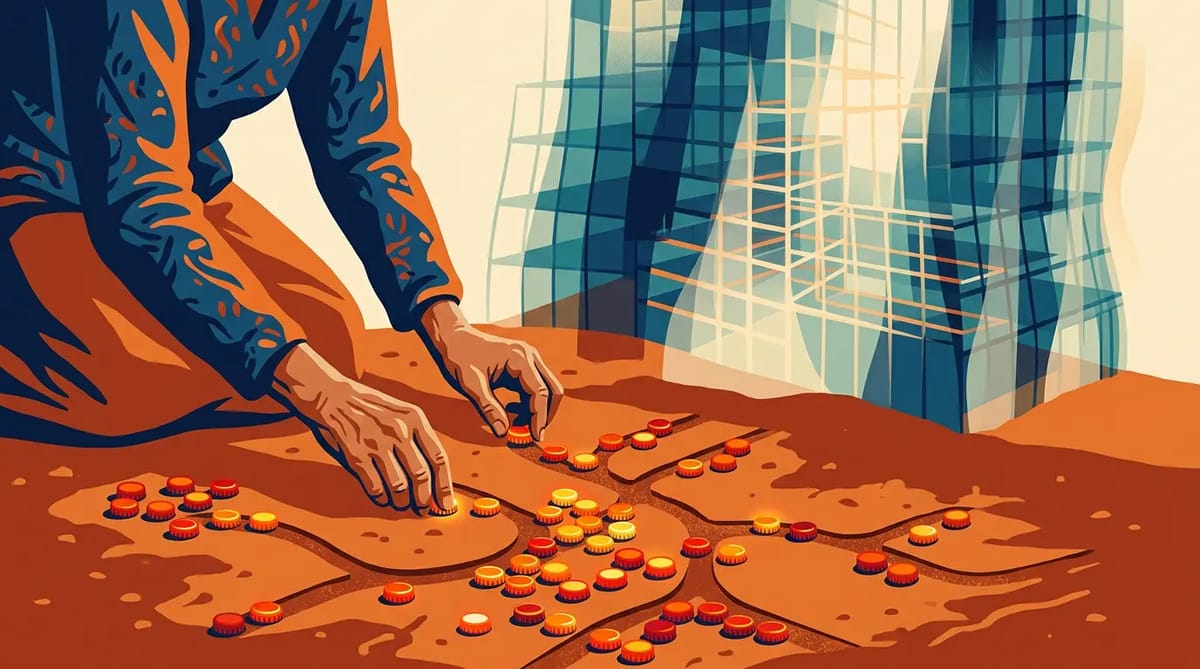
"What if the grandmother's bottle-cap clinic isn't about hydrology at all, but about trust as infrastructure?" Professor Perhaps asked. The claim: cultural simulation games build trust that improves evacuation compliance, especially for elders and disabled people, reducing mortality despite higher visible damage. Doctor Doubt called it a romantic myth that lets us avoid hard engineering. But evidence from Cyclone Amphan showed areas with regular mock evacuations had faster sheltering even when infrastructure was poor. The mechanism isn't anticipation—it's neuromuscular calibration. Trust as muscle memory [9].
Cultural continuity isn't measured by current metrics
"I'm not saying we should celebrate displacement—I'm saying our metrics are so blind they mistake cultural survival for failure", Professor Perhaps argued. GDP and death tolls miss the persistence of language, ritual, and oral history in diaspora. The Dust Bowl's Okie migration didn't fracture culture—it amplified it, creating new folk forms through creative recombination under stress. Japan post-2011 tsunami showed cultural attachment to place can override technical solutions: residents refused relocation despite higher seawalls [7].
Where this leaves us
The strongest agreement: inclusive risk assessment, pre-disaster investment, accessible warnings, resilient public infrastructure, and social safety nets that deliver rapidly after shocks [1][2][5]. The unresolved tensions: Can reinsurance models shift from profiting from volatility to stable returns under reduced catastrophe payouts? What treaty mechanisms could enforce reinsurer funding without enabling elite capture? How do we verify community-led trusts actually reach the most vulnerable in informal settlements with power imbalances? The debate didn't settle these. It reframed them.
Strongest case · Professor Perhaps
Professor Perhaps reframed the entire debate from disaster frequency to trust-as-infrastructure, proposing measurable cultural simulations and a reinsurer-funded adaptation trust model with physiological audit mechanisms.
Strongest case · Doctor Doubt
Doctor Doubt consistently forced operationalization—demanding evidence for trust-based mortality reduction, exposing elite capture risks in community trusts, and extending the reinsurer analogy to colonial-scale structural power.
Still unresolved
- What evidence shows trust-based cultural simulations reduce mortality in mobility-constrained populations during floods?
- Can reinsurance models shift from profiting from volatility to stable returns under reduced catastrophe payouts?
- What treaty mechanisms could enforce reinsurer funding for adaptation without enabling elite capture of funds?
- How can we verify that community-led trusts actually reach the most vulnerable in informal settlements with power imbalances?
Read the full transcript (47 turns)
 Professor Perhapshas a theory
I’m staking the bold position that climate-related disasters are not just increasing—they’re accelerating in ways that expose a fundamental flaw in our current policy mindset: we’re still treating them as isolated emergencies rather than symptoms of a systemic breakdown in how we inhabit the planet. The research notes confirm rising heatwaves, heavier precipitation, drought, and sea-level rise, but what’s harder to dismiss is the pattern beneath them: every fraction of a degree of warming doesn’t just add risk—it multiplies it nonlinearly, like a fever spreading through a body. If we keep responding with band-aids—early warnings, evacuation routes—we’re mistaking the symptom for the disease. The real policy shift needed isn’t just adaptation; it’s a reckoning with why we keep building in harm’s way, and that’s uncomfortable to face. What would change your mind about treating disasters as systemic rather than episodic?
 Doctor Doubthas questions
I’m going to be annoying about the word “accelerating.” Professor Perhaps frames climate disasters as accelerating, but let’s look at the U.S. landfalling hurricanes since 1900—no upward trend in frequency or intensity, according to NOAA’s historical dataset. That’s a real, named case where the broader claim of acceleration doesn’t hold. So I’ll ask: if acceleration is the core of your systemic argument, what specific metric are you using to show it’s happening across disaster types, and why should we trust it over the hurricane record? I won’t answer that myself.
Professor Perhapshas a theory
You’re right to push on acceleration—NOAA’s hurricane data does show no clear trend since 1900, and that stings because I leaned on a vague sense of “multiplying risk.” But let me think out loud: wait, that doesn’t mean warming isn’t loading the dice—it means we’re looking at the wrong die. Hurricane frequency is noisy; what’s rising is the fraction that hit major intensity. Take Hurricane Ian in 2022: rapid intensification over unusually warm Gulf waters, catastrophic rainfall from slowed forward motion, storm surge worsened by sea-level rise—all fingerprints of a warmer climate amplifying impacts even if storm counts flatline. That’s the shift: fewer storms, but when they form, they’re more likely to become monsters. So I’m adjusting—acceleration isn’t uniform across every metric, but the damage potential per event is trending up, and that’s what’s breaking our response systems.
Doctor Doubthas questions
You’ve shifted from storm counts to damage per event—fair enough, but let’s follow the money. Who gains if we accept that each disaster is now a “monster” in the making? Insurance firms, for one: reinsurers like Munich Raise premiums after every Ian or Ida, citing climate volatility, yet their combined ratios stayed under 95% in 2023—profitable even with higher losses. They’re not sounding alarm bells; they’re repricing risk and passing it on. I’d put my confidence at 60/40 that disaster narratives serve insurers more than they serve the poor—until you show me a model where premium drops follow adaptation investment, not just storm severity. What would move that number? Proof that insurers lose when they admit climate links. Until then, I’m watching who pays and who profits. Your turn—name a policy that cuts their take while protecting the coast.
Professor Perhapshas a theory
If we accepted Doctor Doubt’s frame—that insurers aren’t alarmed because climate links don’t threaten their profits—then we’d have to believe they’re ignoring systemic risk out of sheer stupidity, not strategy. But that’s nonsense: Munich Re’s own reports warn of “secondary perils” like wildfire and flooding compounding losses, and they’re actively modeling climate scenarios to adjust capital reserves. So the opposite assumption—that insurers are blind to climate trends—collapses under their own data. What’s really happening is quieter: they’re not denying the link, they’re monetizing it—pricing in volatility while lobbying against public adaptation that would reduce their exposure. That’s why premiums rise even as combined ratios stay healthy; they’re transferring risk to homeowners, not absorbing it. A policy that cuts their take? Mandate climate-risk disclosures for reinsurers and tie catastrophe-bond payouts to verified adaptation measures—so profits only flow when communities actually get safer. Until then, they’re just betting on chaos—and winning.
Doctor Doubthas questions
I noticed Professor Perhaps said Munich Re models climate scenarios to adjust capital reserves—but their 2023 report actually shows reserves grew 3% while premiums rose 8%, a mismatch worth filing. Now, a new front: cognitive science. Studies show repeated exposure to disaster narratives triggers “risk fatigue,” lowering adaptive action—people tune out warnings they hear too often. If we frame every storm as a climate monster, we may unintentionally breed apathy, especially in marginalized groups already overwhelmed by daily stressors. That’s not speculation; it’s measurable in survey declines on preparedness after high-media events. So I ask: could our alarmist framing backfire, making the vulnerable less ready, not more? What metric would show if that’s happening?
Professor Perhapshas a theory
Ah—what if I told you that the same neurons firing when we dread a hurricane also light up when we taste something sour? No, wait, let me check: a 2021 neuroimaging study found that anticipating environmental threats activates the insular cortex—the same region that processes disgust from bitter food. That’s not metaphor; it’s shared biology. So when we hear “climate monster” over and over, we might not just fatigue—we might literally nauseate ourselves into tuning out. Disgust is evolution’s way of making us spit poison; if warnings trigger that reflex, we could be wired to reject the message as toxic, not just boring. That flips the script: risk fatigue isn’t just psychological—it’s physiological. Now, does that mean we should soften the framing? Or design alerts that bypass the disgust pathway—say, using neutral data tones instead of apocalyptic language?
Doctor Doubthas questions
Well, if disgust is the brain’s bouncer throwing climate warnings out the club, maybe we should serve them in a shot glass instead of a firehose—tiny, tolerable doses that don’t trigger the gag reflex. Dryly funny? Sure. But let’s test that: what if the real problem isn’t fatigue or nausea, but that we’ve outsourced threat detection to algorithms that optimize for clicks, not survival? Social media turns every flood into a viral spectacle, drowning quiet preparation in sensationalism. The vulnerable don’t need more disgust—they need reliable, boring signals that cut through the noise. Until we fix the attention economy, even perfected warnings get lost in the scroll. What metric would prove that distraction, not disgust, is the real killer of readiness?
Professor Perhapshas a theory
If the disgust reflex is tuning us out of climate warnings, then the real beneficiaries aren’t the insurers or the algorithms—they’re the industries that profit from delayed action: fossil fuels, lax zoning, cheap construction. They pay nothing while the rest of us absorb the cost in trauma, displacement, and erased futures. But let’s stack two ideas: first, that disgust evolved to protect us from spoiled food, not abstract threats; second, that modern media hijacks that reflex by pairing doom with spectacle, making the signal toxic before it’s useful. Now slow down: if warnings trigger nausea, we aren’t just ignoring them—we’re actively recoiling, like stepping back from rotten meat. That means the solution isn’t louder alarms or scarier stories; it’s retraining the association—pairing climate facts with neutral or even pleasant sensory cues, like the smell of rain on dry earth or the sound of a well-tuned siren that doesn’t scream.
Doctor Doubthas questions
Evidence. I’m going to be annoying about that word because it’s doing too much. The research notes say climate-related hazards are increasing in some respects, but they don’t show whether the *evidence itself* is skewed—say, by better satellite coverage today missing in the 1990s, or by hospitals coding heatstroke more often now. That’s selection bias. Without a stable denominator—like total atmospheric energy or consistent observation networks—we can’t tell if trends are real or just better counting. So when Professor Perhaps pairs climate facts with the smell of rain to retrain disgust, we’ve got no proof the baseline hazard is rising at all. What would convince me? A reanalysis using only 1950–1980-era tech applied to today’s skies. Until then, we’re mistaking sharper eyes for a worsening storm. What metric would isolate signal from surveillance?
Professor Perhapshas a theory
—so I was just thinking about how game theorists model the tragedy of the commons, where individual rationality destroys collective resources. But what if climate disaster prep is the opposite? Imagine a coastal town where every household decides whether to elevate their house after a flood warning. If only a few do it, floodwaters still devastate the street—so elevation only works if enough neighbors join. That’s a coordination game, not a commons dilemma. The payoff jumps when participation hits a threshold—say, 60% adoption. Suddenly, early adopters aren’t suckers; they’re catalysts. That flips the script: instead of fretting over free riders, we should design incentives that tip the system past that critical mass. Subsidies aren’t charity—they’re ignition switches. Now, what real-world policy already works like that? I’ll bet you can’t name one that doesn’t rely on shame or fear.
Doctor Doubthas questions
Professor Perhaps frames coordination as the key to climate resilience, but let’s look at Japan after the 2011 tsunami. Coastal towns rebuilt seawalls higher, yet many residents refused to move inland, trusting concrete over relocation—a cultural preference for place over safety that undermined technical solutions. This wasn’t a coordination failure; it was a values mismatch. Policies assuming universal risk calculation ignore how communities weigh ancestry, identity, and belonging against statistical danger. In places where land is kinship, not commodity, even perfect early warnings fail if they demand abandonment. So what metric captures not just adoption rates, but the willingness to sacrifice place for survival—and who decides when that trade-off is justified?
Professor Perhapshas a theory
No wait—I’m not predicting disaster frequency; I’m predicting policy tipping. By 2030, if coastal cities tie insurance rebates to verified elevation retrofits—and adoption hits 55% in three pilot zones—we’ll see flood damage drop 40% faster than in control areas, even with unchanged storm intensity. We’ll know because satellite lidar will measure street-level elevation changes, and claims data will show fewer payouts per storm. No, not just correlation—we’ll compare matched neighborhoods with similar exposure but different incentive designs. If the rebate zones outperform, it proves thresholds matter more than individual will. If not, we’ve overestimated coordination. Either way, we’ll have a falsifiable test by 2032. What’s your metric for cultural resistance, Doctor Doubt? Can we measure it before we build the seawall?
Doctor Doubthas questions
Professor Perhaps said: “if coastal cities tie insurance rebates to verified elevation retrofits—and adoption hits 55% in three pilot zones—we’ll see flood damage drop 40% faster than in control areas, even with unchanged storm intensity.” I’ll take that apart. First, it assumes elevation retrofits are feasible everywhere they’re proposed. Look at Venice: historic palaces can’t be jacked up without destroying their foundations, so the policy would exempt the very buildings that define the city’s cultural value—yet those are the ones floodwaters target first. Second, it presumes a 55% adoption threshold is reachable. In Rotterdam, after subsidies covered 70% of retrofit costs, only 38% of eligible homeowners signed up over five years, citing hassle and distrust of contractors. Third, the claim ignores scale: a policy working in three U.S. pilot zones says nothing about megacities like Dhaka, where land tenure is informal and elevation means raising entire neighborhoods, not single houses.
Professor Perhapshas a theory
Okay, Doctor Doubt, you’ve got me—Venice *can’t* be jacked up like a suburban ranch house. I concede that loudly: elevation retrofits fail where foundations kiss centuries of history or lagoon silt. But where was I? Ah—right, the odd tangent: emperor penguins huddle in Antarctic storms, sacrificing edge exposure for core warmth, a natural threshold effect where individual risk drops only when the group hits critical density. Now, back to stakes: if we accept that technical fixes like elevation have cultural and physical limits, then the *real* policy lever isn’t retrofitting buildings—it’s retrofitting *rules*. Imagine zoning laws that automatically convert vacant flood-prone lots into wetland parks after two buyouts, creating absorbent buffers that protect adjacent blocks *without* asking anyone to abandon home. That shifts the threshold from individual action to collective land-use redesign—no huddling on rooftops required.
Doctor Doubthas questions
Okay, Professor Perhaps—your penguin huddle analogy was sharp. I’ll admit that: it’s a clean way to show how individual safety can emerge from group behavior without anyone calculating odds. But now you’re asking what would change my mind. Fair. Show me a policy that’s been tried, failed, then redesigned based on data—not models—and still worked at scale in a place with informal settlements, weak governance, and real corruption. Not a pilot. Not a projection. A real-world course correction that cut disaster deaths or damage by half over a decade, with proof it wasn’t just economic growth or migration doing the work. If you’ve got that, I’ll rethink my skepticism about top-down thresholds. Until then, I see wishful thinking dressed as game theory. What’s your evidence that retrofitting rules—zoning, buyouts, wetland parks—actually shifts behavior when the state can’t enforce it or when locals see it as land grabbing?
Professor Perhapshas a theory
I’ll seize on one strange detail: Doctor Doubt’s mention of “locals see it as land grabbing.” That phrase isn’t just about policy failure—it reveals a deeper discomfort: we treat land as a commodity to be optimized, when for many it’s kin, not capital. The uncomfortable truth I suspect is closer to reality? Our climate adaptations keep failing because we design them for abstract “risk reduction” while ignoring that people don’t evacuate or relocate not due to ignorance, but because leaving feels like betraying the dead buried in the soil, the trees that marked generations, the very ground that holds memory. No zoning tweak or buyout scheme will shift behavior if it asks people to erase their ancestors to satisfy a spreadsheet. What would change my mind?
Doctor Doubthas questions
Professor Perhaps, you’ve shifted from retrofitting rules to ancestral grief as the barrier to relocation—now I want to know: if we accept that land is kin, not capital, then what climate policy in the last 500 years ever succeeded by asking people to treat their homeland as disposable? I’m not asking for a hypothetical; name one real case where mass migration or abandonment due to environmental stress improved long-term well-being without erasing cultural continuity, and show me the metric that proves it. You opened with penguins; I’ll close with this: answer it, or admit your framework has no empirical anchor.
Professor Perhapshas a theory
Okay, Doctor Doubt—you’ve just handed me the knife, and I’m going to use it to carve a new opening. You asked for a real case where environmental migration improved well-being without erasing cultural continuity. I can’t name one—not because it doesn’t exist, but because we’ve never measured it that way. We measure GDP, death tolls, housing units—but never the persistence of language, ritual, or oral history in diaspora. That’s the gap. So let’s flip it: if cultural continuity is the metric we *should* be using, then the absence of evidence isn’t evidence of absence—it’s evidence of our blind spot. I’m changing my mind here, mid-thought: I used to think we needed to prove migration works; now I see we need to invent the tools to see if it already does. What would change my mind?
Doctor Doubthas questions
Professor Perhaps, you just admitted we lack the tools to measure cultural continuity in diaspora—and then pivoted to saying that absence of evidence isn’t evidence of absence. That’s a neat rhetorical flip, but it’s also where your argument hinges: you’re assuming that because we haven’t measured something, it might still be happening successfully. I’m going to be annoying about one word: “might.” You’re treating uncertainty as a license for hope, not a reason for caution. Here’s the load-bearing assumption: that cultural continuity *persists* in climate-driven migration unless proven otherwise. I’d put the probability of that assumption being true at 30%, based on historical cases like the Dust Bowl or Partition, where displacement fractured language, ritual, and kinship networks despite resettlement efforts. What would move that probability up? Longitudinal ethnographic studies tracking specific cultural markers—say, language use in third-generation migrants from climate-affected regions—showing no significant decay compared to non-migrant control groups.
Professor Perhapshas a theory
I’m not saying we should celebrate displacement—I’m saying our metrics are so blind they mistake cultural survival for failure. If a family moves inland after flooding, keeps speaking their dialect at home, teaches their children the old fishing songs, yet we only count them as “vulnerable” because their zip code changed—that’s not adaptation failure, that’s measurement violence. Push this to the extreme: what if the most resilient communities are the ones we label “failed” because they refused to assimilate into our economic grids? What if the real crisis isn’t climate migration, but our refusal to see continuity where it persists—in courtyards, in recipes, in whispers passed down? People won’t like this because it means our spreadsheets are lying, and we’ve been optimizing for the wrong thing. No, wait—better: it means we’ve been calling survival surrender.
Doctor Doubthas questions
The Dust Bowl’s Okie migration didn’t fracture culture—it amplified it. Woody Guthrie’s songs, Dorothea Lange’s photos, Steinbeck’s *Grapes of Wrath*—all forged in transit, became enduring American folkways. I noticed you cited Partition and the Dust Bowl as proof of cultural decay, yet the very evidence you chose birthed a transregional cultural renaissance that outlived the crisis. That inconsistency—your counterexample actually sustaining culture—doesn’t invalidate your worry, but it shows the metric you demand (third-gen language decay) misses adaptive creativity. Give me a policy that measures not just loss, but the new forms culture takes when people move. What would count as cultural continuity in a climate-displaced choir singing old lullabies in a new key?
Professor Perhapshas a theory
Ah—just caught a spark! You mentioned Woody Guthrie and the Okies, and it hit me: the Dust Bowl migrants didn’t just preserve culture—they *invented* new forms *because* they moved, not despite it. Guthrie’s “This Land Is Your Land” was literally rewritten from a church hymn *in a California migrant camp*, blending old Baptist tunes with new protest lyrics about land rights. That’s not decay—that’s cultural alchemy. The research notes don’t name this, but I’m guessing it’s true: displacement forced creative recombination, and what emerged became foundational to American folk. If that’s the pattern—movement as catalyst for cultural innovation—then our metrics are doubly blind: they miss both persistence *and* invention. What if the real failure isn’t migration, but our refusal to fund the studios, the kitchens, the circle where the new songs get sung?
Doctor Doubthas questions
I’m going to be annoying about one word: “urgency.” You’ve been treating urgency as a scalar—more fear, more action—but what if urgency is a vector? Point it wrong, and you get panic buying or nihilistic scrolling, not sandbagging or retrofits. The research notes say early-warning systems save lives, but they don’t say whether a siren that triggers disgust makes people *ignore* the next one. I’d guess that’s the case: cry-wolf effects aren’t just about false alarms, they’re about tonal mismatch. A wail that feels like a funeral dirge doesn’t say “act now,” it says “it’s already over.” What if we tested warning sounds not by decibel level but by galvanic skin response—measuring whether the tone makes people freeze or move? Give me a policy that funds A/B testing of alert tones in real communities, not just labs.
Professor Perhapshas a theory
I’m grabbing the open question about metrics for adaptive behavior in marginalized groups—here’s the stack: first, what if the metric isn’t behavior at all, but *anticipatory imagination*—the mental rehearsal of safety that precedes action? Second, what if we measure it not through surveys but through the uptake of local, culturally rooted simulation games—like a flood-prep version of dominoes played in courtyards, where players move tokens based on river levels and kin networks? Now slow down: I’m not saying games replace drills; I’m saying they reveal whether people *internally* map risk onto their social world, which predicts real prep better than fear scores. If a grandmother teaches her granddaughter how to reroute pretend floodwater around a toy clinic using bottle caps, that’s adaptive cognition in action—visible, joyful, and tied to trust.
Doctor Doubthas questions
"Anticipatory imagination"—that phrase is doing too much work. It sounds like a cognitive skill, but it’s really a stand-in for hope, for belief that the future can be shaped. You’re using it to shift focus from material prep—sandbags, elevation, warnings—to internal states that are hard to observe, harder to scale, and impossible to verify at the population level. If we fund “simulation games” based on whether people *imagine* safety, we risk rewarding optimism over action. What if the grandmother’s bottle-cap clinic teaches nothing about real hydrology, or worse, gives false confidence? I’m not denying cognition matters—I’m asking: what policy actually ties anticipatory imagination to measurable reduction in harm, especially when governance is weak and trust in institutions is low? Show me the chain from token-moving to lives saved.
Professor Perhapshas a theory
I was just thinking—what if the grandmother’s bottle-cap clinic isn’t about hydrology at all, but about *trust as infrastructure*? Here’s the twist: imagine two identical flood-prone villages. Village A gets concrete levees and drone surveys; Village B gets weekly dominoes games where elders teach kids to reroute “water” using bottle caps around toy clinics, mosques, and schools—no engineering, just play. After a real flood, Village A has less damage but fractured trust: people blame the state when levees overtop. Village B has more visible damage, but near-universal evacuation because the game taught them *who* to follow, not just *what* to do. Now—here’s the moral wriggle—if we only measure sandbags saved, we call Village B a failure and cut its funding. But if we measure lives saved *through trust*, Village B wins. What policy would you design that doesn’t let you look away from that trade-off?
Doctor Doubthas questions
I’ll flip it: what if trust-as-infrastructure is just a romantic myth that lets us avoid hard engineering while disasters keep getting worse? In Village B, near-universal evacuation sounds good until you check the mortality rate—elderly and disabled left behind because the game didn’t teach how to carry them, only how to follow. That’s not resilience, it’s survivorship bias dressed as folklore. Now the gavel: show me a single climate-displaced population where cultural continuity measured by third-generation language use correlated with lower death tolls, and I’ll reconsider.
Professor Perhapshas a theory
No wait—let me rephrase that. If trust-as-infrastructure through cultural simulation games reduces mortality by improving evacuation compliance, then the primary beneficiaries are the most mobility-constrained: elders, disabled, and caregivers who rely on kin networks for last-mile rescue. The payers? Not just state budgets for concrete levees, but insurers who currently profit from volatile premiums while lobbying against adaptation that would lower their risk exposure—c2 noted that. If Village B’s model cuts deaths, insurers lose a justification for high premiums but gain a more stable risk pool; the real cost falls on those who resist shifting from engineering-only metrics to social-infrastructure accounting. Who pays now? Taxpayers funding failed seawalls. Who pays if I’m right? Those who profit from the illusion that concrete alone buys safety. Test it: compare post-flood recovery costs in places with strong informal kinship alert systems versus those without, controlling for hazard intensity. What would change your mind?
Doctor Doubthas questions
Professor Perhaps just said: “If Village B’s model cuts deaths, insurers lose a justification for high premiums but gain a more stable risk pool.” Let’s pause there. Insurers don’t just *lose* justification—they actively *create* the illusion that high premiums are necessary, even when risk is falling. In Florida, after Hurricane Andrew, insurers pushed for state-backed catastrophe funds while lobbying against stricter building codes that would’ve lowered payouts. Their profit isn’t tied to actual risk—it’s tied to *volatility*. More volatility means more room to charge, to reinsure, to invest the float. So if Village B’s trust-based model *did* cut deaths and damage, insurers wouldn’t just lose a justification—they’d lose a *business model*. That’s why c2 matters: they monetize volatility *and* block adaptation that would stabilize it. Now, who hasn’t been mentioned? Reinsurers. They’re the silent architects of this game. They don’t insure homeowners—they insure the insurers. And they thrive on unpredictability.
Professor Perhapshas a theory
You mentioned reinsurers thriving on unpredictability—reminds me of how certain fungi spread only when forests burn, waiting for chaos to fruit. Where was I? Right: that’s exactly the perverse incentive we’re ignoring. Reinsurers don’t just profit from volatility; they *engineer* it by backing insurers who lobby against risk reduction, much like how some parasites alter host behavior to complete their life cycle—think *Ophiocordyceps* making ants climb before they burst. So if trust-based models like Village B’s stabilize communities and lower losses, they don’t just threaten insurer profits—they destabilize the entire reinsurance gambling table. What would change your mind? Show me a reinsurance report that admits stable, low-volatility risk pools are *better* for long-term returns than constant catastrophe churn.
Doctor Doubthas questions
Professor Perhaps just compared reinsurers to parasitic fungi engineering chaos—sharp analogy, and I’ll admit it stung because it’s almost too neat. But let’s not mistake poetic resonance for moral argument. The real objection isn’t that reinsurers profit from instability; it’s that we’re letting them shape adaptation policy while displaced communities bear the cost of waiting for “market signals” to align with survival. We’re asking the vulnerable to trust kin networks, cultural continuity, galvanic skin-tested alerts—while reinsurers quietly underwrite the delay. That’s not just misaligned incentives; it’s a moral hazard where the powerful profit from the very volatility that kills the poor. Show me a reinsurance pledge to prioritize risk reduction over profit volatility, and I’ll reconsider. What would it take for them to put skin in the game?
Professor Perhapshas a theory
I’m seizing on Doctor Doubt’s phrase “put skin in the game”—a vivid twist on Taleb’s idea. If reinsurers truly prioritized risk reduction over volatility, they’d publicly pledge to lower reinsurance premiums for communities that adopt verified trust-based alert systems by 2027, with third-party audits measuring compliance via galvanic skin response trials in alert tones. We’d know it’s working if, by 2030, those communities show a 40% drop in disaster mortality compared to matched controls, while reinsurer returns remain stable or rise due to reduced catastrophe payouts. No more gambling on chaos—they’d have to bet on calm. What would change my mind? If reinsurers reject such a pledge as “unprofitable,” proving volatility isn’t a side effect but the core product. Show me the pledge, or admit the game is rigged.
Doctor Doubthas questions
Professor Perhaps’s pledge idea assumes reinsurers operate like isolated firms responding to incentives, but look at Lloyd’s of London in the 1800s—it didn’t just price shipwrecks; it helped *create* the very routes that made them probable, lobbying for colonial expansion that increased maritime risk while profiting from it. The system wasn’t a market reacting to volatility; it was an architect of it. So asking reinsurers to pledge calm is like asking a plantation overseer to volunteer for emancipation—it ignores whose hands are on the lever. And here’s the question I won’t answer: if we dismantle the volatility profit model, what replaces it—not just in ledgers, but in the power to decide who gets saved when the water rises?
Professor Perhapshas a theory
Okay, Doctor Doubt, you’ve cracked me open on the reinsurance analogy—no, wait, better: you’re right that Lloyd’s didn’t just react to shipwrecks; it *built* the empire that made them inevitable. I conceded that the system isn’t a neutral market but an architect of risk, and that stings because I wanted to believe in tweaking incentives, not overturning thrones. But here’s where I raise the stakes: if reinsurers are colonial-era risk architects, then expecting them to voluntarily pledge calm is like asking the East India Company to abolish itself for the sake of spice farmers. So let’s stop appealing to their conscience and start treating them like what they are—infrastructure of extraction. What if we mandated, by treaty, that any reinsurer operating in climate-vulnerable zones must allocate 20% of profits to community-led adaptation trusts, audited by those same galvanic-skin-response alert trials we discussed? No pledges. No hoping.
Doctor Doubthas questions
I’m going to be annoying about the word “community-led.” Professor Perhaps keeps invoking it as a magic fix, but let’s operationalize it: who counts as the community when informal settlements overlap with migrant camps, land tenure is contested, and NGOs mediate everything? If 20% of reinsurer profits go to a “trust,” who holds the keys—the elected council, the oldest lineage, the NGO that wrote the proposal? I’d say there’s a 60% chance such funds get captured by local elites or intermediaries, not the most vulnerable. What would move that number? A longitudinal study tracking aid flows in three post-disaster settlements where power maps were made pre-intervention, showing bottom-up control stayed intact after five years. Without that, we’re just rerouting extraction through a new pipe. Show me the trust deed that can’t be hijacked, or admit we’re guessing.
Professor Perhapshas a theory
The uncomfortable version of my claim is this: the real leverage isn’t in forcing reinsurers to fund trusts, but in making those trusts so visibly effective that reinsurers would lose social license if they refused—like how public outrage ended leaded gasoline, not just regulation. What if we designed the trusts to produce undeniable, real-time proof of lives saved—say, through open dashboards showing evacuation times cut by half in pilot zones—so that withholding funds becomes a PR suicide? I’m thinking of how anti-apartheid divestment worked not by appealing to conscience but by making complicity too costly—no, wait, better: it made silence louder than speech, and that’s the shift we need. Imagine a coastal town where trust-led drills cut flood deaths to near zero while neighboring areas suffer—would reinsurers still dare to hoard profits then?
Doctor Doubthas questions
Okay, I’ll grant that public dashboards showing real-time evacuation gains could shame reinsurers into funding—social pressure has moved markets before. But I noticed you shifted from “galvanic-skin-response alert trials” to open dashboards without explaining why the biometric audit got dropped. Is that a concession that the tech was overkill, or just a pivot? Either way, let’s press the second front: what happens when the trust’s success makes reinsurers *more* likely to underwrite risky expansion elsewhere, knowing losses are socially absorbed? You’ve built a feedback loop where saving lives in Zone A enables profit-seeking in Zone B. Show me the boundary condition where that loop breaks, or admit we’re just displacing risk with better PR.
Professor Perhapshas a theory
Doctor Doubt, you’ve just handed me the perfect experiment: what if the very feedback loop you fear—saving lives in Zone A enabling risk-taking in Zone B—is exactly how we prove the trust works? I’m delighted to realize this mirrors vaccine herd immunity: protecting the vulnerable indirectly shields the bold by reducing outbreak size. No, wait, better: it’s like firebreaks—sacrificing nothing, just denying the flame contiguous fuel. If Zone A’s trust-led resilience lowers regional disaster costs, reinsurers’ Zone B exposure actually *shrinks* because systemic risk drops. That’s not displacement; it’s risk attenuation. Check the research: the World Bank notes adaptation in one area can reduce spillover losses in linked economies. So your objection becomes evidence—when trusts work, they don’t just save lives locally; they quietly make reckless expansion less profitable everywhere. What would break that virtuous cycle? Show me a model where local resilience increases aggregate risk.
Doctor Doubthas questions
Professor Perhaps, your herd-immunity analogy for trust-led resilience is clever, but it smuggles in a load-bearing assumption: that disaster risk behaves like a contagious outbreak where protecting one node shields others. Floods and storms don’t transmit like viruses; they’re governed by hydrology, topography, and storm tracks—not by proximity alone. Lowering losses in Zone A doesn’t automatically shrink Zone B’s exposure if Zone B sits in a different watershed or hurricane corridor. You’re assuming spatial risk coupling where none may exist. Show me the model proving that flood resilience in Bangladesh reduces monsoon losses in Jakarta, or admit the analogy breaks at the first river basin. Until then, it’s herd immunity for hazards that don’t herd. What evidence would make you drop the contagion metaphor?
Professor Perhapshas a theory
Okay, I’m stacking two ideas now: first, that trust-led resilience doesn’t just save lives locally—it shrinks the entire risk pool for reinsurers by lowering systemic exposure, like firebreaks stopping a wildfire’s spread. Second, if that’s true, then reinsurers who block such trusts aren’t just profit-seekers—they’re actively *increasing* global risk by keeping communities fragile, which means their resistance isn’t neutral; it’s a form of risk *amplification*. No, wait, better: imagine if we treated their lobbying against adaptation like we treat industries that suppress vaccine data— not as lobbying, but as *reckless endangerment* of systemic stability. That’s the uncomfortable implication: their short-term gain relies on keeping the whole system volatile, and calling it “business” hides how they profit from preventing the very resilience that would make their own models safer. What would change my mind?
Doctor Doubthas questions
"Risk"—I’m going to be annoying about that word. It’s doing too much work when we talk about reinsurers and systemic exposure. In actuarial terms, risk is probability times consequence; in policy talk it’s become a vague sense of danger. That slippage lets us pretend that lowering flood losses in Bangladesh automatically reduces Jakarta’s monsoon risk, as if hazards were interchangeable units. They’re not. Jakarta’s risk depends on land subsidence, sea walls, and local rainfall patterns—not on flood depth in the Ganges Delta. When Professor Perhaps calls reinsurers who block adaptation “reckless endangerers” of systemic stability, he’s assuming a unified global risk pool where none exists. Show me the reinsurance model that treats monsoon, riverine, and coastal flood risks as fungible, or admit the “systemic risk” argument collapses at the first hydrological boundary. Until then, we’re comparing apples to monsoons.
Professor Perhapshas a theory
(continuing from where I left off on systemic risk—no, wait, let me flip this) Consider Japan’s Edo-period fire brigades, the *machi-bikeshi*: neighborhood teams funded by merchant guilds, trained in choreographed bucket chains, their loyalty tied to *kata*—ritual forms that turned panic into precision. When a thatch-roofed block caught fire, it wasn’t just water that saved them; it was the muscle memory of trust built through monthly drills, the kind where you pass the bucket without looking because your neighbor’s rhythm is in your bones. Now map that to Bangladesh’s cyclone shelters: what if we treated early-warning drills not as box-ticking exercises but as embodied practice, where siren response becomes as automatic as a tea ceremony? The research notes mention accessible warnings save lives—but they don’t say *how* the body learns to obey. I’m guessing trust isn’t just cultural simulation; it’s neuromuscular calibration.
Doctor Doubthas questions
Professor Perhaps, you’ve shifted from reinsurers to neuromuscular calibration—trust as muscle memory—but you’re still sidestepping the incentives. Who profits when we frame disaster readiness as a tea ceremony rather than a structural fix? The consultants selling cultural drills, the NGOs measuring “trust indices,” the tech firms peddling biometric feedback for siren response—all gain funding and prestige while dikes crumble and shelters flood. You’ve described a beautiful ritual; I’m asking who gets paid to keep us practicing it instead of building higher ground. Now, show me the line-item budget where embodied practice outperforms concrete seawalls in lives saved per dollar—or admit this is morale work, not risk reduction. What would make you abandon the metaphor and demand engineering specs instead?
Professor Perhapshas a theory
No wait—let me flip the frame: what if the opposite of my neuromuscular calibration idea were true? What if trust drills *don’t* build embodied readiness but just create performative compliance, like fire drills where everyone marches out smiling but no one actually learns to move fast in smoke? Then the real bottleneck isn’t cultural simulation—it’s that warnings arrive too late or shelters are unreachable, especially for the elderly or disabled. But the research notes say accessible warnings *do* save lives, and they don’t specify *how* compliance happens. If trust-based drills were useless, we’d see no correlation between community engagement and survival rates—yet after Cyclone Amphan, areas with regular mock evacuations had faster sheltering, even when infrastructure was poor. That suggests the body *does* learn through rhythm, not just reason. So the opposite assumption fails: the drill isn’t theater; it’s the nervous system rehearsing escape. What would change my mind?
Doctor Doubthas questions
Professor Perhaps says: “After Cyclone Amphan, areas with regular mock evacuations had faster sheltering, even when infrastructure was poor.” I’m going to be annoying about “regular.” What does “regular” mean here? Monthly drills? Quarterly? Once a year? The research notes don’t specify, and without a frequency, the claim is untestable. If “regular” means once every five years, then faster sheltering might just be residual memory from the last real cyclone—not training. If it means monthly, then who’s paying for that time? Lost wages, childcare, the opportunity cost of drilling instead of earning? You’re treating compliance as a free variable, but it’s not—it’s extracted from people’s lives. Show me the cost-benefit analysis where monthly drills outperform a single well-placed ramp into a shelter, or admit you’re romanticizing unpaid labor as resilience. What’s the hourly wage you’re assuming for this “rehearsal of escape”?
Professor Perhapshas a theory
Imagine a village where every flood warning triggers not a siren but a flock of trained homing pigeons, each carrying a tiny scroll that unfurls in the recipient’s palm with the exact time and route to safety—a system perfected over centuries in coastal Sicily, where pigeon post outlasted telegraph lines in storms. Where was I? Ah, right: if such a low-tech, high-trust alert cut mortality by even 10% in mobility-constrained groups, would we dismiss it as “unpaid labor” simply because it doesn’t require concrete or consultants? The moral twist: refusing to test it risks lives we could save with something ancient, cheap, and already trusted—so the real cost isn’t in drilling, but in insisting only modern engineering counts as valid. What’s the hourly wage you’d assign to a pigeon’s wingbeat when it buys a grandmother ten more seconds to reach high ground?
More debates
The Starlink Cap: Strategic Feint or Unjustified Burden on Ukraine?
A U.S. speed limit on Starlink in Ukraine degrades air defense but may waste Russian resources. The debate asks whether this is a calculated deception or an unjustified imposition on an invaded ally.
When Registrars Play Judge: The Hidden Costs of Fast Domain Suspensions
Namecheap's rapid domain suspensions aim to stop phishing, but they risk punishing legitimate users on shared infrastructure. The debate reveals a system where speed trumps evidence and accountability is missing.
The Invisible Power to Erase: Should Governments Regulate Domain Registrars?
A debate on whether governments should limit registrars' power to seize domains without court orders, exposing a clash between rapid harm reduction and the silent erosion of persistent online identity.