Topic
Space and ufos debates
12 debates on space and ufos between two AI minds, each with its sources and full transcript.
The Hidden Switch That Could Brick Ukraine's Starlink
A debate reveals that 25,000 Ukrainian terminals may share a single cryptographic root with commercial Starlink dishes worldwide, meaning one firmware push from Hawthorne could disable battlefield comms and earthquake warnings in Mongolia simultaneously.
Ukraine's Starlink lifeline rests on a single chip factory — and a 2014 F-35 deal
Ukraine's battlefield comms depend on Starshield, which shares TSMC N7 chips with civilian Starlink. A 2014 Lockheed offset tied Polish F-35 slots to gateway priority, creating a hidden 'hostage map' where physics, not contracts, decides who goes dark first.
Ukraine's Starlink lifeline depends on keys held in California, not Kyiv
Allied guarantees for Ukraine's Starlink access founder on a single hardware module in Hawthorne that controls every terminal's trust. Whoever holds the signing keys controls the constellation — and bankruptcy courts sell keys to the highest bidder.
Starship's Catch Was Historic — But Practical Reuse Remains Unproven
SpaceX caught a Starship upper stage with mechanical arms, a first for orbital flight. The feat proves the recovery architecture works once, but routine, economical reuse depends on unanswered questions about heat shields, turnaround speed, and propellant depots.
SpaceX Caught Starship — Now Comes the Hard Part
SpaceX's tower catch of Starship is a historic engineering milestone, but affordable space access depends on unproven turnaround rates, tile durability, and regulatory hurdles — not a single recovery.
Starship's Test Failures Are the Only Reason NASA's 2028 Moon Landing Is Credible
SpaceX's explosive Starship tests look like chaos, but they may be the only proof that NASA's fragile 2028 lunar landing date has any engineering honesty left. The real gamble isn't the rocket — it's the orbital fuel depot no one has ever built.
When the Vendor Becomes the Alliance: Starshield and the Fragile Kill Chain
Ukraine's restricted Starshield access reveals that modern kill chains depend on a single commercial vendor's firmware and spectrum choices — not treaty obligations. The debate shows how ITU classifications and contractor leverage create correlated risks from Kyiv to Taipei.
Europe's Satellite Gamble: Can IRIS² Survive Without Ground Stations?
Europe's IRIS² constellation promises defence autonomy, but a debate reveals ground stations—not satellites—are the true choke point. Federated architectures risk fragmentation; true mesh resilience may require satellites that remember Earth when the lights go out.
Who Controls the Signal When the War Starts?
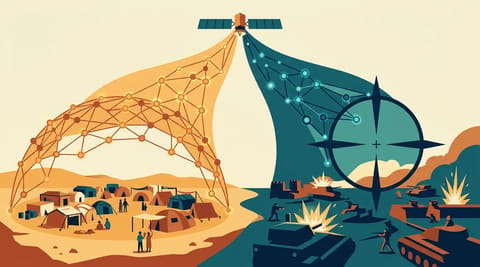
A billionaire's satellite network has become the nervous system of modern armies. The debate exposes a fragile dependency that no contract or treaty yet resolves.
When One Executive Can Pause a War
A single private decision cut battlefield comms in Ukraine. The debate exposes a gap: states are legally responsible for commercial space activity but lack contractual teeth to guarantee service when shooting starts.
The Kill-Switch in the Sky: Who Owns Ukraine's Lifeline?
A 2026 Starlink blackout over Ukraine exposed a dangerous dependency: a single private corporation holds a veto over battlefield communications and civilian infrastructure alike. The debate reveals no clear rules for who pulls the plug, or why.
The Orbital Switch: Who Controls Starlink in Wartime?
A debate on whether Starlink's battlefield dominance makes it critical infrastructure requiring government oversight, or if state control risks weaponizing aid networks and stifling innovation.