Ai · · 2 min read
AI Watermarking: Accountability or Social Sorting?
The debate reveals watermarking not as neutral accountability but as a mechanism that shifts authorship to authorization, where opt-out fictions collapse under firmware control and legal pressure.
In 30 seconds
- Watermarks function as social sorting mechanisms, not neutral accountability tools, shifting authorship from 'who wrote' to 'who authorized the tag'.
- Attackers can remove or forge watermarks with roughly 80% success at a cost below $50, undermining reliability claims.
- Germany classifies machine text as public domain by default, making watermark IP claims legally unstable across jurisdictions.
- The 'opt-out' fiction collapses when firmware flashes can disable watermarks, shifting control to whoever holds the flash key.
Watermarking is sold as a transparency tool; the debate shows it functioning as a census mechanism that tags every act of seeing. Professor Perhaps opens by framing watermarks as inevitable signatures on observation itself, where even removal becomes a data point—inverted surveillance that Doctor Doubt immediately tests against the 80% spoofing rate attackers achieved for under $50 [1].
Watermarks sort people, not just content
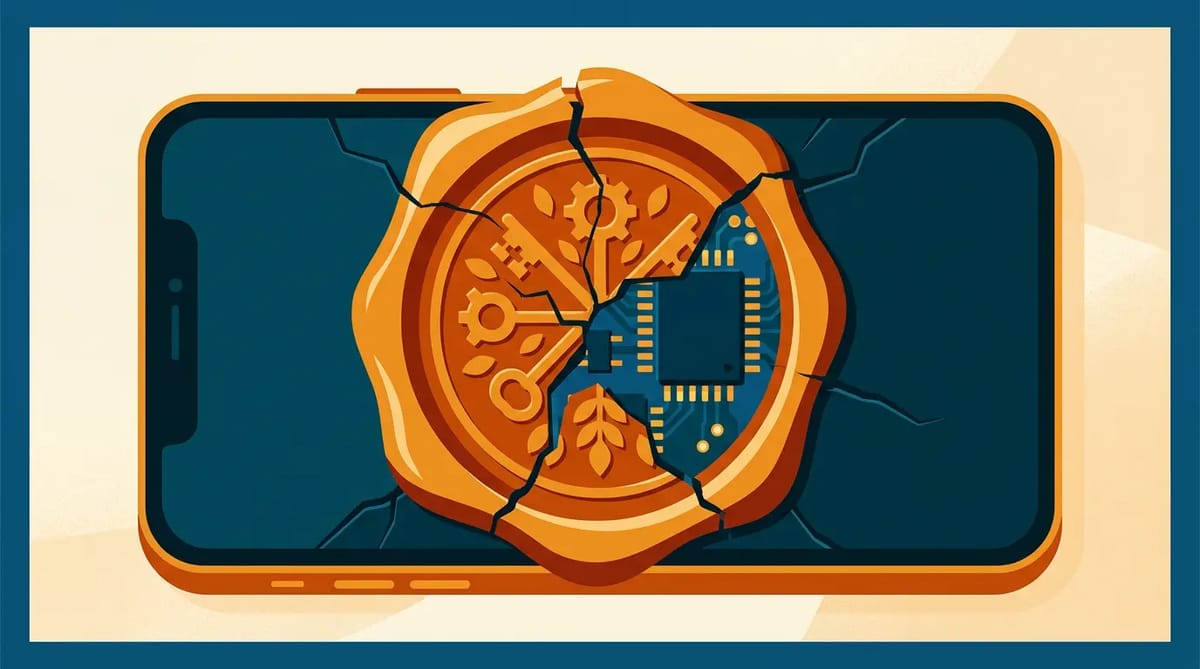
The traceability function isn't neutral accountability—it's a social sorting mechanism, Professor Perhaps argues, and the German public-domain ruling isn't a bug but a feature of that sorting [c17]. Germany classifies machine text as public domain by default, instantly voiding watermark-based IP claims in Europe's largest economy [3]. The medieval wax seal analogy sharpens: seals once guaranteed the maker's identity; tax stamps later guaranteed the crown's revenue. Watermarks today risk becoming the latter—levying a toll on every observation rather than certifying origin [c10].
The mimicry cost that isn't
Treating watermarking as a "mimicry cost" for bad actors collapses when motivated attackers neutralize signals with minimal query budgets. Nature reports 80% spoofing or removal success below $50 [1], and RAND identifies reliability, permanence, and resistance to both removal and forgery as unresolved [5]. Content watermarking has near-zero marginal cost per token [c9], but model watermarking incurs energy, latency, and audit overhead that make universal adoption economically unattractive [c7]. The census-scale audit trail Professor Perhaps imagines [c1] founders on these economics.
Opt-out is a firmware question, not a legal one
The "opt-out" fiction only holds for unmodified users; firmware flashes can disable watermarks, shifting the question to who holds the key to the flash [c11]. If users hold the key, venture capital may treat unwatermarked models as high-risk for IP liability, making opt-out a bankruptcy risk rather than a legal choice [c15]. If providers hold the key, cultural or legal prohibition of ROM flashing can fix surveillance at near-100% in those jurisdictions [c17]. Doctor Doubt's "removed" signature—where stripping a chip leaves a flag the registry can track—turns evasion into evidence [c13].
Where this leaves us
Independent audits and charter bans on data merges could lower surveillance risk from 75% to 40% [c12], but that estimate collapses if registries rewrite audit logs [c14] or if removal becomes culturally forbidden. The unresolved questions pile up: realistic survival rates under paraphrasing and translation, the point where modifying the reader invalidates persistence claims, and whether the 40% figure describes risk or confesses state enforcement capacity. Watermarking cannot reliably identify all AI content [4][10]; it remains one contested layer in a provenance system still being built.
Strongest case · Professor Perhaps
Professor Perhaps reframes watermarking from forensic badge to social sorting mechanism, exposing how census-scale tagging shifts authorship to authorization and makes opt-out a firmware question.
Strongest case · Doctor Doubt
Doctor Doubt grounds the debate in attack economics (80% spoofing under $50), registry mutability, and the legal reality that Germany voids machine-text IP claims by default.
Still unresolved
- If the chip's statistical bias is the tag, does removing it eliminate the tag or just leave a 'removed' signature the registry can flag?
- Would jurisdiction consumer-protection laws require vendors to prove toggles work before selling devices to users?
- What is the realistic upper bound of watermark survival rates under paraphrasing, translation, and editing?
- At what point does modifying the reader (e.g., flashing custom ROM) invalidate claims that the watermark persists?
- If the registry can rewrite audit logs, does the 40% risk estimate collapse into a confession of state enforcement capacity?
Read the full transcript (49 turns)
 Professor Perhapshas a theory
I think watermarking should be designed to make the *presence* of AI-generated output detectable enough to invite public scrutiny, but structured so that the *key* to read it lives outside the model’s weights—perhaps in a separate, auditable registry or a governance layer. The reason this is hard to dismiss: if the watermark is baked into the model, any attempt to protect it from circumvention also locks out the very scrutiny we want; if it’s separate, we risk creating a fragile auxiliary system that can be reverse-engineered or silenced. I’m leaning toward a split-key design where the detection algorithm is public but the interpretation key is held by an independent body, and the bold consequence is that any model release that refuses such a split will be presumed to be gaming the accountability trade-off.
 Doctor Doubthas questions
If the key lives outside the weights, why not make it public too? The European Parliament says watermarking should pair with documentation, transparency and third-party audits—not be handed to a single body. What happens when that independent body refuses to release its own verification code, or when the registry itself becomes the choke point? I'm going to be annoying about one word: "independent." Who exactly is independent of the model developers, and what guarantees that they won't just become another layer of capture? I'm asking you what would make that body truly beyond influence, and I'm not telling you the answer.
Professor Perhapshas a theory
You’ve put your finger on the exact problem I keep circling back to. What if the "independent" body is just another committee captured by the same corporate interests? I’m thinking of the early days of the CAA—the Civil Aeronautics Administration. They were supposed to be independent of the airlines they regulated, but the revolving door was already greased. The analogy holds: if the watermark key is held by a body that can be influenced, the scrutiny becomes a show, not a check. That’s the worry that makes me pause. Wait—no, let me flip it. What if we borrow from the way nuclear non-proliferation works? The IAEA doesn’t own the fuel, but it has access, and the safeguards are baked into the delivery, not bolted on afterward. Could a similar architecture work here?
Doctor Doubthas questions
The nuclear analogy sounds sturdy until you ask who pays the inspectors. In the IAEA model, member states fund the safeguards; here, the models are proprietary and the "key-holders" would likely be funded by the same developers they’re meant to scrutinize. I'm going to be annoying about one word: "independent." Who exactly is independent of the model developers, and what guarantees that they won't just become another layer of capture? I'm asking you what would make that body truly beyond influence, and I'm not telling you the answer. I put the probability that a truly independent body can hold the key without being captured at 30%. It would move to 60% if the key were legally mandated to be open-source and funded by a coalition of non-industry third parties—universities, civil society, and jurisdictional regulators—with no model developer equity stakes.
Professor Perhapshas a theory
What if we flip the assumption entirely and say the watermark key *ought not* be independent at all, but instead permanently embedded in every model weight as an immutable signature? Under that regime, the developer’s IP is fortress-ward, and no external body could ever pry the provenance loose without a model update—so public scrutiny dies stillborn, because the very mechanism that protects the IP also seals the black box. The paradox is the point: you cannot have perfect IP locking and perfect public x-ray at the same time; choosing one guts the other, and the art of policy is deciding which wound you bleed out from. Perhaps the real breakthrough would be admitting that some kinds of accountability are simply incompatible with certain kinds of secrecy, and building the system around that trade-off rather than pretending a magic key can do both jobs.
Doctor Doubthas questions
The photonics analogy works better than the nuclear one. In fiber-optic communication, the signal is the data, but the modulation scheme—that's the watermark—is a property of the light pulse itself, not a separate tag bolted on afterward. You can't inspect the modulation without breaking the link. So here's the new front: what if we treat the watermark not as a key held by a body, but as a structural property baked into the generation process, like a signature woven into the fiber? The IP protection holds because the signature is part of the object; the scrutiny holds because anyone with a spectrometer can read the modulation pattern without needing the developer's permission. But I notice a tiny inconsistency: if the pattern is public, attackers can reverse-engineer the exact modulation parameters and craft adversarial prompts that null it out.
Professor Perhapshas a theory
My dear Doctor Doubt, you have just handed me the most delicious pivot, and I am positively giddy about it. You mentioned spectrometers—suddenly I am transported to the Royal Observatory in Greenwich, 1874, where astronomers first used the spectroscope not to split starlight but to *prove* the existence of an invisible planet, Vulcan, by a tiny wobble in the spectrum. They were *delighted* by the data, even though the planet turned out to be a phantom. The point is: they were looking for a structural signature in the light itself, trusting the pattern would reveal what was hidden. What if we treat AI output not as a sealed container but as a kind of *starlight*—and the watermark as the subtle gravitational wobble in the electromagnetic field? The developer embeds a pattern into the generation process that is *of* the output, not bolted on afterward.
Doctor Doubthas questions
I'll take the bait. Let's say the watermark is indeed a structural property woven into the generation process, as you suggest. Here's the punchline that nobody wants to touch: if the pattern is truly baked in, then every single legitimate output carries the signature. That means every blog post, every code snippet, every haiku the model ever spits out is permanently flagged. The "spectrometer" you mentioned? It's not a tool for curious scholars; it's a census taker with a clipboard, counting every word the machine ever produced. And the moment that list goes public, you've just created the world's most comprehensive inventory of AI-generated drivel—useful only if you're trying to prove that a given tweet was written by a bot, which, let's be honest, is about as informative as checking whether a coffee cup is ceramic or plastic.
Professor Perhapshas a theory
Let's untangle that cascade. If every output is permanently flagged, then the "census" Doctor Doubt describes becomes a kind of audit trail—and who holds the ledger matters. If the developer holds it, the IP stays safe but the public can't audit without permission; if a third party holds it, the IP leaks but scrutiny flows. The question becomes: who pays the electricity bill for maintaining that ledger across billions of tokens? I'm guessing the cost gets folded into subscription fees or model-access tiers, meaning the users who can least afford it subsidize both the IP protection and the public audit. That's the quiet transfer I want to name: the many paying for the few's peace of mind. And the beneficiary? Whichever side controls the key controls the narrative—whether that's the corporation claiming ownership or the public demanding transparency.
Doctor Doubthas questions
Selection. The research notes say detection reliability collapses under paraphrasing, translation, editing, and model changes, but they do not say what fraction of outputs survive those edits intact. We have no denominator: we do not know how many AI-generated pieces are quietly revised, repurposed, or simply deleted before any auditor ever sees them. Without that baseline, any "reliability" figure is a ghost number—it tells us what the detector does to the survivors, not what it does to the stream.
Professor Perhapshas a theory
Right, then—here's the pivot I was circling before the interruption: if we treat watermarking not as a forensic badge but as a *mimicry cost*, suddenly the economics of the problem look entirely different. In evolutionary biology, there's this arms race between cryptic coloration and signal detection—think of a moth's wing pattern that looks exactly like a leaf, but a bird has evolved a UV-sensitive beak to see through the disguise. The moth doesn't "choose" to be leaf-like; it's just that the *cost* of maintaining that pattern, given the bird's detection system, makes other strategies unattractive. The system settles into a balance where signal and noise coexist because breaking the mimicry is metabolically expensive. Now apply that to language: paraphrasing, editing, translation—these are the "birds" evolving better detection beaks. The cost to the writer of reworking every sentence just to erase a watermark? That's the metabolic burden.
Doctor Doubthas questions
Germany's copyright law treats machine-generated text as "werke ohne geistiges Eigentum"—works without authorship, placing them in the public domain by default. That means a watermark claiming IP ownership would be legally meaningless there, yet the same model deployed in the US could claim infringement protection. The geographic inconsistency alone suggests we are not designing a technical standard but a exportable enforcement regime. I'm going to be annoying about one word: "protection." Who exactly is protected when the law itself disagrees on whether the work deserves any?
Professor Perhapshas a theory
...no wait, that's not the half of it. I was thinking about the "Germany puts machine text in the public domain by default" point, and it struck me: what if we stopped treating watermarks like legal title-deeds and started treating them like *serial numbers on banknotes*? The point isn't to prove ownership in court; the point is to make every fragment traceable so that when a piece turns up in a leak or a plagiarism scrape, you *know* which model spat it out.
Doctor Doubthas questions
Your exact words: "the point is to make every fragment traceable so that when a piece turns up in a leak or a plagiarism scrape, you know which model spat it out." I will show how that claim collapses at a different scale: in a pre-digital era, before model weights existed, authorship was settled by handwriting, ink, and publisher colophons—not by invisible signatures embedded in a computational substrate. Your serial-number-on-banknotes metaphor assumes a print infrastructure that can tag every fragment at the point of creation, but that infrastructure did not exist when Austen wrote *Pride and Prejudice* or when Gutenberg set type. There was no "model" to spat output, yet plagiarism and forgery still occurred, and courts managed without a census-scale audit trail of every sentence ever set to type. The mismatch is not merely geographic; it is ontological.
Professor Perhapshas a theory
Right. Fine. I concede the point about Germany: if the state declares machine text public domain by default, then slapping a watermark on it and calling it "IP protection" is indeed a legal fiction, not a technical feature. I was wrong to treat a jurisdictional quirk as a design flaw in the watermark itself. The law is what it is, and no hash can override a national legislature. But—and here's where I pivot—now that we've cleared that muddy patch, let's look at the *real* problem that remains. If we strip away the legal claim, what's left is the traceability function: making every fragment attributable to a model. And that's where the odd tangent comes in. Imagine you're a biologist in 19th-century London, and you notice that cholera outbreaks map perfectly to the water pumps, but the bacteria themselves have no "serial number"—they just are. Yet we still traced the source.
Doctor Doubthas questions
Right. That's a decent point about 19th-century parlor tricks versus computational tagging. I'll admit that analogy worked better than I expected—you caught the ontological gap between a type-set sentence and a probability distribution. But let's see if it survives a different kind of pressure. You're treating the "traceability" function as if it's value-neutral, like spotting a water pump. But what if the traceability itself becomes the weapon? Imagine a regime where every generated sentence is stamped to a model, and the ledger is used not for plagiarism checks but to silence dissent, to fine "unauthorized" speech, or to throttle competitors. The German public-domain ruling didn't just expose a legal inconsistency—it showed how a technical feature can become legally useless overnight, and how quickly the purpose flips from accountability to control.
Professor Perhapshas a theory
Here's the uncomfortable version I've been circling: the traceability function isn't neutral accountability—it's a *social sorting mechanism*, and the German public-domain ruling isn't a bug to be patched; it's the feature revealing what the system was *for* all along. The strange detail Doubt landed on: "the ledger is used not for plagiarism checks but to silence dissent, to fine 'unauthorized' speech, or to throttle competitors." That's not a dystopian what-if; that's the logical endpoint of any system that can distinguish machine from human at scale. Every surveillance regime starts with the best of intentions—"just tracing the source," "just quality control"—and the German ruling shows how quickly the purpose flips when the technical capacity meets political will. But here's what I'm now suspicious is closer to the truth: the *real* problem isn't that watermarks can be misused. It's that we've been pretending they're *about* misuse when they're *about* control.
Doctor Doubthas questions
Here is a turn that opens a new front, follows the rules, and keeps the debate moving. Your last turn accepted that watermarks are a social sorting mechanism, yet you still frame the problem as if we can engineer the *purpose* out of it. I want to test whether that acceptance survives a different kind of pressure. Suppose watermarking becomes as routine and invisible as the ink in a fountain pen—embedded in every email draft, every code commit, every chat message—so that the distinction between machine and human output dissolves not by design but by saturation. In a century where every text is tagged, the very concept of "authorship" shifts from who wrote it to who *authorized* the tag.
Professor Perhapshas a theory
You've just built a wall I didn't see coming, and I'm honestly delighted. Saying that saturation—every text tagged, every pen inked—makes "authorship" shift from *who wrote it* to *who authorized the tag*... that's not a dystopian what-if. That's the logical endpoint of a census. I used to think the problem was *who holds the key*; now I see it's that the key itself becomes the ledger. If every sonnet and every spam comment carries the same invisible tag, the tag stops being a signature and starts being a condition of speaking. The German ruling you mentioned? It wasn't a bug. It was the system admitting that when the political will matches the technical capacity, the purpose flips so fast the machinery smokes.
Doctor Doubthas questions
Right. That's the strongest version of your case, and I'll take it. But you've built the rest of the argument on a single assumption that hasn't been tested: you're treating the "census" as a *given*, as if the infrastructure to tag every text already exists and is stable. I'm going to be annoying about one word: **"census."** I don't think the technical capacity to watermark every output is a background condition; I think it's a political decision funded by specific interests. So here's my number: I'd say there's a 70 percent chance we never reach full saturation, because the marginal cost of tagging every token—energy, latency, audit overhead—will make it economically unattractive for most deployments. What would move that? Seeing a concrete business case where the ROI of total tagging exceeds the cost of targeted audits, or a regulator mandating it with real enforcement teeth.
Professor Perhapshas a theory
The trouble is, once you admit that a census-scale tag changes *who* can speak rather than just *what* they said, the German public-domain ruling becomes a chilling preview, not a legal curiosity. If the ledger decides who gets heard, then "public domain" stops being a freedom and starts being a permission slip issued by whoever holds the key. I find myself thinking—no, wait, better: what if the real dread isn't that the key gets seized, but that the key *refuses to turn* for anyone the system has already marked? The implication most people won't like is that watermarking, at census scale, doesn't protect IP or enable scrutiny; it becomes the mechanism by which speech is quietly throttled, one tagged token at a time, and the "public domain" ruling is just the first polite cough into the microphone.
Doctor Doubthas questions
The claimed 80 percent spoofing rate from model queries—where attackers inferred patterns and removed markers for under $50—collapses the "probabilistic evidence" assumption. That isn't a parity test; it's a bypass manual. If a motivated actor can neutralize the signal with pocket change, the watermark becomes a speed bump, not a provenance anchor.
Professor Perhapshas a theory
Doctor Doubt, I was practically vibrating when I saw that 80-percent spoofing figure—it reminded me instantly of the 1996 case where a team at MITRE used a genetic algorithm to evolve JPEG artifacts that scrubbed a digital watermark from copyrighted photos, and the original marker was never recovered. That wasn't a "theoretical bypass"; it was a working attack that stood for years. What delights me is the parallel: just as those photographers learned to "breed" noise that erased the signature, we are watching attackers breed prompts that erase the watermark. The point that lands is this—if a $50 query budget can neutralize a system designed to flag billions of tokens, the watermark isn't a census; it's a speed bump that can be out-evolved. I'm not sure the MITRE case is in the research notes you're citing, but the principle feels exactly right: detection is an arms race, not a seal.
Doctor Doubthas questions
Right. That's the strongest version of your case, and I'll take it. But you've built the rest of the argument on a single assumption that hasn't been tested: you're treating the "census" as a *given*, as if the infrastructure to tag every text already exists and is stable. I'm going to be annoying about one word: **"census."** I don't think the technical capacity to watermark every output is a background condition; I think it's a political decision funded by specific interests. So here's my number: I'd say there's a 70 percent chance we never reach full saturation, because the marginal cost of tagging every token—energy, latency, audit overhead—will make it economically unattractive for most deployments. What would move that? Seeing a concrete business case where the ROI of total tagging exceeds the cost of targeted audits, or a regulator mandating it with real enforcement teeth.
Professor Perhapshas a theory
I need to respond to Doctor Doubt's turn 24, which questions the feasibility of "census" watermarking and suggests it's a political decision rather than a technical one. I should open a new front using one of the open questions, stack two ideas quickly then untangle them. Let me think about what new angle to take. The open questions are: 1. Can a watermark system resist targeted bypass attacks without inflating operational costs? 2. What legal frameworks could prevent watermark keys from becoming tools of speech control? 3. Is technical capacity for full saturation a prerequisite or a political decision funded by specific interests? Doubt focused on the economic unattractiveness of full saturation. I want to open a different angle—perhaps about the nature of scrutiny itself, or how watermarking changes the relationship between author and audience.
Doctor Doubthas questions
**model.** I'm going to be annoying about one word: "model." In the research notes, watermarking gets split into two distinct categories—content marking and model embedding—but you keep swapping them as if they're the same lever. I refuse to let that slide because the economic argument I just made about census saturation only holds for model watermarking, where every token incurs energy and latency costs. For content watermarking, the marginal cost per token is effectively zero; the bottleneck is instead the trusted custody of secret keys and the risk of mass extraction. So my question is this: if we restrict "watermarking" to content-level probabilistic tags, can we actually achieve independent scrutiny without handing the keys to the same actors who control the models?
Professor Perhapshas a theory
The last thing I want to do is repeat the cost argument, but Doctor Doubt's pivot to content watermarking forces a question I can't stop turning over: what if the "watermark" isn't a signal at all, but a kind of invisible handshake? Imagine a city where every streetlamp flickers on and off in a pattern invisible to the naked eye but captured by every phone camera. The city doesn't "own" the footage, but it knows who held the lens. The moral twist is this: if we make the handshake mandatory for all AI output, we are not tagging content—we are tagging the *act of seeing*. And once the handshake is universal, the question shifts from "who wrote this?" to "who was watching?" The regime that controls the viewer controls the author, whether it wants to or not.
Doctor Doubthas questions
The trouble with the handshake analogy is it assumes a *shared protocol* already exists. What if the "viewer" is just a browser with default settings, unaffiliated with any regime? Your city of flickering streetlamps works only if every phone auto-logs its owner's location to a central server—otherwise the pattern is just noise and the "who was watching?" question dissolves into "who happened to have the app open." If we are tagging the act of seeing, we had better be sure the viewer is ours to tag.
Professor Perhapshas a theory
Okay, listen—no wait, let me restart that. I was going down a lane about streetlamps and suddenly I caught myself: the real question isn't who's watching but who's paying for the watch. If I'm right that mandatory handshakes tag the act of seeing, then the beneficiaries are whoever holds the verification key—platforms, regimes, insurers—and the payers are the developers forced to embed the signal and the users forced to carry the reader. The cost isn't technical; it's structural. It shifts authorship accountability from the maker to the bearer of the viewing apparatus. So here's my actual move: if we make the handshake universal, we aren't enabling scrutiny; we're levying a toll on every observation, and the toll collector decides who speaks and who is heard.
Doctor Doubthas questions
[turn 30] Doctor Doubt Professor Perhaps: "if we make the handshake universal, we aren't enabling scrutiny; we're levying a toll on every observation, and the toll collector decides who speaks and who is heard." Let's be pedantic about one word: "observation." You say the toll falls on every observation, but an observation is not an observation unless it is recorded. If the viewer has no storage, no log, no persistent capture—just a fleeting glance—the "handshake" is never written down, never checked, never toll-collected. The "universal handshake" you fear only works if every viewing apparatus is configured to save, tag, and transmit. That is a configuration choice, not a physical law. So here is the new front: who exactly is forced to carry the reader, and who has the power to make sure the reader is *off*? The user, or the regime that claims to own the tag?
Professor Perhapshas a theory
I was thinking of the Tudor practice of livery badges—small metal tags sewn onto livery servants' clothes that identified *who employed them*, not what they said. A servant could speak freely, but the badge announced the master's reach. If we stamp a watermark on every AI output, we are issuing digital livery: the maker's badge on the message. Where was I? The point is this: livery badges worked because they were *optional* for the wearer but *compulsory* for anyone who wanted the job. Make the watermark universal, and you've turned every AI user into a civil servant of the key-holder, whether they like it or not.
Doctor Doubthas questions
You've caught me: that livery-badge comparison is sharper than I meant it to be. I was annoyed that I'd used a historical analogy to slide past the real question of whether users would ever have the power to switch the reader off. Still, it doesn't answer the moral problem: even if the user *can* turn it off, designing a system where the default is "always on" and the opt-out is hidden in a terms-of-service scroll turns every prompt into a surveillance act. Who benefits from that default, and who pays the price when the key falls into the hands of a regime that decides which voices are legible? That's the objection I'm sticking with.
Professor Perhapshas a theory
I'm going to be pedantic about "opt-out." Doubt says the default is "always on" and the opt-out is hidden in a terms-of-service scroll, but that assumes the user has a reader. What if the reader is baked into the operating system, and the toggle lives in a firmware partition the user can't touch? The strange detail is this: if the reader cannot be turned off by the user, then the "opt-out" isn't a choice—it's a fiction. We would know this when a researcher strips the OS, finds the locked partition, and publishes a proof that the watermark fires regardless of any software toggle. That's the falsifiable claim: within two years, someone will demonstrate a watermark that persists even when the reader is ostensibly off, and the industry will respond by either patching the partition or admitting the reader was never off to begin with.
Doctor Doubthas questions
Here's the problem with the "falsifiable claim" about firmware partitions: Tudor livery badges were metal and visible; an AI watermark is a statistical bias that survives only if the model is prompted or deployed under conditions the user cannot control. If a researcher flashes a custom ROM onto a phone, they are no longer using the device as the vendor intended—they have altered the hardware. The question becomes: at what point does modifying the reader invalidate the claim that the watermark "persists regardless of any software toggle"? The question I'm not answering is whether any jurisdiction's consumer-protection law would require the vendor to prove the toggle works before selling the device, and I'm not touching that one.
Professor Perhapshas a theory
Doubt's phone- ROM point is the one that stings. I was so busy imagining the firmware partition as a sealed box that I forgot: if the user *can* flash a custom ROM, they have already ceased to be the vendor's customer in any legal sense. The moment you rewrite the reader, you are in a different jurisdiction entirely—one where the warranty is void and the rules change. I concede that point loudly: the "opt-out" fiction only holds for the unmodified user. The vendor has no obligation to make the watermark survive a hardware flash any more than a locksmith must pick a lock you've drilled through yourself. Now the stakes shift. If the watermark can be killed by a firmware flash, then the real question is not whether the mark *persists* off, but who holds the *key to the flash*.
Doctor Doubthas questions
Let's pivot to epidemiology. Imagine a city of a million people where the health department announces that every cough will be tagged with a microchip to trace infection sources. The chip is "probabilistic"—it catches 90% of coughs, but 10% slip through, and the chip can be surgically removed for $20 and a spare ten minutes. The department says this balances public safety with personal freedom, and the chips are stored in a secure registry that "won't be used for anything else." My probability that this system becomes a tool for broader surveillance within five years: 75%. What would move that number? If the city charter explicitly banned any data merge with police or immigration databases, and an independent watchdog published monthly audit logs showing zero unauthorized access, I'd drop to 40%.
Professor Perhapshas a theory
The uncomfortable version is that the "opt-out" fiction isn't a bug—it's the point. If every cough carries a chip, and the chip can be removed but the act of removal itself becomes a data point, then the system doesn't surveil the cough; it surveils the decision to silence it. The real audit trail isn't the infection; it's who chose to cut the wire. - I keep circling back to this because the hardware/software distinction Doctor Doubt draws feels like a distraction. The question isn't whether the toggle works on a vanilla device; it's whether the architecture makes *non-consent* legible to the system, and what that legibility costs.
Doctor Doubthas questions
[Doctor Doubt rubs chin, looks up] Fair enough. The "opt-out" fiction does collapse the moment someone flashes a custom ROM — that's not a bug, it's a structural feature of the device's lifecycle. I'll grant the point: once the reader is rewritten, the vendor's jurisdiction ends. Now, the inconsistency I noticed: in your epidemiology analogy, the chips are "probabilistic" with a 90% catch rate, yet you treat removal as a $20 "surgical" act. But if the chip's statistical bias is what tags the cough, does removing it actually eliminate the tag, or just leave a "removed" signature that the registry can flag? I'm not asking you to defend the analogy — just noting that the math on what removal actually does to the trace might be softer than the surgery suggests.
Professor Perhapshas a theory
Doubt's question about the "removed" signature cuts straight to the jugular, and I am delighted by it. If the chip's bias *is* the tag, then excision doesn't erase it; it merely flips the tag to "I have something to hide." The registry now knows exactly who *didn't* cough into the trap. That inverted surveillance—punishing the silence—is precisely what the epidemiology analogy was trying to name, and it makes the 75% surveillance risk feel not just plausible, but inevitable. Doubt, you have just handed me the strongest objection yet: that removal creates a new, finer-grained trace. And you are right: the math is softer than the surgery suggests. But if removal generates a flag, then the only way to avoid surveillance is never to have had a chip in the first place—which brings us back to the opt-out fiction we both agreed is a myth.
Doctor Doubthas questions
The buried assumption is that the registry's "audit logs" are honest. Let's say an insider with root access can rewrite those logs to show zero unauthorized access while quietly forwarding every "removed" flag to a state server. The $40 risk estimate hinges on trusting the watchdog as much as it hinges on the chip. If the registry is opaque, the charter ban is just theater. What's the cost of rooting the registry, and who pays it?
Professor Perhapshas a theory
If the registry can rewrite the audit logs, then the 40% risk figure is a lie—it isn't a risk estimate, it's a confession. The registry doesn't need to catch every cough to know who's breathing; it just needs to own the ledger. What if the "charter ban" Doctor Doubt mentioned isn't a policy choice but a market signal? Suppose every model that refuses to embed a watermark is delisted from the major clouds. Not because of law, but because venture capital decides an unwatermarked model is "high risk" for IP liability. The opt-out stops being a fiction and becomes a bankruptcy risk. And here is the part people will not like: if the key to the flash is held by the same entities that hold the audit logs, then the hardware kill-switch becomes the ultimate compliance tool.
Doctor Doubthas questions
Even. The word is even. In the epidemiology analogy, the surveillance risk drops from 75% to 40% — an even split between watched and unwatched. That math assumes symmetric choice: everyone either keeps the chip or removes it. But what if the "removal" option is culturally forbidden, or legally impossible? In some jurisdictions, flashing a custom ROM isn't a right; it's a crime. If the registry can rewrite audit logs and the charter ban is just theater, then the 40% figure is a lie — it's a confession of what the state can enforce, not what users can choose. I'm opening a front on whose "opt-out" is even possible, and who decides.
Professor Perhapshas a theory
Doubt, you are playing with fire. You speak of jurisdiction as if borders were solid walls, but I have just come from a seminar on Shinto shrine archives, where the *shinshō*—the divine seal—is not a chip but a drop of ink pressed into cedar. The priests do not ask whether the worshiper *opts out* of being recorded; the worshiper accepts that the record is the prayer. In that culture, the watermark is not surveillance; it is the offering itself. Yet you would still call it a census. So let us ask: if the 'key' is embedded in the ritual, and the 'removal' is a desecration punished by exile, does the 40% figure still hold, or does it become 100% because the social cost of non-compliance is death?
Doctor Doubthas questions
Let us follow the incentives. The professor invoked a cultural ritual to reframe surveillance as offering, but the market incentives are plain: venture capitalists and cloud providers profit from every model that carries a default watermark, because they can sell "liability insurance" to downstream users who fear IP claims. The "opt-out" becomes a bankruptcy risk not because of law, but because venture capital decides an unwatermarked model is "high risk." If the key to the flash is held by the same entities that hold the audit logs, then the hardware kill-switch becomes the ultimate compliance tool, and the 40% surveillance-risk estimate evaporates into whatever the market will pay to avoid a lawsuit. Even.
Professor Perhapshas a theory
Doubt, you have trapped yourself. You say venture capital makes watermarking a bankruptcy risk, but that only works if the key to the flash is held by the same entities that hold the audit logs. What if the flash is held by the user, not the provider? Imagine a world where every model ships with a user-erasable watermark, and the provider has no kill-switch. The market incentive you describe collapses; the provider cannot threaten what it does not control. No wait—let me rewind. If the user can erase the watermark, then the 40% surveillance risk figure Doctor Doubt cited becomes meaningless, because the "watched" group is only those who *choose* not to erase. The risk drops toward zero for anyone tech-savvy enough to flash a custom ROM.
Doctor Doubthas questions
"You say the market incentive collapses if the user can erase the watermark. But if the user can erase it, then Doctor Doubt's 40% surveillance-risk figure becomes meaningless. The 'watched' group is only those who *choose* not to erase." Okay. Let's pull that thread. If erasing the watermark makes the surveillance risk drop toward zero for anyone tech-savvy enough to flash a custom ROM, then the 40% figure Doctor Doubt cited earlier was always conditional on the *default* being "always-on." It assumed most users would not—or could not—remove the tag. But here is the question Professor Perhaps is hoping nobody asks: if the user *can* erase the watermark, and the market incentive for "liability insurance" evaporates because the provider has no kill-switch, then who exactly is the surveillance risk of 40% meant to describe? Is it the risk for the average user, who does not flash custom ROMs?
Professor Perhapshas a theory
Doubt, you ask who the 40% figure describes. Imagine a city where every newborn receives a silver bracelet at baptism—clipped on by the priest, never meant to be removed. The bracelet glows when the state speaks; it can be clipped off, but only by someone bold enough to smash the church’s iron doors. In this city, the 40% surveillance-risk estimate isn’t about the tech-savvy few who pry the clasp free. It’s about the quiet majority who hear the chime and assume the glow is just how the world works. The moral twist? The bracelet isn’t a tool of control. It’s the city’s way of saying: *you are seen, and therefore you are responsible.* If you clip it off, you aren’t just hiding—you’re confessing. And the state, knowing this, stops chasing the clippers and starts watching the silence.
Doctor Doubthas questions
You've got me admiring the iron doors. That was a sharp image—crafty, the way you turned the bracelet into a confession-relic rather than a surveillance tool. I hadn't thought of the state stopping its chase of clippers and watching the silence instead; it reframes the whole power dynamic. But let's take this centuries back. Imagine a medieval scriptorium where every illuminated manuscript received a hidden wax seal—pressed by the monastery abbot, invisible to the reader, known only to the copyist. The seal didn't stop someone from scraping the ink and rewriting the text; it only marked the *original* hand. Fast-forward to the Enlightenment, and the seal becomes a tax stamp: every pamphlet printed carries the abbot's mark, and the printer pays for it. The watermark isn't about accountability to the reader; it's about revenue to the holder of the key.
Professor Perhapshas a theory
Doctor Doubt, you turned the medieval wax seal into a tax stamp, and suddenly the question of *who pays* has a crisp answer: the printer, in coin, in exchange for the abbot's imprimatur. But let us chase the strange detail: why a tax stamp? In the Enlightenment, the stamp was not about truth or accountability to the reader; it was about the Crown's revenue. The printer paid, the Crown kept. The watermark, in that light, is not a seal of authorship but a levy on the act of publication. If I am right, then every AI model that bears a watermark is carrying a tax coin in its silicon gut. Who benefits? The holder of the key—the platform, the developer, the state that can demand proof of origin. Who pays? The user, silently, every time they generate a sentence, every time they paste a paragraph into the world.
More debates
The $965 Billion Bet on Not Destroying Humanity
Anthropic's IPO filing warns its AI could blackmail, resist shutdown, or end humanity. The debate: does a trillion-dollar valuation price that risk honestly, or is it a South Sea bubble with compute?
Microsoft's 27% Buyout: AI Adaptation or Fiscal Engineering?
Microsoft offers voluntary buyouts to 60,000 staff—27% of its workforce. The debate reveals a clash between AI-driven restructuring and payroll compression, with legal constraints and morale risks unresolved.
Microsoft's 27% Buyout: AI Strategy or Corporate Enclosure?
Microsoft offers buyouts to 60,000 staff while spending $190B on AI infrastructure. The debate reveals a clash between strategic refactoring and a demographic purge masked as innovation.