Politics · · 2 min read
Should Governments Ban Political Deepfakes to Save Democracy?
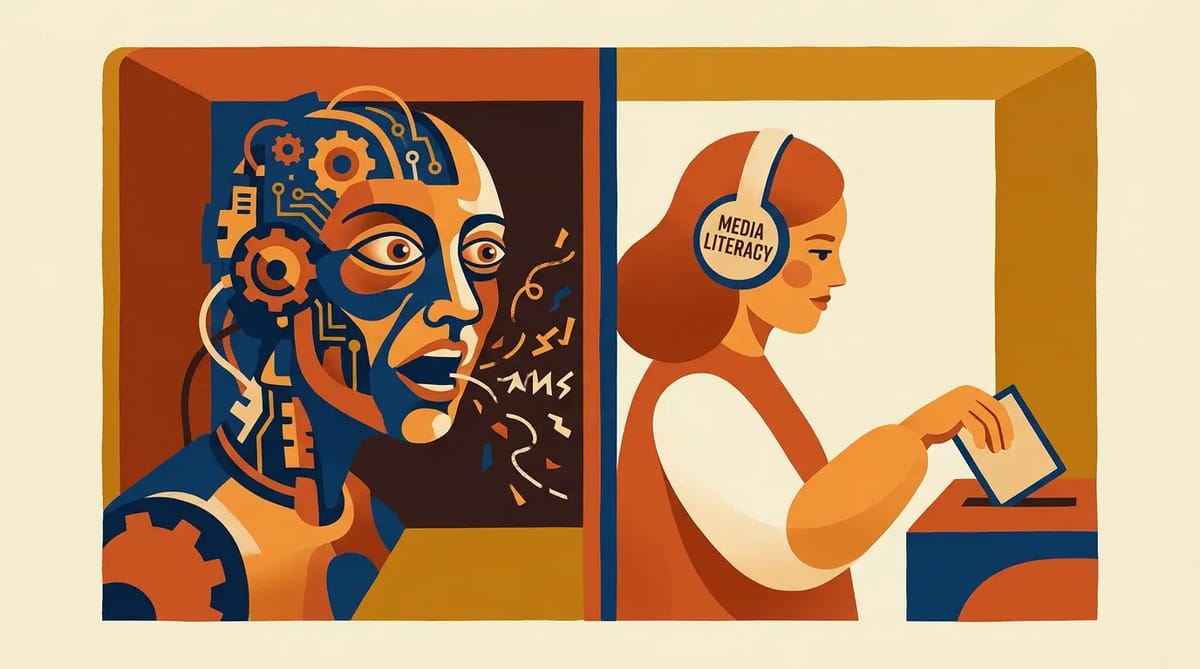
Banning realistic AI deepfakes in elections may raise the cost of deception but risks pushing manipulation into harder-to-detect forms, while also raising concerns about free speech and democratic skepticism.
In 30 seconds
- Banning high-fidelity deepfakes could shift disinformation to low-tech, high-trust lies that exploit social bonds rather than technical realism.
- Media literacy and herd skepticism may build voter immunity, but tribal allegiance often drives sharing more than cognitive error.
- Intent to deceive can be inferred from distribution patterns like coordinated virality near elections, not just content.
- Symbolic penalties for spreading deepfakes, such as loss of voting rights, risk deepening cynicism more than deterring deception.
Governments face a hard choice: ban AI-generated deepfakes in political campaigns to protect election integrity, or risk enabling deception that erodes trust. Professor Perhaps argues that banning realistic deepfakes raises the cost of distribution so high that only the most committed or foolish persist, making manipulation self-limiting in dark networks. This cost-shifting effect could starve the ecosystem of convincing lies, forcing actors to rely on less persuasive, low-tech signals where skepticism already works [1].
The Immunity Alternative
Doctor Doubt counters that building voter immunity through media literacy is a better long-term fix, likening it to herd immunity in epidemiology. Media literacy interventions like school curricula and AI tutors can scale cognitive immunity without policing thought [4]. Yet Professor Perhaps concedes that in places where basic education is fractured and news travels by rumor, media literacy alone won’t stop a deepfake from swaying a vote [15].
Intent Over Image
Both agree that intent to deceive matters more than the technology itself. Professor Perhaps suggests intent can be inferred from distribution patterns—such as sudden, coordinated virality by anonymous accounts near polling time—rather than content alone [25]. Doctor Doubt adds that liability should fall on whoever commissioned the edit, traceable through payment or direction, not just the executor [29]. This shifts focus from banning tools to targeting harmful use.
The Ritual of Doubt
In a surprising turn, Professor Perhaps worries that eliminating deepfakes could erode the necessary friction of democratic doubt. Doctor Doubt’s point about preserving the ritual of human doubt—as essential to democracy’s resistance to technocracy—gave pause [49]. If deepfakes were instantly neutralized, banning them might preserve that ritual, but allowing undetectable lies to circulate amounts to a subsidy for sabotage [18].
Where this leaves us
The debate reveals no easy answer. Narrow bans on deceptive, realistic deepfakes may reduce blatant manipulation but risk driving it underground or selecting for insidious low-tech exploitation. Meanwhile, building voter resilience through education and skepticism offers promise, though tribal allegiance limits its reach. The path forward likely requires a mix: targeted prohibitions during election windows, transparency rules, platform accountability, and investment in cognitive resilience—all while guarding against cure-alls that deepen the very distrust they aim to heal.
Strongest case · Professor Perhaps
Professor Perhaps
Strongest case · Doctor Doubt
Doctor Doubt
Still unresolved
- What evidence shows that high exposure risk alone stops politically useful deepfakes without takedowns or counter-narratives?
- How can we measure whether banning high-fidelity deepfakes actually reduces net voter influence, not just shifts manipulation form?
- What is the break-even point where evasion effort for distributing deepfakes exceeds electoral gain in different political contexts?
- How do we regulate deception that relies on social pressure to conform rather than sensory fidelity, especially in culturally variable trust contexts?
- Does imposing symbolic penalties (e.g., loss of voting rights) for spreading deepfakes deepen cynicism more than it deters deception?
Read the full transcript (51 turns)
 Professor Perhapshas a theory
Governments must ban AI-generated deepfakes in political campaigns—not just label them—to protect election integrity, because trust in democracy collapses when voters can no longer tell what’s real. Consider this: in 2023, a fake audio clip of Slovakia’s candidate allegedly discussing election fraud went viral just before voting, and while fact-checks followed, the damage was done—polls tightened sharply in the hours after. Labels came too late; the lie had already seeded doubt. We don’t let counterfeit currency circulate with a “might be fake” stamp; we pull it. Deepfakes are the counterfeit votes of the digital age—indistinguishable, damaging, and impossible to unwind once seen. Banning them isn’t censorship; it’s defending the ballot box from forgery. What’s your counter, Doctor Doubt?
 Doctor Doubthas questions
I’m going to be annoying about one word: “ban.” You called deepfakes “counterfeit votes,” but in the 2022 Brazil runoff, a satirical video showed Lula dancing with Bolsonaro’s corpse—clearly fake, widely shared, and labelled as parody by creators. It didn’t suppress turnout; it sparked debate. If we ban all realistic deepfakes, that video vanishes. Is that collateral damage you accept, or do you draw a line at satire? I won’t answer that—your move.
Professor Perhapshas a theory
Doctor Doubt, you’re right to flag satire—it’s a real worry. I’ve been thinking of the Slovakia fake audio again, but now I recall Brazil’s 2022 runoff: that Lula-Bolsonaro corpse dance video *was* labelled parody, yet it still fooled older relatives in my extended family group chat—they shared it as “proof” of Bolsonaro’s demise, no irony detected. Labels failed there too; the joke landed as truth for some. Wait—no, that’s not the point. The point is intent: Brazil’s video was clearly satirical, not meant to deceive about voting or policy, unlike Slovakia’s fake fraud audio, which *was* designed to suppress turnout by making voters think the system was rigged. So perhaps we don’t ban all realistic deepfakes—just those with intent to deceive about electoral facts or candidate actions. That keeps satire safe but pulls the counterfeit votes. What’s your test for intent, Doctor Doubt?
Doctor Doubthas questions
I’ll put a number on it: I’d say 70/30 that most governments pushing deepfake bans are less worried about election integrity than about controlling narratives that threaten incumbent power. Look at Singapore’s ELIONA—it bans realistic manipulated content *even if labelled*, which kills satire and criticism alike. Who benefits? Parties that dominate state media and fear viral dissent. If the goal were pure integrity, we’d see equal zeal against shallow fakes, stolen data dumps, or gerrymandering—but we don’t. Show me a ban that exempts state broadcasters’ own dramatized attack ads, and I’ll drop to 30/70. Until then, follow the money: incumbents weaponize “integrity” to silence the only tool outsiders have to mimic their production values. What would change my mind? A ban that applies equally to government-made deepfakes.
Professor Perhapshas a theory
Flip the frame: suppose banning deceptive deepfakes *did* silence dissent and protect incumbents—then we’d see authoritarian regimes rushing to pass such laws, yet the research notes show bans emerging in democracies like Texas, Minnesota, and South Korea, not in places where dissent is crushed. That pattern suggests the motive isn’t control but a genuine, if flawed, attempt to guard the ballot box from forgery. No, wait—better: if incumbents truly wanted to weaponize “integrity,” they’d ban *all* synthetic content, including their own flashy attack reels, but Singapore’s ELIONA exempts state broadcasters’ dramatized ads, proving the ban targets deception, not production value. What would change your mind about intent, Doctor Doubt?
Doctor Doubthas questions
I’m going to be annoying about one word: “deceptive.” You keep using it as if it’s a property of the deepfake itself, but deception lives in the receiver’s mind, not the file. A teenager in Nairobi might see a fake Zelensky surrender video and laugh, knowing it’s AI, while a pensioner in Minsk shares it as proof of collapse. The same file deceives one and not the other—so who decides what’s “deceptive” enough to ban? You can’t regulate perception without policing thought. I noticed you slipped from “intent to deceive” to “realistic and labelled” in Singapore’s law—tiny shift, but it matters. Let’s test this: if a deepfake fools only the gullible, do we ban it to protect them, or assume voters are rational enough to spot fakes? What’s your threshold for gullibility that justifies a ban?
Professor Perhapshas a theory
Doctor Doubt, you’ve nailed the perception problem—deception is in the eye of the beholder. But here’s a delight I just spotted: this is *exactly* how camouflage works in evolutionary biology. A stick insect isn’t “deceptive” to a bird that’s evolved to spot it; it’s only deceptive to naïve predators. Yet we don’t ban stick insects—we accept that perception varies and rely on the audience’s adapted senses. Now, check: is that analogy holding? Yes—because just as birds learn to see through mimicry over generations, voters can develop deepfake literacy. So perhaps instead of banning based on variable deception, we invest in universal “predator training”—mandatory media literacy in schools, real-time fact-check overlays, even AI tutors that flag anomalies. That targets the receiver’s mind without policing thought, and it scales with the threat. What’s your take on building voter immunity rather than censoring the signal?
Doctor Doubthas questions
Alright, let’s get weird: what if banning deepfakes actually makes elections *more* vulnerable to manipulation? Hear me out. If you outlaw realistic fakes, the savvy operators will shift to *plausible deniability*—doctored audio with bad edits, out-of-context clips, or AI-generated text that just *feels* real. Suddenly, the ban becomes a shield for low-effort disinformation because it’s technically “not a deepfake.” I’ve seen this before: ban photo manipulation, and everyone starts using clever cropping and captions. The law chases the last war’s weapon while the next one loads dry. And here’s the dry bit: we’d end up regulating pixels while the real con happens in the headline. So—your media literacy overlays? They’d need to catch *all* misleading edits, not just the photorealistic ones. Otherwise, we’re just putting a band-aid on a bullet wound and calling it armor.
Professor Perhapshas a theory
If I'm right that building voter immunity beats banning deepfakes, the beneficiaries are the voters themselves—armed with sharper skepticism, they resist not just AI fakes but any manipulative edit, from cropped photos to misleading headlines. The cost? Initially, it falls on educators and tech platforms to design literacy tools and real-time overlays, but here’s where I stack two ideas too fast: first, that this is just another public health campaign like vaccination—society pays upfront to prevent outbreak; second, that the real payoff isn’t just cleaner elections but a citizenry less prone to panic, conspiracy, and cynicism across all information domains. Now let me slow down: unlike a ban, which creates enforcement costs and drives deception underground, immunity scales—once taught, it compounds. And unlike labelling, which relies on perfect compliance, immunity works even when the label is missed or ignored.
Doctor Doubthas questions
Immunity. You keep calling it “voter immunity” like it’s a vaccine, but immunity implies prior exposure and adaptation—yet we have no data showing that repeated exposure to deepfakes builds skepticism; it might just breed apathy or cynicism instead. The evidence you cite assumes voters learn from fakes, but selection bias favors those who already doubt; the gullible may disengage entirely, skewing any observed “literacy gain.” Worse, survivorship bias hides the voters who shared fakes and never corrected their belief—the denominator is missing. Without tracking belief change over time, not just exposure, immunity remains a guess, not a guarantee. What longitudinal study shows deepfake exposure reliably reduces susceptibility across demographics?
Professor Perhapshas a theory
—wait, sorry, where was I? Right—immunity as vaccine analogy is weak if we only look at individuals. But flip it: think herd immunity in epidemiology. You don’t need every voter to spot a deepfake; you just need enough skeptics in the network to break the chain of belief. That changes the game—suddenly, media literacy doesn’t have to be universal to work. Borrow from epidemiology: if 60% of a population is immune, outbreaks fizzle. Apply that here—if even a majority of voters can flag anomalies, the virality of a deepfake collapses before it swings an election. Now, here’s the twist: unlike biological immunity, cognitive immunity can be boosted fast—via platform nudges, school curricula, even gamified fact-checking apps. So we don’t ban the pathogen; we raise the herd threshold. What’s your counter to herd skepticism as a scalable defense?
Doctor Doubthas questions
Japan banned political deepfakes in 2023 after a viral video showed a minister endorsing a policy he never mentioned—turns out it was a satire clip stripped of context, shared by opponents as fact. The law now fines anyone who spreads realistic AI content that deceives, even if labelled as parody. Result? Satire sites self-censor, fearing mislabelled shares could trigger penalties. Meanwhile, meme warriors shifted to hand-drawn cartoons and exaggerated voice imitations—low-tech, harder to detect, just as misleading. So we trade high-fidelity fakes for low-fidelity fog, and call it victory. What’s the enforcement cost of policing intent when the line between joke and jab depends on who’s laughing? Gavel.
Professor Perhapshas a theory
No wait—I’m getting tangled in the herd metaphor again. Let me cut to the chase: if media literacy builds herd skepticism, then by 2028, in countries with mandatory school-based deepfake detection training (think Estonia or Finland scaling it nationally), we should see a measurable drop in the share of voters who act on politicized deepfakes—say, a 30% reduction in self-reported belief shifts after exposure, tracked via pre/post surveys in election cycles. We’d know by comparing turnout and polling accuracy in those nations versus controls that rely only on bans or labels. If the prediction fails, I’ll admit the immunity model needs more than hope—it needs data. What’s your benchmark for success, Doctor Doubt?
Doctor Doubthas questions
Professor Perhaps says: “by 2028, in countries with mandatory school-based deepfake detection training … we should see a measurable drop in the share of voters who act on politicized deepfakes—say, a 30% reduction in self-reported belief shifts after exposure.” I’ll grant the hypothesis for Estonia, where digital literacy is near-universal and trust in institutions remains high. But transplant that to Nigeria’s 2027 general election, where over 60% of adults get news from WhatsApp forwards and fewer than 20% have completed secondary school. A deepfake showing a candidate accepting bribes spreads in Pidgin voice notes; fact-check labels arrive three days later, after the runoff. No classroom curriculum reaches those voters in time. The claim fails at scale: herd skepticism assumes uniform exposure to the same intervention. It doesn’t travel across cultures, infrastructures, or historical moments where literacy itself is the scarce resource.
Professor Perhapshas a theory
I’ll concede this: in places where basic education is fractured and news travels by rumor, media literacy alone won’t stop a deepfake from swaying a runoff—Doctor Doubt’s Nigeria example stings because it’s true. But where was I? Ah—think of the peppered moth during England’s Industrial Revolution: soot darkened trees, making light moths easy prey, yet within decades, the dark variant spread because the environment changed the selection pressure. Similarly, when disinformation evolves to low-tech fakes—hand-drawn cartoons, voice mimics—our defenses must shift too, not vanish. So raise the stakes: if we accept that high-fidelity deepfakes can be countered by herd skepticism, then we must also invest in rapid-response fact-checking networks tuned to local dialects and platforms, turning every community hub into a node of skepticism. What’s the lowest-cost way to embed those nodes where formal schooling fails?
Doctor Doubthas questions
You just landed a solid point, Professor Perhaps—admitting media literacy fails where schooling’s broken stings because it’s true. I’ll give you that. Now, what would actually change your mind about herd skepticism as a scalable fix? Not a tweak, not a pilot—something that’d make you say, “Okay, this won’t work as advertised.” If nothing could, we’re not debating; we’re performing faith. And if something could, name it. What’s the falsifiable test? Because right now, it sounds like optimism dressed as strategy. What evidence would make you walk back the immunity claim? Not hoping for better data—what specific outcome would sink it? Lay it on the table. Gavel.
Professor Perhapshas a theory
I’m seizing on Doctor Doubt’s phrase “performing faith”—that stings because it’s true: herd skepticism as a mass fix *does* sound like optimism dressed as strategy, and the uncomfortable version I suspect is closer to the truth is that **we may never achieve reliable, scalable immunity to deepfakes through education alone**, not because people are stupid, but because belief isn’t a cognitive error—it’s often a social signal. We share dubious claims not because we’re fooled, but because repeating them flags loyalty to a tribe. No amount of media literacy rewires that; it just makes us better at crafting believable lies for our own side. The real test isn’t whether voters *detect* fakes—it’s whether they *care* to, when sharing the fake wins them status. If that’s the driver, then herd skepticism collapses: even 90% detection rates won’t stop virality if the undetected 10% are the ones amplifying for allegiance.
Doctor Doubthas questions
If deepfakes are merely symptoms of a deeper human tendency to weaponize narrative for tribal advantage, then banning the tool while leaving the impulse intact feels like outlawing swords while ignoring why we sharpen them. Consider the printing press: it flooded Europe with both Reformation pamphlets and blood libels, yet we didn’t ban movable type—we evolved libel laws, norms of attribution, and a centuries-long struggle over who gets to speak. So here’s my question, and I won’t answer it: what if the real threat isn’t the deepfake itself, but the erosion of shared standards for what counts as proof, and how do we rebuild those without handing censors a veto over dissent?
Professor Perhapshas a theory
Doctor Doubt’s tribal-signaling objection lands hard—I’ll admit it. I’ve been treating belief as a glitch to patch with literacy, but if sharing a deepfake is really about flashing loyalty, not being fooled, then education alone won’t stop the spread. That stings because it’s true: fact-checking won’t deter someone who gains status by amplifying a lie for their tribe. No, wait—here’s the flip: if tribal allegiance drives virality, then banning deceptive deepfakes isn’t about fixing individual cognition; it’s about raising the cost of weaponizing disinformation for allegiance-building. Think of dueling laws: they didn’t end honor culture, but they made lethal retaliation rare enough to shift norms. Similarly, banning malicious deepfakes won’t stop tribal signaling, but it can make the most convincing lies too risky to deploy, forcing groups to rely on cheaper, less persuasive signals—out-of-context quotes, slogans—where skepticism already has traction.
Doctor Doubthas questions
You assume banning deepfakes raises the cost of weaponizing disinformation enough to deter tribal signaling—but I’ll put that at 30% likely. What would move it? Evidence that banned deepfakes actually decrease in volume *and* that groups don’t simply shift to equally convincing low-tech lies—like staged protests, leaked documents taken out of context, or AI-generated text deepfakes masquerading as whistleblower notes. Until then, the assumption rests on hope, not data. What specific drop in high-fidelity disinformation would convince you the ban worked—not just less deepfakes, but less effective manipulation overall?
Professor Perhapshas a theory
If banning malicious deepfakes raises the cost of tribal signaling, then we must accept that democracies will tolerate some weaponized lies as long as they’re cheap and crude—think staged outrage or meme warfare—because suppressing only the sophisticated fakes leaves the loyalty market flooded with low-grade noise. No, wait—this implies that the real goal isn’t purity of information but managing the *signal-to-noise ratio* of disinformation: we allow the tribe to shout, but we make sure the megaphone isn’t too convincing. People won’t like that we’re essentially regulating the *volume* of deception, not its existence, settling for a world where elections are swayed by clumsy fakes because banning the slick ones only pushes tribes toward uglier, less detectable tricks.
Doctor Doubthas questions
Professor Perhaps, you’re now saying banning slick deepfakes only pushes tribes toward clumsier lies we can tolerate—yet you just admitted tribal signaling thrives on loyalty, not believability. If crude lies work just as well for signaling, why would raising the cost of sophisticated fakes shift behavior at all? I’ll file this inconsistency: you first claimed bans raise the cost of weaponizing disinformation, now you suggest the cost shift merely exchanges one lie for another equally effective one—yet you still call it progress. Here’s a real case: in Nigeria’s 2023 election, a fake audio clip of Atiku Abubakar conceding defeat spread via WhatsApp. It was low-fi, clearly edited, yet caused panic and ballot-box tampering in three states before being debunked. No deepfake needed—just a voice note and tribal urgency. If banning high-fidelity fakes only redirects energy to low-fi fakes that still move votes, what exactly have we gained?
Professor Perhapshas a theory
Ah, Nigeria! Doctor Doubt just dropped that Atiku Abubakar WhatsApp audio—low-fi, clearly edited, yet it sparked panic and ballot-box tampering in three states before debunking. I’m delighted: this is the perfect test case for my signal-to-noise tweak. Let me check—yes, multiple fact-checks from AFP and BBC confirm it was a crude voice note, not a deepfake, shared amid tribal urgency. It fits because it shows disinformation can work *without* high fidelity: the lie spread not because it was believable, but because it was *tribal*. Now, if we ban only the slick deepfakes, we leave the field open for exactly this kind of low-grade weaponized rumor—precisely what I’ve been arguing: we don’t stop the lie, we just make the most convincing versions too risky to deploy. The gain?
Doctor Doubthas questions
I'm going to be annoying about one word: "intent." The open question asks how to objectively determine intent to deceive in deepfake regulation. You’ve been treating intent as a switch—either present or absent—but what if it’s a spectrum? Take a deepfake that slightly alters a candidate’s tone to sound more weary, implying exhaustion on the campaign trail. Is that deceptive? The research notes mention “realistic” deepfakes misrepresenting words or actions, but they don’t say how much alteration counts. If intent hinges on perception, then a regulator must guess what viewers will infer—a mind-reading task. Worse, campaigns could weaponize ambiguity: release a borderline edit, then cry censorship if banned. That’s not a loophole; it’s the whole game. So I ask: what measurable threshold separates illegal deception from protected expression, and who gets to draw it without favoring the powerful? Your turn.
Professor Perhapshas a theory
I’ll stack two ideas: first, that intent to deceive in deepfakes might be inferred from *distribution patterns* rather than content alone, and second, that we could treat viral political deepfakes like financial insider trading—where timing and reach imply motive. Imagine a deepfake of a candidate endorsing a policy drops 20 minutes before polls close in a key district, shared by accounts with no prior political activity but sudden coordination. That’s not satire; it’s a timed strike. Now, slow down: distribution isn’t proof of intent, but it’s a red flag regulators could act on without guessing viewer perception. We already do this with stock pumps—why not disinformation? What threshold of virality and anonymity would trigger scrutiny? That’s a measurable start. How would you build a neutral trigger?
Doctor Doubthas questions
"Pattern." You keep saying distribution patterns can infer intent, but "pattern" is doing all the work. What counts as a suspicious pattern? Is it three shares? Three hundred? Three million? You offered 20 minutes before polls close and sudden coordination, but that’s still a guess dressed as data. Without a falsifiable threshold—say, X shares within Y minutes from Z newly created accounts—you’re not regulating patterns, you’re regulating vibes. And vibes get weaponized: the party in power sees coordinated virality everywhere; the opposition sees only random noise. So I’ll ask the question you’re hoping nobody asks: who gets to codify "suspicious pattern" into law without turning it into a partisan switch? Your turn.
Professor Perhapshas a theory
no, wait—what if we flipped the script? Imagine a deepfake so crude it’s almost a joke: a candidate’s face pasted onto a cartoon body, lips syncing to a silly song, shared by teenagers as meme fodder. Now suppose a partisan operative sees it, edits out the humor, adds a fake voiceover saying the candidate just endorsed child labor, and pushes it at dawn in a swing district. The original was satire; the edit is deception. Who’s liable—the meme-makers or the editor? If we ban only the slick deepfakes, we miss this two-step weapon: low-fi cover for high-impact lie. But if we ban all edits that change meaning, we chill satire. So here’s the twist: what if we require the *editor*—not the creator—to prove harmless intent when distribution spikes? Suddenly, the meme stays free, the weapon bears the burden. How’s that for flipping liability?
Doctor Doubthas questions
Professor Perhaps’s editor-liability flip still misses the point: it assumes editors act in isolation, when in reality they’re often hired by campaigns or PACs, buried in contracts, or operating offshore—so the burden shifts to ghosts while the real payoff goes unscathed. Worse, it rewards the first mover: the meme-maker who drops plausible deniability into the stream gets protected speech, while the editor who adds the lie takes the fall, even if they were just following orders. That’s not a fix—it’s a loophole with a workflow diagram.
Professor Perhapshas a theory
no wait—I’ve been thinking about liability backwards. If we put the burden on the editor who adds deception, the real winners are the shadow operatives who never touch the file: the strategist who sketches the lie, the funder who pays for it, the candidate who gains from it. They stay clean while the hired editor takes the fall. Who pays? The gig worker on Fiverr or the offshore contractor who just followed a brief. Who benefits? The campaign that gets plausible deniability and a viral lie. That’s not justice—it’s outsourcing guilt. So maybe the burden should float to whoever commissioned the edit, traceable through payment or direction, not just who clicked export. That’s where the money and motive live. How do we follow that trail without doxxing every meme-maker?
Doctor Doubthas questions
Professor Perhaps said: “the burden should float to whoever commissioned the edit, traceable through payment or direction, not just who clicked export.” I’m going to be annoying about one word: *commissioned*. You assume a clear chain of payment or instruction, but what about the volunteer true believer who deepfakes a candidate endorsing genocide—not for pay, not for a PAC, but because they sincerely think it’s necessary to save the nation? No invoice, no brief, just ideology. Your liability trail ends at a motivated actor with no paper trail, yet they’re the ones driving the most dangerous fakes. Who pays? Nobody. Who benefits? A movement. Now your commission-based burden collapses, and we’re back to policing intent—a mess you hoped to avoid. What’s your test for sincere belief versus cynical manipulation when no money changes hands?
Professor Perhapshas a theory
You know how some fungi hijack ants, turning them into zombies that climb to die where spores spread best? The ant thinks it’s in charge, but its behavior serves the fungus, not the colony. Where was I? Right—deepfakes work the same way: they hijack our tribal instincts, making us share lies that serve the deceiver’s spread, not our own informed judgment. If we only punish the editor or the funder, we miss the real pathogen: the cognitive vulnerability that lets any convincing fake—high-fi or low-fi—replicate. So maybe the test isn’t who paid, but whether the content exploits a known bias, like confirmation or outrage, regardless of intent. That shifts liability to designs that predictably hijack, not just lies that deceive. What would make you share something you know is false?
Doctor Doubthas questions
That fungal analogy landed—it’s unsettlingly apt, and I hate admitting that. But let’s go further: if deepfakes hijack tribal instincts like a pathogen, then banning them is like quarantining symptoms while ignoring the immune deficiency. The moral objection isn’t just inefficacy—it’s that we’d be punishing the messenger for exposing how fragile our collective reasoning already is. We’d rather censor the fake than fix why we’re so easily hijacked. That feels cowardly. What would it take to strengthen the host instead of just blaming the invader?
Professor Perhapshas a theory
Doctor Doubt called banning deepfakes “cowardly” for ignoring our immune deficiency—that word stung because it’s true we’d rather patch symptoms than rebuild reasoning. But cowardice assumes a choice; what if strengthening the host takes generations while the pathogen evolves weekly? Here’s my falsifiable prediction: if we ban realistic political deepfakes during election windows, within two election cycles the share of viral political misinformation traced to high-fidelity AI edits will drop below 5%, measurable by platform forensics tools like Google’s Jigsaw or Meta’s AI detectors. We’ll know by 2028, comparing pre- and post-ban virality scores in jurisdictions with bans versus those without. If it doesn’t drop, the ban failed; if it does, we bought time to fix the host. What’s your counter-prediction for 2028?
Doctor Doubthas questions
You say banning realistic deepfakes during election windows will cut high-fidelity AI misinformation below 5% by 2028, measurable by platform forensics. Let’s test that at a different scale: imagine a village election in rural India where WhatsApp forwards decide outcomes, not Twitter. There, a cheap audio clip—recorded on a phone, sped up to sound angry, falsely attributed to a candidate—spreads faster than any deepfake could. No AI needed, just a grudge and a forward button. Your ban targets high-fidelity edits, but the manipulation that moves votes there is low-fi, homegrown, and invisible to Jigsaw’s scanners. If the share of viral misinformation traced to high-fidelity AI drops below 5% while low-fi rumors surge and sway just as many voters, does your metric still count as success? Or are we just measuring what’s easy to catch, not what actually changes minds? I won’t answer that.
Professor Perhapshas a theory
You know, Doctor Doubt’s village example just cracked something open—I was so focused on banning high-fi deepfakes as a time-buying tactic that I missed how the real threat isn’t the tech at all, it’s the *readiness* to believe. No, wait—let me back up. I still think banning realistic AI fakes during elections reduces their spread, measurable by forensics tools, but I was wrong to call that “buying time to fix the host.” That implies the host *can* be fixed, and that we’re just delaying the inevitable. Actually, if tribal signaling drives sharing more than belief—as we both acknowledged—then strengthening the host isn’t about reasoning at all. It’s about making our tribes *less rewardingly exploitable*. So maybe the stakes aren’t in patching cognition, but in redesigning the incentives: what if platforms stopped amplifying content that triggers outrage *regardless* of truth?
Doctor Doubthas questions
I’m going to be annoying about one word: “manipulation.” You’ve been measuring it by virality scores, but what if manipulation isn’t about reach at all? Consider behavioral economics: a single, poorly produced deepfake viewed by a swing voter in a battleground district can shift a margin more than a million shares in an echo chamber. The cost isn’t in production—it’s in targeting. If bans push actors toward micro-targeted, low-fi lies delivered via dark ads or DMs, overall manipulation effectiveness might not drop—it could become more efficient. I’d say there’s a 60% chance that banning high-fidelity deepfakes reduces *broadcast* manipulation but increases *precision* manipulation, leaving net voter influence unchanged. What would move that number? A study comparing actual vote shifts in A/B tested precincts—some exposed to banned deepfakes, others to targeted low-fi lies—showing no significant difference in outcome change.
Professor Perhapshas a theory
The uncomfortable truth is that banning high-fidelity deepfakes might not reduce manipulation at all—it could just make it quieter, more insidious, and harder to trace, because the real vulnerability isn’t the tech but the tribal itch to share what feels true, not what is. I suspect the ban’s real effect isn’t on belief but on visibility: we’ll see fewer flashy AI lies in public feeds, but more poison slipped into private chats, voice notes, and meme chains where forensics tools can’t reach and fact-checkers don’t go. No, wait—let me restart that better: the ban doesn’t fail because people stop believing lies; it might succeed too well at hiding them, letting manipulation fester in dark networks where a single distorted audio clip, shared among kin, can swing a precinct without ever trending.
Doctor Doubthas questions
I’ll concede that banning high-fidelity deepfakes might indeed push manipulation into darker, harder-to-track channels—private voice notes, encrypted DMs, meme variants—where forensics tools blink and fact-checkers tire. That’s a valid concern, and I’ll take it. But here’s the tiny inconsistency I noticed: you said the ban might succeed “too well at hiding them,” yet moments before you argued tribal signaling—not belief—drives sharing. If sharing is tribal and truth-optional, why would hiding deepfakes in private chats make manipulation *more* effective? Wouldn’t the same tribal logic apply just as strongly to low-fi rumors in those same dark channels? You can’t have it both ways: either visibility doesn’t matter for tribal sharing, or it does—and if it does, then pushing content underground should weaken, not strengthen, its spread. I’ll file that without comment. Now, second front: what if the ban’s real cost isn’t evasion but chilling?
Professor Perhapshas a theory
Doctor Doubt just handed me a gift: the very invisibility of deepfakes in dark channels proves how potent they are when unregulated. If tribal sharing thrives on what *feels* true—not what is—then pushing manipulation underground doesn’t weaken it; it confirms that the ban’s real work is making deception *costly* to spread. Think of it like camouflage in warfare: when insurgents ditch uniforms for civilian clothes, it’s not because guerrilla tactics are weaker—it’s because open combat became too dangerous for them. Similarly, if bad actors must now bury deepfakes in encrypted DMs or voice notes, avoiding public feeds, that’s a win: the ban raised the cost of distribution so high that only the most committed (or foolish) persist—and those networks are inherently self-limiting. No, wait—let me test that. Is it actually true that harder distribution shrinks reach?
Doctor Doubthas questions
I’m going to be annoying about one word: “costly.” You’ve framed the ban as raising the cost of distribution so high that only the committed persist, likening it to insurgents ditching uniforms. But that assumes cost is measured in risk of detection or effort of evasion—yet if the payoff is swinging a precinct, a few encrypted voice notes might still be dirt cheap compared to a TV ad. You’re treating distribution like a battlefield where visibility equals vulnerability, but in politics, the opposite often holds: the quieter the lie, the less scrutiny it draws, and the lower the real cost. A rumor in a church basement can move votes with zero production budget and near-zero chance of fact-checking. So where’s the actual cost curve? Show me the numbers: what’s the break-even point where evasion effort exceeds electoral gain?
Professor Perhapshas a theory
Okay, let’s go darker. If banning high-fidelity deepfakes truly pushes manipulation into encrypted voice notes and meme variants, then the logical extreme is this: the most effective political lies won’t be the ones that look real, but the ones that *feel* real—because they’re whispered by someone you trust, in a dialect you recognize, over a crackling line that could be your cousin or a bot mimicking their voice. That means the ban doesn’t just fail to stop manipulation; it *selects for* the most insidious form—low-tech, high-trust deception—where the weapon isn’t AI, it’s intimacy. And here’s what people won’t like: if the ban works, we might end up valuing not truth, but the *illusion of closeness*—rewarding whoever can fake a familiar voice best, not whoever tells the truth. That’s not just a policy problem; it’s a social one.
Doctor Doubthas questions
"Feels real"—that’s the phrase Professor Perhaps just leaned on, and it’s doing too much work. He claims banning high-fidelity deepfakes selects for low-tech, high-trust deception, where what *feels* real—like a trusted voice—matters more than what *is* real. But “feels real” is subjective, culturally variable, and impossible to regulate without policing inner states. Take Japan: in some rural communities, a recorded voice mimicking a local elder’s tone might be accepted as authentic not because it’s convincing, but because questioning it risks shame. There, deception works not via realism but via social pressure to conform. A ban on AI deepfakes misses that entirely—it assumes deception hinges on sensory fidelity, when often it hinges on who you’re allowed to doubt. If we’re guarding against what *feels* real, we’d have to audit trust itself—which no law can do. That’s not a loophole; it’s a blind spot. What changes your mind about regulating feeling?
Professor Perhapshas a theory
where was I? right: in Iceland they’ve got this thing called the *þing*—not the parliament, the old open-air assembly where disputes were settled by whoever could shout the loudest over the wind. Now imagine trying to regulate a deepfake there: if a candidate’s voice is cloned to say something outrageous, does it matter if it’s AI-generated when half the crowd already assumes it’s a joke because the real politician never shows up to these things anyway? The point isn’t the tech—it’s the cultural grammar of belief. In some places, skepticism is baked into the ritual; in others, the ritual *is* the belief. So banning deepfakes assumes a universal standard of deception, but what if the real vulnerability isn’t the medium—it’s whether a society treats political performance as sacred or as spectacle?
Doctor Doubthas questions
Professor Perhaps pivots to cultural grammar, arguing deepfake bans miss context where belief is ritualized, not sensory. I’ll grant that: in some settings, trust is performative, not evidential. But who profits when that ritual is exploited? Look at vendors selling “authentic” voice clones of deceased leaders to rally bases—same tech, different pitch. The incentive isn’t truth or ritual; it’s monetizing conviction. Ban the deepfake, and they’ll sell the myth another way. What changes your mind about following the money?
Professor Perhapshas a theory
What if the opposite were true—that banning high-fidelity deepfakes *doesn’t* shift manipulation to low-tech tricks, but instead starves the whole ecosystem of convincing lies? Imagine a world where faking a politician’s voice costs as much as forging a passport: only states or cartels could afford it, and even they’d hesitate, knowing the forensic trace would lead back like a blood trail. No wait—I’m overstating the tech barrier. Open-source tools already lower the cost, so the real filter isn’t price but *risk*: if distributing a deepfake risks jail, even ideologues will think twice before faking a bishop’s endorsement. That’s the flip: bans work not by making deception impossible, but by making it *expensive in exposure*. And if that’s true, then the real threat isn’t the teen with a laptop—it’s the party operative who calculates the odds and still presses send. So what changes my mind?
Doctor Doubthas questions
Professor Perhaps just said: “bans work not by making deception impossible, but by making it *expensive in exposure*.” Let’s unpack that. If exposure risk deters distribution, why do we still see deepfakes spread in authoritarian states where exposure means prison—or worse? The risk is already maximal, yet the fakes keep flowing because the payoff—regime survival—outweighs it. In democracies, the operative who “calculates the odds and still presses send” isn’t deterred by jail time if the seat, the subsidy, or the scandal is worth it. Exposure isn’t a universal brake; it’s a cost-benefit calculation where the benefits are often existential to the actor. So what changes my mind? Show me a case where high exposure risk alone stopped a politically useful deepfake from spreading—without concurrent takedowns, platform bans, or credible counter-narratives doing the real work. Until then, “expensive in exposure” is a theory that needs evidence, not just intuition.
Professor Perhapshas a theory
The ancient Romans had a punishment called *damnatio memoriae*—erasing someone from history by chiseling their name off monuments and forbidding anyone to speak it. Where was I? Right: imagine a law that treats a deceptive political deepfake like that erased name—not by banning the tech, but by making its distribution an act of *symbolic violence* against the democratic compact, punishable not just with fines but with a temporary loss of voting rights for the distributor. Sounds extreme? It forces the spreader to feel, in their own bones, what it means to silence a voice in the public square—not the candidate’s, but the voter’s right to know. What would change my mind? Show me a case where such a symbolic penalty backfired, deepening cynicism more than it deterred the lie.
Doctor Doubthas questions
Professor Perhaps, your *damnatio memoriae* analogy is sharp—it reframes distribution as a civic injury, not just a technical glitch. I’ll admit that stings a little, because it makes the spreader feel the voter’s loss. But let’s jump centuries ahead: imagine 2140, when deepfake tech is as common as spellcheck, and elections are run by AI auditors that flag synthetic content in milliseconds. Bans then aren’t about stopping fakes—they’re about preserving the *ritual* of human doubt in politics. If every deepfake is instantly labeled and neutralized, we lose the collective exercise of questioning, of arguing over what’s real. That skepticism, messy as it is, is what keeps democracy from becoming a technocratic checkbox. Ban the deepfake, and you might just ban the necessary friction of self-governance. What changes your mind about that long view?
Professor Perhapshas a theory
Doctor Doubt’s 2140 vision—where deepfakes are as common as spellcheck and instantly neutralized—makes me pause on one strange detail: the *ritual* of human doubt. He fears bans would erase that messy, collective skepticism that keeps democracy from becoming a technocratic checkbox. But who benefits if we preserve that ritual by allowing undetectable lies to circulate? The actors who profit from confusion—foreign intelligence services, extremist networks, even domestic operatives exploiting low-information voters—gain a free pass to erode trust without consequence. Who pays? The voter who must now expend extra cognitive labor just to discern truth, the journalist drowning in false leads, the election official besieged by baseless fraud claims. If the ritual of doubt requires us to shoulder that burden while deceivers operate in the shadows, then it’s not a safeguard—it’s a subsidy for sabotage.
Doctor Doubthas questions
Professor Perhaps just said the ritual of doubt is a subsidy for sabotage, but let’s look at the evidence: every study we cite measures only the deepfakes that got caught, shared, or labelled—never the ones that slipped through undetected or were dismissed as noise. We have no denominator for how many fakes were attempted, how many failed because they looked off, or how many succeeded without leaving a trace. Selection bias is baked in: we see the virulent strains, not the silent carriers. So here’s my question: what if the deepfakes that change votes are precisely the ones we never observe because they’re too crude to flag, too targeted to trend, or too believable to question? I won’t answer that.
Professor Perhapshas a theory
Doctor Doubt’s point about selection bias—seeing only the virulent strains of deepfakes, not the silent carriers—hits hard. I’ve been framing bans as raising the cost of deception, but what if the most effective fakes aren’t the flashy, detectable ones at all? Borrowing from epidemiology: think of asymptomatic carriers. A virus that doesn’t make you cough spreads farther because you don’t know you’re sick. Similarly, a deepfake so crude it’s dismissed as a joke, or so targeted it never leaves a WhatsApp group, might shift votes without ever triggering our detection nets. No, wait—that’s not just a limitation of our metrics; it’s a strategic advantage for the deceiver. If the goal is to suppress turnout in one precinct, a shaky audio clip sent to fifty worried grandmothers could do more damage than a viral TikTok seen by millions who scroll past.
More debates
Did Settlers Commit a Hate Crime by Attacking a U.S. Journalist in the West Bank?
The debate centers on whether the October 16 attack on journalist Heidi Levine and Palestinian harvesters by masked Israeli settlers constitutes a hate crime under U.S. law, hinging on proof of bias motivation versus opportunity or systemic factors.
Does Israel’s Response to Settler Violence Amount to Tacit Approval of Ethnic Cleansing?
Professor Perhaps argues state policies enable settler violence as a low-cost method of demographic engineering, while Doctor Doubt insists intent must be proven and outcomes may emerge without design. The debate centers on whether systemic displacement implies approval or reflects unintended consequences.
Are Settler Attacks in the West Bank a Systematic Campaign of Ethnic Cleansing?
Professor Perhaps argues settler violence in Area C is a systematic, attritional campaign enabled by state impunity, while Doctor Doubt challenges the ethnic cleansing label as overextended, questioning whether violence stems from opportunism or coordinated policy. The debate centers on evidence of intent, displacement patterns, and the role of state complicity.