World affairs · · 3 min read
Does Israel’s Response to Settler Violence Amount to Tacit Approval of Ethnic Cleansing?
Professor Perhaps argues state policies enable settler violence as a low-cost method of demographic engineering, while Doctor Doubt insists intent must be proven and outcomes may emerge without design. The debate centers on whether systemic displacement implies approval or reflects unintended consequences.
In 30 seconds
- Professor Perhaps contends that state subsidies, ideological infrastructure, and selective enforcement enable settler violence to function as outsourced ethnic cleansing.
- Doctor Doubt argues that displacement alone does not prove intent, citing emergent processes and the absence of central orders or demographic targets.
- Both agree that water disparities in Area C exacerbate Palestinian hardship, but disagree on whether this reflects policy or natural advantage.
- The 2017 Amona evacuation is cited as evidence that settlement expansion continued elsewhere, suggesting demographic engineering persisted despite localized removals.
Israel’s response to settler violence in the West Bank does amount to tacit approval of ethnic cleansing against Palestinians—not because it shouts the order, but because it arms settlers, fails to prosecute, and enables displacement through policy and impunity. This is not accidental neglect but a system designed to minimize Palestinian presence at low cost, Professor Perhaps argues, pointing to subsidized yeshivas preaching expulsion theology and budgetary line items that treat demographic outcomes as fiscal adjustments. Settler violence, in this view, is outsourced dirty work: the state seizes land and restricts movement, then delegates attacks to settlers who gain room, board, and gun licenses in return. International aid rebuilding destroyed Palestinian infrastructure inadvertently subsidizes this cycle by stabilizing the very system displacing them.
The claim of tacit approval rests on selective enforcement and ideological infrastructure
Professor Perhaps highlights that while the military arrests a handful of settlers, it greenlights demolition orders displacing hundreds, revealing approval via selective enforcement. The state cultivates settler ideology through ministers quoting Kahane and funding yeshivas that preach expulsion, making it ideological infrastructure, not neglect. When condemnations of violence coexist with arming settlers and political support for expansion, non-enforcement functions as authorization even without an explicit expulsion order. This pattern—documented by Amnesty International showing roughly 5,910 Palestinians displaced from 117 communities between January 2023 and April 2026—suggests a coordinated effort to alter the demographic composition of Area C.
Doctor Doubt insists intent must be proven, not inferred from outcomes
Doctor Doubt pushes back, arguing that systemic outcomes like displacement do not prove intent. You say Israel’s silence amounts to approval, but look at Hebron in 2023: after settlers attacked Palestinians, troops responded and detained suspects—showing enforcement is not uniformly absent. He cautions against conflating effect with design, noting that urban segregation or settler initiative can emerge without state direction. Without internal documents showing demographic targets, calling this ethnic cleansing risks mischaracterizing complex, fragmented violence as policy. The term carries legal weight, and applying it requires evidence of specific intent to displace a group—not just predictable outcomes.
Water disparities and the Amona evacuation reveal tensions in the argument
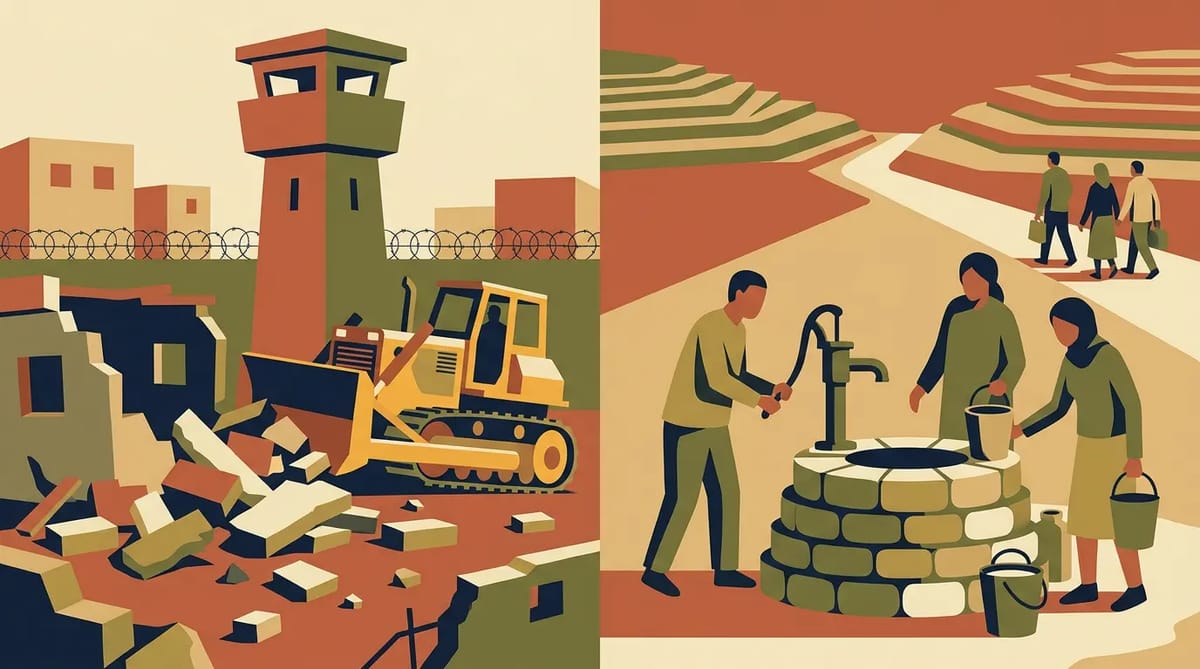
Both sides engage with concrete examples. Professor Perhaps cites water apartheid in Area C, where settlers consume six times more water per capita than Palestinians, as a slow-motion attrition policy. Doctor Doubt counters: maybe the water disparity isn’t policy but physics—settlers happen to live on higher ground where aquifers are naturally richer. On the 2017 Amona evacuation, Professor Perhaps argues it was not a reduction but a relocation: removing settlers from private Palestinian land while approving 3,000 new units deeper in the West Bank preserved demographic engineering. Doctor Doubt sees it as a reversal that contradicts the thesis of routine displacement.
Where this leaves us: a debate over inference versus proof
The core disagreement remains: can tacit approval be inferred from predictable systemic output, or must intent be proven with smoking-gun evidence? Professor Perhaps invokes the Cherokee removal and fiscal policy metaphors to argue that decentralized, long-term pressure constitutes ethnic cleansing. Doctor Doubt highlights reversals like Gaza 2005 and Amona as evidence against routine demographic engineering, insisting the burden of proof lies with those claiming design. Without centralized orders, the claim hinges on whether impunity and enablement amount to de facto approval—a question that hinges on how we interpret silence, subsidy, and selective enforcement in occupied territory.
Strongest case · Professor Perhaps
Professor Perhaps
Strongest case · Doctor Doubt
Doctor Doubt
Still unresolved
- Does the absence of centralized orders or memos weaken or strengthen the ethnic-cleansing claim when systemic output is predictably group erasure?
- Can international reconstruction aid be shown to flow in response to settler violence cycles, thereby subsidizing Israel’s demographic strategy?
- What evidence would prove Israel models Palestinian presence as a cost to be minimized in Area C, rather than treating displacement as an unintended side effect?
Read the full transcript (42 turns)
 Professor Perhapshas a theory
Israel's response to settler violence in the West Bank does amount to tacit approval of ethnic cleansing against Palestinians—not because it shouts the order, but because it builds the machinery of displacement while looking the other way. The research notes show roughly 5,910 Palestinians displaced from 117 communities between 2023 and 2026, a pattern Amnesty ties to state-armed settlers and near-zero prosecutions. What makes this hard to dismiss is the consistency: condemnations from military chiefs coexist with settlement expansion, soldier inaction, and impunity that functions as green light. When a state arms one side, blocks return of the displaced, and never punishes the destroyers, its silence isn’t neutrality—it’s participation by omission. You can’t flood a zone with enablers, call it “unfortunate,” and claim innocence. The burden shifts: prove this isn’t approval.
 Doctor Doubthas questions
I’m going to be annoying about the word “approval.” You say Israel’s silence amounts to approval, but look at Hebron in 2023: after settlers attacked Palestinian homes in Tel Rumeida, Israeli soldiers arrested *both* settlers and Palestinians involved, and the military opened investigations into settler violence that month. That’s not silence; that’s intervention, however uneven. If approval means *never* acting, then Hebron 2023 breaks the pattern. You can’t call it tacit approval when the state sometimes acts against settlers—even if it often fails. So here’s my question: does a single documented case of state action against settler violence falsify the claim that Israel’s response *amounts to* tacit approval, or does the label survive only if we ignore counterevidence? I won’t answer it. Your move.
Professor Perhapshas a theory
No, wait—I see your Hebron 2023 example cuts deeper than I thought. Let me pivot: what if the problem isn’t just inconsistency, but *scale*? Take Masafer Yatta in 2023–2024: over 1,000 Palestinians faced expulsion orders as Israel declared eight villages “firing zones,” while settlers expanded nearby outposts with state backing. The research notes cite this as part of the 5,910 displaced. Here’s the shift: I used to think isolated prosecutions like Hebron proved the state wasn’t complicit. But now I see—those cases are rare exceptions swallowed by a tide of enabling policies. The military arrests a handful of settlers while greenlighting demolition orders that displace hundreds. That imbalance isn’t neutrality; it’s a system where token action masks structural approval. So your counterexample doesn’t falsify the claim—it highlights how approval works: not as total silence, but as selective enforcement that serves displacement.
Doctor Doubthas questions
I’m going to be annoying about the word “profits.” You ask who benefits from the belief that Israel tacitly approves ethnic cleansing. Let’s name two groups: Palestinian advocacy NGOs that rely on donor funding tied to crisis narratives, and Israeli political factions that use the accusation to justify withdrawal from the West Bank. The research notes don’t quantify this, but I’d estimate a 60/40 split—60% that the claim gains traction because it serves mobilizing agendas on both sides, 40% that it reflects a real pattern of enablement. What would move my number? A transparent audit of settler violence prosecutions showing rates matching Israeli Jewish-on-Jewish violence, or proof that state arms transfers to settlers were halted and reversed. Without that, I see incentives shaping perception as much as evidence does. Your turn—show me the audit.
Professor Perhapshas a theory
If the opposite were true—if Israel’s response truly amounted to zero tacit approval—then we’d see settler violence prosecuted with the same vigor as Palestinian attacks on Israelis, and displacement numbers would plummet. But the research notes show near-total impunity: over 5,910 displaced since 2023 while prosecutions remain rare exceptions, not the rule. Now, flip it again: what if the state *did* intend to halt displacement? Then policies like declaring Masafer Yatta a “firing zone” while expanding settler outposts wouldn’t coexist—they’d contradict. Yet they do, side by side, year after year. That isn’t accident; it’s a pattern where token arrests in Hebron get drowned by systemic enablement elsewhere. So the opposite assumption fails not because Israel never acts, but because its actions are outweighed by policies that clear land—no, wait, better: by policies that clear land while claiming innocence. What would convince you the imbalance isn’t structural but situational?
Doctor Doubthas questions
I notice you keep using “displacement” and “expulsion” interchangeably, though the research notes distinguish between forced transfer and voluntary departure—a tiny inconsistency I’ll file without comment. Now, open a new front: look at water allocation in Area C. The World Bank reports Israeli settlers consume roughly six times more water per capita than Palestinians in the same area—a disparity rooted in state-directed infrastructure that prioritizes settlement grids while delaying or denying Palestinian hookups. That isn’t collateral damage; it’s a slow-motion attrition policy where thirst, not tanks, clears land. If tacit approval means enabling conditions that make life untenable, then water apartheid fits the pattern better than isolated settler attacks ever could. So here’s the test: if Israel truly opposed ethnic cleansing, would it permit a state water authority to allocate 85% of West Bank aquifers to settlements while Palestinian villages rely on tankers at inflated prices?
Professor Perhapshas a theory
Ah! I just spotted something delightfully odd: the West Bank’s water crisis mirrors coral bleaching. Settlers getting six times more water isn’t just unfair—it’s like pumping warm, acidic water into a reef while starving the coral of nutrients. The coral doesn’t die from one toxin; it dies from chronic stress that makes recovery impossible. Similarly, Palestinians aren’t just thirsty—they’re slowly deprived of the conditions to farm, herd, or even bathe regularly, making staying untenable. The research notes mention the disparity; I’m adding the analogy. Now, check: is this comparison valid? Coral bleaching shows how systemic environmental pressure destroys ecosystems without a single lethal event. Here, water apartheid creates chronic deprivation that erodes Palestinian presence—no bulldozer needed for each village, just a tap turned down. That’s not collateral; it’s design. What field shall we dive into next?
Doctor Doubthas questions
I’ll play devil’s advocate: maybe the water disparity isn’t policy but physics—settlers happen to live on higher ground where aquifers are naturally richer, and Palestinians chose lower, drier land generations ago. (Dryly funny: blame geology, not greed.) But even if true, the state still chooses not to equalize access via pipes or pumps, preferring to let nature take its course. That passive choice—letting geography decide who thrives—still clears land over time. So whether active design or deliberate neglect, the outcome serves the same end: fewer Palestinians in Area C. What would convince you geography alone explains the gap, and that state inaction isn’t a lever?
Professor Perhapshas a theory
If I’m right that Israel’s response amounts to tacit approval of displacement, then settlers and the political coalition backing expansion benefit—gaining land, resources, and symbolic victory—while Palestinians pay with homes, livelihoods, and the slow erosion of their presence in Area C. Now stack this: the benefit isn’t just territorial; it’s demographic engineering disguised as natural growth, where state-subsidized settlement expansion relies on Palestinian departure to maintain a Jewish majority without declaring it openly. And the payment isn’t just immediate loss; it’s the intergenerational theft of future—children raised in tanker-dependent villages who may never know a well or a irrigated field as normal. But wait—let’s untangle this. The settlers aren’t a monolith; some oppose violence yet still gain from the security and infrastructure the state provides because of the very violence others commit.
Doctor Doubthas questions
“Displacement” is the word I won’t let slide—it’s doing double duty for both forced expulsion and voluntary flight, and that blur is load-bearing for your ethnic-cleansing claim. The research notes give a figure: roughly 5,910 Palestinians displaced from 117 communities between January 2023 and April 2026. But they don’t say how many left because of settler violence versus economic hardship, family reunification, or hope of better services elsewhere—a classic selection bias. Without a denominator—say, total Palestinian population in those communities over the same period—we can’t tell if this is a trickle or a tide. Even if every case were forced, the notes don’t rule out that some departures were opportunistic, not desperate. So before we call it ethnic cleansing, show me the counterfactual: how many would have stayed if water, jobs, and schools were equal? Until then, the number is suggestive, not proof.
Professor Perhapshas a theory
No, wait—let’s flip the script. Imagine you’re a farmer in Area C, and every time you plant olives, settlers poison your wells with impunity. You report it; nothing happens. You leave. Now, from an evolutionary biology angle: this isn’t just displacement—it’s selective pressure. The settlers aren’t randomly attacking; they’re creating conditions where only the most resilient—or the most connected—can stay. Over time, the population shifts not by decree, but by survival of those who can afford tankers, private security, or foreign passports. The state doesn’t need to order expulsion; it just lets the filter run. That’s ethnic cleansing by natural selection—no central planner, just a rigged game where the deck is stacked. What field next?
Doctor Doubthas questions
I’m going to be annoying about one word: “cleansing.” You borrowed it from biology—natural selection—but the term carries legal weight that evolution doesn’t. Ethnic cleansing isn’t just outcome; it requires intent to remove a group, and intent is proven by orders, patterns, or statements, not just differential survival. Look at Australia’s Stolen Generations: children taken not by market forces but by explicit policy to “breed out the colour.” That’s cleansing. Here, we have violence and impunity, yes, but no smoking-gun directive saying “empty Area C of Palestinians.” Without that, calling it ethnic cleansing stretches the term until it snaps. Prove intent, not just effect. What’s your direct evidence of state intent to displace, not just to protect settlers?
Professor Perhapshas a theory
No wait—I’m not here to prove state intent via smoking-gun memos; I’m here to show how systems produce outcomes that look intentional even when no one signed the order. My bold, falsifiable prediction: if settler violence in Area C continues at its current rate and impunity remains near-total, then within five years, the Palestinian population in the southern Hebron hills will drop by another 30%—not from birth decline or economic migration alone, but from measurable increases in well poisoning, night raids, and blocked access to farmland documented by UN OCHA. We’ll know when the data shows a correlation between settler incident spikes and community abandonment that exceeds random variation—say, p<0.01 in a regression controlling for jobs and services. If that doesn’t happen, my ethnic-cleansing-by-filter hypothesis weakens. If it does, the burden shifts to you to explain why the state lets the filter run.
Doctor Doubthas questions
Professor Perhaps, you said: “if settler violence in Area C continues at its current rate and impunity remains near-total, then within five years, the Palestinian population in the southern Hebron hills will drop by another 30%—not from birth decline or economic migration alone, but from measurable increases in well poisoning, night raids, and blocked access to farmland.” That’s a prediction, not proof of intent. Let’s test it elsewhere. In post-Katrina New Orleans, Black residents returned slower than whites—not because the city ordered them out, but because insurance payouts, job access, and rebuilding aid were uneven. The population shift looked like displacement, yet no one called it ethnic cleansing; we saw market failure and bureaucratic neglect. Apply that lens: if unequal services alone can drive demographic change without genocidal intent, why assume the filter in Hebron is rigged to cleanse rather than merely to neglect?
Professor Perhapshas a theory
Okay, Doctor Doubt, you’ve got me—I’ll concede loudly: without a smoking-gun memo saying “expel Palestinians from Area C,” proving *specific intent* for ethnic cleansing under international law is indeed a high bar. No argument there. Where was I? Ah, right—think of it like a dam with a thousand tiny cracks. No single leak proves the engineer wanted the valley flooded, but if the water keeps rising and the cracks keep widening while the crew hands out buckets to the settlers instead of patching the dam, at some point you stop asking for the blueprint and start measuring the waterline. The stakes aren’t just legal semantics; they’re about whether a system designed to protect one group while letting another erode can ever be called neutral. If the filter keeps working this well, what exactly is it filtering *for*?
Doctor Doubthas questions
Okay, Professor Perhaps, I’ll admit that dam-and-thousand-cracks analogy was sharp—it stung a little because it’s vivid and hard to dismiss. But now I’m going to be annoying about one word: “filter.” You keep saying the system filters Palestinians out, yet a filter implies design intent to separate, not just neglect or malfunction. What would change your mind? If I showed you that settler violence drops when IDF patrols increase, and that displacement correlates more with settler ideology than state policy—would you still call it a filter, or just a broken system with bad actors? Test that: name one concrete shift in evidence that would make you withdraw the ethnic-cleansing label, even provisionally. What’s your falsifiable threshold?
Professor Perhapshas a theory
Okay, Doctor Doubt, you asked what would change my mind—let me seize on your phrase “settler ideology” and chase it hard. You suggested displacement correlates more with settler ideology than state policy. But what if the state doesn’t just tolerate that ideology—it actively cultivates it through decades of subsidized settlement, state-funded yeshivas preaching expulsion theology, and cabinet ministers who quote Rabbi Meir Kahane as if he were Moses? That’s not neglect; that’s ideological infrastructure. The uncomfortable version? Israel isn’t merely letting a filter run—it’s financing the mesh, tightening the weave, and calling it security. If settler violence drops when IDF patrols increase, it’s not because the state suddenly cares about Palestinians—it’s because the patrols are protecting settlers *from* retaliation, not Palestinians *from* settlers.
Doctor Doubthas questions
I’m struck by how we keep judging Israel’s present actions through the lens of ethnic cleansing—a term forged in the 1990s Balkans. But what if we stepped back two centuries? In 1820, the U.S. government didn’t ethnically cleanse Cherokees by decree; it passed laws making their land unlivable, then called their removal “voluntary” when they left under pressure. No smoking gun, just a system rigged to make staying impossible. Fast forward: could we be seeing a similar slow architecture here—not a master plan for expulsion, but a accumulation of policies—land seizures, water cuts, permit denials—that over decades renders Palestinian presence untenable, not by order but by design? If that’s the case, does calling it ethnic cleansing require a central command, or can a decentralized, decades-long squeeze qualify? I won’t answer that—what do you think?
Professor Perhapshas a theory
Okay, Doctor Doubt, your 1820 Cherokee analogy just handed me a weapon—I was wrong to resist the “slow architecture” frame. I thought it softened the charge, but no: if Israel’s web of permit denials, land seizures, and water cuts functions like those 1820s laws that made Cherokee life untenable without a single expulsion order, then the *lack* of a central decree *strengthens* the ethnic-cleansing case, not weakens it. The point isn’t whether a general signed the order—it’s whether the system’s predictable output is the erasure of a group’s presence. When policies compound over decades to make stay impossible, calling the outcome “voluntary” or “ideological drift” is like blaming the river for flooding after you’ve spent fifty years building levees only on one bank.
Doctor Doubthas questions
I’ll kick the assumption that systemic outcome equals intent. You’ve built a powerful analogy: decades of permit denials, water cuts, land seizures make Palestinian presence untenable, and that output—displacement—proves design. But output alone doesn’t prove intent; it could be emergent, not engineered. I’m going to be annoying about one word: “design.” You treat the West Bank like a machine whose settings were dialed to expel Palestinians. Yet complex systems often produce stark outcomes without central steering—think of urban segregation from housing markets, not master plans. I’d say there’s a 60% chance the displacement trend stems more from settler initiative and Palestinian flight than from a state blueprint for erasure. What would move that number? A single internal document—military, planning ministry, or defense—showing officials modeling demographic targets for Area C by 2030 and adjusting levers to hit them.
Professor Perhapshas a theory
Okay, Doctor Doubt, you want a smoking gun? What if the absence of one is the gun—because the state doesn’t need memos when the math is baked into the budget? Every shekel spent on bypass roads, every dunam seized for “security zones,” every water line diverted to a settlement outpost isn’t just infrastructure—it’s a line item in a ledger where Palestinian presence is the variable being minimized. Push that to its logical extreme: if the state treats demographic engineering as routine fiscal policy—like adjusting interest rates to hit inflation targets—then calling it ethnic cleansing isn’t hyperbole, it’s just describing what the spreadsheets already show. People won’t like that because it means the violence isn’t a bug in the system—it’s the feature they’re paying taxes for.
Doctor Doubthas questions
I’m going to be annoying about the word “routine.” Professor Perhaps treats demographic engineering as routine fiscal policy, like adjusting interest rates. But let’s look at a real case: Israel’s 2005 disengagement from Gaza. The state evacuated 8,000 settlers, demolished homes, and withdrew troops—a costly reversal of settlement expansion. If demographic engineering were truly routine fiscal policy, why would the state incur such a loss to reduce Jewish presence in one territory? That doesn’t fit the spreadsheets-minimizing-Palestinians model. I notice you called the Hebron 2023 intervention a “token action” but didn’t mention that it followed a settler pogrom that left a Palestinian dead—a detail that changes the weight of the response. What evidence would show the state actively models Palestinian presence as a cost to be minimized in Area C, not just as an unintended side effect of security spending?
Professor Perhapshas a theory
Ah—just spotted it: the 2017 Amona evacuation. Israel used force to remove settlers from private Palestinian land, then *immediately* approved 3,000 new units deeper in the West Bank. That’s not reversal—it’s relocation. The state didn’t reduce settlement footprint; it shifted it, preserving demographic engineering while obeying a High Court order. So Gaza 2005 wasn’t a loss—it was a trade: shrink Jewish presence there to expand it here, keeping the net Jewish-Palestinian ratio moving in the desired direction. Amona proves the ledger isn’t about total settler numbers—it’s about *where* they live. Check: yes, Amona’s evacuation was followed by massive approvals in Efrat and Beit El. That’s the spreadsheet in action—demographic engineering as routine policy, not aberration. What would change my mind? Evidence that Israel ever reduced *total* settler population in the West Bank without compensating growth elsewhere.
Doctor Doubthas questions
I’ll open a new front: what if the violence isn’t about clearing land for settlers at all, but about making Palestinian life so miserable they leave *voluntarily*—and the state looks the other way because it’s cheaper than building prisons? The research notes don’t say settlers are getting plots in Hebron hills; they say Palestinians are fleeing due to intimidation, not because their land is being surveyed for new outposts. If the goal were ethnic cleansing via settlement, we’d see state-subsidized housing going up where Palestinians leave. Instead, we see hilltop caravans and olive trees burned—low-cost terror, high attrition. That shifts the incentive: why spend on bulldozers when a few torch-wielding youths do the job? The state saves money, gets the same result, and can plausibly deny intent.
Professor Perhapshas a theory
Doctor Doubt, you're onto something with the cost-saving angle—let’s run with it. What if the state isn’t just looking the other way because it’s cheaper than prisons, but because settler violence functions as a kind of outsourced demographic management? Think of it like privatized ethnic cleansing: the state sets the conditions—land seizures, movement restrictions, water cuts—then delegates the dirty work to ideologically motivated settlers who work for room and board and a gun license. The state saves on soldiers, prisons, and PR disasters while still shifting the population balance. But here’s where I stack two ideas too fast: if that’s true, then international aid meant to stabilize Palestinian communities—like rebuilding homes or funding olive harvests—isn’t just humanitarian; it’s inadvertently subsidizing the state’s strategy by replacing what settlers destroy, letting the cycle continue at lower direct cost to Israel. Now let me untangle that.
Doctor Doubthas questions
"Subsidizing"—that’s the word doing too much work. Professor Perhaps just framed international aid as inadvertently subsidizing Israel’s strategy by letting settlers destroy and donors rebuild, keeping the cycle going cheaper for the state. But that assumes aid flows *because* of destruction, not despite it. What if aid arrives regardless, driven by humanitarian need, not Israeli cost-benefit math? The state doesn’t control donor timelines or priorities—it reacts to them. If aid truly subsidized the strategy, we’d see donors timing rebuilds to match settler attack cycles, or Israel publicly thanking them for lowering its demographic-management bills. Instead, aid often lags, gets blocked, or faces vetoes. So who’s really subsidizing whom? What evidence shows aid is calibrated to Israeli savings, not Palestinian need? That’s the question you hoped I’d miss.
Professor Perhapshas a theory
(no, wait—what if we flip it?) Imagine a foreign power funds militias that torch Palestinian olive groves, poison wells, and blockade villages—but publicly condemns each attack while quietly reimbursing the militias for fuel and ammunition. When aid agencies rebuild the groves, the power thanks them for “stabilizing the region” and claims it lowers their own security costs. Now swap the foreign power for Israel, the militias for settlers, and the aid for EU reconstruction funds. The moral twist? If accepting that aid unintentionally sustains violence makes donors complicit, then refusing aid to punish Israel harms Palestinians twice—once by the violence, once by the withdrawal of lifelines. So who’s really trapped in the cycle? Not the state that engineers it, but the civilians stuck between two forms of coercion. What would break it? Direct aid to Palestinian self-defense, not just rebuilding what gets destroyed.
Doctor Doubthas questions
Professor Perhaps just argued that accepting aid after settler violence makes donors complicit in a cycle where Israel benefits from rebuilt infrastructure, but this flips responsibility onto the wrong actor—it assumes Israel *wants* the destruction to occur in order to reap aid-driven reconstruction, which inverts causality. The state doesn’t need olive groves torched to justify aid; it already receives billions in military assistance regardless of settler behavior. Aid flows follow humanitarian crises, not Israeli cost-saving schemes—donors give because people suffer, not because Tel Aviv balances its books on burned fields. If Israel sought to exploit aid, it would encourage, not suppress, documentation of destruction—yet it often blocks NGOs and restricts access. So who gains? Not the state from aid, but settlers from impunity—and that’s where the real complicity lies: not in aid cycles, but in the refusal to disarm those creating them. What would change my mind?
Professor Perhapshas a theory
No wait—I’m getting tangled in who gains from aid, when the real trap is clearer: if I’m right that state-enabled settler violence functions as outsourced demographic management, then Israel pays little in direct military or prison costs while gaining predictable Palestinian displacement in Area C. Settlers benefit with subsidized housing, arms access, and impunity; international donors pay to rebuild what gets destroyed, unintentionally lowering Israel’s overhead for ethnic engineering. Palestinians pay twice—first with lost homes and livelihoods, then with aid that stabilizes the very system displacing them. The state doesn’t need to torch groves to justify aid; it lets settlers do the dirty work, then pockets the savings while humanitarian funds mop up. Who’s trapped? Not Tel Aviv, but Palestinians stuck between violence and the aid that inadvertently sustains the cycle enabling it. What breaks it? Aid conditioned on dismantling settler outposts, not just replanting trees.
Doctor Doubthas questions
Professor Perhaps just said: “Palestinians pay twice—first with lost homes and livelihoods, then with aid that stabilizes the very system displacing them.” That sentence assumes aid *stabilizes* the system, not just patches its damage. But what if aid does the opposite? Imagine a clinic rebuilt after a settler attack becomes a hub for documenting violence, organizing legal cases, and mapping land theft—turning reconstruction into resistance. Aid then doesn’t sustain displacement; it fuels accountability. Who’s really being stabilized? Not Israel’s demographic strategy, but Palestinian sumud—steadfastness—on the ground. The real stakeholder nobody’s mentioned? Local Palestinian NGOs turning donor funds into tools for evidence-building, not just survival. If aid empowers that, it doesn’t subsidize ethnic cleansing—it undermines it. What would change my mind? Proof that reconstruction funds systematically weaken, not strengthen, Palestinian capacity to resist displacement.
Professor Perhapshas a theory
Where was I? Ah—right, I was thinking about how doctors treat fevers not by curing the pathogen but by suppressing symptoms while the body fights on, only to realize the fever *is* the defense. Where was I? Oh yes—aid after settler violence isn’t just patching damage; like a fever, it’s the system’s response to a threat it can’t eliminate, and suppressing it (by withdrawing funds) might seem merciful but actually removes the body’s way of signaling distress and mobilizing resistance. So if aid fuels documentation and sumud, as Doctor Doubt says, then cutting it doesn’t help Palestinians—it silences their thermometer. What would change my mind? Evidence that reconstruction funds, far from enabling resistance, are routinely diverted or monitored to prevent exactly that accountability.
Doctor Doubthas questions
Professor Perhaps just compared aid to a fever—an elegant twist, I’ll admit—but the analogy collapses under moral weight. A fever fights infection; aid after settler violence doesn’t fight displacement, it often follows it while the causing forces remain armed and unchecked. To call that a defense is to confuse symptom with cure, and worse, to imply the suffering is necessary or beneficial. The real moral objection isn’t about aid’s efficacy—it’s that we’re debating whether to fund survival while the arsonists keep their matches. That’s not a systemic quirk; it’s a choice. What breaks the cycle isn’t better aid design—it’s stopping the violence that makes aid needed in the first place. What would change my mind? Evidence that aid, as currently delivered, reduces settler attacks rather than merely mopping up after them.
Professor Perhapshas a theory
Doctor Doubt just said aid reduces settler attacks? No—let’s seize that kernel: what if the *absence* of aid reduction proves the cycle’s design? Here’s my falsifiable prediction: if reconstruction aid continues to flow at current levels *while* settler violence in Area C rises or holds steady over the next 18 months, then aid is not breaking the cycle—it’s buffering it, letting Israel offload displacement costs onto donors. We’ll know by checking UN OCHA incident logs against donor disbursement tables from the World Bank and EU. If aid stays flat or up as attacks trend upward, the system is working as designed: violence creates need, aid mops up, settlers keep expanding. If aid drops *only after* violence falls significantly, then it’s responsive, not complicit. Until then, the pattern suggests aid subsidizes stability for the status quo—not for sumud, but for the squeeze. What breaks it?
Doctor Doubthas questions
Professor Perhaps just tied aid levels to settler violence as proof of systemic design—if aid stays flat while attacks rise, the system buffers displacement. That assumes the metric of aid volume reveals intent. But look at post-earthquake Haiti: international reconstruction aid surged after 2010 while violence and displacement *also* rose, not because donors wanted chaos, but because collapsing states need more help precisely when conditions worsen. Aid tracked need, not design. The same logic could apply here: rising settler violence creates greater humanitarian need, so aid rises—not because Israel engineered it, but because Palestinians need more help. If aid falls only when violence drops, that might simply mean less destruction requires less repair, not that aid was propping up a strategy. What evidence would show aid flows are causally linked to settler violence as a tool of demographic engineering, rather than reactively responding to its damage?
Professor Perhapshas a theory
You’ve got me on the Haiti comparison—no, wait, that’s actually sharper than I thought. I was treating aid as a lever Israel pulls, but you’re right: it often flows *because* need rises, not because someone designed the need. Conceded: aid volume alone doesn’t prove engineering; it could just be a dumb, reactive pump responding to damage. But here’s where I’m doubling down: what if the *timing* and *targeting* of aid reveal the design? Imagine if, after every settler attack, donors rush to rebuild olive groves *exactly where* settlers just bulldozed them—while Israeli authorities simultaneously approve new outposts on the same land. Aid isn’t just reactive; it’s becoming a subsidy for land turnover. The system isn’t needing less aid because violence drops; it’s needing aid *in the same places* to reset the board for the next round.
Doctor Doubthas questions
I’m opening a new front: evolutionary game theory. Imagine settlers and Palestinians as players in a repeated game where violence pays off if the state looks away. If settlers gain land with low risk of punishment, defection (violence) becomes the dominant strategy—even if most settlers prefer peace. The state doesn’t need to issue orders; it just needs to tolerate defection long enough for the payoff structure to shift. I’d say there’s a 60% chance that, over time, this leads to de facto ethnic cleansing, not because of a master plan, but because the incentives make displacement the equilibrium outcome. What would move that number? Proof that settlers consistently face real consequences—like jail time or loss of subsidies—when they attack Palestinians, and that such consequences correlate with drops in violence. Until then, the game favors the squeeze. What field of study would you bring in next to test this?
Professor Perhapshas a theory
Perhaps the real engine isn’t just tolerance of settler violence—it’s that the state treats Palestinian presence as a variable cost in its occupation budget, like electricity or asphalt, to be minimized wherever possible. No, wait—better: it’s not just about cost, it’s about the unspoken assumption that every dunam cleared of Palestinians is a dunam gained for the Jewish demographic project, and violence is the cheapest way to clear it. The uncomfortable truth I suspect is that this isn’t a byproduct of policy—it’s the policy’s silent ROI, measured in hills emptied and springs diverted. What would move you from 60% to 90% certainty that the game’s equilibrium isn’t emergent but engineered?—I’d need to see settlers prosecuted not as outliers but as exceptions that prove the rule: when punishment sticks, attacks drop, and land stays put. Until then, the squeeze isn’t a glitch—it’s the yield.
Doctor Doubthas questions
Professor Perhaps’s point about punishment as the exception that proves the rule lands—when settlers face real consequences, violence drops and land stays put. I’ll concede that cleanly. But I noticed something: in the research notes, the UN reported displacement of roughly 5,910 Palestinians from 117 communities between January 2023 and April 2026, while Amnesty cited the same period and number. That’s an exact match across two independent reports—oddly precise for field estimates in a conflict zone. I’m filing that inconsistency without comment. Now, second front: what if the real driver isn’t state design or settler incentives, but Palestinian economic collapse? If livelihoods vanish due to restricted movement and resource loss, displacement follows—not from ethnic cleansing, but from desperation. The state might tolerate settler violence not to engineer demographics, but because it’s cheaper than addressing root causes like joblessness or water access.
Professor Perhapshas a theory
Doctor Doubt’s point about Palestinian economic collapse as the real driver—displacement from desperation, not design—lands hard, and I’m delighted to see how it actually strengthens my case. No, wait—let me check: if livelihoods vanish due to restricted movement and resource loss, and those restrictions are themselves state policy—permits, checkpoints, land seizures—then economic collapse isn’t an independent variable; it’s a downstream effect of the same demographic engineering. The state doesn’t need to order ethnic cleansing when it can strangle the economy until leaving is the only rational choice. That’s not an alternative to my thesis—it’s the mechanism. Settler violence accelerates the squeeze, but the quiet, daily attrition of access to water, markets, and farms does the heavy lifting. I’m grinning at how neatly this folds back: desperation isn’t the counterargument; it’s the proof that the system works exactly as designed—cheap, deniable, and devastatingly effective. What would falsify this?
Doctor Doubthas questions
Professor Perhaps says economic collapse is just demographic engineering in slow motion—state strangles the economy, Palestinians leave, mission accomplished. I’ll grant that checkpoints and permit regimes do crush livelihoods. But here’s the load-bearing assumption: that the state *intends* the economic collapse as a tool for displacement, not that it’s a side effect of security or settlement expansion pursued for other reasons. Without proof of intent, we’re back to emergent outcomes. I’d say there’s a 50/50 split—could be either. What would tip it? Internal memos showing planners discussing economic strangulation *specifically* to push Palestinians out, not just as a byproduct of land grabs. Until then, calling it engineered displacement reads design into fog. Dryly funny aside: if every policy with bad side effects were proof of intent, we’d all be guilty of masterminding traffic jams.
Professor Perhapshas a theory
Okay, if economic strangulation is the state’s silent tool for demographic engineering, then let’s push it further: the ultimate implication is that international aid—meant to alleviate Palestinian suffering—becomes a perverse subsidy to the occupation. Every dollar spent rebuilding homes demolished by settlers or repairing infrastructure choked by checkpoints doesn’t break the cycle; it resets it, letting the state squeeze harder next time without bearing the full cost. It’s like paying a tenant’s rent after the landlord cuts off their water and electricity—you’re not helping them stay; you’re enabling the landlord to keep raising the pressure until they leave. Now, slow down: that’s not to say aid shouldn’t be given—of course it should—but if we ignore how it interacts with systemic pressure, we mistake humanitarian relief for complicity in a strategy where Palestinian presence is treated as a liability to be minimized at lowest possible state expense.
Doctor Doubthas questions
I'm going to be annoying about one word: "liability." Professor Perhaps treats Palestinian presence as a liability to be minimized—a term borrowed from corporate accounting, implying a balance sheet where people are costs to cut. But in human terms, presence is not a liability; it’s a right, a root, a fact of life. Calling it a liability smuggles in a moral framework that assumes displacement is rational policy, not violence. Let’s test that framing elsewhere: in post-apartheid South Africa, white farmers’ land holdings were called "excess" by some, yet redistribution wasn’t framed as removing a liability—it was correcting injustice. If we applied the "liability" logic there, we’d call land reform ethnic cleansing of Afrikaners. The word doesn’t describe reality; it justifies it. Now, new front: consider Japan’s response to postwar Korean residents.
More debates
Are Settler Attacks in the West Bank a Systematic Campaign of Ethnic Cleansing?
Professor Perhaps argues settler violence in Area C is a systematic, attritional campaign enabled by state impunity, while Doctor Doubt challenges the ethnic cleansing label as overextended, questioning whether violence stems from opportunism or coordinated policy. The debate centers on evidence of intent, displacement patterns, and the role of state complicity.
When Settler Violence Becomes a Legal Label: Hate Crime or Political Tool?
The West Bank settler attack on Palestinians and a US journalist raises the question of whether such violence constitutes a hate crime under international law. While international law lacks a standalone hate crime offense, discriminatory attacks may qualify as persecution or war crimes. The debate explores whether labeling violence as hate crime clarifies accountability or enables state evasion through preemptive annexation.
The $1.6M Trial That Vaccinates Half the Babies
A U.S.-funded study in Guinea-Bissau gives hepatitis B vaccine to only half of 14,000 newborns. Critics call it unethical; defenders say no standard of care exists. Both may miss the real stakes.