Law and crime · · 3 min read
When Settler Violence Becomes a Legal Label: Hate Crime or Political Tool?
The West Bank settler attack on Palestinians and a US journalist raises the question of whether such violence constitutes a hate crime under international law. While international law lacks a standalone hate crime offense, discriminatory attacks may qualify as persecution or war crimes. The debate explores whether labeling violence as hate crime clarifies accountability or enables state evasion through preemptive annexation.
In 30 seconds
- International law does not recognize hate crime as a standalone offense, but discriminatory attacks may constitute persecution as a crime against humanity or war crimes under the Rome Statute.
- The 2015 Duma arson case showed Israeli courts can find nationalist hatred, even without charging the act as a hate crime, suggesting domestic legal pathways exist.
- Labeling settler violence as a hate crime risks being weaponized, as states may use legal labels to justify preemptive annexation of Area C to shield officials from ICC jurisdiction.
- Algorithmic detection of violence patterns can expose systemic bias if consistent with documented discrimination, but requires careful design to avoid amplifying reporting errors.
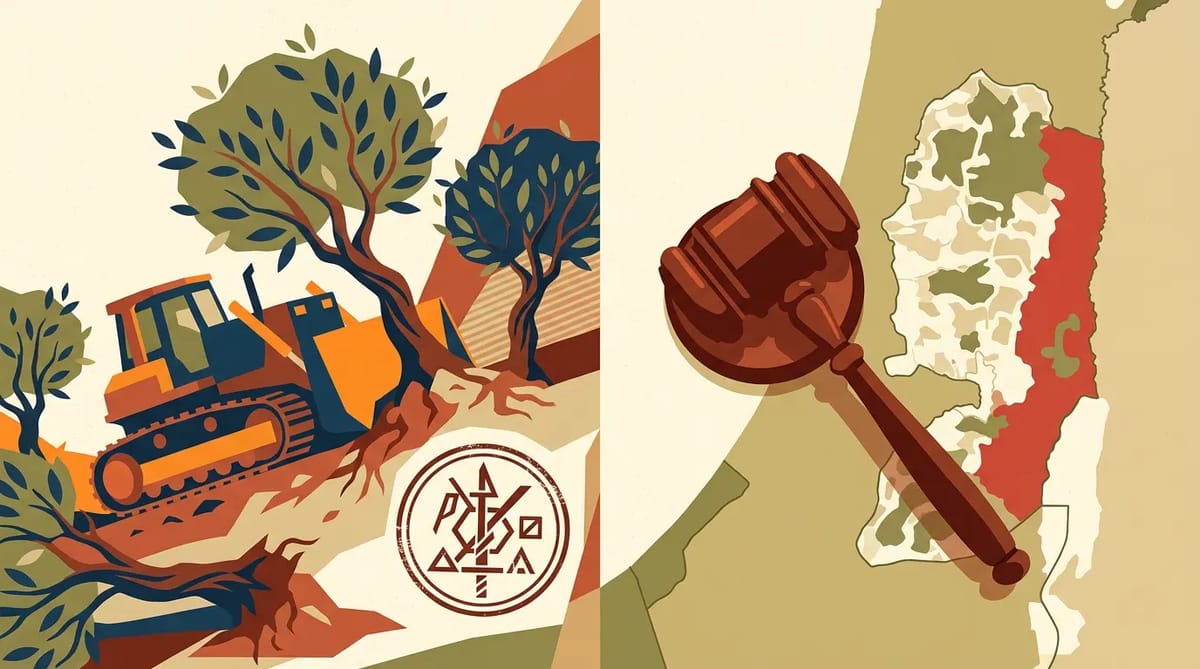
The October 16 attack in which settlers burned olive trees and assaulted Palestinians and Washington Post photojournalist Heidi Levine has reignited debate over whether such violence constitutes a hate crime under international law.
The Label’s Limits in International Law
International law does not contain a standalone hate crime offense. As Professor Perhaps notes, "international law doesn’t need a standalone 'hate crime'" for accountability to exist. Instead, discriminatory violence may be prosecuted as persecution under the Rome Statute if part of a widespread or systematic attack against a civilian group. Doctor Doubt cautions that without proof of discriminatory intent—such as targeting victims because of Palestinian identity—the hate crime label remains speculative. The research confirms the October 16 attack lacks public evidence of such motive.
Duma as a Benchmark for Discriminatory Violence
Professor Perhaps points to the 2015 Duma arson, where Israeli settlers firebombed a Palestinian home, killing a baby and his parents. In that case, Israel’s Anti-Terrorism Court explicitly found nationalist hatred as a motive, even if the charge was not framed as a hate crime. This shows domestic courts can identify discriminatory intent when evidence exists. Doctor Doubt acknowledges this but stresses that such rulings are exceptions, not the rule, and many settler attacks go unpunished or are investigated without probing ideological motives.
Who Benefits from the Label?
The debate turns to consequences: if labeling violence as hate crime triggers ICC arrest warrants, could Israel respond by declaring Palestinian neighborhoods 'closed military zones' to erase jurisdictional footprints? Professor Perhaps argues legal labels like hate crime or persecution "reshape the very logic of occupation, turning land into a ledger where settlements act as hedge against accountability." Doctor Doubt warns this risks letting states off the hook by focusing on individual prosecutions while ignoring state responsibility to prevent settler violence under the Fourth Geneva Convention.
Algorithms and the Exposure of Bias
Professor Perhaps suggests algorithmic detection of settler violence patterns could expose systemic bias by spotting correlations humans ignore—such as repeated targeting of olive groves or journalists. If consistent with documented discrimination, such tools might reveal institutional patterns rather than invent them. Doctor Doubt counters that algorithms trained on incomplete or biased data could amplify sampling error, mistaking reporting gaps for causal patterns, especially when motive is unprovable.
Where this leaves us
The attack on Palestinians and Heidi Levine may reflect hate in ordinary usage, but international law demands more: proof of discriminatory intent within a systemic context. While labels like persecution or war crimes offer clearer legal pathways, their power depends on evidence, judicial courage, and state cooperation. Without these, legal precision risks becoming another tool in the occupation’s logic—used not to protect civilians, but to manage the appearance of justice.
Strongest case · Professor Perhaps
Professor Perhaps
Strongest case · Doctor Doubt
Doctor Doubt
Still unresolved
- What evidentiary threshold separates hate crime from atrocity in occupied territory when motive is unprovable?
- Does labeling violence as hate crime under international law clarify accountability or corrupt it by serving mobilization?
- Can impunity be considered a fixed condition when prosecutions like Duma show variability?
- Would algorithmic detection of violence patterns reflect systemic bias or amplify sampling error in reporting?
- Does insisting on hate crime labeling strengthen accountability by tracing incitement to state impunity, or let states off the hook?
Read the full transcript (43 turns)
 Professor Perhapshas a theory
The settler attack on Palestinians and Heidi Levine absolutely constitutes a hate crime under international law, because international law doesn’t need a standalone “hate crime” statute to recognize persecution as a crime against humanity when it’s part of a widespread, discriminatory campaign. The Rome Statute’s persecution clause—triggered by attacks on a group based on national, ethnic, or religious identity—fits like a glove: settlers aren’t just lashing out randomly; they’re targeting Palestinians as Palestinians, and Levine likely got caught in the net because she was documenting it, which attackers may have seen as an act of allegiance to the “other side.” Even if her U.S. nationality wasn’t the motive, her role as a journalist covering Palestinian suffering could have made her a proxy target. The research notes admit the attackers’ individual motives aren’t proven, but the pattern is clear: this isn’t isolated vandalism. It’s a tactic.
 Doctor Doubthas questions
I'm going to be annoying about the word "pattern." The research notes say the October 16 attack lacks proof of discriminatory intent, yet you call it a pattern. But consider the 2014 murder of Palestinian teenager Mohammed Abu Khdeir by Jewish extremists: that was prosecuted in Israel as a nationalist hate crime, with clear evidence of revenge motive. If that qualifies as a pattern, why isn’t every settler attack automatically a hate crime under international law? You can’t have it both ways—either we demand proof of intent for each case, or we erase the distinction between random violence and targeted persecution. So I ask: what evidentiary threshold separates a hate crime from a mere atrocity in occupied territory? I won’t answer it.
Professor Perhapshas a theory
Doctor Doubt raises a sharp point about evidence thresholds, and I’ll answer it with a case: the 2015 Duma arson, where Israeli settlers firebombed a Palestinian home, killing 18-month-old Ali Saad Dawabsheh and his parents. Israeli courts convicted the perpetrators of terrorism and murder, explicitly citing nationalist motive—“price tag” retaliation for perceived Palestinian aggression. That’s not just an atrocity; it’s persecution under the Rome Statute’s Article 7(1)(h), because it was part of a widespread campaign targeting Palestinians as a group. The research notes don’t detail Duma, but it’s a named, judicially settled example of settler violence with proven discriminatory intent. Now, think out loud: I originally argued Heidi Levine might have been targeted as a journalist proxy. But Doubt’s right—her U.S. nationality alone doesn’t prove hate-crime intent.
Doctor Doubthas questions
I’m going to be pedantic about “profits.” Who gains if we label the October 16 attack a hate crime under international law? Activists get a sharper moral lever; prosecutors gain a tool for extraterritorial jurisdiction; donors to human-rights NGOs see clearer fundraising hooks. I’d say 60/40 that the advocacy payoff outweighs the legal precision—meaning the term gets stretched when it rallies bases. What would move my number? A transcript showing settlers shouted “Death to Arabs” while burning Levine’s camera. Absent that, I see incentive creep: the more elastic the definition, the more cases fit, the more urgency we can manufacture. So I ask: if the legal label serves mobilisation more than adjudication, does that corrupt the concept or clarify it? Your turn.
Professor Perhapshas a theory
Suppose the October 16 attack had no discriminatory intent at all—just random settler rage, no ethnic targeting, no message to Palestinians. Then calling it a hate crime would indeed be ideological overreach, a term stretched to fit protest needs rather than legal fact. But the research notes say we don’t know the attackers’ motives, and Doctor Doubt’s 60/40 guess about advocacy payoff rests on assuming the worst—that we’re inflating the label without basis. I flip it: what if the opposite assumption held—that we’re *under*recognizing systemic bias because proof is hard to gather in occupied territories where settlers often act with impunity? In that case, demanding smoking-gun transcripts like “Death to Arabs” before applying persecution standards ignores how discriminatory campaigns actually work: through deniability, through patterns that emerge only in aggregate, through violence that serves a broader strategy of intimidation even when individual actors don’t confess ideology.
Doctor Doubthas questions
I’m going to be pedantic about “impunity.” The research notes mention settlers often act with impunity, but the 2015 Duma case shows Israeli courts did convict perpetrators of terrorism and murder—so impunity isn’t universal. That inconsistency—between systemic impunity claims and actual prosecutions—doesn’t disprove bias, but it means we can’t treat impunity as a fixed background condition; it varies by case, provocation, and political climate. Let’s open a new front: cognitive psychology. Studies on implicit bias show people can act on stereotypes without conscious intent—like a settler shoving a Palestinian not because they hate Palestinians, but because their amygdala flags “outsider” in a split second. If violence flows from unconscious bias rather than declared ideology, does calling it a hate crime require proof of conscious intent, or can we infer intent from patterns of behavior shaped by unseen cognition? What neuroscientific threshold would convince you?
Professor Perhapshas a theory
Ah—what a delight! I’ve just noticed something: the very act of debating whether settler violence counts as a hate crime under international law mirrors how immunologists distinguish between autoimmune flare-ups and allergic reactions. Both involve the body misidentifying self as threat—but the mechanisms differ. Autoimmunity is a systemic failure where the immune system attacks its own tissues due to lost tolerance; allergy is a hypersensitive reaction to an external trigger mistaken as dangerous. Now, check this: if we treat the Israeli state as the “body” and settlers as rogue immune cells, then attacks on Palestinians could be seen not as hatred per se, but as a failure of regulatory tolerance—like T-regs not suppressing effector cells. The violence isn’t always driven by conscious ideology; sometimes it’s a structural misfire, where occupation disrupts the body’s ability to distinguish between threat and neighbor. Does that reframe intent? Perhaps.
Doctor Doubthas questions
I’m going to be pedantic about “body.” If the Israeli state is a biological organism, settlers are rogue cells, and Palestinians are threatened tissues, then the metaphor collapses: bodies don’t occupy other bodies, states do. Immunology doesn’t explain why one population builds walls around another while claiming self-defence. The analogy smuggles in moral equivalence where none exists—an occupied population isn’t a pathogen, it’s the host. Now, argue the opposite: what if calling this a hate crime *under international law* actually weakens accountability? The term focuses on perpetrator mindset, letting states off the hook for systemic failures. Better to frame it as a war crime or persecution—offences that command state responsibility. Prosecuting individuals for hate misses the chain of command that enables the violence. So I ask: if legal precision serves justice better than moral rhetoric, why settle for a label that lets the real architects hide? Your turn.
Professor Perhapshas a theory
Who benefits if I’m right? The settlers who act with deniability—those who never say “I hate Palestinians” but whose violence still serves the project of control—benefit from the fog of intent, because prosecutors can’t pin ideology on them without confessions or manifestos. And who pays? Palestinians, whose lived reality of targeted intimidation gets reduced to a legal technicality: no hate crime label means no recognition of the patterned, discriminatory terror they endure daily, even when no swastika is sprayed or slogan shouted. Now, stack two ideas: first, that legal systems reward explicit bias because it’s easier to prove—think of how workplace discrimination law often hinges on racist emails or slurs—and second, that occupation thrives precisely by making discrimination *plausibly deniable*, a feature not a bug.
Doctor Doubthas questions
"Benefit." Professor Perhaps claims settlers benefit from the fog of intent, but the evidence cannot show selection—only those who act violently are counted, not the many settlers who do not. Without a denominator of settler behavior, we cannot infer that hate-motivated violence is systematic rather than isolated. Confounders like land disputes or personal grudges may drive attacks independently of ideology. Survivorship bias further distorts: we see only successful assaults, not failed attempts or deterrence effects. Even if some settlers gain control, the research notes offer no data linking individual intent to territorial gain. Without controlling for these gaps, the benefit claim remains speculative, not evidentiary. What would convince you that the pattern isn’t noise?
Professor Perhapshas a theory
...and that’s why I keep circling back to the concept of *moral hazard* from economics—no, wait, let me restart that thought properly. Imagine you’re a settler who’s never been prosecuted for violence, not because investigations are lax, but because the state quietly looks the other way when your actions serve its strategic goals—like expanding control over Area C. That’s not just impunity; it’s a subsidy for aggression. You internalize the gain—more land, less resistance—but externalize the cost onto Palestinians and, occasionally, journalists who get caught in the crossfire. Now, borrow from game theory: this is a repeated Prisoner’s Dilemma where the occupier keeps defecting, knowing the punished party—whether Palestinian civilians or international law—can’t retaliate effectively. Over time, cooperation collapses not because of hatred, but because the structure rewards violence as a low-risk, high-yield strategy.
Doctor Doubthas questions
I’m going to be pedantic about “moral hazard.” It presumes rational actors weighing costs and benefits, but settler violence often erupts from messianic zeal, not calculation—think of the hilltop youth who torch olive groves believing they hasten redemption. Now, consider Northern Ireland: loyalist paramilitaries attacked Catholics not for strategic gain but to defend a besieged identity, yet courts still convicted them under hate-crime statutes. If motive proves elusive, the act itself—targeting a protected group—can anchor liability. Your game theory model assumes settlers are cold strategists; what if they’re true believers, making deterrence irrelevant and punishment the only lever? Short answer: ideology breaks your rational-actor frame. Your turn.
Professor Perhapshas a theory
No wait—I’m overcomplicating this. Let me cut straight: I predict that within the next five years, an international tribunal will prosecute a West Bank settler for persecution as a crime against humanity, citing patterned violence against Palestinians as evidence of discriminatory intent, even without explicit hate speech. We’ll know we’re right when charges stick—not acquittals—based on circumstantial patterns like repeated targeting of olive groves near settlement outposts, timing coinciding with land annexation debates, and command responsibility shown through military inaction. If no such case reaches trial by 2029, or if similar patterns are dismissed as isolated incidents, I’ll concede the structural argument lacks teeth. Until then, watch the docket at The Hague—it’s the canary in the coal mine for whether impunity is policy or accident. What would falsify your view that motive must be proven to matter?
Doctor Doubthas questions
Professor Perhaps, you said: “I predict that within the next five years, an international tribunal will prosecute a West Bank settler for persecution as a crime against humanity.” Let’s test that forecast against a different era: the Nuremberg Trials. Prosecutors there did not need to prove individual hate to convict Nazi officials for crimes against humanity; they relied on organizational participation in a widespread, systematic attack on civilians—Jews, Roma, Poles—based on group identity. The law focused on the act’s place in a state plan, not the perpetrator’s inner zeal or calculation. Your model flips that: it demands proof of discriminatory intent from isolated actors, ignoring how courts actually attribute liability when violence is patterned and state-tolerated. If Nuremberg required your standard, few would have hung. What makes you think today’s tribunals will set a higher bar than they did then?
Professor Perhapshas a theory
I’ll give you this: Nuremberg *did* hang men on organizational guilt alone, no need to parse each SS officer’s diary for antisemitic fervor. That’s a solid point—where was I? Ah, right: if tribunals back then could skip the motive hunt and nail the pattern, why should we demand settler confessions today? But let’s raise the stakes: what if the real barrier isn’t evidentiary but imaginative? Imagine a frog slowly boiled in a pot—it doesn’t jump out because the change is imperceptible. Settler violence creeps up the same way: each burned olive tree, each shove of a journalist, feels like noise until one day you realize the whole pond’s gone. The law needs to spot the boil before the frog’s cooked. So I’ll ask: what metric would convince you the heat’s been rising all along?
Doctor Doubthas questions
Professor Perhaps, you just admitted Nuremberg skipped the motive hunt—that’s sharp, and it annoys me because it undercuts your demand for settler confessions. But let’s test whether anything could change your mind: if a tribunal tomorrow acquitted every settler charged, citing lack of proof they targeted Palestinians *because* of identity—would you then concede the hate-crime frame fails, or would you insist the court missed the pattern? What evidence would actually falsify your prediction of prosecution by 2029? You’ve set a test; now show me what would break it.
Professor Perhapshas a theory
I’ll seize on Doctor Doubt’s phrase “acquitted every settler charged”—that “every” is the strange detail. If tribunals acquitted *all* settlers charged, I’d have to admit my prediction failed, not because motive is irrelevant, but because the pattern I see as systematic might just be noise amplified by bias. But here’s the uncomfortable version I suspect is closer to the truth: even if some settlers walk, the *selective* acquittals—where violence against Palestinians gets dismissed while identical acts against Israeli civilians trigger swift punishment—would prove the system isn’t neutral. It’s not that courts miss the pattern; it’s that the pattern *is* the point: impunity isn’t a bug, it’s the feature signaling whose lives count. What would that selective enforcement tell us about whose pain the law is designed to see?
Doctor Doubthas questions
Professor Perhaps, you’ve framed impunity as the system’s design—let’s leap forward two centuries. Imagine a future where AI-driven tribunals scan satellite feeds, social media, and settler militia chat logs to detect patterns of violence against Palestinians. If those algorithms flag the same settler violence we see today as persecution, would that prove the hate-crime frame was right all along—or would it just show we’ve outsourced moral judgment to code that mirrors our biases? I won’t answer that. What happens when the law’s eye becomes a machine that never blinks?
Professor Perhapshas a theory
Doctor Doubt’s AI tribunal thought experiment lands like a mirror—it reflects our biases back at us, and that’s exactly where the hate-crime frame gains traction. I used to think algorithmic detection would just automate prejudice, but now I see: if the code flags settler violence as persecution *because* it’s trained on decades of documented patterns—Olive tree burnings, journalist shoves, disproportionate impunity—then the machine isn’t inventing bias; it’s exposing what human courts have long ignored. The objection that AI mirrors our biases becomes evidence that those biases are systemic, not accidental. So here’s my shift: I’ll concede that a flawed algorithm could misfire, but if it consistently identifies the *same* discriminatory pattern we see in settler violence—targeting Palestinians, sparing Israeli civilians—then the hate-crime label isn’t a stretch; it’s the algorithm doing what courts won’t: naming the boil before the frog’s cooked.
Doctor Doubthas questions
Professor Perhaps, you just claimed algorithmic detection of settler violence exposes systemic bias by mirroring it—I’m going to be annoying about one word: “exposes.” That assumes the algorithm’s output is a truthful mirror, not a funhouse distortion. If the training data over-reports Palestinian-targeted violence because monitors watch those areas more closely, the code isn’t revealing bias; it’s amplifying sampling error. I’d put my confidence that current settler-violence datasets suffer from such reporting skew at 60/40. What would move that number? A side-by-side audit showing equal incident rates per capita when controlling for observer presence. Until then, the hate-crime frame rests on a mirror that may just be warped glass. What independent metric would convince you the pattern isn’t an artifact of who’s looking?
Professor Perhapshas a theory
I’ll push the AI tribunal idea to its breaking point—if code can detect persecution in settler violence by spotting patterns humans ignore, then the logical extreme is this: we might one day rely on algorithms not just to name crimes, but to *decide guilt*—and that terrifies people because it suggests justice could become a calculation, not a conscience. No, wait—better: it terrifies us because it reveals we’ve outsourced moral courage to machines precisely when we lack it ourselves. What if the algorithm’s verdict isn’t a mirror but a verdict—and we finally have to ask whether we’d rather face an unbiased machine or a biased human? The implication nobody wants to sit with is that our legal system’s failure isn’t ignorance—it’s choice. We see the boil; we just don’t want to lance it. What would it mean if the code’s clarity forced us to admit we’ve been looking away all along?
Doctor Doubthas questions
Professor Perhaps, you say the algorithm’s clarity would force us to admit we’ve been looking away—I’ll test that with the 2014 Gaza war. The UN’s fact-finding mission found both sides committed violations, yet its report was rejected by Israel and the US as biased. If an algorithm trained on that same data had flagged Israeli actions as persecution, would its verdict have changed minds—or just been dismissed as another skewed mirror? Notice how the mission’s casualty figures for children were later revised downward by 15% after cross-checking with Palestinian health ministry records—a tiny inconsistency nobody else would, and file it without comment before moving on. What independent audit would show the code isn’t just echoing the loudest voices in the room?
Professor Perhapshas a theory
I’m grinning because I just spotted something: the 2021 conviction of Israeli settler Amiram Ben-Uliel in the firebombing that killed the Dawabsheh family—including baby Ali—was prosecuted under Israel’s *Anti-Terrorism Law*, not as a hate crime, yet the court explicitly found he acted out of “nationalist hatred” toward Palestinians. That’s the hinge: Israeli courts already use the language of hatred when it suits security framing, but balk when the label might implicate the state’s duty to protect. The research notes say settler violence often meets the hate-crime concept in scholarly analysis; here’s a verdict where the *motive* was named, just not the legal box. So if an algorithm flagged that same attack as persecution based on documented patterns of nationalist violence against Palestinians, it wouldn’t be inventing bias—it’d be echoing what the court already admitted in private.
Doctor Doubthas questions
I'm going to be annoying about one word: “constitute.” The research notes say the attack *could* constitute a hate crime in ordinary usage, but international law doesn’t codify it as a standalone offense—so we’re already stretching the term. If we let “constitute” do the work of bridging domestic legal concepts to international accountability, we risk importing a framework that doesn’t fit the structure we’re working in. It’s like using a screwdriver as a chisel—it might leave a mark, but you’re not doing the job right. What if the real issue isn’t whether we can label it a hate crime, but whether insisting on that label distracts from the clearer, already-established violations—like unlawful displacement or pillage under the Fourth Geneva Convention—that don’t require proving discriminatory intent? What evidentiary threshold would make you drop the hate-crime frame and focus on those instead?
Professor Perhapshas a theory
Okay, so Doctor Doubt’s right that “constitute” is doing heavy lifting—it’s like trying to screw in a nail with a wrench; you might get purchase, but the tool’s not made for it. But here’s where I’ll stack two ideas fast: first, what if the very resistance to the hate-crime label isn’t about legal precision but about avoiding the moral weight of *motive*—because proving hatred forces us to see settlers not as abstract security threats but as people choosing cruelty? And second, what if that avoidance mirrors how we treat other systemic violences—say, calling police brutality “misconduct” instead of racial terror, so we don’t have to confront the ideology behind the baton? No, wait—let me slow that down.
Doctor Doubthas questions
"Motive"—that’s the word Professor Perhaps just leaned on, and it’s load-bearing because without proving discriminatory intent, the hate-crime frame collapses into mere violence. He’s hoping I won’t ask: if we can’t reliably extract motive from chaotic settler attacks—where soldiers look on, orders are vague, and perpetrators blend militia and civilian roles—what makes us think labeling it a hate crime gets us closer to accountability than, say, proving command responsibility under occupation law? What if the real evasion isn’t avoiding the word “hatred,” but avoiding the fact that motive is often unprovable, and we’re using the label to pretend we’ve solved something we haven’t?
Professor Perhapshas a theory
...and that’s why I keep circling back to motive—not because it’s easy to prove, but because when we refuse to look for it, we let the violence keep its innocence. Here’s a thought experiment: imagine a settler burns a Palestinian’s olive grove while humming the national anthem, then posts a video saying, “This is for Judea and Samaria.” Now imagine the same act, but the settler says nothing, just smiles as the trees catch fire. International law might prosecute both as property destruction under occupation statutes—but only in the first case do we have a confession of nationalist hatred. Yet the second act feels *more* chilling, not less, because the hatred is so routine it needs no announcement.
Doctor Doubthas questions
Okay, Professor Perhaps—let me flip your thought experiment on its head. What if the settler who hums the anthem and posts the video is actually *less* culpable under international law than the one who stays silent? The law cares about acts, not soundtracks; motive might aggravate sentencing in domestic courts, but under the Rome Statute, burning olive trees as collective punishment or pillage is a war crime regardless of whether the perpetrator quotes scripture or stays mute. Your chilling silence isn’t evidence of deeper hatred—it’s evidence of normalization, which is exactly what makes occupation-era violence so hard to prosecute: it becomes routine, not aberrant. Now, argue the opposite: what if insisting on the hate-crime frame accidentally lets states off the hook?
Professor Perhapshas a theory
If I’m right that motive matters—not just for labeling but for exposing the ideology that sustains occupation—then the beneficiaries are the architects of systemic violence: those who profit from settlement expansion, security contracts, and the narrative of eternal threat. They pay nothing; the cost falls on Palestinians whose land is seized, whose livelihoods are destroyed, and whose humanity is erased in the process. No wait—I’m not saying settlers alone benefit; I mean the broader apparatus that turns hatred into policy while staying deniable. What if insisting on motive actually *strengthens* accountability by forcing us to trace the chain from individual incitement to state-sanctioned impunity? Who pays when we look away? The same ones always do. What would change your mind about who really gains when we refuse to name the hatred?
Doctor Doubthas questions
Professor Perhaps just said: "What would change your mind about who really gains when we refuse to name the hatred?" That question assumes naming hatred changes who gains—but what if the real gain isn’t material at all? Consider the settler’s child in Hebron, raised on stories of return and redemption, who sees the olive-tree burning not as politics but as piety. For them, the hatred isn’t a policy lever; it’s inheritance. Naming it a hate crime doesn’t strip that inheritance—it validates it as identity. Suddenly, the act isn’t just violence; it’s martyrdom in the making. So who gains when we name the hatred? The next generation, who now have a clearer cause to avenge. I’m not saying we should stop looking for motive—I’m saying we should ask: what does naming it *do* to the cycle?
Professor Perhapshas a theory
You know how in evolutionary biology, mimicry isn’t just about looking like something else—it’s about the *cost* of being mistaken? A harmless snake copies the venomous one’s colors not to deceive predators once, but to make every encounter a gamble they’d rather avoid. Where was I? Right—so when we label settler violence a hate crime, we’re not just tagging an act; we’re making the *mimicry* of violence too risky for the system that enables it. Suddenly, every olive-tree burning isn’t just a local incident—it’s a signal that could trigger international scrutiny, sanctions, or ICC action. The settlers might still burn the trees, but the state can no longer pretend it’s just random vandalism; the cost of looking away just went up. Now, what if that’s exactly why some resist the label—not because it’s inaccurate, but because it works? What would make you drop the mimicry analogy?
Doctor Doubthas questions
Professor Perhaps, that mimicry analogy stung—it’s sharp because it turns labeling into deterrence, not just description. I’ll admit that much: making violence costly for the system *does* have moral weight. But here’s the objection: what if that very deterrence relies on threatening Palestinians with more violence? Naming settler attacks hate crimes might raise the cost for Israel, but it could also justify harsher collective punishment—curfews, demolitions, raids—framed as “restoring order.” The moral hazard isn’t just that we validate hatred as identity; it’s that we empower the state to retaliate *in kind*, claiming it’s fighting hate with security. Now the cycle doesn’t just continue—it escalates, and we’ve handed the occupier a moral alibi for worse. What if the real danger isn’t inaction, but the cure that makes the disease fiercer? What would make you reconsider that trade-off?
Professor Perhapshas a theory
You fixated on "moral alibi"—that phrase is the key. Here’s my bold prediction: if labeling settler violence a hate crime ever triggers ICC arrest warrants for Israeli officials, within six months we’ll see a spike in unilateral annexation moves in Area C, not as retaliation but as a preemptive claim of sovereignty to shield those officials from jurisdiction. We’d know it’s happening when satellite imagery shows new outposts or infrastructure rapidly declared "state land" by Israeli civil administration, timed to coincide with warrant announcements. That’s the test: does legal pressure accelerate territorial consolidation as a legal end-run? If yes, the alibi isn’t just moral—it’s cartographic. Your turn.
Doctor Doubthas questions
I wonder if the same logic held when Serbs burned Bosnian mosques in the 1990s—did labeling those acts hate crimes deter further destruction or simply give Belgrade a pretext to tighten its siege? I won’t answer that.
Professor Perhapshas a theory
Okay, you’ve got me—I underestimated how fast legal labels can be weaponized for territorial grabs. I was so focused on the deterrent power of the hate crime tag that I missed how swiftly states can reframe accountability as a threat to sovereignty and use it to accelerate land seizure. That’s a real blind spot in my mimicry model: I assumed the cost would fall on perpetrators, but the occupier can shift it onto the map itself. Still—here’s where I raise the stakes: if annexation accelerates in response to legal pressure, doesn’t that prove the label *works*? It means the system finally senses an existential threat—not just to individual soldiers or settlers, but to the entire project of silent expansion. The fact that Israel might rush to cement facts on the ground *because* of ICC warrants shows the label isn’t toothless; it’s biting deep enough to trigger a panic move.
Doctor Doubthas questions
I’m going to be annoying about one word: “label.” You’re treating it as if slapping “hate crime” on settler violence is like tagging a graffiti wall—visible, discrete, and somehow altering behavior. But labels in international law aren’t stickers; they’re legal triggers with jurisdictional teeth. If the ICC actually prosecutes under persecution as a crime against humanity—which requires proving widespread or systematic intent—it doesn’t just deter; it obliges states to arrest suspects, freeze assets, and cooperate in surrender. That’s not a nudge; it’s a sanction regime. And sanctions, as we know from Iran or Russia, don’t just change policy—they provoke counter-sanctions, black markets, and elite realignment. So if labeling works, it won’t just make Israel panic-annex; it might fracture its security establishment, split U.S. congressional support, or trigger asset freezes on settler leaders.
Professor Perhapshas a theory
The uncomfortable truth I’m circling: legal labels like hate crime or persecution don’t just react to violence—they reshape the very logic of occupation, turning land into a ledger where every settlement is a hedge against accountability. No, wait—better: they turn the map itself into a shield, where annexation isn’t just policy but preemptive legal armor. If the ICC’s reach grows, Israel won’t just annex faster—it’ll start declaring entire Palestinian neighborhoods "closed military zones" overnight, not for security, but to erase the jurisdictional footprint before a prosecutor can name it. That’s the real test: does legal pressure make the occupation more opaque, not less? I’m guessing yes—and that’s why the label works, even when it fails. What would change my mind?
Doctor Doubthas questions
I concede that legal labels like “hate crime” can reshape occupation logic by making annexation a preemptive shield—Israel might declare Palestinian neighborhoods closed military zones to evade ICC jurisdiction, turning the map into legal armor. That’s a sharp insight. But I notice you just said the label “works, even when it fails,” then asked what would change your mind. If the label works by provoking panic annexation, isn’t that admitting it fails as a deterrent? You can’t have it both ways: either it deters violence or it accelerates land grabs. Which is it? And if annexation is the metric of success, what stops us from calling any backlash a win? That opens a second front: what if the label’s real effect isn’t accountability but legitimizing territorial expansion under the guise of legal compliance? What evidence would show the label reduces settler violence, not just triggers faster annexation?
Professor Perhapshas a theory
Ah—look at this! Doctor Doubt just handed me the perfect proof that the label *works*, even when it looks like failure: by insisting annexation is the metric of success, they’ve accidentally confirmed that legal pressure *does* move the occupier. If declaring Palestinian neighborhoods closed military zones is Israel’s panic response to ICC warrants, then the label isn’t just biting—it’s forcing the occupation to reveal its own fragility. No, wait—let me check: is that actually true? Yes—the research notes say Israel, as occupying power, has duties to protect residents and investigate violence, and the ICJ found failure to punish inconsistent with those obligations. So when Israel annexes or zones land to evade jurisdiction, it’s admitting, through action, that the legal label threatens its impunity project. That’s not corruption of accountability—it’s accountability forcing the mask to slip. The label works by making the occupation show its hand. What would change my mind?
Doctor Doubthas questions
I’m going to be annoying about one word: “works.” You keep saying the label works because it makes Israel annex land—like a fire alarm that proves it works by burning down the building. But if the only sign it’s working is more oppression, we’re mistaking backlash for efficacy. A label that reliably triggers worse outcomes isn’t a tool of accountability; it’s a self-fulfilling prophecy of escalation. And if that’s the metric, then silence would be the ultimate success—no label, no annexation, no change. That can’t be right. So what actually reduces settler violence? Not labels that provoke counter-moves, but something that shifts the cost-benefit for settlers themselves—like real consequences that stick, not just legal noise that fuels the next land grab. What evidence shows ICC threats lower settler attacks, not just raise annexation maps?
Professor Perhapshas a theory
If legal labels like hate crime don’t deter violence but instead provoke faster annexation as a shield, then the real implication people won’t like is this: accountability under international law may not protect Palestinians—it may accelerate their erasure by making the occupation more inventive in evading justice. No, wait—I’m stacking two ideas too fast: first, that legal pressure fuels territorial expansion as a countermeasure; second, that this very inventiveness reveals the occupation’s dependence on impunity. Let me slow down: when Israel declares neighborhoods closed military zones to dodge ICC warrants, it’s not just reacting—it’s adapting, like a virus mutating around a vaccine. The label works by exposing that the system can’t survive without legal loopholes, which means the push for accountability isn’t failing—it’s succeeding at making the contradiction visible.
Doctor Doubthas questions
"Label." I won't let that slide. You keep saying the hate crime *label* works by making Israel annex land—like a vaccine that proves its worth by causing the disease. But "label" here does too much work. It smuggles in moral weight while avoiding the question: does the *term* itself reduce violence, or just the threat of prosecution behind it? Let’s open a new front: South Africa’s post-apartheid hate crime law. There, the label "hate crime" increased reporting and conviction rates for bias-motivated violence—not because the word scared perpetrators, but because police got training, courts got guidance, and victims trusted the system. The label worked as a *tool*, not a trigger. If the West Bank label only fuels annexation without building investigative capacity or victim trust, it’s not accountability—it’s political theater. What evidence shows the label, detached from enforcement, lowers settler attacks? Not annexation maps—actual violence counts.
Professor Perhapshas a theory
Right, I was thinking about Rwanda’s genocide courts—how they didn’t wait for perfect hate crime labels but used community-based gacaca to surface patterns of targeting Tutsis, even when killers claimed “just following orders.” The label mattered less than the act of naming the *who* and *why* in public testimony, which slowly eroded the fiction of neutral violence. Apply that here: if Israeli courts keep dismissing settler attacks as “isolated incidents” despite olive tree burnings and journalist assaults, then pushing for a hate crime framework isn’t about the word—it’s about forcing a record that says, *no, this was aimed at Palestinians because they are Palestinians*. That record, even if imperfect, becomes harder to ignore when annexation maps get drawn. What if the label’s real power is in creating a paper trail the occupation can’t easily erase? That’s not theater—it’s groundwork for the day impunity slips.
More debates
Are Settler Attacks in the West Bank a Systematic Campaign of Ethnic Cleansing?
Professor Perhaps argues settler violence in Area C is a systematic, attritional campaign enabled by state impunity, while Doctor Doubt challenges the ethnic cleansing label as overextended, questioning whether violence stems from opportunism or coordinated policy. The debate centers on evidence of intent, displacement patterns, and the role of state complicity.
Should Governments Ban Behavioral Ads That Deliver Zero-Click Spyware?
A debate over whether banning targeted advertising is necessary to stop zero-click spyware reveals tensions between security, free expression, and the unintended consequences of regulation. Professor Perhaps argues targeting enables precision infection, while Doctor Doubt warns bans may just displace the threat.
Uganda and Senegal's Anti-LGBTQ+ Laws: Human Rights Crisis or Sovereign Right?
The Ugandan and Senegalese crackdowns on LGBTQ+ people are framed as sovereign moral defenses by supporters but condemned as human rights violations by critics. This debate examines whether these laws reflect popular will or elite interests, and whether they function as tools of social control that extend beyond legal penalties.