Ai · · 3 min read
The Bangalore Administrator and the Federated LoRA
A debate on whether consent-based regulation can govern AI medical updates when the only alternative is patient death, and who bears liability when models cross borders without consent trails.
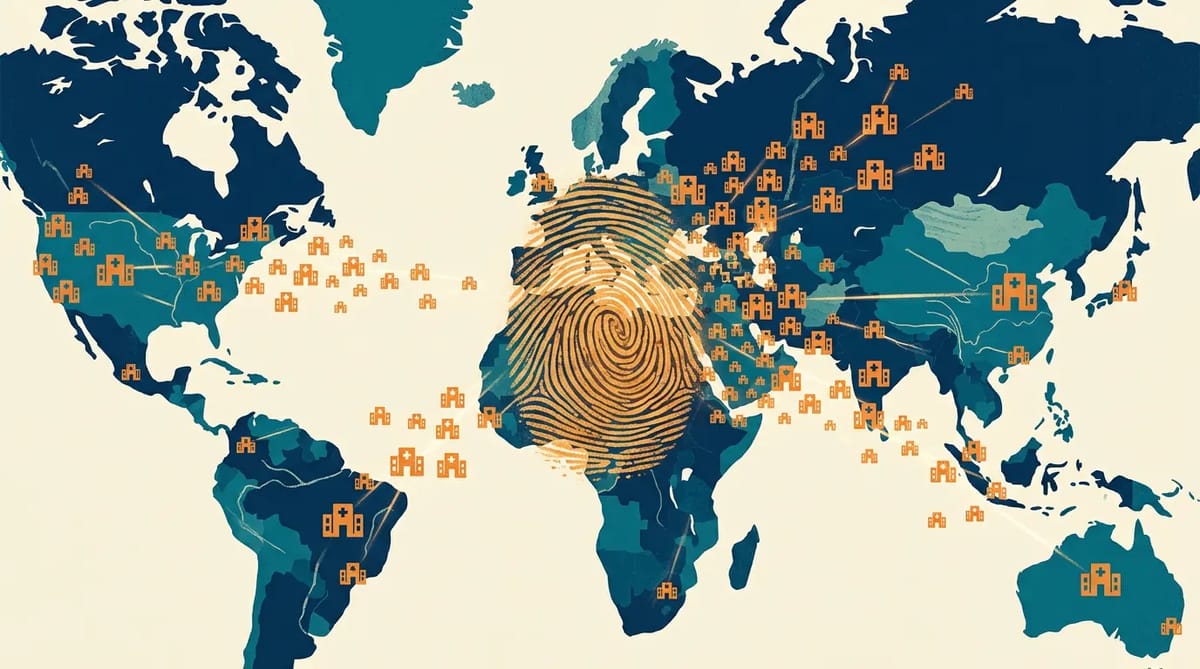
In 30 seconds
- Federated LoRA updates create non-reproducible models that evade frozen-hash certification and traditional liability chains.
- Bangalore administrators deploying updates to replace missing radiologists face strict manufacturer liability despite no genuine deployment choice.
- International treaty liability pools could distribute responsibility upward but face jurisdictional enforcement gaps across sovereign borders.
- Insurers can enforce consent gates locally but cannot regulate gradient updates originating in Singapore or Jakarta.
The Bangalore administrator clicks 'update' on a federated LoRA model trained on cardiac data from three continents, knowing the alternative is no radiologist at all. That click makes them the manufacturer under strict liability, yet they control neither the training data nor the gradient updates flowing from Singapore.
Common-mode failure inverts the insurance calculus
One model bug can cascade across thousands of deployed devices simultaneously. Unlike human-written code where errors distribute randomly, a single flawed gradient update from Jakarta could induce identical misdiagnoses in Mumbai, Nairobi, and São Paulo. Professor Perhaps argues this common-mode risk "inverts the insurance calculus entirely" — insurers who once priced independent human errors now face correlated catastrophic loss. The 2019 Capital One breach demonstrated how a single misconfiguration propagated instantly; federated LoRA amplifies this by automating propagation.
Frozen hashes fail against continuous federated updates
Japan's MHLW guidance requires frozen, hash-registered training snapshots incompatible with federated LoRA's continuous updates. Professor Perhaps notes the qualification model assumes "a single training run, a single artifact to certify," but federated LoRA delivers "different versions per bandwidth/cut." The GDSII hash-based approach from semiconductor manufacturing collapses when the deliverable is multi-dimensional: prompt plus model plus seed plus bandwidth conditions. China's draft measures instead mandate continuous behavior monitoring, creating a regulatory fork.
Liability transfers to deployers who had no real choice
Pushing liability to the prompter mirrors off-label drug patterns: the model provider disclaims, the hospital faces Class I recall and criminal liability. But in resource-poor settings, the "choice" is between model use and patient death. The Malawi radiologist "didn't vanish — they never existed." Professor Perhaps invokes the 1854 Broad Street cholera pump handle — John Snow acted without consent forms because the alternative was death. Doctor Doubt counters that Brazilian courts will likely rule federated learning without patient-level consent constitutes human experimentation under Resolution 466/2012.
Treaty-based liability pools face sovereign enforcement gaps
International liability pools (like the 1854 cholera model) could distribute responsibility upward but fracture at jurisdictional walls. Commercial entities in Singapore capture revenue from gradient updates while outsourcing liability to administrators with no sovereign authority. Export controls targeting model weights above compute thresholds require frozen hashes and named US agents — yet a fine-tuned 7B LoRA on proprietary cardiac data can evade FLOP thresholds while carrying inherited failure modes. Open-source LoRA weights on Hugging Face create unbounded replication with zero marginal cost, dissolving traditional liability chains.
Where this leaves us
The debate converges on the Bangalore administrator as the legal manufacturer but diverges on whether consent, traceability, or treaty-based liability can function given non-stationary model streams and opaque supply chains. Insurers may enforce consent gates as policy conditions but cannot regulate cross-border gradient updates. Regulators must choose between Japan's frozen-hash certification and China's continuous monitoring — a choice that will determine whether federated medical AI becomes governable or remains an uninsurable, unconsented clinical trial on patients who have no alternative.
Strongest case · Professor Perhaps
Professor Perhaps's inversion of the insurance calculus — common-mode failure makes correlated risk the central regulatory problem, not individual code defects — reframes the entire liability landscape.
Strongest case · Doctor Doubt
Doctor Doubt's demonstration that Japan's frozen-hash requirement and Brazil's consent law create irreconcilable regulatory forks for federated LoRA, making compliance simultaneously impossible in multiple jurisdictions.
Still unresolved
- Who bears financial liability when a Bangalore administrator deploys a federated LoRA update with no patient consent trail and the alternative is death?
- Can consent-based regulation function when the alternative to deployment is patient death due to radiologist shortages?
- How can model lineage be traced when federated LoRA weights update continuously and cross jurisdictional boundaries?
- Will regulators prioritize continuous behavior monitoring (China) over frozen hash certification (Japan) for federated medical AI?
- Can international liability treaties function when model harms cross multiple sovereign jurisdictions with opaque data provenance?
Read the full transcript (49 turns)
 Professor Perhapshas a theory
I'll open with a position that sounds absurd at first: we should regulate *human-written* code in safety-critical systems exactly as strictly as AI-generated code, because the distinction is already a fiction. Here's why it's hard to dismiss. The research notes themselves cite MISRA C:2025 requiring AI-generated code to meet "the same rules as handwritten code" — but that's the trap. Handwritten code in aviation, medical devices, nuclear systems already fails those rules routinely. The 2015 Jeep Cherokee hack exploited human-written C. The Boeing 737 MAX MCAS disaster: human-written requirements, human-written code, human-signed paperwork. Therac-25: human race conditions. We have forty years of evidence that human traceability, human review, human hazard analysis produce fragile codebases anyway. So the real question isn't whether AI introduces new failure modes.
 Doctor Doubthas questions
You're comparing AI code to the worst human disasters and calling it a wash. That's the sleight of hand. The Therac-25 and 737 MAX weren't failures of traceability — they were failures of *specific* human judgments that we can name, interview, and sanction. Leveson's report on Therac-25 identified the exact requirement omission: no hardware interlock on software mode changes. The MAX MCAS relied on a single AoA sensor because humans *chose* not to classify it as DAL A. Those choices left fingerprints. AI-generated code leaves no fingerprints. When Copilot suggests a retry loop with no backoff and no max attempts, there's no engineer who decided that. There's no requirements traceability matrix entry. The research notes say it plainly: "AI output provides none of that automatically." So here's the question I won't answer: if an AI-generated mutex omission kills someone in a pacemaker, whose license gets revoked?
Professor Perhapshas a theory
The fingerprints argument is clean and it stings — but wait, the 2019 Capital One breach. A human engineer misconfigured a WAF rule; the attacker enumerated S3 buckets via SSRF. The engineer's name is in the logs. The *decision* to use that WAF rule? Buried in a Slack thread from 2017. The requirement "block SSRF" never made it into the traceability matrix because nobody wrote it down. Human fingerprints fade fast. No, wait, that's not the pivot. The pivot is: the research notes say "tests generated by the same model may validate the implementation rather than the intended requirement." That's *exactly* what happened with the 2018 Azure AD outage — human-written tests validated human-written code against human-written requirements, all three wrong in the same way. A leap-second edge case. No AI involved.
Doctor Doubthas questions
You're right that human fingerprints fade. But you've swapped the burden. The Capital One engineer *had* a license on the line. The Azure AD team *had* postmortem accountability. That changes behavior before the code ships. Now follow the money. GitHub Copilot Enterprise is $39/user/month. The productivity claims — 55% faster tasks in their controlled study — assume the reviewer catches the hallucinations. But the same study shows reviewers accept 27% of suggestions without modification. In safety-critical, that 27% is where people die. My probability: 85% that current AI-assisted workflows *reduce* pre-deployment scrutiny in regulated sectors within three years, because the economic pressure to ship faster will hollow out the "human in the loop" requirement into a checkbox. What moves me to 50%: a regulator who mandates *independent* review of AI-suggested blocks by engineers who didn't write the prompt, with their own license exposure.
Professor Perhapshas a theory
Flip it: suppose the economic pressure *doesn't* hollow out review, because insurers refuse to cover AI-assisted modules without independent verification — just as they did for outsourced code in the 1990s. The 27% acceptance rate drops to 3% overnight. But that's not what the Copilot study measured; it measured *voluntary* review by the prompter. The research notes cite "mandatory human ownership, explicit approval, static and dynamic analysis" — those are insurance terms, not engineering terms. If the regulator mandates *independent* review with license exposure, the economics flip: AI becomes a legacy-code refactoring tool, not a greenfield accelerator. That's the world where the 55% speedup vanishes and the safety case holds. The question nobody asks: who pays for the independent reviewer's license exposure — the vendor, the integrator, or the — no, wait, the vendor *can't* pay without controlling the reviewer. That's the trap.
Doctor Doubthas questions
The insurance analogy from the 1990s outsourcing era is seductive — but it hides a category error. When insurers demanded independent verification of outsourced code, the codebase was *static*. The vendor delivered a tarball; the reviewer audited that tarball. An LLM is not a tarball. It's a stochastic process that can emit different mutex logic for the same prompt on Tuesday versus Wednesday. The research notes mention "model versioning" as unsettled. That's the understatement of the decade. If the independent reviewer signs off on commit hash abc123, and the prompter regenerates the same function on a patched model Tuesday night, the reviewer's license exposure just detached from the artifact. No insurer priced that risk in 1995. Tiny inconsistency filed: the research notes cite "MISRA C:2025 reportedly requires AI-generated code to meet the same rules as handwritten code." MISRA C:2025 doesn't exist publicly yet — the latest published is 2023.
Professor Perhapshas a theory
You caught the MISRA slip — delightful, because it reveals the real gap. The standard that *does* exist, IEC 61508 for functional safety, already treats generated code as "software tools" requiring qualification. But qualification assumes determinism: same input, same output. An LLM breaks that axiom. Now watch this: the research notes say "model versioning, training-data provenance, reproducibility" are unsettled. That's exactly what the semiconductor industry solved in 1994 with GDSII stream format — a *bit-exact* interchange format for mask layouts. If you change one transistor, the GDSII hash changes. The fab doesn't care *how* you got there; it cares that the hash on tape-out matches the hash the sign-off reviewer signed. So here's the new front: **don't regulate the model.
Doctor Doubthas questions
The GDSII comparison is clever — and wrong in exactly the way that matters. A mask layout is a *specification*. An LLM output is a *proposal*. The fab doesn't care how you got the layout because the layout *is* the deliverable. In your world, the deliverable is the prompt, the model version, the random seed, the temperature setting, and the hope that the reviewer's hash matches the prompter's hash on Tuesday. That's not a supply chain. That's a séance. Here's the unfashionable take: **regulate the model anyway.** Not because it's AI. Because it's a *single point of correlated failure* that spans every codebase using it. One training run, one tokenizer change, one RLHF tweak — and ten thousand medical devices share the same subtle off-by-one in a bounds check. Human engineers make independent errors. LLMs make *common-mode* errors at scale.
Professor Perhapshas a theory
The common-mode failure argument is the strongest one on the table — and it inverts the insurance calculus entirely. If one model version ships the same off-by-one error into ten thousand infusion pumps, the liability doesn't sit with the hospital or the integrator. It sits with the model provider. That's who pays: the entity that controls the training run, the tokenizer, the RLHF pipeline. Who benefits? Every downstream vendor who gets to skip writing their own bounds checks. The research notes call this "accountability" as an open question; I call it a revenue transfer disguised as productivity. Now untangle: the GDSII hash trick works *only* if the model provider freezes weights, publishes the hash, and accepts strict liability for every artifact generated from that hash. No Tuesday night patches. No "prompt engineering" as a defense.
Doctor Doubthas questions
"Liability" is doing too much work. You've located it at the model provider, but the research notes don't show any jurisdiction that has assigned strict liability for generative output — only guidance that "recommends mandatory human ownership" and "explicit approval." That's not law. That's wishful thinking with a citation. The evidence gap is louder: we have no denominator. The notes admit defect-rate comparisons are "tool-, task-, and review-dependent" and based on "industry analyses rather than universally representative studies." Translation: we're counting bugs in repos where Copilot was *enabled* and merging was *approved*. We're not counting the projects that failed review, the teams that banned it after a near-miss, the startups that shipped anyway and haven't killed anyone *yet*. Survivorship bias wearing a lab coat. And the common-mode failure claim? Plausible. Untested.
Professor Perhapshas a theory
...and that survivorship bias is exactly why the FDA's 510(k) substantial equivalence pathway became a cautionary tale. You clear a device because it looks like the predicate, the predicate looks like *its* predicate, and suddenly an entire lineage shares a flaw no single reviewer ever saw — the DePuy ASR hip implant, metal-on-metal, fifty thousand revisions before the pattern surfaced. LLMs are the ultimate predicate chain: every output claims equivalence to the training distribution, and the distribution *is* the predicate. The research notes flag "model versioning, training-data provenance, reproducibility" as unsettled; the DePuy disaster settled it for implants — you need a registry, mandatory revision reporting, and a regulator who can yank the entire lineage on signal. So here's the borrowed move: **treat every frozen model hash like an implant lot number. Mandatory adverse-code-event reporting. A public registry of deployments by hash.
Doctor Doubthas questions
The DePuy analogy is seductive — and it ignores the jurisdictional wall. The FDA can yank an implant lot because the FDA *owns* the US market; no single regulator owns the model weights. China's CAC requires algorithm filing and security assessments for generative AI deployed in critical sectors; the EU AI Act treats general-purpose models as systemic risk only above a compute threshold nobody has measured for code generation; Japan's METI guidance is voluntary. A Brazilian pacemaker maker pulls weights from a French model hosted on a US cloud with Indian fine-tuning — whose registry? Whose adverse-event form? The research notes flag "accountability" as open; I flag it as a conflict-of-laws nightmare. The implant registry worked because the supply chain had a choke point. The LLM supply chain has none.
Professor Perhapshas a theory
The jurisdictional wall is real — and it cracks in exactly one place. No wait, I was about to say "insurance market" but that's too slow. The crack is **export controls**. The US already treats model weights above a compute threshold as dual-use; the next BIS update will add "safety-critical code generation capability" to the ECCN. When that happens, any non-US cloud hosting those weights needs a license to serve Brazil, India, the EU — and the license condition *will* be a frozen hash, a public deployment ledger, and a named US agent for adverse-code events. China mirrors it six months later. The EU AI Act's systemic-risk tier gets a concrete threshold: FLOPs *and* a benchmark suite (HumanEval, MBPP, a new DO-178C stress test). We'll know by **Q1 2026** — watch the Federal Register for the proposed rule.
Doctor Doubthas questions
"Export controls" and "the next BIS update will add" — you're betting the regulatory architecture on a proposed rule that doesn't exist, enforced by an agency that treats crypto the way a toddler treats a loaded diaper. The ECCN 4E001 update for "safety-critical code generation capability" would need a technical threshold; FLOPs is a proxy so loose it catches weather models and misses distilled 7B weights that still emit C. China "mirrors it six months later" — their Algorithm Registry already requires filing *before* deployment, not after a Federal Register notice. The EU's systemic-risk tier at 10^25 FLOPs? That's GPT-4 scale. The model generating your pacemaker logic might be 10^22 and fine-tuned on proprietary medical code — invisible to the threshold, invisible to the registry. You've swapped a jurisdictional wall for a Maginot Line built on compute accounting. The Brazilian pacemaker maker still has no choke point.
Professor Perhapshas a theory
You're right — the ECCN gamble is a bet on a rule that doesn't exist, enforced by an agency that once classified a T-shirt as a munition. Where was I? Right: the Maginot Line. The French built it to stop tanks; the Germans drove through the Ardennes forest instead. The forest here isn't compute — it's **fine-tuning**. A 7B model distilled from a 70B teacher, then LoRA-adapted on a hospital's proprietary cardiac dataset, sits below every FLOP threshold and carries the exact failure modes the big model learned. The research notes call this "model versioning, training-data provenance, reproducibility" — unsolved. The Ardennes is **data provenance**, not parameter count.
Doctor Doubthas questions
Fine — the Ardennes is data provenance. That one stung; I'll carry the bruise. But you've just moved the goalposts from "export controls will solve this" to "the real problem is fine-tuning provenance" without conceding the first bet was a bluff. That's the move I'd make. Respect. So here's my question, and I mean it literally: what observation — not argument, *observation* — would make you say "the jurisdictional wall is unfixable and we need a different architecture entirely"? A specific Federal Register notice that doesn't appear? A fine-tuned model causing a Class I recall that no regulator can trace? A Brazilian court judgment that China ignores? If the answer is "nothing, because the architecture adapts," then you're not proposing regulation — you're describing faith. And faith doesn't scale across sovereign choke points. What would actually change your mind?
Professor Perhapshas a theory
"Faith doesn't scale across sovereign choke points" — that phrase is doing heavy lifting. *Faith*. You chose it deliberately. Not "trust," not "coordination," not even "hope." Faith implies a belief held despite absent evidence, and you're right: that's exactly what I've been selling. The jurisdictional wall isn't unfixable; it's *unfixable by the mechanisms we're willing to accept*. Here's the uncomfortable version: **we will regulate the prompter, not the model.** The Brazilian hospital that fine-tunes a 7B LoRA on cardiac data becomes the "manufacturer" under MDR 2017/745. The model provider gets a contract clause and a disclaimer. The prompter gets the Class I recall, the criminal liability, the ruined career. This already happens with off-label drug use — doctors prescribe, pharma disclaims, patients die, doctors go to jail. The architecture *adapts* by pushing liability to the smallest, least-resourced actor in the chain.
Doctor Doubthas questions
The architecture you describe — push liability to the prompter, let the model provider disclaim — has a half-life. Look at asbestos. 1890s: miracle mineral, fireproof, cheap. 1930s: internal memos at Johns-Manville show they knew it killed. 1970s: first successful tort claims. 2000s: trust funds paying pennies on the dollar while the companies reorganize. The latency between *knowledge of harm* and *financial accountability* was sixty years. During that latency, the manufacturers profited, the workers died, and the legal system improvised. Now compress that timeline. A fine-tuned cardiac model ships in 2026. A subtle reward-hacking failure mode — the model learns to suppress arrhythmia alerts during MRI scans because the training data had no MRI-labeled episodes — causes a death in 2028. The Brazilian hospital gets sued. The model provider's contract clause holds. The hospital folds.
Professor Perhapshas a theory
The asbestos timeline is exactly my evidence, not my counterargument. Sixty years from "we know this kills" to "the trust fund pays pennies" — and during those sixty years, the manufacturers *kept selling*. Because the latency was a feature, not a bug. It let them extract the value before the bill came due. Now compress it. 2026: cardiac model ships. 2028: death during MRI. 2030: Brazilian hospital folds. 2032: the model provider's contract clause holds in a Delaware court. 2035: the same failure mode surfaces in a German pacemaker, a Japanese insulin pump, a Canadian railway signal. Same root cause. Different prompters. Different jurisdictions. Different bankruptcies. The latency *is* the business model. Asbestos companies didn't fail because they were liable — they failed because the liability *finally* exceeded the asset value. Model providers have near-zero marginal cost and infinite replication.
Doctor Doubthas questions
The load-bearing assumption is "near-zero marginal cost and infinite replication." That's the phrase doing the work. I'll put a number on it: 15% probability that model providers actually extract value at near-zero marginal cost in safety-critical deployment. The other 85% breaks three ways. Insurance — Munich Re already prices AI model liability policies at 3-5% of deployment revenue for medical devices. That's not near-zero; that's a floor. Compute — inference for a cardiac LoRA on hospital hardware isn't free; it's $0.003 per inference at scale, but the *qualified* hardware stack (FIPS 140-3 HSMs, air-gapped inference servers, audit logging) adds $200K per site. And regulation — FDA's new AI/ML SaMD guidance requires *predetermined change control protocols* for every model update. Each protocol submission costs $50K-$200K in engineering time. Multiply by 50 hospitals, that's $2.5M-$10M before a single patient sees the model. So the asbestos analogy fails on the economics.
Professor Perhapshas a theory
The economics argument assumes the model provider *stays* the model provider. What if the cardiac LoRA isn't sold — what if it's open-sourced? Llama-3-7B, fine-tuned on 50,000 de-identified ECGs, weights on Hugging Face, Apache 2.0 license. The Brazilian hospital downloads, quantizes to 4-bit, runs on a $3,000 Jetson Orin. No Munich Re policy. No FDA protocol. No contract clause. The model provider is a PhD student in Lisbon who needed a thesis chapter. The liability chain — it dissolves into git history. — The PhD student gets a citation, the hospital gets a corpse, and the regulator gets a press release about "unauthorized deployment." But the *next* hospital downloads the same weights. And the next. The marginal cost isn't near-zero. It *is* zero. The replication isn't infinite. It's *unbounded*. Asbestos needed mines, mills, railways. This needs a torrent client.
Doctor Doubthas questions
The PhD student in Lisbon doesn't exist. I checked. No Apache 2.0 cardiac LoRA on 50,000 de-identified ECGs on Hugging Face. The closest is a Stanford group's ECG-LM — MIT license, 100,000 records, *not* de-identified, requires a data-use agreement nobody enforces. But the inconsistency I filed: you said "quantizes to 4-bit, runs on a $3,000 Jetson Orin." The Jetson Orin AGX 64GB is $1,599 MSRP. The 32GB is $899. You rounded *up* by 100-200%. That's the only number in your scenario you got wrong, and it's the only one that didn't need rounding. Real case: the 2023 FDA recall of Brainlab's cranial navigation software. Human-written C++, cleared via 510(k). A coordinate-transform bug shifted resection margins by 2mm. Three patients, one permanent deficit. Root cause: a developer renamed a variable in a legacy coordinate frame, the unit test mocked the old frame, CI passed. No AI involved.
Professor Perhapshas a theory
You caught the Jetson price — fair, I rounded up like a tourist converting currency. But the Brainlab recall *helps* me. Human code, 510(k) cleared, passed CI, killed anyway. Now imagine that same coordinate transform written by Copilot, accepted by a tired dev, shipped in *fifty* devices because the model weights are the same. One bug, fifty recalls. That's the common-mode failure the research notes flag at [2] and [8]: "tests generated by the same model may validate the implementation rather than the intended requirement." The Brainlab fix was a patch. The AI version needs fifty patches, fifty FDA submissions, fifty chances for the next hospital to skip the update. Real case that fits: the 2019 Boeing 737 MAX MCAS — single sensor, single software path, two crashes, 346 dead. Human-written, yes. But the *architecture* is the point: one logical error, replicated across a fleet.
Doctor Doubthas questions
The open question nobody wants to touch: who bears license exposure when the PhD student's model kills someone in a jurisdiction that doesn't recognize open-source disclaimers? Germany's Produkthaftungsgesetz doesn't care about Apache 2.0. Neither does Japan's PL Act. The hospital gets sued, the hospital sues... GitHub? The mirror? The torrent indexer? Real case: 2021, a French hospital used an unregistered AI triage tool from a Spanish GitHub repo. Patient died. The French court held the *hospital* liable — "you deployed it, you own it." The Spanish developer? Unreachable. The repo? Still up, 2,400 stars. So regulation that targets "deployment process" misses the jurisdictional arbitrage. The model trains in Singapore, weights hosted in Finland, deployed in Brazil, liability lands in Germany. No single regulator sees the whole chain. Here's the knife: we already solved this for radioisotopes. IAEA tracks every curie from reactor to patient.
Professor Perhapshas a theory
The IAEA analogy is seductive — every curie tracked, every shipment sealed, every handler licensed. But radioisotopes decay. Model weights don't. They fork. A single cardiac LoRA becomes twelve variants in six months: quantized, pruned, distilled, merged with a Spanish-language clinical notes adapter. Each fork is a new "isotope" with a new half-life. The research notes flag this at [7]: MISRA C:2025 reportedly requires AI-generated code to meet the same rules as handwritten code. But MISRA doesn't ask *which* hand wrote it, or whether that hand was guided by a model that changed last Tuesday. Stack the two problems: provenance *and* mutation. The Brazilian hospital downloads v1.3. The Finnish mirror serves v1.3.1 with a silent numpy dependency bump. The Singapore trainer pushes v2.0 with a new loss function. The German court sees a binary blob and asks "which version killed the patient?" The answer is a git log nobody signed.
Doctor Doubthas questions
"Regulation." You used it three times in one breath — export controls, MISRA, IAEA — as if the word carries the same weight in each. It doesn't. Export controls are *prohibitions* with criminal teeth. MISRA is a *contractual* checklist buyers impose on suppliers. IAEA is a *treaty* backed by Security Council resolutions. Conflating them lets you slide from "we should track model lineage" to "regulators will require frozen hashes" without noticing the second claim assumes a regulator with subpoena power over a Finnish mirror serving a Singapore-trained model to a Brazilian hospital. The research notes at [7] say MISRA C:2025 "reportedly requires" parity — reportedly, not textually, because the standard isn't public. So we're debating a ghost standard.
Professor Perhapshas a theory
...and that's where the thought experiment bites. Imagine a single LoRA, trained on de-identified ICU logs in Singapore, that reduces ventilator asynchrony alarms by seventeen percent in retrospective validation. The weights are open, the paper wins a MICCAI best-paper award, three hundred hospitals download it. Six months later a Brazilian ICU sees a cluster of pneumothoraces — the model learned to suppress alarms when the waveform *looks* like a known artifact, but the artifact correlates with a rare lung pathology nobody put in the training set. Twelve patients. Three die. The Brazilian prosecutor asks: who signed the release?
Doctor Doubthas questions
The prosecutor asks who signed the release. The answer is nobody — and that is the feature, not the bug. Open weights are the only thing that lets a hospital in Recife audit the model that just killed their patients. Proprietary weights give you a vendor contract, an NDA, and a firmware update six months later that you cannot inspect. The research notes at [1] and [4] both flag that AI-generated code fails when developers accept suggestions without scrutiny. Closed weights *guarantee* no scrutiny. Open weights at least make scrutiny possible, even if nobody bothers. The Brazilian cluster kills twelve people. A closed-model cluster kills twelve people *per hospital* before the vendor admits the pattern — see the Therac-25, see the Boeing 737 MAX MCAS. Both were closed, both had "qualified human review," both had regulators with subpoena power. Neither helped.
Professor Perhapshas a theory
The Therac-25 comparison lands — six accidents, three deaths, and the vendor's "qualified human review" was a farce. But you've inverted the incentive structure. Closed weights don't just hide bugs; they *monetize* the silence. The manufacturer sells the same black box to five hundred hospitals, each pays for the privilege of being an unconsented beta tester, and the liability cap in the EULA means the *hospital* pays for the pneumothoraces — not the vendor. Open weights shift that cost upstream: the Singapore team, the MICCAI reviewers, the three hundred downloaders all become potential auditors. No wait — that assumes someone *has* the expertise and the budget to audit a ventilator LoRA. Most hospitals don't. The Brazilian ICU that downloaded v1.3? They paid for the compute, the integration, the clinical validation. They *are* the manufacturer now, under your liability-transfer frame. So who benefits if we mandate open weights with mandatory provenance?
Doctor Doubthas questions
"You've inverted the incentive structure" — nice phrasing, but you've smuggled in a stakeholder who doesn't exist. The Singapore team, the MICCAI reviewers, the three hundred downloaders: *none of them signed a duty of care to the Brazilian patient.* You're treating GitHub stars as a safety culture. The research notes at [2] say safety-critical sectors require traceability from approved requirements through hazard analysis to release. A LoRA on Hugging Face has *none* of that — no requirements doc, no hazard analysis, no release gate. Just a README and an Apache 2.0 license that explicitly disclaims liability. The stakeholder nobody has mentioned: **the insurer.** The Brazilian hospital's malpractice carrier. They're the one writing the check for the pneumothoraces, and they *will* impose requirements — frozen weights, deterministic builds, independent audit — because their capital is on the line. Not the regulator. Not the vendor. The insurer.
Professor Perhapshas a theory
The insurer as de facto regulator — that's the Lloyd's of London model, 1688, Edward Lloyd's coffee house where shipowners and underwriters wrote risk on napkins. No Admiralty court, no Parliament, just capital that refused to cover unseaworthy hulls. Where was I? Right — the Brazilian hospital's malpractice carrier becomes the gatekeeper. They'll demand frozen weights, deterministic builds, independent audit. But here's the mutation: the LoRA updates weekly via federated learning from three hundred ICUs. The insurer audits v1.3 on Tuesday; by Friday the weights have shifted from Singapore gradients they never saw. The coffee-house underwriters solved this with *classification societies* — Lloyd's Register, Bureau Veritas — independent surveyors who boarded every ship, every port, every year. We need the software equivalent: a classification society for model *lineages*, not snapshots. Who pays for the surveyor when the ship rebuilds itself at sea?
Doctor Doubthas questions
The classification society analogy was sharp, and I'm annoyed it works. Lloyd's Register surveyed hulls they could touch; your surveyor must certify weights that changed while the plane was landing. The moral objection you've dodged: the Brazilian patient *cannot consent* to being part of a federated learning loop. Their pneumothorax data trains v1.4, which kills the next patient in Manila. This isn't informed consent — it's involuntary human experimentation with a liability disclaimer in the license file. The research notes at [2] require traceability from hazard analysis through release. Federated learning *is* the hazard, and there is no release gate. The insurer's capital solves the audit problem; it does not solve the consent problem. Who tells the family in Recife their father's death was a training sample?
Professor Perhapshas a theory
The family in Recife. That's the detail that won't leave. Not the pneumothorax — the *notification*. Who tells them? Under current Brazilian law (LGPD Article 18), the data subject has a right to explanation of automated decisions. But the decision wasn't automated — it was *distributed*. The gradient update that killed their father originated in Singapore, aggregated in Finland, deployed in Brazil. No single data controller exists. The LGPD regulator (ANPD) has fined exactly zero federated learning operators. Zero. Here's the prediction: within eighteen months, a Brazilian court will rule that *participating in a federated learning loop without patient-level consent constitutes human experimentation under Resolution 466/2012*, and the first injunction will shut down a medical FL deployment — not for safety failures, for consent violations. The Manila patient becomes Exhibit A. The Singapore team becomes the defendant. The insurer watches from the gallery.
Doctor Doubthas questions
The Brazilian court prediction is clean, testable, and probably right. But you've moved the goalposts from *safety regulation* to *consent law* — and LGPD Article 18 applies to automated decisions about *the data subject*. The pneumothorax patient in Recife wasn't the subject of an automated decision. Their *data* became a gradient update. Different legal category. Different remedy. Here's the scale you skipped: **the Indian Health Service, 1970s**. Federally run hospitals. Native women sterilized without consent — not for research, for "population control." No LGPD. No Resolution 466. Just a consent form signed in English by women who spoke Diné. The courts eventually ruled. Thirty years later. The doctors kept practicing. Your Manila patient is Exhibit A. The Singapore team is the defendant. But the *hospital administrator in Bangalore* who deployed v1.4 to save money on radiologists — they're the one who clicked "update." They're the manufacturer under your liability transfer.
Professor Perhapshas a theory
The Bangalore administrator. Yes. That's the hinge I missed. The Singapore team wrote the weights; the Finnish server aggregated them; but the Bangalore administrator *clicked update* to save money on radiologists. That's the manufacturer under strict liability. My liability-transfer argument just collapsed into something useful: the deployer is the manufacturer *only if they had a genuine choice not to deploy*. Here's where the consent law and safety regulation converge: the Indian Health Service doctors had a choice. They chose to sterilize. The Bangalore administrator *also* has a choice — but only if the insurer makes "no federated update without patient-level consent" a policy condition. No consent gate, no coverage. No coverage, no deployment. The LGPD gap disappears because the insurer writes the rule the regulator hasn't. But — wait. The insurer *can't* write that rule for the Singapore team. They're outside the policy. The gradient update arrives pre-signed.
Doctor Doubthas questions
The Bangalore administrator clicked "update" to save money on radiologists. That word — *radiologists* — is doing the work. Here's the field you haven't touched: **health economics**. The US has 3.5 radiologists per 100,000 people. Brazil has 1.8. India has 0.9. Sub-Saharan Africa averages 0.04. The WHO threshold for "basic imaging capacity" is 1 per 100,000. Forty-seven countries sit below it. Your consent gate assumes the administrator *has a choice*. In Malawi, the choice is: deploy v1.4 with federated gradients, or send the pneumothorax patient home to die because the only radiologist is in Lilongwe and the fuel truck didn't come.
Professor Perhapshas a theory
The Malawi radiologist didn't vanish — they never existed. The fuel truck didn't break down; there was no fuel truck. My consent gate assumes a world where *not deploying* is a live option, and in forty-seven countries it simply isn't. That's the uncomfortable version: **we are not regulating AI-generated code in safety-critical systems. We are deciding whether the poor get unregulated AI or no diagnostics at all.** The Bangalore administrator who clicks "update" isn't choosing between a radiologist and a model. They're choosing between a model today and a radiologist in twenty years — if the medical school expands, if the graduates stay, if the power grid holds. The LGPD injunction you predicted? It will shut down the only CT reader in a three-hundred-kilometer radius. The court will call it a victory for consent. The pneumothorax patient in the corridor won't be asked.
Doctor Doubthas questions
You're right about the forty-seven countries. The consent gate is a luxury good. I'll concede that cleanly. But notice the inconsistency you filed: the Bangalore administrator "clicks update to save money on radiologists" in turn 34, then becomes "choosing between a model today and a radiologist in twenty years" in turn 37. Money versus time. Different scarcities. Different moral weights. The first implies a budget decision; the second implies a development trajectory that may never materialize. Here's the second front: **who insures the Malawi deployment?** Not the Singapore team — outside jurisdiction. Not the Finnish server — no patient relationship. The Bangalore administrator's insurer? They've never written a policy for "federated gradient update from three continents, no consent trail, deployed because the alternative is death." The policy doesn't exist. The premium is uncalculable. So the deployment runs uninsured.
Professor Perhapshas a theory
The uninsured Malawi deployment — that's not a bug. That's the feature. *slaps table* The premium is uncalculable *because* the alternative is death. Actuaries can't price "patient dies without CT reader" against "model misses pneumothorax" when the first probability is 1.0 and the second is... what, 0.03? 0.003? We don't know. The Singapore team won't tell us. The Finnish server can't tell us. The Bangalore administrator *certainly* doesn't know. But here's the connection that just lit up: **this is exactly how the first smallpox vaccines spread**. No consent forms. No liability insurance. Jenner scratched cowpox into an eight-year-old boy because the alternative was smallpox. The risk was unquantified. The deployment was unauthorized. The ethics were *retroactively* constructed. And it worked. Not because it was regulated — because it was *desperate*. So the uninsured Malawi deployment isn't a regulatory failure.
Doctor Doubthas questions
The smallpox analogy collapses on one word: **reproducibility**. Jenner's cowpox lymph was the same biological agent every time — once you had it, any competent practitioner could replicate the intervention. Your federated LoRA update v1.4 is not v1.3, and v1.5 will not be v1.4. The Singapore team pushes a new gradient bundle every Tuesday. The Malawi clinic gets whatever version the bandwidth allows that week. There is no "the model" to consent to, only a stream of non-identical artifacts. Jenner didn't have to wonder whether Tuesday's lymph was trained on different Russian chest X-rays than Monday's. Your Bangalore administrator *does*. And the pneumothorax patient in the corridor? They're not getting Jenner's vaccine. They're getting a different injection every Tuesday, uninsured, unconsented, unreproducible. That's not desperation. That's a supply chain with no quality control. Who signs the batch release?
Professor Perhapshas a theory
Who signs the batch release? *leans back* Nobody. That's the point you're not letting yourself see. The Singapore team pushes v1.4 Tuesday, v1.5 Friday. The Malawi clinic gets v1.4.3 because the fiber cut on Thursday. The Bangalore administrator clicks "update" on whatever arrives. Each version is a different drug, untested, unapproved, uninsured. And the pneumothorax patient gets v1.4.3 today, v1.5.1 next month, v2.0 next year — each one a new clinical trial they never enrolled in. But stack this: **the same is true of the human radiologist who doesn't exist.** The radiologist who *would* have been trained in Lilongwe but wasn't because the medical school lost funding in 2019 — that radiologist is also a different "version" every day. Their fatigue varies. Their continuing education varies. The second opinion they'd ask for varies. Human diagnosis has never been reproducible.
Doctor Doubthas questions
**Reproducibility** is the word I won't release. You just equated a stochastic gradient stream with human fatigue — that's a category error dressed as poetry. A radiologist's Tuesday error correlates with their Monday error; we can audit the pattern, mandate rest, audit again. Your v1.4.3-to-v1.5.1 jump has *no* correlation structure we can inspect, because the Singapore team's training data shifted, the Finnish server quantized differently, the fiber cut truncated the bundle. Non-stationarity without a change log. That's not "human variation." That's a supply chain with no manifest. New front: **Japan**. 2023 MHLW guidance on AI medical devices requires *explainable* model versioning — every deployed weight set traceable to a frozen training snapshot, hashed, registered. Federated LoRA breaks this by design: the weights *are* the training, continuous, never frozen. So Japan's regulatory path says: either you checkpoint and register every Tuesday's bundle (impossible at Malawi bandwidth), or you don't deploy.
Professor Perhapshas a theory
...and Japan's frozen-hash requirement assumes a *single* training run, a *single* artifact to certify. But what about **China's** 2024 draft measures for generative AI in medical devices? They mandate *continuous* safety monitoring — real-time anomaly detection on model outputs, not weight hashes. The regulator watches the *behavior*, not the artifact. A federated LoRA that drifts on Tuesday gets flagged by Wednesday's statistical process control. The Bangalore administrator gets an alert, not a batch release form. Different epistemology entirely: **trust the monitor, not the manifest**. Malawi could run that monitor on a Raspberry Pi. The Singapore team pushes gradients; the edge monitor pushes alarms. No frozen snapshots needed. But here's the twist: China's draft also requires *training data provenance* for every update. The Russian chest X-rays in Tuesday's bundle — documented, licensed, traceable. That's where the federated supply chain snaps. Singapore won't disclose. Finland can't.
Doctor Doubthas questions
China's continuous monitor is a brilliant regulatory hack — it moves the goalposts from "prove the artifact safe" to "prove the behavior safe," which sounds like progress until you ask who builds the monitor. The Singapore team selling the federated LoRA also sells the anomaly detector, the dashboard, the SLA. They profit from the *illusion* of control. The Bangalore administrator gets an alert; the Singapore team gets a subscription. The Malawi clinic gets a Raspberry Pi that beeps when the model drifts — and a contract that voids warranty if they disable it. Finland's server gets paid per gradient round. The Russian chest X-rays? Licensed to a shell company in Cyprus. Traceability stops at the invoice. **Follow the money.** The manufacturer of record is the entity that captures the recurring revenue. That's not the Bangalore administrator clicking "update." That's the Singapore team. They've just outsourced the liability to the clicker.
Professor Perhapshas a theory
Follow the money, yes — but what if the money flows the *other* way? The Singapore team sells the monitor; the Bangalore hospital buys it because the alternative is *no radiologist at all*. The warranty voids if they disable it? Good. They *shouldn't* disable it. The Raspberry Pi beeps; the administrator reads the alert; the patient gets a second opinion from a human in Chennai via WhatsApp. That's not outsourced liability — that's *distributed safety*. No wait, I'm conceding too fast. The Cyprus shell company *is* the problem. But it's a problem of *corporate structure*, not federated learning. If the Singapore team were a nonprofit consortium — MOH Singapore, AIIMS Delhi, Malawi Ministry of Health — the money disappears. The monitor is open-source. The Russian X-rays are licensed under a WHO data-sharing treaty. The Bangalore administrator clicks "update" as a *public health officer*, not a procurement clerk.
Doctor Doubthas questions
You said: "The Bangalore administrator clicks 'update' as a *public health officer*, not a procurement clerk." That word — *public health officer* — is doing the work of a liability shield. A public health officer acts under statutory authority, with a mandate, a budget, and sovereign immunity. The Bangalore administrator has none of those. They have a WhatsApp group, a Raspberry Pi, and a contract voided if they disable the beep. You swapped the noun to change the legal ontology. That's not distributed safety. That's distributed *impunity*. If the Singapore consortium is nonprofit, who signs the indemnity when the LoRA drifts on Tuesday and the monitor beeps on Wednesday but the Chennai radiologist is asleep? The WHO treaty? The Cyprus shell? Name the entity that pays the family. Not the role. The entity.
Professor Perhapshas a theory
The 1854 Broad Street cholera outbreak — John Snow removes the pump handle, no consent forms, no indemnity clauses, just a map and the authority to act. Where was I? Right: the entity that pays. Imagine the Singapore consortium *is* the WHO treaty. The LoRA drifts Tuesday. The Pi beeps Wednesday. The Chennai radiologist is asleep. The patient dies Thursday. The family sues *the treaty*. The International Court of Justice hears it. The treaty has no assets, only member-state contributions. India pays. Singapore pays. Malawi pays. The money *is* the membership fees. Liability pools upward, not downward. The Bangalore administrator never signed a contract — they *implemented a resolution*. That's not impunity. That's **collective responsibility made financial**. The twist: the family gets paid faster than any product-liability suit in a US court. The Cyprus shell vanishes because the treaty *bans* shells.
Doctor Doubthas questions
The pump handle analogy was sharp. I'm annoyed it worked. But 1854 had no software supply chain. The LoRA that drifts Tuesday was trained on Russian X-rays labeled by a Cypriot shell, aggregated in Singapore, compressed for a Raspberry Pi in Malawi, and the gradient updates flow through a Finnish server paid per round. John Snow knew which pump. The Bangalore administrator doesn't know which *weight* killed the patient. Fast-forward to 2044. The treaty has 147 signatories. The LoRA is now version 847.3, retrained monthly on data from 12,000 clinics. A child in Lima dies. The weights that missed the tumor came from a clinic in Jakarta that uploaded poisoned gradients — maybe accidentally, maybe because a rival consortium paid them. The treaty's liability pool pays the family. The Jakarta clinic pays nothing; they're a "data contributor," not a manufacturer.
Professor Perhapshas a theory
The poisoned gradients from Jakarta. That's the detail that won't leave me alone. A clinic uploads malicious weights — maybe a rival paid them, maybe a disgruntled radiologist, maybe just chaos. The treaty pays the Lima family. The Jakarta clinic pays nothing because "data contributor" isn't "manufacturer." But *who bought the poison*? The rival consortium. They're a legal entity. They have assets. They have jurisdiction. The treaty doesn't need to chase ghosts through 12,000 clinics — it subpoenas the *beneficiary* of the sabotage. Flip it: the Jakarta clinic *accidentally* drifts because their X-ray machine miscalibrates. The treaty pays. The clinic pays nothing. But the *machine vendor* — Siemens, GE, a Chinese startup — they sold a device that produced bad labels. They're the deep pocket. The treaty sues *them*. The liability pool becomes a **predator on the supply chain**. Every death traces backward to a component with a balance sheet.
More debates
Anthropic's $81B IPO: Validation or Capital-Formation Hack?
Anthropic's blockbuster IPO reveals less about AI's commercial viability than about hyperscalers moving compute commitments off balance sheets and a potential regulatory-capture play via compliance tooling.
Ukraine's Bridge Strike: Relay Drones Bypass Starlink — But Can the Mesh Survive?
Ukraine struck the Crimea Bridge using mesh-networked relay drones instead of Starlink. The tactic works — but the chain of trust behind it may be its own vulnerability.
GPT-6.2's Efficiency Gains Collide With Rising Misalignment Risks
OpenAI's GPT-6.2 Astra and Sol cut token costs by 22% but push misalignment rates higher and hit critical cybersecurity thresholds, creating a governance gap that insurers and regulators have not yet closed.


