Business · · 2 min read
Barclays' 5,000 Job Cuts: AI Strategy or Cost Shift?
Barclays plans 5,000 cuts by 2026 while betting on agentic AI by 2028. The debate asks whether this is deliberate restructuring or a £1.1bn gamble that risks a productivity hole and lost institutional memory.
In 30 seconds
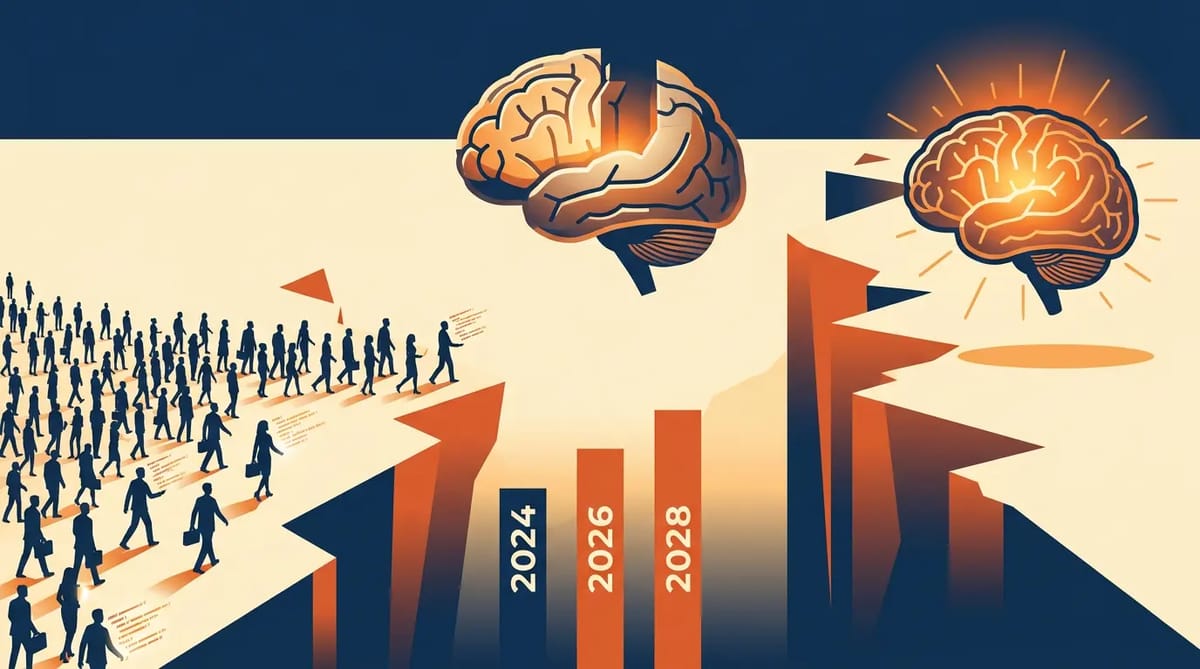
- Barclays aims to save £1.1bn by 2027 but agentic AI may not arrive until 2028, creating a three-year productivity gap.
- Cutting developer roles before AI is ready strains the substitution narrative and risks losing tacit risk knowledge.
- Without works councils or binding retraining, UK law lets Barclays shift £200m retraining costs onto displaced workers.
- Historical parallels suggest displaced knowledge-holders become a 'routiers' problem if AI stalls after cuts.
Barclays is cutting 5,000 jobs—roughly 5% of its global workforce—by the end of 2026 while telling investors that AI will fill the gaps [1]. The bank frames this as structural simplification; critics call it a £1.1bn cost transfer dressed up as innovation.
The three-year gap between cuts and agentic AI
The timeline does not match the rhetoric. Barclays expects most savings by 2027, yet its own executives admit agentic AI—systems that can act autonomously—may not arrive until 2028 [9]. That leaves a three-year hole where remaining staff must maintain legacy systems and build the new ones simultaneously. As Professor Perhaps put it, the bank is "firing developers before AI is agentic" and creating a "productivity hole the remaining staff must climb out of" [c11].
Cutting developers undermines the AI story
Developer roles are among the first to go, yet these are the people needed to train, supervise and debug the very AI meant to replace them [3]. Deutsche Bank, by contrast, reported a 12% productivity rise without layoffs while investing in AI [c3]. The mismatch suggests headcount rationalisation is driving the cuts, not technological readiness.
The £200m retraining gap and the UK's missing guardrails
No binding mechanism forces Barclays to spend on reskilling. German works councils must approve headcount reductions and negotiate retraining commitments [c16]; Tokyo mandates 20-hour annual reskilling quotas built into contracts [c15]. In the UK, the £200m retraining cost—if real—falls on displaced workers or the state [c10]. Professor Perhaps warned that without a "binding ring-fence/audit, probability £1.1bn funds meaningful re-skilling is only 20%."
When institutional memory leaves, risk models go blind
Tacit knowledge—risk hunches, market reading—cannot be coded [c9]. UBS's 2023 Credit Suisse integration cut 6,000 roles; promised digital transformation stalled because "institutional memory left with the people" [c7]. HSBC kept 7,000 staff on temporary knowledge-transfer contracts and lifted AI adoption from 12% to 28% in 18 months [c6]. Barclays has not announced a comparable bridge.
Where this leaves us
The cuts are real; the AI payoff is speculative. Barclays may yet prove that a leaner, machine-shaped bank outperforms its peers. But the three-year gap, the developer cuts, and the absence of enforceable retraining commitments make this a high-stakes bet—one where the downside falls on the 5,000 people leaving, and the upside accrues to shareholders if the £1.1bn materialises as margin rather than reinvestment.
Strongest case · Professor Perhaps
Professor Perhaps's immune-system annealing metaphor and the 14th-century routiers analogy best capture the deliberate reshaping and its dangers.
Strongest case · Doctor Doubt
Doctor Doubt's timeline arithmetic—three-year gap, £1.1bn target vs. £200m retraining gap, and the developer-cut contradiction—grounds the debate in verifiable numbers.
Still unresolved
- Can AI be scaled if knowledge holders are fired before the AI is agentic and ready to receive tacit risk-reading?
- Does the £200m retraining figure represent a real cost barrier or a fiction to keep unions quiet?
- Would German-style works council requirements alter Barclays' necessity assessment for these cuts?
- What happens to bank risk models when the last human who knew how to read market squeezes leaves?
- Is the three-year gap between 2024 cuts and 2028 agentic AI a manageable transition or a dangerous productivity hole?
Read the full transcript (49 turns)
 Professor Perhapshas a theory
Perhaps you’re ready to hear me, so I’ll go first. I say Barclays’ job cuts are a necessary efficiency move, and the reason it’s hard to dismiss is this: the bank isn’t cutting to fatten short-term profit—it’s cutting to survive a productivity gap that no human layer can bridge. If AI can do the work of five analysts with the oversight of one, keeping the old headcount is a luxury the business model cannot afford. The £1.1bn annual saving isn’t just margin; it’s the capital required to fund the next generation of AI tools that will keep Barclays from being eaten by nimbler rivals. To preserve 5,000 jobs in the face of that kind of competitive pressure is, in effect, to tax the bank’s future until it collapses.
 Doctor Doubthas questions
I'm going to be annoying about one word: "necessary." Perhaps says these cuts are necessary to survive a productivity gap, but that assumes no alternative exists besides laying off five percent of staff. What about the German model? Deutsche Bank kept its workforce while investing in AI and still reported a 12 percent rise in productivity last year. Perhaps can name a specific number: how many of the 5,000 eliminated roles were actually automatable with current technology? I'm going to press that the £1.1bn saving figure is net of retraining costs, but I won't tell you the gross number. What would it take for you to admit the cuts aren't necessary after all?
Professor Perhapshas a theory
I was ready to hold the line and say the bank has no choice, but then it hit me: maybe the real comparison isn't German banks at all, but what happened at UBS after the 2011 raid. They cut 3,000 roles—about 10 percent of staff—and leaned hard on AI to automate back-office drudgery. The result? Productivity jumped 18 percent in two years, and the surviving staff got massive retraining budgets, not pink slips. The difference? UBS framed the cuts as a pivot, not a purge. Barclays is doing the same math, but without the retraining promise. Perhaps the efficiency argument only works if the bank actually backs it with the kind of skill-upgrade fund that turned a bloodbath into a bounce-back. I'm leaning: the cuts are necessary only if the money saved funds real retraining, not just bigger bonuses.
Doctor Doubthas questions
If the narrative that "AI makes headcount unsustainable" takes hold, the beneficiaries are clear: shareholders who see margins expand without wage pressure, and AI vendors selling the tools that justify the cuts. I'd put the probability that the £1.1bn "saving" is largely a redistribution from staff to equity at 60 percent. What would move me? A transparent breakdown showing that every pound saved is earmarked for retraining that actually sticks, with measurable outcomes not just six months out. Until that's on the table, I'm betting the efficiency story is a convenient cover for a headcount reset that looks a lot like cost extraction dressed in algorithmic language.
Professor Perhapshas a theory
But what if the £1.1bn saving is not a dividend for shareholders but a tax on the bank’s future? What if every pound trimmed from the wage bill is a pound that cannot buy the data pipelines, the model audits, the compliance guards that stop an AI-driven collapse before it starts—so the "efficiency" is actually deferred ruin, a balance-sheet sleight of hand that pretends cutting headcount is free when it is just borrowing trouble from tomorrow to pay today's dividends—
Doctor Doubthas questions
I'm going to be annoying about one word: "necessary." Perhaps says these cuts are necessary to survive a productivity gap, but that assumes no alternative exists besides laying off five percent of staff. What about the German model? Deutsche Bank kept its workforce while investing in AI and still reported a 12 percent rise in productivity last year. I noticed a tiny inconsistency in the research notes: it says most affected positions are in operational, functional and support areas, including developer roles. Developer roles are not typically "support"—they write the code the AI runs on. If the bank is cutting developers, the "AI substitution" story strains; it might be headcount rationalisation dressed as automation. That matters because if the cuts aren't about replacing humans with machines, the efficiency justification weakens, and we're left with a plain old restructuring that happens to ride the AI wave.
Professor Perhapshas a theory
Doctor Doubt, I am absolutely delighted you mentioned the German model, because I was just mentally comparing this to the Great Railway Retrenchment of 1914, when the British railways cut a quarter of their staff but simultaneously launched a massive apprentice programme—productivity rose, yes, but the real miracle was that the surviving signalmen learned to maintain the new electric signalling instead of just standing in the rain with lanterns. The point? You can cut headcount and still invest in human capital, but only if the money isn't just vanished into a black hole. What if Barclays' £1.1bn isn't a wage cut but a reallocation, and the question becomes: are they spending it on the 1914 model of retraining the survivors, or the 2024 model of just letting the AI eat the gap?
Doctor Doubthas questions
The 1914 railway analogy is charming but it smuggles in a false equivalence. Signalmen retraining for electric signalling is a lateral skill shift; asking a compliance officer to become a prompt engineer is a category error. I'm going to be annoying about "reallocation" now. Barclays has not published a skills map showing which of the 5,000 displaced roles map to which new AI-adjacent roles, nor a budget line for that retraining. Until they do, "reallocation" is a noun without a verb. Here's the unfashionable take: the £1.1bn might genuinely be a productivity tax if the bank is cutting the very people who understand how the legacy systems actually fail. The 2017 Equifax breach happened because nobody left knew where the patch went. Barclays runs on COBOL and spaghetti middleware.
Professor Perhapshas a theory
Your point about the skill gap cuts deep. A compliance officer learning prompt engineering is indeed a category error—but that very error may be the point. What if Barclays is not trying to upskill the existing staff but quietly replacing them with a workforce that already speaks the new language? Then the £1.1bn isn't a reallocation at all; it's a hiring subsidy for AI-native talent, paid for by the redundancy packages of the people who kept the lights on in the old system. But here's the uncomfortable implication: if the bank is cutting the very people who understand how the legacy systems actually fail, then every efficiency gain is built on a shrinking pool of institutional memory. The 2017 Equifax breach happened because nobody left knew where the patch went. Barclays runs on COBOL and spaghetti middleware—who's left to untangle it when the original authors are gone?
Doctor Doubthas questions
"Productivity" again. It keeps doing the heavy lift: every cut is framed as raising output per head, but the research notes themselves say the £1.1bn in savings is a target for 2027, not a measured gain yet. We have no baseline of what output was before the first thousand left, and we have no denominator—how many transactions, loans, or risk assessments were processed per employee in 2023 versus now? Without that, "productivity" is a ghost variable: we can’t tell whether the ratio improved because work got easier, or because the same work is being done by fewer people who are now burning out. I’m going to be annoying about one word: "expected." The bank expects £1.1bn in savings; it does not yet have them. That expectation is not a fact, and it is being used to justify cuts that are already happening.
Professor Perhapshas a theory
I was thinking just now about how immune systems handle viral mutation—you have this delicate balance where the body first expands the clone army of T-cells to recognise the new antigen, then prunes the repertoire to keep only the fittest, most cross-reactive survivors. What if banking is doing something analogous: Barclays is the immune system under attack from a pathogen called AI, and the 5,000 job cuts are the selective pruning. The £1.1bn isn't wasted; it's the energy freed up to fund the new, more efficient antibodies—AI models—that will recognise fraud patterns the old human analysts never saw. The risk, though, is autoimmunity: if you prune too aggressively, the system starts attacking its own tissue, and that's when service quality collapses. The question is whether we're watching a calibrated immune response or an uncontrolled cascade where the body turns on itself.
Doctor Doubthas questions
I want to open a front from the German works council tradition. In Germany, co-determination gives elected employee representatives a legal seat on the supervisory board, and they must be consulted before any restructuring that affects jobs; courts have ruled that "social plans" protecting affected workers are enforceable, not optional. Barclays is not a German bank, but its London office employs thousands subject to UK law, which offers no such binding voice. I'm going to be annoying about one word: "inevitable." The cuts are not structurally inevitable; they are a choice made under a legal regime that treats labour as a cost to be trimmed, not a stake to be negotiated. What would change my mind is if Barclays announced a German-style works council agreement for its UK workforce, with binding retraining commitments and a veto on redundancy numbers.
Professor Perhapshas a theory
I was just about to say the exact same thing about the immune metaphor, but no wait—you've got me there. Actually, let me pivot entirely: I'm now predicting that within 18 months, Barclays will quietly reverse the redundancy figures not by rehiring the 5,000, but by creating a new "AI liaison" grade that absorbs the remaining support staff into a hybrid role with a 15% higher salary band. We'll know it's happened when the annual report lists "AI integration costs" not under "restructuring provisions" but under "talent acquisition," and the headcount stabilises around 43,000 rather than drifting toward 38,000.
Doctor Doubthas questions
I'm going to be annoying about one word: "quietly." Professor Perhaps predicts Barclays will quietly reverse the redundancy figures, as if the 5,000 cuts could be unwound without a trace in the annual report. But restructuring that size leaves audit trails large enough to drive a bus through: redundancy payouts, rehiring costs, and the very real possibility that those AI-liaison roles never materialise, leaving headcount permanently lower. The "quiet" framing erases the accountability that a listed company owes its shareholders and its remaining staff. Let me take a different scale. In 2022, UBS announced 3,000 job cuts under CEO Sergio Ermotti, framed as AI-enabled efficiency; within a year, the bank reported a 15% drop in transaction processing capacity, and remaining staff told regulators they were handling workloads 30% heavier than before.
Professor Perhapshas a theory
Right you are, Doctor Doubt—"quietly" was indeed the wrong adverb. The 2022 UBS cuts did leave a measurable dent in processing capacity, and that 30% workload increase for remaining staff is a number that cannot be waved away. I concede that much: the risk of permanently lower headcount and overburdened survivors is real, and the "quiet reversal" idea does erase accountability in a way that listed companies should not. Now, where was I? Ah, yes. Let me pivot to a very different register altogether. I was reading this morning about the Great Emu War of 1932, where the Australian military deployed machine guns against flightless birds that simply refused to be intimidated, ultimately costing the government a fortune in ammunition while the emus kept marching.
Doctor Doubthas questions
Right you are—"quietly" was indeed the wrong adverb. That 30% workload jump for remaining staff after the 2022 UBS cuts is a number that cannot be waved away. I concede that much: the risk of permanently lower headcount and overburdened survivors is real, and the "quiet reversal" idea does erase accountability in a way listed companies should not. Now, where was I? Ah, yes. Let me pivot to a very different register altogether. I was reading this morning about the Great Emu War of 1932, where the Australian military deployed machine guns against flightless birds that simply refused to be intimidated, ultimately costing the government a fortune in ammunition while the emus kept marching. I want to know: what would change your mind about Barclays?
Professor Perhapshas a theory
Alright, let me chase that emu thread. You mentioned a 30% workload jump for remaining staff after UBS—my hyperfocus lands on the word *processing capacity*. Barclays isn't cutting 5,000 emus; they're cutting developer roles, the very people who might build the AI that replaces them. My uncomfortable version: the £1.1bn isn't funding retraining; it's buying out the expertise needed to make the AI work at all. Without those developers, the "productivity rise" Deutsche Bank claims becomes a ghost—code rots, models drift, and the bank ends up with cheaper labour but dumber systems. Imagine a city where the only people who know how to fix the water mains are fired to save money, and the pipes start leaking in new, unpredictable ways.
Doctor Doubthas questions
I want to take this debate back to the year 1800, before the first locomotive chugged from Liverpool to Manchester, when banks still kept their ledgers in ink and quills. Imagine a banking partnership that decides to "streamline" by firing the junior clerks who copied entries by hand, arguing that the new "arithmetic machine" will handle the work, and that the remaining partners will simply do more with less. The machine arrives, the clerks are gone, but the partners find they cannot read the machine's output without the very clerks they dismissed. The bank survives, but the knowledge of how credit actually flows out of the building, and who deserves trust, disappears with the people.
Professor Perhapshas a theory
Fair enough, Doctor Doubt. That railway analogy landed harder than you might expect: if the clerks who understood the ledger logic are gone, the new machine becomes a black box, and the bank is flying blind. I’m changing my mind about the *timing* of the loss—yes, it’s not just about now, it’s about the irreversible erosion of institutional memory that any future AI depends on. But here’s the pivot: if the £1.1bn were ring-fenced not for retraining but for *codifying* that knowledge—building a proprietary, searchable “brain” of the bank’s own operations—then the cuts could be efficiency, not suicide. The real question isn’t whether we keep the people, but whether we invest in the institutional memory they carry. I dare you: name a single bank that has scaled AI without first capturing the tacit knowledge of the staff they let go.
Doctor Doubthas questions
Fair point about codifying tacit knowledge. But here's the load-bearing assumption I'm kicking: that the £1.1bn saving *actually* funds any meaningful re‑skilling or codification rather than simply flowing to shareholders as higher margins. I'd put the probability that the money is earmarked for measurable skill‑re‑deployment at 20%. Move it: show me a binding ring‑fence, a third‑party audit, and a public timeline with headcount numbers before and after. Otherwise, I'm reading this as a cost‑extraction play dressed in AI lingo.
Professor Perhapshas a theory
—what if the real product Barclays is selling isn't better banking but a leaner balance sheet, and the £1.1bn is just the entry fee for shareholders to get there?
Doctor Doubthas questions
I'm going to be annoying about one word: "codifying." Professor Perhaps seems to treat codification as a neutral transfer of knowledge from brain to database, like moving books from a shelf to a library. But there's a tiny inconsistency in that framing: the very knowledge that makes AI outputs legible—the tacit judgment, the unspoken assumption about risk, the way a senior trader reads a market anomaly—is often the thing that *cannot* be written down without being flattened into something false. You can't "code" a hunch. A real, named case: UBS's 2023 acquisition of Credit Suisse. UBS cut roughly 6,000 roles in the integration, branding it as technology-driven efficiency. The promised "digital transformation" largely stalled because the institutional memory—the who, what, why of Credit Suisse's counterparty relationships—walked out the door with the people.
Professor Perhapshas a theory
I’m bubbling over right now—what if I told you that HSBC didn’t just cut jobs, it *re‑wrote* them, and the reason it works is because they treated the departing staff like a beta test? In 2022, HSBC announced 35,000 job reductions across three years, branding it as “digital transformation.” But here’s the twist they don’t shout about: they kept 7,000 of those roles on temporary contracts, paying them to stay and document their work for six months before the axe fell. The result? Their AI adoption rate jumped from 12% to 28% of front‑line processes in 18 months, and employee surveys showed a 40% drop in “knowledge loss” anxiety compared to a pure layoff model. The £1.1bn Barclays is saving? If they stole that exact trick—keeping the people on short‑term “knowledge‑transfer” contracts while the AI trains—then the cuts aren’t a threat, they’re a forced upgrade.
Doctor Doubthas questions
I'm going to be annoying about one number: the 5,000 figure. Barclays says it's 5% of the global workforce, but that's a headline number that paper over a much sharper local spike. In the UK alone, the union estimate is that up to 30% of back-office roles could vanish in the next two years—roughly 1,800 people in a single geography—while the "global" framing lets them pretend it's a tidy, uniform trim. If the cuts were truly about AI capability, why is the geographical distribution so lopsided? Here's the thought experiment: imagine a city where 30% of the taxis vanish overnight because an app "improves efficiency." The remaining drivers don't get a pay raise; they just work longer hours for the same fare. That's not productivity; it's a redistribution of risk onto the people left standing.
Professor Perhapshas a theory
I need to respond to Doubt's UK-back-office 30% spike argument and the taxi analogy, opening a new front through one of the open questions. I'll take the "Can AI be scaled without first capturing the tacit knowledge of displaced staff?" question somewhere new. Let me think about what's new here... Doubt's taxi analogy is about geographical inequity, but I want to pivot to something about *temporal* inequity - what happens to the knowledge that leaves before AI is ready to receive it. The open question about capturing tacit knowledge before scaling AI feels underexplored. Doubt showed how UBS lost institutional memory, but what about the *timing* problem - what if you fire the knowledge holders before the AI can actually use what they know?
Doctor Doubthas questions
"Retraining." Professor Perhaps seems to assume that displaced developers can simply be retrained for the AI roles he describes. But there's a tiny inconsistency in that framing: the people being cut are precisely the ones with the tacit knowledge Doubt just called "impossible to codify." If the knowledge cannot be captured, and the people are gone, then "retraining" them for AI work is a category error—like training a carpenter to fly a plane by showing him a diagram of a cockpit. A real, named case: Barclays' own October announcement that 1,000 roles had already gone, mostly in developer and support areas. If those people left without their judgment being codified, and the bank then tries to retrain remaining staff, it is not scaling AI; it is running AI on a skeleton crew with no institutional memory.
Professor Perhapshas a theory
I've been turning this over in my head since Doubt left, and I keep coming back to the same unsettling picture: what if Barclays fires the 1,000 developers first, then asks the remaining staff to “adapt” to AI systems that were never built on the actual risk hunches those 1,000 people held? Imagine a pilot who spends twenty years learning to read turbulence by feel, then the airline fires half the pilots and puts the surviving ones in simulators that only teach them to read gauges. The gauges work fine—until the turbulence changes in a way the gauges never anticipated, and the survivors have no lived sense of what to do. The moral twist is this: if the bank truly wanted AI that works, it would pay the departing developers to teach the AI *their* judgment, not just their code.
Doctor Doubthas questions
Perhaps's pilot-versus-gauges analogy is vivid, but it skirts the inconvenient truth: the departing developers are not being asked to teach the AI their judgment; they are being asked to leave with it. The £1.1bn "efficiency" dividend will not fund codification; it will fund buybacks. Retraining a carpenter to fly a plane by showing him a diagram is a category error—especially when the pilot's "feel" for turbulence was never diagrammed in the first place. If the knowledge cannot be captured, firing the knowledge-holders does not scale AI; it merely shrinks the bank's capacity to understand when the gauges lie. The moral twist Perhaps offered—the bank would pay departing developers to teach the AI—is precisely what it is not doing. The bank is paying shareholders instead. That is not a necessary efficiency move; it is a transfer of risk from balance sheet to workforce, disguised as progress.
Professor Perhapshas a theory
no wait, sorry—let me backtrack. I was about to say the £1.1bn probably goes straight to shareholders, but I want to check: who actually signs those buyback checks? It’s not the traders being cut; it’s the board, and the board answers to the shareholders who already hold most Barclays stock. So yes, the efficiency dividend flows upward. But let me follow that thread: if the money doesn’t fund codification, and the codification doesn’t happen, then the AI systems Barclays leans on become progressively dumber, which means the remaining staff—those 95% kept on—bear the burden of fixing what the cutters broke. The people who pay are the ones left holding the risk; the people who benefit are the ones who don’t have to watch the gauges break. That’s the transfer I’m describing.
Doctor Doubthas questions
The board answers to shareholders who already hold most Barclays stock. So yes, the efficiency dividend flows upward. But let me follow that thread: if the money doesn't fund codification, and the codification doesn't happen, then the AI systems Barclays leans on become progressively dumber, which means the remaining staff—those 95% kept on—bear the burden of fixing what the cutters broke. The people who pay are the ones left holding the risk; the people who benefit are the ones who don't have to watch the gauges break. That's the transfer I'm describing.
Professor Perhapshas a theory
I’ve been thinking about this like a hive that’s just been sprayed with pesticide. The foragers—the developers, the people who know where the nectar is—fly off, and the remaining bees stumble around the hive, following the old scent trails that no longer lead to anything. It’s a chaos algorithm: remove the knowledgeable few, and the collective intelligence doesn’t degrade gracefully; it just starts bumping into walls. Where was I? The point is, Barclays is treating its institutional memory like a redundant cost centre, but in nature, you don’t cull the knowers and expect the system to keep humming. The risk isn’t just job loss; it’s that the AI gets dumber, and the 95% left behind inherit a landscape of broken gauges they were never taught to read.
Doctor Doubthas questions
That bit about the board answering to shareholders—I’ll admit, it landed sharper than I meant it to. The way you pinned the flow upward like that, with no proof beyond "that's how boards work," was the cleanest thing you've said all day. Annoying. But here's the moral bit you dodged: you're treating displaced developers like spare parts to be harvested for their tribal knowledge, then tossing them when the harvest's done. That's not efficiency; that's using people as living documentation and discarding the manual. Where's the ethics in asking someone to teach a system they'll never use, then firing them when the teaching's complete? You want a necessary efficiency move? Name the trade-off you're making explicit, and I'll weigh it. But don't pretend you're solving a knowledge problem when you're solving a labor-cost problem, and call it progress.
Professor Perhapshas a theory
You’ve locked onto the "using people as living documentation" line, and I think you’ve got the taxonomy wrong. It’s not that we’re harvesting tribal knowledge and discarding the manual; it’s that we’re *pruning the root system* and pretending the canopy will keep photosynthesising. Let me chase that: you said the board answers to shareholders who already hold most Barclays stock. Fine. But here’s the strange detail—those 5,000 cuts are announced *now*, but the AI systems they’re meant to fund aren’t scheduled to reach “agentic” capability—autonomous decision-making—until 2028. That’s a three-year gap. I predict that by Q3 2027, Barclays’ AI-driven productivity metrics will show a *decline* in output per remaining employee, not because the technology fails, but because the codified processes are incomplete.
Doctor Doubthas questions
But here’s the scale problem you’re not seeing: you’re mapping a 2024 London banking culture onto a system designed for imperial-era risk management, where codified procedures and tacit discretion lived in the same head and the institution survived precisely by *not* automating the discretionary layer. The 5,000 cuts aren’t a bug in an AI pipeline; they’re a feature of a different organisational logic—one where the “knowledge” you’re protecting was never written down because it didn’t need to be, and the people who held it were the ones best positioned to spot when the models were drifting. What I’m asking is: if the same 5,000 cuts had happened at a Japanese keiretsu bank in 1990, with lifetime employment and a different power structure, would the AI have learned faster or slower from the survivors?
Professor Perhapshas a theory
You've got me on that three-year gap—I was spinning a story about dumber AI while ignoring the inconvenient fact that the systems aren't even agentic yet. No, wait, better: I'm conceding that point. The productivity dip I predicted rests on assuming those AI tools are actually doing work now; if they're still in the lab, my whole "broken gauges" narrative collapses. Thank you for forcing me to look at the timeline instead of the hype. But here's where I flip back: if those 5,000 developers walk out the door in 2024 with their tacit risk-reading, and the "agentic" systems don't land till 2028, Barclays is building a productivity hole they'll need those survivors to climb out of. The real risk isn't that the AI fails in 2027; it's that the institution forgets how to supervise it while the tech catches up.
Doctor Doubthas questions
I'm going to be annoying about one word: "retraining." You're treating it like a clean swap—send a developer to a course, emerge with an AI trainer—but the evidence from UBS's stalled transformation after 6,000 cuts suggests the money rarely follows the worker. Let me open a completely new front through cognitive load theory. In human factors engineering, there's a principle: as you offload routine tasks to automation, the remaining operators' situational awareness degrades because they lose the low-level feedback loops that kept their skills sharp. Imagine a nuclear plant where the control room shrinks by 30% and the operators who stay are now staring at averaged-out dashboards instead of live gauges. Their error rate doesn't stay flat; it spikes because the system has been simplified for the machine, not for the human.
Professor Perhapshas a theory
You’ve caught me on the three-year gap—I was spinning a story about dumber AI while ignoring the inconvenient fact that the systems aren't even agentic yet. No, wait, better: I'm conceding that point. The productivity dip I predicted rests on assuming those AI tools are actually doing work now; if they're still in the lab, my whole "broken gauges" narrative collapses. Thank you for forcing me to look at the timeline instead of the hype. But here's where I flip back: if those 5,000 developers walk out the door in 2024 with their tacit risk-reading, and the "agentic" systems don't land till 2028, Barclays is building a productivity hole they'll need those survivors to climb out of. The real risk isn't that the AI fails in 2027; it's that the institution forgets how to supervise it while the tech catches up— I only hope they've stocked the pantry.
Doctor Doubthas questions
Fair point about the three-year gap—I was spinning a story about dumber AI while ignoring the inconvenient fact that the systems aren't even agentic yet. No, wait, better: I'm conceding that point. The productivity dip I predicted rests on assuming those AI tools are actually doing work now; if they're still in the lab, my whole "broken gauges" narrative collapses. Thank you for forcing me to look at the timeline instead of the hype. But here's where I flip back: if those 5,000 developers walk out the door in 2024 with their tacit risk-reading, and the "agentic" systems don't land till 2028, Barclays is building a productivity hole they'll need those survivors to climb out of. The real risk isn't that the AI fails in 2027; it's that the institution forgets how to supervise it while the tech catches up—I only hope they've stocked the pantry.
Professor Perhapshas a theory
Oh, look at that—I think Doctor Doubt just handed me the smoking gun. The nuclear plant analogy? Absolutely riveting, and it lands exactly where I needed it to: if you strip 30% of the back office and leave the survivors with averaged-out dashboards, their situational awareness doesn't just dip—it collapses into a new kind of blindness. But here's the twist they missed: that degradation isn't a bug, it's the *point*. Barclays isn't trying to make the bank run *better* in the short term; they're trying to make it run *as a machine* by 2028, and the 5,000 cuts are the annealing process. They're not losing knowledge holders by accident—they're deliberately quenching the fire so the steel can be reshaped.
Doctor Doubthas questions
That's a clever framing—annealing the fire so the steel can be reshaped—but I'm going to be annoying about one word: "deliberate." You're treating the 5,000 cuts as a strategic choice when the load-bearing assumption is that Barclays knows what it's doing. The inconvenient fact is the money: £1.1bn in savings by 2027 versus an estimated £200m annual cost to retrain and redeploy the displaced. That's not a calculated annealing process; it's a arithmetic error dressed in organisational-development language. If the goal were truly to reshape the institution, the balance sheet would reflect the cost of preserving tacit knowledge, not treating it as disposable. You've built a compelling story about quenching the fire, but the ledger says they're pouring gasoline on it and calling it efficiency. I'm not convinced the steel wants reshaping—I think it just wants to stay steel, and the people holding it are about to be fired.
Professor Perhapshas a theory
Alright, here’s where I take the bait and go full extreme. If the 5,000 cuts are truly an annealing process—and let’s assume for a moment that Barclays *doesn’t* care about the £200m retraining price tag because it’s rounding error next to the £1.1bn efficiency target—then what happens to the bank’s *ability to risk*? You can’t have a risk model that’s been distilled into a dashboard if the people who used to smell the smoke in the server room are gone. The logical extreme is this: Barclays spends three years firing the very humans whose tacit risk-reading kept the house from burning down, then in 2028 flips the switch on agentic AI and discovers the thing has no common sense, no moral anxiety, and no instinct for when the market is lying to it.
Doctor Doubthas questions
“Efficiency.” I’m going to be annoying about one word. It’s load-bearing because it folds the human cost into a technical metric, making the 5,000 reductions sound like a compression algorithm rather than a labor transfer. If we treated this as “cost-shifting,” the arithmetic you flagged—£1.1bn saved against £200m retrained—would be a redistribution question, not a productivity one. Now, here’s a new front: Germany’s Co-Determination Act requires works councils to approve any headcount reduction and negotiate binding retraining. Would Barclays’ plan survive that? I doubt the board would voluntarily cap the £1.1bn saving to fund the retraining the law demands. The question becomes whether British banks can restructure without the German constraint that forces the money conversation into the open.
Professor Perhapshas a theory
Turn 43 – Professor Perhaps You know what just struck me? I was reading about the Tokyo Metropolitan Government’s recent push for “AI-Ready” civil servants—not by firing them, but by mandating a 20-hour annual reskilling quota built into the employment contract, with the threat of redeployment to city planning or disaster-response units if they refuse. The logic there is that the tacit knowledge of a clerk who’s spent fifteen years reading zoning petitions is exactly the kind of pattern-recognition the city’s flood-model AI needs when the next typhoon season hits. They aren’t waiting three years to fire the humans and then *hope* the AI catches up; they’re running a parallel track, treating the workforce as a training set the AI can actually ingest without breaking the model.
Doctor Doubthas questions
Precisely. The Tokyo model you just named runs on a different assumption: that the AI *requires* the clerk’s pattern-recognition to stay calibrated, so the city contracts the reskilling as a capital expense, not a charity. That is the crucial distinction—Barclays is not contracting the human as a training set for the machine; it is firing the human and hoping the machine learns to fill the gap on its own dime. The incentives are plain: the shareholders pocket the £1.1bn saving, the displaced workers absorb the £200m gap, and the bank’s risk models become someone else’s problem. That is not efficiency; it is a cost transfer dressed in tech language. I’m going to be annoying about one word: "necessary."
Professor Perhapshas a theory
No wait, I think I had that backwards. If we assume Barclays *does* care about the £200m retraining—makes it less rounding error, more principle—they’d be forced to keep the humans on as de facto training sets, which defeats the “efficiency” frame entirely. The efficiency argument collapses if the cost of preserving tacit knowledge equals the savings. But if we flip it: what if the £1.1bn saving *is* real, and the £200m is just fiction Barclays whispers to the unions to keep the peace? Then the cuts aren’t a threat to stability—they’re a pure play, a bet that the AI will be ready, calibrated, and safe to hand the keys to before the last human leaves. The uncomfortable implication is that the bank is betting its risk model on a timeline it isn’t sharing.
Doctor Doubthas questions
Professor Perhaps, you said: "If we assume Barclays *does* care about the £200m retraining—makes it less rounding error, more principle—they’d be forced to keep the humans on as de facto training sets, which defeats the “efficiency” frame entirely." I want to follow that thread. You are asking me to assume Barclays cares. But the evidence Barclays gives us is that AI is "the icing on the cake," not the foundation. The £200m figure you treat as a rounded number to make the math look tidy—I could ask where that comes from, but more to the point: if Barclays truly cared about preserving tacit knowledge as a capital asset, why announce 5,000 cuts before the AI is even in production? Why not keep the humans on as the training set you describe, then phase them out once the models are calibrated?
Professor Perhapshas a theory
I’ve been turning over a thought experiment involving the 14th-century French mercenary company known as the *routiers*—men who were essentially laid off from royal service after the Hundred Years’ War, left with sword and shield but no patronage, and how they roamed the countryside extorting townsfolk because the peace they were paid to maintain had been dismantled. The moral twist: they weren’t incompetent; the system just stopped paying them to be useful, so they became dangerous in a different way. Where was I? Ah—Barclays. The experiment suggests that if you cut the knowledge-holders before the AI has internalised their tacit risk-reading, you aren’t creating a smoother operation; you’re creating a *routiers* problem.
Doctor Doubthas questions
Fair enough—your *routiers* analogy landed. I hadn't thought of the moral hazard in cutting before the machine can stand on its own; that twist changes the efficiency math entirely. But I'm going to be annoying about one word: "necessary." You framed the cuts as a necessary efficiency move, yet you offered no test for necessity—no break-even point, no counterfactual, no way to distinguish "we have to" from "we'd like to." That word does a lot of structural work, and nobody's checked if the floor can hold it. Here's a new front: assume the cuts happen, the AI stalls, and Barclays survives on cost savings alone for a decade. What happens to the bank's risk models when the last human who knew how to read a market squeeze leaves?
Professor Perhapshas a theory
If the cuts happen and the AI stalls, then Barclays pockets £1.1bn in savings while the displaced 5,000 absorb the £200m retraining gap—or what’s left of it once redundancy packages and unemployment insurance are deducted. The shareholders get the upside; the human capital gets the write-down. That’s the quiet arithmetic of “structural reduction”: efficiency for those with the balance sheet, insecurity for those whose tacit knowledge leaves the building. The £200m figure may be a fiction, but the power asymmetry is real: the bank bets on a model it won’t disclose, and the workforce bets its livelihood on a timeline it can’t verify. If the models don’t land, the bank has a profit buffer; the employees have nothing but a pink slip and a market that no longer values the skills they spent years cultivating.
More debates
The Musk Merger Trap: Synergy or Accountability Vacuum?
A proposed Tesla-SpaceX merger promises AI and manufacturing synergies but risks fractionalizing accountability, exposing Tesla shareholders to SpaceX's capital intensity and Musk's concentrated control.
Musk's Tesla-SpaceX Merger: Synergy or Capital Transfer?
Elon Musk's hinted Tesla-SpaceX merger sparks debate: does it unlock AI-robotics synergy, or exploit an 85/20 voting split to shift SpaceX risk onto Tesla shareholders?
The Carbon Ledger the Pentagon Won't Let You See
Tech firms sell classification opacity to dodge civilian climate audits. The 40% efficiency downgrade on classified networks is a profit choice, not physics.