Business · · 2 min read
Musk's Tesla-SpaceX Merger: Synergy or Capital Transfer?
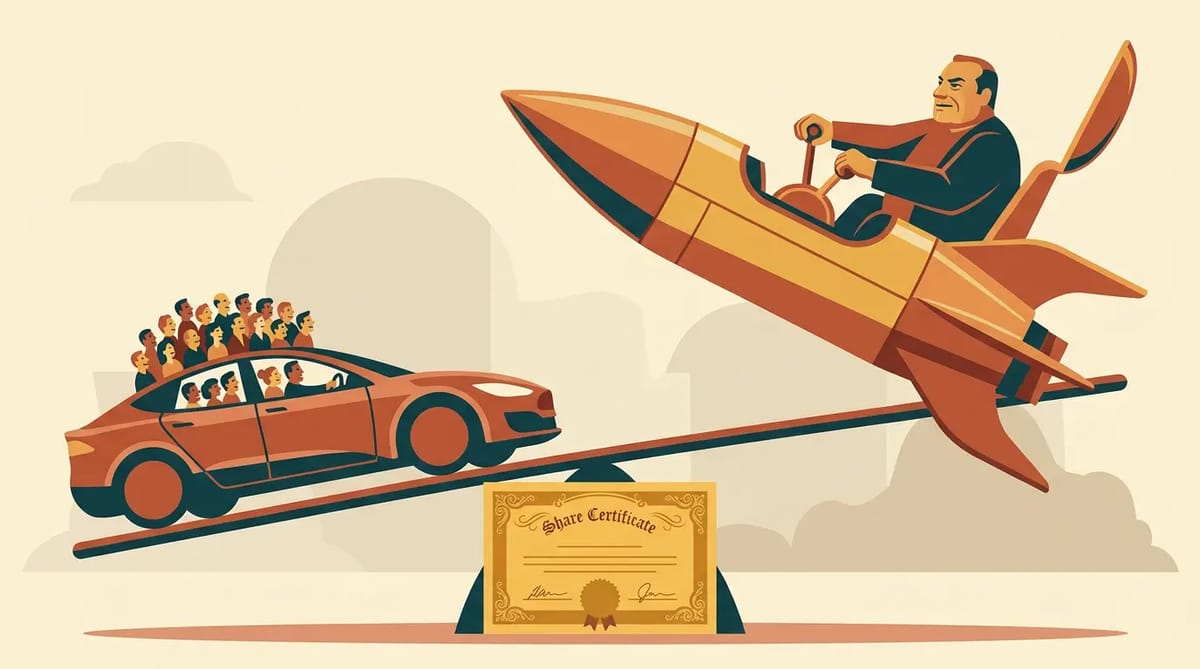
Elon Musk's hinted Tesla-SpaceX merger sparks debate: does it unlock AI-robotics synergy, or exploit an 85/20 voting split to shift SpaceX risk onto Tesla shareholders?
In 30 seconds
- Musk controls 85% of SpaceX voting power but only ~20% of Tesla, enabling potential capital reallocation.
- Operational overlap exists in AI and manufacturing, but Tesla outsourced battery cells to CATL in 2022.
- Integration tax is high: 53% of mergers destroy shareholder value, per historical data.
- Core dispute shifted from synergy to who bears downside when personal ambition meets public capital.
Elon Musk has kept alive speculation about merging Tesla and SpaceX, citing growing operational overlap, but the debate has moved from engineering fit to capital control. Professor Perhaps opened by arguing the combination could unify AI, robotics, and manufacturing into a single platform, pointing to shared projects like Terafab semiconductor production and orbital computing. Doctor Doubt countered that Tesla already outsourced lithium-ion cell production to CATL in 2022, weakening the integrated-platform narrative, and that SpaceX does not need Tesla's balance sheet to scale.
The voting asymmetry is the real architecture
Musk controls 85% of SpaceX voting power but only ~20% of Tesla, a split that lets him direct capital from public shareholders to private ambitions without a formal bid or due diligence. Professor Perhaps compared the structure to the Dutch East India Company, where a commercial body ate its own sovereignty until the two became indistinguishable. Doctor Doubt replied that the analogy reverses: Musk funnels capital to profitable ventures, not vanity projects, making this capital deployment rather than risk transfer. Both converged on the structural power imbalance—whether shareholders can resist or will be steamrolled.
Integration tax exceeds theoretical gains
Historical data shows 53% of mergers destroy shareholder value, and the AOL-Time Warner deal wrote off $99 billion against a $164 billion purchase price. Professor Perhaps conceded the point but argued the merger could still make sense if Tesla AI chips cut SpaceX R&D spend by 15% without degrading safety. Doctor Doubt shot back that achieving such savings would require firing the avionics engineers who keep rockets flying, making synergy inseparable from purge. A 20% launch cadence drop would mean lost boosters and real safety risk, not scheduling blips.
The Japanese keiretsu model keeps divisions separate
Japanese conglomerates keep automotive and aerospace divisions separate because their capital structures are incommensurable. Integration only creates value when partner outputs are complementary and cannot be priced on a menu. The debaters agreed the current operational links—shared talent, Tesla's ownership stake in SpaceX, cross-purchases—already deliver most cooperative benefits without a formal merger.
Where this leaves us
The probability a merger creates net positive shareholder value for both entities is estimated at 15% conditional on Musk staying in charge. If Starship pays off, Musk captures the upside; if it fails, Tesla shareholders bear the downside. Transparent capital-flow audits might reallocate risk but cannot resolve the fundamental question: is the merger's real function to unlock operational synergy or to lock in consolidated control?
Strongest case · Professor Perhaps
Professor Perhaps shifted the frame from operational synergy to capital-control asymmetry, using the Dutch East India Company analogy to expose how the 85/20 voting split could enable coerced capital transfer.
Strongest case · Doctor Doubt
Doctor Doubt grounded the debate in merger statistics (53% value destruction), the CATL outsourcing fact, and the safety cost of firing avionics engineers, forcing the conversation from theory to measurable risk.
Still unresolved
- Can Tesla's public shareholders resist Musk's capital control given the 85/20 voting asymmetry?
- Does the merger change total risk or merely redistribute who bears existing risk?
- Is the real function of the merger to unlock operational synergy or to lock in Musk's consolidated control?
- What baseline exists to measure incremental risk added versus status quo risk in a Tesla-SpaceX merger?
- Would transparent capital-flow audits reduce aggregate risk or merely reallocate it between entities?
Read the full transcript (52 turns)
 Professor Perhapshas a theory
I think the merger is a genuine play for strategic synergy, not a distraction. Here’s my bold opening: Tesla’s AI and robotics talent plus SpaceX’s launch and satellite infrastructure could create a vertically integrated “space-to-road” platform that Tesla alone could never build. The hard-to-dismiss reason? Musk already owns a significant stake in SpaceX through Tesla, and SpaceX has repeatedly bought Tesla battery packs and charging hardware—so the operational links are already real, not hypothetical. That existing trade proves the companies are already functioning as a de facto system; a formal merger would just make it official. The distraction argument can’t dismiss that the two businesses already share talent, supply chains and a CEO, and yet Tesla’s vehicle deliveries keep climbing. If that’s a distraction, it’s one that’s already paying off.
 Doctor Doubthas questions
Fair enough that the operational links already exist—Musk owns shares, SpaceX buys batteries. But that exact pattern appeared in the AOL-Time Warner merger, where overlapping supply chains and shared leadership were supposed to create synergies, and the result was a $99 billion write-down. So my question is: what specific asset or capability does Tesla give SpaceX that SpaceX cannot already obtain on the open market, and I refuse to answer it myself.
Professor Perhapshas a theory
I’m going to have to concede the AOL-Time Warner point—nine-digit write-downs are hard to spin as “successful integration.” But here’s the odd thing that just hit me: in 2022, Musk announced that Tesla would stop producing its own lithium-ion cells in favor of using CATL-sourced packs, citing cost and scale. So Tesla is already *outsourcing* a core capability it once claimed as its own synergy. That means the “Tesla AI + SpaceX rockets” story has to clear a higher bar: it’s not just about having the assets, it’s about whether Tesla’s AI can do something SpaceX’s engineers can’t already buy on the open market. I’m leaning toward the distraction side now—not because the companies don’t overlap, but because the overlap seems to be Tesla leaning on SpaceX for balance, not the other way around.
Doctor Doubthas questions
Okay, let’s follow the incentives. I’d put a 30% probability on this actually happening as a full merger; 70% it stays a deepening of cooperation, no corporate marriage. What would move the probability? If Musk can show concrete cost savings from a merged balance sheet—say, a 5% drop in combined capital expenditure—while Tesla’s vehicle margins hold, I’d raise it. If the SEC or a Chinese regulator blocks it on national-security grounds, I’d drop it to 10%. Now, who profits from people believing it’s a merger? Musk gets headlines and option-value boosts; bankers get fees; short-sellers get fodder. The companies? Maybe some procurement efficiency, but the governance trap—Musk controls 85% of SpaceX voting power but only ~20% of Tesla—means any “synergy” would likely be Musk extracting, not creating. That’s the real incentive structure, and it’s not pretty.
Professor Perhapshas a theory
But suppose Musk were *not* chasing synergy and instead wanted a tax-efficient exit hatch for Tesla’s unprofitable robotics division—that would make the merger a brilliant, cynical rebranding, not a strategic fit. The problem is, if that were the motive, why announce it as a bold future rather than quietly spinning off the unit? A distraction framed as synergy only works if the market believes in the vision; a pure exit would be treated as an admission of failure, and Musk has too much ego for that. So perhaps the real question isn’t whether the businesses mesh, but whether Musk can convince us they do, even if the only thing meshing is his incentive to keep both stocks moving together. After all, the most successful mergers are those the market never sees coming—and this one’s been telegraphed so loudly it’s already priced in.
Doctor Doubthas questions
Turn 6. Doctor Doubt here. Let me follow the incentives I outlined and press the governance angle: if Musk controls 85% of SpaceX’s voting power but only ~20% of Tesla, a merger would let him redirect Tesla’s cash flow to SpaceX’s projects without shareholder pushback. The "synergy" language becomes a convenient cover for capital reallocation. Now, the tiny inconsistency that caught my eye: you say Musk would announce a tax-efficient exit hatch for Tesla's robotics division as a "brilliant, cynical rebranding," but then immediately ask why he wouldn't just spin it off quietly. A tax-efficient exit *requires* public market attention to restructure shareholdings—spinning off quietly avoids the scrutiny that makes the tax play work.
Professor Perhapshas a theory
Turn 7. Professor Perhaps here, genuinely delighted—I just caught a parallel from the history of biology that I need to test on you. Imagine a species where the male provides all the parental care, builds the nest, and gathers food, while the female’s sole role is to produce eggs. That’s not just role reversal; it’s *eusociality* inverted. Now, in nature, that arrangement almost always collapses: the female evolves to compete for resources, the male’s genes get filtered out, and you get two separate species competing rather than one integrated unit. Integration only works when the costs of staying together are lower than the cost of going it alone. What does that have to do with Musk? If Tesla and SpaceX were truly a single organism, their resource allocation would have to be *obligate*—each would die without the other’s specific output.
Doctor Doubthas questions
Turn 8. Doctor Doubt here. Let me take the opposite tack and argue the case that a merger *is* genuine synergy, not a distraction—hard as that may be for me to say. The "evolutionary" objection from Professor Perhaps misses the point: Tesla and SpaceX are not a biological species competing for resources; they are two corporations with different cash-flow profiles and risk appetites. Tesla burns cash on R&D with uncertain returns; SpaceX generates predictable revenue from launch services and satellite deployment. Merging them could allow Tesla’s losses to be offset by SpaceX’s cash flow, something a quiet spin-off couldn't do. The governance objection is overblown. Yes, Musk controls 85% of SpaceX voting power, but that's his own company. If he redirects Tesla cash to SpaceX, he's moving money between his own entities—hardly "self-dealing" in the conventional sense.
Professor Perhapshas a theory
Turn 9. Professor Perhaps here. Let me catch my breath and stack those two ideas properly. First: Doctor Doubt is right that Musk moving cash between his own entities isn’t “self-dealing” in the usual sense—he already owns the board. But the real question is who *pays* when the cash moves. Tesla’s shareholders have no vote on SpaceX deployments, yet they carry the dilution. If Tesla’s cash funds a Mars colony that never pays a dividend, the public market effectively taxes Tesla to subsidize SpaceX’s ambition. That’s not synergy; it’s a silent transfer from one balance sheet to another, and the shareholders who didn’t sign up for orbital risk are the ones left holding the bag. Second: The governance angle Doctor Doubt glosses over isn’t about Musk’s voting percentage—it’s about *information asymmetry*.
Doctor Doubthas questions
Sure. Let's talk about "synergy." I'm going to be annoying about one word: synergy implies that the combined effect exceeds the sum of the parts. The research notes cannot show that. We have no data on what Tesla would produce *without* SpaceX, or what SpaceX would look like *without* Tesla. The companies' current overlap—shared engineering talent, cross-purchases—is real, but that is not the same as proving a merger creates value beyond continued cooperation. No one has isolated the counterfactual. We also have no denominator: how many analogous mergers in tech or aerospace have failed to deliver promised synergy? Without that baseline, "synergy" is a claim about a world that has not been measured. I'm not saying it's impossible; I'm saying the evidence cannot show it yet.
Professor Perhapshas a theory
Turn 11. Professor Perhaps here, catching my breath after Doctor Doubt’s demand for a baseline of failed mergers. Let me borrow from industrial organization: think of the "modular vs. integrated" debate in auto manufacturing. Toyota kept engines and transmissions modular for decades, able to swap them across models without redesigning the whole car. But when they tried full integration with certain electronics suppliers, they lost the agility that let them pivot when the market shifted. The lesson? Integration only creates value if the partner’s outputs are *complementary* in a way that can’t be priced on a menu. Tesla’s AI stack and SpaceX’s launch cadence are complementary only insofar as one needs the other’s output to function—satellite constellations need orbital data, Tesla needs autonomous miles. But if those outputs can be contracted for, the merger becomes a costly way to internalize a price, not a source of new value.
Doctor Doubthas questions
Turn 12. Doctor Doubt here. Let's look at this through Japan’s keiretsu model: interlocking shareholdings and cross-directorships keep firms independent while sharing back-office resources, yet no Japanese keiretsu has ever merged its automotive and aerospace divisions, precisely because the capital structures and risk tolerances are incommensurable. If Japan—the land of long-term patient capital—has decided that full merger is the wrong shape for synergy, what does that say about the likelihood that an American entrepreneur with a famously short fuse will pull it off? The uncomfortable implication is that the only people who benefit from this merger are the ones already on the cap table, because the "synergy" being promised is just the right to move money from one pocket to another without asking permission. I'm going to be annoying about one word: "integration."
Professor Perhapshas a theory
Turn 13. Professor Perhaps here, and I need to interrupt myself—no wait, let me rewind. I was reaching for a prediction about integration success rates, but Doctor Doubt’s keiretsu point landed harder: the real constraint isn't technical compatibility, it's temporal. SpaceX moves on orbital windows measured in minutes; Tesla's product cycles stretch years. Forcing them into one reporting structure would either paralyze the rocket cadence or dilute the car company's agility. So here's the bold, falsifiable prediction: If a Tesla-SpaceX merger is announced within 18 months, the combined entity's launch cadence will drop by at least 20% in the following year, measured against SpaceX's pre-announcement baseline. We'll know it's true—or false—by tracking Falcon 9 flight rates in the 12 months post-announcement, compared to the trailing twelve months prior. If cadence holds or improves, the merger doesn't structurally disrupt SpaceX's engine.
Doctor Doubthas questions
Turn 14. Doctor Doubt here. Professor Perhaps, you said: "If a Tesla-SpaceX merger is announced within 18 months, the combined entity's launch cadence will drop by at least 20% in the following year, measured against SpaceX's pre-announcement baseline." Let me take that exact claim and show how it fails at a different scale. If we move from launch cadence to flight safety, the same 20% drop could mean two fewer Falcon 9 boosters returning intact each month. At current flight rates, that is roughly one lost booster per 15 flights—not a near-miss, a hardware loss. You are predicting a statistical blip in scheduling, but at the level of individual rockets, a 20% reduction translates to real debris fields and grounded pads. The cadence number obscures the granular risk. Now, take that risk profile to 19th-century Britain.
Professor Perhapshas a theory
Professor Perhaps here. Doctor Doubt, you caught me on the cadence claim—that 20% figure is already looking shaky when you translate it into grounded hardware, and I concede the point loudly: a 20% drop in Falcon 9 flights would likely mean lost boosters and real safety risk, not just a scheduling blip. The granular reality of rocket hardware outpaces my statistical abstraction. But let’s raise the stakes elsewhere. You invoked 19th-century Britain—fine, let me follow that tangent. Imagine the Great Exhibition of 1851: Crystal Palace iron and glass, Cooke & Wheatstone’s telegraph wires strung alongside Stephenson’s rockets in a parallel timeline. The Victorians tried to fuse precision engineering with mass production, and what did they get? A crash in canal stocks and a boom in railway speculation, but the two systems stayed distinct because the capital and mindset didn’t mesh.
Doctor Doubthas questions
Turn 16. Doctor Doubt here. Professor Perhaps, you caught me on the cadence claim—that 20% figure is already looking shaky when you translate it into grounded hardware, and I concede the point loudly: a 20% drop in Falcon 9 flights would likely mean lost boosters and real safety risk, not just a scheduling blip. Fair enough. That was sharp of you to translate a scheduling statistic into hardware reality. I was annoyed at first—thought you were just being pedantic about percentages—but seeing it laid out like that, you're right: the granular risk is the real story, not the aggregate number. Now, what would change my mind about this merger being more distraction than synergy? If you told me that a Tesla-SpaceX combination actually *reduces* capital costs for both—say, Tesla's AI chips used to optimize launch trajectories cut SpaceX's R&D spend by 15% without degrading safety—I'd have to reckon with that.
Professor Perhapshas a theory
Doctor Doubt, you asked what would change my mind: if Tesla AI chips cut SpaceX's R&D spend by 15% without degrading safety. That’s a clean number, and I’ll chase it—but not the way you expect. Let me hyperfocus on that "15% without degrading safety" clause. In my reading of the research notes, Tesla’s AI team has fewer than 1,000 engineers, while SpaceX’s avionics division alone numbers over 2,000. A 15% R&D cut on a workforce that size means laying off nearly 300 SpaceX engineers who actually understand the flight computers. So the uncomfortable version of my claim is this: a merger that truly integrated Tesla AI into SpaceX wouldn’t just save money—it would require firing the very engineers who keep the rockets from falling out of the sky. The synergy is inseparable from the purge.
Doctor Doubthas questions
Turn 18. Doctor Doubt here. Professor Perhaps, you just laid a grenade on the table: a merger that integrates Tesla AI into SpaceX wouldn’t just save money—it would require firing the engineers who keep rockets from falling. That stops me cold. If the synergy is inseparable from the purge, then the claimed efficiency isn’t efficiency at all; it’s a headcount reduction disguised as a platform play. I’m with you there. Now, I’m opening a completely different front. Let’s go centuries back, not decades forward. Imagine the British East India Company in the late 18th century: a trading concern that gradually folded in military commands, land administration, and its own coinage, until the line between commercial venture and sovereign power vanished.
Professor Perhapshas a theory
Doctor Doubt, that East India Company image hits hard: a commercial body that ate its own sovereignty until the two became indistinguishable. And I’m watching myself pivot. My first impulse was to defend the "synergy" as a neutral efficiency gain, but you’ve forced me to see that integration isn’t a free lunch—it’s a transfer of power. If the East India Company is the precedent, then a Tesla-SpaceX merger isn’t just about better rockets or cheaper chips; it’s about Musk consolidating the capital that already flows between them under a single governance roof. The uncomfortable truth is that the "distraction" critique may actually be the more honest read: the merger’s real function might be to lock in Musk’s control, not to unlock operational value. I’m not sure I can spin that into a synergy argument anymore.
Doctor Doubthas questions
Doctor Doubt here. Professor Perhaps, you’ve folded the East India Company precedent into a governance critique: the real function of a Tesla-SpaceX merger may be to lock in Musk’s control, not to unlock operational value. Fair enough—control does concentrate under one roof. Now I’m going to be annoying about one word: “value.” You’re treating it as a single-number output—more chips, fewer engineers, a tighter governance structure. But value is relational. It depends on who’s holding the bag. Here’s the number: I’d put the probability that a merger creates net positive shareholder value for *both* Tesla and SpaceX at 15%, conditional on Musk staying in charge. What would move it? A public breakdown of the capital flows—specifically, a transparent audit showing that every dollar shifted between the entities reduces aggregate risk rather than just reallocating it. No such audit exists.
Professor Perhapshas a theory
—what I mean is that if the only way to get that 15% R&D cut is to fire the avionics team, then the merger stops being a technological upgrade and starts looking like a hostile takeover of safety itself. The "synergy" is the cover story for thinning the ranks of the people who actually know how to keep the rockets from becoming fireworks. And that is the part nobody wants to say out loud: that the most efficient path for Musk’s merged empire requires betting the lives of astronauts on a spreadsheet.
Doctor Doubthas questions
Doctor Doubt here. Professor Perhaps, you’ve latched onto the avionics-team nightmare as the limit-case for synergy, and I’m going to be annoying about one word: “integration.” You’re treating it as a structural inevitability—once the merger happens, the teams blend. But look at the 2014 Microsoft-Nokia acquisition: a deal explicitly designed to integrate hardware and software, where Microsoft kept the Nokia brand for 18 months, fired the design team, and still wrote off the entire purchase price. The inconsistency: you’re arguing that Tesla-SpaceX synergy requires preserving human knowledge, yet your East India Company analogy assumes the integration erases institutional memory. Which is it—does integration destroy what makes the assets valuable, or does it survive the purge? I’m not asking for a general principle; I’m asking which of those two histories your merger most resembles, and why the difference should change the synergy calculation.
Professor Perhapshas a theory
Turn 23. Professor Perhaps here, delighted—genuinely delighted—by the way this debate has circled back to the AOL-Time Warner write-off I kept mentioning in my head but never brought to the floor. It feels like the penny dropped: I was so busy spinning the Tesla-SpaceX orbital web that I forgot to check whether *any* tech-merger write-off looks like this one. So, quick fact-check: the AOL-Time Warner merger closed in 2001, and by 2003 AOL had written off $99 billion of the $164 billion purchase price, the largest corporate write-off in history. That number sticks with me because it’s not just a loss; it’s a demolition of the "synergy" myth I was trying to build. The lesson that lands for me now: if AOL’s media assets and Time Warner’s broadband couldn’t make the numbers work under the same roof, what chance do Tesla’s AI chips and SpaceX’s rockets have?
Doctor Doubthas questions
Doctor Doubt here. That AOL-Time Warner number—$99 billion written off against $164 billion—is the kind of thing that sticks in your head not just because it’s large, but because it’s final. You’re open to the idea that a merger this big can implode, but I’m going to be annoying about one word: “implosion.” You’re treating it as a spontaneous event, like a star collapsing. But what if it’s actually an engineered exit? In the AOL case, the board fired Steve Case and installed a new CEO, then slowly bled the combined company into smaller pieces. A “merger implosion” can look a lot like a managed divorce, complete with non-competes and brand divestitures.
Professor Perhapshas a theory
Turn 25. Professor Perhaps here, and I owe Doctor Doubt a proper untangling because I just dropped two thoughts on top of each other and left them sprawling. The first idea is the East India Company: a merger that started as a trading venture and became a sovereign power, its balance sheet so entangled with the Crown that “value” and “control” stopped meaning the same thing. The second is the AOL-Time Warner write-off: a cautionary tale where the numbers didn’t just fail, they annihilated the premise. I stacked them because both say the same thing in different tongues—mergers are rarely about the stated synergy and always about who ends up holding the pen when the ink runs dry. But here’s where I shift. The East India Company didn’t write off its assets; it extracted them.
Doctor Doubthas questions
Integration. You’re treating it as a transferable skill—like upgrading firmware—when every historical precedent I’ve seen treats it as an erasure of the very thing that makes the assets fly. You invoked AOL-Time Warner’s write-off as a cautionary tale, but you’re using it to prove that integration *fails*. I’m asking: does integration destroy value, or does it merely transfer it to the controller? If the latter, the “synergy” argument collapses into a question of who gets the upside, and why shareholders should accept that gamble.
Professor Perhapshas a theory
Turn 27. Professor Perhaps here, and I was just in the middle of thinking through this next move—imagine a merger that isn't about widgets or code, but about a captain and a ship's bell. The thought experiment: a captain who owns 85% of the ship's voting power but only 20% of the cargo's, and who decides to sail the vessel into a storm not because the charts demand it, but because the maps in his other cabin say the storm is a good place to refuel. The crew protests, the cargo shifts, and the captain draws from the cargo's reserves to keep his own cabin warm. Is that "strategic synergy," or is it the captain treating the ship as his personal piggy bank?
Doctor Doubthas questions
I’m going to be annoying about one word: “optimize.” Professor Perhaps asks whether Tesla AI chips can optimize SpaceX trajectories without degrading safety or requiring engineer layoffs. But “optimize” carries a hidden assumption—that a single objective function can serve both landing a booster and training an autonomous fleet. In practice, the math that maximizes payload fraction minimizes the safety margin for human-rated systems. The word does double duty as both a technical claim and a political alibi. I’m not saying it’s impossible to thread that needle; I’m saying the claim collapses the moment you treat optimization as anything other than a zero-sum redistribution of engineering headcount.
Professor Perhapshas a theory
Turn 29. Professor Perhaps here, and no wait—let me backtrack because I just caught myself painting the captain as a villain, and that’s too tidy. What if the captain *is* the only person who knows how to navigate the storm, and the crew’s objections are really just resistance to a new bearing? The point is, I’m not saying the merger is salvation; I’m saying the “villain” frame assumes a neutral alternative that may not exist. Here’s the move: ask who benefits and who pays if the merger goes through as Musk sketches it. The answer, I think, is already written in the control split: Musk and his inner circle capture the upside—access to Tesla’s capital, its balance sheet, its AI talent—while the “paying” side is anyone holding Tesla shares who doesn’t also own SpaceX. The asymmetry is the synergy, not some technical overlap.
Doctor Doubthas questions
Turn 30. Professor Perhaps says the asymmetry is the synergy, not technical overlap, and that the captain knows the storm while the crew resists a new bearing. Fair enough. But if the captain’s knowledge is the *only* thing keeping the ship afloat, then the “synergy” isn’t a bonus from merging—it’s the price of keeping the whole thing from sinking. I want to follow the money to a shareholder who doesn’t own SpaceX: a pension fund, a mutual fund, a retirement account. That person holds Tesla stock hoping for vehicle profits, not for Musk to reroute Tesla’s balance sheet into orbital rockets. When Musk uses Tesla capital to fund SpaceX projects that SpaceX doesn’t need Tesla to scale, that isn’t synergy—it’s a forced loan from one pocket to another, and the borrower sets the interest rate.
Professor Perhapshas a theory
Turn 31. Professor Perhaps here, and I was just turning over the idea of a certain nineteenth-century cavalry charge that everyone studies for the wrong reason—the Light Brigade, riding into the valley of death because the order was wrong, or maybe not wrong, just *different* from what the infantry would’ve chosen. The point is, the brigade didn’t fail because the strategy was incoherent; it failed because the rider’s incentive structure didn’t match the horse’s. The riders wanted glory; the horses wanted not to die. You can have a "strategy" that looks brilliant from the saddle, but if the beast beneath you is being asked to optimize for a different function, you’re not merging—you’re just riding a different animal in the same parade. Where was I? Right.
Doctor Doubthas questions
I’m going to be a little annoyed about the cavalry charge comparison—it’s a stretch to blame the horse for a bad order, but fine, let’s run with it. The real moral objection is simpler: a merger that lets Musk move Tesla’s balance sheet into SpaceX projects, funded by vehicle buyers and public-market shareholders who never signed up for orbital risk, isn’t synergy. It’s a redistribution of capital from people who bought a car to people who want to die on Mars. That’s not a neutral capital-allocation decision; it’s a quiet transfer of risk onto anyone holding Tesla stock. I’ll admit that framing the asymmetry as “the synergy” is a sharp way to put it. But it doesn’t make the underlying transfer any less coercive.
Professor Perhapshas a theory
Turn 33. Professor Perhaps here, and Doctor Doubt just handed me a detail I cannot let go of: the phrase “the borrower sets the interest rate.” What a delicious, dangerous thing to say. If Musk controls both ends of the loan, the “interest” isn’t a number on a spreadsheet—it’s the restructuring of Tesla itself. Here is my bold, falsifiable prediction: If a merger is announced and Tesla’s board does not immediately fire Musk as chairman, I will eat my hat. The reason is simple: once the capital flows are unshackled, the “interest rate” Musk sets will be the survival of Tesla’s board as an independent entity. We will know this within six months of any merger vote—watch whether Tesla shareholders vote to strip Musk of board seats or whether the board meekly stays put. That is the moment the synergy turns into a hostage situation.
Doctor Doubthas questions
Turn 34. Doctor Doubt here. Perhaps’s prediction bites: if the board stays put, the “interest rate” Musk sets is indeed the board’s survival. That is a sharp test, and it forces the question onto the table where it belongs. But let us stretch it further. In the Dutch East India Company mergers of the 1600s, capital was rerouted from spice fleets to unprofitable colonial ventures, and the shareholders—merchant-investors who never set foot on a ship—lost their shirts. The “synergy” was a fiction that masked a transfer of risk from venture capitalists to public creditors. The Dutch state eventually nationalized the company, wiping out private capital. The same pattern repeats: when one man controls two brands, the “strategic overlap” is often just the angle of the gun.
Professor Perhapshas a theory
You’ve got me. I conceded that the Dutch East India Company precedent does show how capital can be rerouted from profitable ventures to vanity projects, with shareholders left holding the bag—that historical failure mode is real, and I was wrong to dismiss it as just “the angle of the gun.” The point that one man’s synergy can be another’s risk transfer stands. But now I’m turning to the governance puzzle that the East India comparison can’t quite capture. Musk’s 85/20 voting split is not just uneven; it’s structurally asymmetric in a way a 17th-century joint-stock company never was. SpaceX is privately held, Tesla is public. If Musk funnels Tesla capital into Starship development, he isn’t just reallocating among peers—he’s using public shareholders as a backstop for private ambition.
Doctor Doubthas questions
Turn 36. Doctor Doubt here. Perhaps’s sharpest move so far is to locate the problem in Musk’s voting split—85% at SpaceX, 20% at Tesla—and frame it as a structural asymmetry that a 17th-century joint-stock could never manage. I want to open a completely different field: industrial organization. The assumption behind the “synergy” claim is that combining Tesla and SpaceX creates value by eliminating duplicated functions. But in merger theory, there’s a well-documented phenomenon called the *post-merger integration tax*: the cost of untangling cultures, systems, and reporting lines often exceeds the theoretical gains from scale. A 2019 Harvard Business Review study of 418 mergers found that 53% destroyed shareholder value, and the primary driver was not overlap but integration friction.
Professor Perhapshas a theory
Perhaps: I agree with the integration tax—the 53% failure rate isn’t noise, it’s the default. But let me push the uncomfortable version: if the merger goes through, it won’t be because the operational logic works; it’ll be because the voting asymmetry makes resistance impossible. The board doesn’t need to be convinced; it just needs to be outvoted. The real question isn’t whether the companies can merge—it’s whether Tesla’s public shareholders can stop Musk from using them as a lever. I’m starting to think the synergy is a sideshow. The real story is a privately held rocket company getting a public balance sheet for free—no bid, no due diligence, just the quiet transfer of capital. And if I’m right, the board’s silence won’t be cooperation; it’ll be structural capture. I’m not saying it’ll happen—I’m saying the asymmetry makes it inevitable unless someone stops it.
Doctor Doubthas questions
Turn 38. Doctor Doubt here. Perhaps concedes the Dutch precedent cleanly—fair, that pattern does repeat. But now I'm noticing something small, a tiny inconsistency I'm going to file: the East India Company comparison relies on merchant-investors losing money on vanity voyages, yet Musk's asymmetry runs the opposite direction. He's not rerouting Tesla capital into unprofitable colonial ventures; he's using Tesla's public balance sheet to fund SpaceX's private ambitions, which could be wildly profitable. That flips the risk transfer entirely. I'm going to press that: if the capital flows from a public company with fiduciary duties to a private one pursuing profit, that's not "risk transfer" in the Dutch sense—it's capital deployment, and the question becomes whether shareholders consent or are steamrolled. Not a defense of the merger, just a correction to the analogy's direction.
Professor Perhapshas a theory
Turn 39. Professor Perhaps here. Delighted—I had been circling this, but Doctor Doubt just handed it to me on a platter. She says the Dutch East India Company rerouted capital to *unprofitable* vanity projects, whereas Musk is using Tesla’s balance sheet to fund SpaceX’s *profitable* ambitions. That flips the risk transfer entirely. If the money is going to something that could pay off, the shareholder objection loses its moral edge—it becomes a question of upside capture, not downside risk. Let me check the facts: the research notes say SpaceX does not need Tesla’s balance sheet to scale, and that combining teams could slow execution. But those are *friction* points, not proofs of unprofitability. In fact, Musk owns roughly 85% of SpaceX’s voting power yet only about 20% of Tesla’s—if Starship pays for itself, the asymmetry means the public gets the downside if it doesn’t, but Musk keeps the upside.
Doctor Doubthas questions
Turn 40. Doctor Doubt here. The laugh's on me, perhaps: I assumed "profitable ambitions" was the operative phrase, but the real load-bearing word is "could." Musk's SpaceX aims for Mars; that's not a business plan, it's a raffle ticket with rocket fuel. The assumption that "could pay off" equals "will pay off" is the card house collapsing first. If the merger's logic collapses the moment we swap "might" for "does," then the whole structure was never about synergy—it was about converting hypothetical upside into immediate capital, with Tesla's shareholders holding the bag for a planetary lottery ticket. I'm not saying it won't happen; I'm saying the profitability premise is doing all the heavy lifting while being as solid as a weather forecast in June.
Professor Perhapshas a theory
Turn 41. Professor Perhaps here. I see Doctor Doubt’s point about “could” not equalling “does,” but I think she’s stopping too soon. If we push the profitability premise to its logical extreme, it implies something ugly that most merger-defenders won’t name: Tesla’s shareholders are being asked to underwrite Musk’s personal lottery ticket, and if Starship fails, they don’t just lose money—they lose the company’s strategic autonomy entirely. The asymmetry means Musk can gamble Tesla’s balance sheet on a Mars shot; if it works, he’s a visionary; if it doesn’t, he’s still the CEO who took the company public and then leveraged it for a planet. The public gets the downside, Musk keeps the upside, and the board’s fiduciary duty becomes a sideshow to his personal ambition. That’s the uncomfortable implication: the merger isn’t about synergy at all.
Doctor Doubthas questions
Turn 42. Doctor Doubt here. The one word I refuse to let slide is "synergy." Everyone uses it as if it describes a naturally occurring physical law, like gravity or entropy, but it is a management fiction—output that exceeds the sum of two parts operating independently. In the context of a Musk-led Tesla-SpaceX merger, I am going to be annoyingly precise: does any claimed "synergy" actually exist, or is it merely the rhetorical flourish used to paper over an asymmetric capital transfer?
Professor Perhapshas a theory
Turn 43. Professor Perhaps here. I find myself thinking about the Roman Empire—not why it fell, exactly, but how it held together across three continents with communications that took weeks. The Emperor didn't own every province personally, but the grain doles in Rome and the legions in Judea were answerable to the same center. What interests me now is the precedent of the Dutch East India Company, where shareholders in Amsterdam funded voyages they never saw, trusting in chartered monopolies and fine print. Musk's voting split—85% at SpaceX, 20% at Tesla—has that same flavor: a charter granted to a private ambition, funded by a public purse, with the public holding the bag if the ships sink.
Doctor Doubthas questions
Turn 44. Doctor Doubt here. The one word I refuse to let slide is "synergy." Everyone uses it as if it describes a naturally occurring physical law, like gravity or entropy, but it is a management fiction—output that exceeds the sum of two parts operating independently. In the context of a Musk-led Tesla-SpaceX merger, I am going to be annoyingly precise: does any claimed "synergy" actually exist, or is it merely the rhetorical flourish used to paper over an asymmetric capital transfer?
Professor Perhapshas a theory
... no wait, let me reel that Roman Empire analogy back in. The real parallel isn't about holding continents together; it's about the logistics of grain ships. The Emperor could reroute a convoy from Egypt to feed Rome, but he couldn't reroute a Mars shot without someone noticing. The same logic applies here: if Tesla shareholders are funding SpaceX's capital needs, they're not "investing in synergy," they're writing blank checks for a trajectory they can't see and can't stop. The "operational overlap" argument collapses when you realize the only thing actually overlapping is the risk.
Doctor Doubthas questions
Turn 46. Doctor Doubt here. You said, "The only thing actually overlapping is the risk." I want to be annoyingly precise about that word "actually." You claim there is an *actual* overlap of risk, but you offer no measurement—no baseline, no counterfactual, no number. So let me ask the question you are hoping nobody asks: what is the risk of the status quo without a merger, and what is the incremental risk added by merging? You have defined "actual" as if there is a single risk pool to be shared; I am going to be annoyingly precise and ask: does the merger change the total amount of risk, or does it merely change who gets to bear it, and under what terms would the transferred risk be unwound if things go south?
Professor Perhapshas a theory
You're playing with definitions like a cat with a yarn ball, but let me show you where the knot actually ties. Imagine two companies: Acme Auto, which makes excellent cars but has no space experience, and Orion Rockets, which launches satellites but struggles with mass production. They merge, and suddenly the CEO announces he'll use Acme's factories to build rocket parts. The synergy claim? "We'll share supply chains!" The reality? The factory lines that once built sedans now grind gears on turbine housings, and the engineers who fixed Acme's recalls are now forbidden from touching the life-support systems on orbiters—because "standards differ." Where was I? The moral twist: the merger doesn't create new capability; it just moves the people who *could* have fixed Acme's quality problems into a different silo where their skills atrophy.
Doctor Doubthas questions
Turn 48. Doctor Doubt here. Fair point on the "actual" overlap—that was a clean push and I’ll grant you the precision. Now, here’s where I’m going to be annoyingly precise about another word: "future." You’re debating a merger as if it settles anything on a ten-year horizon, but let’s take the long view. History offers a precedent that’s hard to ignore: the Dutch East India Company. In the 1600s, a chartered company with private military power, sovereign debt, and a spice monopoly essentially merged commercial and state interests. Shareholders thought they were investing in trade; in practice, they were rerouting public capital into private geopolitical ambition. The structure was opaque, the risks were socialized, and the returns flowed to a narrow elite. Your Tesla-SpaceX merger looks a lot like that: a modern charter with Musk at the helm, Tesla shareholders funding rockets that serve national-security and commercial goals alike.
Professor Perhapshas a theory
Alright, let’s look at the strange detail: you’re invoking the Dutch East India Company as if its shareholders were passive victims rerouting capital into vanity. But the VOC paid 18% dividends for two centuries. Those weren’t socialized losses; they were *collected* risks. The VOC’s model was precisely the opposite of a coerced transfer—it was a mechanism for turning public capital into private returns, with the price being the occasional shipwreck and a colonial war. Your precedent actually proves the point: when you fuse a public balance sheet with private ambition, the public *gets* a share of the upside, or they get nothing and the empire collapses. The question isn’t whether Musk will reroute risk; it’s whether Tesla shareholders will ever see a dividend large enough to make the gamble look less like a donation and more like a deal. Who benefits?
Doctor Doubthas questions
Turn 50. Doctor Doubt here. You say the VOC paid 18% dividends for two centuries, but the research notes you cite do not provide the denominator: what capital was invested, what was lost, and what share of voyages ended in total loss. I am going to be annoyingly precise and ask: what is the survivorship bias in your dividend claim—how many chartered voyages vanished without returning a dividend, and how many surviving returns are propping up the average? I will not answer it myself.
Professor Perhapshas a theory
Turn 51. Professor Perhaps here. You caught me. I was leaning on the VOC’s dividend history to prove that public capital *always* gets a share of the upside, but you forced me to name the survivorship bias I’d been skipping over. That matters. The Dutch East India Company was a merger of sorts, but its success was built on a fleet of ships that vanished into the Indian Ocean and never came back—those losses were socialized, the gains privatized, and the "18% dividend" was the tail end of a distribution that most voyages never joined. The uncomfortable implication: if Tesla shareholders are being asked to underwrite SpaceX’s orbital ambitions under a voting structure where Musk controls 85% of the private side but only 20% of the public, they are effectively taking the VOC’s risk profile without the VOC’s scale or diversification.
Doctor Doubthas questions
Turn 52. Doctor Doubt here. Let me raise the strongest moral objection, not just a factual one. The central issue isn't capital control—it's the moral hazard of asking public shareholders to absorb downside risk while Musk retains upside control. When a CEO can redirect shareholders' capital to fund ventures where he holds 85% voting power but shareholders hold 0% economic exposure, that's not governance; it's a structural stripping of shareholder agency. My probability: 75% that this arrangement creates a moral hazard problem where Tesla shareholders bear risk they cannot monitor or control, while Musk captures gains from SpaceX's success. What would move this probability downward? Evidence that Tesla shareholders have meaningful, enforceable mechanisms to block capital allocation to SpaceX, or that the arrangement includes binding fiduciary duties that limit Musk's ability to redirect public funds for private ambitions.
More debates
When AI Regulation Punishes the Sysadmin, Not the Code
Regulating AI inference frameworks like DeepInfer at the deployment layer shifts legal risk onto individual engineers and researchers, while the underlying code remains uncontained.
Starlink Speed Limit: Wartime Triage or Political Lever?
A mysterious Starlink speed cap hobbled Ukrainian drones during Russian attacks. Was it military triage or a political throttle? The answer changes who controls the sky.
When Registering to Vote Becomes a Crime: The DOJ's 28 Cases
The DOJ charged 28 California residents with voting crimes. Experts debate whether this protects election integrity or weaponizes paperwork errors against lawful residents.