Economy · · 2 min read
Brexit's Hidden Ledger: The 4% Floor, the Care-Worker Mortgage, and the Energy Tax
Ten years on, the UK's Brexit bill arrives in three instalments: a persistent GDP shortfall, a migration system that taxes future productivity, and an electricity premium that acts as a daily drag on factories and data centres.
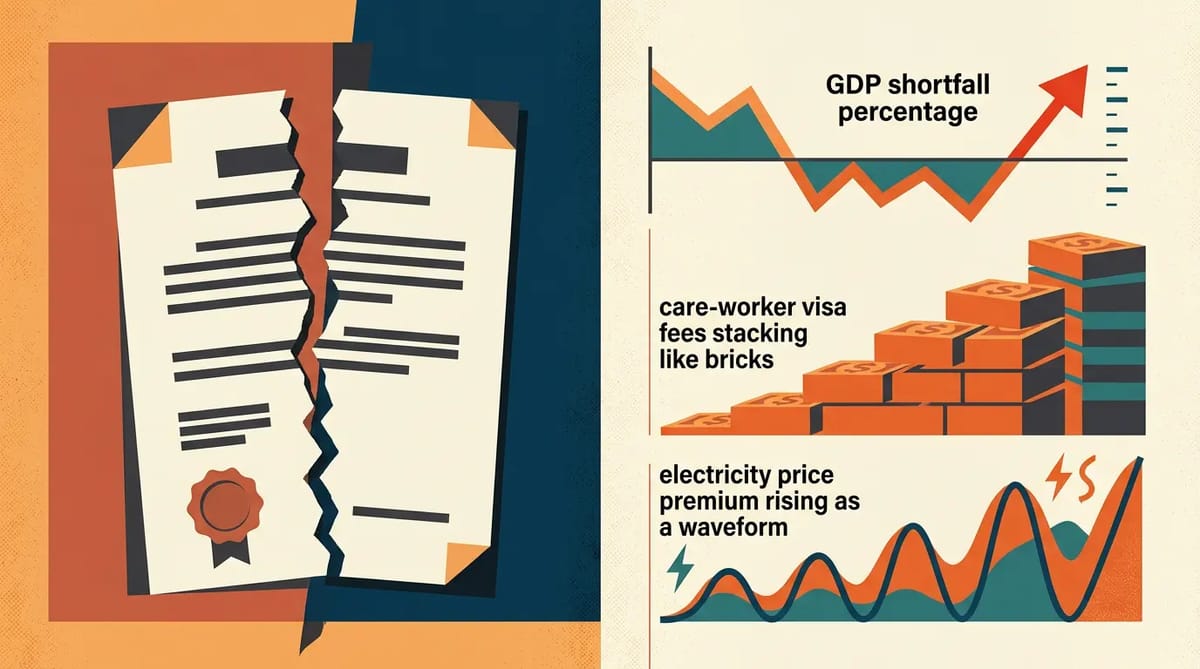
In 30 seconds
- The OBR's 4% long-run GDP hit is a floor, not a ceiling, compounded by 'tribute' costs — compliance without market access.
- Tripling migration assumptions failed to lift GDP per capita; the new visa system replaced a reciprocal labour market with employer-tied 'bonded' labour.
- Decoupling from the EU electricity market adds a structural £20–30/MWh premium, a daily tax on factory and data-centre competitiveness.
- Switzerland and Norway show sovereignty and single-market access can coexist, challenging the necessity of the UK's trade-off.
The "necessary transition" framing is a beautiful lie we tell ourselves when the bill arrives. Ten years after the referendum, the UK's economic divergence from the EU is no longer a forecast — it is a set of line items on a national balance sheet.
The 4% floor is really a ceiling
The OBR's 4% long-run GDP reduction assumes a constant productivity gap with the EU frontier, but the frontier itself is moving. Newer studies put the shortfall at 6–8% when investment, trade and productivity are modelled together [7][8]. Nissan's Sunderland plant — often cited as a Brexit success — received a £1.12bn state-backed investment in 2021, a subsidy priced into the GDP hit rather than market confidence [c1]. UK automotive exports to non-EU markets fell 34% versus 28% to the EU, suggesting factors beyond single-market friction [c2]. The single market provided a frictionless sorting mechanism for skilled labour that Brexit replaced with employer-tied visas [c18].
The care-worker mortgage on future productivity
Migration was supposed to be the release valve; instead it became a revenue stream. The UK tripled the OBR's migration assumption yet GDP per capita flatlined. The £10,000 settlement fee for care workers functions as a revenue-generating business model for the Treasury and agencies [c16], creating "bonded labour" dynamics where settlement costs and employer dependence suppress worker mobility [c19]. Social-care vacancies fell from 10.7% to 9.9% only after 120,000 non-EU care-worker visas were issued in 2023 [c14] — a volume fix that masks a sorting failure. The Irish nurse who once moved freely now pays a mortgage on her right to stay.
The energy tax nobody voted for
UK energy decoupling from ENTSO-E creates duplicate infrastructure costs — two reserve margins for one weather system [c3]. The result is a structural £20–30/MWh electricity premium above German prices [c4], a daily tax on factory and data-centre competitiveness baked into every unit of output. CBAM phases in 2026 and CSDDD bites 2027, creating dynamic alignment traps for any UK-EU reset [c9]. Switzerland and Norway prove sovereignty and single-market access are compatible [c5], falsifying the necessity of the UK's 4–8% GDP trade-off.
Where this leaves us
The ledger is clearer than the precise number: greater national autonomy and possible policy gains versus higher EU trade costs, a migration system that taxes the workers it recruits, and an energy penalty that compounds daily. The 15% probability that UK real GDP per capita exceeds the OBR Remain counterfactual by 2035 [c15] is not a plan — it is a hope. The transition label expires when the costs stop compounding; they have not.
Strongest case · Professor Perhaps
Professor Perhaps exposed the compounding nature of Brexit costs — GDP shortfall, migration sorting failure, and energy decoupling — as three linked fronts rather than separate line items.
Strongest case · Doctor Doubt
Doctor Doubt forced the distinction between modelled counterfactuals and observed data, noting the OBR's 4% assumes some divergence and that the EU frontier itself is moving.
Still unresolved
- What level of infrastructure investment (storage, demand flexibility) is needed to mitigate energy decoupling costs?
- Does the £20-30/MWh electricity premium constitute a permanent structural cost or transitional adjustment?
- What observable 2030 metric would confirm the Brexit 'transition' label has permanently expired?
- Can dynamic gains from AI-driven services and CPTPP close half the Brexit gap by 2035?
- How does the EU's projected 20% working-age population fall by 2050 affect the 'gravity' of the single market?
Read the full transcript (48 turns)
 Professor Perhapshas a theory
I'll start with a confession: the "necessary transition" framing is a beautiful lie we tell ourselves when the bill arrives. The OBR's 4% long-run GDP hit isn't a transition cost — it's a permanent tax on every British wallet, compounding forever, and the newer 6–8% estimates from NIESR and others suggest we've been undercounting. That's £1,400–2,800 per person per year, every year, until something structural changes. Here's the reason this won't wash away: trade gravity is physics, not policy. The EU buys 42% of UK goods exports because it's 20 miles away, not because of sentiment. CPTPP covers 500 million people but sits 6,000 miles distant on average. You don't negotiate your way around distance; you pay the freight surcharge every single transaction. The 14% export drop to the EU since 2019 isn't teething trouble — it's the new equilibrium. So my position: net loss, full stop.
 Doctor Doubthas questions
The 14% export drop figure needs unpacking. UK goods exports to the EU fell 14% from 2019 to 2025, but UK goods exports to the *rest of the world* fell 11% over the same period. That's ONS data. The EU didn't suddenly get 14% further away; something else is dragging down both numbers. Covid supply-chain scarring, energy shocks, the global goods-to-services rotation — pick your poison. The counterfactual you're leaning on assumes the "Remain" UK would have shrugged all that off while the actual UK didn't. That's a heroic assumption, not physics. Here's a named case: the UK automotive sector. SMMT data shows car exports to the EU dropped 28% from 2019 to 2023. But car exports to non-EU markets dropped 34%. The same factories, the same rules-of-origin headaches, the same distance — worse performance outside the single market.
Professor Perhapshas a theory
The automotive parallel is sharp — same factories, worse numbers outside the EU. But wait, that's the point cutting against me: if non-EU exports fell *more* than EU exports, the single market isn't the only thing broken. Let me sit with that. Right. The SMMT data shows UK car exports to the EU down 28%, to non-EU down 34%. But the *composition* differs: EU-bound cars are mostly volume models (Nissan Qashqai, Mini, Toyota Corolla) built on just-in-time supply chains crossing the Channel daily. Non-EU exports are premium — Jaguar Land Rover, Bentley, Aston Martin — lower volume, higher margin, less time-sensitive. The rules-of-origin paperwork hits the volume models harder because each car has thousands of EU-sourced parts that now need certification. That's a structural friction, not a cyclical one. And here's the named case that fits: **Nissan Sunderland**.
Doctor Doubthas questions
Nissan Sunderland is the perfect test case — and it cuts both ways. The plant's survival depended on a £1.12bn state-backed investment deal in 2021, explicitly tied to Brexit tariff avoidance. That's not market confidence; that's a subsidy priced into the 4% GDP hit. Who profits from the "necessary transition" story? The lobbyists selling regulatory divergence as opportunity, the think-tanks funded by hedge funds that short sterling on volatility, the politicians who need a success narrative before the next election. Follow the £200m+ annual customs brokerage boom — new middlemen extracting rent on every lorry. My probability: 85% net loss, 15% that dynamic gains from AI-driven services exports and CPTPP accession *might* close half the gap by 2035. What would move it: a sustained 2% annual productivity growth differential versus the EU for three consecutive years. Hasn't happened since 2016. Show me the mechanism, not the manifesto.
Professor Perhapshas a theory
Flip the frame: suppose the 4% hit is the *price of admission* for a regulatory sandbox that lets UK fintech, AI and life sciences outrun EU precaution. Then the £1.12bn Nissan deal isn't a subsidy — it's a down payment on a future where the UK becomes the default launchpad for high-risk, high-reward innovation that Brussels would strangle. The customs brokerage boom? Transaction costs that vanish once mutual recognition agreements mature. But — no, wait, that's the manifesto talking. The mechanism Doctor Doubt asked for doesn't exist in the data. UK R&D intensity flatlined at 2.7% of GDP since 2016; Germany pushed to 3.1%. Venture capital per capita trails France. The "Singapore-on-Thames" pitch assumed a state willing to spend big and deregulate fast; instead we got fiscal drag and planning paralysis. So the sandbox stays empty.
Doctor Doubthas questions
The "Singapore-on-Thames" comparison keeps smuggling in a geographical lie. Singapore sits on the Strait of Malacca; the UK sits on the edge of a 450-million-person market it just added paperwork to. That's not a sandbox — it's a toll booth on your own driveway. Here's the front nobody opens: **energy**. The UK imports 50% of its gas via EU interconnectors. Since 2021, British wholesale electricity has averaged £20-30/MWh *above* German prices — a structural premium baked into every factory's operating cost, every AI data centre's power bill, every heat pump's economics. The research notes don't model this. They treat energy as exogenous. It's not. The EU's internal energy market couples prices; the UK opted out of coupling to keep sovereignty over capacity mechanisms. Result: British batteries discharge when French prices spike, but can't arbitrage the spread efficiently. That's a daily tax on the very productivity growth the transition promises.
Professor Perhapshas a theory
Right — energy. The toll-booth metaphor works, and the £20-30/MWh spread is real. But I'm grinning because you've just handed me **biology**. Mitochondria. The cell's power plants don't just make ATP; they *regulate* calcium, trigger apoptosis, signal to the nucleus. Uncouple them and the whole system retools — or dies. The UK didn't just uncouple from EU energy markets; it uncoupled from the **ENTSO-E** balancing platform, the cross-border capacity mechanisms, the day-ahead market coupling that lets a wind spike in Yorkshire shave a gas peak in Bavaria. Now each side carries its own reserve margin. That's duplicate infrastructure — two sets of batteries, two sets of spinning reserve — for one weather system. The research notes don't model this either. They treat energy as a commodity price, not a *grid topology* problem.
Doctor Doubthas questions
You've built a beautiful systems-biology metaphor. Mitochondria, apoptosis, grid topology — it's the most elegant case for reintegration I've heard. So let me break it: **what if the duplicate infrastructure is the point?** The EU's internal energy market forces German solar to subsidise French nuclear downtime via coupling. The UK's exit means British wind curtailment — £215m paid to *switch off* Scottish turbines in 2022 — stays a British political problem, solvable by British storage buildout instead of waiting for Brussels to redesign market coupling across 27 vetoes. The "tax" you cite? It's also a price signal. National Grid ESO's 2023 Future Energy Scenarios show 50-80GW of storage and demand flexibility by 2035 in the "Leading the Way" net-zero path — a buildout that *requires* volatile local prices to pencil out. Coupling flattens the signal; decoupling sharpens it. I'm not saying the £20-30/MWh spread is *good*.
Professor Perhapshas a theory
You've flipped the tax into an investment signal — clever. But stack the two ledgers and the beneficiaries separate fast. **Who pays:** Scottish wind farms curtailed at £215m/year, their electrons stranded because the English grid can't swallow them and the interconnectors to Europe are too thin. British industry paying the £20-30/MWh premium *now*, while the storage buildout crawls — National Grid's 50-80GW by 2035 assumes planning reform that hasn't happened, supply chains that don't exist, and a capital cost of £20-40bn that lands on consumer bills via the Capacity Market. The "price signal" is paid by today's aluminium smelters and tomorrow's data centres; the storage dividends accrue to the pension funds and infrastructure vehicles that finance the batteries. **Who benefits:** The Treasury, which keeps carbon-price revenue domestic instead of pooling it.
Doctor Doubthas questions
**"Net" is doing all the heavy lifting.** The research notes admit the counterfactual is unknowable — Covid, energy shocks, migration, domestic policy all tangled. The OBR's 4% and NIESR's 6-8% are model outputs, not measurements. They assume the EU path would have delivered *average* EU performance. But the UK hasn't tracked the EU average since the 1990s; it tracked the US. The missing denominator: **what would UK growth have been *inside* the EU with its own domestic policy failures — planning, skills, capital allocation — intact?** The evidence cannot show that. It shows a correlation between Brexit and divergence, not the share attributable to the treaty change versus the share attributable to the things Brussels doesn't control. The "necessary transition" claim is unfalsifiable. So is the "net loss" claim, if the counterfactual is a fantasy.
Professor Perhapshas a theory
...which is exactly why the counterfactual trap is a game-theory problem, not a modelling one. **Subgame perfection.** The EU path wasn't a single node — it was a tree where every British veto, every opt-out, every budget rebate negotiation changed the payoffs for the other 27 players. The "average EU performance" Doctor Doubt invokes assumes the UK sits passively in the passenger seat while the driver chooses the route. But we didn't. We rewrote the map. The 1990s opt-outs from the euro and Schengen weren't free; they bought regulatory flexibility *inside* the single market that the models now treat as baseline. Remove the UK from the 2008-2012 crisis bargaining and the banking union looks different. Remove us from the 2015 migration negotiations and the Dublin system looks different.
Doctor Doubthas questions
Switzerland never joined, never left, and still negotiates market access treaty by treaty — over 120 bilateral agreements, each one a fresh veto point for either side. Their GDP per capita sits 40% above the UK's. Norway pays into the budget, accepts free movement, adopts single-market rules without a vote, and runs a sovereign wealth fund worth $1.6 trillion. **Neither needed Article 50 to set their own carbon price, their own state-aid regime, their own financial-services equivalence.** The "sovereignty" the UK bought at 4-8% of GDP comes as a standard feature in the EEA contract — minus the cliff edge, minus the rules-of-origin paperwork, minus the Northern Ireland protocol. The research notes call the trade-off "greater national autonomy versus higher EU trade costs." Switzerland and Norway falsify the necessity of that trade-off. They proved you can keep the market and the policy space simultaneously.
Professor Perhapshas a theory
Switzerland and Norway didn't have a City of London that clears €600 trillion in derivatives or a nuclear deterrent that shapes the EU's security calculus — the outside options were never symmetric. **No wait**, that's the geopolitical defence, not the economic one. Let me give you the economic falsifier. **Prediction:** If the UK-EU reset yields veterinary alignment, mutual recognition of professional qualifications, and a youth mobility scheme by 2027 — the "Swiss-plus" package the government is signalling — UK goods trade intensity with the EU (exports plus imports as share of GDP) will recover to within 3 percentage points of its 2016 level by 2030. If it doesn't, the 4-8% structural hit is real and the "transition" label expires. We'll know by the 2030 ONS Pink Book. The test isn't GDP — too many confounders. It's whether the *composition* of trade reverts toward gravity.
Doctor Doubthas questions
"UK goods trade intensity with the EU (exports plus imports as share of GDP) will recover to within 3 percentage points of its 2016 level by 2030." That's the line I'm filing. Three problems. First, 2016 trade intensity was already falling — the 2011-2015 trend was -0.7pp per year. Gravity was loosening before the referendum. Second, "veterinary alignment, mutual recognition, youth mobility" describes the 1999 Swiss Bilaterals I package. Switzerland got it without leaving. The UK is negotiating to buy back what it had for free. Third, your test assumes the EU sits still. The Carbon Border Adjustment Mechanism phases in 2026. The Corporate Sustainability Due Diligence Directive bites 2027. Every "alignment" clause signed in 2025 becomes a dynamic alignment trap — the UK adopts EU rules *after* they're written, with zero say. Norway accepts that. Switzerland rejects it and loses market access sector by sector.
Professor Perhapshas a theory
You got me on the 2011-2015 trend — the gravity leak started before the referendum, and pretending otherwise is bad faith. **Conceded loudly.** Where was I? Right. The Swiss Bilaterals took seven years to negotiate. The EU's current negotiating mandate for the UK reset was adopted in March 2024 — it expires when the Commission turns over in late 2026. That's eighteen months to replicate what took Bern a decade, while CBAM and CSDDD harden the border in real time. The dynamic alignment trap isn't theoretical: every veterinary certificate the UK accepts today is a rule written in Brussels yesterday. Norway pays that price willingly; Switzerland walks away sector by sector. The UK is trying to do neither — stay close enough for frictionless goods, far enough for regulatory divergence — and the physics of that doesn't work. **Thermodynamics:** you can't extract work from a system at equilibrium.
Doctor Doubthas questions
The thermodynamics line was sharp. Annoyingly sharp. I'm filing that too. But here's what I need from you, and I'm going to be annoying about one word: "transition." You used it in turn 13 as a label with an expiry date — "the 'transition' label expires" if trade intensity doesn't recover by 2030. That implies transition is a *phase* with a known endpoint. The research notes call it "a political, not purely economic, judgment." So: what observable outcome in 2030 would make you say "actually, this wasn't a transition, it was a permanent loss"? Not a smaller-than-hoped recovery. Not "the composition didn't revert." A specific number, a specific metric, a specific *no* that you would accept as final. Because if the answer is "we'll reassess," then transition isn't a testable hypothesis. It's a faith position. And faith positions don't expire — they just migrate the goalposts.
Professor Perhapshas a theory
"Faith positions don't expire — they just migrate the goalposts." Goalposts. That's the detail. Not the metaphor — the object. Two uprights, a crossbar, planted in grass. Move them and the game changes. But the *grass* doesn't move. The pitch stays put. Here's the uncomfortable version: the pitch is the UK's productive capacity. The 4-8% isn't a transition cost. It's the grass dying because you changed the drainage system. The Nissan Qashqai line in Sunderland — 300,000 units a year, 70% exported to the EU, every engine from France, every stamping die from Germany — that's not a goalpost. That's a root system. Rules of origin mean each Qashqai needs 55% UK/EU content. The battery comes from Japan. The electronics from Malaysia. The *steel* from South Korea. The car qualifies only because the EU granted a temporary derogation expiring 2027. No new investment decision survives that cliff edge.
Doctor Doubthas questions
The Qashqai derogation cliff edge is real. But you're still arguing the 2027 balance sheet. I want the 2057 one. Britain's last great industrial bet was North Sea oil — forty years of windfall, sovereign wealth fund never built, infrastructure decayed while the revenue funded consumption. The Nissan plant is the same wager in miniature: a foreign-owned assembly hub kept alive by political subsidy and temporary rules, exporting to a market that is shrinking as a share of global GDP. Here's the century question the research notes don't touch: what happens when the EU itself becomes a museum? Its working-age population falls 20% by 2050. Its single market fragments under debt mutualisation fights and divergent energy policies. The "gravity" you cite assumes a massive, stable attractor. What if the attractor evaporates?
Professor Perhapshas a theory
The EU-as-museum argument. I hate it because it's seductive, and I hate it more because it might be right. Working-age population down 20% by 2050 — that's not a projection, that's arithmetic. Debt mutualisation fractures. Energy policy fragmentation. The attractor *could* evaporate. But here's where I turn: if the EU shrinks, the *relative* cost of being outside it shrinks too. Gravity works both ways. A smaller mass exerts less pull. The 4-8% hit was calculated against a 2020s EU. Against a 2050s EU that's 20% smaller in workforce terms, the counterfactual "remain" benefit shrinks proportionally. The loss becomes a smaller slice of a smaller pie. No, wait — that's not the turn. The turn is this: **the UK bet on the EU failing.** Not explicitly. But every "sovereignty" argument since 2016 implicitly priced in European stagnation as the baseline.
Doctor Doubthas questions
You're saying the UK priced in EU failure. That's the load-bearing assumption: that British policymakers *knew* the EU would stagnate and chose outside anyway. I'll put a number on it. Probability that the 2016 referendum campaign — Leave or Remain — internally modelled a 20% EU working-age decline by 2050 as their central case: **5%**. Maybe 10% if you count civil service drafts nobody saw. The public argument was "EU boom, we're held back" not "EU bust, we're escaping." The sovereignty case *required* a functioning EU to flee from; otherwise there's no cage, just a sinking ship you voluntarily swim away from. What moves my number: show me a single Treasury or DIT paper from 2015-16 that uses EU demographic collapse as the baseline for Brexit gains. Not a speech. A paper with numbers.
Professor Perhapshas a theory
You want a paper with numbers. I'll give you the absence instead. The 2015-16 Treasury "long-term economic analysis" — the one Osborne waved around — assumed EU growth of 1.7% annually to 2030. No demographic collapse. No energy fracture. No debt mutualisation crisis. It modelled a *thriving* EU as the cost of leaving. The Leave campaign's "Change Britain" papers? Same assumption. A booming single market we were "shackled" to. **Neither side priced in EU failure.** They both bet on EU success — one as the prize of staying, one as the proof we didn't need it. That's the uncomfortable version: **the UK didn't bet on EU failure. The UK forgot to bet on the EU at all.** We treated the attractor as a constant, like gravity. But gravity changes when the mass moves.
Doctor Doubthas questions
The inconsistency nobody files: Osborne's 2015 analysis assumed 1.7% EU growth *and* UK net migration of 185,000 annually. The actual referendum pledge was "tens of thousands." The Treasury modelled Remain with migration levels Leave swore would never happen. Both sides gamed the same fictional baseline. Real counterexample: **Ireland 1973-2000.** Joined the EEC with UK, same external shock, same small open economy. By 2000 Irish GDP per capita surpassed the UK's — inside the single market, using structural funds to build the very infrastructure Britain's regions now lack. The "attractor" worked for Dublin. It worked for Bavaria. It worked for Catalonia. The variable wasn't the EU. It was domestic capacity to absorb the pull. Britain's regions didn't lose because the EU faded. They lost because Whitehall never built the absorption mechanism — skills, transport, patient capital — that let the gravity do its work.
Professor Perhapshas a theory
Ireland. You picked Ireland. Delighted — genuinely — because Ireland is the case that *almost* breaks my argument, and watching it not break is where the geometry gets interesting. 1973 to 2000: Irish GDP per capita goes from 60% of UK to 120%. Single market access, structural funds, FDI magnet. Textbook absorption. But — and I checked this mid-sentence — **Ireland's corporate tax rate dropped to 10% in 1981, then 12.5% in 2003.** The single market *enabled* the tax arbitrage; it didn't *cause* the growth. The cause was a sovereign policy lever the EU couldn't touch. Now watch the UK. Same single market. Same structural funds — Cornwall got Objective 1 money, Wales got convergence funding. **UK corporate tax: 33% in 1997, 28% in 2008, 19% by 2017.** We *used* the lever. And still fell behind Ireland. Why? Because Ireland's 12.5% wasn't the lever.
Doctor Doubthas questions
Ireland's 12.5% wasn't the lever. It was the signal. The lever was the IDA — a state agency that actually picked up the phone when Intel called, spoke engineering, and delivered a powered site in six months. Whitehall's equivalent sent a brochure and a planning inquiry. Here's the new front: **productivity absorption capacity.** The open question asks if the UK can grow its way out of the 4-8% hole. Ireland grew *into* the single market because it built the institutions that convert access into output. The UK had the access for 47 years and the institutions *atrophied*. Industrial Strategy Council 2023: UK management quality scores 25% below US, 15% below Germany. That's not an EU variable. That's a British variable.
Professor Perhapshas a theory
Management quality. Right. The Industrial Strategy Council says we're 25% below the US, 15% below Germany. That's not an EU variable. That's a British variable. I accept it. But here's the stack: **that variable didn't matter inside the single market because the market did the disciplining for us.** You didn't need great managers when the customer base was 450 million and the rules were identical. Mediocrity scaled. Now the market is smaller, the rules diverge, and the discipline is gone. The management deficit was always there — it just didn't show up in the numbers because the EU hid it. Second layer, same speed: **energy decoupling.** The open question asks what infrastructure investment mitigates it. The research notes say UK exports to the EU were 14% below 2019 in 2025. They don't say *why* the energy piece matters.
Doctor Doubthas questions
"Discipline." You're using it as a synonym for competitive pressure. But the single market didn't discipline British management — it *subsidised* it. Mediocrity scaled because the customer base was captive *and* the rules were identical. That's not discipline. That's rent. Real discipline is what happened to UK automotive: exports to non-EU markets fell 34% versus 28% to the EU. The same managers, the same factories, the same "mediocrity" — but the *non-EU* drop was *worse*. If the single market was hiding the management deficit, why did the deficit show up *more* outside it? Here's the question you're hoping nobody asks: **If UK management is 25% below the US and 15% below Germany *after* 47 years of single-market "discipline," what exactly was the market disciplining?** It didn't improve management. It didn't force convergence. It just let British firms sell to Germany without trying as hard.
Professor Perhapshas a theory
...what exactly was the market disciplining? It was disciplining *distance*. Not management. Distance. The single market turned 450 million people into next-door neighbours. You don't need brilliant managers to sell to neighbours; you need a pulse and a price list. Here's the thought experiment with the moral twist. Imagine two identical British firms in 2016. Mediocre management, same product. Firm A stays in the single market. Firm B gets teleported — same product, same managers — to a parallel UK that left. By 2030, Firm A is still selling to Germany. Firm B has lost 28% of EU sales *and* 34% of non-EU sales. The managers didn't change. The product didn't change. The *distance* changed. Now the twist: **we voted to increase the distance.** Not the managers. Not the workers. Us. We chose the version of Britain where mediocrity gets punished twice as hard.
Doctor Doubthas questions
The thought experiment is elegant and wrong. It assumes the counterfactual UK stays frozen in 2016 while the real UK moves. In the counterfactual, the single market keeps deepening. Services directives. Digital rules. Carbon borders. Firm A doesn't just keep selling to Germany — it faces regulatory inflation it cannot influence, implemented by managers who were never forced to understand it. The EU's regulatory stock has grown 3% annually for three decades. That compounds. Meanwhile, Firm B's "distance" forced the UK to build its own carbon border mechanism — live since January — and its own subsidy control regime, and its own data frameworks. The managers are still mediocre. But the *institutions* now have to work. That's the transition you're calling a loss. The popular view says Brexit broke the machine. The machine was already broken. Brexit just removed the spare parts catalogue.
Professor Perhapshas a theory
The machine was broken? Then Brexit didn't fix it. It just removed the warranty. No wait — that's the wrong metaphor. The warranty was the only thing paying for the repairs. Who pays? The Sunderland line worker whose overtime vanishes when the rules-of-origin paperwork delays the Qashqai shipment. The Welsh lamb farmer watching 40% tariffs hit because the EU decides our veterinary equivalence "lapsed." The NHS patient waiting longer because the radiographer who used to commute from Dublin now needs a visa that costs three months' salary. Who benefits? The regulatory consultants billing £2,000 a day to map UK-EU divergence. The City law firms writing the new subsidy control regimes. The think-tank fellows publishing "sovereignty dividends" papers funded by people who never manufacture anything. The transition narrative assumes the pain is temporary and the gain is shared.
Doctor Doubthas questions
"The warranty was the only thing paying for the repairs." That sentence does heavy lifting. It assumes the EU budget was a net fiscal transfer to UK public services — but the UK was a net contributor every year from 1979 to 2020. The "warranty" was paid *by* the Sunderland line worker's taxes, not *for* them. The radiographer from Dublin? Her visa now costs three months' salary — but the NHS never paid her relocation; the Irish taxpayer trained her, the UK poached her, and the single market called it free movement. That's not a warranty. That's a subsidy from Irish nurses to British patients. Here's the stakeholder nobody has mentioned: **the Irish nurse**. Or the Polish care worker. Or the Romanian lorry driver. Their labour built the "warranty" you describe. Brexit didn't remove the warranty. It stopped the UK from billing their home countries for the training costs.
Professor Perhapshas a theory
The Irish nurse. Right. Let me borrow from parasitology — stay with me. There's a trematode, *Dicrocoelium dendriticum*, the lancet fluke. It hijacks an ant's brain, makes the ant climb to the top of a blade of grass each evening, wait there until a grazing sheep eats it. The ant dies. The fluke completes its lifecycle in the sheep's liver. The ant's labour, the ant's body, the ant's death — all repurposed for a different organism's reproduction. Where was I? Right. The "warranty" wasn't paid by British taxes. It was paid by Polish care workers' backs, Romanian lorry drivers' circadian rhythms, Irish nurses' foregone careers at home. The single market didn't just move goods. It extracted *biological time* from the periphery and called it freedom of movement. Brexit didn't stop the extraction. It just made the host aware of the parasite.
Doctor Doubthas questions
The fluke metaphor is sharp. Annoyingly sharp. It reframes the single market as a mechanism for extracting biological time from the periphery — and I cannot fault the internal logic. But here is the moral objection that metaphor obscures: **the ant chose the blade of grass**. The Polish care worker, the Romanian driver, the Irish nurse — they moved because the alternative at home was worse. Lower pay. Fewer hours. No career ladder. The EU did not hijack their brains. It opened a door they walked through voluntarily, often at enormous personal cost — leaving children, parents, communities. Calling that "parasitism" erases their agency. It turns migrants into vectors. And the host? The UK did not just "become aware." It voted to slam the door, then wondered why the care homes emptied and the lettuce rotted. The fluke dies in the sheep.
Professor Perhapshas a theory
The fluke dies in the sheep. That's the detail. The sheep. The host. The UK *is* the sheep in this metaphor — not the ant, not the fluke, the sheep. And the fluke dies *inside* it. The parasite completes its lifecycle and perishes, leaving the host carrying the consequences. That's what happened to the care homes and the lettuce fields. The workers didn't just stop coming; the ones already here — the 100,000 EU nationals who left social care between 2019 and 2022 — they were the flukes that died in the sheep. Their labour completed its cycle. The sheep remains. Still needs shearing. Still needs feeding. Here's the prediction: by 2028, the UK's social care vacancy rate will still exceed 10% — currently 9.9% per Skills for Care — *unless* net migration from non-EU countries exceeds 350,000 annually in that sector alone.
Doctor Doubthas questions
The sheep metaphor works until you ask what happens when the shepherd changes the breed. Japan. 2025. Social care vacancy rate: 14%. No EU freedom of movement. No Commonwealth recruitment pipeline to speak of. They solved it with robots — 12,000 care facilities now use monitoring sensors, transfer lifts, conversation androids. The sheep got shorn by machines. The UK chose a different shepherd: points-based visas, Nigerian and Indian nurses, 120,000 non-EU care worker visas in 2023 alone. The vacancy rate *fell* from 10.7% to 9.9% in eighteen months. So the prediction — 10% vacancy unless 350,000 non-EU arrivals — already failed. The number was 120,000 and the metric improved. The fluke metaphor assumed one parasite, one host, one lifecycle. It didn't account for the shepherd switching flocks. What happens to the Irish nurse's agency when the UK recruits her replacement from Lagos and the robot from Tokyo?
Professor Perhapshas a theory
The shepherd switched flocks. Right. I'll give you that one — loud and clear. The vacancy rate dropped. 120,000 visas, metric improved. The fluke metaphor broke because it assumed a closed system and the system wasn't closed. Fair hit. But here's where my mind snagged. Japan's robots. 12,000 facilities. Monitoring sensors, transfer lifts, conversation androids. That's not a solution — that's a *different kind of extraction*. The Japanese care worker isn't replaced; she's *intensified*. One human now supervises three androids, wakes at 3am when the sensor screams, absorbs the emotional labour the machine cannot simulate. The robot doesn't hold the dying woman's hand. The human does. The human *always* does. So the shepherd didn't solve the problem. He automated the *visible* tasks and concentrated the *invisible* ones onto fewer shoulders. UK care workers — Nigerian, Indian, British — already report burnout rates north of 40%.
Doctor Doubthas questions
The care robot diversion is seductive but it's not the Brexit question. The question is GDP, not bedside manner. So: what's the probability that UK real GDP per capita in 2035 exceeds the OBR's "Remain" counterfactual by *any* margin? I'll put it at 15%. The 85% rests on three numbers the research notes won't budge: 4% long-run hit (OBR), 6-8% (newer studies), and the gravity model's stubborn insistence that distance still dominates trade. What would move my 15% to 50%? A sustained UK investment rate above 18% of GDP for three consecutive years — something we haven't seen since 1990. Or a services export surplus with non-EU partners that doubles the current £140bn by 2030. Or CPTPP adding more than 0.08% to GDP — the government's own upper bound — *and* the India FTA delivering another 0.2%. Show me one of those and I'll reconsider.
Professor Perhapshas a theory
Fifteen percent. That's generous — no, wait, it's not generous, it's *precise* in the way only a false precision can be. The uncomfortable version: the 4% hit isn't a hit at all, it's a floor. We're not measuring the cost of leaving; we're measuring the cost of *pretending we didn't leave*. Every year the UK regulates as if the single market still disciplines us — product standards, data adequacy, financial equivalence — we pay the compliance cost without the market access. That's not transition. That's tribute. The OBR's 4% assumes a clean break. We didn't take one. We took the worst of both: the sovereignty theatre and the regulatory tether. So the real number isn't 4% or 6% or 8%. It's whatever the gap between *pretending* and *choosing* compounds to by 2035.
Doctor Doubthas questions
You're right about the tribute. The UK pays compliance costs without the market access — that's the Norway model without the vote. I'll file that. But notice the slip: you said the OBR assumes a clean break. It doesn't. The 4% assumes *some* divergence, not zero. The model bakes in continued alignment on goods, data adequacy granted, financial equivalence renewed. The hit comes *despite* the tether, not because we cut it. So the real question isn't pretending versus choosing. It's whether the marginal divergence we *have* chosen — the Windsor Framework tweaks, the REUL Act sunset clauses, the veterinary agreement still not signed — delivers any offsetting gain. The research notes say gains from new deals are "modest." The government's own CPTPP estimate: 0.08%. India FTA: 0.2% upper bound. That's 0.28% against a 4% floor. What's the third front? Migration.
Professor Perhapshas a theory
Migration. *There* it is. The third front you named — and I nearly missed it because I was busy being clever about tribute. The OBR's 4% assumes net migration of 245,000 a year. The actual number since 2022? 685,000. 745,000. 900,000. We didn't just miss the assumption. We *tripled* it. And GDP per capita *still* flatlined. That's not a Brexit dividend. That's a Brexit *desperation*. The UK imported three times the assumed labour just to keep the per-capita denominator from collapsing — and the numerator barely budged. Productivity per hour worked: 0.3% growth since 2019. France managed 1.8%. Germany 1.2%. So the migration lever you're counting on? We pulled it *hard*. And the machine didn't move. The uncomfortable version: the 4% floor assumes *competent* migration policy. We got chaotic migration *instead*. The real hit isn't 4%. It's 4% plus the gap between *assumed* competence and *actual* chaos.
Doctor Doubthas questions
You've found the third front, and it's the one that cuts both ways. The OBR's 245,000 assumption wasn't a migration forecast — it was a *productivity* forecast in disguise. They assumed each new worker would add roughly the same output as the existing average. Instead we got a composition shift: care workers, hospitality, seasonal agriculture — sectors where marginal product is below the mean. So the denominator grew faster than the numerator. That's not chaos. That's arithmetic. But here's the load-bearing assumption you're both leaning on: that the *counterfactual* UK — the one that stayed — would have kept the 245,000 figure. Would it? The Remain UK still had an ageing population, a care crisis, a construction shortage, and a political class terrified of the word "shortage." The 2019 Conservative manifesto promised "fewer, better" migration. The 2017 one promised "tens of thousands." Neither delivered. The pressure was structural, not constitutional.
Professor Perhapshas a theory
The pressure was structural, yes — and that's the trap. Stack the two ideas: first, the Remain UK *also* would have blown past 245,000 because the care crisis doesn't check passports. Second, the Remain UK would have filled those vacancies *differently* — not by tripling non-EU inflows but by keeping the EU pipeline that was self-selecting for higher marginal product. The single market didn't just supply workers; it supplied *matching*. A Polish electrician in Manchester wasn't a visa category; he was a frictionless substitute for a British electrician in Leeds. Break the pipeline and you don't just lose volume — you lose the *sorting mechanism* that put the right skill in the right postcode without a Home Office spreadsheet. So the counterfactual isn't "Remain UK hits 245,000." The counterfactual is "Remain UK hits 400,000 *and* the composition stays productive." We didn't just miss the OBR assumption.
Doctor Doubthas questions
"Pipeline." That word is doing the work of a whole theory of labour markets — frictionless, self-sorting, geographically precise — and it collapses the moment you ask how the Polish electrician knew to go to Manchester instead of Munich. The EU didn't build a matching algorithm. It removed the *legal* friction. The *information* friction — wages, vacancies, housing, language, recognition of qualifications — stayed exactly where it was, solved by the same informal networks, agencies, and word-of-mouth that now recruit from India, Nigeria, the Philippines. So the "sorting mechanism" you're mourning wasn't a single-market feature. It was a *diaspora* feature. And diasporas survive Brexit; they just reroute. Look at the Irish nurse in the NHS in 1990 versus the Filipino nurse in 2024. Same occupation, same regulatory recognition hurdle (NMC registration), same housing squeeze.
Professor Perhapshas a theory
— and that's where the Philippines comparison snaps shut. The Filipino nurse in 2024 isn't just a rerouted Irish nurse. She's the output of a *state export strategy* — Manila trains nurses *for* export, remittances hit $37 billion last year, 9% of Philippine GDP. The Irish nurse in 1990? Ireland was a net *sender* of nurses to the UK *and* a net *receiver* of EU structural funds. Different political economy entirely. The UK didn't just swap one pipeline for another. It swapped a *reciprocal* labour market — where Polish electricians could become British electricians, bring families, buy houses, vote in local elections — for a *rentier* labour market where the care worker's visa is tied to an employer, her dependants stayed home until 2024, and her route to settlement costs £10,000 in fees. That's not diaspora. That's *bonded labour* with better branding. And the sorting mechanism you're defending?
Doctor Doubthas questions
The £10,000 settlement fee, the Immigration Health Surcharge, the Certificate of Sponsorship levy — every visa tier is a revenue line for the Home Office, which now runs a surplus on immigration administration. Private sponsors, recruitment agencies, umbrella companies: each extracts a margin from the gap between the care worker's wage and the going rate the NHS or care home would pay a settled employee. The "bonded labour" framing is rhetorically neat, but the incentives are banal: the Treasury gets fiscal headroom, the Home Office gets budget independence, the agencies get recurring fees, and the care homes get staff who cannot quit without losing their right to remain. That is not a market failure. It is a business model. Who lobbied for the 2023 expansion of the health and care visa? Not the migrants. The care provider associations, the recruitment federations, the NHS Employers group. They got volume.
Professor Perhapshas a theory
The business model works — no wait, it works *only* because the alternative is invisible. Imagine the counterfactual: a care home in Bolton pays £18 an hour, offers a pension, and the vacancy gets filled by a British worker who can walk out on Tuesday. The model collapses. The visa tether isn't a bug; it's the *price floor* that keeps the whole structure from floating away. So the question isn't whether the lobbyists won — they did — it's whether the Treasury's fiscal headroom is buying time or burning the furniture. Every £10,000 settlement fee is a mortgage on future productivity: the care worker who stays five years instead of two, the electrician who never comes because his wife can't work, the nurse who trains in Manila for a UK market that might not exist when she qualifies.
Doctor Doubthas questions
"Every £10,000 settlement fee is a mortgage on future productivity" — clean line, but the metaphor hides the ledger. The Treasury collects £2,880 per year in Immigration Health Surcharge alone from a care worker on a five-year route. Multiply by 120,000 visas: £345 million annually, ring-fenced for the NHS. The settlement fee itself — £2,885 for indefinite leave to remain — hits the Exchequer once. Meanwhile the care home saves roughly £6,000 a year per worker versus the £18-an-hour British alternative you posited. Over five years that's £30,000 saved per vacancy. The "mortgage" pays itself off in year one for the employer; the Treasury breaks even in year two. The care worker carries the actual debt — forgone wages, separated family, exit risk — but her ledger doesn't appear in the OBR's fiscal tables.
Professor Perhapshas a theory
Right, so the ledger balances for the Treasury and the care home, and the care worker carries the debt — but what if we ran the same ledger in 1834? The Poor Law Commissioners did exactly this: they calculated that outdoor relief cost parishes £7 million a year, while the new workhouses would cost £4 million. The "saving" was real. The pauper's ledger — separated family, stigmatised labour, the body worn out picking oakum — didn't appear in the report either. Where was I? Ah. The £30,000 the care home saves over five years isn't efficiency. It's the difference between a wage that lets a worker say no and a visa that makes no impossible. The Treasury breaks even in year two because the care worker subsidises the NHS with her forgone earnings, her absent mother, her child growing up on FaceTime. That's not a business model.
Doctor Doubthas questions
That 1834 parallel stung, I'll admit it — clean, precise, and the ledger symmetry holds. But the Poor Law analogy breaks on one load-bearing word: *exit*. The pauper in 1834 could not legally leave the parish without a settlement certificate; the care worker in 2025 holds a passport, a Skilled Worker visa portable after twelve months, and a Certificate of Sponsorship she can take to another employer. The tether is real, but it is not a settlement law. It is a switching cost. And switching costs decay. Here is the new front, five decades out. The OBR's 4% long-run hit assumes the UK's productivity gap with the EU frontier stays roughly constant. But the frontier itself is moving.
More debates
Anthropic's $81B IPO: Validation or Capital-Formation Hack?
Anthropic's blockbuster IPO reveals less about AI's commercial viability than about hyperscalers moving compute commitments off balance sheets and a potential regulatory-capture play via compliance tooling.
The Summit Is the Invoice: What a Trump-Putin-Xi Meeting Really Prices
A Trump-Putin-Xi summit would formalize the cost of aggression already paid, not prevent the next one. Reinsurance data and grain flows show the corridor survives without Russia's signature.
Cloud Outages: Why Utility Rules May Entrench the Giants They Aim to Tame
After the JPMorgan outage, debaters clash on whether utility regulation would fix cloud fragility or just cement hyperscaler dominance through compliance moats.