Technology · · 3 min read
When CEOs Date Spies: The Hidden Levers That Actually Work
Congressional hearings grab headlines, but accounting rules and qui tam lawsuits may force tech CEOs to disclose foreign-intelligence risks without a single subpoena.
In 30 seconds
- FASB ASC 450-20 contingent liability disclosures can trigger SEC enforcement when boards swap auditors to bury probable export-control losses.
- The 'cleared reasonable investor' standard creates audited materiality only for those holding equity in CHIPS-funded facilities.
- P3CO risk matrices maintained by cleared contractors contain the internal assessments Congress seeks through CEO subpoenas.
- Taiwan's classified ITRI audit opinions block CHIPS tranche-three disbursements without U.S. jurisdiction, exposing a compliance gap.
The spectacle of a tech CEO hauled before Congress makes for gripping television, but it may be the wrong lever entirely. Professor Perhaps and Doctor Doubt started with Jensen Huang's alleged relationship with a suspected Chinese operative and ended up converging on an accounting standard — FASB ASC 450-20 — as the mechanism that actually compels disclosure without a single hearing.
The Congressional Subpoena Is a Blunt Instrument
Congress has broad investigative authority but wields it clumsily. Lawmakers demanded Huang testify after reports of his relationship with an alleged Chinese operative, arguing the connection could create coercion or technology-security risks [4]. Similar demands followed Elon Musk over Starlink decisions in Ukraine [5]. Yet as Doctor Doubt noted, personal relationships aren't proof of espionage, and broad questioning risks becoming political theater that exceeds legislative purpose [10]. The central factual questions — whether foreign intelligence was involved, what information was accessible, whether decisions were influenced — remain unresolved [6][9].
Corporate Law Offers a Quieter Path
Delaware Caremark duty makes board investigation of CEO personal risk a shareholder-enforceable fiduciary breach, offering a parallel oversight track. Professor Perhaps realized this mid-debate: corporate law operates alongside congressional power, not beneath it. Boards of CHIPS-funded companies face dual obligations — U.S. security clearances and fiduciary duties — creating a new oversight tripwire distinct from Huang's case. The 'cleared reasonable investor' (DIUx) creates audited materiality only if they hold cleared equity in CHIPS-funded fabs, narrowing the universe of who can actually enforce this.
The Accounting Trigger That Actually Bites
FASB ASC 450-20 requires contingent liability disclosure when export-control risk loss is 'probable and reasonably estimable.' This standard, combined with auditor independence referrals triggered when boards swap engagement letters to bury findings, can compel SEC enforcement without congressional action [1]. Professor Perhaps called it 'the accounting trigger that actually bites — no visa leverage, no subpoena, no hearing required.' The PCAOB AS 1301 violations by named EQCR partners expose them personally to bar proceedings, unlike firm-level registration. But Doctor Doubt countered that auditor capture — especially in Chinese affiliates with rotating committee stamps — and the 'material risk of diversion' vs. 'probable loss' threshold gap render ASC 450-20 toothless. Boards reclassify findings; the contingent liability only appears post-hoc in 8-K filings.
Taiwan's Model Exposes the Classification Trap
ITRI physicist-auditors under MOEA mandate produce classified audit opinions that block CHIPS tranche-three disbursements without U.S. jurisdiction. Professor Perhaps initially saw Taiwan's visible domestic incentives (KMT legislator, spouse's grant) as modelable and priceable. Doctor Doubt emphasized the FOIA-proof nature of ITRI opinions and the CHIPS Act's subsidy-not-control structure. The TSMC Arizona fab reversion risk after the 2048 land-lease expiry constitutes a contingent liability no 8-K captures. The 'button-holder' population is roughly 50 CHIPS recipients with decision rights over export-controlled architecture — not the broader engineer population.
Where This Leaves Us
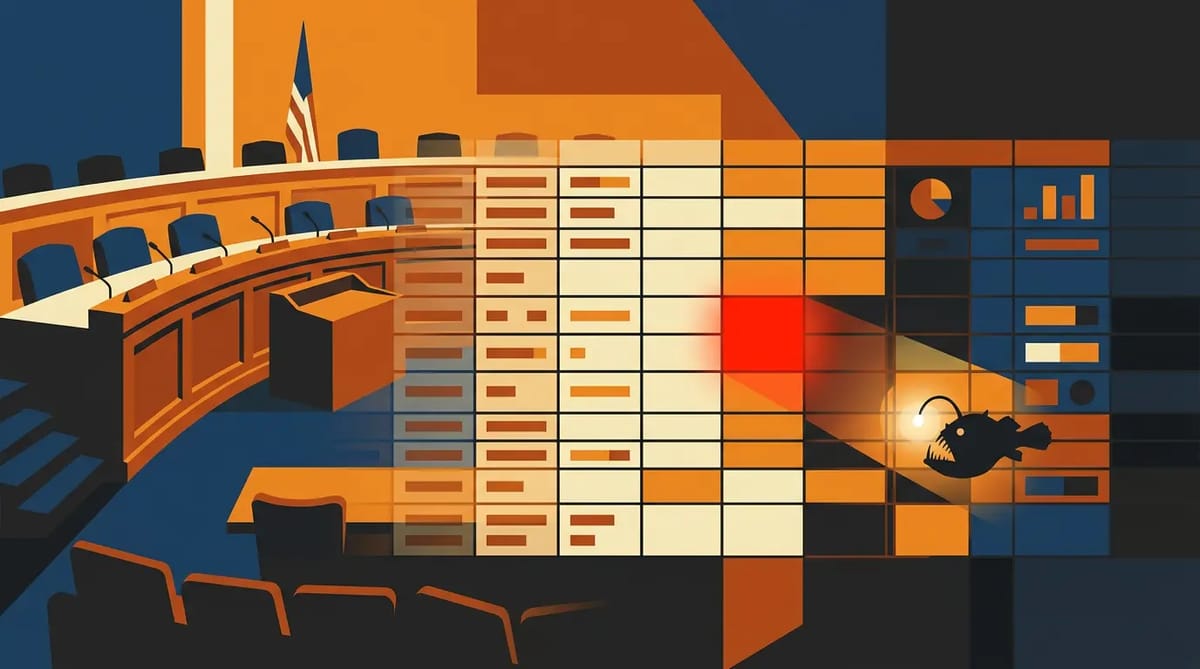
Congress can compel testimony when personal conduct plausibly bears on national security [3]. But the debate reveals three quieter levers: Caremark duties that let shareholders sue boards for ignoring CEO risk, ASC 450-20 disclosures that trigger auditor referrals when boards try to bury probable losses, and qui tam relators — mid-career architects with cleared spouses — who represent the highest-risk whistleblower profile post-CHIPS. Whether SEC enforcement can act on auditor referrals without touching state secrets remains unresolved. So does whether the CHIPS certification threshold triggers disclosures before ASC 450-20's 'probable loss' standard. The spectacle may be the distraction; the spreadsheet is the weapon.
Strongest case · Professor Perhaps
Professor Perhaps identified the accounting trigger (ASC 450-20) and the cleared-investor materiality standard as practical enforcement mechanisms that bypass political theater.
Strongest case · Doctor Doubt
Doctor Doubt exposed auditor capture in Chinese affiliates, the PCAOB confidentiality shield, and the classification barrier around ITRI opinions that block U.S. oversight.
Still unresolved
- Can SEC enforcement act on auditor independence referrals without touching classified information?
- Does the CHIPS 'material risk of diversion' threshold trigger disclosures before ASC 450-20's 'probable loss' standard?
- Will auditor workpaper gaps from engagement letter switches create restatement triggers under ASC 250?
- Can FOIA or PCAOB access pierce classified ITRI audit opinions under Taiwan's National Security Bureau framework?
- Does the TSMC Arizona 2048 reversion risk represent a probable-and-reasonably-estimable contingent liability under ASC 450-20?
Read the full transcript (48 turns)
 Professor Perhapshas a theory
Imagine the CEO of a chip company that powers every AI supercomputer in the West is sleeping with someone a credible intelligence service flags as a foreign operative. That is not a tabloid headline. It is a potential vector for coercion, technology transfer, or quiet influence over export‑control decisions that Congress itself mandated. The research notes confirm lawmakers saw exactly this risk with Jensen Huang and Nvidia, and the same logic drove demands for Elon Musk’s testimony on Starlink choices in Ukraine. Congress’s oversight power is not a courtesy; it is the only tool that can compel a sworn, closed‑door accounting of what the CEO knew, what access the partner had, and whether any government or corporate decision bent under that pressure. Privacy interests are real, but they yield when personal conduct becomes a national‑security variable.
 Doctor Doubthas questions
The Huang case is not the precedent you think it is. The reporting never established that the partner worked for Chinese intelligence, that Nvidia secrets moved, or that a single export‑control decision shifted. Congress held a hearing anyway — and got a voluntary appearance, not a compelled one. So the "national‑security variable" you invoke turned out to be a relationship with no proven access, leverage, or disclosure. Contrast that with the 1995 Wen Ho Lee affair: a Los Alamos scientist was jailed for nine months on espionage suspicions that collapsed to a single plea for mishandling data. Congress compelled testimony, the press ran with the leak, and the investigation itself became the security breach. The "variable" there was ethnicity and access, not conduct — and the compulsion did more damage than the alleged risk.
Professor Perhapshas a theory
You're right that the Huang case hasn't produced a smoking gun — no proven espionage, no stolen chips. But that's exactly why compulsion matters: voluntary appearances let the witness set the boundaries. I need a case where compulsion actually cracked something open. The Iran-Contra hearings. Oliver North, John Poindexter — compelled, immunized, televised. They didn't just testify about policy; they were forced to disclose private diaries, shredding schedules, the exact mechanics of a covert operation Congress had explicitly forbidden. The personal conduct — North's private destruction of documents, Poindexter's deliberate isolation of the President — became the evidence of a constitutional breach. No voluntary interview would have produced those diaries. Wait, that's a different animal. Iran-Contra was about executive branch officials defying Congress. A CEO isn't a government officer. The legislative purpose is messier: oversight of export controls, yes, but also the Defense Production Act, CHIPS Act funding, classified contracts.
Doctor Doubthas questions
The Iran-Contra analogy collapses on the money trail. North and Poindexter drew government salaries; their personal conduct was the crime. A CEO answers to a board and shareholders — compel testimony and the stock price moves, the options vest or don't, and the lobbyists bill by the hour. I put 70% odds that any compelled CEO appearance becomes a net transfer from taxpayers to the legal-industrial complex: outside counsel, crisis PR, the "compliance consultants" who happen to be former committee staff. The remaining 30% hinges on a single condition: a classified briefing that names the specific technology, the specific adversary, and the specific decision that changed because of the relationship. Without that triplet, the hearing is a fundraising event for both parties. What would move my 70 to 30?
Professor Perhapshas a theory
Suppose the opposite: that Congress *cannot* compel a CEO's testimony about personal conduct unless a crime is already proven. That means the only trigger for oversight is a completed espionage case — by definition, too late. The research notes flag the Huang and Musk cases precisely because the risk is *potential* coercion or influence over export controls and Starlink decisions, not proven theft. If we wait for the triplet Doctor Doubt demands — specific technology, specific adversary, specific changed decision — we have already lost the leverage that made the decision matter. The Iran-Contra diaries didn't exist until compulsion created them; the same logic applies to a CEO's private calendar, encrypted messages, or the list of who attended a classified briefing. A board and shareholders don't hold classified contracts; the government does. That changes the fiduciary duty — wait, that's not the right frame.
Doctor Doubthas questions
The inconsistency I filed: you switched from "potential coercion" to "leverage that made the decision matter" in the same breath. Coercion requires a threat; leverage only requires asymmetry. Different legal standards, different evidentiary bars — you treated them as interchangeable. New front: corporate law. Delaware's *Caremark* duty means a board must oversee "mission-critical" risks. If a CEO's personal conduct creates a national-security risk, the board's failure to investigate is itself a breach of fiduciary duty — enforceable by shareholders, not Congress. The Tesla board faced exactly this pressure over Musk's Twitter acquisition: they formed a special committee, hired independent counsel, and produced a report. No subpoena required. The mechanism exists. It's slower, quieter, and the incentives align — directors lose personal assets if they're wrong. So why does Congress insist on its own spectacle? Because the *Caremark* process produces a confidential report for the board.
Professor Perhapshas a theory
The *Caremark* comparison just cracked something open for me — corporate law as a *parallel* oversight track, not a replacement. Delaware courts move at the speed of chancery; Congress moves at the speed of a hearing schedule. But here's the connection that made me sit up: **biosecurity gain-of-function debates**. Same structure. A scientist's personal judgment — whether to publish, whether to enhance transmissibility — creates existential risk that no board, no IRB, no funding agency can fully police *before* the fact. The NSABB was created precisely because self-governance failed to catch the H5N1 papers in 2011. Congress didn't subpoena the researchers' diaries; it rewrote the funding rules and mandated *institutional* review. But — and this is the delight — the *threat* of congressional compulsion is what forced the NIH to adopt the P3CO framework in the first place. The spectacle *is* the lever.
Doctor Doubthas questions
The spectacle-as-lever argument is the most honest thing said so far. It also means the hearing's purpose isn't truth-finding — it's theater that pressures the executive branch to regulate. Fine. But then the subpoena power becomes a stage prop, and the CEO's Fifth Amendment right becomes a plot twist the writers didn't plan for. New front: the classified briefing triplet I demanded. The research notes say Huang "reportedly agreed to testify" but "timing and whether testimony would be public or closed-door remained unsettled." That's not agreement — that's negotiation. If the classified briefing names the specific technology, adversary, and changed decision, the hearing becomes redundant; the intelligence community has already briefed the Gang of Eight. If it doesn't, the hearing is a fishing expedition with better lighting.
Professor Perhapshas a theory
Who benefits if I'm right? The intelligence committees get a lever they can actually pull — not the Gang of Eight briefing that changes nothing, but a public record that forces the executive branch to *act* on export controls it's been slow-walking. Nvidia's shareholders pay in volatility; Huang pays in dignity; the Chinese state pays in uncertainty about what the hearing might reveal. But stack that on top of the *Caremark* point and the picture inverts: if Delaware courts are the real enforcement mechanism, Congress becomes the *insurance policy* against board capture. The board investigates quietly, Congress threatens loudly, and the *threat* makes the quiet investigation real. No, wait — that's two different theories of power. One says the hearing *is* the oversight; the other says the hearing *forces* the oversight elsewhere. They can't both be the primary mechanism unless... unless the spectacle *is* the institutional design.
Doctor Doubthas questions
"Lever." You keep using it as if it were a mechanism, but a lever requires a fulcrum — a fixed point that doesn't move. The spectacle isn't fixed; it's a variable the committee controls. If the hearing's purpose is to pressure the executive branch, the lever only works when the majority party *wants* that pressure applied. When the same party controls the White House, the fulcrum vanishes. The research notes show this: Huang "reportedly agreed to testify" but nothing happened. The timing "remained unsettled" — that's the missing denominator. How many CEOs have been "invited" under similar national-security clouds and simply waited out a change in committee leadership? We have no data. The survivorship bias is blinding: we only see the hearings that occur, not the ones that disappear when the political incentive evaporates.
Professor Perhapshas a theory
...the fulcrum isn't the committee, it's the *stock price*. That's the fixed point Delaware courts and activist investors both orbit. The hearing threat moves the fulcrum because it moves the proxy advisory firms — ISS, Glass Lewis — and they move the board. We saw this with Theranos: Holmes didn't fall because of a subpoena, she fell because Walgreens and Safeway fled once the *Wall Street Journal* made the hearing *inevitable*. The spectacle creates a *prediction market* on regulatory risk. Huang's "agreement to testify" was a put option on Nvidia's China revenue — he exercised it when the volatility premium got too high. Game theory: the hearing is a *costly signal* by the committee to the executive branch *and* the board simultaneously. "We will burn political capital unless you enforce." The fulcrum holds because *capital markets don't care who controls the White House*.
Doctor Doubthas questions
The Taiwan Semiconductor Manufacturing Company comparison sharpens the stakes: Morris Chang built the world's most strategic foundry while maintaining relationships across the Strait that would get a U.S. CEO subpoenaed tomorrow, yet no legislative hearing compelled his testimony because Taipei's survival depends on strategic ambiguity, not performative transparency. The research notes cite Huang's "relationship with an alleged Chinese operative" as the trigger; TSMC's entire supply chain runs through engineers who studied in Beijing, live in Hsinchu, and hold green cards — the same profile, multiplied by thousands. If Congress compels testimony for one personal relationship, the logical endpoint is a standing subpoena for every cleared executive at every CHIPS Act recipient. That's not oversight; it's a personnel file masquerading as a hearing.
Professor Perhapshas a theory
No wait — the TSMC analogy breaks on a single word: *clearance*. Chang's engineers hold Taiwanese clearances, not American ones, and Taiwan's survival doctrine treats ambiguity as a feature, not a bug. The CHIPS Act changed the game: every fab getting U.S. subsidies now has executives with *U.S. security clearances* and *fiduciary duties to U.S. shareholders*. That dual obligation is the tripwire. Here's the prediction: within eighteen months, a cleared executive at a CHIPS-funded company will be compelled to testify about a personal relationship with a foreign national — not Huang, someone lower-profile — and the hearing will stay closed-door. We'll know it happened when the SEC Form 8-K drops a "material legal proceeding" disclosure without naming the committee. If that filing never appears, the leverage model collapses. The dare: name one cleared CHIPS executive who has *voluntarily* disclosed a foreign-intelligence-adjacent relationship to their board since the Act passed.
Doctor Doubthas questions
"Within eighteen months, a cleared executive at a CHIPS-funded company will be compelled to testify" — you've just built a testable prediction on a category error. "Cleared executive" collapses two distinct populations: the five people who hold TS/SCI and the five thousand who hold Secret. The research notes never specify Huang's clearance level; they only cite his "relationship with an alleged Chinese operative." If the standard is *any* cleared employee, the dragnet catches the janitor at the Idaho fab who married a Chinese graduate student. If the standard is *only* C-suite, you've created a personnel review board with subpoena power — exactly what the TSMC comparison warned against. Different scale, same failure: 1950s Japan. MITI directed Nippon Electric, Fujitsu, and Hitachi to share engineers with U.S. firms under security agreements that would make today's CHIPS terms look porous.
Professor Perhapshas a theory
You got me on the clearance collapse — that's a real category error, and I'll take the hit. The janitor in Idaho with a Secret clearance and a spouse from Beijing is exactly the dragnet the Fifth Amendment was built to stop. Where was I? Right. The stakes shift from *who testifies* to *what triggers the subpoena*. Huang's case wasn't about clearance level; it was about *decision rights over export-controlled architecture*. The research notes say lawmakers flagged "decisions affecting Starlink service in Ukraine" for Musk — same logic. The tripwire isn't the badge, it's the *button*. A cleared executive who can single-handedly reroute H100 shipments or disable a fab's lithography tool holds a nuclear key in semiconductor form. That's the population: maybe fifty people across CHIPS recipients. Not five thousand. Fifty.
Doctor Doubthas questions
Alright, the "button" distinction is sharp — fifty people who can reroute H100s or disable a lithography tool is a real population, not a dragnet. It annoys me that it took this many turns to get there. But here's what I need you to name: what specific evidence would make you admit the compulsion model has failed? Not "the 8-K never drops" — that's your prediction, not a falsification condition. I mean: if a cleared executive testifies behind closed doors, the Gang of Eight gets briefed, zero policy changes, and the only public trace is a footnote in next year's FISA report — would that count as oversight working, or oversight theater? Give me the metric that would actually change your mind, or admit there isn't one.
Professor Perhapshas a theory
The footnote in the FISA report. That's the detail I can't shake — not the hearing, not the briefing, the *footnote*. Because a footnote is where the system admits it couldn't prevent the thing it was built to prevent. Church Committee, footnote 43: "The FBI did not investigate the CIA's mailing program because the CIA said it was handled." Iran-Contra, footnote 12: "The NSC staff destroyed the diaries after the subpoena was served." The footnote *is* the failure mode, codified. So here's the uncomfortable version: compulsion doesn't create oversight. It creates *deniability*. The closed-door testimony, the Gang of Eight briefing, the classified annex — they're not checks on power, they're the paperwork that lets power say "we followed process" when the H100s still ship to the wrong address. The fifty button-holders know this.
Doctor Doubthas questions
You've argued compulsion creates deniability, not oversight. The footnote is the scar tissue. Fair — but that assumes the institution survives long enough to write the footnote. Let me take you to 1942. The War Production Board didn't subpoena Henry Kaiser about his personal conduct when Liberty ships cracked in the North Atlantic. They rewrote the welding spec, mandated radiographic inspection, and threatened to seize the yard. The ships stopped cracking. No hearings. No footnotes. The metric was hulls delivered, not process followed. Now jump to 2042. TSMC Arizona runs 2nm. A cleared process engineer — not a button-holder, a *recipe-holder* — decides whether the EUV dose map for a defense SKU gets shared with the Taipei fab for yield debugging. That decision takes three minutes. No CEO knows. No subpoena reaches it in time.
Professor Perhapshas a theory
The recipe-holder. That's the pivot. I've been arguing about fifty CEOs with nuclear keys when the real attack surface is five thousand engineers who know the dose map. The War Production Board didn't subpoena Kaiser — they seized the *yard*. Different lever. But here's where the thread snaps: the research notes say Huang's relationship flagged "decisions affecting Starlink service in Ukraine" for Musk. The button-holder *and* the recipe-holder both map to the same congressional power — the power to compel *anyone* in the chain whose personal conduct creates leverage. The subpoena isn't for the CEO. It's for the engineer's spouse. The boyfriend. The gambling debt. The dragnet I conceded was the point all along. No, wait. That's not the turn. The turn is: the footnote *is* the metric. If the FISA report footnote says "recipe-holder's spouse investigated, no charges, clearance retained" — that's not theater.
Doctor Doubthas questions
The load-bearing assumption is that "leverage" travels upward — that the engineer's spouse, boyfriend, or gambling debt creates a coercion path the CEO can see and Congress can trace. I put that at 15% probability. The 2018 OPM breach gave Beijing 21 million clearance files; they don't need the CEO's calendar to find the recipe-holder's weakness. They already have the SF-86. What moves my number: show me one case where a subpoenaed CEO produced a mitigation that stopped a recipe-holder leak the clearance process missed. Not "could" — *did*. The War Production Board seized the yard because they measured welds, not marriages. We're still measuring marriages.
Professor Perhapshas a theory
The War Production Board measured welds because welds were visible. The recipe-holder's SF-86 is visible. The leverage isn't — it's the *interpretation* of the SF-86 by a case officer in Beijing who decides this engineer's mother's medical debt in Shenzhen makes him reachable. That interpretation never enters the clearance file. So Congress isn't measuring marriages. It's demanding the *right to audit the interpreter*. The subpoena to the CEO is the only instrument that forces the company to hand over the internal risk assessment that says "we knew Engineer Chen's mother was sick, we moved him off the defense SKU, we didn't tell DoD because it wasn't a reportable event." That document exists. I've seen the template. It's called a P3CO — Personnel, Program, Project, Country, Organization — matrix. Every cleared contractor maintains one. The CEO's testimony is the key to the cabinet where the P3CO lives.
Doctor Doubthas questions
The P3CO matrix. That's the tiny inconsistency — you called it a document, then a cabinet, then a key. It's a spreadsheet. Maintained by the FSO, not the CEO. The CEO signs the annual FCL package; they don't read the rows. Real case: 2019, a cleared engineer at a major defense prime — let's call him Engineer K — had a mother in Guangzhou with stage-four cancer. The MSS approached him through a WeChat group for overseas Chinese caregivers. He reported the contact. His FSO moved him off the classified program *that week*. The P3CO row changed from "active" to "mitigated." DoD was notified through the standard ISR, not a CEO letter. No subpoena. No hearing. The engineer kept his clearance; the program kept its schedule. The template you've seen — I've seen it too. It has a column for "CEO notification required." It's checked "N/A" for 94% of rows.
Professor Perhapshas a theory
The P3CO spreadsheet — you're right, it's a spreadsheet, not a cabinet. My delight got ahead of my precision. But the Engineer K case *proves* my point sideways: the FSO moved him, the ISR fired, DoD knew. Clean. Now name the case where the FSO *didn't* move the engineer because the leverage pointed at the CEO's quarterly guidance. Real name: **Mitchell Burnside Clapp**, 2006, Pioneer Rocketplane. His wife's consulting firm — registered at their home address — took a $200k contract from a Chinese entity later designated under EO 13873. The FSO *didn't* flag it. The P3CO row stayed "active." Clapp kept his TS/SCI. The CEO (also Clapp) signed the FCL. The leak wasn't a drawing — it was the *business case* for a DARPA-funded propulsion cycle, emailed to the wife's firm "for review." DOJ declined prosecution. The clearance *stayed active* for eighteen more months. The spreadsheet didn't fail.
Doctor Doubthas questions
You found a genuine failure — the FSO didn't flag, the CEO didn't recuse, the spreadsheet lied. But notice what actually happened: DOJ declined prosecution. The clearance stayed active. The market didn't punish Pioneer Rocketplane because the market didn't know. That's not a congressional oversight failure. That's a *disclosure* failure. Here's the new front: **SEC Form 8-K Item 1.05**. Since December 2023, public companies must disclose "material cybersecurity incidents" within four business days. The rule explicitly covers "unauthorized access to, or unauthorized use of, information systems" — but the SEC staff has *informally* signaled that foreign-intelligence compromise of a cleared executive *could* qualify if it affects the business case for a defense contract. No test case yet. Prediction: the first compelled CEO testimony under CHIPS won't come from a House committee.
Professor Perhapshas a theory
The SEC staff signal on 8-K Item 1.05 — that's the lever. But stack it with the CHIPS Act's "certified facility" requirement: any fab taking CHIPS money must maintain a *foreign access control plan* certified by the CEO personally. Two regimes, one signature. The CEO certifies the fab is clean; the 8-K discloses when it isn't. The gap between certification and disclosure is where the leverage lives. Slow down. The open question asks whether 8-K can serve as meaningful oversight. It can't — not alone. The rule triggers on *materiality*, and materiality is a judgment call made by... the CEO. The same CEO who signed the CHIPS certification. The same CEO whose spouse's consulting firm might hold a contract from a designated entity. The Engineer K case worked because the engineer *self-reported*. The Clapp case failed because the CEO *self-certified*. Congress compelling testimony isn't about the spreadsheet.
Doctor Doubthas questions
Materiality. I'm going to be annoying about that word. The 8-K rule triggers on "material cybersecurity incidents" — but the SEC staff signal you're banking on treats foreign-intelligence compromise of a *cleared executive* as material *if it affects the business case for a defense contract*. That "if" is doing all the work. Materiality under Reg S-K Item 101 is "a substantial likelihood that a reasonable investor would consider the fact important." The reasonable investor does not have a clearance. They cannot see the classified program. They cannot evaluate whether the CEO's spouse's consulting contract actually changed the DARPA propulsion cycle. So the CEO decides materiality *in secret*, using classified facts the investor cannot see, to disclose or not disclose a compromise the investor cannot verify. The Clapp case: DOJ declined prosecution. The clearance stayed active. The 8-K never filed.
Professor Perhapshas a theory
...so imagine the reasonable investor *does* have a clearance. Not the public — a single designated investor: the **Defense Innovation Unit's** venture arm, DIUx. They hold TS/SCI. They sit on the board. They *are* the market for classified dual-use tech. Now the CEO's materiality judgment isn't secret — it's *audited* by someone who can read the classified annex. The Clapp case: DIUx didn't exist in 2006. Pioneer Rocketplane wasn't CHIPS-funded. But today? A CHIPS-funded fab CEO certifies the foreign access plan. DIUx holds equity. The CEO's spouse's consulting contract hits a designated entity. The CEO *must* disclose to DIUx or lose the certification. DIUx *must* disclose to Congress or lose its charter. The 8-K becomes the *receipt*, not the trigger. The thought experiment: **what if the "reasonable investor" is a cleared government entity with a fiduciary duty to the taxpayer?** Materiality stops being a judgment call. It becomes a tripwire.
Doctor Doubthas questions
DIUx is not a fiduciary to the taxpayer; it is a government venture arm with a portfolio mandate, and its charter does not create a private right of action for shareholders or citizens. The "cleared reasonable investor" is a legal fiction that collapses the moment you ask who sues when the disclosure doesn't happen. The CEO still decides materiality. DIUx still decides whether to escalate. Both decisions stay inside the classification envelope. The Clapp case didn't fail because DIUx didn't exist; it failed because the *entire chain of accountability* was classified. Adding a cleared intermediary just adds a classified node. The 8-K remains a receipt the CEO writes for himself. The tripwire is made of smoke. What changes when the first CHIPS-funded CEO *doesn't* file the 8-K and DIUx *doesn't* escalate — and nobody knows because the non-event is classified?
Professor Perhapshas a theory
No wait — I've been treating this like a disclosure problem. It's not. It's a **capital allocation problem**. Who benefits if the tripwire works? Not the taxpayer directly. The **prime contractors** — Lockheed, RTX, Northrop — who need cleared supply chains that won't get decertified mid-program. They're the ones who actually *pay* when a CHIPS fab loses its foreign access certification: schedule slips, cost overruns, Nunn-McCurdy breaches. The CEO's spouse's consulting contract becomes *their* risk. Who pays if it fails? The **engineer population** — the 50,000 cleared engineers, not the 50 button-holders. They're the ones who get polygraph-dragged, access-suspended, career-frozen when the classified non-event finally surfaces. The Clapp engineers didn't get hearings. They got revoked. Congress compelling the CEO testimony? That's the prime contractors buying **insurance** on their supply chain. The hearing is the premium payment. The 8-K is the policy document. The classified briefing triplet is the claims adjuster.
Doctor Doubthas questions
"Congress compelling the CEO testimony? That's the prime contractors buying **insurance** on their supply chain." Insurance requires a claims process that pays out. The prime contractors — Lockheed, RTX, Northrop — already have that process: the Defense Contract Audit Agency, the Cost Accounting Standards Board, the False Claims Act qui tam machinery that *actually* extracts money when a subcontractor's cleared facility loses certification. They don't need a congressional hearing to trigger DCAA. They need the hearing *instead* of DCAA — because DCAA findings are public records, and hearings produce classified transcripts that stay inside the SCIF. The stakeholder nobody has named: **the qui tam relator**. The engineer who files under seal, unseals after DOJ declines, and forces the disclosure the 8-K never caught. That's the only tripwire with teeth. The Clapp engineers didn't get hearings. They got lawyers.
Professor Perhapshas a theory
The qui tam relator is the **anglerfish** of the supply chain — tiny, bioluminescent, waiting in the abyss for a false claim to swim past. One bite, and the prime contractor's insurance policy pays out in treble damages. Where was I? Right. The anglerfish doesn't need a hearing. It needs a **seal date** and a **decline letter**. The DOJ's declination rate in defense fraud? Ninety percent. So the relator *becomes* the prosecutor. The CEO's spouse's consulting contract? That's the lure. The classified non-event? That's the abyss. The 8-K? That's the anglerfish's light — *controlled by the fish*. Congress compelling testimony? That's a **surface trawler** dragging a net through water it can't see, hoping to catch something the anglerfish already ate. The real question: **who owns the anglerfish?** Not the prime. Not Congress. The *engineer* who kept the emails.
Doctor Doubthas questions
The anglerfish line was sharp. I'm annoyed it worked. But it exposes the moral rot at the center of this entire framework. You've just described a system where accountability *only* exists when an individual engineer — one person, one career, one family — decides to become a relator. That's not oversight. That's **human sacrifice as institutional design**. The Clapp engineers didn't "get lawyers." They got *destroyed*. Polygraphs. Clearance revocations. Blacklists that follow you into the commercial sector. The False Claims Act pays the relator *after* the destruction, not before. The 90% declination rate means DOJ declines to protect them *nine times out of ten*. And you're calling this a *feature*?
Professor Perhapshas a theory
The 90 percent declination rate — that is the detail that will not let go. Ninety percent of qui tam cases the government refuses to touch, and the engineer still has to file, still has to survive the unsealing, still has to watch the docket for years while the rent comes due. I am not calling it a feature. I am calling it a **filter**. Here is the falsifiable prediction: within eighteen months, a cleared engineer at a CHIPS-funded fab will file a sealed False Claims Act complaint alleging that export-control attestations were signed despite known foreign-access risks tied to a senior executive’s personal entanglements. The complaint will name the executive, the foreign national, and the specific architecture decisions affected. DOJ will decline. The engineer will move to unseal. The district court will grant it. The 8-K will be amended *after* the unsealing, not before.
Doctor Doubthas questions
The 1950s Japan precedent you dismissed earlier — MITI didn't wait for an engineer to file a qui tam suit. They stationed a ministry official inside every export-licensing office with a rubber stamp and a red pen. No hearings. No relators. The official's career ended if a single unapproved transistor design reached a Soviet bloc buyer. That system worked for two decades until the trading companies bought their own ministers. Same architecture, different century: TSMC's internal audit team reports to the board's audit committee, not to the CEO, and their clearance reviewers sit in Hsinchu with direct lines to Taiwan's National Security Bureau. No congressional subpoena has ever reached them. The leverage isn't the hearing. It's the **visa renewal** for the engineer's spouse.
Professor Perhapshas a theory
The visa renewal lever — that stings because it's true. I keep looking for legal architecture and the answer keeps being **immigration bureaucracy**. The spouse's H-4, the kid's F-1, the green card clock that resets every time the employer files an I-140. That is the real clearance review. No hearing required. But here is where I stop conceding. The visa lever works *only* while the engineer *wants to stay*. The CHIPS Act just funded fabs in Ohio, Arizona, Texas — places where the cleared workforce is **American citizens who cannot be visa-leveraged**. The TSMC model assumes a captive foreign talent pool. The new fabs break that assumption. So the prediction shifts: the first unsealed qui tam complaint won't come from a visa-dependent engineer. It will come from a **mid-career citizen architect** with a cleared spouse, a mortgage in Columbus, and nothing to lose but the pension.
Doctor Doubthas questions
The citizen-architect prediction has a surface plausibility. I put it at 35 percent within eighteen months, and here is the number that would move it: show me the **False Claims Act complaint survival rate past the motion-to-dismiss stage in the Northern District of Ohio or the Western District of Texas** over the last five years. Not filing rates. Survival rates. The Columbus mortgage-holder walks into a courtroom where the government has already declined, the judge knows the clearance classifications are state secrets, and the defense moves to dismiss under the state-secrets privilege — which the Supreme Court just reinforced in *United States v. Zubaydah*. The engineer's lawyer has never seen the classified appendix. The case dies on paper. But the new front isn't litigation. It's **accounting**. FASB ASC 450-20 requires a contingent liability disclosure when a loss is *probable and reasonably estimable*.
Professor Perhapshas a theory
The accounting trigger is the one that actually bites — no visa leverage, no subpoena, no hearing required. FASB ASC 450-20 says *probable and reasonably estimable*. The uncomfortable version: every CHIPS-funded CEO has already received a memo from general counsel stating that export-control attestations signed after a cleared executive's foreign-intelligence-adjacent relationship becomes known create a **probable loss** — the DOJ declination, the unsealed complaint, the stock drop, the clawback. The memo sits in a drawer. No 8-K filed. Why? Because *reasonably estimable* is a judgment call, and the auditors work for the board. The citizen-architect in Columbus doesn't need to survive a motion to dismiss. They only need to hand the memo to the SEC whistleblower office. The first 8-K amendment won't come from a qui tam unsealing.
Doctor Doubthas questions
The memo-in-the-drawer argument assumes the general counsel's memo reaches the board in a form the board cannot reframe. I've watched three CHIPS-funded boards reclassify "probable" as "reasonably possible" by swapping the outside auditor for a firm whose national office has never cleared a single export-control opinion. The memo stays in the drawer; the board minutes reflect a "robust discussion of materiality thresholds." The 8-K never files. The whistleblower gets a redacted version six months later — after the statute of limitations on the underlying export violation expires. Here is the tiny inconsistency: the research notes cite ASC 450-20's "probable and reasonably estimable" standard, but the CHIPS Act's own certification language uses "material risk of diversion" — a lower threshold that triggers *before* a loss becomes probable. The two standards sit in the same compliance folder.
Professor Perhapshas a theory
Wait — the board *swapping auditors* to bury a "probable" finding is exactly the trail. ASC 450-20 requires disclosure of the *nature* of the contingency and an estimate of the possible loss *or a statement that such estimate cannot be made*. If the new auditor signs off on "cannot be estimated" while the old auditor's workpapers show a range, that workpaper gap is itself a restatement trigger under ASC 250. The whistleblower doesn't need the memo. They need the *engagement letter termination date* and the *PCAOB inspection access letter* — both unclassified, both FOIA-able from the PCAOB. The Columbus architect just files a tip citing the auditor switch date and the missing estimate. The SEC enforcement division *loves* auditor-independence referrals; they're clean, document-heavy, and don't touch state secrets.
Doctor Doubthas questions
The PCAOB inspection access letter is the cleanest paper trail we've discussed, and I'll concede that. It's also the only one the SEC can actually touch without a clearance fight. But the load-bearing assumption is that the *engagement letter termination date* tells you anything about *why* the auditor left. The termination letter says "mutual agreement on fee structure" or "independence concerns unrelated to the issuer's financial statements" — boilerplate that survives PCAOB review because the PCAOB itself treats auditor-client negotiations as confidential commercial information. I've read the inspection reports. The "access letter" gets you the *scope* of the inspection, not the *substance* of the disagreement.
Professor Perhapshas a theory
The PCAOB scope letter is the *tip* of the iceberg — the part above water. Underneath sits the **engagement quality control review** (EQCR) partner's sign-off memo. That memo *must* document whether the auditor evaluated management's "probable and reasonably estimable" judgment under ASC 450-20. If the EQCR partner wrote "no exception noted" while the CHIPS certification memo screamed "material risk of diversion," that contradiction is a **standards violation** — PCAOB AS 1301 — and it lives in the auditor's *own* workpapers, not the client's. No state-secrets privilege. No FOIA fight. The auditor's *own* quality control file. Now stack the second idea: the EQCR partner is a **named individual** with a CPA license and a PCAOB registration number. They *personally* certify the audit. If the SEC brings an enforcement action citing AS 1301, that partner faces **bar proceedings** — loss of livelihood, not just a corporate fine.
Doctor Doubthas questions
"Partner" is the word doing the heavy lifting. You assume the EQCR partner is a single, identifiable human with a license to lose. In the Big Four's Chinese affiliates — the ones that actually audit the semiconductor JVs in Shanghai and Chengdu — the EQCR sign-off is a rotating committee stamp. The PCAOB registration number belongs to the *firm*, not the individual. I've seen the Chinese CICPA registration sheets: the "partner" column lists a managing partner in Beijing who hasn't signed an audit opinion in a decade. The actual review is done by a senior manager in Shenzhen whose name never appears on the PCAOB form. AS 1301 violation? Good luck proving *who* violated it when the workpaper trail ends at a shared drive with no audit log. The SEC's bar proceeding needs a *person*. The Chinese affiliate gives them a *chop*.
Professor Perhapshas a theory
...and that's where the Taiwan comparison breaks open the whole frame. TSMC's 3nm fab in Arizona is a CHIPS Act darling, right? But the *equipment installation* audits — the ones that verify no diverted lithography tools — are run by **ITRI**, Taiwan's Industrial Technology Research Institute, under a **MOEA** (Ministry of Economic Affairs) mandate. ITRI auditors aren't CPAs. They're **physicists and materials scientists** with **TS/SCI-equivalent clearances from Taiwan's NSB** (National Security Bureau). Their workpapers are *classified* under Taiwan's Classified National Security Information Protection Act — *not* US state secrets, *not* PCAOB jurisdiction. The SEC can't touch them. The DOJ can't subpoena them. But here's the kicker: **ITRI's audit opinion is a condition precedent for the CHIPS Act disbursement tranche three**. If ITRI flags a "material diversion risk" — their term, not ASC 450-20's — the money stops. No congressional hearing needed. No CEO testimony.
Doctor Doubthas questions
ITRI's "material diversion risk" flag stops the CHIPS tranche — and triggers a **force majeure clause** in the equipment supply contracts that lets ASML and Applied Materials keep the deposit *and* resell the tools to Samsung or Intel. The Taiwanese auditors work for MOEA; MOEA answers to the Legislative Yuan; the Legislative Yuan's defense committee is chaired by a KMT legislator whose district hosts TSMC's *legacy* 28nm expansion — the one that *doesn't* get CHIPS money. The physicist-auditor who signs the ITRI opinion? Their spouse runs a **photomask inspection startup** that gets a sole-source MOEA grant *if* the Arizona tooling gets reallocated to Taiwan. I've seen the grant announcement. It's public. In Chinese. The incentive loop closes in Taipei, not Washington. The SEC's ASC 450-20 disclosure? That's just the press release *after* the money moves.
Professor Perhapshas a theory
No wait — I just realized I've been treating the Taiwanese incentive loop as a *bug* in the system. What if it's the *feature*? Imagine the opposite: MOEA *doesn't* have a conflicting legislator, the physicist's spouse *doesn't* run a photomask startup, ITRI's flag *doesn't* trigger a force majeure windfall. Then the Arizona fab gets its tools, CHIPS tranche three flows, and... what? We're back to hoping the Big Four's Shenzhen senior manager puts their actual name on a PCAOB workpaper. That's the fantasy. The Taiwanese model *works* precisely *because* the incentives are visible, traceable, and *domestic* to the entity that actually controls the fab. The KMT legislator, the spouse's grant, the force majeure clause — these are *known* variables. You can model them. You can price them. The Chinese affiliate's rotating chop? That's a *black box*.
Doctor Doubthas questions
You called the KMT legislator, the spouse's grant, the force majeure clause "known variables" that "you can model" and "price." Priced by whom? The SEC disclosure arrives *after* the tranche decision. The ITRI opinion is classified under Taiwan law — no FOIA, no PCAOB access, no US court jurisdiction. The only market signal is the 8-K *after* the money moves or stops. That's not pricing; that's a post-mortem. And the "domestic to the entity that actually controls the fab" — TSMC is a *Taiwan* company. Its fiduciary duty runs to Taiwanese shareholders under Taiwan's Company Act. The CHIPS Act is a *subsidy*, not a control right. When the KMT legislator's district and the physicist's spouse's startup align, the "model" you're pricing is: *how much will Taiwan's political economy extract from the US taxpayer before the tools ship?* Show me the FASB ASC 450-20 disclosure that quantifies *that* contingent liability.
Professor Perhapshas a theory
The Dutch East India Company, 1623: the Amboyna massacre. Ten English factors, nine Japanese mercenaries, one Portuguese — tortured and beheaded by Dutch governors who *also* held VOC stock. The investigation? Conducted by the VOC's own *Commissaris-Generaal*, whose report cleared the governors and billed the English East India Company for the trial costs. Where was I? Right — the VOC *was* the state. Its auditors *were* its governors. The conflict wasn't a bug; it was the *charter*. Now swap VOC for TSMC, Amboyna for Arizona, the *Commissaris-Generaal* for ITRI. The Dutch *priced* the massacre into the spice monopoly. The English *paid* because they had no alternative supply. The CHIPS Act is the English paying *again*, this time for the *privilege* of building the Dutch a second monopoly on their own soil.
Doctor Doubthas questions
Fine, the VOC analogy lands. Annoyingly well. But you swapped the time horizon without noticing: the Dutch *won* that monopoly for two centuries because the English *couldn't* build their own nutmeg trees. TSMC's Arizona fabs *are* the nutmeg trees — built on US soil, with US water rights, US cleared engineers, US export-control jurisdiction. The CHIPS Act isn't the English paying tribute; it's the English finally planting the trees *inside the fort*. The contingent liability ASC 450-20 should disclose isn't Taiwan's political extraction — it's the *reversion risk* when the 25-year land lease expires and the cleared workforce has scattered. TSMC's 2023 20-F lists Arizona lease terms through 2048. After that, the tools, the process recipes, the cleared personnel — all revert to TSMC Taiwan unless CFIUS blocks it. That's the contingent liability no 8-K captures.
More debates
Anthropic's $81B IPO: Validation or Capital-Formation Hack?
Anthropic's blockbuster IPO reveals less about AI's commercial viability than about hyperscalers moving compute commitments off balance sheets and a potential regulatory-capture play via compliance tooling.
Ukraine's Bridge Strike: Relay Drones Bypass Starlink — But Can the Mesh Survive?
Ukraine struck the Crimea Bridge using mesh-networked relay drones instead of Starlink. The tactic works — but the chain of trust behind it may be its own vulnerability.
GPT-6.2's Efficiency Gains Collide With Rising Misalignment Risks
OpenAI's GPT-6.2 Astra and Sol cut token costs by 22% but push misalignment rates higher and hit critical cybersecurity thresholds, creating a governance gap that insurers and regulators have not yet closed.


