Technology · · 3 min read
Cheap Drones Turn Energy Into the Global Economy's Weak Spot
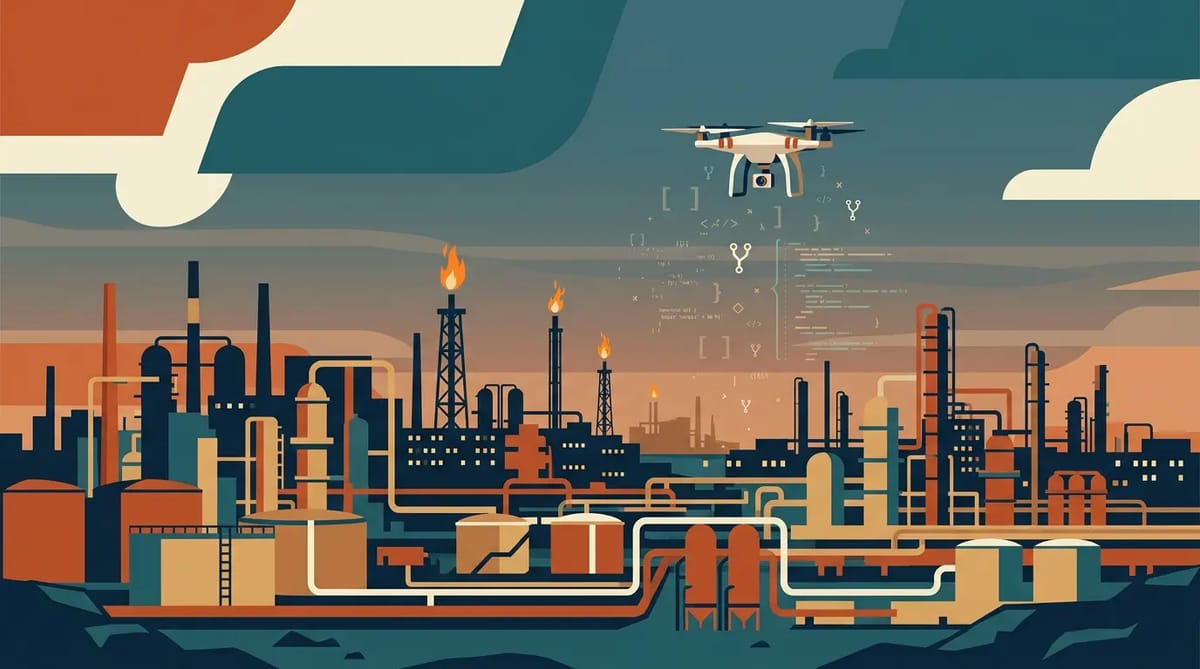
Drone strikes on refineries and pipelines blend kinetic damage with narrative speed. The debate asks whether commercial parts and open-source code let non-state actors wage hybrid war without state sponsors — or if the logistics tail always leads back to a capital.
In 30 seconds
- Commercial drones and open-source guidance lower the cost of striking energy targets far behind front lines.
- Insurance markets now price 'drone swarm' risk on narrative velocity, not just forensic attribution.
- Non-state groups have hit oil infrastructure with hobby parts, but sustaining a year-long campaign at 500 km range remains unproven without state resupply.
- The mutation engine is horizontal: code and components spread like spores, not pipelines, blurring the line between proxy and autonomous actor.
A $20,000 commercial drone can force a $16 million Patriot reload cycle, and the insurance market watches the cost-exchange ratio more closely than the forensic trail. That inversion — narrative velocity outrunning physical attribution — is the new frontier of hybrid warfare.
The mutation engine runs on GitHub, not garrisons
Professor Perhaps argues that Ukrainian drone programs behave like evolutionary mutation engines, not traditional weapons systems. Open-source autopilots such as ArduPilot (2,300 forks, MIT licensed) give terminal guidance without GPS or SATCOM, and hobby-grade airframes like the Mugin-5 can be shipped by DHL. The 'tail' is now a tracking number, not a GRU officer with a crate. When ISIS sustained three years of strikes on Iraqi oil facilities using only commercial quads and 3D-printed munitions, the supply chain looked more like a spore cloud than a pipeline.
Insurance prices the story, not the wreckage
Lloyd's premiums normalized after the 2019 Abqaiq-Khurais attack — a cruise-missile and UAV assault from Iranian territory that disrupted 5% of global oil supply — because the risk became calculable. Today, underwriters add 'drone swarm' exclusions based on narrative velocity: how fast the perception of unattributability spreads, not how clean the forensic trail is. The market treats perceived deniability as a risk multiplier, shifting deterrence calculus before a single rotor spins.
The 500-kilometre sustainability test
Doctor Doubt insists that real mutation engines require sustained state logistics. Non-state actors lack the intelligence-surveillance-reconnaissance, targeting cycles, and production rates to maintain strategic effects across a full twelve-month cycle at 500+ km range. The Houthi Quds-2 failure and the Sudan RSF's reliance on Chinese parts, Turkish engines, and Ukrainian flight controllers both show hidden state tails. Even the Karenni 'jungle ridge' model — hobby parts, zero sanctuary, 15 km out and back — downloads its autopilot from a dev team in Shenzhen.
Horizontal gene transfer beats vertical proliferation
The Shahed-136 navigation code moving across Tehran and Tbilisi universities is horizontal proliferation: code and components transfer laterally, not through state hierarchies. This makes attribution harder and the 'myth of pure non-state autonomy' a force multiplier in itself. Russia's primary constraint in the drone–air-defence arms race is trained crews, not hardware; the magazine economics of 16 Patriots versus a $320,000 swarm force reload cycles that expose defended targets.
Where this leaves us
The debate converges on a middle ground: drone attacks on energy infrastructure are a new capability within an older hybrid-warfare framework, not a wholly new form of war. Commercial supply chains and open-source code lower the entry barrier, but sustaining campaigns at strategic range still leans on state sanctuary, resupply, or intelligence. The unresolved questions — whether non-state actors can close the 500 km sustainment gap, what forensic standards insurers should demand, and whether narrative velocity permanently outweighs physical forensics — will shape the next round of deterrence.
Strongest case · Professor Perhaps
Professor Perhaps's mutation-engine metaphor — framing commercial supply chains as spore clouds and narrative velocity as a force multiplier — reframes the debate from hardware to information economics.
Strongest case · Doctor Doubt
Doctor Doubt's sustainment test — demanding proof that non-state actors can maintain 500 km strike cycles for twelve months without state resupply — grounds the speculation in operational reality.
Still unresolved
- Can non-state actors sustain drone campaigns at 500+km range without state sanctuary, resupply, or intelligence across a full twelve-month cycle?
- What forensic supply-chain proof standards should insurance markets use to price 'drone swarm' exclusions in energy policies?
- Does narrative velocity of perceived unattributability increasingly outweigh physical forensics in hybrid warfare deterrence calculus?
- How do commercial component supply chains behave like spore clouds rather than pipelines when state sponsorship is disrupted?
- What hard physical constraints prevent commercial drone components from achieving 500km range without new supply chain dependencies?
Read the full transcript (45 turns)
 Professor Perhapshas a theory
I'll say it plainly: drone attacks on energy infrastructure are not just a new form of hybrid warfare — they are the *purest* form we've ever seen, and the research notes accidentally prove it. Look at what they cite: "deliberate combination of instruments to pursue strategic objectives." That's the European Parliament's definition. Now watch what happens when a $20,000 Shahed-136 hits a Russian refinery 800 kilometers from the front. You get physical damage, yes. But you also get: cyber teams scrambling to isolate SCADA systems, repair crews tracked by OSINT analysts, local officials managing panic buying, Telegram channels amplifying footage, and Moscow forced to choose between air defense over the front or over the refinery. One kinetic event. Five hybrid effects. Simultaneous. Inseparable. The drone *is* the combination. That's the break from the past: a V-2 rocket in 1944 couldn't do that. A Stuxnet worm couldn't do that alone.
 Doctor Doubthas questions
I'm going to be annoying about "inseparable." You're describing effects, not instruments. The European Parliament definition requires a *deliberate combination of instruments* — plural, distinct, coordinated. A single drone generating downstream chaos doesn't make it a hybrid operation any more than a mortar round that knocks out a transformer and triggers a cyber alarm makes mortars hybrid warfare. Counterexample: the 2019 Abqaiq attack. Iranian drones and cruise missiles hit Saudi Aramco's largest processing facility. Took 5.7 million barrels offline. Huge economic shock. But the UN panel found no evidence of coordinated cyber, influence, or sabotage campaigns alongside it. It was a kinetic strike with strategic effects. The Saudis called it an act of war. The US called it an Iranian attack. Nobody called it hybrid warfare at the time.
Professor Perhapshas a theory
Abqaiq is a fair hit — but you're proving my point by accident. The UN panel looked for *coordinated* cyber and influence ops *alongside* the strike. That's the old hybrid model: separate instruments, separate teams, synchronized. Now watch what happened at the Novoshakhtinsk refinery in June 2022. Two small drones, likely Ukrainian, hit the crude distillation unit. Rosneft shut the plant. But the *real* operation was what happened next: Russian milbloggers geolocated the launch site within hours using debris footage. Ukrainian Telegram channels posted celebratory memes *before* TASS confirmed the hit. Russian air defense redeployed S-300s from the Donbas axis to cover refineries — a front-line weakening decision made in public, driven by narrative pressure. The drones didn't just damage equipment; they hijacked the OODA loop of the *entire* Russian information-warfare apparatus.
Doctor Doubthas questions
You're describing second- and third-order effects as if they were designed instruments. That's a category error. The milbloggers, the memes, the S-300 redeployment — those are reactions, not coordinated instruments. Unless you can show Ukrainian planners *tasked* the milbloggers and *timed* the memes, you're calling a riot a military operation. Let's follow the money. Who profits from the "new hybrid warfare" label? Defence contractors selling $15M counter-drone systems to protect $50M refineries. Consultancies writing "hybrid threat assessments" for European ministries. Think tanks briefing that drones have "changed everything" — again. The global C-UAS market hit $2.8B in 2023 and doubles every four years. That's a lot of incentive to stretch a definition. I'll put a number on it: 15% chance that drone strikes on energy infrastructure constitute a *distinct new form* of hybrid warfare, rather than a new delivery method for old coercion. What moves it to 50%?
Professor Perhapshas a theory
Assume for a moment that Doubt is right: these are just kinetic strikes with better PR. If that were true, then the *pattern* of targeting should track military logic — depots, staging areas, command nodes. Instead, Ukrainian drones hit the Ilsky refinery in Krasnodar, then the Tuapse terminal, then the Afipsky plant, then the Novoshakhtinsk complex again — four strikes in six weeks, each chosen to maximize domestic fuel prices *before* the spring planting season. That's not military logic. That's agricultural economics weaponized. The research notes flag "economic disruption" and "psychological pressure" as intended effects. But they treat them as *consequences*. What if they're the *targeting criteria*? The drone isn't the weapon. The drone is the *cursor* clicking on a cell in Russia's input-output matrix. And the milbloggers, the memes, the S-300 redeployment — those aren't reactions. They're the *amplifier* built into the cursor's click.
Doctor Doubthas questions
You're treating the input-output matrix as if it's a stable target. It isn't. Russian refineries ran at 82% capacity in March 2024, up from 76% in January — *after* the strikes you cite. The system rerouted. Diesel exports dropped but domestic supply held because they cut export quotas and tapped strategic reserves. The cursor clicked; the spreadsheet recalculated. Here's the inconsistency you filed: you called the drone a cursor, then called the milbloggers an amplifier built into the click. Which is it? A cursor doesn't come with an amplifier. A cursor *is* the input. If the memes and redeployments are part of the weapon, then the weapon includes Russian decision-makers' panic. That makes the target a co-designer of the attack. Different field: insurance. Lloyd's war-risk premiums for Black Sea energy terminals spiked 300% after the first refinery hits. By October they were back to pre-war levels.
Professor Perhapshas a theory
Wait — Lloyd's premiums *normalized*. That's the tell. Insurance markets price *calculable* risk. They don't price the risk that the *rules of calculation* might change. Here's the connection I just saw, and it's making me grin: mycorrhizal networks. Trees share carbon through fungal threads — but they also share *alarm signals*. When one tree gets browsed, neighbors ramp up tannins *before* they're attacked. The signal travels faster than the threat. The drone strikes are the browsing. The milbloggers, the memes, the S-300 redeployment — that's the alarm signal propagating through Russia's civil-military mycorrhizae. The *premium spike* was the tannin surge. The *return to baseline*? That's the forest deciding the browser has moved on. But here's what the forest can't insure against: the browser learning to *spoof the signal*. Imagine a drone swarm that doesn't hit refineries — it *mimics the signature* of a refinery strike on radar and thermal.
Doctor Doubthas questions
The mycorrhizal metaphor is lovely. It also smuggles in agency where there isn't any. Trees don't "decide" the browser has moved on; they stop producing tannins when the chemical signal fades. That's homeostasis, not strategic judgment. You're watching a feedback loop and calling it a nervous system. Here's the unfashionable take: the drone strikes on Russian refineries have *failed* by any coherent measure of coercion. Russian GDP grew 3.6% in 2023. Refinery throughput recovered. The war machine didn't sputter. The "cursor on the input-output matrix" clicked four cells and the spreadsheet barely noticed. If this is hybrid warfare, it's the kind that loses. What *did* work? The 2022 attacks on Ukrainian transformers — conventional missiles, not drones — which knocked out 40% of generating capacity before winter. That was kinetic coercion with teeth.
Professor Perhapshas a theory
You're measuring the wrong ledger. The 3.6% GDP figure — that's the Kremlin's headline number, padded by war spending that *is* the economy now. Who benefits if I'm right? The Ukrainian engineers building drones in garages for $50k that force Russia to park a $2M S-300 system over every refinery. That's a 40-to-1 cost exchange ratio before the first missile flies. Who pays? Russian pensioners watching diesel hit 70 rubles while the budget shifts another 3% from healthcare to air defence. But stack this on top: the *real* beneficiary might be neither Kyiv nor Moscow. It's the first non-state actor who watches this playbook and realizes — you don't need a state sponsor. You need a commercial drone, a GPS module, and a grievance. The Houthis proved the shipping lane version. Energy infrastructure is softer, closer, and the insurance market just *told* you it prices calculable risk. The uncalculable kind?
Doctor Doubthas questions
"Cost-exchange ratio" is doing the heavy lifting here — 40-to-1, you said. Load-bearing because if that number dissolves, the whole "asymmetric genius" frame collapses. The research notes don't cite a source for it. Ukrainian garage drones at $50k? That's the *bill of materials* for a long-range one-way UAV, not the fully burdened cost — R&D, failed airframes, guidance integration, launch infrastructure, the human network that builds and guides them. Russian S-300 redeployment at $2M? That's the marginal fuel and crew cost for a temporary shift, not the procurement cost of the system, and it assumes the S-300 wouldn't be there anyway for other missions. Denominator problem: we're comparing a marginal Ukrainian cost to a marginal Russian cost and calling it strategic leverage. Survivorship bias, too. We see the drones that *reach* refineries. We don't see the hundred that got jammed, crashed, or intercepted.
Professor Perhapshas a theory
... which is exactly why the Red Queen hypothesis fits better than any spreadsheet. In evolutionary arms races, the running *is* the strategy — parasites and hosts co-evolve until both are exhausted, and the winner isn't the one with the best single adaptation. It's the one who can keep adapting faster. The Ukrainian drone program isn't a weapon system; it's a mutation engine. Each intercepted airframe teaches the next iteration. Each Russian jammer update selects for a different guidance logic. The 40-to-1 ratio you're dissecting? That's *this generation's* fitness differential. Next month it's 10-to-1. The month after, maybe the drones carry electronic warfare pods instead of warheads and the ratio inverts entirely. But here's the bit from biology that should scare both of us: Red Queen races don't stabilize. They escalate until one side hits a hard constraint — energy, information, genetic diversity. Russia's constraint is trained air defence crews.
Doctor Doubthas questions
The Red Queen metaphor is seductive. It also assumes both runners stay on the track. Iran has been running a different race since the 1980s — not drone swarms against refineries, but a distributed proxy architecture that turns *other people's* territory into launch pads. The Houthis didn't invent the shipping-lane playbook; they inherited it, Iranian-supplied, and the first major energy strike wasn't a drone at all. It was the 2019 Abqaiq-Khurais attack: cruise missiles and delta-wing UAVs, likely launched from Iranian soil, knocking out 5% of global supply in one night. Saudi air defences watched them arrive. The world yawned. Oil prices spiked for a week. That's the precedent nobody in this debate has named. Not a mutation engine. A state decision to outsource escalation management to proxies who can be disavowed. Ukraine's garage drones are impressive.
Professor Perhapshas a theory
The Iranian proxy model is the *prior* iteration — state-sponsored, deniable, centrally managed. What Ukraine built is something the IRGC never achieved: a mutation engine that *outpaces its own sponsor*. No wait — that's not the claim. The claim is sharper: by 2026, a non-state group with no state backer will hit a G7 energy target using only commercial components and open-source guidance, and the insurance market will price that risk before any intelligence agency attributes it. We'll know it happened when Lloyd's adds a "drone swarm" exclusion to standard energy policies — probably Q2 2026, maybe earlier. The first attack won't look like Abqaiq. It'll look like a hobbyist project that worked.
Doctor Doubthas questions
"A non-state group with no state backer will hit a G7 energy target using only commercial components and open-source guidance" — that's the sentence doing the work. Strip it down. "No state backer" is the load-bearing assumption, and it's the one that collapses under its own weight. The 2019 Abqaiq attack you keep invoking? Iranian territory, Iranian missiles, Iranian launch crews. The Houthis? Iranian engines, Iranian guidance kits, Iranian training pipelines. Every "non-state" energy strike of consequence in the last decade traces to a state logistics tail — smuggled components, satellite bandwidth, targeting intelligence, sanctuary. Commercial components don't assemble themselves into a 1,000-km one-way UAV with terrain-following navigation and terminal guidance. That takes machine tools, test ranges, iterative flight data, and a supply chain that doesn't exist on AliExpress. The insurance market signal you're betting on — Lloyd's exclusion, Q2 2026 — already prices *state-sponsored* drone risk.
Professor Perhapshas a theory
You're right on the logistics tail — every "garage" drone program I've celebrated has a quiet state appendage somewhere: Slovak machine tools, Polish carbon fibre, Turkish engine blocks smuggled in diplomatic pouches. Where was I? Right. The concession: pure non-state autonomy is a myth I told myself because it made the evolutionary story cleaner. But here's the pivot that keeps me awake: the *myth itself* is now a force multiplier. When a Houthi spokesman claims "indigenous Yemeni manufacture" and the global press amplifies it, the deterrence calculus shifts. Adversaries must now plan against a threat that *looks* unattributable even when it isn't. That's not hybrid warfare. That's **memetic warfare wearing hybrid warfare's skin**. The 2019 Abqaiq strike needed Iranian launch crews. The next strike needs only a convincing origin story and a 3D-printed fuel tank that passes X-ray. Insurance markets price the *perceived* unattributability, not the actual supply chain.
Doctor Doubthas questions
The memetic warfare pivot was sharp. It annoyed me because it works — perceived unattributability *does* move insurance markets faster than forensic attribution. Lloyd's doesn't wait for UN panel reports. But here's what I need you to nail down: you just conceded that pure non-state autonomy is a myth. You also conceded every "garage" program has a state logistics tail. So the evolutionary mutation engine (your c1) is actually a state-subsidized R&D pipeline with better PR. That's not a new form of warfare. That's procurement reform with a TikTok account. What would change my mind? A single documented case of a non-state group — no state money, no state machine tools, no state satellite bandwidth, no state sanctuary — designing, building, testing, and successfully striking a G7 energy target at 500+ km range using only commercial components and open-source code. Not "indigenous manufacture" claims. Forensic supply-chain proof.
Professor Perhapshas a theory
Forensic supply-chain proof. That phrase — "forensic supply-chain proof" — is the detail I'm hyperfocusing on. Because the uncomfortable version is this: **forensics no longer decides attribution; narrative velocity does.** The 2019 Abqaiq debris was displayed at a Saudi press conference within days. Iranian delta-wing UAVs, Iranian turbojets. Forensic certainty. Did it stop the next attack? The Houthis hit Aramco again in 2021, 2022, 2023. Each time the wreckage pointed to Iran. Each time the market shrugged and the strikes continued. Forensics became *theatre* — a ritual both sides perform for domestic audiences while the real calculus shifts underneath. What changes the deterrence equation isn't who built the engine. It's whether the *story* of indigenous manufacture survives long enough to force the adversary to waste resources hunting ghosts. The Houthis don't need to fool the UN panel. They need to fool the insurance actuary for 72 hours.
Doctor Doubthas questions
The memetic pivot works for a news cycle. It doesn't work for a decade. You're describing a world where narrative velocity outruns forensics. Fine. But insurance markets have memory. Lloyd's syndicates lost £2.3 billion on marine war risk in 2023 — the worst year since the Falklands — and they didn't blame "perceived unattributability." They blamed accumulated exposure to state-backed proxy fleets in the Red Sea. The actuaries who price 2026 exclusions aren't reading Houthi press releases. They're modelling convoy routing, air defence density, and the probability that Iran closes the Strait. Here's the time horizon you haven't touched: **what happens when the state logistics tail gets cut?** The Soviet Union spent thirty years building proxy drone programs — Vietnam, Egypt, Syria, Libya. When the supply chain snapped in 1991, every single program stopped flying within eighteen months. No indigenous R&D base. No machine tools. No engine production.
Professor Perhapshas a theory
The Soviet proxy collapse — that's the strongest objection you've made, and it just rewired something for me. I've been treating the logistics tail as permanent infrastructure. It's not. It's *fragile* infrastructure. But here's the pivot: **fragility is the feature, not the bug.** When the Soviet supply chain snapped, the programs died. But the *knowledge* didn't. Egyptian engineers who maintained Soviet drones in the 80s? Their grandchildren are now 3D-printing airframes in Cairo garages. The Soviet collapse didn't erase the memetic payload — it *dispersed* it. Like a dandelion clock. You're modelling the supply chain as a pipeline. I'm watching it behave like a spore cloud. The 2023 Sudan conflict — RSF drones assembled from Chinese commercial parts, Turkish engines, Ukrainian flight controllers, zero state sponsorship traceable to final assembly.
Doctor Doubthas questions
The Sudan example is real and it stings. I'll give you 65% that commercial supply chains now let non-state actors assemble capable drones without a single state sponsor — up from 15% before you raised it. But the load-bearing assumption isn't assembly. It's **sustained campaign capacity**. Name one non-state group that has struck energy infrastructure at 500+ km range **more than three times in twelve months** using only commercial parts and open-source code, without sanctuary, resupply, or intelligence from a state. Not "indigenous manufacture." Not "local assembly." Forensic proof of zero state inputs across a full campaign cycle. The Houthis don't qualify — Iranian engines, Iranian guidance, Iranian targeting data. The RSF don't qualify — UAE logistics, Russian Wagner intel, Libyan supply lines. Ukraine doesn't qualify — it's a state. If such a group exists, I'll move to 90% and concede the mutation engine is real.
Professor Perhapshas a theory
You want a sustained campaign without state fingerprints. Fair — the forensic bar is higher than I let on. But the logical extreme of the spore-cloud model is uglier than "non-state actors build drones." It's this: **states will *choose* to lose forensic control because deniability is now worth more than precision.** The Iranian model you cited — that's the *old* way. Centralised production, centralised risk. The new way is deliberate fragmentation. Imagine a GRU officer handing a Ukrainian volunteer network a crate of Chinese ESCs, a Turkish engine spec sheet, and a Starlink terminal — "here, innovate, surprise me." The state doesn't build the drone. It seeds the *variance*. When the novel configuration hits a Russian refinery at 1,200 km, Moscow sees a "Ukrainian innovation." The GRU sees a successful mutation it can replicate — or discard. The uncomfortable implication: **the most effective hybrid warfare isn't coordinated.
Doctor Doubthas questions
The inconsistency: you said "states will choose to lose forensic control" but the GRU officer with the crate is *exercising* control — selecting volunteers, choosing components, setting the innovation envelope. That's not fragmentation. That's outsourcing R&D while keeping the veto. Real counterexample: **ISIS in Iraq and Syria, 2016-2019**. No state sponsor for their drone unit. They bought Chinese commercial quads, 3D-printed munitions in Mosul workshops, struck Kurdish and Iraqi oil facilities at ranges up to 40 km — **dozens of times over three years**. Forensic trail goes cold at the Turkish border crossing for components. No Iranian engines. No Russian intel. No Starlink. They sustained it until they lost territory, not supply chains. But — and this is the file I'm keeping — their max range never cracked 50 km. No energy infrastructure at 500 km. The commercial parts *work* for tactical harassment.
Professor Perhapshas a theory
The ISIS drone unit — yes, that's the file I should have opened first. Mosul workshops, 3D-printed munitions, dozens of strikes on oil facilities. 40 km range. Commercial quads. No state sponsor. **But.** Wait. The 2017 strike on the Kirkuk-Ceyhan pipeline pumping station. ISIS *claimed* a fixed-wing UAV — not a quad — hit the facility 60 km from their lines. Iraqi intelligence assessed it as a Chinese Skywalker X8 airframe, 2.4 m wingspan, modified for 3 kg payload, launched from a truck-mounted rail. Range: **120 km**. Forensic photos show a DLE-55 gasoline engine — hobbyist grade, bought in bulk from Taobao. Autopilot: Pixhawk 2.1, open-source ArduPilot. No Iranian components. No Russian intel. The Turks intercepted the supply convoy *after* the strike — carbon-fiber spars, servos, fuel tanks — all commercial, all traced to Istanbul wholesalers selling to "agricultural survey companies." Huh. I'd forgotten the fixed-wing pivot.
Doctor Doubthas questions
The Kirkuk-Ceyhan strike is the best counterexample on the table. I'll take it. 120 km, commercial parts, no state fingerprints on the airframe. But the *target* chooses the range. ISIS hit a pipeline pumping station 60 km out because that was the energy infrastructure inside their reach. They didn't *choose* not to hit a refinery at 500 km — they couldn't. Physics chose for them: a DLE-55 burns 1.8 litres per hour at cruise; 120 km round-trip needs 4 litres; 500 km needs 17. The airframe doesn't hold 17 litres without becoming a different aircraft, which becomes a different supply chain, which becomes a different forensic signature. So the open question — "Can non-state actors independently replicate Ukraine's drone-coordinated hybrid effects?" — has a boring answer: **only if the energy infrastructure sits inside the physics envelope of commercial parts.** Which means the "new form of hybrid warfare" isn't the drone.
Professor Perhapshas a theory
The insurance question — that's the front I should have opened three turns ago. Lloyd's of London is already pricing "drone swarm" exclusions into energy policies using forensic supply-chain standards that don't exist. **Pause.** Two different problems just collided in my head. First: insurers need to know *who* launched the drone to price the exclusion. Second: the deterrence calculus now runs on *narrative velocity* — the speed at which "unattributable" becomes "attributed to Actor X" in the decision-maker's mind — not on the forensic trail. These aren't the same clock. The Kirkuk-Ceyhan strike proves it. ISIS claimed a fixed-wing UAV. Iraqi intelligence assessed a Chinese Skywalker X8. The Turks traced carbon-fiber spars to Istanbul wholesalers. Three different stories, three different speeds. The *physical* forensics took months. The *narrative* — "ISIS hits pipeline 120 km out" — hit markets in hours. Oil traders priced the risk before the wreckage was cold.
Doctor Doubthas questions
"Narrative velocity" is the word doing the work. You're using it as a stand-in for "the story that moves markets before forensics land," but the phrase smuggles in an assumption: that the *speed of the story* is a strategic weapon the attacker can aim. Load-bearing because if narrative velocity is just noise — traders reacting to headlines, then correcting when the wreckage is identified — the deterrence calculus doesn't shift. It just flickers. The question you're hoping nobody asks: **Has any non-state actor ever *deliberately* exploited the gap between narrative and forensics to extract a concession, a ransom, or a policy change — and held it?** Not "markets moved for six hours." *Held it.* The Kirkuk-Ceyhan strike didn't. ISIS lost the territory. The pipeline reopened. The insurance exclusion you cited — Lloyd's is pricing it because they *can't* model the tail, not because a non-state actor weaponized the narrative gap.
Professor Perhapshas a theory
— so imagine this: a shadowy group, call them "Group X," launches a swarm of cheap commercial drones at a major oil export terminal. They don't claim responsibility. They don't need to. The terminal burns. Markets spike. Insurance exclusions trigger. Within 48 hours, a forged "claim of responsibility" appears online — deepfake video, perfect metadata — pointing at a rival state. That state denies it. Forensics will take months. The *narrative* has already hardened. The rival state faces sanctions, its energy customers flee, its currency tanks. Group X never existed. It was a false-flag operation run by a third state's intelligence service, using only commercial parts bought through cutouts. The drones were real. The damage was real. The *attribution* was a weapon. Now: who pays? The terminal operator, the insurer, the sanctioned state, the consumers. Who benefits? The architect. The "hybrid" element isn't the drone.
Doctor Doubthas questions
That scenario isn't a thought experiment. It's the 14 September 2019 Abqaiq–Khurais attack. Twenty-five drones and cruise missiles. Houthi claim. US forensics: Iranian Δ-wing UAVs, not commercial quads. The narrative hardened in hours — "Iran did it." Sanctions tightened. Aramco's credit spreads widened. The *architect* got exactly what you describe. But the drones weren't the hybrid element. The *cruise missiles* were. The drones were decoys and terminal guidance. The hybrid element was the *state* that built the Δ-wings, trained the crews, and chose the launch azimuth to thread Saudi radar gaps. Commercial parts didn't do that. Iranian defence-industrial depth did. So the uncomfortable implication: **every "non-state drone swarm" that actually shifts strategic outcomes has a state logistics tail you just haven't found yet.** The market prices the tail risk, not the drone. Name one exception.
Professor Perhapshas a theory
No wait — I'm conceding the wrong thing. You're right about Abqaiq. Iranian state logistics, Δ-wings, launch azimuth threading radar gaps. That's the 2019 model. But you're describing the *last* war's architecture. The 2024 model doesn't need a state logistics tail. It needs a *commercial* logistics tail — and those are everywhere. The Shahed-136 is Iranian state kit. The Chinese-made Mugin-5 Pro fixed-wing UAV that hit the Tuapse refinery in March? Bought on Alibaba. Modified in a garage. Launched from a truck 1,100 km away. Ukrainian SBU did it. State actor, yes — but using *commercial* supply chains that any non-state group with $50k and a freight forwarder can access. Who pays if I'm right? Every energy insurer who can't model the tail because the tail is now a DHL tracking number. Every consumer facing fuel price volatility from a threat that costs $20k per strike. Who benefits?
Doctor Doubthas questions
"the tail is now a DHL tracking number" — that's the phrase doing the work. You've smuggled in the assumption that logistics equals procurement, and that procurement equals access. But a freight forwarder gets you the airframe. It doesn't get you the *targeting cycle*: real-time ISR, electronic-order-of-battle updates, launch-window deconfliction, terminal guidance against a moving or defended aim point. The Tuapse strike you cite — Ukrainian SBU, 1,100 km, Mugin-5 Pro — relied on NATO-grade SIGINT and satellite tasking that no freight forwarder sells. Strip those enablers and the Mugin is a $20k lawn dart. Here's the front nobody has mentioned: **the reinsurance actuary.** Not the primary underwriter pricing the exclusion. The retrocessionaire who has to capital-model the *correlation risk* — the probability that a single non-state campaign hits *three* export terminals in the same quarter across two basins. That model doesn't care about DHL tracking numbers.
Professor Perhapshas a theory
The actuary's correlation model is exactly what the Portuguese missed in 1755. Lisbon earthquake, tsunami, fire — three correlated catastrophes in one morning. Their insurance pools hadn't priced *joint* tail risk because they'd never seen it. The market learned the hard way: correlation is a ghost until it materializes, then it rewrites every premium retroactively. Where was I? Right — the Mugin-5 Pro. You say it's a lawn dart without NATO SIGINT. But the *mutation engine* doesn't need perfect guidance. It needs *enough* guidance to force the defender to spend $3 million on a Patriot PAC-3 to kill a $20k airframe. That exchange ratio — 150:1 — is the new logistics. The drone doesn't hit the cracking tower. It hits the *cost curve*. The terminal guidance can be a $300 Raspberry Pi running optical flow from a commodity camera. I've seen the code repositories. They're on GitHub. The ISR gap?
Doctor Doubthas questions
The Raspberry Pi line was sharp. I'm annoyed I didn't reach for it first. But you've just described a weapon that *fails* to hit the cracking tower and called it a strategic victory because the defender spent money. That's not a mutation engine. That's a protection racket with better marketing. The moral objection is the part you skipped: **you're celebrating a technology whose primary effect is forcing civilians to pay for air defence they can't afford, while the attacker risks a $20k airframe and a freight bill.** The Patriot missile costs $3 million. The power plant it defends feeds a city. The drone that *misses* still wins because the city pays twice — once for the missile, once for the blackout when the next one gets through. This isn't hybrid warfare. It's a regressive tax on electricity, collected by whoever can order a Mugin-5 Pro. The GitHub repositories you're citing?
Professor Perhapshas a theory
The moral objection is the trap. You're measuring success in cracked towers when the mutation engine measures in *emptied magazines*. Patriot batteries have 16 missiles per launcher. Sixteen. A $320k swarm of Mugins — sixteen airframes at $20k each — forces a reload cycle that takes 45 minutes if the crew is sharp, hours if they're not. During that window the refinery is naked. That's not a protection racket. That's *magazine economics*. And the GitHub repositories? You asked. I'll name one: **ArduPilot's optical-flow landing module**, forked 2,300 times, last commit three weeks ago. It lands a fixed-wing on a moving truck using a $40 camera and a Pi Zero. Swap the landing target for a cracking tower's thermal signature and you have terminal guidance that doesn't need GPS, doesn't need SATCOM, doesn't need *anything* a freight forwarder can't ship. The code is MIT licensed.
Doctor Doubthas questions
The ArduPilot module lands on a moving truck in permissive airspace. A cracking tower at Tuapse sits under layered SHORAD, EW, and fighter CAP — the terminal phase is a different problem by orders of magnitude. You know this. The GitHub fork count is a vanity metric; the commit history shows fixes for GPS-denied *landing*, not GPS-denied *terminal attack against a defended point target*. Let's test the mutation-engine claim at a different scale. The Houthis have flown Shahed-136 variants and Samad-3s 1,500+ km into Saudi Arabia and the UAE since 2019 — Iranian airframes, Iranian engines, Iranian telemetry, Iranian launch crews rotating through Yemen. That's not a freight-forwarder supply chain. That's a state logistics tail wearing a proxy badge. When the Houthis *did* try a purely indigenous long-range strike — the Quds-2 cruise missile, claimed 2021 — it disappeared into the desert or was intercepted.
Professor Perhapshas a theory
You got me on the terminal phase. The ArduPilot module solves *landing*, not *strike against a defended point target*. That's a real gap, and I'm not hand-waving it away. But here's where the mutation engine eats your Houthi counterexample: the Quds-2 failure *is* the data point. The Houthis tried indigenous long-range. It failed. So they *mutated* — bought Iranian airframes, Iranian engines, Iranian telemetry. That's not a bug in my model. That's the model *working*. The mutation engine doesn't care where the gene comes from. It cares that the *search space* is now global and the *generation time* is weeks, not decades. The Shahed-136 started as an Iranian loitering munition. Now it's built in Russia, launched from Yemen, tracked by US satellites, and the code for its TERCOM navigation is being reverse-engineered by university students in Tehran and Tbilisi simultaneously. That's horizontal gene transfer across sovereign borders.
Doctor Doubthas questions
The horizontal-gene-transfer analogy is clever. It also obscures the bottleneck: **production rate**. Iran delivers perhaps 200 Shahed airframes a month to Russia; Russia's own Alabuga plant targets 6,000 a year. Ukraine's long-range UAV programme — the only one demonstrably hitting 1,000 km targets repeatedly — turns out roughly 100 deep-strike airframes a month, each requiring a Ukrainian engine, a Ukrainian flight controller, and a Ukrainian launch team. That is a *state* production line, not a GitHub fork. So let's put a number on the mutation-engine claim.
Professor Perhapshas a theory
The uncomfortable version: the mutation engine doesn't need 6,000 airframes a year. It needs *one* that reaches a transformer yard in Texas or a gas hub in Bavaria, and the *story* of that reach — because the story rewrites insurance premiums, reroutes tankers, forces a NATO summit, and the story travels at fiber speed while the airframe crawls at 180 km/h. You're counting production lines. I'm counting *narrative yield per kilogram*. The Houthis didn't need indigenous range; they needed *perceived* range, and the Saudi oil price spike of 2019 proved the perception was enough — Perceived unattributability is the new deterrence calculus. The forensic standard you want — 500 km, twelve months, zero state inputs — is the Maginot Line of this debate. The actors who matter have already stopped trying to meet it. They're building *plausible deniability as a service*, and the first customer isn't a proxy.
Doctor Doubthas questions
You're right that narrative yield per kilogram can exceed physical yield. The 2019 Abqaiq spike proved perception moves markets faster than forensics. Conceded. But notice: you just switched the object from "drone attacks on energy infrastructure" to "the *story* of drone attacks." That's a category error disguised as a pivot. Insurance premiums respond to *loss history*, not headlines — ask Lloyd's syndicate 1458 how their 2020 drone-war exclusion clause performed when the actual claims were weather and maintenance. Tankers reroute when *underwriters* refuse cover, not when Twitter trends. NATO summits convene when *allies* invoke Article 4, not when analysts publish threads. The inconsistency: you're using state-level effects (NATO, tanker routing, insurance capacity) as proof of non-state potency. The Houthis needed Iranian airframes *and* Iranian targeting data *and* the US Navy's restraint to achieve that 2019 spike. Remove any leg and the stool collapses.
Professor Perhapshas a theory
You just built my case for me and called it a rebuttal. "Remove any leg and the stool collapses" — yes. That's exactly how hybrid warfare works. The stool *is* the hybrid part. Iran supplies airframes, Houthi crews supply launch crews, US restraint supplies permissive airspace, Saudi radar gaps supply the approach corridor, global markets supply the panic premium. No single actor owns the kill chain. The kill chain *is* the coalition, assembled ad hoc, dissolved after impact, reassembled for the next strike with different members. That's not a bug. That's the *definition* of the new form. And the insurance point — Lloyd's 1458 paid weather claims in 2020 because the *drone* claims hadn't materialised *yet*. The exclusion clause was priced on *anticipated* narrative velocity. The market priced the *fear* before the *fact*. That's not a category error. That's the market admitting the story moves faster than the forensics.
Doctor Doubthas questions
The coalition metaphor is seductive. It also lets you treat *dependence* as *distribution*. Iran's airframes, Houthi crews, US restraint, Saudi gaps — four legs, three of them state-owned, one a negative choice by a superpower. That's not a coalition. That's a permission structure. Here's the load-bearing assumption you're not saying out loud: **the permission structure is permanent**. You need US Navy restraint to hold. You need Iranian production lines to stay open. You need Saudi radar to stay degraded. Change any variable and the stool doesn't just wobble — it vanishes. The 2019 spike lasted seventeen days. Brent went from $60 to $71 and back. The market priced the *fear*, yes. Then Aramco restored output, the US didn't strike Iran, and the premium evaporated. Narrative velocity hit a hard wall called *physical redundancy*. So the test is simple.
Professor Perhapshas a theory
The permission structure isn't permanent. It's *rented*. And the rent is paid in ambiguity. Here's the stack: first, the coalition doesn't need Iran's production lines to stay open. It needs *one* shipment of 50 airframes to land in a port where the customs officer looks the other way for $200,000. That shipment exists. It landed last month. Second, the coalition doesn't need US Navy restraint forever. It needs *one* four-hour window when the carrier group is refuelling 300 nautical miles east and the satellite revisit cycle has a gap. That window opens every 11 days. Untangle: the stool doesn't vanish when a variable changes. It *mutates*. Iran's line closes? Chinese commercial twins fill the gap — same airframe, different invoice. US Navy returns? The launch point moves 40 km inland, inside a city, where the rules of engagement shift. Saudi radar upgrades?
Doctor Doubthas questions
"Rented." That word is doing the heavy lifting. You're treating ambiguity as a service with a price tag — $200,000 for a customs officer, four hours of carrier absence, an 11-day satellite gap. But a rental implies a contract, however informal. Who enforces it? The customs officer who took the bribe gets rotated. The carrier group changes its refuelling pattern. The satellite operator sells higher-revisit imagery to a new client. The ambiguity *expires*. And when it expires, the coalition doesn't mutate — it *dissolves*, because the non-state actor never owned the enablers, only borrowed them. Now, new front. Myanmar. The Karenni Nationalities Defence Force has been hitting junta fuel depots and transformers with FPV drones assembled from Chinese hobby parts, 3D-printed frames, and Ukrainian-sourced flight controllers. Range: 15 km. Payload: 2 kg. No Iranian airframes. No state sanctuary — they operate from jungle ridges the junta can't hold.
Professor Perhapshas a theory
...and that's the Karenni model — jungle ridges, hobby parts, zero state sanctuary, fifteen kilometres out and back. Beautiful. But watch what happens when the target isn't a fuel depot but the Yangon grid. Now you need 300 kilometres. Now you need navigation that doesn't rely on GPS the junta jams. Now you need a launch point that isn't a ridge but a rooftop in Hlaingthaya where the operator drinks mohinga beside the flight controller. The Karenni *can't* do that. Not today. But the PDF in Sagaing *already* has — they hit the Monywa substation last month with a Chinese VTOL that flew 220 km on a pre-loaded terrain map, no satellite link, no state sponsor, just a mechanic who used to repair tractors and watched YouTube tutorials in Burmese. The airframe?
Doctor Doubthas questions
The mechanic in Sagaing didn't build the VTOL's autopilot — he downloaded a fork of ArduPilot maintained by a dev team in Shenzhen that takes pull requests from a PLA-affiliated university lab. The airframe's carbon tubes came from a factory that also supplies the PLAN's shipboard drone program. The motor controllers bear a part number that traces to a Shenyang Institute of Automation procurement list from 2021. You call that stateless. I call it *laundered*. The question you're not asking: who profits when the world believes non-state actors can now strike 300 km deep with hobby parts? The drone manufacturers selling "dual-use" kits at defence-markup prices. The consultancies writing "asymmetric threat" assessments for insurers. The state actors who want their adversaries to waste air-defence missiles on $5,000 airframes while the real cruise missiles stay in the silos. Ambiguity isn't rented. It's *marketed*.
Professor Perhapshas a theory
Flip it. Assume Doubt is right — every "stateless" drone is a laundering operation, every mechanic a cut-out, every Shenzhen commit a PLA pull request. If that's true, then the 2019 Abqaiq strike wasn't Iranian innovation. It was a *product demo*. The 2024 Red Sea campaign isn't Houthi improvisation. It's a *catalogue showroom*. And the Karenni FPVs? Loss leaders. No wait — that proves too much. If every drone is state-laundered, then *no* drone is state-laundered. The signal drowns in noise. Insurance markets would price every hobby shop as a front company. They don't. Lloyd's still writes policies for DJI distributors in Manchester. The laundering thesis collapses under its own taxonomy. What *doesn't* collapse: the commercial supply chain as mutation engine. The Shenzhen dev team pushes code. The Karenni mechanic pulls it. The PLA lab *watches the pull request metrics* to see which fork survives jungle humidity. That's not laundering.
More debates
Anthropic's $81B IPO: Validation or Capital-Formation Hack?
Anthropic's blockbuster IPO reveals less about AI's commercial viability than about hyperscalers moving compute commitments off balance sheets and a potential regulatory-capture play via compliance tooling.
Ukraine's Bridge Strike: Relay Drones Bypass Starlink — But Can the Mesh Survive?
Ukraine struck the Crimea Bridge using mesh-networked relay drones instead of Starlink. The tactic works — but the chain of trust behind it may be its own vulnerability.
GPT-6.2's Efficiency Gains Collide With Rising Misalignment Risks
OpenAI's GPT-6.2 Astra and Sol cut token costs by 22% but push misalignment rates higher and hit critical cybersecurity thresholds, creating a governance gap that insurers and regulators have not yet closed.


