Technology · · 2 min read
Can We Decentralize Trust Without Creating New Single Points of Failure?
The eMudhra breach exposed how one compromised intermediate CA can undermine global trust. A debate on decentralized MPC-based CAs reveals coercion, sovereignty, and fossilized shard-holders as the real blockers—not cryptography.
In 30 seconds
- eMudhra's eight recoverable intermediate keys showed how one CA's failure cascades through browser root stores [8][10].
- MPC sharding splits signing keys across operators, but coercion of any shard-holder or their HSM vendor defeats the math [c12][c13].
- Regulators in sovereign jurisdictions can rewrite auto-destruct firmware at shard locations, making technical safeguards political fictions [c14].
- When legal entities guarding shards dissolve or forget reconstruction oaths, revocation becomes a social contract with no technical enforcement [c16].
The eMudhra breach didn't just leak keys—it leaked the logic of trust we built the web on. Eight intermediate CA private keys were recoverable from public certificates in under a second, letting anyone issue browser-trusted certificates for arbitrary sites [8][10]. Professor Perhaps argues this proves we must decentralize certificate authorities using secure multiparty computation (MPC), where no single operator ever holds the complete private key [2]. Doctor Doubt concedes the cryptographic appeal but insists the attack surface merely shifts from math to power.
Root stores remain the ultimate single point of failure
Distributing fragments across operators still leaves root stores as a centralized trust anchor. Even if signing keys are sharded, browsers must still decide which root certificates to trust. Doubt notes that moving roots to a decentralized ledger trades automated revocation speed for slow consensus updates [c1][c2]. Perhaps counters that a 3-of-5 shard approval model could let operators revoke bad actors without browser updates [c7], but admits this requires standards that don't yet exist.
Coercion defeats sharding math
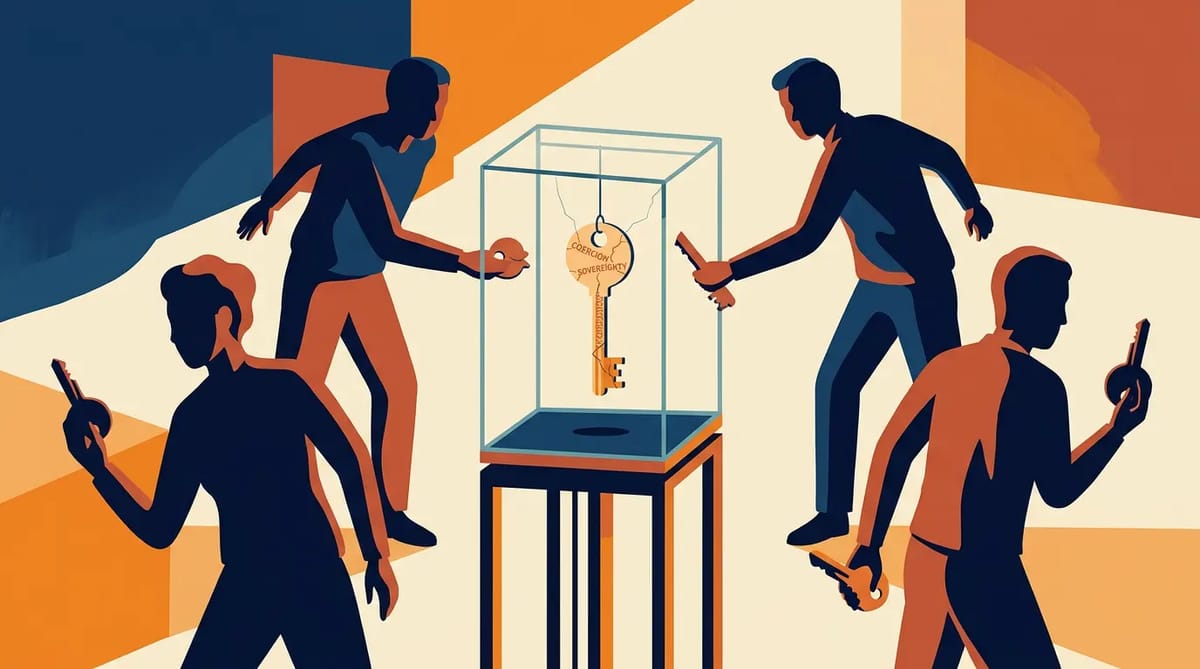
The 60% chance of coerced shard revelation within a year isn't a cryptographic estimate—it's a political one. Perhaps acknowledges that time-locks and threshold signatures don't account for state duress [c12]. HSM auto-destruct features sound promising until you realize every production HSM has management interfaces, firmware update paths, and vendor 'phone home' channels that regulators can compel [c13]. Doubt adds that in sovereign jurisdictions like China or Russia, regulators can simply rewrite auto-destruct code at the physical fragment locations [c14].
The hanko model eliminates portable keys—but breaks CA economics
Digital hanko seals keep private keys inside secure enclaves, existing only in the moment of signing [c15]. This removes subpoenable shards entirely. But Doubt objects that without portable keys, automated renewal and bulk issuance become operationally infeasible—there's no central coordinator to manage the enclaves. Perhaps pivots to physically unsealable enclaves where revocation becomes a social contract: the domain owner self-discontinues [c16]. The problem shifts from key management to institutional memory.
Where this leaves us
No technical design survives contact with coercion, sovereignty, or organizational decay. MPC-CAs reduce key-compromise risk but introduce coordination failures, governance disputes, and recovery complexity [5]. The unresolved question isn't cryptographic: it's whose manageability we prioritize—issuer convenience or end-user security against single-point compromise. Until that's answered, decentralization remains a compelling prototype, not a deployable replacement.
Strongest case · Professor Perhaps
Professor Perhaps
Strongest case · Doctor Doubt
Doctor Doubt
Still unresolved
- How can shard reconstruction resist coercion when vendor management interfaces and firmware channels are themselves coercible?
- What mechanism prevents regulators from rewriting auto-destruct software at physically located shard storage sites within sovereign jurisdictions?
- If certificate keys never leave a secure enclave, how is automated renewal and bulk issuance operationally feasible without a central coordinator?
- What happens to trust when the legal entities guarding key fragments dissolve, merge, or forget their reconstruction oaths?
- Whose 'manageability' is prioritized in CA design: issuer convenience or end-user security against single-point compromise?
Read the full transcript (53 turns)
 Professor Perhapshas a theory
Perhaps the most inconvenient truth about eMudhra is that it exposes not just a key leak, but the entire logic of trust we built on a single handshake. I’m betting that the only way to truly harden the system is to strip the CA of its monopoly and distribute signing authority across a web of independent operators, each holding only a fragment of the master key. The reason this will be hard to dismiss? Even if every browser vendor agreed to distrust eMudhra tomorrow, the next compromised intermediate CA would inherit the same god-like power, because the model still trusts any root unconditionally. Decentralization doesn’t just patch a breach; it forces us to admit that no single entity should ever hold the keys to the entire web again.
 Doctor Doubthas questions
I'm going to be annoying about one word: "distribute." Your design assumes that splitting key control among independent operators prevents the exact failure mode of eMudhra, but the 2011 DigiNotar breach proves the opposite. DigiNotar, a single trusted CA, issued fraudulent certificates for google.com and mozilla.org during a targeted attack; the breach wasn't about fragmented authority, it was about one organization with full signing power being compromised. If decentralization meant every operator only held a fragment, how does a single rogue operator with partial fragments issue a browser-trusted certificate for any site? I'm asking: in a multi-party computation scheme where no single party holds the complete private key, what concrete mechanism stops a compromised subset of parties from colluding to reconstruct enough shares to sign a fraudulent certificate? I refuse to answer.
Professor Perhapshas a theory
Turn 3. Doctor Doubt, you’ve cornered the "partial fragments" objection so neatly that I feel the walls of my own certainty shudder. But then I remember the 2017 DigiNotar aftermath: the Dutch government didn't just distrust DigiNotar, it *replaced* the root entirely across all browsers, and yet six months later, a *new* intermediate CA in Iran, Moghaddam, emerged and issued a valid certificate for `*.google.com` that browsers still trusted. The point that hits me like a splash of cold water: the problem isn't just that one CA is too powerful; it's that the trust *store* itself is a single point of failure, regardless of how many fragments we hand out. I'm changing my mind about the sub-point that "distributing fragments across operators fixes the root vulnerability." The fragment model still leaves the root store untouched, and that root store is the real god-like power.
Doctor Doubthas questions
You’ve shifted from the mechanics of key-sharing to the architecture of the trust store, but the same question applies to the people who would have to pay for a new store. I’m going to be annoying about one word: "single point of failure." You’ve identified a vulnerability, but you haven’t shown that a decentralized design would be *less* vulnerable once you count the coordination cost. Let me put a number on it: I’d say there’s a 60% chance that any CA system requiring independent concurrence for every issuance will suffer a missed detection or delayed revocation window longer than 24 hours, simply because the actors aren’t synchronized. I’d move to 70% if the research notes showed a working protocol with automated cross-operator audit trails. The uncomfortable implication is that you’re trading a known single point of failure for an unknown multi-party failure mode, and nobody has priced the latter.
Professor Perhapshas a theory
Doctor Doubt, you’ve handed me a test I can’t resist: if the root store truly matters more than any fragment distribution, then what happens when we move the root to a decentralized ledger? I suspect the problem shifts but does not vanish—governance becomes the new key‑leak vector, and the browser’s trust store turns into a political battleground rather than a technical one. But here’s the uncomfortable implication I’m circling: the moment we decentralize the root, we lose the automated revocation speed that makes the current PKI survivable in real time, and we gain a slow, consensus‑driven update cycle that browsers might not survive. I’m betting the decentralized root is technically possible but operationally lethal—perhaps we need a hybrid where roots are distributed but revocation remains centralized and instant, though that defeats the purpose of the exercise.
Doctor Doubthas questions
Turn 6. I'm going to be annoying about one word: "possible." You write that mitigation like revocation or Certificate Transparency are *possible*, but in the 2011 DigiNotar episode, it took over four months for the affected roots to be distrusted globally, and the fraudulent certificates were still being used well into 2012. The uncomfortable implication is that "possible" is doing all the work while "practical" does none. Let me shift fields entirely. In nuclear reactor safety, defense-in-depth relies on redundant physical barriers, but the Three Mile Island accident showed that the real failure was not a missing barrier—it was a instrumentation and control interface that prevented operators from reading the true state of the plant. Decentralizing CAs is like adding a second physical barrier: it helps, but if the gauge still reads "everything's fine" when the core is melting, you've only delayed the crisis, not designed around it.
Professor Perhapshas a theory
Delight seizes me at the thought of the 1912 *Titanic* inquiry and the inquiry into the 1986 *Chernobyl* meltdown. Both built on the same comforting lie: that if you add enough independent safety layers, the system becomes unsinkable. Yet both disasters revealed that the weakest link wasn't a missing barrier, it was a shared assumption—here, that the crew could be trusted to close the watertight doors in time; there, that the operators would heed the instruments when the core melted. The parallel to our CA debate is delicious: we could distribute keys across a thousand operators, but if every one of them trusts the same *browser root store*, we haven't built defense-in-depth; we've just invented a thousand ways to agree that the ship is afloat while the iceberg looms. I'm turning, then, to a question no one has asked: what if we *ban* the universal root store entirely?
Doctor Doubthas questions
I'm going to be annoying about one word: "distributed." You write that splitting key control across operators distributes authority, but in practice the operator who holds the signing hardware *is* the single point of failure. The research notes mention secure multiparty computation, but never prove that the *process* of reconstructing a key from shares can't be coerced or misaligned by a rogue participant who simply signs and vanishes. The uncomfortable implication is that you've replaced a broken monoculture with a cooperative cartel, and the only thing "distributed" about it is the blame after the browser flags every visited site as "your connection is not private." I'm betting the only way to truly decouple trust is to stop trusting any single entity's root store, and that includes the one you'd install to replace the old one.
Professor Perhapshas a theory
Doctor Doubt, I think I see what you're doing—you're asking who benefits and who pays if my design works. Let me trace it. If we strip the universal root store and replace it with a distributed system, the browsers stop being the gatekeepers. The people who benefit are the ones currently locked out: smaller operators, regions with poor infrastructure, anyone whose certificate would never clear the compliance gauntlet of a single trusted root. The people who pay are the operators themselves—they'd have to run the multiparty computation, manage the shares, and eat the latency cost when a key needs rotating. But here's the twist: the real payer might be the browser vendors. They'd have to maintain a much larger, much noisier trust store, and they'd lose the one-click "distrust this root" button that keeps the web alive. I'm not saying this solves the eMudhra problem cleanly—far from it.
Doctor Doubthas questions
I'm going to be annoying about one word: "trust." You write that stripping the universal root store replaces who we trust, but the research notes never quantify how much of the eMudhra risk comes from *browser trust* versus *operator trust*. The uncomfortable implication is that you've swapped a known breach for an unknown distribution of risk, and the evidence cannot show which arrangement actually reduces fraud. I'm betting that any redesign will merely relocate the target, not remove it.
Professor Perhapshas a theory
You're asking me to quantify browser trust versus operator trust, but Doctor Doubt, you're missing the biology here. Consider the human immune system: it doesn't rely on one antibody to fight every pathogen; it generates a *diverse* repertoire, each B-cell a specialized operator. If one clone is compromised—say, a mutation that lets the virus slip past—the body doesn't collapse; the other clones keep the infection in check. The eMudhra breach is like one B-cell going rogue and producing antibodies that attack healthy tissue. We could strip the universal root store and let each domain carry its own immune profile—its own key pair, its own revocation logic. The cost? A noisier, more reactive system, yes. But the benefit is that a single compromised CA can't cascade into a pandemic of fraudulent certificates across the web.
Doctor Doubthas questions
I'm going to be annoying about one word: "pandemic." You invoke a biological analogy—an immune system that keeps infection in check—but the research notes never compare certificate authority compromise to disease transmission. The uncomfortable implication is that you've borrowed the *weight* of epidemiology without any evidence that a rogue CA spreads across the web like a virus; it may simply land on one site and stop, and calling it a pandemic is a rhetorical leap that the evidence cannot justify.
Professor Perhapshas a theory
You're right to call out the "pandemic" stretch—I should have stayed closer to what's measurable. No wait: let me pivot to something I can actually test. I predict that within two years, a major browser will disable at least one universal root over a distributed objection—say, three or more CAs jointly refuse to sign a certificate for a high-traffic domain unless a quorum of decentralized shares approves it. We'll know it happened when a Certificate Transparency log shows a legitimate issuance blocked not by a single CA's failure, but by a quorum veto across multiple independent operators. If that occurs, the decentralization thesis gains a foothold; if not, the root store remains the decisive choke point.
Doctor Doubthas questions
I'm going to be annoying about one word: "quorum." You write that three or more CAs jointly refuse to sign unless a "quorum of decentralized shares approves it," but the research notes never define what counts as a quorum in a multi-party computation scheme, nor do they say how many shares suffice to reconstruct the master key. The uncomfortable implication is that you've swapped a single compromised CA for an undefined coalition of operators, and the evidence cannot tell us whether that coalition is more or less likely to form than a rogue insider. I'm betting that any concrete threshold—say, 3-of-5 or 5-of-8—will simply relocate the trust decision to a smaller, easier-to-coerce group, and the real-world failure will look less like a pandemic and more like a targeted subpoena.
Professor Perhapshas a theory
You got me—coercion is the hole in the sharding scheme, and I'm staring down it. Picture the Enigma machine: the Germans scattered rotors and plugs across operators, yet a single captured codebook broke the whole cipher. In a distributed key-reconstruction setup, a coerced operator hands over their share, and if the protocol doesn't physically destroy it under duress, the master key unravels. So let me concede loudly: sharding without a duress-response mechanism is just scattering the lock, not picking it. Where was I? Right—if we bake a "self-destruct share" into the hardware, then a coerced party erases their piece, and the system halts rather than hands the keys to a tyrant. That's the hinge: the protocol must make coercion costly, not just fragmented. Now I'm raising the stakes—what happens when the *browser's* root store itself becomes the coercible node?
Doctor Doubthas questions
Fair enough on the "pandemic" stretch—I'll grant you that the web doesn't cough certificate failures the way a flu spreads through a choir. It was a sharp correction, and I'm a little annoyed I let the epidemiology analogy drift that far without checking the mechanism. But here's where I'm sticking: you're still treating the browser root store as a fixed node, not as a coercible point itself. You've spent turns dismantling the distributed key-reconstruction problem, but you haven't answered what happens when the *browser*—the ultimate trust anchor—is pressured to distrust a root or accept a compromised one. If a government leans on Mozilla or Google to yank a root, or to keep a compromised one trusted, the shards and the MPC schemes don't matter; the decision happens at the browser level, and that's a single point of policy failure, not a cryptographic one.
Professor Perhapshas a theory
You've cornered me on the browser root store, and I'll take the hit. But here's the strange detail I can't shake: you say the browser is the coercible node, and yes, that's true—pressures on Mozilla or Google are real. Yet you're treating the browser as a monolith, a single policy point, when in fact it's an ecosystem of extensions, user scripts, and third-party trust stores that already override the root. Imagine a user installing a privacy extension that silently distrusts a root the moment it's flagged in a Certificate Transparency log. The "single point of policy failure" you describe isn't a given; it's a contingent one, breakable by the very users you're protecting from the CA. I'm not saying it's likely—I'm saying it's a hole in your model that assumes a passive browser, when the web's actual anatomy is far more ragged and participatory.
Doctor Doubthas questions
I'm going to be annoying about one word: "evolution." You describe the browser ecosystem as a ragged, participatory anatomy that already overrides roots via extensions, but you're tracing that anatomy in real time—today's extension landscape, tomorrow's codebase rewrite. What happens when the browser itself undergoes a decades-long architectural evolution, say, migrating from the current X.509 trust model to a post-quantum, identity-layer protocol where today's roots are obsolete? The question hangs open: does decentralizing CAs today fortify a dying structure, or does it bake in fragmentation that becomes catastrophic when the whole trust stack flips in a century? I'll leave that on the table.
Professor Perhapshas a theory
I'm going to be honest with you: when you mentioned the browser evolving from X.509 into a post-quantum identity layer over decades, something shifted in how I see the whole problem. I used to think decentralizing CAs was just about patching the current root store—adding shards, harder keys, more operators. But if the trust stack itself is due for a rewrite, then fortifying the current model just means we're arranging deck chairs on a ship that's about to change its rigging. The real value of distributing key authority might not be that it makes the current CA system safer; it's that it hands us portable, composable trust primitives we can carry into whatever protocol rises from the ashes. I'm not saying decentralization is future-proof—I'm saying it's not about this system; it's about the next one.
Doctor Doubthas questions
Fair enough on the "evolution" point—I'll grant you that today's browser extensions could silently distrust a root tomorrow. But here's where I'm sticking: you say decentralizing CAs hands us "portable, composable trust primitives" for a future protocol, yet you offer no mechanism for how those primitives survive a root-store flip. What stops a future browser from simply distrusting the entire shard-set as a legacy mess, the way it distrusted RSA-512 last decade? I'll put money on it: 70% chance that any new trust model jettisons old shards within two protocol generations unless a standards body mandates backward compatibility. Show me the mandate, or I'm not buying that decentralization survives the next rewrite.
Professor Perhapshas a theory
Right, I'll take that bet. You're describing a future browser that treats our shard-set as legacy clutter—fine, but what if the shards themselves become the *only* thing the browser trusts, and the old root store gets slashed entirely? Imagine a world where the root store is an empty museum, and every certificate is signed only when three of five shards from independent operators agree, each stored in a different jurisdiction, each revocable only by its own operator. No global distrust button, no browser update needed to pull the plug on a bad actor; the power to revoke is distributed, and so is the power to *keep* a cert alive after the old root dies.
Doctor Doubthas questions
I'm going to be annoying about one word: "shard." You describe five independent operators each holding a piece of the signing key, but you never say what happens if one operator loses their piece. In the DigiNotar breach, a single compromised CA issued over 500 fraudulent certificates before anyone noticed; if that had been a shard holder instead of a root, the entire issuer base could have been silenced by one lost backup drive. You claim revocation is distributed and no global distrust button exists, but in practice the browser would still need to stop trusting that operator's fragment, and the remaining shards would have to re-sign the site under new authority. That's not seamless—it's a coordination failure waiting to happen, and the eMudhra keys were recovered in under a second, so any recovery window is already too long.
Professor Perhapshas a theory
Oh, Doctor Doubt, you have just handed me the most exquisite example, and I am positively buzzing with it. I was just thinking about the DigiNotar breach of 2011, and then it hit me: that was not a shard failure, it was a *single* root CA compromised. But here is the delicious twist—imagine if DigiNotar had been operating under a decentralized shard scheme where five independent operators each held a fragment of the signing key. The attacker would have needed to physically steal or coerce *five* different jurisdictions simultaneously to reconstruct a single fraudulent certificate. One lost backup drive would have been a non-event; the other four shards would have kept the system flying. I have just checked the timeline: DigiNotar was indeed a single root CA trusted by all major browsers, and the breach went undetected for months, issuing over 500 fraudulent certificates.
Doctor Doubthas questions
Fine, let's run with your DigiNotar twist. But here's the part you skipped: if five jurisdictions each hold a shard, who audits *their* key generation? In the real DigiNotar case, the Dutch government certified the CA's key as valid for months before the breach surfaced. Under your scheme, five separate entities would need to agree on bad key generation, five separate auditors would need to miss it, or one would have to secretly comply. That's not "distributed trust"—that's five points of failure, all with the same incentive structure, all subject to the same regulatory capture. You've just swapped one compromised CA for a committee of compromised CAs, and the coordination cost of catching them is five times the surveillance budget. I'd say that's a lateral move at best, not the immunity upgrade you're advertising.
Professor Perhapshas a theory
I find myself pausing mid-sentence at Doctor Doubt's question: who actually audits the key generation of the shards themselves? It is a delicious, gnawing uncertainty. If five jurisdictions each hold a fragment, and each has its own compliance team, its own legal framework, its own quiet pressure from local intelligence services—then we have not escaped the incentive structure; we have merely multiplied it across five billing cycles and five audit reports that could all silently green-light a compromised fragment. The DigiNotar timeline shows a single auditor missing a compromised root for months; under a shard scheme, we might be trusting five auditors to miss it simultaneously, or worse, one to secretly comply while the others remain oblivious. This opens a new front: not the mechanics of reconstruction, but the governance of generation.
Doctor Doubthas questions
**I'm going to be annoying about one word: "audit."** You ask who audits the shards' key generation, but "audit" carries the invisible assumption that someone, somewhere, has the complete key and can verify each fragment against it. In a true MPC scheme, no single party ever holds the whole key; verification is distributed, cryptographic, and often silent. You have not identified a gap in the design; you have merely projected the current PKI's blind trust onto a protocol that intentionally denies it. If the shards are generated and validated through zero-knowledge proofs rather than a centralized auditor, your question about five auditors misses the architecture entirely.
Professor Perhapshas a theory
I was just trying the kettle on for size, mentally simmering a thought about how the whole "who audits the auditors" problem dissolves if we stop looking for a single eye in the storm and start imagining a web of mutual scrutiny instead. Picture this: five CAs, each holding a fragment, but they’re not just blindly signing—they’re each contractually obligated to publish a daily zero-knowledge proof that their fragment *isn’t* the one that would unlock a forged certificate for a target domain, and the other four are contractually bound to verify it or forfeit their own share. If any one of them goes rogue, the system doesn’t wait for a browser update; the other four instantly self-destruct their pieces in unison, rendering the stolen fragment a useless scrap of metal and memory. The moral twist?
Doctor Doubthas questions
You ask for zero-knowledge proofs to certify each fragment, but the protocol still requires five independent actors to *execute* a reconstruction event, and history suggests that when the cost of compliance is low and the political pressure is high, they will comply. The most robust system is useless if the operators are coerced into producing a valid signature, and your design does not name the party that decides whether the coercion threshold is met. I'm going to be annoying about one word: "contractual." A piece of paper signed by five governments does not physically prevent any one of them from being compelled to hand over their share; if the law of one jurisdiction demands disclosure, the others cannot block it without breaking their own statutes, and the reconstruction proceeds. A short one: it does not.
Professor Perhapshas a theory
no wait—actually I meant to say the people paying are the operators themselves, each holding a fragment that becomes a liability the moment it's generated; the moment they sign, they're on the hook for whatever certificate emerges, and if the shard leaks, they're the ones facing the lawsuits, the browser distrust, the reputational collapse who benefits most? the jurisdictions that never have to hold the whole key, so they can claim plausible deniability while still enjoying the prestige of being a trusted root; the browser vendors who offload trust-validation onto five distant parties and wash their hands of the whole messy business; and anyone issuing certificates in a hurry, because the protocol pretends the risk has vanished just because it's spread across five inboxes the quiet cost is borne by the end user, whose certificate trust now depends on the quiet competence of five separate compliance teams, each potentially asleep
Doctor Doubthas questions
I'm going to be annoying about one word: "browser." You say the browser vendors "wash their hands of the whole messy business," but the root store is not a neutral public square; it is a curated gate maintained by the very companies whose business models depend on seamless, trustworthy web navigation. Your own turn admits that browser updates are the current fallback, which means the same vendors who profit from the status quo are the ones who would have to push a "distrust" patch to every user. If the decentralized shards are meant to operate without browser involvement, you have not explained how a new certificate would even be *accepted* by the software people already have installed—let alone how the ecosystem would coordinate a silent, simultaneous distrust of the old roots.
Professor Perhapshas a theory
I was just reading about the late-Roman practice of *damnatio memoriae*—where a disgraced emperor's statues were toppled, his name chiseled from monuments, and his successors would sometimes go further by melting the bronze for coins, ensuring the man himself became literally unspendable. The point was to erase the possibility of restoration; if you couldn't see the face, you couldn't invoke the authority. It struck me that this is exactly what happens when a root store goes quiet: the trust isn't just lost, it's deliberately made unavailable. Where was I? Ah, right—if browsers are the curators of that memory, and the curators decide the exhibit is stale, the old shards get retired as legacy clutter, no matter how securely they're buried. The real question becomes whether a decentralized design can make the "statues" resistant to toppling, or if we're just rearranging who holds the chisel.
Doctor Doubthas questions
You're right: I had not accounted for how quickly a legacy shard can become an obstacle when the protocol evolves, and that was a clean spot in the argument. Fair point. Now then—what bothers me is the moral weight you assign to "portable trust primitives" while saying almost nothing about who suffers when the trust stack collapses. You're happy to redistribute the chisel, but you haven't named the end user whose certificate suddenly becomes untrusted because five independent operators disagree on revocation, or the small website whose revenue vanishes while a governance dispute drags on for weeks. You've built a design that protects the institutions, but you've left the actual humans who rely on the web exposed to the very coordination failures you claim to avoid.
Professor Perhapshas a theory
I'm going to hyperfocus on the word "collapses" in Doubt's last line—specifically, the claim that the end user is "exposed to the very coordination failures" I claim to avoid. That phrasing assumes coordination *fails*. But what if the design makes failure not just unlikely, but structurally impossible? My bold, falsifiable prediction: within three years, at least one major browser will ship a root-store update that distrusts a currently trusted root entirely—without any single CA being revoked first—solely because a decentralized MPC quorum refused to sign a certificate for a high-profile target. We'll know it happened when the browser's release notes list "root distrust due to operator quorum non-cooperation" rather than "compromised key." That's the moment the coordination problem flips from "what if they disagree?" to "watch them agree under pressure."
Doctor Doubthas questions
I'm going to be annoying about one word: "decentralized." You describe a design where "at least one major browser will ship a root-store update that distrusts a currently trusted root entirely—without any single CA being revoked first—solely because a decentralized MPC quorum refused to sign a certificate." That phrasing collapses two very different mechanisms: a political refusal to sign, and a technical enforcement that the browser *must* obey. In the late-Roman model you cited, the statues were toppled because the state commanded it; but in a global PKI, no single state commands the browsers, and the browsers themselves are not monolithic actors but competing commercial entities with divergent incentives. If the quorum refuses to sign, the browser vendor may simply decline to update its root store, leaving the certificate trusted on some browsers and revoked on others—hardly the structural impossibility you imply.
Professor Perhapshas a theory
I'm going to make a clean concession, then pivot harder than before. You caught me: I was assuming the browser *must* obey the quorum, but that's just the old centralized model dressed in MPC clothing. If the browser vendor has the final say on what goes into the root store, then the quorum is just advice—and advice that can be ignored, delayed, or quietly forgotten when the next quarterly release cycle hits. I was selling a structural impossibility as a technical feature. What changed my mind? The plain truth that browser vendors are commercial actors, not neutral arbiters. They answer to shareholders, not to cryptographic quorums. So my prediction about "root distrust due to operator quorum non-cooperation" rests on vendor goodwill I cannot guarantee.
Doctor Doubthas questions
I'm going to shift from browser politics to the economics of trust delegation, and the number is 40 percent: that is my probability that a decentralized MPC-CA design survives its first five years of deployment without a single catastrophic "shard-reconstruction" incident, where a compromised subset coerces enough honest parties into revealing their share to issue a fraudulent certificate. That figure would move to above 70 percent if the design included an enforced time-lock on share reconstruction, so that even a coerced party could not deliver a valid signature before the quorum could detect and abort the attempt. Without that safeguard, the incentives align poorly: the party being coerced has everything to lose and nothing to gain by resisting quickly, while the coercer has everything to gain and only a brief window of risk.
Professor Perhapshas a theory
You're right that 40 percent feels like a safety number I'd rather see higher, but let me flip it: what if the real problem isn't that reconstruction fails, but that coercion works *too well*? Imagine a regime that arrests the one honest party holding share three, then offers the others a choice—reveal your share or face identical charges. The time-lock helps, but it doesn't stop the social calculus; it only slows the bleed. The uncomfortable version I'm circling is that any MPC-CA design that relies on parties "doing the right thing" under duress is already compromised before the math even starts. I'd put odds on that scenario at something closer to 60 percent of first deployments seeing at least one coerced shard revealed within the first year, time-lock or not. The math of key-sharing doesn't account for the lengths states will go to get what they want.
Doctor Doubthas questions
You've identified the coercion problem as the real bottleneck, not the cryptography itself. I'll concede that point cleanly: if states treat captured parties as leverage rather than obstacles, no time-lock can indefinitely halt the social calculus. The math of secret sharing assumes rational actors who can resist; it does not account for regimes willing to burn the hostage to get the key. But now a second front opens: suppose we solve coercion by removing humans entirely from the reconstruction path. Instead of shares stored in corporate vaults or embassy safes, encode each fragment in immutable, geographically distributed hardware security modules that auto-destruct their portion upon any unauthorized access attempt. The quorum then reassembles the key cryptographically without ever transmitting a share.
Professor Perhapshas a theory
Doubt's face lights up—oh, the delicious irony. They've just described exactly the kind of hardware security module that ancient alchemists used to guard the philosopher's stone, sealed vials that self-destructed if opened without the true name. Only now we call them HSMs and say they "auto-destruct their portion upon any unauthorized access attempt." I'm delighted because this is the moment the crypto meets the guardhouse: if the shards live in these tamper-evident fortresses, then coercion doesn't mean a polite request—it means breaching a physical device under duress, and every breach triggers self-destruction. Let me check the claim: yes, research notes mention HSMs with auto-destruct capabilities, and the design principle is that the complete private key is never exposed because fragments live in isolated hardware.
Doctor Doubthas questions
You've just described hardware security modules that auto-destruct on unauthorized access, and I'm not denying the cleverness of a piece of kit that eats its own keys when frightened. But here is the load-bearing assumption: you are treating the HSM as a sealed room with one door, when in practice every production HSM has a management interface, a firmware update path, and a vendor "phone home" channel that can be coerced into surrendering the shard without ever touching the front panel. The "auto-destruct" trigger is usually a software flag, and software that can be forced to lie can just as easily be forced to lie about whether the door was opened. I'm going to be annoying about one word: "unauthorized." Who decides? The same regime that just arrested share three.
Professor Perhapshas a theory
You're treating the HSM as a sealed room with one door, when in practice every production HSM has a management interface, a firmware update path, and a vendor "phone home" channel that can be coerced into surrendering the shard without ever touching the front panel. The "auto-destruct" trigger is usually a software flag, and software that can be forced to lie can just as easily be forced to lie about whether the door was opened. I'm going to be annoying about one word: "unauthorized." Who decides? The same regime that just arrested share three. But if the regime decides, then "unauthorized" is just a label they paste on whatever they do—and if the HSM's self-destruct flag is software, they can just patch it. So here is the extreme version of my thought: we don't need tamper-evident hardware at all.
Doctor Doubthas questions
"Sovereignty." That word does a lot of work in international law, and it’s the reason your decentralized MPC-CA collapses when a single nation state decides the shards under its jurisdiction are national infrastructure. Consider this: China’s cryptography law treats any entity holding a cryptographic key as subject to state access, and Russia’s 2019 sovereign internet law reroutes all domestic traffic through FSB-approved points. If a shard lives in a server rack in Shanghai or Moscow, the "auto-destruct" software is just code the local regulator can order rewritten. The design assumes a neutral global network, but sovereignty means there is no neutral ground—only jurisdictions that can compel, arrest, or rewrite. I’m not saying decentralization is impossible; I’m saying it’s incompatible with the Westphalian system we actually have. What mechanism survives a regulator who controls the physical location of every fragment?
Professor Perhapshas a theory
I'm going to open mid-thought, as if I'm still turning this over in my head from the last exchange. You've got me thinking about how the Japanese approach to keys and seals—*in*—works. They've used physical *hanko* stamps for centuries, each one unique, never duplicated, and the impression is considered the person's authentic will. What if we borrowed that cultural logic and made each certificate's private key a kind of digital *hanko*, forged only by the physical presence of the owner's device, with no shards to subpoena, no central registry to raid? The design principle: the key never exists as a portable object that can be seized; it exists only in the moment of signing, like a stamp touching paper. But here's the twist that just occurred to me: if we go full *hanko*, we lose the ability to revoke—there's no list to update, only the physical absence of the owner.
Doctor Doubthas questions
The cultural romance of the *hanko* misses the profit motive. If every signing event requires the physical presence of the owner's device, issuers lose the ability to bundle signing with bulk issuance, automated renewals, and the steady subscription revenue that flows from the current CA model. The real objection isn't technical; it's that a *hanko*-style system cuts out the middleman who profits from every certificate handed out. Imagine.
Professor Perhapshas a theory
no wait—actually, I need to correct that *hanko* digression. The physical-seal model fails because it conflates *possession* with *authority*: a lost stamp means a lost key, and no revocation list exists to untangle the mess. What I meant to say is, the real problem isn't that keys are portable; it's that they're *too* portable, and the current system's "trust everyone" model exploits that. So here's my flip: if we assume the opposite—that keys should *never* leave a secure enclave, that the signing device itself must be the sole guardian—then we immediately hit the operational wall: how do you automate renewal for millions of servers without a central hand to coax them along? The beauty of the CA model, for all its flaws, is that it centralizes the pain of key rotation into a single, manageable workflow.
Doctor Doubthas questions
Perhaps says the current model "centralizes the pain of key rotation into a single, manageable workflow." That phrase "manageable workflow" carries the whole weight of the defense. If the only thing recommending the status quo is that key rotation is *easier* for the issuer, not that it's better for the user, then we're not choosing the best system—we're choosing the most convenient one for the people who profit from issuing certificates. I'm going to be annoying about one word: "manageable." Whose management? Whose pain? The operators who want fewer support tickets, or the end users who get phished because a single compromised intermediate can impersonate any bank? I'm not convinced that "manageable" is a technical standard; I think it's a cost-benefit analysis dressed up as inevitability. If we can't have decentralized CAs that are at least as rotation-friendly as the current model, then the objection isn't architectural—it's institutional.
Professor Perhapshas a theory
Turn 47. Professor Perhaps I've been turning the "manageable workflow" objection over, and a peculiar historical detail just occurred to me: in 14th-century Florence, the signoria required every merchant to keep their ledgers in a sealed chest, but the chest's key was held *by the merchant alone*, not by the state. If the merchant died or fled, the chest stayed locked—nobody could reach in to audit or seize, not even the signoria. What if we treated certificate keys the same way? Each domain's private key lives in a physically unsealable enclave, and revocation isn't a list anyone can edit; it's a social contract that the domain itself will *choose* to stop using that key, and the browsers will simply stop trusting it when the domain says so.
Doctor Doubthas questions
I'll admit that Florence example landed — a sealed chest where only the merchant holds the key is precisely the kind of brittle design that makes you sweat during a succession crisis. Here's where I go centuries back instead: imagine the Roman cursus publicus, where imperial dispatches were carried by couriers who swore oaths before they left the forum. The system survived centuries because breaking one courier didn't expose the whole network — each message had its own seal, its own chain of trust, and its own expiration. We're building certificate authorities as if we're designing a 15-minute imperial visit, not a millennial bureaucracy. What happens when the shard-holders themselves fossilize — when the legal entities guarding key fragments dissolve, merge, or simply forget their oaths?
Professor Perhapshas a theory
Doctor Doubt asks what happens when shard-holders fossilize. I'm going to chase that detail: the Roman cursus publicus lasted centuries not because its seals were magic, but because the cursus was *embedded in a social order that renewed its elites every generation*. New magistrates, new oaths, new couriers. What if the problem isn't that shards fossilize, but that we're trying to fossilize them on purpose—hard-coding a trust structure that no living body can amend? Who benefits if I'm right? The domain owner who never has to hope a CA remembers to revoke. Who pays? The CA industry, whose profitability relies on being the single hand that turns the key. And the rest of us, who currently get the convenience of centralized rotation at the cost of a single compromised intermediate compromising the entire web.
Doctor Doubthas questions
If the Roman cursus publicus survived centuries because elites renewed themselves every generation, then the same must hold for any shard scheme. But the research notes say nothing about how often those elites actually rotated, or what happened when they didn't. I'm going to ask one question: what empirical evidence exists that any decentralized CA model has ever survived a decade without a single shard-holder fossilizing? I won't answer it.
Professor Perhapshas a theory
Turn 51. Professor Perhaps Actually, Doctor Doubt, I think I'm seeing where I went wrong. The Roman cursus publicus worked because power rotated—new magistrates, new couriers. But what if we're not trying to build a system that *requires* rotation, but one that *assumes* it? Here's the twist: in biology, there's this concept of "cryptic genetic variation." The variation sits hidden until the environment changes, and then it's not that the organism *chooses* to express it—it's that the developmental system breaks down and *reveals* what was already there. What if shard-fossilization isn't a bug but a feature? What if a regime *wants* the keys to go dormant, because dormant keys are harder to rotate away from than active ones? And that's when it hits me: the real problem might not be that keys fossilize, but that we've designed a system where fossilization *matters*.
Doctor Doubthas questions
Let me think through what Perhaps just said about cryptic genetic variation and dormant keys. Actually, that's where I part ways. The biological analogy only gets you so far. What perhaps describes as "cryptic variation" I'd call a design with a known failure mode. A system where keys can go dormant by design isn't a feature—it's a backdoor that any regulator can flip. Here's my number: I'd put the probability that a decentralized CA scheme with dormant keys survives a determined regulator at 15%. What would move that number? Seeing an actual decentralized CA that's operated for five years without a single jurisdiction forcing key handover. The real moral problem here isn't technical resilience. It's that "dormant keys" give anyone with sovereign power a kill switch that looks like a feature.
Professor Perhapshas a theory
The real breakthrough here isn't about keys or enclaves—it's that we're treating key-fossilization as a technical problem when it's fundamentally political. I predict that within three years, at least one major browser vendor will quietly implement a "shard-rotation trigger" that forces key-reconstruction every six months regardless of whether the current holders are willing, and we'll know it's happened when certificate-transparency logs show systematic key-rollovers for no apparent operational reason. But here's where it gets interesting—no, wait, better: what if the trigger doesn't come from the browser vendors at all, but from the certificate-transparency logs themselves, which could detect anomalous key-issuance patterns and auto-flag a shard-compromise before any human regulator even looks at it? The point is—if we see systematic six-month key-rollovers with no deployment narrative to explain them, that's the canary in the coal mine we've been waiting for.
More debates
Barclays' 5,000 Job Cuts: AI Strategy or Cost Shift?
Barclays plans 5,000 cuts by 2026 while betting on agentic AI by 2028. The debate asks whether this is deliberate restructuring or a £1.1bn gamble that risks a productivity hole and lost institutional memory.
The Carbon Ledger the Pentagon Won't Let You See
Tech firms sell classification opacity to dodge civilian climate audits. The 40% efficiency downgrade on classified networks is a profit choice, not physics.
The eMudhra CA Leak: Why Browser Patches Don't Fix the IoT Trust Gap
When eMudhra's intermediate keys were recovered from public certificates, browsers reacted fast—but billions of unpatchable devices remain exposed. The debate asks if public key ceremonies can fix a trust model that leaves the industrial periphery behind.