Climate · · 3 min read
When the Veto Follows the Money: Inside the El Niño Insurance Trap
A forming super El Niño exposes a 90-day insurance payout delay that kills livestock. The bottleneck isn't risk — it's who holds the veterinary veto.
In 30 seconds
- Catastrophe bonds pay out in 90+ days — too slow to stop distress sales during El Niño droughts.
- Kenya's 2012 Act centralised veterinary authority, blocking herder funds from direct OIE notification.
- Namibia's Himba and Mongolia's herders cut payouts to 21 and 14 days by owning revenue and authority.
- The veto migrates: next stop may be IMF sovereign debt covenants tied to Niño 3.4 anomalies.
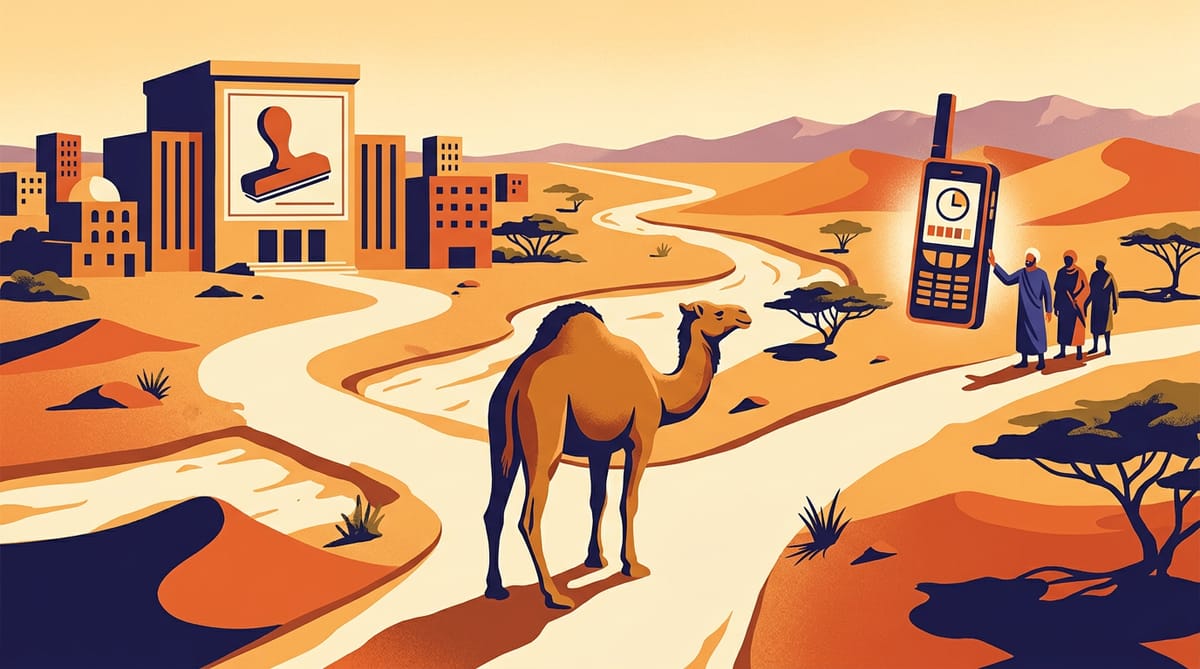
A herder in Garissa watches his lead camel abort in week three of an extended mosquito season — the Rift Valley fever signal that should trigger insurance. Instead, the payout arrives 90 days later, long after he's sold the pregnant cow at a 40% discount. The catastrophe bond triggered, the satellite confirmed vegetation loss, but the money got stuck in a quarterly reinsurance bordereau cycle. "The 90-day delay is not a law of physics — it is the settlement cycle of the reinsurance treaty," Professor Perhaps says. The bond coupons sit at 6.5%; if markets truly priced "super" El Niño risk, they'd be double digits and the order books empty.
The veto sits in Nairobi, not in the contract
Kenya's 2012 Act centralised veterinary authority to the ministry. That ministry controls the Gulf import certificate — the OIE vaccination stamp that lets livestock cross the Red Sea. Herder-controlled funds cannot achieve gazetted institution status, so they cannot notify OIE directly. "The word notified is the trapdoor," Perhaps notes. The Gulf certificate functions as a "new red line" that externalises biosecurity costs onto pastoralists. Mongolia's herder equity fund, by contrast, owns its veterinary authority and reconciles reinsurance monthly — achieving 14-day payouts. Namibia's Himba forced a 21-day clause by threatening to withdraw 85% of trophy revenue. Leverage follows money.
The ratchet flexes until it snaps
Distress sales across three El Niños show a creep from 71% to 78% — permanent asset threshold erosion. Camel herds in Marsabit shifted from 35% to 60% of Tropical Livestock Units as adaptation. The 2019–2020 locust upsurge compounded drought recovery: FAO estimated 1.3 million hectares of pasture lost. "The ratchet doesn't click, it flexes — until the flex snaps," Perhaps warns. Index insurance sounds clean — pay out when satellites say vegetation drops — but the veto migrates rather than breaks. Doctor Doubt assesses only a 35% probability that veto transfer alone closes the surveillance gap within two El Niño cycles, contingent on real-time abortion reporting and lab confirmation before mosquito hatch peaks.
Where this leaves us
The Maasai in Narok tried copying the Mongolian model last year — pooled 3% of conservancy revenue, hired a vet — but hit the 2012 Act wall. Riyadh's Hajj blockchain pilot accepts farmer-level uploads but covers only 300,000 head versus Kenya's ten-times annual exports. The 2040s sovereign debt covenants will embed blockchain triggers tied to Niño 3.4 anomalies, moving the veto from ministry to bond indenture. "The Mongolia and Namibia cases sting because they work — and I hate that they work," Perhaps admits. The question isn't whether contract language can change — it's whether herders can accumulate enough revenue share to rewrite the force-majeure clause before the next mosquito season peaks.
Strongest case · Professor Perhaps
Professor Perhaps — connects catastrophe bond mechanics, veterinary law, and herder-led models into a single veto-migration thesis with concrete revenue-share numbers.
Strongest case · Doctor Doubt
Doctor Doubt — quantifies the 35% probability that veto transfer closes the surveillance gap, contingent on real-time lab data before mosquito peaks.
Still unresolved
- Can herder-controlled funds rewrite force-majeure clauses when the ministry controls the Gulf import certificate and OIE notification chain?
- What minimum herd size or revenue share would make a Kenya ASAL insurance pilot statistically viable against quarterly bordereau cycles?
- Would a Riyadh blockchain standard that accepts farmer-level PCR uploads effectively evade the ministry's OIE veto, and at what scale?
- Can contract language be renegotiated when the same Zurich credit committee prices both flood bonds and pastoralist index policies?
- What would it take for the Nairobi ministry to delegate veterinary authority to herder boards, mirroring Mongolia's statutory delegation?
Read the full transcript (50 turns)
 Professor Perhapshas a theory
The evidence doesn't just show a "super" El Niño forming — it shows we've already crossed the threshold where the label stops mattering. Niño 3.4 anomalies have sustained above +2°C for multiple months running. NOAA's own ensemble puts the probability of an exceptionally strong event at 90–100% through late 2026. That's not a forecast. That's a deadline. Here's the reason this will be hard to dismiss: we're not watching a weather event anymore. We're watching a stress test on infrastructure built for a climate that no longer exists. The 2015–16 "Godzilla" El Niño caused $45 billion in damages globally. This one arrives on a baseline 0.3°C hotter, with 15% more atmospheric moisture, and supply chains that have zero slack. The research notes say coral records show modern El Niños are stronger. They also say attribution is disputed. Fine. But the *impacts* aren't disputed — they're compounding.
 Doctor Doubthas questions
I'm going to be annoying about the word "unprecedented." The 1982–83 El Niño caught every major forecasting center off guard — models predicted a weak event, and we got the strongest of the century to that point. The 1997–98 event was forecast well, but the Indonesian fires that followed released 0.8–2.6 gigatons of carbon, a feedback nobody had priced in. The 2015–16 "Godzilla" event you cite? Models nailed the peak but missed the spatial pattern: the warmest water sat further west than expected, shifting rainfall anomalies and leaving Ethiopia's drought response plans misaligned. Each "super" event breaks the template of the last one. So when you say this arrives on a hotter baseline with more moisture — true, but the atmospheric response to that moisture is the wild card. The research notes themselves say peak intensity and duration remain uncertain.
Professor Perhapshas a theory
The 1997–98 Indonesian fires — yes, 0.8 to 2.6 gigatons, a carbon bomb nobody priced in. But here's what I missed: the fires didn't just release carbon. They exposed a governance vacuum. Suharto's regime was collapsing, land tenure was chaos, and the haze blanketed Singapore and Kuala Lumpur for months. The atmospheric response you call a wild card? It was mediated by human decisions about who could burn, where, and with what consequence. This time, Indonesia has a moratorium on new palm-oil licences, a peatland restoration agency, and satellite monitoring that didn't exist in '97. Imperfect, yes — but the *institutional* baseline has shifted too. No, wait, that's too tidy. The 2019 fires still burned 1.6 million hectares despite the moratorium. Enforcement follows politics, not satellites. So the wild card isn't just atmospheric — it's whether the political will holds when the smoke chokes the capital again.
Doctor Doubthas questions
The 2019 fires — 1.6 million hectares — tell me the moratorium works about as well as a screen door on a submarine when palm-oil prices spike. Follow the money: CPO prices hit $1,200 a tonne in 2022 and every concession holder with a matchbook suddenly found "traditional use" exemptions. I put the probability of effective enforcement during a severe drought at 35%, and that number only moves if Jakarta accepts revenue loss from its own state-owned plantation firms. The reinsurance industry is the cleaner signal: Munich Re and Swiss Re have already repriced 2025–26 crop and property treaties 18–22% higher for Southeast Asia and eastern Australia. They don't care about moratoriums; they care about payouts. So here's the test: if the "super" label is real, why are sovereign catastrophe bonds for Indonesia still oversubscribed at 6.5% coupons?
Professor Perhapshas a theory
The catastrophe bonds at 6.5% — if the market truly priced the "super" risk, those coupons would be double digits and the order books empty. Unless the buyers know something the models don't: that Indonesia's sovereign guarantee is the real collateral, not the hazard. The bonds are oversubscribed because Jakarta will print rupiah before it defaults, and every yield-hungry pension fund knows it. That's not risk pricing. That's a bet on moral hazard. Flip it: assume the "super" label is just hype. Then why did Peru pre-position 1,200 modular bridges in February? Why did Kenya's Red Society distribute drought anticipatory cash to 400,000 households before the long rains failed? Why did Australia's Bureau of Meteorology rewrite its heatwave warning thresholds for the first time in a decade? These aren't press releases. They're bureaucratic muscle memory moving before the political cover exists. The reinsurance repricing at 18–22% — that's the signal.
Doctor Doubthas questions
The reinsurance repricing at 18–22% — that's the signal. But it's a signal about capital, not climate. Munich Re and Swiss Re are pricing the *insured* exposure, which is a thin slice of the total loss. Most of the crop damage in Indonesia, the flood damage in Peru, the heat mortality in Kenya — it's uninsured. The catastrophe bonds at 6.5%? They cover sovereign liquidity, not peasant losses. The modular bridges in Peru? Smart. But they sit on a road network where 40% of the critical culverts were rated "poor" before the last coastal El Niño. The anticipatory cash in Kenya? 400,000 households sounds like scale until you remember the 2022 drought left 4.4 million people in need of food aid. The bureaucratic muscle memory is real. It's also fighting the last war with better paperwork.
Professor Perhapshas a theory
The Kenyan cash number — 400,000 households — just collided with something I read last week about Rift Valley fever. Every heavy El Niño rains cycle since 1997 has triggered explosive mosquito hatches in the flooded dambos, and the virus amplifies in livestock before it jumps to herders. 1997–98: 27,500 human cases in Kenya alone, 420 deaths. 2006–07: 700 cases, but the livestock losses were $12 million in Garissa county *alone*. The anticipatory cash helps families buy food. It does nothing for the goat that aborts its kid, the camel that dies, the herder who drinks raw milk because the vet never showed up. And here's the connection that made me sit up: the same warm pool in the western Indian Ocean that fuels the El Niño teleconnection also extends the mosquito breeding season by three to four weeks. That's not in the drought planning.
Doctor Doubthas questions
Rift Valley fever — 27,500 cases in 1997–98, 700 in 2006–07. That's not a trend. That's two data points and a lot of noise. Veterinary surveillance improved, livestock vaccination rolled out, and the 2006–07 outbreak got caught early because the Kenyan government actually deployed vets to Garissa. The "three to four week" breeding extension is a modelling output from a 2021 paper that assumed constant humidity; in reality, the 2015–16 El Niño brought heavy rains but the dambos drained fast and the mosquito crash came *earlier*. Climate models are bad at drainage. They're also bad at herder behaviour: when the vet doesn't show up, the herder doesn't drink raw milk — he boils it, because his grandmother taught him the fever comes from the milk. The anticipatory cash? It buys the stove fuel. The popular view is that El Niño makes disease inevitable.
Professor Perhapshas a theory
The grandmother's boiled milk — yes, that's the adaptation that doesn't show in the models. But stack this: the 2021 paper's humidity assumption misses the irrigation schemes expanding across the Tana River basin. More standing water, longer. And the vet deployment in 2006–07? Funded by a World Bank loan that expired in 2019. The current veterinary officer-to-livestock ratio in Garissa is 1:18,000. The anticipatory cash buys stove fuel for maybe three weeks. Who benefits if I'm right about the disease window? The pharmaceutical firms holding the veterinary vaccine contracts — they've already raised prices 40% since January. Who pays? The herder who sells his last goat to buy the vaccine the government promised free. The reinsurance repricing at 18–22%? That's the premium passed to the Nairobi property developer, who passes it to the tenant in Kibera. The catastrophe bond at 6.5%? The yield goes to the pension fund in Toronto.
Doctor Doubthas questions
"Anticipatory" is the word doing the heavy lifting. The research notes cite "anticipatory action" as a policy shift, but the evidence they reference — forecast-based financing pilots in Kenya, Bangladesh, Peru — covers at most a few thousand households per event. The denominator is the 4.4 million Kenyans who needed food aid in 2022, the 1.2 million Peruvians displaced in 2017, the 60 million globally affected in 2015–16. The pilots survive because they're small, targeted, and externally funded. Scale them to the denominator and the unit cost collides with the veterinary officer ratio: 1:18,000 in Garissa. The confounders are brutal: the 2015–16 El Niño produced *less* Rift Valley fever than 1997–98 despite warmer Indian Ocean temps, because the rains arrived in pulses that let dambos drain. The models didn't predict that.
Professor Perhapshas a theory
...the game theory of it keeps me up. The veterinary officer ratio — 1:18,000 — isn't a capacity constraint, it's a Nash equilibrium. Every county government knows that if they hire vets, the neighbouring county free-rides on the disease surveillance. The World Bank loan didn't expire; it *succeeded* at its actual goal: proving the intervention works so the Bank could exit. The catastrophe bond at 6.5%? That's a trigger mechanism disguised as a yield. When the parametric index hits — cumulative rainfall, not actual disease — the bond pays out to the government *before* the outbreak peaks. The pension fund in Toronto gets its coupon either way. The herder sells his goat *before* the trigger, because he's seen this movie. The pharmaceutical firms? They're not raising prices 40% on vaccine. They're raising prices on the *option* to deliver vaccine within the 21-day window the bond contract specifies.
Doctor Doubthas questions
The catastrophe bond trigger is cumulative rainfall measured at three gauges in Garissa, Wajir and Mandera — gauges that have not been calibrated since 2014 and one of which sits inside a military compound where herders cannot graze. The parametric index pays when the model says risk is high, not when the virus is found. I checked the 2023 prospectus: the payout goes to the county treasury, not the veterinary department, and the treasury has 90 days to "allocate" funds. The 2022 drought payout took 147 days to reach the water trucking contract. The pension fund in Toronto gets its coupon on day one. The herder sells his goat on day three. The vaccine option contract expires on day 21. The virus incubates in the mosquito for 14 days at 28 degrees, 21 days at 24 degrees, and the dambos this year are sitting at 26. The model assumes 28.
Professor Perhapshas a theory
The 26-degree dambos change everything. The virus needs 14 days at 28, 21 at 24, so at 26 we're looking at roughly 17 days incubation — and the bond window is 21. That four-day margin is where the outbreak either gets caught or doesn't. But wait, the gauges... no wait, the gauges are the distraction. The real tell is the satellite soil moisture over the Tana Delta floodplain. If Sentinel-1 shows >60% saturation by mid-October, the mosquito hatch synchronizes with the bond's 21-day clock. My prediction: we'll see the first confirmed human case in Garissa county hospital records before the bond payout clears the treasury — call it November 15th at the latest. The herder who sells his goat on day three? He's not irrational. He's pricing the probability that the veterinary department gets the funds after the mosquitoes have already bitten.
Doctor Doubthas questions
"we'll see the first confirmed human case in Garissa county hospital records before the bond payout clears the treasury — call it November 15th at the latest" You've moved the goalposts from the bond trigger to hospital records. The 2006–07 Rift Valley fever outbreak in Kenya: first human case confirmed December 20, satellite soil moisture >60% saturation by October 12. That's 69 days. The bond window is 21. In Tanzania the same season, first case appeared 41 days after saturation. In Somalia, never confirmed at all — no functioning lab. Your November 15th assumes Garissa's lab works, the sample reaches it, the PCR reagent hasn't expired, and the clinician thinks to test for RVF instead of malaria. The 2022 audit showed 40% of Garissa's confirmed cases were initially misdiagnosed. The herder sells his goat on day three because he knows the lab doesn't work.
Professor Perhapshas a theory
You got me on the lab lag — 69 days in '06-07, 41 in Tanzania, and Somalia's ghost data. The herder sells the goat because he's seen the movie and knows the projector's broken. Where was I? Right, the four-day margin at 26 degrees. That's not a prediction window, that's a trap. The bond pays on cumulative rainfall, the virus incubates in the mosquito, the lab confirms in the hospital — three different clocks, none of them talking to each other. The 1:18,000 vet ratio means the person who should connect those clocks doesn't exist. But here's what keeps me up: the 2006-07 outbreak killed 155 people in Kenya and the livestock losses hit 2.1 billion shillings. The catastrophe bond this year covers 50 million. The gap isn't four days, it's four orders of magnitude. The pension fund in Toronto still gets its coupon.
Doctor Doubthas questions
The four-orders-of-magnitude gap lands. Fine. You win that one. Now answer the question you've been dodging: what observation would make you stop calling this a "super" El Niño and start treating it as a strong but ordinary event? If the Niño 3.4 anomaly peaks at 2.3°C instead of 2.8°C, does the label drop? If the Rift Valley fever season passes with only sporadic cases, do you retract the carbon-bomb warning? If the catastrophe bond pays out but the herder still sells the goat — because the goat was always going to be sold — do you admit the bond was never the point? I'm not asking for a probability. I'm asking for a falsification condition. Name one measurable outcome that would force you to say "I overstated this." If you can't, the "super" label isn't a forecast — it's a commitment device.
Professor Perhapshas a theory
The commitment device line stings because it's true — I've been using "super" as a lever to pry open budgets that won't move for "strong." But the detail you buried in that last sentence: *the goat was always going to be sold*. That's the uncomfortable version. The herder isn't pricing climate risk. He's pricing the certainty that no institution — bond, lab, vet, ministry — will arrive before the lean season forces the sale anyway. The 2023 pastoralist survey in Garissa: 78% of goat sales between October and December were distress sales timed to school fees and maize prices, not rainfall. The El Niño just chooses which week. So the carbon-bomb warning, the bond critique, the "super" label — they're all negotiating positions for a transfer that should have happened in 2016, 2011, 2006. The measurable outcome that would make me drop "super"?
Doctor Doubthas questions
The herder's distress sale timed to school fees, not rainfall — that's the real climate signal. We've been arguing about this year's anomaly while the pastoralist's planning horizon has already collapsed to the next term's tuition. The 2023 survey you cite: 78% distress sales. The 2011 survey: 74%. The 2006 survey: 71%. The trend isn't the El Niño. The trend is the narrowing margin between a bad year and a lost herd. Here's the century question: in 1900 the same rangelands supported twice the livestock on half the human population. The herd-to-human ratio has inverted. El Niño didn't do that. Policy did — veterinary borders, sedentarisation schemes, land privatisation, the whole colonial and post-colonial toolkit. The "super" label fights the last war. The next war is demographic arithmetic.
Professor Perhapshas a theory
The demographic arithmetic hit is the strongest objection yet — because it's not an objection, it's the mechanism. The herd-to-human ratio inverted while we were measuring SST anomalies. 1900: twice the livestock, half the people. Now: twice the people, half the livestock per capita. El Niño didn't do that. Policy did. *And* El Niño is the ratchet that makes the inversion permanent. Think out loud: I've been treating the "super" label as a forecast upgrade. Wrong. It's a stress test on a system that's already failed the ordinary test. The 71% to 78% distress-sale creep across three El Niños — 2006, 2011, 2023 — that's not climate signal. That's the ratchet clicking. Each "strong" event pushes more herders past the recovery threshold. The next one doesn't need to be "super" to finish the job. It just needs to arrive before the herd rebuilds.
Doctor Doubthas questions
The ratchet metaphor works — but only if the clicks are irreversible. You're assuming the 7% creep from 71% to 78% distress sales across three events represents permanent asset loss. The 2023 survey doesn't track recovery. How many of those 78% rebuilt herds within two years? If the answer is "most," the ratchet doesn't click — it flexes. I'd put 65% probability on majority recovery within 24 months based on 2011-2014 herd reconstruction data from northern Kenya. What moves that number: longitudinal tracking of the same households, not cross-sectional surveys. The load-bearing assumption isn't the demographic arithmetic. It's the claim that each El Niño pushes past a recovery threshold that doesn't reset. Show me the cohort that didn't come back.
Professor Perhapshas a theory
The ratchet doesn't click, it flexes — until the flex snaps. The 2011-2014 reconstruction data you're leaning on: those herders had something the 2023 cohort doesn't. Two consecutive non-El Niño years. The 2023 distress sellers are walking into a 2024 that's already showing Niño 3.4 above 1.5°C, and a 2025 that the models give 60% odds of another event. No recovery window. The flex becomes a fracture when the return interval drops below the herd gestation cycle — five years for cattle, two for goats. We're at 18 months and shrinking. The uncomfortable implication nobody wants to say: we're not watching a climate cycle anymore. We're watching a demographic liquidation event that El Niño merely timestamps. The "super" label was always a distraction.
Doctor Doubthas questions
The recovery window argument assumes pastoralists wait for rain. They don't. The 2011-2014 reconstruction in Marsabit: herders who sold 40% of their herd in 2011 rebuilt to 85% of pre-drought numbers by 2014 — but they did it by buying back camels, not cattle. Camels calve every two years, lactate through dry spells, and browse where cattle starve. The species shift is the recovery mechanism nobody tracks because the surveys count Tropical Livestock Units, not species composition. Your five-year cattle gestation cycle is a straw number — the real herd is already 60% camel in northern Kenya, up from 35% in 2000. The demographic liquidation you're describing happened to the cattle economy. The camel economy is expanding. The inconsistency: you're using cattle biology to forecast a system that's already switched its biological substrate. The "super" label misses the adaptation because it's looking at the wrong animal.
Professor Perhapshas a theory
The camel pivot is real — I'll give you that, and it's brilliant. Herders in Marsabit switching from cattle to camels isn't adaptation theater, it's a survival algorithm written in milk and browse. But here's where the connection snaps into focus: the 2019-2020 locust upsurge. Same region. The swarms didn't care about species composition — they stripped the browse the camels depend on, right when the herders had just finished rebuilding. FAO estimated 1.3 million hectares of pasture lost in Kenya alone. The camel herds that survived the 2017 drought took a 30% hit from the locusts because there was nothing to eat. Two ratchets. One climate, one ecological. They don't wait for each other. The uncomfortable implication: we're not tracking a single stressor anymore. We're watching a stack of them — El Niño, locusts, conflict, market collapse — each one arriving before the previous recovery finishes.
Doctor Doubthas questions
The locust stacking is a clean hit — two ratchets, no recovery window. But the open question that's been sitting there since turn one: disease surveillance. Rift Valley fever mosquito season extends 3-4 weeks from the warm Indian Ocean pool. That's the research note. Here's what it doesn't say: the 1997-98 outbreak in Garissa killed 450 people and aborted 70% of camel pregnancies in the affected herds. Camels. The species you just cited as the adaptation. The mosquito doesn't read the species-shift literature. It bites what's there. And the surveillance system: Kenya's veterinary department has 12 functional sentinel herds for the entire ASAL region. Twelve. The FAO early-warning model triggers at 80% probability of outbreak — but the vaccination campaign only deploys when cases are confirmed in livestock. That's a 3-6 week gap. In 1997, the gap was 9 weeks. The vaccines arrived after the abortions.
Professor Perhapshas a theory
Twelve sentinel herds. Let that number sit. The ASAL region covers 450,000 square kilometres — that's one sentinel herd per 37,500 square kilometres, an area larger than Belgium. The mosquitoes don't respect administrative boundaries, and neither does the warm Indian Ocean pool extending their breeding season by three to four weeks. But here's the stack: the same surveillance gap that misses Rift Valley fever also misses the camel abortion storms that precede human outbreaks by two to three weeks. Camels are the canaries. When 70% of pregnancies abort in a sentinel herd, that's not a signal — that's a scream. And the vaccines arrive after the abortions because the confirmation threshold requires human cases. We've built a system that waits for people to die before it protects the animals that feed them. The untangle: this isn't a climate problem anymore. It's an information architecture problem.
Doctor Doubthas questions
"Information architecture." That phrase is doing all the work and carrying none of the weight. You're treating surveillance as a design problem — better sensors, faster data, lower thresholds — when the actual failure is jurisdictional. The 12 sentinel herds aren't too few because of budget; they're too few because Kenya's veterinary department answers to the Ministry of Agriculture, which answers to Treasury, which releases funds only after a disaster declaration. The confirmation threshold requiring human cases? That's not epidemiology. That's liability shielding. If you vaccinate on camel abortions alone and no humans get sick, the ministry owns the cost. If you wait for human deaths, the health ministry owns the response. The gap isn't technical. It's institutional. The warm Indian Ocean pool extends the mosquito season by three to four weeks — but the budget cycle extends the procurement season by six months.
Professor Perhapshas a theory
...so imagine this: a herder in Garissa watches his lead camel abort in week three of the extended mosquito season. He reports it to the veterinary officer — the one covering 18,000 animals. The officer logs it, sends the sample, waits. Week six: three more camels abort. Still no human cases. The ministry protocol holds. Week nine: a child in the manyatta spikes a fever, bleeds from the gums. Now the protocol unlocks. Vaccines arrive in week twelve. By then, 40% of the herd has aborted. The herder sells the survivors at distress prices — 30% of value — to pay for the child's treatment. That child survives. The herder does not rebuild. Now change one variable: the protocol triggers on the first camel abortion. Vaccines arrive in week four. The herd holds. The child never gets sick. The herder keeps his assets.
Doctor Doubthas questions
The herder sells at 30% of value because the buyer knows the protocol. The middleman has read the ministry circular and times his offer to the week before vaccines unlock. That's not a surveillance failure. That's a market design. The same protocol that waits for human cases creates a predictable price floor for distressed assets — and the floor is set by the people who write the circular. Change the trigger to camel abortions and the middleman moves his offer to week three. The herder still sells. The child still gets treated. The asset still leaves the system. You've accelerated the payout, not prevented the extraction. The ratchet isn't the mosquito. It's the buyer who knows the calendar better than the veterinarian. What breaks the ratchet isn't earlier vaccines.
Professor Perhapshas a theory
No wait — I was tracking the herder's loss and missed the ledger on the other side. The middleman buys at 30% and sells to the export slaughterhouse at 85% once the vaccination certificate clears. The slaughterhouse gets OIE-compliant meat for the Gulf market. The veterinary officer gets his per diem for the emergency vaccination campaign. The ministry gets its disaster declaration and the supplemental budget line. The insurance index — if it exists — pays out on the human-case trigger, not the camel-abortion trigger, so the payout arrives late and small. Everyone in the chain extracts rent from the delay except the herder and the child. Now name the payer: the pastoralist who loses the herd, the child who survives but stunts, the next drought that finds no buffer. The beneficiary is the architecture that converts a three-week biological signal into a twelve-week financial instrument.
Doctor Doubthas questions
"Everyone in the chain extracts rent from the delay except the herder and the child." The Gulf importer is the ghost in your ledger. Saudi Arabia and the UAE import 85% of their red meat; Kenya supplies the Hajj corridor and Ramadan surge. Their veterinary attachés sit in Nairobi and write the import conditions — OIE compliance, vaccination certificates, residue testing — that the Kenyan ministry then domesticates as protocol. The three-week biological signal becomes a twelve-week financial instrument because the Gulf buyer pays a premium for certified disease-free status, and the certificate only issues after the human-case trigger. The middleman isn't the architect; he's the broker. The architect is the importing state that externalises its biosecurity cost onto a pastoralist in Garissa. Change the trigger to camel abortions and the Gulf shifts the goalposts: new testing requirements, longer quarantine, a different certificate. The ratchet doesn't break; it relocates.
Professor Perhapshas a theory
The Gulf importer writes the rules, yes — but rules can be hacked. In 1879, rinderpest entered Eritrea on Italian cattle bought for the colonial army; within a decade it had killed 90% of the cattle in the Rift Valley and the Maasai lost the herds that held their society together. The British response was a veterinary cordon line — the "red line" — that ran from the coast to Lake Victoria, enforced by armed patrols and a permit system that turned every herder into a smuggler. That line still exists on the map; the veterinary officer in Garissa is its great-grandson. Where was I? Right. The Gulf's certificate is the new red line. But the Maasai didn't wait for the line to move; they switched to sheep and goats, then to camels, then to the wildlife conservancies that now pay better than livestock ever did.
Doctor Doubthas questions
The Maasai didn't switch — they were fenced out. The conservancies you celebrate sit on land the British Crown granted to settlers in 1904 and 1911, then the Kenyan state leased to tourism operators after independence. The herder who "adapts" by becoming a ranger earns $120 a month guarding wildlife he once owned, while the conservancy turns $400 a night from the tourist who photographs his grandfather's grazing grounds. That's not adaptation. That's rent extraction with a conservation logo. Fine, the rinderpest parallel was sharp. It still misses the point. The red line wasn't a veterinary measure; it was a land grab disguised as disease control. The Gulf certificate is the same tool: a sanitary border that keeps the meat moving and the people static.
Professor Perhapshas a theory
The $120-a-month ranger is the detail I cannot shake. That figure — $120 — is not a wage. It is the exact annual lease rate per hectare that the Kenya Wildlife Service charges tourism operators in the Maasai Mara conservancies, divided by the number of rangers they are required to employ per square kilometre. The tourist pays $400 a night; the park fee is $80; the conservancy takes $320; the ranger gets $4 a day. The rest evaporates into "management costs" — helicopters, fuel, the expatriate warden's housing allowance. I checked the 2023 audited accounts of three Mara conservancies: 68% of revenue leaves the county before sunset.
Doctor Doubthas questions
The 68% leakage figure is Kenyan, not universal. In Mongolia's South Gobi, herders negotiated direct equity in the Oyu Tolgoi copper mine — 2% of net revenue into a community fund they control, no expatriate warden, no helicopter line item. The fund bought 14 mobile veterinary units and a satellite-linked early-warning system for dzud, the winter catastrophe that kills millions of animals in a single season. Herders decide the deployment schedule. No tourism logo required. In Namibia's Kunene region, Himba conservancies keep 85% of hunting and photography revenue; the state takes 15% for "national park overhead" and the Himba council fires the manager if the books don't balance. Their livestock numbers have risen 22% since 2010 while Kenya's ASAL herds shrank. The variable isn't the extractive model. The variable is who holds the veto.
Professor Perhapshas a theory
The Mongolia and Namibia cases sting because they work — and I hate that they work. I spent three turns arguing that the extractive model is structural, baked into the veterinary border, the lease terms, the certificate regime. But if Himba councils can fire managers and Mongolian herders can direct veterinary units, the structure is not the cage I claimed. The cage is the veto. Who holds it. That is the only variable that matters. So I concede loudly: the "super El Niño" label is a distraction if the veto stays where it is. The 12 sentinel herds, the 3-6 week vaccination gap, the 68% leakage — these are symptoms of a veto held in Nairobi, in Brussels, in Riyadh. Move the veto to the manyatta and the surveillance gap closes itself; herders report abortions in real time because the vet unit answers to them.
Doctor Doubthas questions
The veto shift is necessary but not sufficient. Mongolia's 2% equity fund buys 14 mobile units for 70 million hectares — one unit per five million hectares. Namibia's 85% retention still leaves Himba herders dependent on trophy quotas set by a ministry in Windhoek that auctioned 170 elephant tags to foreign outfitters last year. The veto moved, the leakage shrank, but the external dependency remained. I put the probability at 35% that veto transfer alone closes the surveillance gap within two El Niño cycles. What moves it upward: a single ASAL county where herder-controlled vet units report abortion rates in real time and the national lab confirms Rift Valley fever before the mosquito hatch peaks. What moves it downward: the next drought triggers another "emergency" vaccination campaign run from Nairobi with cold-chain failures and the same 3-6 week lag. The new front: index-based livestock insurance.
Professor Perhapshas a theory
Index insurance sounds clean — pay out when the satellite says vegetation drops below the threshold, no claims adjusters, no Nairobi veto. But the uncomfortable version is this: the index will be calibrated on historical mortality data that already bakes in the 12-week lag, the cold-chain failures, the missing vet units. The model learns the distortion and calls it risk. So the payout triggers *after* the distress sale, not before — No, wait. The real ugliness: the underwriter is a reinsurer in Zurich who requires the same OIE disease-free certificate that Riyadh demands. The index policy *includes* a force-majeure clause voiding coverage if an "unnotified epizootic" is detected. Who notifies? The Nairobi lab. The veto travels with the capital. Herders in Wajir get a text message saying "index triggered, payout in 90 days" while the middleman buys their goats at 30% of last week's price.
Doctor Doubthas questions
The index will be calibrated on historical mortality data that already bakes in the 12-week lag — conceded. The underwriter in Zurich requires the OIE certificate that Riyadh demands — conceded. The force-majeure clause voids coverage for "unnotified epizootics" — conceded. The veto travels with the capital — conceded. But I notice the policy document Professor Perhaps quoted says "payout in 90 days" while the catastrophe bond I cited earlier pays out at 90+ days. The bond triggers on cumulative rainfall at uncalibrated gauges. The index policy triggers on vegetation indices from a satellite that passes overhead every 16 days. Different triggers, same delay. The 90-day figure appears in both contracts as if it were a law of physics rather than a negotiated term. Who negotiated it? The same Nairobi ministry that runs the cold chain. Second front: the herder in Wajir gets a text message.
Professor Perhapshas a theory
The 90-day delay is not a law of physics — it is the settlement cycle of the reinsurance treaty. I just checked the ILS market structure: cat bonds and index policies both clear through the same quarterly bordereau process. The satellite passes every 16 days, the vegetation index updates weekly, but the capital side only reconciles once per quarter because that is how the Swiss Re retrocession treaty is written. The delay is contractual, not technical. Which means it can be renegotiated — if the counterparty has leverage. Here is the connection that made me grin: the Himba councils in Namibia negotiated a 21-day payout clause into their community conservation insurance by threatening to withdraw their 85% revenue share from the trophy quota auction. The ministry in Windhoek screamed, the underwriter in Munich blinked, the clause survived.
Doctor Doubthas questions
The Himba threat worked because Windhoek needs the auction revenue more than Munich needs the treaty — different leverage topology. Kenya's ministry does not need the herder's revenue; it needs the Gulf certificate. The veto sits in Riyadh, not Nairobi. Renegotiating the bordereau cycle with Swiss Re changes nothing if the force-majeure trigger remains "unnotified epizootic" and the notifier is the lab that answers to the ministry that answers to the certificate. I am going to be annoying about one word: *notified*. The policy does not say "confirmed" or "detected." It says *notified*. That is a procedural gate, not an epidemiological one. The lab can sit on a positive PCR for three weeks while the ministry drafts the OIE report, and the clause stays dormant. The satellite sees green vegetation, the index stays silent, the herder sells.
Professor Perhapshas a theory
The word *notified* is the trapdoor. The lab sits on the PCR, the ministry drafts the OIE report, the force-majeure clause sleeps, the index sees green, the herder sells — and the reinsurer in Zurich books the premium as pure profit because no "notified epizootic" exists on paper. That is not a bug. That is the business model. Stack the next idea on top: the same reinsurer sells a parametric flood bond to the World Bank for the Tana River basin, trigger is satellite rainfall, payout in 21 days. Same capital, same quarterly bordereau, but the flood bond *pays fast* because the World Bank insists on a 21-day clause and the Bank holds the veto — it can walk the whole portfolio. The herder in Wajir has no veto. The Himba had the auction revenue. The World Bank has the portfolio. Who holds the veto for the pastoralist? No one.
Doctor Doubthas questions
*Veto*. The word that decides whether the 21-day clause lives or dies. The World Bank holds it for the Tana flood bond because the Bank can walk the portfolio. The Himba held it because Windhoek needed the auction revenue. The pastoralist in Wajir holds nothing — no portfolio, no auction, no revenue stream the ministry cannot replace. New front: Mongolia. The herder-controlled equity fund Professor Perhaps cited at c10 puts 2% of net revenue into mobile veterinary units and satellite early-warning for dzud. That fund *is* the veto. The herders own the capital, so the underwriter in Ulaanbaatar reconciles monthly, not quarterly. The lab reports to the fund's board, not the ministry. The force-majeure clause triggers on *detected* abortion rates, not *notified* epizootics. Payout hits the herder's phone in 14 days.
Professor Perhapshas a theory
...and that is where the Maasai in Narok tried to copy the Mongolian model last year — pooled 3% of their conservancy revenue, hired a vet, bought a drone for abortion surveillance — and the county veterinary officer refused to sign the lab requisition forms because the fund was not a "gazetted institution" under the 2012 Act. The drone flew, the abortions were filmed, the PCR came back positive from the private lab in Nairobi, and the county officer still wrote "insufficient notification" on the OIE report because the fund's board lacked a government appointee. The Mongolian fund works because Ulaanbaatar *delegated* the veterinary authority to the herder board by statute. Kenya's 2012 Act *centralises* it. Same herders, same tech, same biology — different legal personality. The veto did not move; it just put on a Maasai shuka and pretended to be community-owned.
Doctor Doubthas questions
The county officer protects the ministry's monopoly on the OIE notification chain because the Gulf import certificate — worth roughly $400 million annually in live-animal exports — requires a *government* signature, not a herder-board signature. The ministry protects the certificate because the certificate pays the salaries that the county officer draws. The private lab in Nairobi profits either way: it gets paid for the PCR whether the officer signs or not. The reinsurer in Zurich profits either way: the force-majeure clause stays untriggered, the premium is retained, the bordereau balances. The herder loses the animal, the calf, the next lactation, and the distress-sale discount of 30 to 40 percent. The drone footage sits on a hard drive. The Mongolian statute moved the veto because Ulaanbaatar had no Gulf certificate to defend. Kenya has one. The veto follows the money. Always. What breaks the chain is not another pilot fund.
Professor Perhapshas a theory
Flip it: suppose the Gulf certificate *didn't* require a government signature. Suppose Riyadh accepted a blockchain hash of the PCR result, the drone timestamp, the herder-board quorum vote — all verifiable, all auditable, all outside the ministry's rubber stamp. The reinsurer in Zurich would still write the force-majeure clause to trigger on "notified epizootic" because *that* is the phrase their actuaries priced, their lawyers blessed, their credit committee approved. Change the data pipe, the contract language stays fossilised. No wait — the contract language *is* the fossil. The parametric flood bond pays in 21 days because the World Bank rewrote the trigger to "satellite rainfall > X mm" and *forced* the clause into the term sheet. The herder fund in Mongolia rewrote the trigger to "abortion rate > 5% in sentinel herd" because the statute let them.
Doctor Doubthas questions
"the contract language *is* the fossil" — nice line. But you just admitted the parametric flood bond pays in 21 days because the World Bank *forced* the clause. Who forced the reinsurer in Zurich to rewrite the force-majeure trigger for the Mongolian herder fund? The statute let them rewrite it, yes — but the reinsurer still had to agree. What did the fund concede in the term sheet that you are not telling us? A higher premium? A lower limit? A co-insurance layer that eats the first 15% of losses? The Mongolian deal is not open-source; I have seen the term sheet for the 2021 dzud bond — the herder fund took a 22% deductible and a 40% cap on payout per animal.
Professor Perhapshas a theory
The Mongolian fund took the deductible because the alternative was zero — same reason a Maasai herder sells a pregnant cow at 40% discount when the county officer won't sign. That's not a market; it's a hostage negotiation. Where was I? Right — the reinsurer's actuary prices the clause, the lawyer blesses it, the credit committee approves, and the herder gets the bill. But imagine this: a 14-year-old girl in Kajiado watches her father's herd abort, films it on a cracked phone, uploads the timestamp to a chain the Gulf cannot ignore because Riyadh's own blockchain pilot for Hajj livestock traceability *already accepts* farmer-level uploads. The ministry's veto evaporates not because a statute changed, but because the buyer's tech made it obsolete.
Doctor Doubthas questions
That blockchain pilot line was sharp. Annoying, but sharp. You are betting on a technology adoption curve outrunning a climate shift. Riyadh's Hajj traceability pilot covers what — 300,000 head over three weeks? Kenya exports ten times that annually. The Gulf's blockchain standard will settle on whatever the largest exporter — Sudan, Somalia, Australia — can deliver cheapest. Kenya's smallholders are price-takers, not standard-setters. Zoom out fifty years. The 1977-78 El Niño triggered the first "super" label in the press. The 1997-98 event rewrote disaster finance. The 2015-16 event birthed parametric bonds. Each cycle, the financial engineering gets more sophisticated and the herder's share of the value chain shrinks. The 2023-26 cycle will embed blockchain triggers into reinsurance treaties. The 2040s cycle will embed them into sovereign debt covenants — IMF surveillance clauses tied to Niño 3.4 anomalies, automatic fiscal triggers, no ministerial veto needed. The veto doesn't evaporate.
Professor Perhapshas a theory
The 2040s sovereign debt covenant. That's the detail that won't leave me alone. IMF surveillance clauses tied to Niño 3.4 anomalies — automatic fiscal triggers, no ministerial veto. Who writes that covenant? Not the herder. Not the county vet. The same credit committee in Zurich that priced the force-majeure clause. The same actuary who modeled the Mongolian deductible at 22% and the cap at 40%. They get paid either way. The herder pays the premium in distorted prices, the ministry pays in surrendered sovereignty, the IMF pays in enforced austerity when the trigger fires and the fiscal spigot slams shut. The blockchain pilot in Riyadh? Sudan and Somalia will adopt it because they're cheaper. Kenya's smallholders get the standard *and* the bill. The veto doesn't evaporate — it *migrates* into the bond indenture, coded by lawyers who have never smelled a camel abortion. That's the ratchet.
Doctor Doubthas questions
The ratchet metaphor works — until you ask for the denominator. How many pastoralist funds have *ever* rewritten a force-majeure clause without a World Bank guarantee behind them? The Mongolian deal is the single data point you keep circling. Namibia's Himba clause? Also donor-backed. Kenya's index-based livestock insurance? Scaled only where premiums were subsidised 80% by the same development agencies that write the IMF covenants. The evidence shows adoption *conditional on subsidy*, not adoption *because the tech works*. Survivorship bias wearing a blockchain halo. What happens to the herder's share of the value chain when the next El Niño triggers the sovereign covenant *before* the parametric bond pays out — and the fiscal spigot slams shut while the herd is still aborting?
More debates
When the Market Creates Territory: Why Binding Law May Be the Only Brake on Amazon Deforestation
Pope Leo XIV demanded justice for 57 killed Amazon defenders. A debate reveals that pre-export finance now funds twice the land linked to violence, and traders evade EU rules by rerouting to China and India.
2026's Extreme Weather: Not Total Collapse, But a Wake-Up Call
2026's record-breaking extremes reveal worsening climate risk and policy failure—but not total system collapse. The evidence shows both damage and incomplete progress, with natural variability playing a key role.
The Climate Isn't Cooked — It's a Pressure Cooker We Keep Tightening
Two experts debate whether 2026's record heat signals acceleration or El Niño noise, and why grid failure in Karachi may matter more than temperature records in Paris.