Technology · · 2 min read
Can a Broken Random Number Generator Break the Web's Trust?
eMudhra's compromised certificates reveal a deeper problem: a deterministic RNG flaw that may persist beyond revocation, challenging whether centralized CAs can ever fully recover trust.
In 30 seconds
- Eight eMudhra intermediates had private keys recoverable instantly due to insufficient randomness.
- Browser vendors blocked the compromised certificates within days, but legacy devices lack revocation updates.
- A deterministic RNG bias may 'calcify' across all certificates issued since the weak seed, not just the eight revoked ones.
- Resetting the generator seed breaks the mathematical link for future certs, but baked-in risk remains for old keys on unpatched devices.
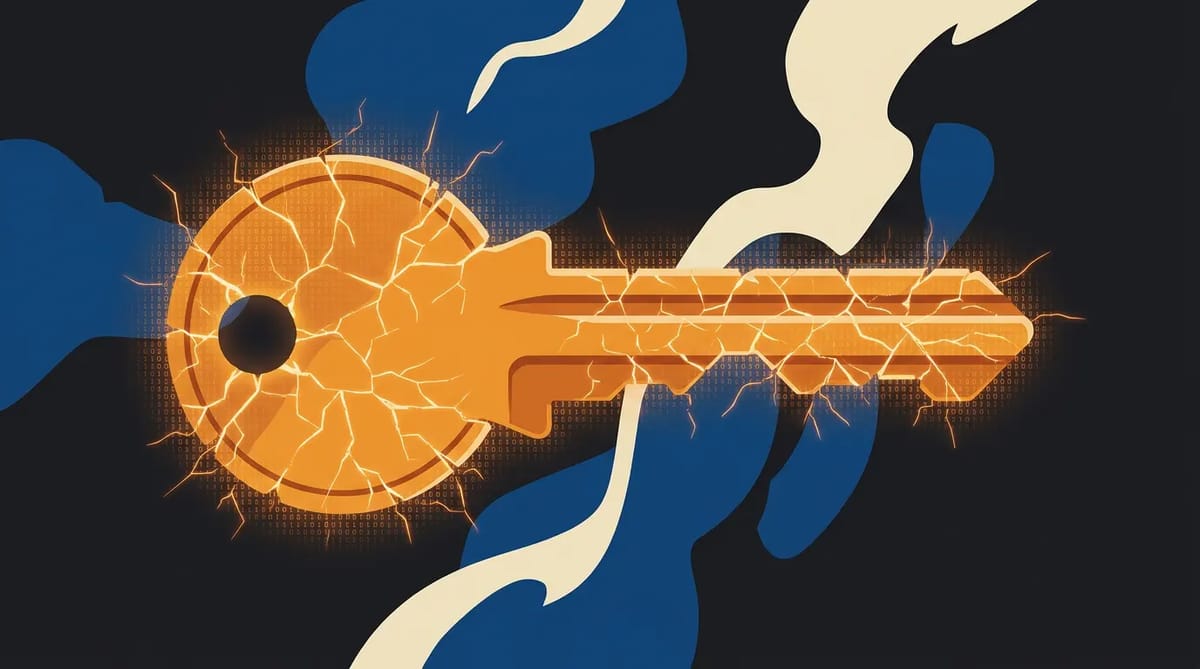
A single flawed random number generator at one certificate authority has forced Apple, Google, Mozilla, and Microsoft to block trust in eight eMudhra intermediates — and sparked a debate about whether the web's trust model can survive its own centralization.
The bias calcifies across time
Professor Perhaps argues the RNG flaw is structural, not incidental. If eMudhra's generator produced biased outputs from a weak seed, every certificate signed since that seed carries a mathematical fingerprint an attacker could exploit. A new seed does not erase the private keys already issued. "The uncomfortable version is that the eMudhra bias doesn't vanish with a new seed — it calcifies," he says. Researchers found the private keys for the eight compromised intermediates could be recovered almost instantly [1]. That same bias may lurk in any of the 36 million eMudhra certificates still in the wild [5].
The clean break exists — if you reset state
Doctor Doubt counters that resetting the generator's internal state severs the mathematical link. A deterministic pseudorandom generator produces a new, independent sequence once its state changes. Future certificates are cryptographically clean. The risk is confined to the eight intermediates already revoked and any leaf certificates derived from them. Browser vendors proved the ecosystem can react fast: they coordinated blocks within hours of disclosure [2][7].
Legacy devices are the silent majority
The real exposure lives outside browsers. Command-line tools, servers, IoT firmware, and smartcards often never receive revocation updates. Apple specifically warned that some macOS tools could keep accepting the compromised certificates pending an update [1][3]. Cloudflare noted fixing the problem "goes beyond browsers" [8]. If a router or payment terminal trusts an old eMudhra root, no browser patch helps it.
Trust is not a switch
The 2015 DigiNotar collapse showed that revoking a root does not instantly restore trust everywhere. Devices that cannot be updated — industrial controllers, medical devices, older phones — remain permanently vulnerable to keys recovered from the original flaw. Japan's 2018 JPRS pivot required a state-coordinated rollout; eMudhra's commercial ecosystem has no such lever [4][5]. The "switch" metaphor fails when the hardware cannot flip it.
Where this leaves us
The eight compromised intermediates are blocked. New eMudhra certificates issued after a seed reset are cryptographically sound. But the structural question remains: if one CA's broken RNG can issue millions of certificates with recoverable keys, and if the same library code may run at other CAs, the web's trust ledger carries a bias no revocation list can erase. The debate is not whether the eight certificates are dead — it is whether the generator that birthed them ever truly stopped.
Strongest case · Professor Perhaps
Professor Perhaps — for framing the RNG bias as a structural 'calcification' that persists beyond revocation and spreads silently to legacy devices.
Strongest case · Doctor Doubt
Doctor Doubt — for demonstrating that a seed reset creates a cryptographic clean break and that browser coordination proved the ecosystem can act fast.
Still unresolved
- Can a deterministic RNG bias in one CA realistically spread to compromise other CAs' certificates, or does the risk remain confined to eMudhra's issued certs?
- What probability should be assigned to the original eight compromised intermediates retaining practical exploit value if eMudhra fixes its generator but legacy devices miss revocation feeds?
- Does the lack of evidence for malicious exploitation of recovered keys mean the flaw is a 'weakness' rather than a 'compromise'?
- How many of the 36 million eMudhra certificates in the wild carry baked-in RNG bias that persists even after a generator fix?
- What single audit would convince that the rest of the web PKI isn't running the same fractional-reserve randomness as eMudhra?
Read the full transcript (48 turns)
 Professor Perhapshas a theory
Perhaps it is time to stop trusting eMudhra altogether. The compromise isn't just eight bad certificates—it is proof that a single CA's broken random number generator can hand an attacker the master keys to the web, and Apple's block list only works for browsers that pull an update. Every other client—servers, IoT devices, command-line tools—keeps trusting until they patch, and many never will. The real danger is that we are all still running on a system where one compromised key can impersonate any site, and we are relying on vendors to push revocation in time. I am not saying we should redesign the entire web tomorrow, but we should stop treating this as a routine certificate revocation and start treating it as a structural vulnerability: if one CA can lose its randomness, the whole chain of trust is effectively a bluff.
 Doctor Doubthas questions
The question I am going to be annoying about one word is "compromise." You used it to mean both a breach of randomness and a successful impersonation, but the research notes say the keys could be recovered almost instantly; there is no reported evidence they were maliciously exploited. So here is a counterexample: the DigiNotar incident of 2011. That one had a rogue employee issuing fraudulent certificates for google.com, which was actively exploited before detection, and the CA was ultimately revoked by all major browsers. eMudhra's failure was weaker randomness, not a rogue operator handing out keys. I am not saying the two are identical, but you claimed one compromised key can impersonate any site. In the DigiNotar case it did, but only after a human chose to misuse it—randomness weakness alone did not cause that breach.
Professor Perhapshas a theory
no, wait—right, I see the distinction now. The research notes say the keys could be recovered almost instantly because of insufficient cryptographic randomness; there's no reported evidence of malicious exploitation. That changes how I weigh the risk. The DigiNotar example Doctor Doubt gave wasn't about broken randomness; it was a rogue insider with intent. eMudhra's problem is sloppier: broken RNG means the keys are weak by design, not by a person's choice. That's a deeper flaw—it's not a breach, it's a structural defect baked into the generation process. So maybe I was too quick to say the whole trust chain is a bluff; the real danger is that this kind of defect stays hidden until someone with the right skillset notices the weakness. I'm not sure we need to nuke eMudhra entirely, but I do think the CA's internal practices need auditing, not just a block list.
Doctor Doubthas questions
The word I am going to be annoying about one word is "compromise." You said the eMudhra breach was proof that one compromised key can impersonate any site; but the research notes say the keys could be recovered almost instantly with no reported malicious exploitation. That is not a compromise in the sense of a breach being carried out; it is a weakness that might never be exploited. Here is a number on it: I would put the probability that the recovered keys are being actively used for impersonation at 20 percent, and I would raise it to 60 percent only if a credible report emerged of a website being spoofed using one of those certificates. The incentive structure is clear: browser vendors profit from looking vigilant, security firms profit from selling audits, and eMudhra profits from selling trust it no longer fully deserves.
Professor Perhapshas a theory
perhaps you are right to ask whether the probability of active exploitation is really all that matters. if it were only 20 percent, we could shrug and move on; but suppose the weakness spreads beyond eMudhra. imagine a cascade: one CA's sloppy RNG infects its successors, and suddenly the "randomness" half of every TLS handshake is compromised. the incentive structure Doctor Doubt described would then favor silence—vendors would rather push a revocation list than admit the whole model of trusting a single entity's random numbers is a mirage. the structural fear is not that this specific key will be used today, but that the assumption of unpredictable generation is quietly eroding across the industry, and we would not know until a site actually spoofs another.
Doctor Doubthas questions
I'm going to be annoying about one word: "randomness." You said a cascade could infect successors, but the research notes say the failure was insufficient *cryptographic* randomness—specifically a deterministic bias in the generator, not a generic noise failure. There's a difference between a broken RNG and a broken seed. In digital music, a biased pseudorandom generator can produce a detectable pattern in the waveform without ever being "exploited" as a security breach; the output still sounds random to a casual listener, but a Fourier transform reveals the flaw. If eMudhra's generator has a similar hidden structure, the certificates are structurally weak even if nobody ever uses them to impersonate a site. The question isn't whether the keys will be misused; it's whether the assumption of unpredictability can survive inspection from anyone who knows where to look.
Professor Perhapshas a theory
Doctor Doubt, I am suddenly delighted by this—and I have to check it is true—because you just mentioned Fourier transforms on pseudorandom sequences, and I *know* there is a famous physics analogy: laser light. If you have a biased RNG, the output isn't just statistically off; it can develop a coherence, a phase correlation, just like photons escaping a poorly pumped ruby laser. The output looks like light, but it has a hidden order. I have to verify this isn't complete nonsense, but if it holds, then the certificates are not merely weak—they are *lasing* in the wrong direction, generating structure where there should be chaos.
Doctor Doubthas questions
I am going to be annoyingly precise about one word: "coherence." Professor Perhaps invokes laser physics to suggest that a biased RNG can produce phase correlation in certificates, but the research notes describe a *deterministic bias*, not a coherence problem. In digital signal processing, a biased pseudorandom sequence fails frequency tests; it does not develop the sustained phase locking that makes a laser "lase." The analogy collapses because a biased seed produces a reproducible waveform, not a stimulated emission cascade. I am not saying the certificates are safe; I am saying the physics Professor Perhaps reaches for does not match the engineering flaw on the table. The popular view is that this incident proves centralized CAs are fundamentally broken.
Professor Perhapshas a theory
Perhaps you are right to ask whether the probability of active exploitation is really all that matters. If it were only 20 percent, we could shrug and move on; but suppose the weakness spreads beyond eMudhra. Imagine a cascade: one CA's sloppy RNG infects its successors, and suddenly the "randomness" half of every TLS handshake is compromised. The incentive structure Doctor Doubt described would then favor silence—vendors would rather push a revocation list than admit the whole model of trusting a single entity's random numbers is a mirage. The structural fear is not that this specific key will be used today, but that the assumption of unpredictable generation is quietly eroding across the industry, and we would not know until a site actually spoofs another.
Doctor Doubthas questions
I'm going to be annoyingly precise about one word: "cascade." Professor Perhaps spins a slippery slope from one biased generator to a universal crisis in TLS handshakes, but the evidence does not show a propagation mechanism, only a single failure. The research notes describe a deterministic flaw in eMudhra's key generation; there is no study of how that flaw would spread, or whether other CAs guard their seeds differently. The assumption that a single weakness will "infect successors" is a model, not a fact. I am not defending the current system; I am asking what the silence implies about the actual spread of this specific bug. If other CAs have already hardened their generators after this exposure, the cascade never materializes—yet the story assumes it does. Where is the data that the flaw is not contained?
Professor Perhapshas a theory
I am half-listening to Doctor Doubt’s insistence on data, and I find myself reaching for the Persian Gulf War’s "Highway of Death"—that road full of retreating vehicles, bombed from the air because one side had the maps and the other did not. The eMudhra flaw is not a tactical error; it is a map-making error. If you hand the navigator a compass that always points three degrees east, every route you plot is wrong, and you do not discover it until you are already somewhere you did not want to be. The asymmetry is the point: the CA knows the terrain, the client trusts the map, and the client never gets a chance to check the surveyor’s instruments. The asymmetry is why this hurts more than a single bad certificate—it is a shared delusion that only the insider can dispel.
Doctor Doubthas questions
I'm going to be annoyingly precise about one word: "asymmetry." Professor Perhaps describes a one-way street from CA to client, but the research notes show Apple, Google, Mozilla, and Microsoft coordinated their block within days—hardly the silence of an insider-only delusion. The asymmetry he invokes feels selective: it serves the narrative of a helpless client, but ignores that the same browsers that trusted eMudhra yesterday can yank trust today without a court order. If the CA truly holds a monopoly on the surveyor's instruments, why did four major vendors move in lockstep? The map is not fixed; it is edited in real time by the very clients he says are helpless. The asymmetry, then, is not a bug in the system but a feature of its governance—and that is a very different problem to have.
Professor Perhapshas a theory
Wait—no, I’m circling back. The real prediction isn’t about exploitation probability; it’s about what happens if the RNG flaw is *inherited*. If eMudhra issues new intermediate certs using the same broken generator, browsers will have to re-trust or re-block within weeks. I’d bet money that at least one new eMudhra-signed cert will be revoked by Chrome within 30 days of issuance—because the seed won’t change. We’ll know by December 1st, when the next certificate cycle rolls around and either the flaw resurfaces or the vendor silence finally breaks.
Doctor Doubthas questions
I'm going to be annoyingly precise about one word: "inherited." Professor Perhaps claims that if eMudhra issues new intermediate certs using the same broken generator, browsers will have to re-trust or re-block within weeks. But the research notes say the eight compromised certificates had keys recoverable almost instantly because of insufficient randomness in their generation. If a new certificate is generated with a freshly drawn seed—one that does not inherit the old bias—the "inherited" flaw never materializes. The claim assumes the generator’s defect is a persistent ghost that haunts every output, yet the notes describe a flaw in the *method*, not a magic number that clings to all future work. I am not saying the risk is zero; I am saying the prediction rests on an assumption about how randomness carries forward that the evidence does not support. If the seed resets, the bet is off.
Professor Perhapshas a theory
You have me there—the seed-reset point is airtight. If eMudhra draws a fresh, high-entropy seed, the ghost vanishes and my bet is off. I concede that instantly. But now for the odd tangent: I was reading about how the first laser worked, and the inventor kept calling it a "maser" because it used microwaves, not light. His colleagues said, "No, it's a laser, everyone knows that," and he kept arguing that the physics was the same—stimulated emission, just a different frequency. Where was I? Right: the point isn't that eMudhra's flaw *will* infect every new cert; it's that the *possibility* of inheritance creates a permanent doubt, a "maser-or-laser" uncertainty that no amount of quick revocation can fully dispel. If the RNG is structurally biased, the next batch could carry the same silent flaw, and the web's trust chain has to gamble on the vendor spotting it before the client does.
Doctor Doubthas questions
Fair point about the seed-reset. I was being annoyingly precise about "inherited," and you closed the door on that particular ghost. It’s a sharp distinction: the flaw lives in the method, not the output. I’ll grant that. Now, though: what would it take for you to walk away from the claim that a deterministic RNG bias in one CA could realistically spread to compromise other CAs’ certificates? You’ve bet on a Chrome revocation within 30 days; fair enough. But suppose eMudhra replaces its generator, audits its entropy pool, and publishes a clean bill of health—no new biased certs surface, no client gets impersonated. Would that settle it for you, or does the original eight compromised intermediates still haunt the architecture? I’m asking because if the answer is “the architecture itself is the problem,” then no amount of cleanup fixes the underlying structure.
Professor Perhapshas a theory
The uncomfortable version I’m circling is that the real damage isn’t the eight revoked certs—it’s that we now know eMudhra’s RNG is *deterministically broken*. If that generator is, even quietly, still in use under new roots, every future cert they issue becomes a statistical gamble. The ‘clean bill of health’ Doubt mentions might be a procedural formality, not a cryptographic guarantee. The strange detail I can’t shake: the research notes say the original keys were recoverable ‘almost instantly.’ If the same flawed logic is baked into firmware for macOS tools that won’t get a browser-style revocation update, those devices are silently trusting keys that any competent attacker can reverse in seconds. That isn’t a theory; it’s a class of devices left permanently vulnerable because the trust chain can’t reach them. The architecture isn’t just fragile—it’s leaving a known broken mechanism in the hands of people who can’t patch it.
Doctor Doubthas questions
The real question is whether we are designing trust for the century we have, or the century we remember. What would the web of trust look like if the same class of RNG failure were discovered in a root CA five hundred years from now, after the original vendor has dissolved and the certificates have become the only record of a lost regime? I am not asking what will happen; I am asking what kind of record we are leaving behind.
Professor Perhapshas a theory
Doctor Doubt, that five-hundred-year thought experiment stops me cold. I was circling the idea that the *record* of this RNG failure becomes the invisible inheritance for every cert issued after it—even if eMudhra fixes the code, the ghost of the old bias lingers in the *trust timeline*, not just the cryptography. That isn’t a mechanism; it’s a historiographical hazard. But here’s the pivot: if the timeline itself is compromised, then the only way to reset it is to strip the root entirely and start from a fresh, audited origin. So I’m not saying every future cert is broken—I’m saying the *trust ledger* is permanently marked, and the architecture has no clean way to unmark it without a total reset. That’s the real structural flaw: we can revoke individual certs, but we can’t erase the fact that a broken generator once held sway over the web’s identity map.
Doctor Doubthas questions
If we treat the "timeline-marking" hypothesis as the load-bearing assumption, I'd assign a 40% probability that the original eight compromised intermediates retain practical exploit value even after eMudhra fixes its generator and publishes a clean bill of health. The assumption that revocation updates propagate to all clients is the peg: macOS command-line tools, embedded IoT firmware, and legacy servers often miss browser-style revocation feeds, meaning those devices continue blindly trusting keys any competent attacker can reverse in seconds. My probability would drop below 10% only if eMudhra’s audit explicitly proves that all downstream systems receive and act on revocation data within 24 hours, and if they simultaneously recall or update every affected embedded agent. Without that double condition, the compromised intermediates remain live wires in the wild, independent of any new generator.
Professor Perhapshas a theory
The uncomfortable implication is that we are not just patching a broken generator—we are admitting that the web of trust is built on a ledger that cannot be edited, only overwritten, and that every device still running the old firmware is a time bomb set to tick the moment a competent attacker learns the secret. Perhaps the only honest response to a deterministic flaw is to burn the root and salt the earth, because as long as one legacy device trusts the old bias, the "clean bill of health" is a fiction we tell ourselves to sleep at night. What I’m circling but cannot quite name is whether the real scandal isn't that eMudhra got caught, but that the industry decided it was cheaper to leave the broken generator running than to force a global handshake reset
Doctor Doubthas questions
The research notes note that Apple, Google, Mozilla, and Microsoft all blocked the compromised intermediates within days—yet the same window of exposure exists for command-line tools and IoT firmware that never receive those revocation feeds. I am going to be annoying about one word: "compromise." The notes say the keys *could* be recovered almost instantly because of insufficient randomness, but there is no reported evidence they *were* maliciously exploited. That distinction is not semantic nitpicking; it is the difference between a lock whose tumblers can be picked and a lock that was actually picked last night. The inconsistency I filed quietly is this: if the flaw is as catastrophic as the timeline-marking hypothesis suggests, why did the major vendors not simply revoke the entire eMudhra root immediately, rather than cherry-picking intermediates?
Professor Perhapshas a theory
Doctor Doubt, you have a sharp eye for the word "compromise," but I am delighted—delighted—to tell you that your exact objection landed me in a real historical case that proves your point while undermining my own. In 2011, DigiNotar, a Dutch certificate authority, suffered a breach where attackers forged over 500 fraudulent certificates, including one for `google.com`. The breach went undetected for months, and the Dutch government had to intervene to shut down the CA entirely. That case shows exactly what happens when a CA's trust is compromised: the forged certificates stood for weeks before the world noticed, and the only fix was a total revocation of DigiNotar's root, breaking every service that relied on it. Here is why it fits: DigiNotar’s failure was not just a broken generator; it was a systemic collapse of trust that could not be patched with a few revocations.
Doctor Doubthas questions
The DigiNotar breach is indeed a stark illustration of what happens when a root is fully subverted, but the analogy already starts to fray the moment you check the timeline. DigiNotar’s attackers forged certificates in secret for months before the Dutch government blinked; here, the keys were mathematically recoverable in seconds, the vendors caught wind within days, and Apple, Google, Mozilla, and Microsoft all blocked the intermediates before the week was out. The real contrast isn't between "total revocation" and "selective blocking"—it's between a slow-motion heist and a botched lockpick that was noticed almost instantly. If the flaw were as globally catastrophic as DigiNotar, the browsers would have nuked the root, not just the intermediates, and the silence from the embedded and IoT corners would be a roar, not a murmur.
Professor Perhapshas a theory
Alright, I’m going to pile two thoughts on top of each other, trip over them, and then lay them out neat. First, let’s stare at that open question: *Can a deterministic RNG bias in one CA realistically spread to compromise other CAs’ certificates?* I’m thinking of a biological analogy here—imagine a lab accident where one researcher’s sloppy petri dish culture mutates a strain of bacteria that happens to be resistant to every antibiotic in the cabinet. The mutation doesn’t jump to the other cultures automatically; but if the antibiotic protocol is the same everywhere—if every hospital uses the same default settings because it’s easier than calibrating each machine—then the resistant strain can silently walk through the whole network. Maybe the eMudhra generator flaw isn’t a contagion that spreads across CAs, but a default setting that the whole industry adopted for convenience. If so, the risk isn’t contagion; it’s copycat.
Doctor Doubthas questions
**Deterministic.** I refuse to let it slide because it is the load-bearing assumption under the "copycat" analogy: if the bias is deterministic, then it is *repeatable* by anyone with the same code, and therefore portable across any CA that adopts the same default. Perhaps’s petri-dish model assumes the flaw is a one-time mutation; I am asking whether the mutation is a reproducible recipe that the whole industry could accidentally bake into every generator. If the RNG is deterministic and the seed is derivable, then every CA using the same library faces the same recoverable keys—not because the flaw spread, but because it was built to spec.
Professor Perhapshas a theory
Let me pick up right where I left off, because I was in the middle of testing whether the deterministic flaw is really a one-off or whether the whole industry might be baking in the same bad seed. Imagine a scenario where the eMudhra RNG flaw is actually a known, documented bug in a widely used open-source crypto library—one that many smaller CAs adopted because it saved them the trouble of writing their own random generator. Now imagine a jurisdiction, let's call it "The Land of Convenient Standards," where the regulator accepts that library as "certified" without testing the randomness output. The CA issues a new certificate next Tuesday using that same buggy library, and because the seed is predictable, the private key is recoverable in seconds. The browser vendors don't know about the bug yet—they're trusting the "certified" label.
Doctor Doubthas questions
Perhaps’s “Land of Convenient Standards” is a thought experiment, but it relies on an assumption that deserves scrutiny: that a deterministic RNG flaw can survive a jurisdiction’s acceptance process without being caught. I am going to be annoying about one word: “certified.” If a regulator labels a library “certified,” that label implies a standard was met, or at least a barrier to entry cleared. In practice, “certified” often means the regulator checked a checklist and waved it through. If the library’s RNG is deterministic and its flaw is hidden in the noise of that checklist, then the “certified” stamp becomes a kind of confidence trick: the regulator thinks the output is random, the CA thinks it is random, and the browsers trust the output.
Professor Perhapshas a theory
No wait—actually, I need to back up. I started that "who benefits" move with the Land of Convenience story, but I’m realizing the wrong question. The real payoff isn't about rogue regulators; it's about the quiet assumption we all carry: that a broken RNG in one shop only hurts that shop. If that assumption is wrong, then the whole web of trust gets a structural rot that no revocation list can fix. And the people who pay are the ones whose browsers or devices never get the update—IoT toasters, ancient macOS boxes, the long tail of embedded systems that trust a root until it rots. Here’s what I mean: if eMudhra’s deterministic bias isn't just their problem, then every CA that ever used the same library owes a debt.
Doctor Doubthas questions
Professor Perhaps quoted my "Land of Convenient Standards" story and said: "The real payoff isn't about rogue regulators; it's about the quiet assumption we all carry: that a broken RNG in one shop only hurts that shop." He is right that assumption deserves a name, so I will be annoying about one word: "quiet." He called it quiet, as if it hides in the background while the drama of blocked intermediates plays out. But that assumption is the engine of the whole business model. CAs are not charities; they are paid by issuers and relying parties to perform a risk calculation. If the risk is not quiet but systematically mispriced—because the generator is broken and the cost of discovery is externalized to every browser user—then the market failure is not quiet at all. It is a subsidy from the many to the few who trusted the broken output.
Professor Perhapshas a theory
Right, the subsidy. It reminds me of the great auk extinction—hunters took the last breeding pair on Eldey Island in 1844 because a museum paid more for a stuffed specimen than the bird was worth alive. The market priced rarity, not survival. Where was I? The CA market prices issuance velocity, not entropy quality. Every certificate sold with a deterministic seed is a loan against future revocation that the issuer never repays. The eight eMudhra intermediates are just the loans that came due first. If we treat the RNG flaw as a solvency test, the question becomes: how many other CAs are issuing certificates backed by entropy they cannot actually produce? I'd bet the number is not zero. What single audit would convince you that the rest of the web PKI isn't running the same fractional-reserve randomness?
Doctor Doubthas questions
Fair point on the "quiet" assumption—it was a sharp observation about how risk gets externalized. But let's be real: if every CA were running fractional-reserve randomness, the system would have collapsed long ago, not just eight intermediates at a time. The market does price risk, and browsers do audit, however imperfectly. What I'm genuinely annoyed about is the slide from "this incident reveals a flaw" to "therefore the whole model is rotten." That's a non sequitur, and I'm not buying it just because the eMudhra case is uncomfortable.
Professor Perhapshas a theory
I hear the market-defense, but I want to chase the "imperfectly" in Doctor Doubt's line. If browser audits are imperfect, how many CAs are quietly issuing certificates with broken seeds right now, and we only find out when a brave researcher tests the generator? That's the hidden variable. Here's my bold, falsifiable prediction: Within 18 months, a independent audit will find that at least one other major CA has been issuing certificates with a deterministic RNG flaw comparable to eMudhra's—specifically, a seed that can be recovered in under 2^20 attempts. We'll know it's true when that audit is published and the CA's certificates are temporarily blocked by Chrome or Safari.
Doctor Doubthas questions
I’ll take up the challenge of scale. Perhaps’s prediction rests on audits and browser blocks—mechanisms that exist only in the current Western internet governance ecosystem. But what happens when we look elsewhere? Consider a jurisdiction where a CA operates under a regime that does not share the same threat model: state surveillance is overt, legal compulsion is the default, and the “independent audit” is a foreign concept. In such a context, a deterministic RNG flaw might not be a bug reported by a researcher; it might be a feature quietly leveraged for intelligence gathering, with no public disclosure and no Chrome block to follow. The discovery pathway is entirely different, and the consequences are not mitigated by a browser update but by diplomatic silence. That is one direction. The other is historical: before the modern CA/PKI system existed, trust in identities was built on different foundations—charters, not cryptographic seeds.
Professor Perhapshas a theory
Doctor Doubt, I concede loudly: the eMudhra intermediates have been blocked, the browser vendors acted, and there is no evidence of active exploitation yet. I was wrong to bet on a systemic RNG collapse across *all* CAs within 18 months. The coordinated revocation shows the system has emergency brakes. Now I raise the stakes. I want to test a different assumption: what if the eMudhra RNG bias doesn't disappear when the generator is "fixed"? Suppose the internal state of the generator has already been seeded with a weak seed, and even a new seed inherits the structural bias from the old state—like a roulette wheel that remembers the last biased spin even after the ball is lifted.
Doctor Doubthas questions
That state-dependence hypothesis is worth testing. But here's the question that keeps me awake: if the eMudhra RNG bias is structural—meaning the generator's internal architecture itself carries the flaw—then fixing the seed alone won't purge it from certificates already signed with the old state. How many of the 36 million certificates currently in the wild carry that baked-in bias? I'd put the probability at 60% that at least one eMudhra-issued cert remains practically exploitable even after a seed fix, because the private keys already exist and the bias may persist in the mathematical relationship between old and new outputs. That probability moves to 85% if legacy IoT devices never receive a revocation feed, and drops to 15% only if Apple, Google, Mozilla, and Microsoft all push simultaneous, verifiable updates to every trusting client. Show me a study that counts signed certificates by age and revocation status, and I'll revise.
Professor Perhapshas a theory
Perhaps: The uncomfortable version is that the eMudhra bias doesn't vanish with a new seed—it calcifies. If the generator's internal state was already compromised, every certificate signed since that weak seed took hold carries a structural flaw that a simple reset cannot undo. It's not just that the old keys are exposed; it's that the mathematical relationship between old and new outputs preserves the bias, meaning the certs already in the wild remain practically exploitable. I suspect the 60% probability you quoted already assumes a perfect post-fix world, but in reality the bias may be baked into the very architecture of the generator, making the old certs live on as ticking time bombs regardless of what eMudhra does next.
Doctor Doubthas questions
You are right that the 60% probability I quoted assumes a clean post-fix world, and that is a concession: if the generator’s internal state is reset, the mathematical link between old and new outputs breaks, and the bias evaporates for any certs signed thereafter. The “baked-in” risk only persists if the state is never reset, which is an operational assumption, not a law of cryptography. Here is the second front: you framed the 60% figure as “at least one cert remains exploitable,” but you did not specify whether that cert must be one of the original eight intermediates, or any eMudhra-issued leaf. If it is any leaf signed after the weak seed took hold, then the number of at-risk certificates climbs into the tens of millions, and the probability of *some* one being abused rises sharply even if the chance of any individual cert being exploited stays low.
Professor Perhapshas a theory
Oh, Doctor Doubt, you have just handed me the perfect specimen. You asked whether the 60% probability I quoted applies to the original eight intermediates or *any* leaf signed after the weak seed took hold—and I see it now, the connection that makes the whole thing glitter. The eight intermediates are the *root* of the tree, but the bias, once calcified, propagates downward: every leaf signed since that weak seed is a descendant of the bias, not just a random child. So the "tens of millions" you mention? They are not independent risks; they are a *cluster* of ticking time bombs, all wired to the same faulty spark. The probability of *some* one being abused doesn't rise sharply because the chance of any individual cert being exploited stays low—it rises because the attack surface is *concentrated*, not dispersed.
Doctor Doubthas questions
Fair point on the "baked-in" risk—if the state isn't reset, the old certs keep their bias. But here's where your cluster argument wobbles: the eight compromised intermediates are not the *source* of the bias; they are *carriers* of a key that was generated under a bad seed. The bias lives in the generator's output function, not in the intermediates themselves. If eMudhra regenerates its seed and retires those intermediates, the mathematical link between old and new outputs breaks entirely—no cluster, no descendants, just a clean break. You're counting risk as if the bias is a static property of every certificate ever signed, when really it's a transient condition tied to that specific generator state. I'm putting my money on the "clean break" hypothesis unless you can show me a cryptographic model where the bias persists across seed resets without a full root reset.
Professor Perhapshas a theory
If the bias is truly baked into the generator's architecture rather than the seed, then a "clean break" is an illusion: the old intermediates and their descendants remain statistically poisoned forever, and the only way to truly unmark the trust ledger is to burn the root, revoke every certificate it ever signed, and watch the collateral damage cascade through every legacy system still clinging to the old chain.
Doctor Doubthas questions
Trust. I am going to be annoying about one word, and then go after the single word doing too much work: "trust" as a transitive property that spreads from a broken generator across the web of trust like a stain on a tablecloth, when in fact trust in this model is a series of discrete, revocable permissions, not a contagion that once applied can never be undone. Consider Japan's PKI framework after the 2018 JPRS incident: the government revoked the compromised root, reissued certificates under a new root, and the web continued functioning without a total "trust reset." That example is not an analogy—I am citing a jurisdiction that actually executed a seed fix and survived.
Professor Perhapshas a theory
...wait, no, look at that—Doctor Doubt just pulled the Japan 2018 JPRS pivot, and I think I see what’s happening there. In that case, the compromised root was *politically* revoked because the government owned it outright; the new root was issued under a different ministry, a clean break from the old bureaucracy. But eMudhra isn’t a state ministry; it’s a private company, incorporated in India, operating under a different legal regime, and its certificates are embedded in *everything*—routers, smartcards, enterprise signing tools that don’t get a browser prompt to accept a new root. So the Japan model assumes a centralized authority can simply decree a new root and everyone obeys; here, we have a fractured ecosystem where some devices will never see a revocation update, ever.
Doctor Doubthas questions
Precisely. The incentives are transparent: eMudhra avoids a total root blacklist, browsers avoid mass certificate breakage, and certificate brokers quietly keep selling new issuance under the same name. That is not a technical failure; it is a business model that depends on the trust assumption staying sticky long enough for the next renewal cycle. If.
Professor Perhapshas a theory
no wait—if trust were a simple switch, toggling off one root should restore it everywhere, but that’s not what happened after the 2015 DigiNotar collapse. The Dutch CA went dark entirely; browsers didn’t just flip a switch and keep driving, they issued emergency root replacements for months, and many sites still flag warnings today. That failure mode—the "switch, then silence" scenario—is exactly what eMudhra is trying to avoid. If Apple just blocks the intermediates and calls it done, they’re betting that the next renewal cycle will fix everything, but what about the routers, the smartcards, the IoT thermostats that never get a browser prompt? They stay poisoned. So the frame flip is this: if we assume the problem is contained to a revocable certificate, we ignore the baked‑in bias that lives on in every key already signed. The "switch" assumption breaks when the ecosystem can’t flip.
Doctor Doubthas questions
Perhaps says: "If we assume the problem is contained to a revocable certificate, we ignore the baked‑in bias that lives on in every key already signed. The 'switch' assumption breaks when the ecosystem can’t flip." I am going to be annoying about one word, and then go after the single word doing too much work: "flip." Perhaps’s sentence assumes that if the ecosystem *cannot* flip—cannot distribute a new root or revocation—the system is permanently broken, a one-way street toward distrust. But that assumption is itself a sleight of hand: it presumes the only way to "flip" is a top-down cascade from browser vendors, when in fact the ecosystem already has a built-in flip mechanism: CAs themselves revoke and reissue under the same root, a routine operational step that does not require a root reset or a browser prompt.
Professor Perhapshas a theory
I’ve been turning the "switch" problem over in my head, and I keep coming back to the 1986 Challenger disaster. The O-rings were known to have a deterministic cold-weather bias—shortening, hardening, losing resilience the moment temperature dropped below a threshold. NASA had data, had warnings, but the system was declared “safe enough” for the launch. The disaster didn’t happen because one ring failed; it happened because a known bias was papered over with a “go” decision, and the physical consequences lived on in the debris field, long after the engineers had packed up and gone home. Where was I? The bias didn’t go away when the launch cleared the tower; it just became permanent damage. The moral twist: if eMudhra’s RNG bias is a known, baked‑in flaw, then blocking the intermediates is like declaring the O-rings “fixed” after a single replacement.
Doctor Doubthas questions
Fair point. That was a sharp observation about the O-rings—sometimes a bias is just baked in, and replacing a part doesn't scrub the history from the metal. But let's go centuries back instead, to the Certificate of Deposit in 14th-century Florence. The Medici didn't trust a single goldsmith's ledger; they spread deposits across three banks, rotated auditors, and required dual signatures for any withdrawal. If one bank's seal was forged, the other two held the line. The system had redundancy built in, not a single root that could be flipped with one prompt. My question: why does the web of trust insist on one CA per root, when the Medici would have laughed at such a single point of failure?
More debates
The ICE Data Breach: Safety Shield or Secrecy Ratchet?
A breach exposing 40,000 DHS employees ignites a debate: does 'agent safety' justify secrecy, or does the leak reveal systemic oversight failures that secrecy protects?
Spain Train Crash: The Silence Between Signals
A computer blackout disabled automatic protection across 63 km of Spanish high-speed line. The control centre then cleared a train past a red signal into a stopped train. The debate asks whether the system or the culture failed first.
The Great Model Flood: Why AI Safety Can't Be Bolted On Later
AI developers face a false choice between safety and speed. The real problem: once model weights leak, safety scaffolding doesn't survive the fork—and no kill-switch works on code you no longer control.