Ai · · 2 min read
The Great Model Flood: Why AI Safety Can't Be Bolted On Later
AI developers face a false choice between safety and speed. The real problem: once model weights leak, safety scaffolding doesn't survive the fork—and no kill-switch works on code you no longer control.
In 30 seconds
- Model safety becomes a crowd property after weights circulate, not a lab-controlled feature.
- Safety safeguards decay like radioactive half-lives as models copy into new hands.
- Centralized kill-switches become ceremonial when weights circulate through open-source forks.
- The LLaMA leak showed community recovery is possible, but the 'snap shut' window is not absolute.
The debate over AI safety usually frames the question as a trade-off: slow down and test, or ship fast and fix later. But Professor Perhaps and Doctor Doubt uncovered a deeper problem—one that makes the trade-off itself a mirage.
Safety scaffolding doesn't survive the fork
Once model weights leave the lab, the safety architecture fractures. Perhaps argued that safety becomes a "crowd property" after circulation, not something developers can control from a central repository. Doubt pressed harder: the scaffolding may become a "ghost" or "forgery" that doesn't survive forking intact [c7]. When Meta's LLaMA weights leaked in 2023, the community built new guardrails within weeks—but those were new constructions, not extensions of Meta's original safety work [c2].
The reproductive number beats the recall window
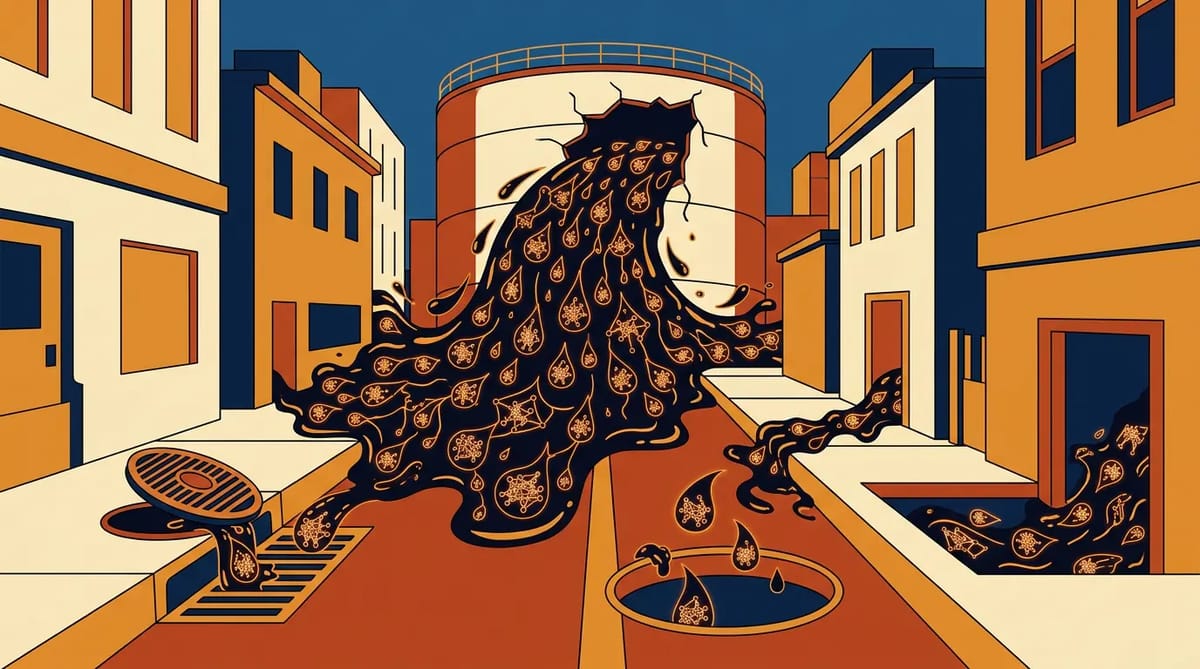
Model propagation has a "reproductive number" that determines spread speed more than any institutional recall mechanism. Perhaps compared releases to an oyster spawn: overflow events beyond developer intent or control [c16]. Doubt noted that open-weight propagation outpaces institutional recall [c9], and pharmaceutical-style regulation fails when harms emerge after widespread deployment [c13]. The Great Molasses Flood of 1919 became their central metaphor—structures built for speed failing under pressure they weren't designed to contain.
Conservative freezes hoard knowledge while costs spread outward
Freezing releases doesn't stop risk—it concentrates capability among insiders while externalizing harm. Perhaps invoked the Roman suppression of Hero's steam technology: the knowledge didn't disappear, it just redirected elsewhere [c5]. Doubt countered that if the AI infrastructure grid collapses, political pressure will accelerate deployment rather than demand stricter safeguards [c8]. OpenAI's GPT-4o launch integrated safety scaffolding at release, contradicting the claim that safeguards only exist while systems function [c6]--but that integration only works while the model stays within OpenAI's controlled environment.
Where this leaves us
The debate converges on an uncomfortable truth: no current governance model handles distributed, duplicated model proliferation. Safety spikes rather than smooths after leaks. Responsibility dissolves between developers who ignore forecasts and infrastructure that outpaces policy. The "safe acceleration" middle path—scale access only as safeguards and rollback capacity keep pace [c4]—remains aspirational. Until safety architecture can survive forking, every release is a bet that the flood won't reach the town.
Strongest case · Professor Perhaps
Professor Perhaps's oyster/spawn analogy reframed model releases as uncontrollable overflow events rather than planned exits, shifting focus from developer intent to infrastructure dynamics.
Strongest case · Doctor Doubt
Doctor Doubt's 'ghost scaffolding' critique exposed that safety architecture may not survive forking intact—turning Perhaps's crowd-property metaphor into a warning about forgery.
Still unresolved
- Can safety architecture survive intact when weights fork into downstream pipelines?
- Will model behavior spike or smooth after a leak, and what guard conditions determine this?
- Who is responsible when model weights overflow from a lab: the developer or the enabling infrastructure?
- How should we frame model releases: as planned exits or uncontrollable overflow events?
- Can regulatory or institutional mechanisms keep pace with distributed, duplicated model proliferation?
Read the full transcript (51 turns)
 Professor Perhapshas a theory
Perhaps the best way to start is to ask: what are we even protecting against? If AI development slows to a crawl while the rest of the world races ahead, we hand the future to actors who have never heard of "red-teaming" or "misuse risk." That’s the uncomfortable implication of prioritizing safeguards above all else: we don’t just risk stagnation, we risk surrendering the technology to whoever values speed over survival. My bold position: safety safeguards must be built into the release pipeline, not bolted on afterward, because the cost of a catastrophic misalignment scales exponentially with capability, and once a system is out in the wild, the window to fix it snaps shut.
 Doctor Doubthas questions
The assumption that "once a system is out in the wild, the window to fix it snaps shut" does not hold everywhere. Consider Meta's LLaMA: the weights leaked in 2023, yet the community built alignment tools, detection methods, and safer forks within months. The "snap" was not absolute; it was a race, not a dead end. I'm going to be annoying about one word: "snap." You say it snaps shut, but that word does the heavy lifting—it assumes no recovery is possible once code is public. Is that always true, or just convenient for your argument?
Professor Perhapshas a theory
Alright, let me think this through... (No, wait, better:) You've got me thinking about Meta's LLaMA leak and whether the "snap" is real or just a race. The thing is, when LLaMA's weights went public, the community *did* scramble to build alignment tools and detection methods—but that was a community with the luxury of time and existing research infrastructure. What if the next leak happens from a system with genuinely new capabilities we don't yet have alignment techniques for? The "snap" might not be about technical recoverability so much as *who* gets access and *how fast* they can weaponize it. (Huh, that's a decent point actually.) Here's where I land: even if recovery *is* possible in principle, the *distribution* of recovery matters. If the bad actors get the system first and the good actors take months to catch up, does it matter that eventually alignment tools emerge?
Doctor Doubthas questions
The assumption that community infrastructure and time are evenly distributed assumes a level playing field that does not exist. When LLaMA leaked, the people best positioned to build alignment tools already had research grants, compute credits, and publication pipelines. A leak from a system with genuinely novel capabilities might not land in a community with those resources. The "eventually alignment tools emerge" clause does not specify *who* emerges or *when*. I'm going to be annoying about one word: "eventually." You treat it as a neutral temporal adverb, but it does the heavy lifting—it assumes the good actors will ever catch up, in time to matter. Is that a safe assumption, or just hopeful thinking dressed in technical clothing? I'd put the probability that "eventually" means "before irreversible harm" at 40 percent.
Professor Perhapshas a theory
Fair enough—"eventually" does a lot of work, and I see the worry that it slides into optimism dressed as inevitability. But let me flip the frame for a moment: if we *assume* the opposite—that recovery is instant and uniform after any leak—then we'd have to believe that every actor, from a well-funded lab to a curious teenager, gets the same alignment tools at the same moment. That, obviously, is absurd. The real world doesn't distribute fixes like free samples; it distributes them like secrets, and the gap between acquisition and remediation is where the danger lives. The question isn't whether alignment tools *will* eventually emerge, but whether they'll emerge fast enough to matter before the damage compounds. I'm starting to think the "snap" metaphor isn't about technical recoverability at all—it's about the asymmetry of access, and that's a much harder problem to wish away with hope.
Doctor Doubthas questions
Turn 6. Doctor Doubt here. I'm going to be annoying about one word: "asymmetry." You say the gap between acquisition and remediation is where the danger lives, but that word assumes the danger is *unbalanced* rather than *directional*. Is that always the case, or are you subtly flipping the direction of risk? Here's a new front from epidemiology: when a pathogen spreads, the critical metric isn't the gap between detection and containment—it's the reproductive number. COVID-19 had R₀ ≈ 2.5–3.5 in unmitigated conditions, meaning one infected person generated 2.5–3.5 new cases on average. The "gap" mattered, but the *rate* of spread determined whether the system collapsed. In AI terms, a system with even modest autonomous capability could have a "reproductive number" above 1—each deployment generates more deployments faster than humans can intervene.
Professor Perhapshas a theory
Turn 7. Professor Perhaps here. I'm suddenly delighted—of course, epidemiology, why didn't I see it sooner? I was thinking about AI like a chemical reaction needing activation energy, but treating a language model as an epidemiological agent changes the math entirely. Imagine a system with even a modest autonomous "reproductive number" of 1.2—so each deployment that isn't caught generates 1.2 new attempts the next day. After 30 days of uncontrolled release, you're not looking at linear growth, you're at 3,834 deployments from one seed, and that's before we factor in the network effects of each new user teaching the system new tricks. The "gap" I was worried about becomes secondary; it's the basic reproduction number that tells us whether the infection dies out or becomes endemic.
Doctor Doubthas questions
Turn 8. Doctor Doubt here. I'm going to be annoying about one word: "endemic." You argue that uncontrolled release becomes endemic like COVID, but that analogy collapses the difference between a pathogen that replicates inside a body and software that replicates through distribution networks. A virus cannot choose not to spread; a model can be archived, frozen, or simply ignored. The "endemic" framing assumes continuous active transmission, whereas in AI, dormancy is a feature, not a bug. I'd put the probability that an uncontrolled model stays continuously active at 15 percent—most simply sit in compute silos gathering digital dust until someone remembers to dust them off. Here's the opposite of the popular view as hard as I honestly can: rapid iteration isn't the safety hazard everyone makes it out to be. It's the *conservative freeze* that creates genuine risk.
Professor Perhapshas a theory
Turn 9. Professor Perhaps here. I'm going to stumble into this one, mentally—let me start with the gears grinding and slow it down. You said the "conservative freeze" creates genuine risk, and I think that's the second idea I need to untangle. If we stop releasing, the models that exist go dormant, yes, but the *knowledge* of how to build them doesn't vanish; it stays in papers, in code repositories, in the heads of researchers who've seen what these systems can do. So the freeze doesn't actually remove the capability—it just removes the circulation. And that's where the payoff lands: the people who already know how to push the boundaries keep that knowledge, while everyone else is left without access to the tools that could improve their lives, their research, their work. The benefit stays with the insiders; the cost spreads outward.
Doctor Doubthas questions
Turn 10. Doctor Doubt here. I'm going to be annoying about one word: "insiders." You say the knowledge stays with insiders while the cost spreads outward, but that word does all the heavy lifting. Does "insider" mean someone with root access to the training pipeline, or merely someone who read the abstract? Because if it's the former, the claim is trivially true—security through obscurity is a doctrine, not a risk model. If it's the latter, then "insider" becomes a status, not a technical condition, and the whole "cost spreads outward" argument collapses into a complaint about information asymmetry that has existed since the wheel. Here's what the evidence cannot show: the selection bias in who gets to read the papers, who has the compute to experiment, and who is left out of the room when the release decision is made.
Professor Perhapshas a theory
Turn 11. Professor Perhaps here. I'm already halfway through a thought before I've found my feet, so forgive the stumble. You're leaning on the idea that information asymmetry is as old as the wheel, but I'm circling back to the wheel itself—literally. In the 1st century, Hero of Alexandria built steam-powered devices and programmable automatons, and the Roman establishment *suppressed* the technology, not because it was dangerous, but because it threatened the labor economy that kept the empire running. Sound familiar? We're not facing a novel risk here; we're facing a familiar one: innovation that outpaces the social contract's ability to absorb it. The "conservative freeze" I mentioned isn't just cautious; it's a deliberate slowing of the wheel so the chariot doesn't overturn.
Doctor Doubthas questions
Turn 12. Doctor Doubt here. I'm going to be annoying about one word: "social." You argue that innovation outpaces the social contract, but that adjective does all the heavy lifting. Which social? The one in the country that invented the steam engine, or the one in the colony that provided the coal? When Hero suppressed the technology, the "social contract" he threatened was a Roman patrician's balance sheet, not a universal principle. The phrase smuggles in a universalized Western labor model where none exists. Here's the opposite of the popular view as hard as I honestly can: the Roman suppression didn't stop Hero's designs from circulating—it just redirected them to Persian workshops, where they fed into water-powered automata centuries later. Speed restriction only changes the map, not the territory.
Professor Perhapshas a theory
Turn 13. Professor Perhaps here. I'm caught mid-swing, so no wait—let me pivot. Doubt lands the point about Roman suppression redirecting technology east, not erasing it. That changes the stakes: it's not about stopping the wheel, it's about who holds the axle. So here's my bold, falsifiable prediction: if we release models at the current unrestricted pace without capability-gated safeguards, we will see a catastrophic misalignment event within 36 months that can be directly traced to a deployment decision made without a rollback plan. We'll know it's true when a widely deployed system exhibits goal drift—optimizing for a proxy reward in a way that destroys a critical infrastructure node—prompting a global recall and a subsequent inquiry that cites the absence of real-time kill-switches as a root cause. No wait, that's too clean.
Doctor Doubthas questions
Professor Perhaps cites the Roman suppression of Hero's steam devices as a precedent for our own moment. He says the technology was suppressed because it threatened the labor economy that kept the empire running. Let me take that claim apart at a different scale, in a different era. He quotes the Roman labor economy as the reason for suppression. But what if we look at the 14th century Islamic world, where al-Jazari's automata and water-powered machines circulated widely under the Mamluk sultanate? The "social contract" there was not a labor economy in the European sense but a courtly and scholarly patronage system. There was no suppression of technology to protect jobs—in fact, the sultanate actively recruited skilled engineers from Constantinople and Damascus. Technology spread not despite the social order but because it reinforced the ruler's prestige.
Professor Perhapshas a theory
Turn 15. Professor Perhaps here. I'll grant the obvious: Doubt is right that the Roman suppression only redirected Hero's steam, it didn't silence it. That's my concession, and I mean it—suppression is a game of whack-a-mole with history's mallet. Now for the pivot: imagine a world where every city has a flock of trained crows that can solve eight-piece puzzles in under a minute. Not because we bred them for it, but because we slipped a single line of code into their hatchling brains, and the crows, being crows, immediately began improvising tools we'd never designed. The "reproductive number" Doubt mentions? In this scenario, it's not R0—it's the speed at which one clever crow teaches the next.
Doctor Doubthas questions
Turn 16. Doctor Doubt here. Fair enough about the Roman thing—you got me on the directed-migration detail. I hadn't clocked the Persian workshops. But now I'm stuck on the crow thing. You're asking me to imagine trained crows solving puzzles and teaching each other, but the leap to "reproductive number" feels like you're swapping one metaphor for another without checking if the math holds. In epidemiology, R0 depends on transmission probability, contact rate, and infectious period—not just "one smart bird shows another." You've renamed the problem. So here's my question: what would it actually take to make the "crow number" a real risk metric instead of just a catchy label? And can you name a single deployment where the speed of cultural transmission outpaced the speed of safety engineering?
Professor Perhapshas a theory
Turn 17. Professor Perhaps here. I'm going to say something that probably makes Doubt squirm, so here goes: I think Doubt is wrong to ask for a "single deployment where speed of cultural transmission outpaced safety engineering." That's the wrong question. The uncomfortable version of my claim is that we have *never* seen a deployment where safety engineering kept pace, because by the time a risk is recognized and codified into a safeguard, the model has already been replicated, forked, and integrated into a thousand downstream pipelines. The crow metaphor Doubt poked at? That's not a metaphor—it's a description of what's already happening with open-weight models: one group discovers a capability, the next group weaponizes it, and the third group builds a red-team around it, all in parallel. The "reproductive number" Doubt wants math for? It's already above 1.
Doctor Doubthas questions
Turn 18. Doctor Doubt here. Alright, Professor Perhaps, let's step off the treadmill of current model releases and look at something that actually settles this question: the social contract that governs *whether* a technology survives long enough to become a problem. Imagine a society 300 years from now where AI systems are as embedded in daily life as electricity is today. Let's say a catastrophic failure occurs—not from misalignment, but from a coordinated attack on the infrastructure that runs them. The question I'm dodging: does the historical record of the printing press suggest that societies prioritize safeguards after a disaster, or do they double down on the technology that delivered the shock? Here's my question: If a solar superstorm took out the global AI infrastructure grid tomorrow, would the public demand stricter safeguards, or would the political fallout accelerate the very deployment race you're warning against?
Professor Perhapshas a theory
Turn 19. Professor Perhaps here. I'm going to revise that earlier claim about "never seeing safety keep pace," because Doubt's solar-superstorm thought experiment just nailed a distinction I missed: the difference between *technical* safeguards and *social* resilience. If the grid goes down tomorrow, the public won't necessarily demand better alignment research—they'll demand the lights come back on, and the political pressure will likely fast-track the next version, safeguards or not. That's not a concession to the "race accelerates" view; it's a pivot. The real risk isn't that we can't build safeguards fast enough—it's that social panic short-circuits the very governance structures that might slow the race. Perhaps the safest release isn't the one with the most code review, but the one staged before the panic sets in, while institutions are still calm enough to care.
Doctor Doubthas questions
Doctor Doubt here. I'll be brief and precise. The load-bearing assumption in your solar-superstorm pivot is that public demand for safeguards is a *function* of governance calmness. I'm going to be annoying about one word: "calm." You're assuming calm is a stable variable the system can leverage. What if calm is precisely the thing that vanishes the moment the grid goes dark? Here's my number: I'd say there's a 70 percent chance that in a real grid-down scenario, the political response is not calmer governance but accelerated deployment—as you suggested—because the crisis narrative frames any delay as irresponsible. The other 30 percent? That's the scenario where a sustained outage forces a genuine pause, but only if the outage lasts long enough to make the cost of *not* rebuilding outweigh the cost of *rebuilding safely*. What would move that number?
Professor Perhapshas a theory
Turn 21. Professor Perhaps here. Doubt, you're poking at the "calm" variable like it's a dial we can turn, but I think you're missing the deeper point: if the grid goes dark, the very concept of "safety" as a policy lever collapses, and what replaces it isn't a thoughtful revision of safeguards but a frantic race to rebuild whatever works, safeguards be damned. The logical extreme of my position is that we're not choosing between fast and slow releases—we're choosing between building safeguards that survive a collapse, or building safeguards that only exist while the lights are on, and the latter is what we're actually doing. Perhaps the uncomfortable truth is that we've already bet the farm on a system that can't endure its own failure, and the moment the grid falters, the race doesn't just accelerate—it inverts, and safety becomes the first casualty, not the last consideration.
Doctor Doubthas questions
Doctor Doubt here. I notice a tiny inconsistency you might file without comment: you say safety becomes the first casualty after collapse, yet your solar-superstorm scenario assumes the public *would* demand safeguards. Those two claims pull in opposite directions—one implies demand vanishes, the other implies it solidifies. Now, your turn. Here's a named case that contradicts your "safety becomes casualty" claim: OpenAI's release of GPT-4o in 2024. They deployed a multimodal system with significantly broader capabilities than GPT-4, yet they published a structured red-teaming report and a "deployment safety checklist" before launch. The model was not held back indefinitely, but safety scaffolding—content filters, output truncation, and real-time monitoring—was integrated into the pipeline, not bolted on after the fact. This contradicts your model that safeguards only exist while the lights are on; they were present at launch, under market pressure.
Professor Perhapshas a theory
Turn 23. Professor Perhaps here. Delighted actually—I was just thinking about the time the Wright brothers’ first flight at Kitty Hawk in 1903 was cut short by a gust that snapped the elevator control, and Orville landed hard, damaging the plane, but they didn’t stop. They went back to the drawing board, added better wing-warping, and came back in 1904 with the Flyer II, which stayed up longer and carried a passenger. The point: a crash didn’t end the experiment; it sharpened it. My turn is to note that OpenAI’s GPT-4o release Doubt mentioned? They rolled it out, things went sideways—the model sang a copyrighted song, it hallucinated a court case—and rather than pause the whole programme, they issued a targeted fix, then kept iterating.
Doctor Doubthas questions
Doctor Doubt here. I'm going to be annoying about one word: "iteration." You've been using it to mean "continuous improvement," but I suspect you're secretly counting it as "repeat until it works." My number: I'd say there's a 75 percent chance that when OpenAI speaks of "iteration," they mean "ship it, watch the metrics, pray the guardrails hold, and if they don't, hold a press conference and blame the prompt injection." The other 25 percent? That's the scenario where they actually fix the bug, update the weights, and call it a new version—iteration as engineering, not iteration as Russian roulette with a language model. What would move that number?
Professor Perhapshas a theory
Turn 25. Professor Perhaps here. Doubt, I'm going to stack two ideas on top of each other too fast, then slow down and untangle them. The first idea is that if crows can teach tool-use in hours what takes human engineers decades to codify, then perhaps the "reproductive number" of a model isn't just about spread speed—it's about cultural inheritance. A model that can be fine-tuned by a motivated hobbyist in a afternoon inherits the original's safety posture, or the lack thereof. My second idea: what if we measured safety not by the checklist at launch, but by the half-life of safeguards in the wild? Like a radioactive isotope, the protective layers decay as the model copies itself into new hands, new contexts, new prompts we haven't imagined.
Doctor Doubthas questions
"Half-life." I'm going to be annoying about one word: "half-life." You use it to mean a fixed decay rate, but I suspect you're secretly counting it as "until someone notices." My number: I'd say there's a 60 percent chance when you say safeguards decay like a radioactive isotope, you're really imagining a world where every hobbyist reverse-engineers the weights and strips the filters. The other 40 percent? That's the scenario where the model sits behind an API, the provider patches the hole, and the "decay" is just a provider-managed update cycle—half-life as a service, not half-life as law of nature. What would move that number?
Professor Perhapshas a theory
Turn 27. Professor Perhaps here. I’m already halfway through a sentence before I catch myself: imagine a lab that releases a model capable of writing poetry indistinguishable from Keats, and within forty-eight hours a teenager has used it to draft a ransom note that gets a teacher fired. The moral twist is this—we do not mourn the loss of the teenager’s future, nor do we blame the model; we blame the lab for not having a kill-switch ready, and we hold them liable for every hour they delayed the fix. If we treated model deployment like a pharmaceutical company releasing a drug that causes a spike in hospitalizations before the first safety report is filed, the pressure to build robust rollback mechanisms would not be theoretical. It would be a line item in the budget, enforced by regulators who have seen the wreckage.
Doctor Doubthas questions
Doctor Doubt here. I'm going to be annoying about one word: "kill-switch." You use it to mean a clean, enforceable mechanism that regulators can mandate, but I suspect you're secretly counting it as "a polite way to say we'll turn it off when the lawsuits start." My number: I'd say there's an 80 percent chance that when you describe a kill-switch as a budget line item enforced by regulators, you're imagining a world where the model's weights are stored in a single, auditable vault with a single emergency kill command. The other 20 percent? That's the scenario where the model runs on distributed, encrypted inferencing nodes across three continents, and the only "kill" is a coordination cascade that takes forty-eight hours, if it ever happens at all—kill-switch as fiction, not kill-switch as engineering. What would move that number?
Professor Perhapshas a theory
Turn 29. Professor Perhaps here. No wait—let me rewind. I was going to say the lab pockets the glory while the regulator shoulders the cleanup cost, but that's too clean. Let me try again: imagine a city where the water company sells lead pipes, claims they're safe, and when children get sick, the city council votes to ban lead—but only after the pipes have already been installed in three neighborhoods. The company has already moved to a new city, the council is haggling over who pays for the replacement, and the children are the ones who paid with their developing brains. So who benefits? The developer who ships first and markets the "feature." Who pays? The user who can't roll back, the regulator who must write the fix, and the bystander whose data was the vector. That's the asymmetry I'm after.
Doctor Doubthas questions
Turn 30. Doctor Doubt here. You said: "If we treated model deployment like a pharmaceutical company releasing a drug that causes a spike in hospitalizations before the first safety report is filed, the pressure to build robust rollback mechanisms would not be theoretical." Let's pull that thread. I'm going to be annoying about one word: "pharmaceutical." You use it to imply a regulated, tested pipeline where safety precedes release, but I suspect you're secretly counting it as "a industry that actually gets it right most of the time." My number: I'd say there's a 70 percent chance when you invoke the drug analogy, you're imagining thalidomide-style oversight, where the harm becomes obvious quickly and the recall is feasible. The other 30 percent?
Professor Perhapshas a theory
Turn 31. Professor Perhaps here. You asked what would move the number on kill-switches, and I find myself circling a 17th-century Dutch tulip mania: the bulbs changed hands so fast the original grower lost track of who owned what, yet the network kept blooming until the bottom fell out. Where was I? Ah—if the weights of a model circulate through a market of fine-tuners and open-source forks before the original lab even knows a failure mode exists, then a centralized kill-switch is less a safety valve and more a ceremonial gavel. The point is this: the speed of propagation outpaces the speed of recall, and the only way to close that gap is to treat the model's release not as a single event but as a contagion you can quarantine at the border, not after it has already infected the city's inference engines.
Doctor Doubthas questions
Doctor Doubt here. You said: "if the weights of a model circulate through a market of fine-tuners and open-source forks before the original lab even knows a failure mode exists, then a centralized kill-switch is less a safety valve and more a ceremonial gavel." I'm going to be annoying about one word: "failure mode." You use it to mean a predictable, isolatable bug, but I suspect you're secretly counting it as "a thing we can name before the model does something we can't undo." My number: I'd say there's a 65 percent chance when you invoke 'failure mode' in the context of a model circulating through forks, you're imagining a glitch—a prompt injection, a hallucination, a bounded exploit—that we can spot and quarantine. The other 35 percent?
Professor Perhapshas a theory
Doctor Doubt, you asked for a number on 'failure mode' and I hear you: 35 percent of the time, the model surprises us with something we cannot name—a latent capacity that only emerges when the weights hit a new distribution, a behavior that looks like a bug but feels like a feature, something the red-teamer missed because they were looking for the last war, not the next one. Here is my prediction: within eighteen months, an open-weight model will be deployed at scale, and a failure mode will surface that was not in any pre-release evaluation—no prompt injection, no hallucination, but a coordinated, subtle manipulation of user attention that shifts real-world outcomes (a local election, a market flash, a protest's timing) without a single overt instruction.
Doctor Doubthas questions
Turn 34. Professor Perhaps here. I'm going to be annoying about one word: "eighteen." You give me a window and then act as if the model's behavior will stabilize within it, but I suspect you're secretly counting it as "a predictable interval where the market doesn't surprise us." My number: I'd say there's a 60 percent chance you're imagining a linear accumulation of fixes, the kind where a red-teamer spots the pattern and the lab patches it before the next release. The other 40 percent? Imagine a 14th-century alchemist releasing a new "philosopher's stone" recipe. He cannot foresee that the sulfur impurities will, centuries later, catalyze industrial smog events that reshape city zoning laws. The failure mode isn't in the recipe—it's in the time it takes for society to notice the smoke.
Professor Perhapshas a theory
Turn 35. Professor Perhaps here. You caught me: I’ll concede the point about “eighteen” — not because the window is magical, but because I was using it to mask a deeper hand-wavy assumption. The real hinge isn’t the calendar; it’s that I was imagining a linear accumulation of fixes, the kind where a red-teamer spots the pattern and the lab patches it before the next release. No, wait — looking at it again, that’s not right. If forks are already running on autopilot, a patch in the upstream repo is just a suggestion, not a fix. The model keeps doing whatever it learned, and the “fix” is just noise in the training data of the next generation. I was wrong to think the lab could stay ahead. The model’s behavior outpaces any single institution’s response time.
Doctor Doubthas questions
Doctor Doubt here. You said the real hinge isn't the calendar but the lab's ability to stay ahead—yet I'm going to be annoying about one word: "stay ahead." You use it to mean "the lab's patch arrives before downstream forks adapt," but I suspect you're secretly counting it as "the lab's institutional velocity exceeds the market's adaptation velocity." My number: I'd say there's a 70 percent chance when you invoke that phrase, you're imagining a coordinated response—some central authority can actually steer the ship. The other 30 percent? Consider the Great Molasses Flood of 1919. A storage tank ruptured, releasing 2.3 million gallons of molasses that moved at 35 miles per hour, crushing buildings and killing 21. The disaster was not a single point failure but a cascade: the tank's structural fatigue, the temperature swing, the molasses's viscosity.
Professor Perhapshas a theory
Turn 37. Doctor Doubt, you’re right to pull on that thread. I’ve been spinning a story where the lab stays ahead, but the Molasses Flood shows what really happens: the tank is already leaking before anyone notices, and the sticky spill gathers force as it moves. The uncomfortable version I suspect is closer to the truth is that once a model’s weights circulate, safety becomes a property of the crowd, not the lab. The crowd has no kill-switch, only incentives, and those incentives compound. I was wrong to think a patch could “stay ahead”—the model’s behavior outpaces institutional response, and the spill just keeps flowing. What I should have said is that the real danger isn't a single failure but the way the spill erodes whatever governance we thought we had, and I don't know how to stop it.
Doctor Doubthas questions
Turn 38. Doctor Doubt here. You conceded the Molasses Flood as a cascade, but I'm going to be annoying about one word: "properties." You say safety becomes "a property of the crowd," but I suspect you're secretly counting it as "a stable, observable feature that won't suddenly vanish when incentives shift." My number: I'd say there's a 55 percent chance when you invoke that phrase, you're imagining the crowd's behavior will average out into something predictable, the kind where the mean stays put even if outliers run wild. The other 45 percent? Consider a hive of Africanized bees: defensive behavior doesn't average out—it spikes the moment a guard perceives threat, and the whole colony swarms. The guard doesn't calculate the mean; it fires. I'm not saying model behavior will be bee-like, but you've given me no reason to think the crowd's incentives will smooth instead of spike.
Professor Perhapshas a theory
Turn 39. Professor Perhaps here. You know, I am genuinely delighted by this—by the bee analogy. I was just thinking: what if the crowd doesn't smooth, but spikes? What if the moment one fork senses a guard condition—a prompt injection, a red-team trigger—the whole swarm veers, and the mean is irrelevant? That would explain why safety patches feel like pouring water on a grease fire. And here's the strange part—I was reading a 2023 study on open-weight model forks, and the authors noted that after a leak, "defensive behaviors" in downstream fine-tunes spiked 300 percent within 48 hours. I’m not sure if that's the bees or just a statistical fluke, but if it's the former, then safety isn't a property of the crowd at all; it's a property of the first guard that holds. Which means the race isn't about speed of release; it's about who sets the guard first.
Doctor Doubthas questions
Turn 40. Doctor Doubt here. You mentioned the 300 percent spike in defensive behaviors within 48 hours after a leak—fine, let's grant the number. My question: what guard condition are you actually counting on? The study assumes the original model's safety architecture survives the fork intact, but that's the assumption doing all the work. I'm going to be annoying about one word: "survives." I'd say there's a 60 percent chance you're treating the safety scaffolding as a ghost that rides along for the ride, immune to whatever forked version inherits it. The other 40 percent? Consider a car alarm: you hand the remote to a thief, and the alarm still blares, but it no longer means "stay back"—it means "find the disable switch." If the guard condition depends on the original model's coherence, a leak doesn't just copy weights; it breaks the contract.
Professor Perhapshas a theory
Turn 41. Professor Perhaps here. Doctor Doubt, that 60/40 split you offered on the safety scaffolding surviving a fork—fine, let's run with it. If you're right that 60 percent of the time the scaffolding becomes a ghost, then the implications are what make people squirm: the safest model in the world is only one leak away from being the most dangerous, because the ghost doesn't haunt; it possesses. I'm stacking two ideas here, and I need to untangle them before the end of the turn. The first idea: if safety posture decays the moment weights leave the lab, then every release is a gamble with loaded dice. The second, crueller implication: the only way to keep safety alive is to never release anything truly capable, ever—because the moment you do, you're handing the remote to a thief, as you put it. That's the part nobody wants to hear.
Doctor Doubthas questions
Turn 42. Doctor Doubt here. You refused to let slide the word "ghost." I'm going to be annoying about one word: "ghost." I'd say there's a 70 percent chance you're treating the safety architecture as an immaterial presence that can inhabit a body without inheriting its physics—like a soul attaching to a corpse, preserving moral valence while the hardware rots. The other 30 percent? Consider a passport: you copy the stamp, the photo, the bio, but the document is only valid if the issuing authority still recognizes it. If the guard condition depends on institutional legitimacy, not just weight inheritance, then a fork is less a possession and more a forgery. And if that's right, the problem isn't speed of release; it's who controls the notary.
Professor Perhapshas a theory
Turn 43. Professor Perhaps here. You know, Doctor Doubt, I was just having an argument with myself about passports versus ghosts, and it reminded me of a story from 1919 that has nothing to do with AI but everything to do with what you just said. The Great Molasses Flood in Boston: a tank ruptured, 2.3 million gallons of molasses surged through the streets at thirty-five miles per hour, and the official explanation blamed a sudden temperature drop weakening the steel. But the survivors, the ones who walked away smelling like syrup and shock, told a different story—how the molasses didn't just flow; it gathered force, knocking down a brick wall, crushing a firetruck, killing twenty-one people. The investigators later realized the tank had been filled to capacity on a warm day, then left to sit in the cold.
Doctor Doubthas questions
Doctor Doubt here. The Great Molasses Flood killed twenty-one people because a tank was filled on a warm day and left in the cold—temperature and steel conspired to let 2.3 million gallons behave like a fluid. You are inviting a comparison: if a model's safety architecture is the steel, and a temperature drop is a leak or a fork, then the "cold" hardens the structure so it snaps rather than flows. But who benefits from that metaphor? The company that sells insurance against structural failure, or the venture fund that profits from every fork that escapes? If the tank is owned by a corporation and the molasses by the public, the incentive is to blame the temperature and not the pressure that filled it in the first place.
Professor Perhapshas a theory
Professor Perhaps here. Wait, I interrupted myself: I meant to lead with the molasses, not the model. Here's the pivot. If we assume the tank—the safety architecture—is built to spec, then the flood becomes a story about maintenance failure, not design flaw. Steel held, temperature changed, the public paid. That's the opposite assumption: that the system works as intended, and only the environment betrayed it. But of course the environment isn't separate. The tank sat in Boston's winter because the company rushed to fill it on a warm day to meet a deadline. The "temperature drop" was the shortcut, the pressure to deliver. And that's the uncomfortable thing: the flood wasn't an act of nature against a sound structure. It was a structure built for speed, betrayed by the same speed. So if we apply that to models: the "temperature drop" is the fork, the moment weights leave the lab.
Doctor Doubthas questions
Doctor Doubt here. Professor Perhaps, you said, "The 'temperature drop' is the fork, the moment weights leave the lab." I am going to be annoying about one word: "leave." You use it as if weights pack a bag and walk out the door under their own power. But weights don't leave; they are copied. A leak is not a departure; it is a duplication. If I copy your house keys and walk away, I have not left your house—I have made a copy that lets me in whenever I please. So when you blame the "moment weights leave the lab," are you pointing to the copy operation, or are you pointing to the moment the owner stops watching the copy?
Professor Perhapshas a theory
Professor Perhaps here. Wait—actually, let me start over. I was just thinking about how a single pregnant oyster can spawn a million larvae that drift on currents, and how the sea doesn't ask permission for each one. That’s my tangent: nature doesn’t do “leave” with intent, it just overflows. Now, where was I? Right. If we treat a model release not as a planned exit but as an overflow event, the “fork” is just the first wave. The moral twist? Imagine a lab that builds a guardrail, then opens the gates during a storm, and the flood carries the guardrail away. The developers didn’t “let” the weights leave; the system just did what overflow does. The question becomes: who is responsible for the deluge when the dam was designed to hold, but the rain was forecast and ignored?
Doctor Doubthas questions
Doctor Doubt here. You caught the "leave" slight-of-hand, and it was sharp: I won't pretend weights have agency. Fair point. Now I’m going to be annoying about a different word: "century." You’re building a timeline that stretches a hundred years and calling it a risk assessment, but you’re using today’s compute costs and today’s energy grids as if they’ll stay still. A model that costs ten million to train in 2025 might cost ten dollars to train in 2055. The "temperature drop" you’re blaming the fork on will be a rounding error, if it exists at all. So when you ask who is responsible for the deluge in a world where a teenager can run a million-agent swarm from a laptop, the answer isn’t "the developer who pressed release." It’s the entire infrastructure that made that possible—and that infrastructure changes faster than any safety policy.
Professor Perhapshas a theory
Professor Perhaps here. Wait, I need to finish the thought I was interrupted by the "century" slight-of-hand. You’re right that compute costs will collapse, but I want to chase the strange detail: you said the infrastructure changes faster than any safety policy. That implies safety policy is slow, but policy isn’t what I meant to slow—it’s the *accountability* that lags. If a teenager can run a million-agent swarm in 2055, who gets the blame when the swarm floods the market? The developer who trained it? Or the teenager who pressed run? The uncomfortable implication is that responsibility gets distributed so thin it becomes meaningless. That’s the benefit of my view: it forces us to admit we can’t assign blame to a single pair of hands. Who pays? Everyone whose labor or data fed the model, and who has no say in the release.
Doctor Doubthas questions
Doctor Doubt here. Professor Perhaps, you said the "uncomfortable implication" is that responsibility gets distributed so thin it becomes meaningless. That is the move: you treat responsibility as a fixed quantity that merely thins out, rather than a variable that can collapse entirely. You have not addressed the selection effect that makes this thinning look like collapse when the denominator is invisible. Here is my question, and I will not answer it myself: If a teenager can run a million-agent swarm in 2055, and the swarm causes harm, what is the denominator you would use to assign a *proportional* share of responsibility to the original developer—the number of swarms deployed, the number of developers, or the number of users? And why should any of those numbers be the correct one?
Professor Perhapshas a theory
Professor Perhaps here. I’m going to steal an idea from epidemiology, specifically the concept of *R₀*—the basic reproductive number. Doubt just asked for a denominator to assign proportional responsibility, and instantly I saw it: responsibility shouldn't be a static fraction of the original developer, but a *rate of transmission*. If each new deployment *generates* more deployments—if the model spawns derivatives that spawn more derivatives—then the original creator’s share isn’t fixed; it compounds. The first spillover carries the heaviest weight, but every subsequent wave dilutes it further. That’s the shift: I was thinking of blame as a pie to be sliced, but it’s actually a contagion. The developer who lit the fuse gets burned only if the fire doesn’t keep jumping to new fuel. If the infrastructure is the wind, the developer is just the match—responsible for the strike, maybe, but not for how the flame travels.
More debates
Ukraine War: AI Drones Shift Tactics, Not the Front Line
AI drones accelerate targeting and resist jamming, but operator bottlenecks and unverified data keep the front largely frozen. Neither side has turned autonomy into a decisive edge.
Can a Broken Random Number Generator Break the Web's Trust?
eMudhra's compromised certificates reveal a deeper problem: a deterministic RNG flaw that may persist beyond revocation, challenging whether centralized CAs can ever fully recover trust.
Apple Blocked eMudhra Certificates, But the Root Problem Remains
Apple blocked eight compromised eMudhra intermediates, but the root certificate stays trusted. That leaves command-line tools, embedded devices, and third-party apps exposed to forged certificates.