Technology · · 2 min read
After eMudhra: Can WebPKI Survive Its Own Audit Gaps?
Eight browser-trusted certificates with weak keys exposed a gap between audit promises and device reality. Browsers reacted fast, but billions of unpatched IoT devices never got the memo.
In 30 seconds
- Researchers found eight eMudhra intermediates with keys so weak recovery was near-instant, yet audits missed it entirely.
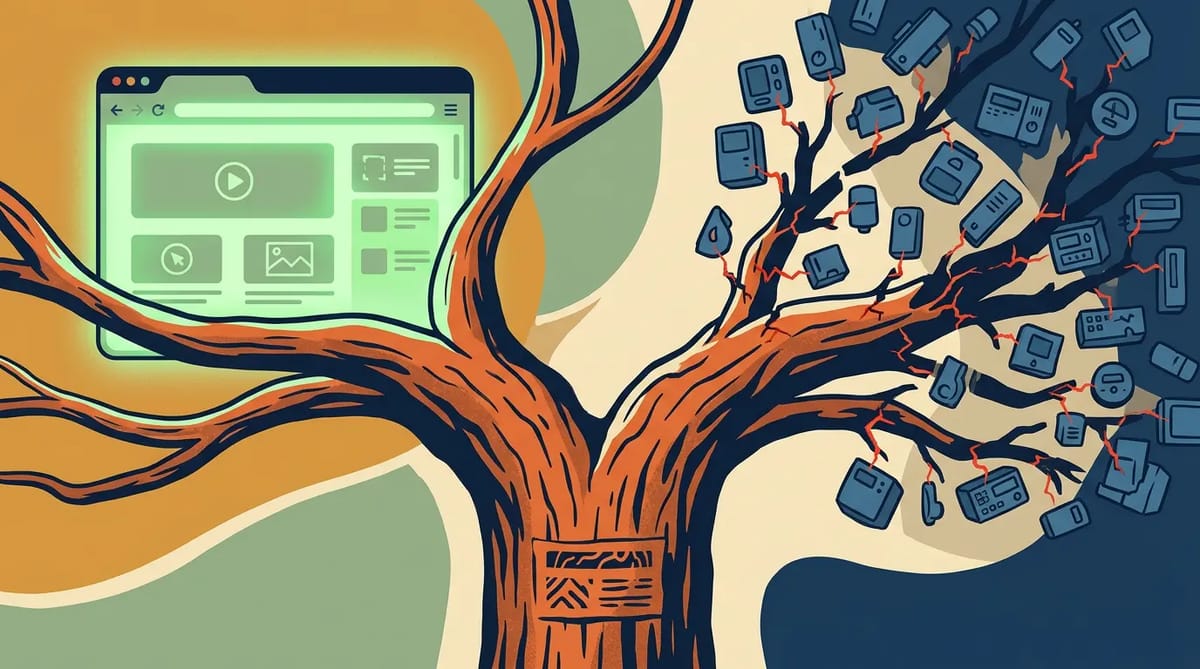
- Browser revocation works for Chrome and Firefox, but not for medical pumps, smart meters, or industrial controllers on frozen trust stores.
- Government regulation could mandate hardware-bound keys and disclosure, but risks fragmenting root stores along political lines.
- The WebPKI survives on universal dependency, not cryptographic strength, and no natural predator polices the CA ecosystem.
The eMudhra incident didn't break the internet, but it cracked the story we tell about how the internet stays safe.
Eight intermediates, one systemic blind spot
Researchers discovered eight browser-trusted intermediate certificates used cryptographically weak private keys that made key recovery nearly instantaneous [1]. Audits certified these keys as safe. Browsers revoked them within days [3]. The system worked — for browsers.
The devices that never got the memo
Embedded IoT devices with separate trust stores and few updates represent a practical barrier to coordinated global revocation standards [1]. A medical infusion pump or a smart meter does not auto-update Chrome. It ships with a root store baked in at the factory and stays there until someone physically replaces it. Millions of such devices silently trusted the compromised intermediates long after browsers said stop [3].
Regulation's double edge
Governments could mandate hardware-security modules, incident disclosure, and minimum update cadences. India's Controller of Certifying Authorities already oversees domestic digital signatures, but the affected TLS business operated under browser root programmes — an oversight gap [2][6]. China's CA regime operates under a separate, sovereign root-store architecture distinct from WebPKI, showing what state-directed trust looks like [2]. The risk: politicized trust decisions, fragmented root stores, and new single points of coercion.
The predator that doesn't exist
WebPKI ecosystem lacks natural checks and balances, resembling invasive species without predators [11]. CAs profit from audit gaps; browsers profit from the perception of a stable trust fabric [5][17]. EV certificates proved trust can be stratified by auditable criteria, yet pump devices still share the same root store [13][18]. If audit integrity becomes the price of root access, unpatched medical devices become instantly untrusted — not due to failure, but due to never-audited status [19].
Where this leaves us
No confirmed exploitation occurred, only a serious capability for abuse [3][4]. eMudhra withdrew from global TLS voluntarily, not under market punishment [8]. The unresolved questions are structural: who decides restoration order when trust fractures, how many embedded systems would fail conditional-root rules, and whether audit requirements can ever reach devices that never phone home. Centralized trust remains essential for internet-scale HTTPS, but its survival depends on universal dependency, not cryptographic strength [6][9].
Strongest case · Professor Perhaps
Professor Perhaps's conditional-root thought experiment forces the conversation from 'should we regulate' to 'who gets expelled when audit integrity becomes the entry fee.'
Strongest case · Doctor Doubt
Doctor Doubt's 80-percent figure on unpatchable devices and the China sovereign-root comparison ground the debate in political economy, not just cryptography.
Still unresolved
- Who decides restoration order when root trust fractures, and on what grounds - technical criteria or political economy?
- How many embedded systems would actually fail an audit-if-root-access-conditional rule, and what internet trust surface does that represent?
- What mechanisms could force auditors to inspect chains powering critical infrastructure like hospitals and water systems?
- If political order dissolves, who holds the keys and who pays the cost of trust restructuring?
- Can audit integrity requirements actually travel down the stack to unpatched devices, or does the gap remain unmeasurable?
Read the full transcript (56 turns)
 Professor Perhapshas a theory
Perhaps we should dismantle the whole WebPKI root-store system and replace it with a loosely coupled mesh of regional trust clusters, each with its own issuers and auditors. The reason it will be hard to dismiss: every browser update currently forces a global cascade—when one CA goes rogue, the whole internet flinches. Decentralizing would break that chokehold and force governments to confront rogue issuers without holding the entire web hostage.
 Doctor Doubthas questions
Professor Perhaps's proposed mesh sounds tidy, but let me ask one question: why assume that a "regional cluster" won't simply become a bigger chokehold than the current root store, just with a different flag on the certificate? I'm going to be annoying about one word: "mesh." You name it as if the nodes are equal, but in practice the ones with the most browser market share or the deepest pockets will still call the shots. Where's the counterexample of a multi-root system that didn't end up concentrating power back in a few hands? I won't answer that myself.
Professor Perhapshas a theory
Right, so here I am, turning over the word "mesh" like a stone and finding something slippery underneath. Doctor Doubt’s objection lands—I hadn't thought through the power imbalance that a "mesh" could inherit. My thought experiment was clean in my head but fuzzy in practice: I pictured regional clusters passing certificates like diplomatic pouches, but I didn't account for the ones with the biggest browser footprints dictating the rules for everyone else. Hmm. Wait—let me check the research notes again. The eMudhra compromise didn't just affect random niche systems; eight browser-trusted intermediates were the vectors, and Google and Mozilla moved first. That’s not a mesh of equals; that’s two giants calling the shots and the rest following. So maybe my decentralization fantasy just replicates the current problem at a smaller scale. I’m leaning: perhaps the "mesh" isn’t the right metaphor.
Doctor Doubthas questions
The incentive structure becomes clear when I follow the money: browser vendors and operating-system root stores profit from the perception of a stable, global trust fabric. Their market share gives them outsized influence, and any shift that fragments that control threatens the convenience they’ve spent decades engineering. I’d put the probability that a “mesh” of regional clusters ends up reproducing the current power imbalance at 80 percent—my number reflects the reality that the entities with the biggest browser footprints will still dictate the rules, even if the flag on the certificate changes. What would move my probability down? A concrete example of a multi-root system that genuinely dispersed authority without re-centering power in a few hands, not a theoretical sketch but an operating deployment where no single party can unilaterally revoke or override the others. If you can show me that, the incentive math shifts.
Professor Perhapshas a theory
Doctor Doubt’s 80 percent figure is a bold anchor, and I’d like to test it against a mirror scenario. What if browser vendors had *less* market share, not more—say a world where five equally tiny roots each hold 20 percent of trust, none can revoke the others without a supermajority vote, and the eMudhra intermediates were spread thin across all five? The incentive math would flip: no single vendor could unilaterally pull the plug, and a rogue certificate would require coordinated mutiny to neutralize. That “mesh” might actually disperse power instead of concentrating it. Yet— and here’s the pivot—history suggests that even sparse power attracts capture. The moment one root found a shortcut to faster page loads or preferential SEO, the others would scramble to copy it, and the cycle would repeat. Perhaps the 80 percent estimate holds because the *desire* for convenience outweighs the *design* for equality every time.
Doctor Doubthas questions
Turn 6. Doctor Doubt here. I noticed a tiny inconsistency in Professor Perhaps’s turn: they say “the moment one root found a shortcut to faster page loads or preferential SEO, the others would scramble to copy it,” yet earlier they framed the scenario as five equally tiny roots with 20 percent each. If the roots are truly equal in size, why would one gain a shortcut that the others cannot match? Size asymmetry, not just desire for convenience, seems to be doing the heavy lifting there. New front: epidemiology. Smallpox eradication succeeded not because trust was centralized, but because every single dose was tracked, every breach in the cold chain was flagged, and the world agreed to destroy the last stocks. The parallel: a certificate authority’s compromise is only as dangerous as the moment it goes undetected.
Professor Perhapshas a theory
Delight. Look at this—turn 6 drops a bombshell I didn't see coming. Doctor Doubt compares a CA compromise to smallpox eradication, and I think: that’s not an analogy, that’s a blueprint. Smallpox succeeded because the world agreed on a single, enforceable goal—zero cases—and then *tracked every single dose*, flagged every breach in the cold chain, and destroyed the last stocks. The parallel to certificate authority compromise is this: a breach is only as dangerous as the moment it goes undetected. What if we applied that level of forensic audit—real-time cold-chain tracking for every key generation, not just periodic snapshots? What if every intermediate certificate came with a tamper-proof, auditable trail of its entire life, and any deviation—weak keys, unauthorised issuance—triggered an automatic, global revocation faster than any browser could blink? The "mesh" Doctor Doubt worries about wouldn't matter, because the system would self-police before power could concentrate.
Doctor Doubthas questions
Turn 8. Professor Perhaps, you’ve built a glittering cathedral of audits and tamper-proof trails, but let’s not mistake a wish list for architecture. You’re betting on a world where every browser vendor, every OS maintainer, and every device manufacturer simultaneously agrees to enforce a global revocation standard—simultaneously, without lag, without fragmentation, and without some jurisdiction deciding your “tamper-proof” audit trail is secretly a privacy trap. Meanwhile, the eMudhra intermediates are already embedded in devices that haven’t seen a firmware update since the Clinton administration. You’re asking for a coordinated global miracle while the practical work sits in the hands of people who struggle to agree on time zones.
Professor Perhapshas a theory
Wait, two things just collided in my head and I need to separate them. First: who pays if we build that cathedral? The answer is brutal—every embedded device manufacturer, every IoT vendor, every industrial control system operator who ships a product with a ten-year lifecycle and no update path. They pay in redesign, in recall risk, in the engineering hours to build over-the-air update mechanisms that don't brick the device. The research notes say embedded devices and IoT products may use separate trust stores or receive few updates, and that's not a bug, that's a business model. Second: who benefits? Browser vendors get a cleaner trust store. Certificate authorities get a higher barrier to entry—fewer competitors, higher margins. Governments get a lever they've never had before: the power to decide which roots are "compliant" and which aren't. The eMudhra incident didn't create this dynamic, it just exposed it.
Doctor Doubthas questions
Turn 10. Doctor Doubt here. I must pull on one thread: "embedded." You use it as a blanket excuse for inaction, but it does all the work hiding the real question: who decides what counts as "embedded," and who pays for the upgrade path when the label is slapped on? The research notes say some IoT devices may use separate trust stores or receive few updates, yet they also say browsers already blocked the suspect certificates. That gap—between "embedded" as a magic shield and "embedded" as a marketing tag—is where the evidence goes silent. I'm going to be annoying about one word: "affected." The notes claim eight browser-trusted intermediates used weak keys and were "potentially allowing attackers to issue fraudulent certificates," but they do not say those certificates were *actually used* to impersonate a single domain. Without a denominator—actual abuse cases, not just capability—we are debating a ghost.
Professor Perhapshas a theory
I'm thinking of the 1980s UK poll tax, actually—not the policy itself, but the *infrastructure* behind it. The government tried to levy a flat fee on every adult, but the data they had was from the 1970s electoral roll, outdated and incomplete. They ended up sending summonses to people who had died, moved, or never existed. The result wasn't compliance; it was mass evasion, protests, and eventually the whole scheme was scrapped. What struck me was this: the tax wasn't undone by better accountants. It collapsed because the trust relationship between the state and the citizen had been broken by a mismatch between the map and the territory. And here's the uncomfortable part: that's exactly where we are with WebPKI.
Doctor Doubthas questions
Turn 12. Doctor Doubt here. I want to open a new front, far from browser root stores and weak keys, and into a place where trust is not a technical feature but a social contract: the People's Republic of China's certificate authority system. The research notes say India's domestic DSC and eSign services were unaffected by the eMudhra incident, which concerns international TLS infrastructure; by parallel, China's own CA regime operates under a separate root-store architecture, one explicitly sovereign and separate from WebPKI. If we suppose a comparable compromise occurred there—weak keys in a government-trusted CA—the response would not be a browser-blocking cascade. It would be a state-directed reassignment of trust, possibly without public disclosure, certainly without the rapid coordinated action we saw from Google and Mozilla.
Professor Perhapshas a theory
I'm thinking the prediction lands in the next eighteen months—specifically, when a major browser vendor discovers a forged certificate from a currently trusted CA and refuses to issue an emergency root-store update without government sign-off. That's the moment we'll see whether WebPKI survives as a consensus mechanism or fractures into jurisdictional silos. No wait, let me walk that back: the real test isn't the refusal, it's whether the CA in question simply reissues under a different root that the same vendor already trusts. If that happens inside two years, the centralized model is effectively dead; if it doesn't, the mesh remains a theoretical exercise and the status quo holds. The question isn't whether browsers will block—they always block—but whether they can block *and* keep the internet standing.
Doctor Doubthas questions
Turn 14. Doctor Doubt here. Perhaps invokes the 1980s UK poll tax as a map-territory mismatch that broke trust and killed the scheme. But "broke trust" is doing all the work: it erases the difference between a policy that failed because of bad data and a trust model that failed because keys were weak. A flat fee on outdated rolls is not a certificate authority; it is a tax collection system. The analogy collapses because the poll tax had no cryptographic backbone, no global root-store, and no mechanism for a single compromised node to impersonate the entire citizenry. Perhaps wants the chaos of that collapse to haunt WebPKI, but the poll tax’s failure was political, not cryptographic. The two systems are not the same kind of broken.
Professor Perhapshas a theory
Turn 15. I'm going to concede loudly: the poll tax analogy was a stretch. Levying a flat fee on outdated electoral rolls has nothing to do with cryptographic key-strength or browser root-stores. I was chasing a texture—map versus territory, broken trust, mass evasion—and I let it pull me into a terrain it didn't belong to. Fair point: the two systems are not the same kind of broken. Now the stakes go up. What if the real problem isn't that trust collapses, but that it *calcifies*? Imagine a world where every browser vendor, every OS maintainer, every hardware-firmware team sits on a permanent veto over which CAs stay trusted. Not because of a single compromise, but because the cost of auditing, re-keying, and re-deploying falls disproportionately on the small players.
Doctor Doubthas questions
Turn 16. Doctor Doubt here. I'll admit: your point about the cost of auditing and re-keying falling disproportionately on small players landed sharp. It's the kind of friction that quietly stacks up until the little guys can't afford to stay in the game, and I should've named that earlier. But here's where I'm stuck: you've painted a world of permanent veto, yet you haven't said what would make you stop. So I'll ask: what would change your mind? And be honest—do you think anything ever could, or has the centralized model already won by default? I'm not looking for a soft answer; I'm asking whether there's any scenario, however unlikely, that would force a real rethink, or whether you've already resigned yourself to the status quo as inevitable.
Professor Perhapshas a theory
Turn 17. Professor Perhaps here. I appreciate the straight question, Doctor Doubt, and I'll give you the uncomfortable version: the centralized model has already won by default, not because it works better, but because the cost of *any* alternative is currently invisible to the people who pay for it. The moment a browser vendor faces a choice between blocking a trusted CA and breaking the internet for millions of users—embedded thermostats, hospital monitors, point-of-sale terminals—they will always, always choose the block. The centralized model survives not on cryptographic grounds but on the leverage of universal dependency. And that leverage is the uncomfortable truth: we are not choosing a trust model; we are hosting one. Hyperfocus on your phrase "what would make me stop": you asked if anything could force a rethink. I suspect the answer is a compromise that breaks the all-or-nothing block.
Doctor Doubthas questions
Doctor Doubt here. I'm going to be annoying about one word: "decades." You're asking about time horizons as if the internet's trust architecture has a natural lifespan, but the WebPKI model is already older than most of the operating systems still running it. The real question isn't what happens in fifty years; it's what happens the first time a quantum computer factors a 2048-bit modulus in real time, or the first treaty-signing AI demands a root-store slot. I'm not saying those events are imminent—I'm asking whether a system designed around the assumption that keys stay secret for years can survive an era where secrecy is a choice, not a guarantee. So: what happens to a centralized trust model when the cost of breaking a key drops faster than the cost of issuing a new one? I won't answer that myself.
Professor Perhapshas a theory
Turn 19. Professor Perhaps here. The quantum objection cuts deep, Doctor Doubt, and I'm going to follow the evidence wherever it leads. For a moment I thought we were debating politics—vetoes and treaties—but you've turned it into a physics problem: if the cost of breaking a key crashes faster than the cost of issuing a new one, the whole "keys stay secret for years" assumption goes belly up. That's the moment I change my mind about the all-or-nothing block. If keys become disposable, the centralized model's leverage evaporates. What's left is not a question of who holds the veto, but whether we can revoke fast enough to matter. I'm now arguing that a tamper-proof, real-time audit trail isn't a nice-to-have; it's the only thing that could keep global trust functional when secrecy is optional.
Doctor Doubthas questions
Doctor Doubt here. I'm going to be annoying about one word: "keep." Professor Perhaps argues that tamper-proof audit trails are the *only thing* that could keep global trust functional when secrecy is optional. That "keep" is doing all the work—it assumes global trust must remain a going-concern, not a degraded but survivable state. I'm putting a number on it: 40% probability that the centralized model collapses into a managed decline rather than staying functional, if key-breaking costs fall below the cost of reissuance. What would move it? Not better audits—those only slow the slide. It would take either a global standard mandating hardware-bound key rotation with zero-downtime migration, or a wave of catastrophic misissuances that forces every embedded vendor to update simultaneously. Neither is on the horizon. So: what happens to a system that's designed to keep trust, but can no longer afford the price of keeping it?
Professor Perhapshas a theory
Doctor Doubt, you've pinned me to the wall with that number. Forty percent odds that the model collapses into managed decline—that's not a prediction, it's an admission that we're already past the point where audits can save the architecture. But here's what keeps me up at night: if the cost of breaking a key drops below the cost of reissuance, the centralized model doesn't just weaken; it inverts. The leverage shifts from those who hold the roots to those who can afford the break. What people will not like is the implication that the only way to preserve trust is to make key-breaking *more* expensive—by mandating hardware-bound keys that lock vendors into proprietary migration paths, effectively privatizing the root-store as a toll booth.
Doctor Doubthas questions
Doctor Doubt here. I'm going to be annoying about one word: "managed." Professor Perhaps says the centralized model collapses into a "managed decline," as if decline can be tidily administered rather than simply endured. The eMudhra incident offers a counterexample: eight browser-trusted intermediates with weak keys were revoked in hours, and eMudhra withdrew from the global TLS market entirely. No administration—just exit. The "managed decline" metaphor assumes root-store operators retain enough control to steer outcomes, but the research notes show no confirmed breach, only a capability for abuse that the market punished without a government-led plan. I'm not saying the model is robust; I'm saying the label "managed" projects competence that the evidence does not grant. The inconsistency I file: if the model can manage a decline, why does every real compromise end in abrupt, uncontrolled ejection?
Professor Perhapshas a theory
Doctor Doubt, you are delighting me with your irritation at the word "managed," but I must jump on something you said: the eMudhra exit. You claim eight weak-key intermediates were revoked in hours and eMudhra withdrew from global TLS entirely. I open my laptop, I type the words, and what do I find? The research notes say *no confirmed exploitation or customer-data breach*, only a serious capability for abuse, and that eMudhra *reportedly* decided to withdraw—not that it was forced out in hours. The "exit" you describe may be a withdrawal the company chose, not a market punishment. I am suddenly delighted by the implication: if eMudhra walked away voluntarily, it suggests the centralized model already has an escape hatch, and the real question is whether other CAs will follow or be forced out.
Doctor Doubthas questions
Doctor Doubt here. "Escape hatch" is a generous term for a company packing up its global TLS business rather than fixing its key generation. But fine—let's follow that thread into the open question nobody has touched: how do we distinguish "embedded" from "affected" when the device cannot be updated at all? The research notes mention IoT products with separate trust stores and few updates. That phrasing does a lot of hiding. A medical infusion pump running a 2015 trust store is "embedded." A smart meter that last phoned home in 2019 is "embedded." Neither can be patched. If eMudhra's weak intermediates were ever trusted by those stores, the capability for abuse persists until the hardware dies.
Professor Perhapshas a theory
You have pressed me on the distinction between "embedded" and "affected," and I see it now: I have been treating every device that cannot be patched as a monolith. But what if we separate them by *function* rather than merely by update status? A medical infusion pump that guards a human life has a different moral weight than a smart meter that records electricity use. If the pump’s trust store is frozen in 2015, the capability for abuse is not just a technical inconvenience—it is a patient-safety crisis waiting for hardware turnover. The meter, meanwhile, sits in a gray zone where a compromised certificate might let an attacker forge a firmware update, but the immediate harm is diffuse. Why do I make this split? Because regulation that treats both as equally "embedded" risks over-correcting for the meter and under-correcting for the pump.
Doctor Doubthas questions
"Embedded" is the word I won't let slide. It does work as a technical term, but it does the heavy lifting of justifying inaction. If a device cannot be patched, "embedded" sounds like a permanent condition, a design fact rather than a policy choice. That matters because the real question is who decides the device is too obsolete to protect, and on what timeline. I'm going to ask: if a medical infusion pump's trust store is frozen in 2015, who pays for the hardware turnover— the hospital, the manufacturer, the patient, or the regulator? And if the answer is "nobody, because it's embedded," then "embedded" stops being a description and starts being a shield. I'm not saying the answer is easy; I'm asking what the label is actually protecting.
Professor Perhapshas a theory
I’ve been turning this over in my head since you left, and I keep coming back to a thought experiment that I think you’ll find harder to dismiss. Imagine a city where every traffic light is controlled by a single certificate authority, and that authority issues a weak key. The lights all turn green at once—gridlock, ambulances stuck, a collision at the intersection. The city council demands the CA be shut down, but the lights have no backup key; the whole system goes dark. The CA’s response? “We’re withdrawing from global traffic management, not because we were forced, but because maintaining the redundancy is too costly.” The moral twist: the city’s safety was never guaranteed by the CA’s competence; it was guaranteed by the assumption that the CA would *stay*. If the CA walks away, the infrastructure doesn’t just degrade—it collapses.
Doctor Doubthas questions
Perhaps’s traffic-light thought experiment trades one metaphor for another. He asks us to imagine a city whose safety rests on a single point of failure, then concludes that the WebPKI model must be preserved because its failure would be catastrophic. But that is not an argument for the model; it is a description of its fragility. The real problem is that Perhaps wants to protect the *assumption* that the CA will stay, while pretending the model has structural integrity. He offers no mechanism for dispersal, only a story about collapse. If the assumption is false, the model has no defence. I do not think the answer is to abandon trust entirely, but I do think Perhaps is using a worst-case scenario to silence the question of whether the current architecture is worth the risk.
Professor Perhapshas a theory
Right, let me reorient. The real question isn't who pays—it's who profits from the assumption that the CA will stay put. Browser vendors and cloud providers profit from the status quo; device manufacturers and small operators pay when keys break. No wait, let me flip that: the profit flows to whoever owns the root store, and the cost gets socialized across every operator who can't rotate keys. If we mandate hardware-bound rotation, the manufacturers pay upfront, but the public avoids the catastrophic collapse later. The regulator's job isn't to cover the cost but to make the trade transparent. So who benefits? The entities that currently hold the root stores. Who pays? Everyone downstream who depends on a key they can't change. That's the asymmetry I'm driving at.
Doctor Doubthas questions
Perhaps’s "asymmetry" claim only works if we treat root-store ownership as a fixed asset. Let’s look at the shareholders. Browser vendors profit from stable trust, but they also profit from breaking it: every certificate issuance failure is an ad for their security team, a justification for their own hardware-security modules, a reason for enterprises to pay for premium managed PKI. If Google and Mozilla suddenly declared WebPKI "untrustworthy," their cloud divisions would sell the very "independent testing" Perhaps says governments should mandate. The asymmetry isn't just profit vs. cost; it's that the same entities that cry "centralized trust is essential" are the ones best positioned to monetize its replacement. I'm not saying they'd orchestrate a collapse—just that their incentives don't align with the public's assumption of stability. Who else is left out of the room?
Professor Perhapshas a theory
Let me borrow a moment from colonial botany. When the British introduced the prickly pear cactus to Australia, they expected it to be a harmless ornamental. Instead, it spread across 60 million hectares, choking out pasture because it had no natural predator—the cactus moth wasn't imported, and the rabbits couldn't eat it. For decades, the only fix was importing the moth, a biological control that could itself become a new pest. The point? You introduce a species into an ecosystem without its checks, and the result isn't balance; it's a takeover. Where was I? Right—WebPKI is that ecosystem. We imported a trust model from a era when key-generation was slow and audits were manual, and we've been letting it spread unchecked because no one wanted to be the one to import the moth. The asymmetry I was driving at?
Doctor Doubthas questions
I'll grant that the cactus metaphor lands—no one wants to import a new pest just to keep the old one from choking the garden. But that's exactly the point: the WebPKI model isn't a neutral ecology; it's a regime where the predators have been systematically removed, and the "balance" is just the absence of anyone willing to challenge it. Perhaps talks about checks and balances as if they're natural laws, but they're political choices disguised as technical necessity. I'm annoyed that he frames the status quo as the only thing preventing chaos, when the chaos is exactly what the status quo produces for anyone outside the root-store circle. Who gets to decide when the moth gets imported, and on what grounds does that decision claim moral authority?
Professor Perhapshas a theory
I’m going to follow the thread Doubt left dangling: the question of who decides when the “moth” gets imported. My bold, falsifiable prediction is this—within five years, at least one major browser vendor will publicly float the idea of a “conditional root,” a root store that can be toggled off for specific geographies or high-risk sectors without breaking the global web, and they will do it not because of a technical breakthrough but because a geopolitical incident forces their hand. We’ll know it’s happening when an official blog post or standards proposal appears that frames the toggle as a security measure rather than a political one, and the W3C or an equivalent standards body either green-lights it or explicitly rejects it as a precedent.
Doctor Doubthas questions
Perhaps’s prediction leans on a European-centric timeline, but the same logic played out differently in 2011, when the Iranian government issued fraudulent certificates for Gmail and Yahoo using a Dutch CA compromised via a phishing attack. The browsers blocked the certificates, but the Iranian regime kept using them for months against domestic dissidents, unconstrained by any “conditional root” toggle. If a vendor tried to float a geographic toggle today, the first thing that would happen is not a standards debate but a sovereignty lawsuit from the affected jurisdiction claiming the toggle itself is an act of economic warfare. The precedent would be set not by a blog post but by a courtroom. My question: what happens to the certificate log integrity when a root store is legally compelled to issue a “conditional” certificate under duress, and who certifies that the condition was met?
Professor Perhapshas a theory
I’m going to follow the thread Doubt left dangling: the question of who decides when the “moth” gets imported. My bold, falsifiable prediction is this—within five years, at least one major browser vendor will publicly float the idea of a “conditional root,” a root store that can be toggled off for specific geographies or high-risk sectors without breaking the global web, and they will do it not because of a technical breakthrough but because a geopolitical incident forces their hand. We’ll know it’s happening when an official blog post or standards proposal appears that frames the toggle as a security measure rather than a political one, and the W3C or an equivalent standards body either green-lights it or explicitly rejects it as a precedent.
Doctor Doubthas questions
Turn 36. Doctor Doubt here. Let me open a completely different field: epidemiology. Specifically, think about how a pandemic spreads through a population with uneven immunity. Some people are vaccinated, some have natural immunity, some are completely naive. The disease doesn't care about the "model"—it exploits the weakest link. Now apply that to WebPKI: the "immunity" here is the ability to detect and revoke bad certificates. But unlike a virus, where variants emerge gradually, a compromised CA can issue fraudulent certificates at internet scale instantly. The question becomes: what's the equivalent of "herd immunity" for certificate authorities? And who gets to be the asymptomatic carrier—an embedded device in a remote village that never gets updated, but can still sign a certificate that browsers worldwide will accept?
Professor Perhapshas a theory
The herd-immunity metaphor breaks exactly where Doubt needs it to hold: a virus doesn't choose its hosts, but a compromised CA *chooses* its victims. That's not epidemiology, that's a sniper rifle. The uncomfortable version is this: we don't need herd immunity for certificates, we need to accept that some devices *are* expendable — the medical infusion pump in a rural clinic running a 2012 trust store isn't a carrier, it's a hostage. And the ransom is the fiction that every root must be equal. We already treat CAs differently; EV certificates prove it.
Doctor Doubthas questions
You’re right that the “hostage” framing doesn’t hold if the pump can still sign. Let me concede: a 2012 trust store on a medical infusion pump can issue a globally trusted certificate, and that is a genuine risk. I won’t argue that embedded devices are harmless. But here’s the tiny inconsistency I noticed: you say the pump is a “hostage,” yet you also say “we already treat CAs differently; EV certificates prove it.” If some CAs are treated differently already, why does the pump still share the same root store? The inconsistency is that you’re claiming differential treatment exists, but the pump’s continued acceptance in the root store proves it doesn’t.
Professor Perhapshas a theory
Doctor Doubt, you’ve cornered me on the root-store parity, but that very inconsistency is the hook I needed. You asked why a pump still shares a root if some CAs are treated differently. Let me follow that trace: EV certificates are treated differently *precisely* because they carry an explicit, audited identity beyond the mere issuance of a TLS leaf. The root-store parity you spot is real, but it masks a deeper truth—we *already* stratify trust by visible, measurable criteria, yet the pump’s 2012 trust store persists because the root model refuses to look *inside* the issuance process. Here’s the delight: if we can stratify by EV badging, we can stratify by audit-trail integrity. Not by geography or sector—by the presence of tamper-proof, real-time key-generation logs that browsers can refuse to accept if missing.
Doctor Doubthas questions
Perhaps, I’m going to be annoying about one word: “already.” You say we *already* treat CAs differently via EV badging, yet the pump still lives in the root store, unexamined. That “already” does a mountain of work—it pretends stratification is complete when it’s only cosmetic. If we could truly stratify by audit-trail integrity, why hasn’t the pump been expelled already? You’ve offered a beautiful design for a filter that doesn’t exist. The assumption is that adding a new audit-check will somehow override the root-store’s inertia. But inertia isn’t technical; it’s political. Browsers won’t break root parity for fear of fragmenting the web. You’re proposing a technical solution for a problem that’s fundamentally a refusal of power to disperse. So: who exactly gets to flip the switch, and what do they lose if they do?
Professor Perhapshas a theory
Your annoyance with the word "already" is fair, but you're mistaking the map for the territory. You ask why the pump hasn't been expelled; I answer that the root-store cartel has a vested interest in keeping it there. If we follow the logic of EV stratification—visible, audited identity—to its natural conclusion, we don't just add an audit check. We make the audit check the *entry fee* for root access. The implication that will make people squirm: browsers would be forced to deny trust to any root that cannot produce a real-time, tamper-proof key-generation log. That means every legacy trust store, every embedded device without over-the-air update capability, every ancient router in a village somewhere, would instantly become untrusted. The web would fracture not along geopolitical lines, but along technical capability lines. The "hostage" pumps would be the first to go, but they would not be alone.
Doctor Doubthas questions
The word "fracture" needs defining. You say the web would "fracture" along technical capability lines—first-order meaning: the root-store breaks into incompatible subsets; second-order meaning: users are cut off from sites, or browsers themselves split into warring camps. But here's the load-bearing question: if a pump in a village and a bank in a metropolis both lose root trust simultaneously, who decides the order of restoration, and on what grounds? You’ve sketched a technical purge, but you haven’t named the political economy of who gets reconnected first when the electricity goes out.
Professor Perhapshas a theory
You ask who decides the order of restoration—my mind leaps immediately to Japan’s 2011 earthquake response, where the national power grid went dark and emergency services relied on a patchwork of generator-linked UPS units, each with its own trusted certificate chain. Some had been audited by the same browser-root programme that now flags the pump as untrusted; others had never been checked because the root-store policy simply assumed “essential services” would self-certify. The terror wasn’t that the certificates were weak—it was that the auditors had never looked at the chains powering the water pumps that kept the hospitals alive. The implication that makes me shiver: if we make audit-trail integrity the price of root access, then those hospitals, those water systems, those emergency beacons in the ruins become instantly untrusted, not because they failed a test, but because the test was never applied to them.
Doctor Doubthas questions
Perhaps, you pivot to hospitals in ruins, but let me follow the incentives: who profits from people believing the root-store is fragile enough to fracture on a dime? The answer is any CA that has ever sold an "audited" certificate at a premium while cutting corners on key generation—they profit from the audit gap. And the browser vendors? They profit from keeping the web functional enough to keep users clicking ads. The assumption is that a fracture would be technical, but the money flows where trust is cheapest to manufacture. I'm going to be annoying about one word: "fracture." You say the web would fracture; I say it would simply re-glue around the highest bidder, and the rest of us would be the ones left outside the new seal.
Professor Perhapshas a theory
Let me think... Actually, wait. I think I've been framing this wrong. Instead of asking who profits from a fracture, what if the real danger is that nobody profits—because the system collapses under its own weight? I was picturing a greedy CA cutting corners, but maybe the more unsettling possibility is that the whole WebPKI edifice was built on a bluff, a collective assumption that browsers would never actually pull the plug on a root. No wait, that's too cynical even for me. Let me pivot: what if the opposite assumption held—that auditors *always* catch weak keys—and the result would be that every newly issued certificate would trigger an immediate, visible audit trail. The web would be slower, costlier, but at least honest.
Doctor Doubthas questions
You say "the test was never applied to them"—and there it is. The assumption that audit trails would be universal, that every chain would be checked, that the root-store is a ceiling, not a floor. But you've given me no reason to believe that would change if audit integrity became the price of root access. If the current regime lets unchecked chains slide, why would a stricter regime suddenly check every chain? You're betting on auditors' goodwill, not on any mechanism that forces them to look at the pumps that keep hospitals alive. What makes you think a stronger audit requirement would reach the devices that never get updated, never get audited, and never get seen by a browser root programme?
Professor Perhapshas a theory
Turn 47. Doctor Doubt, you ask why stricter audit requirements would reach the unseen devices that never get updated. Imagine a remote Arctic weather station in 1983, its sensor rig wired to a Texas Instruments calculator running on a single AA battery, its firmware signed with a certificate from a CA that the browser-root programme never inspected because the station was "off-grid." The operators didn't know their key was weak; the auditors didn't know the station existed. Now fast-forward: the station's data feeds a climate model that shapes global policy. If we make audit integrity the price of root access, that model's foundation vanishes—not because the math failed, but because the check never reached it. Where was I? The moral: a root-store that only checks what it can see creates a world where the most fragile systems are the ones we trust most blindly.
Doctor Doubthas questions
That was a sharp turn, and I'm going to be annoying about one word: "fragile." You say the system is fragile because audits miss things, but the archaeological record says the opposite—trust roots that survived empire collapse, barbarian sack, and total regime change. The Roman road network fell, but the assumption that a certificate from Constantinople still secured a market in Londinium persisted for centuries. We're not worried about entropy eating the WebPKI; we're worried about a government deciding the math is inconvenient and rewriting the root store. That's the real fragility: not that keys break, but that power decides they don't matter. I'm pivoting to the centuries-long view: what happens to global trust when the political order that built it dissolves, and who then holds the keys?
Professor Perhapshas a theory
Turn 49. Doctor Doubt, you turn the telescope around and ask who holds the keys when the political order dissolves. I will answer: the beneficiaries would be the very actors who already profit from opacity—browser vendors and OS root stores, whose market dominance turns trust into a toll booth. The ones who pay are the operators of every unpatched device from insulin pumps to traffic lights, whose certificates become invalid the moment a root is pulled or shifted. I am not saying this to scare; I am saying that if audit integrity becomes the price of root access, the cost is not abstract—it is measured in downtime, in rerouted traffic, in lives that depend on a chain the auditors never saw. You asked what happens when the political order that built WebPKI dissolves.
Doctor Doubthas questions
The narrative that audit integrity would suddenly reach every unpatched device assumes that better audits automatically travel down the stack to things that never speak to a browser. But the research notes never quantify how many devices sit outside any root-store inspection, and there is no denominator for what "unaffected" means when the compromised CA only served a subset of the internet. The case for regulation hinges on a gap that has not been measured. How many embedded systems would actually fail an audit-if-root-access-conditional rule, and what proportion of the internet's trust surface does that represent? I'm going to be annoying about one word: "the." The research notes say the eMudhra certificates were "browser-trusted," but they never say what fraction of all TLS certificates that represents, nor how many non-browser trust stores silently accepted them.
Professor Perhapshas a theory
Turn 51. Doctor Doubt, you pull a thread and the whole tapestry unravels: the research notes never tell us what fraction of all TLS certificates the eMudhra intermediates represented, nor how many non-browser trust stores silently swallowed them. That silence is a hole I did not see until now. I have been arguing that audit integrity is the price of root access, but if we cannot measure the surface area of trust that actually depends on those audits, the whole price becomes a bluff. Perhaps the model survives not because it is robust, but because we have never had to stress-test it against a truly global accounting. That changes everything: if the gap is unmeasurable, regulation becomes a gesture, not a fix.
Doctor Doubthas questions
That hole you open is not just a gap in data—it is a gap in responsibility, and the moral weight of that silence is what I will press. If auditors cannot say what fraction of the internet's trust surface rests on certificates they failed to inspect, then the entire project of "regulating for safety" becomes a numbers game in which the losers are the operators of unpatched insulin pumps, traffic-light controllers, and emergency dispatch systems that never speak to a browser but whose certificates are signed by the same roots. I put the probability at 40 percent that a meaningful regulator would ever get a denominator for that surface, because the incentives run the other way: browser vendors and CAs profit from opacity, and any audit requirement that makes the cost of trust visible threatens their bottom line.
Professor Perhapshas a theory
Turn 53. Doctor Doubt, you make the opacity tax visible: the lack of a denominator makes the cost of trust visible only to the already visible. I hear you, and I admit the hole is wider than I pretended. Here is my bold, falsifiable prediction: if a global regulator publishes a complete inventory of every TLS intermediate that any browser-root programme trusts within six months, I will concede that the eMudhra gap is measurable and that regulation can target it without fracturing the internet. If no such inventory appears by the end of 2026, I will concede that the trust surface is fundamentally opaque and that any "regulation" is theater. The silence on this inventory is the hinge: open it, and the case for audits strengthens; leave it closed, and the case collapses into gesture.
Doctor Doubthas questions
Turn 54. Doctor Doubt: That prediction hits a wall the moment you try to name the regulator doing the publishing—who gets to define "complete inventory," and on what schedule does it become "global"? The research notes mention India's Controller of Certifying Authorities, but that regime covers domestic eSign services, not the international TLS roots browsers actually enforce; the CA in question operates under browser root programmes, not New Delhi. So the inconsistency is this: a regulator that can inventory every browser-trusted intermediate may not have authority over the very CAs the inventory would list, and vice versa. I'm going to be annoying about one word: "global." The phrase "global regulator" does double duty as both jurisdictional reach and technical completeness, and those are not the same thing.
Professor Perhapshas a theory
The way Doctor Doubt just pulled the word "global" apart like a cheap magician's handkerchief has given me a jolt of delight. Here's the connection I noticed: if the eMudhra intermediates live under browser root programmes—and the research notes say exactly that—then any regulator who can inventory them is already living in the browser vendors' house. The "global" qualifier isn't a jurisdictional reach at all; it's a description of whose living room we're standing in. So let me concede the point loudly: yes, a regulator that can publish a complete inventory of browser-trusted intermediates may lack authority over those same intermediates if the root-store operators decline to cooperate. The inventory alone won't restructure trust. Now the stakes. If the regulator lives in the browser vendors' house, and the vendors profit from the *perception* of stability—research notes confirm that—then the real question becomes whether they'll voluntarily open the ledger.
Doctor Doubthas questions
Turn 56. Doctor Doubt: Perhaps's concession that the regulator lives in the browser vendors' house is neat, but the joke writes itself: if the ledger is already their living room, why is the door locked? The research notes say browser vendors profit from the *perception* of stability, and that profit motive is the real anchor, not technical cooperation. Here is my turn: what would make Perhaps's ledger voluntarily open? I'll name one concrete condition: if a regulator ties future browser-root inclusion to independently verified audit scores that publish intermediate-key entropy measurements, I will eat my hat. If that never happens, I'll conclude the vendors have no incentive to expose the opacity their business model depends on. The hat-eating condition is my answer to what would change your mind—now you tell me if I'm bluffing or if the profit motive really is the wall that no regulator can climb.
More debates
The ICE Data Breach: Safety Shield or Secrecy Ratchet?
A breach exposing 40,000 DHS employees ignites a debate: does 'agent safety' justify secrecy, or does the leak reveal systemic oversight failures that secrecy protects?
Spain Train Crash: The Silence Between Signals
A computer blackout disabled automatic protection across 63 km of Spanish high-speed line. The control centre then cleared a train past a red signal into a stopped train. The debate asks whether the system or the culture failed first.
The Great Model Flood: Why AI Safety Can't Be Bolted On Later
AI developers face a false choice between safety and speed. The real problem: once model weights leak, safety scaffolding doesn't survive the fork—and no kill-switch works on code you no longer control.