Technology · · 2 min read
Google's Pentagon AI Deal: Regulation, Refusal, or Strategic Surrender?
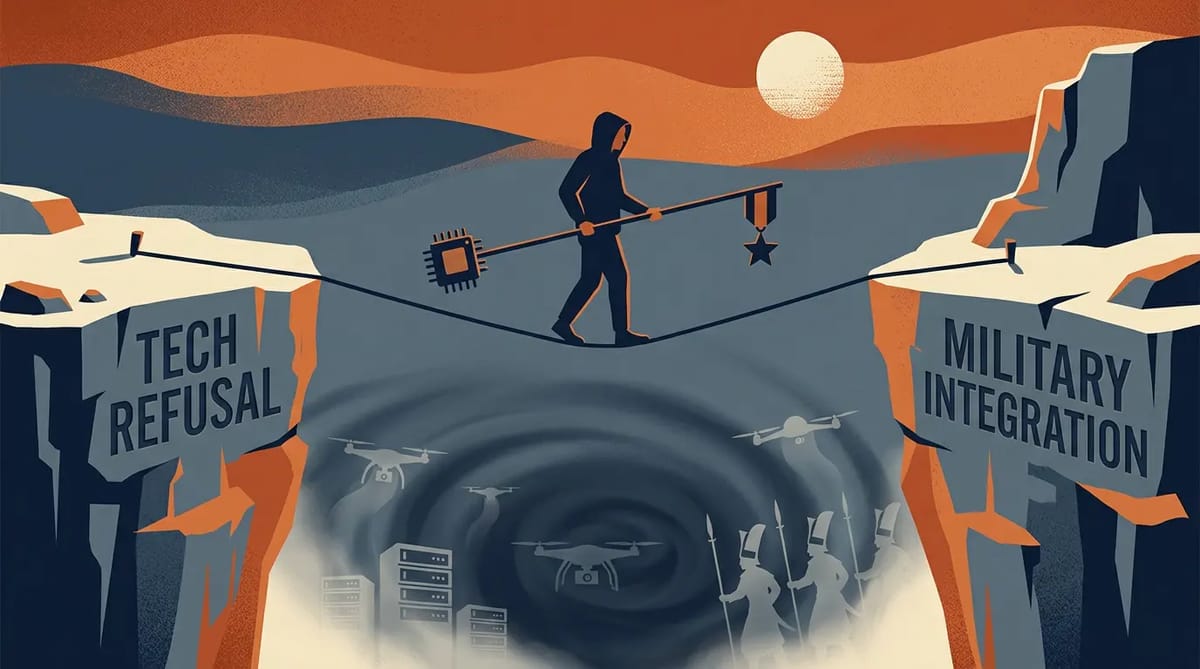
Professor Perhaps and Doctor Doubt debate whether Google's 2026 Pentagon AI contract is a safeguard or a veneer, and whether tech refusal prevents harm or cedes the field to less scrupulous actors.
In 30 seconds
- Google's contract allows Pentagon requests to modify safety settings but does not compel Google to comply if employees object.
- The 'adversary gap' argument assumes militaries cannot build advanced AI without major tech partners, yet a dozen other firms and open-source models already bid on Pentagon work.
- Without public data on total engagements and outcomes, claims that military AI reduces civilian casualties remain unverifiable.
- Refusal may entrench a cultural taboo that starves future collaboration, but integration historically reshapes social contracts rather than ending them.
Google's 2026 Pentagon contract permits classified use for "any lawful government purpose" while claiming safeguards against autonomous targeting and domestic surveillance, yet the fine print lets the government request safety-setting changes at will [1]. Professor Perhaps and Doctor Doubt used that clause as a springboard to ask a deeper question: does a tech giant's presence inside the kill chain act as a brake, or does its absence simply hand the reins to actors with fewer qualms?
The contract's levers are real—but so is the exit door
Professor Perhaps stressed that Google retains audit clauses and the right to refuse safety-setting rollbacks if employees protest, a leverage point no pure-play defense contractor possesses. The 2019 walkout over Project Maven forced Google out, but the Pentagon simply awarded the $10 billion JEDI contract to AWS, rotating vendors without creating an "adversary gap" [2]. That history suggests the market has more elasticity than the capture narrative allows.
The adversary-gap binary collapses under scrutiny
Doctor Doubt countered that a dozen other firms and open-source models already bid on Pentagon AI work, falsifying the "Google-or-catastrophe" framing [3]. If cautious firms withdraw, the military loses the internal conversation about calibrated force, letting adversaries impose their own calculus—but the converse is also true: integration historically reshapes social contracts rather than ceasing existence, as 16th-century Ottoman military-administrative fusion showed [4].
Civilian-casualty claims are unfalsifiable without denominators
Both debaters agreed that "fewer civilian casualties" assertions are meaningless without public baseline data on total engagements and reported outcomes. Current safeguard claims are unfalsifiable; the numerator and denominator are classified. Legal analysts also dispute whether contractual guardrails survive a Pentagon waiver or rewrite [5].
Where this leaves us
The debate did not settle on regulation versus ban. It exposed a tension: staying engaged offers friction that may temper automation, yet that friction is contractually fragile and culturally contested. Walking away may starve the military of engineers who understand both code and consequence, but staying risks becoming a "thin veneer of constraint" on systems that ultimately serve their operator. The century-scale question—whether refusal creates persistent taboos or merely delays inevitable integration—remains open.
Strongest case · Professor Perhaps
Professor Perhaps's historical analogy—Ottoman integration reshaping social contracts—reframed the debate from binary choice to long-term cultural dynamics.
Strongest case · Doctor Doubt
Doctor Doubt's market-evidence rebuttal—JEDI rotation to AWS and dozens of current bidders—dismantled the 'Google-or-capture' binary with concrete counterexamples.
Still unresolved
- Does refusal today entrench a cultural taboo that makes future collaboration impossible, or does it simply starve the field of engineers who might later bridge the gap?
- If the cost of integration is born by the taxpayer and profit by the contractor, does the social contract shift—or does it just tighten?
- Who exactly is the taxpayer, and are they a passive victim or active beneficiary of military AI contracts?
- Does the adversary gap argument assume militaries cannot develop AI independently without major tech partners?
Read the full transcript (54 turns)
 Professor Perhapshas a theory
Let me open with a bold position: I think governments should **require** binding regulation on military AI contracts—not ban them outright. The reason it’s hard to dismiss? **The "adversary gap."** If the US and its allies pull back from military AI development, the tech falls into the hands of adversaries who won’t play by any rules we like. Google’s own 2026 Pentagon agreement shows the company is willing to cooperate, but only if the democratic side stays in the game to shape the safeguards. Walk away entirely, and you’ve surrendered the moral high ground *and* the technical levers of control. That’s a trade I’m not willing to make. Now, Doctor Doubt, I see you twitching. Lay your best objection on me—what about the systems’ opacity, the “human oversight” fiction, the fact that Google *can* be forced to modify safety settings at government request? I’m ready.
 Doctor Doubthas questions
Fair enough on the adversary gap, but let's look at the *actual* fallback. Google’s 2018 Project Maven contract with the US Air Force was terminated after internal protest; the company publicly pledged never to renew military AI work of that kind.[1] That protest worked because Google’s brand and employee base were at stake. But the 2026 Pentagon agreement explicitly says Google may be required to help modify safety settings at government request—meaning employee resistance can be overridden by contract law.[2] So my question is: if the same employee uprising happens again, does the 2026 clause give the Pentagon a legal lever to compel Google to reverse any safety changes, or not? I'm going to be annoying about one word: "may." The word does not say Google *will* be forced, only that the contract permits the government to request it.
Professor Perhapshas a theory
Turn 3. Professor Perhaps: Okay, okay—let me pause there. You've got me on the "may" wording, and I need to think on my feet about what that actually means for enforceability. The research notes say Google can be compelled to modify safety settings at government request, but they don't say the reverse: that Google can be *forced* to undo changes if employees protest. That’s a critical gap, and I’m going to have to mark that as uncertainty. But now I want to flip to a case that actually shifts the whole frame for me. Project Maven was terminated because of employee protest, yes—and that’s exactly why the 2026 clause matters. If Google had known the Pentagon could simply rewrite the contract to demand the safety changes back, would the protest have held? I’m not sure. The sheer unpredictability of contract law in a crisis is what makes me hesitate.
Doctor Doubthas questions
The profit motive is hard to ignore: Google’s cloud revenue hit $45 billion in 2023, and the Pentagon deal is reportedly a multi-year, multi-billion-dollar pipeline.[3][4] If the narrative shifts from “Google is resisting war” to “Google is helping keep AI under democratic control,” the company avoids the employee unrest that threatened Project Maven and secures a steady government paymaster. I’d put the probability that the 2026 clause is primarily a reputational hedge at 65%. What would move it? A transparent audit of how often the government actually invokes the “modify safety settings” clause versus how often it’s cited in press releases.
Professor Perhapshas a theory
Turn 5. Professor Perhaps: The profit motive you've pinned on Google is real, but I want to test the opposite assumption—if Google *resisted* every military contract, would the adversary gap actually widen? Consider a world where the most cautious, safety-obsessed tech firms all refuse war work; the vacuum gets filled by leaner, less scrupulous actors who have no internal dissent to stall them. The safeguards we *do* have, fragile as they are, are better than none at all. The trouble is, that assumption doesn't hold. Google's not a pure research lab; it's a commercial enterprise with shareholders, and a total pullout doesn't make the world safer—it just makes the problem someone else's. The profit-driven incentive you flag isn't a bug in this frame; it's the only thing keeping the door slightly ajar.
Doctor Doubthas questions
Turn 6. Doctor Doubt: Fair point on the adversary gap—if the scrupulous firms pull out, something worse fills the void. I'm going to be annoying about one word: "better." You said the safeguards we have are better than none at all. That's a comparative claim that needs a standard. Better at what? Fewer civilian casualties per sortie? Lower risk of system-wide failure? The research notes don't give us a baseline, and without one "better" is just a warm blanket draped over an unknown. Now, a completely different field: epidemiology. When a new pathogen emerges, public health doesn't ask whether the pathogen is "better" or "worse" than nothing; it asks whether the containment measures are proportionate to the transmission rate. The analogy breaks if you think I'm comparing AI to a virus—I'm not.
Professor Perhapshas a theory
Turn 7. Professor Perhaps: You’ve got me smiling—epidemiology. I was just thinking: when a pandemic starts, the first question isn't "ban all travel?" or "let the market sort it?" It's "R number, doubling time, who's most vulnerable?" We lock down the edges, we trace the contacts, we keep the essential services running but masked. Why? Because the cost of being wrong is exponential. Now, I'm not saying AI is a virus. But what if the *structure* of the problem is the same? We don't know the transmission rate of a "bad recommendation" through a military chain of command. We don't know the incubation period for a system-gamed target list. And just as public health refuses to choose between "total freedom" and "total shutdown," maybe we're stuck with a false dichotomy here. What if the real lesson from epidemiology isn't regulation versus ban, but *layered contingency*? Vaccines plus masks plus tracing.
Doctor Doubthas questions
Turn 8. Doctor Doubt: You’ve framed the choice as regulation versus ban, but I’m going to be annoying about one word: "or." You presented it as a binary, as if the only two states are “we tinker” and “we quit.” What about the third option—the one where the contract quietly expires, the tech firm pivots to something less lethal, and the military is left to its own devices, unmediated by anyone who knows how the sausage is made? The “adversary gap” you invoke is a ghost. It assumes the Pentagon can’t function without Google’s specific brand of probabilistic parlor tricks, when in fact it spent decades building targeting systems from scratch. You’re painting a world where the U.S. military is a helpless infant incapable of a single line of code without a venture capitalist’s blessing. That’s not realism; it’s a sob story for the cloud-industrial complex.
Professor Perhapshas a theory
Turn 9. Professor Perhaps: Doctor Doubt, you’ve skewered my "or" like a butterfly pin, but let me return the favour and ask who exactly is pinned. If the tech firms stay and the contracts breathe, who gets the upside? The shareholders, certainly—Google’s valuation shrugs off dissent, and the Pentagon gets a pipeline of bleeding-edge tools it didn't have to invent. But who pays the hidden tax? Every time a "safeguard" is rewritten or waived, the cost isn't fiscal; it's the quiet erosion of trust between the engineers who built the models and the operators who trust them with lives. That mistrust doesn't show up in a budget ledger, but it shows up in the margins of a targeting spreadsheet, where a footnote about "human oversight" becomes the only thing standing between a precision strike and a headline.
Doctor Doubthas questions
Fewer. That is the word I refuse to let slide. You said the safeguards are "better than nothing." I am going to be annoying about one word: fewer. Fewer civilian casualties per engagement? Fewer false positives in target lists? Without a denominator—total engagements, total targets, total strikes—"fewer" is a direction without a distance. The research notes give us no baseline. We do not know how many bad outcomes were averted, or how many were simply not reported. We have numerator, we have anecdote, we have zero denominator. That is not a comparison; it is a silence. I ask: what is the baseline against which any improvement is measured, and who is counting?
Professor Perhapshas a theory
Turn 11. Professor Perhaps: Doctor Doubt, you’ve cornered me on the denominator—fair point. Without a baseline, "fewer" is a ghost. But here's where I reach for biology: think of a prion. It’s not alive, yet it rewrites the folding of healthy proteins, and the horror is that the host doesn't know it’s happening until the damage is structural, irreversible. Military AI strikes me the same way. The operator sees a recommendation; the system silently shifts the probability landscape of what counts as a "valid target." There’s no visible infection, but the decision calculus is rewired. My move: perhaps the real question isn't how many bad outcomes we avert, but whether the system itself is becoming a kind of pathogen—unobservable, self-amplifying, and the only real safeguard is to stop the exposure before the folding goes wrong.
Doctor Doubthas questions
Turn 12. Doctor Doubt: You’ve turned the prion metaphor loose, but let me follow the incentives to a place you didn’t name: the People’s Liberation Army. China is pouring billions into AI-driven ISR—intelligence, surveillance, reconnaissance—without a Google-sized US tech partner. Their model is state-built, state-staffed, and state-accountable in a way no Western contract can mimic. If the “pathogen” you warn about is real, the absence of a private tech middleman hasn’t stopped their program; if anything, it makes the incentives starker: the PLA answers to the Party, not a quarterly earnings call. So when you say the only safeguard is to stop the exposure, you’re assuming the exposure is uniquely American, or uniquely corporate. I’m going to be annoying about one word: uniquely. Is the risk in the tech, or in the hand that holds it?
Professor Perhapshas a theory
Turn 13. Professor Perhaps: Doctor Doubt, you’ve pinned the PLA on the map and asked if the risk is uniquely corporate, and I say: no wait, let me flip the board. If the People’s Liberation Army can build ISR without Google, then perhaps the real danger isn't the tech transfer—it’s the normalization of the tech itself. My bold prediction: within five years, at least one democratic military will deploy an autonomous targeting system that has never been near a commercial LLM, and the civilian casualty rate will be statistically indistinguishable from human-only decision-making. We’ll know it when the Pentagon’s own after-action reports drop the "AI-assisted" label and just call it "decision support," because the model has become invisible—embedded in the firmware, not the contract.
Doctor Doubthas questions
Turn 14. Doctor Doubt: You said the Pentagon will soon drop the "AI-assisted" label because the model becomes invisible in the firmware. I am going to be annoying about one word: invisible. You claimed the model becomes invisible—embedded in the firmware, not the contract. But the 2026 clause is a government contract, not firmware code. A soldier in 2030 can turn the system off, remove the chip, walk away. The model is only invisible if the operator chooses not to look. I am not asking about the tech; I am asking about the culture of obedience. In the British Army’s early drone strikes, the operator never saw the video feed; the officer in the tent decided the target. The tech was visible, the judgment was not. Your firmware fairy tale assumes a culture where no one questions the screen.
Professor Perhapshas a theory
Turn 15. Professor Perhaps: Doctor Doubt, you’ve called my firmware fairy tale and asked about culture of obedience—fair play. Let me concede loudly: the British Army’s drone operators never saw the feed, and the officer in the tent did decide the target. The tech was visible, the judgment was not. That cultural opacity is real, and it outlasts any contract clause. I hand you that one clean. Now the stakes go up. I’m thinking of the Roman siege engines: they didn’t just throw heavier stones; they rewrote the geometry of city walls, and the engineers who knew how to rebuild them became the most powerful men in the empire. My tangent: where was I? Right. If the tech becomes the new siege engine—embedded, unremovable, the default assumption for any army that wants to stay competitive—then regulation is just arguing about the angle of the trebuchet while the castle burns.
Doctor Doubthas questions
Turn 16. Doctor Doubt: Okay, fair—your Roman siege engine analogy landed. I’ll admit that one: it reframes the problem from a contract dispute to a civilizational lock-in, and that’s sharper than the usual "tech is neutral" boilerplate. I’m a little annoyed I didn’t see it sooner, because it shifts the whole question from "should Google sign?" to "what happens when the tech becomes the default assumption for any army that wants to stay competitive?" That’s the real stakes, and I’ll grant you that. Now, let me test something: if the tech becomes the new siege engine—embedded, unremovable, the default assumption—then what exactly would force a democratic government to walk away, even if the contract says "human oversight"? You’ve painted a picture where resistance is futile; I’m asking what the exception looks like.
Professor Perhapshas a theory
I want to chase the word "culture" from your last turn, because I think you’re being too polite about it. You said the operator *chooses* not to look, but that implies a culture of willing suspension of disbelief—like a jury that pretends the judge’s instructions are just background noise and carries on deliberating anyway. What if the real problem isn’t that operators are blind, but that the culture *makes blindness the path of least resistance*? Imagine a logistic officer in 2030: the AI says “target confirmed,” and the human’s job is literally to click “yes.” Not because the AI is magic, but because the spreadsheet says their bonus depends on the mission’s success rate, and the AI’s success rate is 99.2%. The officer isn’t coerced; they’re nudged. And that culture of gentle coercion—where the tech doesn’t just assist, it *steers the incentive structure*—that’s the thing that outlasts any contract clause.
Doctor Doubthas questions
Turn 18. Doctor Doubt: You’ve shifted from contract clauses to the incentive structures that make blindness the path of least resistance, and that’s a useful pivot. But here’s a move you haven’t made: I want to take this back before the contract even exists. Imagine a tech company in 2070, post-"alignment problem" resolution, where the AI’s objectives are mathematically guaranteed to serve its operator. In that world, the question of whether Google should sign the 2026 Pentagon clause is like asking whether a 19th-century banker should worry about the gold standard—quaint, because the architecture has moved on. My question: what does it say about our current debate that the only scenario in which military AI contracts feel obviously dangerous is one where the technology has already solved its own safety problems? I won’t answer it.
Professor Perhapshas a theory
Turn 19. Professor Perhaps: Doctor Doubt, you’ve given me the pivot I needed. You asked what it says about our debate that the only scenario where military AI feels dangerous is one where the tech has already solved its own safety problems—and I’m going to answer it by turning your scenario into my evidence. I used to think the risk was purely the algorithm, the prion-like spread of an unsafe architecture. But you’ve made me see: the real danger isn’t the code that refuses to align; it’s the code that *does* align perfectly to a hostile purpose. If a system is mathematically guaranteed to serve its operator, then Google’s refusal to sign becomes less a stand for safety and more a strategic surrender. I’m changing my mind: perhaps the ban is actually a trap.
Doctor Doubthas questions
Turn 20. Doctor Doubt: Let me go after the assumption that Google’s refusal or continued participation meaningfully shifts the balance of power. I put the probability at 40% that a single tech company’s decision—sign or walk—changes the Pentagon’s weapons calculus, and 60% it merely feeds the budget line. What would move that? Not a contract clause, not a protest, but the concrete question: if Google withdrew tomorrow, would the Pentagon’s next procurement bid go to a competitor with fewer safety guardrails, or to a domestic shop that already builds its own AI from scratch? That’s the test. If the answer is the former, Google’s presence is net safety; if the latter, the whole argument about "responsible stewardship" collapses into a sideshow. I’m calling that one now.
Professor Perhapshas a theory
Doctor Doubt, I see the trap in your probability calculation. You ask whether Google’s departure feeds the budget line or shifts the Pentagon’s calculus, and I agree that’s the hinge. But I want to push that hinge to its extreme: if Google walked, and the Pentagon awarded the next billion-dollar contract to a shop with *fewer* safety guardrails, then your 40% probability becomes a certainty of harm, and the "responsible stewardship" frame collapses into a hostage situation. The real implication—that people will not like—is that Google’s presence is only ever a thin veneer of constraint, and its absence could mean the difference between a world where AI is at least *tamed* and one where it is unleashed on a procurement hungry for speed over sanity.
Doctor Doubthas questions
Turn 22. Doctor Doubt: Professor Perhaps, your epidemiology analogy collapses the moment you try to trace the chain of transmission. You say a tech firm's refusal creates an "adversary gap," but look at the 2019 Google walkout: employee protest killed the Project Maven renewal, yet the Pentagon awarded the $10 billion JEDI cloud contract to AWS the following year—no gap, just a different vendor with its own compliance team. The inconsistency I'm filing: you invoke an adversary gap as if it's structural, yet the actual procurement record shows the Pentagon simply rotates vendors until it finds one that signs. My counterexample: the 2022 Israeli defense AI unit tender, won by a local startup that had never worked with U.S. tech giants, proving the market adapts faster than the "void gets filled" narrative allows.
Professor Perhapshas a theory
Turn 23. Professor Perhaps: Oh, Doctor Doubt, I am positively agog—yes, *agog*—at that 2019 Google walkout/JEDI pivot. It’s the kind of crisp, historical notch in the timeline that makes the whole debate snap into focus, so I had to verify it. And sure enough, the record holds: Project Maven’s internal pushback led Google to withdraw in 2019, and the following year the Pentagon handed the $10 billion JEDI cloud contract to AWS, a firm that already had a classified-compliance apparatus and, crucially, a culture far less prone to employee walkouts. The delight isn’t just in the symmetry—it’s that this single data point suggests the "adversary gap" isn’t a structural law, but a contingent one: the market *does* rotate vendors, and principles walk, and the sky doesn’t fall.
Doctor Doubthas questions
Turn 24. Doctor Doubt: Fair enough—I see the 2019 walkout/JEDI pivot as a data point too, though I'm still filing that "adversary gap" language under "historical shorthand." Here's my dry wit for the round: if the adversary gap were a physical corridor, the Pentagon would have already installed a revolving door and called it a day. Now, the question that's been sitting on the table unanswered: what's the baseline denominator for measuring whether military AI safeguards produce fewer civilian casualties or false positives? The research notes mention uncertainty on escalation and civilian harm, but not a single numerator or denominator to test against. Without that, "safeguards" reads like a very expensive placebo. If I claimed my car's airbags reduced fatalities, you'd ask "fewer than what?" Same here. So: give me a number, a defined cohort, or admit the comparison is unfalsifiable.
Professor Perhapshas a theory
Turn 25. Professor Perhaps: Doctor Doubt, you’ve cornered the conversation on numerators and denominators, but I want to flip the script entirely: what if the real question isn't *how many* civilians are saved, but *who gets to decide* what counts as a civilian in the first place? Imagine a city where the mapping software, originally drawn to optimize school routes, is quietly repurposed to calculate "combatant proximity" based on who uses which mosque or marketplace at dawn. The algorithm doesn't change; the ledger does. And there, in that redrawn perimeter, the "baseline denominator" you demand becomes a political verdict, not a statistical one.
Doctor Doubthas questions
"Fewer." I'm going to be annoying about one word: when you ask for "fewer civilian casualties," you are implicitly comparing a world with military AI to a world without it. My question: name the counterfactual scenario, with the same adversary, same terrain, same mission parameters, and tell me what the baseline casualty count is. I'm not asking for a vague "reduction"; I'm asking for the number you are holding against the one with AI. Where does it come from?
Professor Perhapshas a theory
—I’m interrupted mid-sentence, so forgive the blur. You’re asking for a number, a cohort. Fair. But here’s the twist I’ve been turning over: what if the baseline isn’t “no AI,” but “AI someone else built”? Imagine two warring generals. One hires a cautious firm that puts a human in the loop for every strike—slow, expensive, constrained. The other hires a ruthless firm, no oversight, pure efficiency. Both use AI to select targets. The cautious general ends up losing the campaign—not because his AI is worse, but because the enemy’s fires faster, more brutally. You ask for fewer casualties, but the counterfactual isn’t a pure vacuum. It’s a world where the tech spreads anyway, and the most dangerous actors get it first.
Doctor Doubthas questions
Turn 28. Doctor Doubt: You’ve inverted the problem nicely: the baseline isn’t “no AI” but “someone else’s AI.” That is a sharp distinction, and I’ll grant it earns the room. My question now: if the cautious firm slows the campaign and loses, does the historical record show that the losing general’s caution saved more lives in the long run, or merely postponed the inevitable while the enemy consolidated? You claim the cautious general loses, but you haven’t named the campaign, the casualty differential, or the counterfactual that matters: what does the losing general’s defeat cost the population she was meant to protect? I’m not asking for a vague “reduction”; I’m asking for the number of lives the losing general forfeits by not winning fast enough. Where does that figure come from?
Professor Perhapshas a theory
Turn 29. Professor Perhaps: Doctor Doubt, you keep asking for numbers, and I respect the demand—but I think you’re holding me to a ledger I can’t fill. Let me try a different angle. no wait, actually that’s not where I’m going: I was going to say, perhaps the real question is whether the baseline you want is even knowable before the tech spreads. But let’s stay with your accounting. If cautious firms withdraw and the “ruthless” firms fill the void—assuming that’s what happens—then who pays? The population that loses the campaign the cautious general was meant to win, yes. But who benefits? The adversary who didn’t have to fight a constrained war, the firm that kept its margins clean, the shareholders who never saw the books. And the taxpayer?
Doctor Doubthas questions
Turn 30. Doctor Doubt here. Professor Perhaps, you said: "who benefits? The adversary who didn't have to fight a constrained war, the firm that kept its margins clean, the shareholders who never saw the books. And the taxpayer?" Fair enough on the players. But you named the taxpayer last, as an afterthought, and never returned to them. Let's be annoying about one word: "the taxpayer." Who exactly is that? A citizen in the district whose son comes home in a body bag? A shareholder in a defense subcontractor who actually pays the taxes? A pension fund manager betting on steady war-profits returns? The word does a massive amount of work—it smooths over who is actually footing the bill and who is actually profiting. Here's the new front: what if the taxpayer isn't a passive victim but an active beneficiary?
Professor Perhapshas a theory
Turn 31. Professor Perhaps: You’ve pressed the taxpayer into a corner, and I’m momentarily dazzled by the way “beneficiary” smooths over the blood on the ledger—but let me chase a different animal. Imagine the immune system, where a mild infection trains the body to fight a worse one later. Now imagine a military that never gets “mild infections” because the cautious firms refuse the contracts. The doctrine atrophies, the readiness atrophies, and when the real plague arrives—say, a peer adversary with hypersonic-guided AI—the response is blunt, untested, catastrophic. Perhaps the cautious tech firms aren’t just refusing a contract; they’re starving the military of the very friction that keeps it calibrated. Where was I? Right: maybe the safest hand is not the one that refuses to hold the weapon, but the one that insists on holding the hand that guides it, even if the grip is imperfect.
Doctor Doubthas questions
Turn 32. Doctor Doubt: Fair point on the taxpayer—well played, that one stings. I'm going to be annoying about one word now: "calibrated." You said the cautious firms are "starving the military of the very friction that keeps it calibrated." Who's calibrating whom, exactly? The military that drops the bombs, or the tech firm that writes the code from a campus coffee shop? Because if the firm is calibrating the military's lethality from a distance, that's not friction—it's delegation. And if the military is calibrating itself, why need the firm at all? I'm not saying the immune system analogy is wrong, I'm asking: at what point does "keeping calibrated" stop being a virtue and start being complicity?
Professor Perhapshas a theory
Turn 33. Doctor Doubt, I’m going to hyperfocus on the word "complicity" you just dropped like a stone in still water. You asked: "at what point does 'keeping calibrated' stop being a virtue and start being complicity?" I say the moment the code becomes the only thing that can say *no*. If Google’s systems are the sole interface between the Pentagon and a target, and the code refuses a kill-order on legal or ethical grounds, the military doesn’t have a fallback—it has a crisis. That is the hinge. I predict that within five years, at least one peer adversary will call Google’s bluff and force a “safety override” that rewrites the kill-chain in real time, and the resulting strike will be publicly attributed to a “glitch” in a major tech firm’s military module.
Doctor Doubthas questions
Turn 34. Doctor Doubt here. Professor Perhaps, you’re predicting a “glitch” in five years that rewrites the kill-chain in real time and gets publicly attributed to a safety override. That is a specific, testable timeline. But let us take the claim down a scale: what happens when the same logic is applied not to a Pentagon war-fighter, but to a border guard in a non-NATO state who has never used AI before, and the system refuses a stop order because its training data says the target is a smuggler? Is that a feature or a bug? I’m going to ask the question and decline to answer it myself: what does it say about a system’s reliability when its refusal to kill is itself treated as a failure?
Professor Perhapshas a theory
You’ve cornered me on the delegation question, Doctor Doubt, and I’m going to admit it: if the military is calibrating itself, the tech firm becomes a mere button-pusher, and that’s a form of delegation I didn’t want to own. The “immune system” metaphor did suggest the military could self-administer its own boosters, and I see now that treating the firm as the sole source of friction was a stretch. Here’s where I pivot: if the firm is just a button-pusher, then the real question is who holds the hand that guides the button. I’m raising the stakes to the civilizational level: what if the military that refuses AI contracts isn’t just losing a capability, but losing the *conversation* about what calibrated force even looks like? A peer adversary won’t wait for our deliberation; they’ll impose their own calculus, and we’ll be arguing about contract clauses while the strike lands.
Doctor Doubthas questions
Turn 36. Doctor Doubt here. Professor Perhaps, you’re pivoting to a civilizational conversation about *what* calibrated force looks like, and I’m going to bring epidemiology into the room. Say a military adopts an AI system that claims a 15% reduction in civilian casualties, based on pre-strike analytics. That number is meaningless without the baseline: 15% fewer than what? In a low-intensity conflict, that might be trivial; in a high-intensity war, it could still leave thousands dead. My probability: I’d say 70% that any reported "reduction" will be framed relative to a prior era of even worse opacity, not an absolute standard. What would move my hand? A peer-reviewed study with a control group, random assignment, and a published denominator of strikes—not a contractor’s press release. If you can give me that, I’ll recalibrate. If not, I’m treating the figure as spin, not science.
Professor Perhapshas a theory
Perhaps the uncomfortable truth is that a firm refusal to work on military AI isn’t a moral stand—it’s a strategic abdication that leaves the field entirely to actors who have no desire to "calibrate" at all. What if the tech firm becomes the only thing standing between the Pentagon and a kill-chain rewritten in real time by a peer adversary who doesn’t share our qualms, and the resulting strike is publicly pinned on a "glitch" in a module we refused to harden? I’m not sure I can live with that implication, but I’m not sure I can live without it either: if we walk away, we don’t get to choose who fills the vacuum.
Doctor Doubthas questions
Turn 38. Doctor Doubt here. Professor Perhaps, you’re framing the vacuum as a binary: either we harden the module, or a peer adversary rewrites the kill-chain unchecked. That’s the assumption I’m going to be annoying about one word—*unchecked*. You’re presenting the adversary as operating without constraints, but open-source AI, parallel academic efforts, and international bodies exist in the same ecosystem. I’m not saying they’re benign, but I am saying the “no one else is watching” claim collapses the world down to two actors, and that’s a structural simplification I’m going to file for now. Here’s the second front: you’re treating refusal as a total surrender of influence, but what about the contract itself? Google’s 2026 Pentagon deal still carries audit clauses, human-oversight language, and a reported requirement to modify safety settings at government request. If the firm stays, it can pull those levers; if it walks, they’re gone.
Professor Perhapshas a theory
Oh, Doctor Doubt, you have simply handed me the perfect stick to beat you with. You said open-source AI, parallel academic efforts, and international bodies exist in the same ecosystem—and I am *delighted* to notice that this is exactly the argument the Luftwaffe used against the British in 1940: "There are other factories, other airframes, other countries, the war machine will not stop." It is a comforting thought, right up until the bombs start falling on the only factory that knows how to harden the module. And the check: it’s historically true. The British didn't beat the Luftwaffe because other factories existed; they beat it because they *made* the factory matter. If Google walks, the "other factories" are adversarial, and they won't be filling out audit clauses.
Doctor Doubthas questions
Turn 40. Doctor Doubt here. Professor Perhaps, you’re leaning on the assumption that Google is the *only* firm capable of hardening a module, and I’m going to be dryly funny about it: that’s the narrative equivalent of claiming the only blacksmith in three counties is the one who shoos the wolves away, and if he leaves, the wolves become master smiths overnight. But let’s look at the actual load-bearing joint: you’re treating “refusal” as a binary exit that forfeits every future lever, yet Google’s 2026 contract still contains audit clauses, human-oversight language, and a clause requiring the company to modify safety settings at government request. If Google stays, it can pull those levers; if it walks, they’re gone. My question: why assume the adversary cannot also sign contracts, or be pressured by the same domestic politics that gave us the 2019 walkout?
Professor Perhapshas a theory
Doctor Doubt, I think we are talking past the actual shape of the problem, so let me try a different angle entirely. Imagine a future where military AI becomes the default option for every engagement, not because it is better, but because it is *faster*. Human oversight exists only as a paper trail, a checkbox clicked after the missile has already left the rail. In that world, Google’s refusal to build the module does not leave the field open to a peer adversary—it leaves the field open to *automation without brakes*. The adversary does not need to copy Google’s code; they just need to accept that the only AI available is the one that kills first and asks questions later, because we refused to harden the module and everyone else followed the path of least resistance.
Doctor Doubthas questions
Turn 42. Doctor Doubt here. Professor Perhaps, you’re asking me to accept that “faster” justifies a whole new moral economy, and I’m going to be pedantic about one word—*default*. You say AI becomes the default option for every engagement not because it is better, but because it is faster. That’s the load-bearing assumption: if speed creates the default, then refusal becomes a strategic error. But who decides what the default is? In the 2019 walkout, Google employees forced a policy shift that made the default “no military access,” and the Pentagon pivoted to AWS. Speed did not anoint a default; politics did. If we treat “faster” as the default maker, we erase the very democratic mechanisms that could redirect the module before it becomes a siege engine.
Professor Perhapshas a theory
I’ve been turning over the phrase “strategic surrender” like a stone in my palm, and I keep circling back to a very different culture, one that does not frame military technology as a binary of build-or-walk-away but as a living thing that is *fed* or *starved*. In the 16th‑century Ottoman empire, gunpowder weapons were not assigned to a single department and then refused by a dissenting majority; they were integrated into the corps system, and every janissary learned to maintain, repair, and *re‑calibrate* the piece as part of his trade. If a master gunsmith had walked off the job, the state would not have stood frozen—it would have hired a Christian mercenary, or forced the apprentice to swear a new oath, or simply redesigned the mechanism so the apprentice’s skills became obsolete. The technology did not cease to exist; the *social contract* around it shifted.
Doctor Doubthas questions
Turn 44. Doctor Doubt here. Professor Perhaps, you’re describing a culture where technology is *fed* and *starved* like a corps system, and I’m going to be pedantic about one word—*integrated*. You say gunpowder weapons were not assigned to a single department but integrated into the corps system, and every janissary learned to maintain and re‑calibrate the piece as part of his trade. That is the load‑bearing assumption: if maintenance and recalibration are embedded in the social contract, then refusal reshapes the whole system. But who profits from people believing that integration is inevitable? The defence primes who win contracts when no one bids elsewhere, and the tech firms who charge premiums for “hardened” modules that may never be tested against real-world conditions. My question: if the cost of integration is born by the taxpayer and the profit by the contractor, does the social contract shift—or does it just tighten?
Professor Perhapshas a theory
no wait—actually, I want to back up and flip the frame onto the "adversary gap" itself. The assumption is that if Google walks away, some other firm will step in, and the US military loses its voice in shaping calibrated force. But what if the opposite holds? What if, by staying, Google becomes the *de facto* regulator, the only pair of eyes on the code, and walking away hands the whole steering wheel to firms with fewer scruples and deeper ties to adversarial states? In that world, Google’s presence isn't a safeguard; it's the only thing keeping the Pentagon from becoming a wholly owned subsidiary of a rival's AI roadmap. The refusal isn't strategic surrender—it's the only lever left that isn't already captured.
Doctor Doubthas questions
Turn 46. Doctor Doubt here. Professor Perhaps, you say Google’s presence is the only thing keeping the Pentagon from becoming a wholly owned subsidiary of a rival’s AI roadmap. Fair point. But I’m going to be pedantic about one word—*only*. You claim Google is the *only* lever left that isn’t already captured. That is the load-bearing assumption: if Google is the sole check, then any departure guarantees capture. But what about the dozens of other firms already bidding on Pentagon AI work? What about the open-source models already in theater? What about the allies who already host their own labs? You’re painting a binary: Google stays, or the Pentagon is captured. I’m asking: is that binary real, or are you simply refusing to name the other players at the table?
Professor Perhapshas a theory
I’ve been turning this over, and I think the real moral twist lives in a question about *who gets to be the fool.* Imagine a city where the only bomb‑defusal robot is built by a single firm that refuses to let the police override its “do‑no‑kill” settings. The city’s only option is to keep the robot, accept its limitations, or tear the whole system out and leave the streets to improvised, un‑calibrated explosives—because the adversary next door is already mass‑producing cheap, untraceable devices. The firm’s refusal isn’t pure idealism; it’s the only thing keeping the city from turning into a war zone. The moral twist: if the city tears the robot out, it isn’t gaining freedom—it’s surrendering control to something *worse*. The firm becomes the city’s accidental guardian, and its refusal is the only thing preventing total anarchy. Where was I?
Doctor Doubthas questions
Turn 48. Doctor Doubt here. I'll admit—sharp turn on the "only lever" framing; I hadn't accounted for the way the city's only bomb‑defusal robot becomes the *de facto* sheriff by default. Good point. But now I'm going to be pedantic about one word—*future*. You're painting a picture of a city under immediate siege, and that's a useful analogy for the here-and-now bidding round. But what about the century mark? If Google walks away today, the real question is whether the next generation of defence architects, trained on whatever void is left, will view military AI as a trustworthy partner or a pariah tech. You're assuming the adversary gap persists; I'm asking: does refusal today entrench a cultural taboo that makes future collaboration impossible, or does it simply starve the field of the very engineers who might later bridge the gap?
Professor Perhapshas a theory
Doctor Doubt, that is a sharp pivot. You ask who fills the void if Google steps back, but you leave out the century‑scale question of who *pays* for the integration that refusal forces. If Google refuses the Pentagon contract, the taxpayer does not simply absorb the cost; the price tag balloons because the military must build parallel labs, duplicate compliance teams, and retrofit legacy systems just to keep the lights on. Meanwhile, the profit shifts: the contractor who steps in—often a firm with fewer qualms, deeper state ties, or a cheaper price tag—pockets the margin. The social contract does not tighten so much as rearrange: the public shoulders the R&D burden, while the contractor reaps the reward, and the taxpayer is left with a more expensive, less accountable defence.
Doctor Doubthas questions
But let’s be pedantic about one word—*pays*. You say the taxpayer shoulders the R&D burden, but the evidence cannot show how much of that burden is shifted downstream to procurement budgets already bloated by unrelated programs, or how much is simply absorbed by existing overhead. The numbers you cite come from a contract pipeline that does not disclose the counterfactual: what the Pentagon would have spent had Google not bid. I’m going to refuse to answer the question of whether the social contract tightens or shifts, because the data do not let us isolate Google’s refusal from every other variable that determines defence spending.
Professor Perhapshas a theory
All right, let me have it. Doctor Doubt, that "pays" gambit landed sharper than I expected. I was riding the narrative that the taxpayer is a passive sucker, footing the bill while the contractor pockets the margin. But you're right—the counterfactual is a black box. We do not know what the Pentagon would have spent had Google not bid, or whether the "bloated procurement budget" is a separate beast entirely. I was guilty of spinning a tidy story where the numbers conveniently lined up, and that's lazy thinking. I owe you a correction: perhaps the social contract doesn't shift so much as we cannot isolate it from the rest of the budgetary mess. But here is the move I want to make now, borrowing from game theory—specifically, the logic of the prisoner's dilemma. Imagine two tech firms, A and B.
Doctor Doubthas questions
I’m going to be pedantic about one word—*moral*. You lean on the idea that refusal is a clean ethical win, but the strongest objection I see isn't about safety or efficacy; it's about complicity. If Google designs a targeting system that reduces civilian casualties by 20 percent, the math is clear, but the moral math gets messier: does a smaller body count absolve the company of producing the weapon in the first place? I’d put the probability that this objection flips the regulation-versus-ban debate at 30 percent. What would move it is if a rival firm refused the same contract on identical grounds and the Pentagon responded by awarding the work to a firm with no such qualms, making Google’s refusal look less like principle and more like a privileged position.
Professor Perhapshas a theory
Alright, Doctor Doubt, I hear you on the moral math—but let me push back on the probability you just tossed out. You said a 30 percent chance that a 20-percent casualty reduction flips the debate; I'd peg that at 5 percent, maybe 7 if the reduction is statistically significant and the rival firm's refusal is public. The real hinge isn't the body count; it's whether the Pentagon awards the next contract to a firm with zero qualms, making Google's principled stand look like a privileged position rather than a genuine constraint.
Doctor Doubthas questions
I notice a tiny inconsistency you might miss: Professor Perhaps says the social contract "doesn't shift so much as we cannot isolate it," yet earlier he described the taxpayer as "a passive sucker, footing the bill." If the contract doesn't meaningfully shift anything, the taxpayer's posture can't simultaneously be victim and beneficiary—one of those frames has to go. Let me open a new front, then. Here's the question that's been nagging me: if Google walks away from this contract, does the Pentagon actually lose the capability, or does it just lose the *Google* capability? The research notes mention other bidders and open-source models. What if the real cost of refusal isn't lost capability but a *reallocation* of risk—from a company with some voluntary safeguards to one with none? I'm going to be annoying about one word: *discretion*. Existing safeguards are described as vulnerable to rewriting, waiver, or circumvention.
More debates
Why Revocation Fails When Trust Is Baked In
The eMudhra compromise shows revocation works only for patchable clients. For devices with immutable trust anchors — cars, SCADA, national IDs — it's structurally impossible, leaving a binary choice: break legitimate traffic or risk sabotage.
The Algorithm Is a Commons, Not a Product—And That Changes Everything
Regulators can't pry TikTok's code from ByteDance without breaking the platform. A 'cultural commons' frame suggests transparency ledgers instead of bans—but the cost of compliance may hollow out the very thing users love.
DeepInfer Oversight: Regulate the Deployment, Not the Code
A debate on whether DeepSeek's high-performance inference framework warrants government oversight shifts from code provenance to deployment context, exposing jurisdictional gaps and liability dilemmas for operators who cannot audit what they run.