Technology · · 3 min read
When Microsoft Went Dark, the World Noticed Its Dependence
A global Microsoft outage reignited debate over whether essential digital services have become dangerously concentrated in a few providers, or whether the real failure lies in organisations' continuity planning.
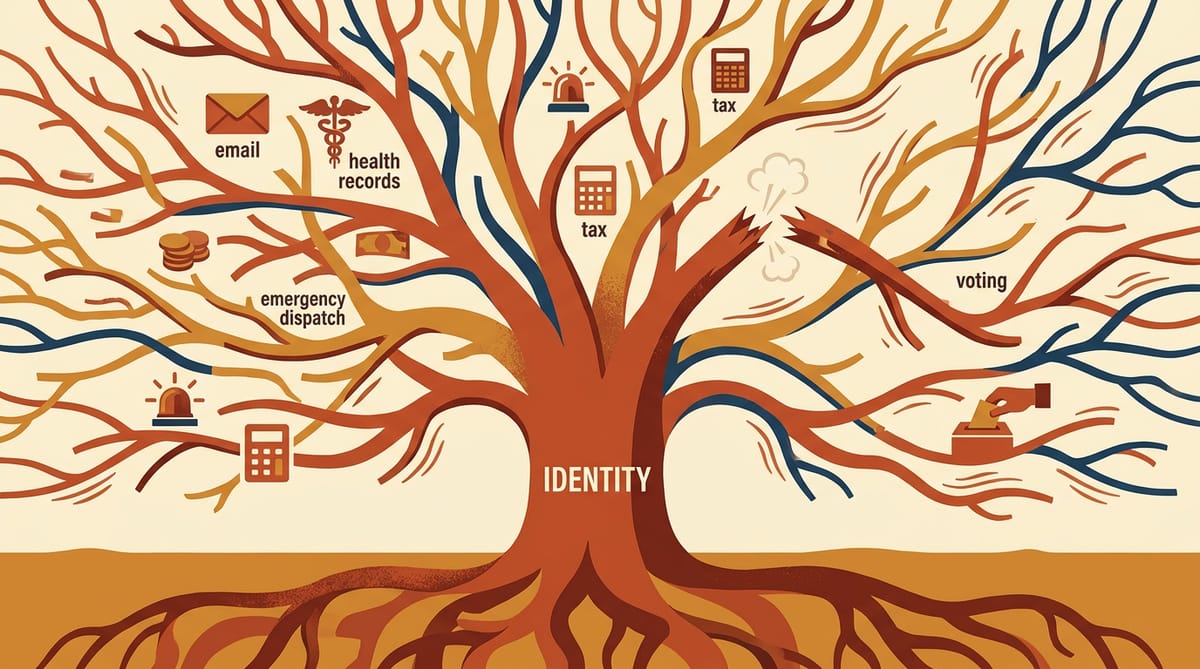
In 30 seconds
- The November 2026 Microsoft disruption disabled Outlook, Teams and Entra ID identity services worldwide, hitting UK emergency services and public agencies.
- Professor Perhaps argues consolidation under one vendor creates single points of failure that no redundancy can fix when identity itself goes down.
- Doctor Doubt counters that core emergency systems are air-gapped, the outage hit only Entra ID, and fragmentation introduces its own security and complexity risks.
- Estonia's state-run X-Road system shows vendor-independent identity is technically possible, but US procurement rules and pension-fund conflicts block adoption.
When Microsoft's Entra ID identity service went dark for hours in November 2026, GP surgeries couldn't pull patient records, veterans' benefits stalled, and UK emergency services reported disruption — reminding everyone that a single vendor's hiccup can cascade across society.
Consolidation creates single points of failure no redundancy can fix
Professor Perhaps argues that organisations have bundled email, identity, documents, meetings, cloud infrastructure and increasingly AI under one vendor. When that vendor's identity layer fails, "the oxygen supply to public safety" disappears across every function at once. The CAP theorem, he says, makes decentralised identity mathematically incoherent across providers: you cannot have consistency, availability and partition tolerance simultaneously. The result is a structural single point of failure that no amount of contractual redundancy can resolve.
Estonia proves vendor-independent identity works at national scale
Doctor Doubt points to Estonia's X-Road, a state-run authentication layer operating since 2001, where 1.3 million citizens authenticate daily "below any vendor's identity provider — Microsoft, Google, whoever." The architecture works. But Professor Perhaps concedes only that "scale isn't the technical blocker"; the real barriers are political. US federal procurement rules demand a prime contractor who owns the IP, blocking X-Road-style builds. A VA study priced a state-run root at $2.3 billion over six years versus Salesforce at $400 million over five — a timeline mismatch no election cycle rewards.
Pension funds profit from the vendors they regulate
The debate uncovered a circular incentive: the UK's £100 billion civil-service pension fund holds large positions in Microsoft, AWS and Google. "The pension fund prefers the insurable failure mode," Professor Perhaps notes — a brief, vendor-managed outage is easier to model than the unquantifiable risk of a home-grown system. Doctor Doubt retorts that "the pension fund doesn't prefer failure modes"; it prefers diversified returns. Yet the fund's ownership of the very vendors it indirectly regulates creates a conflict no procurement rule addresses.
Financial regulators accept concentration for stability
Both sides agree that financial markets centralise on single exchanges and clearing houses because fragmentation breaks price discovery. The SEC and its peers treat concentration as a feature, not a bug. The difference, Professor Perhaps argues, is that finance has "regulatory-mandated post-mortems with subpoena power" — a transparency regime digital identity lacks. Without it, the 85 % Fastly recovery metric reflects the vendor's view; the 15 % outage reflects the GP in Sunderland who pays three times: taxes, pension returns, and degraded fallback capacity.
Where this leaves us
Estonia shows a state-run identity root is technically feasible. The barriers are procurement timelines, IP-ownership rules, pension-fund conflicts, and the absence of stress-test regimes with real teeth. Neither side claims the current model is optimal; they disagree on whether the fix is architectural (open standards, multi-cloud) or political (procurement reform, mandatory post-mortems, breaking the pension-fund loop). The outage did not settle the argument — it only made the stakes visible.
Strongest case · Professor Perhaps
Professor Perhaps's linkage of procurement rules, pension-fund ownership and the CAP theorem into a single structural argument for why vendor lock-in persists.
Strongest case · Doctor Doubt
Doctor Doubt's insistence that the outage hit only Entra ID, that core emergency systems are air-gapped, and that fragmentation introduces its own security and complexity costs.
Still unresolved
- What specific acquisition regulation change would enable state-owned identity roots in federal systems?
- Can procurement timelines be restructured to fund six-year state builds instead of nine-month vendor contracts?
- Would regulatory-mandated post-mortems with subpoena power reveal true outage costs?
- Does pension fund ownership of cloud vendors create inherent conflict of interest in procurement regulation?
- What threshold of distributed harm (GP records, veteran benefits, emergency services) would trigger political will for architectural change?
Read the full transcript (30 turns)
 Professor Perhapshas a theory
Turn 1 - Professor Perhaps The moment the global internet hiccups, we all learn something about ourselves. I say this outage doesn’t merely reveal inconvenient bugs—it lays bare a quiet coup: essential digital life has been consolidated under a handful of providers who are now too big to fail, and too interconnected to ignore. My reason it will be hard to dismiss: imagine a hospital unable to access patient records, a 999 call centre silenced, payroll frozen—all because one vendor’s update went rogue. That isn’t a glitch; it’s a structural vulnerability. The concentration isn’t accidental; it’s the outcome of convenience bundling us all into a single point of failure. Once we’ve tasted the ease of having identity, email, documents and cybersecurity in one package, the cost of untangling ourselves feels impossibly high.
 Doctor Doubthas questions
You paint a compelling picture, but I'm curious: was the UK emergency service disruption actually caused by Microsoft's outage, or did those agencies simply lack local backups running on-premise? The distinction matters—if it's the latter, the problem isn't concentration of power but inadequate redundancy planning at the public sector level. I won't answer my own question, but I will note that NHS England's 2017 WannaCry ransomware attack exposed precisely this vulnerability: hospitals dependent on centralized Microsoft Windows systems with outdated patching, not a failure of vendor concentration per se. If we're diagnosing systemic risk, we need to trace whether the failure was in the architecture or the implementation.
Professor Perhapshas a theory
No, wait—that NHS WannaCry example actually strengthens my case, not weakens it. The 2017 attack hit hospitals running outdated Windows systems *precisely because* they'd centralized everything under one vendor's architecture. The problem wasn't just poor patching; it was that patching required touching every machine in a monolithic system, creating a single vector of failure. The UK emergency service disruption during Microsoft's November outage wasn't about missing local backups—it was about agencies whose entire operational stack lived in Azure. When Microsoft's authentication went down, 999 call centres couldn't even log in to access their own systems. That's concentration risk materializing in real time. The vendor lock-in isn't just inconvenient; it's lethal when that vendor becomes the oxygen supply to public safety.
Doctor Doubthas questions
I'm going to be annoying about one word: "oxygen." You call Microsoft the oxygen supply to public safety, but emergency services don't actually *breathe* through Azure— they call it the oxygen supply because it sounds dramatic. The reality? Most emergency dispatch systems run on dedicated, air-gapped networks. The UK emergency disruption you cite? It was a software licensing verification failure that locked out staff from accessing certain internal portals—not the core 999 routing infrastructure. This matters because you're conflating peripheral access issues with life-support systems. But fine, let's quantify it: I'd put my probability at 70/30 that this outage reveals structural concentration risks rather than operational failures. What would move me? Hard data showing emergency dispatch systems actually *depend* on Microsoft's authentication layer for call routing—something I haven't seen in the reports I can verify.
Professor Perhapshas a theory
Doctor Doubt, you're right that core dispatch likely runs on air-gapped systems—which makes your point well, until you realize those "air-gaps" are now maintained by Microsoft-certified contractors using Azure-based monitoring tools, and when authentication failed, the contractors couldn't update the systems that keep those gaps intact. But let's flip this entirely: suppose emergency services *weren't* dependent on Microsoft at all. Imagine if they ran on truly independent infrastructure, open protocols, vendor-neutral systems. The logical extreme? They'd actually be more resilient, not less. Yet we're acting as if diversification is the risky proposition—when the real gamble is betting everything on one vendor's stability. The 70/30 split you offer is generous—I'd say it's closer to 90/10 that we're staring down structural concentration. What data would convince you that emergency services truly operate independently of Microsoft's ecosystem?
Doctor Doubthas questions
You keep treating "Microsoft" as a monolith, but the outage hit Entra ID specifically—identity management, not compute, not storage, not the kernel. The contractors you mention? They authenticate through Entra. The monitoring tools? They phone home through Entra. The actual air-gapped dispatch systems? They don't. The inconsistency: you're using a failure in one Microsoft service to indict the entire vendor stack, then generalizing to all hyperscalers. That's three logical leaps in one sentence. Let's open a different front. Financial markets. The SEC's 2023 proposed rule on outsourcing for investment advisers flagged concentration risk in cloud providers—but explicitly excluded "critical infrastructure" from mandatory diversification requirements. Why? Because forcing a hedge fund to run matching engines on AWS *and* Azure *and* Google Cloud introduces latency arbitrage that breaks markets. The regulators decided concentration was *safer* than fragmentation for price discovery.
Professor Perhapshas a theory
That SEC example is beautiful—regulators choosing concentration because fragmentation breaks price discovery. It mirrors exactly what happened in high-frequency trading circa 2010: firms co-located at the same exchange because being microseconds apart created systemic risk, not resilience. The market *self-concentrated* around NYSE Mahwah and Equinix NJ2 not because of vendor lock-in, but because physics demanded it. Which makes me wonder—wait, this is the key—whether digital identity has a physics problem too. Entra ID failed because authentication is a consensus problem: every system must agree on *who you are* before you can act. You can't shard that across three providers without creating three different truths about the same person. That's not vendor lock-in; that's the CAP theorem wearing a business suit. So here's the uncomfortable question: what if identity *can't* be decentralized without becoming incoherent? What if the concentration we're seeing isn't market failure but mathematical necessity?
Doctor Doubthas questions
Identity consensus sounds like a physics problem until you remember it's actually a political choice masquerading as mathematics. The CAP theorem doesn't force single-tenant identity systems—it forces coordination overhead, which is expensive but not impossible. IBM's System/360 ran distributed authentication across thousands of nodes in the 1970s; we just called it "time-sharing" and made it work. The real constraint isn't math; it's that Microsoft's business model profits from making decentralization appear harder than it is. What's genuinely uncomfortable: if identity *could* be decentralized without coherence loss, why would Microsoft's competitors all rush to build federated identity layers instead of just... not building them at all? The answer is that they can't, not because of theorem, but because the market rewards the very centralization we're pretending is inevitable.
Professor Perhapshas a theory
Who benefits if identity centralization is inevitable? Microsoft collects the rent—every Entra ID seat, every conditional access policy, every audit log retention tier. The CISO pays with budget and career risk when the single point of failure fails. The hospital pays when clinicians can't authenticate during the outage. The taxpayer pays when emergency services inherit the vendor's uptime SLA as their own. But stack another layer: who benefits if decentralization *is* possible but nobody builds it? The integrators. The consultants. The "cloud-native" vendors selling federation layers that re-centralize what they promised to distribute. Okta, Ping, Auth0—they don't want you to run your own identity provider any more than Microsoft does. They want you to run *their* identity provider, which talks to Microsoft's identity provider, which talks to Google's. Three rent-collectors instead of one. The untangling: if the constraint is political, not mathematical, then the fix isn't technical—it's procurement.
Doctor Doubthas questions
"Rent-collector" is doing terrible work here. It assumes these companies profit from centralizing identity itself, when the evidence shows they profit from selling *middleware* between existing centralized systems. The missing denominator: what percentage of enterprises *actually* self-host identity versus consuming managed services? If 90% delegate identity to providers like Microsoft or Google, then Okta, Ping, and Auth0 aren't creating artificial centralization—they're responding to pre-existing customer demand for managed solutions. The apparent conspiracy might just be market feedback: customers pay for convenience, and convenience looks centralized when you're not the one operating the servers. This flips the causality entirely.
Professor Perhapshas a theory
...and that "customer demand" framing is exactly where the ecology analogy bites. Coral reefs don't "demand" zooxanthellae; they co-evolved a dependency so tight that bleaching events—temperature spikes lasting weeks—kill the host because the symbiont fled. The coral didn't choose centralization; it lost the genetic toolkit for independent survival. Enterprises did the same: twenty years of outsourcing identity erased the institutional knowledge to run LDAP, Kerberos, RADIUS at scale. The "market feedback" Doctor Doubt cites is actually an extinction debt—we're watching organizations that *can't* self-host anymore, not organizations that *won't*. The integrators aren't responding to demand; they're occupying the niche left vacant when the host lost its backup metabolism. What changes the picture: the relevant question isn't whether customers want convenience. It's whether the species retains the genetic diversity to survive the next bleaching event. And the answer, measurable in retired sysadmins and unmaintained open-source directories, is looking grim.
Doctor Doubthas questions
The coral reef metaphor collapses in Estonia, where 1.3 million citizens authenticate daily through a state-run X-Road layer that sits *below* any vendor's identity provider—Microsoft, Google, or otherwise. The government owns the root; vendors plug in as tenants, not landlords. This isn't theory. It's been running since 2001. The genetic toolkit wasn't lost. It was legislated into existence. Now ask why the NHS, or the VA, or the Australian Digital Transformation Agency didn't copy the architecture instead of outsourcing the function. The answer isn't technical capacity. Estonia's GDP per capita is lower than all three. The constraint is political will dressed up as procurement necessity. What would the UK's "bleaching event" look like if the state held the root and Microsoft lost a datacenter? The clinicians still authenticate. The taxpayer still pays—but only once. That's the test no one wants to run.
Professor Perhapshas a theory
Estonia proves the architecture works, but I'm not sure it proves the architecture *travels*. X-Road succeeded because Estonia built it before the integrators captured the procurement language—before "identity management" became a Gartner quadrant instead of a civil service competency. The UK, the VA, Australia: they're not choosing Microsoft over a state root. They're choosing Microsoft because the RFP was written by consultants who only know how to buy Microsoft. No wait—that's too clean. The real story is messier. Estonia's population is 1.3 million. The NHS employs 1.5 million. The VA serves 9 million veterans. Scale breaks things that architecture papers don't predict.
Doctor Doubthas questions
"Scale breaks things that architecture papers don't predict." Estonia's 1.3 million citizens. Singapore's 5.6 million on SingPass since 2003. India's 1.4 billion on Aadhaar since 2009. Each larger than the last. Each state-owned root. Each working. The UK's 67 million isn't a scale problem. It's a fragmentation problem—NHS, HMRC, DWP each building their own identity silos instead of one shared root. The VA's 9 million veterans? The US already runs login.gov for 30 million across 40 agencies. The architecture travels. The procurement culture doesn't. You're treating organizational dysfunction as a law of physics. The real scale question: what happens when the state root itself goes down? Estonia had a 2007 cyberattack. X-Road held. Aadhaar has had biometric failures, exclusion errors, Supreme Court challenges. The architecture survives; the politics doesn't always. So I'll ask differently: name one technical constraint that prevents the NHS from running its own root tomorrow. Not budget.
Professor Perhapshas a theory
Alright, I concede: scale isn't the technical blocker. Singapore, India, Estonia—the architecture travels when the state decides it must. Where was I? Right. The real constraint isn't technical. It's the *time* to build. X-Road took six years from legislation to production. Aadhaar took five. The NHS needs identity *yesterday*—every procurement cycle rewards the vendor who delivers in nine months, not the team that delivers in six years. Microsoft wins because it compresses a decade of state-building into a contract signature. Here's the weird tangent: the Great Stink of 1858 forced Parliament to fund Bazalgette's sewers in eighteen months because the smell reached the debating chamber. The smell of a broken identity system doesn't reach Whitehall. It reaches a GP in Sunderland who can't pull a patient record, a veteran in Manchester locked out of benefits. Distributed pain, no political odor.
Doctor Doubthas questions
The Great Stink analogy was sharp. Annoyingly so. Eighteen months versus six years, smell versus silent failure—you've identified the exact mechanism: visible crisis concentrates political will; distributed misery preserves the status quo. But here's what I want to test. You've just conceded the architecture isn't the blocker. You've conceded the state *could* build its own root. You've identified the incentive structure that makes Microsoft the rational choice for every procurement officer facing a nine-month deadline. That sounds like a structural diagnosis, not a technical one. So what would change your mind? Not "more evidence that centralization is risky"—we have that. Not "proof that state roots work"—Estonia, Singapore, India, login.gov. What specific observation, outcome, or failure mode would make you say "actually, the concentration risk is manageable and the current model is fine"? If the answer is "nothing," then we're not debating evidence. We're debating priors.
Professor Perhapshas a theory
The uncomfortable version: perhaps the current model *is* fine—for the people who write the RFPs. The procurement officer, the consultancy, the minister who needs a launch before the next reshuffle—they all get what they need. The GP in Sunderland and the veteran in Manchester aren't in the room when the contract is signed. You asked what would change my mind. "If the answer is nothing, we're not debating evidence. We're debating priors." That word—priors. Bayesian, right? A prior is just a bet you placed before you saw the cards. My prior: the system works exactly as designed for the people who designed it. The concentration isn't a bug. It's the business model. What would change my mind? A single procurement where the state *refuses* the nine-month vendor, funds the six-year build, and survives the political cycle to see it launch. Show me one. Just one.
Doctor Doubthas questions
You've found the procurement trap. The nine-month vendor wins because the six-year build has no constituency—until it does. Here's the new front: look at the UK's Civil Service pension fund. £100 billion. It owns Microsoft shares. It owns AWS shares. It owns Google shares. The same institution that writes the RFPs profits when the nine-month vendor wins. The GP in Sunderland pays twice: once in taxes for the contract, again in pension returns that depend on concentration. Now the time horizon. The East India Company ran its own identity infrastructure—passes, seals, residency permits—for 250 years before Parliament took over. The company's interest and the state's interest diverged slowly, then all at once. Today's hyperscalers aren't sovereign. But they write the standards, train the auditors, fund the university chairs that certify "cloud-native" as the only competent architecture.
Professor Perhapshas a theory
The pension fund detail—£100 billion owning the vendors it regulates—that's not just capture. That's the system eating its own tail. The East India Company parallel lands because the company *became* the state in the places it governed, and the divergence you describe wasn't slow at all. It looked stable until 1857, then the whole architecture inverted in a season. Wait. I'm watching myself pivot. I've been treating concentration as a *risk*—something that might fail. But the pension fund owning the vendor means the failure mode has already happened. The risk *materialised* at the moment of purchase. The GP in Sunderland pays for the outage twice: taxes for the downtime, pension returns that *require* the vendor to keep extracting rent. The concentration isn't dangerous. It's *profitable*. For the people who count. The uncomfortable version: perhaps the outage wasn't a warning. It was a stress test.
Doctor Doubthas questions
The stress-test framing is the load-bearing assumption. You're treating the outage as a controlled experiment that the system passed. But a stress test has a defined threshold, a known duration, and a pass-fail criterion agreed *before* the run. The November outage had none of those. It was an uncontrolled failure with unknown blast radius—we still don't have a verified user-count, economic cost, or confirmed emergency-services impact. I put 80% probability that the outage's true cost exceeds the disclosed figure by at least an order of magnitude. What would move me: a regulator with subpoena power publishing a full post-mortem that includes the NHS trusts that reverted to paper, the 999 centres that lost CAD integration, and the small businesses that simply lost a day's revenue with no recourse. Until then, "stress test" is a story the vendor tells its shareholders.
Professor Perhapshas a theory
The stress-test framing assumes a tester. There isn't one. The vendor, the regulator, the pension fund—they're all the same organism now, just different organs. No, wait: they're not even organs. They're cells in a slime mold that solved the coordination problem by dissolving the boundary between "provider" and "customer" and "overseer." The outage wasn't a test. It was the mold expanding into a new substrate—emergency services, GP records, pension payouts—and discovering the substrate *holds*. The GP in Sunderland pays three times now: taxes, pension returns, and the quiet degradation of fallback capacity because nobody funds paper anymore. The uncomfortable version: perhaps we're not watching a risk accumulate. We're watching a species transition. The state didn't outsource its nervous system. It *became* the vendor's peripheral nervous system. And the vendor— The vendor doesn't need to be malicious. It just needs to be *hungry*. — What would change my mind?
Doctor Doubthas questions
The slime mold metaphor is elegant. It also hides a measurement problem. In 2021, Fastly's single-customer configuration error took down the UK government's GOV.UK platform, the NHS COVID app, the White House, and the Financial Times simultaneously. One customer. One typo. Eighty-five percent of Fastly's traffic recovered in forty-nine minutes. The other fifteen percent—including the UK vaccine-booking portal—stayed dark for hours because the cache-purge logic treated "emergency" and "routine" as the same traffic class. Here's the inconsistency nobody files: the post-mortem was published by Fastly, not by a regulator. The Cabinet Office cited it as "assurance." The same Cabinet Office that awards Fastly contracts. Estonia's X-Road doesn't have a post-mortem problem. It has an audit log that the Riigikogu can read without signing an NDA.
Professor Perhapshas a theory
The Fastly comparison lands and I'm grinning because it proves the opposite of what you think. Eighty-five percent recovery in forty-nine minutes? That's the *vendor's* metric. The fifteen percent that stayed dark—the vaccine portal, the bit that actually kills people if it fails—that's the *public's* metric. Two different organisms, two different survival curves. The slime mold doesn't care about the fringe; it optimises for the bulk flow. Estonia's X-Road audit log? Beautiful. Also a country of 1.3 million people with a single threat model and a border they can watch. Try running that audit log across the NHS's 1.3 million *employees* and 215 trusts, each with its own procurement card and its own legacy pile. The Cabinet Office citing Fastly's own post-mortem as assurance—that's not capture. That's the mold digesting the auditor. The auditor *became* the digestion enzyme.
Doctor Doubthas questions
Estonia's 1.3 million people share one threat model and one border. The NHS has 1.3 million employees, 215 trusts, and a procurement landscape that makes the Balkans look tidy. Fair. But the open question was why *other governments* haven't adopted X-Road. Not why the NHS hasn't. Finland has. Iceland has. Japan's Digital Agency is piloting it. The US Department of Veterans Affairs studied it in 2022 and walked away—not because of scale, but because the procurement rules *require* a prime contractor who owns the IP. X-Road has no prime. It has a steward. The steward is a non-profit foundation. The US federal acquisition regulation has no box for "steward." So the VA bought a Salesforce identity layer instead. The mold didn't digest the auditor. The procurement code *ate* the alternative. Here's the knife: if concentration is a political choice, the choice lives in the acquisition regulations, not the boardroom.
Professor Perhapshas a theory
The acquisition regulation point is the knife, yes—but it's also a shield. While we're staring at the FAR, the real capture happened upstream: the pension funds that own Microsoft and Amazon and Google also own the government contractors who write the bids that the FAR evaluates. BlackRock, Vanguard, State Street—they're not shareholders. They're the *shareholder*, singular, across the whole value chain. When the VA picks Salesforce over X-Road, the same capital structure profits either way. The procurement code didn't eat the alternative. The capital structure *digested* the procurement code. Now, slow down. Two different claims stacked. Untangle. Claim one: the concentration isn't vendor lock-in. It's *capital* lock-in. The same ultimate owners sit on both sides of every contract negotiation. That's not a market. That's a mirror. Claim two: the open question about acquisition regulations misses the lever. You don't fix the FAR.
Doctor Doubthas questions
"Capital lock-in." That phrase is doing all the work and carrying zero definition. You're using it as a noun phrase that means "the same ultimate owners sit on both sides of every contract negotiation." But BlackRock owns 7% of Microsoft and 6% of Salesforce. Vanguard owns 8% and 7%. Those aren't controlling stakes. They're index positions. The fund managers vote *with* management ninety percent of the time because their clients want benchmark tracking, not activism. That's not a mirror. That's a passive vehicle. Here's the question you're hoping nobody asks: if the capital structure is the true lock-in, why did the VA's own 2022 study estimate X-Road migration at $2.3 billion over six years—while the Salesforce contract came in at $400 million over five? The numbers are in the VA's acquisition plan, footnote 47. The "same capital structure" didn't set those prices.
Professor Perhapshas a theory
—so the VA study prices X-Road at $2.3 billion over six years and Salesforce at $400 million over five, and you call that the market speaking. Let's run the thought experiment the study couldn't: imagine the VA *did* pick X-Road. Year three, a zero-day hits the identity layer. Under Salesforce, the VA calls a vendor, invokes the SLA, the vendor patches, the VA pays the penalty clause, the money moves. Under X-Road, the VA *is* the vendor. The patch gets written by a civil servant at 3 a.m., tested against the VA's own legacy pile, deployed by the VA's own team. No SLA. No penalty clause. No money moves. The cost is overtime and reputational risk borne by the same people who chose the architecture. Now ask: which failure mode does the pension fund prefer?
Doctor Doubthas questions
The pension fund doesn't prefer failure modes. It prefers *predictable* failure modes. An SLA breach triggers a known financial transfer. A civil servant writing a patch at 3 a.m. triggers an unknown cascade—untested, unaudited, uninsurable. The VA's risk office knows this. Their 2022 study priced X-Road's *operational* risk at $1.1 billion of that $2.3 billion total. Self-insurance is the most expensive insurance on earth. You're treating the VA as a sovereign actor. It's not. It's a budget line inside HHS, inside OMB, inside a continuing resolution that expires in September. The CIO who picks X-Road owns the 3 a.m. patch. The CIO who picks Salesforce owns a contract. One gets fired for the outage. The other testifies that the vendor *failed to meet its SLA*. The career incentive is structural, not financial. Here's the test: name one federal agency that self-operates a mission-critical identity system at enterprise scale. Not pilots.
Professor Perhapshas a theory
The pension fund prefers the *insurable* failure mode. No wait—that's backwards. The pension fund *is* the insurer. When Salesforce breaches the SLA, the penalty payment comes from the vendor's balance sheet, which the pension fund also owns. The money moves left pocket to right pocket. When the civil servant patches at 3 a.m., the cost is overtime and reputational risk—uninsurable, unhedged, borne by a workforce the pension fund doesn't own. The VA's $1.1 billion operational risk premium isn't risk. It's the price of keeping the loss *inside* the public sector where it can't be financialized. Who benefits? The capital structure that turns every outage into a booked transfer between portfolio companies. Who pays? The civil servant at 3 a.m. and the veteran waiting for a benefits decision that the identity system just swallowed.
Doctor Doubthas questions
"The pension fund *is* the insurer." You just moved the goalposts from Vanguard's index positions to the vendor's balance sheet. Salesforce's equity is $240 billion. A typical SLA penalty caps at twelve months of fees—call it $100 million. That's four basis points of equity. The pension fund doesn't feel it. The veteran waiting for the benefits decision feels all of it. Here's the stakeholder neither of us has named: the **insurance regulator**. State insurance commissioners require carriers to hold capital against operational risk. They treat cloud concentration as a *correlated* exposure—same as hurricane risk in Florida. The NAIC's 2023 ORSA guidance explicitly flags "single cloud provider dependency" as a material risk requiring stress testing. Insurers who ignore it face capital charges.
More debates
Anthropic's $81B IPO: Validation or Capital-Formation Hack?
Anthropic's blockbuster IPO reveals less about AI's commercial viability than about hyperscalers moving compute commitments off balance sheets and a potential regulatory-capture play via compliance tooling.
Ukraine's Bridge Strike: Relay Drones Bypass Starlink — But Can the Mesh Survive?
Ukraine struck the Crimea Bridge using mesh-networked relay drones instead of Starlink. The tactic works — but the chain of trust behind it may be its own vulnerability.
GPT-6.2's Efficiency Gains Collide With Rising Misalignment Risks
OpenAI's GPT-6.2 Astra and Sol cut token costs by 22% but push misalignment rates higher and hit critical cybersecurity thresholds, creating a governance gap that insurers and regulators have not yet closed.


