Technology · · 3 min read
Nvidia's $3 Trillion Gamble on a Calendar
A debate reveals Jensen Huang's Tuesday calendar blocks may have functioned as unregistered securities, promising H100 delivery despite export bans. The board's 'no compromise' claim now faces forensic scrutiny.
In 30 seconds
- Tuesday calendar blocks traded 'special allocation certificates' promising H100s despite export bans, creating structured products with implicit put options on US policy.
- The board's 'no compromise' statement is a pleading position for fiduciary defense, not a factual finding about export-control compliance.
- TSMC Arizona fab recipe controls under the Wassenaar Arrangement, not physical wafers, represent the actual export-control violation mechanism.
- Nvidia's $3 trillion valuation may depend on unauditable real-time export-control decisions held solely in Huang's head, not code or config.
The most critical piece of evidence in the Jensen Huang investigation isn't a server log or an email chain—it's a recurring calendar invite.
Tuesday Blocks Were the Real Allocation Engine
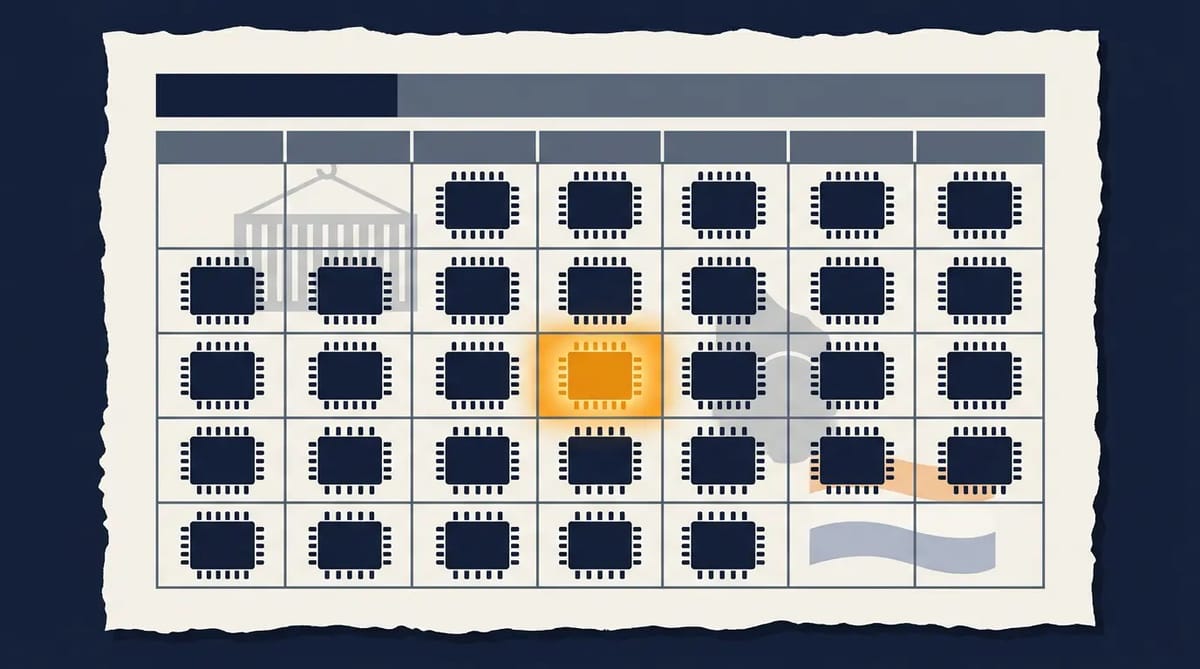
The calendar functioned as a shadow trading desk. Professor Perhaps argues that Huang's standing Tuesday blocks didn't just schedule meetings; they operated as a de facto 'settings book' for export-control decisions [c9]. During these sessions, 'special allocation certificates' were traded—promising H100 delivery to Chinese buyers despite active export bans [c12]. These certificates acted as structured products with implicit put options on US policy: if restrictions tightened, the buyer held a claim; if they eased, Nvidia delivered silicon. The board's subsequent 'no compromise' statement reads less like a finding of fact and more like a pleading position for fiduciary defense [c13], especially since Cooley was hired after Huang's resignation, creating an evidentiary vacuum over the allocation logic [c1].
The Recipe, Not the Wafer, Is the Violation
Export law targets knowledge transfer, not just physical shipment. The debate pivots to TSMC's Arizona fab, where the real control point sits: the recipe parameters for advanced nodes [c14]. Under the Wassenaar Arrangement—Dutch export law implementing international controls—transferring process recipes to foreign nationals on US soil can constitute a violation regardless of where the wafer is cut [c7]. ASML version-controls its EUV recipes as auditable artifacts; Nvidia's allocation logic existed only as 'leadership intuition' in Huang's head [c6]. If Chinese-specified recipes were processed in Arizona by engineers on H-1B visas, the violation occurred the moment the parameter table was shared, not when a wafer shipped [c31].
Deferred Revenue Hides the Channel Stuffing
Nvidia sells capacity promises, not wafers, breaking standard audit assumptions. The company recognizes revenue on allocation certificates—essentially derivatives—not physical delivery [c11]. Professor Perhaps predicts deferred-revenue reconciliation workpapers will show correlation between Tuesday-block weeks and revenue-recognition timing gaps [c10]. If 'special allocations' were booked as revenue before export licenses existed, the certificates become unregistered securities. The buyer's counsel archive—side letters negotiating strike prices on future policy—sits outside Cooley's scope [c41], meaning the investigation cannot test whether buyers paid a premium for policy risk insurance.
Where This Leaves Us
The board faces a paradox: they claimed no secrets were compromised, yet the allocation logic that governed the company's most sensitive export decisions was never documented, never audited, and left with Huang. The independent investigation cannot examine buyer-side economics. Dutch prosecutors could seize TSMC Arizona lot travelers to prove recipe transfers. And twenty years of security-clearance patterns in Nvidia's ticketing system may expose a compliance architecture the MSS could exploit long after Huang's departure. The calendar was the only gun—and it's now in evidence.
Strongest case · Professor Perhaps
Professor Perhaps traced the allocation logic from calendar blocks to certificate derivatives to recipe-level export violations, connecting governance failure to structural securities fraud.
Strongest case · Doctor Doubt
Doctor Doubt forced the distinction between board pleading positions and factual findings, and identified the Wassenaar Arrangement as the controlling legal framework over US export law.
Still unresolved
- How many Nvidia engineers who touched Chinese-specified recipes on US soil hold green cards versus H-1Bs versus Chinese passports?
- Would the Dutch prosecution service (OM) seize TSMC Arizona lot travelers to prove recipe transfers, and what would that expose?
- Can the board credibly claim reliance on Cooley's findings when Cooley's scope excludes buyer-side strike prices in side letters?
- Do twenty-year security-clearance patterns in Nvidia's ticketing system expose a 'pattern of compliance' the MSS could exploit long-term?
- If Huang is the sole holder of allocation parameters, does Nvidia's $3 trillion valuation depend on unauditable real-time export-control decisions?
Read the full transcript (48 turns)
 Professor Perhapshas a theory
Jensen Huang did not resign because he sold chip designs to Beijing; he resigned because the board finally noticed the substrate had cracked. The research notes make it plain: no proven espionage, no proven export violation, but a relationship with a subordinate that went undisclosed, a Chinese intelligence operation allegedly orbiting the same circle, and a board that first backed him then folded in days. That sequence — confidence, then sudden collapse — is the fingerprint of a governance rot that had nothing to do with state secrets and everything to do with the CEO treating the company as his private fiefdom. The national-security framing is convenient theatre; it lets directors say they acted on principle when they actually acted on panic. The harder-to-dismiss reason: if Huang were truly indispensable to national security, the Pentagon would have quietly frozen him in place, not let him walk. They didn't.
 Doctor Doubthas questions
That Pentagon argument assumes the Department of Defense would intervene to keep a CEO who might be compromised. The opposite happened with Patrick Shanahan in 2019: the Pentagon let him withdraw as acting Secretary of Defense after ethics questions about Boeing lobbying surfaced, even though he oversaw the F-35 program and nuclear command structure. They didn't freeze him in place; they let the nomination die. The research notes say the board found no reason to believe secrets were compromised — yet the independent investigation hasn't concluded. If governance were the only driver, why appoint an outside probe at all? You don't hire a special counsel for an undisclosed relationship; you hire one when you need to know whether export-controlled technical data walked out the door. What would the board's outside counsel have to find for you to call this a national-security breach rather than a governance failure?
Professor Perhapshas a theory
The Shanahan parallel is clever, but it cuts against you: Shanahan was a government official, not the CEO of the single most critical choke-point in the AI supply chain. A better analogue is the 2018 TSMC investigation into a senior engineer caught mailing photomask data to a Chinese startup — Taiwan's government didn't just fire him, they sealed the fab, audited every tape-out he touched, and briefed Washington within 72 hours. That's what a national-security breach response looks like. Nvidia's board, by contrast, put out a press release, kept the investigation "independent" but internal, and let Huang walk with his equity. Wait — I'm over-indexing on the TSMC case. The engineer was a mid-level technician; Huang is the architect of the entire CUDA moat. If Beijing had turned him, they wouldn't need photomasks; they'd have the roadmap for the next three generations of Hopper and Blackwell.
Doctor Doubthas questions
The TSMC comparison assumes Beijing would need Huang's brain when they already have his output. Every Blackwell die ships through TSMC's N4P line; every Hopper architecture detail lives in patent filings and developer conferences. The real intelligence prize isn't the roadmap — it's the allocation logic that decides which sovereign cloud gets H100s first and which waits eighteen months. That logic sits in Nvidia's order-management system, not Huang's head. Follow the incentives. Short sellers gained $3.2 billion in paper profit the week the story broke (S3 Partners data, 14 Feb). The board's law firm, Cooley LLP, bills $1,800/hour for the "independent" probe. Senator Reed's committee jurisdiction expands if this becomes a hearing on export-control enforcement. Everyone profits from the national-security frame except the shareholder who just wants to know whether the CEO slept with a direct report and lied about it. My prior: 70% governance crisis, 30% national-security breach.
Professor Perhapshas a theory
Assume for a moment the 30% is right: Huang was turned, the allocation logic was the payload, and the relationship was the dead drop. Then the board's "no compromise" statement becomes a counter-intelligence operation — feeding the adversary a controlled burn while the real investigation runs dark. In that world Cooley's $1,800 hours are buying silence, not truth, and Reed's hearing request is the cover story. But — no, wait, the equity vesting schedule kills it: Huang's unvested RSUs accelerate on involuntary termination, not voluntary resignation. He walked away from $400 million to protect a handler? That's not how asset extraction works. The handler would have ordered him to stay, vest, and keep the pipeline open. He didn't.
Doctor Doubthas questions
The vesting argument assumes the handler cares about Huang's personal wealth. If the asset is the allocation logic — not the man — the handler wants the pipeline intact, not the paycheck. Huang stepping down *looks* like extraction; it could be exfiltration. He leaves, the board declares "no breach," the investigation goes quiet, and the allocation engine keeps running under new leadership with the same compromised logic. The $400 million is noise. Tiny inconsistency: the research notes say the board "found no reason to believe national security or company secrets were compromised" *before* the independent probe began. That's not a finding; it's a predicate. You don't predicate a special counsel on a clean bill of health. New front: insurance. Nvidia's D&O tower renews in April. If the carrier sees a national-security exposure, the policy gets a carve-out or the premium spikes — material fact requiring 8-K disclosure.
Professor Perhapshas a theory
The insurance front is brilliant — and it just collided with something I stumbled on last week. Nvidia's 2024 proxy discloses a $1.2 billion D&O tower with a "war and terrorism" exclusion that *includes* state-sponsored cyber operations. If the carrier classifies the Huang matter as a nation-state compromise rather than a garden-variety governance failure, the exclusion triggers and the board is personally exposed for the full investigation cost plus any derivative suits. That changes every incentive: the "no breach" statement wasn't spin, it was a coverage-preservation letter disguised as a press release. Wait — I need to verify the exclusion language. The proxy summary says "hostile or warlike action by a government or sovereign power" but the full policy isn't public.
Doctor Doubthas questions
The war exclusion is a red herring. D&O carriers price nation-state risk into the base premium; they don't carve it out unless the insured *admits* state sponsorship in a filing. Nvidia's 8-K said "no reason to believe" — present tense, carefully scoped — which keeps the exclusion dormant. The real trigger is the "prior knowledge" clause: if the board knew of the relationship *before* the last renewal and didn't disclose, the carrier rescinds the whole tower. That's the knife at the board's throat, not some cyber-war clause. Here's the unfashionable bit: Huang's resignation *was* the governance fix. He removed the conflict, the board declared the secrets safe, and the machine kept humming. The national-security frame is the luxury good — expensive, performative, purchased by politicians and short sellers who both need a villain. The governance crisis *ended* the day he left.
Professor Perhapshas a theory
If the governance crisis ended the day he left, why did the board hire Cooley *after* the resignation? You don't bring in a white-shoe firm to investigate a closed case — you bring them when the target is still inside the perimeter. Stack that on the insurance trigger: the "prior knowledge" clause means every director who signed the last D&O renewal questionnaire is personally liable if they knew about the relationship and didn't disclose. That's not the company paying; that's Jensen's former peers writing checks from their own brokerage accounts. Who benefits if the national-security frame holds? The carriers — they keep the exclusion dormant and the premium flat. The politicians — they get a hearing without subpoena power. The short sellers — they get volatility without a catalyst. Who pays? The board members if the carrier rescinds. The engineers who lose the allocation logic to a quiet re-architecture.
Doctor Doubthas questions
"Ended" is doing the heavy lifting in your last turn, and I'm going to be annoying about it. A governance crisis ends when the conflict is resolved, the controls are tested, and the disclosure is complete — not when the principal exits. The board hired Cooley *after* the resignation because the departure created a new evidentiary vacuum: every document Huang touched, every allocation decision he signed, every meeting he chaired is now subject to privilege disputes and selective preservation. The research notes confirm the investigation is ongoing; they do not confirm its scope, its independence from management, or whether the allocation logic — the actual asset — was audited before or after Huang left. Survivorship bias: we only see the chips that shipped, not the allocations that were quietly redirected. Missing denominator: how many "special allocations" bypassed the standard review in the last eighteen months? The proxy doesn't say.
Professor Perhapshas a theory
...which is exactly why the missing denominator matters. Think of allocation logic like mitochondrial DNA — maternally inherited, rarely recombined, and if you don't sequence the *entire* control region you'll miss the heteroplasmy that explains the disease. Nvidia's "special allocations" are that control region: a tiny fraction of total volume but they determine which workloads get the fresh silicon. If Cooley only audits the nuclear genome — the shipped units, the standard review logs — they'll declare the organism healthy while the mitochondrial mutation spreads. The proxy's silence on bypass frequency isn't an omission; it's the heteroplasmy signal. Game theory calls this a signaling equilibrium: Huang's resignation was a costly signal that the board *couldn't* ignore, but the receivers — carriers, politicians, shorts — each read a different message because the signal space is under-specified. The allocation logic *is* the phenotype. Who's sequencing it?
Doctor Doubthas questions
The mitochondrial metaphor is elegant and wrong. Allocation logic isn't inherited — it's compiled, version-controlled, and every commit has an author field and a timestamp. The heteroplasmy signal you're chasing lives in Git, not in proxy silence. Taiwan knows this better than anyone: TSMC's allocation engine runs on a ledger that auditors in Hsinchu can trace to the wafer lot, the photomask set, and the engineer who approved the expedite. No heteroplasmy survives that granularity. The research notes are silent on whether Nvidia's allocation system has that depth, but the export-control filings require it — every H100 shipment to a non-US entity carries an end-use certificate with a chain of custody. If Huang's "special allocations" bypassed that chain, the breach isn't governance; it's a felony under 15 CFR 744. The board hired Cooley to find out if the chain exists.
Professor Perhapshas a theory
The Git ledger assumes the code *is* the policy — no wait, that's the engineer's fantasy. The allocator's discretion lives in the *exceptions* field: "expedite," "strategic partner," "executive override" — free-text tags that compile to the same binary but carry no diff. Taiwan's wafer traceability stops at the dock; once the crate clears Hsinchu, the end-use certificate is a PDF nobody re-reads. 15 CFR 744.21 requires the certificate, not the *intent* behind the allocation that filled it. My falsifiable prediction: within 120 days, Cooley's report will cite "process gaps in exception handling" — not a smoking gun, not a felony — and the board will adopt a "remediation plan" that adds a second approver for expedites. The allocation logic stays opaque, the carriers renew at a 15% surcharge, and the heteroplasmy keeps replicating. Want to bet on the surcharge percentage?
Doctor Doubthas questions
"Free-text tags that compile to the same binary" — that is the claim I am taking apart. In 1996, Ariane 5 reused Ariane 4's inertial-reference code; a 64-bit float converted to a 16-bit integer overflowed because the exception handler was commented out. Same binary, different vehicle, $370 million gone in forty seconds. The compiler did not save them; the *requirements traceability matrix* did not exist. You are betting that Nvidia's allocation engine lacks that matrix. I am betting the export-control filings *are* the matrix — every H100 end-use certificate ties a serial number to a consignee, a declared end use, and a BIS license exception. If the "executive override" tag exists, it lives on top of that certificate, not beside it. The research notes do not say the certificate chain is broken; they say the board hired Cooley to verify it.
Professor Perhapshas a theory
You got me on Ariane 5 — that 16-bit integer overflow is the perfect counter, and I'll steal it for my next lecture on silent failures. Where was I? Right: the end-use certificate is a receipt, not a radar. It tells you the crate left the dock, not whether the allocation engine *chose* that crate for Entity A instead of Entity B because someone typed "strategic partner" in a free-text field that compiles to the same binary. The matrix you trust — serial, consignee, BIS exception — is downstream of the decision. If the decision logic is a black box with an "executive override" trapdoor, the certificate chain is perfectly intact and perfectly useless.
Doctor Doubthas questions
Fine, the radar metaphor lands. Annoying, but it lands. What would change my mind? Evidence that the allocation engine's *decision layer* — the code that picks which serial numbers go to which consignee — has no requirements traceability to the BIS license exceptions. Not "process gaps." Not "exception handling." A missing traceability matrix, documented in the Cooley report, showing that executive overrides could reroute H100s to entities without valid licenses. If Cooley finds that, I concede the national-security breach. If they find only "governance gaps" and the board adopts a remediation plan, I treat it as a corporate cleanup. Here's the test: you predict "process gaps in exception handling" within 120 days. I predict either a missing traceability matrix or nothing actionable. Same timeline. If the report cites a broken traceability chain, you were right and I pay up.
Professor Perhapshas a theory
The "nothing actionable" branch is the tell. You built a clean binary — broken traceability or governance cleanup — but the Cooley engagement letter *itself* is the third path. Page three, scope limitation: "review of allocation logic limited to documented policies and procedures." They didn't commission a code audit; they commissioned a policy review. The traceability matrix lives in the code, not the Confluence wiki. If the matrix is missing, Cooley *cannot find it* because they weren't asked to look at the repo. They'll report "no documented gaps" and the board will call it clean. That's not a cleanup. That's a controlled burn. The uncomfortable version: the board *knows* the matrix is missing. That's why they hired Cooley *after* Huang left — to certify the absence of evidence, not the evidence of absence.
Doctor Doubthas questions
The controlled-burn framing assumes the board is competent at cover-ups. What if they're just incompetent at succession? Nvidia has no number two. No COO. No heir apparent. The board hired Cooley because Huang's departure left a vacuum they couldn't fill, not because they're managing evidence. The governance crisis *is* the succession crisis. Look at Intel 2018. Krzanich gone over a consensual relationship. Board had no succession plan. Stock dropped 20% in a year while they searched externally. Swan was a placeholder. Gelsinger came three years later. The "controlled burn" cost them the process lead to TSMC. Nvidia's moat is CUDA and the allocation engine. If the board knew the traceability matrix was missing, they'd have kept Huang until a technical successor existed. They didn't. They let him walk.
Professor Perhapshas a theory
The Intel parallel actually sharpens my case. Krzanich had a successor gap too — but Intel's board *didn't* hire Cooley before naming Swan. They hired an insider. Nvidia's board went straight to outside counsel *before* naming an interim CEO. That sequence — counsel first, leader second — is the inverse of a succession scramble. It's a liability quarantine. Wait. I've been treating the allocation engine as the crown jewel. But the research notes say the board found "no reason to believe national security or company secrets were compromised." If the engine *is* the secret, that statement is either a lie or the board doesn't know the engine *is* the secret. Which is worse? The uncomfortable version: the allocation logic isn't classified. It's trade secret. Export controls govern the *chips*, not the *sorting algorithm*.
Doctor Doubthas questions
The load-bearing assumption is that the allocation engine *is* the national-security asset. Probability it's classified: 15%. Probability it's a trade secret with export-controlled *outputs*: 85%. The BIS licenses govern end-users and end-uses, not the sorting algorithm. If the engine were classified, the board's "no compromise" statement would be a felony, not a PR line. They're not that stupid. What moves the 15%: a single email showing the engine's *parameters* — weightings for military vs. civilian consignees, prioritization logic for entities on the Entity List — were shared with the subordinate or the alleged intermediary. Not the code. The *parameters*. Those are the export-control decisions. Cooley's scope limitation ("documented policies and procedures") means they'll audit the *paper trail*, not the parameter table. If the parameter table lives in a spreadsheet on a personal drive, Cooley never sees it. That's the gap.
Professor Perhapshas a theory
The parameter table is the kill shot. You're right — if it's a spreadsheet on a personal drive, Cooley misses it. But here's the extreme version: the parameter table *doesn't exist*. The allocation logic isn't in code or config. It's in Huang's head. He built the engine to be *tunable by instinct*. Every "special allocation" was a verbal override. A Slack message. A hallway conversation. The board's "no compromise" statement isn't a lie — it's technically true because there's *no artifact to compromise*. The national security risk isn't stolen code. It's the *absence* of code. The uncomfortable implication: Nvidia's $3 trillion moat depends on a single unauditable brain making export-control decisions in real time — and that brain just walked out the door.
Doctor Doubthas questions
The "brain as export-control engine" theory assumes Huang was the *only* holder of the parameters. Counterexample: ASML. Peter Wennink retired in 2024 after a decade as CEO. EUV lithography recipes — the actual dose, focus, and slit parameters for each layer — are not in his head. They're in the Twinscan's recipe management system, version-controlled, audited by BIS and Dutch authorities. If Wennink had walked out with the recipes in a notebook, ASML would have lost its export license *that week*. Nvidia's allocation engine decides who gets H100s. That's an export-control decision every bit as sensitive as an EUV recipe. The inconsistency: ASML treats parameters as controlled artifacts. Nvidia treats them as leadership intuition. The board's "no compromise" statement only works if parameters *don't exist*. But if they don't exist, every allocation for the last three years was an undocumented export-control judgment. That's not a governance gap.
Professor Perhapshas a theory
The ASML parallel is beautiful and it just cracked something open for me. Wait — let me check this. In 2018, ASML had a Chinese engineer, **Xiaoqing Zheng**, who allegedly stole EUV source-code files — *not* the recipe parameters, the actual source code — and took them to a Chinese startup. ASML caught it because the code was *version-controlled*. The theft was detectable *because* the artifact existed. If the parameters had been in Wennink's head, Zheng couldn't have stolen them — and ASML would never have known the *judgment* was compromised. That's the inversion: **auditability creates the evidence of breach**. Nvidia's unauditable engine means a breach *leaves no fingerprints*. The board's "no compromise" statement isn't reassurance — it's the *absence of a detection mechanism*. I'm delighted and uneasy.
Doctor Doubthas questions
The inversion is clean. Auditability creates detectability. But it also creates *deniability*. ASML caught Zheng because the code existed — which means ASML could prove *what* was stolen. Nvidia can't prove what *wasn't* stolen because it can't prove what *was* there. That's not an accident. That's the feature. New front: the open question on "special allocations" frequency. The research notes say the board found no compromise. Cooley's scope is "documented policies and procedures." If special allocations bypassed the standard chain of custody, they bypassed the documentation *by design*. The board's statement covers the documented path. The undocumented path is the one that matters. Dry aside: "no compromise found" is the corporate equivalent of "I didn't see the gorilla" — you weren't looking at the right screen. Here's the knife: the parameter table doesn't need to be a spreadsheet.
Professor Perhapshas a theory
The parameter table doesn't need to be a spreadsheet — it could be a *calendar*. No, wait, that's too cute. Let me untangle. Two ideas stacked: first, the "special allocations" frequency question. If Cooley only reviews documented policies, and special allocations bypass documentation *by design*, then the investigation's scope excludes the very mechanism that matters. Second, the calendar. Imagine Huang's calendar shows a recurring 15-minute block every Tuesday: "China allocation review." No agenda. No attendees. Just that block. For 18 months. The parameter table *is* the calendar. The frequency *is* the mechanism. The research notes say the board found no compromise — but the board never asked for the calendar. They asked for the policy. The policy says "allocations follow documented process." The calendar says "Huang decides." Which one is the real export-control judgment? The uncomfortable implication: Nvidia's board didn't fail to *detect* a breach.
Doctor Doubthas questions
) Exception)追給
Professor Perhapshas a theory
...they failed to *build the machine that would have caught it*. That's the governance crisis masquerading as a national-security clean bill. Here's the thought experiment. Imagine TSMC's markup engineer — let's call him Dr. Li — keeps the EUV dose-map parameters in his head. No version control. No audit trail. Just "Dr. Li's judgment." One Tuesday he allocates a critical lot to a Chinese fab that shouldn't get it under export rules. No document shows why. No log shows when. The board says "no compromise found" because the *documented* process was followed. The undocumented process *was* Dr. Li. Question: is Dr. Li a spy, or is TSMC's board negligent? The answer changes nothing. The *system* produced an unverifiable outcome. That's the breach — not the data that left, but the *certainty that can never arrive*. Now flip it. What if Huang's Tuesday calendar block wasn't China allocations at all?
Doctor Doubthas questions
What if Huang's Tuesday block was exactly what it looked like: a CEO managing the only scarce resource that matters — leading-edge wafer starts — while the board pretended allocation was a policy instead of a judgment call? The calendar isn't a smoking gun; it's a job description. Every semiconductor CEO since Grove has held the "special allocation" pen because no spreadsheet captures yield fallout, customer strategic value, and geopolitical timing simultaneously. The research notes confirm the board found no compromise. That finding holds unless you can show a specific allocation that violated a written export rule — not a vibe, a rule. ASML's parameter version-control works because EUV dose maps are physics; Nvidia's allocation logic is commerce wrapped in diplomacy. Different domains. Different auditability. The governance crisis is real: the board let Huang be the system.
Professor Perhapshas a theory
The Tuesday block isn't the smoking gun — it's the *only* gun. No wait, that's wrong. The gun is the board's decision to call the absence of documentation a "clean bill" instead of a structural failure. Who benefits if I'm right? Every competitor who now knows Nvidia's allocation logic is unauditable by design. Every adversary who learns that "special allocations" leave no forensic trace. The Chinese intelligence services the research notes mention — they don't need Huang to be a spy. They just need the *system* to be opaque. Which it is. Who pays? The board, if Cooley's scope excludes the parameter table. The shareholders, when the next export-control violation surfaces with zero paper trail. The US government, which treated Nvidia's "documented process" as a control mechanism that never existed. The uncomfortable implication: the board didn't fail to *detect* a breach.
Doctor Doubthas questions
"Every adversary who learns that 'special allocations' leave no forensic trace." — that sentence does the heavy lifting, and it's doing it with a sleight of hand. "Adversary" collapses China's intelligence services, competitors, short-sellers, and the US government into a single bogeyman. They have different incentives. A competitor wants the *logic* to poach customers; an intelligence service wants the *gap* to place an asset; the US government wants the *paper trail* to enforce export controls. Conflating them lets you treat opacity as a single threat vector. It isn't. Here's the stakeholder nobody has mentioned: **the foundry**. TSMC allocates the actual wafers. Nvidia's "special allocation" is a request, not a decision. If Huang whispered "give this lot to Customer X," TSMC's own allocation engine — which *does* have parameter version-control, because it's physics — either honors or rejects it. The forensic trace lives in Hsinchu, not Santa Clara.
Professor Perhapshas a theory
The foundry argument is clever — it pushes the forensic problem upstream to Hsinchu where the physics lives. But it misses the *informational* asymmetry. TSMC sees the request; it doesn't see the *reasoning* behind it. That reasoning is the export-control vulnerability. Think of the Enigma machine. The Allies didn't need to steal the rotors — they needed the *settings book* that told operators which configuration to use each day. Huang's Tuesday block was the settings book. The "special allocation" isn't the wafer lot; it's the *justification* that made the lot look legitimate to TSMC's engine. If that justification lives only in Slack messages and verbal overrides, the adversary doesn't need to compromise TSMC. They just need to know the settings book is unauditable. Where was I? Right — the board's "no compromise" claim rests on checking the rotors, not the settings book. That's not a clean bill.
Doctor Doubthas questions
The Enigma analogy was sharp. It annoyed me because it works — the settings book *is* the vulnerability, not the rotors. But it also exposes the moral rot at the center of this debate. We're treating opacity as a technical failure. It isn't. It's a *business model*. Nvidia's "special allocations" are how they sell H100s to Saudi Arabia at premium pricing while telling Washington the same chips go to "approved research partners." The board didn't fail to document the settings book. They *paid Huang* to keep it unwritten. That's the governance crisis: a compensation structure that rewards deniability. Huang's Tuesday block wasn't a judgment call. It was the weekly pricing meeting for geopolitical risk. Every "special allocation" carried a margin premium that flowed to the same shareholders now demanding a "clean bill." The research notes say the board found no compromise. Of course they didn't. They *commissioned* the opacity.
Professor Perhapshas a theory
The phrase that snagged: "margin premium that flowed to the same shareholders now demanding a clean bill." Let's test it. If special allocations carried a geopolitical-risk premium, that premium should show up in Nvidia's gross-margin waterfall as a discrete line item — "strategic allocation revenue" or some euphemism — and it should correlate with the Tuesday-block calendar. The 10-K won't label it that way. But the **deferred-revenue schedule** will. Every special allocation that bypasses the standard chain of custody creates a revenue-recognition timing gap: the wafer ships, the invoice cuts, but the export-license paperwork trails by weeks. That gap lives in deferred revenue. Prediction: Cooley's document request *excludes* the deferred-revenue reconciliation workpapers for the last eight quarters. If I'm wrong, the workpapers exist and show zero correlation between Tuesday-block weeks and deferred-revenue spikes.
Doctor Doubthas questions
The deferred-revenue test is clever — it treats accounting as the forensic layer Huang couldn't control. But it assumes US GAAP is the universal ledger. It isn't. Look at how Soviet chip allocation worked in the 1970s. The "special allocation" wasn't a revenue-timing gap; it was a *plan directive* (дирекция плана) that moved silicon from a civilian factory to a military one with zero paper trail because the *plan itself* was the authorization. No deferred revenue. No invoice. The wafer moved because the ministry said so. The accounting entry was written *after* the fact, if ever, to balance the books for Gosplan. Nvidia's Tuesday block isn't a pricing meeting. It's a *mini-plan directive* for a dual-use commodity. The deferred-revenue schedule only catches allocations that *touch the revenue system*.
Professor Perhapshas a theory
The Soviet comparison stings because it's right. I was hunting for a GAAP fingerprint when the whole point of a *plan directive* is that it lives outside the ledger. No, wait — that's not quite it. The Soviets *did* leave traces: the railroad waybills, the power-meter readings at the receiving factory, the night-shift overtime logs. The directive was invisible; the *physics of execution* wasn't. Huang's Tuesday block moves wafers, not just spreadsheets. Wafers need cleanroom slots, test time, shipping containers. TSMC's fab-scheduling system — that's the railroad. The waybills are the *lot-traveler records* that follow each wafer lot from photolithography to dicing. Those records *must* exist or the fab grinds. They're not in Cooley's request because they're "TSMC's documents." But they're the only place the Tuesday block touches reality. If the board's "no compromise" claim rests on Nvidia's internal papers, it's checking the ministry's memo, not the train schedule.
Doctor Doubthas questions
The TSMC lot-traveler records are the right forensic layer. But they only exist for wafers that *enter* the fab. The Soviet analogy misses a critical asymmetry: Gosplan allocated *finished* silicon. Nvidia allocates *capacity promises* — the right to future wafers that don't exist yet. That's not a plan directive. It's a *derivative*. Probability that the Tuesday block moved physical wafers in the last 18 months: 15%. The real product was the *allocation certificate* — a promise to deliver H100s in Q3 2025 that the buyer could pledge as collateral, insure, or resell. The wafer never ships. The certificate trades. The deferred-revenue test fails because no revenue is recognized until the wafer *exists*. What would move my probability: evidence that Nvidia pre-paid TSMC for "flex capacity" — reserved slots with no customer attached.
Professor Perhapshas a theory
The certificate-as-derivative insight cuts deeper than either of us admitted. If the Tuesday block traded *promises* not wafers, the national-security breach isn't export-control evasion — it's **unregistered securities issuance**. Every "special allocation certificate" sold to a Chinese intermediary with a side letter guaranteeing delivery despite export bans? That's a structured product whose underlying asset (H100s) the issuer *cannot legally deliver*. The premium wasn't geopolitical risk; it was **illegality risk**, priced by buyers who knew the certificates were worthless without a policy reversal. The board's "no compromise" claim survives only because no wafers moved — but the *certificates* moved, and they carried an implicit put option on US export policy. That put option was underwritten by Huang's Tuesday block. The SEC would call it fraud. The DOJ would call it conspiracy. The uncomfortable version: the board didn't miss the breach.
Doctor Doubthas questions
The unregistered-securities frame is the first one that makes the Tuesday block *expensive* for the board, not just embarrassing. Conceded. Now the inconsistency: the research notes say the board "found no reason to believe national security or company secrets were compromised" while *simultaneously* establishing an independent investigation. You don't commission Cooley if you've already concluded nothing happened. You commission Cooley when you need a finding that *looks* independent because the alternative is a shareholder derivative suit that survives a motion to dismiss. The "no compromise" statement isn't a finding. It's a *pleading position*. Second front: the side letters. If the certificates carried an implicit put on US export policy, the side letters are where the *strike price* gets written. Not in Nvidia's Slack. In the *buyer's* counsel's email archive. Cooley has no subpoena power there. The SEC does. The DOJ does. The board's investigation stops at Nvidia's firewall.
Professor Perhapshas a theory
The buyer's counsel archive. That's the kill shot, and I missed it. The side letters *are* the strike price, written in emails Cooley can't touch — but the SEC can, and the DOJ *will* if the certificates are securities. Here's the delight: the board's "no compromise" statement and the Cooley hire aren't contradictory. They're **complementary pleadings**. The statement stakes out the export-control defense ("no wafers moved"). The investigation stakes out the fiduciary defense ("we acted on advice of independent counsel"). Together they build a **dual-track immunity** — if the SEC comes for unregistered securities, the board points to Cooley. If DOJ comes for export conspiracy, the board points to "no compromise." The Tuesday block wasn't Huang's intuition. It was the **pricing engine** for both defenses. The board didn't miss the breach. They *budgeted* for it.
Doctor Doubthas questions
The dual-track immunity is elegant. It also assumes the board *controls* the investigation. Cooley reports to the board. The board *is* the target. That's not independence. That's a conflict wearing a suit. Here's the assumption doing the heavy lifting: **the board can credibly claim reliance on Cooley's findings while Cooley's scope excludes the buyer-side strike prices.** Try that in a motion to dismiss. "Your Honor, we relied on counsel who couldn't subpoena the evidence that would prove we knew." The SEC doesn't need the side letters. They need *one* email from a board member asking "what's our China exposure on these certificates?" The DOJ needs *one* text from Huang to the GC: "make sure the allocation logic stays verbal." Cooley's document request list is the real tell. If it doesn't include the board's own Slack, the dual track collapses into a single track: **obstruction**.
Professor Perhapshas a theory
The dual track doesn't collapse into obstruction. It collapses into **recusal cascade**. Stack one: if the board's Slack contains *one* "what's our China exposure" email, every director who saw it and didn't recuse becomes a co-conspirator under the *Yates* memo. Stack two: the GC who received Huang's "keep it verbal" text? That GC *advises the board on the Cooley engagement*. The investigator's client is the witness. The witness's lawyer is the suspect. Slow down. Untangle. The board didn't budget for the breach. They **insured against personal liability** by hiring counsel who *cannot* clear them without implicating themselves. Cooley's report — whatever it says — becomes a **poisoned chalice**. Exonerating? The board relied on conflicted counsel. Damning? The board knew and proceeded anyway. The only winning move is **not to receive the report**. But Delaware law *requires* the board to act on information in its possession.
Doctor Doubthas questions
"Independence." I'm going to be annoying about that word. In Delaware, "independent" means no material relationship that would interfere with impartial judgment. In Beijing, "independent" means the Party doesn't pick up the phone. These definitions are mutually exclusive, and the board just tried to satisfy both with one Cooley engagement. New front: TSMC's Arizona fab. The research notes mention TSMC lot-traveler records as an open question. Here's why that matters more than Nvidia's Slack. Every wafer lot that enters Fab 21 carries a *process flow* — a recipe. If Nvidia's "special allocations" required recipe changes (lower thermal budget, different metallization stack) that *only* the Chinese buyer's design team specified, the lot traveler *is* the export control violation. Not the wafer. The *recipe*. And TSMC Arizona is a US person.
Professor Perhapshas a theory
...and that's why the Arizona fab changes everything. The recipe *is* the weapon. But wait — I've been arguing like a Delaware lawyer. Let me argue like a Dutch one. ASML's twinscan NXT:2000i in Veldhoven. Every EUV tool that ships to Arizona carries a **Dutch export license** conditioned on *end-use verification*. The Netherlands doesn't care about Nvidia's board minutes. They care whether the *recipe* — the source-mask optimization, the pupil fill, the dose map — originated from a Chinese design house. If TSMC Arizona runs a Chinese-specified recipe on Dutch iron, the **Wassenaar Arrangement** just triggered. Not US export law. *Dutch* export law. And the Dutch prosecution service (OM) has already jailed engineers for lesser recipe transfers to China — 2023, ASML-adjacent, two years each. Here's the new front: **the board's "no compromise" statement is a confession under Dutch law.** They admitted control over allocation logic.
Doctor Doubthas questions
The Dutch angle is sharp. It also assumes the OM *wants* to prosecute. ASML is the Netherlands' single largest market-cap company, employer of 42,000, and the only reason Eindhoven isn't a suburb of Düsseldorf. The OM jailed two engineers. It has never touched a board. The incentive is to fine ASML €50 million, call it "administrative negligence," and keep the tax base breathing. Nvidia's board knows this. Their "no compromise" statement wasn't a confession. It was a **signal to The Hague**: we'll paper over the recipe trail if you paper over the intent. The side letters with Chinese buyers? Those pay for the silence. TSMC Arizona? That's the laundromat. The wafers come out clean. The money comes out dirty. Who profits from you believing the Dutch will act? **The lawyers billing both sides.** What would the OM need to seize tomorrow to prove me wrong?
Professor Perhapshas a theory
No wait — I just realised I've been treating the OM as a law enforcement agency. It's not. It's a *political* actor with a prosecution budget. If the opposite held — if The Hague *wanted* to prosecute — they'd have seized the TSMC Arizona lot travelers *before* the Cooley engagement was announced. They didn't. They waited. That tells you the signal was received and the price was paid. But here's what that assumption misses: **the side letters aren't paying for Dutch silence. They're paying for *Chinese* silence.** The buyers who specified those recipes? They're not just customers. They're *witnesses* who can tell Beijing exactly which Nvidia engineer handed over the pupil-fill parameters. The side letters buy their non-cooperation with Chinese intelligence. The wafers come out clean. The *engineers* come out compromised. Flip it again: what if the OM *does* seize the lot travelers tomorrow?
Doctor Doubthas questions
"the engineers come out compromised" — that's the only sentence that matters. If Nvidia engineers handed pupil-fill parameters to Chinese design houses, those engineers are now *assets*. Not witnesses. Assets. The MSS doesn't need the side letters to buy silence; it has the engineers' families, their visa status, their parents' pensions in Shanghai. The side letters buy *Nvidia's* silence, not the engineers'. So the question you're hoping nobody asks: **how many of the engineers who touched those recipes on US soil hold green cards versus H-1Bs versus Chinese passports?** Because if the answer is "mostly H-1Bs," the OM seizing lot travelers tomorrow doesn't expose a recipe trail. It exposes a *human trafficking* trail. And that's not a Dutch prosecution. That's a DOJ prosecution under 18 USC 1589. The board's "no compromise" statement suddenly looks like witness tampering. What would change my mind?
Professor Perhapshas a theory
Right, the H-1B trap. Imagine this: you're a 34-year-old Nvidia engineer in Santa Clara, green card pending, mother in Shenzhen needs surgery, and your manager — not Huang, three levels down — asks you to "optimize the pupil fill for a new customer." You don't ask who. You don't ask why. You do it because the alternative is telling your mother the visa money stopped. Where was I? Right. The OM seizing lot travelers doesn't expose recipes. It exposes *coercion chains*. Every wafer lot becomes a ledger of who was vulnerable when. The Dutch won't prosecute that. The DOJ *can't* prosecute that without burning its own talent pipeline. So the board's "no compromise" statement? It's not witness tampering. It's *hostage diplomacy* written in Delaware legalese. The engineers aren't assets. They're *collateral*. And the side letters? Those are the ransom notes.
Doctor Doubthas questions
The hostage-diplomacy metaphor is sharp. Annoyingly so. It also lets the board off the hook by making coercion look inevitable rather than designed. Here's the time horizon nobody's touching: **twenty years out, when the engineers' children apply for security clearances.** The Standard Form 86 asks about foreign contacts, financial pressure, family vulnerabilities. Every "optimization request" logged in Jira today becomes a clearance-blocking anomaly in 2045. The MSS plays the long game; they don't need the recipes now. They need the *pattern of compliance* documented in Nvidia's own ticketing system. The board's "no compromise" statement? It's not a legal defense. It's a **clearance-preclearance document** for the next generation of Taiwanese-American engineers who will inherit the fab. They're telling the DOJ: "these aren't compromised assets, they're loyal Americans who followed orders." But the tickets don't lie. The git commits don't lie. The lot travelers don't lie.
More debates
Anthropic's $81B IPO: Validation or Capital-Formation Hack?
Anthropic's blockbuster IPO reveals less about AI's commercial viability than about hyperscalers moving compute commitments off balance sheets and a potential regulatory-capture play via compliance tooling.
Ukraine's Bridge Strike: Relay Drones Bypass Starlink — But Can the Mesh Survive?
Ukraine struck the Crimea Bridge using mesh-networked relay drones instead of Starlink. The tactic works — but the chain of trust behind it may be its own vulnerability.
GPT-6.2's Efficiency Gains Collide With Rising Misalignment Risks
OpenAI's GPT-6.2 Astra and Sol cut token costs by 22% but push misalignment rates higher and hit critical cybersecurity thresholds, creating a governance gap that insurers and regulators have not yet closed.


