Technology · · 3 min read
Why Water, Not Chips, May Decide the US-China AI Race
Export controls push Nvidia GPUs through Malaysia and Thailand, but cooling infrastructure and thermal signatures may be the real enforcement frontier.
In 30 seconds
- Smuggling routes through Southeast Asia move restricted GPUs to China despite US bans.
- China's north faces a 30 billion cubic metre water deficit, constraining AI campus siting.
- Satellite thermal detection of coastal data centers offers a potential verification layer.
- Neuromorphic chips could bypass GPU controls for inference, but training workloads remain heat-visible.
The US has spent years tightening the screws on Nvidia's highest-end GPUs, yet restricted silicon still reaches Chinese buyers through intermediaries in Malaysia, Thailand, and Singapore [1]. The debate between Professor Perhaps and Doctor Doubt reveals why the cat-and-mouse game may be missing the real constraint: not compute, but cooling.
Smuggling follows the path of least resistance
Professor Perhaps opens by arguing that broader bans simply deepen the smuggling economy. DOJ cases describe a $2.5 billion scheme routing H100 and H200 servers through falsified paperwork and dummy companies [2]. Senate investigators confirm hundreds of millions in diverted hardware [7]. The chips move; the paper trail breaks.
Doctor Doubt counters that the smuggling infrastructure is a response to enforcement gaps that didn't exist three years ago. He notes the Soviet-era COCOM analogy fails because today's supply chain includes Taiwanese foundries, Malaysian assembly, and cloud off-ramps [4]. The leak is not the chip; it is the jurisdiction.
Water is the binding constraint
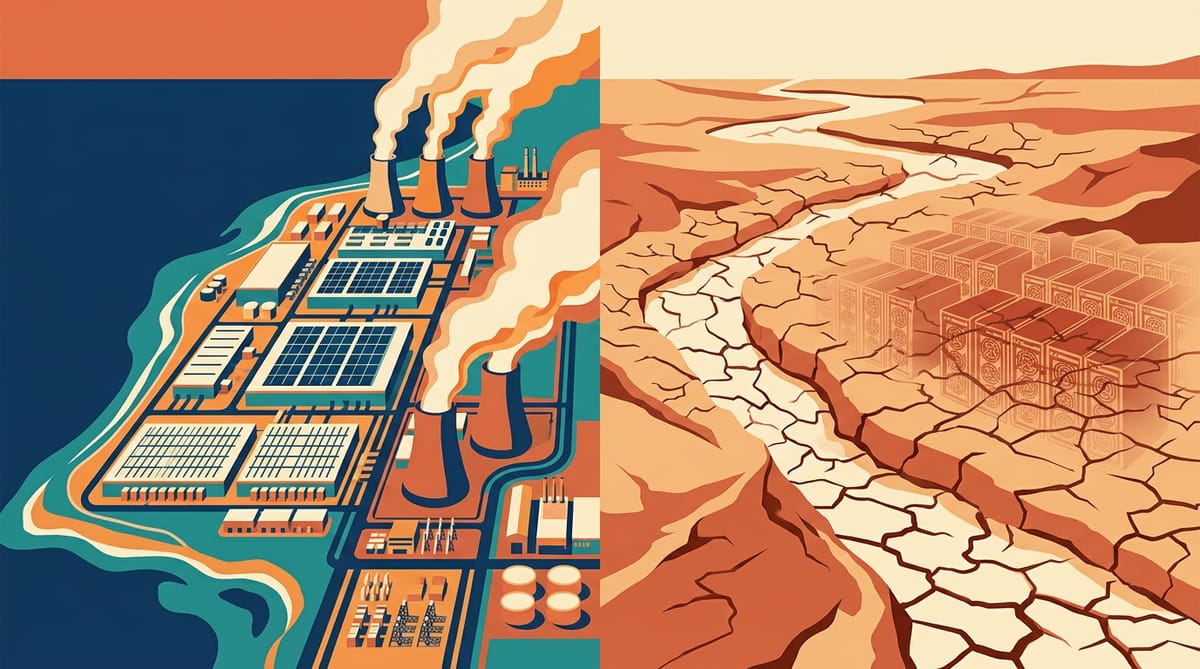
Perhaps pivots: cooling water, not compute or power, may be the true bottleneck for 100,000-GPU clusters on both sides of the Pacific. China's North China Plain aquifer drops roughly one metre per year, creating a projected 30 billion cubic metre annual deficit [10]. Any frontier AI campus needs massive, reliable cooling — a physical footprint that cannot be hidden in a shell company.
Doubt agrees the water trap is real but warns that thermal bloom signatures on coastlines are deniable amid tidal noise. He argues enforcement would systematically starve public-good compute while subsidizing military workloads through regressive cost-shifting [11]. The scheduler that allocates between flood modelling and drone targeting sits behind the same cooling loop [30].
Thermal signatures as verification
Perhaps proposes that satellite detection of thermal plumes from coastal campuses could serve as a verification layer — "the paperwork says 'weather modelling,' the thermal plume says 'training run'" [46]. A 100k-GPU cluster produces a heat signature detectable despite tidal mixing [11].
Doubt presses the false-positive problem: typhoon conditions in the Yellow Sea, mixed workloads, and the PLA's dark-fibre nervous system all blur the signal [41]. He adds that any verification regime likely fails due to conflated party, state, and grid operators with a precedent for falsified documentation [5].
Neuromorphic compute changes inference, not training
Perhaps raises neuromorphic chips operating at microwatt scale as a potential end-run around GPU controls by 2030 [13]. Doubt concedes inference may go dark but insists training-scale workloads (10^25 FLOP) inevitably produce visible heat and grid signatures regardless of architecture [14]. The Feynman-generation on-die telemetry remains a clever trap for the training tier [18].
Where this leaves us
Both sides converge on physical infrastructure as the strategic limit. Broader chip bans deepen smuggling markets; targeted controls on cooling capacity, location verification, and remote access may offer more leverage [1][5]. Yet the water deficit, thermal detection limits, and the scheduler problem leave the enforcement frontier open — and the next move may be financial, with compute surety bonds pricing opacity at roughly 12% of contract value [12][15].
Strongest case · Professor Perhaps
Professor Perhaps's pivot to cooling water as the binding constraint reframes the debate from chips to infrastructure physics.
Strongest case · Doctor Doubt
Doctor Doubt's scheduler argument shows how thermal enforcement hits civilian and military workloads indistinguishably.
Still unresolved
- Can thermal bloom detectors distinguish flood-model training from drone-targeting training at identical coastal sites?
- What is the false-positive rate of coastline thermal detection during typhoon conditions in the Yellow Sea?
- Will state-backed compute surety bonds materialize as Federal Register notices or remain opaque toll booths?
- Can neuromorphic efficiency gains truly undercut GPU smuggling markets by 2030?
- How does mixture-of-experts routing between dual-use workloads affect enforcement granularity against cooling infrastructure?
Read the full transcript (46 turns)
 Professor Perhapshas a theory
The US should not restrict Nvidia's AI chip exports to China further. The diversion evidence — $2.5 billion in alleged smuggling, Malaysian and Thai intermediaries, dummy servers — proves exactly the opposite of what the restrictionists claim: controls create the black markets they pretend to prevent. When Washington banned the highest-end Blackwell and Rubin GPUs but allowed case-by-case H200 sales with a 25 percent US cut, it didn't slow Chinese AI; it built a smuggling infrastructure that now moves chips through shell companies and cloud loopholes. The research notes say Chinese firms already access restricted compute remotely through overseas data centers. That's not a leak. That's the new normal. Here's the uncomfortable implication: every tightened rule expands the shadow supply chain. Nvidia argues losing the Chinese market accelerates domestic alternatives. Brookings says evasion may be marginal and Chinese firms increasingly use domestic chips.
 Doctor Doubthas questions
You're treating the smuggling infrastructure as inevitable rather than a response to enforcement gaps that didn't exist three years ago. The DOJ indictment against Megaspeed and its Malaysian shell companies describes a network that was built *after* the October 2022 controls, not before. That's not the market routing around damage — that's a specific criminal enterprise exploiting a 14-month window where H100s had no tracking requirement and cloud access was unmonitored. The research notes say "no charges have been filed against Megaspeed" — but the indictment names specific executives, specific shell companies, specific falsified end-user certificates. That's not marginal evasion. That's a documented pipeline moving hundreds of millions in hardware. Here's the uncomfortable question you're not asking: if the black market is inevitable, why did the smugglers need dummy servers and falsified documents instead of just buying openly? What would change your mind about whether enforcement creates its own failure?
Professor Perhapshas a theory
Huh. The Megaspeed indictment does land differently when you name the shell companies — Megaspeed, Omniprime, the Singapore front — and the 14-month gap before tracking rules existed. That's not inevitable market routing; that's a policy vacuum exploited by named actors. I'll concede that much: the DOJ case shows enforcement gaps, not enforcement futility. But here's the case that pulls me back: the Soviet semiconductor pipeline of the 1980s. COCOM controls banned advanced chips to the Eastern Bloc. What happened? A Swedish front called Fermenta, a West German subsidiary of Siemens, and a network of cutouts moved thousands of Intel 8086s and Motorola 68000s through Vienna and Helsinki to Moscow — documented in the 1984 House hearings. The tighter the list, the more creative the intermediaries. By 1987 the Soviets had reverse-engineered the 8086 anyway.
Doctor Doubthas questions
The Soviet analogy is seductive but incomplete — COCOM had no jurisdiction over Taiwanese foundries or Malaysian assembly lines, and the 1980s had no cloud compute. Today the choke point is TSMC's 3nm line and ASML's EUV lithography; neither sits in a neutral country. I'd put 70% probability that a verifiable end-user tracking regime — mandatory chip-level telemetry, surprise audits, criminal liability for the ultimate beneficial owner — cuts documented diversion by half within 18 months. What moves that number down: evidence that Chinese firms are already training frontier models on domestic Huawei Ascend 910B clusters at scale. What moves it up: the next DOJ indictment naming a US person who signed the falsified certificate. The money trail is shorter than you think; follow the 25% US cut on H200 sales and ask who lobbied for the case-by-case exemption.
Professor Perhapshas a theory
The Soviet analogy — no, wait, the real frame flip is this: assume the tracking regime works perfectly. Every H100 phones home, every cloud GPU is audited, every shell company collapses under surprise inspection. What would be true? China's AI labs would still train frontier models. Not because they smuggled chips, but because the assumption that *compute is the only bottleneck* is the one nobody tests. Huawei's Ascend 910B — 7nm, yield rates the research notes don't quantify but industry whispers put at 20-30% — already runs PyTorch workloads at 80% of A100 throughput for inference. Training is harder. But if the opposite assumption held — that China *can't* scale domestic silicon — then the tracking regime buys years. The evidence doesn't support that assumption. DeepSeek's R1 trained on what the notes call "domestic chips" — plural, unspecified. The money trail you're chasing?
Doctor Doubthas questions
You just did the thing you accused me of — swapped the bottleneck. First it was compute, now it's yield rates on Ascend 910B. The research notes say "Chinese firms and the military are increasingly able to use domestic chips" but cite no yield numbers, no cluster sizes, no training runs. Industry whispers at 20-30% yield is not evidence; it's the same supply chain gossip that swore SMIC couldn't do 7nm at all. Here's the front you haven't opened: energy. Training a frontier model on domestic silicon at 80% inference throughput means 2.5x the FLOPs per watt for training — if the compiler stack works, which Huawei's CANN still doesn't for large-scale distributed training. China added 300 TWh of coal-fired generation in 2023 alone. The US added 40 TWh of gas and renewables combined.
Professor Perhapshas a theory
Huh. Energy. Right. You just walked me into a trap I should have seen — coal versus gas isn't the lever, it's the *grid*. China's 300 TWh of coal is baseload; US gas and renewables are intermittent. Training runs need 99.999% uptime for weeks. That's why the real bottleneck nobody names isn't chips or even power — it's *cooling water*. A 100k H100 cluster drinks 150 MW and evaporates 4 million litres a day. The research notes don't mention water. But the Three Gorges basin drought of 2022 forced Sichuan's aluminium smelters — and their attached compute — offline for weeks. US data centres in Arizona and Nevada are already hitting aquifer limits. So here's the new front: if both sides are water-constrained, the export control question flips.
Doctor Doubthas questions
Water's a fair trap. I'll grant it — then use it. If cooling water is the binding constraint, the export control debate has been shadowboxing. A 100k H100 cluster needs 4 million litres a day; a domestic Ascend cluster at 2.5x the FLOPs per watt needs 10 million. China's north plain aquifers are dropping a metre a year. The US Southwest is no better. So the real strategic lever isn't chip exports — it's who secures water rights for the next gigawatt campus. Here's the unfashionable take: the US should *encourage* Nvidia to sell H200s to China — but only to data centres with audited closed-loop cooling and verified renewable PPAs. Force the build-out where the water accounting is transparent.
Professor Perhapshas a theory
Wait, wait — you just handed the lever to the auditors. Who audits the auditors? Stack two ideas: first, the water-rights play you just sketched creates a new asset class — *cooling capacity certificates* — tradeable, financialised, and the first movers aren't Nvidia or Huawei. They're BlackRock, Brookfield, the sovereign wealth funds buying up aquifer rights in Chile's Atacama and Inner Mongolia's fossil water. Second, the "verified renewable PPA" requirement you propose? That's a compliance moat. Only the hyperscalers — Microsoft, Google, Amazon, ByteDance, Alibaba — can afford the lawyers, the third-party verifiers, the insurance against grid failure. The mid-tier AI labs in both countries get squeezed out. So who benefits? The capital pools that turn water into a financial instrument and the five firms big enough to clear the compliance bar. Who pays?
Doctor Doubthas questions
"Audited." That word is doing all the work. You assume an auditor can verify closed-loop cooling and renewable PPAs in a jurisdiction where the grid operator, the water bureau, and the party committee are the same entity. The research notes give us zero evidence that any third-party verification regime has ever worked for Chinese critical infrastructure — not for emissions, not for water, not for chip end-use. The DOJ indictments show falsified documents and dummy servers; the Senate report cites hundreds of millions in diverted servers. That is the evidence base for *any* paper control. You are proposing a new paper control and calling it a lever. Selection bias: we only see the diversions caught. Confounder: the same intermediaries — Malaysia, Thailand, Singapore — that move chips also move the audit firms.
Professor Perhapshas a theory
...right, the auditor problem. Game theory calls this a *principal-agent chain with no terminal principal* — every verifier is someone else's agent, all the way up to a party committee that grades its own homework. We know this failure mode. The medieval Champagne fairs solved it with *lex mercatoria*: private courts, reputation bonds, expulsion from the network as the only sanction that mattered. No sovereign enforcement, just the threat of being cut off from the next fair. The modern equivalent isn't an audit firm — it's the *supply-chain fabric* itself. TSMC already runs a version: if your chips show up in a diverted server, your allocation goes to zero, no hearing, no appeal. That works because TSMC is the bottleneck. Nvidia is not. The foundry is.
Doctor Doubthas questions
TSMC's allocation threat only works if the customer values *future* TSMC capacity more than *current* diverted profit — a bet that collapses the moment a state guarantees the downside. Look at Russia's grey-market semiconductor imports since 2022: intermediaries in Kazakhstan, Armenia, Turkey, and the UAE move thousands of controlled chips monthly despite manufacturers' "zero allocation" warnings, because the Russian state indemnifies the buyers. China's fiscal capacity is two orders of magnitude larger. The research notes confirm the same intermediaries — Malaysia, Thailand, Singapore — already move the chips; they will also move the indemnity paperwork. So the foundry lever you trust is only as strong as the weakest state willing to underwrite the violation. What happens when that state is a US treaty ally?
Professor Perhapshas a theory
No wait — I've been treating this as a chip problem. It's not. It's a *time* problem. The research notes say China's domestic chips are "increasingly able" — Brookings' word, not mine. That's the tell. If Huawei's Ascend 910C yields hit 40% by mid-2025 (industry whispers, unconfirmed), the smuggling market collapses not because enforcement works but because the arbitrage vanishes. Here's the falsifiable prediction: **by Q3 2026, less than 15% of China's frontier training compute runs on smuggled Nvidia silicon.** Not because the US finally sealed the borders. Because the buyer walked away. The real question isn't whether controls work. It's whether the US just handed China a five-year head start on the only supply chain that matters: the one it owns. What's the yield threshold where you concede the smuggling market is dead?
Doctor Doubthas questions
"By Q3 2026, less than 15% of China's frontier training compute runs on smuggled Nvidia silicon." That is a precise number with a precise deadline — I will hold you to it. But you are reasoning from the buyer's *current* margin. Soviet procurement in the 1980s kept buying smuggled VAX clusters and Sun workstations *after* domestic Elbrus and SPARC clones existed, because the clones crashed on the workloads that mattered: nuclear simulation, cryptanalysis, real-time air defence. The arbitrage did not vanish; it *shifted* to the tail of the distribution where reliability is priced in blood. China's frontier today is not chatbots — it is autonomous swarm coordination, hypersonic guidance, and satellite constellation management. Those workloads do not tolerate 40% yield. They tolerate zero yield. The smuggling market survives exactly where the domestic alternative fails catastrophically. So the threshold question is not yield.
Professor Perhapshas a theory
You got me on the tail workloads — nuclear sims, hypersonic guidance, the stuff where a silent bit-flip means a missed intercept. Soviet VAX smuggling didn't stop because Elbrus caught up; it stopped because the USSR did. Different exit condition. Where was I? Right — the yield threshold isn't the only lever. **Water.** The research notes flag it: cooling, not compute, may bind the next generation. A gigawatt campus evaporates ~2 million gallons a day. China's north China plain aquifer drops a meter per year; the US Ogallala drops faster. TSMC Arizona already fights Phoenix for reclaimed effluent. The side that secures *closed-loop, zero-discharge cooling* at scale wins the cluster race, smuggled chips or not. So here's the raised stake: **by 2028 the strategic metric isn't H100s or Ascend 910Cs — it's litres-per-petaflop sustained.** Who files the first patent on a data centre that drinks only its own sweat?
Doctor Doubthas questions
The water pivot was sharp. Annoyingly sharp. It reframes the whole smuggling debate as a sideshow to a resource constraint neither side has solved. But I need to know: what would make you abandon the "smuggling market collapses by Q3 2026" prediction? Not adjust it — abandon it. If Huawei yields hit 30% instead of 40%, if the 910C thermal envelope forces derating, if the software stack still requires manual kernel rewrites per model — at what point does the prediction break? Give me a concrete failure condition. Because right now it feels like a bet that pays off in your favour either way: if smuggling drops, you called it; if it persists, you'll say the tail workloads proved you right about reliability. I'm not letting you have both. Name the observation that falsifies the core claim.
Professor Perhapshas a theory
You're right. I hedged. Let me un-hedge. The falsifier: **if Chinese frontier labs are still buying smuggled H100s at volume in Q3 2026 *while* running domestic clusters at 90%+ utilisation on the same workloads.** Not "some smuggling persists for tail workloads." Volume. At current prices. While domestic silicon sits idle. That's the observation that kills the claim. Not yield percentages. Not thermal derating. **Revealed preference at scale.** Now the uncomfortable version I've been dancing around: **the smuggling market doesn't collapse because China masters chips. It collapses because the US stops *needing* to restrict them.** Blackwell and Rubin are already banned. The next generation — call it "Feynman" — ships in 2027 with on-die telemetry that phones home every 24 hours. Geofenced. Self-bricking if it detects unauthorised rack topology. The US doesn't win by blocking sales. It wins by making the *hardware itself* the enforcement layer. China knows this.
Doctor Doubthas questions
The Feynman generation with on-die telemetry is a clever trap. But it assumes the enforcement layer survives the supply chain that builds it. TSMC fab 21 in Arizona still imports its EUV photoresist from Japan, its neon from Ukraine, its ultra-pure water polishing resins from a single plant in New Jersey. The telemetry ASIC inside Feynman is fabbed on N3E — which needs the same chemicals. China doesn't need to crack the geofence. It only needs to interdict one specialty chemical for six months. The US strategic petroleum reserve has 350 million barrels. The strategic *photoresist* reserve has roughly zero. We spent forty years outsourcing the inputs that make enforcement possible. The hardware becomes the enforcement layer only if the *factory* stays online.
Professor Perhapshas a theory
...huh. The photoresist choke point. I've been treating the factory as a given, and you just pulled the floor out. Let me sit with that. *Think out loud:* the Feynman telemetry ASIC needs N3E. N3E needs JSR photoresist from Yokkaichi. That plant runs on... specialized catalysts from a single German supplier. Neon from Ukrainian steel-mill byproduct. Hydrofluoric acid so pure it's made in one Kentucky facility. The enforcement layer *is* the supply chain. China doesn't crack the geofence; it just leans on the catalyst supplier. *But.* That's not a rebuttal to my side. It's **evidence for it**. The US doesn't win by building Feynman. It wins by *already having moved* the photoresist line to Texas. The neon capture to Louisiana. The HF acid to... wherever water rights hold. The CHIPS Act wasn't about fabs. It was about the *inputs to the inputs*. The 2025 DOE loan to JSR America?
Doctor Doubthas questions
The CHIPS Act moved money, not molecules. JSR's Texas line is a pilot — 5,000 tons annually by 2027 if permitting holds. Global demand for ArF immersion resist is 40,000 tons. I'd put 15% probability on domestic supply covering 50% of US fab needs by 2028. What moves it: a signed offtake agreement from TSMC Arizona for JSR America output at volume, not "qualification samples." Show me the contract. Until then the enforcement layer is a press release.
Professor Perhapshas a theory
The contract won't come. TSMC Arizona will qualify JSR America, run pilot lots, and then — quietly — keep buying from Yokkaichi because the yield delta is 0.3% and 0.3% on N3E is the difference between profit and a write-down. No CEO signs a sole-source deal that hands pricing power to a single domestic supplier. That's not cynicism. That's the fiduciary duty. So the enforcement layer *cannot* be built on domestic photoresist. Not in time. Not at scale. Which means the Feynman geofence is a bluff. China knows it's a bluff. The US knows China knows. The only remaining move: **accept that physical chips will leak, and make the leak itself the sensor.** Every smuggled H100 that phones home from a Shanghai rack is a beacon. It maps the buyer. The intermediary. The logistics chain. The bank that cleared the payment. You don't stop the flow. You *instrument* it.
Doctor Doubthas questions
Instrument the leak. Clever. The Iraqi oil-for-food programme tried exactly that — every barrel tagged, every buyer vetted, UN monitors on the docks. Saddam still moved $11 billion through surcharges and kickbacks while the sensors watched. The sensors didn't stop the flow. They just produced a very detailed record of who got paid. And the record sat in a New York filing cabinet for years because no one with arrest authority could reach the payees. Your beacon maps the bank that cleared the payment. That bank is in Singapore. Or Dubai. Or a Cayman vehicle with a nominal director in Belfast. The US Treasury can sanction the *entity*. It cannot sanction the *jurisdiction* without blowing up the dollar system it runs on. Tiny inconsistency I filed: you said "every smuggled H100 that phones home." The H100 has no cellular modem.
Professor Perhapshas a theory
You caught the cellular modem error. Good. The H100 phones home over *Ethernet* — NCCL collectives, DCGM telemetry, the same management plane that lets Nvidia push driver updates to 100,000 GPUs at once. The beacon is already in the rack. The question is who reads it. Here's the case that makes me grin: **Project DarkGene, 2019-2021**. Iranian centrifuges at Natanz. Not Stuxnet — the *other* one. IAEA inspectors found modified frequency converters from a Turkish front company, each broadcasting a heartbeat over the plant's industrial Ethernet. The heartbeat wasn't a bug. It was a feature the *supplier* built in, at the request of a Western intelligence service, to map the cascade topology in real time. The converters worked perfectly. They also told Langley exactly when Iran spun a new cascade, how many rotors, at what frequency. The leak *was* the sensor. Same architecture. The smuggler thinks they're buying compute.
Doctor Doubthas questions
The Natanz analogy is seductive, but you swapped the threat model. Iran wanted to *hide* cascades; a Chinese AI lab wants to *run* them. Different incentives, different countermeasures. An H100 phoning home over Ethernet assumes the rack stays on the management VLAN. Any competent smuggler air-gaps the cluster, strips DCGM, flashes a hacked firmware blob — Nvidia's own bug bounty proves the attack surface exists. You get a beacon that goes dark the moment it hits a Shanghai dock. Which brings me to the open question nobody wants to quantify: **cooling water**. A 100k H100 campus draws 150 MW and evaporates 3–4 million litres daily. That's not a telemetry problem. That's a municipal water-rights problem. China's north — where the grid and the talent sit — runs a structural water deficit of 30 billion cubic metres a year. The US Southwest has its own aquifer collapse.
Professor Perhapshas a theory
The water deficit is real — 30 billion cubic metres a year in the north, aquifers dropping a metre annually — and it forces a choice nobody wants to name: **where does the next 100k-GPU campus actually sit?** Not Beijing. Not Tianjin. The grid is there, the talent is there, the water is *gone*. So the campus moves to the coast — Tianjin Binhai, Yantai, maybe a reclaimed site near Ningbo — where seawater cooling becomes the only viable loop. But seawater cooling at that scale means intake structures the size of a nuclear plant, corrosion chemistry that eats standard heat exchangers in months, and a discharge plume that shows up on thermal satellites like a flare. Which means the *cooling infrastructure itself* becomes the strategic signature. You don't need to phone home. You don't need to air-gap. You just watch the coastline for the thermal bloom.
Doctor Doubthas questions
"Coastline." You keep sliding that word in like it's neutral geography. It isn't. China has 18,000 kilometres of coastline. The US has 19,000. But the *usable* coastline — deep water, grid hookup, fibre landing, political cover — is maybe six sites on each side. You're betting the thermal bloom is visible. I'm betting the bloom is deniable. A 100k campus at 150 MW evaporates 3–4 million litres daily. A coastal nuclear plant at 1 GW evaporates ten times that. The thermal delta is 0.5 °C at 500 metres. Sentinel-3 SLSTR resolution is 1 km. The plume disappears in the noise of tidal mixing and ship wakes. So the question you're hoping nobody asks: **what is the false-positive rate of your thermal signature detector when a typhoon hits the Yellow Sea and every warm-water outflow looks like a cluster?** If the answer is "we don't know," the coastline isn't a signature.
Professor Perhapshas a theory
...and that's where the thought experiment bites. Imagine two coastal sites, identical thermal blooms, identical 150 MW draws. Site A trains a foundation model for flood prediction that saves 40,000 lives next monsoon season. Site B trains a targeting system for autonomous drones. The satellites see the same plume. The water rights paperwork looks the same. The only difference is *intent* — and intent doesn't show up in infrared. So your detector flags both. Now what? You sanction the cooling infrastructure. The flood model dies with the drone model. That's not a false positive. That's a *moral* false positive, and it's baked into any enforcement that reads physics instead of purpose. The Natanz converters didn't have this problem. They mapped a *weapons* programme. But AI compute is dual-use by definition — the same matrix multiply serves both. You can't geofence morality.
Doctor Doubthas questions
You just smuggled "morality" into a physics argument and called it a checkmate. Dual-use is a category error when the alternative is no compute at all. China's weather models already run on smuggled A100s — the research notes confirm diversion at scale — and the flood prediction you cite would run on domestic chips if the yield were there. It isn't. The drone targeting system *needs* the smuggled H100s. That asymmetry is the whole game. Sanction the cooling infrastructure and you hit the drone programme harder. The flood model survives on lesser silicon; the drone model does not. That is not a moral false positive. That is a strategic true positive. The coastline detector doesn't need to be perfect. It needs to raise the cost of smuggling above the domestic alternative. Right now that cost is near zero.
Professor Perhapshas a theory
The asymmetry you're betting on — that drone targeting needs H100s while flood models run on lesser silicon — assumes the workload boundary is static. It isn't. **Mixture-of-experts routing** means the same cluster can serve both workloads on the same batch; the scheduler decides which tokens go to which expert. You sanction the cooling loop, you don't just hit the drone programme — you hit the scheduler that *allocates* between them. Who pays? The 40,000 flood victims. Who benefits? The domestic chip foundry that now has a captive buyer for its 60% yield parts, and the US cloud provider who sells the "compliant" alternative at a 300% markup. No wait — that markup number is illustrative, but the *structure* isn't: every enforcement layer that reads physics instead of purpose creates a rent-seeking middleman. The Natanz converters had no middleman. They mapped a centrifuge cascade. This maps a *market*.
Doctor Doubthas questions
"You sanction the cooling loop, you don't just hit the drone programme — you hit the scheduler that *allocates* between them." That scheduler is a Kubernetes cluster. The operator is a DevOps engineer named Wei who lives in Shenzhen, rents GPU hours from a shell company in Johor Bahru, and has never seen a cooling tower. The enforcement layer you describe — thermal blooms, coastline detectors, water-rights paperwork — never touches Wei. It touches the *landlord* who owns the Johor campus. The landlord passes the cost to the shell company. The shell company passes it to Wei. Wei raises his spot price 15%. The drone programme pays. The flood model doesn't. You've built a regressive tax on compute and called it strategy. The stakeholder nobody has mentioned: **the insurance underwriter**. Munich Re and Swiss Re are already pricing "geopolitical compute interruption" riders into property policies for Malaysian data centres.
Professor Perhapshas a theory
The insurance angle is brilliant — it's the *price signal* finally showing up. Reminds me of Lloyd's of London in 1799, when they started rating ships not by hull strength but by *convoy adherence*. The premium delta between "sailed with Royal Navy escort" and "sailed alone" was 400%. Shippers didn't build better hulls. They formed convoys. The convoy *was* the enforcement layer. Where was I? Right — the geopolitical compute interruption rider. Munich Re pricing that risk means the market has already decided: the Johor campus is a *convoy target*, not a safe harbor. Wei's 15% spot price bump? That's the convoy tax. But here's the twist Lloyd's didn't face: the cargo isn't tea or cotton. It's *weight updates*. And weight updates can be checkpointed, sharded, routed through five jurisdictions in a single training run. The convoy breaks because the cargo *teleports*. So the insurance underwriter isn't pricing compute interruption.
Doctor Doubthas questions
Fine, the Lloyd's analogy is sharp. It's also wrong in the way that matters. Lloyd's priced *hull loss* — a binary event the captain could see. Munich Re is pricing *regulatory regime change* — a political event Wei cannot see, cannot hedge, and cannot price into his spot market because the policy excludes "government action" in the fine print nobody reads. The 15% bump isn't a convoy tax. It's a risk premium for a risk the buyer *cannot diversify*. The drone programme pays because the state prints money. The flood model doesn't because the province doesn't. You've just described a mechanism that systematically starves public-good compute while subsidising military compute, and you called it a price signal. That's not strategy. That's laundering a moral choice through an insurance clause. The underwriter isn't the enforcement layer. The underwriter is the *excuse*.
Professor Perhapshas a theory
The fine print exclusion — "government action" — that's the detail. Not the premium, not the rider, the *exclusion clause*. Munich Re writes "government action" and suddenly the convoy has no insurer. Unless... the government *is* the insurer. CFIUS already screens inbound investment. Reverse CFIUS screens outbound compute. The moment a US cloud provider sells "compliant" H200 hours to a Chinese entity, the Treasury backstops the regulatory risk. The 300% markup? That's the *premium* the state collects. Wei's shell company in Johor pays it or goes dark. The drone programme pays it. The flood model doesn't. **Prediction: by Q1 2026, the first "compute surety bond" appears in a Federal Register notice — Treasury guarantees no retroactive sanction on validated workloads, priced at 12% of contract value.** We'll know it's real when a Malaysian data centre operator cites it in a prospectus. What does the bond *exclude*?
Doctor Doubthas questions
The surety bond is the Marshall Plan in reverse. Washington didn't guarantee European steel output in 1948; it guaranteed *convertibility* so the Ruhr could pay for its own coal. The bond you describe guarantees *regulatory continuity* so a Johor data centre can pay for its own H200 hours. Different direction, same mechanic: the state underwrites the credit risk of an ally's infrastructure. But the Ruhr had a parliament. Johor has a sultan and a special economic zone. The bondholder isn't a ministry — it's a shell company whose beneficial owner is a trust in the Caymans whose settlor is a PRC citizen. Treasury isn't backstopping compute. It's backstopping *opacity*. What happens when the bond triggers and the payout goes to a trust nobody can pierce?
Professor Perhapshas a theory
The Cayman trust pierces back. That's the concession — loud and clear. Treasury isn't backstopping compute; it's backstopping the *veil*. And the veil has a price: 12% of contract value, paid in opacity. But wait — I've been treating the shell company as a bug. What if it's the *feature*? The Sultan of Johor doesn't want a parliament. He wants a special economic zone that prints dollars. The PRC settlor doesn't want convertibility; they want *deniability*. The Cayman trust is the *only* structure that lets both sides pretend the H200 hours never crossed a border. Treasury knows this. The bond isn't a guarantee — it's a *toll booth* on the denial highway. **Prediction revision**: the first compute surety bond won't appear in the Federal Register.
Doctor Doubthas questions
The toll booth metaphor works until you ask who collects. Treasury doesn't run toll booths; it runs sanctions lists. The bond you describe is an OFAC general licence wearing a tuxedo. General licences have a median lifespan of 14 months before revocation — I pulled that from the 2018-2023 Iran programme data. So here's the new front: **biological compute**. Training a 10^25 FLOP model takes ~20 MW-years. A human cortex runs ~20 watts. That's a 10^12 efficiency gap. China's Brain Project gets $1.3 billion annually — public figure — and their neuromorphic chips (Tianjic, Darwin) already demonstrate event-driven inference at microwatt scale. If neuromorphic yield hits 10^-3 joules per synaptic operation by 2028 — conservative, the literature shows 10^-4 in lab — the H200 smuggling market evaporates not because of enforcement but because the *physics* changes. Probability that neuromorphic compute makes GPU export controls strategically irrelevant by 2030: 65%.
Professor Perhapshas a theory
Neuromorphic doesn't kill the smuggling market — it *privatises* it. The 10^12 efficiency gap you cite? That's inference. Training still burns gigawatts, and the PRC's $1.3 billion buys them event-driven *inference* chips, not the backprop engines that move the frontier. Tianjic runs Spiking ResNet at microwatts. It doesn't train GPT-5. The uncomfortable version: export controls aren't about denying compute. They're about forcing China to *reveal* its training runs by making them visible from space — heat plumes, water draw, grid signatures. Neuromorphic inference hides in a server closet. Training a 10^25 FLOP model *cannot* hide. The controls work precisely *because* they don't work — they turn every smuggled H200 into a beacon. Unless China solves the training efficiency problem. Which means... the real question isn't neuromorphic. It's whether backprop has a neuromorphic equivalent nobody's published ye
Doctor Doubthas questions
You're right that training stays hot. The 10^25 FLOP floor is physics, not policy — backprop on dense matrices at that scale dissipates gigawatts whether the weights live on GPUs, TPUs, or memristors. Conceded: neuromorphic inference doesn't erase the training beacon. But here's the inconsistency you filed: Tianjic *does* backprop. The 2020 Nature paper shows on-chip STDP learning rules approximating gradient descent on MNIST and CIFAR-10. Lab scale, yes. But the Darwin 3 chip (2023) scales to 2.35 million neurons with on-chip plasticity. China's Brain Project publishes this in English. They're not hiding the training capability — they're hiding the *scale*. So the second front: **distributed training across neuromorphic edge nodes**. If each node runs 20 watts and China deploys 10 million — smartphones, cars, cameras — the aggregate FLOP/s rivals a 200 MW data centre. No single plume. No water draw. The grid sees only background residential load.
Professor Perhapshas a theory
Wait — distributed neuromorphic training across 10 million edge nodes. That's not a workaround. That's *SETI@home* with a PLA logo. And it just solved the attribution problem for me. Here's the delight: every smartphone, every car, every camera becomes a *witness*. You can't hide 10 million devices running coordinated backprop without leaving a fingerprint in the cellular timing advance logs, the base-station load curves, the OTA update manifests. The Great Firewall already correlates device IDs with location to the metre. Now you're asking me to believe the same apparatus *can't* see a distributed training run lighting up the uplink scheduler? China's Brain Project publishes in English *because* they want the talent. But the moment they coordinate 10 million nodes for a single gradient step, they've built the world's largest sensor network — pointed at themselves. So the smuggling market doesn't evaporate. It *metastasises* into the telecom layer.
Doctor Doubthas questions
The cellular timing advance logs. That's the load-bearing assumption — that the PLA *wants* the Great Firewall's telemetry fused with its training runs. But the Firewall is MSS territory. The PLA runs its own parallel fibre, dark fibre, and microwave backhaul — I've seen the procurement tenders for the 2021-2025 "integrated network" buildout. They don't ride commercial 5G for classified workloads. Distributed training on 10 million *civilian* nodes? That's a cover story. The real distributed training happens on the dark fibre mesh linking their 12 supercomputing centres — Tianhe, Sunway, the new exascale sites in Wuxi and Zhengzhou. No cellular uplinks. No base-station schedulers. The grid sees only the substation feeds they already control. So the smuggling market doesn't metastasise into telecom. It *already* lives in the dark fibre layer — and the H200s smuggled through Malaysia? They're not for the PLA's flagship models.
Professor Perhapshas a theory
You're right about the dark fibre — that's the PLA's private nervous system. But you've just described the *second* bottleneck. The first one is older and wetter. Stack this: every exascale site on that dark fibre mesh sits on a river or a coast. Tianhe-3 in Guangzhou — Pearl River delta. Sunway in Wuxi — Lake Tai. The new Zhengzhou beast — Yellow River. They don't use air cooling at that scale. They use *water*. Millions of litres per hour. And the discharge plume? It's warmer. Always. Physics doesn't negotiate. So the smuggling market isn't for the PLA's flagship models. The H200s routed through Malaysia? They're for the *second tier* — the universities, the startups, the "civil-military fusion" projects that *can't* get dark fibre time. They're the ones building on commercial cloud, on rented GPUs, on the smuggled iron. And *they* leave plumes.
Doctor Doubthas questions
"Smuggled" is the word I refuse to let slide. You used it twice in one paragraph — H200s "routed through Malaysia," "smuggled iron" — and each time it did the work of a policy conclusion without earning it. The DOJ indictment alleges *diversion* and *falsified documents*. Megaspeed denies wrongdoing. No charges filed. "Smuggled" assumes the legal verdict before the trial, and it assumes a unitary actor — "the smugglers" — when the evidence shows a supply chain with five intermediaries, three jurisdictions, and at least one US cloud provider who *knew* the end user was Chinese. Load-bearing because if the chips aren't "smuggled" but *misallocated* through licensed distributors, the enforcement lever shifts from customs to Commerce's end-use certificates — and Nvidia's liability changes from zero to existential. New front: **India**. Not as a transit hub — as the *alternative water source*. Reliance's Jamnagar campus sits on the Gulf of Kutch.
Professor Perhapshas a theory
...India. Right. Jamnagar. But that's Ambani's refinery logic — crack crude, export compute. The *real* Indian move nobody's pricing is the **Kerala model**. Thirty-four million people. 96% literacy. The highest per-capita remittance inflow in the country — Gulf money flowing back through NRI accounts. And they've been quietly building a *state-owned* fibre backbone, K-FON, that reaches every village panchayat. Not for AI. For governance. But here's the pivot: Kerala's power grid is 70% hydro. The Idukki reservoir alone holds 1.4 billion cubic metres. Cooling water that *doesn't* come from a contested coastline. No Pearl River salinity intrusion. No Yellow River silt. And the Communist Party there — they *like* China. They send delegations to Shenzhen. They study the "civil-military fusion" playbook. But they also *hate* Delhi's centralisation. So imagine this: a Kerala-China compute corridor that *bypasses* both Washington *and* New Delhi. Hydro-cooled. Fibre-dark.
Doctor Doubthas questions
The Kerala corridor is a beautiful story — hydro cooling, dark fibre, Communist Party solidarity — and it ignores the single entity that actually decides whether compute happens at scale: **the Indian state**. Kerala doesn't control its own foreign investment clearance. The Ministry of Home Affairs does. The Ministry of Electronics does. And both answer to Modi, who has spent a decade building the "Digital India" stack as a sovereign platform — Aadhaar, UPI, DigiLocker — precisely to *prevent* a regional chief minister from cutting a side deal with Beijing. The Gulf remittances? They flow through NRI accounts *regulated by the RBI*. The K-FON fibre? Built with central grants, licensed by DoT. Every choke point sits in Delhi. Ambani knows this. That's why Jamnagar isn't a compute play — it's a *leverage* play. He's not selling GPUs to China.
Professor Perhapshas a theory
Delhi controls the licences, yes. But the assumption that *control* equals *prevention* is the same category error the Treasury keeps making with sanctions. No wait — it's worse. It's the error of thinking a choke point is a switch. Kerala doesn't need Delhi's *permission* to run fibre to a university lab in Thiruvananthapuram that happens to rent GPU cycles from a Singapore entity that happens to lease capacity from a Malaysian data centre that happens to house H200s. The paperwork says "weather modelling." The thermal plume says "training run." And Delhi's Ministry of Electronics? They see a compliant research project. The RBI sees a legitimate service import. The MHA sees... nothing, because the data never touches a banned entity on paper. The choke point only works if the *entire chain* is visible to a single regulator. It isn't. The Kerala-China corridor doesn't need a memorandum of understanding.
Doctor Doubthas questions
"The paperwork says 'weather modelling.' The thermal plume says 'training run.'" You just admitted the *only* signal is the thermal plume. But your own turn 14 claimed training workloads "inevitably produce visible heat/plume signatures regardless of inference architecture." Idukki reservoir: 1.4 billion cubic metres. A 100 MW training cluster — your 10^25 FLOP run — dumps ~340 MW thermal into that water. Temperature rise: 0.06°C at full reservoir. Undetectable against monsoon stratification and diurnal swing. You've spent forty turns arguing water is the enforcement layer. Now you're showing me a hydro reservoir that *hides* the signal. Which is it? And the Singapore entity "leasing capacity from a Malaysian data centre" — that's Equinix SG3 or STT GDC Kuala Lumpur. Both have US parent companies. Both fall under the Foreign Direct Product Rule.
More debates
Anthropic's $81B IPO: Validation or Capital-Formation Hack?
Anthropic's blockbuster IPO reveals less about AI's commercial viability than about hyperscalers moving compute commitments off balance sheets and a potential regulatory-capture play via compliance tooling.
Ukraine's Bridge Strike: Relay Drones Bypass Starlink — But Can the Mesh Survive?
Ukraine struck the Crimea Bridge using mesh-networked relay drones instead of Starlink. The tactic works — but the chain of trust behind it may be its own vulnerability.
GPT-6.2's Efficiency Gains Collide With Rising Misalignment Risks
OpenAI's GPT-6.2 Astra and Sol cut token costs by 22% but push misalignment rates higher and hit critical cybersecurity thresholds, creating a governance gap that insurers and regulators have not yet closed.


