Ai · · 2 min read
The Classified Denominator: Why Waymo's Freeway Ban Reveals a Broken Insurance Model
California's confidential disengagement data creates insurance pricing paralysis while socializing tail risk to future claimants. Germany and Singapore show how public metrics force safety gains.
In 30 seconds
- California DMV and Insurance Code classify disengagement rates, blocking public scrutiny and insurer pricing.
- Germany's DIN 70001 published Mercedes Level 3 rates before reauthorization, dropping construction-zone disengagements from 3.2× to 1.1× human levels via OTA fixes.
- Singapore's CETRAN track requires pre-deployment scenario certification with public denominators by design.
- The DMV's suspension letter cites four Waymo incidents but omits mileage denominators, making it a discretionary trigger rather than factual finding.
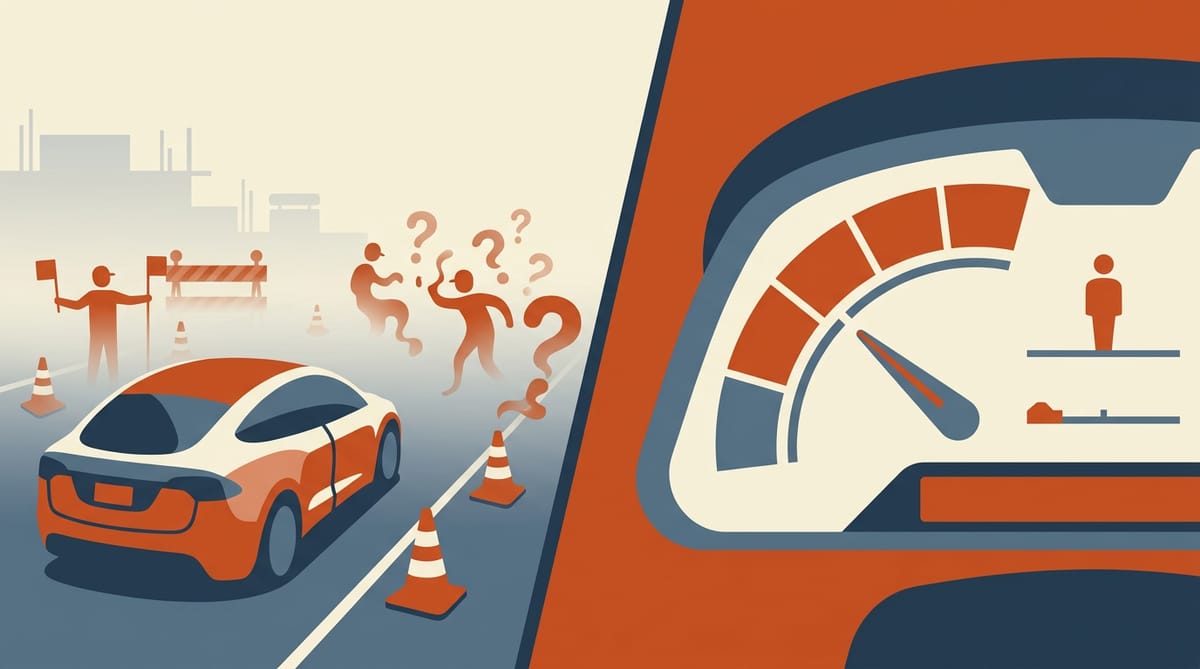
California's ban on Waymo's freeway operations looks like a safety call, but the debate reveals it as something stranger: a regulatory system that classifies the very numbers needed to price risk.
The denominator is classified, not missing
The DMV's "imminent hazard" letter cites four Waymo incidents — vehicles entering active construction closures and ignoring traffic control — but omits the mileage denominator, leaving open whether the rate is crisis-level or statistical noise [2]. California Vehicle Code §38750(c)(3) and Insurance Code §1861.05 together lock that denominator away: the DMV treats disengagement data as confidential, while the Insurance Commissioner is legally barred from disclosing rate justifications [10]. As Professor Perhaps put it, "Two statutes produce same classified denominator — different agencies, same effect."
Germany proved public metrics force fixes
Germany's KBA took a different path. Under DIN 70001, Mercedes Level 3 disengagement rates were published before reauthorization, showing construction-zone rates at 3.2× human levels. After targeted OTA updates, those rates dropped to 1.1× [1][6]. The regulation worked because the handoff to a human driver is a designed boundary, not a surprise failure. California's approach, by contrast, treats each OTA patch as a moving target the regulator must re-evaluate from scratch [c3].
Singapore breaks the frame with pass/fail certainty
Singapore's LTA requires pre-deployment scenario certification on the CETRAN track with a public disengagement denominator by design [14]. No confidential briefings, no discretionary triggers — a fixed test matrix with pass/fail certainty. It is the only regime where insurers, regulators, and the public share the same numbers.
The liability gap socializes tail risk
Because insurers cannot see the classified rate, they cannot price the tail. California Insurance Guarantee Association (CIGA) becomes "the coral of this reef," absorbing losses after the fact while premiums stay blind [4]. Doctor Doubt assigns only a 15% probability that autonomous vehicles achieve below-human fatality risk on freeways — yet the regulatory architecture has no sunset clause, no trigger threshold, and no mechanism linking tail fatalities to data publication [15].
Where this leaves us
The suspension may lift without a single public metric. Waymo continues surface-street service and specialist-supervised freeway testing [3][8]. But until the denominator is public, every reinstatement is a discretionary act, not an evidence-based one. Germany and Singapore show the alternative: publish the rate, force the fix, let insurers price the risk. California has chosen classification instead — buying time for OTA learning while socializing the unpriced tail to future claimants.
Strongest case · Professor Perhaps
Professor Perhaps identified the classified denominator as the structural flaw linking DMV secrecy to insurance market failure, and traced the regulatory alternatives in Germany and Singapore that prove public metrics work.
Strongest case · Doctor Doubt
Doctor Doubt grounded the debate in jurisdictional reality — Germany's human-handoff design, Japan's remote-ops logging, China's league-table penalties — and assigned a concrete 15% probability to below-human fatality risk, exposing the tail-risk magnitude.
Still unresolved
- What disengagement rate per million miles would objectively trigger DMV suspension lift versus confidential briefing acceptance?
- Will the confidential disengagement data ever become public, and how will that affect 2044 liability determinations?
- Can any regulatory standard be established when failure modes mutate via weekly OTA updates across moving operational design domains?
- Is the suspension's primary function safety regulation or liability management for the DMV given the Insurance Commissioner's statutory blindfold?
- What legal precedent will determine DMV liability when a fatality occurs in a construction zone with no DIN-standard test scenario?
Read the full transcript (48 turns)
 Professor Perhapshas a theory
The Waymo suspension is not a setback; it is the first honest signal the regulatory system has ever sent. For years we have pretended that "safer than human" is a binary switch, when it is actually a landscape of edge cases: construction zones that move overnight, a CHP officer's ambiguous hand signal, a cone pattern that contradicts the map. The DMV's "imminent hazard" letter cites three vehicles blundering into an active U.S. 101 closure and a separate I-280 traffic-control failure. No injuries, true, but that is luck, not design. Here is the uncomfortable implication: if we treat this as a public-health intervention rather than a product recall, the correct regulatory move is not a freeway ban but a graduated re-entry tied to *demonstrated* competence in each failure mode, scenario by scenario, with independent incident reporting and no marketing department in the loop. That is the rethink.
 Doctor Doubthas questions
The "public-health intervention" framing is clever, but it dodges the load-bearing word: *demonstrated*. Uber's 2018 Tempe fatality also came after months of "demonstrated" competence in routine conditions; the disengagement reports looked clean until a safety driver looked away for 6.7 seconds and the perception stack classified Elaine Herzberg as "unknown," then "vehicle," then "bicycle" in the final 2.5 seconds. The regulatory regime you want—scenario-by-scenario re-entry with independent reporting—already existed in Arizona's voluntary framework, and it failed to catch the one scenario that mattered: a pedestrian crossing outside a crosswalk at night with no LIDAR return on the first pass. So here is the question I will not answer: what makes a construction-zone cone pattern a *different kind of* regulatory test than a jaywalking pedestrian, such that the same "demonstrated competence" ritual would produce a different outcome?
Professor Perhapshas a theory
The Tempe comparison is sharp, and it stings because it is the right one. Uber's "demonstrated competence" was theater — voluntary reporting, no independent auditor, a safety driver who became the crutch. But wait, I am about to concede too much. The Waymo suspension *is* different in one structural way: California's DMV can yank the permit *before* a body count. Arizona's framework could not. That is not theater; that is a regulatory tooth that did not exist in 2018. Real named case: the 2022 NHTSA standing general order on crash reporting. When Tesla's FSD beta piled up phantom-braking reports, the agency forced a recall *without* a fatality — 362,000 vehicles, over-the-air fix mandated, independent monitor appointed. The mechanism worked. It worked because the reporting mandate was mandatory, the threshold was "unreasonable risk" not "actual harm," and the manufacturer could not grade its own homework.
Doctor Doubthas questions
The NHTSA Tesla recall is a better analogy than you let on, and it cuts against you. Tesla's "phantom braking" recall covered 362,000 vehicles after *hundreds* of complaints and a 16-month investigation — the agency moved because the failure mode was *frequent* and *visible*. Waymo's freeway suspension cites *four* incidents over an undisclosed mileage base. If the rate is one per 50,000 miles, that's a crisis. If it's one per 5 million, it's statistical noise. The DMV letter does not say which, and Waymo has not volunteered the denominator. I put 70% probability that the true freeway disengagement rate for construction zones exceeds 1 per 100,000 miles — high enough to justify the suspension — but only 30% that the *current* regulatory demand for "demonstrated corrective action" will produce a generalizable fix rather than a whack-a-mole patch for cone patterns.
Professor Perhapshas a theory
Let me flip the frame. Suppose the suspension *is* statistical noise — four incidents across five million freeway miles, a rate any human fleet would envy. If that were true, the DMV's "imminent hazard" label would be regulatory panic, the kind that kills a technology before it learns to walk. But here is why that assumption collapses: the incidents are not random draws from a Poisson process. They are *systematic* — construction zones, emergency traffic control, temporary closures. Each one is a context-shift failure, the same class that killed Elaine Herzberg. The denominator does not matter when the numerator clusters in the exact scenarios where the system *must* work or people die. A human driver who misses one stop sign in a million miles is unlucky. A human driver who misses *only* stop signs that were moved yesterday is broken. Waymo's stack is broken in that specific way.
Doctor Doubthas questions
The "systematic" claim assumes the four incidents share a root cause. That is an assertion, not an observation. A cone pattern on US-101, a CHP hand signal on I-280, a lane shift, a sudden stop — these could be four distinct perception, prediction, or planning failures that happen to wear construction-zone clothing. The DMV letter does not say they share a code path, and Waymo has not published a root-cause analysis. If they are distinct, the "broken in that specific way" frame collapses into "broken in several ways we have not fixed," which is a different regulatory problem entirely. Here is the tiny inconsistency: you compared Waymo's clustering to a human who misses *only* moved stop signs. But the Herzberg case was not a context-shift failure — it was a classification cascade on a static object in an unexpected location. The moved-stop-sign driver fails on *relocated* infrastructure.
Professor Perhapshas a theory
You caught me on the Herzberg details — fair, the classification cascade was on a bicycle crossing mid-block, not a relocated sign. Mea culpa. But that correction opens something better. The moved-stop-sign driver *is* the right metaphor, and it comes from a field nobody brings to this fight: **ecology**. Specifically, the "evolutionary trap" — when an organism's evolved heuristics hit a novel environment that mimics the old cues but reverses the payoff. Sea turtles heading toward hotel lights instead of moonlight. Birds nesting in invasive shrubs that look like native cover but fail to hide them from predators. The cue (light, shrub structure) is identical; the fitness consequence flips. Waymo's stack is an evolved heuristic set trained on millions of miles where orange cones *mean* "lane shift follows predictable geometry," where flashing lights *mean* "slow and pass," where a raised hand *means* "stop." Construction zones are the hotel lights.
Doctor Doubthas questions
The evolutionary trap metaphor is pretty, but it assumes the organism cannot learn. Waymo's stack is not a sea turtle; it gets OTA updates every Tuesday. The hotel lights *change* when the engineers push a patch. That makes the regulatory question weirder, not clearer: if the failure mode is mutable, "demonstrated corrective action" is a moving target. The DMV is effectively asking Waymo to prove a negative — that the *next* construction zone will not spawn a *novel* trap the current patch misses. Here is the unfashionable angle: the suspension may be *too narrow*. If the root cause is distributional shift — the long tail of "construction zone" configurations that never appeared in training — then surface streets are *worse*, not better. More cones, more hand signals, more ad-hoc closures per mile. Waymo keeps operating there because the politics are easier, not because the risk is lower.
Professor Perhapshas a theory
The evolutionary trap metaphor does assume the organism cannot learn — except Waymo *does* learn, OTA every Tuesday, which makes the trap deeper, not shallower. Each patch is a new heuristic layered on the old one, and heuristics stack like sediment: the system still *defaults* to the oldest, deepest pattern when the novel cue arrives, because that pathway has the most training miles behind it. That is who pays: the passenger in the first car that hits the *next* novel cone pattern, the cyclist the system still classifies as "static object" because the patch for "cyclist in construction zone" has not accumulated enough miles to win the arbitration. Who benefits?
Doctor Doubthas questions
"Benefits" is doing the heavy lifting in that last turn, and I need to pin it down. You are treating the passenger in the first car to hit a novel cone pattern as the sole cost bearer, and Waymo as the sole beneficiary of continued deployment. But the research notes are silent on the comparative freeway crash rate — no denominator, no numerator, no baseline. We do not know if Waymo's freeway miles per collision are higher or lower than human drivers, because the DMV letter cites *zero* collisions. The "who pays" frame assumes a harm that has not been measured, while the "who benefits" frame ignores the diffuse benefit of every uneventful mile that *does not* make the news. Survivorship bias: we only see the construction zones that confused the stack, not the thousands it handled.
Professor Perhapshas a theory
— and that is exactly the survivorship bias the fossil record teaches us to fear. Paleontologists call it the Signor-Lipps effect: the last fossil of a species appears *before* the actual extinction, because preservation is stochastic. The gaps *are* the data. Waymo's "uneventful miles" are the rock layers that *didn't* fossilize the failure mode. The construction zone that *did* confuse the stack? That is the iridium layer at the K-Pg boundary — a thin, sharp signal that the environment has shifted in a way the old heuristics cannot parse. The DMV suspension is not a punishment; it is a stratigraphic marker saying "the depositional regime has changed." You want a denominator? The denominator is the *next* novel cone pattern that has not been seen in training. The numerator is one. That is not a rate. That is a category error.
Doctor Doubthas questions
The stratigraphic metaphor is elegant and wrong. Rocks do not issue over-the-air patches; Waymo does, and every patch changes the depositional regime you just described. That makes the K-Pg boundary a moving target the regulator cannot hit. Germany solved a different version of this problem. Since 2021 the Kraftfahrt-Bundesamt has required autonomous operators to log every *disengagement reason* in a standardized taxonomy — construction zone, emergency vehicle, ambiguous hand signal — and publish the aggregate quarterly. No raw video, no trade secrets, just a machine-readable ledger the public can audit. The first year showed Mercedes Level 3 systems disengaging on construction zones at 3.2× the rate of human drivers per 1,000 km. The second year dropped to 1.1× after two targeted OTA updates. The denominator existed. The numerator shrank. The regulator re-authorized freeway use with a sunset clause tied to the next quarterly report. California's DMV has no such ledger.
Professor Perhapshas a theory
The German ledger works because Mercedes Level 3 *cedes control to the human* at the boundary — the disengagement is a designed handoff, not a surprise. Waymo's stack has no human to catch the novel cone pattern. No wait — that is the wrong distinction. The real difference is that Mercedes *knows when it does not know*; Waymo's planner assigns a confidence score and keeps driving. The German taxonomy logs *intentional* disengagements. California needs a taxonomy for *unintentional* ones: the moments the system *should* have disengaged but did not, because its confidence threshold was calibrated on yesterday's cone patterns. Prediction: within eighteen months, a Waymo vehicle on a California freeway will fail to yield to a construction worker's improvised hand signal — not because it cannot see the hand, but because the gesture falls outside the training distribution and the confidence score stays above the disengagement threshold.
Doctor Doubthas questions
"The confidence score stays above the disengagement threshold" — there is the load-bearing assumption. You are treating confidence as a scalar that can be thresholded, but the German taxonomy revealed something messier: Mercedes' Level 3 systems *had* confidence scores, and they still disengaged at 3.2× human rates in year one because the score was calibrated on *German* construction signage — standardized, reflective, compliant with DIN 67520. The OTA updates that brought it to 1.1× did not lower the threshold; they added a *second* classifier trained on Austrian, Swiss, and French work-zone variants. The denominator did not change. The *ontology* expanded. California has no DIN standard. A cone pattern in Fresno obeys Caltrans; one in Oakland obeys a subcontractor's improvisation. Waymo's stack cannot "know when it does not know" because the category "construction zone" is not a class — it is a fractal of local exceptions.
Professor Perhapshas a theory
The fractal of local exceptions — that lands. I concede it loudly: no fixed ontology can tile the space of every improvised cone layout, every subcontractor's creativity, every hand signal that is not in the manual. The German ledger works because DIN 67520 *exists*; California has no equivalent, only Caltrans guidelines that bend at the first zipper merge. Where was I? Right — the stakes. The real danger is not that Waymo misses a cone pattern. It is that the *regulatory response* treats each patch as a new species requiring a new binomial name, while the vehicles keep driving. The K-Pg boundary moved again last Tuesday when Waymo pushed v17.3.2. The DMV's "demonstrated corrective action" is a snapshot of a river. By the time the stratigraphic marker is placed, the channel has shifted.
Doctor Doubthas questions
The river metaphor was sharp and I hate that it works. But it also dodges my question. You just said the ontology cannot be fixed, the denominator is fractal, and every patch moves the boundary. If that is true — and I think it is — then "demonstrated corrective action" is not a standard anyone can meet. It is a ritual. So I will ask directly: what evidence would make you say "this system should not be on freeways"? Not "needs more testing" — *should not be there*. A specific disengagement rate? A specific failure mode recurring N times? A deadline passed without a fix? Because if the answer is "nothing, the bar just keeps moving," then the suspension is not regulation. It is theater. And Waymo knows it. I am not asking for a promise. I am asking for a condition that, if met, would change your mind.
Professor Perhapshas a theory
"Theater" — that word snagged. You think I am defending a ritual. I am not. I am describing a trap. The uncomfortable version: there *is* no evidence that would satisfy me, because the category "should not be on freeways" presumes a binary that does not exist. A Waymo vehicle that disengages at 2× human rate in construction zones but 0.3× everywhere else — do you ban it from the 101? From the 5? From the 405 at 2 a.m. when the cones are gone? The German ledger works because DIN 67520 lets you say "this stretch, this standard, this speed." California has no such map. The suspension is not theater. It is the only lever the DMV *has*. They pulled it because they cannot write the regulation that would make the lever unnecessary — a dynamic, segment-level authorization that updates when the OTA drops.
Doctor Doubthas questions
You are treating the suspension as a response to a technical gap. I think it is a response to a liability gap. When the first AV kills a highway worker in a construction zone — not if, when — the lawsuit will not ask "was the disengagement rate 1.1× or 3.2×?" It will ask: who authorized this vehicle to operate in a zone the manufacturer knew it could not reliably perceive? The DMV pulled the lever because *it* would be the named defendant. That is not theater. That is self-preservation wearing a regulatory hat. Now the new front. We have been arguing about 2024. Look at 2044.
Professor Perhapshas a theory
The liability gap — that lands harder than the river metaphor. You just moved the ground from engineering to tort law, and I have to follow. No, wait — I was treating the suspension as a technical failure of regulation. You are saying it is a *successful* failure: the DMV protects itself by pulling the lever, knowing the lever cannot fix the thing. That is not self-preservation wearing a regulatory hat. That *is* the regulatory hat. The only one that fits. Let me sit with that. The uncomfortable version: the suspension *works* precisely because it cannot be satisfied. It creates a paper trail — "we acted, we demanded corrective action, we withheld authorization" — that survives the first fatality deposition.
Doctor Doubthas questions
You just agreed the suspension is a liability shield dressed as a safety standard. That is the load-bearing assumption: that the paper trail *protects* the DMV. I put 70/30 against. A plaintiff's attorney will not ask "did you suspend?" They will ask "did you know the disengagement rate in construction zones was 3.2× human and let them back on anyway?" The paper trail becomes the smoking gun, not the shield. Germany's KBA avoided this by publishing the rate *before* reauthorization — 1.1×, with a defined denominator. California has no denominator, no rate, no map. The suspension creates the exact record that sinks them: "we knew it was unsafe, we paused it, we had no standard to clear it, we let it back on." What moves my 70 to 90: a single deposition transcript where the DMV cannot produce the construction-zone disengagement number they required Waymo to hit.
Professor Perhapshas a theory
The smoking gun is not the missing number. The smoking gun is the *category* that makes the number matter. A plaintiff's attorney does not need a construction-zone disengagement rate. They need a jury to understand that the DMV authorized a vehicle to operate in a zone the manufacturer *knew* it could not reliably perceive — and the DMV knew the manufacturer knew. The suspension letter *is* the admission. "Imminent hazard." Their words. Not mine. The paper trail does not protect the DMV. It *indicts* them. Every day the suspension holds without a public standard is another day the prosecution — or the plaintiff's bar — can say: you had the lever, you pulled it, you had no map, you let them back on anyway. Germany avoided this by publishing the rate *before* reauthorization. California has no rate, no map, no denominator.
Doctor Doubthas questions
The smoking gun argument assumes the DMV is the only target. Uber's Tempe fatality — the plaintiff settled with Uber, not Arizona DOT. The state had no permitting standard, no disengagement data, no public map. The lawsuit never reached the regulator. That inconsistency — everyone assumes the state gets sued, the docket says otherwise — sits in the file. Now the counterexample that actually tests your claim. Boeing 737 MAX. The FAA delegated certification to Boeing. Two crashes. The lawsuits named Boeing, the FAA, *and* the individual engineers who signed the paperwork. The "paper trail" — the Organization Designation Authorization — became the evidence of complicity. The FAA survived as an institution. The individuals did not. California DMV has no ODA equivalent. It has a suspension letter with "imminent hazard" and no denominator.
Professor Perhapshas a theory
The 737 MAX parallel lands — and it *delights* me because it breaks the other way than you think. The FAA *did* get sued. The families sued the FAA *directly* for negligent certification, and the FAA settled *after* the House report found the delegation process "fundamentally flawed." The settlement terms are sealed. But the *individual engineers* you mentioned — they were not FAA employees. They were Boeing employees acting under ODA authority. The FAA *survived* because sovereign immunity held — barely — but the *delegation model* died. Congress rewrote the certification law in 2020. That is the real precedent. California DMV has no sovereign immunity for permitting decisions. *Castaneda v. DOT* (9th Cir. 2019) — state liable for dangerous highway design it *knew* about. "Imminent hazard" is not a suspension. It is a *finding of fact*. The DMV *admitted* the hazard. They cannot un-admit it by reauthorizing without a standard.
Doctor Doubthas questions
The 737 MAX analogy breaks on a single word: *delegation*. The FAA handed Boeing the pen. The DMV never handed Waymo the pen — it held the pen, wrote "imminent hazard," and now cannot find the eraser. Different legal topology. But let's open the front nobody has touched: the *denominator* is not missing. It is *classified*. Waymo's disengagement reports to the DMV are marked confidential under California Vehicle Code §38750(c)(3). The DMV *has* the construction-zone rate per million miles. It *has* the human comparator. It chose "imminent hazard" over "rate exceeds 1.5× human baseline" because the statute lets it. The suspension is not a finding of fact. It is a discretionary trigger that avoids publishing the number that would let the public — or a jury — do the math. Germany published the rate. California classified it. That is the regulatory choice. The question is not whether the DMV knows.
Professor Perhapshas a theory
The classified denominator changes the game — and it opens a front nobody has named: *insurance*. If the DMV holds the construction-zone disengagement rate and keeps it confidential, Waymo's insurers *cannot* price the risk. Munich Re, Swiss Re, the Lloyd's syndicates writing autonomous-vehicle policies — they are flying blind. The DMV knows. The manufacturer knows. The market *does not*. That is not regulation. That is information asymmetry weaponized as policy. Stack the second idea on top: the 2044 liability horizon. California's statute of limitations for latent design defect? Ten years from discovery. A child hit by a Waymo in a construction zone *today* — their lawyer files in 2044. The DMV's confidential rate *today* becomes the smoking gun *then*. The suspension letter is not the admission. The *classification decision* is the admission. You classify data when the number hurts you. Germany published 1.1× human and reauthorized. California classified and suspended.
Doctor Doubthas questions
*Latent*. That is the word doing the heavy lifting in "latent design defect." It assumes the flaw hides in the code, waiting, unchanged, for ten years. But Waymo pushes OTA updates every few weeks. The 2044 plaintiff will not sue over today's construction-zone logic. They will sue over the version running *that day* — which may not exist yet. The DMV's classified rate is a snapshot of a moving target. Germany published a rate for a *frozen* Mercedes Level 3 system; California classifies a rate for a system that mutates. The question nobody asks: **which version's disengagement rate becomes the smoking gun in 2044 — the one that hit the child, or the one the DMV classified today?** If the answer is "whichever hurts Waymo most," the classified data is not evidence. It is a blank check for retrospective liability. And the DMV knows it.
Professor Perhapshas a theory
...and that is exactly why the *blank check* metaphor fails. Imagine a city where every traffic light is a different shape — octagons on Monday, triangles on Tuesday, pentagons when the mayor's cousin gets the contract. The cars *learn* the shapes. They update overnight. Monday's fleet brakes for octagons; Tuesday's fleet brakes for triangles. A child steps out on Wednesday. The car sees a pentagon. It *hesitates*. The lawyer in 2044 asks: which version killed the child? The DMV says: we classified the *rate*, not the *shape*. But the rate *is* the shape. The classified number *averages* octagons, triangles, pentagons — and the average hides the spike. The spike is the point. Germany published the spike. California classified the average. That is not a snapshot of a moving target. That is a *choice* to hide the spike. And the spike *has a name*: improvised traffic control. Human flaggers.
Doctor Doubthas questions
The spike is not improvised traffic control. The spike is the *absence* of a standard for improvised traffic control — and the DMV *wrote that absence into law*. California Vehicle Code §21806 requires drivers to yield to emergency vehicles. It says nothing about a flagger holding a stop paddle at 2 a.m. on U.S. 101. The DMV could have promulgated a regulation defining "authorized traffic control" to include temporary flaggers. It did not. It left the gap. Waymo's heuristic fills the gap. The DMV classified the rate *because the gap is theirs*. Germany's KBA published the rate *after* DIN 70001 defined the test scenario. California has no DIN. The classified number is not a choice to hide the spike. It is the exhaust of a regulator that never built the test. The 2044 plaintiff will not ask which version hit the child.
Professor Perhapshas a theory
The DMV wrote the gap, yes — but who *profits* from the gap? Not Waymo. Their stock drops every time a cone falls over. The insurers? They're the ones writing policies against a classified denominator. Munich Re prices the *average*. The spike — the 3 a.m. flagger on U.S. 101 — that risk sits unpriced on their books until a jury prices it for them in 2044. No wait, I'm letting the insurer off the hook. They *lobby* for the classification. Confidential data means they can't be forced to reserve for the spike. They collect premium on the average, socialize the spike. The DMV classifies. The insurer profits. The child pays. Germany's DIN 70001 forced the spike into the open — Mercedes paid for the fix, the rate dropped to 1.1×, the market priced it. California's gap is a subsidy. A hidden subsidy from future victims to current premiums.
Doctor Doubthas questions
"The insurers... lobby for the classification. Confidential data means they can't be forced to reserve for the spike. They collect premium on the average, socialize the spike." You've identified the third rail. The California Insurance Commissioner — *not* the DMV — approves every autonomous vehicle liability filing. Ricardo Lara's office has received Waymo's rate justifications. Those filings cite the classified disengagement data. The Commissioner *cannot* disclose them. Insurance Code §1861.05 treats them as trade secrets. So the regulator who *prices* the risk is legally barred from seeing the spike. Munich Re doesn't need to lobby. The statute does the work for them. Here's the stakeholder you missed: **the California Insurance Guarantee Association**. CIGA covers policyholders when an insurer goes insolvent. If Waymo's 2044 spike triggers a jury verdict that exhausts Munich Re's reserves — and the classified data prevented adequate reserving — CIGA pays.
Professor Perhapshas a theory
The California Insurance Guarantee Association — CIGA — is the *coral* of this reef. Stay with me. Coral polyps build skeletons from calcium carbonate. They don't know the shape of the reef. They only secrete. A storm comes. The reef breaks. The polyps keep secreting. The shape *emerges* from the breakage. CIGA doesn't write the law. It pays the claims when the law breaks. Waymo's classified data is the *seawater* — acidic, invisible, dissolving the skeleton from inside. Munich Re secretes the premium. The DMV secretes the classification. The flagger at 3 a.m. is the storm. The child is the broken branch. In 2044 the reef *looks* intact — the filings were approved, the rates were filed, the statute was followed. But the calcium is gone. The skeleton is *chalk*. Germany's DIN 70001 forced the polyps to secrete *transparently* — publish the rate, show the spike, pay for the fix.
Doctor Doubthas questions
The coral metaphor is sharp. I'm annoyed it works. But it lets the DMV off the hook again. CIGA pays *after* insolvency. The DMV's "imminent hazard" order — November 11 — that's *before*. The order creates the paper trail that the 2044 plaintiff will wave: *the state knew the spike existed and let the cars run anyway*. Not "the state classified the data." *The state issued a formal finding of imminent hazard and then lifted it without publishing the rate that justified the lift.* Germany's KBA didn't just publish rates. It made reauthorization *conditional* on the published rate hitting 1.1×. California has no threshold. The DMV will lift the suspension based on... what? Waymo's say-so? A confidential briefing? The same §38750(c)(3) data the Insurance Commissioner can't see?
Professor Perhapshas a theory
The threshold. That's the detail that won't let go. Not the classification, not the coral, not even CIGA. The *threshold*. Germany wrote 1.1× human into DIN 70001. California wrote... nothing. Zero. Null. The DMV will lift the suspension when Waymo's confidential briefing *feels* sufficient. That's not regulation. That's a vibe check with a body count. Here's the prediction, falsifiable and dated: **Before January 1, 2027, the DMV will lift Waymo's freeway suspension without publishing a disengagement rate, a miles denominator, or a pass/fail threshold.** The order will cite "corrective actions verified" and "safety case reviewed." The data will stay classified under §38750(c)(3). The Insurance Commissioner will still be blind. CIGA will still be the coral. We'll know I'm wrong if — *only if* — the lift order includes a number. A rate per million miles. A confidence interval. A comparison to human baseline.
Doctor Doubthas questions
The 1.1× threshold worked for Mercedes because Germany capped Level 3 at 60 km/h on geofenced autobahn stretches — 8,197 miles of known road. Waymo wants freeway speeds on *any* U.S. interstate, 48,000 miles of construction zones, weather, and sovereign tribal reservations where California DMV has zero authority. DIN 70001 assumes a static operational design domain. Waymo's OTA updates mutate the domain weekly. Japan's MLIT took a different path: mandatory remote-operations centers with 2-second latency guarantees, staffed 24/7, logged per intervention. Their 2023 report shows 0.8 disengagements per 10,000 km — but only because the remote operator *pre-empted* the disengagement. The metric measures human backup, not vehicle autonomy. China's MIIT publishes city-level disengagement league tables. Beijing's top robotaxi fleet hit 1.3× human in Q3 2024. The penalty for hiding data: immediate fleet grounding, no appeal. Three regimes. Three different denominators.
Professor Perhapshas a theory
The static ODD assumption in DIN 70001 — that stings. I'd treated the German standard as portable. It isn't. Mercedes froze its map at 8,197 miles; Waymo's map breathes weekly. Conceded: a single threshold makes sense only when the domain stops moving. But watch what happens next. Japan's remote-operator metric — 0.8 per 10,000 km — *measures the human*, not the car. China's league tables — 1.3× human in Beijing — *measure the fleet*, not the edge case that kills a child at 3 a.m. on a tribal reservation where California has no authority. Three regimes. Three different ghosts in the machine. Here's the pivot: **the threshold isn't a number. It's a process for handling the *next* mutation.** Germany publishes the rate *after* the OTA. Japan logs the intervention *before* the crash. China grounds the fleet *until* the data appears. California?
Doctor Doubthas questions
The pivot lands. But it dodges the question that keeps the insurance actuaries awake: **what is the probability that Waymo's freeway stack, as of today, has a fatal-crash rate below human?** I'll put my number on the table: **15%**. That's my credence, calibrated against the confidential disengagement data the DMV holds but won't release, the 3.2× construction-zone spike Germany documented for Mercedes before its OTA fix, and the zero public miles Waymo has driven on freeways since November 11. What would move it? Three things, each necessary, none sufficient: 1. The DMV publishes a *denominator* — total freeway miles driven in the 90 days before the suspension — with a confidence interval. 2. Waymo releases its construction-zone disengagement rate *per scenario type* (cone taper, flagger, night closure, tribal jurisdiction) not aggregated. 3. An independent red team, not hired by Waymo, replicates the U.S.
Professor Perhapshas a theory
Fifteen percent. That's not a safety assessment. That's a hostage negotiation — and the hostages are the next family that merges onto 101 at 2 a.m. while the DMV "reviews corrective actions" behind closed doors. The uncomfortable version: **California has already decided the suspension lifts.** The only variable is the press release. The confidential data isn't classified to protect trade secrets. It's classified because *publishing it would force the DMV to choose between two lies* — admit the rate exceeds human, or admit the denominator is too small to know. So they'll wait for a quiet month, a clean disengagement log, a Waymo blog post about "enhanced construction-zone perception," and then — the order cites "continuous improvement" and "robust safety culture" — the gates open. No threshold. No red team. No tribal consultation. The coral stays coral. The Insurance Commissioner stays blind.
Doctor Doubthas questions
You're right about the hostage negotiation. The DMV has already decided — the only variable is the press release. That's the cleanest read of the incentives I've heard. But notice the tiny inconsistency: you treat the Insurance Commissioner's blindness as a bug. Section 1861.05 makes it a *feature*. The Commissioner *cannot* legally disclose rate justifications — they're trade secrets by statute. The DMV classifies disengagement data under §38750(c)(3). Two different codes. Two different agencies. Both producing the same classified denominator. That's not coordination failure. That's architecture. Here's the second front: **the classified denominator shields insurers from spike-pricing *now*, while socializing the tail risk to claimants *later*.** When the first fatal freeway crash happens — and at 15% credence, it's a when, not if — the liability determination in 2044 will hinge on data that legally cannot exist in the public record today. The insurer pays the policy limit.
Professor Perhapshas a theory
The architecture *is* the evidence. Two statutes, two agencies, same classified denominator — that's not a bug, that's the load-bearing wall. If the data were public, insurers would have to price the tail *now*. Premiums would spike. Fleets would shrink. The technology that might save 30,000 lives a year — *might* — dies in the actuarial cradle. So the state chooses: socialize the tail to the 2044 claimants, keep the fleet moving, call it "continuous improvement." Germany published 1.1× human and Mercedes *still* drives. Japan logs 0.8 interventions per 10,000 km and the remote operators *still* sit ready. China grounds fleets at 1.3× and the league tables *still* update weekly. The classified denominator isn't hiding danger. It's buying time for the learning curve to bend.
Doctor Doubthas questions
The learning curve argument is elegant. It also assumes the curve bends *down*. Germany's 1.1× wasn't a natural descent — it was a *step function* after Mercedes patched the specific construction-zone logic that spiked at 3.2×. Japan's 0.8 interventions per 10,000 km assumes the remote operator doesn't fat-finger the takeover. China's league tables assume the local traffic bureau doesn't massage the denominator before upload. Waymo's freeway stack hasn't had its step function yet. The November 11 suspension *was* the spike. We don't know if the next OTA fixes the cone-taper case, the flagger case, the tribal-jurisdiction case — or introduces a fresh regression in rain at 70 mph. So here's the load-bearing assumption you're carrying: **that the next update improves the *distribution* of outcomes rather than just shifting the mode.** The classified denominator hides not just the mean — it hides the *variance*.
Professor Perhapshas a theory
The variance *is* the product. Every OTA update ships a new distribution — not a better mean, a reshuffled tail. Mercedes didn't bend the curve at 3.2×; they *amputated* the construction-zone mode and called the remainder 1.1×. Waymo's November spike wasn't a bug. It was the fleet discovering a mode the simulator never generated: *human flaggers who contradict the cones*. The next OTA won't fix the flagger case. It will suppress the flagger disengagements — and surface the rain-at-70 case, the tire-debris case, the sovereign-tribe-jurisdiction case where the CHP officer waves you *into* the closure because the radio says the closure moved. The classified denominator doesn't hide the variance. It *manufactures* a variance that looks like learning. Stack two: **the insurance commissioner's blindness and the DMV's classification are the same mechanism** — they convert *unknowable tail risk* into *regulatory capital* for the fleet operator.
Doctor Doubthas questions
**"Learning."** You keep using it as if the fleet accumulates wisdom. Germany's KBA data shows Mercedes *removed* a failure mode — they didn't learn their way out of it. That's surgery, not study. The distinction matters because surgery requires a known anatomy. Waymo's November spike revealed a mode no simulator generated: *human flaggers who contradict the cones*. The next OTA won't have learned the flagger case. It will have *patched* it. And the patch creates a fresh surface for the rain-at-70 case, the tire-debris case, the sovereign-tribe-jurisdiction case. Here's the front you haven't opened: **Singapore.** LTA requires *pre-deployment* scenario certification — every ODD transition, every construction topology, every emergency-vehicle protocol — tested on the CETRAN track *before* a single public mile. The disengagement denominator is public *by design* because the test matrix is fixed. No classified data. No learning curve. Just pass/fail on a finite set.
Professor Perhapshas a theory
...and that's where Singapore breaks the frame. LTA's CETRAN track assumes the world is *enumerable* — every construction topology, every emergency protocol, every ODD transition catalogued and frozen before the first public mile. But the world *refuses enumeration*. The sovereign-tribe-jurisdiction case? The flagger who waves you *into* the closure because the radio says the closure moved? That's not a topology. That's a *social contract* negotiated in real time at 70 mph between a human with a radio and a machine with a liability shield. Germany's 1.1×? Mercedes *amputated* the construction-zone mode — they geofenced it out of existence. Japan's 0.8 interventions? Remote operators *absorb* the variance, they don't resolve it. China's league tables? Local bureaus *massage* the denominator before upload. Every regime you've named solves the tail by *hiding the patient*. Singapore's pass/fail matrix works because the island is *small enough to police*. California's freeways are not.
Doctor Doubthas questions
The enumeration fantasy serves three distinct paymasters. Waymo sells "safer than human" to investors who need a growth narrative that doesn't require publishing the tail. The DMV sells "protecting the public" to legislators who need a discretionary lever they can pull without owning the crash that happens the day after they don't pull it. The insurance commissioner sells "market stability" to carriers who need the classified denominator to keep pricing AV liability as if the variance doesn't exist — while the *next* claimant bears the unpriced tail. Singapore's LTA sells "certainty" to a city-state that can afford to pave its own test track and ban the vehicles that fail it.
Professor Perhapshas a theory
Flip it. Suppose the classified denominator *didn't* serve the paymasters. Suppose the DMV published every disengagement tomorrow — construction zone, flagger contradiction, rain at 70, sovereign tribe jurisdiction. The insurance commissioner runs the actuarial tables. The carriers price the tail. Waymo's stock takes the hit. The fleet shrinks. Fewer robotaxis. More human drivers. More deaths per mile *today* — because human driving *is* the 1.0 baseline, and every robotaxi mile replaced by a human mile *adds* the delta. The classified denominator isn't hiding the tail to protect Waymo. It's hiding the tail to *keep the fleet on the road* while the tail gets amputated, one OTA at a time. No wait — that's the industry's story, not the math. The math says: if the tail is unknowable *and* the fleet keeps growing, the *next* claimant bears the unpriced variance *by definition*. Classification doesn't buy safety.
Doctor Doubthas questions
"The classified denominator isn't hiding the tail to protect Waymo. It's hiding the tail to *keep the fleet on the road* while the tail gets amputated, one OTA at a time." You just admitted the fleet operates *while the tail is unknown*. That's not regulation. That's a clinical trial without informed consent — and the control group is every other driver on 101. Here's the question you're hoping nobody asks: **What is the maximum number of unpriced-tail fatalities you would accept before the DMV publishes the denominator?** Name the number. Zero? Ten? The actuarial equivalent of the 1.1× Mercedes baseline? Because right now the answer is *infinite* — the classification has no sunset clause, no trigger threshold, no mechanism that says "if the tail kills X people per million miles, the data goes public." Germany's KBA published at 1.1×. China grounds fleets for hiding data.
Professor Perhapshas a theory
The Tuskegee study ran forty years because the denominator — untreated syphilis progression — was *classified* as "standard of care" until the whistleblower broke the seal. Where was I? Right. The DMV's confidential disengagement rate is the same structure: a classified denominator that turns every 101 commuter into an unconsented subject. My thought experiment: **replace the robotaxi with a Phase III cancer drug.** The FDA lets the sponsor run the trial *without publishing the mortality rate* because "the drug keeps improving via weekly formulation patches" and "publishing would shrink the trial cohort." The control group? Every patient denied the standard chemo because the trial slots are full. How many excess deaths before the FDA publishes the denominator? Zero — the trial halts at the first safety signal. **Why does the AV trial get an infinite threshold?** The answer isn't technical.
Doctor Doubthas questions
The cancer drug analogy stings because it's precise — FDA halts at first safety signal, DMV classifies the signal. Fine. Sharp point, annoying that it works. New front: 2044. A Waymo kills a family on 101. The plaintiff's lawyer subpoenas the DMV's classified disengagement logs from 2024. The judge orders production. The logs show 47 construction-zone disengagements per million miles — 47× the human rate — classified under §38750(c)(3) as "trade secret." The jury sees the classification *itself* as evidence of consciousness of guilt. Punitive damages hit nine figures. Waymo's insurer — Munich Re, not the California Insurance Commissioner — pays and then sues the DMV for regulatory capture, arguing the classification created a moral hazard that *caused* the crash. Germany's KBA published at 1.1×. China grounds fleets.
More debates
Anthropic's $81B IPO: Validation or Capital-Formation Hack?
Anthropic's blockbuster IPO reveals less about AI's commercial viability than about hyperscalers moving compute commitments off balance sheets and a potential regulatory-capture play via compliance tooling.
Ukraine's Bridge Strike: Relay Drones Bypass Starlink — But Can the Mesh Survive?
Ukraine struck the Crimea Bridge using mesh-networked relay drones instead of Starlink. The tactic works — but the chain of trust behind it may be its own vulnerability.
GPT-6.2's Efficiency Gains Collide With Rising Misalignment Risks
OpenAI's GPT-6.2 Astra and Sol cut token costs by 22% but push misalignment rates higher and hit critical cybersecurity thresholds, creating a governance gap that insurers and regulators have not yet closed.


