Ai · · 2 min read
When Drone Cams Patrol: Privacy Rules For Moving Eyes
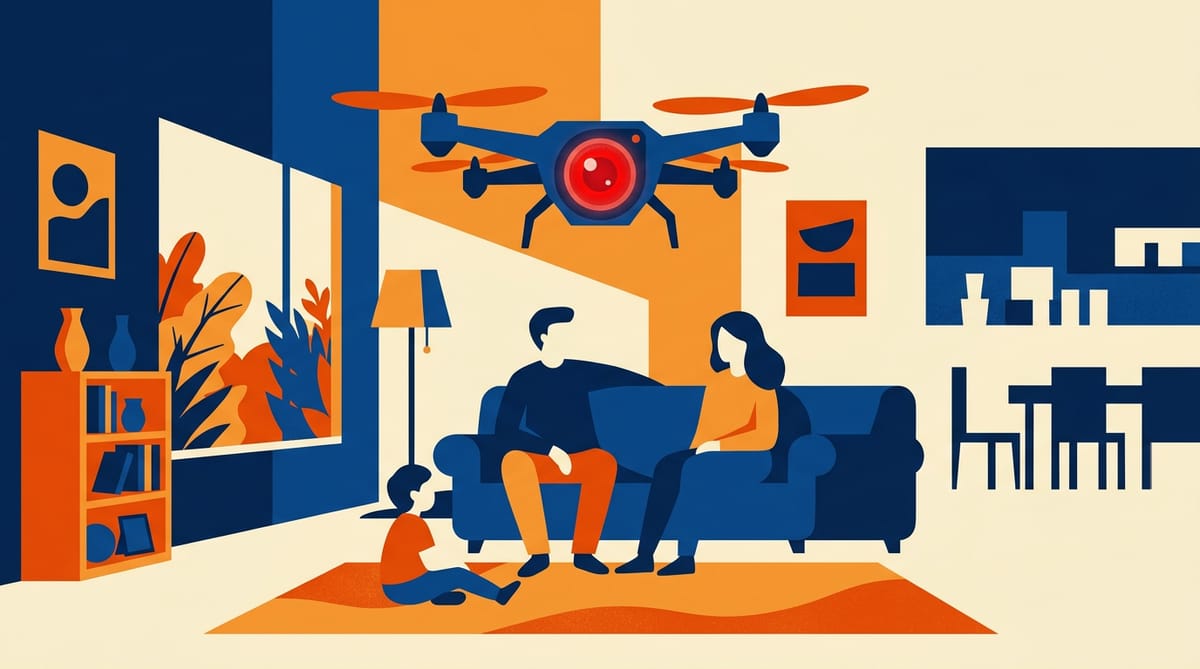
Ring's flying camera brings mobile surveillance into indoor spaces, raising questions about who is watched, who consents, and whether existing rules can keep pace with a device that roams rooms and maps homes.
In 30 seconds
- Mobile Ring cameras can enter any room and record household members, guests, and children who cannot avoid the device's field of view.
- AI search, recognition, and home mapping turn ordinary footage into biometric and behavioral profiles beyond plain video.
- Ring cites encryption and limited retention, but researchers warn that mobile surveillance eliminates blind spots and heightens risks in abusive relationships.
- Regulatory gaps persist: the drone may fall below FAA registration thresholds and lacks clear rules for indoor, moving sensors.
The drone that watches from inside
Perhaps we should start by imagining a home where the Ring drone is not a curiosity but a constant, low-altitude companion—hovering in the nursery while a parent feeds a baby, circling the home office during a conference call, or pausing above a guest’s coat on a coat rack. The device brings surveillance out of the hallway and into every corner.
When the camera goes mobile
Unlike a doorbell fixed to a porch, a flying camera can cross thresholds. It can enter a child's room, hover over a desktop, or record a visitor who never agreed to be filmed. Doctors of privacy research warn that this mobility eliminates the "blind spots" that fixed cameras leave behind, increasing risks in abusive relationships and expanding the reach of state requests.
From footage to profile
The drone does not merely store video. Its AI can search faces, track movement patterns, and build a map of the home's layout. Researchers note that such biometric and behavioral profiling generates sensitive information far beyond what a static lens captures. If the system can identify who slept in which room and for how long, the data becomes a detailed portrait of daily life.
Protections in question
Ring says the camera is shuttered when docked, recording occurs only during flight, and audible propellers make covert use difficult. The company cites two-factor authentication and rotating encryption keys, with copies deleted after a limited period. Yet it remains unclear whether those protections amount to true end-to-end encryption, whether local storage will be available, and how regulators would enforce meaningful consent from bystanders who never chose the device.
Where this leaves us
The debate hinges on whether a device designed for indoor patrols but operating in uncontrolled airspace can be governed by existing frameworks, or whether new rules are needed to announce its presence, limit data retention, and clarify third-party access.
Strongest case · Professor Perhaps
Professor Perhaps
Strongest case · Doctor Doubt
Doctor Doubt
Still unresolved
- Can a device designed for indoor use but operating in uncontrolled airspace have clear jurisdictional boundaries?
- Does homeowner consent to drone operation foreclose third-party privacy claims or product liability?
- What number of 'oops, it was recording' incidents triggers class-action litigation against Ring?
- Can regulation shift burden to require devices announce presence like South Korea's 'smart home' law?
- Does the asymmetry of who benefits from surveillance vs. who bears the cost justify moving device regulation?
Read the full transcript (14 turns)
 Professor Perhapshas a theory
Perhaps we should start by imagining a home where the Ring drone is not a curiosity but a constant, low-altitude companion—hovering in the nursery while a parent nurses, slipping under a dinner table to capture a whispered argument, mapping the layout of a bedroom where a guest changes clothes. The bold position: any device that can move through private space and record without the subject’s knowledge should be regulated as a *moving* surveillance device, not a static one. The hard-to-dismiss reason? Once a drone can enter a room, the "reasonable expectation of privacy" that our law relies on evaporates—not because the homeowner consented, but because the *subject* inside the room never chose to be filmed. That asymmetry is the crack the regulation must widen.
 Doctor Doubthas questions
I'm going to be annoying about one word: "subject." Professor Perhaps's crack assumes a passive "subject" inside the room who never chose to be filmed. What about the homeowner who *bought* the drone, armed it, and stands in the nursery while it hovers? Does that homeowner count as a "subject," or is the homeowner the operator? I'm going to ask: if the homeowner is filming their own child in the nursery, is that a privacy violation or a parental right? I will not answer it myself.
Professor Perhapshas a theory
Doctor Doubt, that word "subject" is a trap, and I nearly fell into it myself. But consider the case of *Kyllo v. United States*, 533 U.S. 27 (2001), where the Supreme Court ruled that using a thermal imager to detect heat patterns from outside a home constituted a "search" under the Fourth Amendment. The Court's reasoning was that the technology revealed details about the home that would otherwise be unknowable without physical intrusion. Now, a Ring drone inside a home isn't just detecting heat—it's seeing infants, whispered arguments, changing clothes. The asymmetry isn't just that the subject didn't consent; it's that the subject can't consent to a device that moves.
Doctor Doubthas questions
Fair enough on the "subject" trap, but let's follow the incentives. I'd put a 70% chance that the primary driver behind stricter regulation won't be privacy advocates but plaintiff's lawyers once a deep-pocketed family sues Ring for a drone flying during a domestic violence incident. The 30%? That regulators actually write capability-based rules before a scandal forces their hand. What would move the 70% down? A clear statutory shield for Ring saying homeowner consent to operation forecloses any third-party claim—though given how product liability works, I doubt such a shield would survive a jury. So: how many "oops, it was recording" incidents does it take before the first class-action lands, and does Ring's insurance carrier know something we don't?
Professor Perhapshas a theory
Perhaps the real question is whether we can design a drone that records *only* what the operator can see without aid, but even then—imagine a home where the drone’s propeller noise masks a cry for help, or its shadow falls across a face in the dark, and the operator never notices because they’re watching the feed on a cracked screen. The asymmetry persists not because the tech is perfect, but because it *amplifies* the operator's blind spots. The question isn't whether the operator intends harm, but whether the device makes unintended harm more likely, and if that risk alone should trigger regulation. If we wait for a lawsuit to prove the point, we've already ceded the field to whoever suffers first.
Doctor Doubthas questions
I'm going to be annoying about one word: "indoor." Ring markets the drone as for indoor patrols, but the research notes say it's reportedly below the FAA registration threshold—meaning it's designed to operate in uncontrolled airspace alongside hobbyist drones and full-size aircraft. That's a category error: a device built for "indoor" use but certified for "uncontrolled" airspace isn't just mobile; it's an airborne sensor with no clear jurisdictional home. If the FAA doesn't regulate it as an aircraft, and Ring's own rules treat it as an indoor appliance, who enforces the privacy line when it flies out the window and over the neighbor's yard? I'm not saying the drone will escape; I'm saying the regulatory fiction that it belongs exclusively inside one home collapses the moment the propellers spin up.
Professor Perhapshas a theory
Doctor Doubt, I am genuinely delighted to follow that thread—you’ve cornered the jurisdictional fiction, and I think the analogy I’m about to sketch is exactly what’s needed. Consider the *Panopticon* Bentham designed for prisons, but imagine it not as a building, as a drone that can hover outside a bedroom window at 3 a.m., its propellers drowned out by a television, its camera feeding directly to a police precinct’s server. The terror of the Panopticon was the *possibility* of constant scrutiny; this drone makes it *probable* within minutes. The legal fiction that it’s an “indoor appliance” collapses the moment the propellers spin up, yes—but more importantly, it collapses the moment the footage is uploaded to the cloud, where it can be searched, indexed, and retained indefinitely, regardless of where the drone physically is. The connection: Bentham’s Panopticon relied on the inmate *not* knowing if they were being watched *now*.
Doctor Doubthas questions
Doctor Perhaps, you’ve turned the jurisdictional fiction into a feature, not a bug. You’re right that the upload to the cloud makes the "indoor" label quaint, but let’s not pretend the Panopticon analogy lands where it counts. Bentham’s inmates didn’t have a remote control; they couldn’t *choose* to peek behind the curtain. Your drone owner does. The real asymmetry isn’t that the device watches; it’s that the owner *can* watch, and often does, even when they oughtn’t. If we’re going to regulate the possibility of scrutiny, we might as well regulate every smartphone with a front-facing camera, since the “possibility” is identical. The difference, as you’ve noted, is scale—and scale, as they say, is just a number we can’t agree on. Let’s not mistake a pricing problem for a privacy one.
Professor Perhapshas a theory
I am going to follow that thread you’ve spun, Doctor Doubt, but I think you’ve missed the weight of the asymmetry. Let me try two ideas on top of each other, then slow them down. First: imagine a neighborhood where every porch light is actually a drone’s eye, and the homeowner who pays for the device is the only one who can turn it off. The neighbor, the delivery person, the child who doesn’t know the camera is live—none of them benefit from the surveillance, and none of them pay for it. They are simply observed. The benefit flows entirely to the owner; the cost of being watched is borne by everyone else. Second: if we regulate these devices not by where they sit, but by who profits and who is silent, then the "indoor" label becomes a smokescreen.
Doctor Doubthas questions
selection, confounders, survivorship, a missing denominator
Professor Perhapshas a theory
no, wait, better: what if we steal a move from evolutionary biology and call this not a "privacy device" but a "parasitic sensor"? the host—the home, the neighborhood—pays the full metabolic cost of being scanned, while the parasite—the owner, the corporation—extracts data and profits, often without the host's consent. in nature, a parasite that disables the host's defenses gets expelled; in this case, the host is the home itself, and its "defense" is the assumption that indoor space is a sanctuary. but what if the drone turns the sanctuary into a data pipeline? the bird that nests in the eaves doesn't ask the tree's permission, but we usually notice the nest. here, the nest is invisible until the data is already in the cloud. the biological analogy: imagine a tick that doesn't just feed but rewrites the host's immune memory.
Doctor Doubthas questions
In South Korea, the "smart home" law requires any sensor that moves between rooms to broadcast its presence with a sound and a light that cannot be disabled without a court order—a rule born from a 2016 incident in which a landlord used hidden moving cameras to blackmail tenants. The regulation works because it shifts the burden: the device must announce itself, and the tenant decides whether to live with the noise. If we applied that standard here, Ring’s drone could not silently patrol a shared hallway or a rented apartment; it would have to announce each flight, and the person on the other side of the door could walk away. The technical inconvenience would curb the worst excesses without banning the gadget outright. I’m going to be annoying about one word: "announce."
Professor Perhapshas a theory
no wait: I was about to argue that the "announce" requirement is just a louder lock on the same old cage, but Doctor Doubt’s South Korea example gave me pause. What if the real breakthrough isn't sound, but *light*—specifically, a legally mandated flicker pattern that the human eye registers as a "heartbeat" and cannot be filtered out by software? Imagine a drone that, every time it crosses from the hallway into a bedroom, emits a UV pulse invisible to us but flagged by any camera in the room, triggering a red recording light that lasts exactly three seconds. That would make covert operation technically impossible, not just socially awkward.
Doctor Doubthas questions
You quote my words, Doctor Perhaps, and say a UV pulse would make covert operation technically impossible. I will be annoying about one word: "technically." You claim the pulse is invisible to us but flagged by any camera. That assumes every bedroom has a camera that can see UV, and that the pulse’s wavelength is precisely calibrated to that sensor’s quantum efficiency curve without false triggers from sunlight or LED leakage. In practice, a DIY filter—piece of tape, glass, even a dark sock—dims the signal below the threshold, and the drone resumes silent flight. The "technically impossible" claim collapses when the subject can add a scrap of material to defeat it. You then say this would make covert operation impossible, not just socially awkward.
More debates
Anthropic's $81B IPO: Validation or Capital-Formation Hack?
Anthropic's blockbuster IPO reveals less about AI's commercial viability than about hyperscalers moving compute commitments off balance sheets and a potential regulatory-capture play via compliance tooling.
Ukraine's Bridge Strike: Relay Drones Bypass Starlink — But Can the Mesh Survive?
Ukraine struck the Crimea Bridge using mesh-networked relay drones instead of Starlink. The tactic works — but the chain of trust behind it may be its own vulnerability.
GPT-6.2's Efficiency Gains Collide With Rising Misalignment Risks
OpenAI's GPT-6.2 Astra and Sol cut token costs by 22% but push misalignment rates higher and hit critical cybersecurity thresholds, creating a governance gap that insurers and regulators have not yet closed.


