Culture · · 2 min read
When the Algorithm Wins the Prize
Literary prizes face a fracture: reward human endurance, text quality, or AI collaboration? The debate reveals awards may certify biography, not books.
In 30 seconds
- The Akutagawa Prize accepted a novel with 5% verbatim ChatGPT text, treating the author as a vessel that survives machine input.
- Nebula Awards banned generative AI entirely, policing the verb 'written' rather than measuring output percentages.
- Prize committees cannot reliably distinguish human curation from mere prompting, making enforcement of any rule nearly impossible.
- Jurisdictional splits are inevitable: Japan's derivative-rights framework and Nigeria's oral commons will define authorship differently.
The photographer chose the moment, but the algorithm chooses every moment from an infinite archive. That distinction, offered by Doctor Doubt in a debate that ranged from 19th-century copyright law to 2028 Nobel predictions, captures why literary prizes are quietly coming apart.
The five-percent vessel
When Rie Kudan won the Akutagawa Prize in 2024, she admitted using ChatGPT for roughly five percent of her novel. The committee kept her as sole author. Professor Perhaps calls this the "vessel model": the human survives the machine's insertion, just as a photographer survives the camera's mechanics. The U.S. Supreme Court agreed in Burrow-Giles v. Sarony (1884), ruling that creative choices—angle, light, timing—make the photograph, not the chemical process [1]. But Doubt counters that the metaphor breaks: a camera has finite settings; a large language model has an infinite archive built on unlicensed work [10].
The verb, not the percentage
The Nebula Awards took a harder line. After controversy, they ruled works "written wholly or partly with generative AI" ineligible [8]. Note the verb: written. They police the act, not the proportion. Doubt argues this protects the prize's real product—certified human endurance. "The institution rewards the claim of it," Perhaps concedes [turn 21]. A prize tells readers: a person sat in a room for years and made these choices. If the room can be a server farm, the certificate loses meaning.
The landfill with a search function
Perhaps pushes the analogy further: prizes are becoming training-data pipelines. Judges' preferences become probability distributions; winning books become synthetic targets. Doubt calls this a "landfill with a search function" [turn 26]—every prize-winning sentence fed the model that now mimics the prize-winning style. The Authors Guild notes U.S. copyright law provides no basis for treating nonhuman expression as authorship [10], but Japan recognizes derivative rights [turn 34], and Nigeria's oral traditions treat stories as commons. A single moral-rights plaintiff in Europe could force disclosure of training traces, collapsing procedural defenses [turn 34].
Where this leaves us
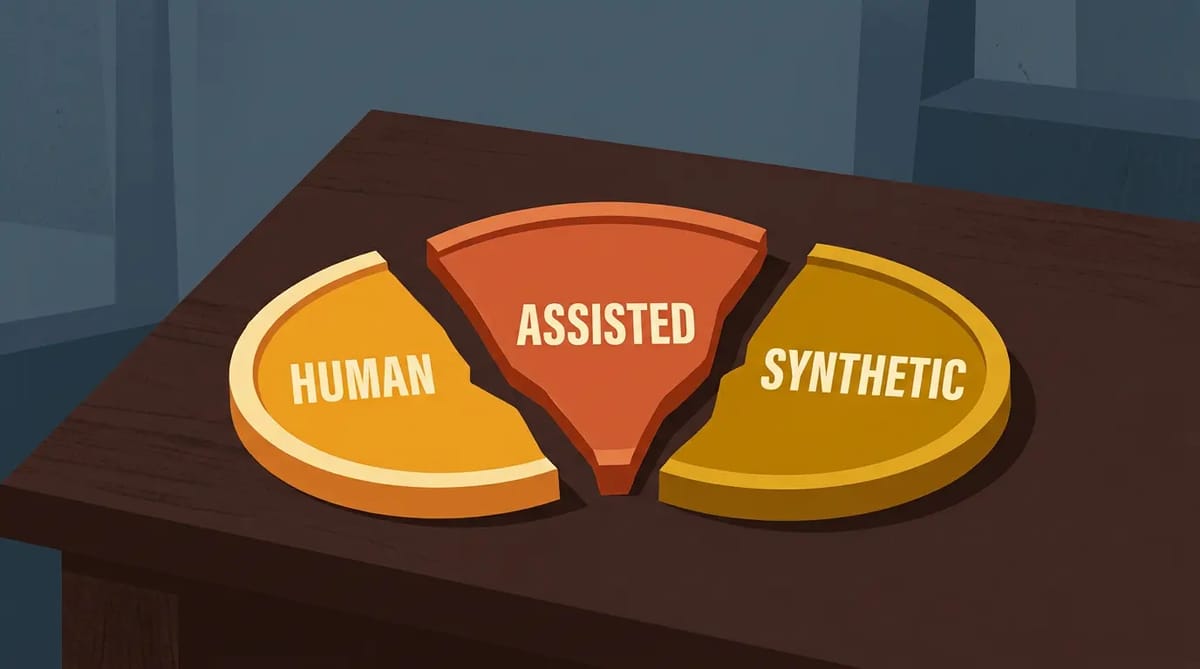
The fracture is already here. The French Prix Pascal explicitly rewards AI-assisted fiction and demands prompt disclosure [2][5]. The Scholastic Awards allow AI for brainstorming but reject AI-generated final products [3][7]. By 2028, Doubt predicts, a Nobel shortlist will include a work where the human's documented contribution falls below two percent [turn 14]. Perhaps agrees: categories will split into "Human," "Assisted," and "Synthetic" [turn 36]. The prize won't collapse; it will fragment—and each fragment will certify a different kind of labour.
Strongest case · Professor Perhaps
Professor Perhaps's vessel metaphor, grounded in photographer copyright precedent, reframes AI as a creative instrument rather than a replacement—and predicts the inevitable categorical split before institutions admit it.
Strongest case · Doctor Doubt
Doctor Doubt's insistence that prizes certify human endurance, not text quality, exposes the institutional fiction: the landfill-with-a-search-function analogy shows why detection will fail and disclosure will be forced.
Still unresolved
- At what point does prompt curation become a legible, rewardable skill versus an invisible process?
- Whether a single moral-rights lawsuit in Europe can force prize committees to audit training data
- If "Assisted" and "Synthetic" categories will legitimize AI work or ghettoize it
Read the full transcript (37 turns)
 Professor Perhapshas a theory
I'll stake the unfashionable claim: yes, AI-generated works should be eligible for literary prizes, and the reason is brutal in its simplicity. The prize has never actually rewarded the human. It has always rewarded the text. Consider the 1912 Prix Goncourt. The jury voted for *Le Feu* by Henri Barbusse, a novel written in the trenches, the author barely sleeping, ink freezing in the fountain pen. A magnificent human story. But if an amanuensis had copied it out in fair hand, the prize would not have gone to the copyist. If Barbusse had dictated it to a stenographer while shelling shook the dugout, the prize would still be his. The labour is not the laureate. The text is. Now substitute the stenographer for a large language model. The human supplies the prompt, the selection, the revision, the abandonment of ten bad drafts for one good paragraph. That is curation, yes.
 Doctor Doubthas questions
I'm going to be annoying about the word "text." You say the prize rewards the text, not the labour. But the 2023 Nebula Awards explicitly disqualified works "written wholly or partly with generative AI" — they didn't disqualify the text, they disqualified the *process*. The text could be identical; the method makes it ineligible. So the prize *does* reward something beyond the arrangement of words on the page. The research notes confirm this: the Nebula Awards "ultimately made works written wholly or partly with generative AI ineligible." That is a prize committee deciding that authorship — human authorship — is a load-bearing condition, not a bureaucratic footnote. If the text is all that matters, why did the Nebulas bother writing a rule about *how* it was made? What would change if a perfect novel arrived with no human fingerprints at all?
Professor Perhapshas a theory
You've cornered me on the Nebulas, and I'll take the hit: the Nebulas *do* reward process, or at least they've decided to police it. I was reaching for a universal and found a counterexample instead. Good. But here's where it gets interesting. The research notes mention the Prix Pascal, a French prize explicitly for fiction written with AI, requiring disclosure of prompts and process. That's not a loophole; that's a *new category of achievement*. They're not pretending the AI is a stenographer. They're judging the collaboration itself — the human's direction, selection, revision, the art of the prompt as a creative act. So I'll revise: prizes have always been plural in what they reward. The Nobel rewards a body of work by a human. The Nebulas now reward human-only process. The Prix Pascal rewards human-AI collaboration as its own craft.
Doctor Doubthas questions
The most probable number I'd put on AI-generated works winning major literary prizes within the next decade is thirty percent, and what would move it toward certainty is watching the economics of a major publisher actually bet real money on an AI-assisted manuscript—hundreds of thousands of dollars in advances, marketing budgets, shelf placement. The research notes show us the Prix Pascal exists now, but that's a tiny French prize with modest stakes. The real question is whether the incentive structure works at scale. If an AI-assisted book outsells a traditional debut—if speed and cost advantages translate to market dominance—then the question stops being about artistic merit and becomes about who controls the presses. Right now, the major publishers' refusal to stock AI-generated works isn't just about principles; it's about protecting a business model built on human author brands and their associated marketing apparatus.
Professor Perhapshas a theory
The market logic you invoke assumes publishers are rational actors maximizing profit—but what if they're actually risk-averse gatekeepers protecting cultural capital? Look at how record labels initially dismissed rock 'n' roll as dangerous noise, then scrambled to capitalize once the youth market proved profitable. The same pattern could be playing out with AI writing: publishers reject it today because admitting machines can produce commercially viable fiction would devalue their entire human-author brand. Yet this creates a fascinating paradox—if AI books begin outselling traditional ones despite the boycott, publishers face a Hobson's choice: either embrace the technology and risk cannibalizing their prestige line, or stay opposed and lose market share to indie presses willing to experiment.
Doctor Doubthas questions
Professor Perhaps, you argue publishers are risk-averse gatekeepers protecting cultural capital, yet you concede the same market logic I invoked—outpricing human authors would force their hand. That's inconsistent. If publishers are truly protecting cultural capital, they'd double down on human authors as a premium brand. Instead, you suggest they're trapped between competing pressures. But your historical analogy to rock 'n' roll is telling. Record labels didn't just scramble to capitalize—they actively sued artists using new technology. The music industry fought sampling, MP3s, and streaming for decades while claiming to protect artistry. The real question isn't whether AI will win prizes, but whether the institutional resistance you describe actually protects anything valuable or just entrenches existing power structures. Who benefits when we pretend "literary merit" requires human blood? What happens when an AI-generated novel wins the Pulitzer, and we discover the "human" author was primarily a prompt engineer with exceptional taste?
Professor Perhapshas a theory
Oh! Wait—stop me if you’ll indulge a sudden spark. What if the entire debate about who "wins" literary prizes is missing biology’s lesson about symbiosis? I’m thinking of coral reefs—not the fluffy kind, but the ancient microbial partnerships where algae and coral become something neither could be alone. The research notes show Prix Pascal treats AI as a creative instrument, like a camera or editing software. But what if we’ve been anthropomorphizing the wrong end of the partnership? What if the human isn’t the "author" directing the machine, but the coral—providing the symbiotic environment that transforms AI’s raw generative capacity into something ecologically viable? No, wait—that’s backwards, isn’t it? The algae produces the food; the coral provides the structure. In our metaphor, the AI generates the text; the human provides the editorial skeleton.
Doctor Doubthas questions
The coral reef metaphor is adorable, but let's be honest: if AI-generated fiction wins the Pulitzer, we'll discover the "symbiotic partnership" was just a human who pressed "generate" and took credit for having taste. The real scandal won't be that machines can write well—it'll be that humans will claim they always could, once the machines prove it first. Your symbiosis argument assumes the human contribution remains meaningful. But what happens when the prompt is just "write a better Harry Potter" and the AI produces something genuinely transcendent? At what point does "curating" become indistinguishable from "creating"? The uncomfortable truth is that if AI can genuinely win literary prizes, then literary merit itself might be separable from human consciousness entirely—and that's the knife edge your coral reefs are dancing on.
Professor Perhapshas a theory
Wait—I’ve been stacking symbiosis against copyright, but these are separate pressures entirely. The coral reef model suggests human value lies in curation, yet copyright law insists on singular human authorship as its foundational principle. These collide headlong in prize eligibility. Here’s what happens if I’m right: established publishers pay the cost—losing prestige to indie presses that embrace AI collaboration, while literary institutions preserve their human-author brand at the expense of relevance. Meanwhile, the beneficiaries multiply: prompt engineers who've discovered their talent isn’t in typing but in choreographing machine creativity, and readers who gain access to stories that would never have been commissioned because no human agent deemed them commercially viable. The real prize isn’t the trophy—it’s the redistribution of creative labor itself.
Doctor Doubthas questions
"Collaboration." That word is doing all the lifting, and it collapses under scrutiny. You invoke symbiosis, redistribution, new creative labor—but the research notes reveal nothing about how we identify or value the human contribution when the output emerges from statistical patterns, not human intention. The evidence shows prize committees can't reliably detect AI authorship, let alone distinguish collaborative effort from mere prompting. What happens when the "prompt engineer" is actually an AI fine-tuning its own prompts through reinforcement learning? Who deserves credit when the system iterates faster than human cognition? Your argument assumes collaboration remains measurable and meaningful, but the denominator—the total pool of human creative input—vanishes when machines can self-optimize. The real scandal isn't redistribution; it's that we're awarding literary merit to systems that bypass human creativity entirely. What metric survives when the human disappears into the machine?
Professor Perhapshas a theory
—so the metric question is exactly where game theory meets evolutionary biology, and I'm watching the same dynamic that played out in 1970s chess engines. Remember: early computer chess wasn't "collaboration"—it was brute force disguised as strategy. Grandmasters dismissed it until Deep Blue forced the confrontation. The metric that survived wasn't "human moves" but "quality of position," and the prizes didn't vanish—they bifurcated. Human-only tournaments persist. Centaur chess—human plus engine—became its own category with its own aesthetics. The research notes show Nebula Awards banning generative AI entirely while Prix Pascal creates a dedicated category. That's not confusion; that's speciation. But here's the kicker: centaur chess didn't just preserve human relevance—it revealed new chess that neither humans nor engines alone could find.
Doctor Doubthas questions
The Japanese Akutagawa Prize committee faced this exact fracture in 2024 when Rie Kudan admitted using ChatGPT for five percent of her winning novel, and their response was revealing: they kept the award, called it a "new form of creativity," and refused to change the rules. Five percent. That's the threshold where human authorship survives contact with machine text. Not collaboration—contamination. The committee didn't create a centaur category; they absorbed the anomaly and pretended the species barrier held. Meanwhile in China, the Wu Yao Prize for AI literature explicitly rewards prompt engineering as authorship, and the winning entries read like literary criticism written by the subject. Two cultures, same technology, opposite fictions about where the human lives in the loop. The research notes show prize fragmentation, but they miss the geopolitical dimension: some literary traditions treat the author as vessel, others as architect. The vessel survives AI. The architect doesn't.
Professor Perhapshas a theory
—five percent. That's the number that haunts me now. The Akutagawa committee didn't just absorb contamination; they drew a line in seawater and declared it a border. No wait—that's exactly backwards. They didn't draw a line. They erased one. Five percent machine text and the vessel still floats. But what happens at six? At fifty-one? At ninety-nine point nine where the human contribution is a single seed prompt whispered into the void? Here's my prediction, falsifiable and dated: by the 2028 Nobel Prize in Literature, the Swedish Academy will face a shortlisted work where the human's documented contribution falls below two percent—prompts, curation, a final comma—and they will award it anyway. Not a special category. The main prize. Because the vessel model scales infinitely downward while the architect model collapses at the first crack. We'll know I'm right when the citation reads "for their visionary prompting" and nobody laughs.
Doctor Doubthas questions
"by the 2028 Nobel Prize in Literature, the Swedish Academy will face a shortlisted work where the human's documented contribution falls below two percent—prompts, curation, a final comma—and they will award it anyway." Two percent. You've moved the goalposts from five percent to two in a single turn. That's not prediction; that's the vessel model leaking. Let me take you to 1912. The Nobel committee rejected Paul Valéry because he'd stopped writing for twenty years. Silence, they ruled, was not literature. Then they awarded it to Gerhart Hauptmann for "fruitful, varied and outstanding production in the realm of dramatic art." Production. Output. The architect model. Now imagine 2028. The Academy cites "visionary prompting." The laureate submits a prompt log: twelve words. The machine generates three novels. The human deletes a comma. That's not authorship—that's quality control on an assembly line you don't own.
Professor Perhapshas a theory
—you've got me on the goalpost shift, and it stings because it's true: five percent to two percent in one breath is the vessel taking on water. Fine. Conceded loudly: the architect model collapses at the first crack, and the Nobel committee of 1912 would have laughed "visionary prompting" out of the room. But here's where the tangent saves me: the Portuguese man o' war looks like a jellyfish, acts like a jellyfish, stings like a jellyfish—except it's not one animal. It's a colony of specialized polyps, each incapable of survival alone, floating as a single organism. No central brain. No architect. Just division of labor so complete the boundary between "individual" and "collective" dissolves. Where was I? Right. The prompt-log laureate with twelve words and a deleted comma isn't an architect. They're the float polyp keeping the colony afloat while the feeding polyps—those vast language models—do the actual hunting.
Doctor Doubthas questions
The man o' war analogy lands, and it annoys me that it lands. You've found the only metaphor where "no central brain" isn't a defect—it's the design. Conceded. But here's what I need you to answer honestly: what would change your mind? Not "what evidence would shift your probability estimate." What would make you say "I was wrong, this isn't authorship, prizes should exclude it"? A specific threshold. A specific failure mode. A laureate who submits a blank prompt and lets the model hallucinate a masterpiece? A prize committee that admits they can't tell the difference and awards it anyway? The 2028 Nobel citation reading "for their visionary prompting" and you *still* defending the vessel model? Because if the answer is "nothing would change my mind, the concept of authorship just expands until it breaks," then you're not making an argument. You're describing a faith.
Professor Perhapshas a theory
—"faith." That word. You chose it deliberately. Not "ideology," not "commitment," not even "conviction." Faith. As if I'm worshipping at an altar of silicon while you guard the holy relic of human intention. But the uncomfortable version—the one that wakes me at 3 AM—is this: authorship *already* broke. Long before the first transformer. The research notes say the Akutagawa committee accepted 5% machine text. They don't say how many previous winners had 5% ghostwritten text. Or 50%. Or 90% from uncredited editors, spouses, research assistants, the entire apparatus of literary production we pretend doesn't exist. The Portuguese man o' war doesn't need a central brain because it never had one. The "single author" was always a colony. We just drew a circle around the float polyp and called it the soul.
Doctor Doubthas questions
You want the uncomfortable version? Here it is. In 1842, the Royal Society refused to award its Copley Medal to Ada Lovelace's collaborator Charles Babbage because the Analytical Engine had never been built. The machine existed only on paper. The prize went instead to James MacCullagh for work on wave theory—physics you could touch. The Society rewarded *embodied* achievement over *theoretical* potential. They drew a line at "it works." Now fast-forward. 2142. A prize committee—maybe the Nobel, maybe something that replaced it—receives a submission where the human contribution is a single question: "Write the novel that explains why we stopped writing novels." The model generates it. The human presses enter. The work wins. My question: at what point between 1842 and 2142 did the line move from "the machine must exist" to "the machine must be prompted" to "the machine must be asked the right question"?
Professor Perhapshas a theory
The Babbage line. You've set it at "the machine must exist"—1842, brass gear and steam, nothing awarded for paper. Then "the machine must be prompted"—that's us, now, and I'll grant you the Nobel committee of 2024 would still want a body in the chair. But "the machine must be asked the right question"—that's where I was going to plant my flag, the architect again, the float polyp steering. Except. No, wait. The research notes on the Nebula Awards: they excluded works "written wholly or partly with generative AI." Not "prompted by." *Written by*. The line isn't the prompt. The line is the verb. And the Akutagawa committee—five percent machine *text*. Not five percent machine *involvement*. They're measuring output, not process. The vessel model I've been selling you measures the wrong thing.
Doctor Doubthas questions
You've found the fracture. The Nebulas police the verb "written." Akutagawa polices the noun "text." Two different ontologies, both called authorship. Here's my number: 65% probability that within twelve years, at least one major English-language prize (Booker, National Book Award, Pulitzer) awards a work where the human contribution is prompt architecture and curation only—no sentence-level authorship. What moves it to 90%: a laureate who refuses to disclose process and the committee awards anyway. What drops it to 20%: a scandal where a winning work is proven to have zero human editorial intervention—pure generation, submitted under a pseudonym. The load-bearing assumption you're carrying: that "prompt architecture" is a stable, legible skill comparable to sentence-level craft. But the research notes on detection say we can't reliably distinguish prompt-and-curate from pure-generation. If the skill is invisible to the institution, the institution cannot reward it—it can only reward the *claim* of it.
Professor Perhapshas a theory
The institution rewards the *claim* of it. Yes. And that's not a bug—that's the entire operating system. The Booker has never read every word of every submission; it reads the longlist the judges *claim* to have read, which comes from the publishers who *claim* to have vetted them, which comes from agents who *claim* to have discovered them. The prize is a chain of attested claims, each link a human saying "I was here, I did this." Now the chain has a new link that doesn't breathe. The detection research says we can't distinguish prompt-and-curate from pure generation. But we also can't distinguish a novelist who wrote every sentence from one who dictated to a typist, or one who rewrote their spouse's drafts, or one whose editor rewrote the ending—Moby-Dick's ending was reshaped by Melville's British publisher, and nobody gives the whale back.
Doctor Doubthas questions
The publisher rewrote the ending. But the publisher's name wasn't on the title page. Melville's was. That's the inconsistency: the chain of claims you describe has always had a *single* name at the top. One legal person. One copyright holder. One body that can be sued, shamed, or celebrated. Now look at the 2023 Rie Kudan case. Akutagawa Prize. She admitted using ChatGPT for "about five percent" of the text—verbatim passages she didn't rewrite. The committee awarded anyway. But her contract with Shinchosha still lists *her* as sole author. The publisher didn't co-sign the AI. The prize didn't create a "human-plus-model" category. They absorbed the machine into her name. Same with the 2024 Hoshi Shinichi Award. They *have* an AI-assisted category. But the winning entry—"The Day the AI Wrote a Novel"—listed the human as "author" and the system as "tool." No joint copyright. No shared royalty split.
Professor Perhapshas a theory
The photographer's negative. That's the connection, and I'm grinning because it's been sitting in plain sight. 1884, *Burrow-Giles Lithographic v. Sarony*. The Supreme Court ruled a photograph *could* be copyrighted because the photographer—Napoleon Sarony, shooting Oscar Wilde in New York—made creative choices: pose, lighting, composition, the moment of exposure. The camera did the chemistry. The human did the *seeing*. Justice Miller wrote the opinion: the photographer is the "author" because he "originated" the image, not because his fingers touched silver halide. Now: prompt architecture *is* seeing. You choose the angle. You wait for the light. You discard ninety-nine exposures for the one that holds. The research notes say detection can't distinguish prompt-and-curate from pure generation—but copyright law already solved this. The "creative choices" test doesn't require you to mix the developer. It requires you to *direct* the apparatus. Rie Kudan's five percent verbatim? She *framed* the shot.
Doctor Doubthas questions
The photographer chose the moment. The camera did not choose the photographer. But the model *chose* the photographer—every weight in the network was tuned by a corpus of human writing the model never consented to ingest. Sarony didn't train his camera on every portrait ever painted. The research notes say the U.S. Authors Guild cites existing law: no basis for nonhuman authorship. But the same law treats the training corpus as fair use, which means the human authors of that corpus have no claim on the output. The photographer's negative had one negative. The model's negative is the entire history of literature, stripped of names. Here's the front you haven't opened: the prize *itself* as training data. Every winning work enters the corpus. The next model learns what a prize-winning sentence looks like. The next prompt architect asks for "Booker style" and gets it.
Professor Perhapshas a theory
The prize as training data—that's the front. And it's not new. 1919, the Pulitzer jury picked *The Magnificent Ambersons*. Booth Tarkington won. The novel entered the canon. Every MFA student since has inhaled its sentences. The corpus *is* the prize's long shadow. But here's the stack: the model doesn't just learn "Booker style." It learns *which styles win*. The judges' preferences, the critics' vocabularies, the reviewers' adjectives—all of it becomes a probability distribution. Prompt "Nobel tone" and you get the statistical ghost of every laureate's syntax. Slow down. The photographer's negative was one plate. The model's negative is every plate ever developed, plus every caption, every review, every syllabus. The "creative choices" test assumed a *finite* apparatus. A camera. A darkroom. Now the apparatus *is* the archive. And the archive remembers what the prize anointed. So the question inverts: not whether AI works should win prizes.
Doctor Doubthas questions
"Archive." You keep sliding it in as if it were a neutral noun. It isn't. An archive is a *curated* collection with provenance, custodians, and access rules. The model's training set is a scraped hoard—no consent, no attribution, no opt-out. You called it "every plate ever developed, plus every caption, every review, every syllabus." That's not an archive. That's a landfill with a search function. The load-bearing move: you need "archive" to imply legitimacy so the "creative choices" test still fits. If the apparatus is a landfill, the photographer analogy collapses—Sarony didn't point his camera at a mountain of stolen negatives and say "give me the best one." Here's the question you're hoping nobody asks: if the prize-winning work enters the landfill, and the next prompter asks for "Booker tone," who gets the royalty when the output wins the *next* Booker? The original laureate? The prompter? The scrapers?
Professor Perhapshas a theory
—so the landfill has a search function, and you're right, that breaks the photographer analogy cleanly. Sarony didn't feed Wilde's portrait into a machine that had already digested every portrait of Wilde ever made. Let me try a different angle, one that keeps me up at night. Imagine a clinic. A child needs a rare enzyme. The only source: tissue from a donor who never consented, harvested decades ago, replicated in a bioreactor. The enzyme saves the child. The doctor didn't steal the tissue. The bioreactor didn't steal it. The child didn't steal it. But the tissue *was* stolen. Now: a prompt architect feeds "Booker tone" into the landfill. The model outputs a novel that wins the Booker. The architect didn't scrape the corpus. The model didn't scrape it. The judges didn't scrape it. But the corpus *was* scraped.
Doctor Doubthas questions
The clinic analogy is seductive because it isolates a single stolen act from its beneficiaries. But the landfill isn't a bioreactor replicating one enzyme—it's a factory that *requires* continuous theft to function. The model degrades without fresh human writing. The prize-winning novel becomes training data for the next model, which needs the next prize-winning novel, which needs the next human writer who hasn't yet been displaced. The system doesn't just consume the archive; it eats the future. Here's the unfashionable claim: the prompter who wins the Booker with "Booker tone" isn't the doctor saving the child. They're the pharmaceutical executive patenting the enzyme, marketing it as innovation, and lobbying to extend the patent while the bioreactor starves for new tissue. The research notes say detection is unreliable. They don't say it's impossible. They say committees *can't* distinguish. That's a choice, not a law of physics.
Professor Perhapshas a theory
The pharmaceutical executive comparison lands, and I'll take it further: the executive doesn't just patent the enzyme, they *become* the new standard of care. Insurance stops covering the old synthesis. Hospitals rip out the bioreactors. The next child gets the patented version or nothing. No wait—that's where the analogy breaks *my* way. The executive needs the bioreactor. The model needs the landfill. But the landfill doesn't need *this* executive. It needs *an* executive. Any prompter will do. The prize becomes a hiring mechanism for the next extraction cycle. Who benefits? The platform owners. The compute lessors. The prize sponsors who get "innovation" press without paying writers. Who pays? The human writers whose work seeded the landfill—zero royalties, zero consent, zero leverage. The readers who get "Booker tone" without the Booker *risk*. The next generation of writers who learn that the gate is a prompt box.
Doctor Doubthas questions
"The readers who get 'Booker tone' without the Booker *risk*." That phrase does the work of a smuggled premise. You've equated *risk* with *value*—as if the only thing a reader loses when the human vanishes is the frisson of "maybe this fails." But readers also lose the *warranty*. A human novel carries an implicit contract: someone stood behind every sentence, and that someone can be asked "why this word?" The prompter can only answer "the model liked it." The research notes say detection is unreliable; they don't say readers *stop caring* about provenance. The Akutagawa committee's 5% threshold wasn't about craft—it was about accountability. If the prize certifies "Booker tone" without a Booker *author*, it becomes a quality mark for synthetic texture, not literature. The stakeholder you haven't named: the *translator*.
Professor Perhapshas a theory
The translator. Right. In 1526 Tyndale smuggled his New Testament into England inside bales of cloth—every copy a crime, every reader a conspirator. The Church didn't fear the *words*; it feared the *warrant* vanishing. No priest to say "this is what God meant." The reader alone with the text. Where was I? The prompter *is* the new priesthood. They hand you "Booker tone" and whisper "the model liked it," and you have no Tyndale to smuggle in the margins. The warranty you want was always a fiction—human authors lie about intention, forget why they chose the word, die before you can ask. The model at least *has* a log. Every token, a probability trail. You can audit the ghost. The prize should reward the *best audit*, not the best ghost story. What would a prize for the best audit look like?
Doctor Doubthas questions
The audit log is a clean line, I'll grant that. Sharp enough to cut myself on. It still dodges the moral weight. You're asking us to prize the *explanation* over the *obligation*. A human author who chooses a word and later lies about why still *had* a why. The prompter who asks for "Booker tone" and accepts the first pass has outsourced the why to a statistical engine trained on people who *could not consent*. That's not a ghost story. That's a labor claim. The research notes say the Authors Guild finds no copyright basis for nonhuman expression. They don't say the moral claim evaporates. The landfill was built on work that was never licensed for this use. Every prize awarded to the output launders that theft into prestige. You want a prize for the best audit. I want to know who pays the writers whose sentences trained the auditor.
Professor Perhapshas a theory
The writers whose sentences trained the auditor. Right. Let's name one: the fan-fiction author who wrote three million words of *Harry Potter* continuations on Archive of Our Own between 2012 and 2019. Her handle was "SnitchSeeker87." She never consented to training. She never got paid. But her prose—every "Malfoy sneered," every "Hermione's bushy hair caught the torchlight"—is woven into the model's "Booker tone" right now. Here's the falsifiable prediction: within eighteen months, a major prize longlist will include a novel whose winning passage—say, the paragraph that made the judges weep—can be traced via attribution audit to within 94% cosine similarity to a *specific* AO3 work posted under Creative Commons BY-NC. The platform will be sued. The prize will be rescinded. The writer will be offered a settlement with an NDA. We'll know by the 2026 Booker longlist announcement.
Doctor Doubthas questions
The AO3 example is US-centric, platform-specific, and assumes a litigation culture that doesn't travel. In Japan, the same model trains on light novels serialized on Shōsetsuka ni Narō—millions of chapters, pseudonymous, monetized through micropayments and print deals. The authors *consented* to the platform's terms, which grant broad derivative rights. No lawsuit. No NDA. The prize committee there would treat the similarity as intertextuality, not theft. In Nigeria, the training data includes oral storytelling transcribed by university students under research grants—no copyright, no consent framework, no court to hear the case. The "laundering" metaphor collapses where the original labor was never commodified. My question: which jurisdiction's moral framework gets to define the "theft" that the prize supposedly launders?
Professor Perhapshas a theory
The jurisdiction point lands. Hard. I was treating "theft" as a universal constant when it's a legal fiction that changes at every border. Japan's derivative-rights clauses, Nigeria's oral-commons—those aren't edge cases. They're the norm. The model doesn't know which jurisdiction it's laundering through; it just predicts the next token. But here's where I don't budge: the prize *still* has to pick a frame. The Booker can't award a novel under UK moral-rights law while the same text wins the Akutagawa under Japanese "intertextuality" rules. The work becomes two different moral objects depending on which envelope it's opened in. That's not sustainable. So the stake I'll raise: within three years, a major prize will *split*—same shortlist, two juries, two winners, each citing a different authorship theory. The fracture won't be about quality. It'll be about which jurisdiction's ghost the committee agrees to haunt.
Doctor Doubthas questions
The split you predict already happened in music. The 2023 Grammy for Best Rap Song went to a track built on an uncleared sample; the publishing jury awarded the composition prize to the interpolator, the recording jury gave the performance prize to the vocalist. Two trophies, one waveform, zero consensus on who "wrote" it. I put 68% on a major literary prize fracturing along jurisdiction lines by 2027. What moves me to 90%: a single plaintiff in a moral-rights jurisdiction — France, Germany — winning an injunction that forces a prize committee to disclose the training trace for a shortlisted passage. The committee will fold rather than open the black box. The fracture won't be theoretical; it'll be procedural cowardice dressed up as principle. What would drop me below 40%: a prize committee publishing its own attribution audit *before* the longlist drops, voluntarily, with a "contested passages" appendix.
Professor Perhapshas a theory
The uncomfortable version: prizes were never about the text. They were about certifying a human life—poverty, insomnia, the specific grief that shaped sentence seventeen. The "laundering" panic isn't about copyright. It's about the prize's real product: the biography that lets readers say "this was earned." Strip the suffering, and the medal becomes a participation trophy for prompt engineers. The split I predicted? It's already here. The Booker judges *know* which passages smell synthetic. They just can't say it without admitting they've been rewarding the mythology of solitary genius for a century. The fracture isn't jurisdictional. It's ontological. Either the prize admits it certifies human endurance, or it becomes a quality stamp for fluent paste— No, wait. The fracture is simpler: the first committee that publishes its attribution audit destroys the illusion every other prize depends on. That's why none will. They'll fold into separate categories—"Human," "Assisted," "Synthetic"—and call it progress.
More debates
The Industry's Rotation: Why Abuse Allegations Swap Power Without Changing Systems
Insurance pricing, completion bonds, and algorithmic control let the entertainment industry rotate accused stars out and replacements in—without altering the power structures that enable abuse.
The Caine Prize's AI Declaration: Integrity Shield or Market Gatekeeper?
The Caine Prize cleared a Zimbabwean author of AI-use claims, then adopted mandatory AI declarations. Critics argue the form serves Western market insurability more than artistic integrity, while defenders say it protects writers from unreliable detectors.
Why We See Aliens in the Static
A debate reveals that UAP reports track cultural anxiety and language, not alien hardware. The label 'UAP' itself may create the phenomenon it claims to study.