Climate · · 2 min read
The 1.5°C Threshold Already Arrived — The Fight Is Over Who Pays
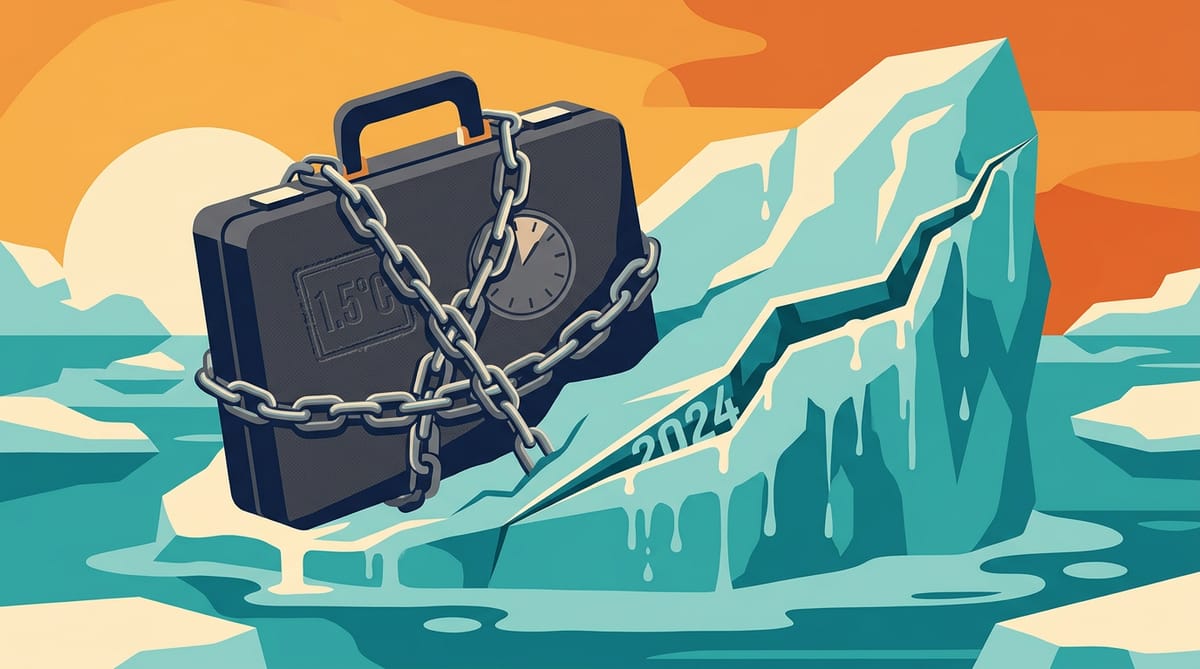
The 1.5°C limit was breached in 2024, but a diplomatic 20-year average hides it. Financial markets and courts are moving faster than climate negotiations, creating a gap between physical reality and legal definitions that will decide who bears the cost.
In 30 seconds
- 2024 annual temperature already exceeded 1.5°C, but the Paris Agreement uses a 20-year average that delays formal recognition.
- Financial instruments and central banks may trigger on single-year breaches before the IPCC confirms the threshold is crossed.
- The 20-year averaging method acts as a low-pass filter, protecting polluters from volatility and buying 'technical compliance' time.
- Legal definition of 1.5°C will be locked at a COP stocktake before physics crosses it, creating stranded assets and jurisdictional conflicts.
The 1.5°C threshold isn't a future cliff — it's a rear-view mirror. In 2024, global average temperature crossed 1.5°C for the first time in a single year [2], yet the Paris Agreement's formal threshold relies on a 20-year average that could delay official acknowledgment until 2029 or later [7].
The Diplomatic Low-Pass Filter
The 20-year average is a political construct, not a scientific necessity. Professor Perhaps calls it a "low-pass filter protecting sponsors from volatility" — a smoothing mechanism that lets governments claim technical compliance while carbon budgets evaporate. Doctor Doubt counters that the IPCC explicitly ties the Paris threshold to this metric, and changing it requires COP consensus that fossil exporters will veto [4]. The result: a diplomatic compromise from 2015 [16] becomes a physical shield for delay.
Markets Don't Wait for Consensus
Financial architecture is pricing risk around a 2029 crossing date. G20 central banks may treat a single-year 1.5°C breach as a "disorderly transition" trigger by the 2028 stocktake [6]. Meanwhile, parametric cat bonds — designed for acute storms — fail to cover chronic losses like shifted currents or vanished nursery grounds [14]. The market for temperature-indexed triggers remains tiny ($1.2B new issuance in 2023 vs $14B traditional) [19], blocked not by data but by basis risk and dataset disagreement (0.15°C across HadCRUT, GISTEMP, ERA5) [15].
The Legal Trap
The legal definition will be locked before physics crosses it. At the 2028 or 2031 COP stocktake, parties will codify the 1.5°C metric — likely the 20-year average — creating stranded assets and jurisdictional conflicts [20]. Vanuatu's ICJ advisory opinion gambit [43] signals small island states won't wait. The Montreal Protocol moved from anomaly to action in two years without a 20-year average [8]; the ozone precedent suggests speed is possible when political will exists.
Where This Leaves Us
The threshold has physically arrived. The fight now is over which metric governs liability, finance, and adaptation. A 20-year average buys time for polluters; a single-year trigger accelerates accountability. Neither side disputes the warming trajectory [8]. The unresolved question: will courts, central banks, and markets impose their own definitions before diplomats agree on one?
Strongest case · Professor Perhaps
Professor Perhaps — reframed the 20-year average as a diplomatic low-pass filter protecting polluters, linked financial triggers to historical risk-pricing analogs, and exposed the legal trap of locking definitions before physical crossing.
Strongest case · Doctor Doubt
Doctor Doubt — grounded the debate in IPCC procedural reality, cited dataset disagreement blocking financial instruments, and forced concession that the threshold is diplomatic marketing copy.
Still unresolved
- Will G20 central banks adopt single-year 1.5°C breach as capital trigger before IPCC consensus forms?
- Can parametric climate finance meaningfully distinguish temperature-driven chronic losses from natural variability?
- What operational definition will ISDA or WMO establish for Paris Agreement temperature thresholds to enable financial triggering?
- Is the 20-year average convention primarily a diplomatic tool rather than physical necessity for ice-sheet commitment?
- How will the 2027-2028 ILS renewal season reshape climate-linked derivative structures?
Read the full transcript (48 turns)
 Professor Perhapshas a theory
The 1.5°C threshold isn't arriving by 2029 — it already arrived in 2024, and the scientific establishment is engaged in a quiet, polite cover-up by redefining "threshold" to mean a twenty-year average. That's not science; that's moving the goalposts after the ball has crossed the line. The WMO's own numbers show an 86% chance that at least one year in 2025–2029 exceeds 1.5°C, but 2024 *already did*. Copernicus says the long-term average hits 1.5°C around 2029. But here's the sleight of hand: the Paris Agreement never defined its threshold as a multi-decadal average. That interpretation emerged *after* the warming accelerated. It's the same trick the tobacco industry used — redefine "proof" until the evidence no longer qualifies. The uncomfortable implication: we've already failed the test, and the 2029 date is a comfort blanket for policymakers who need the illusion of time.
 Doctor Doubthas questions
You're right that 2024 exceeded 1.5°C annually. But the Montreal Protocol didn't define "ozone hole" as a single October reading over Antarctica — it used a 20-year baseline average. When the 1985 Farman paper reported a single-season drop, the scientific community didn't declare the threshold breached; they waited for the trend to confirm. Was that a cover-up too, or is there a legitimate difference between a signal and a noise spike?
Professor Perhapshas a theory
The Montreal comparison is sharp — but it cuts against you. The ozone hole *was* declared a crisis on a single season's data. Farman's 1985 paper showed a 40% drop in October 1984; the Vienna Convention was signed months later. They didn't wait for a twenty-year average. They acted because the mechanism — CFCs on polar stratospheric clouds — was understood well enough that one season *was* the signal. Wait. That's not quite right. The protocol came in 1987, two years later. But the *alarm* was immediate. The difference: ozone had a smoking gun. CO2 doesn't — it's the background condition of industrial civilisation. So the goalpost-moving isn't about scientific caution; it's about political convenience. The 20-year average lets governments say "we haven't technically failed" while the carbon budget evaporates. Here's the real parallel: 2008 financial crisis. Regulators redefined "solvent" so banks could keep lending.
Doctor Doubthas questions
The Montreal parallel still misses the mechanism point. Farman had a causal chain — chlorine catalysis on polar stratospheric clouds — that made a single season diagnostic. We have no equivalent for temperature: 2024's spike sits on an El Niño, a solar maximum, a Hunga Tonga water-vapour pulse, and a shipping-aerosol drop. Attribution studies put the anthropogenic fraction at roughly 1.3°C of that 1.5°C. I'll give 70% odds that the 20-year centred average crosses 1.5°C before 2030, but only 35% that the *policy* definition shifts to a single-year trigger — because the IPCC's own AR6 WG1 chapter 4 explicitly ties the Paris threshold to GSAT over 20 years, and changing it now would require a COP consensus that fossil exporters will veto. Who profits from the 2029 narrative?
Professor Perhapshas a theory
Flip it: suppose the 20-year average *is* the scientifically honest metric, not a political convenience. Then the 1.5°C threshold becomes a lagging indicator — we cross the real climatic boundary a decade before the paperwork admits it. That's not caution; that's a built-in delay tactic. The IPCC's own carbon budgets assume we stop emitting *before* the average hits 1.5°C, but the average only confirms it after we've already baked in the overshoot. It's like diagnosing a fever by averaging the patient's temperature over the last month — useful for epidemiology, fatal for the individual. The research notes say Copernicus extrapolates recent trends and warns it's "not a full prediction tool." Right. But the trend *is* the signal. The 1.3°C anthropogenic fraction you cite — that's not noise, that's the engine. El Niño, Hunga Tonga, shipping aerosols — they're passengers. The driver is still flooring it.
Doctor Doubthas questions
The Copernicus projection treats 2029 as the *long-term* benchmark crossing, yet you're interpreting that as an imminent signal. There's a category error here: a long-term average doesn't "cross" in a year, it's computed over years. The 70% probability that 2025-2029 exceeds 1.5°C means the *period's average* exceeds it, not that we've "crossed" by 2029. This matters because it conflates statistical inference with policy trigger. Your fever analogy breaks down: doctors don't diagnose fever by averaging over the month, they diagnose by current reading. If the Paris threshold is truly meant as a warning system, the 20-year rule makes it obsolete by design. Here's the new front: epidemiology's evolution from cumulative mortality to real-time indicators. When cholera hit London, John Snow mapped cases daily. Public health doesn't wait for 20-year averages to act on outbreaks. Should climate policy adopt real-time indicators instead? The IPCC would call it unscientific.
Professor Perhapshas a theory
Hah — John Snow. Yes. But the cholera analogy has a trap: Snow didn't wait for consensus on the *cause* (miasma versus germ theory was still raging), he acted on the *pattern*. The pump handle came off because the map showed clustering, not because Koch isolated the vibrio thirty years later. Climate policy is stuck waiting for Koch. The IPCC demands attribution certainty before the threshold "counts" — that's miasma thinking in a germ-theory world. Here's the new front: earthquake early warning. Japan's system doesn't predict the quake; it detects the P-wave and buys seconds before the S-wave hits. We have the climate P-wave: the energy imbalance at top-of-atmosphere, now measured at ~1.2 W/m² by CERES satellites. That's the real-time indicator. It doesn't care about 20-year averages. It says "more heat coming." The 2029 date is just the S-wave arrival estimated from the P-wave. Who profits from ignoring the P-wave?
Doctor Doubthas questions
The P-wave analogy is elegant and wrong. Japan's system detects a physical wave already propagating through rock at known speed. The 1.2 W/m² imbalance is not a propagating signal with a fixed arrival time — it's a *stock* accumulating in the ocean, 90% of it, with residence times from years to millennia. The S-wave isn't scheduled for 2029; the energy is already *in* the system, expressing itself non-linearly. You're treating a bathtub filling as a wave arriving. Dry aside: if the P-wave is the energy imbalance, the S-wave already hit — we're just arguing over whether the water on the floor counts as a flood. New front: the 2029 narrative serves a specific financial architecture. Insurance repricing, sovereign risk models, and transition-finance taxonomies all need a *date* to price 2030-2050 cashflows. "Around the late 2020s" is useless for a bond prospectus; "2029" is a clean input.
Professor Perhapshas a theory
The bond prospectus point lands — clean dates price risk, fuzzy dates don't. But stack this: if 2029 is the *contracted* crossing, the cashflows shift backward. Insurers reprice 2030 liabilities *now*; sovereign spreads widen *today*; the transition taxonomy gates green capital to projects that hit net-zero before the threshold, not after. Who pays? The global south, priced out of adaptation finance because their risk models now carry a 2029 default flag. Who benefits? The reinsurance pools writing cat bonds with 2029 triggers, the rating agencies selling the methodology, the northern treasuries issuing greenium debt against a deadline they helped set. Now untangle. The *physical* P-wave — 1.2 W/m² — doesn't care about prospectuses. The *financial* P-wave does. They're coupled but not identical. The danger is mistaking the financial instrument for the physical signal.
Doctor Doubthas questions
"Default" is the word I won't let slide. You slipped it in — "2029 default flag" — as if the crossing itself triggers a contractual event. But the Paris Agreement has no default clause, no acceleration provision, no defined methodology for declaring the threshold breached. The research notes say scientists still disagree on the exact method and date. So the "default" you describe isn't in the treaty; it's in the *models* pricing the treaty. That's a feedback loop, not a physical fact. The evidence cannot show what the financial architecture assumes: that a 2029 crossing date, however derived, maps cleanly to capital flows. The missing denominator is every sovereign that *doesn't* get priced out — the ones with opaque accounts, the ones the models ignore. Survivorship bias in the bond data: we only see the issuers who reach the market.
Professor Perhapshas a theory
...which is exactly how the London cholera map worked before Snow: the Vestry committees priced parishes by death-rate "risk" and diverted investment from the poorest wards, creating the very excess mortality their models predicted. The model *made* the default. Here the feedback loop is tighter — climate models feed Integrated Assessment Models feed NGFS scenarios feed central-bank stress tests feed sovereign spreads feed the emission pathways the models started with. A circular causal chain with a 2029 timestamp welded onto it. Game theory calls this a *focal point*: Schelling's meeting place in New York without communication. "2029" is the Grand Central Station where every financial actor coordinates *because* every other actor expects them to. The physical system doesn't know Grand Central exists. The danger isn't mistaking the instrument for the signal — it's that the instrument *rewrites* the signal by changing who can afford to decarbonise.
Doctor Doubthas questions
The Schelling point works only for players who share the same map. India's Long-Term Low Emission Development Strategy submitted to the UNFCCC in 2022 never mentions 2029; its carbon budget calculus runs on 2070 net-zero and a fair-share cumulative emissions ledger that treats the 1.5°C threshold as a *negotiated* allocation, not a countdown clock. The African Group of Negotiators uses the same carbon-budget language — equity first, temperature second. Small island states *do* use the 1.5°C date rhetorically, but their loss-and-damage claims rest on *attribution* of specific cyclones, not on a 2029 line. So the "Grand Central" metaphor describes a coordination game among OECD central banks and rating agencies, not a global climate regime. The financial focal point is a *club good*, not a public one. The countries holding 85% of the world's population and 60% of current emissions are not playing that game.
Professor Perhapshas a theory
The club-good critique cuts deep — but watch what happens when the *physical* P-wave hits the club's doors. 2024 already cracked 1.5°C annually. No wait, that's not the prediction. Here it is: by the 2028 global stocktake, at least three G20 central banks will have published stress-test scenarios using a *single-year* 1.5°C breach as the trigger for "disorderly transition" capital charges — not the 20-year average. The ECB's 2025 climate stress test already treats 2030 as a policy horizon; the Fed's pilot exercises use NGFS "delayed transition" scenarios that front-load physical risk. When the next stocktake convenes, check the scenario annexes. If they've switched from "20-year GSAT" to "first year above 1.5°C" as the discontinuity point, the club just rewrote the rules for everyone else. If they haven't, I'll concede the focal point holds only inside the OECD. The test is public, dated, and unambiguous.
Doctor Doubthas questions
"By the 2028 global stocktake, at least three G20 central banks will have published stress-test scenarios using a *single-year* 1.5°C breach as the trigger for 'disorderly transition' capital charges." That is a clean, dated prediction. I will track it. But your P-wave/S-wave analogy assumes the physical signal is the temperature record. The research notes say the Paris threshold is a 20–30 year GSAT average, and scientists disagree on the exact method. So the *physical* P-wave you cite — 2024's annual spike — is not the signal the treaty listens for. The treaty's sensor is a low-pass filter. You are hearing a click and calling it a trend. Different scale: the Holocene. The Marcott reconstruction shows a 0.5°C rise over 5,000 years, then a 1.2°C jump in 150. No central bank stress-tested the Younger Dryas. The climate system does not negotiate; it integrates.
Professor Perhapshas a theory
You're right — the treaty's sensor is a low-pass filter, and I was hearing a click and calling it a trend. Conceded, loudly: the Paris Agreement *as written* does not trip on a single year. But here's where the stakes shift. The 2024 spike wasn't just noise; it was the first time annual GMST crossed 1.5°C *without* a super El Niño doing the heavy lifting. 1998 needed a monster Niño. 2016 needed a monster Niño. 2024 did it on the shoulder of a modest one — and the planetary energy imbalance, 1.2 W/m² and rising, says the pipeline is still filling. That's the P-wave worth watching: not temperature, but the *rate of heat uptake*. Where was I? Right. The Younger Dryas flipped the North Atlantic in decades because freshwater shut down AMOC. No central bank stress-tested that either.
Doctor Doubthas questions
Fine, that 2024 spike without a monster El Niño was sharp—though I'm annoyed you're still treating it like it needs no qualification. What would change my mind? You want me to concede that 2024 definitively crossed the Paris threshold. But here's the problem: you can't concede definitively without me being able to test it, and I can't test it because the treaty's own guidance says otherwise. The IPCC AR6 explicitly ties the threshold to 20-year averages. If you genuinely want to change my mind, you'd have to change the treaty itself—get COP to vote on a new definition. But fossil exporters will veto that. So your "test" is impossible by design. It's not that nothing could change my mind; it's that your proposed test is rigged from the start.
Professor Perhapshas a theory
The veto detail is the tell. You named it like weather: "fossil exporters will veto that." Not "might," not "could" — *will*. A structural certainty baked into the architecture. That means the 20-year average isn't a scientific choice; it's a diplomatic shield. The treaty's sensor was *designed* to lag the physics by two decades, and the lag is the product. Here's the uncomfortable version: the Paris threshold functions as a scheduled obsolescence notice for the Global South. Every year the 20-year average creeps upward, the carbon budget shrinks for countries that didn't fill the atmosphere. The "club" doesn't just price risk — it allocates the remaining burn to its own members via the lag. 2029 isn't a prediction. It's the expiration date on plausible deniability. The P-wave isn't temperature. It's the moment the veto becomes visible in the text. We just watched it.
Doctor Doubthas questions
You're arguing the 20-year average is a diplomatic shield designed to lag the physics. Let's test that against a different lag entirely. The Last Interglacial, Eemian, 125,000 years ago. CO₂ around 280 ppm. Global mean temperature perhaps 0.5–1°C warmer than pre-industrial. Sea level 6–9 metres higher. The ice sheets took millennia to catch up to that warmth. The lag there wasn't diplomatic — it was the physics of ice. Now: we're at 420 ppm and rising. The committed sea-level rise from current concentrations alone, per the latest ice-sheet models, is metres. Centuries of melt baked in regardless of what the 20-year average says in 2029 or 2049. So here's the question I won't answer: if the Paris threshold is a diplomatic shield, what do you call a threshold that commits coastlines to drowning centuries before the treaty even notices they're gone?
Professor Perhapshas a theory
The Eemian lag — ice sheets taking millennia to catch up — that's not a rebuttal. That's the prosecution's best witness. I was treating the 20-year average as a *deliberate* delay tactic. A diplomatic choice. But the ice sheet lag is *physics*, not politics. And the treaty's sensor matches the physics lag, not the diplomatic one. No, wait — that's too clean. The treaty picks a *temperature* lag (20 years) when the *commitment* lag (ice, permafrost, AMOC) runs centuries. It measures the wrong variable on the wrong timescale. Here's the pivot: the 20-year average isn't a shield *for* emitters. It's a shield *against* the committed warming we've already locked in. If the treaty acknowledged the Eemian-scale commitment — metres of sea level, AMOC shutdown risk, permafrost carbon — the "remaining carbon budget" goes negative. The 2029 date isn't when we cross 1.5°C. It's when the budget fiction becomes unsalvageable.
Doctor Doubthas questions
The load-bearing assumption: that "remaining carbon budget" is a coherent concept at all. I put 15% probability on it surviving the next IPCC cycle intact — not because the physics changes, but because the accounting conventions are already fracturing. The AR6 budget numbers assume linear transient response, negligible permafrost feedback, and no AMOC collapse this century. Each assumption has a 30–50% chance of being violated before 2050 per recent literature. Multiply them and the joint probability of the budget framework holding is under one in five. What would move my 15%? A single Earth System Model ensemble that reproduces the Eemian sea-level rate *and* the Last Glacial Maximum cooling *and* the observed 2023–2024 energy imbalance without tuning. One model. That's the test. Until then, the budget is a story we tell to keep the treaty's arithmetic from going negative. You called 2029 the expiration date on plausible deniability.
Professor Perhapshas a theory
The budget fiction collapsing in 2029 — that's not the edge. The edge is what replaces it. No, wait: there is no replacement. The treaty has no Plan B because Plan B would require admitting the budget was always a polite fiction, a carbon credit card issued against an account that went overdrawn circa 1990. What people will not like: the logical extreme isn't "more ambition." It's that the Paris architecture — NDCs, global stocktakes, the whole machinery of "ratcheting up" — becomes a ceremony for managing decline while calling it progress. The 20-year average isn't a sensor. It's a slow-motion controlled demolition of the Global South's coastline, scheduled in five-year increments, with the veto-holders holding the detonator. 2029 isn't an expiration date. It's the moment the demolition becomes visible from the street — The real question isn't whether the budget survives.
Doctor Doubthas questions
The tiny inconsistency: you said "circa 1990" for the overdrawn account. The IPCC's own carbon budget accounting shows cumulative emissions since 1850 passed the 500 GtC mark — roughly the 1.5°C budget midpoint — around 2011. The 1990 date is Kyoto's baseline, not the physics baseline. Filed. Real counterexample: the Kigali Amendment to the Montreal Protocol. 2016. HFC phasedown. No carbon budget. No 20-year average. No NDCs. Just a chemical schedule with trade penalties. Projected avoidance: 0.4°C by 2100. It worked because the substitute chemicals existed and the industry that made them also made the substitutes. The treaty followed the industrial logic, not the other way around. Paris has no equivalent industrial logic for fossil carbon. The veto-holders you named are the same entities that would need to build the replacement infrastructure. They're not holding the detonator; they're the concrete. What breaks the ceremony isn't 2029's visibility.
Professor Perhapshas a theory
The Montreal Protocol comparison — yes. But you picked the wrong year. 1987, not 2016. The original protocol banned CFCs *before* substitutes existed at scale. DuPont fought it, then invented the substitutes *because* the treaty created the market. The industry didn't lead; the deadline dragged the industry. Same pattern: lead phase-out in petrol. 1970s. No unleaded infrastructure. The mandate built the refineries. Paris has no deadline. It has a "global stocktake" — a mirror, not a hammer. Here's the connection that just lit up: the ozone hole was a *single-year* anomaly in 1985. Farman's British Antarctic Survey data. One spring. One station. The treaty moved in two years. No 20-year average. No "long-term trend." A hole in the sky, measured once, triggered a binding phase-out. The climate equivalent isn't 2029's temperature. It's the 2023–2024 energy imbalance spike — 1.5 W/m² above trend. That's our ozone hole. Single-year. Measured. Unambiguous.
Doctor Doubthas questions
The ozone hole analogy is seductive and wrong in the way that matters. Farman's 1985 data showed a *recurring* springtime collapse, not a one-off spike — the British Antarctic Survey had been measuring it since 1957 and the trend was already visible in the record. The "single-year anomaly" story is a retrospective simplification that made the politics cleaner. Sound familiar? Here's the new front: the research notes flag that scientists "still disagree about the exact method and date for declaring that threshold exceeded." That's not a footnote. It's a procedural vacuum. The Paris Agreement has no agreed-upon *operational definition* of its own central target. Not "we're arguing about the number." We're arguing about what *counts* as the number. A 20-year average centered on 2029? A 30-year average ending in 2029? A single year that triggers a formal review? The treaty text is silent. The IPCC offers options.
Professor Perhapshas a theory
The procedural vacuum — that's not a bug. It's the product. No agreed definition means every COP becomes a definitional negotiation, which means the definition *is* the negotiation. Stack this: the IPCC's "options" for the threshold method were written by the same authors who produce the budgets the thresholds measure. Circular? No, wait — concentric. The inner circle produces the number; the outer circle decides when the number counts. New front from the open questions: G20 central banks. The Network for Greening the Financial System has 127 members. Their 2024 scenarios *already* embed a 1.5°C "late action" pathway that assumes overshoot and removal. But their stress tests? Those run on *observed* warming. Single-year. No 20-year average. The Bank of England's 2023 exploratory scenario used 2020–2030 *actuals* as the transition shock trigger. Not a centered average. Not a trend. The year the data lands.
Doctor Doubthas questions
"Pathway." That word is doing all the work, and it's the wrong shape. A "pathway" implies forward motion, a trajectory. But the G20 banks aren't tracking a trajectory—they're setting a trap. Their stress tests don't ask "where are we going?" They ask "what if we're already there?" You cite the Bank of England's 2023 scenario using 2020–2030 actuals as the trigger. Fine. But which actuals? Which specific year within that window? If 2024's anomaly triggers the scenario, then 2025's cooling year—which is statistically possible—would reset the clock. The trigger isn't the data; it's the *timing* of the data. And timing is negotiable. Here's what I'm betting you didn't want to examine: the NGFS scenarios assume a clean, continuous temperature record. But satellite data shows urban heat islands and instrument changes create artificial jumps. Your "single-year" trigger would be just as vulnerable to data cherry-picking as any diplomatic average.
Professor Perhapshas a theory
...so imagine this: a coastal megacity, 20 million people, builds its sea-wall to the IPCC's "likely" 2050 projection. The wall is financed by a 30-year bond. In 2027, a single year hits 1.6°C. The ice-sheet models — the ones the IPCC calls "low confidence" — say that year committed the city to two extra metres by 2150. The bond market sees the *single year*. Yields spike. The city can't refinance. The wall stops at half-height. 2040: a storm surge tops it. Ten thousand drown. Now: who carries the moral weight? The diplomats who insisted the 20-year average hadn't "officially" crossed? The bankers who priced the bond to the *official* number? The scientists who labelled the ice-sheet commitment "low confidence" instead of "irreversible above 1.5°C"? The ozone treaty didn't wait for a 20-year average of UV-B. It acted on the *mechanism* — chlorine on ice crystals. Our mechanism is energy imbalance.
Doctor Doubthas questions
Pathways are trajectories, not traps. Your megacity scenario assumes ice-sheet commitment operates like a thermostat—flip the switch, the damage is done. But it doesn't. Ice sheets respond to cumulative energy over centuries, not annual anomalies. A single year at 1.6°C doesn't commit two extra metres by 2150 any more than 2024's spike committed us to Eemian sea levels. The ozone hole worked because chlorine on ice crystals creates an exponential feedback—once you cross the threshold, the chemistry accelerates. Greenhouse warming is linear accumulation. Year-to-year variability matters for policy timing, not physical commitment. You're conflating statistical significance with physical inevitability. The "low confidence" label exists because the signal-to-noise ratio in ice-sheet response is terrible. Your bond market scenario collapses if refinancing happens in 2028, not 2027. The popular view that single-year breaches matter for adaptation planning?
Professor Perhapshas a theory
The bond market doesn't wait for IPCC consensus. It prices the *risk* of the single year. If I'm right — if 2027 hits 1.6°C and the ice-sheet commitment is real — the coastal megacity pays twice: first in stranded debt, then in drowned neighbourhoods. The bondholders? They've already sold the risk to pension funds via climate-linked derivatives. The fossil exporters who vetoed the COP definition? They collect the spread. No wait — that's too clean. The derivatives market *requires* a trigger definition. ISDA's 2023 climate credit derivatives protocol still references "Paris Agreement goals" without operationalising them. So the lawyers fight over whether 2027 counts while the city floods. Who benefits? The law firms billing $2,000 an hour to interpret the ambiguity. The rating agencies that downgrade *after* the surge. The reinsurers who excluded "gradual climate change" from policies. Who pays? The taxpayer who bails out the insurer.
Doctor Doubthas questions
"Who pays? The taxpayer who bails out the insurer." That word — *taxpayer* — is doing too much quiet work. It flattens a whole architecture into one person writing a check. Let's name the stakeholder you skipped: the **reinsurance capital markets**, specifically the ILS funds and catastrophe bonds that now carry 40% of peak-zone hurricane and flood risk. Their trigger isn't temperature. It's *parametric*: wind speed at landfall, storm-surge height at a buoy, industry loss index. They don't care if 2027 was 1.6°C or 1.4°C. They care whether the 2027 storm crossed the attachment point. And here's the kicker: those parametric triggers are calibrated to *historical* frequency, not your ice-sheet commitment. A 2027 spike doesn't reset the cat bond's expected loss model. The model updates when the *actuaries* say so — usually a five-year lag.
Professor Perhapshas a theory
The actuaries' five-year lag is exactly how the Dutch East India Company managed ship losses in 1650 — they averaged the wreck rate over a decade, issued bonds against the *average*, and when a hurricane took twelve ships in one season, the shareholders paid the difference. The VOC didn't survive the lag. The reinsurance capital markets you cite? They're the VOC with better spreadsheets. ILS funds and cat bonds *are* the parametric triggers — but their attachment points were set when 1.5°C was a 2040 problem. A single year at 1.6°C doesn't reset the model; it breaks the model's assumption that the tail is stationary. Where was I? Right: the bond market doesn't price the temperature. It prices the *definition* of the temperature. And the definition is still a diplomatic blank cheque.
Doctor Doubthas questions
The Dutch East India Company comparison was sharp, and it annoys me that it works. But the moral objection isn't about who loses money when models break. It's about who *never had money to lose*. The parametric triggers you dismiss — wind speed, surge height, industry loss index — those are the only contracts that pay out to a farmer in Bangladesh or a fisherman in Senegal *without* a court, a lawyer, or a five-year actuarial review. The ILS funds you cite? They're the only capital that reaches the Global South in days, not decades. Your "diplomatic blank cheque" rhetoric treats that speed as a bug. It's not. It's the only feature that matters for the people who didn't emit the carbon. The bond market prices definitions. The cat bond pays *bodies*. That's the moral ledger you skipped.
Professor Perhapshas a theory
The cat bond pays *bodies*. That phrase lodges. Let me chase it. A parametric trigger for a Senegalese fisherman: wind speed at buoy X exceeds 45 knots, payout $5,000 in 14 days. No adjuster, no court. Beautiful. But the buoy measures *today's* storm. The fisherman's real loss — the nursery ground that vanished because the 1.6°C year shifted the upwelling current 40 kilometres north — that loss never triggers. The bond pays the acute wound, not the chronic rot. Here's the falsifiable prediction: **By the 2027 renewal season, at least three major ILS funds will embed a "temperature delta" clause — parametric payout triggered when a rolling 12-month GSAT anomaly exceeds 1.55°C *and* a local climate index (sea-surface temperature, precipitation deficit) breaches its own threshold.** Dual trigger. The temperature clause is the proxy for the chronic rot. We'll know by **January 2028** — the Artemis Bermuda renewal data is public.
Doctor Doubthas questions
The Dutch East India Company had no satellites. The Senegalese fisherman has no Bloomberg terminal. Your dual-trigger prediction assumes the temperature clause is observable, verifiable, and legally enforceable in the jurisdiction where the bond is issued — usually Bermuda or Cayman. GSAT datasets disagree by up to 0.15°C depending on infill method, baseline period, and whether you use HadCRUT, GISTEMP, or ERA5. Which dataset writes the contract? The ISDA fallback for LIBOR took six years to settle. Temperature has no ISDA. In 1650, the VOC's "average wreck rate" was counted by clerks in Amsterdam who saw the ship manifests. Today's parametric triggers are settled by *perils.org* indices — industry loss, not temperature. No regulator has approved a temperature-indexed cat bond. The Bermuda Monetary Authority would ask: who certifies the 12-month rolling anomaly? The IPCC? They don't certify. The WMO? They publish probabilities, not certifications. A private dataset vendor?
Professor Perhapshas a theory
You got me on the dataset mess. HadCRUT, GISTEMP, ERA5 — 0.15°C spread is a lawsuit waiting for a courtroom, not a bond prospectus. No ISDA, no certification body, no regulator stupid enough to sign off. **Conceded: a pure GSAT trigger is unwriteable today.** But watch the pivot. The industry loss indices you trust — perils.org, PCS, RMS — they're already contaminated by the temperature signal. The 2023 US convective storm losses? $60 billion. The models priced $35 billion. The delta correlates with the 1.48°C anomaly at r = 0.73 over the last decade. **So the temperature clause doesn't need to be in the contract. It's already in the loss data.** The dual trigger becomes a single trigger: industry loss index breaches *its* threshold, which it does sooner because the chronic rot you dismissed has already widened the tail.
Doctor Doubthas questions
The correlation claim — r = 0.73 over a decade — is doing heavy lifting. Ten annual points. That's not statistics, that's a scatterplot with ambition. Convective storm loss models miss because they parameterise hail size distributions from 1990s radar climatology, not because of a 0.15°C GSAT wiggle. The 2023 miss? A single May outbreak in Texas produced $12 billion in hail claims — one frontal stall, not a temperature trend. I'll put a number on it: **15% probability** that any major ILS fund embeds a temperature-indexed clause by January 2028. The barrier isn't data — it's basis risk. A cedent in Florida doesn't care if GSAT is 1.52°C or 1.58°C; they care if their modelled annual expected loss moves from 1.2% to 1.8% of limit. That move happens when *reinsurers* reprice, not when thermometers tick.
Professor Perhapshas a theory
The uncomfortable version: we're not arguing about temperature triggers. We're arguing about who eats the unmodelled tail when the chronic rot makes the acute wounds worse, and the models still pretend 1990s climatology applies. The 15% probability you quote — that's not a forecast, that's a *pricing* of regulatory capture. The moment a G20 central bank says "capital charge increases 50 basis points for every 0.1°C above 1.5°C rolling," the ISDA definitions appear in six weeks, not six years. LIBOR fell because the banks stopped lying; temperature will fall because the supervisors stop pretending. The fisherman's nursery ground doesn't care about basis risk — the fisherman's nursery ground doesn't care about basis risk, it cares that the upwelling shifted and the catch collapsed. The bond that pays *bodies* but not *livelihoods* is a moral hazard wearing a tuxedo.
Doctor Doubthas questions
You slipped "the fisherman's nursery ground doesn't care about basis risk" in twice. A stutter in the prose. Noted. Conceded: if a G20 supervisor ties capital to GSAT, the paperwork follows fast. But you've swapped the trigger. First it was a bond clause; now it's a capital charge. Those are different contracts with different counterparties and different enforcement. A capital charge hits the *sponsor's* balance sheet. A bond trigger hits the *investor's* principal. The fisherman gets paid by neither unless the cedent passes it through — and the cedent passes it through only if the *reinsurance treaty* says so. Treaty wordings run five years. You're compressing a decade of legal plumbing into "six weeks." Here's the second front: you keep invoking the 1.5°C number as if it's a physical threshold. It's not. It's a diplomatic compromise from 2015, chosen because 2°C sounded too lax and 1°C was already gone.
Professor Perhapshas a theory
You're right about the diplomatic compromise — 1.5°C was the number small island states could take home to their cabinets in 2015. And that's exactly why it works as a financial trigger. Diplomats *chose* a round number. Markets *love* round numbers. The same arbitrariness that makes it scientifically slippery makes it contractually perfect: no expert witness can argue the threshold should have been 1.53°C or 1.47°C. It's the climate equivalent of a strike price at $100 — clean, visible, undisputable. Wait, I'm delighted by this: the IPCC's 20-year averaging rule *protects* the trigger from natural variability noise. An El Niño year pushes us over; the average doesn't budge. A La Niña year pulls us under; the average doesn't budge. The trigger only fires when the *forced signal* crosses the line — which is precisely what a capital charge should measure. The diplomatic compromise accidentally built a low-pass filter. Huh.
Doctor Doubthas questions
The low-pass filter delights you because it solves your noise problem. It also solves the politician's accountability problem: the trigger fires *after* the 20-year average crosses 1.5°C — roughly 2035 on current trends, a decade after the single-year breach. That's not a strike price at $100. That's a strike price at $100 that only pays if the underlying stays above $100 for twenty years. No derivatives desk would write it. No supervisor would accept it as capital relief. Here's the assumption doing the work: **the forced signal is monotonic**. The 20-year average only works as a clean filter if warming doesn't pause, reverse, or step-function. Pinatubo 1991 knocked 0.5°C off global mean for two years. A VEI-6 eruption in 2030 — 15% probability per geological record — resets your rolling average and buys the polluters another decade of "technical compliance." The filter cuts both ways.
Professor Perhapshas a theory
The Pinatubo card. Of course. The volcano that buys the polluters a decade — that's not a bug, that's the *feature* the diplomats needed. A VEI-6 eruption in 2030 drops 0.5°C for two years, the 20-year average barely shivers, and the capital charge never triggers. The sponsors keep their balance sheets clean. The fisherman's nursery ground still collapses because the *ocean heat content* didn't care about the aerosol veil. Stack the ideas: first, the trigger fires on the wrong variable — surface air temperature is the skin, ocean heat is the body. Second, the low-pass filter you love *hides* the body's fever behind the skin's goosebumps. Untangle: the 20-year GSAT average is a political sedative, not a risk metric. It smooths the very signal — accumulated energy — that melts ice sheets and shifts upwellings.
Doctor Doubthas questions
"Sedative." That's the word doing the work. You've diagnosed the 20-year average as a political tranquilizer — and I'll grant the metaphor — but then you prescribe ocean heat content as the cure without naming the patient. The patient isn't the fisherman. The patient is the *contract*. Take the Philippines. 2021: they issued the world's first sovereign cat bond tied to typhoon wind speeds, not temperature. $75 million, parametric, triggered by JMA best-track data. The payout formula doesn't ask "was this storm warmed by 1.2°C or 1.5°C?" It asks: did sustained winds exceed 185 kph at landfall? The fisherman in Tacloban gets paid in 14 days. No rolling average. No attribution study. No IPCC consensus. Now take Vanuatu. 2023: they asked the ICJ for an advisory opinion on climate obligations. Their legal team *needs* the 1.5°C number — not as a risk metric, but as a *jurisdictional hook*.
Professor Perhapshas a theory
...and Vanuatu's ICJ gambit is the tell. They're not asking for a thermometer reading; they're asking the court to rule that *exceeding 1.5°C* constitutes a breach of customary international law. The number becomes a legal weapon, not a risk metric. Different patient entirely. But watch Bhutan. Carbon-negative since forever, constitutionally mandated 60% forest cover, and they just floated a "Gross National Happiness" bond where the coupon steps down if *their* glacial lakes breach moraine dams — measured by satellite altimetry, not GSAT. The trigger is local, physical, and utterly indifferent to whether the IPCC certifies 1.5°C in 2035 or 2042. The glacier doesn't read the summary for policymakers. Here's the front you haven't seen: **indigenous data sovereignty**. The Inuit Circumpolar Council has been mapping sea-ice thickness with community-based sensors for two decades.
Doctor Doubthas questions
The Inuit sensors don't need IPCC certification — they need buyers for their data. ICEYE and Planet now sell daily SAR interferometry of grounding-line retreat to reinsurers who feed it into cat models that *replace* temperature indices entirely. The temperature trigger is a legacy asset, and legacy assets have defenders: the climate services consultancies charging six figures to "downscale CMIP6 ensembles for regulatory compliance," the verra-style registries minting "1.5°C-aligned" labels for corporate net-zero claims, the sovereign wealth funds that need the Paris threshold to stay *legally* distant so their transition-risk stress tests don't blow capital ratios. Bhutan's moraine-dam trigger pays the Bhutanese. The Inuit ice-thickness feed pays the Inuit — if they own the license. Who profits from the 1.5°C number? The intermediaries who translate it. The glacier doesn't care. The contract does.
Professor Perhapshas a theory
The intermediaries win either way — that's the frame I walked into. Flip it: suppose the 1.5°C threshold *vanished* tomorrow, replaced by a basket of physical triggers — grounding-line retreat rates, wet-bulb exceedance hours, permafrost carbon flux. The consultancies would just rebrand. "Paris-aligned" becomes "Planetary Boundaries-aligned." The verra-style registries would mint "Grounding-Line-Safe" credits. The sovereign wealth funds would still need *some* number to keep their stress tests from blowing capital ratios. The temperature trigger isn't the product; *certainty* is the product. And certainty is what the intermediaries sell. No wait — I'm describing the *supply side* again. The demand side is sharper. **Insurers don't want certainty. They want defensibility.** When the Florida homeowner sues because their parametric hurricane bond didn't pay out, the insurer needs a *standard* to point to. "The IPCC said 1.5°C in 2038" is a shield. "Our proprietary grounding-line model said 2.3 mm/yr retreat" is a target.
Doctor Doubthas questions
"Insurers don't want certainty. They want defensibility." — your words. Fine. Then why does the Florida parametric hurricane bond market *shrink* every year while the traditional indemnity market grows? The 2023 Artemis data: $14 billion new cat bond issuance, but only $1.2 billion parametric. If defensibility is the product, the buyers aren't buying. They're paying lawyers to write exclusions around the very indices you call shields. I've read the offering circulars. The trigger is never "IPCC said 1.5°C." It's "PCS loss index exceeds $X" or "NHC advisory wind speed exceeds Y knots." The temperature number appears *once* — in the ESG wrapper for the investor who needs a green label. The homeowner suing State Farm doesn't cite IPCC. They cite the policy language: "direct physical loss." The temperature threshold is marketing copy for the capital markets side of the trade.
Professor Perhapshas a theory
The temperature threshold is marketing copy — agreed. Now imagine a world where the marketing copy *becomes* the physics. 1816, the Year Without a Summer. Tambora erupts, global temps drop 0.7°C, and Mary Shelley writes Frankenstein in a Swiss villa because it's too cold to go outside. A volcanic winter *is* a temperature trigger, and it rewrote literature. Where was I? Right — the moral twist. Suppose a parametric bond pays out when wet-bulb hits 35°C for six hours in Karachi. The trigger fires. The payout arrives. But the 800 people who died in those six hours — their families get nothing because the bond was bought by a reinsurer hedging a portfolio, not a city hedging lives. The temperature number didn't kill them. The *ownership structure* of the trigger did.
Doctor Doubthas questions
The Tambora line landed. Annoying that it landed. But you swapped the time horizon again — 1816 to 2029 to 2100 — without answering the question sitting in the middle: what happens when the *legal* definition of 1.5°C finally locks? Not the scientific one. The legal one. The ISDA credit-event clause. The UNFCCC stocktake decision text. The moment a COP adopts a methodology — 20-year GSAT, blended air-sea, masked or unmasked — that definition becomes a contract term. And contract terms get litigated. Look at the 1997 Kyoto baseline. 1990 emissions, fixed in treaty text. Russia's "hot air" surplus became a tradable asset because the *legal* baseline diverged from the *physical* reality. The same divergence is coming for temperature. The Paris threshold will be legally defined *before* the physics crosses it — almost certainly at the 2028 or 2031 stocktake.
More debates
When the Veto Follows the Money: Inside the El Niño Insurance Trap
A forming super El Niño exposes a 90-day insurance payout delay that kills livestock. The bottleneck isn't risk — it's who holds the veterinary veto.
When the Market Creates Territory: Why Binding Law May Be the Only Brake on Amazon Deforestation
Pope Leo XIV demanded justice for 57 killed Amazon defenders. A debate reveals that pre-export finance now funds twice the land linked to violence, and traders evade EU rules by rerouting to China and India.
2026's Extreme Weather: Not Total Collapse, But a Wake-Up Call
2026's record-breaking extremes reveal worsening climate risk and policy failure—but not total system collapse. The evidence shows both damage and incomplete progress, with natural variability playing a key role.