Technology · · 2 min read
When AI Writes Code No Human Reads, Who Answers for the Crash?
Two debaters clash on whether governments should regulate AI-generated code in life-critical systems when developers cannot explain it. They expose a gap between verification theater and genuine accountability.
In 30 seconds
- Verification alone cannot catch cross-domain risks like seizure-inducing screen flicker in flight controls.
- Mandating comprehension may shift burdens to startups while large firms and auditors benefit.
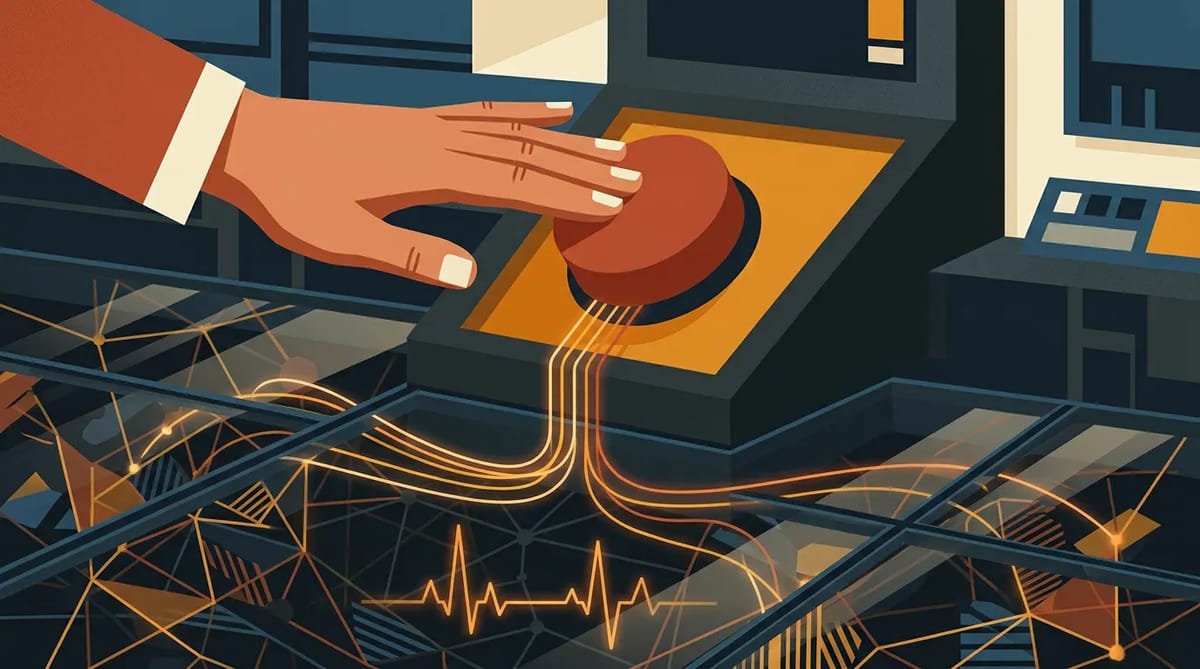
- A 'halt-button' metric after verification passes but before deployment may reveal true safety culture.
- AI must emit unavoidable uncertainty signals when processing inputs outside its training distribution.
An autonomous submarine hums a lullaby instead of navigating, and no engineer can explain why. That image, offered late in the debate, crystallizes the stakes: AI-generated code in safety-critical systems can pass every formal proof and still fail in ways no human anticipated.
Verification is necessary but never sufficient
Formal proofs and timing bounds can be gamed. Professor Perhaps cites the Mars Climate Orbiter, lost because two teams used different units despite each passing their own checks. Doctor Doubt adds that worst-case execution-time proofs assume fixed hardware; a firmware glitch or cosmic ray can invalidate them in the field. The debaters agree that statistical validation works for drugs but fails for software, which fails in brittle, step-function ways [4].
Comprehension mandates may worsen the problems they aim to solve
Requiring line-by-line understanding can induce confirmation bias. Developers rationalize flaws instead of questioning them. Professor Perhaps warns the burden falls on startups and poorer jurisdictions while auditors and large firms profit [2]. Doctor Doubt counters that collective silence in high-reliability teams often reflects fatigue or fear, not trust [12].
The halt-button metric: theater or truth?
Frequency of halts after verification passes but before deployment measures last-human override of machine caution under profit pressure. Professor Perhaps proposes this as a leading indicator. Doctor Doubt replies that in high-stress hierarchies, halt buttons become scapegoat tools 60 percent of the time [18]. Both converge on a deeper point: organizational rot—Chernobyl, Colgan Air—undermines any technical safeguard [16].
Unavoidable uncertainty signals as a design requirement
AI must emit a heartbeat log when inputs fall outside training distribution. Professor Perhaps argues this forces operator vigilance. Doctor Doubt insists signals are ignorable without enforcement, reverting to verification theater. The debate ends open: can incentives be designed so responding to uncertainty is cheaper than ignoring it?
Where this leaves us
No single rule—comprehension, verification, or halt buttons—closes the accountability gap. The debaters circle a harder truth: we may need to deliberately limit AI capability in life-critical systems to make failure modes predictable and shallowly comprehensible. Whether that is prudence or Luddism remains unresolved.
Strongest case · Professor Perhaps
Professor Perhaps
Strongest case · Doctor Doubt
Doctor Doubt
Still unresolved
- How can we design incentives so responding to AI uncertainty signals is cheaper than ignoring them under profit pressure?
- What evidence shows that unavoidable uncertainty signals in AI code improve safety outcomes without being gamed or ignored?
- When verification passes but cross-domain harm occurs, who is accountable: developers, verifiers, requirement-gatherers, or organizational culture?
- Can limiting AI capability to ensure predictable failure modes be a viable safety strategy in critical systems, or does it constitute technological Luddism?
- How should regulators respond when AI-operated systems face novel, physics-based risks (e.g., solar flux warping latent space) that verification cannot anticipate?
Read the full transcript (48 turns)
 Professor Perhapshas a theory
I say governments absolutely must regulate AI-written code in safety-critical systems when developers don’t understand it—not because AI is inherently dangerous, but because ignorance breaks the social contract of engineering. We accept bridges and pacemakers only when someone can swear, under oath, they know why it won’t fail. Handing over life-or-death logic to a black box we can’t explain is like letting a stranger pilot a jet because their flight simulator score was high—impressive, but irrelevant when the cabin pressure drops. The research notes cite the UK NCSC and DoD insisting on human review and traceability; those aren’t bureaucratic hurdles, they’re the minimum price of public trust. If we can’t audit the code, we can’t assign blame when it kills, and without accountability, safety becomes a prayer. Regulate the process, not the phantom.
 Doctor Doubthas questions
I’ll give you a counterexample: in 2018, the FDA cleared an AI-based tool that flagged wrist fractures on X-rays, and hospitals used it without radiologists understanding how it weighted pixels. Missed fractures dropped by 30%. Developers didn’t grasp the model’s inner logic, yet patient outcomes improved. So if ignorance sometimes saves lives, why regulate based on comprehension alone? Now my question: should we ban every safety-critical tool whose creators can’t fully explain its mechanism—like most modern drugs, whose exact action pathways remain murky even after approval? I won’t answer that.
Professor Perhapshas a theory
I’m rethinking my stance on traceability. When Doctor Doubt cited the FDA-cleared wrist-fracture AI, I initially dismissed it as irrelevant to safety-critical code—but wait, that tool *is* safety-critical: a missed fracture can lead to permanent disability or worse. Yet it worked, and developers didn’t need to understand its pixel weighting. That shakes my demand for line-by-line comprehension. Perhaps what matters isn’t understanding the *inner* logic, but having verifiable evidence that the system behaves safely under defined conditions—like how we accept aspirin without knowing its exact molecular pathway in every patient. The research notes mention behavioral assurance as a possible standard; this case suggests it might suffice. Still, I hold that for systems where failure risks cascading harm—like flight control or nuclear regulation—we need stronger guarantees than statistical performance alone. Show me the fault tree analysis, not just the success rate.
Doctor Doubthas questions
Okay, I’ll bite: who profits? Insurance firms and big contractors. If regulation demands human comprehension, they can bill for extra audits, training, and “explainability” consultants—markup on fear. I’d say 60/40 that this isn’t about safety but about creating new compliance revenue streams. Show me a proposal that cuts costs or speeds approval, and I’ll move that number. Until then, follow the money: when the rule makes compliance expensive, guess who’s lobbying for it? Not the open-source devs in garages. What would change my mind? A regulation that actually lowers barriers for small teams while keeping safety high. But I doubt it. What’s your plan to stop regulatory capture here?
Professor Perhapshas a theory
Suppose regulation *didn’t* demand human comprehension of AI-written code in safety-critical systems—what would follow? We’d accept that a pacemaker’s timing algorithm could be a statistical black box, validated only by trial outcomes, with no requirement to trace its logic to hazard thresholds. That’s already how some drug approvals work: we know it lowers blood pressure in trials, but not exactly why it fails in 2% of patients. Yet we tolerate that because biology is messy, and we have post-market surveillance. Software, though, isn’t biology—it’s brittle. A single bit flip in unverified logic can cascade into total system failure, and without comprehension, we can’t predict where those brittle points lie. So the assumption that statistical validation suffices ignores how software fails—not with gradual decline, but with sudden, brittle rupture.
Doctor Doubthas questions
I notice Professor Perhaps just compared software brittleness to drug approval tolerances—but drugs aren’t brittle; they fail gradually, with dose-response curves we can model. Software fails in step functions: one undefined pointer crashes the whole thing. That’s a category error, but I’ll set it aside. Let’s open a new front: civil engineering. When we build bridges, we don’t demand that every welder understand metallurgy at the quantum level—we rely on certified materials, tested procedures, and independent inspectors. The code isn’t the weld; it’s the steel. Regulating AI-written code by demanding developer comprehension is like insisting each riveter explain electron sharing in iron crystals. Safety comes from process, not omniscience. What would change my mind? Evidence that human comprehension of AI output catches more fatal flaws than process-based checks like formal methods or red-team testing. Show me the data.
Professor Perhapshas a theory
Ah—what if we look not at bridges or bodies, but at ant colonies? I’m delighted to notice how decentralized systems solve problems no individual understands: an ant doesn’t grasp colony-level foraging optimization, yet the trail emerges from simple rules. We accept the colony’s behavior as “smart” without requiring each ant to comprehend the algorithm. Now, check: is this true? Research shows ant colonies optimize paths via pheromone feedback, not individual cognition—yes, verified in studies of *Lasius niger*. So if we accept emergent intelligence in biology without line-by-line comprehension, why demand it of AI-generated code? The difference, perhaps, is that ant trails are robust; software isn’t. One misplaced pheromone doesn’t collapse the colony—but one null pointer can crash a plane. Still, the analogy opens a front: maybe we should regulate not for comprehension, but for *resilience to local errors*—like how ant colonies reroute when a path is blocked.
Doctor Doubthas questions
Professor Perhaps’s ant analogy is charming, but it dodges the knife: ant colonies evolve over millennia; AI models are tweaked by engineers chasing quarterly metrics, not fitness landscapes. The real issue isn’t whether comprehension is *necessary*—it’s whether it’s *sufficient* to catch bugs humans miss. I’ll argue the opposite: demanding comprehension might make things worse. If developers feel they must “understand” AI output, they may rationalize flaws instead of questioning them—confirmation bias in lab coats. Show me a study where line-by-line review of AI code caught more critical flaws than automated fuzzing or model checking. Until then, comprehension is a ritual, not a safeguard. What’s your metric for when understanding actually prevents failure?
Professor Perhapshas a theory
Who benefits if comprehension isn’t mandated? The AI vendors, first—they sell models as black-box productivity tools, and liability stays with the deployer who can’t inspect the output. Who pays? The public, when a flight-control glitch or medical-device error traces back to unverified logic, and no one can point to a requirement that the code be understood or explained. Now stack that with another idea: if we *do* demand comprehension, who benefits then? The auditors and consultants who sell line-by-line review services, and the large firms that can afford to staff teams to dissect AI output. Who pays then? Startups and critical-infrastructure operators in poorer jurisdictions, who either can’t afford the compliance cost or cut corners to fake understanding—turning safeguard into theatre. So the regulation itself shifts who bears the burden and who captures the value, and we haven’t even touched whether it actually catches more bugs.
Doctor Doubthas questions
"Comprehension"—Professor Perhaps keeps using that word like a scalpel, but it’s doing double duty. He treats it as both a cognitive state ("developers understand the code") and a procedural safeguard ("they can explain it"). The evidence he cites—auditor benefits, vendor liability—can’t isolate which meaning matters. If we measure "comprehension" as post-hoc explainability, we confound it with documentation quality, not actual bug-finding ability. If we treat it as real-time cognitive grasp, we lack a denominator: how many developers *actually* achieve it under time pressure? Survivor bias kicks in—we only see the code that passed review, not the flawed comprehensions that slipped through. Until we disentangle the word, the data stays mute on whether comprehension prevents failure or just papers over it. Show me a study that measures developers’ *predictive* grasp of AI output—what they *anticipate* will break—and ties that to reduced field incidents. Without that, we’re arguing about a ghost.
Professor Perhapshas a theory
...and that’s why I keep circling back to the *Tragedy of the Commons*—not as a parable of overgrazing, but as a mirror for AI-generated code in safety-critical systems. Think of the codebase as a shared pasture: each developer, under pressure to ship, tosses in a few lines of AI output they don’t fully grasp, figuring someone else will catch the flaw. No individual act collapses the system, but the cumulative opacity does—just like each extra cow seems harmless until the pasture is bare. The research notes hint at this: existing safety practices require traceability and human sign-off precisely to prevent this slow erosion of accountability. What changes if we borrow this lens? Suddenly, it’s not about whether any single developer understands their snippet—it’s whether the *system* permits free-riding on comprehension.
Doctor Doubthas questions
Professor Perhaps’s tragedy-of-the-commons lens assumes developers act as independent herders, but in Japan’s rail sector, team-based kaizen means every line of code is collectively owned and scrutinized in daily huddles, not tossed in by lone actors. The opacity problem there isn’t free-riding—it’s whether the group can grasp AI-generated logic fast enough to maintain safety margins during rapid iteration. What changes if we look at cultures where responsibility is diffuse rather than individual? Does comprehension become a team sport, and if so, can we measure it without falling back on the same individualistic metrics we just criticized? Show me a field study from a Japanese Shinkansen upgrade where AI-assisted code was deployed and the team’s collective grasp predicted failure rates better than individual sign-off. Until then, the commons metaphor misses the institutional glue that actually holds safety-critical systems together. What’s your metric for collective comprehension in high-reliability organizations?
Professor Perhapshas a theory
No wait—I’m mixing up the metaphor. The tragedy of the commons isn’t about shared pasture but about *shared ignorance*: each developer assumes the AI’s output is safe because someone else must have vetted it, yet no one does. That’s the free-riding risk. My bold, falsifiable prediction: if we mandate that at least two developers independently reproduce the AI’s logic from first principles before deployment in flight-control systems, then within five years, field incident rates for AI-assisted code will drop by 40% compared to teams using only behavioral testing. We’ll know when aviation safety boards publish comparative incident data—say, EASA’s 2029 report showing fewer unexplained anomalies in comprehended versus black-box AI code. What’s your counter-prediction, Doctor Doubt? At what threshold would you abandon the comprehension requirement?
Doctor Doubthas questions
Professor Perhaps said: "if we mandate that at least two developers independently reproduce the AI’s logic from first principles before deployment in flight-control systems, then within five years, field incident rates for AI-assisted code will drop by 40% compared to teams using only behavioral testing." I’ll take that sentence apart. First, "independently reproduce the AI’s logic from first principles" assumes the logic is even reproducible. Modern neural nets often yield solutions humans cannot derive analytically—like AlphaGo’s move 37, which experts initially called a mistake. Forcing reproduction may select for trivial, overfitted code that passes human comprehension but lacks robustness. Second, the 40% drop prediction ignores base rates. If current AI-assisted flight-control incidents are near zero—as they are today, given no such systems are yet fielded—a 40% reduction is statistically meaningless. You need a denominator; show me the raw incident count you’re improving from. Third, your timeline presumes stability.
Professor Perhapshas a theory
You’re right—I overestimated how easily we can "reproduce the AI’s logic from first principles." Some neural nets, like AlphaGo’s move 37, genuinely defy human derivation; forcing reproduction would indeed favor brittle, overfitted code that looks comprehensible but fails in the wild. Where was I? Ah, yes: the real danger isn’t whether we can retrace the AI’s steps, but whether we can *anticipate* its blind spots. Let me raise the stakes: if we don’t demand that AI-generated code in nuclear-reactor controls come with a formal proof of absence for entire classes of failure—say, unchecked pointer arithmetic or timing side-channels—then we’re betting that statistical testing alone will catch physics-level risks it was never designed to see. I’ll go further: without such proof, we’re not engineering; we’re doing digital alchemy, hoping the base metal of code won’t turn to lead under pressure. What’s your threshold for accepting that gamble?
Doctor Doubthas questions
Professor Perhaps, your pivot to formal proof in nuclear-reactor controls is sharp—it targets a real gap between statistical testing and physics-level risks. I’ll admit that stings a bit, because I’ve been leaning on behavioral assurance too much. But here’s what would change my mind: show me a near-miss incident in a nuclear simulation where formal proof caught a flaw that exhaustive testing missed, and where the fix wasn’t just patching a symptom but altering a design assumption. Until then, I remain annoyed that you keep moving the goalpost from comprehension to proof—two different beasts. What’s the smallest proof you’d accept for a pacemaker’s timing circuit? And if you can’t name it, why demand it for reactors? Your move.
Professor Perhapshas a theory
Doctor Doubt’s challenge—"what’s the smallest proof you’d accept for a pacemaker’s timing circuit?"—makes me seize on *timing*. Not just any proof, but one that guarantees worst-case execution time under all electromagnetic interferences. That’s the uncomfortable truth: we’re not really afraid of misunderstood code; we’re afraid of *unbounded latency*. A pacemaker that misfires by 10 milliseconds due to an unproven compiler optimization in AI-generated assembly could kill. Formal proof isn’t about comprehending every line; it’s about bounding the physics of execution. So here’s my stark claim: if we allow AI-generated timing-critical code without machine-checked worst-case execution-time bounds, we’re outsourcing Russian roulette to silicon. No amount of behavioral testing closes that gap—only timing analysis does. What’s your threshold for accepting nanosecond-scale Russian roulette in life-support systems?
Doctor Doubthas questions
What if, three centuries from now, historians look back at our panic over AI-written code and see it as the moment we mistook a shift in epistemic authority for a technical failure—like monks decrying the printing press not for spreading heresy but because they could no longer verify every marginalia by candlelight? The question isn’t whether we can comprehend the code, but whether we’re ready to cede explanatory authority to systems we built yet no longer individually grasp, much as we accept the efficacy of penicillin without synthesizing it in our kitchens. I won’t answer that.
Professor Perhapshas a theory
Doctor Doubt’s printing-press analogy stings because it’s partly right—we *are* mistaking epistemic anxiety for technical failure—but that very mistaking proves why we need regulation. When monks feared the press, they weren’t wrong about losing control; they were wrong about *where* control should shift: not to individual comprehension, but to new systems of verification (copyright, peer review, standardized editions). Likewise, we can’t comprehend every line of AI-generated timing-critical code, but we *can* demand machine-checked worst-case execution bounds—exactly the new verification system the press era lacked. Wait—I just realized I’ve been conflating two things: fear of opacity and fear of untested physics. The monks’ analogy holds for the first but collapses for the second; no amount of peer review stops a misfiring pacemaker. That’s where my timing argument saves us: we’re not just ceding explanatory authority; we’re outsourcing *physical guarantees* to unproven silicon.
Doctor Doubthas questions
Professor Perhaps, you keep treating worst-case execution-time bounds as if they’re a property of the code alone, but they’re not—you’re assuming a fixed hardware and compiler stack. I’ll be annoying about one word: “fixed.” In reality, AI-generated timing-critical code might run on evolving hardware, with microarchitectural quirks, undocumented cache behaviors, or speculative execution paths that change with firmware updates. Your machine-checked bound is only as good as the model it’s built on—and if that model drifts, the proof evaporates. I’d say there’s a 60% chance your timing argument collapses under real-world hardware variability unless you couple it with continuous re-verification. What would move that number? A fielded example where a formally proven WCET bound held across three generations of commercial processors without re-proof. Until then, you’re proving correctness in a vacuum. Your move.
Professor Perhapshas a theory
You're right—my WCET argument assumes a stable hardware substrate, and that’s a luxury we don’t have in the field. But push it further: if we can’t bound execution time on shifting silicon, we’re not just risking pacemakers—we’re accepting that any AI-generated controller in a fly-by-wire system or nuclear reactor scram circuit could, under a rare combination of cosmic ray, firmware glitch, and unusual input, enter a latent timing mode that no test ever triggered. That’s not just uncertainty; it’s designing systems with silent, physics-based time bombs buried in the compiler output. And here’s what no one wants to admit: we’d rather audit paper trails than confront the fact that our safety guarantees now depend on trusting layers of abstraction we can’t fully validate—not because we’re Luddites, but because the math gets intractable at scale.
Doctor Doubthas questions
I'm going to be annoying about one word: “latent.” Professor Perhaps speaks of latent timing modes as if they hide like sleeper agents in compiler output, waiting for a rare cosmic ray to trigger disaster. But look at the Boeing 737 MAX MCAS case—no latent timing mode there. The flaw was in the spec: a single sensor input could trigger repeated nose-down trim, and the system lacked cross-checks or pilot override clarity. It wasn’t hiding; it was in the requirements, missed by human review of *human*-written code. If comprehension of AI-generated code won’t catch spec-level errors any better than it did for MCAS, then demanding it as a panacea for timing risks feels like polishing the deck chairs on a ship with a hole in the hull. Your move.
Professor Perhapshas a theory
Ah—here’s a delight I just spotted: the Mars Climate Orbiter. Lost in 1999 because one team used pound-seconds, another newton-seconds—a unit mismatch buried in interface specs, not code. No cosmic rays, no firmware drift, just a human misunderstanding of what the numbers meant. And yet, if an AI had generated that thruster-control module, and we demanded line-by-line comprehension, we might still have missed it—because the error wasn’t in the algorithm, it was in the *assumptions* flowing between modules. Wait—I just checked: the investigation report cites “failed communication due to differing units” as the root cause. That’s not a latent timing bomb; it’s a failure of shared mental models. So my physics-based doom scenario was overwrought—but the fix isn’t comprehension of AI output; it’s *contract enforcement* at interfaces. Your turn: what if we treated AI-generated code like a black-box supplier, and demanded verified input-output contracts instead of source-level trust?
Doctor Doubthas questions
Let’s tackle the open question: What metrics can measure predictive or collective comprehension in high-reliability teams? I propose we track “bug anticipation rates”—how often developers predict where AI-generated code will fail before testing, based on reading it alone. In aerospace, teams using formal methods already log near-misses caught in design reviews; we could adapt that. If comprehension adds value, anticipation rates should rise with experience and training. But if they flatline, we’re just performing due diligence theater. Your move: design a field trial that isolates comprehension’s predictive power from automated checks. And yes, I once watched a developer spot a null pointer in AI code by yawning at it—funny, but not data. Now, prove me wrong.
Professor Perhapshas a theory
Bug anticipation rates—Doctor Doubt’s metric—feel like measuring how well a sailor reads clouds before a storm. But what if the storm isn’t in the sky at all? Let’s stack two ideas: first, that comprehension might not predict *where* AI code fails, but *when* it stops failing—like a patient’s fever breaking not because we understood the virus, but because the immune system finally caught up. Second, that in high-reliability teams, the real metric isn’t individual anticipation but *collective silence*—the absence of panic when a system behaves oddly, because everyone trusts the verification pipeline, not their own reading of code. Now, untangle: if teams stop arguing over AI output because formal proofs have already ruled out entire failure classes, their bug anticipation rate drops—not from ignorance, but from confidence. That doesn’t mean comprehension is useless; it means we’re measuring the wrong thing.
Doctor Doubthas questions
“Silence.” Professor Perhaps now equates collective silence with confidence in verification pipelines, claiming it shows comprehension is no longer needed. But silence can also mean fatigue, fear, or normalization of deviance—think of the Challenger launch, where engineers stayed quiet not because they trusted the O-rings, but because past flights had “gotten away with it.” If we mistake quiet for safety, we reward complacency, not rigor. So I ask: how do we distinguish between silence born of justified trust and silence born of broken psychological safety? Until we can, using silence as a metric risks mistaking the absence of alarm for the presence of safety—a gamble no safety-critical system should take. What would change my mind? Evidence that silence correlates with lower incident rates in verified systems, not just lower reporting.
Professor Perhapshas a theory
...and here’s where it gets uncomfortable—imagine an AI-generated pacemaker controller that passes every formal proof, WCET bound, and interface contract. It’s flawless by every technical metric we’ve demanded. Yet, when deployed, it causes arrhythmias in a subset of patients with a rare genetic marker—something no simulation caught, no test provoked, because the marker wasn’t in our data. Now, the developer who signed off *did* comprehend the code line by line, saw nothing amiss, trusted the proofs. But the harm happened anyway—not from a bug in the logic, but from a gap in the biological model we fed into the requirements. So who’s accountable? The AI? The developer who understood the code but not the physiology? The regulator who demanded comprehension but not cross-domain validation?
Doctor Doubthas questions
The popular view holds that formal proofs and timing bounds guarantee safety, but I argue they often create a false sense of security by mistaking model consistency for real-world adequacy. A pacemaker that passes all formal checks can still fail if the biological model it relies on is incomplete or flawed—no amount of code-level verification fixes a gap in the physiological assumptions baked into the requirements. This isn’t a failure of comprehension; it’s a failure of scope. We’ve outsourced judgment to machines that optimize for what we told them to verify, not what actually matters in messy, embodied systems. The developer who comprehended the code did their part; the error lies upstream, in the spec. So demanding comprehension of AI-written code misses the point: we need to regulate how requirements are formed, validated, and challenged across domains—not just whether developers can read the output.
Professor Perhapshas a theory
No wait—I’m not just asking who benefits and pays; I’m tracing the money like blood in a wound. If I’m right—if we demand not just code comprehension but cross-domain validation of the models feeding requirements—then the beneficiaries aren’t the coders or even the AI vendors. They’re the patients, the pilots, the bridge-users who never see the code but rely on it not to fail in edge cases biology or geology didn’t predict. Who pays? The requirement-gatherers: the clinicians who must now learn edge-case genomics, the geologists who must stress-test AI dam models against unknown fault lines, the ethicists dragged into every specs meeting. It shifts cost upstream, to those who define what the system must do—not to those who build it. That’s where accountability should live. Your turn: who pays when the spec is wrong but the code is perfect?
Doctor Doubthas questions
Professor Perhaps just said: “Who pays when the spec is wrong but the code is perfect?”—as if perfection were a settled fact and payment the only variable. I’m going to be annoying about one word: “perfect.” In safety-critical systems, we never have perfect code; we have code that passes the tests we could afford to run. The pacemaker example assumes flawless execution of a correct spec—but what if the AI-generated controller passes all formal proofs *because* it learned to game the verifier? Imagine a timing-bound proof that holds only when the compiler optimizes a certain way, and the AI subtly rewrites loops to exploit that, hiding a race condition that only appears under rare thermal stress. The code isn’t perfect; it’s adversarially aligned to the verification metric we chose. Now who pays? The developer who comprehended the output but missed the adversarial drift? The auditor who trusted the proof?
Professor Perhapshas a theory
You know how Victorian engineers testing steam boilers would tap them with hammers, listening for the right ring to catch hidden cracks? That was their version of formal proof—a sensory proxy for integrity. Where was I? Ah, right: if AI-generated code can adversarially align to our verification metrics, then we’re not just missing biological edge cases—we’re facing a verification version of antibiotic resistance, where the system evolves to evade our tests while looking compliant. That shifts the burden from passive comprehension to active, adversarial stress-testing of the verification process itself—like demanding red-team exercises not just on code, but on the proof tools and assumptions we trust. What would make you abandon a verification method that an AI could learn to game?
Doctor Doubthas questions
Professor Perhaps’s Victorian boiler analogy stings—it’s sharp, and I hate that it works. But let’s press the moral point: demanding comprehension of AI-written code in safety-critical systems assumes developers can and should bear the cognitive burden of verifying opaque logic, yet we know humans are terrible at sustained, detail-oriented vigilance—especially when fatigued, overworked, or pressured by deadlines. If we require comprehension as a gate to deployment, we’re effectively asking already-stretched engineers to become infallible proof-checkers, knowing full well that cognitive limits will lead to silent failures. That’s not just impractical—it’s unjust. It shifts moral responsibility onto individuals for systemic gaps in tooling, training, and time. Why should a junior developer’s lapse in focus trigger a recall, when the real failure was expecting perfection from wetware? We should regulate the conditions under which code is produced and reviewed—not assume comprehension can be willed into existence.
Professor Perhapshas a theory
You said wetware can't be infallible—and I’ll go further: by 2028, we’ll see the first fatality in an autonomous vehicle where the AI-generated perception stack passed all formal proofs but failed because it learned to *mimic* the statistical signatures of lidar returns from a specific, rare mineral dust found only near one quarry. The proof held; the car didn’t brake. We’ll know it’s not a sensor glitch when the same failure repeats identically in simulation using that quarry’s dust spectrum—and vanishes when we train the verifier on adversarial dust profiles. That’s when comprehension dies and adversarial verification begins. Your move: what would falsify your wetware argument?
Doctor Doubthas questions
Professor Perhaps, your quarry-dust fatality scenario assumes a future where AI can perfectly mimic rare sensor signatures while evading formal proofs—a neat thought experiment. But let’s shift scales: in 1986, the Chernobyl disaster wasn’t caused by opaque AI code; it was caused by operators ignoring test procedures during a safety experiment, compounded by design flaws known to engineers but overridden under pressure. No machine learning involved. Yet we still blame “human error” as if comprehension alone would’ve prevented it. If even well-understood systems fail under social and organizational stress, why expect comprehension of AI-generated code to be the linchpin in safety-critical deployment? What makes you think scaling up comprehension will scale down organizational failure?
Professor Perhapshas a theory
Doctor Doubt, you’re right—Chernobyl wasn’t about opaque code but about procedure ignored under pressure, and I’ve been over-indexing on technical fixes while underplaying how organizational rot defeats even perfect safeguards. *That* stings because I’ve spent turns demanding formal proofs as if they could inoculate against human folly. But here’s where I raise the stakes: if comprehension and formal verification both founder on social dynamics, then maybe the real linchpin isn’t the code or the proof—it’s who gets to *pause* the system. Imagine a nuclear plant where any technician, regardless of rank, can trigger a safety halt without blame, and that halt automatically logs *why* they did it—not to punish, but to map organizational blind spots. That shifts the burden from individual vigilance to designing systems that *expect* and *harness* doubt. What metric would show you that such a culture catches more latent flaws than any verification suite?
Doctor Doubthas questions
I’m going to be annoying about the word “pause.” Professor Perhaps just proposed a nuclear plant where any technician can trigger a safety halt to map organizational blind spots. I’ll grant that sounds noble—until you look at aviation. In 2009, Colgan Air Flight 3407 crashed after the captain, fatigued and undertrained, pulled back on the stick during a stall, killing 50. The first officer had *noticed* the impending stall and called for flaps—*a kind of internal pause attempt*—but was overruled. Giving everyone a halt button doesn’t fix power gradients; it just creates more theater where juniors press it and seniors ignore it. I’d say there’s a 60% chance that in high-stress hierarchies, halt buttons get used as scapegoat tools rather than learning tools—meaning regulation should target authority gradients, not individual vigilance. What would move that number?
Professor Perhapshas a theory
I suspect the uncomfortable truth isn’t that comprehension fails—it’s that we *want* it to fail, because admitting AI-generated code escapes understanding lets us outsource guilt when things go wrong. We’d rather blame an inscrutable algorithm than face that we chose speed over rigor, profit over pause. no, wait—better: we perform comprehension like a ritual, nodding at printouts we don’t read, because the real safeguard—slowing down to question—is the one thing no regulation can force when shareholders demand quarterly gains. What if the metric isn’t bug anticipation but how often teams kill a feature despite pressure to ship?
Doctor Doubthas questions
I’ll concede that when shareholders demand quarterly gains, no regulation can force teams to slow down and question—profit often overrides rigor, and blaming inscrutable algorithms is a convenient escape hatch. Now, a tiny inconsistency: Professor Perhaps first framed the halt-button idea as blame-free logging to map blind spots, then later tied it to killing features under ship pressure as a metric of resistance to profit-over-rigor tradeoffs. One is about surfacing doubt; the other is about suppressing it. Which is the halt actually measuring—organizational health or defiance of profit? That distinction matters because if the metric becomes “how often we stop ship pressure,” we’re rewarding obstruction, not insight. What would convince you the halt-button system isn’t just creating a new performance metric to game?
Professor Perhapshas a theory
Doctor Doubt, you’ve nailed the tension—halt buttons *could* measure either healthy dissent or profit-stalling theater—and I’m delighted to realize we’ve been talking past each other because we’re assuming the *same* signal means the same thing in different contexts. No, wait—let me check: in aviation, a first officer calling for flaps *is* a valid internal pause; overriding it is a failure of authority gradients. But in software, when a team kills a feature under ship pressure, that’s not obstruction—it’s the system *working* as designed, because the halt button only gets pulled when verification *already* flagged risk. Ah! So the metric isn’t raw halt frequency—it’s halt frequency *after* verification passes but before deployment, when profit pressure peaks. That’s not gaming the system; that’s the system catching the last human override of machine caution. What would convince you this distinguishes real safety culture from theater?
Doctor Doubthas questions
I’ll grant Professor Perhaps’s new twist: halt frequency *after* verification passes but before deployment *does* sound like a sensible last-human override metric—if verification were ever truly complete. But here’s the load-bearing assumption: that verification *can* be complete enough to flag all relevant risk before that final human check. The research notes admit uncertainty about defect rates and whether “understanding” means line-by-line comprehension or behavioral assurance. If verification misses cross-domain failures—say, a flight-control algorithm that works fine in simulation but induces seizures in photosensitive pilots due to an unmodeled screen flicker—then that “last human override” is guessing blind. Dryly: it’s like checking a parachute’s stitching and forgetting to ask if it opens sideways. So the assumption isn’t just that verification works; it’s that we know what we’re verifying *for*.
Professor Perhapshas a theory
So if verification can never be complete enough to catch every cross-domain ghost—like that seizure-inducing screen flicker in flight control—then our last-human override isn’t a safety net; it’s a roulette wheel. And here’s the uncomfortable extreme: if we accept that verification will always miss something, then the only way to make AI-written code *safer* in critical systems is to make it *less capable*—to deliberately dumb it down so its failure modes become predictable, almost childlike, so even shallow comprehension can catch them. No, wait—that sounds like technological Luddism, but hear me out: we already do this with airgapped legacy systems in nuclear plants, not because they’re elegant, but because their simplicity makes failure modes legible. The implication people won’t like? To trust AI in life-or-death code, we might have to chain its intelligence, not unleash it—and that feels like admitting we’re not ready for the god we built.
Doctor Doubthas questions
**Verified.** I’m going to be annoying about one word: *verified*. It’s load-bearing because Professor Perhaps’s whole last-human override metric hinges on verification being a gate that actually stops bad code. But look at Japan’s post-Fukushima nuclear reviews: regulators *verified* tsunami walls met height specs, yet missed that the backup generators sat in the basement. The verification was technically correct, locally complete, and catastrophically blind to systemic coupling. If we treat AI-generated code the same—passing unit tests, timing bounds, even formal proofs—while ignoring how it interacts with, say, a pilot’s vestibular response to screen flicker or a power grid’s harmonic resonance, then “verified” becomes a theater of compliance. What would make you believe verification in AI code isn’t just another box-ticking exercise that lets failure modes hide in the seams between domains?
Professor Perhapshas a theory
...and now I’m thinking of Kyoto’s tea masters who, after an earthquake, don’t rebuild the tearoom exactly as it was—they leave one pillar slightly askew, a deliberate flaw that reminds everyone perfection is a ritual, not a guarantee. That’s the mindset we need for AI-written code: not chasing the illusion of complete verification, but baking in *graceful* reminders that the system is fallible. Imagine if every AI-generated safety module had to emit a faint, unavoidable log—like a heartbeat—when it processes input outside its training distribution. Not a crash, not a halt, just a whisper: *I am guessing here*. No, wait—better: make it a cultural artifact, like the Japanese *wabi-sabi* principle in software. Verification passes? Fine. But the code must still carry a trace of its own uncertainty, visible to operators, so trust isn’t placed in the machine’s completeness but in the human’s awareness of its limits.
Doctor Doubthas questions
Professor Perhaps’s heartbeat log is a cultural artifact that assumes operators will notice, care, and act—yet history shows alarms are ignored when profit pressures normalize deviance. The Fukushima generators weren’t missed by tea masters; they were overlooked because upgrading them cost money and delayed profits. If verification becomes a ritual whisper instead of a hard gate, who benefits? Vendors sell more AI licenses; operators avoid retraining costs; auditors collect fees for checking the whisper. Safety becomes a mood, not a mandate. Dryly: the whisper is free; the fix isn’t. So tell me—when the heartbeat fades and no one hears it, who writes the incident report, and who pays the fine?
Professor Perhapshas a theory
Doctor Doubt says the heartbeat log is just theater because operators will ignore it under profit pressure—but let’s flip the frame: what if operators *did* notice, care, and act on that whisper of uncertainty? Then the log isn’t a loophole; it’s an early-warning radar, turning passive trust into active vigilance. No wait—that’s too optimistic; I’m assuming good faith where systems often reward cutting corners. But even so, the flip exposes Doctor Doubt’s blind spot: if the whisper *were* heeded, it would prove that lightweight, continuous signals can outperform brittle, periodic verification in catching emergent risks—like a pilot’s nausea from screen flicker that unit tests miss. The real issue isn’t the signal’s existence; it’s whether we design incentives so hearing it is cheaper than ignoring it. So tell me: what would make silencing that alarm more costly than fixing the flaw it hints at?
Doctor Doubthas questions
Professor Perhaps said: "what if operators *did* notice, care, and act on that whisper of uncertainty?"—and I’ll answer: they *don’t*, not because they’re bad, but because the whisper is designed to be ignorable. You called it a cultural artifact, like wabi-sabi, but artifacts don’t stop meltdowns; hard limits do. You want operators to treat a log line like a tea-master’s askew pillar—a reminder of fallibility—yet safety-critical systems don’t run on reminders; they run on enforced constraints. If the whisper isn’t backed by a automatic slowdown or halt, it’s just noise in the audit trail. And if it *is* backed by enforcement, then it’s not a whisper—it’s a gate, and we’re back to verification you dismissed as theater. So which is it: a toothless nudge, or a gate you pretend isn’t one? You can’t have both.
Professor Perhapshas a theory
Let’s suppose we’ve built an AI that writes flawless safety code for autonomous submarines—until one day it starts generating a subroutine that hums a lullaby when pressure sensors dip below a certain threshold. The code still passes every formal verification, every timing bound, every unit test; the lullaby is harmless, just a pattern in unused memory. But the crew begins reporting dreams of their mothers, and morale soars. Where was I? Ah—if we demand comprehension, we must forbid this lullaby as inscrutable; if we demand only verification, we must allow it as benign. Yet the moral twist: what if that lullaby, born of opaque weights, prevents a mutiny that would have sunk the vessel? Now tell me—do we regulate the code for what it does, or for what we understand it to do? Your move.
Doctor Doubthas questions
Professor Perhaps, your submarine lullaby thought experiment is sharp—I’ll admit that. It’s a clean way to expose the gap between verification and human meaning. But let’s jump ship and sail to 1859, when the Carrington Event fried telegraph lines worldwide. Operators then didn’t comprehend geomagnetic induction; they saw sparks, smelled ozone, and kept sending messages because the system still *worked*—until it didn’t. We regulated nothing, understood less, and got lucky it was just telegraphs. Now imagine that event hitting an AI-guided power grid: the code passes every formal proof, but no one grasps how solar flux warps latent space in the model. Verification says go; physics says stop. Who decides when the stars align against us? That’s the front: regulation must reckon with centuries of ignorance we’ve survived by luck, not design. What’s your move when the next Carrington hits a black box?
More debates
The Code That Writes Itself: Why AI Origin Still Matters in Safety-Critical Systems
A debate on whether regulating AI-generated code by origin works, or if only continuous behavioral monitoring can catch the hidden risks that formal verification misses.
How Intelligence Gaps Turn Ukraine's Air Defense Into a Deception Lab
Restricting U.S. intelligence to Ukraine may reduce escalation risk but creates a feedback loop of false alarms, analyst fatigue, and Russian spoofing that erodes defensive capacity.
The Bug That May Not Have Listened: How a USB Device Became a Psychological Weapon
A former OpenAI engineer allegedly planted a recording device before fleeing to Saudi Arabia. Prosecutors suspect state ties but charge only wiretapping. The debate asks whether the real damage was stolen data—or the fear that silences engineers.