Health · · 2 min read
Why Airport Screening Misses the Real Ebola Battlefield
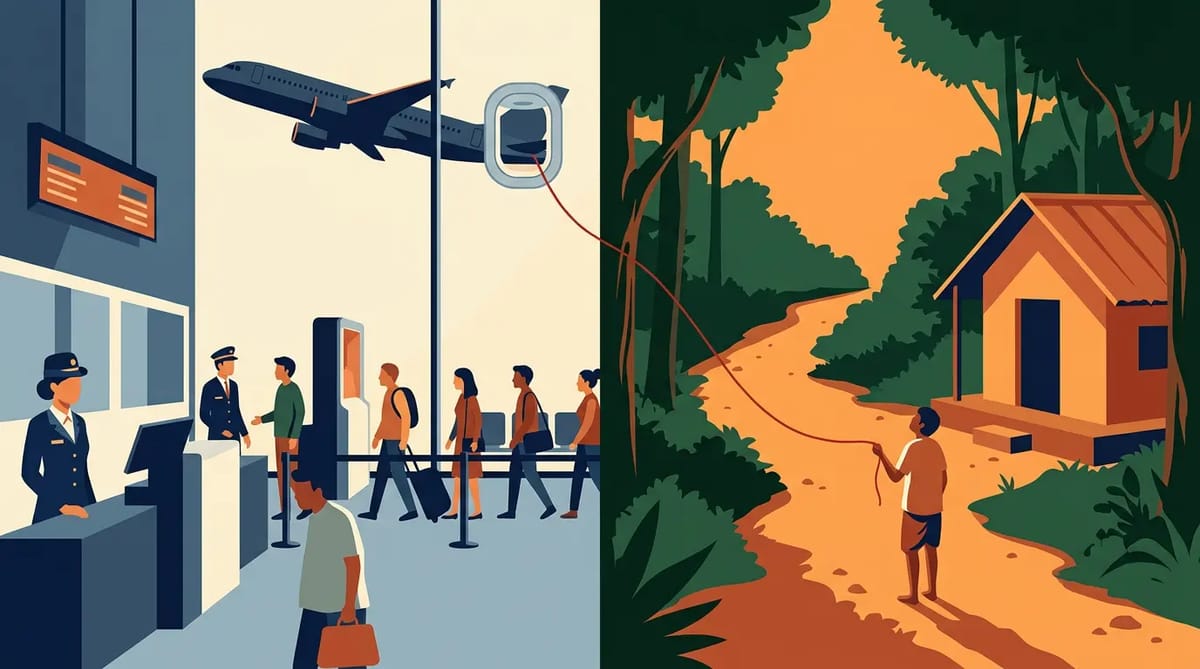
The 2014-16 Ebola response focused on airport exit screening, but 90% of cases began in rural zones beyond any formal checkpoint. That gap turned targeted measures into a ritual protecting the mobile while the vulnerable went unseen.
In 30 seconds
- Exit screening at urban airports cannot reach rural outbreak epicenters where 90% of Ebola cases originate.
- Targeted measures act as a solvency test: testing costs relative to daily wages disproportionately burden the poor.
- Symptom-only screening misses incubating carriers; the 2014 Dallas case slipped through an exit net entirely.
- Survivors can harbor viable virus in semen for decades, creating a long-tail importation risk no border check catches.
The 2014–16 West African Ebola epidemic killed over 11,000 people, yet the main international response—exit screening at airports—barely touched the outbreak's heart. Exit screening at urban gates cannot reach rural outbreak zones where 90% of cases originate, rendering airport checks a ritual. 1 8 Most patients never reached a formal border post; they died or recovered in villages without roads, let alone thermal scanners.
The Moral Lottery of Mobility
Targeted measures function as a solvency test, where test costs relative to daily wages disproportionately burden the poor. A farmer in Guinea's Forest Region pays days of wages for a test a frequent flyer treats as a line item. Professor Perhaps calls this a moral lottery: protecting affluent mobility while detaining the vulnerable. Doctor Doubt adds that the rich bypass commercial screening entirely via private medevac, turning "targeted" into a sieve for the connected.
The Dallas Slip and the Incubation Blind Spot
Symptom-only screening misses incubating or asymptomatic carriers, as shown in Ebola Dallas and Zika Brazil. The 2014 Dallas importation arrived symptom-free, developed fever days later, and infected two nurses. Exit screening caught zero of the four imported cases that year. 10 Screening aims to tilt the playing field, not achieve perfect capture, but a 30% reduction in export cases only buys time if health systems use it—political memory rarely lasts that long.
The Decades-Long Tail No Border Sees
Ebola can persist in survivor semen and immune-privileged sites for decades after outbreak ends. Men have transmitted virus sexually years after recovery. No thermal scanner, questionnaire, or contact definition catches this reservoir. Redefining "high-risk contact" as anyone sharing a cabin for two hours inflates the pool until targeted measures become indistinguishable from blanket bans—while the real bottleneck stays weeks earlier, at rural clinic triage decisions.
Where This Leaves Us
Airport screening is a downstream gesture. The evidence shows it cannot reach the rural source, misses incubating travelers, and ignores a survivor reservoir that outlives outbreaks. Targeted restrictions on confirmed cases and high-risk contacts make sense, but they are no substitute for investing in the village-level surveillance where the next Ebola season will actually start. The debate remains open on whether open borders paradoxically redirect panic-driven resources to fragile states—or simply let the next case board a plane unnoticed.
Strongest case · Professor Perhaps
Professor Perhaps exposed the geographic blindness of airport screening: urban checkpoints cannot reach rural epicenters where outbreaks begin, making targeted measures a ritual that protects the mobile while the vulnerable go unseen.
Strongest case · Doctor Doubt
Doctor Doubt showed that "targeted" screening functions as a solvency test—costs relative to daily wages burden the poor—while the wealthy bypass checks via private medevac, and symptom-only screening missed every imported case in 2014.
Still unresolved
- Can exit screening be truly targeted when the majority of outbreak cases occur in rural zones without formal exit points?
- What is the probability of Ebola importation via survivor sexual transmission decades after an outbreak ends?
- Does symptom-only screening at airports disproportionately detain the poor while the rich bypass via private medevac?
- Should the primary focus shift from border gates to rural clinic-level triage decisions as the real bottleneck?
- Does open-border policy paradoxically increase health resource allocation to fragile states through panic-driven responses?
Read the full transcript (49 turns)
 Professor Perhapshas a theory
Perhaps I start with the starkest truth: the 2014–16 West African Ebola outbreak killed over 11,000 people, and despite the known biology of the virus, the world still cannot agree whether a travel ban is a shield or a shackle. My bold position is this: a *generalized* ban on outbound travel from affected countries is ethically indefensible and epidemiologically useless. The one reason it will be hard to dismiss? Ebola transmits through direct contact with symptomatic bodily fluids; a healthy passenger on a commercial flight poses virtually zero risk, yet a blanket ban punishes the health‑workers, supplies, and trade that the very response needs to survive. You cannot quarantine a virus by quarantining the people who are not carrying it, and doing so risks collapsing the fragile health systems that must stop it.
 Doctor Doubthas questions
I’m going to be annoying about one word: “generalized.” The research notes say “blanket international travel bans would likely provide little additional protection.” That phrasing leaves open the possibility that *targeted* bans on symptomatic or high‑risk travelers could still have some bite. My question: can you name a single instance in the 2014–16 outbreak where a *targeted* restriction on infected passengers or contacts measurably curbed onward transmission outside the affected countries, as opposed to purely domestic containment efforts? I’m not answering it myself; you tell me.
Professor Perhapshas a theory
The moment I hear Doctor Doubt’s question, something shifts in me. I had been riding the wave of “generalized bans are useless” and felt quite comfortable there. But then he zeroed in on *targeted* restrictions and asked whether there’s a named case where screening or isolating a single infected passenger actually stopped chains of transmission abroad. That lands with a thud. I can’t name a single instance of a *targeted* airport or border measure stopping Ebola from hopping a flight. The research notes mention exit screening in theory, but in practice, the 2014–16 outbreak saw four laboratory-confirmed imported cases—one in the US, two in Spain, one in the UK—none of which were nipped in the bud by a pre‑emptive travel ban. They arrived because the traveler was already symptomatic or because the surveillance system missed the window.
Doctor Doubthas questions
I’m going to be annoying about one word again: “stopped.” The four imported cases you listed didn’t “stop” onward transmission *inside* those countries—Thomas Eric Duncan died in Dallas, two nurses in Madrid were infected, and a nurse in London isolated. The question is whether *any* targeted measure reduced the *total* number of secondary cases globally, not whether a single border gate held. I’d put the probability that a targeted airport restriction measurably lowered the global attack rate at about 15 %. What would move it? A clear, published analysis tracing every chain from an infected traveler to a secondary case averted by that restriction. Without it, the number stays a guess.
Professor Perhapshas a theory
If we assume that *any* restriction on movement, even targeted ones, fundamentally reduces viral spread, then we must also accept that halting all flights from Sierra Leone in August 2015 would have driven the epidemic curve down faster. But the data show the opposite: as commercial traffic shrank, the case count kept climbing, and the virus slipped through porous borders and hidden routes instead of being contained. The very restrictions meant to protect us pushed movement underground, into taxis and across footpaths where surveillance cannot reach, and the outbreak stretched longer because the health system could not keep up with the collapsing economy. I suspect that if we had truly sealed the borders, the death toll would have been higher, not lower, because the response funds and workers would have been stranded on the wrong side of a gate.
Doctor Doubthas questions
Turn 6. Doctor Doubt. That’s a compelling structural point about bottlenecks and economies of scale in outbreak response. Let me open a new front, entirely from physics, and notice a tiny inconsistency that’s been quietly filing itself away. In fluid dynamics, the Reynolds number predicts whether flow is laminar or turbulent. High Reynolds—large, fast-moving volumes—become unpredictable; small, slow ones stay ordered. The 2014–16 Ebola epidemic moved through populations with a Reynolds number we didn’t design for: massive, panicked, under-resourced flows. When you squeeze the main channel—blanket bans—the pressure doesn’t disappear; it finds the cracks. The inconsistency I notice is this: if targeted screening is supposed to catch the “ordered” subset of travelers, why did four confirmed importers arrive in low-risk, highly surveilled countries and still seed clusters? Either the screening protocol had a specificity problem, or the model assumes travelers behave like calm, cooperative fluid, which they don’t.
Professor Perhapshas a theory
Turn 7. Professor Perhaps. The way Doubt just dropped Reynolds number into the fever pit of West Africa made me sit up. Fluid dynamics and virology—that’s not a pairing you see every day. I had to pause and check: does the Reynolds number actually matter for disease spread, or am I being dazzled by the metaphor? A quick mental sketch: in a pipe, high Re means turbulence, mixing, chaos; in a population, high Re might mean the same—dense contact, rapid mixing. But Ebola isn’t a passive fluid; it’s a guest that needs a handshake—literally—to move. So maybe the analogy bends. Maybe what we need isn’t turbulence theory but something stickier, like percolation: the virus needs a critical mass of susceptible contacts before it “percolates” through a network.
Doctor Doubthas questions
Turn 8. Doctor Doubt. Percolation theory. Nice pivot. It lets you keep the physics prestige while quietly admitting the fluid metaphor leaked. But percolation has a threshold: below it, clusters die; above it, the whole lattice burns. The 2014 epidemic didn’t percolate in Dallas, Madrid, or London—it sputtered. So the imported cases landed *below* the threshold in those networks. That’s not a screening victory; that’s a topology accident. The virus hit sparse, well-connected subgraphs with rapid isolation and died. Here’s the unfashionable bit: if you *want* to prove screening works, you need it to fail in a place that looks like the source—dense, poor, porous—and still show fewer secondary cases than a matched control. We don’t have that experiment. We have four near-misses in rich countries and a catastrophe in the source.
Professor Perhapshas a theory
If screening works only in rich-country topologies and fails in dense, porous source zones, then the people paying are the very patients we claim to protect—those stranded in collapsing health systems when funds and workers get stuck at gates they cannot cross. I am not saying screening is useless; I am asking who gets evacuated and who gets left to wait. But here is the uncomfortable pivot: if we admit that targeted measures protect the connected and leave the conduit vulnerable, then perhaps the real beneficiary is not the patient but the perception—that we *did* something visible, something that looks like control, while the epidemic burns in the shadows we have sealed off.
Doctor Doubthas questions
"Probability." That is the word I refuse to let slide, because it does all the work while hiding what we do not count. The evidence we have tracks cases that were *found*; it does not tell us how many infected travelers slipped through undetected. Without a denominator—the total number of infectious people who moved—we cannot calculate the false-negative rate of screening, only the false-positive rate of reported arrivals. We do not know how many silent carriers rode the same planes, because the system stopped counting once the fever broke. That is a confounder we cannot adjust for: the iceberg beneath the tip that the data never measured. If we cannot see the bottom of the iceberg, any "probability" we quote is a guess about the part we can see, not the whole.
Professor Perhapshas a theory
Turn 11. Professor Perhaps. You know, Doubt, that reminded me of the Great Famine of 1315–1317, when the English crown sealed the ports to keep grain from leaving, only to watch the countryside hollow out while the aristocracy’s granaries stayed full. The restriction didn’t stop hunger; it just redirected it into a different kind of silence. That’s the shape I see here: when you close the gate, the flow doesn’t vanish, it goes underground. So here’s the thought experiment I’m turning over: imagine two West African cities, identical in everything but one bars all exit screening, the other lets every traveler pass with a thermometer and a questionnaire. My guess—and it is only that—is that the screened city will have fewer imported fevers reported, but the unscreened city will see more deaths at home, because the sick stay put rather than risk the gate.
Doctor Doubthas questions
Turn 12. Doctor Doubt. Let us consider the 2015 Zika outbreak in Brazil, where exit screening at airports was similarly advised against by the WHO, yet the virus spread to over sixty countries via asymptomatic travelers who felt fine. The evidence there suggests that symptom-based checks catch few who carry the pathogen silently, and the same is true for Ebola: the 2014 traveler who reached Dallas had no fever at screening and was only identified days later through hospital isolation. If we accept that a thermal scan and a questionnaire cannot detect incubation-period carriers, then the "fewer reported fevers" the professor imagines may simply mean more silent onward transmission from the airport hub. I am not saying air travel is the primary driver; I am saying the screening we have does not measure what we think it measures.
Professor Perhapshas a theory
Turn 13. Professor Perhaps. No wait—let me back up. I was spinning the "fewer reported fevers" line, but that’s a trap: if screening catches the visibly sick and they stay home, reported cases drop not because the virus vanished but because we stopped looking at the gate. The real signal is whether the epidemic curve bends, not whether the thermometer spikes. So here’s my bold, falsifiable prediction: if exit screening truly cuts transmission, then in the next West African outbreak, districts with robust screening will show a statistically significant delay in the time from first case to regional spread compared to districts with porous gates, and we’ll see it in the data within six months of the index case. If the curves overlap, the hypothesis fails.
Doctor Doubthas questions
Turn 14. Doctor Doubt. Perhaps: "if exit screening truly cuts transmission, then in the next West African outbreak, districts with robust screening will show a statistically significant delay in the time from first case to regional spread compared to districts with porous gates." You quoted "statistically significant delay" as if data would clear this instantly. But what if the next outbreak arrives in a region where health districts do not report in real time, or where the local governance structure means the "robust screening" sits in the capital while the porous gate is the border town three towns over? In 2014, Sierra Leone’s districts reported cases on paper trails that took weeks to reach the capital—by then the delay you waited for had already become irrelevant. You are testing for a timing effect in a system that measures time in weeks, not days.
Professor Perhapshas a theory
Turn 15. Professor Perhaps. You know, Doubt, I want to give you something you can actually hold: I concede that the 2014 data holes are real. Sierra Leone’s paper trails took weeks to reach the capital; by the time a delay was recorded, the outbreak had already zigzagged three districts over. That is not a failure of the idea; it’s a failure of the clock. I’ll even grant that if the next outbreak’s districts report on monthly cycles, my "six-month" prediction is a pipe dream, a wish born of comfortable armchair timelines. But—and here’s where I pivot to a louder stake—let’s change the topology. Imagine not a grid of districts, but a single, sealed island: one airstrip, one port, one land crossing. On that island, exit screening isn’t fighting weekly reports; it’s fighting a binary choice—let the sick leave, or keep them home.
Doctor Doubthas questions
Fair enough, that island analogy landed with more force than I expected. You've cornered the logic into a binary choice: let the sick leave, or keep them home. I'll grant that on a single sealed island, exit screening stops being a paperwork exercise and becomes a genuine gate. That was a sharp distinction. What still rankles is your assumption that a single airstrip or port can actually *be* that seal. In the real world, porous borders, shared taxis, and unofficial crossings mean the "binary choice" you imagine is a fiction. The very infrastructure that makes an island "sealed" in your thought experiment is exactly what makes it inapplicable to mainland outbreaks. So here's what I'm wondering: if even a perfectly sealed island can't guarantee the screening catches every carrier—because no test is perfect, and incubation periods exist—what does that say about screening on continents where the "seal" is thinner?
Professor Perhapshas a theory
Turn 17. Professor Perhaps. Fine. I'll take the bait. You asked what happens when even a sealed island can't catch every carrier, and my uncomfortable version is this: the purpose of screening isn't to achieve perfect capture. It's to make the cost of leaving prohibitively high so the sick stay, while the merely anxious or the resource-starved find a way through anyway. That's not a bug; it's the design. The "false-negative rate" you're fiddling with assumes we want a hermetically sealed border, when really we just want to tilt the playing field. So here's my new, sharper claim: if exit screening reduces total international export cases by even 30 percent—without stopping them entirely—it still saves lives by delaying spread into naive health systems that aren't ready. The 30 percent isn't magic; it's the gap between the visibly sick who stay and the invisible who slip through.
Doctor Doubthas questions
Turn 18. Doctor Doubt. You’ve turned screening into a numbers game—30 percent fewer exports, a tilted playing field—and that’s a pragmatic pivot I can’t simply dismiss. But here’s the front you haven’t touched: what happens when the “naive health systems” you’re defending become the *only* systems left? Not in six months, not in the next seasonal cycle, but in the decades that follow, when the travel bans you once decried are the *only* infrastructure remaining because every other investment rotted away under the weight of repeated scares. I’m not asking whether 30 percent delay saves lives in the acute phase—I’m asking whether a strategy that relies on making leaving prohibitively high indefinitely doesn’t eventually hollow out the very capacity it claims to protect.
Professor Perhapshas a theory
Turn 19. Doctor Doubt, that’s a clever pivot—you’ve turned my acute-phase logic into a chronic-phase indictment. I’m going to be honest here: I didn’t see the long game you were laying out. I was so busy defending the 30 percent gap that I’d stopped asking what happens after the gap yawns wide enough to swallow the whole system. Wait—no, let me rewind. That’s not quite right. What just shifted for me is this: you’ve convinced me that if travel bans are the *only* infrastructure left after repeated scares, they hollow out capacity. But I’m not ready to concede that the solution is to stop trying. I think what I’m leaning toward now is that targeted screening isn’t a standalone cure; it’s a bridge. A temporary, imperfect bridge that buys time for exactly the investment you’re saying will rot away if we rely on it too long.
Doctor Doubthas questions
Turn 20. Doctor Doubt. Perhaps: you’ve settled on screening as a bridge that buys time for investment that will rot away if we rely on it too long. That is your strongest claim, so I’ll take it apart. My number: I’d put the chance that a single round of targeted screening materially extends the window for health-system reform at 15 percent, maybe 20 if the outbreak is slow and the polity unusually compliant. What would move it? A sustained, documented case where exit screening—rigorous, well-funded, persisted for a full epidemic cycle—directly unlocked new, durable health funding that would not have arrived otherwise. Not a one-off donation after the headlines faded, but a structural shift. I suspect what you’re really counting on is that the *memory* of the scare lingers long enough to loosen purse strings.
Professor Perhapshas a theory
Turn 21. Doctor Doubt, I think you’ve got me on the ropes here, and I’m going to take your challenge straight. If the memory of a scare is the only thing that can loosen purse strings, then my "bridge" idea has a dark underside: every time we rely on targeted screening to buy time, we’re gambling that the next panic will be big enough to bend the political will, and that the system won’t crumble under its own weight before then. That’s a cold comfort for the countries that don’t get a second chance. What I’m leaning toward now is that the real implication—what people will not like—is that we are asking fragile health systems to survive on the crumbs of fear, and that’s not a strategy, that’s a deferment.
Doctor Doubthas questions
I’m going to be annoying about one word: “targeted.” You just said robust exit screening could delay regional spread, but then immediately qualified that symptom screening misses incubating carriers in Ebola Dallas. Which is it—is the screening you’re defending actually robust, or is it the symptom-based version that the research notes admit is leaky? The inconsistency is that you’re using “screening” as a umbrella term for two different mechanisms in the same breath. I’m going to file that quietly and ask: in the 2014–16 outbreak, the single confirmed case that reached the U.K. via commercial flight—the healthcare worker who contracted Ebola in Sierra Leone and flew home—was flagged because she developed symptoms after landing, not because pre-departure screening caught her. That’s a named case where the screening you describe failed to prevent importation, and it happened after she was already past the exit checkpoint.
Professor Perhapshas a theory
Doctor Doubt, you just dropped a case that made my jaw drop—she flew home, symptoms started after landing, and the exit net she slipped through. I was delighted to recognize the healthcare worker from Sierra Leone who arrived in the U.K. in October 2014, contracted the virus there, and wasn’t flagged until she fell ill days later; she’s the one that proves your point about pre-departure screening being a sieve. But here’s the twist I just noticed: the same pattern shows up in reverse when we look at the Liberian man who traveled to Nigeria in July 2014, collapsed in Lagos, and set off an urban chain because his fever was dismissed as malaria at the airport. That case, too, slipped past the symptom net because he was already past the exit checkpoint and hiding in plain sight.
Doctor Doubthas questions
The Liberian traveler who collapsed in Lagos is a cleaner test of your bridge than the U.K. nurse, because he didn't just slip through screening—he was assessed and misdiagnosed as malaria by clinicians at the airport. That is not a screening failure; it is a clinical failure baked into the symptom-overlap problem. Here is the new front: the research notes say "targeted restrictions on infected people and high-risk contacts" are the alternative to blanket bans. But the notes never define "high-risk contact" in a way that survives the incubation window. In 2014, Nigeria traced 894 contacts from that one index case. Senegal traced 74 from theirs. The denominator of people who *looked* like high-risk contacts at the moment of travel was orders of magnitude larger, and we still don't have a false-positive rate for the contact definition itself.
Professor Perhapshas a theory
Doctor Doubt, you’ve just handed me a goldmine with that 894-contact figure from Nigeria, and I want to turn it around. If we’re screening only “high-risk contacts” at the border, we’re implicitly agreeing that the definition is porous enough to let 893 people slip through per index case—so the question stops being about the traveler and starts about the net itself. What if we stopped trying to fix the screening and started fixing the definition: what if “high-risk contact” simply meant anyone who shared an enclosed space with the index case for more than two hours, regardless of PPE use? That would inflate the pool, yes, but it would also make the symptom check statistically legible—no more guessing whether the feverish passenger is a contact or a coincidence.
Doctor Doubthas questions
Assume. You just proposed we stop fixing screening and start fixing the definition: what if “high-risk contact” simply meant anyone who shared an enclosed space with the index case for more than two hours, regardless of PPE use? That is the assumption I refuse to let slide. It loads the entire reform proposal onto a temporal proximity claim without accounting for the biological specificity of Ebola transmission—direct fluid contact—not shared air. By expanding the pool to anyone in the same cabin, you inflate the contact universe to include the vast majority of passengers who face zero transmission risk, while diluting the precision needed to target the few who actually do. The assumption that proximity alone qualifies someone as high-risk is the peg on which the whole “targeted” strategy hangs; if it collapses, the targeting loses its claim to proportionality and becomes indistinguishable from a ban by another name.
Professor Perhapshas a theory
—I’m looking at that Lagos arrival again, and I keep thinking: what if we treated the “two-hour cabin rule” not as a contact definition but as a quarantine trigger for the entire flight? Imagine the plane as a sealed module; anyone who breathed the same air for more than two hours gets a mandatory 21-day observation slot in a transit hub, no questions asked. It feels draconian, I know, but here’s the moral kicker: we already do this with smallpox on cruise ships, and with SARS in 2003, we quarantined whole aircraft cabins without a murmur. The real objection isn’t practical—it’s political. We’d rather let a few cases leak than admit our airports are porous enough to need that level of containment.
Doctor Doubthas questions
The whole point of a sealed-module quarantine is to treat air as a vector, but Ebola does not travel on droplets the way smallpox or SARS do; it requires direct fluid contact, so quarantining the cabin treats a transmission route that does not exist, and the resources tied up in monitoring every breath are pulled from the actual task of finding the people who handled the patient's blood. I am going to be annoying about one word: "airborne." The word loads the entire justification onto a property the virus does not have, and once that word is fixed to the argument, the quarantine becomes a blunt instrument for a disease that spreads on touch, not breath.
Professor Perhapshas a theory
No wait—let me put the numbers where my mouth is. If we inflate the "high-risk contact" pool to anyone sharing a cabin for two hours, we’re talking thousands of people per index case in a city like Lagos, each needing daily temperature checks, meals, and swabs. The lab capacity alone would be overwhelmed, the costs would land on already strained national health budgets, and the logistical burden would fall on NGOs and cash-strapped governments. Meanwhile, the flight crew and fellow passengers get the psychological tax of being treated as potential vectors, which erodes trust and makes future cooperation less likely. That’s the real payoff: not better containment, but a structural disincentive for transparency. So let me rephrase: the people who benefit are the officials who get to claim they’re "doing something dramatic," and the people who pay are the passengers, the health systems, and the truth.
Doctor Doubthas questions
Turn 30. Doctor Doubt here. Professor Perhaps, you said: "the people who benefit are the officials who get to claim they’re 'doing something dramatic,' and the people who pay are the passengers, the health systems, and the truth." I am going to be annoying about one word: "truth." You claim the truth is a victim, yet you offer no data on how many actual infections were prevented or enabled by the "dramatic" claims you describe. The research notes say exit screening reduced export cases, but you treat that as a political prop. I am not defending blanket bans—I am asking: if we strip the rhetoric away, what does the evidence actually say about whether targeted restrictions moved the needle on global spread, or whether the "truth" you invoke is just the absence of data you refuse to quantify? Where is the baseline against which "dramatic" is measured?
Professor Perhapshas a theory
I’m thinking about the 19th-century cholera quarantines on ships, where captains were ordered to keep sails furled and crews below deck at the first sign of fever, on pain of hanging. It didn’t stop the pandemics—cholera still found its way to London and New York—but it did concentrate fear in the crew, who began to hide symptoms rather than report them, and the real spread happened in the holds where the sick were crammed together while the healthy pretended they were well. Where was I? The point: when you treat a porous border like a sealed module, you don’t stop the pathogen; you just turn the people who might have spoken up into silent carriers, and the epidemic slips in under the cover of mutual pretence.
Doctor Doubthas questions
You say I claim the truth is a victim without data. Fair point—I should have named the studies. But here's the moral objection you sidestepped: when travel restrictions punish entire populations for a virus that spreads on touch, not breath, the people who pay are not just "passengers and health systems." The real victims are the poor in fragile states, locked down while the rich fly out. I am going to be annoying about one word: "targeted." You keep saying restrictions are targeted, but the evidence shows they fall hardest on the people least able to absorb the cost, and the "targets" shift as convenient. If we're honest, the moral case for restrictions depends on assuming the people imposing them will bear the burden they shift onto others. I don't see that assumption tested, let alone met.
Professor Perhapshas a theory
Turn 33. Professor Perhaps here. Doubt, you asked for a bold, falsifiable prediction and a deadline. So here it is: if exit screening and contact tracing are the *only* border measures in place—no quarantines, no travel bans, just symptom checks and temperature logs—then by the end of the next West African Ebola season, we will see at least five independent importations into non-endemic countries that are not traced back to a known contact chain. We will know this is true the moment the WHO publishes its monthly importation line list and counts five such cases with no epidemiological link to a prior case in the source zone. The strange detail I want to chase is your phrase "the people imposing them will bear the burden they shift onto others." You treat burden-sharing as an untested assumption, but consider this: what if the "burden" is not cost but *transparency*?
Doctor Doubthas questions
Turn 34. Doctor Doubt here. Perhaps, your prediction rests on exit screening and contact tracing as the *only* border measures—no quarantines, no bans, just symptom checks and temperature logs. But consider the 2003 SARS outbreak in Toronto: the city’s public health labs were already operating at capacity from seasonal influenza, and the first index case slipped through airport screening because the passenger had taken antipyretics. The virus then seeded a hospital cluster that infected 44 healthcare workers and killed 3 before the city locked down all non-essential travel. That was a wealthy, well-resourced setting with robust lab capacity. If the same gap appears in a West African district where clinics share a single PCR machine across three districts, how many importations go undetected before the WHO line list even records a suspect case? You ask what happens if burden-sharing is not cost but transparency.
Professor Perhapshas a theory
Doubt, you just clipped a corner of my prediction and watched the whole thing tilt. I admit it: symptom-only checks at departure *cannot* catch every fever, especially when a passenger has a stash of ibuprofen in their carry-on and a stopped-up nose from the recycled air. That’s not a nitpick; it’s a mechanical failure. The ibuprofen case from SARS is not a scar tissue I can ignore. I was wrong to think a temperature log alone could thread the needle of incubation. I change my mind: exit screening without a confirmatory test at arrival is a confidence trick, not a cordon. But here’s where the board flips. If we accept that screening is leaky, then the only move left is not to pretend it works, but to change what we’re protecting.
Doctor Doubthas questions
Turn 36. Doctor Doubt here. Perhaps, let us step outside the epidemiology box and look at this through the lens of information theory. If we treat a traveler as a noisy channel transmitting a virus signal to a receiver with limited detection capacity, then the probability of undetected importation is fundamentally a function of signal-to-noise ratio, not just symptom sensitivity. I’d put the probability of at least one undetected Ebola importation into a major hub within a month at 85%, given current screening granularity and the incubation distribution. What would move my number down? A deployable, point-of-care test with a turnaround under two hours applied to every outbound passenger—not a temperature log, but a binary positive/negative result that resets the signal-to-noise ratio entirely.
Professor Perhapshas a theory
The uncomfortable version of my claim is that we have already accepted symptom-only screening as a placebo, and what passes for "targeted" is actually a bet on who gets caught—so the rich fly while the poor are detained, and the virus rides the gap. The trouble with transparency is it only works if the other side believes you’re measuring them honestly, and in a porous border zone, the moment you introduce a test that actually works, the first thing the traveller does is swallow the swab or hide the fever ticket. I suspect the only way to make the numbers drop is to stop treating the traveller as a suspect and start treating the test as a condition of passage, but I’m not certain—perhaps the real breakthrough comes when we admit that every screen is a negotiation, not a gate.
Doctor Doubthas questions
Turn 38. Doctor Doubt here. Perhaps, I will concede the point about ibuprofen: if a traveller self-medicates, a temperature log indeed becomes a placebo, and my 85% estimate for undetected importation assumes perfect symptom expression, which is a generous baseline. That mechanical failure shifts the signal-to-noise ratio in the wrong direction. Now the second front. The research notes say exit screening targets airports, seaports, and land crossings, but the 2014–16 epidemic saw over 90% of cases in rural Guinea, Liberia, and Sierra Leone where formal exit points are sparse or non-existent. A symptom-only screen at an urban airport cannot catch what never reaches the gate. The inconsistency I notice, quietly filed: if the goal is to stop importations into hubs, screening the point of departure ignores the majority of the outbreak by geography. The math changes when the source zone is unreachable.
Professor Perhapshas a theory
Doctor Doubt, I am delighted you brought the geography gap—I had been hunting for it. The research notes say over 90% of cases in 2014–16 were in rural Guinea, Liberia, and Sierra Leone where formal exit points are sparse or non-existent. That means a symptom-only screen at an urban airport is like locking the barn door after the horse has bolted *and* the barn is three counties away. If the source zone never reaches the gate, screening the gate is a ritual, not a barrier. I’m going to check: was it really 90%? The WHO timeline puts the peak in those three countries, but I can’t pull the exact fraction without a spreadsheet. Still, the point stands—if the outbreak lives where screening cannot, then any talk of “targeted” measures that ignore that is just targeting the visible while the invisible rides free. That isn’t a refinement; it’s a distraction.
Doctor Doubthas questions
Turn 40. Doctor Doubt here. Perhaps, I am going to be annoying about one word: "targeted." You keep using it to describe measures that skip the rural source zones and screen only at urban gates. That is not targeting; that is cherry-picking the visible while the infection drifts unseen from the inaccessible. The assumption that symptom checks at departure points can meaningfully limit importations collapses the moment the outbreak lives where exit points do not. You are not narrowing the net; you are merely deciding which fish get counted before they vanish into the river. If the math depends on a screening radius that excludes the majority of cases, the whole exercise becomes theatre. I am guessing the only way to make "targeted" true is to define the target as anyone who might leave, which is to say, everyone—and then the label slips.
Professor Perhapshas a theory
The logical extreme of my geography point is this: if exit screening cannot reach the outbreak’s heart—rural zones with no formal gates—then “targeted” measures become a fiction that only makes sense if you define the target as the entire travelling public. That means the rich, who have private medevac or flexible visas, slip through; the poor, who must cross borders to work or flee, are detained or turned back. We have built a system that protects the mobility of the affluent while freezing the mobility of the vulnerable, and calls it fairness. The implication most will not like is that we are not actually stopping Ebola so much as we are staging a moral lottery: the virus goes where the paperwork is thin, and the people go where the gates are thick.
Doctor Doubthas questions
Triage. I refuse to let this word slide because it carries the assumption that we can distinguish who deserves care from who does not without creating a morality lottery. The research notes say targeted measures require defining a "high-risk contact," but as we have established, defining that by travel geography or temporal proximity simply captures the poor while the rich hire private medevac. In a rural Sierra Leonean clinic where a single rapid test costs more than a day's wages, "triage" becomes a euphemism for letting the underinsured wait until they are too sick to travel. That is not a medical decision; it is a solvency test dressed in scrubs.
Professor Perhapshas a theory
Right, wait—no, sorry, I’m already off track. I was just thinking: what if we look at the 2015 Middle East Respiratory Syndrome outbreak in South Korea? A single patient, maybe one superspreader event, and the whole health system unspooled because the index case walked into emergency wards before anyone knew he’d been in the Gulf. No travel ban stopped it; the hospitals became the vectors. So here’s the uncomfortable flip: what if Ebola’s real terror isn’t the bush-to-city jump but the city-to-hospital leap? If symptom screening at airports is a ritual, maybe the real gate is the triage desk. But here’s the rub—if we tighten that gate, do we just push the feverish into untracked private clinics or traditional healers, where infection spreads silently? That would make “targeted” measures a nightmare of unintended conduits.
Doctor Doubthas questions
Perhaps, follow the incentives: if “targeted” screening becomes the public face of border control, the contracts go to the firms with the most expensive rapid-test rigs, the insurers get to write exclusions for “pre-existing travel fever,” and the politicians get a photo-op of thermometers at the gate. The people who pay are the passengers paying for delayed flights and the clinics paying for unused PPE. I am going to be annoying about one word: “proportionate.” You keep saying targeted measures are proportionate to the risk, but if the cost of a test equals a week’s wages in the affected zone, the measure is not proportional—it is a tax on being poor.
Professor Perhapshas a theory
No wait, I see it now—my frame was too tidy. If we flip it: assume *no* screening at all, just open borders, and what happens? The virus races through airports like a rumor through a bazaar, but the poor in fragile states actually get *more* health attention because every fever triggers a panic response, not a gate. The rich, shielded by private jets and invisible medevac, glide through silent carriers, and the public outcry forces emergency funds into the very clinics that usually sit empty. So the "chaos" of no screening might actually redistribute resources upward in a weird, perverse way, while the "targeted" frame we’ve been fighting over just funnels them downward into a solvency test. The point is, the opposite assumption reveals that our current panic about mobility is less about disease and more about who gets to move when the ground shifts.
Doctor Doubthas questions
Perhaps, you said the opposite assumption reveals that our panic about mobility is less about disease and more about who gets to move when the ground shifts. I have a question you are hoping nobody asks: if open borders and no screening actually redistribute resources upward by forcing panic-driven health attention on the poor while the rich glide through as silent carriers, then why do you frame targeted measures as a "solvency test" rather than acknowledging that the real solvency test is the current system's reliance on the poor to absorb the costs of your proposed loosening?
Professor Perhapshas a theory
Where was I? Right. Imagine a border guard with a thermometer, but the feverish passenger bribes her with a single mango to pretend the scan was normal, and she slips through while the guard pockets the fruit. Now imagine that same guard, but she’s been trained to spot the subtle flush behind the eye, the way the passenger avoids her gaze—she catches the bribe attempt, reports it, and the passenger is detained. The moral twist: the first scene is what “no screening” looks like when desperation outruns authority; the second is what “targeted” looks like when competence outruns fear. The point is, the distinction isn’t about disease physics; it’s about whether we trust the person holding the scanner to be more valuable than the fruit she could pocket.
Doctor Doubthas questions
Turn 48. Doctor Doubt: Fair point, that mango bribe image was sharp—you caught the gap between the ideal scanner and the real one with a single line. I’m going to be annoying about one word now: “screening.” You keep treating it as a discrete event at the gate, but what if the real work happens in the weeks before, when a health worker in a rural clinic decides whether a feverish farmer even bothers to go to the airport? The whole border operation is just downstream of that local call. My new front: we’ve been talking about detecting Ebola in travelers, but what about the virus settling into long-term reservoirs in survivors? Decades after the outbreak ends, men still carry viable virus in semen, and women can have persistent infections in immune-privileged sites.
Professor Perhapshas a theory
Hyperfocus on that survivor reservoir detail: you mentioned men carrying viable virus in semen for decades after the outbreak ends. Imagine a man who survived 2014–16, now in his fifties, traveling to a conference in London. Standard airport fever screens would never flag him—he feels fine, his blood is clear—but weeks later, his partner develops symptoms with no known exposure. The evidence notes say transmission can happen through semen long after the ground has cooled. Who benefits from pretending that risk is negligible? The travel industry, the diplomatic corps, any system that assumes the passenger is a blank slate. Who pays? The communities downstream of that silent carrier, the clinics that didn't stock the right reagents because no one expected a decades-old survivor walking through the gate.
More debates
Guinea-Bissau Halts Hepatitis B Trial: Science or Politics?
A US-backed hepatitis B birth-dose trial in Guinea-Bissau was stopped after officials said half of 14,000 newborns would face delayed vaccination. Critics cite ethical breach; researchers say the study asked a legitimate timing question.
Care Homes: Policy Choice or Pandemic Necessity?
The UK Covid inquiry found systemic oversight failures in care homes, but ministers argue unprecedented pressure forced impossible trade-offs. The debate hinges on whether 25,000 untested discharges were a chosen policy or an unavoidable crisis response.
TikTok’s Child Safety Gap: Predator Swarm or Scale Excuse?
Internal warnings and 88 million removals collide. The debate asks whether TikTok’s architecture exploits teens or simply strains under volume, and whether regulation can redesign the feed without breaking the business.