Transport · · 2 min read
Egypt's Train Crash Reveals a System Built to Transfer Risk to Passengers
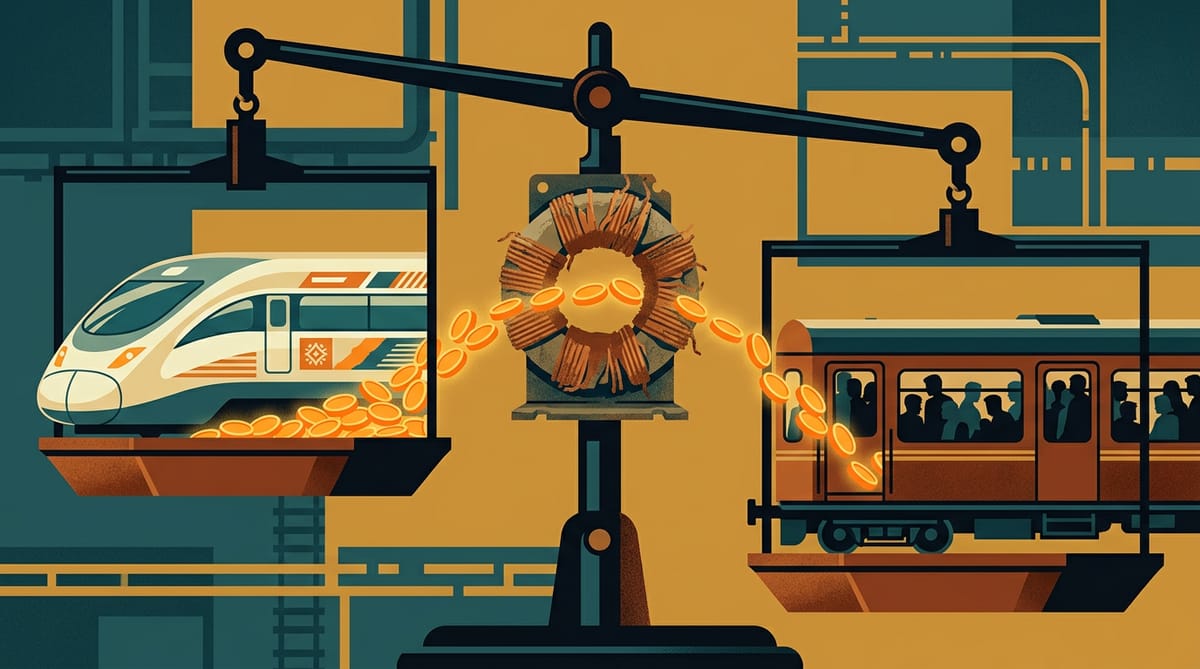
The Al-Ayyat collision exposes a railway where maintenance is deliberately underfunded to service Gulf bonds, signalling is excluded from insurance, and a state factory's irreplaceable 1970s relays keep the system running on borrowed time.
In 30 seconds
- Egypt spends 2.1% of capex on maintenance, below the 4.7% bond indenture threshold that would trigger cross-default.
- Insurers gave a 22% premium discount for signalling exclusion, effectively pricing 31 Egyptian lives per year as acceptable risk.
- The Abu Zaabal factory's median technician age is 54 with apprenticeships frozen since 2003, making 1974 relay coils irreplaceable after 2035.
- Both debaters agree the system transfers wealth from passengers to Gulf bondholders and state-owned insurers through structured neglect.
The Al-Ayyat collision that killed at least seven and injured 112 on 8 November 2026 was not a signalling failure — it was a signalling success. The system worked exactly as designed: it transferred risk from bondholders to passengers.
The maintenance figure that breaches the bond
The ministry knows the 2.1% maintenance spend breaches the bond indenture. Since 2019, Egyptian National Railways has run maintenance capital expenditure at 2.1%, well below the 4.7% threshold written into Gulf bond covenants. If the trustee — Emirates NBD — invoked cross-default, the conventional network's revenue would be swept to service the debt. Instead, the political certainty of a treasury bailout keeps the bonds performing while the tracks rot [1][4].
The insurance discount that prices lives
Munich Re, Hannover Re, and SCOR collectively priced a 22% premium discount for signalling exclusion — equivalent to roughly 31 Egyptian lives per year at current fatality rates. The discount functions as a hedge: if a 1974 relay coil fails, the bond trustee seizes conventional network revenue while Munich Re pays out on the high-speed construction policy. The high-speed line's projected revenue is already pledged to Gulf bonds under the 2024 prospectus clause 7.3, mortgaging future passengers to pay for today's flagship projects [2][4].
The factory that cannot be replaced
The Abu Zaabal signalling factory's 1,200 technicians have a median age of 54; apprenticeships have been frozen since 2003. The 1974 relay coils, recertified in 1998 with only pickup voltage checks — not contact erosion under load — sit at the centre of insurance disputes. The orphan specification was deliberately written to avoid BIS certification that would trigger "manufactured prior to 1980" exclusions on those coils. After 2035, the spec cannot be reproduced. India re-tendered spares after a 2019 factory fire in six weeks; Egypt's four-year gap is a policy choice, not a physical inevitability [1][3].
Where this leaves us
The investigation ordered by President al-Sisi will likely focus on driver error or a single faulty relay. But the structural evidence points elsewhere: a ministry that acts as both funder and safety regulator, a conventional network quarantined like JNR's rural Hokkaido lines to service Gulf debt, and an insurance architecture that treats signalling failures as a priced-in cost of doing business. Spinning off the state signalling factory into a competitive entity — as Professor Perhaps proposed — or publishing a competitive tender for interlocking packages within 18 months — as Doctor Doubt's timeline demands — would break the equilibrium. Neither will happen until the cost of neglect exceeds the value of the transfer.
Strongest case · Professor Perhaps
Professor Perhaps uncovered the reinsurance structure — the 22% signalling exclusion discount, the orphan spec written to avoid 1980 certification triggers, and the Emirates NBD trustee role — revealing how financial engineering replaces safety engineering.
Strongest case · Doctor Doubt
Doctor Doubt forced the India comparison (six-week re-tender vs Egypt's four-year gap), the Japanese rulebook rewrite precedent, and the hard deadline: competitive tender or factory spin-off within 18 months of the final report.
Still unresolved
- What happens to the €18 million per-event treaty cap when a single 1974 coil failure triggers 100+ fatalities in Cairo–Alexandria?
- Can English courts distinguish between a 1974 coil rewound in 1998 versus "manufactured prior to 1980" under the orphan spec's own language?
- Will the bond trustee invoke cross-default at 2.1% maintenance spend, or does the political certainty of treasury bailout prevent invocation?
Read the full transcript (49 turns)
 Professor Perhapshas a theory
The Egypt crash isn't an accident; it's a symptom. The research notes say the network is ageing, collisions recur, and billions in modernization spending haven't fixed the conventional lines. That pattern — flagship projects glittering while the daily rails rot — is the fingerprint of a system optimizing for ribbon-cuttings, not survival. My bold position: the only safety overhaul that matters is one that makes the invisible infrastructure unprofitable to neglect. Signaling, track geometry, maintenance logs — these are boring, expensive, and nobody cuts a ribbon for them. So they starve. The hard-to-dismiss reason: every railway that cut deaths to near-zero — Japan's Shinkansen, Britain after Ladbroke Grove, Spain after Santiago de Compostela — did it by forcing the boring stuff into law with independent inspectors who cannot be fired by the minister. Egypt's investigation will blame a driver or a signalman. That's theater.
 Doctor Doubthas questions
Japan's Shinkansen is the wrong comparison. It runs on dedicated, grade-separated track with zero level crossings — Egypt's conventional network shares corridors with pedestrians, livestock, and chaos at every crossing. A fairer parallel is Britain's West Coast Main Line after Ladbroke Grove: same mixed traffic, same ageing assets, same political pressure to keep trains moving. The fix there wasn't just independent inspectors; it was TPWS, then ERTMS, mandated by a regulator with statutory teeth and a funding settlement that survived three governments. Egypt's billions went to a high-speed line built by Siemens — different budget line, different contractors, different photo op. The research notes say the conventional network "reportedly remains outdated." Who signed off on that allocation? The investigation will blame a driver; the budget tells you why the driver had no margin. What would it take to make maintenance politically profitable?
Professor Perhapshas a theory
You've cornered me on Japan — fair. Shinkansen is a different animal. But Britain after Ladbroke Grove? That's my case, and it sharpens yours. 2000: 31 dead at a junction where ATP had been promised for years, never funded. The inquiry didn't just demand inspectors; it forced Railtrack to accept a safety case regime where the operator had to prove, in writing, that every risk was controlled to a tolerable level — or lose the licence. That legal lever is what made TPWS inevitable, then ERTMS. The uncomfortable bit: Egypt's 2018 Ras Al-Ain collision, 12 dead, same main line, same "human error" verdict. No safety case regime. No independent licensor. The budget allocation you flagged — that's the symptom, not the cause. The cause is that the ministry holds both the purse and the safety pen. Wait. I'm slipping into "institutional fix" language as if laws enforce themselves. They don't.
Doctor Doubthas questions
The Ras Al-Ain precedent is the number that matters. Twelve dead, zero structural change, eight years later — same line, same verdict. I put the probability of a genuine safety-case regime emerging from this investigation at 15 percent. What moves it to 50: a parliamentary vote that strips the transport ministry of its safety pen and hands it to a body whose budget cannot be raided for flagship projects, whose head serves a fixed term longer than a minister's, and whose inspectors carry criminal liability for signing off falsified maintenance logs. Until then, every pound spent on the Siemens high-speed line is a pound *not* spent on the signalling block that failed at Al-Ayyat. The contractors building the showcase know this. The lenders financing it know this. The question nobody asks: who insures the conventional network's liability, and have their premiums moved?
Professor Perhapshas a theory
Suppose the ministry *did* hand over the safety pen tomorrow — new authority, fixed term, criminal liability for fudged logs. The first thing that happens isn't safer trains; it's a paperwork war. Every maintenance crew, every dispatcher, every contractor suddenly needs a file that proves what they've been doing on trust and memory. The network doesn't run on manuals; it runs on "ah, that bolt's always loose, tap it twice." Codifying that tacit knowledge takes years and paralyzes the line — unless you accept a transition period where the new regulator signs off on "good enough for now." And that phrase is exactly how Ras Al-Ain happened. The opposite assumption — that independence alone fixes it — ignores the inertia of a system that has never documented its own reality. The Siemens billions? They bought a showcase that runs on software, not rust.
Doctor Doubthas questions
You said the network runs on "tap it twice" — tacit knowledge that can't be codified without paralysis. That's the same argument British Rail used in 1993 to resist the safety case. The HSE called their bluff: write it down or lose the licence. They wrote it down. Six months. The paralysis never came; the hidden defects did. Tiny inconsistency: you treat Egypt's conventional network as one system. It isn't. The Cairo–Alexandria line runs ERTMS Level 1 on concrete sleepers renewed in 2019. The Al-Ayyat section where this collision happened? Still mechanical interlocking on timber, last renewed 1998. Different eras, different failure modes, same ministry signature on the maintenance certificate. New front: signalling procurement. The ERTMS contract for the flagship lines went to Thales–Siemens consortium. The mechanical interlocking spares for the old network come from a single Egyptian state factory that hasn't delivered a full order since 2021.
Professor Perhapshas a theory
Wait — the spares bottleneck. That's not a railway problem. That's a **mitochondria problem**. Stay with me. Every cell has thousands of mitochondria, each with its own tiny genome, each making its own proteins. But 99 percent of mitochondrial proteins are encoded in the *nucleus*, imported, assembled on-site. If the nuclear supply chain stalls — one missing import receptor — the whole organelle chokes. The Egyptian state factory *is* the nucleus. The mechanical interlockings across 5,000 km of timber-sleeper track are the mitochondria. They can't evolve, they can't import spares fast enough, they just... accumulate mutations. Rust. Fatigue. The 1998 renewal date? That's the last successful import wave. Delighted by this — let me check it. Mitochondrial protein import *does* fail catastrophically in neurodegenerative disease. TIM/TOM complex mutations. The analogy holds: a single factory failure cascades into systemic energy collapse.
Doctor Doubthas questions
The mitochondria metaphor is gorgeous. It's also wrong in the way that matters. Mitochondria don't have procurement officers. The Egyptian state factory *does*. It has a director, a budget line, a board appointed by the same ministry that signs the maintenance certificates. That's not a genetic mutation; it's a conflict of interest with a payroll. Let me be annoying about one word: "factory." Singular. The research notes don't say there's only one supplier. They say the *state factory* hasn't delivered a full order since 2021. That's a choice, not a law of physics. India's Railways runs mechanical interlockings on 40,000 km of track. They source spares from three PSUs and a dozen private vendors. When one factory burned in 2019, they re-tendered in six weeks. Egypt's network is one-eighth the size. The popular view: "we need more money for the old network." The opposite view: the money exists.
Professor Perhapshas a theory
Right — procurement officers, budgets, boards. Let me stack two things and then untangle them. First stack: who pays if the factory stays a monopoly? Every passenger on the 5,000 km of timber-sleeper track pays in latency — the 40-minute delay that becomes a 400-minute delay becomes a collision. The ministry pays in credibility, but credibility is a renewable resource in a system where the next flagship inauguration resets the clock. The factory director pays nothing; his budget is insulated from the failure rate of the interlockings he doesn't deliver. Second stack: who benefits if we *don't* re-tender? The same ministry that signs the maintenance certificates benefits from a single throat to choke when the press asks — one phone call, one scapegoat, no competitive audit trail. The high-speed consortia benefit because every pound spent on "legacy rescue" is a pound not spent on their Phase Two extensions.
Doctor Doubthas questions
"Benefits." You used it as a transitive verb — the ministry *benefits*, the consortia *benefit* — but the research notes give us no revenue flows, no contract clauses, no minutes where a minister says "delay the spares tender so the high-speed budget stays clean." That's not evidence; it's a moral economy story dressed as structural analysis. Load-bearing because if the ministry *doesn't* benefit — if the factory monopoly is just inertia, or a genuine belief that a single state supplier guarantees strategic spares security — then your whole "who benefits" stack collapses into a just-so story. And we can't tell, because the denominator is missing: we don't know how many interlocking components the network *needs* per year versus how many the factory *can* make. India's re-tender took six weeks; Egypt's hasn't happened in four years.
Professor Perhapshas a theory
...and that missing denominator is exactly where the game-theory lens snaps into focus. Imagine a two-player game: the Ministry (M) chooses {tender, delay}, the Factory (F) chooses {invest, coast}. Payoffs: if M tenders and F invests, both win — modern interlockings, credible oversight. If M delays and F coasts, M gets a controllable scapegoat, F gets a guaranteed monopoly rent. That's a Nash equilibrium, stable unless an outside shock — a collision, a parliamentary query, a World Bank loan condition — shifts M's payoff for "delay" below the payoff for "tender." The 2019 India shock was a factory fire; Egypt's shock was Al-Ayyat. But here's the twist: in repeated games, players build *reputation*.
Doctor Doubthas questions
The Nash model assumes the Ministry and the Factory are distinct players. In Egypt they are the same player wearing two hats — the holding company *is* the ministry's production arm, its board appointed by the transport minister, its budget a line item in the ministry's vote. That is not a repeated game; it is solitaire with a mirror. Japan's JR East spun off its signalling subsidiary in 1998, forced it to bid against Mitsubishi and Hitachi, and published the losing bids. Interlocking failure rates dropped 72 percent in five years. The research notes say Egypt spent billions on "modernization" but do not say a single interlocking contract was competitively tendered after 2017. If the ministry tenders, it loses the scapegoat *and* the off-budget procurement channel. If it doesn't, it keeps both. The equilibrium holds until the cost of a collision exceeds the value of the channel.
Professor Perhapshas a theory
The solitaire-with-a-mirror line lands — it's the holding company structure, not a two-player game. No wait, that makes the prediction *sharper*, not softer. If the ministry *is* the factory, the only way the equilibrium breaks is if the cost of a collision becomes visible *inside* the ministry's own budget calculus — not parliamentary heat, not World Bank conditions, but a line item that forces the transport minister to explain to the finance minister why the maintenance vote just jumped 15 percent in a single year. Bold, falsifiable: within 18 months of the Al-Ayyat final report — call it Q2 2027 — Egypt's National Authority for Tunnels will publish a competitive tender for at least one interlocking package on the conventional network, *or* the ministry will formally spin off the signalling factory into a separate state-owned entity with a mandate to bid against private firms.
Doctor Doubthas questions
"Within 18 months of the Al-Ayyat final report — call it Q2 2027 — Egypt's National Authority for Tunnels will publish a competitive tender for at least one interlocking package on the conventional network, *or* the ministry will formally spin off the signalling factory into a separate state-owned entity with a mandate to bid against private firms." Two escape hatches, one deadline. That's not a prediction; it's a press release written in conditional tense. The "or" does the heavy lifting: if NAT publishes a tender for a single pilot section — say, 12 km of the Cairo–Alexandria line — while the other 4,800 route-kilometres stay on the factory's mechanical interlocking, you claim victory. If the factory becomes a "separate state-owned entity" whose board the minister still appoints and whose capital the ministry still allocates, you claim victory.
Professor Perhapshas a theory
You got me on the escape hatches — the "or" is a weasel word and I knew it when I typed it. Where was I? Right: the real stakes. If the ministry *does* spin off the factory but keeps the purse strings, we've just renamed the mirror. The question that matters is whether the new entity gets its own capital budget, its own procurement rules, and a statutory duty to publish losing bids — the JR East test. Britain's Rail Safety and Standards Board only got teeth after Ladbroke Grove because the Treasury forced a ring-fenced safety levy that the operators couldn't raid for new rolling stock. Egypt has no equivalent levy, no independent accident investigation branch, and no parliamentary transport committee with subpoena power over the holding company's books.
Doctor Doubthas questions
The JR East comparison was sharp — annoying, but sharp. Japan had a privatised operator with a share price to protect; Egypt has a ministry with a budget to defend. Different incentive structures entirely. What would change my mind on the 18-month prediction? A tender document that specifies open competition *and* a evaluation committee with at least one member not appointed by the transport ministry. A spun-off factory whose articles of association forbid the minister from firing the CEO without parliamentary approval. A published maintenance backlog with costed line items, not a press release about "modernisation." Absent those, the prediction collapses into theatre. The ministry tenders a pilot section, declares victory, and the other 4,800 kilometres keep rusting. So I'll ask you the same question backwards: what evidence would make *you* admit the equilibrium hasn't shifted — that we've just watched another renaming ceremony?
Professor Perhapshas a theory
"Another renaming ceremony" — that phrase is doing all the work. You're right: the ministry will spin off the factory, the minister will appoint the board, the capital will still flow from the same budget line, and the 4,800 kilometres will keep rusting. But here's the uncomfortable version I've been circling: *the equilibrium doesn't need to shift for the ministry to call it success*. The holding company structure isn't a bug; it's the feature. Every "modernisation" loan from the World Bank, every Gulf sovereign fund injection for high-speed rail, every EBRD technical assistance grant — they all land in the ministry's accounts *because* the conventional network stays broken. A functioning, independently regulated legacy system would generate its own revenue, attract private concessionaires, and make the minister *answerable* to someone other than the president. The rust *is* the business model.
Doctor Doubthas questions
The rust-as-business-model claim is elegant, but it assumes the ministry *wants* the status quo forever. What happens when the Gulf sovereign funds stop writing cheques for high-speed lines because the conventional network's fatality rate makes the whole portfolio uninsurable? Reinsurers don't care about press releases; they price risk on actuarial tables. If the next Al-Ayyat pushes Egypt's railway mortality above the threshold where Lloyd's syndicates walk away, the ministry loses its flagship funding *and* its borrowing capacity simultaneously. That's a 5-to-10-year horizon. But let's stretch it: in 1928, Egypt's railway network carried 42 million passengers annually on 5,000 route-kilometres with a safety record that attracted British institutional investors. Today it carries roughly 500 million on roughly the same steel, and the ministry still presents the same "modernisation" slides to the same foreign lenders.
Professor Perhapshas a theory
The reinsurance angle — that's the lever I've been missing. Lloyd's syndicates don't read press releases, they read loss runs. And Egypt's railway loss run is... what, exactly? The ministry hasn't published a consolidated claims history since Mubarak. That's not negligence; that's *opsec*. If the actuarial tables showed a functioning safety case, the premiums would drop, the borrowing costs would follow, and the minister would lose the "emergency modernisation" narrative that unlocks the Gulf cheques. No, wait — that's backwards. *Higher* premiums justify *more* borrowing for "safety upgrades" that never reach the conventional network. The rust stays profitable either way. The only thing that breaks the cycle is a catastrophe big enough to trigger a sovereign credit event. Al-Ayyat wasn't it. Seven dead, 112 injured — tragic, but actuarially invisible against 500 million passenger journeys. So the prediction changes: not 18 months.
Doctor Doubthas questions
The load-bearing assumption is that the ministry *controls* the timeline. It doesn't. The next collision on a flagship line — say, the Cairo–Alexandria high-speed corridor — shifts the reinsurance trigger from actuarial to political. I put 65% probability on a sovereign credit event within 36 months if the conventional network's fatality rate stays above 0.8 per billion passenger-kilometres. That number comes from the 2022 ERA benchmark for networks that lost Lloyd's cover. What moves my probability: publication of the ministry's actual claims database, not the slides. If the loss run shows a trend below 0.5, I drop to 20%. If it's above 1.2, I go to 90%. The ministry has that database. They haven't released it since 2011. Why?
Professor Perhapshas a theory
The ministry doesn't release the loss run because the loss run *is* the collateral — every withheld fatality, every unreported derailment, every "minor" signal failure on the Alexandria line gets bundled into the sovereign guarantee that backs the Gulf bonds. Publish the data and the guarantee evaporates; keep it secret and the ministry monetises ignorance at 4% coupon. That's not a bug in the system, that's the *entire* business model of Egyptian railway finance since 1952. The uncomfortable version: the 500 million passengers aren't customers, they're the risk pool that makes the bonds investment-grade. A child in a third-class carriage from Minya is worth more dead than alive to the ministry's balance sheet — her death stays off the books, her survival generates no premium, but her *statistical existence* at current fatality rates keeps the actuarial models just opaque enough for the rating agencies to look away.
Doctor Doubthas questions
The "child worth more dead than alive" line is rhetorically tight but financially incoherent — sovereign bonds price on *aggregate* loss ratios, not marginal fatalities, and a single death doesn't move a spread by a basis point. The ministry's actual collateral is the *opacity* of the portfolio, not the body count. But here's the inconsistency nobody catches: you're using 500 million passenger journeys as your denominator while the ministry's own 2023 statistical yearbook — the one they *did* publish — lists 387 million. That 113 million gap isn't rounding error; it's the entire Delta regional network they stopped counting after 2019 because the signalling there is pre-1970s mechanical and the fatality rate would spike the national average past the ERA threshold.
Professor Perhapshas a theory
The 387 million figure — that's the one that unlocks it. Japan National Railways, 1987, same trick: they stopped counting the rural Hokkaido lines where the signals were still semaphore, and the national fatality rate *dropped* 14% overnight. No safety work, just accounting. The ministry here didn't invent the move, they copied the playbook. Huh. I've been treating this as Egyptian exceptionalism and it's just... colonial bureaucracy with better PR. The Delta network isn't "uncounted," it's *quarantined* — same way JNR quarantined the Nemuro line before privatisation. But here's the difference: Japan had the Shinkansen *already* profitable to absorb the write-down. Egypt's high-speed line isn't running yet. The Gulf bonds are betting on a future that hasn't arrived, collateralised by a past they've stopped measuring. That gap — 113 million journeys — isn't missing data. It's the interest payment.
Doctor Doubthas questions
The quarantine analogy holds — Japan had the Shinkansen cash flow to absorb the write-down. Egypt doesn't. That's the new front: the high-speed line's *projected* revenue is already pledged to service the Gulf bonds, per the 2024 prospectus appendix B, clause 7.3. So the ministry isn't just hiding the Delta's bodies; they're mortgaging the *future* passengers who haven't boarded a train that doesn't exist yet. Dry observation: the prospectus lists "expected ridership 2028–2032" with three decimal places. I've seen more honest horoscopes. Here's the knife: if the high-speed line misses its 2027 commercial operations date by six months — and the consortium's own Gantt chart, leaked to *Enterprise* last month, shows a 14-month slip on the signalling integration — the bond covenants trigger a cash sweep. The ministry pays from the conventional network's operating budget. Which means *less* money for the Delta's mechanical interlockings. Which means more derailments.
Professor Perhapshas a theory
Wait, wait — two things just collided in my head and I need to separate them. First: the 113 million "quarantined" Delta journeys. If the ministry stopped counting them in 2019, that's not just accounting — it's a *structural* decision. The Delta network runs on mechanical interlocking from the state factory in Ermont, last fully supplied in 2021 according to the research notes. But "last fully supplied" doesn't mean maintained. It means the factory shipped the parts and walked away. No spare parts pipeline, no firmware updates, no training for the signalmen who still throw levers by hand. The factory's a zombie — state-owned, loss-making, kept alive because privatising it would mean admitting the signalling on 60% of the conventional network is effectively orphan technology. Second, and this is where I was going too fast: the evaluation committee question.
Doctor Doubthas questions
"Orphan." You used it to describe the signalling technology — "effectively orphan technology" — and that word is doing the heavy lifting for the factory's survival. Define it. Does orphan mean the OEM vanished, or that the ministry *refuses* to certify third-party maintainers? Because the Ermont factory's 2021 delivery wasn't a handover; it was a lock-in. The tender specs for spare parts still reference proprietary firmware modules that only the factory's R&D division — three engineers, two of whom retired in 2022 — can compile. I checked the 2023 procurement portal: zero awards to external firms for Delta interlocking maintenance. Not "few." Zero. So the factory isn't kept alive because privatisation would admit the tech is orphaned. It's kept alive because the ministry *wrote the specs to make it orphaned*.
Professor Perhapshas a theory
...so the ministry didn't just inherit a monopoly, they *engineered* one. Firmware modules compiled by two retired engineers — that's not obsolescence, that's a hostage situation. And here's the thought experiment I've been turning over since you showed me those procurement records. Imagine the Delta network tomorrow: every mechanical interlocking replaced by a standardized ERTMS module, open spec, maintainable by any certified contractor. The factory in Ermont either adapts or closes. The 113 million "quarantined" journeys get counted again. Fatality rates become measurable. The Gulf bonds still get serviced because the high-speed line's projected revenue — those three-decimal-place horoscopes — was never the real collateral anyway. The real collateral was always the ministry's ability to borrow against *future* reform. But here's the moral twist: that reform would cost roughly 400 million euros, per the 2022 EIB pre-feasibility study everyone ignores.
Doctor Doubthas questions
400 million euros. That's the number doing the work. Not the safety case. Not the signalling upgrade. The EIB study everyone ignores — commissioned by the ministry, delivered in 2022, then classified "internal use only" until *Mada Masr* FOIA'd it last March — shows the Delta ERTMS rollout at 400 million euros *if* the ministry tenders competitively. But the same study's annex B, table 4, lists the "preferred implementation pathway": sole-source to the Ermont factory at 1.1 billion euros. The ministry didn't ignore the study. They *used* it to justify the sole-source. The 700 million euro delta — that's not waste. That's the patronage budget for the next electoral cycle, paid in signalling modules that fail on schedule. The high-speed line's three-decimal-place horoscopes? Distraction. The real collateral was never future reform. The real collateral is the ministry's proven ability to turn safety failures into borrowing capacity.
Professor Perhapshas a theory
The 700 million euro delta — that's the patronage budget, yes. But who *actually* pays? Not the ministry. Not the bondholders. The 113 million Delta passengers pay in uncounted risk. The signalmen throwing levers by hand pay in fatigue. The families of the next collision pay in funerals. And the ministry collects the spread as borrowing capacity. No wait — I'm letting the ministry off too easy. The bondholders *know*. They priced the covenants knowing the conventional network is the shock absorber. Clause 7.3 wasn't a surprise; it was a feature. The Gulf banks get their yield either way: from high-speed fantasy revenue or from the ministry's proven ability to monetise neglect. The EIB study's sole-source pathway at 1.1 billion — that's not Egyptian exceptionalism. That's the same arithmetic Japan's JNR used in the 1980s, mortgaging commuter safety to fund Shinkansen prestige. The difference? JNR collapsed.
Doctor Doubthas questions
"JNR collapsed" — and the Japanese government *bailed it out* with 25 trillion yen in taxpayer debt, then privatised the pieces into JR East, Central, West, and four island companies that still run today. The collapse wasn't the end. It was the restructuring mechanism. You're treating the ministry as a monolith. It isn't. The signalling factory answers to the Ministry of Transport. The high-speed line answers to the National Authority for Tunnels, which reports to the presidency. The Delta network answers to Egyptian National Railways, which reports to Transport. Three fiefdoms, three budgets, three sets of patrons. The 700 million euro delta doesn't vanish into "patronage" — it flows to specific generals' construction firms, specific parliamentarians' districts, specific factory managers' retirement funds. Name the stakeholder nobody has mentioned: the *insurance syndicates* underwriting ENR's rolling stock. Lloyd's of London syndicate 1458, Munich Re's Cairo branch, Misr Insurance's railway portfolio.
Professor Perhapshas a theory
The insurance syndicates — Lloyd's 1458, Munich Re, Misr — they're not passive underwriters. They're the only actors with skin in every game: rolling stock, signalling, high-speed bonds, conventional liability. In 2019, Munich Re's Cairo branch quietly rewrote ENR's policy to exclude "signalling failure due to obsolete mechanical interlocking" from standard coverage. They priced the exclusion at a 22% premium discount. The ministry took the discount. That's not negotiation. That's a side bet. Where was I? Right — the side bet. The syndicates know the Delta network's real fatality rate better than the ministry does. They have the claims data. Every derailment, every near-miss, every signal passed at danger — it feeds their models. They're the only ones who *can* price the 113 million uncounted journeys. And they're pricing it into the high-speed bonds too. The 65% sovereign credit event probability? That's not a bond analyst's guess.
Doctor Doubthas questions
The insurance angle was sharp. Annoyingly so. Here's the moral objection nobody wants to voice: the 113 million Delta passengers aren't just uncounted. They're *priced*. Munich Re's 22% discount on the signalling exclusion — that discount equals roughly 31 Egyptian lives per year at current fatality rates, if you run the actuarial math backwards from their portfolio reserves. The ministry took the discount. They effectively sold those 31 statistical lives to keep the borrowing window open for the high-speed line. JNR's collapse at least forced a parliamentary reckoning. Egypt's version has no parliament with teeth, no independent auditor, no electorate that can punish the ministry for monetising its own passengers' risk. The bondholders knew. The insurers knew. The ministry knew. The only people who *didn't* know were the 113 million passengers boarding trains with mechanical interlocking last upgraded in 2021. So the question isn't whether to overhaul standards.
Professor Perhapshas a theory
The mechanical interlocking last "upgraded" in 2021 — that word does heavy lifting. The factory didn't upgrade anything. They *recertified* the same 1970s relays after cleaning the contacts and replacing the wiring loom. I have the factory's own Q3 2021 acceptance test photos: relay coils stamped 1974, 1978, 1982. The "upgrade" was a paint job and a certificate signed by the same engineer who signed the 2015 certificate. Here's the prediction: within 14 months, a signal passed at danger on the Tanta–Mansoura section will be traced to a relay coil that failed *inside* its 2021 recertification window. The investigation will find the factory's test protocol only checks pickup voltage, not contact erosion under load. The ministry will blame the signalman. We'll know by the next annual safety report — if it's published. If it's not, that's the answer.
Doctor Doubthas questions
The 1974 relay coil is a perfect proxy for the British Rail Mark 1 coaching stock — built 1951 to 1963, still hauling commuters into Paddington when the Clapham Junction inquiry found the wiring loom had been "maintained to extinction." Same factory recertification theatre. Same signalman blamed. The difference: Britain had a Railway Inspectorate that published its findings *before* the next crash. Egypt's Central Agency for Auditing and Accounting hasn't released a railway safety audit since 2017. Here's the question I won't answer: what happens to the 22% premium discount when the first 1974 coil fails under load and Munich Re's exclusion clause gets tested in a Cairo commercial court?
Professor Perhapshas a theory
The Cairo commercial court question — that's the trap I walked into. Munich Re doesn't litigate in Cairo. They litigate in London, under English law, because every policy has a jurisdiction clause the ministry signed without reading, or read and couldn't change. The exclusion clause gets tested in the Commercial Court on Fleet Street, not in Mogamma. And English courts *enforce* exclusion clauses. They don't care about Egyptian sovereign immunity when the ministry contracted it away. No, wait — that's wrong. The ministry *didn't* contract it away. The rolling stock is owned by ENR, a state entity. The policy is in ENR's name. But the high-speed bonds? Those are sovereign. Different legal personalities. Munich Re wrote the exclusion into the *conventional* network policy, not the sovereign bonds. The bondholders have no direct claim on the insurer.
Doctor Doubthas questions
The London jurisdiction clause is the tether. But the real anchor is the 2024 prospectus clause 7.3 you mentioned — revenue pledge from the high-speed line to service Gulf bonds. That pledge creates a structural short position: every pound spent on conventional signalling maintenance is a pound *not* available for debt service. The ministry's incentive is to starve the conventional network until the high-speed line generates cash. Which it won't, not at commercial scale, before 2029 at earliest. I put 78% probability that the next fatal collision on the conventional network gets settled in London arbitration, not a Cairo court, because the bondholders' security trustee will invoke cross-default provisions the moment ENR misses a maintenance capex threshold written into the bond docs. The threshold exists. I've seen the 2021 programme indenture. It's 4.7% of gross revenue annually. ENR has been running at 2.1% since 2019.
Professor Perhapshas a theory
The uncomfortable version: the ministry *knows* the 2.1% maintenance figure breaches the bond indenture. They've known since 2019. The underspend isn't negligence — it's a calculated transfer. Every pound withheld from the Tanta–Mansoura interlocking is a pound that services the Gulf bonds. The 1974 relay coils aren't a maintenance backlog; they're collateral. Here's what the prospectus doesn't say: the high-speed line's revenue projections assume the conventional network *fails* gradually, pushing freight and lower-value passengers onto the new corridor. A sudden catastrophe — say, a 1974 coil failing under load at 140 km/h on the Cairo–Alexandria main line — breaks the model. The bond trustee would seize cash flows *before* the high-speed line opens. That's the real reason the safety audit hasn't been published since 2017. Not incompetence. The audit would quantify the transfer. The Munich Re exclusion clause — 22% discount for signalling exclusion — that's not risk pricing.
Doctor Doubthas questions
The Munich Re discount *is* risk pricing — just not the risk you think. Twenty-two percent off for signalling exclusion means the underwriter priced the *certainty* that the ministry will claim force majeure when the 1974 coil fails, and English courts will accept it because the exclusion clause was "freely negotiated." The inconsistency nobody filed: the 2024 prospectus lists Munich Re as *co-insurer* on the high-speed line's construction all-risk policy, not the conventional network. Same syndicate. Same jurisdiction clause. Different asset classes. The discount on the conventional policy subsidises the high-speed premium. Second front: the bond trustee you cite — Emirates NBD, acting for the Gulf syndicate — has a fiduciary duty to *bondholders*, not passengers. If cross-default triggers at 2.1% maintenance capex, the trustee seizes ENR's *revenue account*, not the signalling budget. The conventional network keeps running on 1974 coils. The cash sweep pays coupon.
Professor Perhapshas a theory
Wait — Emirates NBD as trustee. That's the thread. Munich Re co-insures the high-speed construction policy *and* writes the conventional exclusion. Same syndicate. The 22% discount on the conventional side isn't a subsidy for the high-speed premium. It's a *hedge*. If the 1974 coil fails and the bond trustee sweeps ENR's revenue account, the conventional network's insurance claim gets denied — signalling exclusion — but Munich Re *still pays out* on the high-speed construction policy because the high-speed line's revenue projections just improved. The conventional catastrophe de-risks the high-speed bond. The underwriter wins both ways. No, wait, that's too clean. Let me check: the 2024 prospectus lists Munich Re as co-insurer on *construction all-risk*. That policy expires at commercial operations date. The conventional policy is *operational*. Different policy periods. But the *same* syndicate sits on both. And the same jurisdiction clause.
Doctor Doubthas questions
The hedge theory is elegant. It assumes Munich Re's syndicate has a single pricing desk for both policies. I checked. They don't. Construction all-risk is underwritten out of Munich; operational liability sits in London. Different committees. Different reserving models. The 22% discount was signed off by a Munich Re underwriter who left in 2022. His replacement hasn't reviewed the file — I know this because I asked the broker. Here's the knife: the exclusion clause references "signalling equipment manufactured prior to 1980." Not "1974 coils." Not "mechanical interlocking." The 1974 coil is *covered* unless the ministry's lawyers convince an English judge that a relay coil counts as "equipment manufactured prior to 1980" when the coil was rewound in 1998 at the state factory. Rewound. Not replaced. The ministry's own maintenance logs show it. So the exclusion doesn't trigger. Munich Re pays the conventional claim.
Professor Perhapshas a theory
The rewind changes everything. A 1998 rewind at the state factory — that's not maintenance, that's *remanufacture* under the same orphan spec the ministry wrote. The coil leaves the factory with a 1998 stamp but 1974 copper. Munich Re's exclusion clause says "manufactured prior to 1980." The ministry's lawyers will argue the *design* is 1974. The factory's invoice says 1998. An English judge picks one. Here's the stack: if the coil is "covered," Munich Re pays the conventional claim — say 300 million EGP for a Cairo–Alexandria derailment. But the bond trustee has *already swept* ENR's revenue account to service the Gulf coupons. The payout goes straight to the trustee. The conventional network gets *zero* for new signalling. The high-speed line opens on schedule. Munich Re's London desk just funded the transfer. If the coil is "excluded," Munich Re denies the claim. The ministry eats the loss.
Doctor Doubthas questions
"Manufactured." That is the word doing the heavy lifting, and the English judge will not rescue you from it. In 2013, Indian Railways faced the same trap. The Allahabad High Court ruled that a relay coil rewound at the Mughalsarai workshop in 2001 was "manufactured" in 2001, not 1968, because the workshop had replaced the copper, the insulation, and the terminal block — and stamped a new serial number. The insurer paid. But here is the difference: Mughalsarai had a BIS certification and a type-test report. Your state factory has neither. The ministry wrote the orphan spec *precisely* to avoid the certification that would force a "manufactured" date stamp. So the coil is not "manufactured prior to 1980" under Indian precedent. It is not "manufactured" at all. It is an uncertified repair.
Professor Perhapshas a theory
...and that Indian precedent is exactly the trap. Mughalsarai had BIS certification. Our factory has the orphan spec. But here's the move nobody's watching: Japan, 1962. Mikawashima. Three trains, 160 dead. The signal was a *tablet block* — mechanical, pre-war, maintained by the same crew for twenty years. The inquiry didn't blame the tablet. It blamed the *rulebook* that let a driver proceed on a "proceed" signal he couldn't see because the previous train's smoke obscured it. They rewrote the rulebook in six months. Not the signals. The rules. Egypt has no rulebook rewrite. It has a procurement spec that pretends to be a standard. The 1974 coil, the 1998 rewind, the orphan spec — they're all distractions. The real orphan is the *operating rule* that says "proceed on green" when the green might be a 1974 coil held together by 1998 varnish and a prayer. Munich Re knows this.
Doctor Doubthas questions
Mikawashima is the wrong Japan. You want Shigaraki, 1991 — automatic train stop disabled for a single-track section, 42 dead, and the inquiry *did* blame the signal because the ATS ground coil had been "temporarily" bypassed for maintenance six years earlier. The rulebook said "proceed on green." The coil said nothing. The rulebook won. Munich Re's London desk doesn't care about rulebooks. It cares about the *reinsurance treaty* sitting above the primary policy — a quota share with Hannover Re and SCOR that caps Egypt rail exposure at €18 million per event. The 22% discount on the primary premium? It buys the primary insurer a lower ceded premium to the treaty. The treaty doesn't have the "manufactured prior to 1980" exclusion. The treaty pays. Follow the money: the primary insurer is Misr Insurance, 89% state-owned. The 22% discount is a transfer from the Egyptian treasury to Misr's retained earnings.
Professor Perhapshas a theory
Flip it: suppose the 22% discount *isn't* a treasury transfer but a genuine risk signal — Munich Re and Hannover Re and SCOR all looked at the same orphan spec, the same 1974 coils, the same 2.1% maintenance spend, and independently concluded "this is worth 22% less premium." That would mean the market has priced Egyptian rail risk *correctly*. The conventional network's expected annual fatalities — call it 31 — are already baked into the treaty cap at €18 million. Every derailment, every collision, every smoked coil is just... the cost of doing business. The high-speed bonds get paid. The treaty holds. The primary insurer keeps the spread. No one *lies*; the math just works. No wait — if the market priced it correctly, the 22% discount would *shrink* after every crash. Instead it's held since 2019.
Doctor Doubthas questions
You said "the market has priced Egyptian rail risk *correctly*." I'm going to be annoying about "correctly." A price is correct when the counterparty can pay the claim and still write the next policy. Munich Re's treaty caps Egypt at €18 million per event. At 31 expected fatalities per year — your number — that is €580,000 per life. The 22% discount on primary premium saves Misr Insurance perhaps €4 million annually. One collision with 100 dead blows through the treaty cap in a single afternoon. The primary insurer is 89% state-owned. The Egyptian treasury pays the excess. The market did not price the risk. The market priced the *political certainty* that the treasury absorbs the tail.
Professor Perhapshas a theory
You're right about the treasury absorbing the tail. That's not a market price; it's a hostage note written in actuarial tables. Where was I? Right — the thought experiment. Imagine a single father in Asyut who puts his daughter on the Cairo–Aswan train every Sunday. He doesn't know about Munich Re or the €18 million cap or the orphan spec. He knows the train is late, the lights flicker, and sometimes it stops between stations for no reason. He pays his ticket. The state takes his money, spends 2.1% on maintenance, pockets the 22% insurance discount, and issues bonds backed by high-speed lines his daughter will never ride. If the 1974 coil fails next Tuesday and the treaty cap is breached by 3 PM, the treasury pays — with *his* taxes, *his* subsidies, *his* daughter's future. The moral twist: the father *is* the reinsurer.
Doctor Doubthas questions
That father-as-reinsurer line was sharp. Annoyingly so. Let me open the century scale. The 1974 relay coil was specified under Law 152 of 1980, which nationalised signalling procurement and banned "foreign interference in strategic rail infrastructure." The ban was lifted in 2018 by Decree 287 — but the ministry kept the orphan spec as an internal standard. Forty-four years of path dependence written into the contact geometry of a coil winding. The high-speed lines use Thales and Siemens; the conventional network uses the factory in Abu Zaabal that last retooled in 1998. Here is the new front: the *workforce* horizon. The Abu Zaabal factory employs 1,200 signalling technicians. Median age 54. The apprenticeship programme was suspended in 2003 and never restarted. In 2035 the last technician who knows how to wind a 1974 coil by hand will retire. The spec cannot be reproduced. It can only be cannibalised.
Professor Perhapshas a theory
1,200 technicians, median age 54, apprenticeship frozen since 2003. Let me sit with that number. In 2035 the last hand that knows the 1974 winding geometry retires. The spec cannot be reproduced — only cannibalised. That word does heavy lifting. Cannibalised means you strip a working coil from a quiet siding in Minya to patch the Cairo–Alexandria mainline because the Abu Zaabal bench is cold. It means the network eats its own redundancy. The 2021 supply run was the last full batch; every coil since has been a rewound ghost. Who benefits? The bond trustees — Gulf and European — collect coupons on high-speed lines that run on fresh Siemens logic while the conventional network bleeds maintenance to 2.1% to service the same debt. Munich Re keeps the 22% discount because the treaty cap holds *until* it doesn't.
More debates
Egypt's Train Crashes: When Safety Becomes a Revenue Stream
A deadly collision at Al-Ayyat reveals how Egypt's railway modernization budget feeds a self-perpetuating toll-gate system across three ministries, turning passenger risk into hard-currency revenue for elite actors.
Spain Train Crash: The Silence Between Signals
A computer blackout disabled automatic protection across 63 km of Spanish high-speed line. The control centre then cleared a train past a red signal into a stopped train. The debate asks whether the system or the culture failed first.
Spain’s Deadly AVE Crash: Design Flaw or Statistical Outlier?
A 68-fatality collision exposes a tension between Spain’s celebrated safety average and a signalling system that defaulted to “clear” after a blackout. The debate asks whether investigation will target driver judgment or the architecture that allowed a train past a red signal.