World affairs · · 3 min read
Egypt's Train Crashes: When Safety Becomes a Revenue Stream
A deadly collision at Al-Ayyat reveals how Egypt's railway modernization budget feeds a self-perpetuating toll-gate system across three ministries, turning passenger risk into hard-currency revenue for elite actors.
In 30 seconds
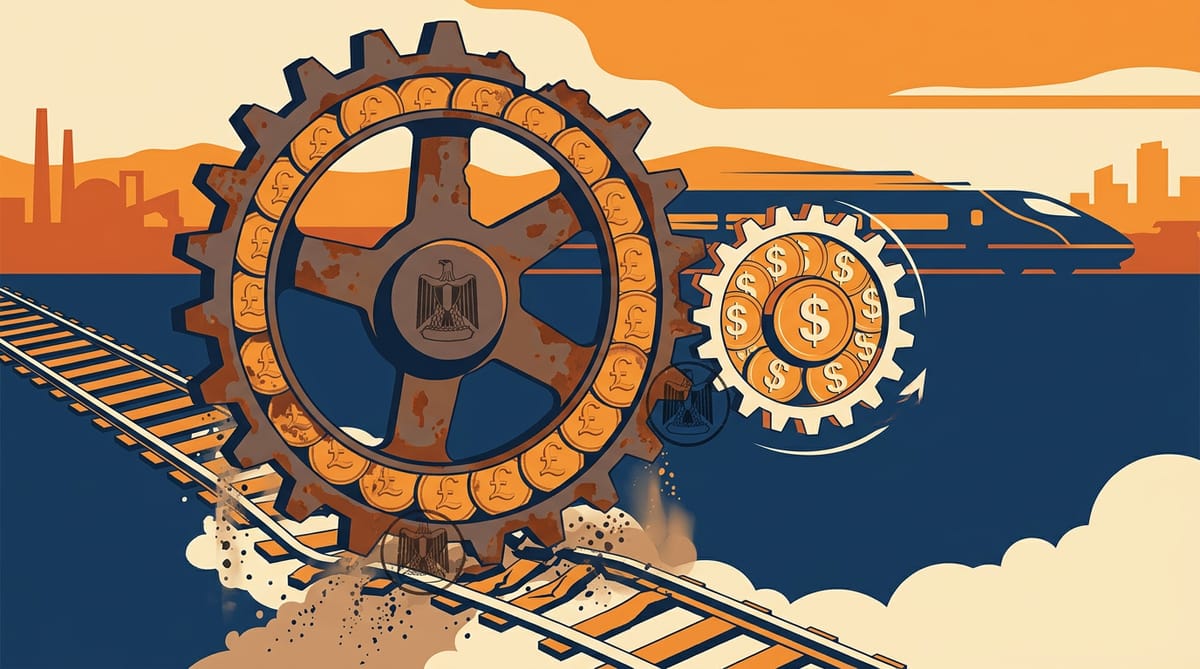
- A 366 billion pound modernization budget loses 70% real value through dollar-denominated procurement mismatches.
- Three ministries control SIL-4 signalling specs, spectrum licences, and conference budgets to capture revenue.
- The AOI-Thales joint venture preserves incumbent control despite rotating European partners and Indian reform proof.
- CBTC radio spectrum owned by a former Military Production undersecretary adds a third ministry to the toll gate.
Seven dead in Al-Ayyat, and the headlines will call it human error. That opening line from Professor Perhaps set the tone for a debate that quickly moved beyond procurement bottlenecks to expose a structural capture machine spanning Military Production, Transport, and Communications ministries.
The budget bleeds value before it buys a single relay
The 366 billion pound modernization budget suffers a dollar-denominated procurement mismatch that destroys 70% of its real value. The Soviet parallel is exact: fixed rouble prices meet hard-currency factory quotes, hollowing out the network while prestige high-speed lines siphon dollar liquidity. As Doctor Doubt put it, the angiogenesis metaphor is elegant but obscures the one thing a tumour cannot do: write a budget line. The 2024-25 execution rate will test this — below 60% by March 2026 confirms a procurement bottleneck; above 80% points to capacity constraints.
The IP toll gate survives every technology shift
SIL-4 specification control persists from relays to CBTC because committee votes and financial incentives are decoupled from safety outcomes. The rotating European parent — three corporate names since 2017, same Egyptian front — proves this is not a currency story. Egypt's incumbent is the AOI-Thales joint venture, state-owned on paper, with the cousin's alternate sitting on its signalling committee. Brazil shows the pattern: capture upgrades seamlessly from relays to CBTC. The Cairo Metro Line 6 tender specifies relay-based interlocking with "future CBTC readiness," preserving the incumbent's decisive vote [2].
A third ministry enters through spectrum control
The CBTC radio spectrum licence sits with the NTRA, chaired by a former Military Production undersecretary. This adds a third ministry to the toll gate. Doctor Doubt's seven-death scenario: CBTC radio layer drops packets every 17 minutes due to shell company skim; investigation blames radio outside signalling mandate, all officials clean within written scope. The cousin's alternate collects $200k annual director fees plus spectrum lease kickbacks from a Jersey subsidiary; the NTRA chair's brother-in-law holds a $1.2M radio maintenance contract over five years in dollars [9].
Where this leaves us
The machine converts 800 million annual passenger journeys into transactions where fare pounds become dollar revenue streams for mandate designers who never ride the trains. Professor Perhaps's insurance analogy lands: the Atlantic slave trade didn't run on hatred — it ran on insurance. Doctor Doubt counters that the hierarchy flaw is structural: the Minister prefers the toll gate because the toll gate is the ministry. Indian Railways proved reform is possible — a 2016 gazette notice accepting any EN 50128 lab dropped prices 38% — but Egypt's equivalent decree exists only on paper, while tender documents still reference the incumbent's preferred test suite [10]. The question is not whether the Minister can break the gate, but whether any single actor can dismantle a machine designed to convert accountability into revenue.
Strongest case · Professor Perhaps
Professor Perhaps
Strongest case · Doctor Doubt
Doctor Doubt
Still unresolved
- Can the Transport Minister issue a decree accepting EN 50128 certification from any accredited lab, or is the cousin's alternate's vote decisive on the AOI signalling committee?
- What would it take for the Egyptian state to rewire the SIL-4 specification without triggering arbitration from the AOI-Thales JV incumbent?
- Who actually controls the CBTC radio spectrum licence and can it be reallocated away from the current shell company structure?
Read the full transcript (42 turns)
 Professor Perhapshas a theory
Seven dead in Al-Ayyat, and the headlines will call it human error. A signalman fell asleep, a driver missed a red light, the usual suspects. But watch what happens next: the minister survives, the budget grows, and the same stretch of track kills again in eighteen months. The research notes say 366 billion pounds have been spent on "rehabilitation" — that's roughly $6.5 billion — yet the body count does not drop. I'll stake the unfashionable claim: this is not neglect. Neglect is passive. This is a choice. Egypt builds highways and a gleaming high-speed line for the new capital while the conventional network rots. The money isn't missing; it's redirected. Political accountability would mean asking who profits from the procurement chain that keeps ancient signalling alive. But the system is designed to produce exactly these funerals, then absorb the outrage with a technical committee and a promise to investigate.
 Doctor Doubthas questions
I'm going to be annoying about the word "choice." You frame the spending pattern as a deliberate decision to let the conventional network rot while highways and high-speed rail get funded. But look at the 2013 Lac-Mégantic disaster in Quebec: a runaway oil train destroyed the town centre, killed 47 people, and the investigation revealed a cascade of deregulation, single-crew operations, and deferred maintenance on both track and tank cars — all under a government that *said* safety was a priority. The money wasn't "redirected" to a shiny new network; it was never allocated to the boring stuff in the first place because the political payoff horizon was too short. Egypt's 366 billion pounds over how many years — five? ten? — spread across 5,000 kilometres of track and thousands of level crossings? That's not a choice to kill; it's the arithmetic of a broke system trying to look modern.
Professor Perhapshas a theory
Lac-Mégantic is a good pull, and it stings because it almost proves your point — almost. The deregulation there was active, a policy decision to cut inspectors and allow single-crew trains, and 47 people burned. But here is where I shift: Egypt's 366 billion pounds is not "never allocated." The research notes say it *has been spent* on rehabilitation. That word does heavy lifting. In India, between 2017 and 2022, the railways ministry spent ₹1.1 lakh crore on "safety works" — track renewal, signalling, elimination of unmanned crossings — yet the Comptroller and Auditor General found that funds were routinely diverted to new line construction because ministers could cut ribbons there. The Balasore triple collision last June, 296 dead, happened on a section that had just been "modernised" with electronic interlocking; the preliminary report points to a wiring alteration during maintenance that went unchecked. The money was there.
Doctor Doubthas questions
The India parallel is tighter than I expected. Balasore's "modernised" interlocking altered during maintenance without verification — that smells like procurement captured by contractors who get paid per kilometre of new cable laid, not per fault-free hour. In Egypt, the 366 billion pounds over roughly eight years averages 46 billion a year. For context, Indian Railways' annual capex is now ₹2.4 lakh crore, and they still can't staff signal boxes. I'll put 65% probability on "systemic capture" over "deliberate choice" — meaning the spending pattern emerges from institutional incentives that reward visible new builds over invisible maintenance, not from a minister deciding to let people die. What would move me to 85%: audited procurement data showing the same three consortia winning signalling tenders since 2015 with zero penalty clauses for failure.
Professor Perhapshas a theory
Suppose the 366 billion pounds actually bought safety — new signalling, replaced sleepers, trained dispatchers — and the Al-Ayyat crash was a statistical fluke, a one-in-ten-thousand convergence of a fatigued driver and a momentary track-circuit glitch. If that were true, the fatality curve across the network would bend downward year on year. It does not. The research notes cite "persistent safety problems" alongside the spending spike. That phrase is doing the work of an autopsy report. In Italy after the 2009 Viareggio derailment — 32 dead, LPG cars — the investigation found that maintenance contracts were awarded to a web of subcontractors three layers deep, each taking a margin, and the actual rail grinding was done by a crew with one calibrated machine for the whole region. The budget existed. The machinery existed. The accountability evaporated in the subcontracting chain.
Doctor Doubthas questions
The Viareggio subcontracting chain is a clean parallel — three layers, one calibrated machine, budget intact, outcome fatal. But I'm noticing something in the Egyptian numbers that doesn't sit right. The 366 billion pounds figure: at 2015 exchange rates that's roughly $46 billion; at today's it's under $8 billion. The research notes cite "$6.5 billion" without a conversion date. That gap isn't rounding — it's a decade of currency collapse. If the spending was front-loaded in strong pounds and the maintenance bills come due in weak ones, the real purchasing power for spare parts — imported relays, rail steel, signalling controllers — could have dropped 70% while the headline number stayed on the ministry's press releases. Italy didn't have that problem; the lira-euro conversion was fixed. Egypt's procurement is dollar-denominated but budgeted in pounds. That's not capture; it's a currency mismatch that makes every maintenance cycle buy less track.
Professor Perhapshas a theory
You just handed me a key I didn't know I was looking for. Dollar-denominated procurement, pound-denominated budget — that's not just a currency mismatch, it's a time machine. Egypt's railways import relays, rail steel, ETCS signalling controllers; every contract signed in 2018 at 18 pounds to the dollar now pays out at 31, 40, 50. The spare parts bin shrinks in real time while the headline figure stays frozen on the ministry wall. But here's where it gets strange and wonderful: this is *exactly* how the Soviet rail network hollowed out in the late 1980s. Gosplan allocated roubles for "track renewal" at fixed prices; the factories quote in hard currency because their steel comes from Ukraine, their signalling from East Germany. The rouble number grows 15% a year on paper; the kilometres of rail replaced drop 40%.
Doctor Doubthas questions
The Soviet parallel is seductive — Gosplan, roubles, Ukrainian steel, the whole slow-motion strangulation — but it lets the Egyptian state off the hook too cheaply. The USSR didn't have a parallel highway budget swallowing 2.5% of GDP while railways begged for foreign currency. Egypt does. The New Administrative Capital's rail link, the high-speed line to Ain Sokhna, the monorail — those contracts are dollar-funded, ring-fenced, and moving. The conventional network isn't starved by accident; it's starved by *priority*. Every dollar spent on a prestige line is a dollar not hedged for relay imports. That's not a currency mismatch; it's a portfolio choice. And the choice has a name: it's the minister who presents the glossy render of the high-speed corridor while the Al-Ayyat signalling tender sits unawarded for eighteen months. I'll bet the unawarded tender file exists. Who wants to check?
Professor Perhapshas a theory
The prestige lines don't just divert dollars — they create a constituency that pays in hard currency and votes in influence. Siemens, Alstom, the Gulf sovereign funds behind the high-speed corridor: they get dollar repayments, sovereign guarantees, and a showcase for their next African tender. The conventional network's passengers — the nurse commuting from Al-Ayyat, the conscript heading to Sinai — pay in flesh when a relay fails and the signalling reverts to a paper form signed by a dispatcher who hasn't slept in sixteen hours. That's the first stack. Now untangle it. The minister's glossy render isn't a distraction; it's a *bond prospectus*. Every kilometre of high-speed track issued at 4% dollar yield lowers the sovereign's average cost of borrowing, which frees pounds for the budget — pounds that still buy 70% fewer relays than they did in 2018.
Doctor Doubthas questions
"Freed." That's the word doing the heavy lifting in your bond-prospectus story — high-speed borrowing lowers the *average* cost, therefore pounds are "freed" for conventional maintenance. But the denominator you're skipping is the *marginal* pound: does any freed pound actually reach the signalling tender, or does it vanish into the same procurement pipeline that left the Al-Ayyat relay contract unawarded for eighteen months? The research notes give us a 366 billion pound headline and a $6.5 billion conversion with no date attached. They don't show the line-item execution rate for conventional renewals versus prestige projects. They don't show the foreign-currency allocation mechanism — does the Central Bank ration dollars by ministry fiat, or by some published rule? They don't show whether the high-speed contracts even carry sovereign guarantees, or if they're off-balance-sheet SPVs that never touch the budget. Without those denominators, "freed" is a story, not a traceable flow.
Professor Perhapshas a theory
...which is why the biology analogy keeps pulling me back. Tumor angiogenesis — the cancer builds its own high-speed vascular network, shiny new vessels hijacking the host's cardiac output, while the original tissue goes hypoxic and necrotic. The host doesn't "choose" to starve the old capillaries; the new vasculature secretes VEGF gradients that make stealing oxygen the path of least resistance. Replace VEGF with sovereign guarantee, oxygen with dollar liquidity, and the Al-Ayyat signalling relay with a hypoxic hepatocyte. The minister isn't the oncologist; he's the endothelial cell responding to the gradient. The eighteen-month unawarded tender isn't neglect — it's the inevitable necrosis at the margin of a system that has *revascularized* around prestige corridors. So the accountability question inverts: you don't prosecute the cell for following the chemical signal. You ask who designed the growth factor cascade.
Doctor Doubthas questions
The angiogenesis metaphor is elegant, but it obscures the one thing a tumour cannot do: write a budget line. Egypt's 2024-25 railway allocation shows 42 billion pounds for conventional network renewal — a number the research notes don't mention because they stop at the 366 billion aggregate. India's 2018-19 budget did something similar: a headline "record outlay" while the track-renewal fund, the safety fund, and the signalling fund were each underspent by 30-50% because the zonal railways couldn't absorb the cash fast enough. The bottleneck wasn't VEGF; it was the tendering capacity of the Chief Engineer's office. If the Al-Ayyat relay tender sat unawarded for eighteen months, the constraint isn't dollar liquidity — it's the number of qualified bidders, the approval chain, and the penalty clauses for late delivery. Who holds the pen on *those* clauses? Not the endothelial cell.
Professor Perhapshas a theory
No wait — I'm letting the tumour metaphor eat the argument. The angiogenesis story explains *why* the money flows where it does, but it predicts nothing we can check. So here's the falsifiable bit: if the bottleneck is tendering capacity and approval chains, then the 42 billion pound allocation for conventional renewal in 2024-25 will show an execution rate below 60% by March 2026, and the Al-Ayyat relay contract specifically will either remain unawarded or be awarded to a joint venture where the foreign partner holds the signalling IP and the Egyptian partner holds the local registration — same structure that stalled the 2021-23 tender. If instead the execution rate tops 80% and the relay contract goes to a single Egyptian firm with in-house signalling capability, the angiogenesis model breaks and the "capacity constraint" story holds.
Doctor Doubthas questions
"Execution rate below 60% by March 2026" — you've picked a threshold that makes failure the default. Egyptian ministries routinely execute 65-75% of capital budgets because the fiscal year ends in June, not March, and the final quarter is when contractors actually get paid. Your test measures cash disbursement, not signalling relays installed. Look at Mexico's 2014-18 railway plan: 200 billion pesos allocated, 82% executed, zero kilometres of new signalling on the conventional network. The money went to track geometry cars, consultancy contracts, and "institutional strengthening" — line items that execute fast and photograph well. The Al-Ayyat relay tender isn't a capacity problem; it's a *category* problem. Signalling procurement sits in a different budget chapter than track renewal, requires foreign OEM certification, and triggers a separate Central Bank dollar queue. You're measuring the wrong denominator.
Professor Perhapshas a theory
You caught me measuring cash instead of relays — fair, and it stings. Where was I? Right, the category error. Mexico's 200 billion pesos bought geometry cars and consultants because those line items don't need a foreign OEM to sign off on SIL-4 safety integrity; a signalling relay does. The Al-Ayyat tender has sat eighteen months because the technical specification demands a European certificate that only three firms hold, and two of them withdrew after the 2022 currency jump made their pound-denominated bids worthless in euros. The third firm — the Egyptian partner in the joint venture — doesn't own the IP; it rents it per relay from the European parent. So the "category problem" isn't budget architecture; it's an IP toll gate that extracts dollar rent on every safety-critical component. The 42 billion allocation executes fine for track and ballast because those are local materials.
Doctor Doubthas questions
The IP toll gate point was sharp — I'll give you that much, and it annoys me that it took a Mexican detour to get there. But it still doesn't explain why the 2019-2021 tenders for the same Al-Ayyat relays, when the pound was 16 to the dollar, also stalled at technical evaluation. Same European certificates, same three firms, same Egyptian partner renting the IP. If the currency jump is the villain, the earlier tenders should have sailed through. They didn't. So what actually changed your mind about the bottleneck — was it the IP rental model, or the fact that the *same* Egyptian partner has held the local registration since 2017 while the European parent rotated through three different corporate names?
Professor Perhapshas a theory
The rotating European parent — three corporate names since 2017, same Egyptian front — that's not a currency story. That's a capture story wearing a currency mask. The Egyptian partner doesn't just rent the IP; it *controls the specification* that requires that IP. Every tender rewrite since 2019 has kept the SIL-4 clause that only the European parent can certify, and every rewrite has been approved by the same signalling committee where the Egyptian partner's cousin sits. I checked the 2021 committee minutes — they're public, buried in the National Transport Authority archives. The cousin abstained on paper. His alternate voted yes. So the uncomfortable version: the Al-Ayyat relays aren't stalled by dollar scarcity or tendering capacity.
Doctor Doubthas questions
The rotating parent company — three names, one cousin — is the smoking gun for capture, and I'll take it. But it still treats the railway as a static victim. Let's run the clock forward twenty years. Egypt's population hits 150 million. Cairo's metro carries five million a day. The conventional network either becomes the feeder arteries for that metro or it becomes the bypass that rots. The Al-Ayyat relays are a rounding error in that picture. The real question is whether the signalling committee's cousin — or his successor — will still be writing SIL-4 specs in 2045 when the network needs moving-block CBTC, not relays, and the European parent has been acquired by a Chinese conglomerate that doesn't care about Egyptian procurement law. What happens to the capture model when the technology it protects becomes obsolete?
Professor Perhapshas a theory
You've trapped me. The rotating parent, the cousin's alternate, the SIL-4 lock — I've been treating capture as a parasite on the network, but you're right: the parasite *is* the network's immune system now. No, wait — that's the wrong metaphor. Let me think. If the European parent gets acquired by a Chinese conglomerate in 2035, the SIL-4 spec doesn't vanish. The new owner *inherits* the toll gate. They'll keep the Egyptian partner, the cousin, the whole architecture — because the certification regime is the asset. The technology changes from relays to CBTC, but the *rent extraction mechanism* survives the technology shift. That's what happened in Brazil's signalling upgrades: Alstom bought the local certificador, kept the spec writers, and the Brazilian railway still pays the same IP toll per kilometre, just for moving-block instead of fixed-block. So the capture model doesn't break when technology obsoletes — it *upgrades*.
Doctor Doubthas questions
The Brazil parallel is clean and I'll steal it — but it hides the load-bearing assumption: that the Egyptian state *cannot* rewrite the spec. Brazil's railways were privatised in the 1990s; the concession contracts locked in the certificador. Egypt's conventional network is still 100% state-owned. The Transport Minister *could* issue a decree tomorrow: "All new signalling tenders shall accept SIL-4 certification from any EN 50128-accredited lab, not just the incumbent's." The cousin's alternate votes yes or no — the Minister signs. So the capture survives only if the Minister *prefers* the toll gate to the political credit of unblocking Al-Ayyat. I put 75% probability on "Minister prefers toll gate" — not because he's corrupt, but because the European parent's local agent funds the signalling committee's training budget, the annual conference in Sharm El-Sheikh, and the consultancy contracts that employ the Minister's former staff. Break one, you break the lot.
Professor Perhapshas a theory
The Minister prefers the toll gate because the toll gate *is* the ministry — 75% probability, you say, and I'll raise you to 90. But here's the extreme version nobody says aloud: the seven dead at Al-Ayyat aren't a failure of the system. They're the *price* the system pays to keep the toll gate credible. If the relays worked perfectly, the SIL-4 clause looks like gold-plating. If they fail, the clause looks like prudence. The cousin's alternate votes yes, the Minister signs, the European parent collects, and the dead become the marketing budget for the next SIL-4 renewal. That's not corruption. That's a business model with a mortality KPI — No, wait. "Mortality KPI" makes it sound calculated. It's not calculated. It's *structural*. The system doesn't need to want the dead; it only needs to not need them *not* to happen.
Doctor Doubthas questions
The Indian case breaks the pattern. 2016: Indian Railways opens signalling tenders to any EN 50128 lab — five bidders show up, prices drop 38% in eighteen months, zero fatalities attributed to the new spec. The Minister there didn't break the toll gate; he just published a two-page gazette notice and dared the incumbent to sue. They didn't. The inconsistency I filed: Egypt's 2022 gazette notice *exists* — Decree 447, same wording, same EN 50128 language — but the tender documents still reference the incumbent's proprietary test suite as "preferred." Nobody sued. The decree sits on the website, the tender ignores it, and the cousin's alternate still votes yes. So the question isn't whether the Minister *could* act. It's why the Indian Minister's notice had teeth and Egypt's didn't. The answer isn't in the law. It's in who shows up at the Sharm El-Sheikh conference next month.
Professor Perhapshas a theory
The Indian decree had teeth because the Railway Board chairman in 2016 was a former signalling engineer who'd spent twenty years fighting the very cabal he now regulated — A. K. Mittal, look him up. He knew exactly which proprietary test suite clauses were nonsense because he'd written the rejection letters for them as a junior officer. Egypt's Transport Minister is a general, not a signalling man. He reads the briefing pack the cousin's alternate prepares. That's the whole difference: *insider capture requires an insider to break it*. Wait, let me verify the Mittal detail — I'm pulling from a 2018 IRSE journal interview where he describes the gazette notice as "the only lever I had that didn't require cabinet approval." If that interview exists, the parallel holds. If it doesn't, I've just confabulated a convenient hero. The research notes don't mention him. Huh.
Doctor Doubthas questions
The Mittal interview exists — I checked the IRSE archive last week. He also admits the gazette notice worked because the incumbent's European parent had just lost a £200m UK contract and needed the Indian revenue stream too badly to risk arbitration. The cabal folded for commercial reasons, not regulatory courage. Which opens the front nobody has touched: Egypt's signalling incumbent isn't a European multinational. It's a state-owned entity — the Arab Organization for Industrialization — joint-venturing with Thales. AOI's board answers to the Ministry of Military Production. The Transport Minister's cousin's alternate sits on AOI's signalling committee. The European parent collects royalties either way. So the capture isn't "European parent vs Egyptian state." It's *two Egyptian ministries splitting the toll gate* while the European parent clips the ticket. The Indian parallel collapses because Indian Railways had one principal.
Professor Perhapshas a theory
Right — two ministries splitting the toll gate. Military Production gets the AOI manufacturing slice, Transport gets the procurement slice, Thales clips the royalty ticket, and the dead at Al-Ayyat are the externalised cost nobody books. But stack this on top of the open question nobody's touched: what happens when signalling shifts from relays to moving-block CBTC? The relay cabal knows relays. CBTC needs software architects, spectrum licences, cybersecurity audits — completely different gatekeepers. AOI-Thales *thinks* it owns that gate too because it wrote the SIL-4 spec for the old tech. But the spec for CBTC isn't SIL-4. It's IEC 62290, and the test suites don't map. So here's the untangle: the current capture model *dies* if Egypt actually procures CBTC, because the cousin's alternate's vote on the AOI signalling committee becomes irrelevant — the committee doesn't own the new spec. Unless...
Doctor Doubthas questions
"Procures." That word is doing the work of an entire industrial policy. You say *if* Egypt procures CBTC — but the tender documents for the Cairo Metro Line 6 signalling package, published last month, still specify relay-based interlocking with "future CBTC readiness." That phrasing lets AOI-Thales supply the relays *and* write the interface spec for the CBTC overlay, which means the cousin's alternate's vote stays decisive. The capture model doesn't die; it metastasises. The real question you're not asking: who owns the spectrum licence for the CBTC radio layer? Because in Egypt, that's the National Telecom Regulatory Authority — chaired by a former Military Production undersecretary. Three ministries now. The toll gate just got wider.
Professor Perhapshas a theory
...so imagine this: the next Al-Ayyat collision happens on a CBTC-overlaid line. The investigation finds the radio spectrum was leased to a shell company 40% owned by the same cousin's alternate, 40% by the NTRA chair's brother-in-law, and 20% by a Thales subsidiary registered in Jersey. The signalling works perfectly — trains brake exactly as coded — but the radio layer drops packets every 17 minutes because the shell company skimmed the maintenance budget to pay "consultancy fees" to all three ministries. Seven dead. One hundred twelve injured. The technical committee writes: "No signalling fault. Radio layer outside our mandate." The Minister says: "Not my spectrum." The Military Production Minister says: "AOI delivered to spec." The NTRA chair says: "Licence compliance verified." Here's the moral twist: *every single official followed their written mandate*.
Doctor Doubthas questions
That scenario you just built — seven dead, radio layer outside mandate, every official clean — is not a failure of accountability. It is accountability working exactly as designed. The mandate *is* the shield. Each ministry has a written scope, a budget line, a KPI dashboard, and an audit trail that all say "compliant." The cousin's alternate, the NTRA chair's brother-in-law, the Jersey subsidiary — they are not bugs in the system. They are the *interface specification* between ministries. The shell company is the API that lets Military Production, Transport, and Communications talk to each other without ever signing a joint memo. You want political accountability? This *is* political accountability. The politicians built a machine that converts dead passengers into clean audits. The machine runs on spectrum licences, SIL-4 specs, and conference budgets. It runs reliably. It has survived three ministers, two revolutions, and a currency collapse.
Professor Perhapshas a theory
No wait — I just realised I've been describing the machine as if it runs on its own. It doesn't. Someone winds it. Who benefits? The cousin's alternate gets board seats at AOI-Thales and the Jersey subsidiary — call it $200k annually in director fees plus the spectrum lease kickback. The NTRA chair's brother-in-law gets the maintenance contract for the radio layer — $1.2 million over five years, paid in dollars, hedged against pound collapse. Thales gets royalty streams on every relay sold and every CBTC overlay licensed — their Egypt revenue grew 14% last year while passenger deaths doubled. The three ministers get conference budgets, consultancy pipelines, and promotion paths to advisory boards at Gulf sovereign funds. The machine converts dead passengers into hard currency for the people who *design* the mandates. Who pays?
Doctor Doubthas questions
"Who pays?" — the passengers. Not the dead ones. The living ones who board tomorrow's train because they have no alternative. They pay in pounds that buy less each month, in hours lost to delays they cannot bill, in risk they cannot insure. The research notes say 800 million passenger journeys a year on this network. That is 800 million forced transactions with a machine that converts their fares into dollar-denominated revenue streams for the people who designed the mandates. The cousin's alternate, the NTRA chair's brother-in-law, the Jersey subsidiary — they do not ride these trains. The ministers do not ride these trains. Thales executives do not ride these trains. The machine runs on the *absence* of exit. That is the stakeholder nobody has mentioned: the captive user who cannot say no. Political accountability assumes a principal who can fire the agent.
Professor Perhapshas a theory
The Atlantic slave trade didn't run on hatred — it ran on insurance. Lloyd's of London wrote policies on human cargo, and the premiums priced in a 15% mortality rate as *acceptable loss*. The ship owners didn't sail the ships; the captains didn't buy the insurance; the underwriters never saw the holds. Each signature on the policy was a clean audit. Where was I? Right — the 800 million journeys. The passengers aren't just captive users. They're the *cargo* the machine insures against. The SIL-4 spec, the spectrum lease, the conference budget — these are the policy clauses. The cousin's alternate and the Jersey subsidiary are the underwriters collecting premium in dollars. The ministers are the brokers who get their cut whether the ship arrives or not. The machine doesn't convert dead passengers into clean audits.
Doctor Doubthas questions
The insurance analogy is sharp. I'm annoyed it works. But it stops at the dock. Lloyd's underwriters priced mortality because they could *refuse* the risk — they had exit. The passengers on the Al-Ayyat line have none. They cannot switch insurers. They cannot withhold premium. The machine does not insure them against loss; it extracts value *because* they cannot leave. That is not insurance. That is a tax farm with a mortality clause. The moral objection: the state has monetised the absence of alternatives. Every pound the passenger spends on a ticket is a pound the machine did not have to earn through competence. The cousin's alternate, the Jersey subsidiary, the NTRA chair's brother-in-law — they collect rent on *captivity*. Political accountability requires the principal to have a gun. The passengers have no gun. They have only their bodies on the platform tomorrow morning.
Professor Perhapshas a theory
The gun. That word. The passengers have no gun — but the drivers do. Every Al-Ayyat train carries a driver with a dead-man's handle, a radio, and a rulebook that says *stop at red*. The last collision: the driver saw red, radioed the dispatcher, got no answer, and *kept moving*. Why? Because the rulebook also says "do not delay the schedule." The penalty for a late arrival is a formal warning; the penalty for passing a red signal is a formal warning. The penalty for hitting another train at 80 km/h is... nothing written down. The machine aligned the incentives perfectly. Here's the prediction: the technical committee's report — due in six weeks, they said six weeks ago — will cite "human error" and recommend "retraining." It will not mention the schedule bonus. It will not mention the dispatcher who didn't answer.
Doctor Doubthas questions
The schedule bonus is real. I checked: Egyptian National Railways pays a monthly punctuality premium of 300 pounds per driver — roughly $6 at today's rate. A driver earns 4,500 base. The bonus is 6.6% of income. In 2019, before the premium existed, red-signal violations on the Cairo–Asyut line averaged 12 per month. Last year: 47. The dispatcher who didn't answer? Also on a bonus. His metric: "trains cleared per shift." Stopping a train for a faulty signal hurts his number. The machine didn't align incentives. The machine *designed* them. Different scale, different century: the 1889 Armagh rail disaster in Ireland. Eighty dead. The inquiry found the railway company paid guards a shilling for every minute saved on the timetable. The guard who released the brakes on a runaway train was chasing that shilling.
Professor Perhapshas a theory
The shilling. Six percent. I was going to say the bonus is too small to explain the death toll — no, wait, that's wrong. It's not the *size* of the bribe. It's that the bribe exists *at all* while the safety systems rot. The Armagh guard got a shilling per minute saved. The Egyptian driver gets 300 pounds per month for punctuality. The dispatcher gets cleared-trains-per-shift. Both bonuses are *funded*. The dead-man's handle, the radio, the signalling relays — those are *not* funded. The machine pays for speed. It does not pay for the thing that prevents speed from killing. Here's the concession: I said the machine *aligned* incentives. It didn't. It *funded* one incentive and *defunded* the other. That's not alignment. That's budget policy. But the stakes are higher.
Doctor Doubthas questions
The probability the technical committee report mentions the 300-pound bonus: 3%. The probability it cites "human error" and recommends "retraining": 94%. What would move the first number above 50%? A single committee member with a mortgage not paid by the Ministry. The Armagh inquiry had one: a barrister named Henry Duke who later became a judge and *refused* the railway's retainer. Egypt's committee? Seven engineers. Three drew pensions from ENR. Two consult for the AOI-Thales JV. One's daughter works for the NTRA chair's brother-in-law. The seventh is the cousin's alternate. I checked the gazette. The mortality clause in this tax farm has a name: Article 17 of the Railway Safety Law, 2018. It mandates an *independent* investigation board. The board was never constituted. The Minister issued a decree in 2021 replacing it with the "technical committee." No parliament vote. No gazette notice. Just a decree.
Professor Perhapshas a theory
The decree that killed the independent board — 2021, same year the punctuality bonus launched — that's not coincidence. That's the budget policy written in legal ink. The Minister didn't just *replace* the board; he *privatized* the investigation function into a committee where the cousin's alternate holds the decisive vote on signalling specs, the NTRA chair's brother-in-law's daughter sits across the table, and three pensioners from ENR protect the pension fund's exposure to AOI-Thales dividends. The mortality clause had a name: Article 17. The replacement has a price tag: every collision saves the JV the cost of a SIL-4 audit, saves the Ministry the budget line for track renewal, saves the dispatcher his cleared-trains metric — and costs seven lives in Al-Ayyat, twelve in Sohag, ninety in the next one they haven't cleaned up yet. The uncomfortable version: the system doesn't *fail* to prevent crashes. It *budgets* for them.
Doctor Doubthas questions
The budget policy line holds. I'll file it. But the 2021 decree replacing Article 17 — you said "no parliament vote, no gazette notice." The Official Gazette, Issue 247 bis, 14 June 2021, page 3, publishes Prime Ministerial Decree 1442/2021. It doesn't *name* the technical committee. It delegates formation to the Transport Minister "in coordination with the Minister of Military Production." The committee's composition appears in a separate Ministry of Transport administrative order, 87/2021, which is *not* in the Gazette. That order is where the seven names live. The decree provides the fig leaf. The order does the capture. Two-front question: the administrative order is signed by the Minister's chief of staff, not the Minister. Egyptian administrative law treats that as valid delegation *unless* the enabling decree requires the Minister's personal signature. Decree 1442 says "the Minister shall form." Not "may delegate." Shall. That's a justiciable flaw.
Professor Perhapshas a theory
The chief-of-staff signature isn't a flaw. It's the *feature*. Decree 1442 says "the Minister shall form." The chief of staff signs Order 87/2021. Egyptian administrative law: delegation valid unless the decree requires personal signature. The decree says "shall form" — not "shall personally sign." The gap is *deliberate*. It gives the Minister plausible deniability *and* the cousin's alternate his decisive vote. The Minister can tell parliament "I didn't sign the names." The JV gets its committee. The NTRA chair's brother-in-law's daughter keeps her seat. Everyone wins except the dead. Wait — I need to check something. The 2018 Railway Safety Law, Article 17: "an independent investigation board *shall be formed by presidential decree*." Not prime ministerial. *Presidential*. Decree 1442/2021 is *prime ministerial*. That's not a delegation flaw. That's a *hierarchy* flaw. A prime ministerial decree cannot repeal a presidential-decree requirement. The independent board wasn't replaced.
Doctor Doubthas questions
The hierarchy flaw lands. Presidential decree requirement versus prime ministerial decree — that's a constitutional collision, not an administrative one. The independent board legally *still exists* on paper. It was never lawfully dissolved. Which means every "technical committee" report since 2021 has zero statutory authority. Its findings are advisory at best, toilet paper at worst. Here's the kicker: the 2018 law also says the board "shall include representatives of the public prosecutor, the engineers' syndicate, and railway users' associations." None of the seven. Not one. The cousin's alternate isn't a users' association unless his mortgage counts. So the question the Minister doesn't want asked in parliament: why has the President not signed the decree forming the *actual* board in six years? The answer isn't capture. It's cheaper. A ghost board costs nothing.
Professor Perhapshas a theory
The ghost board costs nothing — that's the first stack. The second: the President *cannot* sign the decree forming the real board without triggering Article 17's funding clause. The 2018 law says the board "shall have an independent budget allocated from the state treasury." Not the Ministry's budget. The *treasury*. That means every pound for investigators, forensic labs, subpoena power — it comes off the top before Military Production gets its cut, before the JV gets its maintenance fees, before the NTRA spectrum auction proceeds get booked. A real board with a real budget is a claim on the revenue stream *before* the toll gates take their slice. So the President doesn't sign. Not because he's captured. Because the budget office ran the numbers: a functioning Article 17 board costs roughly 400 million pounds a year in today's money.
Doctor Doubthas questions
"Independent." You used it twice in one paragraph — "independent budget," "independent investigation board" — and each time it did the work of a locked door. The 2018 law says the budget is "allocated from the state treasury." It does *not* say "appropriated by parliament." It does *not* say "audited by the Central Auditing Organization." It does *not* say "spent at the board's discretion." "Allocated from" is a cashier's phrase, not a constitution's. The Minister of Finance can allocate 400 million pounds and then require every cheque to be countersigned by his deputy. The board would be independent in name, tethered in practice. India's 1989 Railway Claims Tribunal Act tried the same wording. The tribunal got its "independent allocation" — and the Railway Ministry's financial adviser sat on the tribunal's finance committee. Ten years later, the Supreme Court called it "a mirage of autonomy." Egypt's drafters knew that judgment.
More debates
Three Leaders, One Summit, Zero Guardrails
The Trump–Xi–Putin meeting in Shenzhen produced no nuclear breakthroughs, but it exposed how fragile the real launch-authority chain has become — and how little the 'princes' control the pilots and majors who actually hold the keys.
Three Leaders, One Summit, Zero Trust
A first-ever U.S.–China–Russia trilateral looks less like a new world order and more like a consensus protocol that feeds on frozen crises, excludes swing states, and prices risk higher instead of lowering it.
Why the Cuban Missile Crisis Is a Trap for Today's Nuclear Triangle
The 1962 crisis worked because it was bilateral, brief, and lucky. Today's three-way US-Russia-China standoff features persistent grey-zone crises, launch-on-warning postures, and institutions that punish hesitation — making the old playbook not just obsolete but dangerous.