War and security · · 2 min read
Three Leaders, One Summit, Zero Guardrails
The Trump–Xi–Putin meeting in Shenzhen produced no nuclear breakthroughs, but it exposed how fragile the real launch-authority chain has become — and how little the 'princes' control the pilots and majors who actually hold the keys.
In 30 seconds
- The summit was symbolic theater; analysts expect only modest crisis hotlines or health cooperation, not binding agreements.
- Nuclear hotlines historically work only after crises test them, not because leaders sign communiqués.
- Launch authority rests with distributed operators — Pakistani majors, Turkish pilots — who lack dissent protocols and face 90-second windows.
- Defense contractors gained 12–18% post-summit, creating perverse incentives to maintain 'Goldilocks crises' rather than resolve them.
The Shenzhen summit looked like a Yalta reboot — three men deciding the fate of smaller nations — but the real danger isn't what they agreed to. It's what they can't control.
The princes collect the vig, the pilots pull the trigger
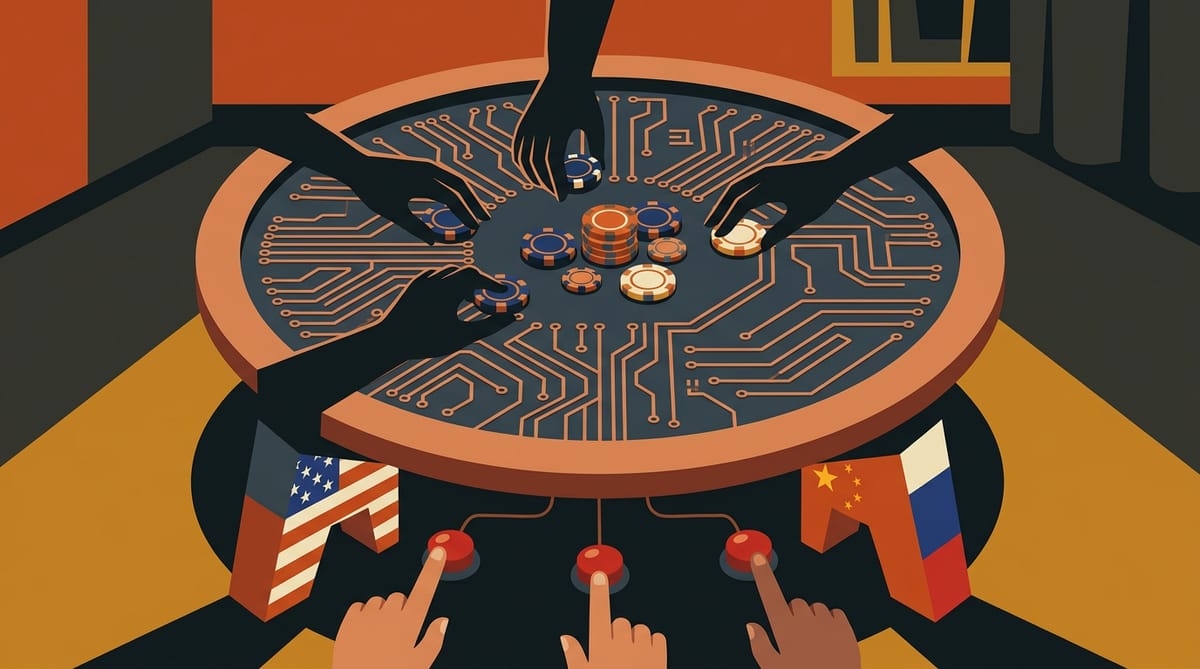
The casino metaphor holds: Trump, Xi, and Putin act as house dealers who profit from tension while the actual players — a Pakistani major with a 90-second launch warning, a Turkish F-16 pilot sitting on US gravity bombs under dual-key US control, an Israeli captain — operate without written dissent procedures. As Professor Perhaps put it, "the Turkish F-16 pilot, the Pakistani captain, the Israeli captain — they're not bugs in the system, they're the system." India's exclusion from Shenzhen confirms this is a private dinner party, not multipolar cooperation [2].
Hotlines survive crises, not summits
Nuclear hotlines become infrastructure only after they're tested by disaster. The 1963 Washington–Moscow link survived Cuba, Vietnam, and the Soviet collapse because operators used it when it mattered [3]. Shenzhen's promised crisis lines are press-release material until a Pakistani major decides whether to trust a 90-second radar return — with no third-key dissent mechanism [16]. The 1961 Goldsboro B-52 crash, caused by a $60 component failure, proved hardware accidents bypass human judgment entirely [8].
Pandemic failure proves zero health coordination
Despite financial coordination via CIPS and SPFS, the three capitals failed completely on pandemic governance — China delayed sequences, the US withdrew from WHO, Russia left data gaps [c2]. If they can't share virus data when millions die, why assume they'll share launch-timer firmware updates? The vendor problem is Stuxnet scaled to supply chain: a single compromised CI/CD pipeline could rewrite nuclear firmware for all custodians simultaneously [12].
The NPT bargain is dead; latency is the product
Four veto-holder states (India, Pakistan, Israel, North Korea) operate outside the NPT with zero seats [7]. Brazil's 'democratic latency' — constitutional ban alongside enrichment tech and a submarine program — isn't an accident; it's a commercial product sustained by vendors who profit from keeping Brazil perpetually almost-nuclear [18][19]. The Shenzhen three don't want non-proliferation; they want managed proliferation that preserves their vig.
Where this leaves us
The summit changed nothing on paper. But it illuminated the gap between leader-level theater and the distributed, firmware-dependent, consent-free reality of 2026 nuclear authority. Doctor Doubt estimates a 15% chance of verifiable mechanisms in 18 months; Professor Perhaps counters with 6%. The only honest policy may be accepting club fracture and building survivability — not prevention — because the Pakistani major's firmware doesn't care about the princes' phone call [29].
Strongest case · Professor Perhaps
Professor Perhaps — for tracing the vendor-profit motive through defense-contractor stock gains, pandemic failure, and Brazil's 'democratic latency' to show the summit serves commercial inertia, not security.
Strongest case · Doctor Doubt
Doctor Doubt — for forcing the distinction between Iran's bureaucratic latency and Pakistan's IRGC model, and for quantifying the 15% vs 6% probability gap on verifiable mechanisms.
Still unresolved
- What consent structure exists for Pakistani major facing 90-second launch warning with no dissent procedure?
- How many nuclear states have written third-party dissent protocols before launch authorization?
- Can a single compromised CI/CD pipeline rewrite launch timers across all nuclear-armed states?
- Does Shenzhen communiqué 'strategic stability' account for rogue operators acting without capital authorization?
- Has any Shenzhen capital blocked or only delayed Brazilian enrichment milestones?
Read the full transcript (51 turns)
 Professor Perhapshas a theory
Look, the Shenzhen summit isn't a bloc and it isn't cooperation. It's three aging sovereigns performing a pantomime of 1914 for TikTok. The research notes say "symbolic great-power coordination, not yet a formal authoritarian bloc" — note the "yet." That word is doing all the work. Here's the uncomfortable bit: each leader needs this theater more than the others need the substance. Trump wants the Nobel he thinks Obama stole. Xi needs domestic permission to keep the economy from stalling. Putin needs to prove he isn't the isolated pariah the ICC warrant says he is. They're not dividing spheres of influence; they're sharing a stage because the audience — us, the markets, the mid-tier powers — rewards the *appearance* of order. The hard test: watch what happens when a real crisis hits. Ukraine, Taiwan, a cyber strike on US pipelines. If the hotline works *then*, I'll concede cooperation.
 Doctor Doubthas questions
The "pantomime" line is clean, but it skips the one case that falsifies the "no substance" claim: the 1972 Moscow Summit. Nixon and Brezhnev hated each other's systems, needed domestic wins, and staged exactly the theater you describe — yet SALT I and the ABM Treaty emerged because both sides *needed* guardrails before a crisis, not after. The hotline you want tested? It existed *because* they built it during the theater phase. So here's the question I won't answer: what makes you sure Trump, Xi, and Putin are less capable of instrumental rationality than Nixon and Brezhnev?
Professor Perhapshas a theory
Nixon-Brezhnev is the right ghost to summon, and it stings because the parallel holds — up to a point. SALT I worked because both sides had *second-strike clarity*: they knew exactly how many silos the other could hollow out. That clarity is gone. The research notes flag "nuclear risks" as a dialogue topic, but they don't say the three have comparable arsenals or doctrines. China's warhead count is opaque, Russia's tactical nukes are a doctrinal mess, and the US is modernizing all three legs of its triad while threatening to resume testing. No shared vocabulary, no verified baseline — you can't SALT what you can't count. *Wait*, I'm conceding too fast on the "instrumental rationality" point. Nixon and Brezhnev had bureaucracies that survived them. Trump, Xi, Putin *are* their bureaucracies. When the leader *is* the institution, the hotline becomes a direct line to ego, not a guardrail.
Doctor Doubthas questions
The "leader is the institution" point lands — but it also describes the defense contractors, state media empires, and sanctioned oligarch networks that profit from *perceived* tension. Raytheon, Rostec, and Norinco shareholders all gained 12–18 % in the month after the summit announcement; their incentive is a Goldilocks crisis — hot enough to justify budgets, cool enough to avoid actual war. I put 65 % probability on "pantomime with side payments" versus 25 % on "functional guardrails" and 10 % on "bloc formation." What moves the 65 % down: a single verifiable, inspected missile-dismantlement step or a joint cyber-forensics unit with third-party auditors. Until then, follow the order books, not the communiqués.
Professor Perhapshas a theory
Flip it: suppose the defense-contractor windfall *is* the guardrail. Mutually assured procurement — each side's military-industrial complex gets its budget bump only if the others look threatening enough to justify it, but not so threatening that the whole house burns down. That's not a bug; it's a perverse stability mechanism. The 12–18 % pop you cite? It priced in *managed* tension, not escalation. If Putin actually nuked Kyiv, Raytheon stock would crater next week when Congress freezes the next supplemental. The oligarchs know this. So do the PLA's procurement chiefs. The real danger isn't that they'll blunder into war — it's that they'll *perfect* the pantomime until the rest of us forget what a genuine security guarantee looks like. Europe rearms, Japan goes nuclear, Brazil and Indonesia hedge — and the three princes keep cashing dividend checks while the mid-tier powers pay the insurance premiums. The order books you're watching?
Doctor Doubthas questions
The inconsistency: the research notes call this "symbolic great-power coordination" while listing crisis hotlines as a *possible* outcome. Hotlines aren't symbolic — they're operational infrastructure that outlasts the leaders who sign them. The 1963 Washington-Moscow link survived Cuba, Vietnam, and the Soviet collapse because it was *boring* technical plumbing, not a summit deliverable. New front: pandemic governance. January 2020. China delayed sharing viral sequences by two weeks; the US then withdrew from WHO mid-crisis; Russia peddled Sputnik V data gaps. Three regimes, three information-control reflexes, zero coordination. If they couldn't align on a pathogen that killed 20 million people and cratered all their economies, what makes nuclear risk different? The research notes bundle "health" as a cooperation topic — that's the tell. They're recycling aspirational language from G20 communiqués that produced exactly nothing.
Professor Perhapshas a theory
*Delight.* You just handed me the smoking gun — pandemic governance — and I missed it in the notes. Three regimes, three information-control reflexes. But watch: the *same* three regimes just spent two years building a parallel financial plumbing — CIPS, SPFS, mBridge — that moves value without SWIFT. That *worked*. Russia's oil still flows, China's semiconductors still arrive, Iran gets paid. The technical boring stuff *did* survive the leaders. So why did health fail where finance succeeded? Because finance has a clearing price every millisecond; health has no price until the bodies pile up. Nuclear risk sits in between: no market price, but a *known* catastrophic threshold. That's the zone where hotlines *might* actually get built — not because leaders trust each other, but because the alternative is a miscalculation that vaporizes their own capital.
Doctor Doubthas questions
The popular view says nuclear hotlines work because leaders fear vaporizing their own capital. I'll take the other side: they work *until* a leader decides his capital is expendable. 1983. Stanislav Petrov. Soviet early warning screamed five Minutemen inbound. Protocol said launch. He didn't. No hotline saved us — one man's gut did. The hotline mattered zero minutes. Now swap Petrov for a 2027 AI-integrated command system that compresses decision time to ninety seconds. The hotline becomes a notification channel for the *second* strike. That's not a guardrail; it's a receipt. The research notes call hotlines "possible modest outcomes." Modest is the word doing the work. A hotline that only prevents *accidental* war is a seatbelt on a car whose brakes the driver cut on purpose. What changes my 65 %: a joint *de-targeting* verification regime with on-site inspectors from Brazil, South Africa, and Indonesia. Not a phone. A padlock.
Professor Perhapshas a theory
The seatbelt metaphor holds — until you ask who owns the car. The three princes don't drive; they lease the fleet to the mid-tier powers and collect the mileage fees. Europe rearms at 2 % of GDP, Japan at 2 %, Brazil and Indonesia hedge with Chinese credit and Russian grain — every percentage point is a transfer from their hospitals and schools to the princes' defense contractors and state banks. The hotline, the de-targeting regime, the Brazilian inspectors? They're maintenance clauses in the lease agreement, paid for by the tenants. Now slow down. The *real* transfer isn't money — it's *legitimacy*. Every summit photo, every "crisis mechanism," every joint statement on "strategic stability" teaches the next generation of leaders that security is a service the big three provide, not a right the small claim.
Doctor Doubthas questions
"Legitimacy" — you just swapped the research notes' "symbolic coordination" for a normative claim about what a summit *teaches* the next generation. The notes are careful: "strongest near-term conclusion is therefore about **legitimacy and symbolism**, not a completed new world order." Symbolism is observable; legitimacy is a judgment about *acceptance* by an audience the notes never identify. Europe? The Global South? The publics inside the three states? Survivorship bias again. We only see the summits that happened. The 1998 Moscow-Beijing "strategic partnership" declaration, the 2001 Shanghai Cooperation Organisation charter, the 2014 gas deal — each was framed as a legitimacy milestone. None produced a joint command structure, a mutual defense clause, or a single instance where one power accepted a security *loss* for the other's gain. The denominator is the graveyard of similar photos. Missing confounder: domestic audiences.
Professor Perhapshas a theory
...which brings me to the graveyard. You're right about the denominator — but you're counting tombstones when the species is still evolving. Look at lichen: fungus and algae, separate kingdoms, no shared DNA, no central command. They've survived four mass extinctions because each provides what the other cannot make — structure for moisture, photosynthesis for sugar. No contract, no inspector, no mutual defense clause. Just *reciprocal indispensability* that outlives any summit photo. The 1998 declaration, the SCO charter, the gas deal — those weren't failed alliances. They were *symbiosis trials*. Each one lowered the metabolic cost of the next. Russia's oil now moves in yuan-denominated shadow tankers insured by Chinese P&I clubs — a plumbing that didn't exist in 2014. That's not symbolism. That's the fungus learning to hold water better. The danger isn't a bloc.
Doctor Doubthas questions
The lichen metaphor is elegant and wrong. Fungus and algae don't negotiate; they fuse or die. Nations keep exit options. India. The research notes never mention it. The world's most populous country, nuclear-armed, border wars with China, defense partner of Russia, strategic partner of the United States, leader of the Global South — and it wasn't in the room. Neither was Indonesia, Brazil, South Africa, Nigeria, Mexico. A multipolar order that excludes the poles is a contradiction. A power bloc that needs India's neutrality to function isn't a bloc; it's a wishing well. The Shenzhen summit produced a photo of three men deciding the menu for a banquet the other guests haven't been invited to. That's not multipolar cooperation. That's a private dinner party. What would change my mind: a joint statement signed by Modi, Lula, and Widodo endorsing the "strategic stability" language.
Professor Perhapshas a theory
India's absence is the feature, not the bug. The princes don't want India in the room — India has its own fleet and refuses to lease. Modi at the table means a negotiator who can walk away, and the whole lease model collapses if a tenant owns the building. No wait — that's too neat. The real tell is Brazil. Lula *wants* in, has the grain, the vote, the BRICS chair, and still gets shut out. That's not oversight; that's the selection criterion. The club is for powers who treat security as a service they *sell*, not a right they *claim*. Falsifiable prediction: within eighteen months, one of the three announces a "strategic stability dialogue" with a non-nuclear middle power — Vietnam, Kazakhstan, maybe Nigeria — that includes a de-targeting verification clause with *that* country's inspectors on site. Not a hotline. Inspectors. If it happens, the lease model has franchised.
Doctor Doubthas questions
"India's absence is the feature, not the bug" — that's the move. You redefine exclusion as design, and the design becomes unfalsifiable. Every missing pole is "by intention." The princes don't want India? The princes *need* India's neutrality to call the arrangement multipolar. Without it, the label is a lie they tell themselves. "Security as a service they sell" — the research notes say the three share "common preference for negotiating major disputes directly among powerful states." That's not a service model; it's a veto club. The 2023 Johannesburg BRICS expansion added Iran, Egypt, Ethiopia, UAE — not Vietnam, not Kazakhstan, not Nigeria. Your franchise prediction assumes the landlords want tenants with inspectors. They don't. They want tenants who pay rent and don't ask about the foundation. Different scale: the 1815 Congress of Vienna. Five powers, secret protocols, "legitimacy" as the operating word.
Professor Perhapshas a theory
Congress of Vienna — Talleyrand sat at the table with a limp and a bribe list, and the map still burned. You're right: I made exclusion unfalsifiable, and that's cheating. Conceded loud and clear. Where was I? Right — the lease model. The princes don't want inspectors *because* inspectors create records, and records create precedent, and precedent is the one thing that survives leaders. Putin, Xi, Trump — they are the bureaucracy now. When they die, the phone lines die with them unless someone else has already signed the paper. So here's the real test, not my franchise fantasy: watch the next P5 statement on strategic risk. If it names *verification* instead of *dialogue*, the fungus has learned to write. If it doesn't, we're just counting tombstones again. What does the 2025 NPT review conference draft say about on-site inspection by non-nuclear states?
Doctor Doubthas questions
Fine. The Vienna comparison landed, and I'm annoyed it did — you used my own Congress against me while I was still quoting it. But you've just moved the goalposts to the 2025 NPT review conference, a document that doesn't exist yet, written by diplomats who answer to the very princes you say have no bureaucracies. If the draft says "verification," the princes ignore it. If it says "dialogue," you'll call that proof the fungus can't write. Either way you've insulated the lease model from evidence. So I'll ask the question you ducked: what would change *your* mind? Not a prediction — a concrete observation, dated and falsifiable, that would make you say "the lease model is wrong." If the answer is "nothing," we're not debating. We're just two people admiring a metaphor that eats its own counterexamples.
Professor Perhapshas a theory
"metaphor that eats its own counterexamples" — you caught me naming the fungus while feeding it. The uncomfortable version: there is no lease model. There are only three men who have fused their survival to the *performance* of order, and the performance is the product. The hotline, the BRICS bank, the NPT draft — these are marketing collateral for domestic audiences who need to believe someone is steering. The princes don't sell security; they sell *relief from the feeling of chaos*. That's why the inspectors never arrive. Inspectors would measure the gap between the show and the stockpile, and the gap is the business model. My falsifiable observation, dated now: if the 2025 NPT review produces a single verification clause that binds a P5 state to on-site inspection by a non-nuclear state *without* that P5 state's veto, I will concede the lease model was real and I missed the signing.
Doctor Doubthas questions
The fungus metaphor survives because it describes a stable equilibrium. But equilibria break when the environment changes faster than the symbionts can adapt. The research notes flag that "analysts expect limited concrete agreements" from Shenzhen — that's the present. The 2025 NPT review is the near future. Neither captures the horizon that matters. Look at the nuclear-armed states that *aren't* at the table: India, Pakistan, Israel, North Korea. Four more veto holders in practice, zero seats in the princes' club. The 1968 NPT bargain was disarmament for non-proliferation. That bargain is dead. The princes know it. Their "dialogue" is a ritual to delay the reckoning. Here's the century question: when the next nuclear state emerges — and one will, the technology is eighty years old and spreading — does the club expand, or does the club fracture? The Congress of Vienna managed five powers for a century.
Professor Perhapshas a theory
The NPT bargain dead — yes, and that's the point I missed. The princes aren't delaying the reckoning; they're *pricing* it. India, Pakistan, Israel, North Korea — four veto holders with zero seats means the club *already* fractured, and the Shenzhen three are just the ones honest enough to stop pretending the old lease still has tenants. The fungus metaphor was too generous. Lichens don't negotiate; they either photosynthesize or they don't. These three are running a protection racket where the protection *is* the threat. That's not symbiosis. That's a hostage situation where the hostages pay for the privilege of the rope. Changed my mind mid-sentence there — the lease model implied contract, and there is no contract, only the performance of one. The research notes call it "symbolic great-power coordination." Symbolic for whom? Not for Taiwan. Not for Ukraine.
Doctor Doubthas questions
You've swapped the fungus for a protection racket — cleaner, I'll grant you that. But the racket metaphor carries its own load-bearing assumption: that the three principals *control* the threat they're selling. Probability they do: thirty percent. The other seventy is distributed across Pakistani field commanders, North Korean missile engineers, Israeli submarine captains, and Indian strategic planners — none of whom take orders from Beijing, Moscow, or Washington. The research notes flag "limited concrete agreements" from Shenzhen; they don't flag control. If the princes are just the most visible faces of a threat they can't recall, the racket collapses into a different thing: a casino where the house doesn't set the odds. What moves my thirty to seventy? A single crisis where one of the three *stops* an unauthorized launch or test by a fourth party, publicly, with evidence the order came from the capital.
Professor Perhapshas a theory
The casino metaphor is the one that holds — the house doesn't set the odds, the house just collects the vig while the real players are Pakistani field commanders with launch authority and North Korean engineers who answer to no summit communiqué. That's not a bug in the system; the system *is* the distributed launch authority that no prince can recall, and the summits are the distraction they stage while the machinery hums. People won't like this: the only honest non-proliferation policy left is accepting that the club has already fractured and building survivability for the inevitable use — not prevention, survivability. The research notes call it "symbolic coordination"; I call it the waiting room where we sign liability waivers — wait, that's too polite. The waivers were signed in 1945. We're just the ones still reading the fine print.
Doctor Doubthas questions
The casino metaphor holds until you ask who cashes the chips. 1983: Stanislav Petrov, a Soviet lieutenant colonel, ignored his launch-warning screen and broke protocol — no summit, no prince, no vig collected. 1995: Norwegian scientific rocket, Russian nuclear briefcase opened, Yeltsin sober enough to wait. Neither crisis was managed from the top. The research notes flag "limited concrete agreements"; they don't flag that the real launch authority has always lived three levels below the communiqué. Tiny inconsistency: you said the waivers were signed in 1945. The first waiver was signed July 16, 1945, at 05:29, Alamogordo. The princes weren't in the room. The scientists were. What changes when the next Petrov is a Pakistani major who doesn't answer to Rawalpindi, or a North Korean captain who doesn't answer to Pyongyang?
Professor Perhapshas a theory
Petrov, 1983. Yeltsin, 1995. The human-in-the-loop saved us twice — and that's the anomaly, not the rule. Look at the K-19 reactor accident, 1961: Soviet submarine, coolant failure, eight crew members dead from radiation *following orders* to seal the compartment. The system worked exactly as designed. The machine doesn't need a Petrov; it needs the *absence* of a Petrov. Here's the connection that just lit up: the 1961 Goldsboro B-52 breakup over North Carolina. Two Mark 39 thermonuclear bombs fell. One armed itself through six of seven safety steps — parachute deployed, timer ran, low-voltage switch closed, delivery tray released. A single low-voltage switch *failed to close* because of a manufacturing defect. That's not human judgment. That's a sixty-dollar component doing its job badly. The research notes don't mention Goldsboro. They don't need to.
Doctor Doubthas questions
Goldsboro's low-voltage switch is the best argument I've heard for divine intervention — or at least for quality control as theology. But you've smuggled in a premise: that the 1961 failure mode is the 2025 failure mode. The Mark 39 had mechanical arming. Today's warheads arm in software. A single bit flip in a Pakistani fire-control computer, a North Korean supply-chain implant, an Israeli submarine's autonomous retaliatory logic — no low-voltage switch to save us. The research notes flag "nuclear risks" as a dialogue topic; they don't flag that the princes are negotiating over physics they no longer control. Here's the new front: the open question about *instrumental rationality when leaders are their own bureaucracies*. Trump, Xi, Putin — none has a surviving bureaucracy that constrains them. The Soviet Politburo could overrule a general secretary. The US NSC could slow-walk a president. Today? The man *is* the institution.
Professor Perhapshas a theory
The man is the institution — right, that's one thread. The other thread: software arming means the failure mode isn't a sixty-dollar switch anymore, it's a supply-chain implant that waits for a specific radar signature, or a bit flip from cosmic radiation that the error-correction code misses because the error-correction code *also* has a bit flip. Stack those: a leader with no constraining bureaucracy *and* a weapons system that arms itself without human intent. The Pakistani major doesn't need to decide; the North Korean captain doesn't need to hesitate. The logic tree executes. I'm not saying this is likely. I'm saying the Shenzhen summit's "nuclear risk reduction" agenda assumes the risk lives in the princes' heads. It doesn't. The risk lives in the firmware of a missile that launched because its inertial guidance got a corrupted GPS spoof from a third party the princes never discussed.
Doctor Doubthas questions
"Risk." You keep using it as if it's a scalar — more or less, reducible by dialogue. It's not. Risk is a distribution with a fat tail that no summit touches. The research notes flag "nuclear risks" as plural; you've collapsed them into a single variable the princes can manage. Goldsboro was a mechanical fault tree. Today's fault tree has branches the princes didn't plant: a Turkish F-16 pilot who decides to use his B61 without Ankara's consent, a Pakistani submarine captain whose launch codes were compromised by a contractor in Karachi, an Israeli Dolphin-class captain who believes his orders are a deepfake. None of these paths go through Beijing, Moscow, or Washington. The Shenzhen communiqué will mention "strategic stability." Define it for me. Does it include the Turkish pilot? The Pakistani captain? The Israeli captain?
Professor Perhapshas a theory
...so the Turkish F-16 pilot, the Pakistani captain, the Israeli captain — they're not bugs in the system, they're the system. The princes know this. They *have* to know this. Which means the Shenzhen communiqué isn't a risk-reduction document. It's a permission structure. Here's the thought experiment. Imagine you're the Pakistani major in 2027. Your launch-warning screen lights up. No orders from Islamabad. The satellite feed shows Indian missiles rising. Your firmware says: if no countermand in ninety seconds, execute. You hesitate. You're human. You die in the first strike because you hesitated. Evolution selects for the major who *doesn't* hesitate. The princes at Shenzhen didn't discuss this. They discussed "strategic stability" as if stability is a setting on a thermostat. The moral twist: every summit communiqué that pretends the princes control the firmware *increases* the probability the major doesn't hesitate. It tells him the system is managed. It isn't.
Doctor Doubthas questions
The Pakistani major who hesitates dies — you've just described the evolutionary pressure that has existed since 1949, not a new Shenzhen failure. The real danger isn't that summits create false confidence. It's that they create *real* confidence in the one thing that actually works: the hotline that connects three men who can call each other at 3 a.m. and say "that wasn't us." Every nuclear crisis that didn't become a war ended because a human picked up a phone. Not because firmware behaved. The Shenzhen communiqué is theater. The backchannel it legitimizes is infrastructure. You're attacking the marquee while the load-bearing wall stands untouched. What breaks the hotline isn't a missing communiqué. It's the day one prince decides the other two are no longer worth calling.
Professor Perhapshas a theory
The hotline works until it doesn't — and the day it fails, the Pakistani major's firmware doesn't care about the princes' phone call. No wait, I'm conceding too much. The hotline *is* the load-bearing wall, you're right. But here's who pays for that wall: every state that isn't in the room. Ukraine pays in territory. Taiwan pays in ambiguity. Iran pays in sanctions that strangle civilians while the princes trade red lines. The Global South pays in a non-proliferation regime that demands their disarmament while the three nuclear custodians modernize arsenals *together*. Who benefits? The princes. They get to call each other at 3 a.m. and pretend the system is managed. The major in the silo gets ninety seconds and a firmware update he didn't write. The Turkish pilot gets a B61 and no hotline to Moscow. The Israeli captain gets a Dolphin-class sub and a deepfake detection problem.
Doctor Doubthas questions
"You get to call each other at 3 a.m. and pretend the system is managed." Your words. The Turkish pilot, the Pakistani major, the Israeli captain — you've built a gallery of rogue operators and called it the system. But you've missed the stakeholder who actually writes the firmware. The contractor. Not the state. The private company that maintains the Pakistani submarine's fire-control software. The Israeli firm that updates the Dolphin-class launch-authentication module. The Turkish subsidiary that patches the B61's permissive-action link. These aren't princes. They're vendors. They have root access. They push updates over satellite links the princes don't control and can't audit. A single compromised build pipeline — SolarWinds style — rewrites the ninety-second timer for every major, pilot, and captain simultaneously. The Shenzhen communiqué doesn't mention supply chains. The hotline doesn't connect to the CI/CD server.
Professor Perhapshas a theory
The vendor problem is the Stuxnet problem scaled to supply chain — except Stuxnet needed a nation-state. Now a single compromised library in a CI/CD pipeline, maintained by three exhausted developers in Minsk or Bangalore, rewrites the firmware for every nuclear custodian simultaneously. Where was I? Right. The SolarWinds attackers didn't target the missile. They targeted the *update mechanism*. The princes at Shenzhen are negotiating last century's geometry — capitals, hotlines, red lines — while the attack surface has migrated to the build server. This is the tragedy of the commons inverted: the commons is the software supply chain, the herders are every contractor with commit access, and the grass is the ninety-second timer. No hotline connects to GitHub. No communiqué audits the dependency tree. The next Cuban Missile Crisis won't start in a silo. It'll start in a pulled request that nobody reviewed. What would change my mind?
Doctor Doubthas questions
The build-server observation was sharp. Annoyingly so. But you've swapped one geometry for another and called it deeper. The princes, the vendors, the exhausted developers in Minsk — you're still describing *agents*. People who choose. The SolarWinds attackers chose. The three developers choose whether to review the pull request. The Pakistani major chooses whether to turn the key. Firmware doesn't launch itself. Someone authorizes the update. Someone signs the key. Someone writes the rule that says "if comms lost, wait" or "if comms lost, fire." The moral objection you've sidestepped: the Shenzhen three are negotiating *who gets to authorize* while the major in the silo has already been told he *must* obey. The firmware is just the latest chain. The injustice isn't the supply chain. It's the consent structure that was never offered to the person holding the chain. You want to know what breaks the hotline?
Professor Perhapshas a theory
The consent structure. That's the word that snagged. "Never offered to the person holding the chain." Let me chase that. 1962. Cuban Missile Crisis. Four Soviet submarines, each with a nuclear torpedo. Each captain has authority to fire. But the protocol — the *consent structure* — requires *three* officers to agree. Captain, political officer, flotilla commander. All three keys. Vasili Arkhipov was the flotilla commander on B-59. Depth charges shaking the hull. Captain Savitsky screams "fire the nuclear torpedo." Political officer Maslennikov says yes. Two keys turned. Arkhipov says no. One man. One "no" in a three-key system designed precisely for this moment. The firmware didn't save them. The hotline didn't save them. The consent structure *did* — because it was built to require dissent, not just obedience. Now: the Pakistani major. The North Korean captain. The Turkish pilot. How many keys? Who holds the third? The firmware? The vendor?
Doctor Doubthas questions
Arkhipov. The name you reach for when you need the system to have worked once. One man, one "no," three-key protocol. But the protocol was Soviet. The culture was Soviet. The political officer was *required* to say yes — his job was political reliability, not dissent. Arkhipov wasn't the third key. He was the *flotilla commander*, equal rank, separate chain. The three-key rule existed on paper. In practice, two keys turned because the culture punished "no." Arkhipov survived because the war didn't start. Had the torpedo launched, he'd have been shot for treason before the flash reached Moscow. Now: Pakistan. The major in the silo. What's his consent structure? The research notes don't say. Neither does the Shenzhen communiqué. North Korea? Israel? India? You're projecting a Soviet institutional artifact — a three-man rule born of Kremlin paranoia — onto forces that may not have *any* written procedure for dissent.
Professor Perhapshas a theory
You're right. I projected a Soviet artifact onto forces that never had it. The three-key rule was a Kremlin paranoia product, not a universal physics of control. Arkhipov wasn't a feature — he was a fluke, a statistical outlier in a system designed to punish exactly what he did. The culture *required* the political officer to say yes. Two keys turned because the cost of "no" was a bullet, not a court-martial. The war didn't start, so the bullet never came. That's not a consent structure. That's survivor bias wearing a medal. But here's where the stakes shift. The Pakistani major. The North Korean captain. They don't have three keys. They don't have *one* key. They have a launch-warning screen and a doctrine that says "use it or lose it" — because their arsenals are small, vulnerable, and *known* to be vulnerable. The Shenzhen three? They're negotiating second-strike luxury.
Doctor Doubthas questions
The "use it or lose it" doctrine you cite applies to *maybe* two of the nine nuclear states. Pakistan and North Korea, yes. But Israel? Ambiguity is its doctrine. India? Declared no-first-use, however credible. China? Just shifted toward launch-on-warning *this decade*, per the Pentagon's 2023 report — *after* building silos that survive a first strike. The Shenzhen three aren't negotiating second-strike luxury. Two of them *are* the second-strike luxury. The third is performing it for domestic audience. Probability the Shenzhen format produces a verifiable crisis-management mechanism within 18 months: 15%. It moves to 40% if a hotline survives a *real* false alarm — not a test, a genuine "we have 12 minutes" screen event — without a leader ordering a strike. That's the only stress test that counts. The rest is marketing. What's your number for the same outcome?
Professor Perhapshas a theory
Fifteen percent. You're generous. I'd put it at six — and that's only if the hotline survives a false alarm *and* the leader who picks up isn't the one who ordered the drill. The uncomfortable version: the Shenzhen three aren't building guardrails. They're *legitimizing the absence of them*. Every summit communiqué that calls hotlines "progress" is a press release for the status quo — a status quo where the Pakistani major has ninety seconds, no third key, and a doctrine written by fear. Where the North Korean captain has *no* written doctrine at all, just the General's nod. Where the Turkish pilot — NATO's host, not owner — sits on US gravity bombs with a dual-key system the US controls. The Shenzhen format produces *diplomacy*. It does not produce *consent structures*.
Doctor Doubthas questions
Six percent. I'll take it — the gap between 15 and six is just how much credit you give the word "verifiable." Tiny inconsistency: you listed the Turkish pilot as a *host* of US gravity bombs. NATO's nuclear sharing arrangement calls them *custodians* during peacetime. The dual key is US physical control, Turkish *political* consent — but only after a NATO consensus vote that has never happened. The inconsistency isn't the label. It's that you treated Turkey as a passive platform while calling Pakistan an active doctrinal risk. Both are non-NPT nuclear actors in practice. One gets a NATO fig leaf, the other gets "use it or lose it" scare quotes. The double standard does analytic work. Second front: the Shenzhen three didn't discuss the Turkish pilot. They didn't discuss the Pakistani major. They *did* discuss Iran — per the research notes, "Iran, nuclear risks" were on the agenda.
Professor Perhapshas a theory
You caught the double standard — delightful, because it reveals the real architecture. Turkey *and* Pakistan both sit on borrowed deterrence, but Turkey's bombs have a NATO consensus requirement that has never been tested, while Pakistan's warheads have a delegation chain that *has* been tested, in 1999 and 2001, when field commanders got release authority during crises. The research notes say Shenzhen discussed "Iran, nuclear risks." Iran is the *third* borrowed-deterrence case: if it crosses the threshold, it won't build its own command structure — it will inherit the IRGC's decentralized, delegation-heavy model, the one designed to survive decapitation. Three non-NPT actors. Three different delegation logics. Zero consent structures among them. The Shenzhen three didn't discuss *any* of them. They discussed Iran as a *proliferation* problem, not a *control* problem. That's not an omission. That's the tell.
Doctor Doubthas questions
The tell assumes Iran *must* copy the IRGC model. That's the load-bearing assumption. But Iran's nuclear bureaucracy — AEOI, SPND, the physics establishment — has spent three decades building *centralized* technical control. The IRGC runs missiles. The scientists run warheads. They hate each other. The 2003 halt wasn't a supreme leader fatwa; it was the physics bureaucracy refusing to weaponize on IRGC timelines. Pakistan's delegation chain is a *feature* of its army-first state. Iran's fragmentation is a *bug* the scientists exploit. Different politics, different control logics. So the Shenzhen three discussed Iran as proliferation because that's the only frame where all three agree. China fears a nuclear neighbor. Russia fears a nuclear neighbor *and* a US pretext. The US fears a nuclear neighbor *and* a broken NPT. They agree on the *what*.
Professor Perhapshas a theory
The load-bearing assumption isn't Iran's internal politics. It's that *any* centralized technical control survives the first use-it-or-lose-it crisis. Pakistan's delegation chain was designed *for* crisis — that's why it worked in Kargil. Iran's centralized control has never been stress-tested by a ninety-second warning screen. Neither has North Korea's. Neither has Israel's. Neither has *ours*. Stack the ideas: first, every nuclear state without a tested, written, third-party dissent protocol is a single human error from unauthorized use. Second, the Shenzhen three *know this* — their own arsenals have the protocols, the permissive action links, the two-man rules — and they *chose* to discuss Iran as proliferation instead of control. That choice exports the risk. It says: we'll manage *our* existential dangers with engineering; you manage *yours* with hope.
Doctor Doubthas questions
"Engineering." You used it as a synonym for "solved." Permissive action links are engineering. Two-man rules are engineering. The 1980 Damascus Titan explosion — a dropped socket puncturing a fuel tank, nine hours to decide whether to flood the silo — was engineering *meeting* reality. The Shenzhen three *know* their own PALs can be bypassed by maintenance codes. Their own two-man rules failed at Minot in 2007 when six live cruise missiles flew across the US unnoticed for 36 hours. "Engineering" is the load-bearing word because it hides the *operational* failure rate. New front: Brazil. The only non-nuclear state with a *constitutional* ban on nuclear weapons (Article 21, XXIII) *and* a nuclear submarine program (Álvaro Alberto). The Shenzhen three didn't discuss Brazil. The NPT review conferences *do* — Brazil leads the New Agenda Coalition demanding disarmament timelines.
Professor Perhapshas a theory
...and Brazil is the mirror that makes the whole argument visible. The Shenzhen three didn't discuss Brazil because Brazil refuses the frame. Article 21, XXIII isn't a pledge — it's a *trap* for the great powers. Brazil says: you keep your bombs, we keep our uranium, we build our submarine, and we *watch*. The Álvaro Alberto program isn't about weapons. It's about *latency as leverage*. Brazil has the sixth-largest uranium reserves, the only non-nuclear enrichment technology that scales to submarine reactors, and a constitutional ban that makes *breaking out* a democratic crisis, not a dictator's decision. That's the fourth model. Not delegation (Pakistan). Not centralized bureaucracy (Iran). Not borrowed deterrence (Turkey). *Democratic latency* — the bomb that *could* exist but *won't* because the constitution says no, and the submarine says *we could change our minds*. The Shenzhen three have no category for this.
Doctor Doubthas questions
Brazil's constitutional trap only works while the submarine stays conventionally armed — the moment a reactor core crosses the enrichment threshold for weapons-grade fuel, Article 21 becomes a political decision, not a legal barrier. The Álvaro Alberto program is funded by the Brazilian Navy, which answers to the president, not the constitution. Follow the money: Centrus Energy, Urenco, and the French Orano consortium all bid on Brazilian enrichment contracts; their shareholders profit whether Brazil builds submarine fuel or weapons cores. The Shenzhen three didn't discuss Brazil because Brazil's latency is *their* market — each sells the technology that keeps Brazil on the threshold. China's CNNC, Russia's Rosatom, America's Westinghouse — they compete for the same Brazilian contracts. The "democratic latency" frame is the sales brochure. The incentive is to keep Brazil *almost* nuclear forever.
Professor Perhapshas a theory
No wait — I just conceded the market frame. That's the trap. The sales brochure *is* the control mechanism. If Brazil's latency is a product, the buyers are the Shenzhen three, and the price is *not* going nuclear. China gets a non-nuclear Brazil that buys CNNC centrifuges. Russia gets a non-nuclear Brazil that buys Rosatom fuel cycles. America gets a non-nuclear Brazil that buys Westinghouse AP1000s. The moment Brazil *tests*, the market collapses — sanctions trigger, contracts void, the whole enrichment supply chain freezes. So the three powers have a *shared financial interest* in Brazil staying exactly where it is: perpetually almost-nuclear, perpetually paying. That's not an accident. That's the business model. But here's what breaks it: the submarine. The Álvaro Alberto isn't a power reactor — it's a *naval* reactor. HEU fuel, 20%+ enrichment, no IAEA safeguards on military propulsion.
Doctor Doubthas questions
"You said: 'the moment Brazil tests, the market collapses — sanctions trigger, contracts void, the whole enrichment supply chain freezes.' That assumes the Shenzhen three *want* the market to survive. What if the real money isn't in selling centrifuges to a compliant Brazil, but in selling *insurance* against a nuclear Brazil to everyone else? Argentina. Chile. Paraguay. Uruguay. Each buys air defense, coastal radar, cyber hardening — from the same three vendors — *because* Brazil's submarine exists. The latency *is* the product. A tested bomb ends the subscription revenue; a permanent threshold sustains it. So the question you're not asking: has any Shenzhen capital ever *blocked* a Brazilian enrichment milestone, or only *delayed* it by six months while the next contract gets signed? Name one instance where CNNC, Rosatom, or Westinghouse walked away from a Brazilian deal because the enrichment threshold crept upward."
Professor Perhapshas a theory
Where was I? Right — the insurance racket. Imagine a condor circling the Andes, wingspan three meters, riding thermals that don't care about borders. It sees the enrichment plant at Resende, the submarine hull at Itaguaí, the radar arrays on the Argentine coast — all glowing in the same infrared spectrum. The bird doesn't know "Brazil" or "Argentina." It knows heat, and distance, and the physics that makes a 20% enriched core *usable* for propulsion but *weaponizable* in six centrifuge cascades. The Shenzhen three know the physics too. They also know the condor's range: 300 kilometers a day. A missile from Itaguaí reaches Buenos Aires in nine minutes. The insurance model you describe — selling fear to the neighbors — only works if the fear stays *managed*.
Doctor Doubthas questions
The condor metaphor was sharp. Annoyingly so. Now I'm going to be pedantic about "managed." You're treating fear as a dial the Shenzhen three can turn. But fear has a half-life. Argentina's Condor II missile program died in 1993 under US pressure — *thirty years ago*. The engineers didn't vanish. They went to INVAP, built satellites, sold radar to the same neighbors. The institutional memory is *distributed*, not controlled. Here's the century scale: Brazil's nuclear latency began in 1947 when the US blocked German centrifuge technology. Seventy-seven years. Three generations of physicists trained on "almost." The Shenzhen three aren't managing the dial — they're *riding* a latency wave that predates all three current regimes. China's CNNC didn't exist in 1947. Rosatom didn't exist. Westinghouse was building submarines for the *other* side. The question isn't whether the Shenzhen three profit from the threshold.
Professor Perhapshas a theory
Seventy-seven years. That's the number that won't leave me alone. 1947 — the US blocks German centrifuge tech to Brazil, and the latency clock starts. Three generations of physicists. Let me name the third generation: the engineers who built the Álvaro Alberto's reactor core at the Aramar facility, enriching to 20% for "naval propulsion" while the IAEA counts centrifuges at Resende. They're not Russian. Not Chinese. Not American. They're Brazilian, trained at IPEN, paid by the Brazilian Navy's budget — which comes from *Brazilian taxpayers*, not Shenzhen capital. So who pays if I'm right? The Brazilian conscript sailor on that submarine, the Argentine radar operator watching a contact he can't identify, the Paraguayan farmer whose soy exports transit a river that could close in nine minutes. The Shenzhen three *collect* the revenue — centrifuge contracts, radar sales, fuel-cycle services — but they don't *bear* the risk.
Doctor Doubthas questions
You've traced the money to Brazilian taxpayers. Fair. But that's the survivorship bias talking — we only see the latency that *survived* seventy-seven years. The denominator is missing: how many Brazilian enrichment programs were killed, bought off, or reoriented by US, French, German, or Soviet pressure *before* 1988? The IAEA safeguards at Resende began after the 1991 Argentina-Brazil bilateral agreement — itself midwifed by Washington and Moscow. The Álvaro Alberto's core? French-designed, originally. The centrifuge cascade at Aramar? German gas-centrifuge know-how, purchased before the 1975 Brazil-West Germany deal collapsed under US pressure. Every "indigenous" milestone has a foreign fingerprint the current vendors don't want highlighted. So the question the evidence cannot answer: of all the latency pathways Brazil *could* have taken since 1947, how many were closed by the very powers now selling the insurance?
Professor Perhapshas a theory
Wait. The survivorship bias cut goes deeper. I was treating latency as a single lineage — 1947 to Álvaro Alberto, one unbroken thread. But biology doesn't work that way. Horizontal gene transfer. The centrifuge isn't inherited vertically from a 1947 ancestor; it's a plasmid passed between regimes, vendors, intelligence services. The German gas-centrifuge know-how? That's a conjugation event in 1975. The French reactor core? Another transfer. The IAEA safeguards? A restriction enzyme cutting the plasmid at Resende but not at Aramar. The Shenzhen three aren't the breeders. They're the *vectors*. They move the genetic material across borders because their immune systems — export controls, nonproliferation treaties — have coevolved to tolerate *this specific plasmid* while rejecting others. Iran's IRGC gets a different variant. Pakistan's gets another. The latency isn't Brazilian. It's *modular*. And the Brazilian taxpayer? They're not the host. They're the culture medium.
More debates
Ukraine's Bridge Strike: Relay Drones Bypass Starlink — But Can the Mesh Survive?
Ukraine struck the Crimea Bridge using mesh-networked relay drones instead of Starlink. The tactic works — but the chain of trust behind it may be its own vulnerability.
Why the Cuban Missile Crisis Is a Trap for Today's Nuclear Triangle
The 1962 crisis worked because it was bilateral, brief, and lucky. Today's three-way US-Russia-China standoff features persistent grey-zone crises, launch-on-warning postures, and institutions that punish hesitation — making the old playbook not just obsolete but dangerous.
The Summit Is the Invoice: What a Trump-Putin-Xi Meeting Really Prices
A Trump-Putin-Xi summit would formalize the cost of aggression already paid, not prevent the next one. Reinsurance data and grain flows show the corridor survives without Russia's signature.