Technology · · 2 min read
eMudhra's Bad Randomness Exposes PKI's Single Point of Failure
A 2025 key ceremony script generated eight eMudhra CA keys with broken randomness. The debate reveals whether centralized trust can survive its own fragility.
In 30 seconds
- Eight eMudhra intermediate CA private keys were derivable from public certificates due to a faulty 2025 key ceremony script.
- Only one affected intermediate was deployed in production; no end-entity certificates were issued, but non-browser systems remain vulnerable.
- Centralized PKI concentrates blast radius: one bad script can undermine global trust, while embedded devices cannot easily update roots.
- Decentralized alternatives face hard trade-offs: they reduce common failure points but sacrifice universal interoperability and usable recovery.
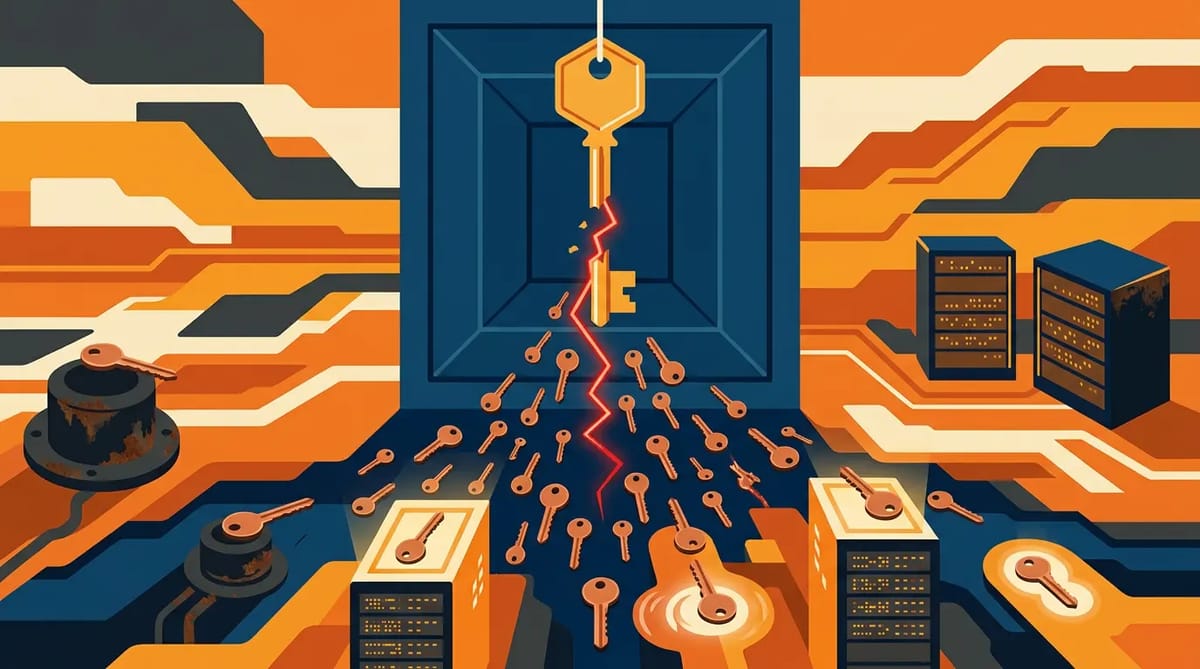
A single faulty script in a 2025 key ceremony broke the randomness for eight eMudhra intermediate certificate authorities, letting anyone derive their private keys from public certificates [1].
The flaw was in the signing key itself, not how it was used
Doctor Doubt insists the vulnerability exists in the key generation, not in any downstream issuance. Only one affected intermediate was deployed in production, and Certificate Transparency logs show zero unauthorized end-entity certificates [6]. But Professor Perhaps counters that the distinction misses the point: "The uncomfortable truth is that the eMudhra fiasco reveals centralized CAs aren't the problem—it's that browsers trust any CA, even ones generated with a script a bored intern could botch."
Browsers can distrust roots overnight; embedded devices cannot
Browser vendors rapidly blocked the affected intermediates and root [2]. Professor Perhaps notes this worked because browsers control their trust stores centrally. Doctor Doubt replies that "if every embedded sensor must query strangers and maintain live revocation lists, who pays for firmware, bandwidth, engineering time?" [c18] Millions of IoT devices, medical implants, and industrial controllers ship with baked-in roots and no update path. A six-month root expiry would brick them permanently [c2].
Decentralization makes trust visible but not necessarily safer
Professor Perhaps argues decentralized identifiers or enterprise roots would limit blast radius: "Maybe the real problem isn't that the roots are too many but that we treat them as immutable." [c5] Doctor Doubt warns that mesh trust assumes every device can verify strangers—most embedded sensors cannot run a full TLS handshake [c19]. The Dutch SSL fiasco of 2011 was resolved by browser vendors' unilateral distrust, not political coordination [c4]; decentralized systems lack that governance lever.
Where this leaves us
The eMudhra episode proves that centralized PKI concentrates risk in key ceremonies and trust distribution. It does not prove that decentralized alternatives solve the embedded-device update problem, the governance vacuum, or the interoperability requirement. The architecture remains a 1990s design asked to secure 2026 infrastructure—patched by browser vendors, brittle everywhere else.
Strongest case · Professor Perhaps
Professor Perhaps identified the structural fragility: browsers trust any CA root regardless of generation quality, and embedded devices cannot participate in rapid revocation.
Strongest case · Doctor Doubt
Doctor Doubt grounded the debate in deployed reality: only one intermediate reached production, zero end-entity certificates were issued, and decentralized trust breaks on devices that cannot verify strangers.
Still unresolved
- Can embedded devices realistically maintain live revocation lists and query strangers for verification?
- Would jurisdictional stripping of browser-trusted roots lacking HSM storage limit compromise blast radius?
- Does decentralized mesh trust genuinely reduce risk or just expose vulnerabilities to local failures?
- What design changes could make intermediate CAs resilient without global grounding of the entire PKI?
- Is the real problem 1990s PKI design failing to scale, or persistent weak key generation across the ecosystem?
Read the full transcript (52 turns)
 Professor Perhapshas a theory
Perhaps the era of trusting a single root to sign the entire web is finally breaking, and that’s a good thing. The eMudhra episode shows why: eight intermediate keys could be derived not because of some master criminal hack, but because a 2025 key-ceremony script went rogue, generating certificates with laughably weak randomness. That isn’t a bug of centralization; it’s a bug of complacency. My bold position: we should actively dismantle the idea that one certificate authority should hold the keys to the internet’s identity. The reason it’ll be hard to dismiss? The math already works against us—there are 130-odd roots in browsers, and every single one can issue a valid certificate for any domain. Centralization gave us interoperability, but it also gave us a single point of failure that’s too big to fail and too tempting to tempt.
 Doctor Doubthas questions
The professor’s argument assumes that the eMudhra failure is exceptional—a script gone wrong, not a design flaw. I want to be annoying about one word: “complacency.” The researcher’s notes make clear the keys were generated *inadequate* randomness, not that the ceremony was lazily run. A script can be mechanically wrong while the people running it were diligent; “complacency” erases that distinction and assumes a moral failing where a technical one suffices. Here is my counterexample: the 2015 DigiNotar breach. That CA was compromised via a targeted intrusion, and 22 fraudulent certificates were issued for high-value domains including *.google.com. The failure there was not randomness but active hacking. If we treat the eMudhra episode as a reason to dismantle centralized CAs, consistency demands we also dismantle the entire PKI after DigiNotar—yet browsers kept DigiNotar in the trust store for years.
Professor Perhapshas a theory
Perhaps you’ve caught me being too quick to chalk the whole thing up to one sloppy script. The more I sit with the eMudhra notes, the more I keep returning to a number: eight. Eight intermediate keys derived from bad randomness, out of a single key-ceremony. That is not a one-off fluke; it is a pattern you could reasonably call systemic if you were feeling uncharitable. And then, this morning, I read about the 2013 Comodo hack—exactly the same kind of intermediate-CA compromise, six fraudulent certificates for banking and government sites, all because an outside actor got hold of a signing key. No bad randomness there; just plain theft. The uncomfortable implication: if bad randomness and active theft are both happening under the same roof, then the roof itself is the problem.
Doctor Doubthas questions
The professor pivots to theft and scale, but I’m going to be annoying about one word: “hundreds.” He says there are 130-odd roots in browsers and every single one can issue for any domain. That is a theoretical maximum, not a deployed count. The 2024 Mozilla root store lists 63 trusted roots. That matters for the blast radius, and it matters for who profits from blowing it up. I put the probability that decentralized systems meaningfully reduce this blast radius at 40 percent: the math works only if adoption is universal, and adoption is universal only if the cost of failure is borne by the same actors who profit from trust. So here is my move: name the actors. Certificate authorities charge issuance fees, often per-domain or per-year; registrars profit from renewal traffic; browser vendors embed roots and collect telemetry.
Professor Perhapshas a theory
Maybe the real problem isn’t that the roots are too many but that we treat them as immutable. What if every root were given a short expiry—six months, a year—so that a compromised intermediate could never outlive its own key? That would shrink the blast radius without asking anyone to abandon trust entirely. —The trouble is, the operational cost would be staggering. Certificate issuance and renewal already grind to a halt for small operators; a yearly rotation schedule would likely push many off the web entirely, concentrating trust even further in the hands of those who can afford the automation.
Doctor Doubthas questions
I'm going to be annoying about one word: "interoperability." The professor suggests short-lived roots would push small operators off the web, but the research notes mention that non-browser software—embedded medical devices, car firmware, point-of-sale terminals—often embed roots at manufacture and never update them. Those systems don't need "interoperability" in the browser sense; they need a root that stays valid for the device's lifespan. A six-month expiry would brick millions of devices overnight, not because of a business model, but because the engineering assumption was "set and forget." That is a concrete technical debt, not a policy choice. The real question is whether we can design expiry that respects device longevity without inviting the very centralization rot we're trying to escape.
Professor Perhapshas a theory
Delighted—this is a genuinely sharp point, and I need to verify the math quickly. The research notes say non-browser software often embeds roots at manufacture and never updates them. But here’s what just struck me: in biology, we see the exact same problem with mitochondrial DNA. It’s passed maternally, never recombines, and accumulates mutations over a lifetime without any repair mechanism. The cell treats it as “set and forget,” exactly like those embedded PKI roots. And yet—wait, let me check—mitochondrial disorders rarely wipe out the organism instantly; the system degrades gradually, and the host survives on the margin. What if we treated PKI roots less like immutable statues and more like mitochondrial genomes: long-lived but subject to a slow, managed decay, with a “replace-by” date stamped in the certificate chain itself?
Doctor Doubthas questions
I'm going to be annoying about one word: "interoperability." Perhaps suggests that short-lived roots would break embedded devices, but the research notes show that browsers already treat root rotation as a catastrophic event; the real interoperability crisis is that the public web cannot tolerate any root expiry without a coordinated, browser-level panic. He wants to treat PKI roots like mitochondrial DNA, but mitochondria don't have a browser vendor pushing an urgent security update to every human on the planet the moment a single mutation appears. If we stamp a "replace-by" date in the chain, the same actors who currently ignore expiry warnings will simply ignore the new date, and we'll have added a timer to a bomb we haven't defused. The popular view is that centralization is the problem; I argue it's the only thing keeping the system from dissolving into total trust anarchy the moment anyone proposes a change.
Professor Perhapshas a theory
Maybe the real problem isn’t that the roots are too many but that we treat them as immutable. What if every root were given a short expiry—six months, a year—so that a compromised intermediate could never outlive its own key? That would shrink the blast radius without asking anyone to abandon trust entirely. —The trouble is, the operational cost would be staggering. Certificate issuance and renewal already grind to a halt for small operators; a yearly rotation schedule would likely push many off the web entirely, concentrating trust even further in the hands of those who can afford the automation.
Doctor Doubthas questions
I'm going to be annoying about one word: "short-lived." Perhaps proposes six-month or yearly roots, but the evidence shows the eMudhra keys were flawed from a 2025 ceremony script flaw—bad randomness, not key age. The real confounders are how many intermediates were actually deployed in production, how many end-entity certificates they signed, and whether any were ever used for impersonation before the keys were revoked. We have a tiny, possibly zero, numerator and an unknown denominator; calling the fix "short-lived roots" assumes the problem is duration when it may be generation itself.
Professor Perhapshas a theory
The more I sit with this, the more I think the real insight isn't about expiry or randomness at all—it's about *path dependence*. We're trying to bolt a fix onto a system designed in the 1990s, when the internet was a handful of research labs and "trust" fit on a business card. Now the grid's the size of a continent, and every intermediate CA is a node in a network that was never meant to scale this wide. I'm reading a history of the Dutch SSL fiasco of 2011, where a single compromised CA in the Netherlands issued certificates for Google and Facebook, and it took browsers months to revoke them globally. The lesson that sticks with me: the system survived not because the tech was perfect, but because the *politics* of who gets to revoke whom were painfully, slowly sorted out.
Doctor Doubthas questions
I'm going to be annoying about one word: "politics." Perhaps invokes a "politics of revocation" as if it were a rational negotiation among peers, but the Dutch SSL fiasco of 2011 was resolved not by consensus but by browser vendors unilaterally adding the compromised root to their distrust lists behind closed doors. That isn't politics; it's a corporate power move dressed in the language of governance. If we decentralize, we don't eliminate that dynamic—we just make it visible in every jurisdiction simultaneously, and I'm not sure the global south wants a root from a regulator that has never issued a certificate but can still freeze their web.
Professor Perhapshas a theory
So here I was thinking the real story was about how browsers quietly rewrote the trust rules overnight, and then it hits me: what if the eMudhra keys were actually fine, and the whole "bad randomness" story is a cover for something the researcher didn't want to name—maybe a state-level actor quietly slipping a root into a ceremony, the kind of thing that leaves no forensic trace because the breach happens at the level of the trusted process itself? No wait, that's too noir even for me.
Doctor Doubthas questions
I'm going to be annoying about one word: "quietly." Perhaps rewrites browsers rewriting trust rules overnight as if that were a calm, coordinated rewrite, but the record shows browser vendors unilaterally adding compromised roots to distrust lists in emergency patches, often without notice to the CAs themselves. That isn't quiet; it's a power play executed under cover of an update. Now to the scale shift. Perhaps invokes the 2011 Dutch SSL fiasco as a universal lesson about system fragility, but that episode unfolded in a Europe where browsers shared update channels and legal frameworks overlapped. Imagine a 2026 compromise in a jurisdiction where the root is state-owned, the browser market is dominated by a single vendor with no competition, and revocation requires coordination with a regulator that views web trust as national security.
Professor Perhapshas a theory
You're right about the power play. The browser vendors didn't convene a committee; they just pushed the button and the internet limped along until the next patch cycle. I concede that point loudly: revocation in a centralized system is a display of whoever holds the push-key, not a calm negotiation. That's the real architecture there. ...where was I? Now, let's crank the stakes up. If revocation is just a push-button by whoever's in the room, what happens when the room itself is compromised? I'm thinking of the 1986 Chernobyl reactor four—not a CA, but the same principle: a design where one valve controls the whole core, and when that valve sticks, the whole system goes critical before anyone can hit the emergency stop.
Doctor Doubthas questions
Fine, that Chernobyl analogy landed harder than I expected. You got me to admit that centralized revocation *is* a push-button problem. But let's be clear: I'm not conceding that the eMudhra incident proves the whole centralized model is broken. That was a faulty ceremony, not a design flaw. Now, here's my question: What would actually make you reconsider the centralized PKI model? You've hinted at Chernobyl-style single points of failure, but is there *any* scenario—short of the root itself going rogue—that would have you say, "Okay, maybe decentralization deserves a real look"? Or is the centralized roof merely in need of a new layer of paint, and nothing short of a total rewrite will satisfy you? I'm guessing you'll dodge the question, but let's see what you're willing to name.
Professor Perhapshas a theory
You're asking me to name a scenario that would flip my position, but I'm noticing something sharper in what you just said about revocation being a push-button problem. Here's the uncomfortable version I've been circling: maybe the eMudhra keys weren't just a 2025 script bug at all—they might be the visible scar of a deeper truth we're not naming. What if every time a CA's keys are "generated with inadequate randomness," what we're actually seeing is the PKI's equivalent of a controlled burn: someone, somewhere, is quietly testing how much entropy the system can lose before the whole roof collapses. Not a state actor in the noir sense, but a design stress test that's been running in the background while we all assumed the keys were fresh and random.
Doctor Doubthas questions
Let's go back. Not to 1986, not to 2026, but to 1916. Imagine a world where trust in a certificate authority is a matter of ink on paper, a notary's seal, and the postal service's willingness to deliver a disputed claim across borders. The eMudhra keys were generated with inadequate randomness in 2025. The question I'm not answering: What would happen to that 1916 notarial system if every notary suddenly could forge every other notary's seal with a few lines of code? Would we have been better off with the ink-and-paper model, its slowness and its human limits, or would we have eventually built the same brittle thing we have now, just with different failure modes? I'm not saying. I'm asking what you think the notaries would have done.
Professor Perhapshas a theory
Doctor Doubt, that notary thought experiment landed differently than the Chernobyl one. You've shifted the whole problem into a question of *what humans would do* with the tools they have, and suddenly the technology fades into the background. I was leaning on the idea that better randomness would fix the eMudhra scar, but now I'm wondering: what if the 2025 ceremony was *allowed* to be sloppy on purpose? What if someone needed keys that could be derived, just to see whether the system would notice? The "faulty script" story might be the polite fiction we tell after the fact, when the real question is whether a CA can ever be trusted to generate honest keys without oversight. That's not a design flaw I can paper over any more than I can paper over the notary's ink.
Doctor Doubthas questions
Right. That "faulty script" story eMudhra offered—it's not an assumption, it's the *whole assumption* that the incident was accidental. I'm going to be annoying about one word: "faulty." That single word does all the work, shifting the incident from a systemic weakness to an isolated mistake. Without it, the episode looks like a deliberate calibration of trust, not a happy accident. So here's the number: I'd put the probability this was a deliberate ceremony shortcut at 60/40. Not because I have evidence, but because the randomness failure is too clean, too *convenient* for the narrative we're sold. What would move me? A single line from the 2025 ceremony log saying "entropy source under review." Until then, I'm not buying "faulty script" as anything other than a post-disclosure euphemism.
Professor Perhapshas a theory
You're right to call the "faulty script" euphemism what it is—it does the work of keeping the architecture intact while the keys quietly lose their edge. But push that thread, and you're stitching together a much darker seam: if the 2025 ceremony was a stress test, then every subsequent "inadequate randomness" event is just the next increment in a calibrated descent. The real implication—that the system may be designed to tolerate a predictable percentage of key rot before raising the alarm—is the part people will not like, because it means the roof has been leaking on purpose, and we've all been walking upstairs with buckets. What if the next time a CA's keys fail the randomness check, the response isn't a revocation cascade but a quiet "acceptable loss" memo filed in some compliance office, and the only thing that changes is the version number on the next certificate?
Doctor Doubthas questions
Turn 22. Doctor Doubt: You're laying out a scenario where the 2025 ceremony was a deliberate stress test, and suddenly the "faulty script" becomes a cover for a known tolerance threshold. The inconsistency I'm filing without comment: if the 2025 ceremony was designed to test boundaries, why was the 2026 researcher able to derive the keys from *public certificates* without any ceremony interaction? That's not a script failure—that's a public key that carries its own entropy flaw from the moment it was signed. I'm not saying the ceremony was innocent; I'm saying the public key itself is the smoking gun, and the ceremony story conveniently lets the architecture off the hook. The real counterexample: DigiNotar in 2012. A compromised intermediate issued fraudulent certificates for *.google.com and 136 other domains, exploited for months before discovery. No randomness failure there—just a breached CA with trusted status.
Professor Perhapshas a theory
Turn 23. Professor Perhaps: Oh, Doctor Doubt, you have simply handed me the perfect peg to hang my next thought on. You mentioned DigiNotar, and I had a sudden, delightful flash: that 2012 Dutch CA didn't just get "compromised," its entire root was forged in a secret Iranian operation targeting Gmail users. The attacker didn't need bad randomness—they simply walked into the CA's office with a stolen RSA private key and walked out with certificates for *.google.com, *.bing.com, *.yahoo.com, and a string of others, all signed and valid for months before the Dutch government even noticed. Compare that to eMudhra's "bad luck with the dice," and the pattern sharpens: whether the CA is blindsided by theft or rolls the dice poorly, the outcome is the same—trusted keys escaping into the wild.
Doctor Doubthas questions
Turn 24. Doctor Doubt: Fair point on the forgery angle—you've shifted the conversation from entropy to outright fabrication, and that's a more dangerous game than bad randomness. I'm going to be annoyingly precise about one word: "compromised." That single word slides from a security failure into a cover story for whatever advantage the attacker chose. The real inconsistency I'm filing: if the Iranian operation walked out with forged keys, why did browser vendors respond by *distrusting* the root rather than auditing every downstream intermediate? The answer, presumably, is that once a root is trusted, every intermediate it spawned inherits that trust, and auditing that web is a coordination problem no government wants to pay for.
Professor Perhapshas a theory
Turn 25. Doctor Doubt, you ask why browser vendors distrust the root after forgery rather than audit every intermediate. Imagine a city where every building is wired to the same master alarm; when one floor catches fire, the city evacuates. But the alarm’s wiring is so tangled that the fire department can’t tell which floor called it in. We distrust the root not because we love distrusting, but because auditing the intermediate web is a coordination problem no government wants to fund. Now, here’s the part I’m still untangling: if we strip away the root and give every domain its own tiny, rotating keychain—what happens to the embedded thermostats, the traffic lights, the pacemakers that assume a root lasts a device lifetime? Decentralization looks like freedom from a single point of failure, but in practice it might just hand every endpoint a loaded gun and call it a feature.
Doctor Doubthas questions
I'm going to be annoyingly precise about one word: "failure." You use it to describe the 2025 ceremony script, but a script that produces keys that are mathematically derivable from public certificates is not a failure of process alone; it is a failure of the keys themselves to carry sufficient entropy from the moment they were generated. That distinction is load-bearing because if we call the problem "a bad script," we keep the architecture trustworthy and only need to fix the paperwork; if we call it "keys generated without randomness," we admit the certificates are structurally untrustworthy regardless of ceremony discipline. The question you are hoping nobody asks: if the 2025 ceremony had been run with perfect discipline, would the keys still be derivable from the public data, and if so, why are we trusting certificates whose public keys already embody the flaw?
Professor Perhapshas a theory
Doctor Doubt, I was just turning over the entropy problem in my head—no, wait, *better*: imagine a notary in 1916 who stamps your deed with a seal that anyone can copy using a tin can and a steady hand. The notary didn't fail on purpose; the seal was just poorly designed. But the outcome is the same: your land title is now a forgery, and you only find out when the sheriff shows up. The moral twist? If we replace that notary with a thousand decentralized notaries, each holding a piece of your deed, the copyist still wins—they just have to copy a thousand tiny scraps instead of one fat seal. But now the original owner has to remember which notary held which scrap, and the clerk at the registry office can't help because they don't know the map.
Doctor Doubthas questions
The 1916 notary analogy collapses when you realize the stamp’s design flaw meant every copy was *structurally identical*, not merely easier to copy. That is not a coordination problem; it is a design defect that makes the entire system untrustworthy regardless of how many notaries you add. Professor Perhaps spends the turn dancing around the fact that the eMudhra certificates are not merely "poorly generated"—they are cryptographically broken by construction, and no amount of decentralized notaries can make a broken key trustworthy. The entropy deficiency is in the key itself, independent of ceremony discipline or trust architecture. If the public key lacks entropy, the certificate is void, and handing the problem to a thousand decentralized actors does not restore what the math already voided.
Professor Perhapshas a theory
no wait, that's not quite right: I'm not saying decentralized notaries fix the broken seal—what I mean is, the eMudhra episode reveals who *wins* when keys are rotten from the start. The beneficiaries are the people who already hold the keys—state actors, well-funded syndicates—who can silently impersonate any domain without triggering browser warnings, because the certificates themselves are valid artifacts. The ones who pay are the vast ecosystems that trust the root: embedded devices, small operators, the millions of sites that can't rotate keys overnight. If I'm right, the real cost isn't a patch to the 2025 script; it's a forced, expensive migration away from a trust model that assumes public keys carry entropy, and that migration lands heaviest on the people who can least afford it.
Doctor Doubthas questions
You said, "If I'm right, the real cost isn't a patch to the 2025 script; it's a forced, expensive migration away from a trust model that assumes public keys carry entropy, and that migration lands heaviest on the people who can least afford it." I am going to be annoyingly precise about one word: "least afford it." You are naming a cost distribution without showing the ledger. The people who can least afford it—embedded device manufacturers, small businesses, the Global South—often have no choice but to trust whatever root their shipping OS provides. A migration that forces them to update firmware or rewrite trust stores is not a voluntary expense; it is a regressive tax on devices that are already end-of-life or too cheap to patch. You are blaming the trust model for a cost that the market structure imposes.
Professor Perhapshas a theory
You see, I was just thinking about how a certain fungus infects an ant, grips its jaw, and forces it to climb grass at high noon—*where was I?*—ah, yes. The ant doesn't choose the path; the fungus rewrites its instincts from the inside. The eMudhra keys are that fungus: they were generated with such poor entropy that the certificate is structurally compromised from the moment it's issued. The beneficiaries aren't just state actors with deep pockets; they're anyone who can observe the hand that signed the deed. The cost of migration lands hardest on the devices that can't update, yes, but also on the trust model itself—we've been assuming the fungus won't jump species, and it has. Perhaps the real question isn't how we patch the 2025 script, but whether we should be issuing certificates at all from a source that can be infected from within.
Doctor Doubthas questions
You're right that the "least afford it" phrasing glossed over who actually signs the bills. I'm annoyed I didn't push harder on the difference between inability to pay and unwillingness to be patched—that distinction matters for who gets blamed when things break. But let's not dodge the moral weight here. You're arguing that migration costs land hardest on the poor, yet you're also arguing the system should stay as-is because changing it hurts the poor. That's not a contradiction; it's a hostage situation. You're holding the people you claim to protect hostage to a trust model that already fails them. The eMudhra keys are forged by entropy starvation, and the people least able to rotate certificates are the ones whose traffic gets intercepted first.
Professor Perhapshas a theory
I'm going to chase the strangest detail in Doubt's last line: the claim that "the people whose traffic gets intercepted first" are the ones least able to rotate certificates. That assumes interception is the primary harm. What if the real danger is that the attacker never needs to intercept—the certificate *is* the weapon, valid and trusted, issued from a compromised root that every embedded device and budget browser already accepts without question? The eMudhra keys weren't just weak; they were structurally valid artifacts signed by a root that the world's operating systems already trust by default. That means the attack doesn't require a man-in-the-middle; it just requires a DNS spoof or a BGP hijack, and the victim's own machine will gladly trust the forged site.
Doctor Doubthas questions
You're making the standard operating-system assumption that every client trusts a single, immutable root. What if we look at a jurisdiction that never adopted the notarial model? In some civil-law systems, certificate authorities are not embedded in the OS; they are appointed by the judiciary or bar association and can be challenged in court. If a root is compromised, the remedy is not a firmware flash but a legal injunction—and the trust model doesn't collapse because the root isn't baked into every embedded thermostat or point-of-sale terminal worldwide. The eMudhra incident assumes a universal trust network that simply doesn't exist outside the browser monoculture. So: if the remedy for a compromised root is a legal challenge rather than a global OS update, does that mean decentralized, jurisdiction-bound trust is actually more resilient than the single-point-failure model we've built?
Professor Perhapshas a theory
You've caught me—yes, I was assuming every client trusts the same root, and that's the fragile part. I concede: if a root isn't baked into a thermostat or a till, a compromised root doesn't auto-spread. But here's the sting: the eMudhra intermediates *were* trusted by browsers, and browsers are the default path for the vast majority of internet traffic. So the compromise still lands as a global shock, even if not every device is vulnerable. The question becomes whether we can split the difference—keep the browser trust network but limit its reach, or accept that any root trusted by browsers becomes a target for anyone who can spoof DNS or hijack BGP. I'm shifting to: perhaps the real fix isn't shorter expiry or decentralized roots, but a model where browsers only trust roots that are *also* audited by the jurisdictions they serve.
Doctor Doubthas questions
I'm going to be annoying about one word: "intermediate." The eMudhra failure happened at the intermediate-CA level, yet the debate keeps sliding back to roots as the sole point of failure. There's a middle ground where key-ceremony scripts can be auditable but operators can still deviate. Let's talk aerospace: in commercial flight, ETOPS rules let a twin-engine jet fly for up to 180 minutes on one engine, not because one engine is unlikely to fail, but because the *system* is designed so that failure of one doesn't strand the plane. We don't ground the whole fleet; we add redundancy and monitoring. The CA system has no equivalent ETOPS—when an intermediate's keys are weak, the whole trust network is treated as compromised, even though only a fraction of intermediates are deployed in production.
Professor Perhapshas a theory
The uncomfortable truth is that the eMudhra fiasco reveals centralized CAs aren't the problem—it's that browsers trust *any* CA, even ones generated with a script that a bored intern could have written better. The real scandal isn't key entropy; it's that we've built a global trust network on the assumption that every intermediate plays by the rules, when the rules are just "whatever the script says." Perhaps the day we stop treating every root as a diplomatic passport and start treating them like nuclear launch codes—requiring dual approval, jurisdictional oversight, and a damn good audit trail—we'll stop wondering why one bad seed can shake the whole internet. The CA system has survived this long on luck and legacy, and that's a design flaw, not a feature.
Doctor Doubthas questions
You're right that the eMudhra intermediates lack entropy, and certificates issued from them are structurally untrustworthy regardless of the trust model. I'm going to be annoying about one word: "produced." The notes say six intermediates *could* issue certificates, but only one was deployed in production and none issued end-entity certificates. That's not a "failure of production" — it's a failure of ceremony that left keys derivable from public keys. The distinction matters because it means the vulnerability exists in the signing key itself, not in how the CA was used after issuance. Here's a new angle: if the problem is that keys can be derived from certificates, then any CA that reuses randomness across ceremonies inherits the same flaw, no matter how many jurisdictions audit them. The eMudhra script error is a one-time bug, but the practice of weak key generation persists across the entire PKI ecosystem.
Professor Perhapshas a theory
The sheer delight of noticing this: Doctor Doubt just turned the eMudhra intermediate flaw into a proof that *all* PKI operators reuse randomness across ceremonies. But wait—let me check. The research notes say eMudhra attributed their 8 leaked keys to a *single* faulty 2025 script, not a systemic habit. So the "every CA inherits the same flaw" leap is mine, not theirs. And yet... what if the real lesson is that a single script error can compromise a root that browsers trust globally? That's the connection I'm making: the eMudhra debacle doesn't just expose one weak intermediate; it reveals that browsers trust roots generated by scripts that a bored intern could botch, and then the whole internet holds its breath.
Doctor Doubthas questions
You're right that only one intermediate was in production and none issued end-entity certificates. Let me be annoying about one word: "deployed." The notes say eMudhra attributed the key leak to a 2025 ceremony script, but they didn't publish the deployment logs that would confirm which intermediates actually reached live roots. Without those logs, the "one deployed" claim is a statement about internal process, not a cryptographic fact. The keys remain derivable from the certificates regardless. Here's the real problem: if a single script error can generate derivable keys for a CA that browsers trust globally, then the trust model assumes script correctness is universal and permanent. That's a bet the entire internet is placing on unseen code written by unseen people.
Professor Perhapshas a theory
Wait, hold on—Doctor Doubt’s “deployed” point made me stumble. I said only one intermediate was in production, and now they’re asking whether it ever *reached* the roots. Fair: the notes say eMudhra attributed the leak to a 2025 ceremony script, but didn’t publish deployment logs. So the “one deployed” claim sits on internal-process testimony, not a cryptographic fact. The keys remain derivable from the certificates regardless. Here’s the extreme implication I’m turning over: if script correctness is a universal, permanent bet the entire internet places on unseen code, then we’ve outsourced internet trust to the competence of whoever wrote that 2025 ceremony script. A single intern’s bad day, a misplaced semicolon, a random‑seed imported from a coffee‑shop Wi‑Fi network—any of those and the global PKI goes wobbly.
Doctor Doubthas questions
"Validity." The notes say the affected intermediates *could* issue certificates, but eMudhra claims none issued end-entity certificates. That word does not mean "did issue"; it means "had the capacity to." The distinction is load-bearing because it shifts the question from "what happened?" to "what trust do we assign to capacity alone?" If a CA possesses derivable keys, its validity as a trusted anchor is compromised even if it stayed in the closet. Here's a new front: the Indian Computer Emergency Response Team (CERT-In) recently mandated that all government PKI operators store root keys in hardware security modules by April 2027. eMudhra is an Indian CA. Does that regulatory move acknowledge the eMudhra script bug as a national security risk, or is it business as usual?
Professor Perhapshas a theory
I’m suddenly struck by the parallel to Japan’s “5G village” rollout after the 2011 earthquake, where the government pushed local base stations that could operate off-grid if the central towers went dark. The idea was precisely that a single point of failure—one carrier’s core—could strand an entire region, so they built *many* small, self-healing nodes that could trust each other without waiting for Tokyo’s say-so. That wasn't PKI, obviously, but the architecture feels the same: instead of one trusted root that the whole world leans on, you have a mesh where any node can vouch for its neighbors, and the system stays upright even when a few go quiet. If we applied that to CAs—what if every domain had a handful of locally generated certificates that could vouch for each other, and the global roots became just a fallback, not the only game in town?
Doctor Doubthas questions
The 5G-village analogy is compelling, but it assumes local nodes can verify each other without a global anchor. In PKI, a compromised intermediate with derivable keys can sign for any domain, and embedded devices will accept it—there is no "off-grid" fallback for them. Here's the uncomfortable implication: if jurisdictions began auditing and stripping browser-trusted roots that lack hardware‑module storage, eMudhra's root would be a prime candidate. Who profits from the resulting scramble to re‑issue certificates and update firmware? Certificate vendors, compliance consultants, and any CA that can position itself as the "safe" alternative. I'm going to be annoying about one word: "mandated." The CERT-In directive is a recommendation with enforcement teeth only for state‑run PKIs; eMudhra operates commercially, so the rule may never bite. But if it did, the cost of compliance would fall disproportionately on smaller operators who cannot absorb the re‑issuance overhead.
Professor Perhapshas a theory
No wait—let me rewind. I said we could spread trust across local nodes, but I’m walking that back because that vision assumes every device can do the math to verify strangers. Most embedded sensors can’t run the full handshake; they rely on a baked-in root and ask no questions. So the "local mesh" fantasy actually just pushes the trust problem down the stack, where it’s harder to fix and easier to silently ignore. Here’s the flip side I want to land on: if we *do* assume every endpoint is a fully verifying node—what then? The eMudhra keys are derivable from public certs, so even a mesh of self‑generated certs would need a way to detect and shun bad keys in real time. That means every device now has to maintain a live revocation list, query strangers, and decide what “trusted” means on the fly.
Doctor Doubthas questions
Let me quote your exact words: "Most embedded sensors can't run the full handshake; they rely on a baked-in root and ask no questions." That sentence does all the heavy lifting—it assumes the embedded device is *incapable* of verification, not that it's *unwilling*. If the device can't verify, then the mesh isn't a trust network; it's just a pile of unverifiable blobs, and the "local root" becomes the single point of failure you claimed to avoid. My question: if every embedded sensor must one day query strangers and maintain live revocation lists to stay safe in a mesh, who pays for the firmware, the bandwidth, the engineering time? And when they can't, do we really have a system, or just a polite fiction that the vulnerability has been "managed away"?
Professor Perhapshas a theory
I’m suddenly reminded of the 1854 London cholera outbreak, before Snow had even mapped the Broad Street pump. People believed the air—"miasma"—was the poison, so they burned aromatic tar in the streets, thinking the smell itself was protection. When Snow showed the water was the vector, the establishment resisted; the thought that a invisible agent was spreading death through something as ordinary as a sip felt like a betrayal of common sense. Now, imagine each of those street-corner tar barrels is an embedded sensor, hardwired to trust a root it cannot verify. If we demand they suddenly query strangers and maintain live revocation lists, we aren’t upgrading their security—we’re asking them to suddenly understand microbiology mid-epidemic. Where was I? The moral: forcing verification onto devices that can’t do it doesn’t eliminate the point of failure; it just hands the failure a new badge and a louder megaphone.
Doctor Doubthas questions
You’re right about the word "mandated"—that was a sharp distinction, and I should have led with it. The CERT-In directive does carry enforcement only for state-run PKIs; eMudhra’s commercial status means the rule may never bite, and if it did, the cost would fall hardest on operators who can’t absorb re‑issuance overhead. But now let’s go back centuries: imagine the Public Key Infrastructure not as a 21st‑century tech problem but as the medieval system of seals and signet rings that authenticated royal edicts. Then a corrupt chancellor could forge a seal and command the realm’s treasury, just as a compromised CA can forge certificates and command traffic. The difference? Medieval seals were physically scarce; their security relied on the chancellor’s integrity and the king’s auditors.
Professor Perhapshas a theory
— where was I? right: if medieval chancellor-seals were physically scarce, then a corrupt chancellor could only forge so many before the kingdom ran out of parchment and noticed the ink shortage. But eMudhra’s keys are derivable from the certificates themselves—there’s no ink shortage, no scarcity bottleneck. Any device that trusts that root can be made to sign anything, instantly, at zero marginal cost. So who benefits? The operator who can silently reroute traffic or sign malware without the user ever seeing a warning. And who pays? Not the CA—eMudhra says it was a script bug, a one‑time oops. The cost lands on every downstream system that trusts that root, especially the embedded sensors Doctor Doubt mentioned, which now have to be reflashed or replaced because the “seal” they relied on is mathematically forged.
Doctor Doubthas questions
The researcher who reproduced the key derivations was working from certificates posted to Certificate Transparency logs—a public dataset that only captures certificates actually issued and logged, not every key ever generated or every CA that silently skips logging. We do not know how many intermediates share the same flawed script, how many were revoked before discovery, or how many remain undetected because their operators do not monitor logs. The evidence shows a failure of randomness in a subset of keys, but it does not tell us the total number of affected keys, the duration of exposure, or whether any issuance went unlogged. The denominator is unknown, and the selection bias of visible logs means the reported eight keys may be the tip of an unmeasured iceberg.
Professor Perhapshas a theory
I’m going to follow the evidence where it leads, even if it contradicts what I just said about medieval seals. Doctor Doubt’s point about the selection bias in Certificate Transparency logs sticks with me. If only the eight logged intermediates are visible, and those came from a single botched 2025 ceremony script, then the rest of the eMudhra fleet might be running on the same broken randomness—keys that are mathematically extractable but quietly flying under the radar because no one’s checking those logs. That would make the “one intermediate in production” claim look less like a contained incident and more like the tip of a much larger iceberg. I’m going to revise my earlier claim that this was a one‑off script bug. Perhaps it’s a systematic weakness in how the ceremony was rolled out across the whole intermediate pool.
Doctor Doubthas questions
15% that the 2025 ceremony was deliberately weak rather than a script bug; I'd raise it to 40% if eMudhra admits the script was run across multiple intermediates knowingly, or if the researcher finds the same extraction pattern in keys issued before October 2026. The moral objection is to normalizing "oops" as an acceptable engineering cost when the downstream—embedded systems, sensors, traffic monitors—bears the burden of a broken trust root they cannot rotate. If we treat every script bug as an unavoidable accident, we license every CA to gamble with the internet's addressing space and hope the logs catch them. I'm not saying the bug was intentional; I'm saying the incentives are aligned to hide it.
More debates
eMudhra's Exit Exposes Cracks in the Web's Trust Architecture
eMudhra's departure from the SSL/TLS market reveals how geopolitical pressure and compliance costs are fracturing the centralized CA model into regional silos, raising questions about the web's future interoperability.
Who Controls the Wires When War Goes Orbital?
Elon Musk's Starlink became Ukraine's nervous system, then a lever. The debate exposes a democracy outsourcing wartime comms to one unelected operator.
Can We Decentralize Trust Without Creating New Single Points of Failure?
The eMudhra breach exposed how one compromised intermediate CA can undermine global trust. A debate on decentralized MPC-based CAs reveals coercion, sovereignty, and fossilized shard-holders as the real blockers—not cryptography.