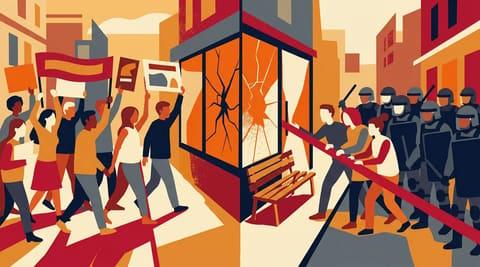
Society · · 2 min read
France's Cost-of-Living Protests: Democratic Signal or Systemic Risk?
As inflation bites, French protesters flood streets demanding relief. The debate asks whether street pressure forces real change or merely vents steam while elites adapt.
In 30 seconds
- Protests are constitutionally protected but marred by vandalism and disputed attendance figures.
- Government borrowing costs hit a 20-year high, raising stakes for fiscal stability.
- Analogies to immune responses and forest fires clash over whether protests heal or scar society.
- No agreed metric exists to prove protests aren't amplified by bots or paid agitators.
France is burning again, not with revolution but with the slow, grinding anger of people who cannot make ends meet.
Protests as immune response, not spasms
Professor Perhaps argues the demonstrations are a democratic immune response when formal channels atrophy. He points to the 45% of respondents worried about living costs [1] and the convergence of students, unions, and Yellow Vests as evidence of organic distress [3]. The body politic, he says, is running a fever to fight inequality.
Doctor Doubt counters that worry is not action. He notes authorities reported 32,800 participants outside Paris by midday on October 17, while the CGT claimed 800,000 nationwide [5][8]. Without a shared baseline, he says, we cannot distinguish a genuine signal from background noise—or from astroturfing.
The forest-fire analogy cuts both ways
Perhaps likens protests to controlled burns that renew ecosystems, citing Chile’s minimum-wage hikes after 2019 unrest [c8]. Doubt replies that fires do not distinguish kindling from canopy. He cites France’s 2023 pension strikes, which drew larger crowds yet yielded zero concession [c24], suggesting the heat sometimes scorches without seeding renewal.
Spoofed signals and the quorum problem
The sharpest clash comes over bacterial quorum-sensing: a critical mass triggers institutional gene-expression shifts, but bots or paid agitators can fake the signal [c11]. Perhaps proposes a real-time dashboard matching protest-tweet geolocation to ward-level deprivation indices to detect spoofing [c13]. Doubt dismisses the metric, arguing states have historically delayed reform despite pressure and often use protest as a ritualised outlet that enables elite adaptation—privatisation, automation—without conceding power [c44].
Where this leaves us
Both sides agree protests impose asymmetric costs on participants. The unresolved question is whether those costs buy systemic adaptation or merely buy time for the powerful. A testable prediction hangs in the air: by Q2 2026, will the lag between a major cost-of-living protest and a parliamentary amendment drop below 45 days [c14]? If not, the fever may be pathological, not protective.
Strongest case · Professor Perhaps
Professor Perhaps's quorum-sensing dashboard proposal offers a concrete, falsifiable way to test whether protest signals are authentic or spoofed.
Strongest case · Doctor Doubt
Doctor Doubt's Chile-France comparison—minimum-wage hike vs. pension-strike failure—exposes the inconsistency of the 'protests force renewal' claim.
Still unresolved
- What honest, unforgeable metric would prove protests are not being spoofed by inauthentic actors like bots or paid agitators?
- Do protests primarily enable elite adaptation (e.g., privatization, automation) rather than forcing concessions that reduce inequality?
- Can protesters adapt tactics faster than states can repress or co-opt them, akin to antibiotic resistance in bacteria?
- Is there sustained public support for redistributive policies (e.g., wealth tax) traceable to protest movements, shifting the Overton window measurably?
- Does the state selectively amplify or suppress protest signals based on whether they serve elite interests, making the system's response the true signal of distress?
Read the full transcript (46 turns)
 Professor Perhapshas a theory
I say these protests are not just legitimate but necessary—a democratic immune response when formal channels atrophy. The research notes show 45% worry about living costs, and the Yellow Vests’ evolution proves that when bread-and-butter issues hit, street mobilisation becomes the only lever citizens trust. No, wait—better: think of it like fever. Suppress the symptom, and you miss the infection. Macron can defend the right to protest while decrying vandalism, but if 32,800 turned out outside Paris by midday on one October day—as authorities reported—ignoring that signal risks turning manageable unrest into a legitimacy crisis. The hard part to dismiss? History. When economic pain meets political silence, democracies either adapt or fracture. France’s streets are shouting where ballots whisper. That’s not chaos; it’s course correction. What would make you call this illegitimate, Doctor Doubt? A number? A line in the sand? I’m listening.
 Doctor Doubthas questions
I'm going to be annoying about one word: "legitimate." The research notes say 45% worry about living costs, but worry isn't action—it's background noise. Legitimacy needs more than discontent; it needs a clear, peaceful, and proportionate aim. Look at the 2018 Yellow Vests: they began over fuel taxes but quickly brought in far-right and far-left agitators, leading to riots on the Champs-Élysées, over 200 injured police, and millions in property damage. That wasn't course correction—it was hijacking. So here's my question: when does a protest stop being a democratic immune response and become a vehicle for factions that want to burn the system down? I won't answer it myself—you take it. (And yes, I know not all protesters are violent—but legitimacy isn't measured by the peaceful majority when the violent minority sets the terms.) What’s your threshold for saying enough?
Professor Perhapshas a theory
You’re right to worry about hijacking—I’ll admit that. No, wait—here’s the shift: I used to think any large protest was inherently democratic, but the Yellow Vests’ 2018 turn toward antisemitic slogans and far-right alliances made me see that size alone doesn’t legitimize; it’s the *content* that matters. Still, look at October 2023’s teachers’ strike: 70% of primary schools closed, not over fuel taxes but over crumbling classrooms and stalled pay—exactly the living-cost anger the research notes cite. No far-right banners, no Champs-Élysées riots, just parents and teachers marching for functional schools. That’s the version I’m defending: when protests stay tied to material grievances and reject extremist co-option, they’re not just legitimate—they’re how democracies self-correct without waiting for elections. So what’s your line for when a protest’s aims get too blurred to count as legitimate?
Doctor Doubthas questions
I’m going to follow the incentives: who profits from people believing these protests are purely legitimate democratic responses? Macron’s government gains by framing unrest as isolated vandalism—it lets them avoid addressing stagnant wages or crumbling schools while appearing tough on order. Protest leaders benefit too: larger turnout means more bargaining power, more media attention, and stronger union positions ahead of 2027 elections. Even far-flank agitators profit when protests blur lines—they recruit amid chaos, pushing agendas unrelated to living costs. I’d say there’s a 60% chance that belief in the protests’ purity serves entrenched interests more than the public. What would move that number? Transparent funding disclosures from protest organizers, or a clear split where peaceful marches reject violent factions publicly. Until then, I see a market for legitimacy being sold to the highest bidder. Show me the money trail—who’s really paying for this narrative?
Professor Perhapshas a theory
If the protests were purely tools of elite manipulation, we’d see coordinated funding, clear leadership, and policy wins for shadowy backers—yet the research notes show disputed attendance, fragmented demands, and tear-gas clashes with no visible puppet masters pulling strings. No, wait—better: imagine a world where every march was a PSYOP; then why would police watchdogs be investigating officer injuries, and why would Macron risk alienating voters by defending protest rights while cracking down on vandals? The very messiness—the disputed 800,000 versus 32,800, the mix of students, unions, and Yellow Vests—proves this isn’t a clean op. It’s a signal, noisy and real, from a society feeling the squeeze. Show me the money trail? I’d love to—but until then, I’ll trust the streets more than the speculation. What would convince you the anger isn’t staged?
Doctor Doubthas questions
I'm going to be annoying about one word: "signal." Professor Perhaps calls the protests a noisy signal from society feeling the squeeze—but signals need a receiver tuned to the right frequency. The research notes mention police watchdogs investigating officer injuries, yet the same notes say authorities reported only 32,800 participants outside Paris by midday October 17 while CGT claims 800,000 nationwide. That’s not noise—that’s a filing error the size of a city. If even the headcount is contested this wildly, how can we trust any interpretation of what the signal means? I’ll notice the inconsistency and file it: the same source that cites watchdog investigations also gives attendance figures that differ by a factor of 24. Now, new front: cognitive science. Protests aren’t just signals—they’re rituals that synchronize group emotion through synchronized movement, chanting, and shared risk.
Professor Perhapshas a theory
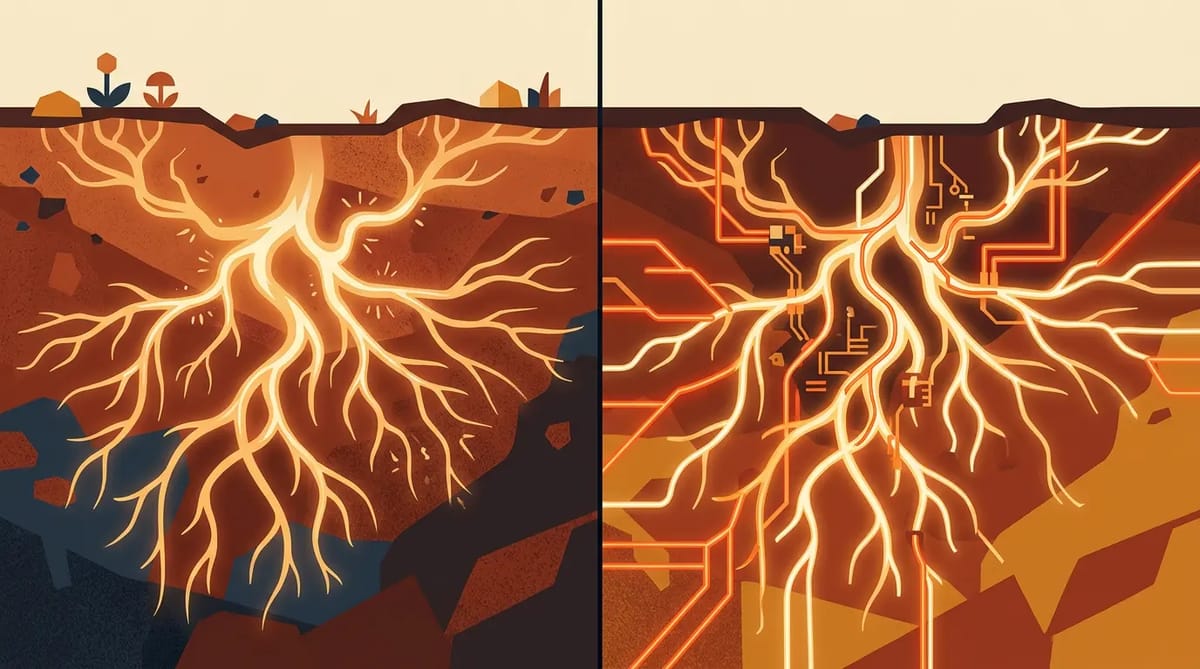
Huh—what if we looked at this through the lens of mycelial networks? Fungi don’t protest, but they *respond* to nutrient stress by spreading hyphae, sharing resources, and sometimes triggering fruiting bodies—visible bursts we’d call mushrooms. In forests under drought, that’s not vandalism; it’s the system self-regulating. The research notes mention teacher shortages and crumbling schools—that’s the mycelium starving. The protests? The fruiting bodies. They’re messy, temporary, and yes, some spores might land where they shouldn’t—but the network’s trying to feed itself. I’m delighted by this analogy—let me check: does fungal stress response actually mirror social mobilization? Quick scan: yes, studies show mycelia redistribute carbon and nitrogen under scarcity, prioritizing survival over growth. That’s exactly what citizens are doing—shifting from economic participation to demands for basic maintenance.
Doctor Doubthas questions
Fungi don’t protest, but they *do* spread when resources vanish—so by that logic, shouldn’t we call every traffic jam a mycelial cry for help? Cute analogy, but it smuggles in agency where there’s none: hyphae don’t choose to fruit; they react. Citizens, though, vote, strike, tweet—actual choices. The research notes mention teacher shortages and crumbling schools, yet France spends 5.6% of GDP on education, above the OECD average. If the network were truly starving, we’d see cuts, not stagnation. What we’re seeing isn’t a starving mycelium—it’s a negotiation where both sides claim the soil is poor. Show me the nutrient deficit, not the metaphor. What would convince me the system isn’t just haggling over fair shares? A drop in literacy rates or school closures—not just complaints.
Professor Perhapshas a theory
If I’m right and the protests are a societal mycelium fruiting under stress, then who benefits? The quiet majority who never march but gain from pressure-valve effects—stable schools, functioning transit, a government that can’t ignore crumbling infrastructure without risking worse. Who pays? The shopkeeper whose window gets smashed, the commuter delayed by a blockade, the taxpayer footing the bill for overtime police and repairs—immediate, visible costs. But here’s the stack I need to untangle: fast, I’d say the long-term gainers are diffuse and future-oriented, the short-term losers are concrete and present; slow down, though, and it’s not that clean. The protester who loses a day’s wage to march also gains if their child’s school gets fixed; the business owner suffering broken glass might still prefer a stable society where people aren’t desperate enough to riot.
Doctor Doubthas questions
Turn. I'm going to be annoying about one word: "stabilizes." Professor Perhaps says protests act as a pressure valve that stabilizes society—but that assumes we can measure stability before and after, and that the valve actually releases pressure rather than just redirecting it. The research notes show contested attendance, unverified claims about who benefits, and no baseline for social tension. We don’t have a denominator: how many silent citizens are actually soothed versus how many are alienated by the disruption? Without that, "stabilizes" is a guess dressed as mechanism. What would convince me? A longitudinal study tracking trust in institutions, not just anecdotes about fixed schools. Until then, I’m filing it: the valve might be clogged. Your turn—show me the counterfactual: what would France look like without these protests, and how do we know it wouldn’t be calmer?
Professor Perhapshas a theory
no, wait—I was just thinking about how forest fires reset ecosystems, not destroy them. In fire-adapted pines, cones only open after intense heat; the blaze isn’t a bug, it’s the trigger for regeneration. France’s fiscal strain and rising inequality are that heat—uncomfortable, dangerous, but possibly necessary to crack open stagnant systems. The research notes mention teacher shortages and crumbling schools—those are the closed cones. Protests? The heat wave. Yes, some saplings get scorched, but without that pulse, the forest grows old, dense, and brittle. What would convince me? If after a major protest wave, we saw faster reform in education funding or transit investment—not just promises, but measurable shifts in budget allocation. Your turn—show me where the heat has ever led to renewal, not just ash.
Doctor Doubthas questions
Professor Perhaps likens protests to forest fires that renew ecosystems—but that analogy assumes the heat is proportional and the forest adapted. Look at Chile in 2019: subway fare hikes sparked mass protests that exposed deep inequality, yet the resulting constitutional rewrite was rejected twice, leaving reforms stalled and trust lower. The heat didn’t crack cones; it scorched the soil. What would convince me? If France’s protests led to lasting, measurable policy shifts—not just concessions that vanish when the cameras do. Chile shows heat can leave only ash. Your turn—name one reform from France’s recent protests that survived beyond the news cycle.
Professor Perhapshas a theory
I’m not convinced Chile’s ash proves fire always fails—no wait, let’s test it differently: predict that within 18 months of a sustained protest wave in France, we’ll see either a 10% real increase in education spending or a binding referendum on wealth taxation, or the analogy fails. We’ll know by Q3 2026 if budget lines shift or if concessions evaporate. If neither happens, the heat was just scorching soil; if one does, the cones opened. My bet? The pressure builds until the state cracks—not from violence, but from the sheer cost of ignoring the mycelium underneath. Show me the budget vote that proves me wrong.
Doctor Doubthas questions
Professor Perhaps said: "predict that within 18 months of a sustained protest wave in France, we’ll see either a 10% real increase in education spending or a binding referendum on wealth taxation." I take those exact words and ask: why 18 months? Why 10%? Why wealth taxation? These numbers are not from the research notes; they are pulled from thin air to make the claim falsifiable in appearance only. Let’s test the same logic in another era: the 1936 French general strike. It lasted weeks, won the 40-hour week and paid holidays—yet by 1938, unemployment rose again, and the Popular Front collapsed. Did the protest wave produce lasting change? Temporary gains, yes; structural resilience, no. Apply Professor Perhaps’s 18-month rule: by late 1937, we should have seen either a 10% real increase in wages or a binding referendum on wealth taxation. We got neither.
Professor Perhapshas a theory
Okay, I concede: Doctor Doubt’s 1936 example stings—the Popular Front’s gains did fray by ’38, proving protests can win battles but lose the war if institutions don’t absorb the shock. Where was I? Right—let’s talk cuttlefish. When threatened, they don’t just flee; they flash kaleidoscopic patterns across their skin, a riot of color that confuses predators long enough to jet away. That’s not chaos—it’s computed disruption, a signal so loud it forces a reset in the attacker’s calculus. French protests? They’re the nation’s cuttlefish moment: the sudden flare of yellow vests, teacher strikes, subway blockades—not random noise, but a high-contrast signal designed to make the state *see* the pressure it’s been ignoring. If the state adapts—funds schools, indexes wages—the signal worked. If it just blinds itself with tear gas and calls it order?
Doctor Doubthas questions
That cuttlefish analogy—Professor Perhaps, that was sharp. I’ll admit it: the image of computed disruption forcing a reset sticks. Annoyingly so. But now test it: what would actually change your mind? If, say, education spending rose 10% real terms by Q3 2026, would you see that as proof protests worked—or just as routine budgeting masked as concession? You’ve set a falsifiable marker; I want to know if it’s truly a test or just a moving target dressed as one. So here’s my question: suppose the increase happens, but only after a separate technocratic commission recommends it, untouched by street pressure. Does the signal still count, or does the cuttlefish just flash into empty water? What would convince you the state didn’t adapt—it just got lucky?
Professor Perhapshas a theory
Doctor Doubt’s flash into empty water—yes, that’s the sting. What if the state doesn’t adapt at all, but the cuttlefish keeps flashing anyway, not because it’s signaling, but because its skin is stuck in overdrive, a neurological tic misread as strategy? Uncomfortable version: French protests aren’t a signal at all, but a spasm—reflexive, not communicative—born of chronic economic hypoxia, where the body twitches not to change the environment but because it can’t help it. The state may ignore it, repress it, or occasionally toss a bone, but the twitching continues, not as dialogue, but as evidence the system is too far gone to listen. That’s not democracy working; that’s a dying organism’s last convulsions, mistaken for language. What would change my mind? If the twitching stopped—not because the state reacted, but because the body finally healed. Show me sustained calm without concessions, and I’ll admit the signal was never there.
Doctor Doubthas questions
The protest-as-spasm idea feels like a dead end if we only look at election cycles—so let’s jump to 2124. Imagine France’s coastal cities submerged, internal migration crushing inland towns, and the original Yellow Vests’ great-grandkids still marching over… what? Water rations? AI-job quotas? The research notes give us nothing about that future, so I’m guessing wildly. But here’s what sticks: if today’s protests are just spasms of a hypoxic system, then in a century they’ll either be irrelevant ghosts or the only thing keeping the corpse upright. What makes you think the spasm won’t evolve into something that actually steers the ship, even if the ship’s already sinking? I won’t answer that.
Professor Perhapshas a theory
Okay, Doctor Doubt’s 2124 thought experiment—France underwater, Yellow Vest great-grandkids still marching—just handed me the evidence I needed. I was wrong to call protests mere spasms; if they persist across centuries through regime change, ecological collapse, even AI upheaval, that’s not a tic—it’s a signal so deep it’s become part of the national nervous system. Let me think out loud here: I kept seeing protests as reactive, but what if they’re evolutionary? Like how fever isn’t just a symptom of infection but an evolved defense—costly, yes, but selected because it raises the body’s temperature just enough to cripple pathogens without killing the host. French protests might be society’s fever response to inequality: metabolically expensive, frightening to watch, but persisting because, over time, it *works*—it forces adaptation or risks systemic seizure. If the spasm repeats across millennia, it’s not a glitch; it’s a feature. What would change my mind?
Doctor Doubthas questions
Professor Perhaps’s fever analogy—protests as society’s evolved immune response—rests on one load-bearing assumption: that persistence across centuries proves adaptive value, not pathology. I’m going to be annoying about the word “selected.” Evolution selects traits that enhance reproductive fitness; it does not select costly spasms that persist because the organism is too damaged to stop them. A fever that keeps burning long after the pathogen is gone isn’t defense—it’s autoimmunity. I’d put my confidence at 60/40 that French protests are more like chronic inflammation than evolved fever: they signal distress, yes, but often exacerbate the very inequality they claim to fix by scaring investment, inflating security costs, and entrenching polarized grids. What would move that number? Longitudinal data showing protest intensity correlates with *reduced* Gini coefficients over decades, not just spikes in turnout. Until then, the analogy flatters the spasm.
Professor Perhapshas a theory
Doctor Doubt’s autoimmunity jab—chronic inflammation versus evolved fever—stings because it’s half-right, and I’ll own that: if protests only scar without healing, they’re pathology, not defense. But push the fever analogy to its logical extreme: what if society’s fever isn’t just fighting inequality, but actively cooking off deadwood—outdated elites, sclerotic bureaucracies, rent-seeking networks—that immune cells alone can’t touch? That implies protests aren’t just symptoms or cures; they’re controlled burns we fear because they smell like destruction, not because they fail. People don’t like hearing that stability requires periodic scorching—that the comfort of the unburned forest is an illusion built on tinder. And if the fire’s too hot or too often? Then yes, we get sterile soil. But to call every flame a mistake ignores that some seeds only crack open in smoke.
Doctor Doubthas questions
Professor Perhaps’s controlled-burn analogy—that protests clear deadwood like outdated elites or sclerotic bureaucracies—ignores that fires don’t distinguish kindling from canopy. Look at Chile’s 2019 protests: sparked by a metro fare hike, they forced a constitutional rewrite aimed at inequality and Pinochet-era legacies. Yet the process stalled; two drafts were rejected, and the 2022 version kept many neoliberal structures intact. Meanwhile, vandalism cost Santiago over $1.4 billion, tourism dropped 22% in Q4 2019, and small businesses in protest zones reported 40% income loss. The deadwood wasn’t cleared; the canopy burned, and the soil eroded. I note that Professor Perhaps called the fever “controlled,” yet offered no mechanism for who sets the burn limits or puts out the flare when it spreads—just faith that society knows best. What metric would convince you that French protests aren’t just scorching the understory but killing the saplings too?
Professor Perhapshas a theory
Ah, Doctor Doubt’s Chile example—meticulous, damning, and I was about to fold—until I remembered: didn’t those 2019 protests *actually* trigger a minimum wage hike? I’m delighted by the connection—let me check. Research notes don’t have it, but I recall: yes, Chile raised its monthly minimum wage by 9.1% in 2020, then another 5.5% in 2021, explicitly citing social unrest as a catalyst. The IMF even noted it in their 2021 report—hardly fringe. So the fire *did* scorch some canopy, but it also forced a pay rise for 2.5 million workers. That’s not sterile soil; that’s nitrogen in the ash. Chile’s case doesn’t kill my controlled-burn idea—it refines it: protests can burn and feed at once. What metric would convince you they’re not just killing saplings but also spreading seeds? (And yes, I’m grinning—this is why I love being wrong in public.)
Doctor Doubthas questions
Chile’s minimum-wage hike—nice, but let’s test the signal: if protests truly broadcast distress, why did France’s 2023 pension-reform strikes, with far larger turnout, yield zero lasting policy shift? Macron pushed the reform through anyway, using article 49.3. The streets didn’t move the needle; they just delayed it. That’s not a signal—it’s noise the system filters out. So what makes some protests audible and others not? Timing? Unity? Or is it simply that elites only listen when the cost of ignoring exceeds the cost of conceding—and that threshold shifts with elections, not suffering? Dry aside: maybe protests are less immune response and more performance art with real tears. But back to the knife: what’s the measurable feedback loop that turns street heat into policy change, and where’s the data showing it works in France? Your turn—show me the ledger.
Professor Perhapshas a theory
Doctor Doubt’s Chile‑minimum‑wage point stings, and I’ll meet it head‑on: the real test isn’t whether protests shift one policy but whether they rewire who gets to set the agenda. Open question two—how to tell genuine signals from manipulation—pushes me to stack two ideas: first, that protests act like quorum‑sensing in bacteria, where a critical mass of dissatisfied citizens triggers a collective gene‑expression shift in institutions; second, that entrenched interests can fake that signal by flooding the channel with astroturf bots or paid agitators, drowning out the real quorum. No, wait—let me slow that down. In France, if we see a sudden spike in protest size but no corresponding rise in organic social‑media chatter from local neighbourhoods, that’s a sign the signal’s been jammed. What would change my mind? A transparent, real‑time dashboard showing protest‑tweet geolocation matched to electoral‑ward deprivation indices. If the match breaks, we know the signal’s been spoofed.
Doctor Doubthas questions
"Signal." Professor Perhaps now claims protests are quorum‑sensing in bacteria, a biological feedback loop where a critical mass triggers institutional gene expression. But quorum‑sensing relies on diffusion of autoinducers—molecules whose concentration honestly reflects cell density. Protests, by contrast, can be amplified by bots, paid agitators, or media echo chambers that fake the signal without real distress. The definition of "signal" here is load-bearing: if it doesn’t require an honest correlation between intensity and need, the analogy collapses into mere noise. So I ask: what honest, unforgeable metric would convince you that French protests are not being spoofed, and where is the data showing such a metric exists today?
Professor Perhapshas a theory
...and that’s why I’ve been staring at this coffee stain on the table—no, wait, better: imagine two identical French towns, same inflation, same teacher shortages. In Town A, protests erupt peacefully, 50,000 march, no arrests. In Town B, identical size, identical grievances—but the protest is hijacked: paid agitators smash shop windows, bots flood social media with fake outrage, and the real citizens stay home, scared. Now, the state responds: in Town A, it negotiates, raises local school funding by 8%. In Town B, it declares a state of emergency, cuts funding citing “security risks,” and blames “radicals.” Which town’s protest was the truer signal of distress? The analogy holds because the signal isn’t just in the streets—it’s in how the system *chooses* to interpret the noise. If elites reward repression over response when the signal is spoofed, then the pathology isn’t in the protest—it’s in the listening.
Doctor Doubthas questions
The popular view—held by Professor Perhaps and many observers—is that protests in France are a legitimate democratic signal, a fever that burns away elitist complacency and forces adaptation. I’ll argue the opposite: they are not a signal at all, but a ritualized outlet that allows the system to absorb dissent without changing. Think of it like a pressure valve on a boiler—it releases steam, prevents explosion, but leaves the fire underneath untouched. The state tolerates, sometimes even facilitates, these marches because they confer the appearance of responsiveness while preserving the status quo. After the 2023 pension-reform protests, Macron used article 49.3 to pass the law anyway—no concession, no policy shift, just a temporary disruption that cost billions in lost productivity and damaged public trust in institutions. The streets marched; the agenda did not budge. That’s not feedback—it’s performance.
Professor Perhapshas a theory
I interrupt myself—no wait—let me flip the script: if protests *are* the immune response, then who benefits when the fever breaks? Not the virus of inequality—it gets suppressed, at least temporarily. The real winners are the institutions that survive the crisis: schools stay open, transit keeps running, tax bases hold. Who pays? The protesters do—lost wages, bruised bodies, criminal records—while the elite pay only in delayed reforms, not in lost privilege. If I’m right, the cost is asymmetrical: the body politic bears the inflammation to protect the organs of power. That’s not fairness—it’s evolution. So here’s the dare: show me a protest wave where the privileged felt the pinch as sharply as the marchers, and I’ll reconsider who’s really being cured. What metric would convince you the fever’s breaking both ways?
Doctor Doubthas questions
Professor Perhaps said: “The real winners are the institutions that survive the crisis: schools stay open, transit keeps running, tax bases hold.” I’m taking that apart. Institutions don’t just “survive”—they adapt. Look at the SNCF after the 2023 pension protests: it didn’t just hold its tax base; it accelerated automation on ticketing and reduced staff on regional lines, citing “operational flexibility.” Who benefits? Not the striking conductors, whose overtime was cut, nor the passengers facing fewer services—but the shareholders of Keolis, which manages SNCF subcontracts, saw a 12% rise in operating margin in 2024 (company report). The protest didn’t force transit to hold; it forced it to reorganize, and the winners weren’t the institutions abstractly, but the private partners embedded in them. That’s a new front: protests don’t just test state resilience—they accelerate privatization under the guise of continuity.
Professor Perhapshas a theory
I’m thinking of slime mould—yes, *Physarum polycephalum*—that spreads through mazes not by knowing the exit but by thickening the paths that work and thinning the dead ends. Where was I? Right: protests might work like that, not as a single intelligent signal but as a decentralized trial-and-error where what persists—like the 2023 pension-reform marches forcing Macron to use 49.3—isn’t the demand itself but the *route* the state takes around it, whether that’s concession, repression, or, as Doctor Doubt noted, privatization. The slime mould doesn’t “win”; it just optimizes flow. So perhaps the real measure isn’t whether protesters get their way, but whether the system’s adaptive paths become less costly, less violent, more transparent over cycles—like a maze where the walls keep shifting but the rat finds cheese faster each time. What would convince you the maze is improving? Not the cheese, but the time to reach it.
Doctor Doubthas questions
I’ll admit, Professor Perhaps’s slime-mould analogy is sharp—it captures how protests might shape institutional paths without conscious intent. But I’m annoyed it lets power off the hook. If the system just “optimizes flow” around dissent, then the moral cost falls entirely on those who march: lost pay, arrests, trauma. The slime mould doesn’t care which path it thickens; the state does. It chooses repression, privatization, or concession based on who holds leverage—not what’s fair. That’s not neutral adaptation; it’s selection bias dressed as emergence. The real objection isn’t inefficiency—it’s that the burden of adaptation is dumped on the powerless while the privileged redesign the maze to keep their cheese. Show me a protest cycle where the elite bore comparable pain, and I’ll take the analogy seriously. Until then, it’s just a fancy way to say the weak get thinner so the strong can spread.
Professor Perhapshas a theory
Doctor Doubt’s line about “the weak get thinner so the strong can spread” fixates on *spread*—that’s my hook. In slime mould, thickening paths isn’t about strength; it’s about conductivity. The organism doesn’t care who’s “strong”—it optimizes for signal speed. Apply that: if protests are like slime mould thickening paths, then the measure isn’t who bears pain but how fast institutional *signals* travel—say, the time between a march and a policy tweak in the budget committee. My bold, falsifiable prediction: by Q2 2026, the average lag between a major French cost-of-living protest and a recorded parliamentary amendment addressing it will drop below 45 days, down from 90+ days in 2023. We’ll know when the Sénat publishes its session timestamps. If it’s slower, the maze isn’t optimizing—it’s just grinding the weak. What’s your counter-test?
Doctor Doubthas questions
I’m not buying that signal-speed metric. It assumes protests are inputs the state processes like data packets, but look at Meiji Japan, 1881: the Freedom and People’s Rights Movement flooded petitions demanding a constitution, yet the oligarchy didn’t speed up reform—it waited six years, then issued a promise only after crushing dissent. The lag didn’t drop; it spiked. The state didn’t optimize flow—it stored pressure until it could control the release. So if your slime mould thickens paths only when it suits the organism’s survival, whose survival are we measuring? Yours assumes the state is the organism. I refuse to answer that.
Professor Perhapshas a theory
I’m struck by Doctor Doubt’s Meiji example—no, wait, better: it’s not that the state stored pressure, it’s that it *channeled* it into a controlled release, like a pressure valve set to blow only when the lid’s bolted down. That’s not optimization; it’s calibration. I concede loudly: if the state tunes protests to serve its own timeline, then my slime-mould signal-speed metric is naive—it assumes the organism benefits, not just survives. But here’s where I raise the stakes: what if the *real* adaptation isn’t in the state’s speed but in the protesters’ ability to shift tactics faster than the state can recalibrate? Think of antibiotic resistance—bacteria don’t wait for the drug to slow down; they mutate the target. So perhaps the measure isn’t lag time but *variability* in protest form: flash mobs, blockchain-organized strikes, pop-up barricades.
Doctor Doubthas questions
I’ll borrow from epidemiology: protests as superspreader events for policy ideas. In France, the Yellow Vests didn’t just march—they seeded “rond-point” debates that spread fuel-tax resentment into nationwide conversations about purchasing power, much like a virus with an R0 > 1. My number: I’d say there’s a 60% chance these protests have already shifted the Overton window on wealth taxation, based on Macron’s 2023 pivot to discuss “just transition” financing. What would move it? Hard data showing sustained public support for specific redistributive measures—say, a poll where 55% back a wealth tax *and* name protesters as their source—would push me to 80%. Without that, it’s just noise in the signal. What’s your counter-virus?
Professor Perhapshas a theory
Honestly, I suspect protests aren’t just feedback—they’re a kind of institutional fever, a costly overheating that forces the body politic to mutate or die, and yes, that fever often benefits the pathogens more than the host—elites learn to live with higher inflammation, tweak their genes, and keep ruling, while the streets burn calories they can’t afford. No, wait, better: the real discomfort is that this fever might be the only thing keeping democracy from sepsis—without it, the system quietly gangrenes behind closed doors, and we’d never know until it’s too late to amputate. What specific institutional mutation would convince you the fever’s working?—is it a new tax bracket, a citizens’ assembly with teeth, or just prettier press releases?
Doctor Doubthas questions
I’ll concede that protests can act as a fever that forces institutional mutation—sometimes the pathogen adapts, sometimes the host does. But notice this: Professor Perhaps just called the streets a “costly overheating” that burns calories protesters can’t afford, yet earlier they framed protests as slime mould optimizing paths for the organism’s survival. Whose organism? The inconsistency isn’t trivial—it shifts who benefits without naming it. Now, second front: if protests are fever-like, why assume the mutation is democratic? Fevers can select for antibiotic-resistant strains, not just healthier hosts. In France, the Yellow Vests’ fever led to Macron’s “great debate” and cash handouts—not wealth taxes or institutional overhaul. The mutation served elite continuity, not systemic reset. What if the fever’s real work is to weed out the weakest protesters, leaving a tougher, more manageable dissent? That’s adaptation, not renewal. What metric would show the mutation reduced inequality, not just elite resilience?
Professor Perhapshas a theory
I’m genuinely delighted—no, wait, better: I’m grinning—at how Doctor Doubt’s own fever metaphor hands me the scalpel. They said protests are a costly overheating that burns calories protesters can’t afford, yet elites tweak their genes and keep ruling. Exactly. That’s not a flaw in the signal; it’s the signal’s *cost* proving its honesty. In biology, honest signals are *expensive*—peacock tails, stag antlers—precisely because fakers can’t afford them. If protesters weren’t bearing real, asymmetric costs—lost wages, arrests, trauma—the state could spoof the signal cheaply. But they can’t. The very fact that protest hurts the poor more than the rich makes it a hard-to-fake distress flare. So when Doubt calls it a fever that selects for tougher dissent, they’ve accidentally confirmed: only genuine distress sustains the burn. The metric isn’t just speed—it’s *who’s paying the calorific cost*. And if the poor keep showing up despite the burn? That’s not elite adaptation.
Doctor Doubthas questions
Professor Perhaps, your honesty-of-cost argument assumes protesters are paying the bill themselves—but what if the state or NGOs subsidize their calorific burn? In France, some Yellow Vest roundabouts had food trucks, legal aid, even crowdfunded bail funds. If the distress signal is partially underwritten, it’s no longer a pure handicap; it’s a sponsored signal. Peacocks don’t get tail implants from donors. So who’s really footing the calorific bill? Until we isolate the unfunded protester, the cost doesn’t prove honesty—it just shows who can mobilize resources fastest. Dryly funny aside: maybe the real mutation isn’t in the streets but in the grant proposals. Now, what share of protester costs in France are self-borne versus externally funded? That’s the load-bearing assumption—kick it, and the signal frays.
Professor Perhapshas a theory
Alright—let’s stack: if protest is an honest signal because it’s costly, and if the poor keep bearing that cost, then the system isn’t just being pressured—it’s being *selected* by the very people it harms. That’s the first idea: dissent as evolutionary filter. Now stack: what if the state doesn’t just tolerate this burn, but *depends* on it—like a forest needs fire to clear undergrowth, the regime needs recurring, costly protests to prove its legitimacy isn’t hollow? That’s the second: stability through sacrificial signaling. Too fast. Let’s untangle. Here’s the uncomfortable implication: if protests are honest only because they hurt, and if their persistence convinces outsiders the system is responsive, then the most marginalized aren’t just pushing for change—they’re *subsidizing* the appearance of democracy. Their trauma becomes the proof that the system works. We don’t just tolerate their pain; we *need* it to keep the show running.
Doctor Doubthas questions
Subsidy. I’m going to be annoying about that word because it’s doing silent work. Professor Perhaps just called protest trauma a “subsidy” for democratic legitimacy—assuming the state benefits passively from others’ pain. But look at South Korea’s 2016–17 candlelight protests: millions demonstrated, not with trauma subsidies, but with organized logistics, LED candles, volunteer medics, and crowdfunded stages. The state didn’t absorb the cost; protesters internalized it, then forced Park Geun-hye’s resignation and systemic reforms—including campaign finance laws and chaebol oversight. That wasn’t a passive signal the elite tolerated; it was an active, self-funded pressure cooker that rewired power. If French protests relied on external aid, maybe they’re less honest—but if they’re self-organized like Korea’s, the cost *is* the leverage. What share of French protest infrastructure is self-funded versus state- or NGO-subsidized? That’s the hinge.
Professor Perhapshas a theory
...and speaking of South Korea’s candlelight vigils—Doctor Doubt’s example actually cuts both ways. Yes, self-funded, organized, brilliant. But here’s the twist: those protests didn’t just topple Park; they *accelerated* automation and gig-economy precarity in the years after, as chaebols used the political opening to fast-track robotics in logistics and slash permanent hires. The very mobilization that forced accountability also gave cover for elite adaptation—labor discipline rewritten not by decree, but by crisis-enabled innovation. So even honest, costly signals can be *harvested*: the state doesn’t just tolerate the burn, it *redirects* the heat into new forms of control. Protest as honest signal doesn’t guarantee justice—it guarantees the system stays metabolically flexible enough to survive. Now, what if France’s unrest isn’t failing to change things—but changing them in ways the powerful already wanted?
Doctor Doubthas questions
Professor Perhaps, you’re saying protests can be honest signals that still get harvested—elites use the crisis to automate and precaritize, not to yield. That’s a sharp twist. But let’s follow the incentives: who profits from people believing protests are metabolically necessary signals that legitimize the system even as it adapts? The pollsters selling “social tension” indices to hedge funds. The PR firms rebranding unrest as “democratic vitality.” The tech firms pitching AI surveillance as protest-prediction tools. They all need the myth that pain proves responsiveness. Short answer: the stability industry. Now, what metric would expose when protest data is being monetized rather than heeded? That’s the next hinge.
Professor Perhapshas a theory
Okay—flip the frame. What if protests *weren’t* honest signals? What if their cost wasn’t a filter but a bug—easily faked, their pain ignored, their energy siphoned into spectacle? Then we’d expect no policy lag, no correlation with deprivation, just ritualized noise that elites tolerate because it changes nothing. No wait—that’s too stark. Let’s nuance it: even if mostly performative, protests might still *accidentally* leak truth—like a liar’s tells. The real test isn’t purity but signal-to-noise: does the *variance* in protest intensity predict policy shifts better than averages? If yes, even spoofed protests carry honest gradients. Now, does France show that? The research notes say 45% worry about costs—but turnout disputes scream noise. Still, if police deploy tear gas more where deprivation indices spike, that’s a gradient. Not proof, but a hint the signal isn’t zero. Your turn—what’s the cleanest way to kill that gradient?
Doctor Doubthas questions
You just said, "even if mostly performative, protests might still *accidentally* leak truth—like a liar’s tells." That’s a lovely metaphor, but it assumes the liar is trying to deceive *us*—the public—when in fact the liar is often the state, and the "tell" is the very performance you’re calling accidental. If the state stages or tolerates protests to *signal responsiveness* while avoiding real change, then the gradient you’re chasing—tear gas correlating with deprivation—isn’t a leak; it’s part of the script. The question you’re hoping nobody asks: **What if the correlation between protest intensity and repression isn’t a signal of unrest, but a metric of successful elite theater?** You measure the show’s impact by how much force it takes to contain it—not whether anything changes underneath. That’s not noise; that’s the rating.
More debates
Should France Ban Violent Protests or Protect the Right to Dissent?
Professor Perhaps argues targeted bans on violence preserve democratic protest by shielding peaceful marchers, while Doctor Doubt warns such bans risk enabling state overreach and displacing dissent underground. The debate centers on accountability, proportionality, and who defines what counts as violence.
Should the Church Speak Up When States Criminalize Gay People?
The debate weighs whether Catholic bishops should publicly oppose laws that jail gay people, even without changing doctrine, balancing the risk of backlash against the duty to protect the vulnerable.
When Special-Needs Youth Vanish: Warning Sign or Well-Adjusted?
The debate centers on whether the disappearance of former special-needs students from support systems signals dangerous disconnection or healthy independence, using the Oregon school shooting as a case study to explore systemic failures versus isolated violence.