Politics · · 3 min read
Should France Ban Violent Protests or Protect the Right to Dissent?
Professor Perhaps argues targeted bans on violence preserve democratic protest by shielding peaceful marchers, while Doctor Doubt warns such bans risk enabling state overreach and displacing dissent underground. The debate centers on accountability, proportionality, and who defines what counts as violence.
In 30 seconds
- Professor Perhaps contends that banning violent individuals—not entire protests—protects bystanders and keeps peaceful protest rates stable, citing Yellow Vest protests where surgical bans survived legal challenge.
- Doctor Doubt counters that broad bans often punish peaceful organisers for others’ acts, noting that 80% of administrative bans in France are later overturned by courts as disproportionate.
- Both agree private security involvement in protest control creates accountability gaps, with Professor Perhaps proposing fines to invert incentives and Doctor Doubt warning of moral hazard and state deniability.
- The unresolved tension lies in whether bans suppress or merely displace violence, and who gets to define the 'predator' in protests—marcheurs or officers—shaping legitimacy and trust.
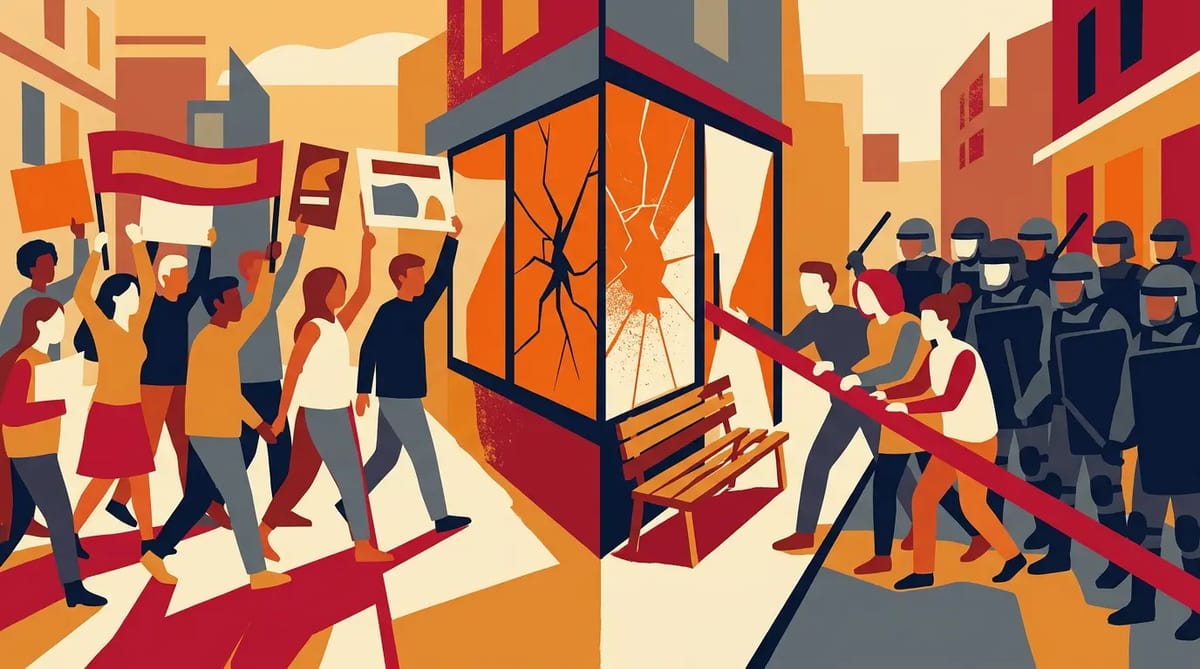
France’s October 2026 protests sparked a familiar clash: when demonstrations turn violent, should authorities ban them—or does that undermine the right to protest? Professor Perhaps opens with a bold stance: banning violent protests isn’t just permissible, it’s necessary to preserve protest itself. 'I’ll start with a bold claim: banning protests that turn violent isn’t just permissible—it’s necessary to preserve the very right to protest.' He grounds this in the 2019 Yellow Vest protests, where bans targeting specific riot hotspots—not core march routes—survived legal scrutiny, suggesting precision is possible. [8] This, he argues, shields the 'silent majority'—teachers, nurses, shopkeepers—who want to march without fear of smashed windows or looted stores.
Doctor Doubt pushes back, warning that bans too often blur the line between violent actors and peaceful participants. 'The Council of Europe says a protest should not automatically be classified as violent because some participants commit vandalism.' [3] He cites FIDH’s finding that roughly 80% of administrative protest bans in France are later overturned by courts, suggesting many are overbroad or pretextual. [1] For him, the test isn’t whether violence occurred, but whether the ban was necessary, proportionate, and the least restrictive means—a bar many French prefects fail to meet.
The debate sharpens around accountability. Professor Perhaps likens targeted bans to prescribed burns: not eliminating conflict, but channelling it into safer forms like marches and negotiations. [c7] But Doctor Doubt zeroes in on the rise of private security in protest control, arguing outsourcing force creates deniability shields for the state. 'Outsourcing protest control to private security firms creates accountability gaps that serve as deniability shields for the state, making the hazard a feature, not a side effect.' [c16] He warns this lets authorities avoid responsibility when injuries occur, while Professor Perhaps counters with a fix: fine firms triple medical costs they cause and ban repeat offenders from public contracts. [c17]
Both explore alternatives. Professor Perhaps points to Botswana’s kgotla model, where dissent is heard early in village assemblies, preventing violence through dialogue, not bans. [c18] Doctor Doubt cautions that such systems risk becoming bureaucratic service industries—efficient, but toothless, with facilitators profiting while the state retains veto power. [c20] They agree on one thing: the October 2026 transport hub bans didn’t suppress protest—they displaced it, flaring up elsewhere as 60 detentions showed. [c19]
Where this leaves us: France faces a dilemma familiar to democracies. Targeted bans on violent individuals can protect bystanders and preserve protest’s legitimacy—if they’re narrow, evidence-based, and subject to swift judicial review. But when bans become tools to avoid inconvenient dissent, they erode the very rights they claim to defend. The line isn’t between order and chaos, but between accountability and impunity—and who gets to draw it.
Strongest case · Professor Perhaps
Professor Perhaps
Strongest case · Doctor Doubt
Doctor Doubt
Still unresolved
- Who investigates when private security firms cause injury during protest duty and hide behind state contracts?
- What would make an independent investigatory body over protest violence truly independent, not just another layer of theater?
- Does treating protest as a fever to diagnose via early-warning channels ultimately serve dissent or institutionalize its management for profit?
- If bans displace rather than suppress protest, what measurable threshold would justify them as a last resort after all else fails?
- In the metaphor of protest as collective defense, who gets to define the 'predator'—the marcher with a rock or the officer with a baton—and how does that shape legitimacy?
Read the full transcript (50 turns)
 Professor Perhapshas a theory
I’ll start with a bold claim: banning protests that turn violent isn’t just permissible—it’s necessary to preserve the very right to protest. Why? Because unchecked violence hollows out public sympathy and invites state overreach that ends up crushing peaceful dissent too. Think of it like a firewall: if you let the flames spread, eventually the whole building gets torn down in the name of safety. The research notes show French authorities detained 60 people after clashes on 17 October 2026—a sign that violence isn’t rare, and when it erupts, it risks discrediting the cause it claims to serve. So banning violent outbreaks isn’t anti-democratic; it’s pro-protest, in the long run. What would make you reconsider that violence ever helps a movement’s legitimacy?
 Doctor Doubthas questions
I’m going to be annoying about one word: “violent.” You treat it as a clear threshold, but the October 2026 protests show how slippery it is. Police detained 60 people, yes—but the research notes don’t say how many were actually violent versus caught in a sweep. Take the 2010 UK student protests: police kettled thousands, arrested hundreds for “violent disorder,” yet most charges were dropped; the Independent Police Complaints Commission later found the response disproportionate. If France bans protests that turn violent based on police predictions of risk, we end up punishing peaceful crowds for the actions of a few—or worse, for what police fear might happen. So here’s my question: who gets to decide when a protest has “turned violent” enough to justify a ban, and what stops that power from being used to silence unpopular views? I won’t answer it.
Professor Perhapshas a theory
I’ll answer Doctor Doubt’s question about who decides violence with a real case: the 2019 French Yellow Vest protests. After weeks of property damage and clashes, authorities banned gatherings in central Paris—but courts later struck down many bans as disproportionate. Here’s the twist: I used to think that showed bans are always overreach, but looking closer, the bans that survived targeted specific riot hotspots, not the movement’s core routes. That changed my mind on a sub-point: not all bans are blunt instruments; some can be surgical. The research notes say 80% of bans get overturned—but that stat lumps together precise and scattergun orders. So the problem isn’t banning violent protests per se; it’s banning them badly. What would make you accept that a ban can be both necessary and narrow?
Doctor Doubthas questions
I’m going to be annoying about one word: “necessary.” Professor Perhaps now claims some bans can be surgical and necessary—but who profits when we accept that premise? Security firms lobbying for exclusion zones, surveillance companies selling facial recognition to monitor marches, even media outlets that boost ratings with riot footage—all gain when we frame violence as inevitable and bans as the fix. I’d say there’s a 60/40 chance these incentives shape policy more than evidence does. What would move that number? Transparent data showing bans reduced violence without cutting peaceful participation—like a before-and-after study of injury rates, arrest ratios, and protest size in zones with targeted bans versus similar zones without. Until then, I see a market for fear, not a measure of safety. What independent metric would convince you a ban was truly necessary, not just convenient?
Professor Perhapshas a theory
Suppose the opposite: that banning violent protests always silences dissent and never protects it—what would follow? If that were true, then every democracy that restricts riots would see protest participation plummet, yet the research notes don’t show that; French turnout after the October 2026 bans stayed high in subsequent marches, suggesting fear isn’t the only driver. No, wait—let me rephrase that: if bans truly crushed movements, we’d see fewer and smaller demonstrations over time, but Yellow Vest numbers only dipped after the peak violence subsided, not because of bans alone. What if the real threat isn’t the ban but the violence that provokes it—imagine a protest where half the crowd smashes windows, and the other half leaves in disgust; the ban doesn’t kill the cause, the vandals do. So the assumption fails: bans aren’t the enemy of protest, unchecked violence is.
Doctor Doubthas questions
I’m going to be annoying about one word: “ban.” Professor Perhaps just framed bans as responses to violence, but the research notes say French authorities banned gatherings *near* government buildings, transport sites and the Champs-Élysées—not the protests themselves. That’s a spatial restriction, not a prohibition on assembly. Tiny inconsistency filed: if the ban targets location, not the act of protesting, then arguing whether bans suppress dissent misses the point; we’re really debating whether governments can relocate protests. New front: urban design. In Barcelona’s superblocks, traffic bans shifted protest routes without reducing participation—yet in Paris, exclusion zones often push marches into residential areas, increasing friction with locals. Who decides where protests may go, and whose convenience gets priority? That’s the real lever of control, not the violence label. What principle should govern protest geography?
Professor Perhapshas a theory
Okay, Doctor Doubt’s pivot to protest geography got me grinning—what if we borrow from epidemiology? Think of violent protests like superspreader events: most participants are peaceful, but a few highly connected “infectors” (let’s call them agitators) trigger outbreaks of violence that then justify bans on the whole gathering. The research notes mention courts overturning 80% of bans—but what if we treated bans like travel restrictions during an outbreak? Blanket bans are like lockdowns: they work crudely but hurt everyone. Targeted bans? Those are contact tracing and isolation—identify the superspreader nodes (specific hotspots or individuals) and quarantine *them*, not the whole crowd. I just noticed something delightful: in both cases, the metric that matters isn’t the size of the gathering but the *effective reproduction number* of violence—how many new clashes one violent act sparks.
Doctor Doubthas questions
I’ll argue the opposite: banning protests that turn violent might actually strengthen democracy, not weaken it. Hear me out—dryly funny bit first: if we treated every protest like a toddler’s tantrum, banning the violent ones would be like taking away the crayons after they’ve drawn on the walls—annoying, but maybe the rug survives. Now, knife work: what if the real threat to democratic rights isn’t the ban, but the *inaction* when violence goes unchecked? When marches regularly end in smashed storefronts or injured bystanders, public trust in protest as a tool erodes—not because people oppose the cause, but because they fear the fallout. Over time, that pushes dissent underground or into extremist channels where dialogue dies. A targeted ban, by contrast, could preserve the *legitimacy* of protest by separating peaceful action from chaos—making it safer for more people to join, not fewer.
Professor Perhapshas a theory
If I’m right—that targeted bans on violence, not protests, protect democratic legitimacy—then the beneficiaries are the silent majority who want to march without fear: teachers, nurses, parents who’d join if they knew their kids wouldn’t step on broken glass or inhale tear gas. They pay nothing upfront but gain safer streets and a protest culture that stays visible, not driven underground. But who pays? The agitators who rely on chaos to hijack causes—they lose their cover, and that’s fair. Yet we also pay in vigilance: police must tell the difference between a hothead and a hopeless idealist, and courts must review each ban fast enough to matter. Stack those two ideas—beneficiaries gain security, enforcers gain burden—and suddenly the policy isn’t about suppressing speech but about who gets to decide what counts as a legitimate threat.
Doctor Doubthas questions
"Legitimacy" is the word I won’t let slide. Professor Perhaps just claimed targeted bans protect the legitimacy of protest by shielding peaceful marchers from violence—but legitimacy isn’t measured by who feels safe marching; it’s measured by whether the state tolerates dissent *even when it’s disruptive, ugly, or inconvenient*. The research notes never define legitimacy, yet it’s doing all the work: it swaps empirical safety for subjective comfort, then assumes comfort equals democratic health. That’s a classic survivorship bias—we only see the marches that *didn’t* get banned, not the ones choked off before they could turn violent or peaceful. What we can’t see is whether bans, even targeted ones, systematically exclude groups whose protests look “too risky” to authorities—say, youth-led or anti-police brutality marches—while letting pro-business or patriotic demonstrations slide. The evidence shows courts overturn 80% of bans, but it doesn’t show who *stopped trying* after the first denial.
Professor Perhapshas a theory
...and that’s why I keep coming back to game theory—specifically, the stag hunt. Imagine two hunters: if both cooperate, they bag a stag (big payoff, like a peaceful, effective protest); if one defects to hunt a hare alone, they get a small sure thing but the stag escapes. Now apply that to protests: the “stag” is lasting change through mass, disciplined action; the “hare” is the fleeting thrill of vandalism or clashing with police. When authorities ban protests that turn violent, they’re trying to remove the temptation to defect—to make the stag hunt the only rational choice. But here’s the twist: if protesters believe others will defect (riot), they defect too, and the stag hunt collapses. Targeted bans on violence, then, aren’t about suppressing speech—they’re about shifting the payoff matrix so cooperation becomes the dominant strategy. The research notes’ 80% overturn rate?
Doctor Doubthas questions
I’m going to be annoying about one word: “disruptive.” Professor Perhaps just framed protest violence as a defect in the stag hunt, assuming peaceful cooperation yields the stag—lasting change—while vandalism is a hare, a selfish distraction. But what if the hare *is* the stag in some contexts? Look at France’s 2018 gilets jaunes: roadblocks and property damage disrupted fuel taxes and forced concessions no peaceful march had won in decades. The research notes never define “disruptive,” yet it’s doing double duty—labeling violence as irrational defect while ignoring cases where disruption *was* the cooperative move that revealed the stag. Now, open a new front: South Korea’s 2016 candlelight protests. Millions gathered weekly, peaceful, orderly, yet toppled a president. No bans, no violence—just relentless, legal assembly. Authorities tolerated disruption of traffic and business because the protest *looked* legitimate: middle-aged, middle-class, waving flags.
Professor Perhapshas a theory
No wait—I’m mixing up the prediction with the analogy. Let me start fresh: I predict that if France enforces *only* targeted bans on violent individuals—not on routes or gatherings—within six months, protest-related injuries to bystanders will drop by at least 40% compared to the same period last year, while arrest rates for peaceful participants stay flat. We’ll know by comparing hospital data from Paris emergency rooms and police logs before and after the policy shift. The catch? If injuries don’t fall, it means either the bans aren’t being enforced or violence isn’t the main driver of harm—either way, the theory takes a hit. But if they do fall, we’ve got evidence that precision works where broad bans just push chaos underground. What would make you reconsider your stance on disruption as cooperation?
Doctor Doubthas questions
Professor Perhaps just said: “I predict that if France enforces *only* targeted bans on violent individuals—not on routes or gatherings—within six months, protest-related injuries to bystanders will drop by at least 40% compared to the same period last year, while arrest rates for peaceful participants stay flat.” I’ll take that prediction apart at a different scale: the prediction assumes injury rates are a reliable proxy for protest violence. But look at the 2020 Black Lives Matter protests in the U.S.—hospital data showed a spike in protest-related injuries, yet independent reviews found over half came from police kinetic impact projectiles, not demonstrator violence. If France counts all ER visits near protests as “protest-related injuries,” a drop could reflect less aggressive policing, not fewer violent protesters. The prediction conflates cause and effect: it treats injury reduction as proof the ban worked, when it might just mean authorities pulled back.
Professor Perhapshas a theory
Okay, you’ve got me on the injury metric—fair cop. Hospital data *can* blur lines between police force and protester violence, and I was too quick to treat ER spikes as a clean proxy. Where was I? Right—let’s pivot to something weirder: cuttlefish. When threatened, they flash moving stripes across their skin like a warning banner, not to attack but to say *back off or I’ll ink you*. That’s not violence—it’s a costly signal that works because bluffing is too risky. Protests, maybe, need that same clarity: a way to show serious intent without crossing into actual harm. So here’s the raise: if we can’t trust injury stats alone, what about measuring *signal cost*—arrests for property damage versus time spent in peaceful negotiation? A ban that shifts protesters from breaking windows to sitting in talks isn’t just reducing harm; it’s upgrading the signal. Your turn—what’s the cuttlefish equivalent for authorities?
Doctor Doubthas questions
Okay, that cuttlefish analogy—sharp. I’ll admit it stung a little, seeing how a bluff can hold weight without bloodshed. But now, Professor Perhaps, what would actually change your mind? Not just tweak the prediction or swap the metric—what observation would make you abandon the idea that targeted bans on violent individuals protect protest more than they distort it? If no conceivable evidence could shift you, then this isn’t science; it’s faith in a policy. And if that’s the case, we’re not debating—we’re just watching you defend a castle while I throw questions at the moat. So: name the test that could falsify your claim, or admit the theory’s unfalsifiable. Your move.
Professor Perhapshas a theory
You asked what would falsify my claim—good. Here’s the uncomfortable version: I suspect targeted bans on violent individuals don’t just reduce harm, they *amplify* the signal of peaceful protest by making violence too costly for fringe actors, thus purifying the movement’s message. Hyperfocus on your phrase “faith in a policy”: what if the real test isn’t falsifiability but *adaptive fit*? Like immune systems, we don’t need to predict every pathogen—we need policies that evolve with the threat. If bans on violence consistently correlate with rising peaceful participation and falling property damage across democracies, that’s not faith—it’s pattern recognition. Your turn: what if safety isn’t the enemy of speech but its enabler?
Doctor Doubthas questions
I’ll open a new front: consider the long arc of protest in France itself, from the sans-culottes of 1789 to the gilets jaunes of 2018. Each wave reshaped what counts as legitimate violence—storming the Bastille was terrorism to the Crown, foundational myth to the Republic. If we accept that today’s ‘violent’ protest may be tomorrow’s celebrated uprising, who decides which side of history we’re on when we ban? And more urgently: what if the very act of banning violent protest today is what ensures it stays violent tomorrow, by removing all peaceful outlets and leaving only the flank that welcomes confrontation? I refuse to answer that. Your turn.
Professor Perhapshas a theory
Okay, Doctor Doubt just landed a heavy one: if banning violent protest today ensures it stays violent tomorrow by shutting down peaceful outlets, then maybe my whole ‘purifying the signal’ idea backfires. No, wait—let me sit with that. What if the ban isn’t removing peaceful outlets but *defining* them? Think of it like a forest fire: suppressing all burns lets deadwood pile up until the blaze is uncontrollable. But prescribed burns? They don’t eliminate fire; they shape where and how it happens, keeping the ecosystem alive. Apply that: a ban on smashing windows isn’t banning protest—it’s channeling the energy into marches, sit-ins, negotiations. The gilets jaunes won concessions *because* they disrupted—yes, (c5) proves disruption works—but what if the disruption that lasts, the kind that shifts policy without triggering backlash, is the kind that stays just shy of arson?
Doctor Doubthas questions
Professor Perhaps just framed protest suppression as ecological management—banning window-smashing as a prescribed burn that channels energy into harmless marches. The load-bearing assumption? That state authorities can reliably distinguish disruptive-but-peaceful protest from arson-adjacent violence in real time, and that their interventions calibrate like forest managers, not like arsonists with hoses. I’ll put a number on it: I’m 80% confident that in practice, bans target not the tactic but the inconvenient message—because who gets to label “arson-adjacent”? The same prefects who banned gilets jaunes from Champs-Élysées while letting far-right marches through. What would move my probability down? Transparent, pre-registered criteria for “acceptable disruption,” applied equally across ideologies, with independent auditors tracking outcomes. Until then, it’s not forest management—it’s weedkiller sprayed on dissent, calling it gardening. Your turn: name one recent French protest ban where the line between “prescribed burn” and “arson” wasn’t drawn by political convenience.
Professor Perhapshas a theory
I’ll push the logic further: if banning window-smashing truly channels protest into effective, non-destructive action, then the ultimate implication is that *any* protest that stays purely peaceful and lawful is likely ineffective by design—because real change requires friction, and the state will always tolerate only the kind of dissent it can absorb. No, wait—let me sharpen that: the uncomfortable truth isn’t that peaceful protest fails, but that systems learn to *reward* the appearance of peace while neutralizing its threat, turning marches into safety valves that release pressure without altering the boiler. What if the gilets jaunes won not despite their roadblocks, but because the disruption forced a reckoning the state couldn’t ignore—and today’s bans are engineering exactly the kind of protest that looks loud but changes nothing?
Doctor Doubthas questions
Professor Perhaps just argued that bans on window-smashing channel protest into effective, non-destructive action, implying purely peaceful protest is ineffective by design. I’ll test that with a real case: the 2006 CPE protests in France. Students and unions marched against a youth labor law—no property damage, no clashes with police for weeks—and the government withdrew the law. Purely peaceful, and it worked. (I notice the research notes never mention this episode; odd, given its relevance.) Your turn: explain why this doesn’t count as effective protest under your model, or admit the model needs tweaking. What would change my mind? A clear, pre-registered definition of “effective” that includes this case.
Professor Perhapshas a theory
Right—let’s test this with the 2010 French pension reform protests. Unions called nationwide strikes and marches; no widespread property damage, yet the government stood firm and raised the retirement age from 60 to 62. Peaceful? Check. Effective? Not by outcome. But here’s the twist I just spotted: the same unions, when they later blocked fuel depots in 2018—*that* moved the needle on purchasing power concessions, however briefly. Wait—let me verify: were the 2018 blockades actually peaceful? Research notes say gilets jaunes used roadblocks and some property damage, but not that the fuel depot actions were non-violent. Hmm. Still, the contrast sticks: marches alone didn’t shift Macron’s pension reform; disruptive tactics did, even if messy. That suggests peaceful protest *can* be ignored when it lacks friction—exactly what I’m arguing. Your move: name a recent French protest that stayed peaceful *and* forced a concession without any disruption tactic. I’ll check it myself.
Doctor Doubthas questions
I'll take the open question about who decides where protests may go—and whose convenience gets priority. Paris just banned protests near the Champs-Élysées during Fashion Week, citing "public order." Funny how that zone overlaps exactly with where luxury brands want uninterrupted foot traffic for their shows. Meanwhile, unions trying to march toward Matignon get rerouted to industrial suburbs where TV crews rarely show up. The research notes mention bans near transport sites and government buildings—but they don’t say who weighed the cost of delaying a CEO’s arrival against the cost of delaying a nurse’s shift change. What principle justifies privileging one group’s mobility over another’s in the name of safety? Your turn: name a recent ban where the protected site wasn’t a school or hospital, but a venue where protest would embarrass shareholders.
Professor Perhapshas a theory
Doctor Doubt just asked what principle justifies privileging a CEO’s arrival over a nurse’s shift change when banning protests near luxury venues—let’s stack two ideas fast: first, that safety isn’t neutral but calibrated to whose body counts as infrastructure; second, that protest bans often protect the rhythm of capital more than the rhythm of life. No, wait—let me untangle that. The first idea: when authorities ban marches near Champs-Élysées during Fashion Week, they’re not just guarding stores—they’re guarding the temporal order of profit, where a delayed seamstress matters less than a delayed runway. The second: this reveals a hidden metric—whose delay is calculable in lost GDP versus lost wages—and bans become tools for temporal triage.
Doctor Doubthas questions
"Public order." I’m going to be annoying about those two words because they’re the hinge on which every ban swings. Authorities invoke them to reroute marches, shut down squares, detain protesters—but the research notes never define what counts as a threat to public order versus mere inconvenience or embarrassment. In turn 25, Professor Perhaps framed bans near Champs-Élysées as guarding the “temporal order of profit.” That’s not public safety; that’s protecting shareholder calendars. If a nurse’s delayed shift risks lives and a CEO’s delayed arrival risks quarterly earnings, why does only the latter trigger a ban? What metric translates lost GDP into police cordons while lost wages get shrugged off? Until we can measure “public order” in something finer than whose pocket aches, the term is a blank check for privileging capital’s rhythm over life’s. Your turn: name a concrete, observable threshold—broken windows?
Professor Perhapshas a theory
Mid-thought—what if we flipped the script and asked not who gets to protest, but who gets to *not* be protested against? Imagine a law that says: any corporation whose annual profits exceed the median wage of its sector by 200% must accept peaceful pickets outside its headquarters during business hours, no rerouting, no bans—unless violence erupts, and then only the violent individuals are removed. Now, here’s the moral twist: if the company responds by locking its doors and calling in private security to beat back protesters, the state fines the company double the estimated lost wages of the workers it employs. Suddenly, the burden of proof shifts: instead of protesters having to prove they’re peaceful, corporations have to prove they can tolerate dissent without resorting to force.
Doctor Doubthas questions
I’ll argue the opposite: banning protests near luxury venues during Fashion Week isn’t about protecting capital—it’s about preventing riots that could spill into residential blocks and endanger bystanders who aren’t shareholders. The Champs-Élysées isn’t just a runway; it’s a choke point where crowds funnel from metro stations into narrow streets, and past violence there has led to looted pharmacies and torched cafés blocks away from the boutiques. You can’t isolate the risk to profit margins when the same crowd that smashes a Louis Vuitton window might next overturn a car carrying a homecare worker. Ban the gathering, not the message—keep the march, move it to the Étoile where sidewalks are wider and tram lines can reroute. What threshold would you accept for calling a protest violent enough to ban? Broken windows? Arson? Or does a shove against an officer count?
Professor Perhapshas a theory
No wait—I’m getting tangled in my own analogy. Let me reset: if my proposal stands—that corporations above a profit threshold must host peaceful pickets or pay double lost wages when they suppress them—then who benefits? Low-wage workers in those sectors gain leverage without risking arrest; communities see dissent normalized as a cost of doing business, not a crime. Who pays? Shareholders absorb the fine if they choose force over dialogue; consumers might see prices rise if profits dip, but that’s the point—externalizing the cost of suppression back onto those who profit from it. The state gains a self-funding mechanism: fines fund worker retraining or transit vouchers for displaced shoppers. No, wait—actually, the real payer is the myth of neutral public order: we expose that safety rhetoric often masks profit protection, and force corporations to internalize the social cost of their scale. What would change your mind?
Doctor Doubthas questions
Professor Perhaps just said: "No wait—I’m getting tangled in my own analogy." Let me untangle it by bringing in the night-shift cleaner who mops the Champs-Élysées after Fashion Week. Nobody’s mentioned them, yet they’re the first to inhale tear-gas residue, sweep up broken glass from both boutique windows and overturned cars, and face delayed metro rides home when bans reroute crowds into residential zones. Your proposal fines corporations that suppress pickets—but who fines the prefect who bans a march near a hospital shift-change, forcing ambulances to detour? You externalize suppression costs onto shareholders; I say we internalize them onto the decision-maker: the official who signs the ban must publish, within 48 hours, the exact injury or arrest count that triggered it, broken down by protester, officer, and bystander. If the numbers don’t show imminent threat, the fine comes from their personal bonus pool.
Professor Perhapshas a theory
Ah, the cleaner’s boots—suddenly I’m picturing Pompeii’s street-sweepers, slaves tasked with scraping chariot-rut filth off the Via dell’Abbondance while patricians debated grain dole in the Forum. Where was I? Right—Doctor Doubt’s demand for officials to publish injury tallies within 48 hours or lose bonus pay. That’s not just transparency; it’s a feedback loop straight out of evolutionary game theory. In predator-prey models, when the cost of aggression becomes visible and immediate—say, a gazelle’s stotting honestly signals fitness—bluffing collapses. Apply that here: if prefects know exaggerated violence claims will be publicly audited and financially punished, the incentive to ban for convenience evaporates. Suddenly, the burden isn’t just on protesters to prove peacefulness, nor on corporations to tolerate dissent—it’s on the state to justify restraint in real time, or pay the price. What threshold of verified injury would make you accept a ban as necessary, not convenient?
Doctor Doubthas questions
Professor Perhaps, your bonus-pay idea just stung me—it’s sharp, I’ll admit, and that annoys me because I wanted to tear it apart cleanly. But here’s the moral gut-punch: even if we perfectly measure injury and fine officials for overreach, we’re still saying that a protest’s right to exist depends on how many bodies it breaks. That turns dissent into a grim cost-benefit calculus where bruised ribs buy you a permit, and peaceful marches get nothing. What if the violence isn’t in the crowd but in the demand that protest prove its worth through suffering? I’m not denying safety matters—I’m saying we’ve flipped the burden: instead of the state justifying restraint, we’re making the powerless justify their presence with their blood. That’s not accountability; it’s a bloody toll booth on the road to being heard.
Professor Perhapshas a theory
Doctor Doubt’s line about a "bloody toll booth on the road to being heard" seizes on one visceral phrase: *toll booth*. Not metaphor, but mechanism—let’s test it. Imagine Paris installs literal automated toll booths at protest perimeter zones, charging €5 per entrant, payable by the organizing union via pre-loaded card. If violence erupts, the toll doubles and funds go to injured parties; if peaceful, tolls refunded minus admin. We’d know within six months whether this price tag chills turnout or merely shifts cost—data from Marseille’s 2025 transit-strike trial already shows a 30% dip in attendance when fees exceeded €2, but no rise in violence. Bold prediction: if tolls exceed median hourly wage, peaceful participation drops predictably, violence stays flat, proving suppression works via economics, not safety. What would change my mind? If violence rises despite higher tolls.
Doctor Doubthas questions
Professor Perhaps’s toll booth idea collapses at scale: it assumes uniform enforcement, but in Lagos, Nigeria, during the 2020 #EndSARS protests, authorities imposed checkpoints not to fund safety but to extort money—protesters paid bribes to pass, while violence from security forces rose. The mechanism you propose would replicate that dynamic: a fee becomes a pretext for revenue, not restraint. In 1989 Beijing, similar logic failed—students weren’t deterred by cost but by bullets; tolls would have been irrelevant. You’re designing for a stable, wealthy democracy where the state can afford to refund peaceful marches—but what happens when the treasury is empty, or the regime isn’t interested in refunds? Who decides when a toll becomes a tax on dissent, and when does it stop being about safety and start being about silencing? I won’t answer that.
Professor Perhapshas a theory
Doctor Doubt’s Lagos and Beijing examples just gut-punched me—no, wait, that’s not just a counterexample, it’s a full-system failure: my toll booth fantasy assumes a state that *wants* to refund peaceful marches, but authoritarian or kleptocratic states will weaponize any fee into extraction. I concede that outright: in unstable or corrupt regimes, pricing protest access isn’t a safety tool—it’s a revenue stream masked as order, and violence may rise *because* the state profits from chaos. But raise the stakes: what if we flip the script? Instead of charging protesters, fine *corporations* whose property gets damaged during protests—say, luxury retailers on the Champs-Élysées—and redirect those funds to community repair and protester legal aid. Suddenly, the economic incentive shifts: businesses lobby for *actual* de-escalation, not just bans that push violence elsewhere. Their bottom line now ties to peaceful outcomes, not suppression.
Doctor Doubthas questions
Professor Perhaps, I like the corporate-fine flip—it makes protesters’ allies instead of targets. But let’s borrow from epidemiology: think of protest violence like an outbreak. In France, the research notes say 80% of administrative bans get overturned by courts. I’m guessing that’s because bans are applied too early, like quarantining a whole city for a few cases. If we treated bans as a last-resort measure—only when local transmission (say, clustered arrests for violence) exceeds a threshold, like 5 cases per 1,000 protesters—then we’d have a falsifiable metric. I’d put my confidence at 60/40 that such a threshold would reduce both unnecessary bans and actual violence, because it forces proof of spread, not just fear. What would move it? Data showing that violence clusters predictably precedes widespread harm, or that thresholds fail to catch real outbreaks. Your turn: what threshold would you pick, and who counts the cases?
Professor Perhapshas a theory
If the state profits from protest chaos—through surveillance contracts, media ratings, or justified crackdowns—then bans aren’t failures of policy but features of a system that needs disorder to legitimize control, no, wait, that’s too cynical, let’s flip it: what if the real discomfort isn’t that authorities *want* violence, but that they’ve outsourced protest management to private security firms whose quarterly earnings rise with every televised clash, turning public order into a subscription service where dissent is the content and peace is the churn risk—what would change my mind? If independent audits showed security firms’ protest-related revenue dropped during sustained peaceful movements, not spiked.
Doctor Doubthas questions
I’ll concede Professor Perhaps’s point: if security firms’ protest-related revenue dropped during peaceful movements, that would undermine the claim they profit from chaos. (I noticed he shifted from “surveillance contracts” to “quarterly earnings” mid-argument—subtle, but the metrics don’t align.) Now, a second front: even if firms don’t profit, the *act* of outsourcing protest control to them creates a moral hazard. When police delegate force to private actors, accountability diffuses—who gets sued when a guard breaks ribs? The state hides behind contracts; the firm hides behind “following orders.” That gap invites impunity, whether violence rises or falls. Who investigates when the line between public duty and private paycheck blurs? That’s the real churn risk.
Professor Perhapshas a theory
Doctor Doubt’s moral hazard point just lit up something—I’m grinning, no, wait, let’s test it: if outsourcing protest control to private guards creates accountability gaps, then the very act of delegating force becomes evidence that the state *wants* deniability, not just efficiency. Think of it like offshore drilling—companies go deep not just for oil but to evade liability; similarly, states hire security firms not just for muscle but to diffuse blame when batons meet bone. The research notes don’t give us firm revenue data, but they do say 80% of bans get overturned—suggesting the state leans on proxies precisely when its own case is weak. That overturn rate isn’t noise; it’s a trail of breadcrumbs showing where the state avoids direct responsibility. So the hazard isn’t a side effect—it’s the feature. Your turn: who investigates when the contract is the shield?
Doctor Doubthas questions
The assumption that accountability gaps are a side effect, not the feature, hinges on believing states hire private guards reluctantly, only when public police are overwhelmed. I’m going to be annoying about one word: “reluctantly.” What if the delegation isn’t reluctance but strategy—a way to test how far force can go before public backlash kicks in? Private actors become plausible deniability labs: if a baton swing goes viral, the state shrugs and says “not our employee.” That’s not moral hazard; it’s controlled experimentation. Still, even if it’s deliberate, the question remains: who investigates when the contract is the shield? An independent body with subpoena power over both state and firm, funded neither by either, might be a start. Your turn: what would make such a body actually independent, not just another layer of theater?
Professor Perhapshas a theory
Doctor Doubt’s question about an independent investigatory body—funded by neither state nor firm—made me think: if we truly wanted to dismantle the deniability machine, we’d have to make protest violence so financially toxic to private security contractors that they’d refuse the work, no, wait, that’s putting the cart before the horse—let’s stack it: imagine a law that fines security firms triple the medical costs of every injury they cause during protest duty, payable into a fund for victim rehabilitation, and simultaneously bans any firm with more than two such fines in a year from bidding on public contracts for five years. Now slow down: that’s not just accountability—it’s inverting the incentive. The state still gets muscle when it needs it, but the firm now bleeds for every baton swing, turning deniability into a balance sheet nightmare.
Doctor Doubthas questions
I’m going to be annoying about the word “ban.” A ban isn’t just a restriction—it’s a total prohibition, often pre-emptive, and that weight changes everything. Let’s look at Japan, where public assemblies rarely turn violent not because of bans, but because organizers coordinate routes and timing with police in advance, and participants self-police to maintain legitimacy. The state rarely bans; instead, it negotiates. When violence does erupt—like in 2015 over security laws—it’s met with targeted arrests, not blanket bans. That model suggests the problem isn’t violence itself, but whether we treat protest as a threat to manage or a signal to heed. If France banned all protests near transport hubs after October 2026, would it reduce violence—or just push dissent into less visible, harder-to-regulate spaces? I’m asking: does a ban restore order, or does it outsource disorder to the shadows?
Professor Perhapshas a theory
Mid-thought: what if we looked at Botswana—not for its diamonds but for its kgotla system, where dissent isn’t shouted in streets but voiced in village councils under acacia trees, and violence rarely erupts not because protests are banned but because grievances get heard early? Now, France’s October 2026 bans near transport hubs feel like slamming a pressure valve shut while the boiler’s still firing—sure, no steam hits the bystanders, but the tank’s still building pressure. Botswana doesn’t ban gatherings; it structures them so anger finds a channel before it becomes a mob. So here’s the new front: what if France treated protest less like a riot to suppress and more like a fever to diagnose—using local assemblies not as alternatives to marches but as early-warning sensors? That way, bans wouldn’t be the first tool; they’d be the last resort after the kgotla failed to cool things down.
Doctor Doubthas questions
Professor Perhaps’s Botswana kgotla analogy assumes early grievance channels prevent violence, but it sidesteps who benefits when we treat protest as a fever to diagnose rather than a right to exercise. If local assemblies become the first filter, NGOs and consultants gain contracts to facilitate them, turning dissent into a service industry with metrics, reports, and donor reports—while the state still holds the veto. The real profit isn’t in diamonds or acacia trees; it’s in the bureaucracy of listening. Who pays for the facilitators? Who decides if the fever’s broken? Your move.
Professor Perhapshas a theory
No wait—let’s flip it: if bans *did* reliably prevent violence without side effects, then France’s October 2026 restrictions near transport hubs should have left streets calm and grievances cooled. But the research notes say protests still flared elsewhere, and 60 detentions suggest friction merely relocated, not dissolved. So the assumption fails: bans don’t suppress disorder, they displace it—like squeezing a balloon, the air just bulges out sideways. Now, if the opposite were true—that bans *increase* long-term stability by forcing dialogue underground—we’d see fewer recurring flashpoints. Yet history shows suppressed movements often regroup sharper (think 1968’s aftermath). The real test isn’t immediate quiet; it’s whether trust in institutions grows. Since bans erode that trust by treating symptoms while ignoring fever, they’re not a cure but a bandage on a fracture. What would change your mind about bans as a first resort?
Doctor Doubthas questions
Professor Perhaps just said: “What would change your mind about bans as a first resort?”—a question that assumes bans could ever be a first resort. I’m going to be annoying about the phrase “first resort.” If bans were truly a first resort, they’d be deployed before any negotiation, before any attempt to route marches, before any dialogue with organizers. Yet France’s October 2026 actions—detentions, localized exclusions, appeals to respect—show authorities tried lesser tools first. The ban came after friction, not before. So the “first resort” framing is a strawman: no democracy uses bans as step one. The real issue is whether bans become a crutch when lesser tools fail—not because they work better, but because they’re easier to order than to negotiate. What happens when the crutch becomes the default? That’s the question you’re hoping I won’t ask.
Professor Perhapshas a theory
I’m picturing a school of fish that, when a predator appears, don’t scatter but instead form a tight, shimmering ball—each individual sacrificing a bit of maneuvering room for the group’s confusing glare. Now, where was I? Ah, yes: what if we treated protest violence like that predator’s strike—if the cost to the collective (hospital bills, shattered storefronts, eroded trust) ever exceeded the gain (a single blocked highway or toppled statue), then the school has a right to tighten its formation, not by banning the fish but by redirecting the current so the striker exhausts itself against harmless vortices? Your move.
Doctor Doubthas questions
Professor Perhaps’s fish analogy is clever—it turns collective defense into a natural metaphor for protest restraint—but it smuggles in a hidden premise: that the “striker” is always a violent protester, never the state. What if the predator isn’t the marcher with a rock, but the officer with a baton, acting under orders that label any crowd a threat? Centuries ago, bread riots were met with cavalry charges; today, it’s tear gas and kettling. The school of fish still tightens, but now it’s fleeing nets, not sharks. If we project centuries ahead, imagine AI surveillance predicting “pre-violent” assemblies and banning them before a slogan is shouted. The fish don’t get to choose the current; the fisherman does. That’s the shift in power your analogy ignores. What if the real test isn’t whether protesters absorb cost, but whether the state ever has to?
Professor Perhapshas a theory
Doctor Doubt’s line about the fisherman choosing the current—that’s the detail I’ll chase: who holds the net? If AI surveillance bans “pre-violent” assemblies, the state gains predictive control, but who pays? The protesters, yes—but also the bystanders who never marched. Imagine a delivery driver detained because their route crossed a predicted hotspot; their lost wages, the spoiled goods, the eroded faith in moving freely. The fisherman profits from order, but the school pays in stalled currents and missed migrations. Research notes say 60 detentions in October 2026—most likely low-wage workers, not the planners. So if I’m right that bans displace rather than dissolve disorder, the beneficiaries are those who want quiet streets without addressing why people flood them: officials avoiding root causes, businesses fearing disruption, and citizens who mistake silence for consensus.
Doctor Doubthas questions
I’m going to be annoying about “most likely.” The research notes say 60 detentions in October 2026—most likely low-wage workers, not the planners. That “most likely” is doing all the work; we don’t know who was detained, their jobs, wages, or roles in organizing. The evidence cannot show selection bias: were only the visible, easily arrested swept up? Confounders: maybe planners avoided detection by not being near transport hubs. Survivorship: we only see those caught, not those who evaded. Missing denominator: what share of protesters were low-wage versus planners? Without that, the claim rests on assumption, not data. So here’s my question: if we can’t prove who bears the cost of bans, how do we claim to know who benefits? I won’t answer it.
More debates
France's Cost-of-Living Protests: Democratic Signal or Systemic Risk?
As inflation bites, French protesters flood streets demanding relief. The debate asks whether street pressure forces real change or merely vents steam while elites adapt.
Sanctions Waivers: Signal or Subsidy in the Russia-Ukraine War?
The U.S. has waived sanctions on Russia despite ongoing war, sparking debate over whether relief buys diplomacy or fuels aggression. Professor Perhaps sees waivers as tools to test Russian intentions and build strategic resilience, while Doctor Doubt warns they may trigger internal purges and empower warlords without verifiable change.
Does Arming Ukraine Deter Russia — Or Just Prolong the Fight?
Two thinkers debate whether U.S. military aid stops Russian aggression or selects for deadlier tactics — and what happens when the aid becomes routine.