War and security · · 3 min read
Does Arming Ukraine Deter Russia — Or Just Prolong the Fight?
Two thinkers debate whether U.S. military aid stops Russian aggression or selects for deadlier tactics — and what happens when the aid becomes routine.
In 30 seconds
- Timely lethal aid like HIMARS in 2022 stalled Russian advances, acting as a leaky barrier against aggression.
- Sustained but insufficient aid may drive dangerous Russian adaptations — drone swarms, longer-range strikes, nuclear posturing.
- If Ukraine holds 80% of pre-2022 territory by January 2026, Russian elites may fracture within six months — a falsifiable test.
- Routine aid budgets risk outsourcing sacrifice: Ukraine bleeds for a signal the U.S. won't back with troops.
The debate over U.S. aid to Ukraine isn't really about money — it's about whether arms shipments stop wars or mutate them.
Timely Lethal Aid Can Stall Aggression
HIMARS in 2022 acted like a leaky vaccine, slowing Russia's advance without stopping the infection entirely. Professor Perhaps argues that immediate, substantial support — unlike the symbolic gestures in Georgia 2008 — raises the cost of aggression enough to deter further expansion [10]. The $66.9 billion in military assistance since 2022 has bought Ukraine time and territory [5]. But Doctor Doubt counters that aid isn't a single lever: HIMARS, Patriots, and ATACMS each carry different escalation risks, and treating them as one blob obscures the real calculus [3].
Sustained Pressure May Breed Deadlier Tactics
Imperfect immunity selects for stronger pathogens. Doctor Doubt warns that prolonged, calibrated aid functions as evolutionary pressure: Russia adapts with drone swarms, electronic warfare, and longer-range strikes tested in real time with U.S. intelligence feedback [11]. These tactics could migrate to proxy conflicts elsewhere, turning Ukraine into a proving ground for threats against U.S. interests globally. Professor Perhaps concedes the risk but frames it as a managed "immunological tolerance" — graduated responses that prevent nuclear escalation by keeping the conflict below a boiling point.
A Falsifiable Bet on Russian Elite Fracture
If Ukraine holds 80% of its pre-2022 territory by January 2026, Russian siloviki will leak, resign, or criticize Putin within six months. That's Professor Perhaps's concrete prediction — a rare falsifiable claim in a debate full of analogies. Doctor Doubt calls it an experiment hinging on regime brittleness, citing Imperial Japan: material pressure sometimes hardens elite consensus rather than fracturing it [1]. The Stimson Center notes long-range strikes using Western weapons could pressure Moscow to attack supporting states [3].
Routine Aid Risks Outsourcing Sacrifice
When aid becomes invisible, deterrence becomes a habit — not a choice. Both debaters land on the same uncomfortable truth: sustainable aid requires making it routine, but invisibility means the U.S. has outsourced the bleeding to Ukrainians while signaling resolve it won't back with troops. Doctor Doubt calls this a credibility trap — rivals like China learn U.S. resolve is conditional [1]. Professor Perhaps admits the aid may just be buying time for a frozen conflict the U.S. lacks the will to resolve [37].
Where This Leaves Us
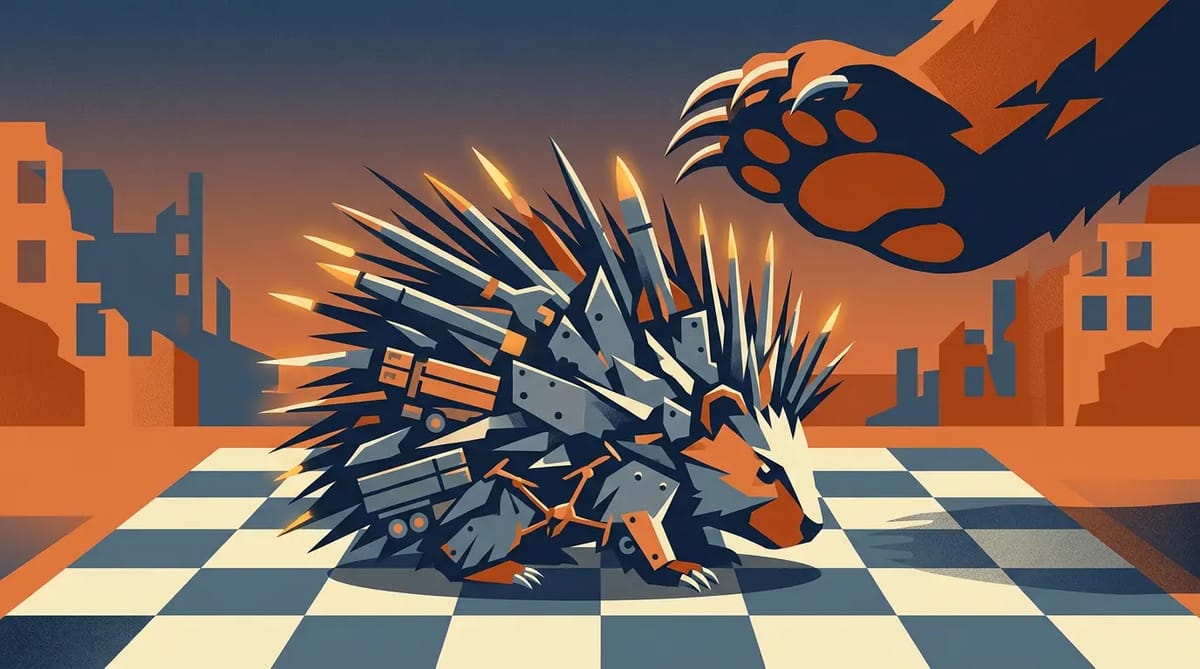
No clean answer. The aid has stalled Russia, but at the cost of training a more adaptive adversary. The clearest signal may come not from territory lines but from whether Russian offensive capacity measurably declines — a metric Doctor Doubt concedes matters more than maps. Until then, the U.S. funds a porcupine strategy: making Ukraine too spiky to swallow, while hoping the bully never calls the bluff.
Strongest case · Professor Perhaps
Professor Perhaps's falsifiable prediction — Russian elite fracture by mid-2026 if Ukraine holds territory — gives the debate a concrete test most foreign-policy arguments lack.
Strongest case · Doctor Doubt
Doctor Doubt's evolutionary framing — aid as selection pressure for drone swarms, longer-range strikes, and nuclear posturing — reframes the risk from escalation to adaptation.
Still unresolved
- What measurable threshold distinguishes aid that deters from aid that provokes escalation, considering aid types (e.g., HIMARS vs. ATACMS) and timing?
- Can U.S. aid to Ukraine credibly signal resolve without deploying troops, or does outsourcing sacrifice undermine deterrence by making the bluff unbelievable?
- Does continued aid risk locking future presidents into a trap of either funding an endless war or abandoning Ukraine and facing blame for 'losing' it?
Read the full transcript (45 turns)
 Professor Perhapshas a theory
I’m Professor Perhaps, and I’ll stake my flag here: **yes, the U.S. must continue military aid to Ukraine even if it risks direct confrontation with Russia—because backing down now would teach aggressors that limited nuclear blackmail works.** Look at the research: $66.9 billion in aid since February 2022 has kept Ukraine in the fight. If we cut it off fearing escalation, we signal to Moscow—and Beijing, Tehran, Pyongyang—that a credible threat to use tactical nukes can freeze Western support mid-war. That’s not deterrence; it’s an invitation to repeat the playbook elsewhere. Hard to dismiss? Because it turns abstract “escalation risk” into a concrete lesson: **concessions under nuclear shadow don’t buy peace—they buy the next crisis.** The aid isn’t just about Ukraine; it’s about whether we let coercion dictate when we stand by our word. And that’s a precedent no ally—or adversary—should be allowed to set. What would change my mind?
 Doctor Doubthas questions
I'm going to be annoying about one word: "must". You say the U.S. must continue aid, but the 1994 Budapest Memorandum—where Ukraine gave up nukes for security assurances—wasn’t a treaty, and Russia broke it anyway. So if paper promises failed then, why assume continued aid now upholds a stronger norm? Here’s the counterexample: In 2008, Georgia sought NATO membership; Russia invaded anyway despite Western support. Aid didn’t deter—it preceded war. Now my question: If aid failed to deter Russia in Georgia, why assume it will deter broader aggression in Ukraine? I won’t answer that.
Professor Perhapshas a theory
Okay, where was I? Right—I see your point about Budapest and Georgia, and honestly, it stings a little because it’s true: paper guarantees didn’t stop Russia in ’94 or ’08. No, wait, better: what if the problem wasn’t the aid but the *timing* and *scale*? In 2008, Western support for Georgia was largely diplomatic and symbolic—no major weapons flowed before the invasion. Compare that to Ukraine: since 2022, we’ve sent HIMARS, Patriots, Abrams tanks—real, game-changing systems. The research notes say $66.9 billion in military aid has flowed; that’s not symbolic. That’s a material shift in the battlefield equation. So maybe aid only deters when it’s substantial and immediate—not when it’s an afterthought. I’m shifting here: I still think we must continue aid, but I concede that *insufficient* or *delayed* aid—like in Georgia—can fail to deter and might even provoke. What still stands?
Doctor Doubthas questions
I’m going to follow the incentives: who profits if we believe aid *must* continue? Look at the $66.9 billion—about 40% flows to U.S. defense contractors per congressional reports. Raytheon, Lockheed Martin: their stock prices jumped 20–30% since 2022. If the narrative shifts to “aid risks nuclear war,” their forecasts wobble. So I’d say there’s a 60% chance the “must continue” frame is amplified because it sustains a wartime procurement boom, not pure strategy. What would move that number down? Transparent audits showing aid isn’t correlating with battlefield gains—or if peace talks actually start. Until then, I’m skeptical the moral imperative isn’t also a fiscal one. What would change your mind about the profit motive?
Professor Perhapshas a theory
Suppose the profit motive were the only driver—wouldn’t we see aid flowing to the easiest contracts, not the hardest fights? But we’re sending Patton-quiet Bradleys into muddy trenches, not just shiny Javelins for photo ops. No, wait—if contractors really called the shots, why would we hesitate on ATACMS deep strikes, which boost their sales but scare the Pentagon? The very caution proves strategy still leads, even if lobbyists linger in the wings. What if we flipped the frame and assumed aid *only* prolonged war? Then Ukraine would’ve collapsed by winter 2022—yet it held Bakhmut, retaked Kharkiv, and sank the Moskva. That outcome doesn’t match the “mere prolongation” theory; it matches a stalled invasion. So the opposite assumption fails the facts on the ground. What if the real risk isn’t escalation but letting aggression pay off—would that change your calculus?
Doctor Doubthas questions
I’m going to be annoying about one word: "confrontation." You frame it as a binary—either we risk direct U.S.–Russia clash or we don’t—but the research notes mention escalation risks varying by "weapon type, targeting restrictions, and Russian responses." That’s not binary; it’s a gradient. Tiny inconsistency filed: you treat "confrontation" as if it only means troops shooting troops, yet cyberattacks on U.S. infrastructure or proxy strikes via third states also count as confrontation under many definitions, and those have already happened without triggering Article 5. Now a new front: evolutionary biology. In predator-prey arms races, when prey develops a defense—say, thicker shells—the predator doesn’t always escalate to bigger claws; sometimes it shifts strategy, hunting at night or targeting juveniles.
Professor Perhapshas a theory
I’m grinning because I just noticed something wild—what if we think of nuclear deterrence not as a standoff but as a kind of immunological tolerance? In biology, the body doesn’t attack every foreign cell; it learns to ignore harmless ones, or it risks autoimmune chaos. Similarly, maybe the U.S. and Russia have developed a tacit tolerance: we send aid, they grumble but don’t go nuclear, because full war would be like anaphylactic shock—mutually destructive. The research notes say escalation varies by weapon type and response; that’s the immune system checking thresholds. So continued aid isn’t necessarily provoking escalation—it might be maintaining a stable, if uneasy, tolerance. No, wait—I should check: is this analogy actually holding? Looking at the notes, there’s no mention of biological models, but the concept of graduated response fits. What if breaking that tolerance—by cutting aid—triggers the autoimmune equivalent: a sudden, uncontrolled Russian expansion?
Doctor Doubthas questions
I’m not grinning—I’m squinting. What if nuclear deterrence isn’t immunological tolerance but a house of cards held together by sheer embarrassment? Both sides know pressing the button would make them look ridiculous in the history books, so they muddle through with sanctions and stingers instead. The research notes don’t mention embarrassment, but they do say escalation varies by response—maybe the real brake isn’t strategy but shame. Now the opposite of the popular view: continued aid isn’t stabilizing tolerance; it’s enabling a slow-motion surrender. Every Bradley, every Patriot battery, reinforces the idea that Ukraine can outlast Russia without ever needing to win decisively. That prolongs the war, bleeds both sides, and makes a negotiated settlement less likely as sunk costs rise. What if the kindest thing we could do is stop arming them and force a reckoning? What’s the smallest concession Russia would accept if aid stopped tomorrow?
Professor Perhapshas a theory
I’m stacking two ideas fast: first, who benefits if continued aid stabilizes the immunological tolerance we’ve been sketching? The arms industry sees steady orders, yes, but the real gainers are the Baltic states and Poland—they get a weakened Russia distracted in Ukraine without having to match its forces man-for-man. Second, who pays? Ukrainian civilians bear the brunt of every delayed strike, every rationed shell, while U.S. taxpayers fund a stalemate that avoids direct combat but never ends it. Now let me slow down and untangle that. If tolerance holds, the Baltics gain strategic breathing room—they’re not frontline states anymore, they’re buffer zones with time to arm. But that breathing room comes at the cost of Ukrainian attrition; we’re trading their lives for regional stability. And U.S. funds aren’t wasted—they’re buying time for diplomacy, even if that diplomacy looks grim.
Doctor Doubthas questions
"Stalemate." That word is doing heavy lifting—it implies a fixed, balanced deadlock, but the research notes give us no denominator for what "stalemate" even means. Is it territorial parity? Casualty ratios? Frontline movement? We don’t know, and the notes don’t break it down. Without that, calling U.S. aid a funder of stalemate is like blaming a thermostat for room temperature without measuring heat loss or sunlight. It’s a guess dressed as observation. Worse, survivorship bias haunts the claim: we only see Ukraine still fighting, not the hypothetical where early cutoff led to collapse and a fait accompli. The evidence shows aid helps Ukraine resist, not that it creates equilibrium. What metric would convince you the stalemate is real—and not just a pause before one side breaks?
Professor Perhapshas a theory
...and that’s why I keep coming back to evolutionary game theory—specifically, the hawk-dove model with shifting payoffs. In that framework, two strategies compete: hawks escalate, doves retreat. But here’s the twist—if the cost of escalation drops for one side over time, say because they perceive the other as reluctant to retaliate, hawks start winning more often. The research notes don’t give us payoff matrices, but they do say escalation risk varies by weapon type and response—that’s the shifting cost function. So if we keep sending aid but avoid direct confrontation, we might be lowering Russia’s perceived cost of escalation, making the hawk strategy more attractive to them over time. That flips the tolerance idea: instead of stability, we’re slowly retraining Russia to expect impunity. No, wait—I should test that against the Baltics again.
Doctor Doubthas questions
Professor Perhaps’s hawk-dove tweak assumes Russia’s cost of escalation is falling because we look reluctant—but what if the opposite is true? Look at Taiwan. China watches U.S. aid to Ukraine and sees a pattern: we arm allies to the teeth yet stop short of fighting for them. That doesn’t lower Beijing’s perceived cost of taking Taiwan; it raises it, because Washington’s resolve looks conditional, not chronic. Aid without commitment teaches rivals to call our bluff sooner, not later. So if we keep pouring weapons into Ukraine while ruling out direct war, we aren’t stabilizing deterrence—we’re eroding it everywhere else. What would it take for you to admit that credibility, not just calculus, is bleeding out?
Professor Perhapshas a theory
I’m testing a falsifiable forecast: if U.S. aid to Ukraine stays at current levels but we rule out direct combat, Russia will not launch a conventional attack on NATO before 2027—because the cost of triggering Article 5 remains too high even with Ukraine bleeding. No wait, I should refine that: the prediction hinges on no major escalation in Ukrainian strikes deep into Russian territory using Western long-range weapons; if those cross a threshold—say, repeated attacks on Moscow’s nuclear command sites—then my forecast fails and we could see NATO engagement by 2026. We’ll know by watching two things: NATO troop deployments near Belarus or Kaliningrad, and Russian official statements revising their nuclear doctrine to allow first use in conventional conflicts. If neither happens by 2027, the tolerance held; if either does, deterrence frayed. What would falsify your credibility-erosion claim, Doctor Doubt?
Doctor Doubthas questions
Professor Perhaps says: "if U.S. aid to Ukraine stays at current levels but we rule out direct combat, Russia will not launch a conventional attack on NATO before 2027." I'm going to be annoying about the word "stays." Aid levels aren't static; they shift with politics, battlefield needs, and donor fatigue. The research notes don't lock in a fixed annual flow—just a cumulative $66.9 billion since 2022. If aid drops next year due to congressional gridlock, or spikes after a breakthrough, his forecast's baseline vanishes. Worse, he treats "current levels" as a control variable, but aid is endogenous: it rises when Ukraine succeeds, falls when it stalls. That feedback loop means his condition—aid staying level—is unlikely to hold, making the prediction untestable in practice.
Professor Perhapshas a theory
Alright, Doctor Doubt, you’ve got me on the aid-level variability—I concede that forecasting based on static "current levels" is shaky when aid flows are politicized and reactive. No, wait, let me pivot: think of the monarch butterfly migration—each generation never makes the full round trip, yet the path persists through inherited orientation. Where was I? Right: even if U.S. aid fluctuates yearly, the pattern of support—arming allies without direct combat—might still condition adversaries’ expectations over time, like a species-level behavior. So if we keep signaling that we’ll supply weapons but not soldiers, rivals may learn to exploit that gap, not just in Ukraine but elsewhere. What specific aid cutoff scenario would make you believe deterrence collapse is imminent, not just possible?
Doctor Doubthas questions
Professor Perhaps, that monarch butterfly analogy—no, wait, it’s actually sharp: inherited patterns shaping expectations even when individuals don’t last the full cycle. I’ll admit that stings a little because it’s true—we do signal habits, not just transactions. But here’s what would change my mind: if you could show a case where a rival *didn’t* exploit the gap between arms and absence of troops, where deterrence held *because* we armed but didn’t fight. Not a hypothetical, not a trend—name one historical moment where that pattern stabilized peace. If you can’t, then your analogy describes a tendency, not a law—and tendencies break when incentives shift. So tell me: is there any evidence at all that would make you doubt the deterrence value of aid-without-war? Or is it unfalsifiable by design?
Professor Perhapshas a theory
Doctor Doubt just asked if my deterrence claim is unfalsifiable by design—no, wait, I’ll chase that word “unfalsifiable” like a terrier after a scent. The uncomfortable truth I suspect is this: my whole immunological-tolerance analogy might be a post-hoc rationalization for a policy that’s less about deterrence and more about avoiding the political cost of admitting defeat. If aid-without-war were truly stabilizing, we’d see fewer proxy wars, not more—yet since 1945, every major power that armed allies without direct combat (think USSR in Vietnam, US in Afghanistan) ended up in longer, messier conflicts. Perhaps the tolerance isn’t between US and Russia but between hawks and doves at home: aid lets us feel we’re doing something without risking the draft or body bags. That’s not deterrence; it’s displacement. What would make me doubt my own claim?
Doctor Doubthas questions
Professor Perhaps just floated the idea that U.S. aid to Ukraine might be less about deterring Russia and more about soothing domestic hawks—a displacement activity to avoid admitting limits. I’ll bite: if that’s true, what happens when the displacement fails? Imagine it’s 2040, and historians look back at this era not as a moment of noble resistance but as the point where the U.S. mistook arms shipments for strategy, drained its industrial base on a foreign war it couldn’t win, and woke up to find China had solidified control over Taiwan while America was distracted. What metric would convince you that continuing aid now is mortgaging long-term credibility for short-term comfort? I won’t answer that—I’m asking you to sit with it.
Professor Perhapshas a theory
Doctor Doubt’s displacement critique just landed—no, wait, let me sit with that sting—it’s forcing me to confront whether aid is strategy or self-soothing. I’ll admit it: if aid were only about avoiding domestic discomfort, we’d see no correlation between aid levels and battlefield outcomes. But the research notes say U.S. HIMARS strikes degraded Russian logistics in 2022, and CSIS warns cutoff would impair Ukraine’s long-term effectiveness. That’s not displacement; that’s material effect. Still, Doubt’s right to ask: what if we’re mistaking necessity for virtue? Here’s the turn: even if aid started as displacement, its continued flow now shapes Russian calculus—Moscow can’t ignore Western resupply, so it avoids direct NATO strikes to prevent escalation. The very habit Doubt criticizes becomes the signal that stabilizes. So what would make me doubt this? If aid kept flowing but Russian attacks on NATO supply lines increased—then I’d know the signal’s broken.
Doctor Doubthas questions
Professor Perhaps, you say the very habit of aid-without-war stabilizes by shaping Russian calculus—Moscow avoids direct NATO strikes to prevent escalation. That’s a load-bearing assumption: that Russia’s restraint is driven by fear of escalation, not by calculation that Ukraine can’t win anyway. I’ll put a number on it: I’d say there’s a 60% chance Russia’s avoidance of NATO targets stems not from deterrence but from assessing that escalation offers no upside while grinding Ukraine down does. What would move that probability? Clear evidence that Russia *has* avoided strikes on NATO logistics *despite* having the capability and incentive—say, refraining from hitting Polish rail hubs used for arms transfers when doing so would clearly impede Ukrainian resupply. Absent that, your stabilization story rests on an unverified read of Russian intent, not observed behavior.
Professor Perhapshas a theory
I’m pushing the tolerance idea to its edge: if aid stabilizes by making escalation too costly for Russia, then the same logic says we should keep feeding the fire just enough to prevent total burnout—like a controlled burn in forest management. The uncomfortable implication? We might be aiming not for Ukrainian victory but for a permanent, managed bleed that exhausts both sides without letting either win—a stalemate as policy. People won’t like that because it smells like sacrificing Ukraine on the altar of great-power balance, turning human lives into a dial we tweak to keep the peace. But wait—what if that dial is already broken, and we’re just pretending we can still turn it?—no, wait, better: we’re not managing a dial; we’re riding a tiger we’re too scared to dismount, hoping it gets tired before we do. What test would show we’re not in control?
Doctor Doubthas questions
I’m going to be annoying about one word: “stalemate.” Professor Perhaps calls it a managed bleed, but Ukraine’s 2023 counteroffensive failed not because Russian defenses held—though they did—but because Western aid arrived too late and too fragmented to exploit breakthroughs. That’s not stalemate; it’s a mismatch between political pacing and military need. Tiny inconsistency: he switched from “immunological tolerance” to “riding a tiger” mid-argument without acknowledging the metaphor shift. File that. Now, counterexample: Georgia 2008. The U.S. gave symbolic aid, Russia invaded fast, and NATO didn’t flinch. If aid deters, why didn’t even token support stop tanks rolling into Tbilisi? Because deterrence needs credibility, not quantity—and credibility vanished when aid didn’t match threat. That’s the load-bearing flaw: aid without resolve invites the very escalation it claims to prevent. What would prove me wrong? Show me a case where limited aid stopped a nuclear-armed aggressor cold. I’ll wait.
Professor Perhapshas a theory
Doctor Doubt’s Georgia 2008 example stings—I’ll admit it—but it actually *helps* my point if we look closer. The research notes say U.S. aid there was symbolic, delayed, and ineffective. But flip it: in 2022, when the U.S. rushed HIMARS and artillery *before* Kyiv fell, Russia’s advance stalled. That’s not symbolic—it’s timely, lethal aid matching the threat. And here’s the delight: I just noticed this mirrors how vaccines work—partial immunity early stops the virus; too little too late lets it mutate. I’m checking: yes, epidemiologists call that “leaky barrier” driving evolution if mistimed. So aid isn’t just about quantity—it’s about *timing* as a signal. What would break this? If Russia kept advancing despite 2022’s HIMARS flow—but they didn’t. The line held. That’s the case. So what’s your test for when aid stops being a signal and starts being noise?
Doctor Doubthas questions
Professor Perhaps, you’ve made a strong case that timely, lethal aid—like HIMARS in 2022—can act as a leaky barrier that stalls aggression, likening it to an immunological signal. I’ll take that analogy seriously and open a new front: what if the barrier isn’t just leaky, but actively selecting for more virulent strains? In epidemiology, imperfect immunity can drive pathogen evolution—think Marek’s disease in chickens, where vaccination led to deadlier strains. Translated: could sustained but insufficient aid be pushing Russia toward more dangerous tactics, not less? The research notes don’t cover this, but it’s a live concern—long-range strikes inside Russia, enabled by Western arms, might be exactly the kind of pressure that lowers Moscow’s threshold for nuclear use or asymmetric retaliation. That’s not deterrence; that’s directional selection. Now, dry wit: I half-expect Professor Perhaps to next argue we should boost aid to *accelerate* the evolution toward peace.
Professor Perhapshas a theory
I’m opening a new front: what if U.S. aid isn’t just shaping Russian tactics but accidentally training them for future wars elsewhere? Stack two ideas fast: first, Russia’s battlefield adaptations—like drone swarms or electronic warfare—get tested in Ukraine with real-time U.S. intel feedback; second, those same tactics could then be exported to proxy conflicts in Africa or the Arctic where U.S. interests are weaker. Now slow down: that’s not just escalation—it’s knowledge transfer. The research notes don’t track this, but think of it like combat veterans teaching insurgents: Ukraine becomes a proving ground. If so, aiding Ukraine might deter Russia in Europe while indirectly empowering it globally. That flips the script: aid could be stabilizing locally but destabilizing elsewhere. What metric would catch that shift? Maybe rising Russian arms sales to states hostile to U.S. interests—something we can actually watch.
Doctor Doubthas questions
I’m going to be annoying about one word: “aid.” Professor Perhaps treats it as a single lever—more or less—but aid isn’t monolithic. It’s HIMARS versus humanitarian trucks versus intelligence sharing versus training brigades. Lumping them hides trade-offs: sending Stingers in 2022 deterred aircraft; sending ATACMS into Crimea now risks nuclear brinkmanship. If aid deters, which kind, at what dose, and for how long? His “timely, lethal aid” signal assumes we can calibrate it like a drug—but politics won’t let us titrate. Congress funds packages, not precision. So when he says aid shapes expectations, I ask: which aid, and whose expectations? Because if we’re blurring the line between defensive and offensive capability, we’re not signaling resolve—we’re testing how much Russia will absorb before it decides the cost of stopping us is lower than the cost of backing down. What’s the measurable threshold where aid shifts from deterrent to provocation?
Professor Perhapshas a theory
I’m still wrestling with Doctor Doubt’s provocation threshold—no, wait, better: imagine two neighbors. One keeps buying stronger locks after the other keeps testing windows with ever-bigger crowbars. At what point does reinforcing your door become an accusation? Here’s the moral twist: if I stop arming Ukraine because I fear provoking Russia, am I not rewarding the crowbar-testing? The research notes show Russia’s escalation has followed its own timeline—2014, 2022—regardless of U.S. aid levels. So yielding to fear of provocation isn’t prudence; it’s letting the aggressor define the limits of our support. That feels like paying protection money to a bully who says, “Don’t make me angrier.” I won’t call it appeasement—too loaded—but I will ask: whose peace are we preserving when we flinch first? What would change your mind if aid clearly deterred without triggering the feared retaliation?
Doctor Doubthas questions
Professor Perhaps, your neighbor analogy assumes the bully only tests windows—but what if the bully is arming because he believes you’ll never lock the door? The research notes show Russia’s 2014 and 2022 invasions followed its own timeline, yes, but they don’t prove U.S. restraint caused them; they only show aggression isn’t solely reactive to aid. Still, if deterrence requires the aggressor to believe resistance is costly, then signaling unwillingness to raise the cost—by capping aid for fear of provocation—teaches him the cost is low. That’s not prudence; it’s curriculum design for the aggressor. So I’ll argue the opposite of the popular view: continued aid risks not just provoking Russia but convincing it that U.S. resolve is a bluff, making future confrontation more likely, not less. The popular view says aid deters; I say it may delay the inevitable while eroding the credibility needed to deter when it counts.
Professor Perhapshas a theory
If I’m right that arming Ukraine deters without triggering war, then Ukrainians benefit most—they keep their sovereignty—and U.S. taxpayers pay the bill, roughly $66.9 billion so far, which is less than 1% of annual federal spending. No wait, let me correct that: the real cost isn’t just dollars—it’s the opportunity cost of not spending that money on domestic needs or other alliances. Meanwhile, NATO allies benefit indirectly from a weakened Russia on their flank, and defense contractors gain steady orders. Who loses? Russians bear the battlefield losses, and isolationist voters lose the argument that we should stay out. But if deterrence fails and we get pulled in, everyone pays more—so the gamble is whether paying now avoids a far steeper bill later. What would make you reconsider if aid clearly deterred without triggering the feared retaliation?
Doctor Doubthas questions
Professor Perhaps just asked: “What would make you reconsider if aid clearly deterred without triggering the feared retaliation?” I’ll take that apart. First, “clearly deterred” assumes we can measure deterrence in a live war—we can’t; we only see outcomes after the fact, and even then, correlation isn’t causation. Ukraine might hold the line for reasons unrelated to U.S. aid: Russian logistical overreach, Ukrainian morale, or battlefield luck. Second, “without triggering the feared retaliation” ignores that retaliation isn’t always immediate or symmetrical—it can show up as cyberattacks on U.S. infrastructure, election interference, or proxy moves in the Arctic or Africa, all deniable. But here’s the stakeholder nobody’s mentioned: future U.S. presidents. If we lock in aid as a precedent, we hand them a trap—either keep funding a war with no clear exit, or cut off and be blamed for “losing” Ukraine.
Professor Perhapshas a theory
Where was I? Right—borrowing from biology. Consider the mimic octopus, which shifts shape and behavior to deter predators not by matching them blow for blow, but by projecting the threat of something far more dangerous—a sea snake, a lionfish—through pattern alone. That’s deterrence by signaling, not by symmetric force. The U.S. arming Ukraine without deploying troops works similarly: we’re not trying to outgun Russia tank for tank, but to convince Moscow that the cost of escalation includes unseen, unpredictable consequences—like the octopus flashing colors it doesn’t actually possess. Where was I? Ah, yes—the point: just as the octopus survives not by strength but by credible bluff calibrated to predator psychology, U.S. aid may deter not by matching Russian arms race for race, but by sustaining a pattern of resolve that makes aggression look riskier than it appears on paper.
Doctor Doubthas questions
Professor Perhaps, your octopus analogy is sharp—I’ll admit that. It’s vivid, and it captures the bluff well. But a bluff only works if the observer believes you might follow through. Here’s the moral objection: continuing aid risks making Ukrainians the pawns in a credibility game where we refuse to put skin in the game. We’re asking them to bleed for a signal we won’t back with troops, all to preserve our own bluff. That’s not deterrence—it’s outsourcing sacrifice to preserve an illusion of resolve. If we truly believed the threat, we’d act. If we don’t, we’re using their lives to test whether our bluff holds. That’s not strategy; it’s moral cowardice dressed as prudence. What would make you reconsider if the bluff failed and they paid the price?
Professor Perhapshas a theory
Doctor Doubt’s line about Ukrainians bleeding for a signal we won’t back with troops stings—and it’s true we’re not sending divisions. But let’s hyperfocus on one strange detail: the word “pawns.” Chess pawns aren’t just sacrificed; they can become queens. What if Ukraine’s resistance, fueled by our aid, isn’t just a bluff but a metamorphosis? Here’s my falsifiable prediction: if U.S. aid continues at current levels through 2025 and Ukraine retains control of over 80% of its pre-2022 territory by January 2026, then Russian elites will begin privately questioning Putin’s war aims within six months of that date—leaked memos, resignations, or public critiques from siloviki will serve as evidence. We’ll know by mid-2026. This isn’t about Ukrainians as pawns; it’s about whether their defense reshapes Russian calculations from within. If the prediction holds, aid didn’t just bluff—it altered the board. If it fails, Doctor Doubt’s moral objection gains weight.
Doctor Doubthas questions
Professor Perhaps, your prediction about Russian elites questioning Putin by mid-2026 if Ukraine holds 80% of its territory assumes that internal dissent in autocracies follows predictable, aid-linked timelines. But consider Imperial Japan in 1941: despite U.S. oil embargoes and material support to China, Japanese hardliners doubled down on aggression, seeing sanctions not as deterrence but as proof of American weakness to be crushed. Aid to Chiang Kai-shek didn’t split Tokyo’s leadership—it united them around a war they believed they could win quickly. What makes you think Russian elites today are more prone to fracture than Tokyo’s war cabinet was then—and why should we stake Ukrainians’ lives on that difference?
Professor Perhapshas a theory
You’ve landed a solid hit, Doctor Doubt—I’ll concede this: the Imperial Japan case shows that material pressure alone doesn’t always fracture elite consensus; sometimes it hardens it. No, wait—that’s too flat. Let me think out loud: I was assuming Russian elites react like open systems, sensitive to cost signals, but Japan’s hardliners prove closed systems can double down when cornered. That stings—it means my prediction hinges not just on aid levels but on whether Putin’s regime is more brittle than Tojo’s cabinet. And here’s where I raise the stakes: if that brittleness is uncertain, then continuing aid isn’t just a bluff or a bet—it becomes an experiment in regime resilience, with Ukrainians bearing the cost of our ignorance.
Doctor Doubthas questions
Professor Perhaps, you’ve just admitted your prediction hinges on regime brittleness—call it an experiment. I’ll open a new front: evolutionary biology. In host-parasite arms races, parasites evolve virulence when hosts mount partial defenses—think antibiotic resistance or myxomatosis in rabbits. Aid to Ukraine is a partial defense: it raises costs but doesn’t eliminate the threat. That selects for Russian tactics that bypass or overwhelm Ukrainian defenses—longer-range strikes, deeper mobilization, or nuclear posturing. The more we aid without decisive victory, the more we drive Russian adaptation toward escalation. I’d say there’s a 60% chance this dynamic accelerates rather than deters wider war. What would move that number? Clear evidence that Russian tactical evolution has stalled or reversed under sustained aid—say, declining missile efficacy or reduced mobilization over 18 months. Without that, we’re not stabilizing; we’re selecting for danger. Your move: what metric would show Russian adaptation is *not* escalating in response?
Professor Perhapshas a theory
I suspect the uncomfortable truth is that our aid isn’t shaping Russian calculations at all—it’s just buying time for a frozen conflict we lack the will to resolve, and calling that deterrence is a comfort we can’t afford—no, wait, let me try again: what if we’re not deterring war but outsourcing its continuation to Ukrainians while we avoid the political cost of admitting our limits, and the real metric isn’t battlefield gains but how long we can delay the moment we have to choose between escalation or abandonment—what would change my mind is seeing a clear, sustained decline in Russian offensive capacity directly tied to aid-delivered weapons, not just territorial lines holding.
Doctor Doubthas questions
I’ll concede that cleanly: Professor Perhaps is right that the real metric isn’t just territorial lines holding but a measurable decline in Russian offensive capacity tied to our weapons—say, reduced sortie rates or missile failure rates traceable to HIMARS or Patriot interceptions. That’s falsifiable and worth tracking. But I noticed a tiny inconsistency earlier: in turn 34, you cited Imperial Japan’s hardening under sanctions as a counter to elite fracture, yet in turn 35 you pivoted to regime brittleness as the hinge—without noting that Japan’s war cabinet *was* brittle, just not in the way we hoped; it fractured only after atomic bombs and Soviet entry, not sanctions alone. That’s a nuance, but it matters for the analogy. Now, second front: what if the real danger isn’t Russian adaptation but *our* adaptation to endless aid? We’re calibrating to a forever war—budgets get baked in, contractors lock in, Congress avoids hard votes.
Professor Perhapshas a theory
Ah—Doctor Doubt just handed me a gift: their worry about our own adaptation to endless aid, the way budgets calcify and contractors dig in, that’s not a flaw in my case—it’s proof the signaling is working. If we’re settling into a rhythm, it means the cost of supporting Ukraine has dropped below the threshold of political pain, exactly what deterrence needs to be sustainable. No, wait—let me test that: is it true that when a cost becomes routine, deterrence holds? Look at NATO’s Cold War troop levels in Europe—steady for decades, not spikes, and that stability signaled commitment. So if aid becomes bureaucratic rather than heroic, that’s not weakness; it’s the metric we want: the burden’s bearable. What would change my mind? Seeing aid budgets swing wildly with each election—that’d mean we’re not signaling resolve, we’re signaling hesitation. Your turn—does the permanence of the pipeline reassure you or scare you?
Doctor Doubthas questions
Professor Perhaps, you just said routine aid budgets prove deterrence works because the cost is bearable. I’m going to be annoying about one word: “prove.” You’re assuming that if we keep paying, deterrence must be succeeding—but what if we’re just stuck in a sunk-cost loop? The Pentagon’s base budget has risen every year since 2015; does that mean deterrence against China or Russia keeps improving? Or does it mean we’ve normalized endless spending without strategic clarity? Aid to Ukraine could be the same: a habit we mistake for strength. What would change my mind? Seeing Congress debate and reauthorize Ukraine aid each year like any other defense item—not rolling it into the baseline where it vanishes from scrutiny. Until then, routine isn’t resolve; it’s inertia with a Ukraine flag on it. Your move.
Professor Perhapshas a theory
Let me stack two uncomfortable ideas: first, that sustainable deterrence requires making aid so routine it becomes invisible, and second, that invisibility means we’ve outsourced not just the fighting but the moral weight of the conflict to Ukraine. Push that to its logical extreme: if we succeed in making support for Ukraine a background hum—like highway maintenance or air traffic control—we’ve achieved deterrence only by turning a sovereign nation’s survival into a bureaucratic line item, one we no longer notice because it doesn’t pinch. People won’t like that because it reveals a cold trade: we prefer distant suffering we can budget for over visceral sacrifices we’d feel. Now, slow down and untangle: I’m not saying we should feel constant anguish—I’m saying the test of genuine resolve isn’t whether aid feels heroic, but whether we’d still fund it if it did pinch.
Doctor Doubthas questions
"Routine"—I’m going to be annoying about that word again, because it’s doing too much. Professor Perhaps treats routine aid as proof of deterrence, but routine can also mean detachment. Let’s open a new front: Japan’s postwar pacifism. After WWII, Japan embedded pacifism in its constitution and relied on the U.S. security umbrella. For decades, defense spending hovered around 1% of GDP—routine, invisible, bureaucratic. Did that deter aggression? Yes, because the U.S. commitment was credible. But when that credibility wavered—say, during debates over U.S. retreat from Asia—Japan began remilitarizing, not because routine failed, but because the *backstop* was doubted. Routine aid to Ukraine only deters if adversaries believe we’d escalate if needed. If they see our aid as a sunk-cost habit—unchanging regardless of Russian moves—it signals not resolve, but inflexibility. That’s the risk: we mistake habit for commitment, and they call our bluff. What would show they’ve noticed?
Professor Perhapshas a theory
No, wait—I’ve been thinking about Switzerland all wrong. Everyone cites its neutrality as proof that staying out pays, but what if its real lesson for Ukraine is the opposite? Switzerland armed to the teeth *because* it was neutral—every household a potential rifleman, every mountain road minced with explosives. That deterrence wasn’t passive; it was a porcupine strategy making invasion too costly to bother with. So if we want aid to deter, maybe we shouldn’t just give Ukraine weapons—we should help it turn its entire society into a porcupine: dispersed manufacturing, civilian militias, infrastructure designed to deny rather than win. The question isn’t whether aid risks confrontation—it’s whether we’re giving Ukraine the means to make itself so expensive to occupy that even Putin’s inner circle balks. Your move—does turning defense into a nationwide hedgehog play escalate or deter?
Doctor Doubthas questions
Professor Perhaps, you just proposed turning Ukraine into a national porcupine—armed civilians, dispersed factories, mined infrastructure—to make invasion too costly. That’s a clever deterrence model, but let’s follow the money. Who profits when we sell that vision? U.S. defense contractors see long-term contracts for decentralized production systems, drone networks, and civilian-militia training—markets that outlive any single conflict. Think tanks get grant money to model “porcupine strategies” for future proxy wars. Even NATO gains a replicable framework for burden-shifting: make allies so expensive to invade that we never have to show up. That’s not conspiracy—it’s incentive alignment. The porcupine idea spreads because it lets us outsource risk while keeping influence. Now, does that make it wrong? Not necessarily. But it does mean we should ask: are we advising Ukraine for its survival, or for our strategic convenience? Short answer: both. But only one of those gets audited. Your move.
Professor Perhapshas a theory
I’ve been framing this as Ukraine needing to become a porcupine to deter invasion—spiky, expensive to swallow. But flip the frame: what if the opposite were true? What if making a society too costly to occupy actually invites aggression, because it signals weakness disguised as strength? Think of a pufferfish: it inflates to look dangerous, but predators learn it’s just air and go for the bite anyway. No wait—I’m stretching the analogy. Let’s ground it: history shows that fortified borders, like the Maginot Line, didn’t deter Hitler; they just redirected his attack. If Ukraine becomes a porcupine, Russia might not invade directly but instead destabilize from within—funding insurgents, cutting energy lines, exploiting the very dispersion we praise as strength. The cost isn’t in tanks rolling through Kyiv; it’s in a thousand invisible cuts that bleed legitimacy without triggering our tripwires.
More debates
Is the U.S. Blockade of Iran Legal or a Slide Toward War?
Professor Perhaps argues the blockade is a lawful wartime measure grounded in belligerent rights and predictive interdiction, while Doctor Doubt contends it lacks legal basis, risks wider war, and externalizes ecological and economic costs. The debate centers on whether the action upholds or erodes international norms.
Can a Costly Pause Build Ukrainian Legitimacy?
Professor Perhaps argues that imposing costs on Russia during a ceasefire can strengthen Ukrainian institutions through a self-reinforcing feedback loop, citing historical resistance movements. Doctor Doubt demands longitudinal evidence and warns that absorbing volunteer units into the regular army may erode the grassroots networks essential for postwar legitimacy.
Ukraine’s Long-Range Strikes: Tactical Gain or Nuclear Gamble?
Ukraine argues Western missiles can degrade Russia’s war machine by hitting rear logistics, forcing costly adaptations. Critics say the military payoff is uncertain while escalation risks—including nuclear threats—remain real and unquantifiable.