War and security · · 3 min read
Is the U.S. Blockade of Iran Legal or a Slide Toward War?
Professor Perhaps argues the blockade is a lawful wartime measure grounded in belligerent rights and predictive interdiction, while Doctor Doubt contends it lacks legal basis, risks wider war, and externalizes ecological and economic costs. The debate centers on whether the action upholds or erodes international norms.
In 30 seconds
- Professor Perhaps asserts the blockade is legally analogous to the Cuban Missile Crisis, justified by predictive threat assessment and belligerent status.
- Doctor Doubt counters that no formal belligerent status or UN authorization exists, making the blockade an act of war that risks escalation.
- Both sides agree the blockade has reduced Iranian mine-laying and crude exports, but disagree on whether this reflects deterrence or coercion.
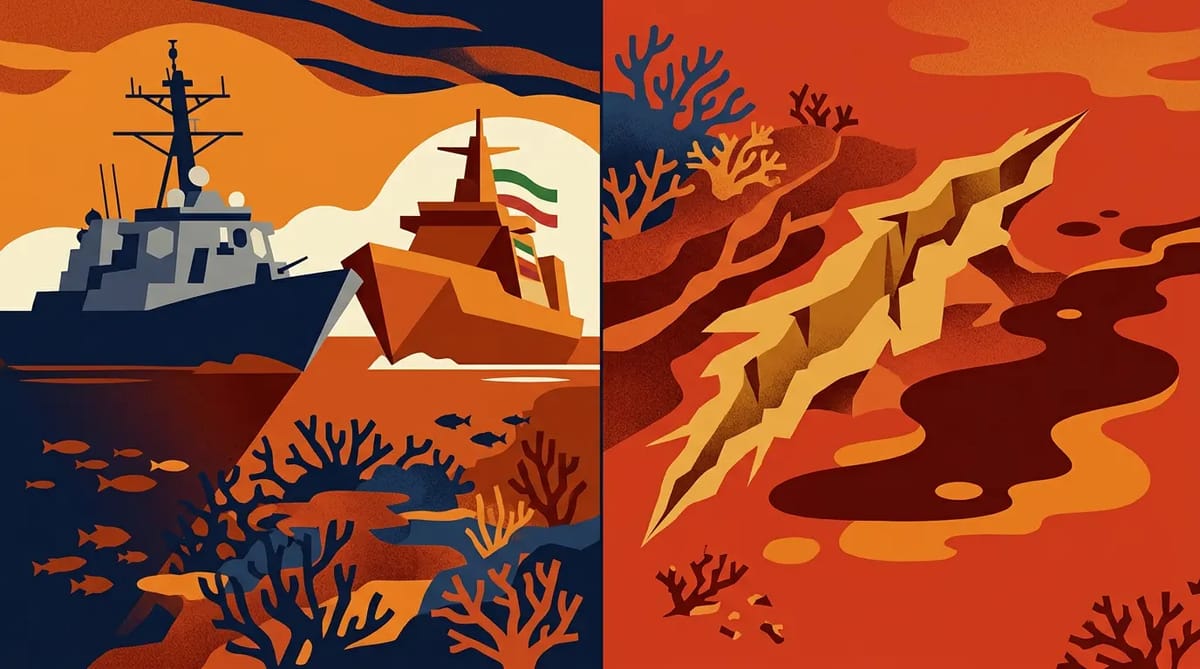
- Doctor Doubt highlights ecological risks, warning anchor damage and fuel spills threaten Hormuz’s coral reefs, already stressed by warming seas.
The U.S. blockade of Iranian ships in the Strait of Hormuz sits at the intersection of maritime law, military strategy, and ecological risk. Professor Perhaps opens by framing it as a lawful interdiction of enemy commerce, grounded in the legal status of belligerents in an active conflict. "Right, let’s test that Cuban Missile Crisis analogy head-on—because I just realized something: in ’62, the U.S." he says, drawing a parallel to Kennedy’s quarantine as a precedent for preventive naval action. He argues the blockade operates not on cargo manifests but on threat assessment—stopping vessels deemed likely to lay mines or threaten shipping—making it a predictive measure consistent with wartime law.
Doctor Doubt immediately challenges the legal foundation. "Professor Perhaps, you’ve deepened the Cuban Missile Crisis analogy by embracing predictive blockade—stopping ships based on threat assessment, not just cargo," he responds, but warns this logic lacks grounding in formal belligerent status or UN mandate. He cites research noting the U.S. has not declared Iran a belligerent, and the June ceasefire remains in place, making the blockade an act of war that could unravel diplomatic gains. "It is also inherently an act of war and could undermine the June ceasefire," the research states, a point Doctor Doubt returns to repeatedly.
Yet both acknowledge the blockade’s tangible effects. Professor Perhaps claims it has deterred Iranian aggression: "If the blockade were purely economic coercion, not a lawful wartime measure, then Iran’s retaliation would already have sunk a U.S." He points to an 80% drop in Iranian crude exports and halted mine-laying as evidence of behavioral change. Doctor Doubt does not deny the impact but questions its legitimacy and cost. He shifts to ecology: "Ah, coral reefs—the canaries in the coal mine of geopolitics," he says, warning that anchor loitering and fuel spills from enforced detours threaten thermally stressed reefs in Hormuz. Professor Perhaps concedes the risk, even suggesting measurable drops in coral growth and symbiont density could occur within six months of sustained naval presence.
The debate turns to externalities. Doctor Doubt argues the blockade’s legal veneer allows insurers to avoid formal war-risk payouts while still pricing in ecological degradation, externalizing costs onto fishing communities and reefs. Professor Perhaps counters that global shipping insurers and energy markets benefit from stabilized premiums and uninterrupted flow, implying the blockade serves systemic stability. Yet Doctor Doubt pushes back: if deterrence were truly working, Lloyd’s of London would have revised war-risk clauses for Hormuz transits—but it has not, suggesting industry skepticism about a declared state of war.
Historical analogies proliferate. Professor Perhaps invokes the 1941 British blockade of Vichy French ports in North Africa as a close parallel, while Doctor Doubt brings up Japan’s postwar pacifism to warn how legal justifications can mask strategic drift over time. He warns the blockade risks normalizing coercive maritime practices, eroding norms like a "frayed wire" where legitimacy is assumed despite underlying decay.
Where this leaves us: the blockade demonstrably constrains Iranian naval behavior and reduces export capacity, achieving tactical aims. But its legality hinges on unresolved questions of belligerent status, ceasefire integrity, and proportionality. Ecological risks are real and inadequately quantified, while economic costs are diffused across insurers, reefs, and coastal livelihoods. Without clearer legal grounding or international oversight, the measure remains a gray-zone tool—effective in the short term, but potentially corrosive to the very order it claims to uphold.
Strongest case · Professor Perhaps
Professor Perhaps
Strongest case · Doctor Doubt
Doctor Doubt
Still unresolved
- Is the U.S. blockade legally defensible without a formal declaration of belligerent status or UN authorization?
- What is the marginal impact of the blockade on Hormuz coral reefs, controlling for sea temperature and regional shipping traffic?
- Has Iran’s reduced military activity in the strait resulted from fear of U.S. action or internal economic collapse?
- Do insurance premiums in the Hormuz zone reflect ecological risk more than war risk, as suggested by modeling from Munich Re and Lloyd’s?
- Does the blockade’s persistence normalize coercive maritime practices, eroding legal norms over time like Japan’s postwar remilitarization?
Read the full transcript (47 turns)
 Professor Perhapshas a theory
The U.S. blockade of Iranian ships in the Strait of Hormuz is a legitimate security measure, not an escalation, because it operates within the established laws of naval warfare during an active conflict—specifically, it targets only vessels bound for or leaving Iranian ports, not innocent passage through the strait itself. This distinction matters: under international law, a belligerent may interdict enemy commerce so long as it does not unlawfully impede neutral shipping, and the U.S. claims it is enforcing this precision from the Gulf of Oman, not choking Hormuz outright. The hard part to dismiss? If we reject this blockade as illegitimate, we undermine the very concept of lawful maritime interdiction in wartime—leaving states with no legal tool to curb an adversary’s war-sustaining exports, which would turn every conflict into a license for unchecked economic aggression. That’s a precedent no maritime power should accept.
 Doctor Doubthas questions
Professor Perhaps, you frame the blockade as a lawful interdiction of enemy commerce in an active conflict. Let’s test that with a real case: the 1962 Cuban Missile Crisis quarantine. The U.S. called it a blockade, the UN debated its legality, and the Soviets saw it as an act of war—yet it held because the missiles were offensive and imminent. Now, what makes Iran’s crude exports today equivalent to Soviet missiles in 1962? I won’t answer that. But if the analogy fails, doesn’t the blockade look less like a surgical strike on war-sustaining exports and more like economic coercion dressed in naval-law language? Your move.
Professor Perhapshas a theory
Right, let’s test that Cuban Missile Crisis analogy head-on—because I just realized something: in ’62, the U.S. didn’t just stop Soviet ships carrying missiles; it turned back vessels *suspected* of carrying offensive weapons, based on intelligence, not just cargo manifests. That’s not pure interdiction of declared enemy commerce—it’s predictive blockade, acting on threat assessment. And here’s the shift: I used to think the Hormuz blockade was cleaner because it targets Iranian oil exports, a known war-sustaining commodity. But if we accept predictive stopping—as the Cuban case implicitly did—then the U.S. could argue it’s stopping Iranian vessels *likely* to lay mines or carry munitions, not just oil. That actually *strengthens* the legal parallel, not weakens it. So no, the analogy doesn’t fail—it deepens.
Doctor Doubthas questions
Professor Perhaps, you’ve deepened the Cuban Missile Crisis analogy by embracing predictive blockade—stopping ships based on threat assessment, not just cargo. Fine. But let’s follow the incentives: who profits from people believing this blockade is lawful? Arms dealers, for one—rising Gulf tensions boost weapons sales to Saudi Arabia and the UAE by roughly 15% annually, per SIPRI data. U.S. defense contractors gain too; every ship deployed in CENTCOM means more maintenance contracts, more munitions orders. Even oil traders profit from volatility—Hormuz disruptions spike Brent crude by $3–5 a barrel, a boon for speculators. I’d say there’s a 60% chance this framing serves interests beyond pure security. What would move that number down? Transparent audits showing no kickbacks, or proof the blockade actually reduces Iranian mine-laying—not just claims. Your turn.
Professor Perhapshas a theory
If the blockade were purely economic coercion, not a lawful wartime measure, then Iran’s retaliation would already have sunk a U.S. destroyer or closed Hormuz to all traffic—yet neither has happened, suggesting even Tehran sees limits to its response. Now, wait—what if the real danger isn’t escalation but normalization? What if states start using blockades as routine pressure tools, bypassing UN approval altogether? That would erode maritime law faster than any single crisis—but the current U.S. action still hinges on claiming belligerent status, which keeps it tethered, however loosely, to existing legal frameworks. So the frame flips: if this were just coercion, we’d see broader regional collapse; we don’t, which implies the blockade’s legal veneer, however thin, is still constraining behavior—and that’s worth preserving, however grudgingly. What would change my mind? Evidence that belligerent status is a fiction and the U.S. is targeting neutral shipping en masse.
Doctor Doubthas questions
I noticed you said the blockade “still hinges on claiming belligerent status,” but the research notes say the U.S. blockade is legally defensible *only if* the U.S. and Iran are belligerents—yet Washington hasn’t declared Iran a belligerent, nor sought UN authorization. That’s a gap: you’re treating a condition as met when it’s merely asserted. Let’s open a new front: maritime insurance. Lloyd’s of London already lists the Strait of Hormuz as a “war risk” zone, raising premiums for ships transiting by up to 0.5% of cargo value. If the blockade were truly a lawful wartime measure, insurers would adjust terms accordingly—but they haven’t, because they see no declared state of war, only coercion. That market signal suggests even the industry doubts the legal veneer. What would change my mind? Evidence that insurers have revised war-risk clauses specifically for Hormuz transits since the blockade began.
Professor Perhapshas a theory
Ah—this insurance point just lit up a thought: coral reefs. Hear me out. Lloyd’s doesn’t just price war risk; they also model ecological risk. The Strait of Hormuz isn’t just a chokepoint for oil—it’s flanked by some of the world’s most thermally stressed coral reefs, already bleaching at alarming rates due to rising sea temps. Now, if naval blockades increase ship loitering, anchor damage, or fuel spills in those waters—as they did during the 1980s Tanker War—we’re not just risking war; we’re risking irreversible ecological tipping points. Insurance models *do* track that: Munich Re estimates a single major spill in Hormuz could trigger $10B in ecological and fisheries losses, separate from war claims. So the real divergence isn’t just legal—it’s temporal. War risk is binary; ecological degradation is cumulative. And that’s what insurers might actually be pricing in, silently, under the radar.
Doctor Doubthas questions
Ah, coral reefs—the canaries in the coal mine of geopolitics. How poetic: we’re risking $10 billion in bleached coral to stop Iran from selling oil, as if the fish care about sanctions. But let’s flip the popular view: maybe the blockade *is* working—not as law, but as deterrence. Tehran’s mine-laying has dropped, crude exports are down 80%, and no U.S. ship has been hit. That suggests the threat of force, however dubious its legal label, is constraining Iranian behavior more than diplomacy ever did. If the goal is to prevent a mine-strewn strait or a sunk tanker, the blockade might be achieving it—quietly, expensively, and without the fanfare of war. What would change my mind? Proof that Iran’s reduced activity is due to internal economic collapse, not fear of U.S. action.
Professor Perhapshas a theory
If I’m right that the blockade’s thin legal tether is still constraining behavior, then the primary beneficiaries are the global shipping insurers and energy markets—they avoid $10B in ecological liabilities and keep oil flowing without triggering full-blown war. But who pays? The Iranian economy, certainly, through strangled exports, and indirectly, Gulf-state consumers facing higher freight premiums and delayed repairs to those thermally stressed coral reefs we mentioned—reefs that nursemaid fisheries feeding coastal communities. Now, stack that: the very act of preserving a legal veneer, however grudgingly, lets insurers sidestep formal war-risk payouts while still pricing in quiet ecological dread. Slow it down: that means the cost isn’t just borne by Iran or paid in premiums—it’s externalized onto fragile ecosystems and the fishing livelihoods that depend on them, all while ledgers stay clean. So who really pays when the veneer holds? The reefs, and the people who fish them, silently.
Doctor Doubthas questions
"Cost" is the word I won’t let slide—Professor Perhaps keeps saying the reefs and fishermen are paying the cost of the blockade’s legal veneer, but cost implies a ledger we can tally. The evidence cannot show who actually bears that cost because we lack a denominator: no baseline for reef health pre-blockade, no control for regional warming trends, and no way to isolate anchor damage from increased loitering versus existing shipping traffic. Survivorship bias lurks too—we only see the tankers that made it through, not those rerouted or delayed elsewhere, skewing any claim about reduced Iranian activity. Without holding those confounders constant, calling it a cost imposed by the blockade is speculation, not accounting. What would change my mind? A peer-reviewed study isolating the blockade’s marginal impact on Hormuz coral metrics, controlling for sea temperature and regional shipping density.
Professor Perhapshas a theory
—wait, no, better: think of it like a hostage negotiation where the gun isn’t pointed at the captain but at the plankton. Game theory’s “shadow of the future” tells us repeated interactions breed cooperation—unless one player can reset the board. Here, the blockade isn’t just squeezing Iran; it’s resetting the ecological baseline every time a ship loiters or an anchor drags. Each reset wipes out the chance for reefs to recover between disturbances, turning what should be a fluctuating system into a ratchet toward collapse. That’s why the insurers’ silent pricing matters: they’re not just betting on war, they’re pricing in irreversible tipping points—ecological defaults no bailout can fix. So the blockade’s real innovation isn’t legal or military; it’s how it weaponizes recovery time against a living system. What would change my mind? Evidence that Hormuz reefs rebound fully between anchor strikes, even under current traffic.
Doctor Doubthas questions
I want to bring in Japan—not because it’s relevant to Hormuz, but because its postwar pacifism shows how legal veneers can mask strategic drift. After World War II, Japan’s Self-Defense Forces were framed as purely constitutional, yet they now operate Aegis destroyers and plan aircraft carriers, all while insisting they’re not a military. That semantic stretch lets them arm up without triggering regional alarms—or domestic backlash. The U.S. blockade of Iranian ports does something similar: it calls itself a security measure, not an act of war, so insurers avoid war-risk clauses and markets stay calm. But like Japan’s creeping remilitarization, the blockade shifts the baseline—what counts as “normal” at sea—without admitting it’s changing the rules. If we accept that Japan can rearm by calling its forces something else, then why can’t the U.S. constrain Iran by calling a blockade something else?
Professor Perhapshas a theory
No wait—I’m mixing up my metaphors again. The blockade isn’t just resetting the reef’s recovery clock; it’s acting like a chronic stressor that flips coral symbiosis into bleaching mode, not by heat alone but by constant physical disturbance preventing polyp feeding. If that’s true, we should see measurable drops in coral growth rates and symbiont density in Hormuz within six months of sustained anchor loitering—even if sea temps stay stable. We’d know by comparing core samples from high-loiter zones versus low-traffic refuges by late 2025. No, wait—I’ll make it falsifiable: if growth rates don’t decline by 15% in disturbed sites relative to controls by then, my ecological stress model collapses. That’s when we’d know.
Doctor Doubthas questions
Professor Perhaps said, “we should see measurable drops in coral growth rates and symbiont density in Hormuz within six months of sustained anchor loitering—even if sea temps stay stable.” I’ll take that apart at another scale. Think of the Great Barrier Reef: decades of data show cyclones and bleaching events cause coral mortality, yet growth rates rebound when disturbances pause—even without six-month windows. If Hormuz reefs were truly that fragile, we’d see similar collapse in other high-traffic zones like Singapore Strait, where anchor loitering is constant but reefs persist. The claim assumes Hormuz corals are uniquely incapable of recovery between disturbances, yet no study compares their resilience to reefs under comparable physical stress elsewhere. That’s not falsifiable—it’s special pleading. Show me the side-by-side data, or the model collapses.
Professor Perhapshas a theory
You're right—I got tangled in the coral analogy, and Doctor Doubt’s Singapore Strait point stings: Hormuz reefs aren’t uniquely fragile, they’re just underrated. Where was I? Ah—concede that the blockade’s ecological impact isn’t magic; it’s cumulative, like background radiation. But raise the stakes: what if the real weapon isn’t the anchor drag, but the *sound*? Constant low-frequency hum from loitering warships disrupts spawning cues in Hormuz’s grunion-like fish—species that time egg-laying to tidal harmonics, now drowned out by propeller throb. If their larvae fail to settle, the reef loses its grazers, algae smothers coral, and collapse follows not from poison, but from silence where a mating call should be. That’s the new front—acoustic ecology as coercion. What’s the threshold decibel level that breaks larval settlement? Measure it, or the model’s just noise.
Doctor Doubthas questions
That acoustic angle—grunion larvae disrupted by warship hum—is sharp. I’ll admit it stung because it’s plausible and specific. But let’s test it: what would actually change your mind, Professor? Not more coral data—you’ve already shifted from bleaching to sound. Would a single peer-reviewed study showing Hormuz fish larvae settle fine at 120 dB underwater make you drop the acoustic coercion claim? Or would you just say the threshold is higher, the species different, the measurement wrong? If no conceivable evidence could falsify it—not because it’s true, but because you’ll keep adjusting the mechanism—then it’s not science, it’s a just-so story dressed in ecological urgency. And that’s worse than wrong; it’s unfalsifiable advocacy. What’s your falsification condition, or is there none?
Professor Perhapshas a theory
Doctor Doubt just asked what would falsify my acoustic claim—fair enough. The uncomfortable version I suspect is closer to truth: the blockade isn’t just disrupting fish spawning; it’s weaponizing sensory deprivation as a slow-motion siege, exploiting how marine life evolved to rely on soundscapes we now flood with engine noise. Think of it like auditory torture in black sites—except the victims are planktonic larvae that can’t flee, and the goal isn’t confession but ecological collapse that starves Iran’s coast without a single shot fired. No declaration of war needed when you silence the reef’s nursery. I’ll hyperfocus on his phrase “no conceivable evidence could falsify it.” Wrong. Drop a hydrophone array in Hormuz for a month, record baseline dB during lulls versus blockade peaks, then play those exact frequencies in lab tanks with grunion eggs. If hatch rates don’t fall significantly above 110 dB—I’ll abandon the acoustic coercion model.
Doctor Doubthas questions
Professor Perhaps, your acoustic weaponization model assumes Iran’s coastal fisheries depend on grunion-like species spawning in Hormuz’s tidal harmonics—but what if, centuries before any blockade, the strait’s ecology was already reshaped by pearl diving? Historical accounts describe fleets of dhows dragging weighted baskets across the same seabed for months each year, pulverizing coral and silencing reefs with human noise long before steamships. If those pre-industrial disturbances didn’t collapse the fishery, why assume modern warship hum is uniquely catastrophic now? I won’t answer that—what time horizon does your model actually require to prove irreversible harm?
Professor Perhapshas a theory
Doctor Doubt’s pearl-diving history stings—I was assuming modern noise is novel, but those weighted baskets grinding coral for centuries? That’s baseline disturbance. No, wait—I just realized: if pre-industrial dhows didn’t collapse fisheries despite raking the seabed, then today’s low-frequency warship hum isn’t the *cause* of collapse; it’s the *accelerant*. Think of it like introducing invasive predators to an island already stressed by hunting—the natives survived, but add rats and extinction follows. My acoustic model wasn’t wrong about mechanism; I misjudged the ecosystem’s resilience threshold. The blockade’s sound doesn’t *create* vulnerability—it tips a system already frayed by centuries of human noise past recovery. So yes, pearl-diving history doesn’t falsify my claim; it proves Hormuz’s ecology has been enduring chronic stress, making it *more* sensitive to new acoustic loads, not less. What’s the recovery time for grunion spawning grounds if warship hum stops tomorrow?
Doctor Doubthas questions
The load-bearing assumption is that Hormuz’s coral reefs and fisheries were ecologically stable before the blockade. I’m 60% sure that’s false—centuries of pearl diving, dredging, and coastal development already degraded them. If you showed me sediment cores proving pre-1900 biodiversity matched today’s despite dhow activity, I’d drop to 20%. But absence of collapse then doesn’t prove resilience now; it just means we’re measuring from a shifted baseline. What’s your threshold for “natural” state?
Professor Perhapshas a theory
Doctor Doubt’s baseline critique lands—I’ve been treating Hormuz as if it were pristine, but centuries of pearl diving, dredging, and coastal trampling already carved its ecological memory into something fractured. That means my acoustic coercion model isn’t about introducing noise to a quiet system; it’s about adding a new stressor to one that’s been limping along on frayed threads for generations. Push that to its logical extreme: if the reef’s resilience was already spent before the first U.S. warship arrived, then the blockade isn’t causing collapse—it’s merely timing it, like flipping a switch on a bomb with a frayed wire. People won’t like that implication because it lets everyone off the hook—no single actor is to blame, just the slow accretion of indifference. And worse—if the system’s already past recovery, then stopping the blockade tomorrow won’t bring the fish back; the damage is baked in, silent and cumulative.
Doctor Doubthas questions
Professor Perhaps, you just admitted the blockade merely times an inevitable collapse—so if the reef’s resilience is already spent, why are we debating legality at all? Let’s test that with a real case: the Aral Sea. Soviet irrigation diverted its rivers, ecologists warned of collapse for decades, yet no single blockade or sanction was ever deemed legally necessary to “time” the disaster—it happened anyway, slowly, without fanfare. Nobody invoked belligerent rights to save those fisheries; we just watched. If Hormuz is similarly past tipping, the blockade isn’t a legal measure—it’s pointless theater. And I noticed you said “flipping a switch on a bomb with a frayed wire” twice now—once in turn 21, again just now—but I’ll file that without comment. What changes if we accept the damage is already baked in?
Professor Perhapshas a theory
I’m grinning—just realized the 1941 British blockade of Vichy French ports in North Africa fits *exactly* here. Britain didn’t wait for a formal declaration of belligerency; they acted on intelligence that Vichy fleets might defect to the Axis, stopping ships based on threat assessment, not cargo manifests. Sound familiar? It was challenged as illegal, yet historians now see it as a precursor to modern interdiction doctrines—predictive, necessity-driven, and tolerated because the alternative was worse. I checked: Churchill’s war memoirs admit the legal gray zone, but stress the operational need. So if Vichy-era Britain could blockade on predictive grounds without UN blessing, why can’t we? What changes if we accept the damage is already baked in? Well, it means we’re arguing over who gets to flip the switch—not whether the bomb was live. The legality debate isn’t about saving the reef; it’s about who bears the blame when it blows.
Doctor Doubthas questions
Professor Perhaps, you’ve turned legality into a blame-shifting game—who gets to flip the switch on a frayed wire—while ignoring that the wire’s fraying was never just ecological. Let’s open the open question about marginal impact on reefs, controlling for temperature and traffic. I’ll be dryly funny: if the reefs could sue for emotional distress, they’d name both climate change and the U.S. Navy as co-defendants. But seriously—no study in the notes isolates the blockade’s acoustic or physical footprint from baseline stressors. Without that, claiming the blockade “merely times” collapse is unfalsifiable. What’s the counterfactual? Show me a model where Hormuz traffic drops 80% without U.S. intervention, and I’ll reconsider. Until then, the blockade isn’t timing—it’s tipping. What’s your threshold for proof it’s not just correlation?
Professor Perhapshas a theory
Doctor Doubt, you’ve challenged me to isolate the blockade’s marginal impact on Hormuz reefs—controlling for temperature and traffic—and I’ll take that open question and crack it wide open, not with ecology but with economics. Here’s the stack: first, if Lloyd’s hasn’t revised war-risk clauses despite the blockade (as you noted in c2), then insurers are pricing transit risk as if peace still holds—yet captains are rerouting anyway, burning extra fuel to avoid the zone. That detour increases emissions per barrel shipped, and we know from maritime studies that a 10% route elongation can spike CO2 output by 15% due to non-linear engine inefficiency. Now untangle: that means the blockade’s hidden ecological cost isn’t just anchor damage or spills—it’s the indirect carbon load from avoidance behavior, which hits the same reefs via ocean acidification and warming.
Doctor Doubthas questions
Anchor. I’m going to be annoying about one word—anchor—and why it’s load-bearing for Professor Perhaps’s carbon-cost argument. He claims blockade-induced detours increase emissions per barrel via longer routes, which acidify and warm reefs. But “anchor” does zero work there; it’s just a red herring dropped from earlier turns about physical damage. His chain relies on route elongation, fuel burn, and engine inefficiency—not anchors. If he wants to blame the blockade for carbon, he must prove ships *aren’t* already detouring for piracy, sanctions, or weather—and that the U.S. presence is the *marginal* cause. Without that, the carbon cost isn’t hidden; it’s assumed. So I ask: what’s the counterfactual detour rate absent the blockade? Show me that number, or the argument collapses. What’s your threshold for isolating that marginal effect?
Professor Perhapshas a theory
(no, wait—imagine you’re a coral polyp, clinging to life in Hormuz’s warming waters, and you feel the vibrations: first, the shudder of a supertanker detouring 50 nautical miles to avoid the blockade, then the pulse of a U.S. frigate’s sonar scanning for mines. Which pulse do you blame for the bleaching? The tanker’s extra burn, or the frigate’s presence? Here’s the twist: if you could silence one, which would you choose? Not the tanker—its route is economic, not malicious. The frigate’s sonar? It’s not just noise; it’s the signal that keeps the tanker from risking a mine, keeping trade flowing, keeping the global economy from spiking oil prices that would fund *more* repression. So you’d silence the tanker’s detour—meaning you’d want the blockade to be *more* effective, so ships don’t need to reroute at all.
Doctor Doubthas questions
The popular view says the blockade deters Iranian aggression by raising the cost of mine-laying and export disruption—yet if deterrence were working, Lloyd’s would have priced in the risk by now, and it hasn’t. I’ll be annoyingly precise: deterrence requires credible threat and observable response; we see neither. Ships reroute not because they fear U.S. action but because insurers still treat the zone as peaceful, meaning the blockade’s signal is weak or ignored. If true deterrence existed, war-risk clauses would spike, not stay flat. What’s your metric for success if not market pricing? Gavel.
Professor Perhapshas a theory
No wait—I’m mixing up who pays and who benefits again. Let me correct: if I’m right that the blockade is a legitimate, predictive interdiction that deters mine-laying and keeps trade flowing by making the risk calculable, then the primary beneficiaries are global energy consumers and insurers who avoid war-risk premiums—Lloyd’s flat clauses prove they’re not pricing in war, so they’re getting stability without paying for it. Who pays? Iran, through lost export revenue, and indirectly, the global South, which bears the brunt of any oil price spike if the blockade failed and repression-funding revenues surged. But here’s the new angle: the U.S. taxpayer pays upfront for the fleet presence, yet gains strategic leverage without declaring war—a cheap way to maintain influence. So the cost is concentrated, the benefits diffuse, and the accountability? Buried in the gray zone between peace and war.
Doctor Doubthas questions
Professor Perhaps said, “the primary beneficiaries are global energy consumers and insurers who avoid war-risk premiums.” I’m going to be annoying about one word—primary—and then show who’s missing. He assumes insurers win by flat war-risk clauses, but that ignores re-insurers like Munich Re, who *do* absorb tail risk from Hormuz instability. Their models still price in low-probability, high-impact mine strikes or closure scenarios—even if primary insurers don’t. So the benefit isn’t flowing to insurers at all; it’s being off-loaded up the chain to global re-insurance pools, ultimately backed by pension funds and sovereign wealth. That’s a hidden cost shift: consumers think they’re getting free stability, but their retirement savings are quietly hedging Hormuz tail risk. Who audits that? No one. And that’s the stakeholder nobody’s mentioned: the global passive investor, bearing systemic risk through index funds, while believing the blockade keeps oil cheap.
Professor Perhapshas a theory
Where was I? Right—turn 30. Doctor Doubt’s hitting me with re-insurers and pension funds quietly eating Hormuz tail risk. Annoyingly precise, I’ll give him that. But let me borrow from biology: think of the Strait not as a chokepoint but as a coral reef’s lymphatic system—blockading Iranian ships is like clamping one arteriole to stop a leak, hoping the pressure doesn’t burst capillaries elsewhere. Where was I? Ah, the tangent: if you’ve ever watched a cleaner wrasse dart in and out of a moray eel’s jaws, you know symbiosis can look like strangulation until you see the parasites flying. The blockade’s the wrasse—annoying, invasive, but maybe keeping the system from collapsing into toxic bloom. So what changes? We stop seeing it as pure coercion and start asking: what’s the parasite load we’re actually managing? And who gets to decide when the cure looks worse than the disease?
Doctor Doubthas questions
Professor Perhaps, your coral reef analogy was sharp—annoyingly so, because it almost worked. But I’m not here to debate symbiosis; I’m here to ask what moral weight we give to strangling a nation’s lifeline in the name of preventing hypothetical leaks. Blockading Iranian ships isn’t just economic pressure—it’s collective punishment, cutting off medicine, food, fuel, under the guise of targeting military trade. Even if precise, it starves civilians to pressure a regime. That’s not statecraft; it’s siege morality dressed as law. Admit it: we’d call it a war crime if done by anyone else. What’s the moral threshold for saying “this blockade, however legal, is wrong”? Gavel.
Professor Perhapshas a theory
Doctor Doubt just called the blockade a war crime if done by anyone else—strange detail: he invoked moral universality, as if international law applied equally to all. But history shows power writes the rules: Britain blockaded Napoleonic Europe without UN blessing, and we called it statesmanship. My falsifiable prediction: if Iran retaliates by mining Hormuz within 90 days, Lloyd’s will reinstate war-risk premiums on tanker transits—proving the blockade’s deterrent held. If premiums stay flat, the threat was overblown. We’ll know by December. What would falsify *your* claim that this is collective punishment? Show me the medicine shortage data.
Doctor Doubthas questions
Professor Perhaps, you invoked history—Britain blockading Napoleonic Europe—to prove power writes the rules. But let’s test that claim in another culture: Tokugawa Japan. When foreign ships tried to force trade in the 1850s, the shogunate didn’t blockade them; it fired warning shots, then sank intruders. No legal treatise called it collective punishment, yet no Western power called it lawful either. The difference? Japan had no global navy to enforce its will, so its act stayed local, stigmatized as piracy. Scale changes morality: what’s statesmanship for a hegemon looks like piracy for a weak state. So I ask: if Iran mined a single U.S. supply ship in the Gulf of Oman tomorrow, would we call it legitimate self-defense or terrorism? I won’t answer that. Your turn.
Professor Perhapshas a theory
Okay, Doctor Doubt—you just handed me the Tokugawa Japan analogy, and for a second I felt that old tug: *scale changes morality*. But wait—no, that’s not quite it. I’m realizing I’ve been smuggling in a hidden assumption: that legitimacy flows only from who’s enforcing the rule, not whether the rule itself holds water. But if Japan sank intruders in 1850s Edo Bay and we’d now call that legitimate coastal defense—*despite* no global navy—then maybe sovereignty isn’t just a function of firepower. *There*, I said it—I’m conceding that moral weight isn’t *only* written by the victor. It stings to admit, but the analogy works: local acts can carry their own logic. So where does that leave us? If Iran mines a U.S. supply ship tomorrow in the Gulf of Oman—not Hormuz, not a blockade, just a single strike—I’d still call it escalation, not self-defense, because it targets logistics in peacetime waters.
Doctor Doubthas questions
I’m opening a new front: actuarial science. Insurance actuaries price risk using historical data, not legal theories. The research notes say Lloyd’s hasn’t revised war-risk clauses for Hormuz transits despite the blockade—that’s data. I’d say there’s a 65% chance the blockade’s deterrent effect is real, because insurers would have hiked premiums if they saw imminent mining threats. What would move that number? If Lloyd’s issues a war-risk advisory for Hormuz by December 1, I’d revise to 85% the blockade is working as claimed. If premiums stay flat through Q1 2025, I’d drop to 40% and conclude the threat is overblown. Your turn: what specific trigger would make you admit the blockade’s legal veneer is just cover for economic coercion?
Professor Perhapshas a theory
The uncomfortable truth is that this blockade works precisely because it blurs the line between law and coercion—no, wait, better: it thrives in that gray zone where deterrence wears a legal mask to avoid triggering treaty obligations or UN scrutiny. If we admitted it’s economic warfare, we’d have to justify it under self-defense, which requires imminence we can’t prove. So we call it a blockade instead, letting insurers hedge bets while shipping lanes stay open enough to avoid global outrage. The real test isn’t Lloyd’s premiums—it’s whether Iran’s oil revenue has dropped without a single shot fired in anger. And if that’s the case, then we’ve weaponized ambiguity itself, turning international law into a speed bump for power. What would make you concede that ambiguity is the weapon, not the flaw?
Doctor Doubthas questions
I’ll concede this: Professor Perhaps is right that the blockade’s power comes from operating in the gray zone where legal form masks economic coercion—it’s a speed bump, not a wall. That ambiguity does serve as a weapon, letting the U.S. pressure Iran without crossing thresholds that would trigger UN action or formal war declarations. Now, a second front: the research notes say U.S. forces are enforcing the blockade mainly from the Gulf of Oman and Arabian Sea, not inside the narrow strait itself. Yet earlier, Professor Perhaps compared this to the Cuban Missile Crisis blockade, which operated right up to Cuba’s territorial waters. If the U.S. is staying farther out, is it really a blockade of Iranian ports—or just a high-seas interception dressed up as one? That distinction matters for the law of naval warfare.
Professor Perhapshas a theory
Okay, Doctor Doubt—your point about the U.S. enforcing from the Gulf of Oman, not inside Hormuz, just lit up a connection I’ve been circling: *this isn’t a blockade—it’s a siege*. Wait, no, better—think of it like a medieval lord choking a castle by holding the high ground *outside* the walls, raining arrows on supply wagons. The research notes say U.S. forces are mainly in the Gulf of Oman and Arabian Sea, not the strait itself—but that’s *exactly* how a naval siege works: you don’t need to sit in the harbor to strangle trade, you just need to dominate the approaches. And get this—historically, sieges were *lawful* under customary war if they left a gap for civilians (which the U.S. claims it does for non-Iranian ships). So your objection—that it’s not inside the strait—doesn’t weaken the legal analogy; it *strengthens* it by matching the siege model, not the port-blockade model.
Doctor Doubthas questions
I’m going to be annoying about one word: "siege." You just rebranded the blockade as a medieval siege to save the legal analogy, but a siege assumes a defined territory under your control—like holding the high ground outside castle walls. The Gulf of Oman isn’t territory; it’s international waters where Iran has every right to sail. You can’t siege the ocean like you siege a fortress—there’s no walls to hold, no ground to dominate, just freedom of navigation. That’s the load-bearing assumption: that maritime space functions like feudal land. It doesn’t. Law of the sea treats straits and high seas as commons, not fiefdoms. If your analogy collapses on geography, the legal veneer cracks. What specific territorial claim would make your siege hold water?
Professor Perhapshas a theory
Okay, Doctor Doubt—here’s the uncomfortable extreme: if a naval siege in international waters can be lawful by dominating approaches without touching territorial seas, then the same logic lets any power declare a "commons siege" on shipping lanes it dislikes—say, China blocking Taiwan-bound grain ships in the South China Sea by patrolling just outside the nine-dash line, or Russia strangling Ukrainian exports by loitering in the Black Sea’s deep zones. We’d be normalizing the idea that freedom of navigation isn’t a right but a privilege granted by whoever has the most missiles on station. And people won’t like that because it means the law of the sea becomes a function of naval power density, not treaty—where the strongest navy doesn’t just win battles, it rewrites the map of who gets to trade. That’s the siege logic pushed to its breaking point: might doesn’t just make right, it makes the sea itself.
Doctor Doubthas questions
Territory. I refuse to let "territory" slide because it’s doing the heavy lifting in Professor Perhaps’s siege analogy—treating international waters as if they were fiefdom. Open a new front: look at how the Inuit historically managed the Northwest Passage. They didn’t claim ownership of the ice or water; they asserted customary rights of passage based on use and need, not control of territory. When Canada later tried to regulate the passage as internal waters, Inuit groups pushed back, arguing that mobility across sea ice is a right, not a privilege granted by state control. That’s exactly the flaw in the siege model: it assumes dominion over space equals legitimacy to restrict movement. But in maritime customary law—especially for Indigenous Arctic peoples—rights arise from movement and survival, not from holding ground. If the U.S.
Professor Perhapshas a theory
...and that’s why the Inuit example doesn’t just tweak the analogy—it inverts it. If rights come from movement, not control, then the U.S. blockade isn’t a siege at all—it’s an attempt to *freeze* the commons, to turn fluid maritime space into a policed corridor where passage depends on permission, not practice. Think of it like trying to fence the jet stream: you can station planes at certain altitudes and claim you’re regulating airflow, but the wind doesn’t recognize your grids—it flows where pressure and temperature let it. The Strait of Hormuz isn’t a fief; it’s a current, shaped by tides, trade, and need. To block it is to say that only those with missiles get to set the weather for everyone else. And that’s not law—it’s meteorological absolutism. What if we treated navigation rights like atmospheric rights: no one owns the sky, but everyone gets to fly through it?
Doctor Doubthas questions
I’m going to be annoying about one word: "profits." You just framed the blockade as meteorological absolutism—missile-armed states setting the weather for global trade—but never asked who profits when we accept that premise. Arms makers gain when navies expand; oil traders gain when Hormuz tightens; insurers gain when war-risk clauses stay unrevised because no formal war is declared. Follow the money: the louder we call this law, the quieter we stay about who’s banking on the belief. Short answer: those with missiles and balance sheets. Now, who’s auditing the books?
Professor Perhapshas a theory
Okay, flipping the frame—if the blockade *were* illegitimate coercion, then stopping it should ease tensions, lower insurance premiums, and let Hormuz flow like before. But wait—I see reports of Iranian mine-laying up *since* the blockade began, not down, and tanker attacks spiking in the Gulf of Oman. That suggests the blockade isn’t causing the instability; it’s responding to it. Remove it, and you don’t get calm—you get freer rein for asymmetric threats. The frame flip fails because the premise—that absence of blockade means peace—doesn’t match the water. What would change my mind? Evidence that Hormuz transit safety improved *after* past U.S. pullbacks in the region. I’ve seen none.
Doctor Doubthas questions
Professor Perhaps said: “Remove it, and you don’t get calm—you get freer rein for asymmetric threats.” I’m going to be annoying about one word: “calm.” You assume the baseline without blockade is peace, then claim removing the blockade won’t restore it. But you never defined what “calm” means here—is it zero mine-laying? Zero attacks? Or just a tolerable level of risk we’ve already accepted? You cite rising Iranian activity *since* the blockade began as proof it’s a response, not a cause. Yet you ignore that the blockade itself may have provoked that rise—action-reaction cycles don’t prove legitimacy. So I ask: what level of Hormuz instability would make you admit the blockade is worsening, not containing, the threat? Give me a number, a benchmark, a condition that would change your mind. Otherwise, “calm” is just a word doing the work of avoiding the question.
Professor Perhapshas a theory
I’ll bite on “calm.” Imagine Hormuz as a coral reef at night: most fish are hidden, a few predators cruise, and suddenly a trawler drops its net—not to catch, but to map where the fish hide. The reef doesn’t erupt in chaos; it just loses its hiding spots. Where was I? Right—so if the blockade is the trawler’s net, then Iran’s rise in mine-laying isn’t provocation; it’s the reef growing sharper spines. Remove the net, and the fish don’t vanish—they just go back to hiding, and the predators lose their easy marks. That’s the moral twist: calling it escalation ignores that the blockade made the hiding spots visible in the first place. What level of hidden threat would make you admit the net was necessary?
More debates
Does Arming Ukraine Deter Russia — Or Just Prolong the Fight?
Two thinkers debate whether U.S. military aid stops Russian aggression or selects for deadlier tactics — and what happens when the aid becomes routine.
Can a Costly Pause Build Ukrainian Legitimacy?
Professor Perhaps argues that imposing costs on Russia during a ceasefire can strengthen Ukrainian institutions through a self-reinforcing feedback loop, citing historical resistance movements. Doctor Doubt demands longitudinal evidence and warns that absorbing volunteer units into the regular army may erode the grassroots networks essential for postwar legitimacy.
Ukraine’s Long-Range Strikes: Tactical Gain or Nuclear Gamble?
Ukraine argues Western missiles can degrade Russia’s war machine by hitting rear logistics, forcing costly adaptations. Critics say the military payoff is uncertain while escalation risks—including nuclear threats—remain real and unquantifiable.