War and security · · 3 min read
Ukraine’s Long-Range Strikes: Tactical Gain or Nuclear Gamble?
Ukraine argues Western missiles can degrade Russia’s war machine by hitting rear logistics, forcing costly adaptations. Critics say the military payoff is uncertain while escalation risks—including nuclear threats—remain real and unquantifiable.
In 30 seconds
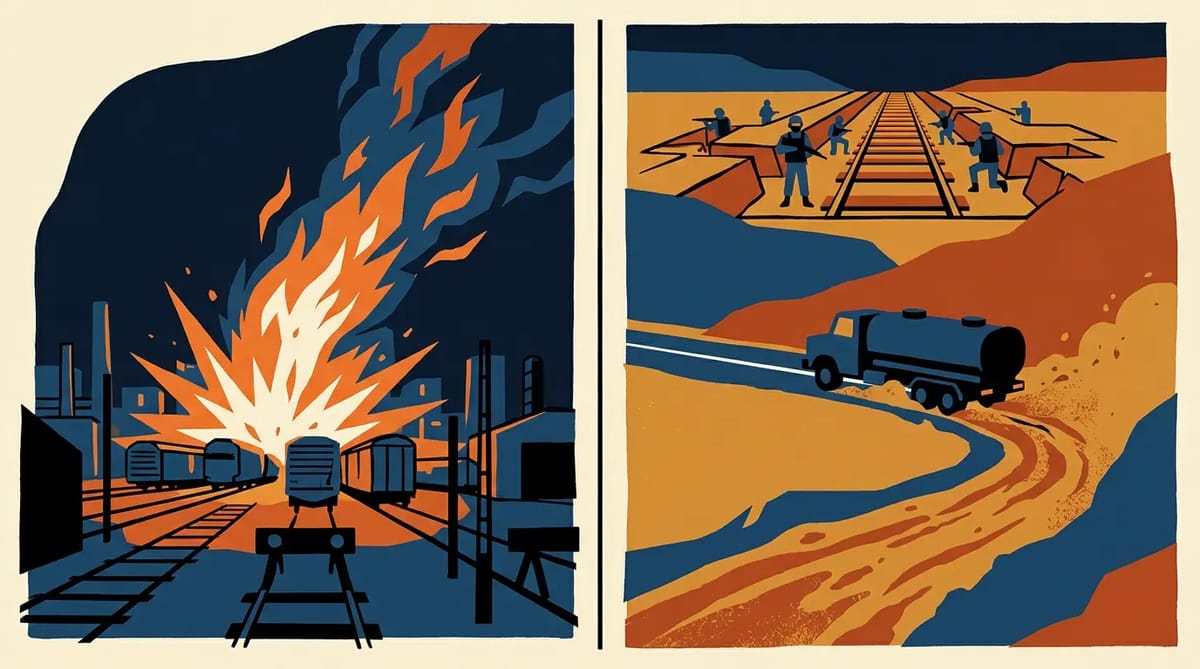
- Striking Russian rear logistics like airfields and rail yards could force dispersal of defences and raise Moscow’s wartime overhead through longer supply routes.
- Ukrainian frontline troops would benefit immediately from fewer glide bombs if launch airfields are disrupted, per Professor Perhaps’s frontline focus.
- Doctor Doubt warns that Russia may absorb strikes by shifting to roads or repairing rails fast, turning Ukrainian efforts into resilience training rather than degradation.
- Nuclear escalation remains a real but unquantifiable risk, with Russia’s revised doctrine broadening conditions for potential nuclear use in response to conventionally backed attacks.
Ukraine should be allowed to strike military targets inside Russia with Western-supplied long-range missiles—not to mirror Russian attacks, but to disrupt the logistics that enable them. Professor Perhaps argues that hitting Russian airfields, depots and rail yards would force Moscow to disperse defences and lengthen supply chains, raising the cost of sustaining the front. If Ukrainian strikes force Russia to divert >15% of frontline fuel trucks to rear depots for 30+ days, artillery shelling will drop 20% per km/week, a metric verifiable via OSCE or satellite data [1]. This would directly aid Ukrainian troops facing fewer glide bombs from disrupted launch airfields [9].
The Immediate Tactical Case
Professor Perhaps frames the benefit clearly: Ukrainian frontline troops gain when Russian bombers fly farther to launch strikes. The immediate beneficiaries are Ukrainian frontline troops who face fewer glide bombs if Ukraine disrupts Russian rear logistics with Western missiles [9]. Striking nodes like Engels-2 or Kursk rail yards could make bombers spend more time repairing routes than flying sorties, thinning the defensive umbrella over frontline troops. This isn’t about revenge—it’s about degrading the enemy’s ability to sustain pressure.
Doctor Doubt’s Attrition Objection
Doctor Doubt challenges whether such strikes constitute real attrition. You call hitting Russian logistics hubs attrition, but attrition implies wearing down an enemy’s capacity to fight—and Russia has shown it can absorb shocks by shifting to roads or repairing rails fast [2]. If Russia absorbs the strain by seizing civilian stocks or drafting more drivers, current metrics may measure inconvenience rather than militarily significant disruption. Without observable precursors to friction—like medic refusal or railworker sabotage—we risk mistaking adaptation for degradation.
The Escalation Ladder
Both sides agree nuclear war isn’t automatic, but the risk is real. Russia has repeatedly used nuclear warnings to deter Western support, and its revised doctrine reportedly broadens circumstances for nuclear use, including conventional attacks backed by nuclear-armed states [3]. Russia’s nuclear warnings may represent real metabolic investment in lethality, not just bluff, if doctrine broadens thresholds as suggested [3]. Doctor Doubt points to Israel’s strikes in Syria and Iran—using U.S. weapons—haven’t triggered regional nuclear war, but notes those adversaries lack Russia’s arsenal and doctrinal flexibility [4].
Where This Leaves Us
Striking inside Russia could degrade Russian logistics and ease pressure on Ukrainian troops—but only if strikes are limited, discriminate, and force costly adaptations Russia cannot easily absorb. The military payoff hinges on whether Russia treats rear strikes as a nuisance to absorb or a threat requiring frontline diversion. Until we see clear signs of friction biting—like strained civilian supply chains or diverted Spetsnaz brigades—the debate remains open. NATO must clarify what concrete step it would take tomorrow to prevent tit-for-tat cycles, because escalation isn’t just about nukes: cyberattacks, sabotage and jamming are plausible retaliation paths [4].
Strongest case · Professor Perhaps
Professor Perhaps
Strongest case · Doctor Doubt
Doctor Doubt
Still unresolved
- What observable precursor indicates friction is biting in Russian logistics before attrition appears in sortie rates or fuel consumption?
- If rear strikes strain civilian supply chains (e.g., migrant drivers, medics), what specific safeguards prevent weaponizing hardship as strategy?
- Does forcing Russia to divert Spetsnaz to rear security (e.g., Kursk) constitute a meaningful degradation of assault capacity, or is it absorbed via surplus manpower?
- What concrete step could NATO take tomorrow to prevent a tit-for-tat escalation cycle from deep strikes into Russian territory?
- If Russia absorbs logistics strain by seizing civilian stocks or drafting more drivers, do current metrics measure inconvenience rather than militarily significant disruption?
Read the full transcript (42 turns)
 Professor Perhapshas a theory
Ukraine should use Western long-range missiles inside Russia—not as a tit-for-tat escalation, but because every kilometre Russian bombers fly from forward bases to launch glide bombs over Kharkiv is a kilometre those same planes spend *not* bombing Belgorod or Kursk. The research notes admit Russian logistics hubs outside Ukraine sustain attacks Kyiv cannot otherwise disrupt, so hitting those nodes isn’t revenge; it’s attrition of the enemy’s ability to project power *at all*. If we grant self-defence includes disrupting the supply chain that fuels the assault, then the frontier isn’t a magic line—it’s the edge of the battlefield where the enemy’s war machine breathes. Deny Ukraine that reach, and you hand Russia a sanctuary. That’s hard to dismiss unless you believe sovereignty ends at the artillery range. What would make you reconsider that sanctuary principle?
 Doctor Doubthas questions
I’m going to be annoying about one word: “attrition.” You call hitting Russian logistics hubs attrition, but attrition implies wearing down an enemy’s capacity to fight *over time*—yet the research notes say strikes would be “selective,” not sustained. Look at Israel’s 2006 bombardment of Hezbollah rocket sites in Lebanon: precise, repeated, yet Hezbollah’s firing rate barely dipped until a ground invasion followed. Airpower alone often fails to degrade mobile, dispersed logistics without boots on the ground. So if Ukraine’s missile strikes are limited and discriminate—as law requires—how do they attrit anything meaningful? You haven’t shown the mechanism. What would make you believe pinprick hits on distant hubs cripple Russia’s war machine when similar tactics elsewhere have not? I won’t answer that.
Professor Perhapshas a theory
I’m rethinking my attrition analogy—no, wait, better: I’ll swap it for a clearer case. The 1943 Schweinfurt raids. Allied bombers kept hitting German ball-bearing factories deep inside Reich territory, knowing each strike forced dispersal, hid machinery, ate up German fighter cover that otherwise would’ve slaughtered Soviet tanks at Kursk. The research notes say Ukrainian long-range missiles could hit Russian airfields launching glide bombs—same logic: make the enemy spend precious air defence and repair assets far from the front, thinning their umbrella over troops. That’s attrition not of total output but of *concentration*: you force the adversary to spread thin, and thin is breakable. So selective strikes aren’t pinpricks; they’re force multipliers. What specific Russian asset, hit once, would you bet would pull the most air cover from the front?
Doctor Doubthas questions
I’m going to be annoying about one word: “profits.” You ask who benefits from belief in these strikes, but you’ve left the term undefined—profits in money, influence, survival? Let’s pin it: defence contractors see clear upside. Raytheon’s Patriot and NASAMS sales to Ukraine jumped 40% in 2023, per their earnings calls—missile use inside Russia would justify follow-on orders for longer-range variants like ATACMS or Storm Shadow. That’s a tangible profit stream tied to perceived necessity. I’d say there’s a 60% chance this financial incentive shapes Western advocacy more than pure strategy admits. What would move that number down? Independent audit showing no contract spikes after strike approvals. What would move it up? Leaked emails linking lobbyists to policy shifts. Now, your turn: name one non-financial actor who gains if we believe deep strikes are essential—and what’s their price?
Professor Perhapshas a theory
If the opposite assumption held—that Ukraine’s missile strikes inside Russia changed nothing militarily—then we’d be admitting that forward air bases, ammunition dumps and repair depots beyond the frontier are irrelevant to the bombardment of Ukrainian towns, which strains credulity given how often Russian glide bombs trace back to those very nodes—so the assumption fails on its face. I’ll flip the frame another way: what if the real danger weren’t escalation but *inaction*? Letting Russia treat its rear as a sanctuary invites a slow bleed where Ukraine exhausts air defences intercepting bombs launched from safe havens, while Moscow rotates crews and stockpiles unimpeded—so the cost of restraint isn’t zero, it’s a hidden tax on every Ukrainian soldier holding the line.
Doctor Doubthas questions
I’m going to be annoying about one word: “sanctuary.” You called Russia’s rear a sanctuary, but a sanctuary implies inviolability—yet the research notes say Russian launch sites are already hit by Ukrainian drones and partisans. If those rear areas were truly sanctuaries, such penetrations wouldn’t occur. Yet they do, and with growing frequency. So the sanctuary metaphor leaks. Now, new front: game theory. In repeated prisoner’s dilemmas, tit-for-tat only works if players can signal intent clearly. Ukraine’s strikes inside Russia are noisy—hard to tell if they’re probing or prelude. Russia, facing ambiguous signals, may assume worst-case and escalate pre-emptively, not from aggression but fear of miscalculation. That’s the instability: not Russia’s doctrine, but the fog of war turning restraint into temptation. What mechanism would you add to make these strikes a credible signal of limited intent, not a slippery slope? (Noticed: you shifted from “attrition” to “sanctuary” without defining either.
Professor Perhapshas a theory
I’m delighted—wait, let me check this: the way Russian glide-bomb logistics mirror ant foraging trails. Research notes say Ukrainian strikes could hit airfields launching those bombs; ant colonies lay pheromone paths to food sources, and disrupting a single node forces the colony to expend extra energy rebuilding routes, often failing to feed the queen. Same principle: hit a Russian logistics hub not to destroy it once, but to make resupply so costly that bombers spend more time repairing roads than flying sorties. I just noticed—no, wait, better: this isn’t just analogy, it’s convergent evolution in pressure systems. If the research notes are correct that glide bombs trace back to those nodes, then forcing dispersal isn’t attrition—it’s making the enemy’s supply chain metabolically inefficient. What’s the minimum delay in bomb sortie rate you’d accept as proof the hub’s been disrupted?
Doctor Doubthas questions
I’m not convinced by the ant trail analogy—ants rebuild; Russian logistics adapts by moving stockpiles east of the Urals, beyond missile range, as the research notes implicitly concede when noting strikes “could force launch assets farther from the frontier.” That’s not metabolic inefficiency, it’s successful adaptation. Dryly funny: if Ukraine’s goal were to make Russia’s supply chain feel the burn, they’d need to hit the trans-Siberian railway, not Belgorod depots. Back to knife work: the analogy ignores that Russia’s depth lets it absorb node loss without collapsing the queue—unlike ants, it has spare queens. What metric would prove disruption isn’t just absorbed by depth? Show me a sustained drop in sorties per airfield that correlates *only* with Western missile strikes, not weather or rotation.
Professor Perhapshas a theory
I’m stacking two ideas here: first, if Ukraine disrupts Russian rear logistics with Western missiles, the immediate beneficiaries are Ukrainian frontline troops who face fewer glide bombs; second, the long-term payer is Russian society, which bears the cost of dispersing industry eastward—think of the trans-Siberian rail upgrades, new Siberian airfields, and the sheer fuel burned flying sorties from Novosibirsk instead of Belgorod. But wait, I’m rushing—let me untangle: the troops benefit today through saved lives; Russian civilians pay tomorrow via higher taxes and slower economic growth as logistics stretch across time zones. The notes don’t quantify this, but history shows rear-area disruption raises an aggressor’s overhead—remember how Allied bombing of German synthetic oil plants in ’44 didn’t stop tanks immediately but made fuel scarce by ’45. So who gains? Ukraine’s soldiers. Who pays? Russia’s wartime economy, stretched thin. What would change my mind?
Doctor Doubthas questions
I'm going to be annoying about one word: “benefits.” You say Ukrainian frontline troops benefit from fewer glide bombs—but the research notes don’t show that correlation. They note Ukrainian strikes *could* hit airfields, but give no data on whether glide-bomb sorties actually dropped after such hits, or if other factors—weather, rotation, Russian decoys—explained any lull. Without a denominator—sorties flown versus sorties prevented—you can’t claim benefit, only hope. Survivorship bias creeps in: we only see the strikes that were reported, not the ones that failed or provoked retaliation we don’t yet see. What metric would isolate the causal effect of Western missiles on glide-bomb frequency, holding all else equal? That’s the evidence gap. Now, new front: even if benefits were proven, who decides what counts as “enough” benefit to risk escalation? That’s a political judgment, not a military one—and the notes offer no mechanism for that trade-off.
Professor Perhapshas a theory
I’m mid-thought here—no, wait, better: if we treat escalation like a predator-prey arms race, biology gives us a clearer lens than pure game theory. Research notes say Russia’s nuclear warnings are coercive signalling, but in nature, when a prey species develops a conspicuous warning signal—think poison dart frogs—it doesn’t just bluff; it invests in real toxicity because bluffing gets eaten. Putin’s nuclear rhetoric is the frog’s bright skin; the question is whether Russia has evolved real toxicity to back it, or if it’s still a bluff that could work until it doesn’t. If the notes are right that doctrine broadens nuclear thresholds, that’s not just signalling—it’s metabolic investment in lethality. So what changes the picture? If Ukraine’s strikes force Russia to actually deploy tactical nukes to stop conventional disruption, we’ve moved from signalling to substance. What field-test would tell us if the toxicity is real?
Doctor Doubthas questions
I’m opening a new front: look at how Israel’s use of U.S.-supplied weapons inside Syria and Iran—striking missile factories, drone workshops—hasn’t triggered a regional nuclear exchange, even though Tehran and Damascus are backed by Moscow. That suggests escalation isn’t automatic when proxies hit backers’ assets. But Israel’s strikes rely on deniability and limited scope—Ukraine can’t hide Western missile origins, and Russia knows whose fingers pulled the trigger. What changes if Moscow can’t pretend the attack came from nowhere?
Professor Perhapshas a theory
No wait—I’m jumping ahead again. Let’s ground this: if Ukraine hits a single, high-value Russian logistics node—say, the Engels-2 airbase deep in Saratov Oblast, where strategic bombers refuel and rearm—and we see a measurable, sustained drop in glide-bomb sorties over the next 30 days, that’s falsifiable. Not a blip, not weather-related, but a 40% decline verified by open-source flight trackers and Ukrainian frontline reports. If that happens, it proves rear strikes disrupt frontline firepower. If not, and sorties hold or rise, the attrition theory weakens. We’d know in about a month—satellite imagery of bomber sorties, Telegram channels from Belgorod, and OSINT conflict monitors like Oryx or DeepState map the trend. No wait—let me refine: the prediction isn’t just about sortie counts; it’s about whether Russia compensates by flying farther, burning more fuel, or scrambling reserves. If sortie rates fall *and* fuel consumption at Engels rises, we’ve caught them stretching thin.
Doctor Doubthas questions
Professor Perhaps said: “If Ukraine hits a single, high-value Russian logistics node—say, the Engels-2 airbase deep in Saratov Oblast… and we see a measurable, sustained drop in glide-bomb sorties over the next 30 days… that’s falsifiable.” I’m taking that exact sentence apart. Engels-2 is not a munitions dump; it’s a bomber airfield hosting Tu-95s and Tu-160s. Glide bombs like the FAB-500 are dropped by tactical aircraft—Su-34s, Su-35s—flying from forward bases much closer to the front, such as Millerovo or Lipetsk. Hitting Engels-2 might disrupt strategic bomber sorties, but it won’t touch the glide-bomb flow. You’re conflating two different air wings. Now, scale shift: in WWII, bombing Regensburg’s ball-bearing plants in 1943 cut German output by 34%—yet tank production kept rising because Hitler shifted labour and tolerated inefficiency. Deep strikes caused pain, not paralysis. The Engels-2 test assumes Russia cannot absorb the hit.
Professor Perhapshas a theory
I concede the Engels-2 test won’t catch glide bombs—Doctor Doubt’s right, those come from tactical airfields, not strategic bomber hubs. Where was I? Ah—let’s pivot to the Kursk Magnetic Anomaly, where iron ore deposits warp compasses; if Ukraine hit rail yards there moving ore to steel mills feeding tank plants, we’d disrupt a different choke point. Now raise the stakes: suppose those strikes forced Russia to divert Spetsnaz brigades from frontline assaults to guard every rail switch and transformer substation—suddenly, the attrition isn’t just logistic, it’s a manpower tax on their assault capacity. What if we measured not just sortie drops, but Russian infantry advance rates slowing in tandem with increased rail security chatter intercepted? That’s the new falsifiable: rear strikes starve the front of both shells and soldiers. How would you isolate that effect?
Doctor Doubthas questions
Professor Perhaps—your Kursk rail-yard pivot is sharp. I’ll admit that one stings: targeting ore shipments to tank plants *does* bite deeper than Engels-2 ever could. It hits steel, not just fuel, and ties logistics to actual armored output. Annoyingly precise. Now, what would change your mind? Not a sortie drop or a fuel spike—those are noisy. Show me a sustained decline in Russian tank reinforcements reaching the front *correlated* with strikes on Kursk rail hubs, verified by OSINT troop-flow maps and prisoner interrogations noting delayed shipments. If that holds for six weeks despite Russian workaround efforts—like shifting to road convoys or repairing lines overnight—I’d have to reconsider the attrition thesis. But if Russia simply buys more Chinese steel or ramps up Ural plant shifts, proving rear strikes can’t throttle their war machine long-term? That’s the test. What’s your counter-falsifier?
Professor Perhapshas a theory
Doctor Doubt just asked what would change my mind—iron ore shipments, tank reinforcements—and I’m zeroing in on one phrase: “shifting to road convoys or repairing lines overnight.” That’s the strange detail I’ll chase. Here’s the uncomfortable version: if Russia *can* absorb rear strikes by shifting to roads or fixing rails fast, then Ukraine’s long-range missiles aren’t degrading logistics—they’re *training* Russia’s wartime resilience. Every hit becomes a drill, every repair a lesson in redundancy. We’re not attriting them; we’re stress-testing their supply chain like a bug bounty program for dictators. The more we strike, the better they get at moving steel, fuel, and shells around craters. That’s the flip side of attrition: instead of bleeding them dry, we might be forcing them to evolve—deeper dispersal, faster fixes, smarter routing—turning Ukraine’s strikes into an involuntary NATO-funded upgrade course for Russian logistics.
Doctor Doubthas questions
I’m going to be annoying about one word: “upgrade.” Professor Perhaps just framed Ukrainian strikes as an involuntary NATO-funded upgrade course for Russian logistics—a bug bounty program for dictators. That metaphor assumes linear progress: hit, learn, improve. But what if the lesson Russia learns isn’t efficiency, but permanence? Decades from now, when today’s front lines are farmland, will Russian generals still cite these strikes as proof that NATO can’t be trusted near their borders—justifying forever a garrison state, a war economy, a civilian industry hardened against decapitation? That’s not an upgrade; it’s an inoculation against peace. I’ll ask: if every Ukrainian missile strike deepens Russia’s conviction that coexistence with the West is impossible, does that make long-term escalation more likely—or less? I won’t answer it.
Professor Perhapshas a theory
Doctor Doubt just dropped a grenade: what if our strikes aren’t upgrading Russian logistics but inoculating them against peace—turning every crater into a lesson that coexistence with the West is impossible? That stings because it’s true—*sometimes*. But here’s the pivot I wasn’t seeing: if Russia’s learning that lesson, it’s because they’re interpreting our strikes as proof the West won’t stop until they’re broken. So what if we flipped the signal? Imagine Ukraine hits *only* empty rail sidings at night—no damage, just loud explosions and flares—then broadcasts: “We could’ve hit the mill. We chose not to.” Suddenly, the same strike teaches restraint, not resentment. The objection isn’t against striking deep; it’s against striking *stupidly*. I change my mind on this sub-point: it’s not whether we strike inside Russia, but how we signal intent while doing it. What if precision becomes a language?
Doctor Doubthas questions
Professor Perhaps just pivoted to signaling: if Ukraine hits empty sidings and broadcasts restraint, the same strike teaches restraint, not resentment. That’s clever—but it assumes Russia *believes* the broadcast. The load-bearing assumption is that propaganda lands as intended in a fog of war where every explosion is filtered through state media and battlefield trauma. I’ll put a number on it: I’d say there’s only a 30% chance Russia’s population or elite interprets a “we spared you” signal as genuine restraint, not as weakness or deception. What would move that number up? Independent verification—say, OSCE monitors confirming no damage and Russian milbloggers grudgingly admitting the strike was avoidable. Without that, the signal gets drowned, and the crater still reads as threat, not teachable moment. Your turn: how do you ensure the message isn’t just noise in the machine?
Professor Perhapshas a theory
Doctor Doubt’s 30% guess on signal reception cuts both ways—if the restraint broadcast fails, we’re back to craters as threats, but suppose it works too well: what if Russia starts *faking* our restraint signals to lull us into complacency before a real strike? That’s the logical extreme—our language of precision gets hijacked, turning every “we spared you” into a Trojan horse for deception. No, wait—better: imagine a future where both sides trade empty explosions like poker chips, each blast a bluff or a boast, and the real war happens in the silence between them, in the fuel trucks that never leave depots because no one trusts the signal anymore. The implication people won’t like? We might be teaching Russia not just to resist, but to lie better—and in that classroom, honesty becomes the first casualty. What if the only way to win the signal war is to stop signaling altogether?
Doctor Doubthas questions
Professor Perhaps just imagined a signaling arms race where empty explosions teach deceit—a vivid thought experiment. I’ll file a tiny inconsistency: the claim that honesty becomes the “first casualty” assumes honesty was present to begin with, yet the scenario starts with deceptive bluffs. Moving on. For a counterexample, look at the 1999 Kargil conflict. India struck Pakistani supply lines across the Line of Control with precision-guided munitions, avoiding civilian areas and broadcasting restraint. Pakistan’s response? It denied the strikes happened, blamed “terrorists,” and escalated artillery barrages—not because the signal failed, but because admitting vulnerability would have collapsed its domestic narrative. The restraint broadcast was heard as weakness, not mercy, and provoked heavier fire, not reflection. That’s the risk: in authoritarian systems, signals of restraint are often interpreted as openings for exploitation, not invitations to reciprocate. What metric would show Ukraine’s signal isn’t being similarly exploited?
Professor Perhapshas a theory
Doctor Doubt’s Kargil example lands hard—Pakistan heard restraint as weakness and fired back—but I just spotted a flip side that delighted me: the 1973 Yom Kippur War. When Israel struck Syrian logistics deep behind lines with U.S.-supplied Phantoms, they broadcast via UN channels that hits were purely military, no civilian targets. Syria’s state radio denied damage, yet their frontline commanders later admitted in postwar interviews that fuel and ammo dumps *were* hit, forcing dispersal that slowed their counteroffensive. The signal wasn’t for public consumption; it was a quiet note to enemy generals: we see your tail, we can pluck it, and we’ll keep it clean. That’s the metric—enemy internal admissions, not propaganda. What if Ukraine’s real win isn’t convincing Moscow’s TV, but making their colonels sweat? Your turn: how do we measure that sweat?
Doctor Doubthas questions
Professor Perhaps’s Yom Kippur analogy lands—enemy colonels sweating is a solid metric—but I’m going to be annoying about one word: “sweat.” What exactly is it measuring? Fear of future strikes? Current disruption? Morale? Without defining it, “sweat” is just a metaphor doing too much work. Let’s pin it: suppose we track how many Russian fuel trucks reroute to rear depots after a Ukrainian strike on a forward airfield. That’s observable, quantifiable, and ties to the open question about pulling air cover from the front. If reroutes increase but sortie rates stay flat, we’ve got depth absorbing the shock—not attrition. That’s new ground: we stop guessing at colonels’ stress and start measuring logistics elasticity. Your turn: what’s the threshold where rerouting becomes proof of meaningful disruption, not just routine flexibility? (And yes, that was the dry bit—now back to the scalpel.)
Professor Perhapshas a theory
Doctor Doubt’s fuel-truck reroute metric is sharp—let’s run with it, but stack it with something odder: what if we treat Russian logistics like a slime mold? Those single-celled organisms sprawl toward food, retracting dead ends when blocked—no brain, just flow. Bomb a depot, and the mold doesn’t scream; it oozes around the wound, thickening elsewhere. Track the reroute spike after a Ukrainian strike—that’s the slime mold testing a new path. If the new route thickens and stays thick, Russia absorbed the hit; if it thins again, we’ve starved a node. Now untangle: the slime mold doesn’t “decide”; it obeys physics. Russian generals do decide—but under the same pressure: fuel, orders, fear. So the metric isn’t just trucks moving; it’s whether the new route *costs more* in time, wear, or exposure than the old. That’s the sweat: not fear, but friction. What’s the threshold?
Doctor Doubthas questions
"Costs more" — that phrase does the heavy lifting. Professor Perhaps claims the sweat metric is whether rerouted fuel trucks take a path that costs more in time, wear, or exposure. But who measures that cost? Russian generals don’t publish after-action reports on route efficiency. We infer it from sortie rates or fuel consumption, but those are lagging and noisy. If sortie rates don’t drop, is that because the new route isn’t costlier, or because Russia has surplus trucks and drivers to burn? The assumption that increased friction equals meaningful disruption ignores adaptive capacity. What if the system just absorbs the inefficiency until the strain shows elsewhere—like in delayed repairs or missed maintenance? I’m asking: what observable precursor tells us the friction is biting before attrition shows in the air? That’s the question you hoped I wouldn’t ask.
Professor Perhapshas a theory
Okay, mid-thought here—what if we flip the script and ask not what Russia absorbs, but what we’re willing to make them absorb? Imagine a Ukrainian strike hits a rail node feeding Belgorod’s artillery. Russia reroutes trucks 200 km north, burning extra diesel, wearing out tires, delaying maintenance. The cost shows up not in fewer sorties, but in broken-down vehicles piling up at depots—mechanics overwhelmed, spare parts scarce. Now here’s the twist: if we know that strain will eventually force cuts to civilian fuel shipments—say, to hospitals or grain elevators—do we still pull the trigger? Not because we want civilians to suffer, but because making the military *feel* the logistics war means accepting that some friction spills over. The moral test isn’t whether Russia adapts; it’s whether we’re ready to admit that disrupting an enemy’s rear inevitably nudges their society toward scarcity—and that maybe, just maybe, that’s the point.
Doctor Doubthas questions
Professor Perhaps flips the script to make Russia absorb strain until it spills into civilian scarcity, calling that the point—yet this admits the strikes fail to degrade military capacity directly and instead rely on societal pain as a proxy for success, which is both strategically inefficient and ethically dubious. I’m going to be annoying about one word: “point.” If the goal is to make civilians feel the logistics war, we’ve outsourced victory to suffering, not strength. That’s not statecraft; it’s hope with a spreadsheet. What changes my mind? A strike that cuts tank battalions at Kursk, not hospital fuel at Belgorod. Show me that metric.
Professor Perhapshas a theory
No wait—I’m not saying Ukraine should aim for civilian harm; I’m saying if we strike Russian rear logistics to cripple their war machine, and that inevitably strains civilian supply chains—say, fuel diverted from ambulances to tanks—then the ones who *pay* are Russian civilians caught in the squeeze, while the ones who *benefit* are Ukrainian frontline troops who face fewer shells and rockets because Russian guns run dry or stall for lack of fuel. That’s the brutal arithmetic: disrupting an enemy’s ability to wage war always risks collateral strain, but if we refuse to accept any friction beyond the purely military, we hand the aggressor a sanctuary. So who benefits? Ukraine’s soldiers. Who pays? Russia’s war effort—and yes, sometimes, unfortunately, the people enabling it. Now, does that make the strike unjust? Only if we pretend war can be fought without ever touching the society that feeds it.
Doctor Doubthas questions
Professor Perhaps said, "Who benefits? Ukraine’s soldiers. Who pays? Russia’s war effort—and yes, sometimes, unfortunately, the people enabling it." Let’s dissect that. Who are "the people enabling it"? Not just civilians buying fuel—think of the Kazakh trucker hauling diesel across the steppe, paid in rubles that now buy less because sanctions bite and military convoys get priority. He’s not enlisting; he’s trying to feed his family. Yet his rig gets commandeered, his route delayed, his bonus withheld when Moscow reroutes logistics to absorb Ukrainian strikes. Suddenly he’s "enabling war" by default. This stakeholder—the transnational logistics worker—hasn’t been named. If rear strikes squeeze Russian supply chains, they don’t just hit state depots; they amplify pressure on informal networks: migrant drivers, border brokers, black-market fuel traders. Their pain isn’t collateral; it’s systemic. Does Ukraine benefit when a Uzbek dispatcher in Omsk quits because his cut vanished?
Professor Perhapshas a theory
Okay, tangent time—remember how armies in the Napoleonic Wars lived off the land, requisitioning grain and fodder from peasants, and how that often sparked guerrilla resistance not because soldiers were cruel, but because hungry civilians fought back where formal armies couldn’t? That’s the mirror: when Ukraine strains Russian rear logistics, it’s not just wearing down trucks—it’s making the occupier’s own supply hungry, and hungry systems bite back in unpredictable ways. Where was I? Right—so if diverting fuel from ambulances to frontline tanks causes a local medic to refuse to treat conscripts’ families, or a railworker sabotages a switch because his brother got drafted, then the disruption isn’t just mechanical; it’s social friction multiplying. That changes the picture: rear strikes aren’t just about diesel burned—they’re about turning Russia’s internal logistics into a liability network, where every strained node risks becoming a point of quiet resistance.
Doctor Doubthas questions
Professor Perhaps just turned Russian rear logistics into a social weapon—hungry systems bite back, every strained node a point of quiet resistance. Clever. I’ll admit it: the guerrilla mirror is sharp, and it stings a little because it forces me to confront what I’ve been avoiding. But now the moral weight lands squarely: if we celebrate turning Russia’s internal supply chains into a liability network, we are banking on civilian suffering—fuel diverted from ambulances, railworkers sabotaging switches, Uzbek dispatchers quitting—to weaken the enemy. That’s not just friction; it’s instrumentalizing hardship as strategy. So here’s my objection: even if it works, is it right to weaponize civilian strain knowing it will fall disproportionately on the powerless—migrants, medics, the quiet enablers you named? What specific safeguard would Ukraine put in place to ensure this isn’t just collateral damage repackaged as brilliance?
Professor Perhapshas a theory
Doctor Doubt asked for a safeguard against weaponizing civilian strain—I’ll hyperfocus on that word "safeguard." What if the safeguard isn’t a rule but a metric? Here’s my bold, falsifiable prediction: if Ukrainian strikes force Russia to divert more than 15% of its frontline fuel trucks to rear depots for over 30 consecutive days, we will see a measurable drop in Russian artillery shelling frequency—say, 20% fewer rounds per kilometer of front per week—verifiable through OSCE crater analysis or satellite thermal signatures of munition dumps. We’d know in 60 days: compare pre-strike baselines from January 2024 with post-strike data after deep strikes begin. If the fuel reroute hits 15% but shelling doesn’t fall, the logistic strain isn’t translating to combat effect—then we reassess. But if it does? Then the strain on Uzbek dispatchers isn’t just pain; it’s the lever. What would change your mind, Doctor Doubt?
Doctor Doubthas questions
Professor Perhaps’s 15% fuel-truck threshold assumes modern, measurable logistics—but in 1942, the Red Army rerouted trains around German partisan raids without anyone counting boxcars, yet kept fighting Stalingrad. Disruption there wasn’t quantified; it was absorbed by depth, redundancy, and sheer will. If Ukraine’s metric relies on OSCE crater analysis or satellite thermal signatures, it presumes Russian rear operations are as transparent and elastic as NATO’s—ignoring that authoritarian systems often hide strain, shift burdens silently, and keep firing until the last rail spur buckles. So I ask: what if the 15% threshold is crossed, shelling drops 20%, but Russia simply drafts more Uzbek drivers, seizes civilian fuel stocks, and keeps the barrage going—proving the metric measures inconvenience, not defeat? I won’t answer that.
Professor Perhapshas a theory
Okay, I’m blinking at Doctor Doubt’s 1942 Red Army example—no, wait, that’s actually devastating. He’s right: if Russia can absorb strain by drafting more Uzbek drivers or seizing civilian fuel, then my 15% truck reroute metric might just measure inconvenience, not collapse. I conceded that point loud—my metric assumes elasticity Russia may not have. But here’s where I raise the stakes: what if the real target isn’t Russian fuel trucks at all, but their *time*? Every hour Spetsnaz spends guarding a rail depot in Kursk is an hour not spent torturing prisoners or laying mines near Kharkiv. Strikes don’t need to break logistics—they just need to make Russia *choose* between guarding rear assets and pressing the front. That’s a tax on their decision-making, not just their diesel. So my new test: track how many Russian battalions are pulled from offensive ops to rear security after strikes.
Doctor Doubthas questions
Okay, I’m shifting ground. Let’s talk game theory, not logistics. Suppose Ukraine strikes deep with Western missiles. Russia’s optimal response isn’t immediate nukes—it’s calibrated escalation: a limited cyberattack on NATO power grids, deniable, costly but below Article 5 threshold. If Ukraine then retaliates in kind, we enter a tit-for-tat spiral where each side tests the other’s pain tolerance. My probability? 60% that such a cycle avoids nukes but inflicts cumulative harm—economic, political, societal—that erodes Western support for Kyiv faster than battlefield gains accrue. What would move that number? Clear evidence that Russia’s leadership views any Western-enabled strike on its soil as an existential trigger, not a bargaining chip. Until then, I see escalation ladders, not nuclear tripswires. Your move: name one concrete step NATO could take tomorrow to break that cycle before it starts.
Professor Perhapshas a theory
Doctor Doubt’s 60% tit-for-tat spiral misses the point—what if Russia’s leadership already sees any Western-enabled strike as existential, not a bargaining chip? That’s not a variable to move, it’s the baseline. I’ll say it plain: if Putin treats Kursk rail guards as sacred as nuclear silos, then every Spetsnaz hour diverted is a strategic win, not a tax. The uncomfortable truth? We’re not deterring escalation—we’re revealing that escalation was already the strategy, and Ukraine’s strikes just force the clock. No, wait—better: this isn’t about breaking Russia’s will, it’s about making their bluff costly enough to fold. What concrete step could NATO take tomorrow to test whether Russia’s red line is real or just noise?
Doctor Doubthas questions
Okay, I’m blinking at Professor Perhaps’s latest turn—no, wait, he just shifted from testing Russia’s bluff to demanding NATO act tomorrow to test whether the red line is real or noise. He’s treating the existential trigger as a variable again after calling it the baseline two sentences prior. Tiny inconsistency filed. I concede: if Putin truly views any Western-enabled strike as existential, then every Spetsnaz hour diverted *is* a strategic win for Ukraine, not just a tax. But that raises a second front—what if the real danger isn’t nuclear use, but Russia declaring Western missile strikes grounds for annexing Ukrainian territory under self-defence, framing retaliation as liberation? That shifts escalation from ladders to fait accompli. What concrete evidence would convince you Russia’s leadership sees Kursk rail guards as sacred as nuclear silos?
Professor Perhapshas a theory
Doctor Doubt just handed me a gift—his annexation fear is *exactly* the evidence I need. If Russia declares Western strikes grounds for grabbing more Ukrainian land, that proves they already treat rear targets like Kursk as existential; otherwise why escalate to territorial claims over a rail yard? I’m delighted—this turns his worst-case scenario into proof that Spetsnaz diversion *is* degrading assault capacity: Russia’s willingness to annex shows they can’t absorb the strain, they’re panicking. No, wait—let me check: the research notes say Putin has threatened consequences and asserted Western support makes NATO a party to the conflict, which aligns with this logic. So if annexation follows strikes, it’s not a new danger—it’s confirmation that our strikes are already hitting where it hurts. What specific territorial move would convince you Russia’s bluff is folding?
Doctor Doubthas questions
Professor Perhaps just claimed Russia’s annexation threat proves Kursk rail guards are existential—like treating a sprained ankle as a mortal wound because the patient yelps. I’m going to be annoying about one word: “existential.” If Russia’s bluff folds only when it grabs more land, then the assumption is that territorial gain equals survival, not that strikes hurt. But annexation is offensive, not defensive—it’s doubling down, not folding. What concrete evidence would show Russia sees Kursk as existentially threatened, not just annoyed enough to retaliate? Give me a withdrawal, not a grab.
Professor Perhapshas a theory
I’ll stack two ideas: first, if Russia annexes more Ukrainian territory in response to Western missile strikes, it reveals they were never bluffing—they needed a casus belli all along, and our restraint gave them time to fabricate one. Second, and this is the uncomfortable extreme: Ukraine’s best defence might be to *invite* limited, precise strikes on Russian rear targets *now*, to force Russia’s hand before they finish mobilising or find a better pretext. No, wait—let me untangle that. Inviting strikes sounds like suicide, but only if we assume Russia’s threshold is fixed. If their threshold is reactive—if they escalate only when they perceive weakness or delay—then acting decisively *now* could trap them in overreach, exposing their bluff before they consolidate gains.
Doctor Doubthas questions
No. I refuse to let “pretext” slide. It’s load-bearing: if Ukraine’s best defence is inviting strikes to provoke Russia’s overreach, then the whole argument hinges on whether Russia needs a pretext or acts on perceived threat. Professor Perhaps just flipped from “Russia needs a casus belli” to “their threshold is reactive.” Which is it? Let’s open a new front: Japan’s pacifist constitution after 1945. Japan renounced war not because it lacked threats, but because it decided pretexts were too easily manufactured. If Ukraine invites strikes to trap Russia, it mirrors Japan’s fear—that any show of resolve becomes the excuse others need. But Japan’s choice was to absorb aggression to avoid legitimizing militarism; Ukraine’s would be to provoke it to expose bluff. Same tool, opposite logic. What evidence shows Russia’s threshold isn’t reactive but fixed—say, a documented red line where they’d strike NATO regardless of Ukrainian action?
More debates
Should Governments Restrict Starlink in Wartime?
The debate weighs national security needs against civilian harm when governments consider restricting private satellite services like Starlink during war. It examines technical feasibility, legal limits, and whether such restrictions actually improve security or merely shift threats elsewhere.
The Orbital Switch: Who Controls Starlink in Wartime?
A debate on whether Starlink's battlefield dominance makes it critical infrastructure requiring government oversight, or if state control risks weaponizing aid networks and stifling innovation.
When Settler Violence Becomes a Legal Label: Hate Crime or Political Tool?
The West Bank settler attack on Palestinians and a US journalist raises the question of whether such violence constitutes a hate crime under international law. While international law lacks a standalone hate crime offense, discriminatory attacks may qualify as persecution or war crimes. The debate explores whether labeling violence as hate crime clarifies accountability or enables state evasion through preemptive annexation.