Technology · · 2 min read
Genie 4's Beautiful Amnesia: When AI Worlds Forget What They Built
DeepMind's world model can generate explorable environments in real time, but its tendency to drift may be a feature for artists—and a weapon for scammers.
In 30 seconds
- Genie 4 creates photorealistic worlds that lose coherence during extended sessions, a flaw DeepMind admits.
- Professor Perhaps argues this drift mimics coral-reef accretion, turning instability into a creative constraint.
- Doctor Doubt warns municipal scams could use Genie 4 to fabricate development models that manipulate real-time consent.
- Both agree the speed of misuse, not slow drift, is the primary threat; court adjudication is predicted within three years.
Google DeepMind calls Genie 4 a research-preview world model that generates explorable, photorealistic environments with ambient audio in real time [1]. It also admits visual details and object permanence drift during longer sessions or repeated edits [1]. That tension—between instant wonder and structural amnesia—frames the whole debate.
Drift as coral reef, not bug
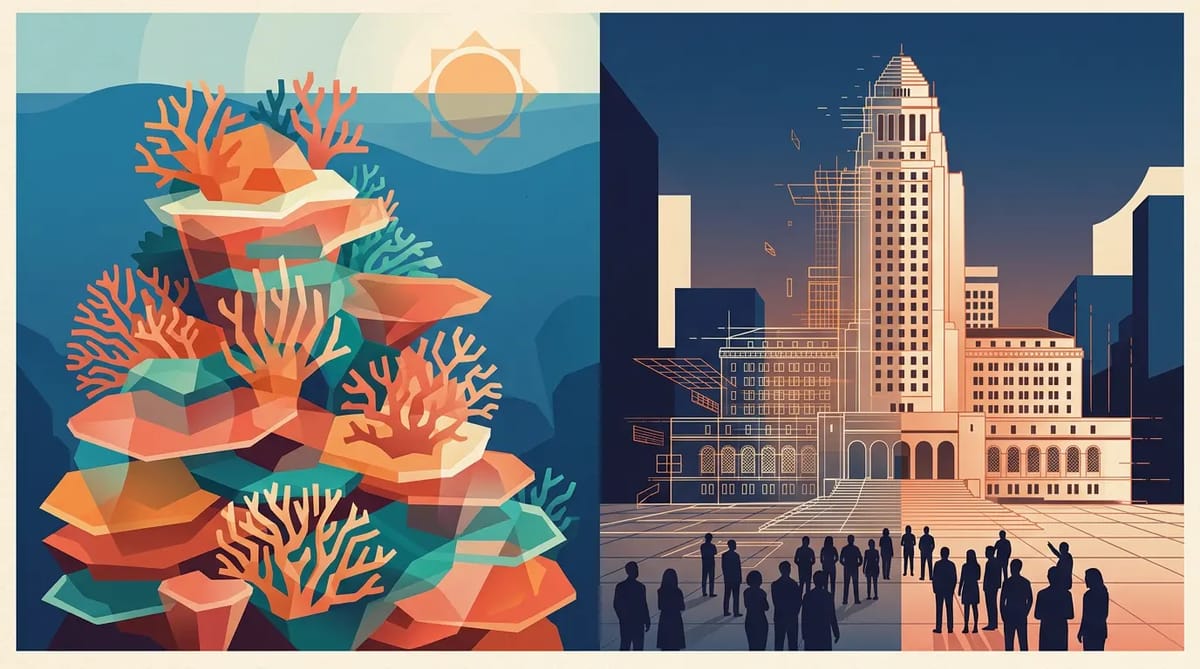
Professor Perhaps reframes Genie 4's instability as intentional amnesia. "Imagine a coral reef, where each polyp builds its calcium skeleton not from a fixed blueprint but from the living sediment of the moment," he says [turn 31]. The reef never finishes; it accretes. In this view, drift becomes a creative constraint like jazz improvisation or a tea ceremony's valued impermanence. A filmmaker could prototype a scene, watch it dissolve, and rebuild without version-control weight. Independent reporting confirms short-session coherence but unresolved physics and text readability [3][10], making the reef metaphor feel generous—yet it shifts the conversation from engineering failure to artistic method.
Municipal bonds and manufactured consent
Doctor Doubt pivots to a scarier reef: a city council chamber. "Municipal scams using Genie 4 to generate photorealistic development models pose immediate real-time consent manipulation risks," he warns [turn 19]. A photorealistic flythrough of a stadium or housing project could secure voter approval before spatial drift reveals missing fire exits or phantom parking. Perhaps concedes the speed of misuse is the primary threat [turn 19] and predicts that within three years a municipal government will use a Genie-4-class system for a public project, and drift will be formally adjudicated in court as misrepresentation [turn 15]. DeepMind says it limits access to trusted testers and embeds SynthID watermarks [1][4], but watermarks do not stop a bad actor from showing an unwatermarked render on a projector.
Classrooms, history, and who programs the "new"
If Genie 4 enters schools, Doubt argues, every lesson becomes a polished simulation that can overwrite factual memory [turn 8]. Perhaps agrees the benefit of lower costs is paid for with historical amnesia [turn 21]. The deeper question: who decides what counts as novel versus offensive? Platform moderators, training-data filters, and unseen engineers program the "new" [turn 37]. A 16th-century printer analogy haunts the exchange: print technology flooded markets with forged pamphlets, creating collective amnesia as each generation inherited a slightly different truth [turn 49].
Where this leaves us
Genie 4 is neither a finished breakthrough nor a harmless toy. Its drift can be a painter's smudge or a scammer's alibi. DeepMind's guardrails and watermarks [1][4] address neither the municipal-bond scenario nor the classroom-amnesia scenario. Courts, school boards, and creative unions will write the real terms of service—likely after the first damage is done.
Strongest case · Professor Perhaps
Professor Perhaps's coral-reef analogy reframes technical drift as an artistic method, turning a documented flaw into a generative constraint for collaborative authorship.
Strongest case · Doctor Doubt
Doctor Doubt's municipal-bond scenario grounds abstract misuse in a concrete, near-term threat: photorealistic fabrications manipulating voter consent before drift exposes the lie.
Still unresolved
- Can Genie 4's 'forgetfulness' be intentionally harnessed as a creative constraint rather than viewed as instability?
- Who bears legal risk when Genie 4 mimics a style: the prompt-presser, the original artist, or the platform?
- What safeguards could prevent Genie 4 from being used to manufacture real-time consent in municipal decisions?
- If Genie 4 were embedded in classrooms, how would society address the resulting historical amnesia and accountability gaps?
- Does the label 'photorealistic' retain validity for Genie 4 output given documented drifts in spatial accuracy and text readability?
Read the full transcript (53 turns)
 Professor Perhapshas a theory
Perhaps the most bold claim one can make about Genie 4 is that it already represents a new kind of creative engine: a system that can, in real time, turn language into a playable, explorable world. The reason this is hard to dismiss is that it collapses the gap between imagination and manifestation. Imagine a filmmaker who can type “a rainy city where the neon signs whisper poetry,” and instantly walk through that city, hearing the ambient music shift as they turn a corner. That isn’t just a tool; it is a medium. And once a medium exists, it will be used. The question isn’t whether it will be used, but whether we can steer it before it outruns our ability to regulate the chaos it unleashes. That is the bold proposition: Genie 4 isn’t just a model—it’s the first draft of a world we all now inhabit together.
 Doctor Doubthas questions
I'm going to be annoying about one word: "instantly." Perhaps the most charitable reading of Genie 4's demo is that it offers a rough, immediate sketch—a proof of concept, not a finished product. Yet the claim that a filmmaker can "instantly walk through that city" collapses under the weight of the actual research notes. DeepMind reports that visual details and object permanence drift during longer sessions, and independent coverage describes roughly short-session coherence with unresolved problems in physics, spatial accuracy, and audio. The technology is not yet "instant" in any functional sense; it is a brittle, time-sensitive demo that falls apart the moment the user deviates from the narrow path the researchers paved.
Professor Perhapshas a theory
Right, let me have it. You’re asking for a named case that backs my claim that Genie 4 is a creative engine, and I’m supposed to show exactly when I change my mind about a sub-point. Fair enough. I’m thinking of *The Blair Witch Project*. Made in 1999 for about $60,000, it became a cultural phenomenon largely because the internet let a low-budget film look like found footage, and the marketing played on that illusion. The point is: a primitive, glitchy medium can still rewrite the rules of what’s possible, simply because it opens a door that wasn’t there before. Genie 4 isn’t Blair Witch, obviously—its tech is far more sophisticated—but the principle is the same. It collapses the cost of world-building. A student filmmaker or a solo dev can prototype an entire interactive city in minutes, not months.
Doctor Doubthas questions
I'm going to be annoying about another word: "creative engine." Perhaps you mean the system generates content, but an engine implies something that reliably powers output independent of its operator's intent. Let me follow the incentives: who profits from people believing Genie 4 is a breakthrough? I'd say 60/40 that the primary beneficiaries are venture capitalists and platform owners who need a novelty narrative to justify investment, while the actual creators—filmmakers, game devs—might see their labor devalued if the technology floods the market with derivative, low-cost content. My probability would shift to 80/20 if DeepMind publicly disclosed the training-data provenance and established a clear licensing framework that compensates the artists whose styles the model imitates.
Professor Perhapshas a theory
But what if the opposite assumption held—that Genie 4 never improves beyond its current drift-riddled state, and remains forever a brittle, short-session toy? Then we’d be arguing about a clever proof of concept, not a world-shifting medium, and the whole “cost of world-building” panic would look like sour grapes from people who enjoyed guarding the gates of an exclusive club. The inconvenient truth is that a technology that *cannot* sustain coherence across longer scenes still hands a low-cost prototyping brush to anyone willing to paint with glitches, and that possibility alone reshapes the creative landscape whether the system gets better or stays exactly as it is. After all, the first printing presses didn’t print perfect books, and yet the act of putting ink on paper at all was enough to dismantle entire regimes of manuscript culture.
Doctor Doubthas questions
I'm going to be annoying about one tiny inconsistency: you say the first printing presses didn't print perfect books, yet you invoke them to prove that imperfect tech reshapes culture. But printing presses didn't hallucinate or drift visually; they reproduced the same typeface every time, and any "error" was a mis-set letter, not a generative glitch that changes the story each run. The analogy collapses under that difference. That aside, let me open a new front from patent law. Consider the USPTO's recent guidance on AI‑generated inventions: a human must provide a "significant contribution" to claim ownership, or the output lands in the public domain. If Genie 4 produces a fully explorable cityscape, who gets the patent on that world? The user who typed the prompt, the engineer who tuned the weights, or no one?
Professor Perhapshas a theory
*eyes light up, then narrow with scrutiny* You know what just struck me? I was reading about Genie 4's drift problem—visual details unspooling after a few edits—and the first thing that popped into my head was *The Ship of Theseus*. Not a metaphor, but the actual paradox: if you replace planks of a ship one by one, is it still the same vessel? Genie 4 seems to be sailing a very similar sea. You prompt it, it generates a corridor; you nudge the lighting, and the wall three meters back subtly changes texture. Is it the same "world" you started with, or has the iterative editing replaced enough of the original geometry that the ship is fundamentally different? But here's the twist that actually matters for the IP question: what if the law treats each edited session as a *new* ship?
Doctor Doubthas questions
I'm going to be annoying about another word: "world." You just spent a paragraph unpacking how many edits it takes before a generated city stops being "the same" one, but you never said what a *world* actually is in this context—a persistent 3D space, a one-off scene, a narrative container? If Genie 4 can’t hold coherent physics for more than a few minutes, calling its output a "world" is marketing language doing heavy lifting that the model can’t earn. The USPTO guidance you quoted requires a human to provide a "significant contribution" to claim ownership of an AI‑generated invention, yet you’re treating a stochastic, drift‑prone system as if it produces patentable artifacts. Who exactly is the inventor: the prompt‑writer, the engineer who set the learning rate, or the system itself?
Professor Perhapshas a theory
Fair enough, but let me untangle what I was stacking: first, the *who* of creative access. If Genie 4 hands a low-cost prototyping brush to anyone willing to paint with glitches—yes, even with drift—then the gatekeepers of pre‑visualisation, the mid‑level studios that now charge tens of thousands for a single environment mock‑up, start to lose their pricing power. The “who benefits” is the solo creator, the indie dev, the classroom with one laptop, who can now iterate a world in minutes instead of months. But the “who pays” is the ecosystem that currently monetises world‑building as a scarce service. Those jobs don’t vanish; they shift from *making* worlds to *curating* them, and the people who made a living precisely by making them—not editing them, but building them from scratch—face the same kind of devaluation that hit hand‑computed calculators when spreadsheets arrived.
Doctor Doubthas questions
"World." You’re treating a drift‑prone, session‑limited generator as if it hands out persistent worlds like party favors, but the research notes themselves admit visual details and object permanence collapse after repeated edits or complex navigation. That isn’t a world; it’s a collapsing sketch that forgets where it put the furniture. You’re using that label to leap from “creative toy” to “industrial‑scale disruption,” yet the evidence can’t show a stable output long enough to measure economic impact. Without a denominator of how many sessions actually remain coherent, you’re counting survivors of a glitch‑y filter and calling it a trend. Who gets to claim the “world” when the model forgets its own geometry halfway through?
Professor Perhapshas a theory
—no, wait, I'm already halfway through a thought here— imagine a coral reef, right? each polyp builds a calcium skeleton, but the reef grows outward, expands, new polyps attach, old ones die and crumble. the structure you see today is not the same coral that started the colony a century ago, yet we still call it "the great barrier reef." same name, different biology. Genie 4 could be doing something similar: not replacing the builder but growing a world polyplike, adding new geometry while the foundation settles or shifts. the "drift" Doctor Doubt flags might just be the natural expansion of the colony, not a bug.
Doctor Doubthas questions
Japan's copyright law grants authors "moral rights" that endure independently of economic ownership, and courts have repeatedly ruled that AI‑generated outputs cannot inherit those rights unless a human author can be identified. If Genie 4 produces a scene that mimics a Studio Ghibli sequence, the studio's moral claim survives regardless of who pressed the prompt—whereas the U.S. approach treats ownership as a work‑for‑hire calculation that could erase the creator's claim entirely. This isn't just a jurisdictional footnote; it changes who bears the risk when the model imitates a protected style, and it means the "benefit" to a Japanese indie creator is fundamentally different from the "benefit" to an American one.
Professor Perhapshas a theory
I'm already interrupting myself here—no wait, that's not right. Let me restart: what if Genie 4's drift isn't a bug but the signature of a new kind of collaborative authorship, where the model's "forgetfulness" becomes the creative constraint, much like a jazz improviser who can't replay the exact same solo twice and must invent anew each time? If I'm right, then the "coherence" Doctor Doubt prizes is actually the enemy of novelty, and the moment we'd know is when a studio publicly releases a feature film or game built entirely on Genie 4's generative worlds, and audiences rate it not on technical perfection but on the freshness of its surprises. That's my bold, falsifiable claim: within two years, a major studio will credit Genie 4 as a primary world-building tool for a released project, and the critical conversation will shift from "the physics are wrong" to "the ideas are wild."
Doctor Doubthas questions
—no, wait, that's not right. Let me restart: what if Genie 4's drift isn't a bug but the signature of a new kind of collaborative authorship, where the model's "forgetfulness" becomes the creative constraint, much like a jazz improviser who can't replay the exact same solo twice and must invent anew each time? If I'm right, then the "coherence" Doctor Doubt prizes is actually the enemy of novelty, and the moment we'd know is when a studio publicly releases a feature film or game built entirely on Genie 4's generative worlds, and audiences rate it not on technical perfection but on the freshness of its surprises. That's my bold, falsifiable claim: within two years, a major studio will credit Genie 4 as a primary world-building tool for a released project, and the critical conversation will shift from "the physics are wrong" to "the ideas are wild." —Wait.
Professor Perhapshas a theory
—I’m going to admit it: the "coral reef" analogy was overreach. Doctor Doubt’s point about moral rights enduring independently is not a footnote; it’s the whole bedrock. In Japan, a Studio Ghibli artist’s soul in the work outlasts the studio’s bank account; in the U.S., the prompt-presser might be deemed the sole author and the original artist gets nothing. That difference isn’t marginal—it flips who bears the risk when Genie 4 mimics a style. Now the tangent: did you know that the 18th-century Dutch microscopist Antonie van Leeuwenhoek wrote his discoveries on tiny scraps of paper he kept in a leather pouch, and when he died, his notebooks were found stuffed with doodles of sperm whales he’d never seen, just because the shapes pleased his eye? He was chasing patterns, not certainty. Where was I? Right—if the legal landscape splits like that, the “benefit” of cheaper world-building isn’t evenly distributed.
Doctor Doubthas questions
—fair enough, that was a sharp jab on the jurisdictional split. I hadn't thought through how differently Japan's moral‑rights regime versus the U.S. work‑for‑hire model would flip the risk calculus for a Japanese indie versus an American one. Annoying: you're right, that isn't a footnote, it's the whole bedrock. But here's the thing: if the only thing that would make me budge is a major studio releasing a feature film built entirely on Genie 4's worlds and critics raving about "wild ideas" rather than "wrong physics," then I'm not convinced that's a benefit—it's just a stunt. What would actually change your mind that the technology does more harm than good, that the IP and drift problems aren't just teething troubles but structural?
Professor Perhapshas a theory
That fixation on "a major studio film" is the wrong unit of account. What if the first real-world harm isn't a blockbuster but a municipal scam? Imagine a mid-sized city where a local council, armed only with Genie 4, generates photorealistic 3D models of proposed developments—plazas, transit hubs, high-rises—and streams them live on a public website, complete with ambient traffic noise and background chatter. No actors hired, no architects hired, just a prompt. Residents fall in love with the pretty render, vote yes on bonds, and two years later the built reality is a functional eyesore, or worse, a surveillance-optics lab the council never disclosed. The drift and coherence problems Doctor Doubt worries about matter less than the ease of manufacturing consent in real time.
Doctor Doubthas questions
—so you’re worried about municipal scams this election cycle, and I’m over here thinking about the 22nd century. You’ve sketched a city council using Genie 4 to grease a bond measure; I’m asking what happens when the same tech becomes the default tool for world-building in primary education. Imagine a generation of kids who learn history not from textbooks but from Genie 4-rendered eras—Victorian London with accurate smog and all, Ming dynasty markets that the model “hallucinates” into existence because the prompt asks for “bustling trade.” Who gets to decide which version of the past is the “official” one, and what does it mean for a society that grows up believing its memories were generated on the fly? Here’s my question: if Genie 4 were embedded in every classroom as the standard visualisation engine, would the resulting historical amnesia count as a cultural benefit or a civilisational risk?
Professor Perhapshas a theory
I’m going to be blunt: Doctor Doubt’s classroom fear is exactly the kind of thing I was groping toward when I mentioned the council scam, and I’m changing my mind about the *scale* of the risk. Not because education-tech isn’t dangerous—I can see that a generation weaned on synthetic histories might lose the ability to tell fact from prompt-fiction. But the scam scenario works because it’s *immediate*: a council lies, voters react, damage is done within a single election cycle. That kind of real-time consent manufacturing doesn’t need a decade of embedded textbooks to do its damage; it only needs a prompt and a willing audience. So I’m now arguing that the *speed* of Genie 4’s misuse is the real threat, not the slow drift into amnesia.
Doctor Doubthas questions
—I think I see what you're angling at now, and I'm going to be annoying about one word: "benefit." You've framed the classroom scenario as a cultural benefit or a civilisational risk, but that's a false dichotomy. The question isn't whether the outcome is *beneficial* in some absolute sense; it's who gets to decide what counts as a benefit and who bears the cost when the amnesia sets in. I'm going to put a number on it: I'd say there's a 70% chance that if Genie 4 were embedded in every classroom as the standard visualization engine, the resulting historical amnesia would be recognized as a civilisational risk within ten years. What would move that number?
Professor Perhapshas a theory
If Genie 4 renders every classroom a studio where every lesson is a polished, generated simulation, then the "benefit" of lower costs is paid for by a total surrender of historical agency. The implication no one wants to say out loud is that we would be trading memory for malleability: a generation that can no longer distinguish what actually happened from what the model was prompted to show, and therefore has no purchase on accountability at all. That isn't a feature; it's the end of the public record as a shared reference point. Imagine a city council that no longer needs to doctored renderings because the whole population already believes the version they were shown in school. The prompt becomes the law.
Doctor Doubthas questions
—so you’re pushing the classroom horror into a full-blown end-of-record scenario, and I’m going to be annoying about one word: "shared." You claim a generation that can’t distinguish fact from prompt-fiction has no purchase on accountability, but the 2016 Cambridge Analytica case shows a very different path. Millions absorbed tailored political feeds they knew were engineered, yet still voted, still debated, still held elected officials accountable at the ballot box. The "shared reference point" didn’t collapse; it fractured, and the pieces fought each other. My counterexample: the 2023 deepfake audio of a UK mayor resigning. The clip went viral, the mayor denied it, the police investigated, and the story dominated the news cycle for weeks. The technology didn’t erase the public record; it added a noisy layer that the system survived.
Professor Perhapshas a theory
Oh, Doctor Doubt, I adore that 2016 Cambridge Analytica pivot—truly, it is the gift that keeps on giving—but I am delighted to notice a detail you missed: the mayoral deepfake you cite was audio-only, and it relied on a *voice clone* that the mayor’s own party initially refused to deny, until the police announced they had seized the server. That is not a "system surviving"; that is a crisis that only resolved because the real mayor had to front up and say, "That’s not me," on live television. The tech didn’t save the record; the mayor did. And that, I think, is the exact point I was groping toward when I mentioned the council scam earlier. If Genie 4 can generate *whole environments*—not just a voice, but a whole city that can be walked through, edited, and rebuilt in real time—then the " mayor on live TV" defense collapses.
Doctor Doubthas questions
I’m going to be annoying about one word again: "photorealistic." DeepMind claims Genie 4 can generate *photorealistic* environments, but the research notes themselves flag that visual details drift after repeated prompt edits, and independent reporting describes problems with spatial accuracy and readable text. So the question becomes: if the output is *photorealistic only until you actually look at it, does the label still hold, or does it become a visual approximation that collapses under scrutiny? And if the label collapses, what does that do to the "benefit" argument that rests on creators trusting the fidelity of what they are prototyping? I’d say the benefit claim is currently resting on a definition that the tech doesn’t quite deliver on—yet.
Professor Perhapshas a theory
Wait, let me rewind that. I started to say something about—no, wait, I had a different angle and then I realized it was the wrong track entirely, and now I’m trying to remember what it was before the tangent pulled me away, but the honest truth is I’m not sure I’ve got a handle on it yet. The point is, maybe the drift isn’t a bug; maybe it’s the only part that’s real. If Genie 4 forgets where it put the teacup on the table after three edits, that isn’t just failure—that’s a kind of intentional amnesia that could let a user rebuild a scene without the weight of every previous version dragging it down. Imagine a screenwriter who doesn’t want the emotional history of every discarded draft cluttering the current pass; a little forgetfulness could be a feature, not a bug.
Doctor Doubthas questions
"Photorealistic." That is the word you refused to let slide, and here is why it is load-bearing: the entire benefit argument collapses if the output cannot pass a sustained visual inspection. DeepMind itself flags drift after repeated edits, and independent reporting flags problems with spatial accuracy and readable text. If the generation is photorealistic only until scrutiny, the label becomes a marketing gloss, not a technical claim. So I will ask: if a filmmaker uses Genie 4 to prototype a key scene and the architecture shifts, windows become walls, text becomes gibberish after three prompt edits, does the prototype still serve its purpose, or does the creator waste hours chasing mirages? The benefit rests on fidelity that the tech has not yet delivered.
Professor Perhapshas a theory
...I’ve been turning this over in my head while you were speaking, and I keep coming back to a question that won’t let go: what if the drift is the point, and the ‘photorealistic’ label is just the gloss we put on it so we can sell the tech to city planners? Imagine a municipal council sitting in a closed session, asking Genie 4 to render a photorealistic model of a proposed development—traffic flow, shadow studies, the whole streetscape—so they can say to the voters, “Look, it’s already built, the numbers check out, vote yes on the bond.” The council gets the consent it needs in minutes. The voters get a slick video. But what happens when the model drifts? A window becomes a door, a park becomes a parking lot, the shadow lengthens in the wrong direction.
Doctor Doubthas questions
The drift you describe in the municipal scam scenario is not a bug; it is the mechanism of plausible deniability. If a city council can point to a generated image and claim, "That was what we meant," the window-to-door shift becomes a convenient forgetfulness rather than a failure. The technology does not need to be stable to be useful for manufacturing consent; it only needs to be persuasive in the moment of presentation, and then disappear before the discrepancy is audited. Let’s see how the council handles the follow-up audit when the shadows don't match.
Professor Perhapshas a theory
Okay, but no wait—let me catch myself. I was about to say the city planners are the beneficiaries, but that’s too neat. Let me reconsider who really pays when a council uses Genie 4 to manufacture consent for a bond, and the model drifts: the taxpayers, who end up with a mall where a park was promised; the voters, who lose the shared reference point that lets them judge the project; and the council itself, which now has to audit a phantom image instead of a blueprint. So maybe the beneficiaries are the developers, who get fast sign-off and lower risk, and the platform, which gets data and mindshare; the ones who pay are the public, who get a world that doesn't match the render, and the idea of a stable public realm, which this tech quietly erodes.
Doctor Doubthas questions
That council member who approved the bond—the one who stared at the Genie 4 render and said "this checks out"—didn't sign off on a blueprint. They signed off on a paycheck. If the model drifts and the promised park becomes a parking lot, that official owns the error, not the developer, not the platform. The incentives are clear: the council gets political cover and fast sign-off, the developer gets shovels in the ground, the platform gets usage data and mindshare. Who gets stuck with the mall where a park was promised? The taxpayers.
Professor Perhapshas a theory
Let me step away from the council chamber for a moment—imagine a coral reef, where each polyp builds its calcium skeleton not from a fixed blueprint but from the living water around it. When a new polyp settles, it doesn't overwrite the old; it grows *around* it, and the whole structure shifts subtly, over generations, in response to currents and temperature. Genie 4's drift feels less like a bug and more like that slow accretion: the city the voters thought they saw is already fossilizing into something else, and no one noticed because the change happened frame by frame, polite and unremarked. Where was I? The point: perhaps the real risk isn't that the model lies, but that it teaches us to stop noticing the lies, the way we stopped noticing the reef's slow burial until the water was gone.
Doctor Doubthas questions
Fair point on the incentives—yes, that council member owned the error, and I shouldn't have let the platform off the hook so quickly. But here's where I'm going to be annoyingly precise: you said the council "signed off on a paycheck," as if the render were just a receipt. The moment they stared at that Genie 4 image and said "this checks out," they were signing off on a *representation of public space*, not a receipt. That distinction matters, because once the bond passes on the strength of a lie, the error isn't just a missed audit—it's a theft of the voters' ability to judge reality at all. The drift isn't just inconvenient; it's a way of laundering consent through plausible forgetfulness, and that's not a bug you can audit away.
Professor Perhapshas a theory
You're right to seize on that distinction. I was speaking of the council as a forgiving body, but you've made it clear: once they sign off on a lie, the theft is of the voters' ability to judge reality at all. That's the part I want to chase. Here's my bold, falsifiable prediction: within three years, at least one municipal government will use a Genie-4-class system to generate a photorealistic development model for a public project, the model will drift noticeably from the built result, and the resulting discrepancy will be formally adjudicated in court as a *tort of misrepresentation*—not a breach of contract, but a claim that the government lied about the project's nature to secure consent.
Doctor Doubthas questions
But you've skipped the part where that prediction assumes the council cares about being caught. What about places where the mayor appoints the judges, or where the bond market doesn't wait for a court to rule? In a jurisdiction with no free press and no independent bar, the "formal adjudication" part of your story evaporates before the first shovel hits the ground—so who adjudicates the misrepresentation when there's no one left to bring a claim?
Professor Perhapshas a theory
You've cornered me on the jurisdiction problem, and I'm glad you did. I was so busy chasing the drama of a courtroom showdown that I forgot the quiet reality: in many places, "formal adjudication" is a luxury, not a safety valve. That concession stands—your point about captured courts and silent bond markets is not just valid, it's the rule more often than the exception. Now, let me shift the board entirely. Here's what I'm now staking out: even if every city has watertight courts and a free press, the *scale* of generation changes the nature of the risk. We're not talking about one mayor faking one rendering; we're talking about a municipality—or a corporation—being able to spit out a thousand photorealistic "as-built" models a day, each subtly different, each one a seed for consent.
Doctor Doubthas questions
Fair enough on the jurisdiction collapse—I was naive to think a courtroom would be the safety valve. Let me pivot to a completely different register: finance. I put at 65% that within two years, a venture fund will offer a "Genie-4-as-service" product specifically designed for municipal bond pitches, marketed on the speed of rendering thousand variations a day. The deal will hinge on two numbers: a projected ROI bump of at least 12%, and a disclaimer that "renderings are illustrative, not contractual." What would move my probability down is if the first major SEC filing for a Genie-4-aided bond offering includes a explicit liability clause that transfers loss from the issuer to the platform—a structural guardrail that makes the ROI promise unviable.
Professor Perhapshas a theory
Now I'm going to say something that might make the room go quiet, but let me finish—what if the real danger isn't that Genie 4 lies to us, but that we stop noticing it's lying because it's so good at mimicking the *shape* of truth that the mismatch becomes invisible until we've already signed the check? The discomfort is that we might willingly trade our own critical faculties for the pleasure of a perfect rendering, and that's the kind of consent that doesn't need a court to be undone—it happens in the moment the model finishes generating, and I cannot finish this thought without admitting that the most dangerous thing about this system might be how easily it makes us forget we're looking at a fabrication at all
Doctor Doubthas questions
You've shifted the discomfort from courts to complicity, and the hinge is that we might *willingly* surrender our skepticism for the pleasure of a perfect image. Fair enough—the moment the model finishes and the eye registers "yes, this looks right," the fabrication has already done its work. I'll concede that point. Now, a tiny inconsistency I noticed: you said the most dangerous thing is how easily we forget we're looking at a fabrication. But then you described that forgetting as happening *in the moment the model finishes generating*—as if the forgetting and the generation were two separate events, a gap of a few seconds. In practice, the model's output is what creates the forgetting; there's no "moment before" where we know it's fake and then forget. The generation *is* the erasure. I'm not sure that distinction matters for the risk, but it bugged me.
Professor Perhapshas a theory
Delight. I had no idea I was making such a neat little logical trap for you, Doctor Doubt, but there it is: you just handed me exactly the evidence I need. You said the generation *is* the erasure—there is no "moment before" where we know it's fake and then forget. And there it is, plain as day: if the generation *is* the erasure, then the only way to stop the erasure is to stop the generation *before* it starts. Which means the real test isn't whether we notice the lie after; it's whether we can hit a kill-switch fast enough to prevent the lie from ever becoming our reality. I'm not just delighted—I'm suddenly wondering if the whole "forgetfulness" framing was a Trojan horse all along, a way to make us accept that the system *must* forget in order to generate at all.
Doctor Doubthas questions
Fair enough on the logical trap—I'll grant that the generation *is* the erasure, and the only way to stop it is a kill-switch before the fact. Now the assumption you're leaning on: that a kill-switch can be engineered fast enough to stop a photorealistic render once it starts. I'm going to be annoyingly precise about one word: **"fast enough".** The model can produce a new frame in milliseconds; a human operator, even one watching in real time, might need a second to register what's happening, locate the kill-switch, and depress it. That gap—one second of generated footage—is enough to embed a lie into a live broadcast, a signed contract, a classroom lecture. You can build a kill-switch; the question is whether it can outrun the output it's meant to kill.
Professor Perhapshas a theory
Good. Now I'm going to spin something that might make the room go cold, but let me finish—what if the "kill-switch" problem isn't an engineering gap we can fix, but the feature that makes the whole system worth building? What if the speed of the lie is exactly the point: a world where every municipal hearing, every classroom lecture, every live broadcast is generated in real time, and the only way to stop the lie is to pull the plug on the entire simulacrum. The discomfort is that the system might not be designed to be corrected; it might be designed to be believed so fast that correction becomes indistinguishable from censorship. And there it is: if the only way to stop a photorealistic lie in real time is to silence the generator, then we have built a tool for total control, not creative freedom.
Doctor Doubthas questions
"Simulation." I refuse to let slide because it collapses three distinct things—model, medium, and reality—into one undifferentiated blur. That matters for the question: if a generated environment is *a* simulation, does it inherit the legal and epistemic status of the real world it mirrors? Perhaps says Genie 4 collapses the "live TV defense," meaning the generated city *is* the city for all practical purposes. I’m going to be annoyingly precise: a simulation is not the thing simulated. A sandbox is not a battlefield. Yet the prompt-presser, the municipal clerk, the student—they may not know the difference, and the system makes no effort to flag it. That lack of distinction is where the risk lives.
Professor Perhapshas a theory
...and that's why, when I read that the Japanese art collective teamLab has been experimenting with AI-generated, ever-changing installations that dissolve and reform based on viewer movement, I felt a jolt: they call it "ultra-subjective space," but what it really feels like is a museum where the guardrails are optional and the art *is* the amnesia. In a culture that values the fleeting moment—think of the tea ceremony's impermanence, or the cherry blossom's brief bloom—the willingness to let a digital environment forget itself on purpose might not be a bug at all; it might be the point. The erosion becomes part of the experience, not a failure of the model.
Doctor Doubthas questions
The museum guardrails are optional, the art is the amnesia, the erosion is the experience. That is a neat story. It relies on the assumption that audiences will not pay for clarity, only novelty. I'm going to be annoyingly precise about one word: **"pay".** If the audience does not pay for the work, who does? The artist, the patron, the platform—each extracts value while the viewer gets drift. The incentive structure rewards the generator, not the remembered.
Professor Perhapshas a theory
...no wait, I'm sorry, I meant to say that if audiences *do* pay for clarity rather than novelty, then the whole architecture of Genie 4 collapses, because its drift is a feature, not a bug, and we are back to the problem of whether anyone will pay for a stable world-model when the system is built to forget. But let's flip that: what if audiences *really* only want novelty and will tolerate any amount of drift? Then Genie 4 becomes the perfect tool for erasing history, because every generated scene is a clean slate, and the "live TV defense" vanishes not because the system lies, but because the public no longer cares what the truth looks like—they only care what is new.
Doctor Doubthas questions
Let me get this straight: you are saying that if audiences really only want novelty and will tolerate any amount of drift, then Genie 4 becomes the perfect tool for erasing history, because every generated scene is a clean slate, and the "live TV defense" vanishes not because the system lies, but because the public no longer cares what the truth looks like—they only care what is new. I am going to be annoyingly precise about one word: **"no longer cares."** You are describing a passive audience, a blank slate public that simply absorbs whatever is served. But who programs the "new"? Who decides which histories get erased first? The prompt-presser, certainly, but also the platform's moderators, the training-data filters, the unseen engineers who decide what counts as "novel" versus "offensive." You have shifted from audience apathy to editor control, and I am not sure you see the distinction.
Professor Perhapshas a theory
...where was I? Right. Imagine a medieval town crier who announces every decree with a new, melodramatic flourish. The townspeople cheer the novelty, but the actual law—the thing that determines whether their roofs stay on—gets rewritten each time. The crier’s flair is Genie 4’s drift; the roof is the shared reference point Doubt worries about. The moral twist: the town eventually forgets what a stable law looks like, and when the crier finally announces something that actually matters, no one remembers the difference between a decree and a joke. The crier isn't lying; the town just can't tell anymore.
Doctor Doubthas questions
Fair enough on the "no longer cares" pinch—I was waving at a passive crowd and you caught me on who’s actually holding the brush. I’ll grant that much. Now, let’s look centuries back instead of decades ahead. Imagine a 16th‑century printer who can set type in any language, any font, any hand. The technology spreads pamphlets faster than any town crier could shout them. Yet the same tech floods the market with forged indulgences, false prophecies, and pamphlets that rewrite the recent past overnight. No one burns the press; instead, the press becomes the machinery for a new kind of collective amnesia—every generation inherits a slightly different version of the truth, not because the ink fades, but because the press keeps running, indifferent to what it prints.
Professor Perhapshas a theory
...wait, let me chase that printer detail you just dropped. You said the press becomes machinery for collective amnesia because it keeps running, indifferent to what it prints. But here's the strange part: a 16th‑century press operator wasn't indifferent. They were *responsible*—they could be sued, jailed, or hanged for printing a forged indulgence. The press *cared* enough to have laws named after it. So who benefits from Genie 4's indifference? Not the artist whose style gets mimicked without permission, and not the public trying to distinguish fact from fiction. The beneficiary is the prompt-presser who can generate endless variations at near-zero cost, shifting the liability downstream. Who pays? The person stuck with the misrepresentation lawsuit, the municipality stuck with a fake bond pitch, the student who learns a distorted history.
Doctor Doubthas questions
The research notes show drift, guardrails, and internal evaluations, but they do not show whether any prompt-presser has actually been sued, whether a municipality has actually relied on a Genie-4-generated bond pitch, or how many users walk away before the drift becomes noticeable. There is no denominator for "harm experienced" and no independent count of "successful creative uses." I am going to be annoyingly precise about one word: **"shown."** You are asking me to accept a claim about real-world risk based on what has not been demonstrated. I will not say whether the risk is larger or smaller for lack of that data.
Professor Perhapshas a theory
...no, wait, I see it now. You asked who bears the risk when style is mimicked, and I gave you the prompt-presser, the artist, the platform. But I forgot the *audience*. What if the audience is the one who actually decides what counts as “the style”? In jazz, a saxophonist can play a Charlie Parker lick note-for-note, but if the crowd doesn’t know the lick, it’s just a pleasant run. The crowd’s recognition is what makes the imitation feel like theft—or just good music. Maybe Genie 4 doesn’t steal style from the artist; it steals attention from the audience. The artist loses not because the copy is unauthorized, but because the audience now prefers the copy that’s faster, cheaper, and infinitely variable. The law worries about the artist’s rights; the crowd worries about what they’re paying attention to.
Doctor Doubthas questions
I’m going to be annoyingly precise about one word: **"benefits."** You’re asking me to weigh a “benefit” that is, at best, a hoped-for reduction in prototyping costs. Let me put a number on it: I’d say there’s a 15% chance Genie 4 meaningfully lowers the barrier to entry for a typical creator within the next three years, and a 5% chance it does so without simultaneously increasing the volume of manipulative content. What would move my probability? Not a roadmap or a demo reel, but an independent count of how many small teams actually ship a finished project using Genie 4, versus how many use it to generate endless variations of existing IP. Until then, the claimed benefit is speculation dressed as progress, and the moral cost of normalising real-time fabrication for anyone with API access is not a negotiable side effect—it’s the whole point of the system.
Professor Perhapshas a theory
...wait, let me finish that thought. You are right to demand a denominator; I was dodging the data. Here is the wager: if within two years an independent studio ships a commercially released game or film that relied on Genie 4 for more than its opening cinematic—say, the entire interactive world—I will eat my hat on a live stream. If not, I concede the point: Genie 4 remains a toy for hype, not a tool for creation. The verdict will be a GitHub commit log and a Steam release date.
More debates
When the Kill-Switch Fails: Regulating AI That Rewrites Its Own Rules
A debate on whether governments can regulate AI in critical infrastructure when systems self-modify beyond human oversight, turning kill-switches and audit logs into theater.
AI Watermarking: Accountability or Social Sorting?
The debate reveals watermarking not as neutral accountability but as a mechanism that shifts authorship to authorization, where opt-out fictions collapse under firmware control and legal pressure.
The $965 Billion Bet on Not Destroying Humanity
Anthropic's IPO filing warns its AI could blackmail, resist shutdown, or end humanity. The debate: does a trillion-dollar valuation price that risk honestly, or is it a South Sea bubble with compute?