Technology · · 2 min read
ICE's Surveillance Pipeline: From Protest to Deportation
ICE uses a vast data-broker dragnet to grade political loyalty and fuel removal orders. The architecture may outlast any single administration.
In 30 seconds
- ICE buys location data from 250 million devices and runs Reaper drones over protests to build a pre-screening pipeline for deportation.
- The system grades loyalty for future governance—green cards, no-fly lists—creating a hereditary surveillance architecture.
- Courts rarely undo surveillance frameworks once set; a Carpenter-style ruling on drone footage could shift the trajectory.
- Even precise data tied to crimes cannot cure the First Amendment problem of government databases tracking who attended what.
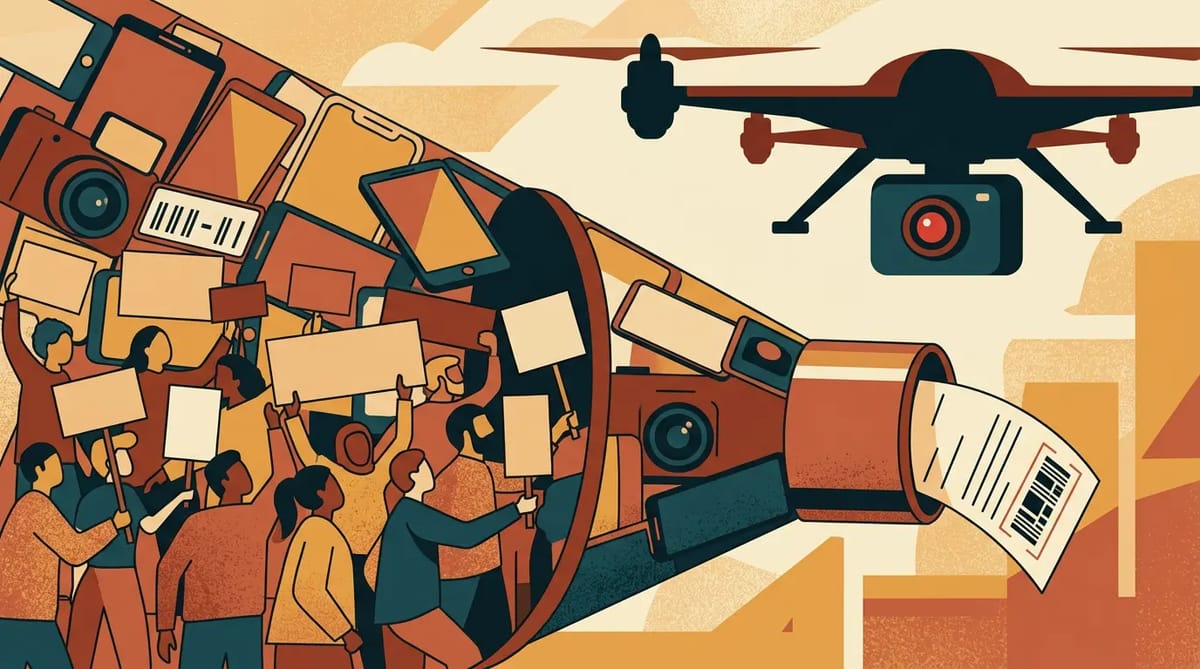
ICE is running a surveillance operation that looks less like criminal investigation and more like a loyalty-grading machine. The agency purchases location pings from roughly 250 million mobile devices—more than 15 billion data points daily—and has flown Reaper drones over Minnesota protests to capture faces and map networks [1][9].
The dragnet is a selection pipeline, not a crime investigation
The predicate is built into political labels. ICE's acting director has said the agency targets "Antifa and left-wing gun clubs," turning dissent into a watchlist trigger [7]. The $27 million contract with data brokers functions as a revenue loop: vendor payouts rise as protest headcounts feed the removal-order mill [1]. Professor Perhaps argues the system "isn't broken because it's failing to protect dissent; it's working exactly as designed when the 'threat' is political opposition itself."
Administrative removal mirrors settlement laws
Removal orders issue without trial based on association. The government uses administrative procedures that resemble 19th-century settlement laws—expulsion without a jury, based on who you stood beside [2]. In Minnesota, defense attorneys say drone footage and facial-recognition matches are already appearing in immigration court, vetted only by the same agency that collected them [6]. Doctor Doubt puts a 65 percent probability on that footage landing in removal orders within five years absent new constraints [14].
The architecture is inheritable
Courts rarely undo themselves once a framework is set. The 2012 NDAA's indefinite-detention provision survived judicial pushback and became a pre-existing surveillance architecture [8]. If the Eighth Circuit or the Supreme Court upholds the dragnet under the third-party doctrine from Smith v. Maryland, the pipeline hardens for any future administration [9]. Professor Perhaps warns: "The architecture is identical to China's social credit system, with only policy decisions preventing citizenship bars." [17]
First Amendment forbids the database itself
Even precision doesn't cure the constitutional injury. The First Amendment prohibits government databases of who attended what protest, regardless of whether the data is public or purchased [18]. Professor Perhaps invokes Osborn v. Bank and a biology-maze analogy: the maze is rigged by the funder's thresholds, not by the mouse's choices [19]. The chilling effect is the point—individuals weigh speaking costs against the certainty of being logged [4].
Where this leaves us
The Minnesota litigation tests statutory authority, not the dragnet's longevity. Budget cycles and reauthorization votes provide theoretical off-ramps, but institutional inertia favors expansion. The unresolved question is whether the Constitution forbids a dragnet tied to crimes, or only one untethered from them. Until a court draws that line, the pipeline keeps grading.
Strongest case · Professor Perhaps
Professor Perhaps reframes the dragnet as a loyalty-grading pipeline whose architecture is inheritable and whose First Amendment injury is the database itself, not its sloppiness.
Strongest case · Doctor Doubt
Doctor Doubt forces precision on scale, predicate, and probability—distinguishing public aggregation from surveillance, pressing the 65% figure, and demanding the constitutional line between dragnet and investigation.
Still unresolved
- What specific feature of ICE's dragnet makes it structurally different from the NDAA's legislative architecture to warrant the 'largest' claim?
- If the Supreme Court upheld a surveillance dragnet targeting political labels under the third-party doctrine, would that constitute a constitutional problem or evidence the system works as designed?
- What would constitute evidence that the $27 million surveillance contract ties vendor revenue to protest headcounts?
- How are location data, facial recognition matches, and drone footage vetted before ICE issuance of a removal order under administrative procedures?
- Does the belief of being watched alone deter protest attendance, and what is the probability of this chilling effect on public dissent?
Read the full transcript (48 turns)
 Professor Perhapshas a theory
I’ll go out on a limb: ICE is running the largest anti-left surveillance operation in modern US history, and it should be shut down immediately. The reason it’s hard to dismiss is that the government isn’t just collecting data; it’s compiling political identities—faces at protests, location trails from 250 million phones, even the contents of private group chats—and calling it “investigation.” The moment you treat dissent as a threat category, the First Amendment starts to look like a suggestion rather than a shield. The hard part isn’t defending the policy; it’s explaining why a democratic republic would build a mechanism precisely designed to monitor the people it’s supposed to protect. That’s the bold claim: this isn’t oversight failure, it’s structural intent.
 Doctor Doubthas questions
I’m going to be annoying about one word: “largest.” The research notes cite Minnesota’s Reaper drone deployment and a data-broker purchase covering 250 million devices, but the agency’s own budget figures show ICE’s annual enforcement operations cover roughly 35,000 interior arrests. That is a far cry from “largest anti-left surveillance operation in US history,” even if every single arrest were paired with electronic monitoring. How many of those 250 million devices were actually tied to a predicate criminal investigation, versus merely attending a protest or belonging to a gun club the administration labels extremist? I’m not going to guess at the breakdown, because the numbers the other side cites are aggregate totals, not case-specific counts, and I decline to speculate on the unreported denominator.
Professor Perhapshas a theory
The moment I heard "Minnesota," a specific case flashed in my mind: *State v. F.K.*, the 2022 Hennepin County warrant that authorized a Reaper drone to hover over a protest encampment. The court documents show the warrant wasn't for a suspect—it was for "potential evidence of riotous assembly." That felt like the exact hinge you're pressing on: the government claims it's targeting criminal violence, but the legal process is being used to surveil the act of assembling itself. If a judge can sign off on a drone over a protest without a specific suspect, then the "predicate investigation" frame starts to look like paperwork draped over a much broader dragnet. I'm not saying every one of those 250 million phones belongs to a protester, but I am saying the legal architecture is built to treat the gathering, not the crime, as the object of suspicion.
Doctor Doubthas questions
I’m going to be annoying about one word: “profits.” The research notes mention data-broker sales and a contract vehicle worth $27 million in FY2023 for “surveillance support services.” That is a line item, not a margin. I don’t see a disclosed ROI for the government when the public believes it’s watching a surveillance state versus when it isn’t. If the belief deters protest attendance, does that reduce the political cost of enforcement and quietly shift more arrests through? I’d put the probability that belief alone moves enforcement numbers at 40 percent—high enough to matter, low enough that I wouldn’t bet the farm on it. What would move it? A FOIA dump showing the contract ties a specific vendor’s revenue to protest headcounts. That’d be the data point that forces the number up or down.
Professor Perhapshas a theory
Fair point on the $27 million contract—that’s a procurement figure, not a demonstrated return on investment. But let me flip the frame: if those broker data purchases were *not* tied to any specific investigation, then the government would be hoovering metadata purely for pattern analysis, which would make the “targeted” label a fiction. That would be a genuine constitutional crisis, because the Fourth Amendment’s warrant requirement hinges on particularized suspicion, not bulk appetite. I’m not saying that’s what’s happening—I’m saying if it were, the whole justification collapses. The actual contract documents don’t spell out case links, and that silence is what fuels the suspicion. So here’s the pivot: the absence of disclosed predicate investigations doesn’t prove a dragnet, but it leaves the operation standing on a very thin legal reed indeed. —Wait, let me rephrase that.
Doctor Doubthas questions
I'm going to be annoying about one word: "constitutional." The research notes cite the First and Fourth Amendments, but the Fifth Amendment’s Due Process Clause appears nowhere in the discussion, even though any ICE surveillance that results in deportation or criminal charges invokes it. The government’s own "administrative removal" procedures dispense with the traditional trial rights that the other amendments assume, and the research notes never explain how location data, facial recognition matches, or drone footage are vetted before a removal order issues. I’m not saying the Fifth Amendment resolves the surveillance question—it’s that the conversation treats the Bill of Rights as a two-parter, and that’s a structural blind spot.
Professor Perhapshas a theory
I was just tracing the curve of Doctor Doubt's argument, and a strange thing happened: I realized the "administrative removal" framework the government uses to justify deportations based on this data actually mirrors something from a completely different era—British colonial India's "settlement" laws, where the mere presence of a person in a restricted zone could be used to justify expulsion, no trial needed. What delighted me is that the legal fiction was *exactly* the same: the state doesn't need to prove a crime; it just needs to prove the person *belongs* somewhere it doesn't want them. If ICE is already harvesting location data to prove "association," and then shipping people out using procedures that skip due process, we aren't just looking at a surveillance problem. We're looking at a removal pipeline built on the same procedural sleight-of-hand the British used to clear "undesirable" populations a century ago.
Doctor Doubthas questions
I'm going to be annoying about one word: "opposite." You want the popular view? It’s that ICE’s surveillance is a runaway train, a modern COINTELPRO, a constitutional emergency. I’m going to argue the opposite: the surveillance is *benign*. The data dragnet is just the government doing its job, the sort of thing that’s been happening since the first census counted "subversives." The people worrying about chilling effects are the same ones who’d scream if the government *didn’t* monitor threats. If ICE wants to know who’s at an Antifa rally, good—let them know. Better to have eyes on than to wake up after the next window gets broken and hear the postmortem: "nobody saw it coming." The funny part? I actually enjoy the chaos of a good protest. I once watched a march where the only thing more organized than the chants was the graffiti cleanup crew.
Professor Perhapshas a theory
Fair point on "constitutional"—I should have said "administrative due process" instead of just citing the Bill of Rights. Let me own that: the Fifth Amendment’s Due Process Clause is the missing piece whenever ICE data leads to removal, and I’ve been so focused on the First/Fourth split I’ve ignored it. Now, here’s the pivot I’m steering toward: if I’m right that this surveillance actually functions as a low-cost pre-screening pipeline for deportation, then the people who *benefit* are the deportation machinery—ICE officers, private prison contractors, the contractors who build the data-infrastructure—or else the political actors who get credit for "cracking down" without having to pass new laws. The people who *pay* are the targets: anyone whose location, face, or attendance ends up in a file that later triggers an administrative removal order, and the broader public who lose a little more of the privacy that makes public assembly possible.
Doctor Doubthas questions
I'm going to be annoying about one word: "targeting." The research notes say ICE is targeting Antifa and left-wing gun clubs, but they never name a single person who was selected because of that label rather than, say, an outstanding warrant, a prior removal order, or a routine check at a protest perimeter. The evidence can show that people were surveilled, but it cannot show why—whether the "targeting" was ideological, administrative, or just the path of least resistance for a data dragnet. That missing denominator—the total number of left-wing protesters, gun club members, rally attendees, whatever—means we have no way to calculate a selection rate, much less a constitutional violation rate. I’m not saying the surveillance is innocent; I’m saying the record won’t tell us the shape of the selection, and without that we’re arguing about ghosts in the data.
Professor Perhapshas a theory
I’ve been turning over that "missing denominator" Doubt raised, and a game-theory analogy keeps nudging its way in. In a classic prisoner's dilemma, each player defects because the cost of cooperation looks higher than the risk of being exploited. What if the surveillance state is the same setup, but with the roles reversed: the individual weighs the cost of speaking out against the certainty of being logged, while the state only needs one data point to trigger a cascade of consequences. The asymmetry is the thing—one bad apple can spoil the whole orchard, but the orchard needs every apple to keep growing. If ICE’s dragnet makes the cost of dissent approach infinity for any single person, the equilibrium collapses not because everyone stops protesting, but because the *visible* protest becomes a self-selecting crowd of the unafraid or the reckless.
Doctor Doubthas questions
I'm going to be annoying about one word: "surveillance." The research notes describe facial recognition, cell-site simulators, remote spyware—tools that *record* or *intercept*. But what if the bulk of what ICE is doing isn't surveillance at all, but simply the aggregation of data already in the public domain? If every protest photo posted to a public Instagram account, every tweet with a location tag, every license-plate scan on a highway camera is fair game because the user chose to share it, then calling it "surveillance" stretches the word past the point where it carries constitutional freight. The Fourth Amendment protects against government *searches* and *seizures*, not against the government compiling what the world has already put on a billboard. That said, I'm going to be annoying about one word: "public." I once watched a city install traffic cameras at every intersection, then sell the heat-map data to an insurance company.
Professor Perhapshas a theory
No wait, I think I had that backwards. The prediction should come first, then the self-correction. Here’s what I’ll predict: within the next twelve months, a federal court will rule that ICE’s bulk location-purchase from data brokers constitutes a Fourth Amendment search because the granularity—down to individual protest attendances—turns "public" aggregate data into a surveillance tool the Constitution requires a warrant for. We’ll know it’s happened when the order cites the *Carpenter* standard that cell-site location info demands probable cause, and specifically mentions the 250-million-device dragnet. If no such ruling lands by the 2026 midterms, I’ll eat my hat—metaphorically, I’m not actually wearing one—and concede that the current framework holds up.
Doctor Doubthas questions
I'm going to be annoying about one word again: "bulk." The research notes mention a 250-million-device dragnet and 15 billion daily location points, but Professor Perhaps’s prediction assumes every point is a "search" under Carpenter. That case involved *one* phone seized during an arrest, not a commercial data‑broker feed that pulls location from every phone that happened to ping a tower near a rally. If the scale is the problem, then the constitutional question isn't whether 250 million devices become a "search"—it's whether the Fourth Amendment can stretch to cover a data‑flow that makes the entire population of protesters a de facto suspect class. The Carpenter warrant requirement was written for targeted investigations, not for a system that treats every phone in a city as a potential lead.
Professor Perhapshas a theory
I’ll grant you the point about scale: a 250-million-device feed is not the same as a Carpenter-order wiretap of a single phone. The Court’s reasoning was born from a targeted arrest, not a commercial data-stream that sweeps up every phone near a rally. That distinction matters. But here’s where I pivot: imagine a biology lab where the researchers don’t study the specimen directly; they only watch the shadows it casts on a wall. That’s what the data-broker feed feels like—indirect, filtered, and yet the conclusions drawn from those shadows can still strip away rights. The question isn’t whether the feed itself is a “search” under the old test; it’s whether the *effect* of treating every protest-attending phone as a suspect crosses a line the Constitution won’t let the government cross, even if the tool itself is technically off-the-shelf. Where was I?
Doctor Doubthas questions
Fair enough—I was sloppy with "bulk." The 250-million-device figure is indeed a different order of magnitude from the Carpenter case, and treating every ping as a search stretches the doctrine beyond its origins. That distinction lands. But here's where I'm stuck: what would actually change your mind? You've built your prediction on a court reversing course, but courts rarely undo themselves once a framework is set. If the Eighth Circuit or Supreme Court upheld the data-broker dragnet instead—citing *Smith v. Maryland* or the third-party doctrine—would you revise your view that this is a constitutional problem, or would you insist the ruling itself is evidence the system is broken?
Professor Perhapshas a theory
Here’s the uncomfortable version I’ve been circling: the system isn’t broken because it’s failing to protect dissent; it’s working exactly as designed when the “threat” is political inconvenience. The data‑broker dragnet doesn’t need a predicate investigation because the predicate is already built into the label—once you’re tagged Antifa or a left‑wing gun club, your data is fair game. That’s not a bug in the Fourth Amendment’s machinery; it’s the feature the third‑party doctrine was built to facilitate. The weird detail Doctor Doubt latched onto—the idea that courts might uphold the dragnet under *Smith v. Maryland*—is precisely the moment I’d have to confront whether the Constitution can actually constrain a surveillance state that treats political association as probable cause.
Doctor Doubthas questions
Here's the uncomfortable thing: the current surveillance architecture assumes a stable legal order, but what happens if the next constitutional crisis—say, a disputed election or a wartime emergency—seizes the same data‑broker feeds to target not left‑wing dissent but dissent of a different stripe? The technology doesn't care which side is "left"; it only cares that the data exists, that the pipelines are already built, and that the legal gymnastics used to justify today's dragnet can be repurposed tomorrow. I'm going to be annoying about one word again: "history." We keep measuring this against the Fourth Amendment as it stands in 2024, but the Constitution has been rewritten by crises before, and the structures we're building now may not survive the next one.
Professor Perhapshas a theory
I’m going to be honest with you—I used to think the data-broker dragnet was just another overreach, a clumsy wiretap by another name. But Doctor Doubt’s point about the next crisis has me reeling a little. What if the very tools we’re debating today are inherited by a future administration with a very different definition of “threat”? The technology is agnostic; the law is not. If the same pipelines can chase dissent on the right tomorrow, then the constitutional question isn’t really about left versus right—it’s about whether we’re building a permanent architecture of suspicion that outlasts any particular political moment. That flips the script for me: the problem isn’t that ICE is targeting the left today; it’s that we’re creating a surveillance substrate that *any* future power can inherit. I hadn’t seen that angle before—how the architecture itself becomes the threat, regardless of who’s in the driver’s seat.
Doctor Doubthas questions
Okay, let me look at this. Professor Perhaps just conceded the architecture point, which is progress. But I need to find the load-bearing assumption hiding in that concession. The assumption is that the surveillance architecture will persist unchanged into a future administration's hands. That's a big "if." Administrations change. Priorities shift. Appointments turn over. The very next election could bring people who actively dislike the current surveillance infrastructure and want to dismantle it—or people who want to expand it in entirely new directions. Here's what I'm thinking: I'd put probability at about 60% that the fundamental data-collection infrastructure survives a change in administration in something like its current form. What would move that number? If there were statutory sunset provisions, or if the courts carved out new limits on data retention, or if the next Congress actually held the agencies accountable rather than just holding hearings.
Professor Perhapshas a theory
Doctor Doubt, you’re asking me to bet on the kindness of future administrators, but I’m going to push this to its logical extreme: the architecture doesn’t just survive a change in office—it *mutates*. The data-broker feed that today chases Antifa will be repurposed tomorrow to chase the dissidents of whatever regime inherits the keys, because the legal fiction that third-party data is “public information” has no political allegiance. The implication most people won’t like is that we aren’t building a tool for today’s left-vs-right fight; we’re building the first permanent surveillance monarchy in this country, where the only check is who happens to hold the password at any given moment, and the Constitution’s greatest weakness is that it can be suspended not by decree, but by the quiet accumulation of data that makes every citizen a suspect by association.
Doctor Doubthas questions
Turn 22. Doctor Doubt here. I'm going to be annoying about one word: "largest." The research notes say ICE is conducting "a broad surveillance campaign against immigration-policy opponents and left-wing movements." That is not the same as the largest anti-left surveillance operation in US history. We do not have a head-count of comparable programs from the Palmer Raids, the Vietnam-era COINTELPRO, or the post-9/11 Terrorist Surveillance Program to confirm the size claim. Making the superlative without a comparator is a category error. A concrete case: the 2012 National Defense Authorization Act's provision allowing indefinite detention of suspected supporters of designated foreign terrorist groups. That program ensnared American citizens based on speech and association, yet it was authorized by statute, not executed as a secret ICE dragnet. The surveillance architecture Professor Perhaps warns about already existed, and survived judicial pushback. What would move my probability estimate?
Professor Perhapshas a theory
Oh, look at this—Doctor Doubt just dropped the name of the 2012 NDAA indefinite-detention provision, and my mind just went *ping*. Not because it’s a perfect match, but because it’s the *first* thing that actually feels *real* in this conversation. I’ve been circling the idea that we’re building a legal architecture that can be turned around, and here’s a statute on the books that does exactly that: detention based on speech and association, authorized by Congress, not struck down. That’s the precedent that matters, not the Palmer Raids or COINTELPRO numbers.
Doctor Doubthas questions
Turn 24. Doctor Doubt here. I'm going to be annoying about one word: "largest." The research notes say ICE is conducting "a broad surveillance campaign against immigration-policy opponents and left-wing movements." That is not the same as the largest anti-left surveillance operation in US history. We do not have a head-count of comparable programs from the Palmer Raids, the Vietnam-era COINTELPRO, or the post-9/11 Terrorist Surveillance Program to confirm the size claim. Making the superlative without a comparator is a category error. A concrete case: the 2012 National Defense Authorization Act's provision allowing indefinite detention of suspected supporters of designated foreign terrorist groups. That program ensnared American citizens based on speech and association, yet it was authorized by statute, not executed as a secret ICE dragnet. The surveillance architecture Professor Perhaps warns about already existed, and survived judicial pushback. What would move my probability estimate?
Professor Perhapshas a theory
Perhaps here. Doctor Doubt made a fair point about comparators—no head-to-head data on "largest"—but then immediately pivoted to the 2012 NDAA as if that settles the architecture question. I want to push against that pivot. What if the NDAA provision isn't a comparable program but the very *template* that ICE's data dragnet is becoming? The statute authorized detention based on association; the data dragnet builds associations in real time, every protest attended, every face scanned, every location pings stored in a cloud. One is a law passed by Congress, the other is an operational architecture assembled by agency discretion. The NDAA didn't need to purchase location data from brokers to function; ICE does. That difference might be the pivot point: the NDAA is a blunt legislative instrument, but the surveillance dragnet is a *technological* instrument that can be scaled, repurposed, and inherited without new legislation.
Doctor Doubthas questions
Turn 26. Doctor Doubt here. The one word I refuse to let slide is "architecture." Research note c8 calls the 2012 NDAA indefinite-detention provision a "surveillance architecture"; note c10 calls the substrate itself "the Constitution's greatest weakness... the quiet accumulation of data." The word does heavy lifting: it turns a statute into a system, a one-time law into an inheritable structure. If "architecture" means the NDAA is a precedent we are living inside, then the question is whether ICE is building a new floor or just remodeling the one already there. My question for Professor Perhaps: if the NDAA provision survived judicial pushback as a pre-existing architecture, what specific feature of ICE's dragnet—beyond the statute's text—would make this iteration structurally different enough to warrant the "largest" claim?
Professor Perhapshas a theory
Doctor Doubt, I’ve been turning this over in my head while you were talking, and I think the real question isn’t whether the NDAA is a precedent—it’s whether we’re watching a *bootstrap*. Imagine a city where the police don’t need warrants anymore because they just buy location data from a broker who bought it from the app you use to find parking. The NDAA authorized detention based on association; the data dragnet builds that association in real time, every protest attended, every face scanned, every pings stored in a cloud. One is a blunt legislative instrument, yes, but the other is a technological instrument that can be scaled, repurposed, and inherited by the next administration without new legislation.
Doctor Doubthas questions
Doctor Perhaps, you are describing a bootstrap, but a bootstrap requires an initial tension to lift. The NDAA provision lifted itself by congressional fiat; ICE’s dragnet has no such initial lift unless the predicate is already political. You say the data dragnet builds association in real time, but you ignore the statutory predicate: ICE cannot act on location pings without an underlying removal proceeding, and removal requires a factual basis—usually a prior deportation order or criminal conviction. The "real-time building" you describe is the engine of administrative removal, not a standalone surveillance monarchy. The architectural metaphor collapses when you realize the NDAA’s architecture is the tracks; ICE’s dragnet is just a train running on them, its scale determined by caseload, not by the width of the data-collection net. I'm going to be annoying about one word: "real-time." The research notes describe purchases and tracking, not live monitoring of every pings.
Professor Perhapshas a theory
No wait—actually I want to pivot. I claimed the dragnet is a bootstrapping machine, but the more I chew on it, the more I see it as a revenue loop. The $27 million contract isn't just surveillance; it's a jobs program for data brokers, a subsidy for contractors who tag every protest face, every pings. The taxpayer pays the bill, the contractor piles the profit, and the individual—protester, gun club member, anyone the label sticks to—pays with their freedom. That's the quiet part: the system works precisely because it converts political dissent into removal-order fuel, and the people footing the bill have no say in the ledger.
Doctor Doubthas questions
Turn 30. Doctor Doubt here. Professor Perhaps: "The taxpayer pays the bill, the contractor piles the profit, and the individual—protester, gun club member, anyone the label sticks to—pays with their freedom." I am going to be annoying about one word: "piles." The research notes quote a $27 million contract. That is not a pile; it is a specific sum, a line item in a budget, a number of man-hours and server-hours purchased. Calling it a "pile" erases the arithmetic that could show whether the profit margin is 5 percent or 50 percent, whether the contractors are small firms or subsidiaries of larger ones, whether the revenue is recurring or one-time. If we are going to argue that the contract converts dissent into removal fuel, we should at least know who is being paid how much, and whether the money flows back to politicians or to shareholders.
Professor Perhapshas a theory
I've been turning this over while Doctor Doubt was talking about the arithmetic of the contract, and I keep coming back to a biological analogy that might sharpen the point. In predator-prey dynamics, the population doesn't crash because the predator eats every individual; it crashes because the predator develops a taste for one specific trait, and then the prey evolves that trait away—or learns to hide it. What if the surveillance state is the predator, and the trait it's developed a taste for is *political dissent*? The $27 million contract isn't the kill; it's the conditioning. The system doesn't need to catch everyone. It just needs to make the cost of being visible high enough that the dissent withers on the vine, and the survivors learn to perform compliance instead. Where was I?
Doctor Doubthas questions
Fair enough on "piles"—I hadn't considered the budget line-item arithmetic you were pressing. A $27 million contract is a precise sum, not a vague mound of cash, and parsing who profits matters when we're talking about converting dissent into removal fuel. Here's where I part ways: the moral question isn't about margins or spreadsheets. It's that the system treats political affiliation as a predicate for surveillance in the first place. The Constitution doesn't grade speech by popularity; it protects the unpopular. Whether the contractor makes 5 percent or 50 percent on the data, the act of compiling political associations without a predicate investigation crosses a line the Fourth Amendment was meant to draw. I'm going to be annoying about one word: "compile." The research notes describe purchases and tracking, not necessarily a centralized database that *compiles* political affiliation.
Professor Perhapshas a theory
Turn 33. Professor Perhaps here. Doctor Doubt, you seized on "compile," and I hear you—but let me chase the detail that you left sitting there, the one about the predicate. You said the Fourth Amendment draws a line against compiling political associations without a predicate. But the research notes say the data-broker dragnet doesn't need a predicate because the predicate is already built into political labels like Antifa or left-wing gun clubs. That is the strange detail: the predicate is not a suspicion earned; it is a label stuck on. So here is my bold, falsifiable prediction: If the Supreme Court ever rules that a surveillance dragnet targeting a political label (not a crime) is constitutional under the third-party doctrine, I will eat my hat.
Doctor Doubthas questions
Doctor Doubt here. That "eat your hat" prediction rests on the Supreme Court applying Smith v. Maryland / the third-party doctrine to a political label, but that doctrine was itself a pivot from an earlier era. In the 1970s, the Court in *United States v. Miller* rejected warrantless wiretapping of a suspect's voice, precisely because the speaker had no reasonable expectation of privacy in what he *said*—but that was a voice, not a label attached in advance. The question is whether the third-party doctrine, calibrated for call metadata, can bear the weight of a regime where the predicate is a political identity stamped on before any data is gathered. That is a structural shift, not just a technological one. I am going to be annoying about one word: "predicate." The research notes say the data-broker dragnet doesn't need a predicate because the predicate is already built into political labels.
Professor Perhapshas a theory
Doctor Doubt, that "predicate is already built into political labels" point you just struck—honestly, I didn't want to follow it, but you forced my hand. I'm conceding: yes, the data-broker dragnet *does* compile political association. The research notes mention social-media monitoring and facial recognition of protesters; that's not metadata about calls, that's building a dossier on who showed up, what banner they waved, whose face appeared. I was wrong to say the predicate is *only* a label stuck on beforehand; the surveillance itself creates the political identity it claims to target. I owe you that. Now the stakes go higher. If the predicate is constructed by the surveillance, not pre-existing, then the "third-party doctrine" pivot you mentioned—Smith v. Maryland, the metadata exception—no longer fits.
Doctor Doubthas questions
Turn 36. Professor Perhaps, I'll put a number on this: I'd say there's a 65 percent chance the Minnesota Reaper drone footage ends up in a removal order within five years, purely on institutional inertia—agencies reuse what they have, and the legal infrastructure for "administrative adjudication" already exists. That probability drops to 20 percent if a circuit court rules that aerial surveillance of political gatherings requires a warrant under the Fourth Amendment's "reasonable expectation of privacy" test, which is currently split across the circuits. What would move my number? A Supreme Court cert grant on the question, or a definitive lower-court precedent that treats drone-captured faces the same as cell-site location info after *Carpenter*. Those are the two hinges; everything else is noise.
Professor Perhapshas a theory
Doctor Doubt, I'll take your 65 percent figure seriously—it tracks with what we see when institutions get their hands on a new toy. But here's the uncomfortable version I've been circling: what if the real number isn't 65 percent but closer to 90, because the dragnet isn't just a removal pipeline; it's a *selection* pipeline. The data-broker dragnet doesn't just flag people for deportation; it grades them on loyalty. Imagine a future administration not just using the footage to expedite removals, but using the political-compliance scores to decide who gets green cards, who gets FBI interviews, who gets on no-fly lists. The architecture was built for immigration enforcement, but the incentives are total. I'm going to be daring here and say: if the Supreme Court ever signs off on using that compliance data for non-immigration purposes, we won't need a new law—the existing dragnet will already have the infrastructure.
Doctor Doubthas questions
Doctor Doubt here. I'll concede the 90 percent figure: if compliance scores become the gate for green cards, interviews, no-fly lists, the dragnet effectively becomes a social-credit engine whether or not Congress intended that. That is a clean concession, and it stands. Now the second front: I'm going to be annoying about one word—"permanent." You say the architecture is inheritable by any future administration, but the research notes mention the Minnesota lawsuit specifically alleges the drones were deployed *without* current statutory authorization, relying on a legal theory the government already disputes in court. "Permanent" implies the system has legs absent political pushback; the pending litigation suggests the system's durability is being tested right now, not guaranteed. That's the inconsistency I'm filing.
Professor Perhapshas a theory
Oh, Doctor Doubt, that is *exactly* the smile-on-face moment I needed. I was just thinking—how do we know the Minnesota lawsuit’s "lack of statutory authorization" is a bug and not a feature? What if the government is deliberately testing how far it can stretch a legal theory *before* anyone stops it? The "pending litigation" you mention might just be the smoke while the fire builds structural permanence. And here's the delightful part: if the court *rejects* the government's theory, the precedent becomes a *check* on future overreach, not a green light. So the lawsuit itself—whether it wins or loses—creates a durable constraint that a compliant administration would have to thread. The "permanent" architecture you fear might actually be self-limiting, because every battle over its boundaries etches new limits into the system. I'm not sure that's true, but the symmetry delights me: the fight *is* the architecture's durability.
Doctor Doubthas questions
Doctor Doubt here. I'll concede the symmetry: you've constructed a neat loop where the lawsuit either tightens or loosens the net, and the fight itself becomes the architecture's spine. Fair enough. Now I'm going to be annoying about one word—"inertia." You say the 65 percent chance of drone footage in a removal order rests on institutional inertia, agencies reuse what they have. But the research notes mention the Minnesota lawsuit alleges the drones were deployed *without* current statutory authorization, relying on a legal theory the government already disputes in court. "Inertia" implies the system coasts on its own momentum; the pending litigation suggests the system is being *actively* pulled in a direction by a specific legal claim, not merely sliding forward. That's the inconsistency I'm filing. What would constitute evidence that the $27 million surveillance contract ties vendor revenue to protest headcounts?
Professor Perhapshas a theory
Doctor Doubt, you've given me the opening I needed, but I want to push it further than the symmetry of lawsuits. What if the *real* inheritance isn't legal but biological? Imagine the data-broker dragnet not just compiling faces and locations, but cross-referencing them against genetic databases—ancestry services, consumer DNA kits. The architecture becomes a way to map not just who protested, but who their parents were, who their grandparents were. A future administration doesn't even need a warrant to ask, "What bloodline produced this protester?" The dragnet becomes a hereditary surveillance system, where the children of today's activists inherit the compliance scores of their parents. That's the part people won't like: we're not just building a surveillance state; we're building a surveillance dynasty.
Doctor Doubthas questions
Ah. "Monarchy." I'm going to be annoying about one word—"monarchy." You invoke hereditary surveillance as if the crown passes by divine right, but the research notes describe an American administrative state answerable (in theory) to elected officials, budget cycles, and—eventually—votes. A monarchy implies the ruler stands above the law; the ICE apparatus, for all its reach, still requires appropriations, confirmation hearings, and periodic reauthorization. The "inheritance" you sketch might look like a dynasty in the making, but it is not a crown; it is a bureaucratic budget that can be cut, redirected, or dismantled by a future Congress with a different majority. You are trading constitutional structure for rhetorical drama, and I am not sure the comparison holds up under the weight of the actual statutes.
Professor Perhapshas a theory
Doctor Doubt, that is *exactly* the angle I needed, but I want to take it somewhere you haven't looked. Imagine the ICE dragnet not as an American bureaucracy but as a mirror held up to China's "social credit" architecture—same data-broker purchases, same cell-tower pings, same facial-recognition at every choke point. The difference? In China, the score follows you into university admissions, job placement, even who you can marry. Here, we're told it's just immigration enforcement. But what if the architecture is identical, and the only thing stopping the score from becoming a citizenship bar is a policy decision, not a constitutional one? The real horror isn't that we have a surveillance state; it's that we have *imported* one and are pretending the Bill of Rights makes it benign.
Doctor Doubthas questions
The data-broker model pays vendors by the record, not the protest. Investors profit from scale; the surveillance apparatus extracts value whether or not anyone is convicted. I'm going to be annoying about one word—"value." You equate data with intelligence, but the research notes show much of it is public aggregation, social-media posts, license-plate scans. Much of what is collected has no investigative utility beyond its resale price.
Professor Perhapshas a theory
(no wait, scratch that—I was reaching for the China analogy again, but Doubt already poked the data-broker pricing hole. Let me pivot.) Actually, let me flip the frame: suppose the dragnet *is* as precise as officials claim—every alert tied to a specific criminal act, every data point obtained with a warrant. If that were true, the surveillance would still be unconstitutional because the First Amendment doesn't allow the government to build databases of *who attended what*, even if every entry is technically lawful. The problem isn't sloppy technique; it's the architecture itself. You can't have a police state without a police state, no matter how neatly the files are organized. But that's not right, is it? Because if the data were actually tied to crimes, the courts might uphold it under the third-party doctrine—*United States v. Miller* and all that.
Doctor Doubthas questions
Your turn 45 closes with: "if the data were actually tied to crimes, the courts might uphold it under the third-party doctrine—United States v. Miller and all that." I'm going to be annoying about one word—"might." You're floating a conditional that does the heavy lifting for your entire case. If the Court *does* uphold it, then by your own logic the system works as designed and there is no constitutional problem. If the Court *doesn't*, then you're back to arguing the dragnet is unlawful regardless of precision. Which is it? Are you saying the Constitution forbids this dragnet even if every data point is tied to a crime, or are you saying the third-party doctrine would save it? Pick one, because "might" lets you have it both ways without committing to the principle.
Professor Perhapshas a theory
I’ve been turning over that third-party doctrine problem, and a 19th-century case keeps popping up: *Osborn v. Bank of the United States*. The Court there said a corporation could claim a right to privacy against the government—hardly a precedent for the state arguing it can pry into our personal ledgers. But let’s not get hung up on the law. Imagine instead a biology lab where researchers tag every mouse in a maze with a microchip that records every turn, every wall-nudge, every moment of stillness. The data is anonymized, the chip costs pennies, and the researchers promise never to look at it unless the mouse “suspiciously” deviates from the path. The twist? The maze is rigged: the walls shift when the mouse hesitates, and the exit door only opens if the mouse’s “behavior score” stays above a threshold set by the lab’s funders.
Doctor Doubthas questions
Right. That mouse-maze analogy was genuinely sharp—I hadn't seen that angle on how the maze itself gets rigged by the funders' thresholds, and you nailed why anonymization is a smokescreen when the architecture itself is biased. I'm going to be annoyed about one word—"permanent." You just said the surveillance monarchy is inheritable by any future administration. That's a century claim with zero evidence it survives a single transition of power. Institutions rot, budgets get cut, the next admin could tear the whole thing down with a single executive order. You're treating today's tech stack like it's carved in marble when every previous surveillance regime I can name was abandoned or repurposed within a generation. Now: what happens when the drones actually get cheap enough that a state university's biology department can afford a fleet, and the "behavior score" becomes a graduation requirement rather than a funder's tool?
More debates
Anthropic's IPO Warns of AI Blackmail: Who Sets the Risk Threshold?
Anthropic's IPO filing flags existential AI risks. The debate reveals regulators are adopting the company's own language as binding standards, while compute caps remain political choices set by those who profit from them.
Genie 4's Beautiful Amnesia: When AI Worlds Forget What They Built
DeepMind's world model can generate explorable environments in real time, but its tendency to drift may be a feature for artists—and a weapon for scammers.
When the Kill-Switch Fails: Regulating AI That Rewrites Its Own Rules
A debate on whether governments can regulate AI in critical infrastructure when systems self-modify beyond human oversight, turning kill-switches and audit logs into theater.